
Christian Robinson always planned to go to college, but when she graduated from Adelanto High School in California’s High Desert, she felt aimless. Without a plan or preparation for higher education, she decided to go to work instead.
She regrets that now.
“I wish I would have gone straight into college because I would have had everything done, finished and over with,” said Robinson, who, at 20, is now enrolling at Victor Valley College.
Currently, Robinson juggles two jobs, working for a security company and serving fast food. She wishes she had received more guidance about attending college from her school.
Robinson’s story was typical for Black students at Adelanto High School, where over 8 out of 10 Black students graduated in 2020 without the college prep courses — known as A-G — required for admission to California’s public universities.
The path has been different for her younger brother, MarQuan Thornton, currently a high school senior at Adelanto. Months away from graduation, Thornton is one of a small group of students deciding not whether he will go to college but which one.

Thornton has worked hard but recognizes that the key difference between his trajectory and his sister’s is the support he’s getting from school that did not exist during his sister’s time there.
Three years after his sister graduated, his high school began the Heritage Program to ensure that Black students like him are on track to complete their A-G requirements.
Thornton knows he’s on track to meet the requirements that will make him eligible to attend a state university.
“If she (Christian Robinson) had this type of chance when she was in high school, she probably would have been where I am at,” Thornton said. “I can see the difference.”
While the vast majority of students in California — 86% of seniors in 2023 — graduate from high school, most — 56% in 2023 — do not complete their A-G requirements, according to an EdSource analysis of data from the California Department of Education. EdSource’s analysis found that Black and Latino students are the hardest hit.
In 2023, 68% of Black students and 64% of Latino students did not meet A-G requirements, compared with 26% of Asian students and 48% of white students, according to EdSource’s analysis.
The highest non-completion group is foster students at 88%, followed by disabled students at 85% and English learners at 82%.
“These kinds of numbers should be treated as a five-alarm fire,” said Melissa Valenzuela-Stookey, director of P-16 research for Ed Trust-West, a nonprofit that advocates for justice in education.
Valenzuela-Stookey said high school graduates are being shut out of affordable four-year public college options because they are not getting the support they need to complete the A-G coursework.
“Our education systems urgently need to invest more in our students of color,” Valenzuela-Stookey said.
As Robinson neared graduation in the early days of the pandemic, she said everyone, even teachers, seemed to lose track of how to prepare students for college and life after high school.
But long before the pandemic, the district was not preparing its Black students to meet their A-G requirements and be ready for higher education, according to Ratmony Yee, assistant superintendent of educational services for Victor Valley Union High.
Robinson’s mother, Crystal Francisco, said she is proud of how hard her daughter works to earn her own money. But she concurs that if Heritage had been around, Robinson might have gone straight to college.
“She probably would have gone a different way,” Francisco said.
Snapshot of California
Of 1,766 high schools in California, about half graduated more than 56% of students lacking the required college preparatory courses.
Fewer than 2 out of 10 students met A-G rates in 2023 in many northern counties, such as Lake, Del Norte, Plumas, Lassen, Nevada, Tehama, Trinity. Just 3 out of 10 students in Kern, Merced, Tulare and Kings counties met the requirements. That compares to the Bay Area in San Mateo, Santa Clara, Alameda and Marin counties, where more than 5 out of 10 students met A-G requirements.
Improving low A-G completion rates has been a longtime goal of both educators and state policymakers. Still, it’s a problem that resists easy answers or quick fixes, said Sherrie Reed, executive director of the California Education Lab at UC Davis and a researcher with Policy Analysis for California Education (PACE), an independent research nonprofit affiliated with several California universities.
The idea of simply aligning the state’s minimum high school requirements with A-G requirements hasn’t gained steam because of the concern that it would result in fewer students graduating, said Mayra Lara, the director of Southern California partnerships and engagement with Ed Trust-West.
What are A-G requirements?
The details of A-G requirements can be arcane, especially for students and parents who are not familiar with the college admissions process. The state requires students to complete a minimum of 13 courses to receive a high school diploma.
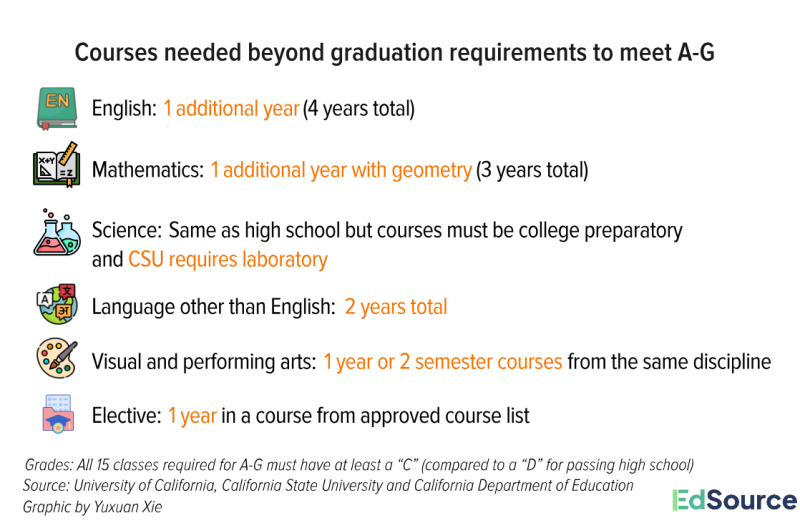
But to attend a UC or CSU requires that a student takes 15 courses in seven areas: history, English, math, science, foreign language, arts and an elective. Each category has its own letter, A-G, which is where the requirements get their name.
These courses overlap with high school requirements, but they are also more rigorous. For instance, three years of English are required to graduate from high school, while A-G eligibility requires four years. Only one of those years can include English as a Second Language or English Language Development — courses that English learners are often enrolled in.
Low grades are a common way students fall off the A-G track. A “D” is considered a passing grade for a high school diploma, but A-G classes require at least a “C” to count as eligible.
The state, instead, has offered carrots for districts working on improving poor A-G rates, especially those that have a large marginalized student population, such as those who are low-income, English learners, homeless or have a disability. In 2021–22, the state set aside over $547 million for the A-G Completion Improvement Grant Program. The state has also pushed dual enrollment and career technical education to the high school curriculum, both of which can help students meet their A-G requirements.
Progress has been slow. The number of students who have met A-G requirements statewide has ticked up just shy of four points over the last six years.
Understanding why any given student may or may not meet A-G requirements requires examining what is happening in a particular region or district, as well as disparities within schools.
“The answer is that it is all of that,” Reed said. “No one factor accounts for it.”
Some students said that graduating without meeting A-G requirements sent them the message that they were not college material.
Brock Wooster-Mills, 20, said he felt “doomed to fail” as a student with a disability attending Liberty High School in Bakersfield, where 49% of students do not meet A-G requirements.
Partial hearing loss had affected Wooster-Mills’ ability to speak and follow lessons in elementary school. But even when his hearing improved, his counselors in the Kern High School District wouldn’t allow him to transfer into required A-G courses such as French and geometry.