Episode transcript
Olivia Allen-Price: This is Bay Curious. I’m Olivia Allen-Price.
Have you ever paused a moment, to fully take in a redwood tree? Stared up at its towering trunk. Cupping around a single ridge of its massive bark. Inhaling that warm, woody, slightly sweet scent…
Bay Curious listener Christy Dundon has.
Christy Dundon: Back when I was in high school, just a long time ago, I worked for the Alameda Recreation and Park Department and we had a day camp and we would take kids up to the Redwood Regional Park.
Olivia Allen-Price: The redwoods in the park now are mostly younger, second-growth redwoods – but there are signs left of the old growth redwoods that once stood.
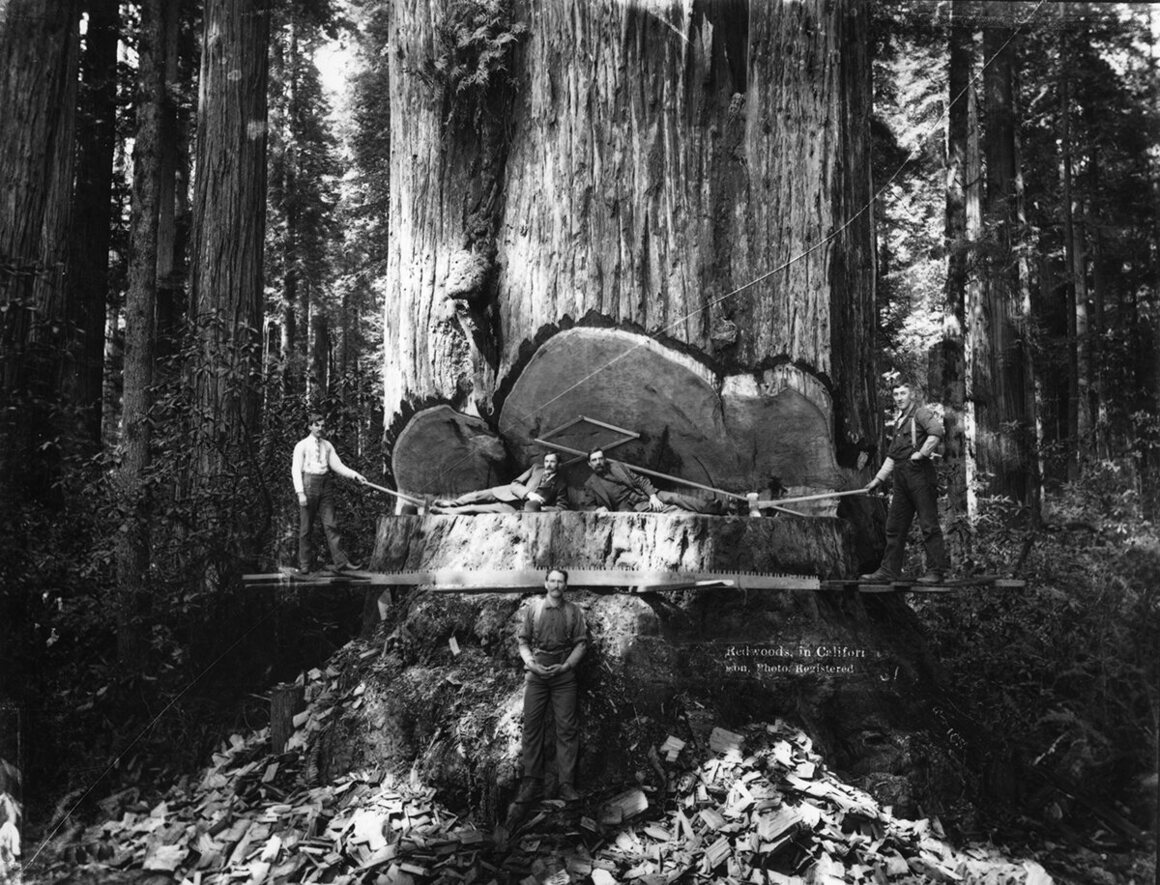
Christy Dundon: I remember showing them the stumps that were there, which were pretty big with usually trees in a circle around them … sometimes I’d have them lie down and it was, you know, its diameter was wider than they are tall.
Olivia Allen-Price: Seeing these stumps got Christy wondering about when these trees were cut down and why. And also how many redwood forests once stood in the Bay Area.
Christy Dundon: I would love to know how extensive it was, what, I mean, did they just somebody got the idea this is where we’re going to get our lumber, and then how much was actually cut down.
Olivia Allen-Price: For this story on old growth redwoods, we called up an old friend, Daniel Potter. Hi, Daniel!
Daniel Potter: Olivia, hi!
Olivia Allen-Price: Daniel has done a few stories for us on natural history and trees… And he even wrote a bit on redwoods for the Bay Curious book. (which, ahem, is still available wherever books are sold.) So Daniel, redwoods. They come in a few varieties.
Daniel Potter: Right. They’re a phenomenon almost exclusive to California. By that I mean there are three species—a somewhat shorter one from central China—and then the two familiar to Californians. Inland, we have the massive Sierra redwoods, also known as giant sequoias, and the kind we’ll be focusing on today, which is actually even taller.
Olivia Allen-Price: That’s the coast redwood, or the one a lot of folks just call… redwoods.
Daniel Potter: The scientific name is Sequoia sempervirens. These trees can grow taller than the Statue of Liberty, including the pedestal and torch. Taller than a football field is long. And they can live around 2,000 years.
Olivia Allen-Price: And true to their name, you tend to find them along the coast, in the fog belt, from Monterey County up to around the Oregon border.
Daniel Potter: One of my favorite Bay Area spots for wow’ing out-of-towners with them has always been Muir Woods, in Marin County. That’s one of the few places in the region where people left old redwoods standing in the last few centuries.
Olivia Allen-Price: So there were once more?
Daniel Potter: So many more! Logging of the redwoods started long before the Gold Rush, in the time of Spanish settlers and Russian traders… but the Gold Rush really kicked it into high gear. For 19th-century people building a city like San Francisco in a hurry, old redwood was ideal. In his book Trees in Paradise, historian Jared Farmer writes “it was easy to work with, hard to wreck. No other lumber matched its combination of lightness, evenness, and durability.”
Olivia Allen-Price: In addition to the stumps Christy saw, you also see little hints of this logging history around. ..Like down on the Peninsula, where you’ll find ‘Redwood City.’
Daniel Potter: Yes! Sawyers would cut down redwoods on the east side of the Santa Cruz mountains, and use the port there to float that wood up toward a growing San Francisco. In his book, Farmer writes “by the mid 1850s, San Francisco had exhausted the easy-to-reach redwood, including pocket stands in the Berkeley Hills.” Loggers then worked their way north up the coast.
Olivia Allen-Price: Okay, let’s fast forward to after the 1906 earthquake and fire. The city is devastated, people need to rebuild, concrete and steel aren’t yet ubiquitous for construction. What happens?
Daniel Potter: People cut down even more trees. They constructed tens of thousands of buildings in the decade after the quake, almost all of them with wood frames. Redwood was the rule—literally. Officials believed using redwood had kept the fire from being even worse, so afterward, builders had to get a permit to use anything else. The demand was epic, on the order of hundreds of millions of square feet, an inch thick.
Olivia Allen-Price: So our question-asker wanted some sense of what was lost here. And it sounds like… a lot.
Daniel Potter: Yeah, exactly how much depends a little on whether you’re just counting the heavy stands of redwoods, like the awesome cathedral stands up toward the North Coast, or also the spots where they’re more mixed in with other trees. But ballpark, before the Gold Rush, there were 1 or 2 million acres of old growth redwood forests, whereas now we’re down to less than 100 thousand acres. So even by a conservative estimate, we’ve lost about 90% of what once was.
Olivia Allen-Price: 90%! And most of it now makes up the skeleton of San Francisco?
Daniel Potter: Yeah, it’s a weird way to think about it, isn’t it?
Olivia Allen-Price: Well… on the bright side, at least there’s still some standing for us to visit.
Daniel Potter: Yeah! My wife and I did the iconic California road trip for our honeymoon a few years ago, and visiting the redwoods up along the Avenue of the Giants was sublime.
Olivia Allen-Price: Mm! Daniel Potter… Longtime friend of the show, now making a podcast called Bug Note about the wiggly, wild, weird world of bugs. Find it on YouTube. Daniel – thank you as always.
Daniel Potter: Olivia, a pleasure as always.
Olivia Allen-Price: When we return a deep dive on what makes Coast Redwoods so special, and how they’re fairing in the age of climate change. Stay with us.
Sponsor Message
Olivia Allen-Price: We have received a bevy of listener questions about redwoods over the years. One came from Julie Menter. She and her husband moved into a house in Oakland in 2017. There were lots of things they loved about their new home, but especially the three big redwood trees in the backyard.
Julie Menter: It feels like it’s a really big part of the identity to me of the city of Oakland. Like if you look at the hills and the trees…being able to go in nature while being in a city feels really important to me for my mental health and balance.
Olivia Allen-Price: Last year, Julie started to worry about the trees. One of them had lost almost all of its leaves and, despite watering it, it wasn’t bouncing back. It had to come down.
Julie Menter: It’s so sad. And I think it’s sad both for the tree because, you know, they’re such beautiful trees, they’re so old and majestic. But also scary to be like, “Whoa, this tree is not doing well, the one next to it isn’t, the ones in my neighborhood don’t seem to be doing well.”
Olivia Allen-Price: Julie’s noticed not just in her backyard, but all around Oakland, redwood trees don’t look so good. Around her neighborhood… off highways… really all over the East Bay, Julie has noticed the trees looking dry and scraggly.
Julie Menter: So I’m wondering, is something happening to the redwood trees in the Bay Area? And if so, what is it and is there anything we can do about it?
Olivia Allen-Price: For this next story, we’re spending more time with California’s state tree: the coast redwood. We’ll dig into why it’s unique to this area, what makes it so special and also how it’s adapting to challenges like climate change and urbanization.
KQED’s Dana Cronin takes it from here.
Sound of walking through a forest
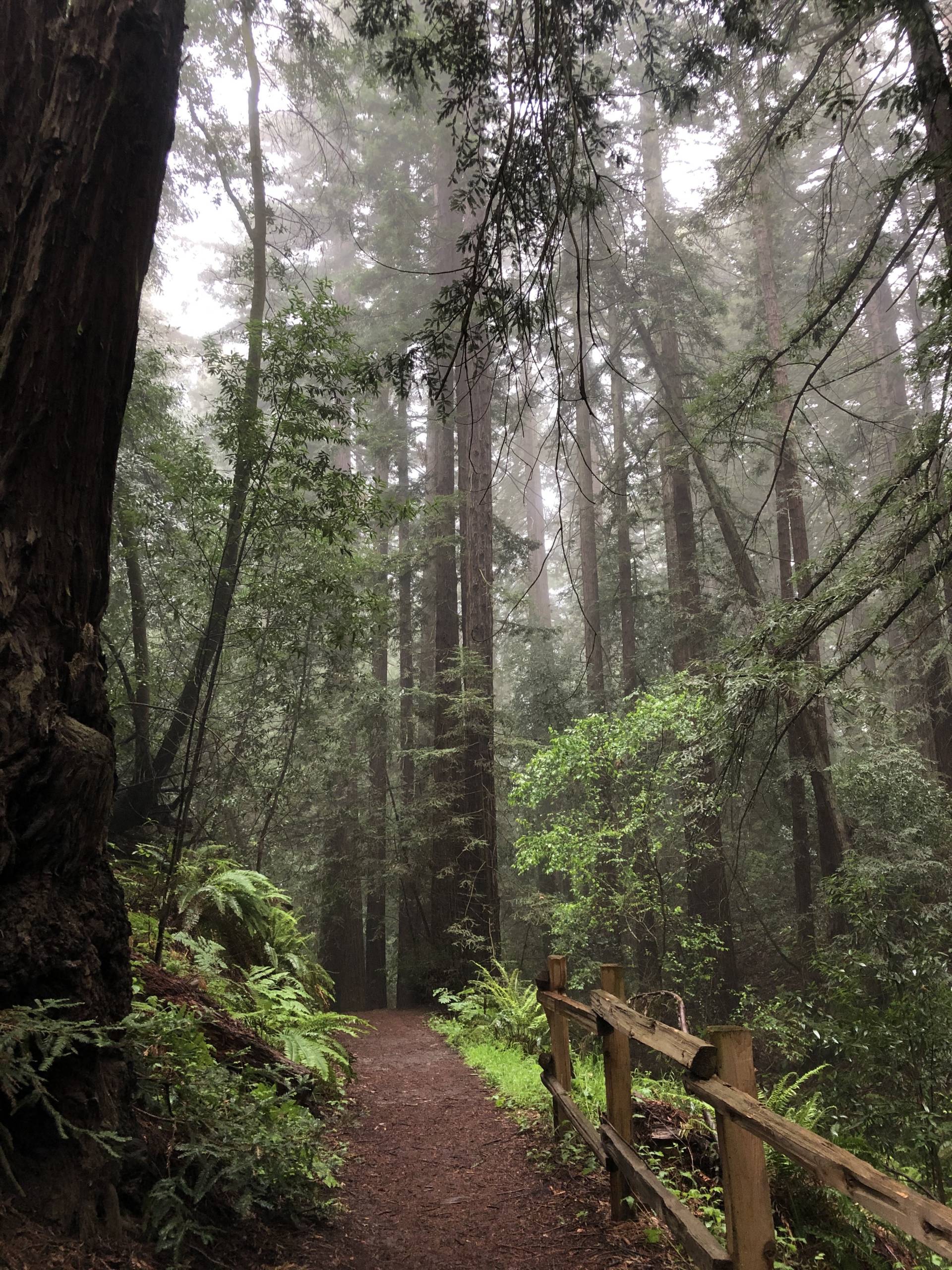
Dana Cronin: There’s a really special feeling I get every time I walk through a redwood forest. My mind goes quiet, the only audible sound coming from the crunch of my footsteps. The temperature is always perfect; even on the hottest day, it’s still cool among the trees. And the smell.
Dana Cronin (in scene): It smells so good. There’s just no, like, even just stepping outside of my car in the parking lot, I was like (breathes in, breathes out) It’s just so good.
Dana Cronin: I’m in the middle of the Roberts Redwood Recreational forest in the Oakland hills… hiking with Deborah Ziertan, who works for Save the Redwoods League. She’s gonna help me teach you all about redwood trees and why they’re unique to our region. Then, later on, we’ll get to the heart of Julie’s question … what’s happening to them? And just a note – for this episode we’ll mostly focus on coastal redwoods, which grow no more than 50 miles from the coastline. Now, Deborah grew up here in Oakland and visited these redwoods frequently as a kid.
Deborah Ziertan: I don’t think I fully appreciated the redwoods until I went away to school and then came back as an adult. And this was the place that I would hike to clear my head. And these were the forests that I came to. And so it is a very special place for me here.
Dana Cronin: Deborah has now dedicated her life to these trees. She’s an educator with Save the Redwoods League. Her job is to teach school-aged kids about them.
Sounds of children in a forest
Deborah Ziertan: Good morning students!
Students: Good morning.
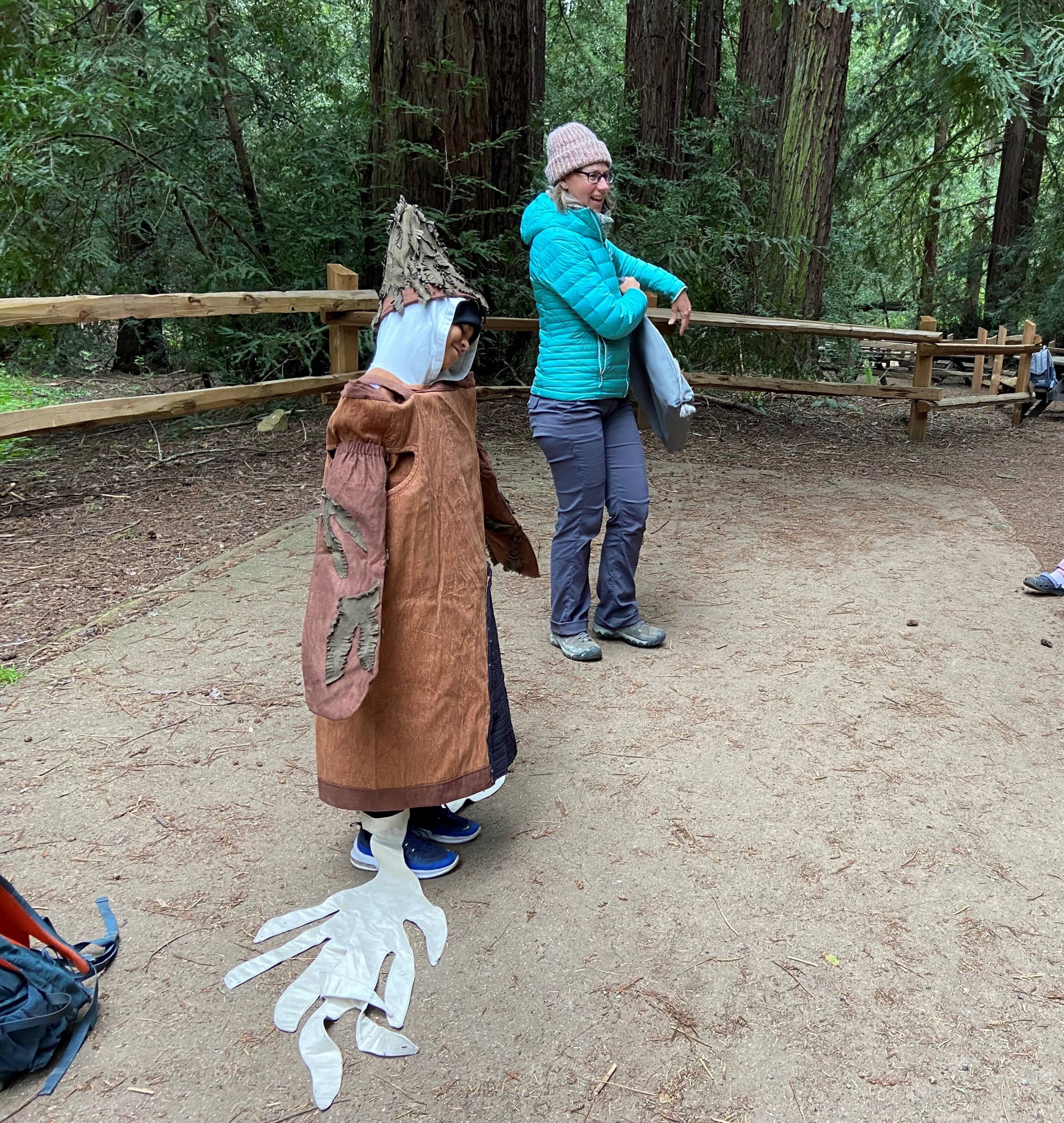
Dana Cronin: I tagged along recently with Deborah, as she guided about thirty fifth graders from a local elementary school through the Reinhardt Redwood Regional Park. The students are spread out across three wooden picnic tables, fidgeting in their seats.
Deborah Ziertan:Can I have everyone’s eyes up here? Ok. Will everyone look up and take a look? We are in a little redwood grove. So these are all redwood trees.
Dana Cronin: After setting a few ground rules… no touching plants… be quiet while others are talking… Miss Deborah — as they call her — launches into the lesson.
Deborah Ziertan: Do you know anything about redwood trees at all? Raise your hand if you know anything about redwoods.
Dana Cronin: A student’s hand shoots up.
Deborah Ziertan: Yes. They are really tall. They are. Redwoods are the tallest tree in the whole entire world.
Dana Cronin: Redwood trees can grow more than 300 feet tall. That’s taller than a 30-story skyscraper. And not only are they the tallest tree in the world, they’re also among the biggest. Their trucks can grow nearly 30 feet wide. So, how are they able to get so big?
Deborah Ziertan: So everyone do this with your arms. It’s okay if you kind of lightly touch your neighbors.
Dana Cronin: Deborah holds her arms out straight to the sides, like a scarecrow.
Deborah Ziertan: One of the things that makes redwoods so unique is that they actually hold hands with their roots underneath the ground, and that’s how they’re able to grow to be so tall and not fall down is that they help each other.
Dana Cronin: Redwood roots are shallow and extend outward instead of down. Their roots extend out almost as far as the tree is tall … and they essentially hold each other up. In addition to being really big… redwoods can also live a very long time… like more than 2,000 years. That means some coastal redwoods today were alive during the Roman Empire. Those old-growth redwoods, which now only account for 5 percent of all redwood trees, can store more carbon than any other forest on the planet.
Deborah Ziertan: So we are pretty lucky to have redwood trees here in Oakland. And people travel from all over the world to come and see redwood trees.
Magical sounding music
Dana Cronin: Redwood trees also have unique ways of reproducing. They produce seeds, like any other tree, but they can also sprout new trees from their roots.
Deborah Ziertan: So often redwood trees, you will find them in circles that we call fairy rings. Because if a parent tree gets hurt or injured, it will send out these baby sprouts into these circles. And it’s kind of like a little family growing.
Dana Cronin: They’re basically clones of their parents. That’s why you rarely see redwood trees standing alone, and more often see them together in a circle formation.
Dana Cronin: Deborah tells the students we can learn a lot from redwood trees. They exist in communities and rely on each other for support. They have hard exteriors that protect them from things like wildfires, but they’re soft on the inside. Deborah says… they’re not so different from us.
Music ends
Dana Cronin: The earliest redwood trees existed more than 200 million years ago… alongside dinosaurs in the Jurassic period. Their natural range has shrunk a lot in that time… now they mostly stretch up and down the northern California coast… as far north as the Oregon border and down to about Big Sur.
Dana Cronin: Their distribution tracks with another iconic California phenomenon… coastal fog. So, in the summer months, when there’s a lack of rainfall, redwood trees essentially drink the fog.
Deborah Ziertan: It’s almost like a sponge sucking in that water. And then when their needles get full, also like a sponge, any of that excess water will drip to the ground. And it’s almost as if they’re creating their own rain.
Dana Cronin: And they’ve adapted to this region in other ways, too. They’re highly adapted to fire. Take the 2020 CZU Lightning Complex fire, for example, which burned through most of Big Basin Redwoods near Santa Cruz. Three years later, that forest is green again… and the old-growth redwood trees there are still standing strong.
Dana Cronin: Redwoods also survived a period of severe logging in the late 18-hundreds when, after the Gold Rush, San Francisco was booming and timber was in high demand. Many trees didn’t survive, though. In fact, most of the trees now living in the Oakland hills are ones that have grown since that period of logging… young, by redwoods standards.
Dana Cronin: Luckily, a movement was underway to protect redwood forests. Save the Redwoods League… where Deborah works… was founded in 1918… and helped to accelerate the preservation of redwood trees across Northern California.
Deborah Ziertan: People started to see the value in recreation and see the value in these trees not as lumber, but for health and wellness and for preservation purposes.
Music in
Dana Cronin: But now they’re facing new challenges. As our question-asker Julie noticed… Redwood trees in the Bay Area are struggling.
Todd Dawson: If you walk and you look up now, in most urban areas, I think everybody can pretty much see that, you know, there’s some tops that are dying back. There’s a lot of, you know, brown foliage in the crowns of these trees.
Dana Cronin: That’s Todd Dawson. He’s an environmental scientist and professor at UC Berkeley and has been studying redwood trees for decades. We met up on a foggy morning at the UC Berkeley campus… home to many unhealthy-looking redwood trees.
Todd Dawson: See the thinning crowns of the one right out there in the distance?
Dana Cronin (in scene): Yeah.
Todd Dawson: There you go. And you just see that over and over and over, repeated in so many places.
Dana Cronin: Todd says trees are suffering all over the Bay Area… even up through Santa Rosa.
Dana Cronin: And, there are two main reasons for that suffering. Let’s take them one at a time.
Music ends
Dana Cronin: The first reason is urbanization. The Bay Area has gone through a drastic transformation over the last century…
Todd Dawson: And with all the concrete and all the pollution that’s associated with urban sprawl, the trees are suffering.
Dana Cronin: That’s mostly because sidewalks and roadways are impinging on redwoods’ root systems. Remember how their roots extend out really wide?
Todd Dawson: Here we are standing ten feet away from a redwood tree on a concrete sidewalk. And we’ve set concrete on top of a big part of the root system. And so it’s really going to have a very, very negative impact on the ability of that tree to get the water it needs, get the nutrients it needs.
Dana Cronin: We’re basically suffocating them. And on top of that, we have reason number two… climate change… which is impacting redwood trees in different ways. That fog that redwoods drink in, well, it turns out it’s on the decline. In fact, since the 1950’s it’s declined about 30% during the summertime… when redwoods really need it.
Dana Cronin: That decline, coupled with periods of severe drought in California, is putting a lot of stress on the trees. Especially Giant Sequoias… another type of redwood that mostly lives in the Sierra Nevada. Thousands of trees there have died due to a lack of water.
Todd Dawson: The water deficit itself didn’t really kill all those trees. It weakened them in a way where other pests and pathogens got in there and basically wiped them out like beetles, fungi, other things like that.
Dana Cronin: In addition to a lack of water… more intense fires are also impacting those trees. Although they have adapted to fire over the centuries… they can’t handle the extreme fires we’re seeing now caused by climate change and bad forest management.
Dana Cronin: All in all, Todd says redwood forests are struggling along their perimeters. As the wildland-urban interface stretches further and further into the wild… redwood trees are increasingly exposed to human impacts. They’re losing their buffer.
Todd Dawson: I think that’s the future, is we’re going to see a patchier world. And that’s really disappointing and concerning for me because, you know, we sit at the heart of that. Humans are really the ones that are in control and are having the negative impacts that we now see.
Dana Cronin: Now, I think we’ve answered most of Julie’s questions… except for one. What can we do about it? Todd has a couple thoughts on that. First, Julie, regarding your backyard redwood trees… Todd says you can try watering them…. But…
Todd Dawson: The trees require so much water. They also require pretty special microclimates, meaning that they like it cooler. They like these moist, foggy summers like we’re seeing today. You know, And I think you can’t really recreate those conditions as a person. Right.
Dana Cronin: Unfortunately, he says, irrigation is a band-aid solution at best. Because the problems redwood trees are facing now are much more systemic. And that’s how we need to think about solutions, Todd says.
Dana Cronin: One of those solutions is to protect redwood forests by getting them in the hands of governments and nonprofits… like Deborah’s Save the Redwoods League. Todd says that work is critical to ensuring the trees’ survival here in Northern California.
Whimsical music begins
Todd Dawson: The forests are just so special, these big cathedrals with these amazing and gigantic trees that there’s just nothing like that. And I think anybody who’s ever walked through a forest for the first time just is in awe of what a special place and what a special feel it has. And so I’m really concerned about them and I want to keep working with them and I’d love to see those forests protected, you know, in perpetuity.
Dana Cronin: Protecting them now means securing their existence for our kids, grandkids… and maybe even humans two THOUSAND years from now.
Olivia Allen-Price: That was KQED’s Dana Cronin.
Bay Curious is made in San Francisco at KQED. We are a member-supported public media station and we really need your help. Give today at KQED.org/donate.
Bay Curious is produced by Katrina Schwartz, Christopher Beale and me, Olivia Allen-Price. Extra support from Maha Sanad, Katie Sprenger, Jen Chien, Ethan Toven-Lindsey and everyone on Team KQED.
Some members of the KQED podcast team are represented by The Screen Actors Guild, American Federation of Television and Radio Artists, San Francisco Northern California Local.