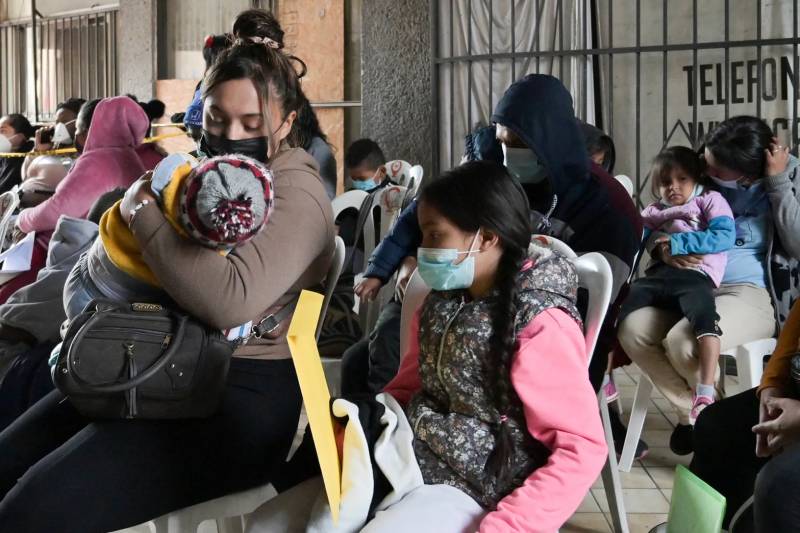
The Supreme Court’s latest move allows a short-term reprieve to an anticipated increase in asylum seekers trying to cross from Mexico into California and other states, but recent confusion at the border is a preview of what may soon come should a pandemic-era measure known as Title 42 be lifted in 2023.
The situation, and its use as a political backdrop, has prompted local officials to ask what state resources will be available next year with California facing a potential budget shortfall and the possibility that Title 42 will end.
Title 42 is a Trump-era immigration policy that has continued under President Joe Biden. It allows border agents to rapidly expel migrants at official ports of entry during public health emergencies. The policy has resulted in the expulsion of tens of thousands of people seeking asylum and has discouraged many others from crossing the border.
The policy states that if the U.S. surgeon general determines there is a communicable disease in another country, health officials have the authority, with the approval of the president, to prohibit “the introduction of persons and property from such countries or places” for as long as health officials determine that action is necessary.
The measure had been set to lift last week by order of a federal court, which would have allowed many asylum-seekers waiting in limbo at the border to go ahead and cross into the United States. Some experts say that because smugglers in Mexico use any shift in U.S. immigration policy to exploit migrants, mere conversation about the possibility of lifting Title 42 triggered even more people to try to cross into the U.S. in recent weeks.
The Supreme Court’s brief order (PDF) Tuesday stayed — meaning delayed — the trial judge’s ruling that would have lifted Title 42 until the high court hears arguments in the case in February. The political and legal ping-pong in the case is hard enough for U.S. audiences to follow, making it nearly impossible to explain south of the border.
The Supreme Court’s order is a response to a request filed by 19 Republican-led states that they be heard in the case. It does not overrule the lower court’s decision that Title 42 is illegal; it merely leaves the measure in place while the legal challenges play out in court.
The federal court order that was supposed to lift Title 42 came as a result of a lawsuit brought by the American Civil Liberties Union on behalf of asylum-seeking families. Asylum is a protection codified in international law for foreign nationals who meet the legal definition of “refugee.” The United Nations 1951 Convention and 1967 Protocol define refugees as people unable or unwilling to return to their home country, and who cannot obtain protection in that country, due to past persecution or a well-founded fear of being persecuted in the future “on account of race, religion, nationality, membership in a particular social group, or political opinion.” Congress incorporated this definition into U.S. immigration law in the Refugee Act of 1980.
For those stuck in Mexico because of Title 42, waiting can be perilous. Human Rights First has documented more than 13,000 attacks on asylum seekers waiting in Mexico during the Biden administration.
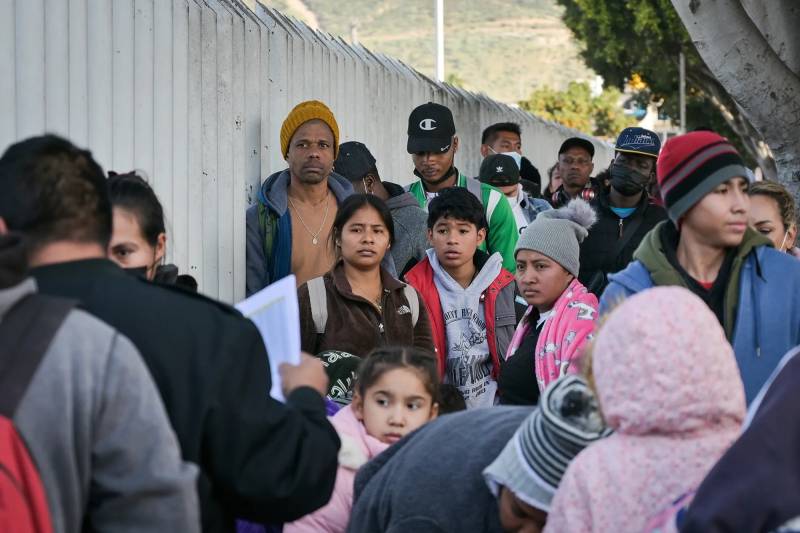
Because it takes time for news of shifts in U.S. immigration policy to reach areas in rural Mexico and Central America, the numbers of migrants arriving in Tijuana and San Diego this week in anticipation of the end of Title 42 could be elevated right now — and it may take some time before those numbers drop-off as news travels, experts said. Migration numbers typically increase through the first half of the year before dropping off in the summer.
San Diego County Supervisor Joel Anderson, a former Republican state senator, was among a group of political leaders who recently complained that the state and federal governments have not provided the funds local leaders have requested to handle the expected influx of asylum seekers and other migrants.
“We’re not even talking about whether these are good policies or not,” he said. “But whatever the policy is, we become the targets of it. We’re willing to step up, but they have to step up, too, by giving us the resources we need to deal with it.”
He joined several local Republican and Democratic leaders in San Diego in urging in letters and news conferences that the state and the feds should provide more support ahead of the expected end of Title 42.
Local officials pointed to needing more funding for schools, hospitals, and police services, among other resources, if Title 42 eventually lifts. The near constant legal back-and-forth has also provided a convenient conversation starter for politicians wanting to debate larger immigration policy issues.
“With the state budget projecting a $25 billion deficit, I’d like to know what the plan is for our schools and to help lift all of our students,” said Andrew Hayes, board president of the Lakeside school district in rural eastern San Diego. Hayes said increases in immigration causes strains to the local educational systems because students fleeing persecution in other countries often have increased mental health needs and sometimes require special instruction.
San Diego County Supervisors Nathan Fletcher and Nora Vargas, both Democrats, wrote to Alejandro Mayorkas, the U.S. homeland security secretary, on December 19, also requesting federal resources and “a comprehensive plan to ensure humane entry into the United States for those seeking asylum into our country.”
“When Title 42 is lifted, we will need additional resources and personnel on the ground to process and arrange for the onward travel of asylum seekers to their final destination,” they wrote. ”We will also need the federal government to set up temporary shelters on federal property to ensure access to needed social and health services. Our hospitals, our public health department, our social services, and our homeless service providers are already at maximum capacity serving vulnerable residents in San Diego.”
El Cajon not ‘the governor’s neighborhood’
Title 42 policy’s end “will likely increase” migration flows, the Department of Homeland Security officially said last week.
The burden will unfairly fall on a few border cities, Anderson said.
“They’re not talking about releasing people into Sacramento or putting people in the governor’s neighborhood,” said Anderson. “No, they’re talking about releasing people right here in El Cajon, where the median household income is just over $58,000 per year.”
Gov. Gavin Newsom’s office responded that the state has done what it can to support local jurisdictions.