Thousands of dead fish have washed up on shores across the Bay Area in recent weeks. A red tide is killing everything from anchovies to sharks. Preventing a similar disaster may cost the region billions of dollars.
In late July, Mary Spicer noticed that the water lapping around her kayak started to turn red. A few weeks later it was dark brown.
“All of a sudden … you could no longer see through the water,” said Spicer, who paddles several times a week on San Francisco Bay. She says she has never seen a red tide or algal bloom like this year’s.
“None of the marine people I know — the rowers, the paddlers, the sailors — are comfortable with what’s happening right now.”
The National Oceanic and Atmospheric Administration describes red tides as a “harmful algal bloom,” or large colonies of algae plants growing out of control that are sometimes rust-colored. Not all algal blooms are harmful, and most are beneficial in the ocean. However, a small percentage of algae can produce deadly blooms.
The species likely leading to the mass fish death is Heterosigma akashiwo, which SF Baykeeper, the San Francisco Estuary Institute and the Aquatic Science Center have been tracking since it appeared in the last month.Jon Rosenfield, senior scientist with environmental group SF Baykeeper, says Heterosigma may be killing fish in two ways: It can produce a toxin that is deadly to fish, but it can also result in low dissolved oxygen levels in the water, which can be deadly.
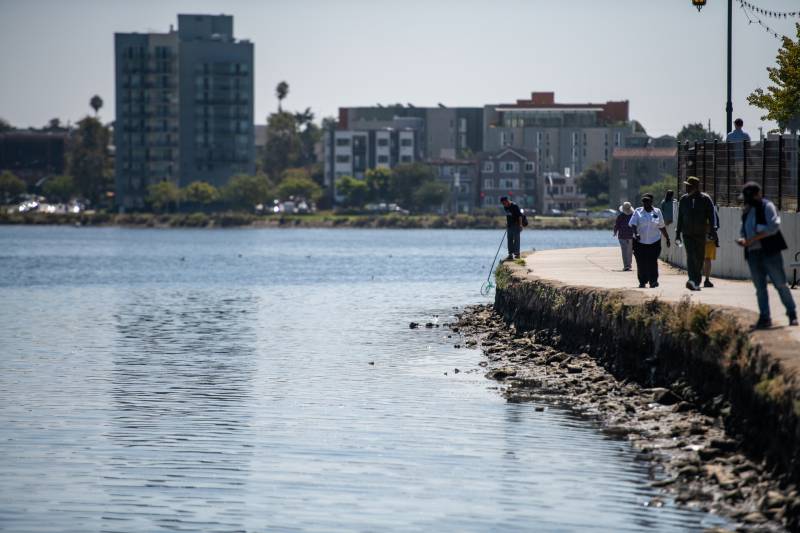
On an estuary that connects the Bay to Lake Merritt a few miles inland in Oakland, a group of people stare wide-eyed from the shore. Sabrina Wicker plugs her nose.
“I thought it was like leaves or something … but those are all fish of different sizes floating dead,” says Wicker as she looks down at the sandy beach below her feet where a web of twisted, tiny, dead fish lie.
Headlines about muddy waters and decaying fish are bad for tourism as well.
Rufus Jeffris of the Bay Area Council, a business-sponsored public policy organization, says fishermen report they’ve had guests cancel charter fishing trips. But Jeffris says the full brunt of financial impacts may not be known for many months.
“It might be a reason not to rent a kayak out of Sausalito and tool along the waterfront,” says Jeffris. “It might be a reason not to visit the waterfront, you know, near Emeryville or in Oakland. How widespread, how deep that is? Hard to tell.”
Scientists say red tides are more likely to occur as the climate warms. The red tide is probably driven by a combination of warmer water temperatures resulting from climate change and high nutrient levels in the water.
“Unfortunately, we have not seen an algae bloom of this particular species, of this magnitude, in San Francisco Bay ever before that we know of,” says Eileen White, executive officer for the San Francisco Bay Regional Water Board.
Part of the problem comes from how sewage is processed in treatment plants, allowing nitrogen and phosphorus to be discharged — nutrients algae love to eat.