As Big Basin Finally Reopens, Indigenous Stewardship Key Among Plans for Park's Rebirth
Big Basin Redwoods State Park finally gets a limited reopening this week, nearly two years after a devastating wildfire. Appeals for renewed forms of Indigenous stewardship are part of its rebirth.
he ancient trees of Big Basin Redwoods State Park, deep in the Santa Cruz mountains, are some of the tallest living things on the planet. A quarter of a million visitors from around the world usually visit this place every year — that was, until August 2020, when the massive CZU Lightning Complex wildfire ripped through the forest, scorching 97% of the park’s 22,500 acres and forcing its closure to the public.
In the nearly two years since, Big Basin has been the site of a mammoth cleanup and recovery operation. And now, a limited reopening of the park will finally take place this week — starting Friday, July 22, the public can once more walk under some of these towering old-growth redwoods.
But safely reopening even a small section of the park is no mean feat, even after 23 months of intense recovery work and preparation. And those tasked with reopening Big Basin’s gates must navigate often-complex, intertwining needs, from Indigenous tribal partners working to regain meaningful access to ancestral lands, to park visitors eager to hike and bike under the big trees again.
And against a backdrop of California’s new wildfire reality, the park’s reopening provides a look at how, after such destruction, a place like Big Basin could seize the chance for a truly different kind of rebirth.
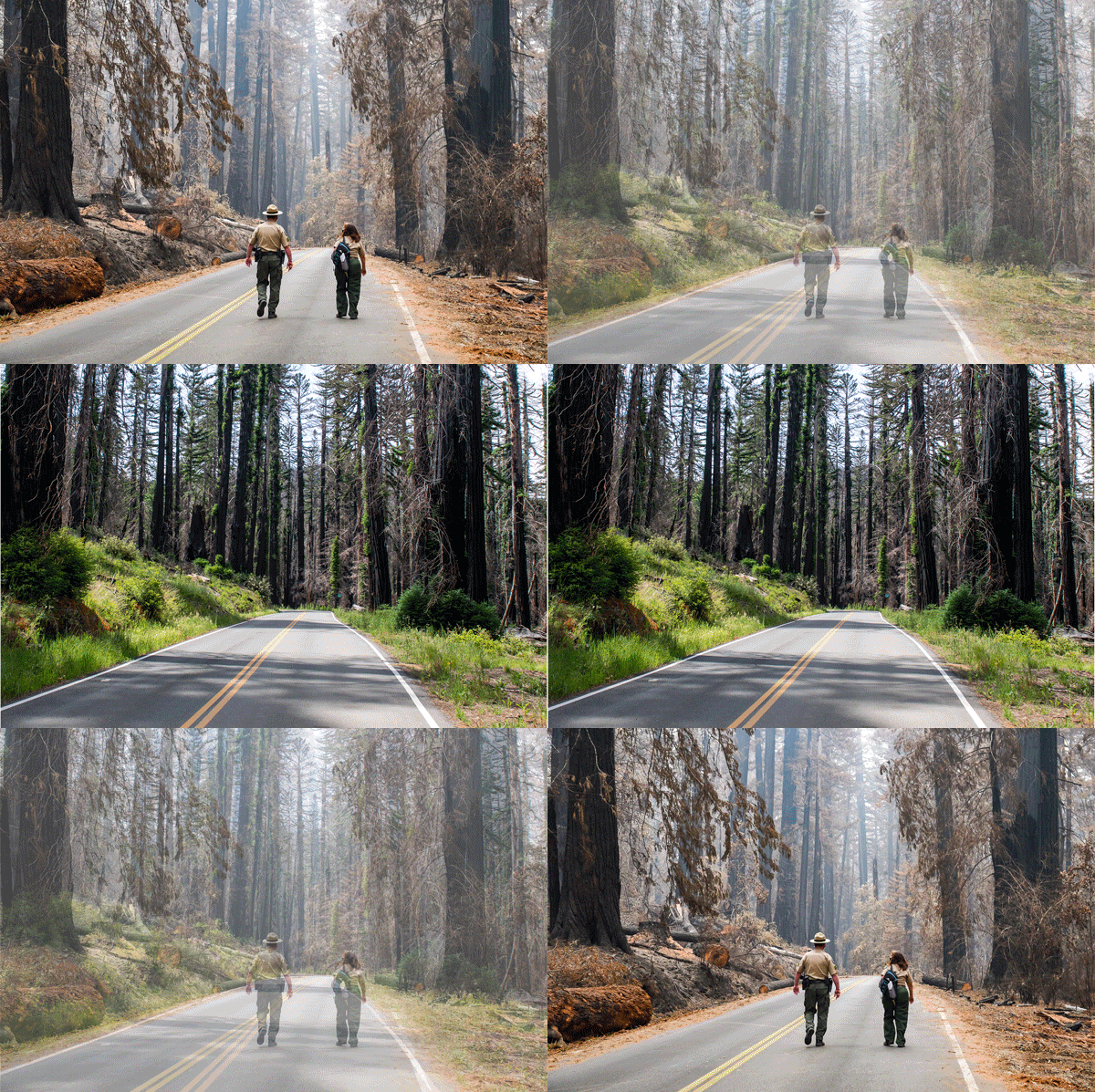
A before-and-after GIF showing the same road in Big Basin in September 2020, after the CZU Lightning Complex Fire, and in May 2022. (Beth LaBerge/KQED)
A reopened park
Ahead of the July 22 limited reopening, the resolute, repeated message from park officials is that visiting Big Basin will be different than before.
One of the biggest changes to the visitor experience is the introduction of a day-use reservation system for parking. There’ll be no parking available within Big Basin without a reservation, and no possibility of overnight stays.
Forty-five spaces per day, for $8 each, will become available up to 60 days in advance, with a limited number of additional reservations released three days before. No day-of, drive-up entry will be available, and parks officials warn reservations will almost certainly fill up several weeks in advance. (Make a day-use reservation for Big Basin, and see the schedule of available parking spots at Big Basin.)
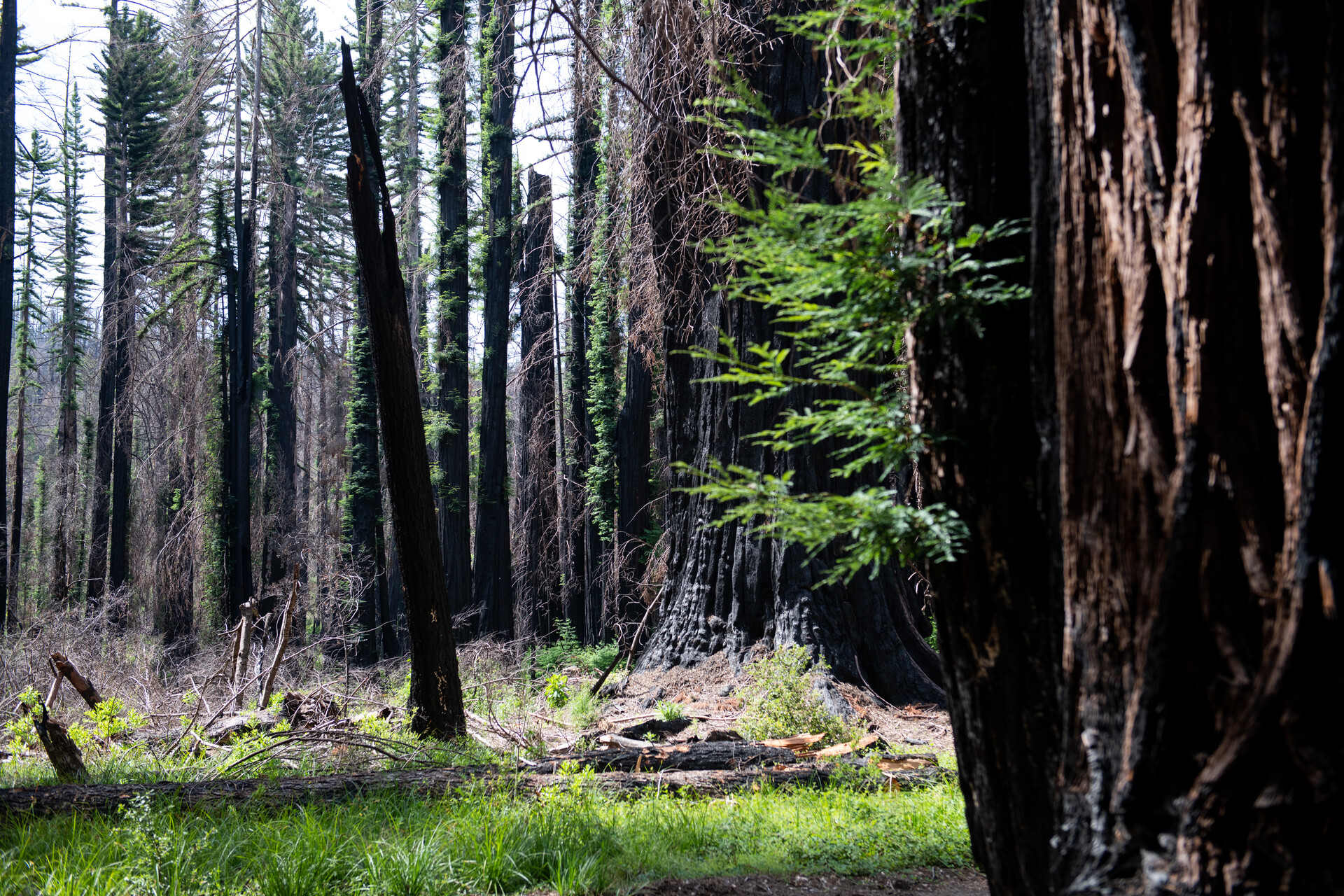
New growth emerges at Big Basin Redwoods State Park on May 26, 2022. (Beth LaBerge/KQED)
Another major change is the amount of the park that’ll be accessible to visitors. The majority of this vast space will remain closed to the public, owing to the innumerable hazards that fire-damaged trees and infrastructure still pose throughout the park. This means visitors will only be able to explore a small amount of Big Basin, including the Redwood Loop trail and access to about 18 miles of fire roads near the historic park core. Bikes will be allowed on some of these fire roads.
The reopening of Big Basin also brings the reopening of Highway 236, which runs through the park. Even without a day-use reservation, motorists may once again use the highway to travel through the park. Although you won’t be able to stop or park anywhere along the way, it’s a way to get a glimpse of Big Basin and see the forest’s recovery.
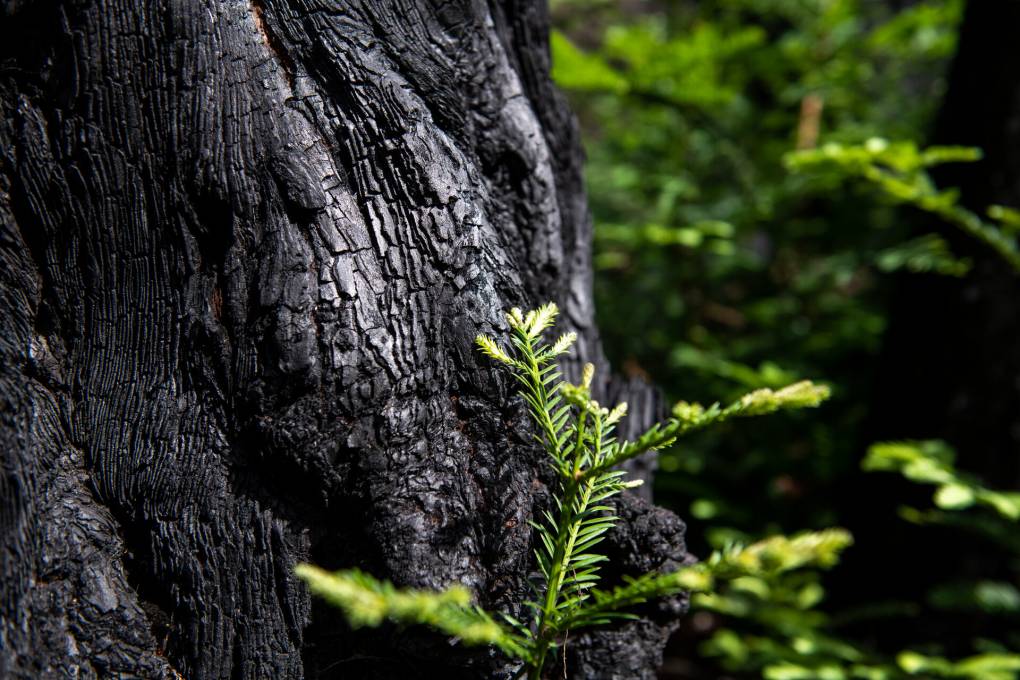
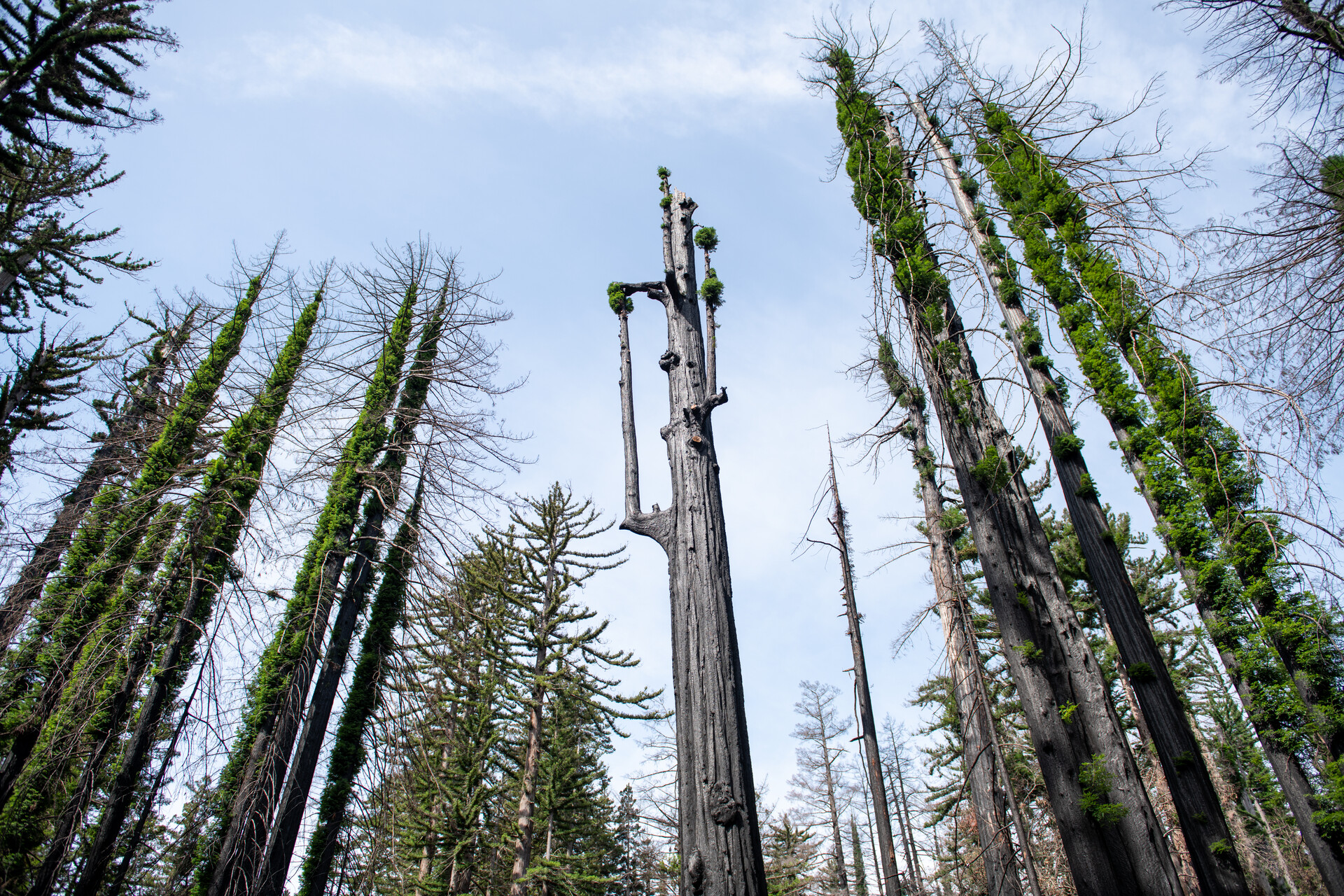
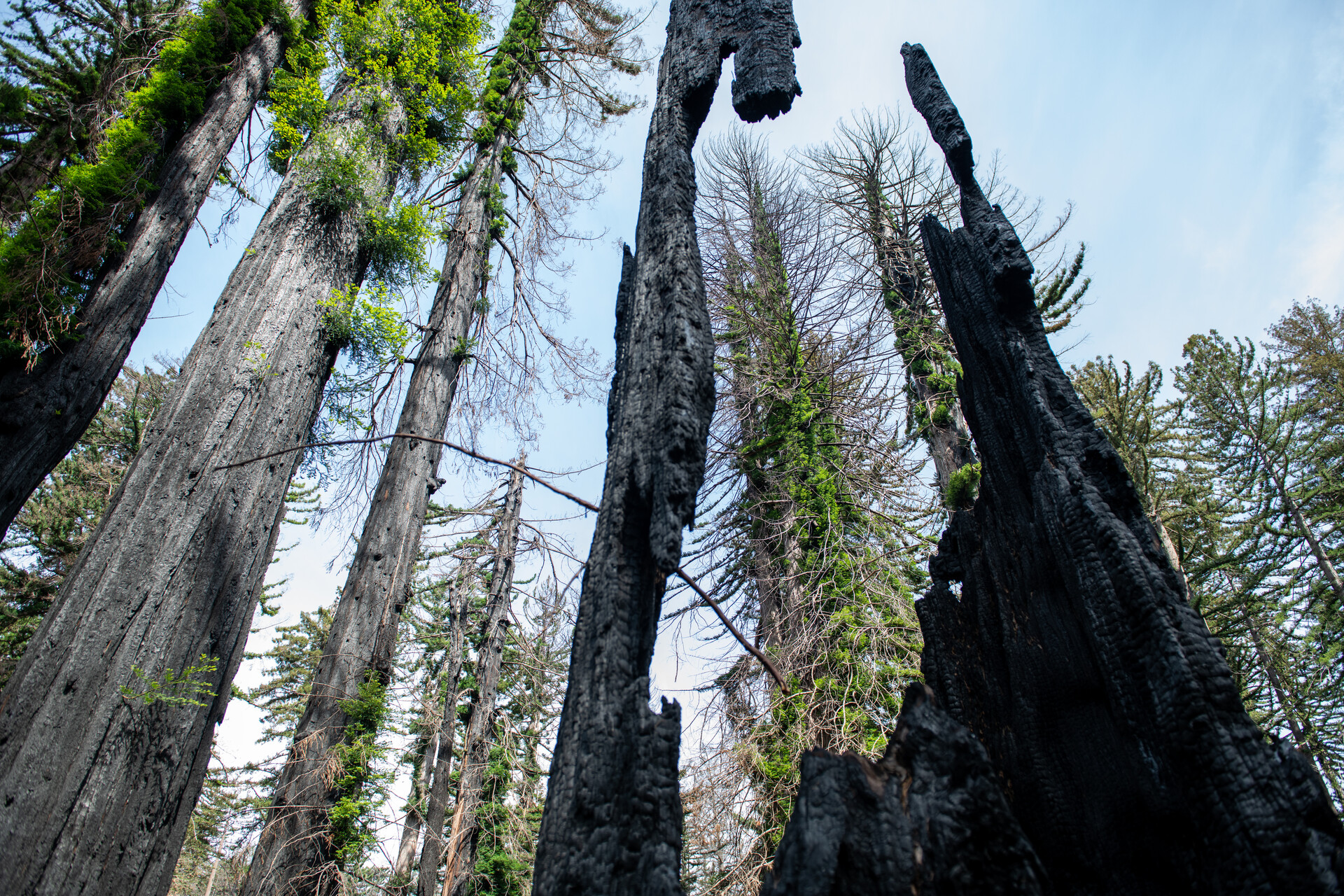
Driving into the park for the first time since the fire, it’s impossible not to be struck by the charring on the trunks of these redwoods. But all around, sprouting from the jet-black trunks and branches is bright green regrowth — so vivid against the black of the burns that it looks like the work of a camera filter.
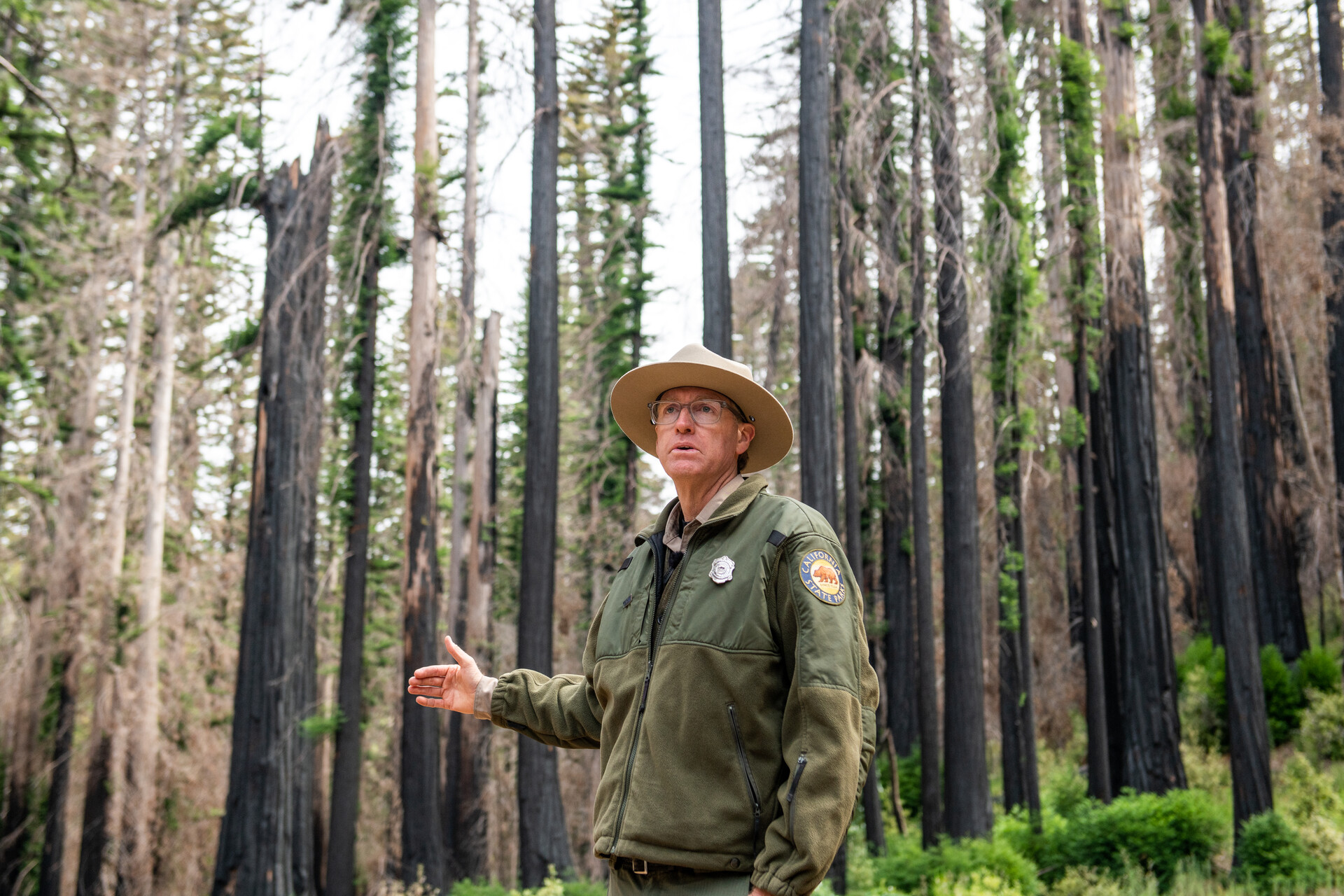
“Most of the redwoods have survived,” says California State Parks Santa Cruz District Superintendent Chris Spohrer, adding that this regeneration is “a remarkable thing that redwoods can do.”
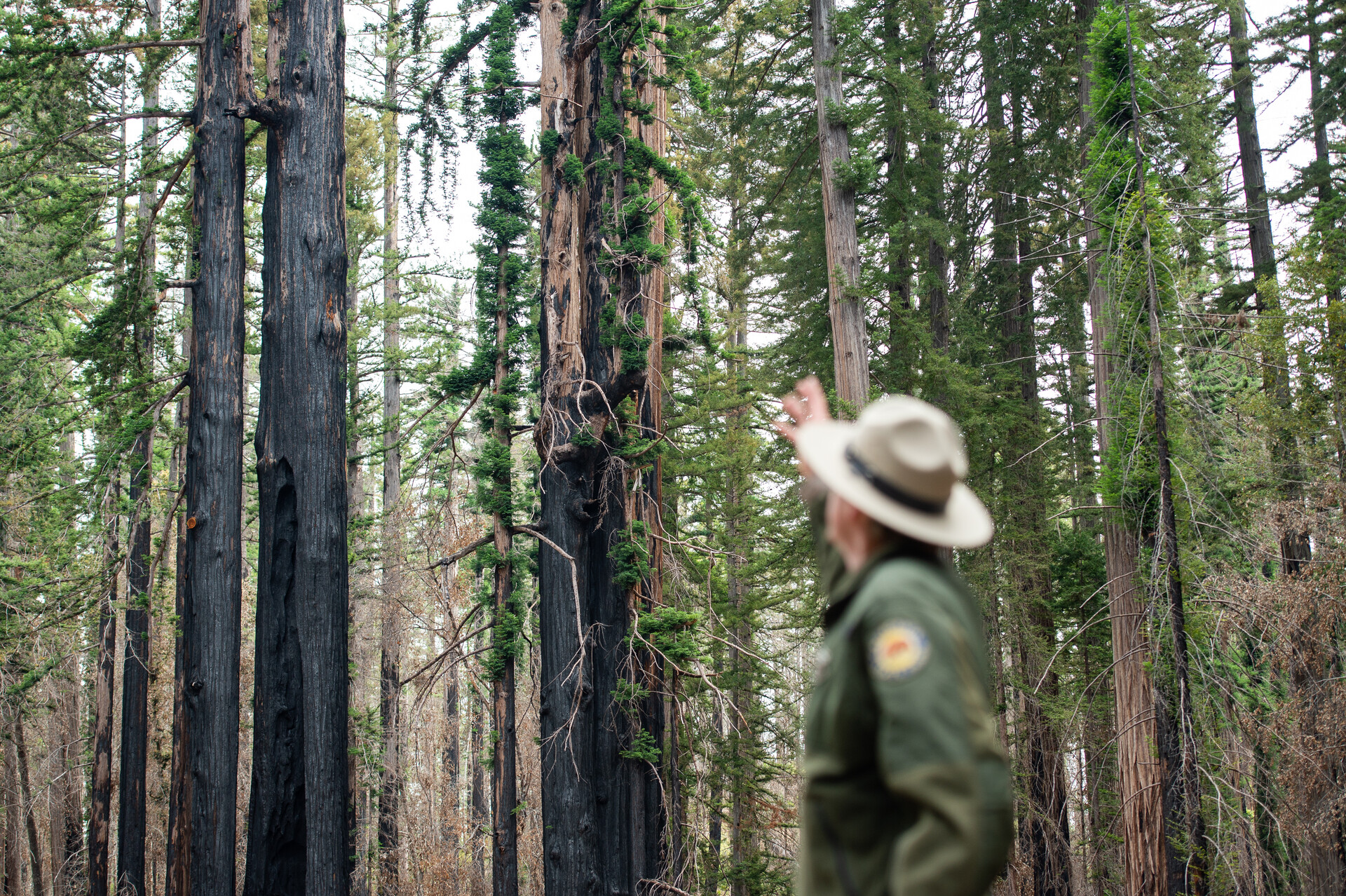
Chris Spohrer, state parks superintendent in the Santa Cruz area, stands in front of burned redwood trees at Big Basin Redwoods State Park on May 26, 2022. (Beth LaBerge/KQED)
The few redwoods that did fall during the fire — or were so damaged and hazardous that they had to be removed afterward — are almost all being repurposed as lumber products throughout Big Basin: as decking on which visitors can walk, and as split-rail fencing.
The trees that didn’t survive the CZU fire were mainly Douglas firs, which lack the resilience to fire that redwoods have. But amid the dead firs, there’s regrowth all around in Big Basin. In the understory, the above-ground trunks of trees such as live oaks and madrones may be visibly dead, but their bases are sprouting and regenerating from their roots.
As a fire-follower shrub, ceanothus (also called California lilac) has come back “in abundance” across the forest floor — something Spohrer calls “part of the succession of the forest.”
The ongoing recovery and reopening of Big Basin is supported by a massive fundraising drive by the Sempervirens Fund — California’s oldest land trust, established in 1900.
Founded by a handful of redwoods enthusiasts in the Santa Cruz mountains, the Sempervirens Fund was responsible for lobbying for the creation of Big Basin itself in 1902, making it California’s very first state park.
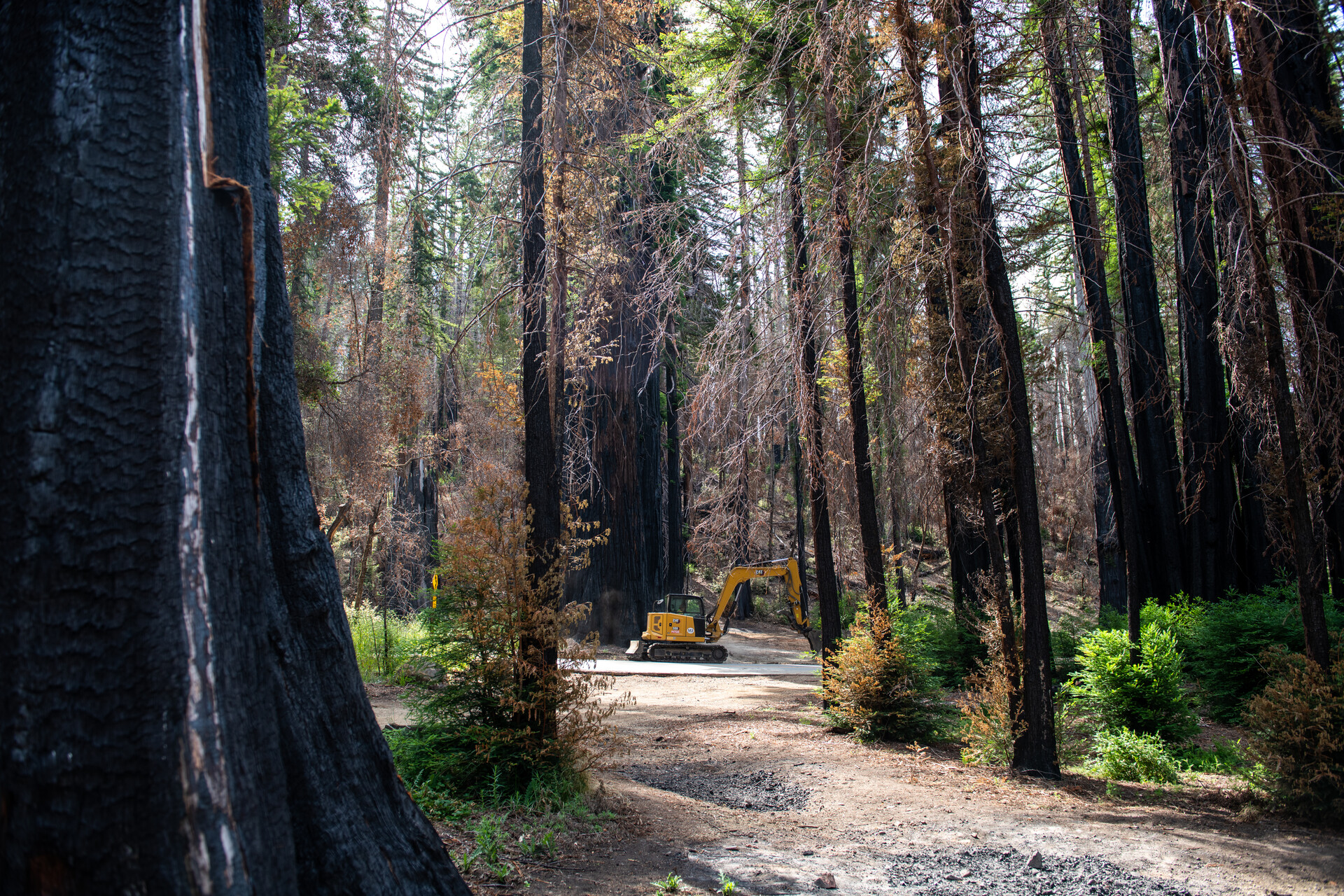
A construction crew works near the former headquarters at Big Basin Redwoods State Park on May 26, 2022. (Beth LaBerge/KQED)
Sara Barth, Sempervirens’ executive director, knows that for those people who loved visiting Big Basin, that first trip back might be emotional — and also jarring to see how the place they remembered has changed.
“They’re going to see these charred trunks,” says Barth, but “please remember that most of those trees are very much alive, and this is part of a natural process.
Related Article
“It’s really hard to kill a redwood — really hard. And that’s a great thing. It’s why they live thousands and thousands of years.
“These forests are meant to burn. And in some ways the fire has been, for much of the forest, a very good thing. And so while it’s tremendously sad that the way you remembered it is not the way it’s going to be, the future is bright for this forest. This is what nature wants — and needs — to happen.
“We have to surrender to the fact that we’re on nature’s timeline, and take heart in the resilience and the greenery that you’re going to see when you’re here.”
Tribal partnership
Big Basin wants to be, as Spohrer puts it, “a model in the future of how you can manage old-growth redwood in the face of a changing climate.” But officials want to rebuild the park in other ways — and they make frequent reference to the deep collaboration between California State Parks and Big Basin’s tribal partners.
The CZU fire, and the reimagining of Big Basin it forced, has been “an opportunity to get back to the table, to think about the entirety of a park plan and have our tribal partners with us during that time,” says Spohrer, with “a real focus on active stewardship.”
New growth can be seen through a burned redwood tree at Big Basin Redwoods State Park on May 26, 2022. (Beth LaBerge/KQED)
The Amah Mutsun’s traditional territory encompasses some or all of what are called San Benito, Monterey, Santa Cruz, Santa Clara and San Mateo counties today. And Big Basin itself is in the traditional tribal territory of the Awaswas people, explains Valentin Lopez, Chairman of the Amah Mutsun Tribal Band.
There are no living survivors of the Awaswas people. It’s for that reason, says Lopez, that the Amah Mutsun “feel that it’s very important that we ensure that their lands are spoken for. That the Awaswas ancestors are remembered and never forgotten. And that’s why we work here.”
In 2013, the Amah Mutsun formally established their Land Trust, a vehicle by which the tribal band pursues the conservation and restoration of Indigenous resources — both natural and cultural — within these traditional territories, to steward these lands and restore historic ecological practices. (The Amah Mutsun Land Trust was also supported and sponsored in its genesis by the Sempervirens Fund.)
It’s this same ethos that Lopez and the Amah Mutsun want to bring to Big Basin, says Lopez: “to bring back the traditional ways of stewarding and managing these lands.”
Concrete ecological asks made by the Amah Mutsun include the management of tree volume.
Maximizing tree growth on land like this “does not make a healthy forest,” says Lopez, who is advocating to reduce the number of trees to increase sunlight on the forest floor: “That right there is really important to take care of the insects, the birds, the four-legged who depend on that landscape there for their foods, and their materials — for their survival.”
Related is the Amah Mutsun’s request to increase the amount of open meadow within the park, of the kind historically stewarded by Indigenous people there. Such open meadowland was “really important to ensure the biodiversity within the forest,” says Lopez.
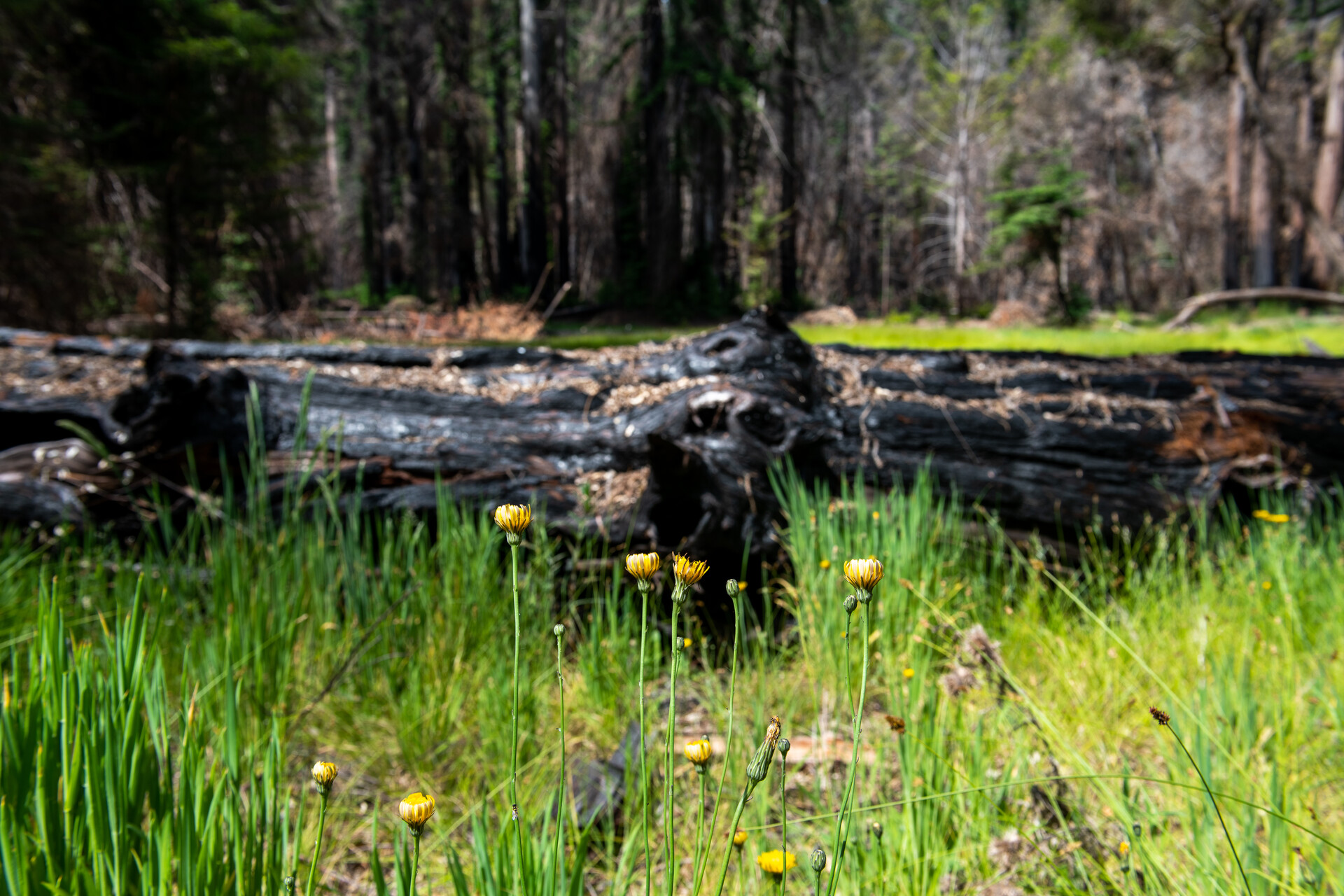
Already, Big Basin’s natural recovery after the CZU fire provides a glimpse of that sort of change: wildflowers in bloom, like violets, recently carpeted areas of the forest floor. These are “things that you wouldn’t necessarily have seen as much under the full canopy cover prior to the fire,” Spohrer says.
Rebuilding for wildfire
Big Basin lost numerous historic visitor buildings in the fire, many of which had been established deep within the forest, like the camp store and the nature museum. Now, a lesser-known area of Big Basin called Saddle Mountain — a place Spohrer calls “something that you kind of drove by on your way down into the headquarters” previously — will soon become the home of a new welcome base, with visitor services, parking and a shuttle to take people into the park.
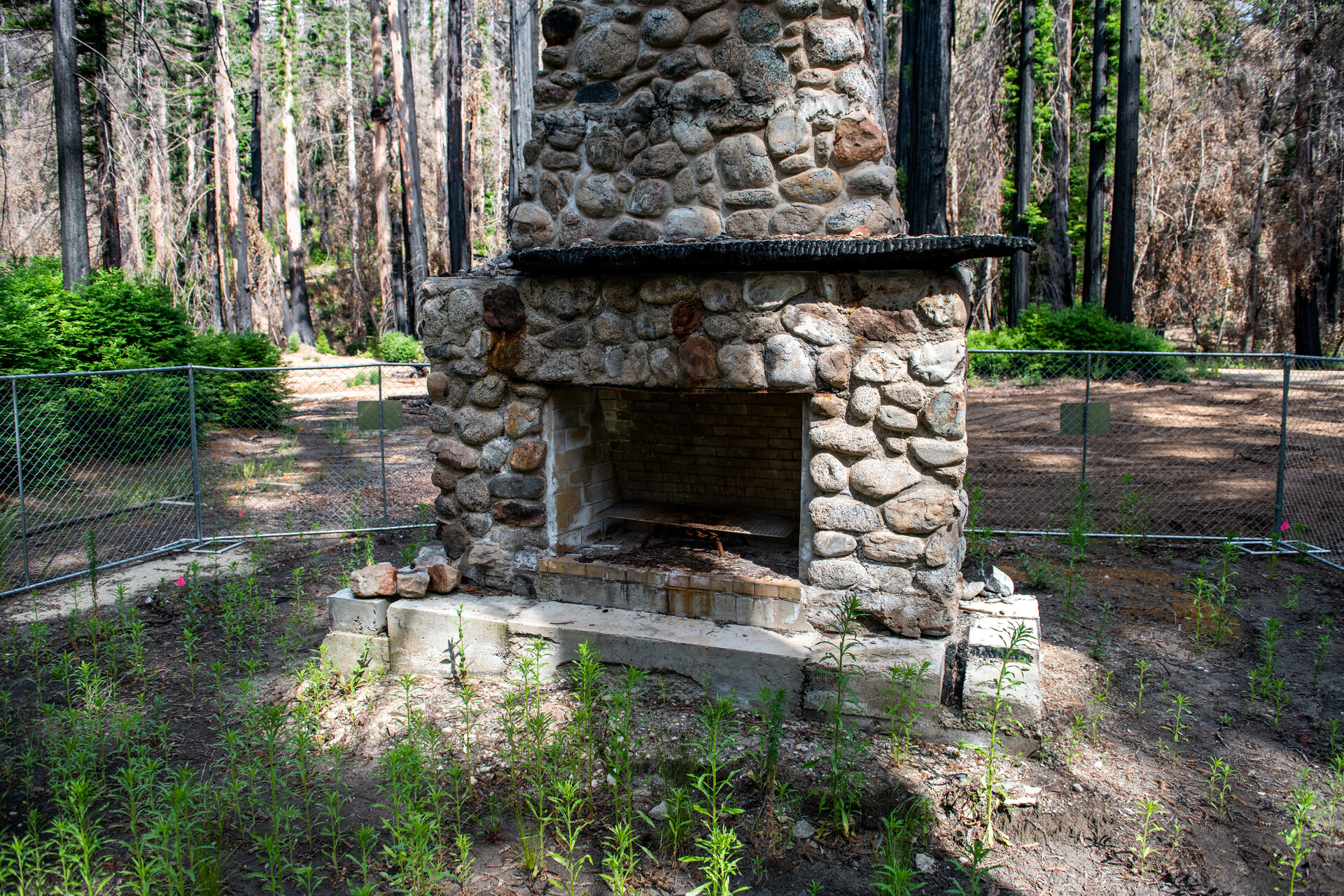
A stone fireplace and chimney remain from the Old Lodge at Big Basin Redwoods State Park on May 26, 2022. (Beth LaBerge/KQED)
Relocating that infrastructure to this new space isn’t just about making the most of a spot that was less harmed by the CZU fire. It’s about moving away from a parks model that places buildings in ancient old-growth redwoods.
There are several reasons for this shift at Big Basin. For visitors, the park’s decision not to rebuild the structures that burned among the redwoods in 2020 will “allow the ancient forests to be a place where people can have a really natural experience in that forest,” says Spohrer. Officials also don’t want to “reestablish structures in a place where it’s nearly impossible to defend them,” says Spohrer. “That is not something we want to repeat.”
Another reason for moving away from pairing old-growth trees with buildings is still visibly scorched onto the forest floor at Big Basin where those visitor structures once stood — namely, the ferocity with which human-made structures can burn. Not only is it “nearly impossible to protect structures in an environment like this,” says Spohrer, but several of the old-growth redwoods that stretched above those historic buildings were affected greatly by the intensity of the structure fires below them.
Amid the optimism of planning for Big Basin’s future is the ever-present need to safeguard against the next big fire. Prescribed burning is a large part of that conversation.
New growth emerges at Big Basin Redwoods State Park on May 26, 2022. (Beth LaBerge/KQED)
“For a healthy forest for future generations, we have to really consider the idea of expanding prescribed fire,” says Spohrer. “This park has had a long history of prescribed fire to protect and enhance old growth, but we have to upscale that and we have to think bigger.”
Before colonization, prescribed fire was a key part of Indigenous stewardship of California’s lands. Tribes held annual controlled burns to clear out underbrush and to encourage the new growth of plants in a managed way. When those Indigenous communities were forcibly removed from their lands by colonizers, who also banned religious ceremonies, this cultural burning was severely throttled. Both California and federal authorities instead pursued a policy of swiftly extinguishing wildfires — an approach that is only just beginning to be reversed.
Most recently, a history of prescribed fire around Yosemite National Park’s iconic Mariposa Grove — a group of giant, ancient sequoias in the park — has been hailed as an instrumental force in defending those trees against the Washburn Fire. Prescribed burns reduced forest fuels in the area, and permitted the fire to move through the grove without inflicting damage on the sequoias themselves.
This need for “good fire” has affected every aspect of the Big Basin redesign, Spohrer says: “By being selective and thoughtful about where we place infrastructure, whether it’s buildings or it’s trails or anything that’s the built environment, we can set ourselves up for the ability to do successful prescribed burning in this area.”
‘Restoring the sacredness to the ground’
“I think when you come into this park now as it is even today [post-fire], you can start to experience what this forest felt like prior to when it started being more developed,” says Spohrer, who calls this “a significant change” that’s “been influenced by our tribal partners.”
But this kind of physical evolution isn’t just about changing the way Big Basin looks and feels for the general public visitor base. For Lopez, it’s also about being clear on the kind of unique, special access and presence that the Amah Mutsun want, and need.
For Lopez, meaningful access to Big Basin for the region’s Indigenous people is key — not temporary stints, or brief allowances in the forest, but the kind of physical and spiritual presence that deepens connection to the land. And the active stewardship that Big Basin officials speak about starts, “first and foremost,” he says, “with restoring the sacredness to the ground.”
One aspect of this access, Lopez says, is about enabling ceremony: designating a place to gather in the forest, a place to hold tribal meetings. There’s also discussion of what kind of physical buildings could be built at Big Basin for ceremonial purposes, such as a roundhouse that could be used “not just by the Amah Mutsun, but by multiple tribes,” says Lopez.
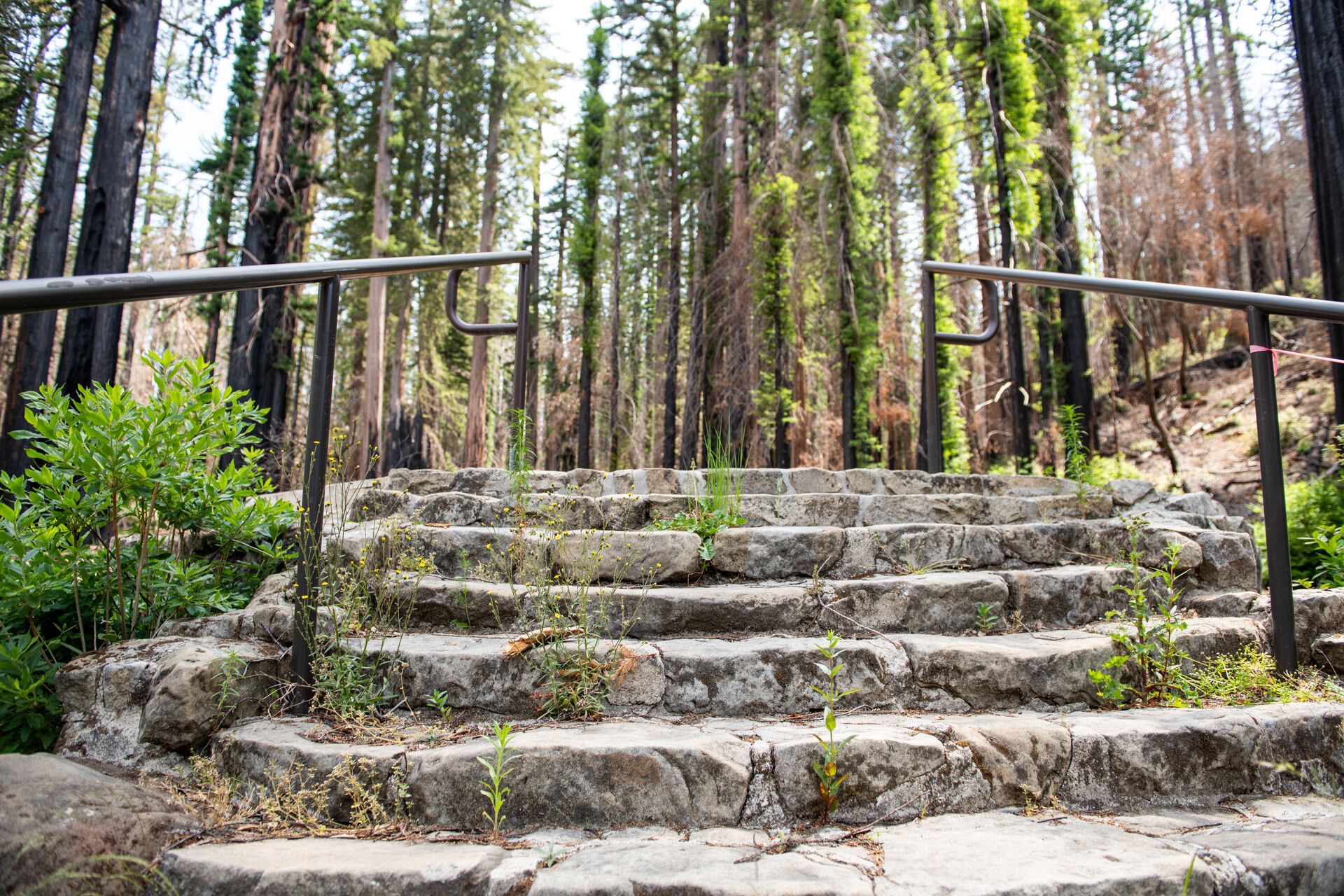
Steps lead to what once was the Headquarters Administration Building at Big Basin Redwoods State Park on May 26, 2022. (Beth LaBerge/KQED)
And just as with the Amah Mutsun’s Land Trust, research into the land and Indigenous practices once used there is a key concern for the tribal group when it comes to Big Basin — as is how such research requires physical access. The tribal band’s members want “to study how our ancestors stewarded and managed and lived in the forest,” explains Lopez. “What were their food sources? Where did they fish? What were their trade routes? What were the places of the rites of passage or coming-of-age ceremonies?”
Lopez is also keen to include concrete specifics in the conversations around Indigenous partnership in Big Basin’s future — the kinds of granular details that can often get left out of revisioning plans. He says the Amah Mutsun want to work with park officials to find a way for tribal members “that are stewarding Mother Earth and taking care of it in the traditional Indigenous ways” to be financially compensated for their work, rather than having to do it for free.
Lopez has spoken in previous years about how many of the Amah Mutsun Tribal Band can no longer afford to live in their ancestral territories, instead having to relocate to areas like the Central Valley. Noting that several tribal members would be “traveling from great distances” to do work in Big Basin, Lopez says, “This should be compensated at a fair rate that is equivalent to others who steward the lands as well, for other organizations.”
When it comes to conversations between California park authorities and tribal representatives, “we’re not shy,” says Lopez. “And that’s based on the relationship and the trust that we have so far.”
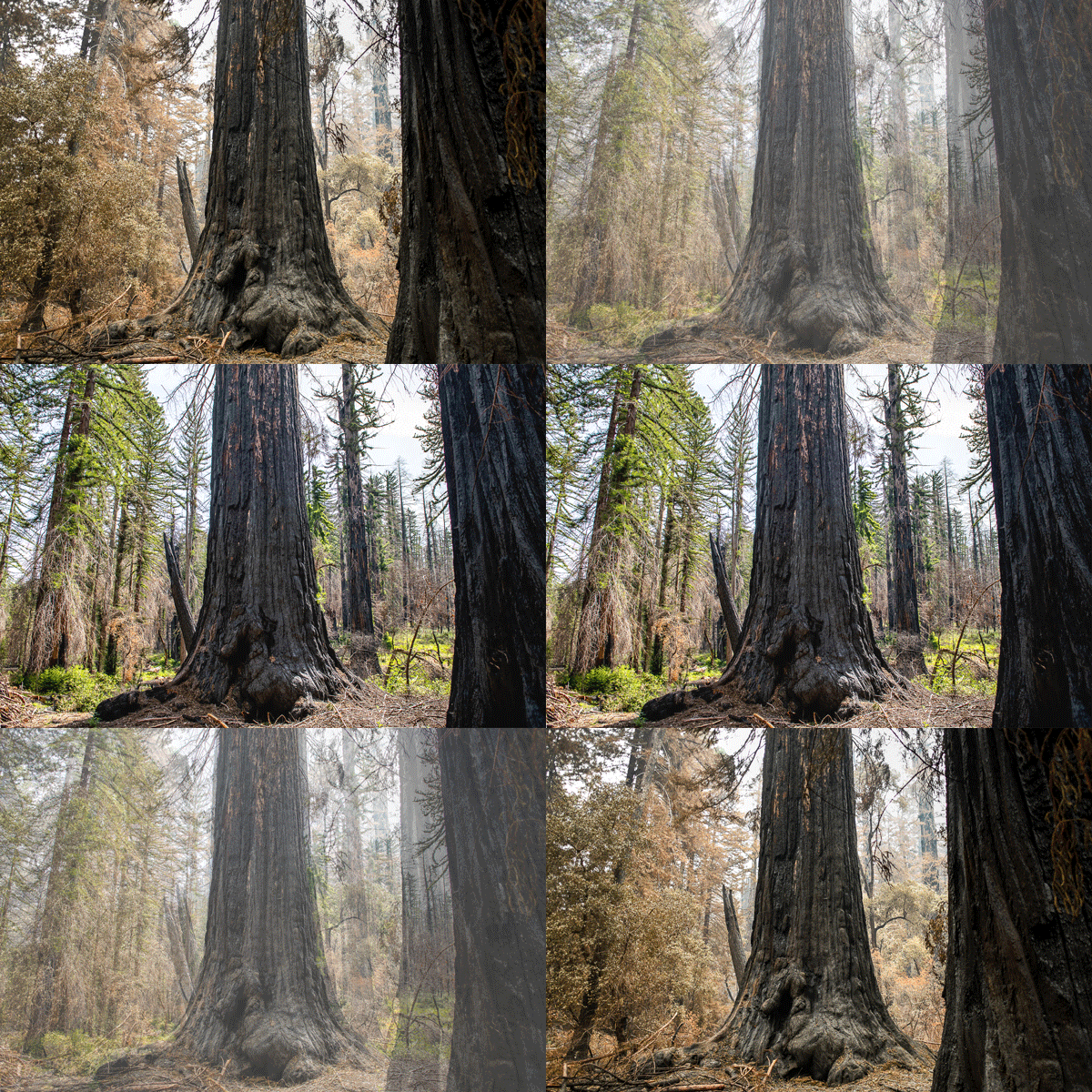
A before-and-after GIF showing the same redwood grove in Big Basin in September 2020, after the CZU Lightning Complex Fire, and in May 2022. (Beth LaBerge/KQED)
For the Amah Mutsun, meaningful access to Big Basin also means California State Parks acknowledging tribal members as being the ones with “decision-making authority on everything related to our culture,” says Lopez. Yes, the group could “ask to hold a ceremony” in Big Basin, he notes — and park officials could grant or deny that request. But this kind of formality around ceremonial gathering within the park — wherein the Amah Mutsun aren’t able to steer the process themselves, for what could potentially be multiday events — could then plunge tribal members into a world of event-planning bureaucracy, and a permit process that covers every aspect from crowd numbers and parking to trash cans and bathrooms, says Lopez.
“That’s not what we want. We want the tribal people to have those kinds of decision-making authorities,” he says. “And that’s the voice that we will be asking for.”
Truth telling
“Our creation stories of multiple tribes tell us a Creator gave us the responsibility to take care of Mother Earth and all living things,” says Lopez. “Because this responsibility was given to us by Creator, we are the only ones that have the moral authority — a moral obligation to take care of these lands. And so that’s what we want to do: We want to work with these lands to fulfill our obligation to the Awaswas, and to Creator.”
That moral obligation is one from which California’s Indigenous communities have been physically obstructed for several centuries. The Amah Mutsun’s work with Big Basin officials comes as many Indigenous communities across the United States continue to advocate for the landback movement, and for the return of lands to the Native stewardship they were forcibly wrested from. It’s a history and a context Lopez wants to make clear — because “within our territory, every inch of land was stolen from us — every inch of the counties that make up the greater Bay Area,” he says. “And all of California, for that matter.”
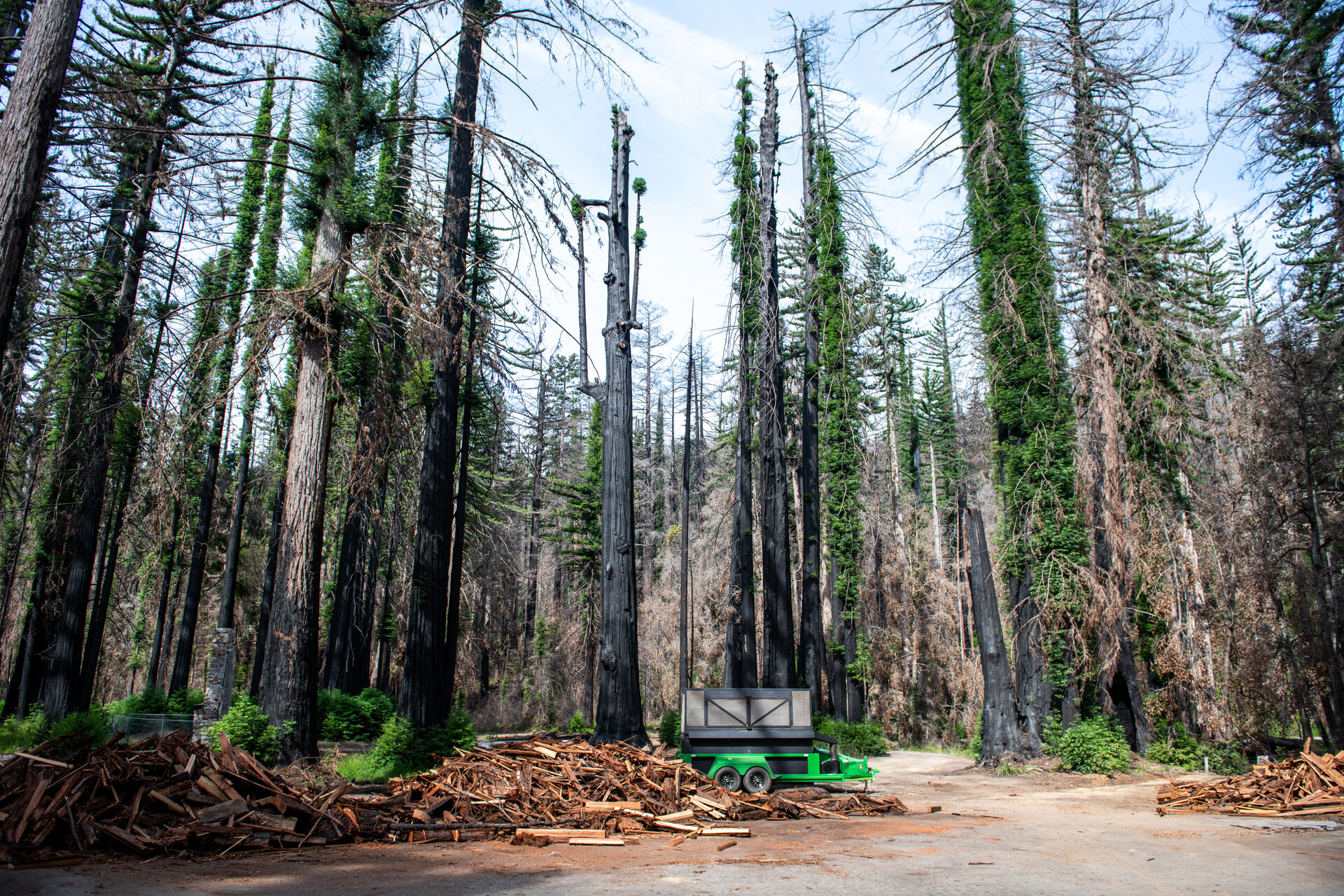
Piles of lumber sit near burned redwood trees with new growth at Big Basin Redwoods State Park on May 26, 2022. (Beth LaBerge/KQED)
While the tribal band has “a strong relationship with [California] State Parks” forged through steady progress and trust-building, Lopez says that “if we’re ever going to have a healthy relationship with the state of California, a healthy relationship with land trusts, open space districts, city/county parks, etc., they have to acknowledge and understand the history of our area — the true history, not the fabricated history, that’s told in schools and other institutions like state parks.”
Interpretation and documentation — that is, whose histories get told within a place like Big Basin, and whose voices are amplified — is a common theme from park authorities in discussions about the park’s future. “We’re trying to tell more inclusive stories,” says Spohrer, adding “there’s going to be … more focus on the history of stewardship here from Native people.”
“One of the things that we’ve really encouraged — and that I’m really pleased to see Parks embrace — is the idea that the interpretive elements here at Big Basin should touch upon every group of humanity that has touched this landscape,” says Barth, the Sempervirens Fund CEO. “And it’s a far more diverse story and diverse group of people than has traditionally been represented here.”
For Lopez, these corrective measures can’t come soon enough. Of California State Parks interpretation in general, “you read the history that’s on those boards or their interpretive signs and stuff like that — you know, the older ones, they don’t say a darn thing about Indigenous people,” he says.
“It’s kind of like the land was cleared and they just came in and claimed it, you know? And this was one of the most populated areas in North America.”
For Lopez and the Amah Mutsun, the deep wounds of California’s history of genocide and cultural erasure targeted at the state’s Native American communities make the need to return Big Basin in some way to Indigenous stewardship all the more urgent — for restitution, and for healing.
“There was a lot of brutality, an incredible amount of brutality. And that has to be acknowledged. And perpetrators such as the state of California, they have to acknowledge their responsibility for that violence,” says Lopez.
“They have to understand that for them to heal as a perpetrator, they need to respect the Indigenous people and they need to work with us to help us restore our culture. To restore our spirituality. To restore our environments. To restore our Indigenous knowledge. And to restore our identities and humanity.”
“We understand that it’s very difficult for non-Indigenous people to understand what we’re asking for, or what we need,” stresses Lopez. “Or to understand how to have a relationship with the tribe … But we appreciate them taking the time to try and understand — to listen, to learn. But for us to keep the conversations going, what we’re looking for is a healthy relationship.
“We cannot have a healthy relationship if they think that this land is theirs because they bought it.”
Looking to the future
The fact that two years on, the majority of the park will still remain inaccessible to the public upon reopening is a testament to the devastating nature of the CZU Lightning Complex Fire and the enormity of the task facing park authorities to make this land safe for the public again.
Spohrer says that, in the name of reopening Big Basin, park authorities continue to “focus on elements that we can do more quickly, along with opening up the trails.” For example, restoring the backcountry trails in the wilderness of Big Basin will be a far longer process, he warns.
“It’s been a long haul,” says Spohrer, “a tough climb out from a devastating fire.”
Another much-loved element of Big Basin lost to the 2020 fire were the four campgrounds. Spohrer says that officials’ “overarching principle” is to “try and retain the amount of camping recreation that we had in the park prior to the fire.” But he notes that of all the elements of Big Basin’s return, camping is one of the ones that will take the longest because of the sheer amount of infrastructure camping facilities demand — and that it’ll be several years until campers can return to the park.
For Big Basin staff, talk of rebuilding the campgrounds comes with particularly raw memories of the campground evacuation that took place when the flames of the CZU fire began to become visible on the horizon: “a flaming front,” as Spohrer puts it, that “moved extremely rapidly” toward the campers gathered below. That night in August 2020, the campgrounds were full with summer vacationers, who were all successfully evacuated from the park.
Chris Spohrer, state parks superintendent in the Santa Cruz area, stands in front of burned redwood trees at Big Basin Redwoods State Park on May 26, 2022. (Beth LaBerge/KQED)
“It was remarkable how quickly our staff was able to respond and to successfully get everybody out without loss of life,” says Spohrer. But those same staff who scrambled to evacuate campers lived close by, in park housing that had stood in Big Basin since the 1950s, and they had no time to go back and save their own possessions. Six of the seven homes burned to the ground, and “they and their families pretty much lost everything,” Spohrer says.
“Everybody in this region that was affected by the fire has been in a recovery mode,” he says. “It takes its toll for sure.”
In many ways, it’s possible to see Big Basin as the inaugural test case for how a beloved California land rebirths itself after fire. What choices will that land’s most recent stewards make — and whose voices and needs are brought to the table, perhaps for the first time? What could it look like to work with fire, not against it, and remake a place not for newness, but in the spirit of intentional return to older ways?
Tall grass and wildflowers grow in a meadow at Big Basin Redwoods State Park on May 26, 2022. (Beth LaBerge/KQED)
“We feel confident that we can find ways to reach agreements to allow Indigenous people to once again come back to these lands, and to take care of them in the traditional ways, and to restore sacredness to these grounds,” says Lopez. “And to have a voice in how Big Basin — and those lands of Big Basin — are managed and stewarded.”
“And it’s going to take time,” he says.
As California wildfires get bigger and hotter, and more national and state parks potentially lie in fire’s path, these are choices those places might have to make soon, too.
As Spohrer acknowledges, at Big Basin “we are — either fortunately, or unfortunately — getting to be the first to do that.”
lower waypointnext waypoint
Player sponsored by
window.__IS_SSR__=true
window.__INITIAL_STATE__={
"attachmentsReducer": {
"audio_0": {
"type": "attachments",
"id": "audio_0",
"imgSizes": {
"kqedFullSize": {
"file": "https://ww2.kqed.org/news/wp-content/themes/KQED-unified/img/audio_bgs/background0.jpg"
}
}
},
"audio_1": {
"type": "attachments",
"id": "audio_1",
"imgSizes": {
"kqedFullSize": {
"file": "https://ww2.kqed.org/news/wp-content/themes/KQED-unified/img/audio_bgs/background1.jpg"
}
}
},
"audio_2": {
"type": "attachments",
"id": "audio_2",
"imgSizes": {
"kqedFullSize": {
"file": "https://ww2.kqed.org/news/wp-content/themes/KQED-unified/img/audio_bgs/background2.jpg"
}
}
},
"audio_3": {
"type": "attachments",
"id": "audio_3",
"imgSizes": {
"kqedFullSize": {
"file": "https://ww2.kqed.org/news/wp-content/themes/KQED-unified/img/audio_bgs/background3.jpg"
}
}
},
"audio_4": {
"type": "attachments",
"id": "audio_4",
"imgSizes": {
"kqedFullSize": {
"file": "https://ww2.kqed.org/news/wp-content/themes/KQED-unified/img/audio_bgs/background4.jpg"
}
}
},
"placeholder": {
"type": "attachments",
"id": "placeholder",
"imgSizes": {
"thumbnail": {
"file": "https://cdn.kqed.org/wp-content/uploads/2024/12/KQED-Default-Image-816638274-2000x1333-1-160x107.jpg",
"width": 160,
"height": 107,
"mimeType": "image/jpeg"
},
"medium": {
"file": "https://cdn.kqed.org/wp-content/uploads/2024/12/KQED-Default-Image-816638274-2000x1333-1-800x533.jpg",
"width": 800,
"height": 533,
"mimeType": "image/jpeg"
},
"medium_large": {
"file": "https://cdn.kqed.org/wp-content/uploads/2024/12/KQED-Default-Image-816638274-2000x1333-1-768x512.jpg",
"width": 768,
"height": 512,
"mimeType": "image/jpeg"
},
"large": {
"file": "https://cdn.kqed.org/wp-content/uploads/2024/12/KQED-Default-Image-816638274-2000x1333-1-1020x680.jpg",
"width": 1020,
"height": 680,
"mimeType": "image/jpeg"
},
"1536x1536": {
"file": "https://cdn.kqed.org/wp-content/uploads/2024/12/KQED-Default-Image-816638274-2000x1333-1-1536x1024.jpg",
"width": 1536,
"height": 1024,
"mimeType": "image/jpeg"
},
"fd-lrg": {
"file": "https://cdn.kqed.org/wp-content/uploads/2024/12/KQED-Default-Image-816638274-2000x1333-1-1536x1024.jpg",
"width": 1536,
"height": 1024,
"mimeType": "image/jpeg"
},
"fd-med": {
"file": "https://cdn.kqed.org/wp-content/uploads/2024/12/KQED-Default-Image-816638274-2000x1333-1-1020x680.jpg",
"width": 1020,
"height": 680,
"mimeType": "image/jpeg"
},
"fd-sm": {
"file": "https://cdn.kqed.org/wp-content/uploads/2024/12/KQED-Default-Image-816638274-2000x1333-1-800x533.jpg",
"width": 800,
"height": 533,
"mimeType": "image/jpeg"
},
"post-thumbnail": {
"file": "https://cdn.kqed.org/wp-content/uploads/2024/12/KQED-Default-Image-816638274-2000x1333-1-672x372.jpg",
"width": 672,
"height": 372,
"mimeType": "image/jpeg"
},
"twentyfourteen-full-width": {
"file": "https://cdn.kqed.org/wp-content/uploads/2024/12/KQED-Default-Image-816638274-2000x1333-1-1038x576.jpg",
"width": 1038,
"height": 576,
"mimeType": "image/jpeg"
},
"xxsmall": {
"file": "https://cdn.kqed.org/wp-content/uploads/2024/12/KQED-Default-Image-816638274-2000x1333-1-160x107.jpg",
"width": 160,
"height": 107,
"mimeType": "image/jpeg"
},
"xsmall": {
"file": "https://cdn.kqed.org/wp-content/uploads/2024/12/KQED-Default-Image-816638274-2000x1333-1-672x372.jpg",
"width": 672,
"height": 372,
"mimeType": "image/jpeg"
},
"small": {
"file": "https://cdn.kqed.org/wp-content/uploads/2024/12/KQED-Default-Image-816638274-2000x1333-1-672x372.jpg",
"width": 672,
"height": 372,
"mimeType": "image/jpeg"
},
"xlarge": {
"file": "https://cdn.kqed.org/wp-content/uploads/2024/12/KQED-Default-Image-816638274-2000x1333-1-1020x680.jpg",
"width": 1020,
"height": 680,
"mimeType": "image/jpeg"
},
"full-width": {
"file": "https://cdn.kqed.org/wp-content/uploads/2024/12/KQED-Default-Image-816638274-2000x1333-1-1920x1280.jpg",
"width": 1920,
"height": 1280,
"mimeType": "image/jpeg"
},
"guest-author-32": {
"file": "https://cdn.kqed.org/wp-content/uploads/2025/01/KQED-Default-Image-816638274-1333x1333-1-160x160.jpg",
"width": 32,
"height": 32,
"mimeType": "image/jpeg"
},
"guest-author-50": {
"file": "https://cdn.kqed.org/wp-content/uploads/2025/01/KQED-Default-Image-816638274-1333x1333-1-160x160.jpg",
"width": 50,
"height": 50,
"mimeType": "image/jpeg"
},
"guest-author-64": {
"file": "https://cdn.kqed.org/wp-content/uploads/2025/01/KQED-Default-Image-816638274-1333x1333-1-160x160.jpg",
"width": 64,
"height": 64,
"mimeType": "image/jpeg"
},
"guest-author-96": {
"file": "https://cdn.kqed.org/wp-content/uploads/2025/01/KQED-Default-Image-816638274-1333x1333-1-160x160.jpg",
"width": 96,
"height": 96,
"mimeType": "image/jpeg"
},
"guest-author-128": {
"file": "https://cdn.kqed.org/wp-content/uploads/2025/01/KQED-Default-Image-816638274-1333x1333-1-160x160.jpg",
"width": 128,
"height": 128,
"mimeType": "image/jpeg"
},
"detail": {
"file": "https://cdn.kqed.org/wp-content/uploads/2025/01/KQED-Default-Image-816638274-1333x1333-1-160x160.jpg",
"width": 160,
"height": 160,
"mimeType": "image/jpeg"
},
"kqedFullSize": {
"file": "https://cdn.kqed.org/wp-content/uploads/2024/12/KQED-Default-Image-816638274-2000x1333-1.jpg",
"width": 2000,
"height": 1333
}
}
},
"news_11919847": {
"type": "attachments",
"id": "news_11919847",
"meta": {
"index": "attachments_1716263798",
"site": "news",
"id": "11919847",
"found": true
},
"parent": 0,
"imgSizes": {
"twentyfourteen-full-width": {
"file": "https://ww2.kqed.org/app/uploads/sites/10/2022/07/RS56337_024_KQED_BigBasinRedwoods_05262022-qut-1038x576.jpg",
"width": 1038,
"mimeType": "image/jpeg",
"height": 576
},
"thumbnail": {
"file": "https://ww2.kqed.org/app/uploads/sites/10/2022/07/RS56337_024_KQED_BigBasinRedwoods_05262022-qut-160x107.jpg",
"width": 160,
"mimeType": "image/jpeg",
"height": 107
},
"post-thumbnail": {
"file": "https://ww2.kqed.org/app/uploads/sites/10/2022/07/RS56337_024_KQED_BigBasinRedwoods_05262022-qut-672x372.jpg",
"width": 672,
"mimeType": "image/jpeg",
"height": 372
},
"kqedFullSize": {
"file": "https://ww2.kqed.org/app/uploads/sites/10/2022/07/RS56337_024_KQED_BigBasinRedwoods_05262022-qut.jpg",
"width": 1920,
"height": 1280
},
"large": {
"file": "https://ww2.kqed.org/app/uploads/sites/10/2022/07/RS56337_024_KQED_BigBasinRedwoods_05262022-qut-1020x680.jpg",
"width": 1020,
"mimeType": "image/jpeg",
"height": 680
},
"1536x1536": {
"file": "https://ww2.kqed.org/app/uploads/sites/10/2022/07/RS56337_024_KQED_BigBasinRedwoods_05262022-qut-1536x1024.jpg",
"width": 1536,
"mimeType": "image/jpeg",
"height": 1024
},
"medium": {
"file": "https://ww2.kqed.org/app/uploads/sites/10/2022/07/RS56337_024_KQED_BigBasinRedwoods_05262022-qut-800x533.jpg",
"width": 800,
"mimeType": "image/jpeg",
"height": 533
}
},
"publishDate": 1658245474,
"modified": 1658245730,
"caption": "New growth emerges on and around burned redwoods at Big Basin Redwoods State Park on May 26, 2022.",
"description": null,
"title": "RS56337_024_KQED_BigBasinRedwoods_05262022-qut",
"credit": "Beth LaBerge/KQED",
"status": "inherit",
"altTag": "A redwood tree trunk, blackened and charred by fire, with a bright green piece of foliage in the foreground.",
"isLoading": false,
"fetchFailed": false
}
},
"audioPlayerReducer": {
"postId": "stream_live",
"isPaused": true,
"isPlaying": false,
"pfsActive": false,
"pledgeModalIsOpen": true,
"playerDrawerIsOpen": false,
"liveAudioPlayStartedAt": 0,
"liveAudioPlayContext": ""
},
"authorsReducer": {
"carlysevern": {
"type": "authors",
"id": "3243",
"meta": {
"index": "authors_1716337520",
"id": "3243",
"found": true
},
"name": "Carly Severn",
"firstName": "Carly",
"lastName": "Severn",
"slug": "carlysevern",
"email": "csevern@kqed.org",
"display_author_email": false,
"staff_mastheads": [
"news"
],
"title": "Senior Editor, Audience News ",
"bio": "Carly is KQED's Senior Editor of Audience News on the Digital News team, and has reported for the California Report Magazine, Bay Curious and KQED Arts. She's formerly the host of \u003ca href=\"http://ww2.kqed.org/pop/category/the-cooler/\" rel=\"noopener noreferrer\">The Cooler\u003c/a> podcast.",
"avatar": "https://secure.gravatar.com/avatar/54037bf5c128fe678f0ef26cec97a93f2e7f220a22d7285703328f12c42c1b1d?s=600&d=blank&r=g",
"twitter": "teacupinthebay",
"bluesky": null,
"facebook": null,
"instagram": null,
"linkedin": null,
"sites": [
{
"site": "",
"roles": [
"editor"
]
},
{
"site": "arts",
"roles": [
"editor"
]
},
{
"site": "news",
"roles": [
"administrator"
]
},
{
"site": "pop",
"roles": [
"editor"
]
},
{
"site": "futureofyou",
"roles": [
"editor"
]
},
{
"site": "about",
"roles": [
"administrator"
]
},
{
"site": "mindshift",
"roles": [
"editor"
]
},
{
"site": "bayareabites",
"roles": [
"editor"
]
},
{
"site": "stateofhealth",
"roles": [
"editor"
]
},
{
"site": "science",
"roles": [
"editor"
]
},
{
"site": "food",
"roles": [
"contributor"
]
},
{
"site": "forum",
"roles": [
"editor"
]
},
{
"site": "perspectives",
"roles": [
"administrator"
]
},
{
"site": "liveblog",
"roles": [
"editor"
]
}
],
"headData": {
"title": "Carly Severn | KQED",
"description": "Senior Editor, Audience News ",
"ogImgSrc": "https://secure.gravatar.com/avatar/54037bf5c128fe678f0ef26cec97a93f2e7f220a22d7285703328f12c42c1b1d?s=600&d=blank&r=g",
"twImgSrc": "https://secure.gravatar.com/avatar/54037bf5c128fe678f0ef26cec97a93f2e7f220a22d7285703328f12c42c1b1d?s=600&d=blank&r=g"
},
"isLoading": false,
"link": "/author/carlysevern"
}
},
"pagesReducer": {},
"pfsSessionReducer": {},
"postsReducer": {
"stream_live": {
"type": "live",
"id": "stream_live",
"audioUrl": "https://streams.kqed.org/kqedradio",
"title": "Live Stream",
"excerpt": "Live Stream information currently unavailable.",
"link": "/radio",
"featImg": "",
"label": {
"name": "KQED Live",
"link": "/"
}
},
"stream_kqedNewscast": {
"type": "posts",
"id": "stream_kqedNewscast",
"audioUrl": "https://www.kqed.org/.stream/anon/radio/RDnews/newscast.mp3?_=1",
"title": "KQED Newscast",
"featImg": "",
"label": {
"name": "88.5 FM",
"link": "/"
}
},
"news_11919474": {
"type": "posts",
"id": "news_11919474",
"meta": {
"index": "posts_1716263798",
"site": "news",
"id": "11919474",
"found": true
},
"articlePosition": 0,
"guestAuthors": [],
"slug": "as-big-basin-finally-reopens-indigenous-stewardship-key-among-plans-for-parks-rebirth",
"title": "As Big Basin Finally Reopens, Indigenous Stewardship Key Among Plans for Park's Rebirth",
"publishDate": 1658351794,
"format": "image",
"headTitle": "As Big Basin Finally Reopens, Indigenous Stewardship Key Among Plans for Park’s Rebirth | KQED",
"labelTerm": {
"site": "news"
},
"content": "\u003cp>[dropcap]T[/dropcap]he ancient trees of Big Basin Redwoods State Park, deep in the Santa Cruz mountains, are some of the tallest living things on the planet. A quarter of a million visitors from around the world usually visit this place every year — that was, until August 2020, when \u003ca href=\"https://www.kqed.org/news/11837196/after-fire-a-charred-big-basin-looks-to-the-future-and-new-life\">the massive CZU Lightning Complex wildfire ripped through the forest\u003c/a>, scorching 97% of the park’s 22,500 acres and forcing its closure to the public.\u003c/p>\n\u003cp>In the nearly two years since, Big Basin has been the site of a mammoth cleanup and recovery operation. And now, \u003ca href=\"https://www.parks.ca.gov/NewsRelease/1104\">a limited reopening of the park will finally take place this week\u003c/a> — starting Friday, July 22, the public can once more walk under some of these towering old-growth redwoods.\u003c/p>\n\u003cp>But safely reopening even a small section of the park is no mean feat, even after 23 months of intense recovery work and preparation. And those tasked with reopening Big Basin’s gates must navigate often-complex, intertwining needs, from Indigenous tribal partners working to regain meaningful access to ancestral lands, to park visitors eager to hike and bike under the big trees again.\u003c/p>\n\u003cp>And against a backdrop of California’s new wildfire reality, the park’s reopening provides a look at how, after such destruction, a place like Big Basin could seize the chance for a truly different kind of rebirth.\u003c/p>\n\u003cfigure id=\"attachment_11919876\" class=\"wp-caption aligncenter\" style=\"max-width: 600px\">\u003cimg loading=\"lazy\" decoding=\"async\" class=\"wp-image-11919876 size-full\" src=\"https://ww2.kqed.org/app/uploads/sites/10/2022/07/001_KQED_BigBasin_09102020-SMALLER.gif\" alt=\"The image dissolves from a road surrounded by blackened and brown trees, with two park officials walking down it away from the camera, into an image showing that same round surrounded by green banks and those same trees, still blackened by fire by sprouting countless bright green shoots.\" width=\"600\" height=\"399\">\u003cfigcaption class=\"wp-caption-text\">A before-and-after GIF showing the same road in Big Basin in September 2020, after the CZU Lightning Complex Fire, and in May 2022. \u003ccite>(Beth LaBerge/KQED)\u003c/cite>\u003c/figcaption>\u003c/figure>\n\u003ch2>A reopened park\u003c/h2>\n\u003cp>Ahead of the July 22 limited reopening, the resolute, repeated message from park officials is that visiting Big Basin will be different than before.\u003c/p>\n\u003cp>One of the biggest changes to the visitor experience is the introduction of a day-use reservation system for parking. There’ll be no parking available within Big Basin without a reservation, and no possibility of overnight stays.\u003c/p>\n\u003cp>Forty-five spaces per day, for $8 each, will become available up to 60 days in advance, with a limited number of additional reservations released three days before. No day-of, drive-up entry will be available, and parks officials warn reservations will almost certainly fill up several weeks in advance. (\u003ca href=\"https://thatsmypark.org/parks-and-beaches/big-basin-redwoods-state-park/\">Make a day-use reservation for Big Basin\u003c/a>, and \u003ca href=\"https://calendar.google.com/calendar/u/0/embed?src=reservebigbasin@thatsmypark.org&ctz=America/Los_Angeles\">see the schedule of available parking spots at Big Basin\u003c/a>.)\u003c/p>\n\u003cfigure id=\"attachment_11919850\" class=\"wp-caption alignnone\" style=\"max-width: 1920px\">\u003cimg loading=\"lazy\" decoding=\"async\" class=\"wp-image-11919850 size-full\" src=\"https://ww2.kqed.org/app/uploads/sites/10/2022/07/RS56348_033_KQED_BigBasinRedwoods_05262022-qut.jpg\" alt=\"A photograph of fire-scarred redwoods at Big Basin soaring into a blue sky, shot from below at a steep angle. There is bright green foliage growing on the branchless black trunks.\" width=\"1920\" height=\"1280\" srcset=\"https://cdn.kqed.org/wp-content/uploads/sites/10/2022/07/RS56348_033_KQED_BigBasinRedwoods_05262022-qut.jpg 1920w, https://cdn.kqed.org/wp-content/uploads/sites/10/2022/07/RS56348_033_KQED_BigBasinRedwoods_05262022-qut-800x533.jpg 800w, https://cdn.kqed.org/wp-content/uploads/sites/10/2022/07/RS56348_033_KQED_BigBasinRedwoods_05262022-qut-1020x680.jpg 1020w, https://cdn.kqed.org/wp-content/uploads/sites/10/2022/07/RS56348_033_KQED_BigBasinRedwoods_05262022-qut-160x107.jpg 160w, https://cdn.kqed.org/wp-content/uploads/sites/10/2022/07/RS56348_033_KQED_BigBasinRedwoods_05262022-qut-1536x1024.jpg 1536w\" sizes=\"(max-width: 1920px) 100vw, 1920px\">\u003cfigcaption class=\"wp-caption-text\">New growth emerges at Big Basin Redwoods State Park on May 26, 2022. \u003ccite>(Beth LaBerge/KQED)\u003c/cite>\u003c/figcaption>\u003c/figure>\n\u003cp>The way to visit Big Basin from July 22 onward without a parking reservation will be on foot or by bicycle, accessible via drop-off or by taking \u003ca href=\"https://www.scmtd.com/en/routes/20202/35\">Santa Cruz Metro Bus Route 35, which will run four trips serving Big Basin on weekends only\u003c/a>.\u003c/p>\n\u003cp>Another major change is the amount of the park that’ll be accessible to visitors. The majority of this vast space will remain closed to the public, owing to the innumerable hazards that fire-damaged trees and infrastructure still pose throughout the park. This means visitors will only be able to explore a small amount of Big Basin, including the Redwood Loop trail and access to about 18 miles of fire roads near the historic park core. Bikes will be allowed on some of these fire roads.\u003c/p>\n\u003cp>https://twitter.com/KQEDnews/status/1529948093537406976\u003c/p>\n\u003cp>The reopening of Big Basin also brings the reopening of Highway 236, which runs through the park. Even without a day-use reservation, motorists may once again use the highway to travel through the park. Although you won’t be able to stop or park anywhere along the way, it’s a way to get a glimpse of Big Basin and see the forest’s recovery.\u003c/p>\n\u003ch2>A survival story\u003c/h2>\n\u003cp>Photographs from the days after the CZU fire show \u003ca href=\"https://www.kqed.org/news/11837196/after-fire-a-charred-big-basin-looks-to-the-future-and-new-life\">a scorched, smoky landscape that’s almost alien-looking\u003c/a>. Today, Big Basin once again looks very different.\u003c/p>\n\u003cp>Driving into the park for the first time since the fire, it’s impossible not to be struck by the charring on the trunks of these redwoods. But all around, sprouting from the jet-black trunks and branches is bright green regrowth — so vivid against the black of the burns that it looks like the work of a camera filter.\u003c/p>\n\u003cp>“Most of the redwoods have survived,” says California State Parks Santa Cruz District Superintendent Chris Spohrer, adding that this regeneration is “a remarkable thing that redwoods can do.”\u003c/p>\n\u003cfigure id=\"attachment_11919846\" class=\"wp-caption alignnone\" style=\"max-width: 1920px\">\u003cimg loading=\"lazy\" decoding=\"async\" class=\"wp-image-11919846 size-full\" src=\"https://ww2.kqed.org/app/uploads/sites/10/2022/07/RS56329_015_KQED_BigBasinRedwoods_05262022-qut.jpg\" alt=\"Chris Spohrer, an older man who presents as white, stands in front of fire-blackened redwoods that have much green foliage growing off them. He is wearing a California State Parks uniform of a green jacket with California state seal on the arm, and a wide-brimmed yellow hat.\" width=\"1920\" height=\"1280\" srcset=\"https://cdn.kqed.org/wp-content/uploads/sites/10/2022/07/RS56329_015_KQED_BigBasinRedwoods_05262022-qut.jpg 1920w, https://cdn.kqed.org/wp-content/uploads/sites/10/2022/07/RS56329_015_KQED_BigBasinRedwoods_05262022-qut-800x533.jpg 800w, https://cdn.kqed.org/wp-content/uploads/sites/10/2022/07/RS56329_015_KQED_BigBasinRedwoods_05262022-qut-1020x680.jpg 1020w, https://cdn.kqed.org/wp-content/uploads/sites/10/2022/07/RS56329_015_KQED_BigBasinRedwoods_05262022-qut-160x107.jpg 160w, https://cdn.kqed.org/wp-content/uploads/sites/10/2022/07/RS56329_015_KQED_BigBasinRedwoods_05262022-qut-1536x1024.jpg 1536w\" sizes=\"(max-width: 1920px) 100vw, 1920px\">\u003cfigcaption class=\"wp-caption-text\">Chris Spohrer, state parks superintendent in the Santa Cruz area, stands in front of burned redwood trees at Big Basin Redwoods State Park on May 26, 2022. \u003ccite>(Beth LaBerge/KQED)\u003c/cite>\u003c/figcaption>\u003c/figure>\n\u003cp>The few redwoods that did fall during the fire — or were so damaged and hazardous that they had to be removed afterward — are almost all being repurposed as lumber products throughout Big Basin: as decking on which visitors can walk, and as split-rail fencing.\u003c/p>\n\u003cp>The trees that didn’t survive the CZU fire were mainly Douglas firs, which lack the resilience to fire that redwoods have. But amid the dead firs, there’s regrowth all around in Big Basin. In the understory, the above-ground trunks of trees such as live oaks and madrones may be visibly dead, but their bases are sprouting and regenerating from their roots.\u003c/p>\n\u003cp>As a fire-follower shrub, ceanothus (also called California lilac) has come back “in abundance” across the forest floor — something Spohrer calls “part of the succession of the forest.”\u003c/p>\n\u003cp>The ongoing recovery and reopening of Big Basin is supported by a massive fundraising drive by the \u003ca href=\"https://sempervirens.org/\">Sempervirens Fund\u003c/a> — California’s oldest land trust, established in 1900.\u003c/p>\n\u003cp>Founded by a handful of redwoods enthusiasts in the Santa Cruz mountains, the Sempervirens Fund was responsible for lobbying for the creation of Big Basin itself in 1902, making it California’s very first state park.\u003c/p>\n\u003cfigure id=\"attachment_11919849\" class=\"wp-caption alignnone\" style=\"max-width: 1920px\">\u003cimg loading=\"lazy\" decoding=\"async\" class=\"wp-image-11919849 size-full\" src=\"https://ww2.kqed.org/app/uploads/sites/10/2022/07/RS56344_030_KQED_BigBasinRedwoods_05262022-qut.jpg\" alt=\"A bright yellow digger performs cleanup in Big Basin in the middle of a redwood grove, where blackened tree trunks have bright green foliage growing off them.\" width=\"1920\" height=\"1280\" srcset=\"https://cdn.kqed.org/wp-content/uploads/sites/10/2022/07/RS56344_030_KQED_BigBasinRedwoods_05262022-qut.jpg 1920w, https://cdn.kqed.org/wp-content/uploads/sites/10/2022/07/RS56344_030_KQED_BigBasinRedwoods_05262022-qut-800x533.jpg 800w, https://cdn.kqed.org/wp-content/uploads/sites/10/2022/07/RS56344_030_KQED_BigBasinRedwoods_05262022-qut-1020x680.jpg 1020w, https://cdn.kqed.org/wp-content/uploads/sites/10/2022/07/RS56344_030_KQED_BigBasinRedwoods_05262022-qut-160x107.jpg 160w, https://cdn.kqed.org/wp-content/uploads/sites/10/2022/07/RS56344_030_KQED_BigBasinRedwoods_05262022-qut-1536x1024.jpg 1536w\" sizes=\"(max-width: 1920px) 100vw, 1920px\">\u003cfigcaption class=\"wp-caption-text\">A construction crew works near the former headquarters at Big Basin Redwoods State Park on May 26, 2022. \u003ccite>(Beth LaBerge/KQED)\u003c/cite>\u003c/figcaption>\u003c/figure>\n\u003cp>Sara Barth, Sempervirens’ executive director, knows that for those people who loved visiting Big Basin, that first trip back might be emotional — and also jarring to see how the place they remembered has changed.\u003c/p>\n\u003cp>“They’re going to see these charred trunks,” says Barth, but “please remember that most of those trees are very much alive, and this is part of a natural process.\u003c/p>\n\u003cp>[aside postID=news_11837196 hero='https://ww2.kqed.org/app/uploads/sites/10/2020/09/RS44851_043_KQED_BigBasin_Fire_09102020-qut.jpg']“It’s really hard to kill a redwood — really hard. And that’s a great thing. It’s why they live thousands and thousands of years.\u003c/p>\n\u003cp>“These forests are meant to burn. And in some ways the fire has been, for much of the forest, a very good thing. And so while it’s tremendously sad that the way you remembered it is not the way it’s going to be, the future is bright for this forest. This is what nature wants — and needs — to happen.\u003c/p>\n\u003cp>“We have to surrender to the fact that we’re on nature’s timeline, and take heart in the resilience and the greenery that you’re going to see when you’re here.”\u003c/p>\n\u003ch2>Tribal partnership\u003c/h2>\n\u003cp>Big Basin wants to be, as Spohrer puts it, “a model in the future of how you can manage old-growth redwood in the face of a changing climate.” But officials want to rebuild the park in other ways — and they make frequent reference to the deep collaboration between California State Parks and Big Basin’s tribal partners.\u003c/p>\n\u003cp>The CZU fire, and the reimagining of Big Basin it forced, has been “an opportunity to get back to the table, to think about the entirety of a park plan and have our tribal partners with us during that time,” says Spohrer, with “a real focus on active stewardship.”\u003c/p>\n\u003cfigure id=\"attachment_11919853\" class=\"wp-caption alignnone\" style=\"max-width: 1920px\">\u003cimg loading=\"lazy\" decoding=\"async\" class=\"wp-image-11919853 size-full\" src=\"https://ww2.kqed.org/app/uploads/sites/10/2022/07/RS56353_039_KQED_BigBasinRedwoods_05262022-qut.jpg\" alt=\"A photograph of fire-scarred redwoods at Big Basin soaring into a blue sky, shot from below at a steep angle. There is bright green foliage growing on the branchless black trunks.\" width=\"1920\" height=\"1280\" srcset=\"https://cdn.kqed.org/wp-content/uploads/sites/10/2022/07/RS56353_039_KQED_BigBasinRedwoods_05262022-qut.jpg 1920w, https://cdn.kqed.org/wp-content/uploads/sites/10/2022/07/RS56353_039_KQED_BigBasinRedwoods_05262022-qut-800x533.jpg 800w, https://cdn.kqed.org/wp-content/uploads/sites/10/2022/07/RS56353_039_KQED_BigBasinRedwoods_05262022-qut-1020x680.jpg 1020w, https://cdn.kqed.org/wp-content/uploads/sites/10/2022/07/RS56353_039_KQED_BigBasinRedwoods_05262022-qut-160x107.jpg 160w, https://cdn.kqed.org/wp-content/uploads/sites/10/2022/07/RS56353_039_KQED_BigBasinRedwoods_05262022-qut-1536x1024.jpg 1536w\" sizes=\"(max-width: 1920px) 100vw, 1920px\">\u003cfigcaption class=\"wp-caption-text\">New growth can be seen through a burned redwood tree at Big Basin Redwoods State Park on May 26, 2022. \u003ccite>(Beth LaBerge/KQED)\u003c/cite>\u003c/figcaption>\u003c/figure>\n\u003cp>Those tribal partners include the Amah Mutsun Tribal Band, a group whose members are the descendants of the Indigenous peoples whose villages and territories fell “under \u003ca href=\"https://amahmutsun.org/history\">the sphere of influence of Missions San Juan Bautista (Mutsun) and Santa Cruz (Awaswas)\u003c/a> during the late 18th, 19th and early 20th centuries,” according to the tribe’s website.\u003c/p>\n\u003cp>The Amah Mutsun’s traditional territory encompasses some or all of what are called San Benito, Monterey, Santa Cruz, Santa Clara and San Mateo counties today. And Big Basin itself is in the traditional tribal territory of the Awaswas people, explains Valentin Lopez, Chairman of the Amah Mutsun Tribal Band.\u003c/p>\n\u003cp>There are no living survivors of the Awaswas people. It’s for that reason, says Lopez, that the Amah Mutsun “feel that it’s very important that we ensure that their lands are spoken for. That the Awaswas ancestors are remembered and never forgotten. And that’s why we work here.”\u003c/p>\n\u003cp>In 2013, \u003ca href=\"https://www.amahmutsunlandtrust.org/our-vision\">the Amah Mutsun formally established their Land Trust\u003c/a>, a vehicle by which the tribal band pursues the conservation and restoration of Indigenous resources — both natural and cultural — within these traditional territories, to steward these lands and restore historic ecological practices. (The Amah Mutsun Land Trust was also supported and sponsored in its genesis by the Sempervirens Fund.)\u003c/p>\n\u003cp>It’s this same ethos that Lopez and the Amah Mutsun want to bring to Big Basin, says Lopez: “to bring back the traditional ways of stewarding and managing these lands.”\u003c/p>\n\u003cp>Concrete ecological asks made by the Amah Mutsun include the management of tree volume.\u003c/p>\n\u003cp>Maximizing tree growth on land like this “does not make a healthy forest,” says Lopez, who is advocating to reduce the number of trees to increase sunlight on the forest floor: “That right there is really important to take care of the insects, the birds, the four-legged who depend on that landscape there for their foods, and their materials — for their survival.”\u003c/p>\n\u003cp>Related is the Amah Mutsun’s request to increase the amount of open meadow within the park, of the kind historically stewarded by Indigenous people there. Such open meadowland was “really important to ensure the biodiversity within the forest,” says Lopez.\u003c/p>\n\u003cp>Already, Big Basin’s natural recovery after the CZU fire provides a glimpse of that sort of change: wildflowers in bloom, like violets, recently carpeted areas of the forest floor. These are “things that you wouldn’t necessarily have seen as much under the full canopy cover prior to the fire,” Spohrer says.\u003c/p>\n\u003ch2>Rebuilding for wildfire\u003c/h2>\n\u003cp>Big Basin lost numerous historic visitor buildings in the fire, many of which had been established deep within the forest, like the camp store and the nature museum. Now, a lesser-known area of Big Basin called Saddle Mountain — a place Spohrer calls “something that you kind of drove by on your way down into the headquarters” previously — will soon become the home of a new welcome base, with visitor services, parking and a shuttle to take people into the park.\u003c/p>\n\u003cfigure id=\"attachment_11919851\" class=\"wp-caption alignnone\" style=\"max-width: 1920px\">\u003cimg loading=\"lazy\" decoding=\"async\" class=\"wp-image-11919851 size-full\" src=\"https://ww2.kqed.org/app/uploads/sites/10/2022/07/RS56351_035_KQED_BigBasinRedwoods_05262022-qut.jpg\" alt=\"A grey-colored stone fireplace and chimney stand in the middle of a redwood grove, with chainlink fencing around it and bright green foliage growing below\" width=\"1920\" height=\"1280\" srcset=\"https://cdn.kqed.org/wp-content/uploads/sites/10/2022/07/RS56351_035_KQED_BigBasinRedwoods_05262022-qut.jpg 1920w, https://cdn.kqed.org/wp-content/uploads/sites/10/2022/07/RS56351_035_KQED_BigBasinRedwoods_05262022-qut-800x533.jpg 800w, https://cdn.kqed.org/wp-content/uploads/sites/10/2022/07/RS56351_035_KQED_BigBasinRedwoods_05262022-qut-1020x680.jpg 1020w, https://cdn.kqed.org/wp-content/uploads/sites/10/2022/07/RS56351_035_KQED_BigBasinRedwoods_05262022-qut-160x107.jpg 160w, https://cdn.kqed.org/wp-content/uploads/sites/10/2022/07/RS56351_035_KQED_BigBasinRedwoods_05262022-qut-1536x1024.jpg 1536w\" sizes=\"(max-width: 1920px) 100vw, 1920px\">\u003cfigcaption class=\"wp-caption-text\">A stone fireplace and chimney remain from the Old Lodge at Big Basin Redwoods State Park on May 26, 2022. \u003ccite>(Beth LaBerge/KQED)\u003c/cite>\u003c/figcaption>\u003c/figure>\n\u003cp>Relocating that infrastructure to this new space isn’t just about making the most of a spot that was less harmed by the CZU fire. It’s about moving away from a parks model that places buildings in ancient old-growth redwoods.\u003c/p>\n\u003cp>There are several reasons for this shift at Big Basin. For visitors, the park’s decision not to rebuild the structures that burned among the redwoods in 2020 will “allow the ancient forests to be a place where people can have a really natural experience in that forest,” says Spohrer. Officials also don’t want to “reestablish structures in a place where it’s nearly impossible to defend them,” says Spohrer. “That is not something we want to repeat.”\u003c/p>\n\u003cp>Another reason for moving away from pairing old-growth trees with buildings is still visibly scorched onto the forest floor at Big Basin where those visitor structures once stood — namely, the ferocity with which human-made structures can burn. Not only is it “nearly impossible to protect structures in an environment like this,” says Spohrer, but several of the old-growth redwoods that stretched above those historic buildings were affected greatly by the intensity of the structure fires below them.\u003c/p>\n\u003cp>Amid the optimism of planning for Big Basin’s future is the ever-present need to safeguard against the next big fire. Prescribed burning is a large part of that conversation.\u003c/p>\n\u003cfigure id=\"attachment_11919855\" class=\"wp-caption alignnone\" style=\"max-width: 1920px\">\u003cimg loading=\"lazy\" decoding=\"async\" class=\"wp-image-11919855 size-full\" src=\"https://ww2.kqed.org/app/uploads/sites/10/2022/07/RS56355_042_KQED_BigBasinRedwoods_05262022-qut.jpg\" alt=\"Fire-scarred redwoods at Big Basin, with bright green foliage growing on the branchless black trunks. One trunk in the foreground has no foliage, and is leaning at an angle. Bright green grass grows below.\" width=\"1920\" height=\"1280\" srcset=\"https://cdn.kqed.org/wp-content/uploads/sites/10/2022/07/RS56355_042_KQED_BigBasinRedwoods_05262022-qut.jpg 1920w, https://cdn.kqed.org/wp-content/uploads/sites/10/2022/07/RS56355_042_KQED_BigBasinRedwoods_05262022-qut-800x533.jpg 800w, https://cdn.kqed.org/wp-content/uploads/sites/10/2022/07/RS56355_042_KQED_BigBasinRedwoods_05262022-qut-1020x680.jpg 1020w, https://cdn.kqed.org/wp-content/uploads/sites/10/2022/07/RS56355_042_KQED_BigBasinRedwoods_05262022-qut-160x107.jpg 160w, https://cdn.kqed.org/wp-content/uploads/sites/10/2022/07/RS56355_042_KQED_BigBasinRedwoods_05262022-qut-1536x1024.jpg 1536w\" sizes=\"(max-width: 1920px) 100vw, 1920px\">\u003cfigcaption class=\"wp-caption-text\">New growth emerges at Big Basin Redwoods State Park on May 26, 2022. \u003ccite>(Beth LaBerge/KQED)\u003c/cite>\u003c/figcaption>\u003c/figure>\n\u003cp>“For a healthy forest for future generations, we have to really consider the idea of expanding prescribed fire,” says Spohrer. “This park has had a long history of prescribed fire to protect and enhance old growth, but we have to upscale that and we have to think bigger.”\u003c/p>\n\u003cp>Before colonization, \u003ca href=\"https://www.kqed.org/science/1973196/the-karuk-used-fire-to-manage-the-forest-for-centuries-now-they-want-to-do-that-again\">prescribed fire was a key part of Indigenous stewardship\u003c/a> of California’s lands. Tribes held annual controlled burns to clear out underbrush and to encourage the new growth of plants in a managed way. When those Indigenous communities were forcibly removed from their lands by colonizers, who also banned religious ceremonies, this cultural burning was severely throttled. Both California and federal authorities instead pursued a policy of swiftly extinguishing wildfires — \u003ca href=\"https://www.kqed.org/news/11835084/to-manage-wildfire-california-looks-to-what-tribes-have-known-all-along\">an approach that is only just beginning to be reversed\u003c/a>.\u003c/p>\n\u003cp>Most recently, a history of prescribed fire around Yosemite National Park’s iconic Mariposa Grove — a group of giant, ancient sequoias in the park — \u003ca href=\"https://www.kqed.org/science/1979849/decades-of-good-fires-save-yosemites-iconic-grove-of-ancient-sequoia-trees\">has been hailed as an instrumental force in defending those trees against the Washburn Fire\u003c/a>. Prescribed burns reduced forest fuels in the area, and permitted the fire to move through the grove without inflicting damage on the sequoias themselves.\u003c/p>\n\u003cp>This need for “good fire” has affected every aspect of the Big Basin redesign, Spohrer says: “By being selective and thoughtful about where we place infrastructure, whether it’s buildings or it’s trails or anything that’s the built environment, we can set ourselves up for the ability to do successful prescribed burning in this area.”\u003c/p>\n\u003ch2>‘Restoring the sacredness to the ground’\u003c/h2>\n\u003cp>“I think when you come into this park now as it is even today [post-fire], you can start to experience what this forest felt like prior to when it started being more developed,” says Spohrer, who calls this “a significant change” that’s “been influenced by our tribal partners.”\u003c/p>\n\u003cp>But this kind of physical evolution isn’t just about changing the way Big Basin looks and feels for the general public visitor base. For Lopez, it’s also about being clear on the kind of unique, special access and presence that the Amah Mutsun want, and need.\u003c/p>\n\u003cp>For Lopez, meaningful access to Big Basin for the region’s Indigenous people is key — not temporary stints, or brief allowances in the forest, but the kind of physical and spiritual presence that deepens connection to the land. And the active stewardship that Big Basin officials speak about starts, “first and foremost,” he says, “with restoring the sacredness to the ground.”\u003c/p>\n\u003cp>One aspect of this access, Lopez says, is about enabling ceremony: designating a place to gather in the forest, a place to hold tribal meetings. There’s also discussion of what kind of physical buildings could be built at Big Basin for ceremonial purposes, such as a roundhouse that could be used “not just by the Amah Mutsun, but by multiple tribes,” says Lopez.\u003c/p>\n\u003cfigure id=\"attachment_11919857\" class=\"wp-caption alignnone\" style=\"max-width: 1920px\">\u003cimg loading=\"lazy\" decoding=\"async\" class=\"wp-image-11919857 size-full\" src=\"https://ww2.kqed.org/app/uploads/sites/10/2022/07/RS56383_060_KQED_BigBasinRedwoods_05262022-qut.jpg\" alt=\"Grey-colored steps with railings on either side, shot from below, with redwoods behind them.\" width=\"1920\" height=\"1280\" srcset=\"https://cdn.kqed.org/wp-content/uploads/sites/10/2022/07/RS56383_060_KQED_BigBasinRedwoods_05262022-qut.jpg 1920w, https://cdn.kqed.org/wp-content/uploads/sites/10/2022/07/RS56383_060_KQED_BigBasinRedwoods_05262022-qut-800x533.jpg 800w, https://cdn.kqed.org/wp-content/uploads/sites/10/2022/07/RS56383_060_KQED_BigBasinRedwoods_05262022-qut-1020x680.jpg 1020w, https://cdn.kqed.org/wp-content/uploads/sites/10/2022/07/RS56383_060_KQED_BigBasinRedwoods_05262022-qut-160x107.jpg 160w, https://cdn.kqed.org/wp-content/uploads/sites/10/2022/07/RS56383_060_KQED_BigBasinRedwoods_05262022-qut-1536x1024.jpg 1536w\" sizes=\"(max-width: 1920px) 100vw, 1920px\">\u003cfigcaption class=\"wp-caption-text\">Steps lead to what once was the Headquarters Administration Building at Big Basin Redwoods State Park on May 26, 2022. \u003ccite>(Beth LaBerge/KQED)\u003c/cite>\u003c/figcaption>\u003c/figure>\n\u003cp>And just as with the Amah Mutsun’s Land Trust, research into the land and Indigenous practices once used there is a key concern for the tribal group when it comes to Big Basin — as is how such research requires physical access. The tribal band’s members want “to study how our ancestors stewarded and managed and lived in the forest,” explains Lopez. “What were their food sources? Where did they fish? What were their trade routes? What were the places of the rites of passage or coming-of-age ceremonies?”\u003c/p>\n\u003cp>Lopez is also keen to include concrete specifics in the conversations around Indigenous partnership in Big Basin’s future — the kinds of granular details that can often get left out of revisioning plans. He says the Amah Mutsun want to work with park officials to find a way for tribal members “that are stewarding Mother Earth and taking care of it in the traditional Indigenous ways” to be financially compensated for their work, rather than having to do it for free.\u003c/p>\n\u003cp>Lopez has spoken in previous years about how \u003ca href=\"https://www.santacruzsentinel.com/2012/12/21/healing-ceremonies-recall-california-mission-heritage/\">many of the Amah Mutsun Tribal Band can no longer afford to live in their ancestral territories\u003c/a>, instead having to relocate to areas like the Central Valley. Noting that several tribal members would be “traveling from great distances” to do work in Big Basin, Lopez says, “This should be compensated at a fair rate that is equivalent to others who steward the lands as well, for other organizations.”\u003c/p>\n\u003cp>When it comes to conversations between California park authorities and tribal representatives, “we’re not shy,” says Lopez. “And that’s based on the relationship and the trust that we have so far.”\u003c/p>\n\u003cfigure id=\"attachment_11919874\" class=\"wp-caption aligncenter\" style=\"max-width: 600px\">\u003cimg loading=\"lazy\" decoding=\"async\" class=\"wp-image-11919874 size-full\" src=\"https://ww2.kqed.org/app/uploads/sites/10/2022/07/001_KQED_BigBasin_09102020-1.gif\" alt=\"An image of a fire-blackened redwood stump -- taken in 2020 after the fire, with brown scorched foliage all around -- dissolves into a more recent image of the same tree, still darkened with burns but surrounded by bright green foliage above and below.\" width=\"600\" height=\"400\">\u003cfigcaption class=\"wp-caption-text\">A before-and-after GIF showing the same redwood grove in Big Basin in September 2020, after the CZU Lightning Complex Fire, and in May 2022. \u003ccite>(Beth LaBerge/KQED)\u003c/cite>\u003c/figcaption>\u003c/figure>\n\u003cp>For the Amah Mutsun, meaningful access to Big Basin also means California State Parks acknowledging tribal members as being the ones with “decision-making authority on everything related to our culture,” says Lopez. Yes, the group could “ask to hold a ceremony” in Big Basin, he notes — and park officials could grant or deny that request. But this kind of formality around ceremonial gathering within the park — wherein the Amah Mutsun aren’t able to steer the process themselves, for what could potentially be multiday events — could then plunge tribal members into a world of event-planning bureaucracy, and a permit process that covers every aspect from crowd numbers and parking to trash cans and bathrooms, says Lopez.\u003c/p>\n\u003cp>“That’s not what we want. We want the tribal people to have those kinds of decision-making authorities,” he says. “And that’s the voice that we will be asking for.”\u003c/p>\n\u003ch2>Truth telling\u003c/h2>\n\u003cp>“Our creation stories of multiple tribes tell us a Creator gave us the responsibility to take care of Mother Earth and all living things,” says Lopez. “Because this responsibility was given to us by Creator, we are the only ones that have the moral authority — a moral obligation to take care of these lands. And so that’s what we want to do: We want to work with these lands to fulfill our obligation to the Awaswas, and to Creator.”[pullquote size=\"medium\" align=\"right\" citation=\"Valentin Lopez, chair, Amah Mutsun Tribal Band\"]‘If we’re ever going to have a healthy relationship with the state of California, a healthy relationship with land trusts, open space districts … parks, etc., they have to acknowledge and understand the history of our area — the true history, not the fabricated history.’[/pullquote]That moral obligation is one from which California’s Indigenous communities have been physically obstructed for several centuries. The Amah Mutsun’s work with Big Basin officials comes as many \u003ca href=\"https://www.kqed.org/education/535779/land-back-the-indigenous-fight-to-reclaim-stolen-lands\">Indigenous communities across the United States continue to advocate for the landback movement\u003c/a>, and for the return of lands to the Native stewardship they were forcibly wrested from. It’s a history and a context Lopez wants to make clear — because “within our territory, every inch of land was stolen from us — every inch of the counties that make up the greater Bay Area,” he says. “And all of California, for that matter.”\u003c/p>\n\u003cfigure id=\"attachment_11919848\" class=\"wp-caption alignnone\" style=\"max-width: 1920px\">\u003cimg loading=\"lazy\" decoding=\"async\" class=\"wp-image-11919848 size-full\" src=\"https://ww2.kqed.org/app/uploads/sites/10/2022/07/RS56341_028_KQED_BigBasinRedwoods_05262022-qut.jpg\" alt=\"A green and black construction vehicle sits among a brown pile of lumber, against a backdrop of redwood trees.\" width=\"1920\" height=\"1280\" srcset=\"https://cdn.kqed.org/wp-content/uploads/sites/10/2022/07/RS56341_028_KQED_BigBasinRedwoods_05262022-qut.jpg 1920w, https://cdn.kqed.org/wp-content/uploads/sites/10/2022/07/RS56341_028_KQED_BigBasinRedwoods_05262022-qut-800x533.jpg 800w, https://cdn.kqed.org/wp-content/uploads/sites/10/2022/07/RS56341_028_KQED_BigBasinRedwoods_05262022-qut-1020x680.jpg 1020w, https://cdn.kqed.org/wp-content/uploads/sites/10/2022/07/RS56341_028_KQED_BigBasinRedwoods_05262022-qut-160x107.jpg 160w, https://cdn.kqed.org/wp-content/uploads/sites/10/2022/07/RS56341_028_KQED_BigBasinRedwoods_05262022-qut-1536x1024.jpg 1536w\" sizes=\"(max-width: 1920px) 100vw, 1920px\">\u003cfigcaption class=\"wp-caption-text\">Piles of lumber sit near burned redwood trees with new growth at Big Basin Redwoods State Park on May 26, 2022. \u003ccite>(Beth LaBerge/KQED)\u003c/cite>\u003c/figcaption>\u003c/figure>\n\u003cp>While the tribal band has “a strong relationship with [California] State Parks” forged through steady progress and trust-building, Lopez says that “if we’re ever going to have a healthy relationship with the state of California, a healthy relationship with land trusts, open space districts, city/county parks, etc., they have to acknowledge and understand the history of our area — the true history, not the fabricated history, that’s told in schools and other institutions like state parks.”\u003c/p>\n\u003cp>Interpretation and documentation — that is, whose histories get told within a place like Big Basin, and whose voices are amplified — is a common theme from park authorities in discussions about the park’s future. “We’re trying to tell more inclusive stories,” says Spohrer, adding “there’s going to be … more focus on the history of stewardship here from Native people.”\u003c/p>\n\u003cp>“One of the things that we’ve really encouraged — and that I’m really pleased to see Parks embrace — is the idea that the interpretive elements here at Big Basin should touch upon every group of humanity that has touched this landscape,” says Barth, the Sempervirens Fund CEO. “And it’s a far more diverse story and diverse group of people than has traditionally been represented here.”\u003c/p>\n\u003cp>For Lopez, these corrective measures can’t come soon enough. Of California State Parks interpretation in general, “you read the history that’s on those boards or their interpretive signs and stuff like that — you know, the older ones, they don’t say a darn thing about Indigenous people,” he says.\u003c/p>\n\u003cp>“It’s kind of like the land was cleared and they just came in and claimed it, you know? And this was one of the most populated areas in North America.”\u003c/p>\n\u003cp>For Lopez and the Amah Mutsun, the deep wounds of California’s history of genocide and cultural erasure targeted at the state’s Native American communities make the need to return Big Basin in some way to Indigenous stewardship all the more urgent — for restitution, and for healing.\u003c/p>\n\u003cp>“There was a lot of brutality, an incredible amount of brutality. And that has to be acknowledged. And perpetrators such as the state of California, they have to acknowledge their responsibility for that violence,” says Lopez.\u003c/p>\n\u003cp>“They have to understand that for them to heal as a perpetrator, they need to respect the Indigenous people and they need to work with us to help us restore our culture. To restore our spirituality. To restore our environments. To restore our Indigenous knowledge. And to restore our identities and humanity.”\u003c/p>\n\u003cp>[ad fullwidth]\u003c/p>\n\u003cp>“We understand that it’s very difficult for non-Indigenous people to understand what we’re asking for, or what we need,” stresses Lopez. “Or to understand how to have a relationship with the tribe … But we appreciate them taking the time to try and understand — to listen, to learn. But for us to keep the conversations going, what we’re looking for is a healthy relationship.\u003c/p>\n\u003cp>“We cannot have a healthy relationship if they think that this land is theirs because they bought it.”\u003c/p>\n\u003ch2>Looking to the future\u003c/h2>\n\u003cp>The fact that two years on, the majority of the park will still remain inaccessible to the public upon reopening is a testament to the devastating nature of the CZU Lightning Complex Fire and the enormity of the task facing park authorities to make this land safe for the public again.\u003c/p>\n\u003cp>Spohrer says that, in the name of reopening Big Basin, park authorities continue to “focus on elements that we can do more quickly, along with opening up the trails.” For example, restoring the backcountry trails in the wilderness of Big Basin will be a far longer process, he warns.\u003c/p>\n\u003cp>“It’s been a long haul,” says Spohrer, “a tough climb out from a devastating fire.”\u003c/p>\n\u003cp>Another much-loved element of Big Basin lost to the 2020 fire were the four campgrounds. Spohrer says that officials’ “overarching principle” is to “try and retain the amount of camping recreation that we had in the park prior to the fire.” But he notes that of all the elements of Big Basin’s return, camping is one of the ones that will take the longest because of the sheer amount of infrastructure camping facilities demand — and that it’ll be several years until campers can return to the park.\u003c/p>\n\u003cp>For Big Basin staff, talk of rebuilding the campgrounds comes with particularly raw memories of the campground evacuation that took place when the flames of the CZU fire began to become visible on the horizon: “a flaming front,” as Spohrer puts it, that “moved extremely rapidly” toward the campers gathered below. That night in August 2020, the campgrounds were full with summer vacationers, who were all successfully evacuated from the park.\u003c/p>\n\u003cfigure id=\"attachment_11919845\" class=\"wp-caption alignnone\" style=\"max-width: 1920px\">\u003cimg loading=\"lazy\" decoding=\"async\" class=\"wp-image-11919845 size-full\" src=\"https://ww2.kqed.org/app/uploads/sites/10/2022/07/RS56328_011_KQED_BigBasinRedwoods_05262022-qut.jpg\" alt=\"A person wearing a California State Parks uniform and a yellow wide-brimmed hat turns away from the camera to point at the redwoods behind them.\" width=\"1920\" height=\"1278\" srcset=\"https://cdn.kqed.org/wp-content/uploads/sites/10/2022/07/RS56328_011_KQED_BigBasinRedwoods_05262022-qut.jpg 1920w, https://cdn.kqed.org/wp-content/uploads/sites/10/2022/07/RS56328_011_KQED_BigBasinRedwoods_05262022-qut-800x533.jpg 800w, https://cdn.kqed.org/wp-content/uploads/sites/10/2022/07/RS56328_011_KQED_BigBasinRedwoods_05262022-qut-1020x679.jpg 1020w, https://cdn.kqed.org/wp-content/uploads/sites/10/2022/07/RS56328_011_KQED_BigBasinRedwoods_05262022-qut-160x107.jpg 160w, https://cdn.kqed.org/wp-content/uploads/sites/10/2022/07/RS56328_011_KQED_BigBasinRedwoods_05262022-qut-1536x1022.jpg 1536w\" sizes=\"(max-width: 1920px) 100vw, 1920px\">\u003cfigcaption class=\"wp-caption-text\">Chris Spohrer, state parks superintendent in the Santa Cruz area, stands in front of burned redwood trees at Big Basin Redwoods State Park on May 26, 2022. \u003ccite>(Beth LaBerge/KQED)\u003c/cite>\u003c/figcaption>\u003c/figure>\n\u003cp>“It was remarkable how quickly our staff was able to respond and to successfully get everybody out without loss of life,” says Spohrer. But those same staff who scrambled to evacuate campers lived close by, in park housing that had stood in Big Basin since the 1950s, and they had no time to go back and save their own possessions. Six of the seven homes burned to the ground, and “they and their families pretty much lost everything,” Spohrer says.\u003c/p>\n\u003cp>“Everybody in this region that was affected by the fire has been in a recovery mode,” he says. “It takes its toll for sure.”\u003c/p>\n\u003cp>In many ways, it’s possible to see Big Basin as the inaugural test case for how a beloved California land rebirths itself after fire. What choices will that land’s most recent stewards make — and whose voices and needs are brought to the table, perhaps for the first time? What could it look like to work with fire, not against it, and remake a place not for newness, but in the spirit of intentional return to older ways?\u003c/p>\n\u003cfigure id=\"attachment_11919856\" class=\"wp-caption alignnone\" style=\"max-width: 1920px\">\u003cimg loading=\"lazy\" decoding=\"async\" class=\"wp-image-11919856 size-full\" src=\"https://ww2.kqed.org/app/uploads/sites/10/2022/07/RS56366_053_KQED_BigBasinRedwoods_05262022-qut.jpg\" alt=\"A blackened fallen redwood tree trunk lies in a bright green meadow. Yellow wildflowers are in the foreground.\" width=\"1920\" height=\"1280\" srcset=\"https://cdn.kqed.org/wp-content/uploads/sites/10/2022/07/RS56366_053_KQED_BigBasinRedwoods_05262022-qut.jpg 1920w, https://cdn.kqed.org/wp-content/uploads/sites/10/2022/07/RS56366_053_KQED_BigBasinRedwoods_05262022-qut-800x533.jpg 800w, https://cdn.kqed.org/wp-content/uploads/sites/10/2022/07/RS56366_053_KQED_BigBasinRedwoods_05262022-qut-1020x680.jpg 1020w, https://cdn.kqed.org/wp-content/uploads/sites/10/2022/07/RS56366_053_KQED_BigBasinRedwoods_05262022-qut-160x107.jpg 160w, https://cdn.kqed.org/wp-content/uploads/sites/10/2022/07/RS56366_053_KQED_BigBasinRedwoods_05262022-qut-1536x1024.jpg 1536w\" sizes=\"(max-width: 1920px) 100vw, 1920px\">\u003cfigcaption class=\"wp-caption-text\">Tall grass and wildflowers grow in a meadow at Big Basin Redwoods State Park on May 26, 2022. \u003ccite>(Beth LaBerge/KQED)\u003c/cite>\u003c/figcaption>\u003c/figure>\n\u003cp>“We feel confident that we can find ways to reach agreements to allow Indigenous people to once again come back to these lands, and to take care of them in the traditional ways, and to restore sacredness to these grounds,” says Lopez. “And to have a voice in how Big Basin — and those lands of Big Basin — are managed and stewarded.”\u003c/p>\n\u003cp>“And it’s going to take time,” he says.\u003c/p>\n\u003cp>As California wildfires get bigger and hotter, and more national and state parks potentially lie in fire’s path, these are choices those places might have to make soon, too.\u003c/p>\n\u003cp>As Spohrer acknowledges, at Big Basin “we are — either fortunately, or unfortunately — getting to be the first to do that.”\u003c/p>\n\u003cp>[ad floatright]\u003c/p>\n",
"blocks": [],
"excerpt": "Big Basin Redwoods State Park finally gets a limited reopening this week, nearly two years after a devastating wildfire. Appeals for renewed forms of Indigenous stewardship are part of its rebirth.",
"status": "publish",
"parent": 0,
"modified": 1722638146,
"stats": {
"hasAudio": false,
"hasVideo": false,
"hasChartOrMap": false,
"iframeSrcs": [],
"hasGoogleForm": false,
"hasGallery": false,
"hasHearkenModule": false,
"hasPolis": false,
"paragraphCount": 78,
"wordCount": 4757
},
"headData": {
"title": "As Big Basin Finally Reopens, Indigenous Stewardship Key Among Plans for Park's Rebirth | KQED",
"description": "Big Basin Redwoods State Park finally gets a limited reopening this week, nearly two years after a devastating wildfire. Appeals for renewed forms of Indigenous stewardship are part of its rebirth.",
"ogTitle": "",
"ogDescription": "",
"ogImgId": "",
"twTitle": "",
"twDescription": "",
"twImgId": "",
"schema": {
"@context": "https://schema.org",
"@type": "NewsArticle",
"headline": "As Big Basin Finally Reopens, Indigenous Stewardship Key Among Plans for Park's Rebirth",
"datePublished": "2022-07-20T14:16:34-07:00",
"dateModified": "2024-08-02T15:35:46-07:00",
"image": "https://ww2.kqed.org/app/uploads/sites/10/2022/07/RS56337_024_KQED_BigBasinRedwoods_05262022-qut-1020x680.jpg",
"isAccessibleForFree": "True",
"publisher": {
"@type": "NewsMediaOrganization",
"@id": "https://www.kqed.org/#organization",
"name": "KQED",
"logo": "https://cdn.kqed.org/wp-content/uploads/2020/02/KQED-OG-Image@1x.png",
"url": "https://www.kqed.org",
"sameAs": [
"https://www.facebook.com/KQED",
"https://twitter.com/KQED",
"https://www.instagram.com/kqed/",
"https://www.tiktok.com/@kqedofficial",
"https://www.linkedin.com/company/kqed",
"https://www.youtube.com/channel/UCeC0IOo7i1P_61zVUWbJ4nw"
]
},
"author": {
"@type": "Person",
"name": "Carly Severn",
"jobTitle": "Senior Editor, Audience News ",
"url": "https://www.kqed.org/author/carlysevern"
}
},
"authorsData": [],
"tagData": []
},
"sticky": false,
"excludeFromSiteSearch": "Include",
"path": "/news/11919474/as-big-basin-finally-reopens-indigenous-stewardship-key-among-plans-for-parks-rebirth",
"audioTrackLength": null,
"parsedContent": [
{
"type": "contentString",
"content": "\u003cdiv class=\"post-body\">\u003cp>\u003cp>\u003c/p>\u003cp>\u003cspan class=\"utils-parseShortcode-shortcodes-__dropcapShortcode__dropcap\">T\u003c/span>\u003c/p>\u003cp>he ancient trees of Big Basin Redwoods State Park, deep in the Santa Cruz mountains, are some of the tallest living things on the planet. A quarter of a million visitors from around the world usually visit this place every year — that was, until August 2020, when \u003ca href=\"https://www.kqed.org/news/11837196/after-fire-a-charred-big-basin-looks-to-the-future-and-new-life\">the massive CZU Lightning Complex wildfire ripped through the forest\u003c/a>, scorching 97% of the park’s 22,500 acres and forcing its closure to the public.\u003c/p>\n\u003cp>In the nearly two years since, Big Basin has been the site of a mammoth cleanup and recovery operation. And now, \u003ca href=\"https://www.parks.ca.gov/NewsRelease/1104\">a limited reopening of the park will finally take place this week\u003c/a> — starting Friday, July 22, the public can once more walk under some of these towering old-growth redwoods.\u003c/p>\n\u003cp>But safely reopening even a small section of the park is no mean feat, even after 23 months of intense recovery work and preparation. And those tasked with reopening Big Basin’s gates must navigate often-complex, intertwining needs, from Indigenous tribal partners working to regain meaningful access to ancestral lands, to park visitors eager to hike and bike under the big trees again.\u003c/p>\n\u003cp>And against a backdrop of California’s new wildfire reality, the park’s reopening provides a look at how, after such destruction, a place like Big Basin could seize the chance for a truly different kind of rebirth.\u003c/p>\n\u003cfigure id=\"attachment_11919876\" class=\"wp-caption aligncenter\" style=\"max-width: 600px\">\u003cimg loading=\"lazy\" decoding=\"async\" class=\"wp-image-11919876 size-full\" src=\"https://ww2.kqed.org/app/uploads/sites/10/2022/07/001_KQED_BigBasin_09102020-SMALLER.gif\" alt=\"The image dissolves from a road surrounded by blackened and brown trees, with two park officials walking down it away from the camera, into an image showing that same round surrounded by green banks and those same trees, still blackened by fire by sprouting countless bright green shoots.\" width=\"600\" height=\"399\">\u003cfigcaption class=\"wp-caption-text\">A before-and-after GIF showing the same road in Big Basin in September 2020, after the CZU Lightning Complex Fire, and in May 2022. \u003ccite>(Beth LaBerge/KQED)\u003c/cite>\u003c/figcaption>\u003c/figure>\n\u003ch2>A reopened park\u003c/h2>\n\u003cp>Ahead of the July 22 limited reopening, the resolute, repeated message from park officials is that visiting Big Basin will be different than before.\u003c/p>\n\u003cp>One of the biggest changes to the visitor experience is the introduction of a day-use reservation system for parking. There’ll be no parking available within Big Basin without a reservation, and no possibility of overnight stays.\u003c/p>\n\u003cp>Forty-five spaces per day, for $8 each, will become available up to 60 days in advance, with a limited number of additional reservations released three days before. No day-of, drive-up entry will be available, and parks officials warn reservations will almost certainly fill up several weeks in advance. (\u003ca href=\"https://thatsmypark.org/parks-and-beaches/big-basin-redwoods-state-park/\">Make a day-use reservation for Big Basin\u003c/a>, and \u003ca href=\"https://calendar.google.com/calendar/u/0/embed?src=reservebigbasin@thatsmypark.org&ctz=America/Los_Angeles\">see the schedule of available parking spots at Big Basin\u003c/a>.)\u003c/p>\n\u003cfigure id=\"attachment_11919850\" class=\"wp-caption alignnone\" style=\"max-width: 1920px\">\u003cimg loading=\"lazy\" decoding=\"async\" class=\"wp-image-11919850 size-full\" src=\"https://ww2.kqed.org/app/uploads/sites/10/2022/07/RS56348_033_KQED_BigBasinRedwoods_05262022-qut.jpg\" alt=\"A photograph of fire-scarred redwoods at Big Basin soaring into a blue sky, shot from below at a steep angle. There is bright green foliage growing on the branchless black trunks.\" width=\"1920\" height=\"1280\" srcset=\"https://cdn.kqed.org/wp-content/uploads/sites/10/2022/07/RS56348_033_KQED_BigBasinRedwoods_05262022-qut.jpg 1920w, https://cdn.kqed.org/wp-content/uploads/sites/10/2022/07/RS56348_033_KQED_BigBasinRedwoods_05262022-qut-800x533.jpg 800w, https://cdn.kqed.org/wp-content/uploads/sites/10/2022/07/RS56348_033_KQED_BigBasinRedwoods_05262022-qut-1020x680.jpg 1020w, https://cdn.kqed.org/wp-content/uploads/sites/10/2022/07/RS56348_033_KQED_BigBasinRedwoods_05262022-qut-160x107.jpg 160w, https://cdn.kqed.org/wp-content/uploads/sites/10/2022/07/RS56348_033_KQED_BigBasinRedwoods_05262022-qut-1536x1024.jpg 1536w\" sizes=\"(max-width: 1920px) 100vw, 1920px\">\u003cfigcaption class=\"wp-caption-text\">New growth emerges at Big Basin Redwoods State Park on May 26, 2022. \u003ccite>(Beth LaBerge/KQED)\u003c/cite>\u003c/figcaption>\u003c/figure>\n\u003cp>The way to visit Big Basin from July 22 onward without a parking reservation will be on foot or by bicycle, accessible via drop-off or by taking \u003ca href=\"https://www.scmtd.com/en/routes/20202/35\">Santa Cruz Metro Bus Route 35, which will run four trips serving Big Basin on weekends only\u003c/a>.\u003c/p>\n\u003cp>Another major change is the amount of the park that’ll be accessible to visitors. The majority of this vast space will remain closed to the public, owing to the innumerable hazards that fire-damaged trees and infrastructure still pose throughout the park. This means visitors will only be able to explore a small amount of Big Basin, including the Redwood Loop trail and access to about 18 miles of fire roads near the historic park core. Bikes will be allowed on some of these fire roads.\u003c/p>\u003c/p>\u003c/div>",
"attributes": {
"named": {},
"numeric": []
}
},
{
"type": "component",
"content": "",
"name": "singleTwitterStatus",
"attributes": {
"named": {
"id": "1529948093537406976"
},
"numeric": []
}
},
{
"type": "contentString",
"content": "\u003cdiv class=\"post-body\">\u003cp>\n\u003cp>The reopening of Big Basin also brings the reopening of Highway 236, which runs through the park. Even without a day-use reservation, motorists may once again use the highway to travel through the park. Although you won’t be able to stop or park anywhere along the way, it’s a way to get a glimpse of Big Basin and see the forest’s recovery.\u003c/p>\n\u003ch2>A survival story\u003c/h2>\n\u003cp>Photographs from the days after the CZU fire show \u003ca href=\"https://www.kqed.org/news/11837196/after-fire-a-charred-big-basin-looks-to-the-future-and-new-life\">a scorched, smoky landscape that’s almost alien-looking\u003c/a>. Today, Big Basin once again looks very different.\u003c/p>\n\u003cp>Driving into the park for the first time since the fire, it’s impossible not to be struck by the charring on the trunks of these redwoods. But all around, sprouting from the jet-black trunks and branches is bright green regrowth — so vivid against the black of the burns that it looks like the work of a camera filter.\u003c/p>\n\u003cp>“Most of the redwoods have survived,” says California State Parks Santa Cruz District Superintendent Chris Spohrer, adding that this regeneration is “a remarkable thing that redwoods can do.”\u003c/p>\n\u003cfigure id=\"attachment_11919846\" class=\"wp-caption alignnone\" style=\"max-width: 1920px\">\u003cimg loading=\"lazy\" decoding=\"async\" class=\"wp-image-11919846 size-full\" src=\"https://ww2.kqed.org/app/uploads/sites/10/2022/07/RS56329_015_KQED_BigBasinRedwoods_05262022-qut.jpg\" alt=\"Chris Spohrer, an older man who presents as white, stands in front of fire-blackened redwoods that have much green foliage growing off them. He is wearing a California State Parks uniform of a green jacket with California state seal on the arm, and a wide-brimmed yellow hat.\" width=\"1920\" height=\"1280\" srcset=\"https://cdn.kqed.org/wp-content/uploads/sites/10/2022/07/RS56329_015_KQED_BigBasinRedwoods_05262022-qut.jpg 1920w, https://cdn.kqed.org/wp-content/uploads/sites/10/2022/07/RS56329_015_KQED_BigBasinRedwoods_05262022-qut-800x533.jpg 800w, https://cdn.kqed.org/wp-content/uploads/sites/10/2022/07/RS56329_015_KQED_BigBasinRedwoods_05262022-qut-1020x680.jpg 1020w, https://cdn.kqed.org/wp-content/uploads/sites/10/2022/07/RS56329_015_KQED_BigBasinRedwoods_05262022-qut-160x107.jpg 160w, https://cdn.kqed.org/wp-content/uploads/sites/10/2022/07/RS56329_015_KQED_BigBasinRedwoods_05262022-qut-1536x1024.jpg 1536w\" sizes=\"(max-width: 1920px) 100vw, 1920px\">\u003cfigcaption class=\"wp-caption-text\">Chris Spohrer, state parks superintendent in the Santa Cruz area, stands in front of burned redwood trees at Big Basin Redwoods State Park on May 26, 2022. \u003ccite>(Beth LaBerge/KQED)\u003c/cite>\u003c/figcaption>\u003c/figure>\n\u003cp>The few redwoods that did fall during the fire — or were so damaged and hazardous that they had to be removed afterward — are almost all being repurposed as lumber products throughout Big Basin: as decking on which visitors can walk, and as split-rail fencing.\u003c/p>\n\u003cp>The trees that didn’t survive the CZU fire were mainly Douglas firs, which lack the resilience to fire that redwoods have. But amid the dead firs, there’s regrowth all around in Big Basin. In the understory, the above-ground trunks of trees such as live oaks and madrones may be visibly dead, but their bases are sprouting and regenerating from their roots.\u003c/p>\n\u003cp>As a fire-follower shrub, ceanothus (also called California lilac) has come back “in abundance” across the forest floor — something Spohrer calls “part of the succession of the forest.”\u003c/p>\n\u003cp>The ongoing recovery and reopening of Big Basin is supported by a massive fundraising drive by the \u003ca href=\"https://sempervirens.org/\">Sempervirens Fund\u003c/a> — California’s oldest land trust, established in 1900.\u003c/p>\n\u003cp>Founded by a handful of redwoods enthusiasts in the Santa Cruz mountains, the Sempervirens Fund was responsible for lobbying for the creation of Big Basin itself in 1902, making it California’s very first state park.\u003c/p>\n\u003cfigure id=\"attachment_11919849\" class=\"wp-caption alignnone\" style=\"max-width: 1920px\">\u003cimg loading=\"lazy\" decoding=\"async\" class=\"wp-image-11919849 size-full\" src=\"https://ww2.kqed.org/app/uploads/sites/10/2022/07/RS56344_030_KQED_BigBasinRedwoods_05262022-qut.jpg\" alt=\"A bright yellow digger performs cleanup in Big Basin in the middle of a redwood grove, where blackened tree trunks have bright green foliage growing off them.\" width=\"1920\" height=\"1280\" srcset=\"https://cdn.kqed.org/wp-content/uploads/sites/10/2022/07/RS56344_030_KQED_BigBasinRedwoods_05262022-qut.jpg 1920w, https://cdn.kqed.org/wp-content/uploads/sites/10/2022/07/RS56344_030_KQED_BigBasinRedwoods_05262022-qut-800x533.jpg 800w, https://cdn.kqed.org/wp-content/uploads/sites/10/2022/07/RS56344_030_KQED_BigBasinRedwoods_05262022-qut-1020x680.jpg 1020w, https://cdn.kqed.org/wp-content/uploads/sites/10/2022/07/RS56344_030_KQED_BigBasinRedwoods_05262022-qut-160x107.jpg 160w, https://cdn.kqed.org/wp-content/uploads/sites/10/2022/07/RS56344_030_KQED_BigBasinRedwoods_05262022-qut-1536x1024.jpg 1536w\" sizes=\"(max-width: 1920px) 100vw, 1920px\">\u003cfigcaption class=\"wp-caption-text\">A construction crew works near the former headquarters at Big Basin Redwoods State Park on May 26, 2022. \u003ccite>(Beth LaBerge/KQED)\u003c/cite>\u003c/figcaption>\u003c/figure>\n\u003cp>Sara Barth, Sempervirens’ executive director, knows that for those people who loved visiting Big Basin, that first trip back might be emotional — and also jarring to see how the place they remembered has changed.\u003c/p>\n\u003cp>“They’re going to see these charred trunks,” says Barth, but “please remember that most of those trees are very much alive, and this is part of a natural process.\u003c/p>\n\u003cp>\u003c/p>\u003c/div>",
"attributes": {
"named": {},
"numeric": []
}
},
{
"type": "component",
"content": "",
"name": "aside",
"attributes": {
"named": {
"postid": "news_11837196",
"hero": "https://ww2.kqed.org/app/uploads/sites/10/2020/09/RS44851_043_KQED_BigBasin_Fire_09102020-qut.jpg",
"label": ""
},
"numeric": []
}
},
{
"type": "contentString",
"content": "\u003cdiv class=\"post-body\">\u003cp>“It’s really hard to kill a redwood — really hard. And that’s a great thing. It’s why they live thousands and thousands of years.\u003c/p>\n\u003cp>“These forests are meant to burn. And in some ways the fire has been, for much of the forest, a very good thing. And so while it’s tremendously sad that the way you remembered it is not the way it’s going to be, the future is bright for this forest. This is what nature wants — and needs — to happen.\u003c/p>\n\u003cp>“We have to surrender to the fact that we’re on nature’s timeline, and take heart in the resilience and the greenery that you’re going to see when you’re here.”\u003c/p>\n\u003ch2>Tribal partnership\u003c/h2>\n\u003cp>Big Basin wants to be, as Spohrer puts it, “a model in the future of how you can manage old-growth redwood in the face of a changing climate.” But officials want to rebuild the park in other ways — and they make frequent reference to the deep collaboration between California State Parks and Big Basin’s tribal partners.\u003c/p>\n\u003cp>The CZU fire, and the reimagining of Big Basin it forced, has been “an opportunity to get back to the table, to think about the entirety of a park plan and have our tribal partners with us during that time,” says Spohrer, with “a real focus on active stewardship.”\u003c/p>\n\u003cfigure id=\"attachment_11919853\" class=\"wp-caption alignnone\" style=\"max-width: 1920px\">\u003cimg loading=\"lazy\" decoding=\"async\" class=\"wp-image-11919853 size-full\" src=\"https://ww2.kqed.org/app/uploads/sites/10/2022/07/RS56353_039_KQED_BigBasinRedwoods_05262022-qut.jpg\" alt=\"A photograph of fire-scarred redwoods at Big Basin soaring into a blue sky, shot from below at a steep angle. There is bright green foliage growing on the branchless black trunks.\" width=\"1920\" height=\"1280\" srcset=\"https://cdn.kqed.org/wp-content/uploads/sites/10/2022/07/RS56353_039_KQED_BigBasinRedwoods_05262022-qut.jpg 1920w, https://cdn.kqed.org/wp-content/uploads/sites/10/2022/07/RS56353_039_KQED_BigBasinRedwoods_05262022-qut-800x533.jpg 800w, https://cdn.kqed.org/wp-content/uploads/sites/10/2022/07/RS56353_039_KQED_BigBasinRedwoods_05262022-qut-1020x680.jpg 1020w, https://cdn.kqed.org/wp-content/uploads/sites/10/2022/07/RS56353_039_KQED_BigBasinRedwoods_05262022-qut-160x107.jpg 160w, https://cdn.kqed.org/wp-content/uploads/sites/10/2022/07/RS56353_039_KQED_BigBasinRedwoods_05262022-qut-1536x1024.jpg 1536w\" sizes=\"(max-width: 1920px) 100vw, 1920px\">\u003cfigcaption class=\"wp-caption-text\">New growth can be seen through a burned redwood tree at Big Basin Redwoods State Park on May 26, 2022. \u003ccite>(Beth LaBerge/KQED)\u003c/cite>\u003c/figcaption>\u003c/figure>\n\u003cp>Those tribal partners include the Amah Mutsun Tribal Band, a group whose members are the descendants of the Indigenous peoples whose villages and territories fell “under \u003ca href=\"https://amahmutsun.org/history\">the sphere of influence of Missions San Juan Bautista (Mutsun) and Santa Cruz (Awaswas)\u003c/a> during the late 18th, 19th and early 20th centuries,” according to the tribe’s website.\u003c/p>\n\u003cp>The Amah Mutsun’s traditional territory encompasses some or all of what are called San Benito, Monterey, Santa Cruz, Santa Clara and San Mateo counties today. And Big Basin itself is in the traditional tribal territory of the Awaswas people, explains Valentin Lopez, Chairman of the Amah Mutsun Tribal Band.\u003c/p>\n\u003cp>There are no living survivors of the Awaswas people. It’s for that reason, says Lopez, that the Amah Mutsun “feel that it’s very important that we ensure that their lands are spoken for. That the Awaswas ancestors are remembered and never forgotten. And that’s why we work here.”\u003c/p>\n\u003cp>In 2013, \u003ca href=\"https://www.amahmutsunlandtrust.org/our-vision\">the Amah Mutsun formally established their Land Trust\u003c/a>, a vehicle by which the tribal band pursues the conservation and restoration of Indigenous resources — both natural and cultural — within these traditional territories, to steward these lands and restore historic ecological practices. (The Amah Mutsun Land Trust was also supported and sponsored in its genesis by the Sempervirens Fund.)\u003c/p>\n\u003cp>It’s this same ethos that Lopez and the Amah Mutsun want to bring to Big Basin, says Lopez: “to bring back the traditional ways of stewarding and managing these lands.”\u003c/p>\n\u003cp>Concrete ecological asks made by the Amah Mutsun include the management of tree volume.\u003c/p>\n\u003cp>Maximizing tree growth on land like this “does not make a healthy forest,” says Lopez, who is advocating to reduce the number of trees to increase sunlight on the forest floor: “That right there is really important to take care of the insects, the birds, the four-legged who depend on that landscape there for their foods, and their materials — for their survival.”\u003c/p>\n\u003cp>Related is the Amah Mutsun’s request to increase the amount of open meadow within the park, of the kind historically stewarded by Indigenous people there. Such open meadowland was “really important to ensure the biodiversity within the forest,” says Lopez.\u003c/p>\n\u003cp>Already, Big Basin’s natural recovery after the CZU fire provides a glimpse of that sort of change: wildflowers in bloom, like violets, recently carpeted areas of the forest floor. These are “things that you wouldn’t necessarily have seen as much under the full canopy cover prior to the fire,” Spohrer says.\u003c/p>\n\u003ch2>Rebuilding for wildfire\u003c/h2>\n\u003cp>Big Basin lost numerous historic visitor buildings in the fire, many of which had been established deep within the forest, like the camp store and the nature museum. Now, a lesser-known area of Big Basin called Saddle Mountain — a place Spohrer calls “something that you kind of drove by on your way down into the headquarters” previously — will soon become the home of a new welcome base, with visitor services, parking and a shuttle to take people into the park.\u003c/p>\n\u003cfigure id=\"attachment_11919851\" class=\"wp-caption alignnone\" style=\"max-width: 1920px\">\u003cimg loading=\"lazy\" decoding=\"async\" class=\"wp-image-11919851 size-full\" src=\"https://ww2.kqed.org/app/uploads/sites/10/2022/07/RS56351_035_KQED_BigBasinRedwoods_05262022-qut.jpg\" alt=\"A grey-colored stone fireplace and chimney stand in the middle of a redwood grove, with chainlink fencing around it and bright green foliage growing below\" width=\"1920\" height=\"1280\" srcset=\"https://cdn.kqed.org/wp-content/uploads/sites/10/2022/07/RS56351_035_KQED_BigBasinRedwoods_05262022-qut.jpg 1920w, https://cdn.kqed.org/wp-content/uploads/sites/10/2022/07/RS56351_035_KQED_BigBasinRedwoods_05262022-qut-800x533.jpg 800w, https://cdn.kqed.org/wp-content/uploads/sites/10/2022/07/RS56351_035_KQED_BigBasinRedwoods_05262022-qut-1020x680.jpg 1020w, https://cdn.kqed.org/wp-content/uploads/sites/10/2022/07/RS56351_035_KQED_BigBasinRedwoods_05262022-qut-160x107.jpg 160w, https://cdn.kqed.org/wp-content/uploads/sites/10/2022/07/RS56351_035_KQED_BigBasinRedwoods_05262022-qut-1536x1024.jpg 1536w\" sizes=\"(max-width: 1920px) 100vw, 1920px\">\u003cfigcaption class=\"wp-caption-text\">A stone fireplace and chimney remain from the Old Lodge at Big Basin Redwoods State Park on May 26, 2022. \u003ccite>(Beth LaBerge/KQED)\u003c/cite>\u003c/figcaption>\u003c/figure>\n\u003cp>Relocating that infrastructure to this new space isn’t just about making the most of a spot that was less harmed by the CZU fire. It’s about moving away from a parks model that places buildings in ancient old-growth redwoods.\u003c/p>\n\u003cp>There are several reasons for this shift at Big Basin. For visitors, the park’s decision not to rebuild the structures that burned among the redwoods in 2020 will “allow the ancient forests to be a place where people can have a really natural experience in that forest,” says Spohrer. Officials also don’t want to “reestablish structures in a place where it’s nearly impossible to defend them,” says Spohrer. “That is not something we want to repeat.”\u003c/p>\n\u003cp>Another reason for moving away from pairing old-growth trees with buildings is still visibly scorched onto the forest floor at Big Basin where those visitor structures once stood — namely, the ferocity with which human-made structures can burn. Not only is it “nearly impossible to protect structures in an environment like this,” says Spohrer, but several of the old-growth redwoods that stretched above those historic buildings were affected greatly by the intensity of the structure fires below them.\u003c/p>\n\u003cp>Amid the optimism of planning for Big Basin’s future is the ever-present need to safeguard against the next big fire. Prescribed burning is a large part of that conversation.\u003c/p>\n\u003cfigure id=\"attachment_11919855\" class=\"wp-caption alignnone\" style=\"max-width: 1920px\">\u003cimg loading=\"lazy\" decoding=\"async\" class=\"wp-image-11919855 size-full\" src=\"https://ww2.kqed.org/app/uploads/sites/10/2022/07/RS56355_042_KQED_BigBasinRedwoods_05262022-qut.jpg\" alt=\"Fire-scarred redwoods at Big Basin, with bright green foliage growing on the branchless black trunks. One trunk in the foreground has no foliage, and is leaning at an angle. Bright green grass grows below.\" width=\"1920\" height=\"1280\" srcset=\"https://cdn.kqed.org/wp-content/uploads/sites/10/2022/07/RS56355_042_KQED_BigBasinRedwoods_05262022-qut.jpg 1920w, https://cdn.kqed.org/wp-content/uploads/sites/10/2022/07/RS56355_042_KQED_BigBasinRedwoods_05262022-qut-800x533.jpg 800w, https://cdn.kqed.org/wp-content/uploads/sites/10/2022/07/RS56355_042_KQED_BigBasinRedwoods_05262022-qut-1020x680.jpg 1020w, https://cdn.kqed.org/wp-content/uploads/sites/10/2022/07/RS56355_042_KQED_BigBasinRedwoods_05262022-qut-160x107.jpg 160w, https://cdn.kqed.org/wp-content/uploads/sites/10/2022/07/RS56355_042_KQED_BigBasinRedwoods_05262022-qut-1536x1024.jpg 1536w\" sizes=\"(max-width: 1920px) 100vw, 1920px\">\u003cfigcaption class=\"wp-caption-text\">New growth emerges at Big Basin Redwoods State Park on May 26, 2022. \u003ccite>(Beth LaBerge/KQED)\u003c/cite>\u003c/figcaption>\u003c/figure>\n\u003cp>“For a healthy forest for future generations, we have to really consider the idea of expanding prescribed fire,” says Spohrer. “This park has had a long history of prescribed fire to protect and enhance old growth, but we have to upscale that and we have to think bigger.”\u003c/p>\n\u003cp>Before colonization, \u003ca href=\"https://www.kqed.org/science/1973196/the-karuk-used-fire-to-manage-the-forest-for-centuries-now-they-want-to-do-that-again\">prescribed fire was a key part of Indigenous stewardship\u003c/a> of California’s lands. Tribes held annual controlled burns to clear out underbrush and to encourage the new growth of plants in a managed way. When those Indigenous communities were forcibly removed from their lands by colonizers, who also banned religious ceremonies, this cultural burning was severely throttled. Both California and federal authorities instead pursued a policy of swiftly extinguishing wildfires — \u003ca href=\"https://www.kqed.org/news/11835084/to-manage-wildfire-california-looks-to-what-tribes-have-known-all-along\">an approach that is only just beginning to be reversed\u003c/a>.\u003c/p>\n\u003cp>Most recently, a history of prescribed fire around Yosemite National Park’s iconic Mariposa Grove — a group of giant, ancient sequoias in the park — \u003ca href=\"https://www.kqed.org/science/1979849/decades-of-good-fires-save-yosemites-iconic-grove-of-ancient-sequoia-trees\">has been hailed as an instrumental force in defending those trees against the Washburn Fire\u003c/a>. Prescribed burns reduced forest fuels in the area, and permitted the fire to move through the grove without inflicting damage on the sequoias themselves.\u003c/p>\n\u003cp>This need for “good fire” has affected every aspect of the Big Basin redesign, Spohrer says: “By being selective and thoughtful about where we place infrastructure, whether it’s buildings or it’s trails or anything that’s the built environment, we can set ourselves up for the ability to do successful prescribed burning in this area.”\u003c/p>\n\u003ch2>‘Restoring the sacredness to the ground’\u003c/h2>\n\u003cp>“I think when you come into this park now as it is even today [post-fire], you can start to experience what this forest felt like prior to when it started being more developed,” says Spohrer, who calls this “a significant change” that’s “been influenced by our tribal partners.”\u003c/p>\n\u003cp>But this kind of physical evolution isn’t just about changing the way Big Basin looks and feels for the general public visitor base. For Lopez, it’s also about being clear on the kind of unique, special access and presence that the Amah Mutsun want, and need.\u003c/p>\n\u003cp>For Lopez, meaningful access to Big Basin for the region’s Indigenous people is key — not temporary stints, or brief allowances in the forest, but the kind of physical and spiritual presence that deepens connection to the land. And the active stewardship that Big Basin officials speak about starts, “first and foremost,” he says, “with restoring the sacredness to the ground.”\u003c/p>\n\u003cp>One aspect of this access, Lopez says, is about enabling ceremony: designating a place to gather in the forest, a place to hold tribal meetings. There’s also discussion of what kind of physical buildings could be built at Big Basin for ceremonial purposes, such as a roundhouse that could be used “not just by the Amah Mutsun, but by multiple tribes,” says Lopez.\u003c/p>\n\u003cfigure id=\"attachment_11919857\" class=\"wp-caption alignnone\" style=\"max-width: 1920px\">\u003cimg loading=\"lazy\" decoding=\"async\" class=\"wp-image-11919857 size-full\" src=\"https://ww2.kqed.org/app/uploads/sites/10/2022/07/RS56383_060_KQED_BigBasinRedwoods_05262022-qut.jpg\" alt=\"Grey-colored steps with railings on either side, shot from below, with redwoods behind them.\" width=\"1920\" height=\"1280\" srcset=\"https://cdn.kqed.org/wp-content/uploads/sites/10/2022/07/RS56383_060_KQED_BigBasinRedwoods_05262022-qut.jpg 1920w, https://cdn.kqed.org/wp-content/uploads/sites/10/2022/07/RS56383_060_KQED_BigBasinRedwoods_05262022-qut-800x533.jpg 800w, https://cdn.kqed.org/wp-content/uploads/sites/10/2022/07/RS56383_060_KQED_BigBasinRedwoods_05262022-qut-1020x680.jpg 1020w, https://cdn.kqed.org/wp-content/uploads/sites/10/2022/07/RS56383_060_KQED_BigBasinRedwoods_05262022-qut-160x107.jpg 160w, https://cdn.kqed.org/wp-content/uploads/sites/10/2022/07/RS56383_060_KQED_BigBasinRedwoods_05262022-qut-1536x1024.jpg 1536w\" sizes=\"(max-width: 1920px) 100vw, 1920px\">\u003cfigcaption class=\"wp-caption-text\">Steps lead to what once was the Headquarters Administration Building at Big Basin Redwoods State Park on May 26, 2022. \u003ccite>(Beth LaBerge/KQED)\u003c/cite>\u003c/figcaption>\u003c/figure>\n\u003cp>And just as with the Amah Mutsun’s Land Trust, research into the land and Indigenous practices once used there is a key concern for the tribal group when it comes to Big Basin — as is how such research requires physical access. The tribal band’s members want “to study how our ancestors stewarded and managed and lived in the forest,” explains Lopez. “What were their food sources? Where did they fish? What were their trade routes? What were the places of the rites of passage or coming-of-age ceremonies?”\u003c/p>\n\u003cp>Lopez is also keen to include concrete specifics in the conversations around Indigenous partnership in Big Basin’s future — the kinds of granular details that can often get left out of revisioning plans. He says the Amah Mutsun want to work with park officials to find a way for tribal members “that are stewarding Mother Earth and taking care of it in the traditional Indigenous ways” to be financially compensated for their work, rather than having to do it for free.\u003c/p>\n\u003cp>Lopez has spoken in previous years about how \u003ca href=\"https://www.santacruzsentinel.com/2012/12/21/healing-ceremonies-recall-california-mission-heritage/\">many of the Amah Mutsun Tribal Band can no longer afford to live in their ancestral territories\u003c/a>, instead having to relocate to areas like the Central Valley. Noting that several tribal members would be “traveling from great distances” to do work in Big Basin, Lopez says, “This should be compensated at a fair rate that is equivalent to others who steward the lands as well, for other organizations.”\u003c/p>\n\u003cp>When it comes to conversations between California park authorities and tribal representatives, “we’re not shy,” says Lopez. “And that’s based on the relationship and the trust that we have so far.”\u003c/p>\n\u003cfigure id=\"attachment_11919874\" class=\"wp-caption aligncenter\" style=\"max-width: 600px\">\u003cimg loading=\"lazy\" decoding=\"async\" class=\"wp-image-11919874 size-full\" src=\"https://ww2.kqed.org/app/uploads/sites/10/2022/07/001_KQED_BigBasin_09102020-1.gif\" alt=\"An image of a fire-blackened redwood stump -- taken in 2020 after the fire, with brown scorched foliage all around -- dissolves into a more recent image of the same tree, still darkened with burns but surrounded by bright green foliage above and below.\" width=\"600\" height=\"400\">\u003cfigcaption class=\"wp-caption-text\">A before-and-after GIF showing the same redwood grove in Big Basin in September 2020, after the CZU Lightning Complex Fire, and in May 2022. \u003ccite>(Beth LaBerge/KQED)\u003c/cite>\u003c/figcaption>\u003c/figure>\n\u003cp>For the Amah Mutsun, meaningful access to Big Basin also means California State Parks acknowledging tribal members as being the ones with “decision-making authority on everything related to our culture,” says Lopez. Yes, the group could “ask to hold a ceremony” in Big Basin, he notes — and park officials could grant or deny that request. But this kind of formality around ceremonial gathering within the park — wherein the Amah Mutsun aren’t able to steer the process themselves, for what could potentially be multiday events — could then plunge tribal members into a world of event-planning bureaucracy, and a permit process that covers every aspect from crowd numbers and parking to trash cans and bathrooms, says Lopez.\u003c/p>\n\u003cp>“That’s not what we want. We want the tribal people to have those kinds of decision-making authorities,” he says. “And that’s the voice that we will be asking for.”\u003c/p>\n\u003ch2>Truth telling\u003c/h2>\n\u003cp>“Our creation stories of multiple tribes tell us a Creator gave us the responsibility to take care of Mother Earth and all living things,” says Lopez. “Because this responsibility was given to us by Creator, we are the only ones that have the moral authority — a moral obligation to take care of these lands. And so that’s what we want to do: We want to work with these lands to fulfill our obligation to the Awaswas, and to Creator.”\u003c/p>\u003c/div>",
"attributes": {
"named": {},
"numeric": []
}
},
{
"type": "component",
"content": "‘If we’re ever going to have a healthy relationship with the state of California, a healthy relationship with land trusts, open space districts … parks, etc., they have to acknowledge and understand the history of our area — the true history, not the fabricated history.’",
"name": "pullquote",
"attributes": {
"named": {
"size": "medium",
"align": "right",
"citation": "Valentin Lopez, chair, Amah Mutsun Tribal Band",
"label": ""
},
"numeric": []
}
},
{
"type": "contentString",
"content": "\u003cdiv class=\"post-body\">\u003cp>That moral obligation is one from which California’s Indigenous communities have been physically obstructed for several centuries. The Amah Mutsun’s work with Big Basin officials comes as many \u003ca href=\"https://www.kqed.org/education/535779/land-back-the-indigenous-fight-to-reclaim-stolen-lands\">Indigenous communities across the United States continue to advocate for the landback movement\u003c/a>, and for the return of lands to the Native stewardship they were forcibly wrested from. It’s a history and a context Lopez wants to make clear — because “within our territory, every inch of land was stolen from us — every inch of the counties that make up the greater Bay Area,” he says. “And all of California, for that matter.”\u003c/p>\n\u003cfigure id=\"attachment_11919848\" class=\"wp-caption alignnone\" style=\"max-width: 1920px\">\u003cimg loading=\"lazy\" decoding=\"async\" class=\"wp-image-11919848 size-full\" src=\"https://ww2.kqed.org/app/uploads/sites/10/2022/07/RS56341_028_KQED_BigBasinRedwoods_05262022-qut.jpg\" alt=\"A green and black construction vehicle sits among a brown pile of lumber, against a backdrop of redwood trees.\" width=\"1920\" height=\"1280\" srcset=\"https://cdn.kqed.org/wp-content/uploads/sites/10/2022/07/RS56341_028_KQED_BigBasinRedwoods_05262022-qut.jpg 1920w, https://cdn.kqed.org/wp-content/uploads/sites/10/2022/07/RS56341_028_KQED_BigBasinRedwoods_05262022-qut-800x533.jpg 800w, https://cdn.kqed.org/wp-content/uploads/sites/10/2022/07/RS56341_028_KQED_BigBasinRedwoods_05262022-qut-1020x680.jpg 1020w, https://cdn.kqed.org/wp-content/uploads/sites/10/2022/07/RS56341_028_KQED_BigBasinRedwoods_05262022-qut-160x107.jpg 160w, https://cdn.kqed.org/wp-content/uploads/sites/10/2022/07/RS56341_028_KQED_BigBasinRedwoods_05262022-qut-1536x1024.jpg 1536w\" sizes=\"(max-width: 1920px) 100vw, 1920px\">\u003cfigcaption class=\"wp-caption-text\">Piles of lumber sit near burned redwood trees with new growth at Big Basin Redwoods State Park on May 26, 2022. \u003ccite>(Beth LaBerge/KQED)\u003c/cite>\u003c/figcaption>\u003c/figure>\n\u003cp>While the tribal band has “a strong relationship with [California] State Parks” forged through steady progress and trust-building, Lopez says that “if we’re ever going to have a healthy relationship with the state of California, a healthy relationship with land trusts, open space districts, city/county parks, etc., they have to acknowledge and understand the history of our area — the true history, not the fabricated history, that’s told in schools and other institutions like state parks.”\u003c/p>\n\u003cp>Interpretation and documentation — that is, whose histories get told within a place like Big Basin, and whose voices are amplified — is a common theme from park authorities in discussions about the park’s future. “We’re trying to tell more inclusive stories,” says Spohrer, adding “there’s going to be … more focus on the history of stewardship here from Native people.”\u003c/p>\n\u003cp>“One of the things that we’ve really encouraged — and that I’m really pleased to see Parks embrace — is the idea that the interpretive elements here at Big Basin should touch upon every group of humanity that has touched this landscape,” says Barth, the Sempervirens Fund CEO. “And it’s a far more diverse story and diverse group of people than has traditionally been represented here.”\u003c/p>\n\u003cp>For Lopez, these corrective measures can’t come soon enough. Of California State Parks interpretation in general, “you read the history that’s on those boards or their interpretive signs and stuff like that — you know, the older ones, they don’t say a darn thing about Indigenous people,” he says.\u003c/p>\n\u003cp>“It’s kind of like the land was cleared and they just came in and claimed it, you know? And this was one of the most populated areas in North America.”\u003c/p>\n\u003cp>For Lopez and the Amah Mutsun, the deep wounds of California’s history of genocide and cultural erasure targeted at the state’s Native American communities make the need to return Big Basin in some way to Indigenous stewardship all the more urgent — for restitution, and for healing.\u003c/p>\n\u003cp>“There was a lot of brutality, an incredible amount of brutality. And that has to be acknowledged. And perpetrators such as the state of California, they have to acknowledge their responsibility for that violence,” says Lopez.\u003c/p>\n\u003cp>“They have to understand that for them to heal as a perpetrator, they need to respect the Indigenous people and they need to work with us to help us restore our culture. To restore our spirituality. To restore our environments. To restore our Indigenous knowledge. And to restore our identities and humanity.”\u003c/p>\n\u003cp>\u003c/p>\u003c/div>",
"attributes": {
"named": {},
"numeric": []
}
},
{
"type": "component",
"content": "",
"name": "ad",
"attributes": {
"named": {
"label": "fullwidth"
},
"numeric": [
"fullwidth"
]
}
},
{
"type": "contentString",
"content": "\u003cdiv class=\"post-body\">\u003cp>\u003c/p>\n\u003cp>“We understand that it’s very difficult for non-Indigenous people to understand what we’re asking for, or what we need,” stresses Lopez. “Or to understand how to have a relationship with the tribe … But we appreciate them taking the time to try and understand — to listen, to learn. But for us to keep the conversations going, what we’re looking for is a healthy relationship.\u003c/p>\n\u003cp>“We cannot have a healthy relationship if they think that this land is theirs because they bought it.”\u003c/p>\n\u003ch2>Looking to the future\u003c/h2>\n\u003cp>The fact that two years on, the majority of the park will still remain inaccessible to the public upon reopening is a testament to the devastating nature of the CZU Lightning Complex Fire and the enormity of the task facing park authorities to make this land safe for the public again.\u003c/p>\n\u003cp>Spohrer says that, in the name of reopening Big Basin, park authorities continue to “focus on elements that we can do more quickly, along with opening up the trails.” For example, restoring the backcountry trails in the wilderness of Big Basin will be a far longer process, he warns.\u003c/p>\n\u003cp>“It’s been a long haul,” says Spohrer, “a tough climb out from a devastating fire.”\u003c/p>\n\u003cp>Another much-loved element of Big Basin lost to the 2020 fire were the four campgrounds. Spohrer says that officials’ “overarching principle” is to “try and retain the amount of camping recreation that we had in the park prior to the fire.” But he notes that of all the elements of Big Basin’s return, camping is one of the ones that will take the longest because of the sheer amount of infrastructure camping facilities demand — and that it’ll be several years until campers can return to the park.\u003c/p>\n\u003cp>For Big Basin staff, talk of rebuilding the campgrounds comes with particularly raw memories of the campground evacuation that took place when the flames of the CZU fire began to become visible on the horizon: “a flaming front,” as Spohrer puts it, that “moved extremely rapidly” toward the campers gathered below. That night in August 2020, the campgrounds were full with summer vacationers, who were all successfully evacuated from the park.\u003c/p>\n\u003cfigure id=\"attachment_11919845\" class=\"wp-caption alignnone\" style=\"max-width: 1920px\">\u003cimg loading=\"lazy\" decoding=\"async\" class=\"wp-image-11919845 size-full\" src=\"https://ww2.kqed.org/app/uploads/sites/10/2022/07/RS56328_011_KQED_BigBasinRedwoods_05262022-qut.jpg\" alt=\"A person wearing a California State Parks uniform and a yellow wide-brimmed hat turns away from the camera to point at the redwoods behind them.\" width=\"1920\" height=\"1278\" srcset=\"https://cdn.kqed.org/wp-content/uploads/sites/10/2022/07/RS56328_011_KQED_BigBasinRedwoods_05262022-qut.jpg 1920w, https://cdn.kqed.org/wp-content/uploads/sites/10/2022/07/RS56328_011_KQED_BigBasinRedwoods_05262022-qut-800x533.jpg 800w, https://cdn.kqed.org/wp-content/uploads/sites/10/2022/07/RS56328_011_KQED_BigBasinRedwoods_05262022-qut-1020x679.jpg 1020w, https://cdn.kqed.org/wp-content/uploads/sites/10/2022/07/RS56328_011_KQED_BigBasinRedwoods_05262022-qut-160x107.jpg 160w, https://cdn.kqed.org/wp-content/uploads/sites/10/2022/07/RS56328_011_KQED_BigBasinRedwoods_05262022-qut-1536x1022.jpg 1536w\" sizes=\"(max-width: 1920px) 100vw, 1920px\">\u003cfigcaption class=\"wp-caption-text\">Chris Spohrer, state parks superintendent in the Santa Cruz area, stands in front of burned redwood trees at Big Basin Redwoods State Park on May 26, 2022. \u003ccite>(Beth LaBerge/KQED)\u003c/cite>\u003c/figcaption>\u003c/figure>\n\u003cp>“It was remarkable how quickly our staff was able to respond and to successfully get everybody out without loss of life,” says Spohrer. But those same staff who scrambled to evacuate campers lived close by, in park housing that had stood in Big Basin since the 1950s, and they had no time to go back and save their own possessions. Six of the seven homes burned to the ground, and “they and their families pretty much lost everything,” Spohrer says.\u003c/p>\n\u003cp>“Everybody in this region that was affected by the fire has been in a recovery mode,” he says. “It takes its toll for sure.”\u003c/p>\n\u003cp>In many ways, it’s possible to see Big Basin as the inaugural test case for how a beloved California land rebirths itself after fire. What choices will that land’s most recent stewards make — and whose voices and needs are brought to the table, perhaps for the first time? What could it look like to work with fire, not against it, and remake a place not for newness, but in the spirit of intentional return to older ways?\u003c/p>\n\u003cfigure id=\"attachment_11919856\" class=\"wp-caption alignnone\" style=\"max-width: 1920px\">\u003cimg loading=\"lazy\" decoding=\"async\" class=\"wp-image-11919856 size-full\" src=\"https://ww2.kqed.org/app/uploads/sites/10/2022/07/RS56366_053_KQED_BigBasinRedwoods_05262022-qut.jpg\" alt=\"A blackened fallen redwood tree trunk lies in a bright green meadow. Yellow wildflowers are in the foreground.\" width=\"1920\" height=\"1280\" srcset=\"https://cdn.kqed.org/wp-content/uploads/sites/10/2022/07/RS56366_053_KQED_BigBasinRedwoods_05262022-qut.jpg 1920w, https://cdn.kqed.org/wp-content/uploads/sites/10/2022/07/RS56366_053_KQED_BigBasinRedwoods_05262022-qut-800x533.jpg 800w, https://cdn.kqed.org/wp-content/uploads/sites/10/2022/07/RS56366_053_KQED_BigBasinRedwoods_05262022-qut-1020x680.jpg 1020w, https://cdn.kqed.org/wp-content/uploads/sites/10/2022/07/RS56366_053_KQED_BigBasinRedwoods_05262022-qut-160x107.jpg 160w, https://cdn.kqed.org/wp-content/uploads/sites/10/2022/07/RS56366_053_KQED_BigBasinRedwoods_05262022-qut-1536x1024.jpg 1536w\" sizes=\"(max-width: 1920px) 100vw, 1920px\">\u003cfigcaption class=\"wp-caption-text\">Tall grass and wildflowers grow in a meadow at Big Basin Redwoods State Park on May 26, 2022. \u003ccite>(Beth LaBerge/KQED)\u003c/cite>\u003c/figcaption>\u003c/figure>\n\u003cp>“We feel confident that we can find ways to reach agreements to allow Indigenous people to once again come back to these lands, and to take care of them in the traditional ways, and to restore sacredness to these grounds,” says Lopez. “And to have a voice in how Big Basin — and those lands of Big Basin — are managed and stewarded.”\u003c/p>\n\u003cp>“And it’s going to take time,” he says.\u003c/p>\n\u003cp>As California wildfires get bigger and hotter, and more national and state parks potentially lie in fire’s path, these are choices those places might have to make soon, too.\u003c/p>\n\u003cp>As Spohrer acknowledges, at Big Basin “we are — either fortunately, or unfortunately — getting to be the first to do that.”\u003c/p>\n\u003cp>\u003c/p>\u003c/div>",
"attributes": {
"named": {},
"numeric": []
}
},
{
"type": "component",
"content": "",
"name": "ad",
"attributes": {
"named": {
"label": "floatright"
},
"numeric": [
"floatright"
]
}
},
{
"type": "contentString",
"content": "\u003cdiv class=\"post-body\">\u003cp>\u003c/p>\n\u003c/div>\u003c/p>",
"attributes": {
"named": {},
"numeric": []
}
}
],
"link": "/news/11919474/as-big-basin-finally-reopens-indigenous-stewardship-key-among-plans-for-parks-rebirth",
"authors": [
"3243"
],
"categories": [
"news_19906",
"news_8"
],
"tags": [
"news_18538",
"news_20023",
"news_27626",
"news_27966",
"news_1262",
"news_21801",
"news_4463"
],
"featImg": "news_11919847",
"label": "news",
"isLoading": false,
"hasAllInfo": true
}
},
"podcastsReducer": {
"isFetching": false,
"fetchFailed": false,
"hasFetched": false,
"podcasts": {}
},
"radioProgramsReducer": {
"isFetching": false,
"fetchFailed": false,
"hasFetched": false,
"radioPrograms": {}
},
"radioSearchSegmentsReducer": {},
"programsReducer": {
"all-things-considered": {
"id": "all-things-considered",
"title": "All Things Considered",
"info": "Every weekday, \u003cem>All Things Considered\u003c/em> hosts Robert Siegel, Audie Cornish, Ari Shapiro, and Kelly McEvers present the program's trademark mix of news, interviews, commentaries, reviews, and offbeat features. Michel Martin hosts on the weekends.",
"airtime": "MON-FRI 1pm-2pm, 4:30pm-6:30pm\u003cbr />SAT-SUN 5pm-6pm",
"imageSrc": "https://cdn.kqed.org/wp-content/uploads/2024/04/All-Things-Considered-Podcast-Tile-360x360-1.jpg",
"officialWebsiteLink": "https://www.npr.org/programs/all-things-considered/",
"meta": {
"site": "news",
"source": "npr"
},
"link": "/radio/program/all-things-considered"
},
"american-suburb-podcast": {
"id": "american-suburb-podcast",
"title": "American Suburb: The Podcast",
"tagline": "The flip side of gentrification, told through one town",
"info": "Gentrification is changing cities across America, forcing people from neighborhoods they have long called home. Call them the displaced. Now those priced out of the Bay Area are looking for a better life in an unlikely place. American Suburb follows this migration to one California town along the Delta, 45 miles from San Francisco. But is this once sleepy suburb ready for them?",
"imageSrc": "https://cdn.kqed.org/wp-content/uploads/2024/04/American-Suburb-Podcast-Tile-703x703-1.jpg",
"officialWebsiteLink": "/news/series/american-suburb-podcast",
"meta": {
"site": "news",
"source": "kqed",
"order": 19
},
"link": "/news/series/american-suburb-podcast/",
"subscribe": {
"npr": "https://rpb3r.app.goo.gl/RBrW",
"apple": "https://itunes.apple.com/WebObjects/MZStore.woa/wa/viewPodcast?mt=2&id=1287748328",
"tuneIn": "https://tunein.com/radio/American-Suburb-p1086805/",
"rss": "https://ww2.kqed.org/news/series/american-suburb-podcast/feed/podcast",
"google": "https://podcasts.google.com/feed/aHR0cHM6Ly9mZWVkcy5tZWdhcGhvbmUuZm0vS1FJTkMzMDExODgxNjA5"
}
},
"baycurious": {
"id": "baycurious",
"title": "Bay Curious",
"tagline": "Exploring the Bay Area, one question at a time",
"info": "KQED’s new podcast, Bay Curious, gets to the bottom of the mysteries — both profound and peculiar — that give the Bay Area its unique identity. And we’ll do it with your help! You ask the questions. You decide what Bay Curious investigates. And you join us on the journey to find the answers.",
"imageSrc": "https://cdn.kqed.org/wp-content/uploads/2024/04/Bay-Curious-Podcast-Tile-703x703-1.jpg",
"imageAlt": "KQED Bay Curious",
"officialWebsiteLink": "/news/series/baycurious",
"meta": {
"site": "news",
"source": "kqed",
"order": 3
},
"link": "/podcasts/baycurious",
"subscribe": {
"apple": "https://podcasts.apple.com/us/podcast/bay-curious/id1172473406",
"npr": "https://www.npr.org/podcasts/500557090/bay-curious",
"rss": "https://ww2.kqed.org/news/category/bay-curious-podcast/feed/podcast",
"amazon": "https://music.amazon.com/podcasts/9a90d476-aa04-455d-9a4c-0871ed6216d4/bay-curious",
"stitcher": "https://www.stitcher.com/podcast/kqed/bay-curious",
"spotify": "https://open.spotify.com/show/6O76IdmhixfijmhTZLIJ8k"
}
},
"bbc-world-service": {
"id": "bbc-world-service",
"title": "BBC World Service",
"info": "The day's top stories from BBC News compiled twice daily in the week, once at weekends.",
"airtime": "MON-FRI 9pm-10pm, TUE-FRI 1am-2am",
"imageSrc": "https://cdn.kqed.org/wp-content/uploads/2024/04/BBC-World-Service-Podcast-Tile-360x360-1.jpg",
"officialWebsiteLink": "https://www.bbc.co.uk/sounds/play/live:bbc_world_service",
"meta": {
"site": "news",
"source": "BBC World Service"
},
"link": "/radio/program/bbc-world-service",
"subscribe": {
"apple": "https://itunes.apple.com/us/podcast/global-news-podcast/id135067274?mt=2",
"tuneIn": "https://tunein.com/radio/BBC-World-Service-p455581/",
"rss": "https://podcasts.files.bbci.co.uk/p02nq0gn.rss"
}
},
"californiareport": {
"id": "californiareport",
"title": "The California Report",
"tagline": "California, day by day",
"info": "KQED’s statewide radio news program providing daily coverage of issues, trends and public policy decisions.",
"imageSrc": "https://cdn.kqed.org/wp-content/uploads/2024/04/The-California-Report-Podcast-Tile-703x703-1.jpg",
"imageAlt": "KQED The California Report",
"officialWebsiteLink": "/californiareport",
"meta": {
"site": "news",
"source": "kqed",
"order": 8
},
"link": "/californiareport",
"subscribe": {
"apple": "https://podcasts.apple.com/us/podcast/kqeds-the-california-report/id79681292",
"amazon": "https://music.amazon.com/podcasts/26099305-72af-4542-9dde-ac1807fe36d5/kqed-s-the-california-report",
"npr": "https://www.npr.org/podcasts/432285393/the-california-report",
"stitcher": "https://www.stitcher.com/podcast/kqedfm-kqeds-the-california-report-podcast-8838",
"rss": "https://ww2.kqed.org/news/tag/tcram/feed/podcast"
}
},
"californiareportmagazine": {
"id": "californiareportmagazine",
"title": "The California Report Magazine",
"tagline": "Your state, your stories",
"info": "Every week, The California Report Magazine takes you on a road trip for the ears: to visit the places and meet the people who make California unique. The in-depth storytelling podcast from the California Report.",
"airtime": "FRI 4:30pm-5pm, 6:30pm-7pm, 11pm-11:30pm",
"imageSrc": "https://cdn.kqed.org/wp-content/uploads/2024/04/The-California-Report-Magazine-Podcast-Tile-703x703-1.jpg",
"imageAlt": "KQED The California Report Magazine",
"officialWebsiteLink": "/californiareportmagazine",
"meta": {
"site": "news",
"source": "kqed",
"order": 10
},
"link": "/californiareportmagazine",
"subscribe": {
"apple": "https://podcasts.apple.com/us/podcast/the-california-report-magazine/id1314750545",
"google": "https://podcasts.google.com/feed/aHR0cHM6Ly9mZWVkcy5tZWdhcGhvbmUuZm0vS1FJTkM3NjkwNjk1OTAz",
"npr": "https://www.npr.org/podcasts/564733126/the-california-report-magazine",
"stitcher": "https://www.stitcher.com/podcast/kqed/the-california-report-magazine",
"rss": "https://ww2.kqed.org/news/tag/tcrmag/feed/podcast"
}
},
"city-arts": {
"id": "city-arts",
"title": "City Arts & Lectures",
"info": "A one-hour radio program to hear celebrated writers, artists and thinkers address contemporary ideas and values, often discussing the creative process. Please note: tapes or transcripts are not available",
"imageSrc": "https://ww2.kqed.org/radio/wp-content/uploads/sites/50/2018/05/cityartsandlecture-300x300.jpg",
"officialWebsiteLink": "https://www.cityarts.net/",
"airtime": "SUN 1pm-2pm, TUE 10pm, WED 1am",
"meta": {
"site": "news",
"source": "City Arts & Lectures"
},
"link": "https://www.cityarts.net",
"subscribe": {
"tuneIn": "https://tunein.com/radio/City-Arts-and-Lectures-p692/",
"rss": "https://www.cityarts.net/feed/"
}
},
"closealltabs": {
"id": "closealltabs",
"title": "Close All Tabs",
"tagline": "Your irreverent guide to the trends redefining our world",
"info": "Close All Tabs breaks down how digital culture shapes our world through thoughtful insights and irreverent humor.",
"imageSrc": "https://cdn.kqed.org/wp-content/uploads/2025/02/CAT_2_Tile-scaled.jpg",
"imageAlt": "KQED Close All Tabs",
"officialWebsiteLink": "/podcasts/closealltabs",
"meta": {
"site": "news",
"source": "kqed",
"order": 1
},
"link": "/podcasts/closealltabs",
"subscribe": {
"apple": "https://podcasts.apple.com/us/podcast/close-all-tabs/id214663465",
"rss": "https://feeds.megaphone.fm/KQINC6993880386",
"amazon": "https://music.amazon.com/podcasts/92d9d4ac-67a3-4eed-b10a-fb45d45b1ef2/close-all-tabs",
"spotify": "https://open.spotify.com/show/6LAJFHnGK1pYXYzv6SIol6?si=deb0cae19813417c"
}
},
"code-switch-life-kit": {
"id": "code-switch-life-kit",
"title": "Code Switch / Life Kit",
"info": "\u003cem>Code Switch\u003c/em>, which listeners will hear in the first part of the hour, has fearless and much-needed conversations about race. Hosted by journalists of color, the show tackles the subject of race head-on, exploring how it impacts every part of society — from politics and pop culture to history, sports and more.\u003cbr />\u003cbr />\u003cem>Life Kit\u003c/em>, which will be in the second part of the hour, guides you through spaces and feelings no one prepares you for — from finances to mental health, from workplace microaggressions to imposter syndrome, from relationships to parenting. The show features experts with real world experience and shares their knowledge. Because everyone needs a little help being human.\u003cbr />\u003cbr />\u003ca href=\"https://www.npr.org/podcasts/510312/codeswitch\">\u003cem>Code Switch\u003c/em> offical site and podcast\u003c/a>\u003cbr />\u003ca href=\"https://www.npr.org/lifekit\">\u003cem>Life Kit\u003c/em> offical site and podcast\u003c/a>\u003cbr />",
"airtime": "SUN 9pm-10pm",
"imageSrc": "https://cdn.kqed.org/wp-content/uploads/2024/04/Code-Switch-Life-Kit-Podcast-Tile-360x360-1.jpg",
"meta": {
"site": "radio",
"source": "npr"
},
"link": "/radio/program/code-switch-life-kit",
"subscribe": {
"apple": "https://podcasts.apple.com/podcast/1112190608?mt=2&at=11l79Y&ct=nprdirectory",
"google": "https://podcasts.google.com/feed/aHR0cHM6Ly93d3cubnByLm9yZy9yc3MvcG9kY2FzdC5waHA_aWQ9NTEwMzEy",
"spotify": "https://open.spotify.com/show/3bExJ9JQpkwNhoHvaIIuyV",
"rss": "https://feeds.npr.org/510312/podcast.xml"
}
},
"commonwealth-club": {
"id": "commonwealth-club",
"title": "Commonwealth Club of California Podcast",
"info": "The Commonwealth Club of California is the nation's oldest and largest public affairs forum. As a non-partisan forum, The Club brings to the public airwaves diverse viewpoints on important topics. The Club's weekly radio broadcast - the oldest in the U.S., dating back to 1924 - is carried across the nation on public radio stations and is now podcasting. Our website archive features audio of our recent programs, as well as selected speeches from our long and distinguished history. This podcast feed is usually updated twice a week and is always un-edited.",
"airtime": "THU 10pm, FRI 1am",
"imageSrc": "https://cdn.kqed.org/wp-content/uploads/2024/04/Commonwealth-Club-Podcast-Tile-360x360-1.jpg",
"officialWebsiteLink": "https://www.commonwealthclub.org/podcasts",
"meta": {
"site": "news",
"source": "Commonwealth Club of California"
},
"link": "/radio/program/commonwealth-club",
"subscribe": {
"apple": "https://itunes.apple.com/us/podcast/commonwealth-club-of-california-podcast/id976334034?mt=2",
"google": "https://podcasts.google.com/feed/aHR0cDovL3d3dy5jb21tb253ZWFsdGhjbHViLm9yZy9hdWRpby9wb2RjYXN0L3dlZWtseS54bWw",
"tuneIn": "https://tunein.com/radio/Commonwealth-Club-of-California-p1060/"
}
},
"forum": {
"id": "forum",
"title": "Forum",
"tagline": "The conversation starts here",
"info": "KQED’s live call-in program discussing local, state, national and international issues, as well as in-depth interviews.",
"airtime": "MON-FRI 9am-11am, 10pm-11pm",
"imageSrc": "https://cdn.kqed.org/wp-content/uploads/2024/04/Forum-Podcast-Tile-703x703-1.jpg",
"imageAlt": "KQED Forum with Mina Kim and Alexis Madrigal",
"officialWebsiteLink": "/forum",
"meta": {
"site": "news",
"source": "kqed",
"order": 9
},
"link": "/forum",
"subscribe": {
"apple": "https://podcasts.apple.com/us/podcast/kqeds-forum/id73329719",
"google": "https://podcasts.google.com/feed/aHR0cHM6Ly9mZWVkcy5tZWdhcGhvbmUuZm0vS1FJTkM5NTU3MzgxNjMz",
"npr": "https://www.npr.org/podcasts/432307980/forum",
"stitcher": "https://www.stitcher.com/podcast/kqedfm-kqeds-forum-podcast",
"rss": "https://feeds.megaphone.fm/KQINC9557381633"
}
},
"freakonomics-radio": {
"id": "freakonomics-radio",
"title": "Freakonomics Radio",
"info": "Freakonomics Radio is a one-hour award-winning podcast and public-radio project hosted by Stephen Dubner, with co-author Steve Levitt as a regular guest. It is produced in partnership with WNYC.",
"imageSrc": "https://ww2.kqed.org/news/wp-content/uploads/sites/10/2018/05/freakonomicsRadio.png",
"officialWebsiteLink": "http://freakonomics.com/",
"airtime": "SUN 1am-2am, SAT 3pm-4pm",
"meta": {
"site": "radio",
"source": "WNYC"
},
"link": "/radio/program/freakonomics-radio",
"subscribe": {
"npr": "https://rpb3r.app.goo.gl/4s8b",
"apple": "https://itunes.apple.com/us/podcast/freakonomics-radio/id354668519",
"tuneIn": "https://tunein.com/podcasts/WNYC-Podcasts/Freakonomics-Radio-p272293/",
"rss": "https://feeds.feedburner.com/freakonomicsradio"
}
},
"fresh-air": {
"id": "fresh-air",
"title": "Fresh Air",
"info": "Hosted by Terry Gross, \u003cem>Fresh Air from WHYY\u003c/em> is the Peabody Award-winning weekday magazine of contemporary arts and issues. One of public radio's most popular programs, Fresh Air features intimate conversations with today's biggest luminaries.",
"airtime": "MON-FRI 7pm-8pm",
"imageSrc": "https://cdn.kqed.org/wp-content/uploads/2024/04/Fresh-Air-Podcast-Tile-360x360-1.jpg",
"officialWebsiteLink": "https://www.npr.org/programs/fresh-air/",
"meta": {
"site": "radio",
"source": "npr"
},
"link": "/radio/program/fresh-air",
"subscribe": {
"npr": "https://rpb3r.app.goo.gl/4s8b",
"apple": "https://itunes.apple.com/WebObjects/MZStore.woa/wa/viewPodcast?s=143441&mt=2&id=214089682&at=11l79Y&ct=nprdirectory",
"tuneIn": "https://tunein.com/radio/Fresh-Air-p17/",
"rss": "https://feeds.npr.org/381444908/podcast.xml"
}
},
"here-and-now": {
"id": "here-and-now",
"title": "Here & Now",
"info": "A live production of NPR and WBUR Boston, in collaboration with stations across the country, Here & Now reflects the fluid world of news as it's happening in the middle of the day, with timely, in-depth news, interviews and conversation. Hosted by Robin Young, Jeremy Hobson and Tonya Mosley.",
"airtime": "MON-THU 11am-12pm",
"imageSrc": "https://cdn.kqed.org/wp-content/uploads/2024/04/Here-And-Now-Podcast-Tile-360x360-1.jpg",
"officialWebsiteLink": "http://www.wbur.org/hereandnow",
"meta": {
"site": "news",
"source": "npr"
},
"link": "/radio/program/here-and-now",
"subsdcribe": {
"apple": "https://itunes.apple.com/WebObjects/MZStore.woa/wa/viewPodcast?mt=2&id=426698661",
"tuneIn": "https://tunein.com/radio/Here--Now-p211/",
"rss": "https://feeds.npr.org/510051/podcast.xml"
}
},
"hidden-brain": {
"id": "hidden-brain",
"title": "Hidden Brain",
"info": "Shankar Vedantam uses science and storytelling to reveal the unconscious patterns that drive human behavior, shape our choices and direct our relationships.",
"imageSrc": "https://ww2.kqed.org/radio/wp-content/uploads/sites/50/2018/05/hiddenbrain.jpg",
"officialWebsiteLink": "https://www.npr.org/series/423302056/hidden-brain",
"airtime": "SUN 7pm-8pm",
"meta": {
"site": "news",
"source": "NPR"
},
"link": "/radio/program/hidden-brain",
"subscribe": {
"apple": "https://itunes.apple.com/us/podcast/hidden-brain/id1028908750?mt=2",
"tuneIn": "https://tunein.com/podcasts/Science-Podcasts/Hidden-Brain-p787503/",
"rss": "https://feeds.npr.org/510308/podcast.xml"
}
},
"how-i-built-this": {
"id": "how-i-built-this",
"title": "How I Built This with Guy Raz",
"info": "Guy Raz dives into the stories behind some of the world's best known companies. How I Built This weaves a narrative journey about innovators, entrepreneurs and idealists—and the movements they built.",
"imageSrc": "https://ww2.kqed.org/news/wp-content/uploads/sites/10/2018/05/howIBuiltThis.png",
"officialWebsiteLink": "https://www.npr.org/podcasts/510313/how-i-built-this",
"airtime": "SUN 7:30pm-8pm",
"meta": {
"site": "news",
"source": "npr"
},
"link": "/radio/program/how-i-built-this",
"subscribe": {
"npr": "https://rpb3r.app.goo.gl/3zxy",
"apple": "https://itunes.apple.com/us/podcast/how-i-built-this-with-guy-raz/id1150510297?mt=2",
"tuneIn": "https://tunein.com/podcasts/Arts--Culture-Podcasts/How-I-Built-This-p910896/",
"rss": "https://feeds.npr.org/510313/podcast.xml"
}
},
"hyphenacion": {
"id": "hyphenacion",
"title": "Hyphenación",
"tagline": "Where conversation and cultura meet",
"info": "What kind of no sabo word is Hyphenación? For us, it’s about living within a hyphenation. Like being a third-gen Mexican-American from the Texas border now living that Bay Area Chicano life. Like Xorje! Each week we bring together a couple of hyphenated Latinos to talk all about personal life choices: family, careers, relationships, belonging … everything is on the table. ",
"imageSrc": "https://cdn.kqed.org/wp-content/uploads/2025/03/Hyphenacion_FinalAssets_PodcastTile.png",
"imageAlt": "KQED Hyphenación",
"officialWebsiteLink": "/podcasts/hyphenacion",
"meta": {
"site": "news",
"source": "kqed",
"order": 15
},
"link": "/podcasts/hyphenacion",
"subscribe": {
"apple": "https://podcasts.apple.com/us/podcast/hyphenaci%C3%B3n/id1191591838",
"spotify": "https://open.spotify.com/show/2p3Fifq96nw9BPcmFdIq0o?si=39209f7b25774f38",
"youtube": "https://www.youtube.com/c/kqedarts",
"amazon": "https://music.amazon.com/podcasts/6c3dd23c-93fb-4aab-97ba-1725fa6315f1/hyphenaci%C3%B3n",
"rss": "https://feeds.megaphone.fm/KQINC2275451163"
}
},
"jerrybrown": {
"id": "jerrybrown",
"title": "The Political Mind of Jerry Brown",
"tagline": "Lessons from a lifetime in politics",
"info": "The Political Mind of Jerry Brown brings listeners the wisdom of the former Governor, Mayor, and presidential candidate. Scott Shafer interviewed Brown for more than 40 hours, covering the former governor's life and half-century in the political game – and Brown has some lessons he'd like to share. ",
"imageSrc": "https://cdn.kqed.org/wp-content/uploads/2024/04/The-Political-Mind-of-Jerry-Brown-Podcast-Tile-703x703-1.jpg",
"imageAlt": "KQED The Political Mind of Jerry Brown",
"officialWebsiteLink": "/podcasts/jerrybrown",
"meta": {
"site": "news",
"source": "kqed",
"order": 18
},
"link": "/podcasts/jerrybrown",
"subscribe": {
"npr": "https://www.npr.org/podcasts/790253322/the-political-mind-of-jerry-brown",
"apple": "https://itunes.apple.com/us/podcast/id1492194549",
"rss": "https://ww2.kqed.org/news/series/jerrybrown/feed/podcast/",
"tuneIn": "http://tun.in/pjGcK",
"stitcher": "https://www.stitcher.com/podcast/kqed/the-political-mind-of-jerry-brown",
"spotify": "https://open.spotify.com/show/54C1dmuyFyKMFttY6X2j6r?si=K8SgRCoISNK6ZbjpXrX5-w",
"amazon": "https://music.amazon.com/podcasts/44420f75-3b0e-4301-ab3b-16da6b09e543/the-political-mind-of-jerry-brown"
}
},
"latino-usa": {
"id": "latino-usa",
"title": "Latino USA",
"airtime": "MON 1am-2am, SUN 6pm-7pm",
"info": "Latino USA, the radio journal of news and culture, is the only national, English-language radio program produced from a Latino perspective.",
"imageSrc": "https://ww2.kqed.org/radio/wp-content/uploads/sites/50/2018/04/latinoUsa.jpg",
"officialWebsiteLink": "http://latinousa.org/",
"meta": {
"site": "news",
"source": "npr"
},
"link": "/radio/program/latino-usa",
"subscribe": {
"npr": "https://rpb3r.app.goo.gl/xtTd",
"apple": "https://itunes.apple.com/WebObjects/MZStore.woa/wa/viewPodcast?s=143441&mt=2&id=79681317&at=11l79Y&ct=nprdirectory",
"tuneIn": "https://tunein.com/radio/Latino-USA-p621/",
"rss": "https://feeds.npr.org/510016/podcast.xml"
}
},
"marketplace": {
"id": "marketplace",
"title": "Marketplace",
"info": "Our flagship program, helmed by Kai Ryssdal, examines what the day in money delivered, through stories, conversations, newsworthy numbers and more. Updated Monday through Friday at about 3:30 p.m. PT.",
"airtime": "MON-FRI 4pm-4:30pm, MON-WED 6:30pm-7pm",
"imageSrc": "https://cdn.kqed.org/wp-content/uploads/2024/04/Marketplace-Podcast-Tile-360x360-1.jpg",
"officialWebsiteLink": "https://www.marketplace.org/",
"meta": {
"site": "news",
"source": "American Public Media"
},
"link": "/radio/program/marketplace",
"subscribe": {
"apple": "https://itunes.apple.com/WebObjects/MZStore.woa/wa/viewPodcast?s=143441&mt=2&id=201853034&at=11l79Y&ct=nprdirectory",
"tuneIn": "https://tunein.com/radio/APM-Marketplace-p88/",
"rss": "https://feeds.publicradio.org/public_feeds/marketplace-pm/rss/rss"
}
},
"masters-of-scale": {
"id": "masters-of-scale",
"title": "Masters of Scale",
"info": "Masters of Scale is an original podcast in which LinkedIn co-founder and Greylock Partner Reid Hoffman sets out to describe and prove theories that explain how great entrepreneurs take their companies from zero to a gazillion in ingenious fashion.",
"airtime": "Every other Wednesday June 12 through October 16 at 8pm (repeats Thursdays at 2am)",
"imageSrc": "https://cdn.kqed.org/wp-content/uploads/2024/04/Masters-of-Scale-Podcast-Tile-360x360-1.jpg",
"officialWebsiteLink": "https://mastersofscale.com/",
"meta": {
"site": "radio",
"source": "WaitWhat"
},
"link": "/radio/program/masters-of-scale",
"subscribe": {
"apple": "http://mastersofscale.app.link/",
"rss": "https://rss.art19.com/masters-of-scale"
}
},
"mindshift": {
"id": "mindshift",
"title": "MindShift",
"tagline": "A podcast about the future of learning and how we raise our kids",
"info": "The MindShift podcast explores the innovations in education that are shaping how kids learn. Hosts Ki Sung and Katrina Schwartz introduce listeners to educators, researchers, parents and students who are developing effective ways to improve how kids learn. We cover topics like how fed-up administrators are developing surprising tactics to deal with classroom disruptions; how listening to podcasts are helping kids develop reading skills; the consequences of overparenting; and why interdisciplinary learning can engage students on all ends of the traditional achievement spectrum. This podcast is part of the MindShift education site, a division of KQED News. KQED is an NPR/PBS member station based in San Francisco. You can also visit the MindShift website for episodes and supplemental blog posts or tweet us \u003ca href=\"https://twitter.com/MindShiftKQED\">@MindShiftKQED\u003c/a> or visit us at \u003ca href=\"/mindshift\">MindShift.KQED.org\u003c/a>",
"imageSrc": "https://cdn.kqed.org/wp-content/uploads/2024/04/Mindshift-Podcast-Tile-703x703-1.jpg",
"imageAlt": "KQED MindShift: How We Will Learn",
"officialWebsiteLink": "/mindshift/",
"meta": {
"site": "news",
"source": "kqed",
"order": 12
},
"link": "/podcasts/mindshift",
"subscribe": {
"apple": "https://podcasts.apple.com/us/podcast/mindshift-podcast/id1078765985",
"google": "https://podcasts.google.com/feed/aHR0cHM6Ly9mZWVkcy5tZWdhcGhvbmUuZm0vS1FJTkM1NzY0NjAwNDI5",
"npr": "https://www.npr.org/podcasts/464615685/mind-shift-podcast",
"stitcher": "https://www.stitcher.com/podcast/kqed/stories-teachers-share",
"spotify": "https://open.spotify.com/show/0MxSpNYZKNprFLCl7eEtyx"
}
},
"morning-edition": {
"id": "morning-edition",
"title": "Morning Edition",
"info": "\u003cem>Morning Edition\u003c/em> takes listeners around the country and the world with multi-faceted stories and commentaries every weekday. Hosts Steve Inskeep, David Greene and Rachel Martin bring you the latest breaking news and features to prepare you for the day.",
"airtime": "MON-FRI 3am-9am",
"imageSrc": "https://cdn.kqed.org/wp-content/uploads/2024/04/Morning-Edition-Podcast-Tile-360x360-1.jpg",
"officialWebsiteLink": "https://www.npr.org/programs/morning-edition/",
"meta": {
"site": "news",
"source": "npr"
},
"link": "/radio/program/morning-edition"
},
"onourwatch": {
"id": "onourwatch",
"title": "On Our Watch",
"tagline": "Deeply-reported investigative journalism",
"info": "For decades, the process for how police police themselves has been inconsistent – if not opaque. In some states, like California, these proceedings were completely hidden. After a new police transparency law unsealed scores of internal affairs files, our reporters set out to examine these cases and the shadow world of police discipline. On Our Watch brings listeners into the rooms where officers are questioned and witnesses are interrogated to find out who this system is really protecting. Is it the officers, or the public they've sworn to serve?",
"imageSrc": "https://cdn.kqed.org/wp-content/uploads/2024/04/On-Our-Watch-Podcast-Tile-703x703-1.jpg",
"imageAlt": "On Our Watch from NPR and KQED",
"officialWebsiteLink": "/podcasts/onourwatch",
"meta": {
"site": "news",
"source": "kqed",
"order": 11
},
"link": "/podcasts/onourwatch",
"subscribe": {
"apple": "https://podcasts.apple.com/podcast/id1567098962",
"google": "https://podcasts.google.com/feed/aHR0cHM6Ly9mZWVkcy5ucHIub3JnLzUxMDM2MC9wb2RjYXN0LnhtbD9zYz1nb29nbGVwb2RjYXN0cw",
"npr": "https://rpb3r.app.goo.gl/onourwatch",
"spotify": "https://open.spotify.com/show/0OLWoyizopu6tY1XiuX70x",
"tuneIn": "https://tunein.com/radio/On-Our-Watch-p1436229/",
"stitcher": "https://www.stitcher.com/show/on-our-watch",
"rss": "https://feeds.npr.org/510360/podcast.xml"
}
},
"on-the-media": {
"id": "on-the-media",
"title": "On The Media",
"info": "Our weekly podcast explores how the media 'sausage' is made, casts an incisive eye on fluctuations in the marketplace of ideas, and examines threats to the freedom of information and expression in America and abroad. For one hour a week, the show tries to lift the veil from the process of \"making media,\" especially news media, because it's through that lens that we see the world and the world sees us",
"airtime": "SUN 2pm-3pm, MON 12am-1am",
"imageSrc": "https://ww2.kqed.org/radio/wp-content/uploads/sites/50/2018/04/onTheMedia.png",
"officialWebsiteLink": "https://www.wnycstudios.org/shows/otm",
"meta": {
"site": "news",
"source": "wnyc"
},
"link": "/radio/program/on-the-media",
"subscribe": {
"apple": "https://itunes.apple.com/us/podcast/on-the-media/id73330715?mt=2",
"tuneIn": "https://tunein.com/radio/On-the-Media-p69/",
"rss": "http://feeds.wnyc.org/onthemedia"
}
},
"pbs-newshour": {
"id": "pbs-newshour",
"title": "PBS NewsHour",
"info": "Analysis, background reports and updates from the PBS NewsHour putting today's news in context.",
"airtime": "MON-FRI 3pm-4pm",
"imageSrc": "https://cdn.kqed.org/wp-content/uploads/2024/04/PBS-News-Hour-Podcast-Tile-360x360-1.jpg",
"officialWebsiteLink": "https://www.pbs.org/newshour/",
"meta": {
"site": "news",
"source": "pbs"
},
"link": "/radio/program/pbs-newshour",
"subscribe": {
"apple": "https://itunes.apple.com/us/podcast/pbs-newshour-full-show/id394432287?mt=2",
"tuneIn": "https://tunein.com/radio/PBS-NewsHour---Full-Show-p425698/",
"rss": "https://www.pbs.org/newshour/feeds/rss/podcasts/show"
}
},
"perspectives": {
"id": "perspectives",
"title": "Perspectives",
"tagline": "KQED's series of daily listener commentaries since 1991",
"info": "KQED's series of daily listener commentaries since 1991.",
"imageSrc": "https://cdn.kqed.org/wp-content/uploads/2025/01/Perspectives_Tile_Final.jpg",
"imageAlt": "KQED Perspectives",
"officialWebsiteLink": "/perspectives/",
"meta": {
"site": "radio",
"source": "kqed",
"order": 14
},
"link": "/perspectives",
"subscribe": {
"apple": "https://podcasts.apple.com/us/podcast/id73801135",
"npr": "https://www.npr.org/podcasts/432309616/perspectives",
"rss": "https://ww2.kqed.org/perspectives/category/perspectives/feed/",
"google": "https://podcasts.google.com/feed/aHR0cHM6Ly93dzIua3FlZC5vcmcvcGVyc3BlY3RpdmVzL2NhdGVnb3J5L3BlcnNwZWN0aXZlcy9mZWVkLw"
}
},
"planet-money": {
"id": "planet-money",
"title": "Planet Money",
"info": "The economy explained. Imagine you could call up a friend and say, Meet me at the bar and tell me what's going on with the economy. Now imagine that's actually a fun evening.",
"airtime": "SUN 3pm-4pm",
"imageSrc": "https://ww2.kqed.org/radio/wp-content/uploads/sites/50/2018/04/planetmoney.jpg",
"officialWebsiteLink": "https://www.npr.org/sections/money/",
"meta": {
"site": "news",
"source": "npr"
},
"link": "/radio/program/planet-money",
"subscribe": {
"npr": "https://rpb3r.app.goo.gl/M4f5",
"apple": "https://itunes.apple.com/us/podcast/planet-money/id290783428?mt=2",
"tuneIn": "https://tunein.com/podcasts/Business--Economics-Podcasts/Planet-Money-p164680/",
"rss": "https://feeds.npr.org/510289/podcast.xml"
}
},
"politicalbreakdown": {
"id": "politicalbreakdown",
"title": "Political Breakdown",
"tagline": "Politics from a personal perspective",
"info": "Political Breakdown is a new series that explores the political intersection of California and the nation. Each week hosts Scott Shafer and Marisa Lagos are joined with a new special guest to unpack politics -- with personality — and offer an insider’s glimpse at how politics happens.",
"airtime": "THU 6:30pm-7pm",
"imageSrc": "https://cdn.kqed.org/wp-content/uploads/2024/04/Political-Breakdown-2024-Podcast-Tile-703x703-1.jpg",
"imageAlt": "KQED Political Breakdown",
"officialWebsiteLink": "/podcasts/politicalbreakdown",
"meta": {
"site": "radio",
"source": "kqed",
"order": 5
},
"link": "/podcasts/politicalbreakdown",
"subscribe": {
"apple": "https://podcasts.apple.com/us/podcast/political-breakdown/id1327641087",
"amazon": "https://music.amazon.com/podcasts/e0c2d153-ad36-4c8d-901d-f1da6a724824/political-breakdown",
"npr": "https://www.npr.org/podcasts/572155894/political-breakdown",
"stitcher": "https://www.stitcher.com/podcast/kqed/political-breakdown",
"spotify": "https://open.spotify.com/show/07RVyIjIdk2WDuVehvBMoN",
"rss": "https://ww2.kqed.org/news/tag/political-breakdown/feed/podcast"
}
},
"possible": {
"id": "possible",
"title": "Possible",
"info": "Possible is hosted by entrepreneur Reid Hoffman and writer Aria Finger. Together in Possible, Hoffman and Finger lead enlightening discussions about building a brighter collective future. The show features interviews with visionary guests like Trevor Noah, Sam Altman and Janette Sadik-Khan. Possible paints an optimistic portrait of the world we can create through science, policy, business, art and our shared humanity. It asks: What if everything goes right for once? How can we get there? Each episode also includes a short fiction story generated by advanced AI GPT-4, serving as a thought-provoking springboard to speculate how humanity could leverage technology for good.",
"airtime": "SUN 2pm",
"imageSrc": "https://cdn.kqed.org/wp-content/uploads/2024/04/Possible-Podcast-Tile-360x360-1.jpg",
"officialWebsiteLink": "https://www.possible.fm/",
"meta": {
"site": "news",
"source": "Possible"
},
"link": "/radio/program/possible",
"subscribe": {
"apple": "https://podcasts.apple.com/us/podcast/possible/id1677184070",
"spotify": "https://open.spotify.com/show/730YpdUSNlMyPQwNnyjp4k"
}
},
"pri-the-world": {
"id": "pri-the-world",
"title": "PRI's The World: Latest Edition",
"info": "Each weekday, host Marco Werman and his team of producers bring you the world's most interesting stories in an hour of radio that reminds us just how small our planet really is.",
"airtime": "MON-FRI 2pm-3pm",
"imageSrc": "https://cdn.kqed.org/wp-content/uploads/2024/04/The-World-Podcast-Tile-360x360-1.jpg",
"officialWebsiteLink": "https://www.pri.org/programs/the-world",
"meta": {
"site": "news",
"source": "PRI"
},
"link": "/radio/program/pri-the-world",
"subscribe": {
"apple": "https://itunes.apple.com/us/podcast/pris-the-world-latest-edition/id278196007?mt=2",
"tuneIn": "https://tunein.com/podcasts/News--Politics-Podcasts/PRIs-The-World-p24/",
"rss": "http://feeds.feedburner.com/pri/theworld"
}
},
"radiolab": {
"id": "radiolab",
"title": "Radiolab",
"info": "A two-time Peabody Award-winner, Radiolab is an investigation told through sounds and stories, and centered around one big idea. In the Radiolab world, information sounds like music and science and culture collide. Hosted by Jad Abumrad and Robert Krulwich, the show is designed for listeners who demand skepticism, but appreciate wonder. WNYC Studios is the producer of other leading podcasts including Freakonomics Radio, Death, Sex & Money, On the Media and many more.",
"airtime": "SUN 12am-1am, SAT 2pm-3pm",
"imageSrc": "https://ww2.kqed.org/radio/wp-content/uploads/sites/50/2018/04/radiolab1400.png",
"officialWebsiteLink": "https://www.wnycstudios.org/shows/radiolab/",
"meta": {
"site": "science",
"source": "WNYC"
},
"link": "/radio/program/radiolab",
"subscribe": {
"apple": "https://itunes.apple.com/us/podcast/radiolab/id152249110?mt=2",
"tuneIn": "https://tunein.com/radio/RadioLab-p68032/",
"rss": "https://feeds.wnyc.org/radiolab"
}
},
"reveal": {
"id": "reveal",
"title": "Reveal",
"info": "Created by The Center for Investigative Reporting and PRX, Reveal is public radios first one-hour weekly radio show and podcast dedicated to investigative reporting. Credible, fact based and without a partisan agenda, Reveal combines the power and artistry of driveway moment storytelling with data-rich reporting on critically important issues. The result is stories that inform and inspire, arming our listeners with information to right injustices, hold the powerful accountable and improve lives.Reveal is hosted by Al Letson and showcases the award-winning work of CIR and newsrooms large and small across the nation. In a radio and podcast market crowded with choices, Reveal focuses on important and often surprising stories that illuminate the world for our listeners.",
"airtime": "SAT 4pm-5pm",
"imageSrc": "https://ww2.kqed.org/radio/wp-content/uploads/sites/50/2018/04/reveal300px.png",
"officialWebsiteLink": "https://www.revealnews.org/episodes/",
"meta": {
"site": "news",
"source": "npr"
},
"link": "/radio/program/reveal",
"subscribe": {
"apple": "https://itunes.apple.com/us/podcast/reveal/id886009669",
"tuneIn": "https://tunein.com/radio/Reveal-p679597/",
"rss": "http://feeds.revealradio.org/revealpodcast"
}
},
"rightnowish": {
"id": "rightnowish",
"title": "Rightnowish",
"tagline": "Art is where you find it",
"info": "Rightnowish digs into life in the Bay Area right now… ish. Journalist Pendarvis Harshaw takes us to galleries painted on the sides of liquor stores in West Oakland. We'll dance in warehouses in the Bayview, make smoothies with kids in South Berkeley, and listen to classical music in a 1984 Cutlass Supreme in Richmond. Every week, Pen talks to movers and shakers about how the Bay Area shapes what they create, and how they shape the place we call home.",
"imageSrc": "https://cdn.kqed.org/wp-content/uploads/2024/04/Rightnowish-Podcast-Tile-500x500-1.jpg",
"imageAlt": "KQED Rightnowish with Pendarvis Harshaw",
"officialWebsiteLink": "/podcasts/rightnowish",
"meta": {
"site": "arts",
"source": "kqed",
"order": 16
},
"link": "/podcasts/rightnowish",
"subscribe": {
"npr": "https://www.npr.org/podcasts/721590300/rightnowish",
"rss": "https://ww2.kqed.org/arts/programs/rightnowish/feed/podcast",
"apple": "https://podcasts.apple.com/us/podcast/rightnowish/id1482187648",
"stitcher": "https://www.stitcher.com/podcast/kqed/rightnowish",
"google": "https://podcasts.google.com/feed/aHR0cHM6Ly9mZWVkcy5tZWdhcGhvbmUuZm0vS1FJTkMxMjU5MTY3NDc4",
"spotify": "https://open.spotify.com/show/7kEJuafTzTVan7B78ttz1I"
}
},
"science-friday": {
"id": "science-friday",
"title": "Science Friday",
"info": "Science Friday is a weekly science talk show, broadcast live over public radio stations nationwide. Each week, the show focuses on science topics that are in the news and tries to bring an educated, balanced discussion to bear on the scientific issues at hand. Panels of expert guests join host Ira Flatow, a veteran science journalist, to discuss science and to take questions from listeners during the call-in portion of the program.",
"airtime": "FRI 11am-1pm",
"imageSrc": "https://cdn.kqed.org/wp-content/uploads/2024/04/Science-Friday-Podcast-Tile-360x360-1.jpg",
"officialWebsiteLink": "https://www.wnycstudios.org/shows/science-friday",
"meta": {
"site": "news",
"source": "npr"
},
"link": "/radio/program/science-friday",
"subscribe": {
"apple": "https://itunes.apple.com/WebObjects/MZStore.woa/wa/viewPodcast?s=143441&mt=2&id=73329284&at=11l79Y&ct=nprdirectory",
"tuneIn": "https://tunein.com/radio/Science-Friday-p394/",
"rss": "http://feeds.wnyc.org/science-friday"
}
},
"snap-judgment": {
"id": "snap-judgment",
"title": "Snap Judgment",
"tagline": "Real stories with killer beats",
"info": "The Snap Judgment radio show and podcast mixes real stories with killer beats to produce cinematic, dramatic radio. Snap's musical brand of storytelling dares listeners to see the world through the eyes of another. This is storytelling... with a BEAT!! Snap first aired on public radio stations nationwide in July 2010. Today, Snap Judgment airs on over 450 public radio stations and is brought to the airwaves by KQED & PRX.",
"airtime": "SAT 1pm-2pm, 9pm-10pm",
"imageSrc": "https://cdn.kqed.org/wp-content/uploads/2024/05/Snap-Judgment-Podcast-Tile-703x703-1.jpg",
"imageAlt": "KQED Snap Judgment",
"officialWebsiteLink": "https://snapjudgment.org",
"meta": {
"site": "arts",
"source": "kqed",
"order": 4
},
"link": "https://snapjudgment.org",
"subscribe": {
"apple": "https://podcasts.apple.com/us/podcast/snap-judgment/id283657561",
"npr": "https://www.npr.org/podcasts/449018144/snap-judgment",
"stitcher": "https://www.pandora.com/podcast/snap-judgment/PC:241?source=stitcher-sunset",
"spotify": "https://open.spotify.com/show/3Cct7ZWmxHNAtLgBTqjC5v",
"rss": "https://snap.feed.snapjudgment.org/"
}
},
"soldout": {
"id": "soldout",
"title": "SOLD OUT: Rethinking Housing in America",
"tagline": "A new future for housing",
"info": "Sold Out: Rethinking Housing in America",
"imageSrc": "https://cdn.kqed.org/wp-content/uploads/2024/04/Sold-Out-Podcast-Tile-703x703-1.jpg",
"imageAlt": "KQED Sold Out: Rethinking Housing in America",
"officialWebsiteLink": "/podcasts/soldout",
"meta": {
"site": "news",
"source": "kqed",
"order": 13
},
"link": "/podcasts/soldout",
"subscribe": {
"npr": "https://www.npr.org/podcasts/911586047/s-o-l-d-o-u-t-a-new-future-for-housing",
"apple": "https://podcasts.apple.com/us/podcast/introducing-sold-out-rethinking-housing-in-america/id1531354937",
"rss": "https://feeds.megaphone.fm/soldout",
"spotify": "https://open.spotify.com/show/38dTBSk2ISFoPiyYNoKn1X",
"stitcher": "https://www.stitcher.com/podcast/kqed/sold-out-rethinking-housing-in-america",
"tunein": "https://tunein.com/radio/SOLD-OUT-Rethinking-Housing-in-America-p1365871/"
}
},
"spooked": {
"id": "spooked",
"title": "Spooked",
"tagline": "True-life supernatural stories",
"info": "",
"imageSrc": "https://cdn.kqed.org/wp-content/uploads/2024/10/Spooked-Podcast-Tile-703x703-1.jpg",
"imageAlt": "KQED Spooked",
"officialWebsiteLink": "https://spookedpodcast.org/",
"meta": {
"site": "news",
"source": "kqed",
"order": 7
},
"link": "https://spookedpodcast.org/",
"subscribe": {
"apple": "https://podcasts.apple.com/us/podcast/spooked/id1279361017",
"npr": "https://www.npr.org/podcasts/549547848/snap-judgment-presents-spooked",
"spotify": "https://open.spotify.com/show/76571Rfl3m7PLJQZKQIGCT",
"rss": "https://feeds.simplecast.com/TBotaapn"
}
},
"tech-nation": {
"id": "tech-nation",
"title": "Tech Nation Radio Podcast",
"info": "Tech Nation is a weekly public radio program, hosted by Dr. Moira Gunn. Founded in 1993, it has grown from a simple interview show to a multi-faceted production, featuring conversations with noted technology and science leaders, and a weekly science and technology-related commentary.",
"airtime": "FRI 10pm",
"imageSrc": "https://cdn.kqed.org/wp-content/uploads/2024/04/Tech-Nation-Radio-Podcast-Tile-360x360-1.jpg",
"officialWebsiteLink": "http://technation.podomatic.com/",
"meta": {
"site": "science",
"source": "Tech Nation Media"
},
"link": "/radio/program/tech-nation",
"subscribe": {
"rss": "https://technation.podomatic.com/rss2.xml"
}
},
"ted-radio-hour": {
"id": "ted-radio-hour",
"title": "TED Radio Hour",
"info": "The TED Radio Hour is a journey through fascinating ideas, astonishing inventions, fresh approaches to old problems, and new ways to think and create.",
"airtime": "SUN 3pm-4pm, SAT 10pm-11pm",
"imageSrc": "https://ww2.kqed.org/radio/wp-content/uploads/sites/50/2018/04/tedRadioHour.jpg",
"officialWebsiteLink": "https://www.npr.org/programs/ted-radio-hour/?showDate=2018-06-22",
"meta": {
"site": "news",
"source": "npr"
},
"link": "/radio/program/ted-radio-hour",
"subscribe": {
"npr": "https://rpb3r.app.goo.gl/8vsS",
"apple": "https://itunes.apple.com/WebObjects/MZStore.woa/wa/viewPodcast?s=143441&mt=2&id=523121474&at=11l79Y&ct=nprdirectory",
"tuneIn": "https://tunein.com/radio/TED-Radio-Hour-p418021/",
"rss": "https://feeds.npr.org/510298/podcast.xml"
}
},
"thebay": {
"id": "thebay",
"title": "The Bay",
"tagline": "Local news to keep you rooted",
"info": "Host Devin Katayama walks you through the biggest story of the day with reporters and newsmakers.",
"imageSrc": "https://cdn.kqed.org/wp-content/uploads/2024/04/The-Bay-Podcast-Tile-703x703-1.jpg",
"imageAlt": "KQED The Bay",
"officialWebsiteLink": "/podcasts/thebay",
"meta": {
"site": "radio",
"source": "kqed",
"order": 2
},
"link": "/podcasts/thebay",
"subscribe": {
"apple": "https://podcasts.apple.com/us/podcast/the-bay/id1350043452",
"amazon": "https://music.amazon.com/podcasts/d800ea4c-7a2c-42f2-b861-edaf78a5db0b/the-bay",
"npr": "https://www.npr.org/podcasts/586725995/the-bay",
"stitcher": "https://www.stitcher.com/podcast/kqed/the-bay",
"spotify": "https://open.spotify.com/show/4BIKBKIujizLHlIlBNaAqQ",
"rss": "https://feeds.megaphone.fm/KQINC8259786327"
}
},
"thelatest": {
"id": "thelatest",
"title": "The Latest",
"tagline": "Trusted local news in real time",
"info": "",
"imageSrc": "https://cdn.kqed.org/wp-content/uploads/2025/05/The-Latest-2025-Podcast-Tile-703x703-1.jpg",
"imageAlt": "KQED The Latest",
"officialWebsiteLink": "/thelatest",
"meta": {
"site": "news",
"source": "kqed",
"order": 6
},
"link": "/thelatest",
"subscribe": {
"apple": "https://podcasts.apple.com/us/podcast/the-latest-from-kqed/id1197721799",
"npr": "https://www.npr.org/podcasts/1257949365/the-latest-from-k-q-e-d",
"spotify": "https://open.spotify.com/show/5KIIXMgM9GTi5AepwOYvIZ?si=bd3053fec7244dba",
"rss": "https://feeds.megaphone.fm/KQINC9137121918"
}
},
"theleap": {
"id": "theleap",
"title": "The Leap",
"tagline": "What if you closed your eyes, and jumped?",
"info": "Stories about people making dramatic, risky changes, told by award-winning public radio reporter Judy Campbell.",
"imageSrc": "https://cdn.kqed.org/wp-content/uploads/2024/04/The-Leap-Podcast-Tile-703x703-1.jpg",
"imageAlt": "KQED The Leap",
"officialWebsiteLink": "/podcasts/theleap",
"meta": {
"site": "news",
"source": "kqed",
"order": 17
},
"link": "/podcasts/theleap",
"subscribe": {
"apple": "https://podcasts.apple.com/us/podcast/the-leap/id1046668171",
"npr": "https://www.npr.org/podcasts/447248267/the-leap",
"stitcher": "https://www.stitcher.com/podcast/kqed/the-leap",
"spotify": "https://open.spotify.com/show/3sSlVHHzU0ytLwuGs1SD1U",
"rss": "https://ww2.kqed.org/news/programs/the-leap/feed/podcast"
}
},
"the-moth-radio-hour": {
"id": "the-moth-radio-hour",
"title": "The Moth Radio Hour",
"info": "Since its launch in 1997, The Moth has presented thousands of true stories, told live and without notes, to standing-room-only crowds worldwide. Moth storytellers stand alone, under a spotlight, with only a microphone and a roomful of strangers. The storyteller and the audience embark on a high-wire act of shared experience which is both terrifying and exhilarating. Since 2008, The Moth podcast has featured many of our favorite stories told live on Moth stages around the country. For information on all of our programs and live events, visit themoth.org.",
"airtime": "SAT 8pm-9pm and SUN 11am-12pm",
"imageSrc": "https://ww2.kqed.org/radio/wp-content/uploads/sites/50/2018/04/theMoth.jpg",
"officialWebsiteLink": "https://themoth.org/",
"meta": {
"site": "arts",
"source": "prx"
},
"link": "/radio/program/the-moth-radio-hour",
"subscribe": {
"apple": "https://itunes.apple.com/us/podcast/the-moth-podcast/id275699983?mt=2",
"tuneIn": "https://tunein.com/radio/The-Moth-p273888/",
"rss": "http://feeds.themoth.org/themothpodcast"
}
},
"the-new-yorker-radio-hour": {
"id": "the-new-yorker-radio-hour",
"title": "The New Yorker Radio Hour",
"info": "The New Yorker Radio Hour is a weekly program presented by the magazine's editor, David Remnick, and produced by WNYC Studios and The New Yorker. Each episode features a diverse mix of interviews, profiles, storytelling, and an occasional burst of humor inspired by the magazine, and shaped by its writers, artists, and editors. This isn't a radio version of a magazine, but something all its own, reflecting the rich possibilities of audio storytelling and conversation. Theme music for the show was composed and performed by Merrill Garbus of tUnE-YArDs.",
"airtime": "SAT 10am-11am",
"imageSrc": "https://cdn.kqed.org/wp-content/uploads/2024/04/The-New-Yorker-Podcast-Tile-360x360-1.jpg",
"officialWebsiteLink": "https://www.wnycstudios.org/shows/tnyradiohour",
"meta": {
"site": "arts",
"source": "WNYC"
},
"link": "/radio/program/the-new-yorker-radio-hour",
"subscribe": {
"apple": "https://itunes.apple.com/us/podcast/id1050430296",
"tuneIn": "https://tunein.com/podcasts/WNYC-Podcasts/New-Yorker-Radio-Hour-p803804/",
"rss": "https://feeds.feedburner.com/newyorkerradiohour"
}
},
"the-sam-sanders-show": {
"id": "the-sam-sanders-show",
"title": "The Sam Sanders Show",
"info": "One of public radio's most dynamic voices, Sam Sanders helped launch The NPR Politics Podcast and hosted NPR's hit show It's Been A Minute. Now, the award-winning host returns with something brand new, The Sam Sanders Show. Every week, Sam Sanders and friends dig into the culture that shapes our lives: what's driving the biggest trends, how artists really think, and even the memes you can't stop scrolling past. Sam is beloved for his way of unpacking the world and bringing you up close to fresh currents and engaging conversations. The Sam Sanders Show is smart, funny and always a good time.",
"airtime": "FRI 12-1pm AND SAT 11am-12pm",
"imageSrc": "https://cdn.kqed.org/wp-content/uploads/2025/11/The-Sam-Sanders-Show-Podcast-Tile-400x400-1.jpg",
"officialWebsiteLink": "https://www.kcrw.com/shows/the-sam-sanders-show/latest",
"meta": {
"site": "arts",
"source": "KCRW"
},
"link": "https://www.kcrw.com/shows/the-sam-sanders-show/latest",
"subscribe": {
"rss": "https://feed.cdnstream1.com/zjb/feed/download/ac/28/59/ac28594c-e1d0-4231-8728-61865cdc80e8.xml"
}
},
"the-splendid-table": {
"id": "the-splendid-table",
"title": "The Splendid Table",
"info": "\u003cem>The Splendid Table\u003c/em> hosts our nation's conversations about cooking, sustainability and food culture.",
"imageSrc": "https://cdn.kqed.org/wp-content/uploads/2024/04/The-Splendid-Table-Podcast-Tile-360x360-1.jpg",
"officialWebsiteLink": "https://www.splendidtable.org/",
"airtime": "SUN 10-11 pm",
"meta": {
"site": "radio",
"source": "npr"
},
"link": "/radio/program/the-splendid-table"
},
"this-american-life": {
"id": "this-american-life",
"title": "This American Life",
"info": "This American Life is a weekly public radio show, heard by 2.2 million people on more than 500 stations. Another 2.5 million people download the weekly podcast. It is hosted by Ira Glass, produced in collaboration with Chicago Public Media, delivered to stations by PRX The Public Radio Exchange, and has won all of the major broadcasting awards.",
"airtime": "SAT 12pm-1pm, 7pm-8pm",
"imageSrc": "https://ww2.kqed.org/radio/wp-content/uploads/sites/50/2018/04/thisAmericanLife.png",
"officialWebsiteLink": "https://www.thisamericanlife.org/",
"meta": {
"site": "news",
"source": "wbez"
},
"link": "/radio/program/this-american-life",
"subscribe": {
"apple": "https://itunes.apple.com/WebObjects/MZStore.woa/wa/viewPodcast?s=143441&mt=2&id=201671138&at=11l79Y&ct=nprdirectory",
"rss": "https://www.thisamericanlife.org/podcast/rss.xml"
}
},
"tinydeskradio": {
"id": "tinydeskradio",
"title": "Tiny Desk Radio",
"info": "We're bringing the best of Tiny Desk to the airwaves, only on public radio.",
"airtime": "SUN 8pm and SAT 9pm",
"imageSrc": "https://cdn.kqed.org/wp-content/uploads/2025/04/300x300-For-Member-Station-Logo-Tiny-Desk-Radio-@2x.png",
"officialWebsiteLink": "https://www.npr.org/series/g-s1-52030/tiny-desk-radio",
"meta": {
"site": "news",
"source": "npr"
},
"link": "/radio/program/tinydeskradio",
"subscribe": {
"rss": "https://feeds.npr.org/g-s1-52030/rss.xml"
}
},
"wait-wait-dont-tell-me": {
"id": "wait-wait-dont-tell-me",
"title": "Wait Wait... Don't Tell Me!",
"info": "Peter Sagal and Bill Kurtis host the weekly NPR News quiz show alongside some of the best and brightest news and entertainment personalities.",
"airtime": "SUN 10am-11am, SAT 11am-12pm, SAT 6pm-7pm",
"imageSrc": "https://cdn.kqed.org/wp-content/uploads/2024/04/Wait-Wait-Podcast-Tile-300x300-1.jpg",
"officialWebsiteLink": "https://www.npr.org/programs/wait-wait-dont-tell-me/",
"meta": {
"site": "news",
"source": "npr"
},
"link": "/radio/program/wait-wait-dont-tell-me",
"subscribe": {
"npr": "https://rpb3r.app.goo.gl/Xogv",
"apple": "https://itunes.apple.com/WebObjects/MZStore.woa/wa/viewPodcast?s=143441&mt=2&id=121493804&at=11l79Y&ct=nprdirectory",
"tuneIn": "https://tunein.com/radio/Wait-Wait-Dont-Tell-Me-p46/",
"rss": "https://feeds.npr.org/344098539/podcast.xml"
}
},
"weekend-edition-saturday": {
"id": "weekend-edition-saturday",
"title": "Weekend Edition Saturday",
"info": "Weekend Edition Saturday wraps up the week's news and offers a mix of analysis and features on a wide range of topics, including arts, sports, entertainment, and human interest stories. The two-hour program is hosted by NPR's Peabody Award-winning Scott Simon.",
"airtime": "SAT 5am-10am",
"imageSrc": "https://cdn.kqed.org/wp-content/uploads/2024/04/Weekend-Edition-Podcast-Tile-360x360-1.jpg",
"officialWebsiteLink": "https://www.npr.org/programs/weekend-edition-saturday/",
"meta": {
"site": "news",
"source": "npr"
},
"link": "/radio/program/weekend-edition-saturday"
},
"weekend-edition-sunday": {
"id": "weekend-edition-sunday",
"title": "Weekend Edition Sunday",
"info": "Weekend Edition Sunday features interviews with newsmakers, artists, scientists, politicians, musicians, writers, theologians and historians. The program has covered news events from Nelson Mandela's 1990 release from a South African prison to the capture of Saddam Hussein.",
"airtime": "SUN 5am-10am",
"imageSrc": "https://cdn.kqed.org/wp-content/uploads/2024/04/Weekend-Edition-Podcast-Tile-360x360-1.jpg",
"officialWebsiteLink": "https://www.npr.org/programs/weekend-edition-sunday/",
"meta": {
"site": "news",
"source": "npr"
},
"link": "/radio/program/weekend-edition-sunday"
}
},
"racesReducer": {},
"racesGenElectionReducer": {},
"racesGenElection2026Reducer": {},
"racesGenElection2026PresidentialReducer": {},
"radioSchedulesReducer": {},
"listsReducer": {},
"recallGuideReducer": {
"intros": {},
"policy": {},
"candidates": {}
},
"savedArticleReducer": {
"articles": [],
"status": {}
},
"newslettersReducer": {
"isFetching": false,
"fetchFailed": false,
"hasFetched": false,
"newsletters": {},
"isSubscribing": false,
"isUnsubscribing": false,
"subscribedNewsletters": {}
},
"termsReducer": {
"about": {
"name": "About",
"type": "terms",
"id": "about",
"slug": "about",
"link": "/about",
"taxonomy": "site"
},
"arts": {
"name": "Arts & Culture",
"grouping": [
"arts",
"pop",
"trulyca"
],
"description": "KQED Arts provides daily in-depth coverage of the Bay Area's music, art, film, performing arts, literature and arts news, as well as cultural commentary and criticism.",
"type": "terms",
"id": "arts",
"slug": "arts",
"link": "/arts",
"taxonomy": "site"
},
"artschool": {
"name": "Art School",
"parent": "arts",
"type": "terms",
"id": "artschool",
"slug": "artschool",
"link": "/artschool",
"taxonomy": "site"
},
"bayareabites": {
"name": "KQED food",
"grouping": [
"food",
"bayareabites",
"checkplease"
],
"parent": "food",
"type": "terms",
"id": "bayareabites",
"slug": "bayareabites",
"link": "/food",
"taxonomy": "site"
},
"bayareahiphop": {
"name": "Bay Area Hiphop",
"type": "terms",
"id": "bayareahiphop",
"slug": "bayareahiphop",
"link": "/bayareahiphop",
"taxonomy": "site"
},
"campaign21": {
"name": "Campaign 21",
"type": "terms",
"id": "campaign21",
"slug": "campaign21",
"link": "/campaign21",
"taxonomy": "site"
},
"careers": {
"name": "Careers",
"type": "terms",
"id": "careers",
"slug": "careers",
"link": "/careers",
"taxonomy": "site"
},
"checkplease": {
"name": "KQED food",
"grouping": [
"food",
"bayareabites",
"checkplease"
],
"parent": "food",
"type": "terms",
"id": "checkplease",
"slug": "checkplease",
"link": "/food",
"taxonomy": "site"
},
"education": {
"name": "Education",
"grouping": [
"education"
],
"type": "terms",
"id": "education",
"slug": "education",
"link": "/education",
"taxonomy": "site"
},
"elections": {
"name": "Elections",
"type": "terms",
"id": "elections",
"slug": "elections",
"link": "/elections",
"taxonomy": "site"
},
"events": {
"name": "Events",
"type": "terms",
"id": "events",
"slug": "events",
"link": "/events",
"taxonomy": "site"
},
"event": {
"name": "Event",
"alias": "events",
"type": "terms",
"id": "event",
"slug": "event",
"link": "/event",
"taxonomy": "site"
},
"filmschoolshorts": {
"name": "Film School Shorts",
"type": "terms",
"id": "filmschoolshorts",
"slug": "filmschoolshorts",
"link": "/filmschoolshorts",
"taxonomy": "site"
},
"food": {
"name": "KQED food",
"grouping": [
"food",
"bayareabites",
"checkplease"
],
"type": "terms",
"id": "food",
"slug": "food",
"link": "/food",
"taxonomy": "site"
},
"forum": {
"name": "Forum",
"relatedContentQuery": "posts/forum?",
"parent": "news",
"type": "terms",
"id": "forum",
"slug": "forum",
"link": "/forum",
"taxonomy": "site"
},
"futureofyou": {
"name": "Future of You",
"grouping": [
"science",
"futureofyou"
],
"parent": "science",
"type": "terms",
"id": "futureofyou",
"slug": "futureofyou",
"link": "/futureofyou",
"taxonomy": "site"
},
"jpepinheart": {
"name": "KQED food",
"relatedContentQuery": "posts/food,bayareabites,checkplease",
"parent": "food",
"type": "terms",
"id": "jpepinheart",
"slug": "jpepinheart",
"link": "/food",
"taxonomy": "site"
},
"liveblog": {
"name": "Live Blog",
"type": "terms",
"id": "liveblog",
"slug": "liveblog",
"link": "/liveblog",
"taxonomy": "site"
},
"livetv": {
"name": "Live TV",
"parent": "tv",
"type": "terms",
"id": "livetv",
"slug": "livetv",
"link": "/livetv",
"taxonomy": "site"
},
"lowdown": {
"name": "The Lowdown",
"relatedContentQuery": "posts/lowdown?",
"parent": "news",
"type": "terms",
"id": "lowdown",
"slug": "lowdown",
"link": "/lowdown",
"taxonomy": "site"
},
"mindshift": {
"name": "Mindshift",
"parent": "news",
"description": "MindShift explores the future of education by highlighting the innovative – and sometimes counterintuitive – ways educators and parents are helping all children succeed.",
"type": "terms",
"id": "mindshift",
"slug": "mindshift",
"link": "/mindshift",
"taxonomy": "site"
},
"news": {
"name": "News",
"grouping": [
"news",
"forum"
],
"type": "terms",
"id": "news",
"slug": "news",
"link": "/news",
"taxonomy": "site"
},
"newsletters": {
"name": "newsletters",
"type": "terms",
"id": "newsletters",
"slug": "newsletters",
"link": "/newsletters",
"taxonomy": "site"
},
"perspectives": {
"name": "Perspectives",
"parent": "radio",
"type": "terms",
"id": "perspectives",
"slug": "perspectives",
"link": "/perspectives",
"taxonomy": "site"
},
"podcasts": {
"name": "Podcasts",
"type": "terms",
"id": "podcasts",
"slug": "podcasts",
"link": "/podcasts",
"taxonomy": "site"
},
"pop": {
"name": "Pop",
"parent": "arts",
"type": "terms",
"id": "pop",
"slug": "pop",
"link": "/pop",
"taxonomy": "site"
},
"pressroom": {
"name": "Pressroom",
"type": "terms",
"id": "pressroom",
"slug": "pressroom",
"link": "/pressroom",
"taxonomy": "site"
},
"quest": {
"name": "Quest",
"parent": "science",
"type": "terms",
"id": "quest",
"slug": "quest",
"link": "/quest",
"taxonomy": "site"
},
"radio": {
"name": "Radio",
"grouping": [
"forum",
"perspectives"
],
"description": "Listen to KQED Public Radio – home of Forum and The California Report – on 88.5 FM in San Francisco, 89.3 FM in Sacramento, 88.3 FM in Santa Rosa and 88.1 FM in Martinez.",
"type": "terms",
"id": "radio",
"slug": "radio",
"link": "/radio",
"taxonomy": "site"
},
"root": {
"name": "KQED",
"image": "https://ww2.kqed.org/app/uploads/2020/02/KQED-OG-Image@1x.png",
"imageWidth": 1200,
"imageHeight": 630,
"headData": {
"title": "KQED | News, Radio, Podcasts, TV | Public Media for Northern California",
"description": "KQED provides public radio, television, and independent reporting on issues that matter to the Bay Area. We’re the NPR and PBS member station for Northern California."
},
"type": "terms",
"id": "root",
"slug": "root",
"link": "/root",
"taxonomy": "site"
},
"science": {
"name": "Science",
"grouping": [
"science",
"futureofyou"
],
"description": "KQED Science brings you award-winning science and environment coverage from the Bay Area and beyond.",
"type": "terms",
"id": "science",
"slug": "science",
"link": "/science",
"taxonomy": "site"
},
"stateofhealth": {
"name": "State of Health",
"parent": "science",
"type": "terms",
"id": "stateofhealth",
"slug": "stateofhealth",
"link": "/stateofhealth",
"taxonomy": "site"
},
"support": {
"name": "Support",
"type": "terms",
"id": "support",
"slug": "support",
"link": "/support",
"taxonomy": "site"
},
"thedolist": {
"name": "The Do List",
"parent": "arts",
"type": "terms",
"id": "thedolist",
"slug": "thedolist",
"link": "/thedolist",
"taxonomy": "site"
},
"trulyca": {
"name": "Truly CA",
"grouping": [
"arts",
"pop",
"trulyca"
],
"parent": "arts",
"type": "terms",
"id": "trulyca",
"slug": "trulyca",
"link": "/trulyca",
"taxonomy": "site"
},
"tv": {
"name": "TV",
"type": "terms",
"id": "tv",
"slug": "tv",
"link": "/tv",
"taxonomy": "site"
},
"voterguide": {
"name": "Voter Guide",
"parent": "elections",
"alias": "elections",
"type": "terms",
"id": "voterguide",
"slug": "voterguide",
"link": "/voterguide",
"taxonomy": "site"
},
"guiaelectoral": {
"name": "Guia Electoral",
"parent": "elections",
"alias": "elections",
"type": "terms",
"id": "guiaelectoral",
"slug": "guiaelectoral",
"link": "/guiaelectoral",
"taxonomy": "site"
},
"news_19906": {
"type": "terms",
"id": "news_19906",
"meta": {
"index": "terms_1716263798",
"site": "news",
"id": "19906",
"found": true
},
"relationships": {},
"featImg": null,
"name": "Environment",
"description": null,
"taxonomy": "category",
"headData": {
"twImgId": null,
"twTitle": null,
"ogTitle": null,
"ogImgId": null,
"twDescription": null,
"description": null,
"title": "Environment Archives | KQED News",
"ogDescription": null
},
"ttid": 19923,
"slug": "environment",
"isLoading": false,
"link": "/news/category/environment"
},
"news_8": {
"type": "terms",
"id": "news_8",
"meta": {
"index": "terms_1716263798",
"site": "news",
"id": "8",
"found": true
},
"relationships": {},
"featImg": null,
"name": "News",
"description": null,
"taxonomy": "category",
"headData": {
"twImgId": null,
"twTitle": null,
"ogTitle": null,
"ogImgId": null,
"twDescription": null,
"description": null,
"title": "News Archives | KQED News",
"ogDescription": null
},
"ttid": 8,
"slug": "news",
"isLoading": false,
"link": "/news/category/news"
},
"news_18538": {
"type": "terms",
"id": "news_18538",
"meta": {
"index": "terms_1716263798",
"site": "news",
"id": "18538",
"found": true
},
"relationships": {},
"featImg": null,
"name": "California",
"description": null,
"taxonomy": "tag",
"headData": {
"twImgId": null,
"twTitle": null,
"ogTitle": null,
"ogImgId": null,
"twDescription": null,
"description": null,
"title": "California Archives | KQED News",
"ogDescription": null
},
"ttid": 31,
"slug": "california",
"isLoading": false,
"link": "/news/tag/california"
},
"news_20023": {
"type": "terms",
"id": "news_20023",
"meta": {
"index": "terms_1716263798",
"site": "news",
"id": "20023",
"found": true
},
"relationships": {},
"featImg": null,
"name": "environment",
"description": null,
"taxonomy": "tag",
"headData": {
"twImgId": null,
"twTitle": null,
"ogTitle": null,
"ogImgId": null,
"twDescription": null,
"description": null,
"title": "environment Archives | KQED News",
"ogDescription": null
},
"ttid": 20040,
"slug": "environment",
"isLoading": false,
"link": "/news/tag/environment"
},
"news_27626": {
"type": "terms",
"id": "news_27626",
"meta": {
"index": "terms_1716263798",
"site": "news",
"id": "27626",
"found": true
},
"relationships": {},
"featImg": null,
"name": "featured-news",
"description": null,
"taxonomy": "tag",
"headData": {
"twImgId": null,
"twTitle": null,
"ogTitle": null,
"ogImgId": null,
"twDescription": null,
"description": null,
"title": "featured-news Archives | KQED News",
"ogDescription": null
},
"ttid": 27643,
"slug": "featured-news",
"isLoading": false,
"link": "/news/tag/featured-news"
},
"news_27966": {
"type": "terms",
"id": "news_27966",
"meta": {
"index": "terms_1716263798",
"site": "news",
"id": "27966",
"found": true
},
"relationships": {},
"featImg": null,
"name": "indigenous",
"description": null,
"taxonomy": "tag",
"headData": {
"twImgId": null,
"twTitle": null,
"ogTitle": null,
"ogImgId": null,
"twDescription": null,
"description": null,
"title": "indigenous Archives | KQED News",
"ogDescription": null
},
"ttid": 27983,
"slug": "indigenous",
"isLoading": false,
"link": "/news/tag/indigenous"
},
"news_1262": {
"type": "terms",
"id": "news_1262",
"meta": {
"index": "terms_1716263798",
"site": "news",
"id": "1262",
"found": true
},
"relationships": {},
"featImg": null,
"name": "native americans",
"description": null,
"taxonomy": "tag",
"headData": {
"twImgId": null,
"twTitle": null,
"ogTitle": null,
"ogImgId": null,
"twDescription": null,
"description": null,
"title": "native americans Archives | KQED News",
"ogDescription": null
},
"ttid": 1274,
"slug": "native-americans",
"isLoading": false,
"link": "/news/tag/native-americans"
},
"news_21801": {
"type": "terms",
"id": "news_21801",
"meta": {
"index": "terms_1716263798",
"site": "news",
"id": "21801",
"found": true
},
"relationships": {},
"featImg": null,
"name": "Santa Cruz Mountains",
"description": null,
"taxonomy": "tag",
"headData": {
"twImgId": null,
"twTitle": null,
"ogTitle": null,
"ogImgId": null,
"twDescription": null,
"description": null,
"title": "Santa Cruz Mountains Archives | KQED News",
"ogDescription": null
},
"ttid": 21818,
"slug": "santa-cruz-mountains",
"isLoading": false,
"link": "/news/tag/santa-cruz-mountains"
},
"news_4463": {
"type": "terms",
"id": "news_4463",
"meta": {
"index": "terms_1716263798",
"site": "news",
"id": "4463",
"found": true
},
"relationships": {},
"featImg": null,
"name": "wildfires",
"description": null,
"taxonomy": "tag",
"headData": {
"twImgId": null,
"twTitle": null,
"ogTitle": null,
"ogImgId": null,
"twDescription": null,
"description": null,
"title": "wildfires Archives | KQED News",
"ogDescription": null
},
"ttid": 4482,
"slug": "wildfires",
"isLoading": false,
"link": "/news/tag/wildfires"
}
},
"userPermissionsReducer": {
"wpLoggedIn": false
},
"eventsReducer": {},
"fssReducer": {},
"tvDailyScheduleReducer": {},
"tvWeeklyScheduleReducer": {},
"tvPrimetimeScheduleReducer": {},
"tvMonthlyScheduleReducer": {},
"userAccountReducer": {
"user": {
"email": null,
"emailStatus": "EMAIL_UNVALIDATED",
"loggedStatus": "LOGGED_OUT",
"loggingChecked": false,
"articles": [],
"firstName": null,
"lastName": null,
"phoneNumber": null,
"fetchingMembership": false,
"membershipError": false,
"memberships": [
{
"id": null,
"startDate": null,
"firstName": null,
"lastName": null,
"familyNumber": null,
"memberNumber": null,
"memberSince": null,
"expirationDate": null,
"pfsEligible": false,
"isSustaining": false,
"membershipLevel": "Prospect",
"membershipStatus": "Non Member",
"lastGiftDate": null,
"renewalDate": null,
"lastDonationAmount": null
}
]
},
"authModal": {
"isOpen": false,
"view": "LANDING_VIEW"
},
"error": null
},
"youthMediaReducer": {},
"checkPleaseReducer": {
"filterData": {
"region": {
"key": "Restaurant Region",
"filters": [
"Any Region"
]
},
"cuisine": {
"key": "Restaurant Cuisine",
"filters": [
"Any Cuisine"
]
}
},
"restaurantDataById": {},
"restaurantIdsSorted": [],
"error": null
},
"userAgentReducer": {
"userAgent": "Mozilla/5.0 AppleWebKit/537.36 (KHTML, like Gecko; compatible; ClaudeBot/1.0; +claudebot@anthropic.com)",
"isBot": true
},
"requestOutcomesReducer": {
"notFound": []
}
}