Updated Thursday, Sept. 23, 2021.
California has become the first state to implement a law that addresses working conditions for warehouse workers, like those working for Amazon, Walmart and other major retailers.
Gov. Gavin Newsom signed AB 701, which takes effect in the new year, into law on Wednesday. The law aims to address the impact of quotas on worker injuries and health.
It establishes new standards for companies to make clear to warehouse staff what their production quotas are. The legislation ensures workers cannot be fired or retaliated against for failing to meet an unsafe quota.
“We cannot allow corporations to put profit over people. The hardworking warehouse employees who have helped sustain us during these unprecedented times should not have to risk injury or face punishment as a result of exploitative quotas that violate basic health and safety,” Newsom said in a statement.
“I’m proud to sign this legislation giving them the dignity, respect and safety they deserve and advancing California’s leadership at the forefront of workplace safety.”
The law gives the state Labor Commissioner the authority to issue citations to companies in violation of the new rules. The department is also allowed to access workers’ compensation data to find facilities where there are high rates of injury and investigate whether they are due to unsafe quotas.
The law also bars the use of algorithms that track rests and bathroom breaks, and specifically prohibits the firing of workers for failing to meet unsafe quotas because they are taking breaks in compliance with health and safety laws.
The legislation would also bar companies from retaliating against workers who raise concerns about warehouse conditions.
Though not explicitly stated, the new rules are widely considered to be targeted toward Amazon. The Seattle-based behemoth runs more than 60 warehouses across the state, and is known for its demanding productivity requirements.
Amazon relies on its thousands of workers to fill its massive warehouses, which it calls “fulfillment centers.” During the pandemic, Americans have relied heavily on online shopping for their goods. In turn, the company, the second-largest employer in the U.S. behind Walmart, hired thousands of workers and plans to hire an additional 100,000 workers this year.
Workers and labor organizations argue that Amazon’s warehouse rules create an unsafe work environment. Investigations by various news organizations, in addition to the labor-backed Strategic Organizing Center, have found that the rate of serious injuries at Amazon warehouses has been nearly double the industry average.
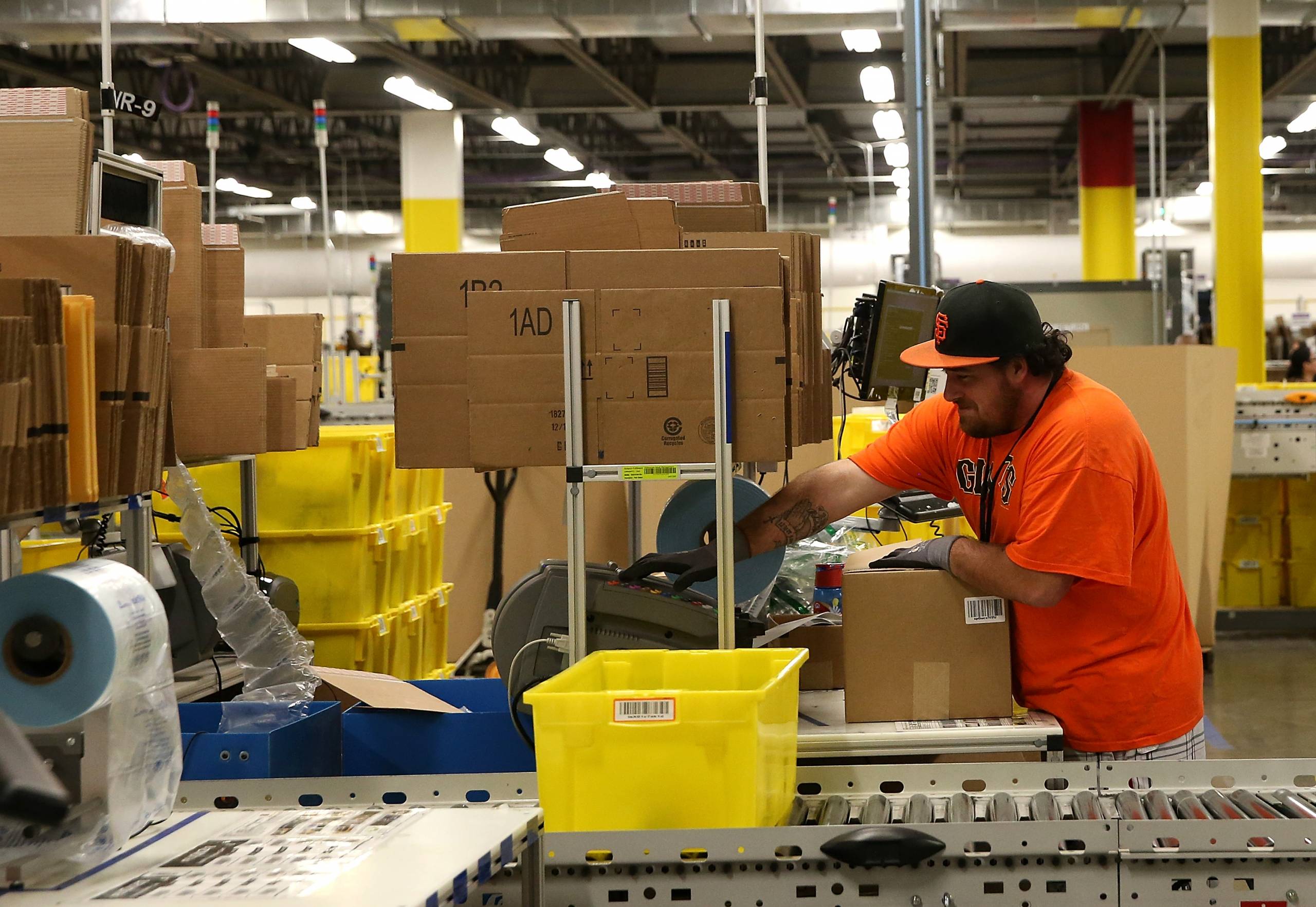
Tracked by algorithms, Amazon warehouse workers rush to pack and ship nonstop shopping orders that often must be delivered in a matter of hours.
While workers are on the job, Amazon watches their “time off task,” which the company says is to monitor for “issues with the tools that people use.” But it also serves to identify underperforming workers. And that, critics say, essentially pressures workers to forgo their state-mandated breaks, or to wait until the end of their shifts to use the bathroom — creating unsafe and unfair working conditions.
But the bill, authored by Assemblymember Lorena Gonzalez, D-San Diego, is intended more generally to help state regulators get a better handle on how a growing number of employers are using tech in the workplace to control the productivity of their workforce.
According to the U.S. Bureau of Labor Statistics, there were about 206,700 workers in the warehousing and storage industry in California as of June. That figure, however, doesn’t include temporary workers, like the many likely to take on warehouse work in the run-up to the holiday shopping season.
A significant portion of that workforce is employed by Amazon. Behind the big yellow “Place your order” button on the company’s site is a vast network of warehouses, filled with nearly 1 million non-union logistics employees across the country — 40,000 in the Inland Empire alone, according to Amazon.
And while the tech-obsessed retailer is famous for using robots, sensors and software to maximize productivity, it’s also infamous for burning out its workers, many of whom head to the exit doors suffering from repetitive stress injuries and, well, stress overall.
“How did you come up with this rate? Was it based on what your understanding of what a human body can do? Or was it based on what you think you need to get through in order to make a profit this quarter?” said Sheheryar Kaoosji, executive director of the Warehouse Worker Resource Center in Ontario, California.
Around the clock, an army of trucks and trains transport cargo from the ports of Los Angeles and Long Beach to vast warehouses in the Inland Empire counties of San Bernardino and Riverside. There, imported goods are sorted and redistributed onto long-haul trucks, which move them to distribution centers across the West.
Amazon’s rivals, like Walmart and Home Depot, are nipping at the tech titan’s heels, eager to adopt the algorithm-driven productivity tracking tools employed by the company, which logistics experts widely agree is the industry leader in this practice.
“It’s not that those companies can’t afford to do the right thing,” said Kaoosji, who has pushed for them to institute humane working conditions that follow labor laws in spirit, as well as practice. “It’s what those companies can get away with. And if they’re not held accountable, that’s what they’ll continue to do.”