
With the delta variant surging and health officials urging indoor mask use — and requiring masks indoors for many Bay Area locations — you've likely pulled out your old cloth masks. But it may be time for an upgrade.
"Masks still work, but with delta, we need better-performing masks," says Linsey Marr, a researcher at Virginia Tech who studies airborne virus transmission.
The delta variant transmits more than twice as easily as the original strain of the coronavirus. It's now one of the most contagious respiratory viruses we know of.
It also replicates quickly in the noses and throats of infected people, so they could be walking around with 1,000 times more virus in their bodies than if they had the original strain. All of that means it's imperative that you make sure your mask is protective, and not simply a bedazzled decoration for your face.
So what makes a high-performing mask? Marr says a mask's filtration efficiency is a function of both what material it's made of and how well it seals to your face. So whatever you do, make sure there are no gaps under cheeks or chin where the virus could sneak in.
Read on for more tips on how to seriously boost the protection your face mask offers.
1. Consider N95s and KN95s.
Some public health experts have suggested that the spread of delta calls for donning more seriously protective masks like the gold standard of protection, N95 respirators, which block out at least 95% of particles when worn correctly.
The good news is N95s are plentiful these days. However, they do have a downside: Because they seal so tightly to your face (that's why they work so well), N95s aren't exactly fun to wear, notes Dr. Ibukun Kalu, a pediatric infectious disease physician at Duke University Medical Center.
"No one wants to wear an N95 for eight hours," Kalu says. She says they're great protection when you are in a high-risk situation such as caring for a COVID-19 patient, "but it can be quite uncomfortable."
If you decide to opt for an N95 anyway, watch out for fakes. Check the CDC's site for advice on how to spot a counterfeit and a list (last updated in June) of trusted sources for surgical N95s. You can also find more guidance on choosing a good fit among different N95 styles, and buy a NIOSH-approved mask at companies like Aiden and the nonprofit Project N95.
Some people have a harder time with the straps that N95s use to attach to your head. In that case, you can also consider KN95 respirators, which often attach with more comfortable ear loops. KN95s are regulated by the Chinese government, and, like N95s, they're supposed to filter out at least 95% of small airborne particles, although the testing standards differ in each country.
However, counterfeits have also been a problem with KN95s. And the FDA recently revoked the emergency use authorization it had granted to KN95s, which allowed them to be used in health care settings. However, you can still search the FDA's list of formerly approved KN95s. You may also want to check NIOSH's list of foreign-made respirators it tested for filtration efficiency in the past, though the agency has now stopped doing those tests.
If you opt for one of these respirators, make sure they also fit tightly to your face. And remember, no matter what you choose, the best mask is ultimately the one you will wear consistently.
2. Wear two masks.
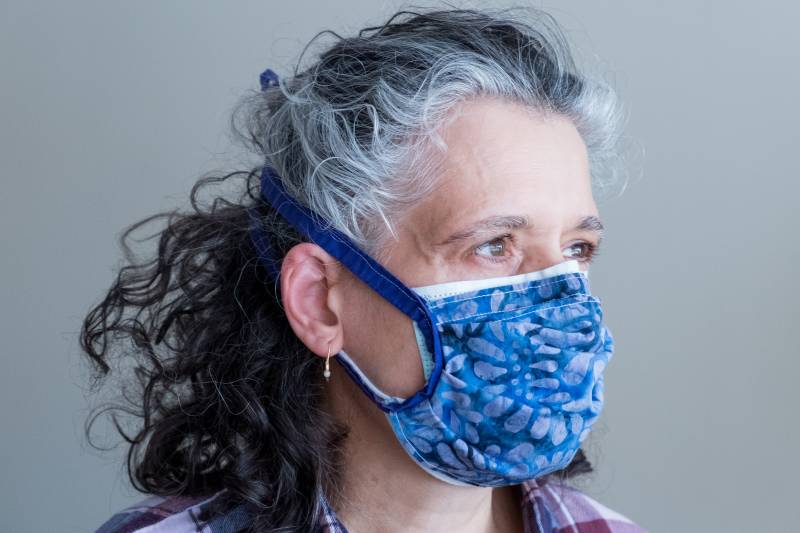
One good way to get a better mask is to double up, says Marr, the researcher at Virginia Tech. Start with a surgical mask closest to your face, she says, and then add a cloth one on top.
The downside of surgical masks is that many of them fit loosely — and a mask's ability to filter out particles depends partly on how well it seals to your face. By layering a cloth mask on top, you can achieve a tighter fit while also adding an extra layer of filtration, says Marr, who co-wrote a commentary earlier this year recommending double-masking.
Choose a surgical mask made out of a nonwoven material called polypropylene, because that material holds an electrostatic charge that allows it to trap particles. (Some surgical masks are made of paper.) Then add a good-quality cloth mask.
But don't keep piling on masks, Marr warns; just one additional mask is plenty. If your masks become too hard to breathe through, air will leak in and out through the sides instead. "Then it's like you have a hole in your mask," Marr told NPR earlier this year.
3. Make your mask fit tighter.
Even at this late stage in the pandemic, it still bears repeating: Don't let your nose hang over your mask — that defeats the purpose! And to get the best protection, you also need to make sure that your mask fits as snugly as possible over your mouth and nostrils, up to your nose bridge, and that you don't see any gaps.
A mask's filtration efficiency varies depending on how well it conforms to your face, as a study in JAMA Internal Medicine illustrates. Researchers found that the surgical masks they tested blocked out just 38.5% of small particles on average when worn normally. But filtration efficiency jumped when they tried various hacks to make the mask seal better.
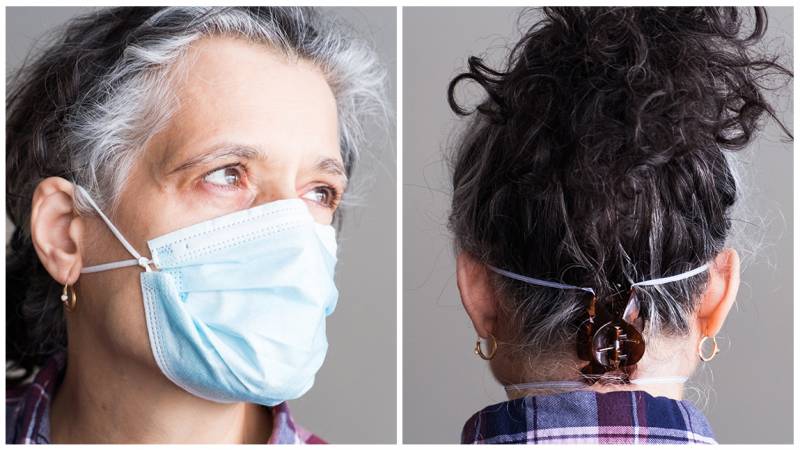
One trick they tested: Tie the ear loops into a knot as close to the edges of the mask as possible, then tuck the side pleats in to minimize any gaps that appear along the edges, as in the left photo, above. This boosted the surgical mask's filtration efficiency to 60%.
Another simple hack is to use a hair clip, as in the photo above at right, to hold the ear loops tightly at the back of the head. That raises the mask's filtration efficiency to nearly 65%.
You could also try a mask fitter or brace — an elastic frame that fits over a mask to make it seal more tightly to the wearer's nose, mouth and face. One study from researchers at the University of Wisconsin-Madison found that using a mask fitter enhanced a surgical mask's filtration efficiency from under 20% to over 90%.
9(MDAxOTAwOTE4MDEyMTkxMDAzNjczZDljZA004))