Episode transcript
Olivia Allen-Price: San Francisco may not be thought of as one of America’s most religious cities these days, but the place is named for St. Francis of Assisi. He’s the patron saint of animals, the environment and the country of Italy, which if you think about the city’s history has turned out to be a pretty apt name.
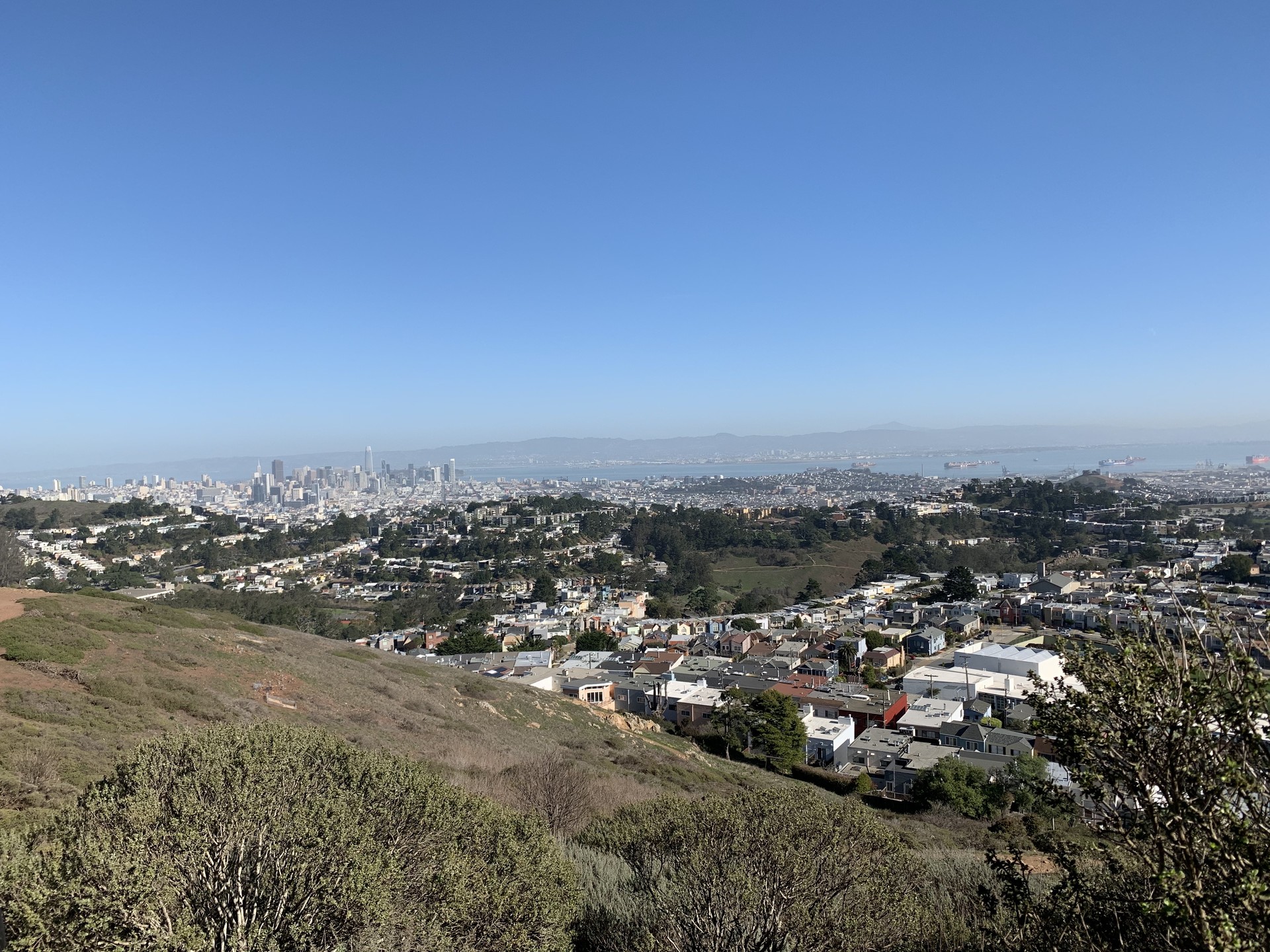
San Francisco has a long tradition of diverse religious practice. One place that hints at this history is on San Francisco’s highest peak, Mount Davidson. Look up and you’ll find a massive concrete cross at the top, one that some of you have been wondering about.
Julia Thollaug: Hi, Bay Curious. I’m Julia Thollaug. I grew up in and around San Francisco.
Phil Montalvo: My name is Phil Montalvo. I’m a native San Franciscan.
Julia Thollaug: I’ve always noticed the cross and just wondered why it was there, where it came from.
Phil Montalvo: Growing up in the Outer Mission, Crocker Amazon, the cross was always in view. I never understood when it was constructed or even why it’s still up on Mount Davidson.
Julia Thollaug and Phil Montalvo together: What’s the deal with the giant cross on the top of Mount Davidson?
Olivia Allen-Price: Today on Bay Curious, we tell the story of how San Francisco ended up with a cross at its highest point. This story first aired in 2021, and we’re sharing it again because, well, there’s an event coming up that makes it sort of noteworthy at this point in time. You’ll see. You’ll see.
I’m Olivia Allen-Price, you’re listening to Be Curious.
Sponsor message
Olivia Allen-Price: What is the deal with that Mount Davidson cross? We sent KQED producer Suzie Racho to find out.
Suzie Racho: Just west of Twin Peaks, rising above a quiet residential neighborhood is Mount Davidson Park. It’s not well-known or well-marked, but once you start walking one of the park’s trails, you’re surrounded by eucalyptus trees, and you start to forget that you’re in the middle of a major city.
Suzie Racho in scene: I’m coming up the trail. I’m a little out of breath, but wow, what an amazing view.
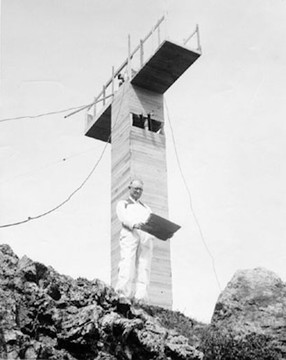
Suzie Racho: When you get to the top, you see two things: a view that stretches all the way to the East Bay and one very big cross. The cross is an imposing sight. It stands at 103 feet tall and 10 feet wide at the base. Made of concrete, it stands in stark contrast to blue sky and the eucalyptus grove that surrounds it. To learn more about how it got here, I went to Mount Davidson’s resident historian.
Jackie Proctor: Hi, I’m Jackie Proctor.
Suzie Racho: Jackie says the cross’s origin story goes back almost 100 years to 1923, to a time when the area was a forest.
Jackie Proctor: A guy named James Decatur, who is an employee of the Western Union Telegraph Company, and followed with the YMCA, hikes through that forest and comes to the top and he sees this incredible view of downtown. And he is just overwhelmed and inspired and he writes this long essay about the experience.
Voice over for James Decatur: Peace and quiet were so profound that it seemed almost unbelievable that the noise and roar of a great city was only a few minutes behind them. The solitude of the forest conveyed a sense of vastness quite as real as one would experience among the age-old monarchs of the High Sierras.
Jackie Proctor: He is inspired then to build a cross to crown the highest point of the city.
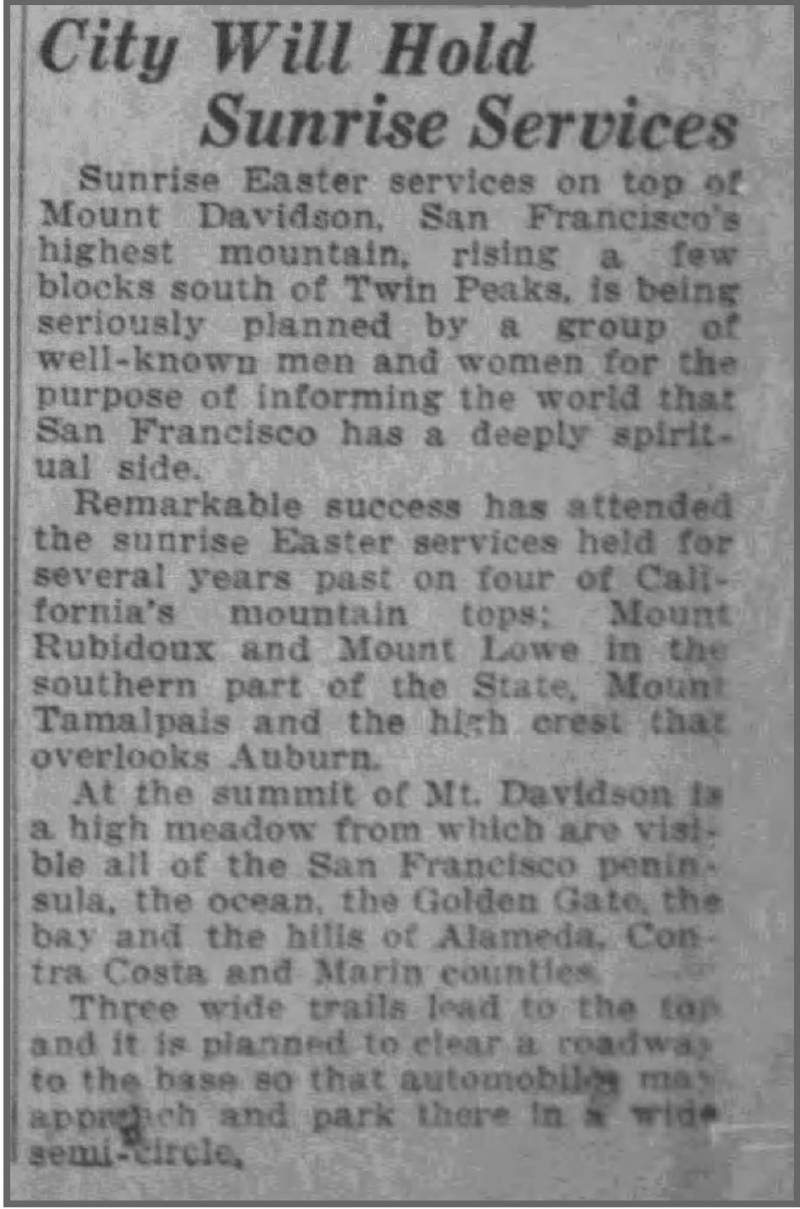
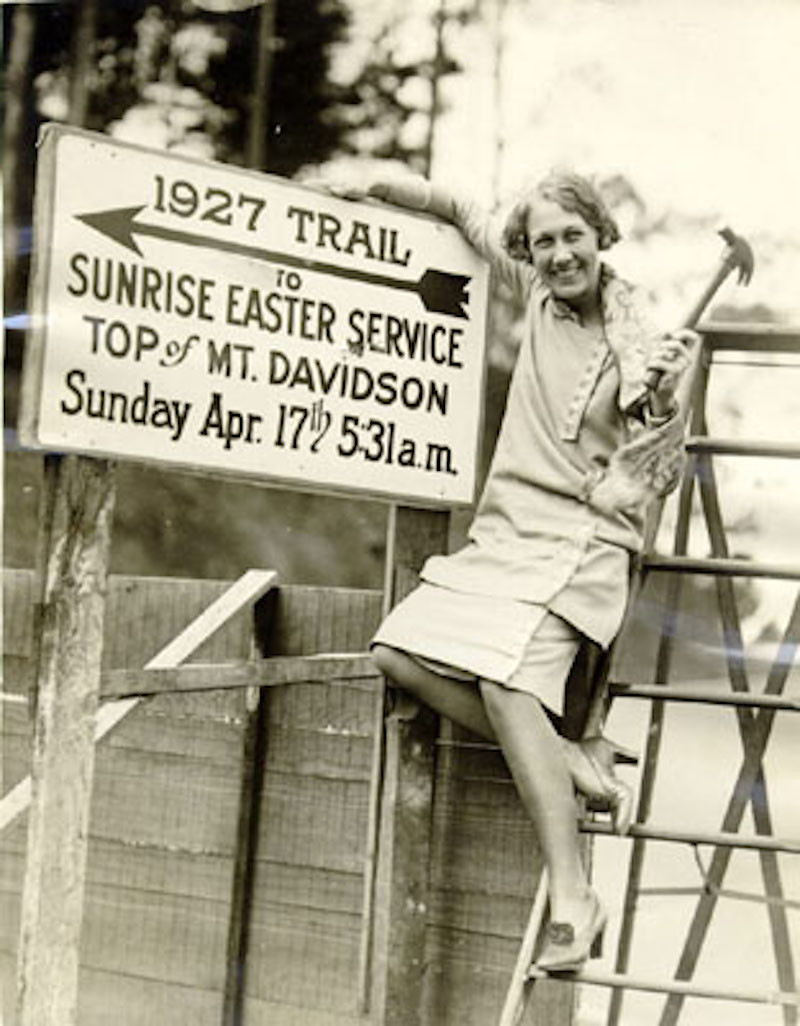
Suzie Racho: Decatur thought it would be a perfect place to hold an Easter sunrise service. Holding religious ceremonies in natural settings was a trend at the time. Jackie says that people were pushing back against the materialism of the Roaring Twenties, reconnecting with the natural and spiritual worlds. So it wasn’t hard to find support for his idea.
Several of Mount Davidson’s trails had already been established by its landowner, a local developer named A.S. Baldwin. Baldwin was already starting to build houses in the surrounding area. He saw the Easter service as a way to introduce more people to the new neighborhoods west of Twin Peaks. So Baldwin not only gives Decatur permission to hold the event, but donates $2,000 to get a 40-foot-tall wooden cross constructed. That’s nearly $31,000 today — a hefty contribution.
Jackie Proctor: 5,000 people hike up that hill in 1923.
Suzie Racho: The service received enthusiastic backing from city officials, religious leaders and community groups. Boy Scouts camped out the night before and acted as ushers for attendees. The Dean of Grace Cathedral led the service.
Jackie Proctor: James Decatur thinks, great, this is great. I had no idea 5,000 people would come, so let’s do it again.
Suzie Racho: Decatur raises money for a bigger wooden cross for the service the following year, but it wouldn’t be the last service or the last cross.
Jackie Proctor: The first one was just torn down and replaced, and then the second one was burned down, and then, the third one was burnt down.
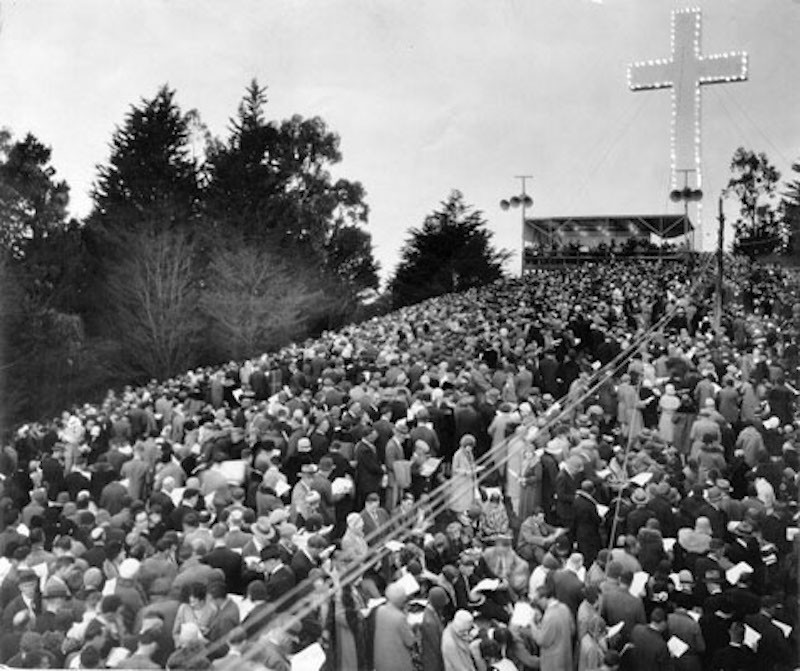
Suzie Racho: Local newspapers report the fires as accidental or vandalism by bored teenagers. Each temporary cross was replaced as the now annual service got more and more popular, drawing tens of thousands of people.
Jackie Proctor: People are dressed up. They’re wearing their fancy shoes and their fur coats and everything. It was like, you know, this incredible civic event.
Suzie Racho: But it was still being held on private land, land that was beginning to fill with newly constructed houses.
The encroaching development alarmed nature lover Maddie Brown. In 1926, she led a campaign to urge the city to buy 25 acres on Mount Davidson to create a public park. Bolstered by women’s groups across the city, the three-year campaign was a success. She even won the support of Baldwin’s widow, Emma. Who donated the six acres at the peak. In 1929, Mount Davidson became a city park. That put the cross on public land. Supporters eagerly began planning for a more permanent cross, one that couldn’t be blown or burned down.
Jackie Proctor reading: And before 32,000 people at the 1932 Sunrise event, Governor Roth dedicated the cornerstone of the new 103-foot-high concrete cross.
Suzie Racho: It took two years and $20,000 to build the enormous concrete cross. That’s almost $400,000 today. And by the time it was done, the country was in the Great Depression. But the people still wanted a grand celebration. 12 huge floodlights were installed on poles surrounding the cross. Maddy Brown envisioned a dramatic moment when the lights would be switched on for the first time. She wrote to President Franklin Delano Roosevelt, asking him to do the honors.
Voice Over: It seems most appropriate that the President, who has brought light into many a darkened American home, and who through his new deal has instilled the principles of the Golden Rule into American business, should take part in this cross-lighting ceremony.
Suzie Racho: Western Union donates their time and their telegraph lines, providing a coast-to-coast hookup between Washington, D.C. And San Francisco. And on the evening of March 24, 1934, President Roosevelt pressed the button that sent electricity across the country to light the Mount Davidson Cross. That Easter, 50,000 people journeyed to the monument. The cross became a San Francisco landmark. It made an appearance in the Clint Eastwood movie Dirty Harry in 1971.
Dirty Harry clip: Now turn, face the cross.
Suzie Racho: But had largely stayed out of the news until the early 90s. That’s when the issue of a cross on public land becomes a lawsuit. Groups concerned about the separation of church and state, including the ACLU, sue the city. After several years, the courts rule that city ownership of the cross violates the California Constitution’s separation of church and state. San Francisco has to find someone to buy the cross or tear it down.
Jackie Proctor: So then the city decides they’re going to sell the land around the cross, and the cross. And they have to sell it with no conditions. So whoever buys it can tear the cross down, or they can…
Suzie Racho: Our historian Jackie, a longtime Mount Davidson resident, remembers the controversy vividly.
Jackie Proctor: Concerned about that. I’m not a religious person. I sort of just saw the cross as like a relic of the depression, another public works project.
Suzie Racho: In 1997, San Francisco settles on a plan to auction off the cross and the little over a third of an acre that it sits on. They require any bidder to keep the site open to the public. The city sets the opening bid at $20,000. Three groups are interested in buying and preserving the cross, the Friends of Mount Davidson Conservancy, of which Jackie was a member, the Museum of the City of San Francisco, and the Council of Armenian American Organizations of Northern California.
Roxanne Makassian: Most Armenian Americans, including those in the San Francisco Bay Area, are descendants of the few survivors of the Armenian Genocide, which was carried out by the Turkish leaders of the Ottoman Empire in 1915.
Suzie Racho: Roxanne Makassian is a member of the Armenian Council. She says that descendants often build two things in the places where they settled, churches and a genocide memorial.
Roxanne Makassian: The Armenians said, you know, this would make a great monument for us to remember the Armenian genocide and maybe to educate locals about it.
Suzie Racho: At the auction, the museum doesn’t go past their opening bid of $20,000. The neighborhood group bids $25,000, but supports the Armenian group after agreeing they both want the same things for the park.
Jackie Proctor: We thought, well, they seem like they really care about maintaining the area for public access. That was our goal.
Suzie Racho: Today the cross is lit two nights a year, April 24th to commemorate the Armenian Genocide, and the night before Easter. The annual sunrise service still exists, today it’s non-denominational, and a few hundred people usually show up. Not quite the same scene as the thousands who appeared in their finery in the 1920s and 30s. But Jackie says, without the sunrise service Mount Davidson would look very different today.
Jackie Proctor: You know, if we didn’t have the sunrise service, we wouldn’t have a park there now. And it would have been covered with houses and buildings or everything like most of the other hills of San Francisco.
Olivia Allen-Price: This year’s sunrise service takes place at 6.30 a.m on April 5th. Find details at mtdavidson.org.
Have you signed up for the Bay Curious newsletter yet? It’s full of Bay Area trivia, more answers to your questions, and usually some cool photos. Sign up at baycurious.org slash newsletter.
This episode was produced by Suzie Racho, Katie McMurran, Katrina Schwartz, Christopher Beale, and me, Olivia Allen-Price. Bay Curious is a production of member-supported KQED in San Francisco.
It is pledge season, and that means we need your support. Give any amount that works for your budget at kqed.org slash donate.
Some members of the KQED podcast team are represented by the Screen Actors Guild, American Federation of Television and Radio Artists, San Francisco, Northern California Local.