
Jean Kendrick stood in the rain outside the duplex she had shared with her disabled son as movers wheeled boxes filled with their belongings onto a truck headed for storage.
“It was like a nightmare,” Kendrick said. “I wouldn’t wish this feeling on anyone.”
It was the second week of December. Kendrick, 70, and her 42-year-old son, Stanley Jackson III, were being evicted from their home in Richmond, even as a deadly surge in coronavirus cases was sweeping through the Bay Area and the country.
“In the middle of a pandemic, on a rainy Sunday morning, we wind up having to move,” Kendrick said.
They are now spending nearly $900 a week for a room at a nearby Extended Stay America hotel, and Kendrick says she has already depleted most of her savings: “And we don’t know where we’re going to go when we run out of money.”
Kendrick and her son are among at least 527 individuals and families in the Bay Area who were evicted between the start of the statewide coronavirus lockdown, on March 19, and the end of December. That’s according to data from sheriffs’ offices in the Bay Area’s nine counties, collected by KQED and CalMatters through public records requests.
Those 527 evictions, however, represent only a fraction of the total number of people who were forced from their homes during that period. Tenants’ attorneys say many tenants leave or get locked out before sheriffs get involved. But the data does provide insight into who is most vulnerable to evictions and where those evictions are happening.
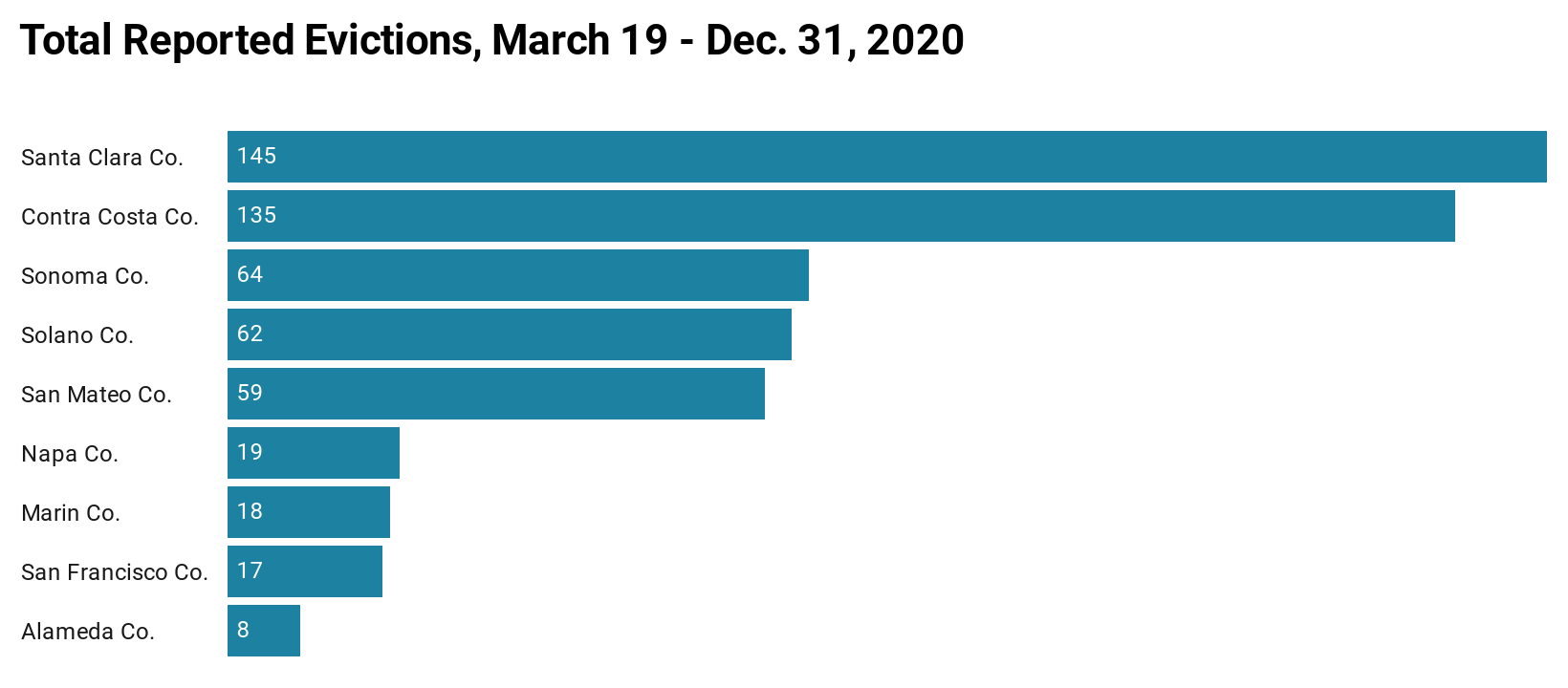
The most evictions in the Bay Area during that time period — roughly half the total — were in Santa Clara County, with 145, and Contra Costa County, with 135. The largest clusters were in San Jose and Antioch.
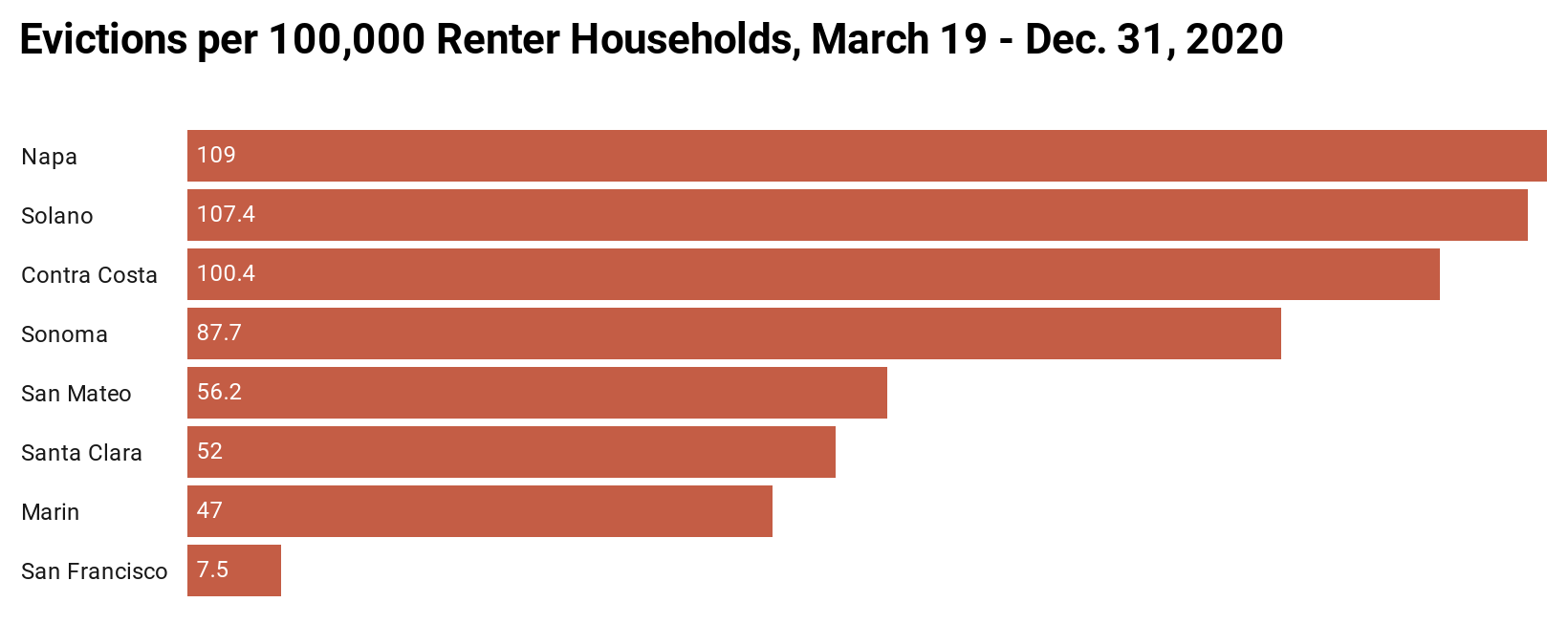
Contra Costa County, where Kendrick lives, also had one of the highest rates of evictions — 100 per 100,000 renter households — according to an analysis of the data by the Urban Displacement Project at UC Berkeley, in partnership with KQED.
That’s a stark contrast to some nearby counties: In San Francisco, sheriff’s deputies carried out only 17 evictions during those nine and a half months. And in Alameda County, only eight were carried out, the lowest in the region. Tenants’ advocates attribute the low numbers to the tenant protections those counties put in place during the pandemic, which are among the strongest in the state.
”The low level of evictions in San Francisco and Oakland, for example, is encouraging that these interventions actually work,” said Tim Thomas, research director for the Urban Displacement Project.
The data also points to ongoing racial disparities in evictions. Thomas and his colleagues estimate that Black renters, like Kendrick, were more than twice as likely to be evicted, as compared to white renters.
To predict the race of the person evicted, Thomas used an algorithm that combines last names with neighborhood demographics, and applied it to the 335 eviction records that included names.
He said the findings were in keeping with earlier research in Seattle and Baltimore that showed higher rates of eviction for Black households.
“Evictions really are a civil rights issue,” he said. “It seems to fall on the backs of Black households more than any other group.”
The following map was produced by Alex Ramiller and Tim Thomas of UC Berkeley’s Urban Displacement Project, based on their analysis of eviction data collected by KQED and CalMatters.
The analysis also shows that evictions have been happening in neighborhoods that are home to some of California’s most vulnerable renters. Those neighborhoods have higher poverty rates and higher levels of rent burden — meaning renters pay more than a third of their income toward rent — compared to neighborhoods where there were no evictions.
Renters, many of whom were already struggling to afford the Bay Area’s high housing costs, have also been particularly hard hit by job losses from the pandemic, because they tend to work in industries that have been shut down.
Loopholes in the Law
Even as evictions have continued, tenants’ attorneys across the Bay Area say rates have been well below what they normally see.
That’s because the state has had some form of eviction protection in place since April, and some cities and counties have added stronger rules.
The Judicial Council, which oversees California courts, put a stop to most eviction cases between April and August. The state Legislature then passed Assembly Bill 3088, which prevents people from being evicted for non-payment of rent, at least until the end of January. Lawmakers on Monday introduced new legislation, Senate Bill 91, to extend the moratorium through the end of June.
Under both pieces of legislation, tenants have to demonstrate that they’ve lost income due to the pandemic and must continue to pay at least 25% of their rent.
Pre-pandemic eviction numbers are not widely available, but in Contra Costa County, for example, the Sheriff’s Office reported enforcing roughly 30 evictions per week in the 18 months prior to the pandemic, as compared to an average of three per week, between March 19 and the end of December.
But many landlords argue that even in a pandemic, they still need the option to evict.
Jenny Zhao owns three properties in San Jose and says she doesn’t want to evict any of her tenants. But her husband recently lost his job, and she doesn’t know how long she can keep paying the mortgage on one of her properties, where her tenants are already three months behind on rent.
“If I don’t pay, I will lose my house,” Zhao said. “Whether I sell or foreclose, that means the tenant will eventually lose their home anyway, and then where do they go?”
Tenants’ advocates, however, argue that nobody should be evicted while the state continues to restrict various business operations and activities, because displacement can threaten not only the health of individuals being evicted, but the entire community.
Research has long shown that evictions lead to higher rates of physical and mental health problems.
