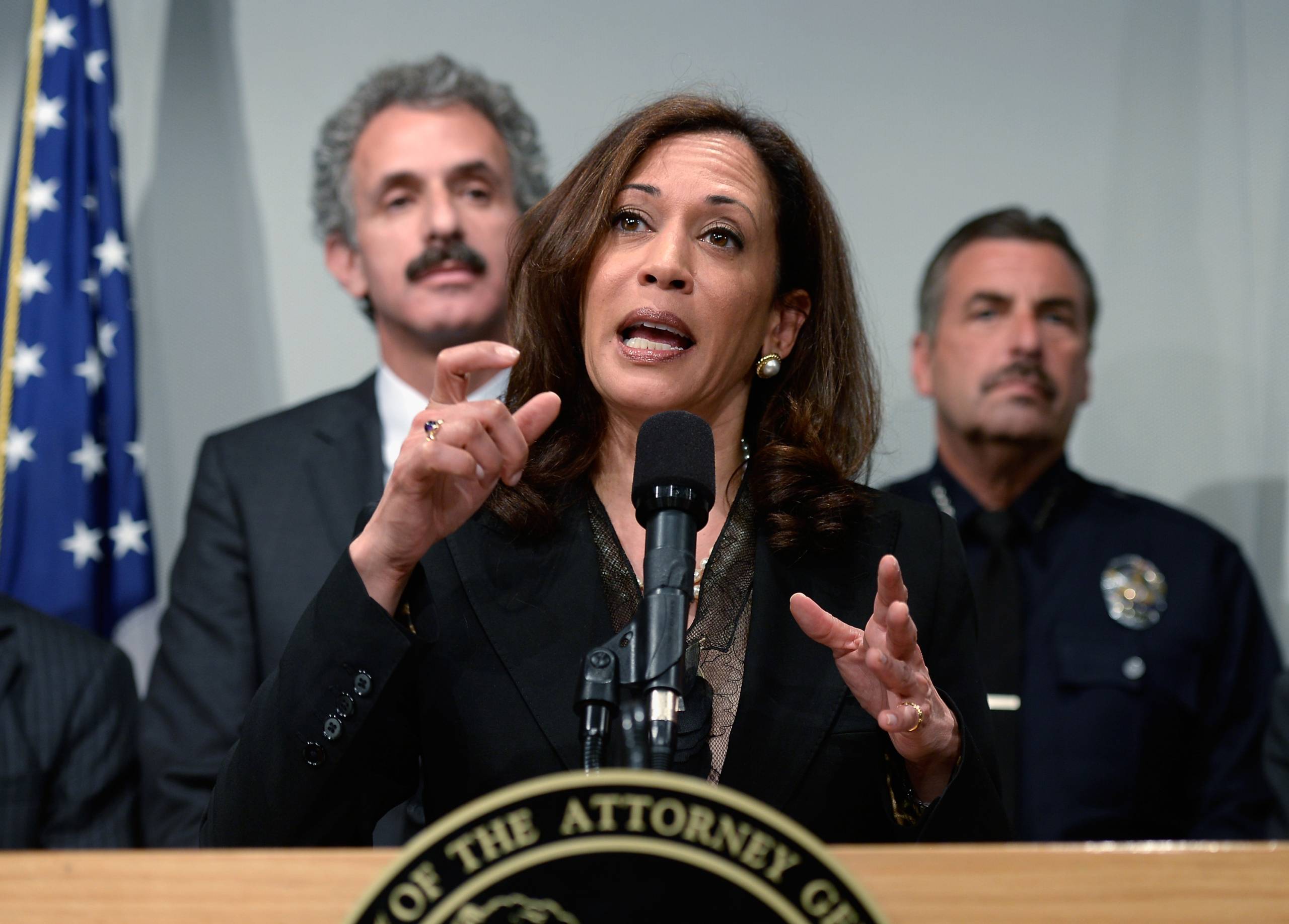
Three months after becoming San Francisco’s district attorney in 2004, Kamala Harris faced a trial by fire.
In her first run for office in 2003, Harris knocked off Terence Hallinan, San Francisco’s progressive district attorney, by running slightly to his right, promising to manage a more professional office that would be tougher on violent crime, domestic violence and sex trafficking, and stand up for those who had felt ignored.
She had also promised never to charge the death penalty — a pledge that was put to the test just four months into her term when a 29-year-old police officer named Isaac Espinoza was shot and killed by a gang member.
Harris ultimately kept her promise, announcing before Espinoza’s funeral that her office would seek life without the possibility of parole.
At the time, Harris said she believed that the majority of San Franciscans wanted to see “the most severe crimes be met with the most severe consequences,” and that in this liberal city, life without parole would likely be the most severe consequence a jury would hand down.
But former police officers union President Gary Delagnes says the timing of Harris’ announcement alienated many officers in the San Francisco Police Department.
“By having a press conference before the kid was even in the ground to announce that she was not seeking the death penalty, I mean, it was such a cold political move that I mean, it just showed a complete lack of compassion,” he said.
While the timing of her announcement poisoned the young prosecutor’s relationship with the police union, even Delagnes acknowledged she made the right call.
“Obviously no San Francisco jury was going to convict a 19-year-old African American man — they’re not going to give the death penalty to somebody in that situation and I said that from the beginning,” Delagnes said.
Harris’ office did get the conviction and sent Espinoza’s killer to prison for life, without the chance for parole.
Breaking Boundaries
Throughout her time in politics, California Sen. Kamala Harris has found herself caught between two very different groups, both of whom see themselves in her: law enforcement officials and progressive activists pushing for a more racially just legal system.
Harris is now the Democratic nominee for vice president, and in recent years has been outspoken about the need for systemic change to policing and criminal justice in America.
But before that, and before she was the second Black and first South Asian woman to serve in the U.S. Senate, Harris was a prosecutor: district attorney of San Francisco, then attorney general of California.
Debbie Mesloh, one of Harris’ longtime advisers, said Harris was from the start considered an outsider by many in the world of law enforcement.
“I recall many situations where people who had been in leadership within the DA’s office or within the police department seemed to struggle with her leadership,” Mesloh recalled. “That first meeting with the District Attorney’s Association of California, she was the only woman to walk in that room. She was one of, I think, three people of color.”