
Update, 1:35 a.m. Tuesday: It’s been voted down, legally challenged, backed by voter referendum, and stalled for years, like a car spinning its wheels in mud. Now, a 315-unit apartment development in Lafayette that became a statewide rallying cry for the Yes In My Back Yard movement will spin its wheels a little longer.
The vote to approve The Terraces development was delayed by the Lafayette City Council after a seven-hour marathon meeting that stretched from Monday night into early Tuesday.
The Lafayette City Council said they needed more time to fully discuss concerns aired by neighbors, many of whom claimed the proposed apartments would bring crippling traffic congestion, increase the risk of wildfire, and imperil the movement of emergency vehicles.
But Jeremy Levine, a Lafayette resident and co-founder of the group Inclusive Lafayette, said those concerns have been proven untrue by Lafayette city staff, and others.
While the Lafayette City Council pushed their decision down the road, public commenters and city staff warned Lafayette would be open to lawsuit under the Housing Accountability Act – and $15 million in possible fines – should they fail to approve the project.
Victoria Fierce of housing advocacy group California Renters Legal Advocacy and Education Fund, or CaRLA said, “Lafayette may no longer choose between housing or no housing. You may decide between housing and consequences.”
The Lafayette City Council will continue its discussion of The Terraces development August 24.
Original post, 1:00 p.m. Monday:
Before a single brick has even been laid, The Terraces, a proposed 315-unit apartment development in Lafayette, became a flash point for discussion around the housing crisis in Northern California.
The 2015 legal battle over the project helped define the “Yes In My Backyard,” or YIMBY, movement. The movement, and the activists behind it, have made a name for themselves by “suing the suburbs” like Lafayette, in a bid to push California to “build, build, build” its way out of the housing crisis.
Now, nearly a decade after the project first entered the public sphere, The Terraces finally faces approval Monday night from the Lafayette City Council.
Councilmember Cameron Burks appealed the project after it was approved July 1 by the Lafayette Planning Commission.
Burks, who recently announced his reelection campaign, said he brought it to the City Council so the body could put itself on record about The Terraces.
“I felt that this particular project was such profound importance to the city that really the community deserved to have their elected officials make the final decision,” Burks said.
The Terraces has drawn rebuke from some neighbors, particularly a group called Save Lafayette, who publicly say the dense housing project will clog local roads with traffic congestion, ruin the city’s “semi-rural” character and is out of touch with Lafayette writ-large.
The town is home to roughly 26,000 people, according to the Census Bureau, and is often touted as an idyllic refuge for people who don’t wish to live the urban life of nearby Oakland or San Francisco, which are only a BART ride away.
Though the project has its detractors, neighbors have come to its defense in recent years, as well. Inclusive Lafayette’s co-founder, Jeremy Levine, said his group’s more than 450 members believe The Terraces project won’t add to the city’s traffic congestion.
In fact, because the project is less than a mile from BART, Levine says that many living in The Terraces won’t need a car at all.
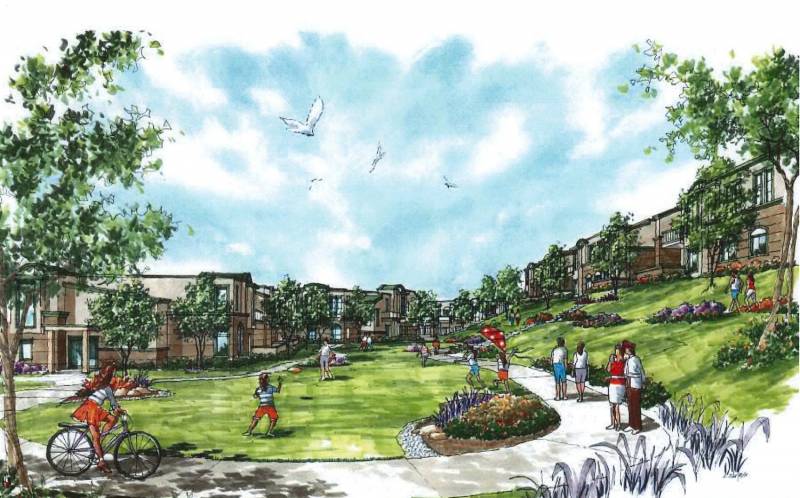
“Compared to almost anywhere else in Lafayette, it’s almost as close as you can get for walkability purposes,” Levine said. “The rest of the community is built on winding roads, squeezed into the hills. And you kind of have to drive if you plan to get anywhere. The Terraces are not that.”
The project has had a tumultuous ride. After developer O’Brien Land Company sought to change a sloping open space into apartments, and it drew community resistance, Lafayette officials sought to turn the project into 44 single-family homes.
But a group called called SF BARF, which was a precursor to the California Renters Legal Advocacy and Education Fund, sued the city for abandoning the apartment development in 2015. Save Lafayette then sued the city, which led to a June 2018 ballot measure. That was defeated by Lafayette voters, leading to the return of The Terraces and the proposal for over 300 apartments.
Along the way, the turmoil over the project also led to the high-profile resignation of former Lafayette City Manager Steven Falk. In a public letter to the City Council in 2018, he drew attention to the connection between the need for all communities to build denser housing and preventing climate change.