A group of homeless mothers who took over a vacant house in West Oakland last month filed court documents on Monday to fight an eviction notice. Their argument for staying? Housing is a human right.
Moms Who Occupied Vacant House in West Oakland Fight Eviction in Court
The group Moms 4 Housing say they're frustrated by real estate companies speculating with vacant properties in the midst of a homelessness crisis. They argue housing is a human right.
01:06
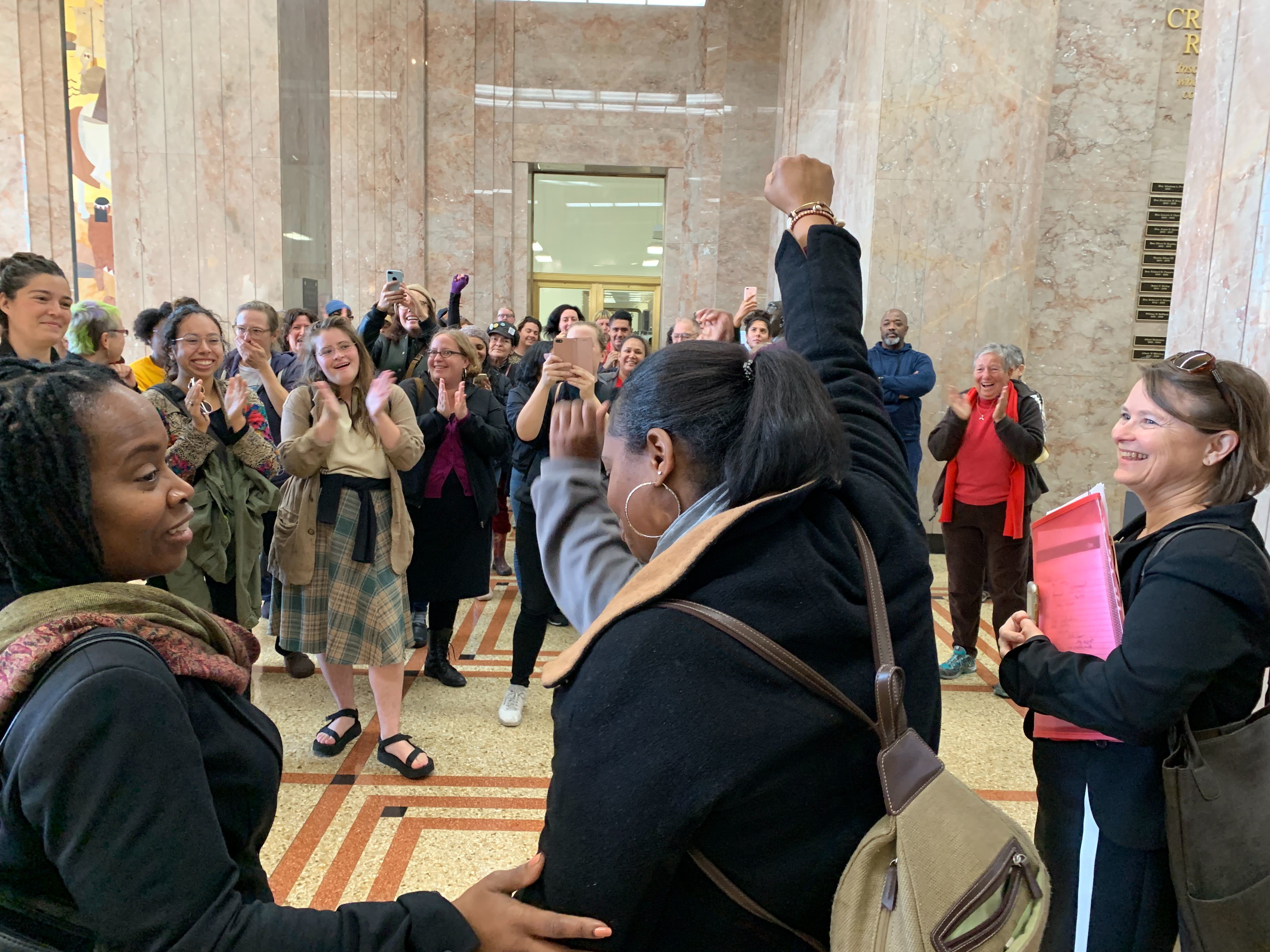
Sameerah Karim raises her fist with supporters after filing a claim to fight her eviction notice at Alameda County Superior Court. (Molly Solomon/KQED)
Related Article
The women, part of a newly formed group called Moms 4 Housing, moved into the vacant three-bedroom home on Magnolia Street to draw attention to investors buying up Bay Area houses and leaving them empty, even though there's a growing homeless crisis in the area.
Dominique Walker, 34, and Sameerah Karim, 41, spoke to a crowd of 30 people Monday morning from the steps of the Alameda County courthouse. Accompanied by their attorneys, the two women and four other community members filed a claim of right to possession in response to an eviction notice from the property owner that was delivered on Dec. 6.
"We’re fighting and we’re not going anywhere," said Walker, who has been living in the empty home with her two young children and Karim. “This land deserves to be back in community control."
The appeal essentially halts a planned eviction by the Alameda County Sheriff’s Office that was scheduled for 6 a.m. Tuesday morning. The county court has 15 days from when the claim was filed to schedule a hearing.
Frustration over inadequate housing policies has sparked a debate over vacant homes and the corporate companies that own them. Last year, the city of Oakland reported having 4,366 vacant properties, including empty homes like the one Walker and Karim have occupied. Meanwhile, the city has seen a 47% uptick in unhoused people over the last two years, according to a federal point-in-time count.
"Housing should not be commodified,” said Carroll Fife, director of the group Alliance of Californians for Community Empowerment. "What you need to exist should not be sold to the highest bidder."
In their claim, attorneys for Moms 4 Housing argue that the Magnolia Street house has sat vacant "during the worst housing crisis in California history."
"Wedgewood is one of the companies that most abused tenants during the foreclosure crisis,"said Leah Simon-Weisberg, an attorney working pro bono for Moms 4 Housing. "This is not just about housing people. This is about an entire community saying 'enough.' "
Wedgewood, a Redondo Beach-based real estate investment company that owns the property, operates real estate investments throughout the Western U.S. and in Florida. According to its website, the company describes itself as "a leading acquirer of distressed residential real estate."
Sam Singer, a spokesman for Wedgewood, called the filing a delay tactic to stall the eviction.
"It buys them time, but it doesn't buy them possession of the home," he said.
The claim filed by Moms 4 Housing also argues that housing is a human right. However, Singer said, not stealing is also a fundamental principle of society — and he argued the two women are attempting, in essence, to steal the property.
"Thou shall not steal," said Singer. "They broke into this home. They’re attempting to steal from this home. And the court will evict them."
Wedgewood bought the home in a foreclosure sale on July 31.
After Monday’s filing, Walker and Karim were met with raised fists and cheers from supporters as they emerged from the building. With the threat of immediate eviction avoided, the women said they could focus their time on making repairs to the house and preparing for the holidays.
Karim asked supporters to bring holiday decorations by the Magnolia home. "I know the kids wanted a Christmas tree," she said.