The Chief: The Remarkable — Sometimes Shocking — Career of Fresno's Top Cop
Fresno Police Chief Jerry Dyer, the 59-year-old son of a Fresno police officer, has amassed the kind of behind-the-scenes power that few police chiefs achieve.
Andrew Beale Investigative Reporting Program, UC Berkeley Graduate School of Journalism
28:42
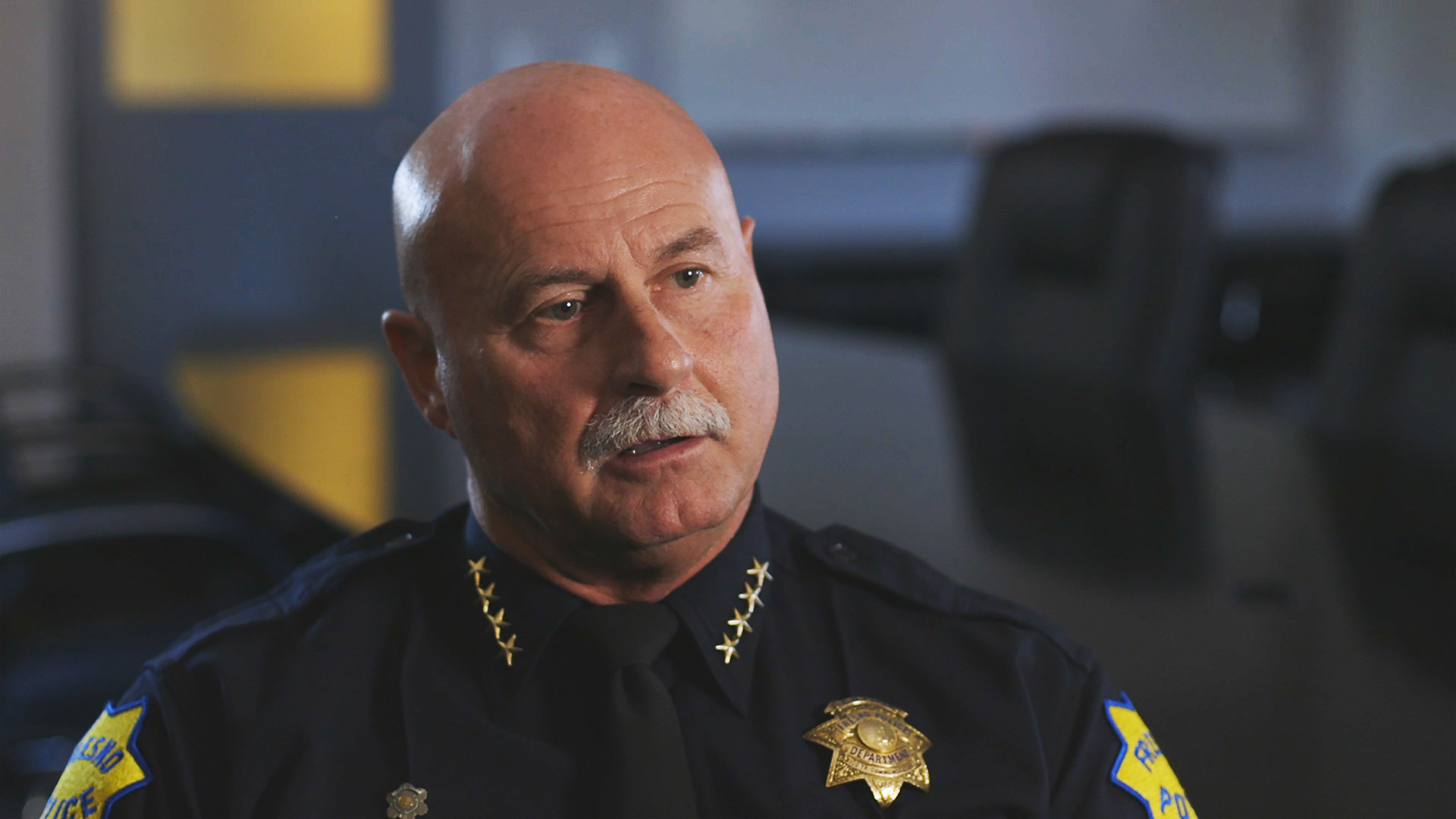
Fresno Police Chief Jerry Dyer (Alexandria Fuller and Mary Newman)
f Fresno were another place, Jerry Dyer’s career might have ended in a federal courtroom two years ago. He had been called to testify in a case that, once again, portrayed Fresno not as the fifth-largest city in the state with forward-thinking institutions but a backwater of corruption a century and a quarter deep.
Dyer wasn’t just any witness. He strode into the downtown courthouse wearing a crisp dark-blue uniform with four gold chief’s stars popping out from the collar. He was in his late 50s, but his neck, chest and arms still bulged from decades of lifting weights. His signature mustache, now gray, was set off by a head completely shaven.
label='Fresno's Economic, Racial Inequalities Explored in 'Unequal From Birth''
His 16-year tenure as chief had made him one of the longest-serving leaders of a big-city police department in modern California history. He had remained the chief by escaping scandal time and again — from front-page revelations that he had been investigated for sex with a minor to the bizarre case of one of his high-ranking officers and good friends turning up dead in front of Dyer’s home under mysterious circumstances.
The case before the federal court now raised questions so troubling — about his administration of the police department, about his supervision of his right-hand man — that Dyer’s conduct itself might have been on trial. His second-in-command, Keith Foster, had been charged as the kingpin of his own drug-trafficking organization. The two men had spent their careers side by side as Foster followed Dyer in every promotion. His office was the only one Dyer passed every day on the way to his own.
Foster’s arrest on charges of conspiring to distribute heroin, marijuana and oxycodone had surprised even jaded City Hall watchers who had seen the FBI in the 1990s arrest dozens of local developers and politicians in a lengthy probe dubbed Operation Rezone. But federal authorities accusing a top official in a major city of running a drug ring was different. So stunning was Foster’s arrest that a top columnist in the city compared it to the shock of the Pearl Harbor attack. Like many others in Fresno, the columnist expected Dyer and other city leaders to face tough questions about what they did and didn’t know. As Dyer walked into the courtroom that spring day, the city’s eyes were on him, waiting to see how he would answer for himself.
Strangely, Dyer hadn’t been called as a witness for the prosecution. He was there on behalf of Foster’s defense. When one of the prosecutors asked him to explain how he felt when he learned of Foster’s arrest, he described emotions — shock, hurt and a sense of betrayal — in a flat tone that belied such feelings.
Over and over, he repeated that Foster had always had his full trust, right up to the day the deputy chief was hit with a seven-count federal indictment after he was pulled over by federal agents as he left his nephew’s house.
As prosecutors continued their questioning of Dyer, they might have delved into why the police chief had missed or chosen to ignore flagrant signs of trouble. But prosecutors never asked the chief about Foster’s finances, which had long ago spiraled out of control. He’d lost his house to foreclosure. He’d been hit with an IRS lien and his wages had been garnished after repeated failures to pay alimony and child support. All the while, according to his ex-wife, he lived a “lavish lifestyle,” complete with furs, jewelry and expensive clothing.
They didn’t ask Dyer why he maintained his trust in Foster even as the deputy chief was accused on two occasions of spousal and child abuse. Neither did prosecutors ask about accusations from two women that Foster had sexually harassed and sexually assaulted them. All of this information was readily available in court documents open to the public. The only noteworthy testimony elicited by the feds from Dyer had to do with Foster’s main line of defense: that he was working on the city’s heroin problem and that’s why he had repeated contacts with a major heroin dealer. Dyer told the jury that if Foster was working in such a capacity, he never produced a report on his findings.
And that was pretty much all the duress the police chief of Fresno faced. As he walked out of the federal courthouse into the sunshine, no probing questions came at him from the local media either.
One TV station described it as a “difficult day” for Dyer that “left him reeling” because of the disappointment he felt at seeing his former deputy chief on trial. Another broadcast a segment in which Dyer explained that “whether the allegations turn out to be true or not, the fact is, this investigation occurred, and Keith was arrested, and as a result I felt a sense of betrayal.”
Nobody asked him why it took federal agents to catch a man that Dyer himself saw every day, a man who, according to a co-conspirator, had been trafficking drugs for seven years.
Two years later, Dyer is still the chief. And within the department, he says, “Keith Foster’s not on anybody’s mind.”
It wasn’t the first time Dyer escaped any real ramifications for problems in his department. Over the years, he’s faced remarkably little scrutiny for someone who spends so much time in the public eye.
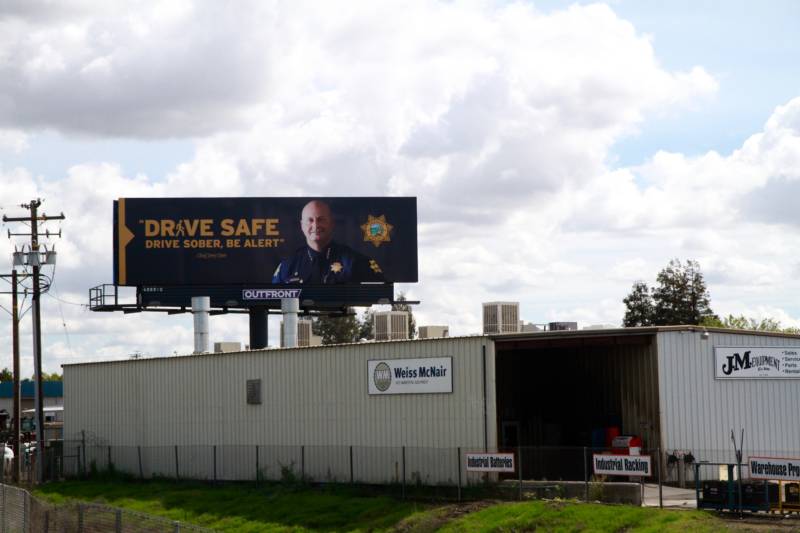
A billboard featuring Fresno Police Chief Jerry Dyer. (Alexandria Fuller)
In Politics, a Police Chief Who Seems Beyond Criticism
In Fresno, Jerry Dyer seems to be everywhere: church services, neighborhood barbecues, in full uniform at a Snoop Dogg concert. He can be seen smiling down from billboards reminding Fresnans to drive safely. He appeared in uniform on a national TV ad for home-security company ADT, saying the company may have saved a Fresno woman. He even has his own bobblehead.
Dyer, the 59-year-old son of a Fresno police officer, has amassed the kind of behind-the-scenes power that few police chiefs achieve. When he was elected head of the California Police Chiefs Association in 2008, he held a three-day party in downtown Fresno featuring armored personnel carriers parading through the streets in what local activists described as a “coronation.” Eight years later, celebrating 15 years on the job, he was feted by local politicians and celebrities at a black-tie event, with all three mayors he had served under praising him effusively, even as some 60 people gathered outside to protest the police killing of unarmed teenager Dylan Noble.
In 2015, three months after Foster’s arrest, a Washington Post profile lauded his commitment to community policing and highlighted his department’s practice of holding barbecues in an effort to connect with citizens. Dyer touts a laundry list of accomplishments, from falling crime rates to a reduction in traffic fatalities during his tenure. Fresno gangs are his bête noire, and he scored a major victory last year as leaders of the notoriously violent Dog Pound gang pleaded guilty to a wide range of federal charges.
In Fresno politics, Dyer seems to be beyond criticism. A review of articles in the local paper, the Fresno Bee, showed that no current City Council member has criticized Dyer in print, not even mildly (a former City Council president did once accuse him of being “arrogant”). And the city has rewarded him handsomely for his service: He made over $247,000 in 2017, more than the police commissioner in New York City. No, Jerry Dyer is not a typical big-city police chief. Then again, Fresno is not a typical big city.
‘God’s Forgiven Me. My Wife’s Forgiven Me. This Department’s Forgiven Me’
Fresno began as little more than a railroad stop in California’s Central Valley. The Central Pacific Railroad Co. founded the town in 1872. It was incorporated 13 years later and soon grew into an agricultural powerhouse. The figure who casts the longest shadow on Fresno today is undoubtedly Hank Morton, the high-water mark of corrupt police chiefs in a town with no shortage of them. During Prohibition, federal agents considered Fresno County the wettest in the nation, and the local police ran the booze. But it was Morton, ruling the department from the ‘50s through the ‘70s, who elevated corruption to an art.
Replacing Chief Ray Wallace, who was sentenced to prison in 1950 for using his office to amass 1,700 acres of land, Morton quickly took control of the area’s brothels, marrying Fresno’s top madam. He consolidated power (and avoided prosecution) using a vast intelligence apparatus inside the Police Department dedicated to gathering blackmail material on political leaders.
After Morton’s retirement, three separate federal organized crime task forces investigated the Fresno police, leading to a reform period in the department that lasted for two decades. That era ended with the appointment of Dyer’s predecessor, Ed Winchester, who stepped down in disgrace in 2001 amid compounding scandals, including the disappearance of 11 pounds of cocaine and $200,000 in cash from the evidence room. Jerry Dyer was born at the height of Morton’s reign, in May 1959, and rose to department leadership under Winchester.
Dyer joined the force on May 1, 1979, just two days before his 20th birthday. His sister, Diane, also became a cop, and served on the Fresno force until 2011. Being a cop was in his blood, but he wasn’t content to remain a patrol officer.
His appointment as chief was, perhaps, inevitable. His first major step was a two-year stint as public information officer, from 1995 to 1997. The name recognition he earned from frequent TV appearances helped him launch the defining project of his pre-chief years, the Skywatch helicopter program. He raised private donations to buy the department its first helicopters.
There was one other key piece of Dyer’s rise, something that might not be expected to influence a career in government service: his identity as a born-again Christian.
He’s a frequent guest at many Fresno-area churches, and is often spotted at prayer breakfasts and other public religious gatherings. In Dyer’s telling, the story goes like this: In his 20s, he began drinking heavily, cheating on his wife and breaking police department rules (which rules, he won’t say, but he does acknowledge being the subject of internal affairs probes while a beat cop.) In 2005, he told a crowd that as a young man he was “dishonest, egotistical, proud, arrogant and disobedient.”
He had a revelation at the age of 32, when a friend suggested he go to church. In what Dyer sees as a sign from on high, the pastor spoke about the two problems plaguing his life: alcohol and adultery. He said he attended services the next two Sundays, and on the third Sunday, he experienced a rebirth, turning himself over to God and pledging to change his ways. He has an exact date for his spiritual awakening: Sept. 15, 1991.
Department leadership quickly noticed his newfound commitment to God — and, stemming from that, his commitment to doing the right thing and working to help others. He rose quickly through the ranks and was named chief just under 10 years later.
Dyer has used his faith as cover to protect him from potentially damaging stories from his pre-religious past. He got his first chance to test his story’s value almost immediately after he was appointed chief.
Fresno’s then-city manager, Dan Hobbs, announced Dyer’s appointment on July 18, 2001. Four days later, a front-page story in the Fresno Bee proclaimed: “Cops twice probed allegations Dyer had affair with girl, 16.”
Dyer reportedly had sex with a 16-year-old girl when he was a 26-year-old officer in 1985. The accusation was investigated shortly after it was alleged to have occurred, and again in response to a citizen complaint after Dyer became department spokesman in 1995.
The Bee article was based on interviews with unnamed police sources who were privy to the investigations, as well as family members of the alleged victim, although the alleged victim herself would not confirm or deny the allegations. Contacted for this article, she declined to comment.
Dyer refused to deny the story, instead relying on his born-again image to excuse his past behavior.
“All I can tell you is that the relationships that I have had outside of my marriage, when I was a young man, have been dealt with,” he told the Bee. “God’s forgiven me. My wife’s forgiven me. This department’s forgiven me and looked into a lot of things in my past.”
Dyer took his oath as police chief on Aug. 2, less than two weeks after the story came out.
Nearly 18 years later, even with the wave of powerful men felled by the #MeToo movement, no reporter or city leader has publicly asked him about it since the original article was published. And he still has not publicly denied the allegations.
He faced another public scandal just a few years later when a lieutenant named Jose Moralez was found dead, shot in the chest just 200 feet from Dyer’s house. The chief was reportedly considering firing Moralez for lying. The shooting was ultimately ruled a suicide. But it’s become something of an urban legend in Fresno and another bizarre chapter in the chief’s lengthy career.
Dyer relied on his religiosity to build faith among his own officers, as well. In a 2005 department-wide memo, Dyer apologized for unspecified offensive comments he made, and he pledged to improve his performance at home, at work and at church. As part of his penance, he told his officers, “I will view teaching Sunday school as an opportunity to help and serve others and not as an obligation.”
Bias Allegations Leveled Against Department From Within
Institutional racism has long plagued Fresno. Its majority-black 93706 ZIP code is the poorest urban ZIP code in the entire state. A person born just 10 miles away, in wealthy Northeast Fresno, has a life expectancy 20 years longer than a person born in the 93706.
Dyer himself is not immune to the racism endemic in the city. In 2011, two deputy chiefs, Robert Nevarez and Sharon Shaffer, sued Dyer personally, alleging he had created a hostile work environment in the Fresno Police Department.
“When referring to African-American individuals, including employees, DYER sings the antebellum slave song ‘Mammy’s little baby loves short’nin bread,’ ” according to Shaffer and Nevarez’s complaint. The deputy chiefs accused Dyer of many other racially and sexually charged comments, including referring to an Asian-American employee as his “little geisha girl,” making inappropriate comments about a subordinate’s breasts and joking that it’s OK to punch African-Americans in the face because they “don’t have bones in their noses.”
Fresno City Hall eventually settled their lawsuit, paying $100,000 each to Shaffer and Nevarez, plus $100,000 in fees and costs to their lawyer. But not before racking up $820,000 in legal fees, according to the Fresno Bee, and exposing the chief’s behind-the-scenes behavior to public scrutiny.
Nevarez and Shaffer’s lawsuit didn’t mark the first time Dyer had run into trouble for what he had said at work. Years later, in response to the 2011 lawsuit, Dyer’s attorneys admitted he had made racially charged and sexually suggestive comments at staff meetings. They repeatedly relied on Foster’s status as an African-American as a shield against allegations Dyer’s remarks were racist. The Nevarez/Shaffer suit also shed light on another aspect of the department: Dyer’s close relationship with Foster.
“At the September 9 Meeting, a Fresno Bee article was discussed. This article quoted Captain Al Maroney calling Deputy Chief Keith Foster, Chief Dyer’s ‘pet,’ ” according to a filing by his lawyers. “Chief Dyer said to Deputy Chief Keith Foster, ‘If you are my pet, then you’re my Chia Pet’ and sang the first lines of the ‘Chia Pet song.’ ”
The lawsuit asserted that the reference to Chia Pets was a racial remark referring to stereotypes about African-Americans’ hair.
“Deputy Chief Keith Foster was not offended by the term ‘Chia pet’ at the September 9 Meeting,” Dyer’s lawyers wrote. Not every officer took Foster’s sanguine view. In an internal survey of officers’ attitudes in 2015, almost 20 percent said racial and gender bias was a “severe or serious problem” in the department.
‘Did you have confidence in him?’ ‘I did.’
The voice crackled through the courtroom speaker with the characteristic pops and hisses of a recorded phone call. “They want one of them?” And the reply, from a deeper, older voice: “Yeah, what’s the ticket?”
“It depends, how, how good of color they want?”
“I mean they, they, the very, very best.”
“The very, very best?”
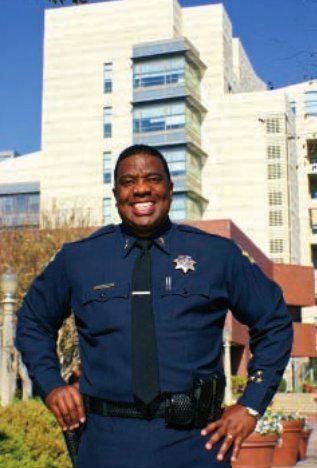
Former Fresno Deputy Police Chief Keith Foster. (Fresno Police Department)
“Yeah.”
“Oh shit, shit, Unc, the very best right there is going at least seven. Not right now, at my cost now they’ll say about a rack for the best. We’re talking about some China white though, you know what I mean?”
“Hey man, hey, hey, hey you ain’t got to go, you ain’t got to go into all the det-. Hey meet me Friday and we’ll, and we, we gonna talk.”
It was in some ways a typical conversation between two drug dealers, complete with coded language — “ticket” meaning price, “a rack” meaning a thousand, “China white” referring to high-grade heroin — and an admonition not to go into detail on the phone. But one of the voices on the line, the one the younger man called “Unc,” was Deputy Chief Keith Foster.
Federal agents on the stand told a winding story, interspersed with headline-grabbing audio recordings like the conversation about “China white.” The story had three main threads, each about a different drug. Foster, they said, had gone into business with one nephew to sell marijuana. He had been prescribed 100 pills a month of oxycodone, which they charged he was selling to another nephew (the jury hung on the oxycodone charges, perhaps because Foster wasn’t heard on wiretaps explicitly talking about the pills.) Finally, he had agreed to purchase heroin for a female friend of his and then tried to buy it from a young man he had previously mentored in a gang-violence prevention program.
Dyer contended that he didn’t know about any of this. While it’s true that Foster had never before been found guilty of wrongdoing, he had been accused of it on numerous occasions. And Dyer certainly knew about the history of troubling allegations. There was the wife of a captain who had accused Foster of sexual battery at a concert. The child abuse claims his department had investigated and rejected, although a doctor had laid blame at Foster. And there were the money problems.
Yes, the sexual battery and child abuse allegations were investigated by the department and rejected. And money problems don’t necessarily mean a longtime, trusted officer will suddenly break bad.
But taken together, they might have prompted a deeper review.
Dyer made no mention of any of this when asked under oath if Foster ever had disciplinary problems.
“Did you have confidence in him?” asked Foster’s defense attorney, Marshall Hodgkins.
“I did,” Dyer answered.
‘I Have a Clear Heart and a Clear Conscience, 100 Percent’
The chief was not entirely unscathed by the Foster saga. Despite ongoing statements of confidence in him from the city’s political leadership, his own department was shaken by the trial. A half-dozen current and former officers interviewed for this article, most of whom did not want to be named for fear of retaliation, uniformly said they were stunned that Dyer didn’t face sustained scrutiny after Foster’s arrest.
In the end, the 54-year-old Foster was sentenced to four years in federal prison. In January last year, he surrendered himself to U.S. marshals to begin his term, which he is serving in Florence, Colorado, while drawing his full $93,000-a-year police pension. A week after his arrest, Foster was allowed to retire from the department. He’s appealing the conviction. In an email from prison, Foster maintained his innocence.
Unsealed: California's Secret Police Files
To this day, Dyer has not said if the department investigated past cases that may have been compromised by Foster’s involvement. And he hasn’t offered any public comments about a deeper probe of his force, despite the fact prosecutors mentioned other officers who Foster tried to enlist to help his nephews.
Other large cities around the state and country have done major reviews of their police departments after corruption scandals. The feds spent only four months looking into Foster who, according to one nephew, was helping deal marijuana for about seven years.
Dyer, upset by public records requests filed during the reporting of this story, refused to speak to this reporter. He called the requests “a slap in my face.”
“I have a clear heart and a clear conscience, 100 percent,” Dyer told editors of this story. He said he’s interested in looking forward, not back. He wants to make it to 40 years in the department, which will happen this year, when he’s technically required to step down.
Dyer said he hasn’t emotionally recovered from the pain of seeing his deputy and friend on trial. “Quite frankly, I haven’t gotten over it,” Dyer said. “It’s kind of like, you’re married and your wife betrays you.”
Dyer said that California’s Peace Officers Bill of Rights, granting broad labor protections to officers, ties his hands. The law, however, does not prevent him from checking into whether his officers had been accused of a crime. Nor is he barred from looking at publicly available documents, such as the divorce files, liens and child-support orders by the district attorney, to get a picture of an officer’s personal life. But in Foster’s case, he said, he had no reason to look deeper.
He has changed the way he reviews new hires and promotions, he said. He now asks them if there is anything in their personal life or finances that might affect their suitability for the job.
Dyer acknowledged that many of his actions may seem suspicious from an outside perspective.
“If I were in Berkeley, I would be saying, that chief’s probably corrupt, he’s probably Teflon, he’s untouchable,” he said. “That’s not me. … I try to live a godly life and a good life. I have a calling, a passion, and things happen along the way that are out of your control.”
Andrew Beale is a reporter for The Press Democrat in Santa Rosa. He completed this article at the Investigative Reporting Program, part of the Graduate School of Journalism at UC Berkeley. Robert Lewis contributed research for this article.
lower waypointnext waypoint
Player sponsored by
window.__IS_SSR__=true
window.__INITIAL_STATE__={
"attachmentsReducer": {
"audio_0": {
"type": "attachments",
"id": "audio_0",
"imgSizes": {
"kqedFullSize": {
"file": "https://ww2.kqed.org/news/wp-content/themes/KQED-unified/img/audio_bgs/background0.jpg"
}
}
},
"audio_1": {
"type": "attachments",
"id": "audio_1",
"imgSizes": {
"kqedFullSize": {
"file": "https://ww2.kqed.org/news/wp-content/themes/KQED-unified/img/audio_bgs/background1.jpg"
}
}
},
"audio_2": {
"type": "attachments",
"id": "audio_2",
"imgSizes": {
"kqedFullSize": {
"file": "https://ww2.kqed.org/news/wp-content/themes/KQED-unified/img/audio_bgs/background2.jpg"
}
}
},
"audio_3": {
"type": "attachments",
"id": "audio_3",
"imgSizes": {
"kqedFullSize": {
"file": "https://ww2.kqed.org/news/wp-content/themes/KQED-unified/img/audio_bgs/background3.jpg"
}
}
},
"audio_4": {
"type": "attachments",
"id": "audio_4",
"imgSizes": {
"kqedFullSize": {
"file": "https://ww2.kqed.org/news/wp-content/themes/KQED-unified/img/audio_bgs/background4.jpg"
}
}
},
"placeholder": {
"type": "attachments",
"id": "placeholder",
"imgSizes": {
"thumbnail": {
"file": "https://cdn.kqed.org/wp-content/uploads/2024/12/KQED-Default-Image-816638274-2000x1333-1-160x107.jpg",
"width": 160,
"height": 107,
"mimeType": "image/jpeg"
},
"medium": {
"file": "https://cdn.kqed.org/wp-content/uploads/2024/12/KQED-Default-Image-816638274-2000x1333-1-800x533.jpg",
"width": 800,
"height": 533,
"mimeType": "image/jpeg"
},
"medium_large": {
"file": "https://cdn.kqed.org/wp-content/uploads/2024/12/KQED-Default-Image-816638274-2000x1333-1-768x512.jpg",
"width": 768,
"height": 512,
"mimeType": "image/jpeg"
},
"large": {
"file": "https://cdn.kqed.org/wp-content/uploads/2024/12/KQED-Default-Image-816638274-2000x1333-1-1020x680.jpg",
"width": 1020,
"height": 680,
"mimeType": "image/jpeg"
},
"1536x1536": {
"file": "https://cdn.kqed.org/wp-content/uploads/2024/12/KQED-Default-Image-816638274-2000x1333-1-1536x1024.jpg",
"width": 1536,
"height": 1024,
"mimeType": "image/jpeg"
},
"fd-lrg": {
"file": "https://cdn.kqed.org/wp-content/uploads/2024/12/KQED-Default-Image-816638274-2000x1333-1-1536x1024.jpg",
"width": 1536,
"height": 1024,
"mimeType": "image/jpeg"
},
"fd-med": {
"file": "https://cdn.kqed.org/wp-content/uploads/2024/12/KQED-Default-Image-816638274-2000x1333-1-1020x680.jpg",
"width": 1020,
"height": 680,
"mimeType": "image/jpeg"
},
"fd-sm": {
"file": "https://cdn.kqed.org/wp-content/uploads/2024/12/KQED-Default-Image-816638274-2000x1333-1-800x533.jpg",
"width": 800,
"height": 533,
"mimeType": "image/jpeg"
},
"post-thumbnail": {
"file": "https://cdn.kqed.org/wp-content/uploads/2024/12/KQED-Default-Image-816638274-2000x1333-1-672x372.jpg",
"width": 672,
"height": 372,
"mimeType": "image/jpeg"
},
"twentyfourteen-full-width": {
"file": "https://cdn.kqed.org/wp-content/uploads/2024/12/KQED-Default-Image-816638274-2000x1333-1-1038x576.jpg",
"width": 1038,
"height": 576,
"mimeType": "image/jpeg"
},
"xxsmall": {
"file": "https://cdn.kqed.org/wp-content/uploads/2024/12/KQED-Default-Image-816638274-2000x1333-1-160x107.jpg",
"width": 160,
"height": 107,
"mimeType": "image/jpeg"
},
"xsmall": {
"file": "https://cdn.kqed.org/wp-content/uploads/2024/12/KQED-Default-Image-816638274-2000x1333-1-672x372.jpg",
"width": 672,
"height": 372,
"mimeType": "image/jpeg"
},
"small": {
"file": "https://cdn.kqed.org/wp-content/uploads/2024/12/KQED-Default-Image-816638274-2000x1333-1-672x372.jpg",
"width": 672,
"height": 372,
"mimeType": "image/jpeg"
},
"xlarge": {
"file": "https://cdn.kqed.org/wp-content/uploads/2024/12/KQED-Default-Image-816638274-2000x1333-1-1020x680.jpg",
"width": 1020,
"height": 680,
"mimeType": "image/jpeg"
},
"full-width": {
"file": "https://cdn.kqed.org/wp-content/uploads/2024/12/KQED-Default-Image-816638274-2000x1333-1-1920x1280.jpg",
"width": 1920,
"height": 1280,
"mimeType": "image/jpeg"
},
"guest-author-32": {
"file": "https://cdn.kqed.org/wp-content/uploads/2025/01/KQED-Default-Image-816638274-1333x1333-1-160x160.jpg",
"width": 32,
"height": 32,
"mimeType": "image/jpeg"
},
"guest-author-50": {
"file": "https://cdn.kqed.org/wp-content/uploads/2025/01/KQED-Default-Image-816638274-1333x1333-1-160x160.jpg",
"width": 50,
"height": 50,
"mimeType": "image/jpeg"
},
"guest-author-64": {
"file": "https://cdn.kqed.org/wp-content/uploads/2025/01/KQED-Default-Image-816638274-1333x1333-1-160x160.jpg",
"width": 64,
"height": 64,
"mimeType": "image/jpeg"
},
"guest-author-96": {
"file": "https://cdn.kqed.org/wp-content/uploads/2025/01/KQED-Default-Image-816638274-1333x1333-1-160x160.jpg",
"width": 96,
"height": 96,
"mimeType": "image/jpeg"
},
"guest-author-128": {
"file": "https://cdn.kqed.org/wp-content/uploads/2025/01/KQED-Default-Image-816638274-1333x1333-1-160x160.jpg",
"width": 128,
"height": 128,
"mimeType": "image/jpeg"
},
"detail": {
"file": "https://cdn.kqed.org/wp-content/uploads/2025/01/KQED-Default-Image-816638274-1333x1333-1-160x160.jpg",
"width": 160,
"height": 160,
"mimeType": "image/jpeg"
},
"kqedFullSize": {
"file": "https://cdn.kqed.org/wp-content/uploads/2024/12/KQED-Default-Image-816638274-2000x1333-1.jpg",
"width": 2000,
"height": 1333
}
}
},
"news_11736345": {
"type": "attachments",
"id": "news_11736345",
"meta": {
"index": "attachments_1716263798",
"site": "news",
"id": "11736345",
"found": true
},
"parent": 11736095,
"imgSizes": {
"post-thumbnail": {
"file": "https://ww2.kqed.org/app/uploads/sites/10/2019/03/DyerClose1920-672x372.jpg",
"width": 672,
"mimeType": "image/jpeg",
"height": 372
},
"kqedFullSize": {
"file": "https://ww2.kqed.org/app/uploads/sites/10/2019/03/DyerClose1920.jpg",
"width": 1920,
"height": 1080
},
"guest-author-50": {
"file": "https://ww2.kqed.org/app/uploads/sites/10/2019/03/DyerClose1920-50x50.jpg",
"width": 50,
"mimeType": "image/jpeg",
"height": 50
},
"guest-author-96": {
"file": "https://ww2.kqed.org/app/uploads/sites/10/2019/03/DyerClose1920-96x96.jpg",
"width": 96,
"mimeType": "image/jpeg",
"height": 96
},
"apple_news_ca_portrait_12_9": {
"file": "https://ww2.kqed.org/app/uploads/sites/10/2019/03/DyerClose1920-1122x1080.jpg",
"width": 1122,
"mimeType": "image/jpeg",
"height": 1080
},
"medium": {
"file": "https://ww2.kqed.org/app/uploads/sites/10/2019/03/DyerClose1920-800x450.jpg",
"width": 800,
"mimeType": "image/jpeg",
"height": 450
},
"guest-author-32": {
"file": "https://ww2.kqed.org/app/uploads/sites/10/2019/03/DyerClose1920-32x32.jpg",
"width": 32,
"mimeType": "image/jpeg",
"height": 32
},
"apple_news_ca_portrait_9_7": {
"file": "https://ww2.kqed.org/app/uploads/sites/10/2019/03/DyerClose1920-840x1080.jpg",
"width": 840,
"mimeType": "image/jpeg",
"height": 1080
},
"apple_news_ca_square_9_7": {
"file": "https://ww2.kqed.org/app/uploads/sites/10/2019/03/DyerClose1920-1104x1080.jpg",
"width": 1104,
"mimeType": "image/jpeg",
"height": 1080
},
"apple_news_ca_portrait_4_7": {
"file": "https://ww2.kqed.org/app/uploads/sites/10/2019/03/DyerClose1920-414x552.jpg",
"width": 414,
"mimeType": "image/jpeg",
"height": 552
},
"apple_news_ca_square_12_9": {
"file": "https://ww2.kqed.org/app/uploads/sites/10/2019/03/DyerClose1920-1472x1080.jpg",
"width": 1472,
"mimeType": "image/jpeg",
"height": 1080
},
"apple_news_ca_portrait_5_5": {
"file": "https://ww2.kqed.org/app/uploads/sites/10/2019/03/DyerClose1920-687x916.jpg",
"width": 687,
"mimeType": "image/jpeg",
"height": 916
},
"apple_news_ca_square_4_7": {
"file": "https://ww2.kqed.org/app/uploads/sites/10/2019/03/DyerClose1920-550x550.jpg",
"width": 550,
"mimeType": "image/jpeg",
"height": 550
},
"apple_news_ca_square_5_5": {
"file": "https://ww2.kqed.org/app/uploads/sites/10/2019/03/DyerClose1920-912x912.jpg",
"width": 912,
"mimeType": "image/jpeg",
"height": 912
},
"apple_news_ca_landscape_5_5": {
"file": "https://ww2.kqed.org/app/uploads/sites/10/2019/03/DyerClose1920-1044x783.jpg",
"width": 1044,
"mimeType": "image/jpeg",
"height": 783
},
"apple_news_ca_square_4_0": {
"file": "https://ww2.kqed.org/app/uploads/sites/10/2019/03/DyerClose1920-470x470.jpg",
"width": 470,
"mimeType": "image/jpeg",
"height": 470
},
"twentyfourteen-full-width": {
"file": "https://ww2.kqed.org/app/uploads/sites/10/2019/03/DyerClose1920-1038x576.jpg",
"width": 1038,
"mimeType": "image/jpeg",
"height": 576
},
"thumbnail": {
"file": "https://ww2.kqed.org/app/uploads/sites/10/2019/03/DyerClose1920-160x90.jpg",
"width": 160,
"mimeType": "image/jpeg",
"height": 90
},
"apple_news_ca_landscape_4_7": {
"file": "https://ww2.kqed.org/app/uploads/sites/10/2019/03/DyerClose1920-632x474.jpg",
"width": 632,
"mimeType": "image/jpeg",
"height": 474
},
"large": {
"file": "https://ww2.kqed.org/app/uploads/sites/10/2019/03/DyerClose1920-1020x574.jpg",
"width": 1020,
"mimeType": "image/jpeg",
"height": 574
},
"complete_open_graph": {
"file": "https://ww2.kqed.org/app/uploads/sites/10/2019/03/DyerClose1920-1200x675.jpg",
"width": 1200,
"mimeType": "image/jpeg",
"height": 675
},
"apple_news_ca_landscape_4_0": {
"file": "https://ww2.kqed.org/app/uploads/sites/10/2019/03/DyerClose1920-536x402.jpg",
"width": 536,
"mimeType": "image/jpeg",
"height": 402
},
"guest-author-64": {
"file": "https://ww2.kqed.org/app/uploads/sites/10/2019/03/DyerClose1920-64x64.jpg",
"width": 64,
"mimeType": "image/jpeg",
"height": 64
},
"apple_news_ca_portrait_4_0": {
"file": "https://ww2.kqed.org/app/uploads/sites/10/2019/03/DyerClose1920-354x472.jpg",
"width": 354,
"mimeType": "image/jpeg",
"height": 472
},
"apple_news_ca_landscape_12_9": {
"file": "https://ww2.kqed.org/app/uploads/sites/10/2019/03/DyerClose1920-1832x1080.jpg",
"width": 1832,
"mimeType": "image/jpeg",
"height": 1080
},
"full-width": {
"file": "https://ww2.kqed.org/app/uploads/sites/10/2019/03/DyerClose1920-1920x1080.jpg",
"width": 1920,
"mimeType": "image/jpeg",
"height": 1080
},
"guest-author-128": {
"file": "https://ww2.kqed.org/app/uploads/sites/10/2019/03/DyerClose1920-128x128.jpg",
"width": 128,
"mimeType": "image/jpeg",
"height": 128
},
"apple_news_ca_landscape_9_7": {
"file": "https://ww2.kqed.org/app/uploads/sites/10/2019/03/DyerClose1920-1376x1032.jpg",
"width": 1376,
"mimeType": "image/jpeg",
"height": 1032
}
},
"publishDate": 1553868057,
"modified": 1553868094,
"caption": "Fresno Police Chief Jerry Dyer",
"description": null,
"title": "DyerClose1920",
"credit": "Alexandria Fuller and Mary Newman",
"status": "inherit",
"isLoading": false,
"fetchFailed": false
}
},
"audioPlayerReducer": {
"postId": "stream_live",
"isPaused": true,
"isPlaying": false,
"pfsActive": false,
"pledgeModalIsOpen": true,
"playerDrawerIsOpen": false,
"liveAudioPlayStartedAt": 0,
"liveAudioPlayContext": ""
},
"authorsReducer": {
"byline_news_11736095": {
"type": "authors",
"id": "byline_news_11736095",
"meta": {
"override": true
},
"slug": "byline_news_11736095",
"name": "\u003cstrong>Andrew Beale\u003cbr />Investigative Reporting Program, UC Berkeley Graduate School of Journalism\u003c/strong>",
"isLoading": false
}
},
"pagesReducer": {},
"pfsSessionReducer": {},
"postsReducer": {
"stream_live": {
"type": "live",
"id": "stream_live",
"audioUrl": "https://streams.kqed.org/kqedradio",
"title": "Live Stream",
"excerpt": "Live Stream information currently unavailable.",
"link": "/radio",
"featImg": "",
"label": {
"name": "KQED Live",
"link": "/"
}
},
"stream_kqedNewscast": {
"type": "posts",
"id": "stream_kqedNewscast",
"audioUrl": "https://www.kqed.org/.stream/anon/radio/RDnews/newscast.mp3?_=1",
"title": "KQED Newscast",
"featImg": "",
"label": {
"name": "88.5 FM",
"link": "/"
}
},
"news_11736095": {
"type": "posts",
"id": "news_11736095",
"meta": {
"index": "posts_1716263798",
"site": "news",
"id": "11736095",
"found": true
},
"articlePosition": 0,
"guestAuthors": [],
"slug": "the-chief-the-remarkable-sometimes-shocking-career-of-fresnos-top-cop",
"title": "The Chief: The Remarkable — Sometimes Shocking — Career of Fresno's Top Cop",
"publishDate": 1553902234,
"format": "audio",
"headTitle": "The Chief: The Remarkable — Sometimes Shocking — Career of Fresno’s Top Cop | KQED",
"labelTerm": {
"term": 72,
"site": "news"
},
"content": "\u003cp>\u003cem>\u003ca href=\"http://itunes.apple.com/us/podcast/the-california-report-magazine/id1314750545?mt=2\" rel=\"noopener\" target=\"_blank\">Listen to this and more in-depth storytelling by subscribing to The California Report Magazine podcast.\u003c/a>\u003c/em>\u003c/p>\n\u003cp>[dropcap]I[/dropcap]f Fresno were another place, Jerry Dyer’s career might have ended in a federal courtroom two years ago. He had been called to testify in a case that, once again, portrayed Fresno not as the fifth-largest city in the state with forward-thinking institutions but a backwater of corruption a century and a quarter deep. \u003c/p>\n\u003cp>Dyer wasn’t just any witness. He strode into the downtown courthouse wearing a crisp dark-blue uniform with four gold chief’s stars popping out from the collar. He was in his late 50s, but his neck, chest and arms still bulged from decades of lifting weights. His signature mustache, now gray, was set off by a head completely shaven.\u003c/p>\n\u003cp>[aside postID='news_11691667' label='Fresno's Economic, Racial Inequalities Explored in 'Unequal From Birth'']\u003c/p>\n\u003cp>His 16-year tenure as chief had made him one of the longest-serving leaders of a big-city police department in modern California history. He had remained the chief by escaping scandal time and again — from front-page revelations that he had been investigated for sex with a minor to the bizarre case of one of his high-ranking officers and good friends turning up dead in front of Dyer’s home under mysterious circumstances.\u003c/p>\n\u003cp>The case before the federal court now raised questions so troubling — about his administration of the police department, about his supervision of his right-hand man — that Dyer’s conduct itself might have been on trial. His second-in-command, Keith Foster, had been charged as the kingpin of his own drug-trafficking organization. The two men had spent their careers side by side as Foster followed Dyer in every promotion. His office was the only one Dyer passed every day on the way to his own.\u003c/p>\n\u003cp>Foster’s arrest on charges of conspiring to distribute heroin, marijuana and oxycodone had surprised even jaded City Hall watchers who had seen the FBI in the 1990s arrest dozens of local developers and politicians in a lengthy probe dubbed \u003ca href=\"https://www.latimes.com/archives/la-xpm-1998-feb-21-mn-21438-story.html\" target=\"_blank\" rel=\"noopener\">Operation Rezone\u003c/a>. But federal authorities accusing a top official in a major city of running a drug ring was different. So stunning was Foster’s arrest that a top columnist in the city compared it to \u003ca href=\"http://www.cvobserver.com/crime/brand-pab-escalated-quickly-foster-trial/\" target=\"_blank\" rel=\"noopener\">the shock of the Pearl Harbor attack\u003c/a>. Like many others in Fresno, the columnist expected Dyer and other city leaders to face tough questions about what they did and didn’t know. As Dyer walked into the courtroom that spring day, the city’s eyes were on him, waiting to see how he would answer for himself.\u003c/p>\n\u003cp>Strangely, Dyer hadn’t been called as a witness for the prosecution. He was there on behalf of Foster’s defense. When one of the prosecutors asked him to explain how he felt when he learned of Foster’s arrest, he described emotions — shock, hurt and a sense of betrayal — in a flat tone that belied such feelings.\u003c/p>\n\u003cp>[ad fullwidth]\u003c/p>\n\u003cp>Over and over, he repeated that Foster had always had his full trust, right up to the day the deputy chief was hit with a seven-count federal indictment after he was pulled over by federal agents as he left his nephew’s house.\u003c/p>\n\u003cp>As prosecutors continued their questioning of Dyer, they might have delved into why the police chief had missed or chosen to ignore flagrant signs of trouble. But prosecutors never asked the chief about Foster’s finances, which had long ago spiraled out of control. He’d lost his house to foreclosure. He’d been hit with an IRS lien and his wages had been garnished after repeated failures to pay alimony and child support. All the while, according to his ex-wife, he lived a “lavish lifestyle,” complete with furs, jewelry and expensive clothing.\u003c/p>\n\u003cp>They didn’t ask Dyer why he maintained his trust in Foster even as the deputy chief was accused on two occasions of spousal and child abuse. Neither did prosecutors ask about accusations from two women that Foster had sexually harassed and sexually assaulted them. All of this information was readily available in court documents open to the public. The only noteworthy testimony elicited by the feds from Dyer had to do with Foster’s main line of defense: that he was working on the city’s heroin problem and that’s why he had repeated contacts with a major heroin dealer. Dyer told the jury that if Foster was working in such a capacity, he never produced a report on his findings.\u003c/p>\n\u003cp>And that was pretty much all the duress the police chief of Fresno faced. As he walked out of the federal courthouse into the sunshine, no probing questions came at him from the local media either.\u003c/p>\n\u003cp>One TV station \u003ca href=\"https://www.yourcentralvalley.com/news/fresno-police-chief-jerry-dyer-testifies-in-keith-foster-trial/716083041\" target=\"_blank\" rel=\"noopener\">described\u003c/a> it as a “difficult day” for Dyer that “left him reeling” because of the disappointment he felt at seeing his former deputy chief on trial. Another broadcast a segment in which Dyer \u003ca href=\"https://abc30.com/news/fresno-police-chief-jerry-dyer-takes-the-stand-in-keith-foster-trial/2006320/\" target=\"_blank\" rel=\"noopener\">explained\u003c/a> that “whether the allegations turn out to be true or not, the fact is, this investigation occurred, and Keith was arrested, and as a result I felt a sense of betrayal.”\u003c/p>\n\u003cp>Nobody asked him why it took federal agents to catch a man that Dyer himself saw every day, a man who, according to a co-conspirator, had been trafficking drugs for seven years.\u003c/p>\n\u003cp>Two years later, Dyer is still the chief. And within the department, he says, “Keith Foster’s not on anybody’s mind.”\u003c/p>\n\u003cp>It wasn’t the first time Dyer escaped any real ramifications for problems in his department. Over the years, he’s faced remarkably little scrutiny for someone who spends so much time in the public eye.\u003c/p>\n\u003cfigure id=\"attachment_11736347\" class=\"wp-caption aligncenter\" style=\"max-width: 800px\">\u003cimg loading=\"lazy\" decoding=\"async\" class=\"size-medium wp-image-11736347\" src=\"https://ww2.kqed.org/news/wp-content/uploads/sites/10/2019/03/jerry-dyer-billboard-800x533.jpg\" alt=\"A billboard featuring Fresno Police Chief Jerry Dyer\" width=\"800\" height=\"533\" srcset=\"https://cdn.kqed.org/wp-content/uploads/sites/10/2019/03/jerry-dyer-billboard-800x533.jpg 800w, https://cdn.kqed.org/wp-content/uploads/sites/10/2019/03/jerry-dyer-billboard-160x107.jpg 160w, https://cdn.kqed.org/wp-content/uploads/sites/10/2019/03/jerry-dyer-billboard-1020x680.jpg 1020w, https://cdn.kqed.org/wp-content/uploads/sites/10/2019/03/jerry-dyer-billboard-1200x800.jpg 1200w, https://cdn.kqed.org/wp-content/uploads/sites/10/2019/03/jerry-dyer-billboard-1920x1280.jpg 1920w, https://cdn.kqed.org/wp-content/uploads/sites/10/2019/03/jerry-dyer-billboard.jpg 2048w\" sizes=\"(max-width: 800px) 100vw, 800px\">\u003cfigcaption class=\"wp-caption-text\">A billboard featuring Fresno Police Chief Jerry Dyer. \u003ccite>(Alexandria Fuller)\u003c/cite>\u003c/figcaption>\u003c/figure>\n\u003ch2>In Politics, a Police Chief Who Seems Beyond Criticism\u003c/h2>\n\u003cp>In Fresno, Jerry Dyer seems to be everywhere: church services, neighborhood barbecues, in \u003ca href=\"https://www.fresnobee.com/latest-news/article211291469.html\" target=\"_blank\" rel=\"noopener\">full uniform\u003c/a> at a Snoop Dogg concert. He can be seen \u003ca href=\"https://abc30.com/politics/new-billboard-campaign-aims-to-reduce-traffic-fatalities/3150483/\" target=\"_blank\" rel=\"noopener\">smiling down\u003c/a> from billboards reminding Fresnans to drive safely. He appeared in uniform on a \u003ca href=\"https://www.fresnobee.com/news/local/article168979932.html\" target=\"_blank\" rel=\"noopener\">national TV ad\u003c/a> for home-security company ADT, saying the company may have saved a Fresno woman. He even has \u003ca href=\"https://kmph.com/news/local/a-jerry-dyer-bobble-head\" target=\"_blank\" rel=\"noopener\">his own bobblehead\u003c/a>.\u003c/p>\n\u003cp>Dyer, the 59-year-old son of a Fresno police officer, has amassed the kind of behind-the-scenes power that few police chiefs achieve. When he was elected head of the California Police Chiefs Association in 2008, he held a three-day party in downtown Fresno featuring armored personnel carriers parading through the streets in what local activists described as a “coronation.” Eight years later, celebrating 15 years on the job, he was feted by local politicians and celebrities at a black-tie event, with all three mayors he had served under praising him effusively, even as some 60 people gathered outside to protest the police killing of unarmed teenager Dylan Noble.\u003c/p>\n\u003cp>In 2015, three months after Foster’s arrest, a Washington Post \u003ca href=\"https://www.washingtonpost.com/national/in-fresno-police-focus-on-building-relationships-not-making-arrests/2015/05/06/3c396f04-eab9-11e4-9a6a-c1ab95a0600b_story.html?noredirect=on&utm_term=.eed239c2aeb5\" target=\"_blank\" rel=\"noopener\">profile\u003c/a> lauded his commitment to community policing and highlighted his department’s practice of holding barbecues in an effort to connect with citizens. Dyer touts a laundry list of accomplishments, from \u003ca href=\"https://www.fresnobee.com/news/local/crime/article210808774.html\" target=\"_blank\" rel=\"noopener\">falling crime rates\u003c/a> to a \u003ca href=\"https://www.fresno.gov/police/chiefs-message/\" target=\"_blank\" rel=\"noopener\">reduction\u003c/a> in traffic fatalities during his tenure. Fresno gangs are his bête noire, and he scored a major victory last year as leaders of the notoriously violent Dog Pound gang \u003ca href=\"https://www.fresnobee.com/news/local/crime/article213544924.html\" target=\"_blank\" rel=\"noopener\">pleaded guilty\u003c/a> to a wide range of federal charges.\u003c/p>\n\u003cp>In Fresno politics, Dyer seems to be beyond criticism. A review of articles in the local paper, the Fresno Bee, showed that no current City Council member has criticized Dyer in print, not even mildly (a former City Council president did once accuse him of being “arrogant”). And the city has rewarded him handsomely for his service: He \u003ca href=\"https://transparentcalifornia.com/salaries/search/?q=Jerry%20Dyer\" target=\"_blank\" rel=\"noopener\">made over $247,000\u003c/a> in 2017, \u003ca href=\"https://www.nytimes.com/2016/08/06/nyregion/scrutiny-of-incoming-police-commissioner-begins-with-his-suits.html\" target=\"_blank\" rel=\"noopener\">more than\u003c/a> the police commissioner in New York City. No, Jerry Dyer is not a typical big-city police chief. Then again, Fresno is not a typical big city.\u003c/p>\n\u003ch2>‘God’s Forgiven Me. My Wife’s Forgiven Me. This Department’s Forgiven Me’\u003c/h2>\n\u003cp>Fresno began as little more than a railroad stop in California’s Central Valley. The Central Pacific Railroad Co. \u003ca href=\"https://www.fresno.gov/darm/historic-preservation/history-of-fresno/\" target=\"_blank\" rel=\"noopener\">founded\u003c/a> the town in 1872. It was incorporated 13 years later and soon grew into an agricultural powerhouse. The figure who casts the longest shadow on Fresno today is undoubtedly Hank Morton, the high-water mark of corrupt police chiefs in a town with \u003ca href=\"https://www.latimes.com/archives/la-xpm-1992-12-06-mn-3568-story.html\" target=\"_blank\" rel=\"noopener\">no shortage of them\u003c/a>. During Prohibition, federal agents considered Fresno County the wettest in the nation, and the local police ran the booze. But it was Morton, ruling the department from the ‘50s through the ‘70s, who elevated corruption to an art.\u003c/p>\n\u003cp>Replacing Chief Ray Wallace, who was sentenced to prison in 1950 for using his office to amass 1,700 acres of land, Morton quickly took control of the area’s brothels, marrying Fresno’s top madam. He consolidated power (and avoided prosecution) using a vast intelligence apparatus inside the Police Department dedicated to gathering blackmail material on political leaders.\u003c/p>\n\u003cp>After Morton’s retirement, three separate federal organized crime task forces investigated the Fresno police, leading to a reform period in the department that lasted for two decades. That era ended with the appointment of Dyer’s predecessor, Ed Winchester, who \u003ca href=\"https://www.latimes.com/archives/la-xpm-2001-may-16-me-64135-story.html\" target=\"_blank\" rel=\"noopener\">stepped down in disgrace\u003c/a> in 2001 amid compounding scandals, including the disappearance of 11 pounds of cocaine and $200,000 in cash from the evidence room. Jerry Dyer was born at the height of Morton’s reign, in May 1959, and rose to department leadership under Winchester.\u003c/p>\n\u003cp>Dyer joined the force on May 1, 1979, just two days before his 20th birthday. His sister, Diane, also became a cop, and served on the Fresno force until 2011. Being a cop was in his blood, but he wasn’t content to remain a patrol officer.\u003c/p>\n\u003cp>His appointment as chief was, perhaps, inevitable. His first major step was a two-year stint as public information officer, from 1995 to 1997. The name recognition he earned from frequent TV appearances helped him launch the defining project of his pre-chief years, the Skywatch helicopter program. He raised private donations to buy the department its first helicopters.\u003c/p>\n\u003cp>There was one other key piece of Dyer’s rise, something that might not be expected to influence a career in government service: his identity as a born-again Christian.\u003c/p>\n\u003cp>He’s a frequent guest at many Fresno-area churches, and is often spotted at prayer breakfasts and other public religious gatherings. In Dyer’s telling, the story goes like this: In his 20s, he began drinking heavily, cheating on his wife and breaking police department rules (which rules, he won’t say, but he does acknowledge being the subject of internal affairs probes while a beat cop.) In 2005, he \u003ca href=\"https://hanfordsentinel.com/community/kingsburg_recorder/news/fresno-police-chief-relies-on-god-for-inspiaration/article_2f70a795-0ea2-5d5b-9075-494a126d9230.html\" target=\"_blank\" rel=\"noopener\">told a crowd\u003c/a> that as a young man he was “dishonest, egotistical, proud, arrogant and disobedient.”\u003c/p>\n\u003cp>He had a revelation at the age of 32, when a friend suggested he go to church. In what Dyer sees as a sign from on high, the pastor spoke about the two problems plaguing his life: alcohol and adultery. He said he attended services the next two Sundays, and on the third Sunday, he experienced a rebirth, turning himself over to God and pledging to change his ways. He has an exact date for his spiritual awakening: Sept. 15, 1991.\u003c/p>\n\u003cp>Department leadership quickly noticed his newfound commitment to God — and, stemming from that, his commitment to doing the right thing and working to help others. He rose quickly through the ranks and was named chief just under 10 years later.\u003c/p>\n\u003cp>Dyer has used his faith as cover to protect him from potentially damaging stories from his pre-religious past. He got his first chance to test his story’s value almost immediately after he was appointed chief.\u003c/p>\n\u003cp>[pullquote size='large' align='right' citation='Fresno Police Chief Jerry Dyer']‘All I can tell you is that the relationships that I have had outside of my marriage, when I was a young man, have been dealt with. God’s forgiven me. My wife’s forgiven me. This department’s forgiven me and looked into a lot of things in my past.’[/pullquote]\u003c/p>\n\u003cp>Fresno’s then-city manager, Dan Hobbs, announced Dyer’s appointment on July 18, 2001. Four days later, a front-page story in the Fresno Bee proclaimed: “Cops twice probed allegations Dyer had affair with girl, 16.”\u003c/p>\n\u003cp>Dyer reportedly had sex with a 16-year-old girl when he was a 26-year-old officer in 1985. The accusation was investigated shortly after it was alleged to have occurred, and again in response to a citizen complaint after Dyer became department spokesman in 1995.\u003c/p>\n\u003cp>The Bee article was based on interviews with unnamed police sources who were privy to the investigations, as well as family members of the alleged victim, although the alleged victim herself would not confirm or deny the allegations. Contacted for this article, she declined to comment.\u003c/p>\n\u003cp>Dyer refused to deny the story, instead relying on his born-again image to excuse his past behavior.\u003c/p>\n\u003cp>“All I can tell you is that the relationships that I have had outside of my marriage, when I was a young man, have been dealt with,” he told the Bee. “God’s forgiven me. My wife’s forgiven me. This department’s forgiven me and looked into a lot of things in my past.”\u003c/p>\n\u003cp>Dyer took his oath as police chief on Aug. 2, less than two weeks after the story came out.\u003c/p>\n\u003cp>Nearly 18 years later, even with the wave of powerful men felled by the #MeToo movement, no reporter or city leader has publicly asked him about it since the original article was published. And he still has not publicly denied the allegations.\u003c/p>\n\u003cp>He faced another public scandal just a few years later when a lieutenant named Jose Moralez was found dead, shot in the chest just 200 feet from Dyer’s house. The chief was reportedly considering firing Moralez for lying. The shooting was ultimately ruled a suicide. But it’s become something of an urban legend in Fresno and another bizarre chapter in the chief’s lengthy career.\u003c/p>\n\u003cp>Dyer relied on his religiosity to build faith among his own officers, as well. In a 2005 department-wide memo, Dyer apologized for unspecified offensive comments he made, and he pledged to improve his performance at home, at work and at church. As part of his penance, he told his officers, “I will view teaching Sunday school as an opportunity to help and serve others and not as an obligation.”\u003c/p>\n\u003ch2>Bias Allegations Leveled Against Department From Within\u003c/h2>\n\u003cp>Institutional racism has long plagued Fresno. Its majority-black 93706 ZIP code is the poorest urban ZIP code in the entire state. A person born just 10 miles away, in wealthy Northeast Fresno, has a life expectancy 20 years longer than a person born in the 93706.\u003c/p>\n\u003cp>Dyer himself is not immune to the racism endemic in the city. In 2011, two deputy chiefs, Robert Nevarez and Sharon Shaffer, sued Dyer personally, alleging he had created a hostile work environment in the Fresno Police Department.\u003c/p>\n\u003cp>“When referring to African-American individuals, including employees, DYER sings the antebellum slave song ‘Mammy’s little baby loves short’nin bread,’ ” according to Shaffer and Nevarez’s complaint. The deputy chiefs accused Dyer of many other racially and sexually charged comments, including referring to an Asian-American employee as his “little geisha girl,” making inappropriate comments about a subordinate’s breasts and joking that it’s OK to punch African-Americans in the face because they “don’t have bones in their noses.”\u003c/p>\n\u003cp>Fresno City Hall eventually settled their lawsuit, paying $100,000 each to Shaffer and Nevarez, plus $100,000 in fees and costs to their lawyer. But not before racking up $820,000 in legal fees, according to the Fresno Bee, and exposing the chief’s behind-the-scenes behavior to public scrutiny.\u003c/p>\n\u003cp>Nevarez and Shaffer’s lawsuit didn’t mark the first time Dyer had run into trouble for what he had said at work. Years later, in response to the 2011 lawsuit, Dyer’s attorneys admitted he had made racially charged and sexually suggestive comments at staff meetings. They repeatedly relied on Foster’s status as an African-American as a shield against allegations Dyer’s remarks were racist. The Nevarez/Shaffer suit also shed light on another aspect of the department: Dyer’s close relationship with Foster.\u003c/p>\n\u003cp>“At the September 9 Meeting, a Fresno Bee article was discussed. This article quoted Captain Al Maroney calling Deputy Chief Keith Foster, Chief Dyer’s ‘pet,’ ” according to a filing by his lawyers. “Chief Dyer said to Deputy Chief Keith Foster, ‘If you are my pet, then you’re my Chia Pet’ and sang the first lines of the ‘Chia Pet song.’ ”\u003c/p>\n\u003cp>The lawsuit asserted that the reference to Chia Pets was a racial remark referring to stereotypes about African-Americans’ hair.\u003c/p>\n\u003cp>“Deputy Chief Keith Foster was not offended by the term ‘Chia pet’ at the September 9 Meeting,” Dyer’s lawyers wrote. Not every officer took Foster’s sanguine view. In an internal survey of officers’ attitudes in 2015, almost 20 percent said racial and gender bias was a “severe or serious problem” in the department.\u003c/p>\n\u003ch2>‘Did you have confidence in him?’ ‘I did.’\u003c/h2>\n\u003cp>The voice crackled through the courtroom speaker with the characteristic pops and hisses of a recorded phone call. “They want one of them?” And the reply, from a deeper, older voice: “Yeah, what’s the ticket?”\u003c/p>\n\u003cp>“It depends, how, how good of color they want?”\u003c/p>\n\u003cp>“I mean they, they, the very, very best.”\u003c/p>\n\u003cp>“The very, very best?”\u003c/p>\n\u003cfigure id=\"attachment_11736121\" class=\"wp-caption alignright\" style=\"max-width: 317px\">\u003cimg loading=\"lazy\" decoding=\"async\" class=\"size-full wp-image-11736121\" src=\"https://ww2.kqed.org/news/wp-content/uploads/sites/10/2019/03/keith-foster.jpg\" alt=\"\" width=\"317\" height=\"468\" srcset=\"https://cdn.kqed.org/wp-content/uploads/sites/10/2019/03/keith-foster.jpg 317w, https://cdn.kqed.org/wp-content/uploads/sites/10/2019/03/keith-foster-160x236.jpg 160w\" sizes=\"(max-width: 317px) 100vw, 317px\">\u003cfigcaption class=\"wp-caption-text\">Former Fresno Deputy Police Chief Keith Foster. \u003ccite>(Fresno Police Department)\u003c/cite>\u003c/figcaption>\u003c/figure>\n\u003cp>“Yeah.”\u003c/p>\n\u003cp>“Oh shit, shit, Unc, the very best right there is going at least seven. Not right now, at my cost now they’ll say about a rack for the best. We’re talking about some China white though, you know what I mean?”\u003c/p>\n\u003cp>“Hey man, hey, hey, hey you ain’t got to go, you ain’t got to go into all the det-. Hey meet me Friday and we’ll, and we, we gonna talk.”\u003c/p>\n\u003cp>It was in some ways a typical conversation between two drug dealers, complete with coded language — “ticket” meaning price, “a rack” meaning a thousand, “China white” referring to high-grade heroin — and an admonition not to go into detail on the phone. But one of the voices on the line, the one the younger man called “Unc,” was Deputy Chief Keith Foster.\u003c/p>\n\u003cp>Federal agents on the stand told a winding story, interspersed with headline-grabbing audio recordings like the conversation about “China white.” The story had three main threads, each about a different drug. Foster, they said, had gone into business with one nephew to sell marijuana. He had been prescribed 100 pills a month of oxycodone, which they charged he was selling to another nephew (the jury hung on the oxycodone charges, perhaps because Foster wasn’t heard on wiretaps explicitly talking about the pills.) Finally, he had agreed to purchase heroin for a female friend of his and then tried to buy it from a young man he had previously mentored in a gang-violence prevention program.\u003c/p>\n\u003cp>Dyer contended that he didn’t know about any of this. While it’s true that Foster had never before been found guilty of wrongdoing, he had been accused of it on numerous occasions. And Dyer certainly knew about the history of troubling allegations. There was the wife of a captain who had accused Foster of sexual battery at a concert. The child abuse claims his department had investigated and rejected, although a doctor had laid blame at Foster. And there were the money problems.\u003c/p>\n\u003cp>Yes, the sexual battery and child abuse allegations were investigated by the department and rejected. And money problems don’t necessarily mean a longtime, trusted officer will suddenly break bad.\u003c/p>\n\u003cp>But taken together, they might have prompted a deeper review.\u003c/p>\n\u003cp>Dyer made no mention of any of this when asked under oath if Foster ever had disciplinary problems.\u003c/p>\n\u003cp>“Did you have confidence in him?” asked Foster’s defense attorney, Marshall Hodgkins.\u003c/p>\n\u003cp>“I did,” Dyer answered.\u003c/p>\n\u003ch2>‘I Have a Clear Heart and a Clear Conscience, 100 Percent’\u003c/h2>\n\u003cp>The chief was not entirely unscathed by the Foster saga. Despite ongoing statements of confidence in him from the city’s political leadership, his own department was shaken by the trial. A half-dozen current and former officers interviewed for this article, most of whom did not want to be named for fear of retaliation, uniformly said they were stunned that Dyer didn’t face sustained scrutiny after Foster’s arrest.\u003c/p>\n\u003cp>In the end, the 54-year-old Foster was sentenced to four years in federal prison. In January last year, he surrendered himself to U.S. marshals to begin his term, which he is serving in Florence, Colorado, while drawing his full $93,000-a-year police pension. A week after his arrest, Foster was allowed to retire from the department. He’s appealing the conviction. In an email from prison, Foster maintained his innocence.\u003c/p>\n\u003cp>[aside tag=\"police-records\" label=\"Unsealed: California's Secret Police Files\" target=\"_blank\"]\u003c/p>\n\u003cp>To this day, Dyer has not said if the department investigated past cases that may have been compromised by Foster’s involvement. And he hasn’t offered any public comments about a deeper probe of his force, despite the fact prosecutors mentioned other officers who Foster tried to enlist to help his nephews.\u003c/p>\n\u003cp>Other large cities around the state and country have done major reviews of their police departments after corruption scandals. The feds spent only four months looking into Foster who, according to one nephew, was helping deal marijuana for about seven years.\u003c/p>\n\u003cp>Dyer, upset by public records requests filed during the reporting of this story, refused to speak to this reporter. He called the requests “a slap in my face.”\u003c/p>\n\u003cp>“I have a clear heart and a clear conscience, 100 percent,” Dyer told editors of this story. He said he’s interested in looking forward, not back. He wants to make it to 40 years in the department, which will happen this year, when he’s technically required to step down.\u003c/p>\n\u003cp>Dyer said he hasn’t emotionally recovered from the pain of seeing his deputy and friend on trial. “Quite frankly, I haven’t gotten over it,” Dyer said. “It’s kind of like, you’re married and your wife betrays you.”\u003c/p>\n\u003cp>Dyer said that California’s Peace Officers Bill of Rights, granting broad labor protections to officers, ties his hands. The law, however, does not prevent him from checking into whether his officers had been accused of a crime. Nor is he barred from looking at publicly available documents, such as the divorce files, liens and child-support orders by the district attorney, to get a picture of an officer’s personal life. But in Foster’s case, he said, he had no reason to look deeper.\u003c/p>\n\u003cp>He has changed the way he reviews new hires and promotions, he said. He now asks them if there is anything in their personal life or finances that might affect their suitability for the job.\u003c/p>\n\u003cp>Dyer acknowledged that many of his actions may seem suspicious from an outside perspective.\u003c/p>\n\u003cp>“If I were in Berkeley, I would be saying, that chief’s probably corrupt, he’s probably Teflon, he’s untouchable,” he said. “That’s not me. … I try to live a godly life and a good life. I have a calling, a passion, and things happen along the way that are out of your control.”\u003c/p>\n\u003cp>\u003cem>Andrew Beale is a reporter for The Press Democrat in Santa Rosa. He completed this article at the Investigative Reporting Program, part of the Graduate School of Journalism at UC Berkeley. Robert Lewis contributed research for this article.\u003c/em>\u003c/p>\n\u003cp>[ad floatright]\u003c/p>\n",
"blocks": [],
"excerpt": "Fresno Police Chief Jerry Dyer, the 59-year-old son of a Fresno police officer, has amassed the kind of behind-the-scenes power that few police chiefs achieve.",
"status": "publish",
"parent": 0,
"modified": 1721120487,
"stats": {
"hasAudio": false,
"hasVideo": false,
"hasChartOrMap": false,
"iframeSrcs": [],
"hasGoogleForm": false,
"hasGallery": false,
"hasHearkenModule": false,
"hasPolis": false,
"paragraphCount": 78,
"wordCount": 4220
},
"headData": {
"title": "The Chief: The Remarkable — Sometimes Shocking — Career of Fresno's Top Cop | KQED",
"description": "Fresno Police Chief Jerry Dyer, the 59-year-old son of a Fresno police officer, has amassed the kind of behind-the-scenes power that few police chiefs achieve.",
"ogTitle": "",
"ogDescription": "",
"ogImgId": "",
"twTitle": "",
"twDescription": "",
"twImgId": "",
"schema": {
"@context": "https://schema.org",
"@type": "NewsArticle",
"headline": "The Chief: The Remarkable — Sometimes Shocking — Career of Fresno's Top Cop",
"datePublished": "2019-03-29T16:30:34-07:00",
"dateModified": "2024-07-16T02:01:27-07:00",
"image": "https://ww2.kqed.org/app/uploads/sites/10/2019/03/DyerClose1920-1020x574.jpg",
"isAccessibleForFree": "True",
"publisher": {
"@type": "NewsMediaOrganization",
"@id": "https://www.kqed.org/#organization",
"name": "KQED",
"logo": "https://cdn.kqed.org/wp-content/uploads/2020/02/KQED-OG-Image@1x.png",
"url": "https://www.kqed.org",
"sameAs": [
"https://www.facebook.com/KQED",
"https://twitter.com/KQED",
"https://www.instagram.com/kqed/",
"https://www.tiktok.com/@kqedofficial",
"https://www.linkedin.com/company/kqed",
"https://www.youtube.com/channel/UCeC0IOo7i1P_61zVUWbJ4nw"
]
}
},
"authorsData": [],
"tagData": []
},
"audioUrl": "https://www.kqed.org/.stream/anon/radio/tcrmag/2019/03/TCRMAG20190329.mp3",
"sticky": false,
"nprByline": "\u003cstrong>Andrew Beale\u003cbr />Investigative Reporting Program, UC Berkeley Graduate School of Journalism\u003c/strong>",
"audioTrackLength": 1722,
"path": "/news/11736095/the-chief-the-remarkable-sometimes-shocking-career-of-fresnos-top-cop",
"audioDuration": 1720000,
"parsedContent": [
{
"type": "contentString",
"content": "\u003cdiv class=\"post-body\">\u003cp>\u003cp>\u003cem>\u003ca href=\"http://itunes.apple.com/us/podcast/the-california-report-magazine/id1314750545?mt=2\" rel=\"noopener\" target=\"_blank\">Listen to this and more in-depth storytelling by subscribing to The California Report Magazine podcast.\u003c/a>\u003c/em>\u003c/p>\n\u003cp>\u003c/p>\u003cp>\u003cspan class=\"utils-parseShortcode-shortcodes-__dropcapShortcode__dropcap\">I\u003c/span>\u003c/p>\u003cp>f Fresno were another place, Jerry Dyer’s career might have ended in a federal courtroom two years ago. He had been called to testify in a case that, once again, portrayed Fresno not as the fifth-largest city in the state with forward-thinking institutions but a backwater of corruption a century and a quarter deep. \u003c/p>\n\u003cp>Dyer wasn’t just any witness. He strode into the downtown courthouse wearing a crisp dark-blue uniform with four gold chief’s stars popping out from the collar. He was in his late 50s, but his neck, chest and arms still bulged from decades of lifting weights. His signature mustache, now gray, was set off by a head completely shaven.\u003c/p>\n\u003cp>\u003c/p>\u003c/div>",
"attributes": {
"named": {},
"numeric": []
}
},
{
"type": "component",
"content": "",
"name": "aside",
"attributes": {
"named": {
"postid": "news_11691667",
"label": "label='Fresno's Economic, Racial Inequalities Explored in 'Unequal From Birth''"
},
"numeric": [
"label='Fresno's",
"Economic,",
"Racial",
"Inequalities",
"Explored",
"in",
"'Unequal",
"From",
"Birth''"
]
}
},
{
"type": "contentString",
"content": "\u003cdiv class=\"post-body\">\u003cp>\u003c/p>\n\u003cp>His 16-year tenure as chief had made him one of the longest-serving leaders of a big-city police department in modern California history. He had remained the chief by escaping scandal time and again — from front-page revelations that he had been investigated for sex with a minor to the bizarre case of one of his high-ranking officers and good friends turning up dead in front of Dyer’s home under mysterious circumstances.\u003c/p>\n\u003cp>The case before the federal court now raised questions so troubling — about his administration of the police department, about his supervision of his right-hand man — that Dyer’s conduct itself might have been on trial. His second-in-command, Keith Foster, had been charged as the kingpin of his own drug-trafficking organization. The two men had spent their careers side by side as Foster followed Dyer in every promotion. His office was the only one Dyer passed every day on the way to his own.\u003c/p>\n\u003cp>Foster’s arrest on charges of conspiring to distribute heroin, marijuana and oxycodone had surprised even jaded City Hall watchers who had seen the FBI in the 1990s arrest dozens of local developers and politicians in a lengthy probe dubbed \u003ca href=\"https://www.latimes.com/archives/la-xpm-1998-feb-21-mn-21438-story.html\" target=\"_blank\" rel=\"noopener\">Operation Rezone\u003c/a>. But federal authorities accusing a top official in a major city of running a drug ring was different. So stunning was Foster’s arrest that a top columnist in the city compared it to \u003ca href=\"http://www.cvobserver.com/crime/brand-pab-escalated-quickly-foster-trial/\" target=\"_blank\" rel=\"noopener\">the shock of the Pearl Harbor attack\u003c/a>. Like many others in Fresno, the columnist expected Dyer and other city leaders to face tough questions about what they did and didn’t know. As Dyer walked into the courtroom that spring day, the city’s eyes were on him, waiting to see how he would answer for himself.\u003c/p>\n\u003cp>Strangely, Dyer hadn’t been called as a witness for the prosecution. He was there on behalf of Foster’s defense. When one of the prosecutors asked him to explain how he felt when he learned of Foster’s arrest, he described emotions — shock, hurt and a sense of betrayal — in a flat tone that belied such feelings.\u003c/p>\n\u003cp>\u003c/p>\u003c/div>",
"attributes": {
"named": {},
"numeric": []
}
},
{
"type": "component",
"content": "",
"name": "ad",
"attributes": {
"named": {
"label": "fullwidth"
},
"numeric": [
"fullwidth"
]
}
},
{
"type": "contentString",
"content": "\u003cdiv class=\"post-body\">\u003cp>\u003c/p>\n\u003cp>Over and over, he repeated that Foster had always had his full trust, right up to the day the deputy chief was hit with a seven-count federal indictment after he was pulled over by federal agents as he left his nephew’s house.\u003c/p>\n\u003cp>As prosecutors continued their questioning of Dyer, they might have delved into why the police chief had missed or chosen to ignore flagrant signs of trouble. But prosecutors never asked the chief about Foster’s finances, which had long ago spiraled out of control. He’d lost his house to foreclosure. He’d been hit with an IRS lien and his wages had been garnished after repeated failures to pay alimony and child support. All the while, according to his ex-wife, he lived a “lavish lifestyle,” complete with furs, jewelry and expensive clothing.\u003c/p>\n\u003cp>They didn’t ask Dyer why he maintained his trust in Foster even as the deputy chief was accused on two occasions of spousal and child abuse. Neither did prosecutors ask about accusations from two women that Foster had sexually harassed and sexually assaulted them. All of this information was readily available in court documents open to the public. The only noteworthy testimony elicited by the feds from Dyer had to do with Foster’s main line of defense: that he was working on the city’s heroin problem and that’s why he had repeated contacts with a major heroin dealer. Dyer told the jury that if Foster was working in such a capacity, he never produced a report on his findings.\u003c/p>\n\u003cp>And that was pretty much all the duress the police chief of Fresno faced. As he walked out of the federal courthouse into the sunshine, no probing questions came at him from the local media either.\u003c/p>\n\u003cp>One TV station \u003ca href=\"https://www.yourcentralvalley.com/news/fresno-police-chief-jerry-dyer-testifies-in-keith-foster-trial/716083041\" target=\"_blank\" rel=\"noopener\">described\u003c/a> it as a “difficult day” for Dyer that “left him reeling” because of the disappointment he felt at seeing his former deputy chief on trial. Another broadcast a segment in which Dyer \u003ca href=\"https://abc30.com/news/fresno-police-chief-jerry-dyer-takes-the-stand-in-keith-foster-trial/2006320/\" target=\"_blank\" rel=\"noopener\">explained\u003c/a> that “whether the allegations turn out to be true or not, the fact is, this investigation occurred, and Keith was arrested, and as a result I felt a sense of betrayal.”\u003c/p>\n\u003cp>Nobody asked him why it took federal agents to catch a man that Dyer himself saw every day, a man who, according to a co-conspirator, had been trafficking drugs for seven years.\u003c/p>\n\u003cp>Two years later, Dyer is still the chief. And within the department, he says, “Keith Foster’s not on anybody’s mind.”\u003c/p>\n\u003cp>It wasn’t the first time Dyer escaped any real ramifications for problems in his department. Over the years, he’s faced remarkably little scrutiny for someone who spends so much time in the public eye.\u003c/p>\n\u003cfigure id=\"attachment_11736347\" class=\"wp-caption aligncenter\" style=\"max-width: 800px\">\u003cimg loading=\"lazy\" decoding=\"async\" class=\"size-medium wp-image-11736347\" src=\"https://ww2.kqed.org/news/wp-content/uploads/sites/10/2019/03/jerry-dyer-billboard-800x533.jpg\" alt=\"A billboard featuring Fresno Police Chief Jerry Dyer\" width=\"800\" height=\"533\" srcset=\"https://cdn.kqed.org/wp-content/uploads/sites/10/2019/03/jerry-dyer-billboard-800x533.jpg 800w, https://cdn.kqed.org/wp-content/uploads/sites/10/2019/03/jerry-dyer-billboard-160x107.jpg 160w, https://cdn.kqed.org/wp-content/uploads/sites/10/2019/03/jerry-dyer-billboard-1020x680.jpg 1020w, https://cdn.kqed.org/wp-content/uploads/sites/10/2019/03/jerry-dyer-billboard-1200x800.jpg 1200w, https://cdn.kqed.org/wp-content/uploads/sites/10/2019/03/jerry-dyer-billboard-1920x1280.jpg 1920w, https://cdn.kqed.org/wp-content/uploads/sites/10/2019/03/jerry-dyer-billboard.jpg 2048w\" sizes=\"(max-width: 800px) 100vw, 800px\">\u003cfigcaption class=\"wp-caption-text\">A billboard featuring Fresno Police Chief Jerry Dyer. \u003ccite>(Alexandria Fuller)\u003c/cite>\u003c/figcaption>\u003c/figure>\n\u003ch2>In Politics, a Police Chief Who Seems Beyond Criticism\u003c/h2>\n\u003cp>In Fresno, Jerry Dyer seems to be everywhere: church services, neighborhood barbecues, in \u003ca href=\"https://www.fresnobee.com/latest-news/article211291469.html\" target=\"_blank\" rel=\"noopener\">full uniform\u003c/a> at a Snoop Dogg concert. He can be seen \u003ca href=\"https://abc30.com/politics/new-billboard-campaign-aims-to-reduce-traffic-fatalities/3150483/\" target=\"_blank\" rel=\"noopener\">smiling down\u003c/a> from billboards reminding Fresnans to drive safely. He appeared in uniform on a \u003ca href=\"https://www.fresnobee.com/news/local/article168979932.html\" target=\"_blank\" rel=\"noopener\">national TV ad\u003c/a> for home-security company ADT, saying the company may have saved a Fresno woman. He even has \u003ca href=\"https://kmph.com/news/local/a-jerry-dyer-bobble-head\" target=\"_blank\" rel=\"noopener\">his own bobblehead\u003c/a>.\u003c/p>\n\u003cp>Dyer, the 59-year-old son of a Fresno police officer, has amassed the kind of behind-the-scenes power that few police chiefs achieve. When he was elected head of the California Police Chiefs Association in 2008, he held a three-day party in downtown Fresno featuring armored personnel carriers parading through the streets in what local activists described as a “coronation.” Eight years later, celebrating 15 years on the job, he was feted by local politicians and celebrities at a black-tie event, with all three mayors he had served under praising him effusively, even as some 60 people gathered outside to protest the police killing of unarmed teenager Dylan Noble.\u003c/p>\n\u003cp>In 2015, three months after Foster’s arrest, a Washington Post \u003ca href=\"https://www.washingtonpost.com/national/in-fresno-police-focus-on-building-relationships-not-making-arrests/2015/05/06/3c396f04-eab9-11e4-9a6a-c1ab95a0600b_story.html?noredirect=on&utm_term=.eed239c2aeb5\" target=\"_blank\" rel=\"noopener\">profile\u003c/a> lauded his commitment to community policing and highlighted his department’s practice of holding barbecues in an effort to connect with citizens. Dyer touts a laundry list of accomplishments, from \u003ca href=\"https://www.fresnobee.com/news/local/crime/article210808774.html\" target=\"_blank\" rel=\"noopener\">falling crime rates\u003c/a> to a \u003ca href=\"https://www.fresno.gov/police/chiefs-message/\" target=\"_blank\" rel=\"noopener\">reduction\u003c/a> in traffic fatalities during his tenure. Fresno gangs are his bête noire, and he scored a major victory last year as leaders of the notoriously violent Dog Pound gang \u003ca href=\"https://www.fresnobee.com/news/local/crime/article213544924.html\" target=\"_blank\" rel=\"noopener\">pleaded guilty\u003c/a> to a wide range of federal charges.\u003c/p>\n\u003cp>In Fresno politics, Dyer seems to be beyond criticism. A review of articles in the local paper, the Fresno Bee, showed that no current City Council member has criticized Dyer in print, not even mildly (a former City Council president did once accuse him of being “arrogant”). And the city has rewarded him handsomely for his service: He \u003ca href=\"https://transparentcalifornia.com/salaries/search/?q=Jerry%20Dyer\" target=\"_blank\" rel=\"noopener\">made over $247,000\u003c/a> in 2017, \u003ca href=\"https://www.nytimes.com/2016/08/06/nyregion/scrutiny-of-incoming-police-commissioner-begins-with-his-suits.html\" target=\"_blank\" rel=\"noopener\">more than\u003c/a> the police commissioner in New York City. No, Jerry Dyer is not a typical big-city police chief. Then again, Fresno is not a typical big city.\u003c/p>\n\u003ch2>‘God’s Forgiven Me. My Wife’s Forgiven Me. This Department’s Forgiven Me’\u003c/h2>\n\u003cp>Fresno began as little more than a railroad stop in California’s Central Valley. The Central Pacific Railroad Co. \u003ca href=\"https://www.fresno.gov/darm/historic-preservation/history-of-fresno/\" target=\"_blank\" rel=\"noopener\">founded\u003c/a> the town in 1872. It was incorporated 13 years later and soon grew into an agricultural powerhouse. The figure who casts the longest shadow on Fresno today is undoubtedly Hank Morton, the high-water mark of corrupt police chiefs in a town with \u003ca href=\"https://www.latimes.com/archives/la-xpm-1992-12-06-mn-3568-story.html\" target=\"_blank\" rel=\"noopener\">no shortage of them\u003c/a>. During Prohibition, federal agents considered Fresno County the wettest in the nation, and the local police ran the booze. But it was Morton, ruling the department from the ‘50s through the ‘70s, who elevated corruption to an art.\u003c/p>\n\u003cp>Replacing Chief Ray Wallace, who was sentenced to prison in 1950 for using his office to amass 1,700 acres of land, Morton quickly took control of the area’s brothels, marrying Fresno’s top madam. He consolidated power (and avoided prosecution) using a vast intelligence apparatus inside the Police Department dedicated to gathering blackmail material on political leaders.\u003c/p>\n\u003cp>After Morton’s retirement, three separate federal organized crime task forces investigated the Fresno police, leading to a reform period in the department that lasted for two decades. That era ended with the appointment of Dyer’s predecessor, Ed Winchester, who \u003ca href=\"https://www.latimes.com/archives/la-xpm-2001-may-16-me-64135-story.html\" target=\"_blank\" rel=\"noopener\">stepped down in disgrace\u003c/a> in 2001 amid compounding scandals, including the disappearance of 11 pounds of cocaine and $200,000 in cash from the evidence room. Jerry Dyer was born at the height of Morton’s reign, in May 1959, and rose to department leadership under Winchester.\u003c/p>\n\u003cp>Dyer joined the force on May 1, 1979, just two days before his 20th birthday. His sister, Diane, also became a cop, and served on the Fresno force until 2011. Being a cop was in his blood, but he wasn’t content to remain a patrol officer.\u003c/p>\n\u003cp>His appointment as chief was, perhaps, inevitable. His first major step was a two-year stint as public information officer, from 1995 to 1997. The name recognition he earned from frequent TV appearances helped him launch the defining project of his pre-chief years, the Skywatch helicopter program. He raised private donations to buy the department its first helicopters.\u003c/p>\n\u003cp>There was one other key piece of Dyer’s rise, something that might not be expected to influence a career in government service: his identity as a born-again Christian.\u003c/p>\n\u003cp>He’s a frequent guest at many Fresno-area churches, and is often spotted at prayer breakfasts and other public religious gatherings. In Dyer’s telling, the story goes like this: In his 20s, he began drinking heavily, cheating on his wife and breaking police department rules (which rules, he won’t say, but he does acknowledge being the subject of internal affairs probes while a beat cop.) In 2005, he \u003ca href=\"https://hanfordsentinel.com/community/kingsburg_recorder/news/fresno-police-chief-relies-on-god-for-inspiaration/article_2f70a795-0ea2-5d5b-9075-494a126d9230.html\" target=\"_blank\" rel=\"noopener\">told a crowd\u003c/a> that as a young man he was “dishonest, egotistical, proud, arrogant and disobedient.”\u003c/p>\n\u003cp>He had a revelation at the age of 32, when a friend suggested he go to church. In what Dyer sees as a sign from on high, the pastor spoke about the two problems plaguing his life: alcohol and adultery. He said he attended services the next two Sundays, and on the third Sunday, he experienced a rebirth, turning himself over to God and pledging to change his ways. He has an exact date for his spiritual awakening: Sept. 15, 1991.\u003c/p>\n\u003cp>Department leadership quickly noticed his newfound commitment to God — and, stemming from that, his commitment to doing the right thing and working to help others. He rose quickly through the ranks and was named chief just under 10 years later.\u003c/p>\n\u003cp>Dyer has used his faith as cover to protect him from potentially damaging stories from his pre-religious past. He got his first chance to test his story’s value almost immediately after he was appointed chief.\u003c/p>\n\u003cp>\u003c/p>\u003c/div>",
"attributes": {
"named": {},
"numeric": []
}
},
{
"type": "component",
"content": "‘All I can tell you is that the relationships that I have had outside of my marriage, when I was a young man, have been dealt with. God’s forgiven me. My wife’s forgiven me. This department’s forgiven me and looked into a lot of things in my past.’",
"name": "pullquote",
"attributes": {
"named": {
"size": "large",
"align": "right",
"citation": "Fresno Police Chief Jerry Dyer",
"label": ""
},
"numeric": []
}
},
{
"type": "contentString",
"content": "\u003cdiv class=\"post-body\">\u003cp>\u003c/p>\n\u003cp>Fresno’s then-city manager, Dan Hobbs, announced Dyer’s appointment on July 18, 2001. Four days later, a front-page story in the Fresno Bee proclaimed: “Cops twice probed allegations Dyer had affair with girl, 16.”\u003c/p>\n\u003cp>Dyer reportedly had sex with a 16-year-old girl when he was a 26-year-old officer in 1985. The accusation was investigated shortly after it was alleged to have occurred, and again in response to a citizen complaint after Dyer became department spokesman in 1995.\u003c/p>\n\u003cp>The Bee article was based on interviews with unnamed police sources who were privy to the investigations, as well as family members of the alleged victim, although the alleged victim herself would not confirm or deny the allegations. Contacted for this article, she declined to comment.\u003c/p>\n\u003cp>Dyer refused to deny the story, instead relying on his born-again image to excuse his past behavior.\u003c/p>\n\u003cp>“All I can tell you is that the relationships that I have had outside of my marriage, when I was a young man, have been dealt with,” he told the Bee. “God’s forgiven me. My wife’s forgiven me. This department’s forgiven me and looked into a lot of things in my past.”\u003c/p>\n\u003cp>Dyer took his oath as police chief on Aug. 2, less than two weeks after the story came out.\u003c/p>\n\u003cp>Nearly 18 years later, even with the wave of powerful men felled by the #MeToo movement, no reporter or city leader has publicly asked him about it since the original article was published. And he still has not publicly denied the allegations.\u003c/p>\n\u003cp>He faced another public scandal just a few years later when a lieutenant named Jose Moralez was found dead, shot in the chest just 200 feet from Dyer’s house. The chief was reportedly considering firing Moralez for lying. The shooting was ultimately ruled a suicide. But it’s become something of an urban legend in Fresno and another bizarre chapter in the chief’s lengthy career.\u003c/p>\n\u003cp>Dyer relied on his religiosity to build faith among his own officers, as well. In a 2005 department-wide memo, Dyer apologized for unspecified offensive comments he made, and he pledged to improve his performance at home, at work and at church. As part of his penance, he told his officers, “I will view teaching Sunday school as an opportunity to help and serve others and not as an obligation.”\u003c/p>\n\u003ch2>Bias Allegations Leveled Against Department From Within\u003c/h2>\n\u003cp>Institutional racism has long plagued Fresno. Its majority-black 93706 ZIP code is the poorest urban ZIP code in the entire state. A person born just 10 miles away, in wealthy Northeast Fresno, has a life expectancy 20 years longer than a person born in the 93706.\u003c/p>\n\u003cp>Dyer himself is not immune to the racism endemic in the city. In 2011, two deputy chiefs, Robert Nevarez and Sharon Shaffer, sued Dyer personally, alleging he had created a hostile work environment in the Fresno Police Department.\u003c/p>\n\u003cp>“When referring to African-American individuals, including employees, DYER sings the antebellum slave song ‘Mammy’s little baby loves short’nin bread,’ ” according to Shaffer and Nevarez’s complaint. The deputy chiefs accused Dyer of many other racially and sexually charged comments, including referring to an Asian-American employee as his “little geisha girl,” making inappropriate comments about a subordinate’s breasts and joking that it’s OK to punch African-Americans in the face because they “don’t have bones in their noses.”\u003c/p>\n\u003cp>Fresno City Hall eventually settled their lawsuit, paying $100,000 each to Shaffer and Nevarez, plus $100,000 in fees and costs to their lawyer. But not before racking up $820,000 in legal fees, according to the Fresno Bee, and exposing the chief’s behind-the-scenes behavior to public scrutiny.\u003c/p>\n\u003cp>Nevarez and Shaffer’s lawsuit didn’t mark the first time Dyer had run into trouble for what he had said at work. Years later, in response to the 2011 lawsuit, Dyer’s attorneys admitted he had made racially charged and sexually suggestive comments at staff meetings. They repeatedly relied on Foster’s status as an African-American as a shield against allegations Dyer’s remarks were racist. The Nevarez/Shaffer suit also shed light on another aspect of the department: Dyer’s close relationship with Foster.\u003c/p>\n\u003cp>“At the September 9 Meeting, a Fresno Bee article was discussed. This article quoted Captain Al Maroney calling Deputy Chief Keith Foster, Chief Dyer’s ‘pet,’ ” according to a filing by his lawyers. “Chief Dyer said to Deputy Chief Keith Foster, ‘If you are my pet, then you’re my Chia Pet’ and sang the first lines of the ‘Chia Pet song.’ ”\u003c/p>\n\u003cp>The lawsuit asserted that the reference to Chia Pets was a racial remark referring to stereotypes about African-Americans’ hair.\u003c/p>\n\u003cp>“Deputy Chief Keith Foster was not offended by the term ‘Chia pet’ at the September 9 Meeting,” Dyer’s lawyers wrote. Not every officer took Foster’s sanguine view. In an internal survey of officers’ attitudes in 2015, almost 20 percent said racial and gender bias was a “severe or serious problem” in the department.\u003c/p>\n\u003ch2>‘Did you have confidence in him?’ ‘I did.’\u003c/h2>\n\u003cp>The voice crackled through the courtroom speaker with the characteristic pops and hisses of a recorded phone call. “They want one of them?” And the reply, from a deeper, older voice: “Yeah, what’s the ticket?”\u003c/p>\n\u003cp>“It depends, how, how good of color they want?”\u003c/p>\n\u003cp>“I mean they, they, the very, very best.”\u003c/p>\n\u003cp>“The very, very best?”\u003c/p>\n\u003cfigure id=\"attachment_11736121\" class=\"wp-caption alignright\" style=\"max-width: 317px\">\u003cimg loading=\"lazy\" decoding=\"async\" class=\"size-full wp-image-11736121\" src=\"https://ww2.kqed.org/news/wp-content/uploads/sites/10/2019/03/keith-foster.jpg\" alt=\"\" width=\"317\" height=\"468\" srcset=\"https://cdn.kqed.org/wp-content/uploads/sites/10/2019/03/keith-foster.jpg 317w, https://cdn.kqed.org/wp-content/uploads/sites/10/2019/03/keith-foster-160x236.jpg 160w\" sizes=\"(max-width: 317px) 100vw, 317px\">\u003cfigcaption class=\"wp-caption-text\">Former Fresno Deputy Police Chief Keith Foster. \u003ccite>(Fresno Police Department)\u003c/cite>\u003c/figcaption>\u003c/figure>\n\u003cp>“Yeah.”\u003c/p>\n\u003cp>“Oh shit, shit, Unc, the very best right there is going at least seven. Not right now, at my cost now they’ll say about a rack for the best. We’re talking about some China white though, you know what I mean?”\u003c/p>\n\u003cp>“Hey man, hey, hey, hey you ain’t got to go, you ain’t got to go into all the det-. Hey meet me Friday and we’ll, and we, we gonna talk.”\u003c/p>\n\u003cp>It was in some ways a typical conversation between two drug dealers, complete with coded language — “ticket” meaning price, “a rack” meaning a thousand, “China white” referring to high-grade heroin — and an admonition not to go into detail on the phone. But one of the voices on the line, the one the younger man called “Unc,” was Deputy Chief Keith Foster.\u003c/p>\n\u003cp>Federal agents on the stand told a winding story, interspersed with headline-grabbing audio recordings like the conversation about “China white.” The story had three main threads, each about a different drug. Foster, they said, had gone into business with one nephew to sell marijuana. He had been prescribed 100 pills a month of oxycodone, which they charged he was selling to another nephew (the jury hung on the oxycodone charges, perhaps because Foster wasn’t heard on wiretaps explicitly talking about the pills.) Finally, he had agreed to purchase heroin for a female friend of his and then tried to buy it from a young man he had previously mentored in a gang-violence prevention program.\u003c/p>\n\u003cp>Dyer contended that he didn’t know about any of this. While it’s true that Foster had never before been found guilty of wrongdoing, he had been accused of it on numerous occasions. And Dyer certainly knew about the history of troubling allegations. There was the wife of a captain who had accused Foster of sexual battery at a concert. The child abuse claims his department had investigated and rejected, although a doctor had laid blame at Foster. And there were the money problems.\u003c/p>\n\u003cp>Yes, the sexual battery and child abuse allegations were investigated by the department and rejected. And money problems don’t necessarily mean a longtime, trusted officer will suddenly break bad.\u003c/p>\n\u003cp>But taken together, they might have prompted a deeper review.\u003c/p>\n\u003cp>Dyer made no mention of any of this when asked under oath if Foster ever had disciplinary problems.\u003c/p>\n\u003cp>“Did you have confidence in him?” asked Foster’s defense attorney, Marshall Hodgkins.\u003c/p>\n\u003cp>“I did,” Dyer answered.\u003c/p>\n\u003ch2>‘I Have a Clear Heart and a Clear Conscience, 100 Percent’\u003c/h2>\n\u003cp>The chief was not entirely unscathed by the Foster saga. Despite ongoing statements of confidence in him from the city’s political leadership, his own department was shaken by the trial. A half-dozen current and former officers interviewed for this article, most of whom did not want to be named for fear of retaliation, uniformly said they were stunned that Dyer didn’t face sustained scrutiny after Foster’s arrest.\u003c/p>\n\u003cp>In the end, the 54-year-old Foster was sentenced to four years in federal prison. In January last year, he surrendered himself to U.S. marshals to begin his term, which he is serving in Florence, Colorado, while drawing his full $93,000-a-year police pension. A week after his arrest, Foster was allowed to retire from the department. He’s appealing the conviction. In an email from prison, Foster maintained his innocence.\u003c/p>\n\u003cp>\u003c/p>\u003c/div>",
"attributes": {
"named": {},
"numeric": []
}
},
{
"type": "component",
"content": "",
"name": "aside",
"attributes": {
"named": {
"tag": "police-records",
"label": "Unsealed: California's Secret Police Files ",
"target": "_blank"
},
"numeric": []
}
},
{
"type": "contentString",
"content": "\u003cdiv class=\"post-body\">\u003cp>\u003c/p>\n\u003cp>To this day, Dyer has not said if the department investigated past cases that may have been compromised by Foster’s involvement. And he hasn’t offered any public comments about a deeper probe of his force, despite the fact prosecutors mentioned other officers who Foster tried to enlist to help his nephews.\u003c/p>\n\u003cp>Other large cities around the state and country have done major reviews of their police departments after corruption scandals. The feds spent only four months looking into Foster who, according to one nephew, was helping deal marijuana for about seven years.\u003c/p>\n\u003cp>Dyer, upset by public records requests filed during the reporting of this story, refused to speak to this reporter. He called the requests “a slap in my face.”\u003c/p>\n\u003cp>“I have a clear heart and a clear conscience, 100 percent,” Dyer told editors of this story. He said he’s interested in looking forward, not back. He wants to make it to 40 years in the department, which will happen this year, when he’s technically required to step down.\u003c/p>\n\u003cp>Dyer said he hasn’t emotionally recovered from the pain of seeing his deputy and friend on trial. “Quite frankly, I haven’t gotten over it,” Dyer said. “It’s kind of like, you’re married and your wife betrays you.”\u003c/p>\n\u003cp>Dyer said that California’s Peace Officers Bill of Rights, granting broad labor protections to officers, ties his hands. The law, however, does not prevent him from checking into whether his officers had been accused of a crime. Nor is he barred from looking at publicly available documents, such as the divorce files, liens and child-support orders by the district attorney, to get a picture of an officer’s personal life. But in Foster’s case, he said, he had no reason to look deeper.\u003c/p>\n\u003cp>He has changed the way he reviews new hires and promotions, he said. He now asks them if there is anything in their personal life or finances that might affect their suitability for the job.\u003c/p>\n\u003cp>Dyer acknowledged that many of his actions may seem suspicious from an outside perspective.\u003c/p>\n\u003cp>“If I were in Berkeley, I would be saying, that chief’s probably corrupt, he’s probably Teflon, he’s untouchable,” he said. “That’s not me. … I try to live a godly life and a good life. I have a calling, a passion, and things happen along the way that are out of your control.”\u003c/p>\n\u003cp>\u003cem>Andrew Beale is a reporter for The Press Democrat in Santa Rosa. He completed this article at the Investigative Reporting Program, part of the Graduate School of Journalism at UC Berkeley. Robert Lewis contributed research for this article.\u003c/em>\u003c/p>\n\u003cp>\u003c/p>\u003c/div>",
"attributes": {
"named": {},
"numeric": []
}
},
{
"type": "component",
"content": "",
"name": "ad",
"attributes": {
"named": {
"label": "floatright"
},
"numeric": [
"floatright"
]
}
},
{
"type": "contentString",
"content": "\u003cdiv class=\"post-body\">\u003cp>\u003c/p>\n\u003c/div>\u003c/p>",
"attributes": {
"named": {},
"numeric": []
}
}
],
"link": "/news/11736095/the-chief-the-remarkable-sometimes-shocking-career-of-fresnos-top-cop",
"authors": [
"byline_news_11736095"
],
"programs": [
"news_72"
],
"categories": [
"news_6188",
"news_8",
"news_13"
],
"tags": [
"news_37",
"news_116",
"news_17041"
],
"featImg": "news_11736345",
"label": "news_72",
"isLoading": false,
"hasAllInfo": true
}
},
"podcastsReducer": {
"isFetching": false,
"fetchFailed": false,
"hasFetched": false,
"podcasts": {}
},
"radioProgramsReducer": {
"isFetching": false,
"fetchFailed": false,
"hasFetched": false,
"radioPrograms": {}
},
"radioSearchSegmentsReducer": {},
"programsReducer": {
"all-things-considered": {
"id": "all-things-considered",
"title": "All Things Considered",
"info": "Every weekday, \u003cem>All Things Considered\u003c/em> hosts Robert Siegel, Audie Cornish, Ari Shapiro, and Kelly McEvers present the program's trademark mix of news, interviews, commentaries, reviews, and offbeat features. Michel Martin hosts on the weekends.",
"airtime": "MON-FRI 1pm-2pm, 4:30pm-6:30pm\u003cbr />SAT-SUN 5pm-6pm",
"imageSrc": "https://cdn.kqed.org/wp-content/uploads/2024/04/All-Things-Considered-Podcast-Tile-360x360-1.jpg",
"officialWebsiteLink": "https://www.npr.org/programs/all-things-considered/",
"meta": {
"site": "news",
"source": "npr"
},
"link": "/radio/program/all-things-considered"
},
"american-suburb-podcast": {
"id": "american-suburb-podcast",
"title": "American Suburb: The Podcast",
"tagline": "The flip side of gentrification, told through one town",
"info": "Gentrification is changing cities across America, forcing people from neighborhoods they have long called home. Call them the displaced. Now those priced out of the Bay Area are looking for a better life in an unlikely place. American Suburb follows this migration to one California town along the Delta, 45 miles from San Francisco. But is this once sleepy suburb ready for them?",
"imageSrc": "https://cdn.kqed.org/wp-content/uploads/2024/04/American-Suburb-Podcast-Tile-703x703-1.jpg",
"officialWebsiteLink": "/news/series/american-suburb-podcast",
"meta": {
"site": "news",
"source": "kqed",
"order": 19
},
"link": "/news/series/american-suburb-podcast/",
"subscribe": {
"npr": "https://rpb3r.app.goo.gl/RBrW",
"apple": "https://itunes.apple.com/WebObjects/MZStore.woa/wa/viewPodcast?mt=2&id=1287748328",
"tuneIn": "https://tunein.com/radio/American-Suburb-p1086805/",
"rss": "https://ww2.kqed.org/news/series/american-suburb-podcast/feed/podcast",
"google": "https://podcasts.google.com/feed/aHR0cHM6Ly9mZWVkcy5tZWdhcGhvbmUuZm0vS1FJTkMzMDExODgxNjA5"
}
},
"baycurious": {
"id": "baycurious",
"title": "Bay Curious",
"tagline": "Exploring the Bay Area, one question at a time",
"info": "KQED’s new podcast, Bay Curious, gets to the bottom of the mysteries — both profound and peculiar — that give the Bay Area its unique identity. And we’ll do it with your help! You ask the questions. You decide what Bay Curious investigates. And you join us on the journey to find the answers.",
"imageSrc": "https://cdn.kqed.org/wp-content/uploads/2024/04/Bay-Curious-Podcast-Tile-703x703-1.jpg",
"imageAlt": "KQED Bay Curious",
"officialWebsiteLink": "/news/series/baycurious",
"meta": {
"site": "news",
"source": "kqed",
"order": 3
},
"link": "/podcasts/baycurious",
"subscribe": {
"apple": "https://podcasts.apple.com/us/podcast/bay-curious/id1172473406",
"npr": "https://www.npr.org/podcasts/500557090/bay-curious",
"rss": "https://ww2.kqed.org/news/category/bay-curious-podcast/feed/podcast",
"amazon": "https://music.amazon.com/podcasts/9a90d476-aa04-455d-9a4c-0871ed6216d4/bay-curious",
"stitcher": "https://www.stitcher.com/podcast/kqed/bay-curious",
"spotify": "https://open.spotify.com/show/6O76IdmhixfijmhTZLIJ8k"
}
},
"bbc-world-service": {
"id": "bbc-world-service",
"title": "BBC World Service",
"info": "The day's top stories from BBC News compiled twice daily in the week, once at weekends.",
"airtime": "MON-FRI 9pm-10pm, TUE-FRI 1am-2am",
"imageSrc": "https://cdn.kqed.org/wp-content/uploads/2024/04/BBC-World-Service-Podcast-Tile-360x360-1.jpg",
"officialWebsiteLink": "https://www.bbc.co.uk/sounds/play/live:bbc_world_service",
"meta": {
"site": "news",
"source": "BBC World Service"
},
"link": "/radio/program/bbc-world-service",
"subscribe": {
"apple": "https://itunes.apple.com/us/podcast/global-news-podcast/id135067274?mt=2",
"tuneIn": "https://tunein.com/radio/BBC-World-Service-p455581/",
"rss": "https://podcasts.files.bbci.co.uk/p02nq0gn.rss"
}
},
"californiareport": {
"id": "californiareport",
"title": "The California Report",
"tagline": "California, day by day",
"info": "KQED’s statewide radio news program providing daily coverage of issues, trends and public policy decisions.",
"imageSrc": "https://cdn.kqed.org/wp-content/uploads/2024/04/The-California-Report-Podcast-Tile-703x703-1.jpg",
"imageAlt": "KQED The California Report",
"officialWebsiteLink": "/californiareport",
"meta": {
"site": "news",
"source": "kqed",
"order": 8
},
"link": "/californiareport",
"subscribe": {
"apple": "https://podcasts.apple.com/us/podcast/kqeds-the-california-report/id79681292",
"amazon": "https://music.amazon.com/podcasts/26099305-72af-4542-9dde-ac1807fe36d5/kqed-s-the-california-report",
"npr": "https://www.npr.org/podcasts/432285393/the-california-report",
"stitcher": "https://www.stitcher.com/podcast/kqedfm-kqeds-the-california-report-podcast-8838",
"rss": "https://ww2.kqed.org/news/tag/tcram/feed/podcast"
}
},
"californiareportmagazine": {
"id": "californiareportmagazine",
"title": "The California Report Magazine",
"tagline": "Your state, your stories",
"info": "Every week, The California Report Magazine takes you on a road trip for the ears: to visit the places and meet the people who make California unique. The in-depth storytelling podcast from the California Report.",
"airtime": "FRI 4:30pm-5pm, 6:30pm-7pm, 11pm-11:30pm",
"imageSrc": "https://cdn.kqed.org/wp-content/uploads/2024/04/The-California-Report-Magazine-Podcast-Tile-703x703-1.jpg",
"imageAlt": "KQED The California Report Magazine",
"officialWebsiteLink": "/californiareportmagazine",
"meta": {
"site": "news",
"source": "kqed",
"order": 10
},
"link": "/californiareportmagazine",
"subscribe": {
"apple": "https://podcasts.apple.com/us/podcast/the-california-report-magazine/id1314750545",
"google": "https://podcasts.google.com/feed/aHR0cHM6Ly9mZWVkcy5tZWdhcGhvbmUuZm0vS1FJTkM3NjkwNjk1OTAz",
"npr": "https://www.npr.org/podcasts/564733126/the-california-report-magazine",
"stitcher": "https://www.stitcher.com/podcast/kqed/the-california-report-magazine",
"rss": "https://ww2.kqed.org/news/tag/tcrmag/feed/podcast"
}
},
"city-arts": {
"id": "city-arts",
"title": "City Arts & Lectures",
"info": "A one-hour radio program to hear celebrated writers, artists and thinkers address contemporary ideas and values, often discussing the creative process. Please note: tapes or transcripts are not available",
"imageSrc": "https://ww2.kqed.org/radio/wp-content/uploads/sites/50/2018/05/cityartsandlecture-300x300.jpg",
"officialWebsiteLink": "https://www.cityarts.net/",
"airtime": "SUN 1pm-2pm, TUE 10pm, WED 1am",
"meta": {
"site": "news",
"source": "City Arts & Lectures"
},
"link": "https://www.cityarts.net",
"subscribe": {
"tuneIn": "https://tunein.com/radio/City-Arts-and-Lectures-p692/",
"rss": "https://www.cityarts.net/feed/"
}
},
"closealltabs": {
"id": "closealltabs",
"title": "Close All Tabs",
"tagline": "Your irreverent guide to the trends redefining our world",
"info": "Close All Tabs breaks down how digital culture shapes our world through thoughtful insights and irreverent humor.",
"imageSrc": "https://cdn.kqed.org/wp-content/uploads/2025/02/CAT_2_Tile-scaled.jpg",
"imageAlt": "KQED Close All Tabs",
"officialWebsiteLink": "/podcasts/closealltabs",
"meta": {
"site": "news",
"source": "kqed",
"order": 1
},
"link": "/podcasts/closealltabs",
"subscribe": {
"apple": "https://podcasts.apple.com/us/podcast/close-all-tabs/id214663465",
"rss": "https://feeds.megaphone.fm/KQINC6993880386",
"amazon": "https://music.amazon.com/podcasts/92d9d4ac-67a3-4eed-b10a-fb45d45b1ef2/close-all-tabs",
"spotify": "https://open.spotify.com/show/6LAJFHnGK1pYXYzv6SIol6?si=deb0cae19813417c"
}
},
"code-switch-life-kit": {
"id": "code-switch-life-kit",
"title": "Code Switch / Life Kit",
"info": "\u003cem>Code Switch\u003c/em>, which listeners will hear in the first part of the hour, has fearless and much-needed conversations about race. Hosted by journalists of color, the show tackles the subject of race head-on, exploring how it impacts every part of society — from politics and pop culture to history, sports and more.\u003cbr />\u003cbr />\u003cem>Life Kit\u003c/em>, which will be in the second part of the hour, guides you through spaces and feelings no one prepares you for — from finances to mental health, from workplace microaggressions to imposter syndrome, from relationships to parenting. The show features experts with real world experience and shares their knowledge. Because everyone needs a little help being human.\u003cbr />\u003cbr />\u003ca href=\"https://www.npr.org/podcasts/510312/codeswitch\">\u003cem>Code Switch\u003c/em> offical site and podcast\u003c/a>\u003cbr />\u003ca href=\"https://www.npr.org/lifekit\">\u003cem>Life Kit\u003c/em> offical site and podcast\u003c/a>\u003cbr />",
"airtime": "SUN 9pm-10pm",
"imageSrc": "https://cdn.kqed.org/wp-content/uploads/2024/04/Code-Switch-Life-Kit-Podcast-Tile-360x360-1.jpg",
"meta": {
"site": "radio",
"source": "npr"
},
"link": "/radio/program/code-switch-life-kit",
"subscribe": {
"apple": "https://podcasts.apple.com/podcast/1112190608?mt=2&at=11l79Y&ct=nprdirectory",
"google": "https://podcasts.google.com/feed/aHR0cHM6Ly93d3cubnByLm9yZy9yc3MvcG9kY2FzdC5waHA_aWQ9NTEwMzEy",
"spotify": "https://open.spotify.com/show/3bExJ9JQpkwNhoHvaIIuyV",
"rss": "https://feeds.npr.org/510312/podcast.xml"
}
},
"commonwealth-club": {
"id": "commonwealth-club",
"title": "Commonwealth Club of California Podcast",
"info": "The Commonwealth Club of California is the nation's oldest and largest public affairs forum. As a non-partisan forum, The Club brings to the public airwaves diverse viewpoints on important topics. The Club's weekly radio broadcast - the oldest in the U.S., dating back to 1924 - is carried across the nation on public radio stations and is now podcasting. Our website archive features audio of our recent programs, as well as selected speeches from our long and distinguished history. This podcast feed is usually updated twice a week and is always un-edited.",
"airtime": "THU 10pm, FRI 1am",
"imageSrc": "https://cdn.kqed.org/wp-content/uploads/2024/04/Commonwealth-Club-Podcast-Tile-360x360-1.jpg",
"officialWebsiteLink": "https://www.commonwealthclub.org/podcasts",
"meta": {
"site": "news",
"source": "Commonwealth Club of California"
},
"link": "/radio/program/commonwealth-club",
"subscribe": {
"apple": "https://itunes.apple.com/us/podcast/commonwealth-club-of-california-podcast/id976334034?mt=2",
"google": "https://podcasts.google.com/feed/aHR0cDovL3d3dy5jb21tb253ZWFsdGhjbHViLm9yZy9hdWRpby9wb2RjYXN0L3dlZWtseS54bWw",
"tuneIn": "https://tunein.com/radio/Commonwealth-Club-of-California-p1060/"
}
},
"forum": {
"id": "forum",
"title": "Forum",
"tagline": "The conversation starts here",
"info": "KQED’s live call-in program discussing local, state, national and international issues, as well as in-depth interviews.",
"airtime": "MON-FRI 9am-11am, 10pm-11pm",
"imageSrc": "https://cdn.kqed.org/wp-content/uploads/2024/04/Forum-Podcast-Tile-703x703-1.jpg",
"imageAlt": "KQED Forum with Mina Kim and Alexis Madrigal",
"officialWebsiteLink": "/forum",
"meta": {
"site": "news",
"source": "kqed",
"order": 9
},
"link": "/forum",
"subscribe": {
"apple": "https://podcasts.apple.com/us/podcast/kqeds-forum/id73329719",
"google": "https://podcasts.google.com/feed/aHR0cHM6Ly9mZWVkcy5tZWdhcGhvbmUuZm0vS1FJTkM5NTU3MzgxNjMz",
"npr": "https://www.npr.org/podcasts/432307980/forum",
"stitcher": "https://www.stitcher.com/podcast/kqedfm-kqeds-forum-podcast",
"rss": "https://feeds.megaphone.fm/KQINC9557381633"
}
},
"freakonomics-radio": {
"id": "freakonomics-radio",
"title": "Freakonomics Radio",
"info": "Freakonomics Radio is a one-hour award-winning podcast and public-radio project hosted by Stephen Dubner, with co-author Steve Levitt as a regular guest. It is produced in partnership with WNYC.",
"imageSrc": "https://ww2.kqed.org/news/wp-content/uploads/sites/10/2018/05/freakonomicsRadio.png",
"officialWebsiteLink": "http://freakonomics.com/",
"airtime": "SUN 1am-2am, SAT 3pm-4pm",
"meta": {
"site": "radio",
"source": "WNYC"
},
"link": "/radio/program/freakonomics-radio",
"subscribe": {
"npr": "https://rpb3r.app.goo.gl/4s8b",
"apple": "https://itunes.apple.com/us/podcast/freakonomics-radio/id354668519",
"tuneIn": "https://tunein.com/podcasts/WNYC-Podcasts/Freakonomics-Radio-p272293/",
"rss": "https://feeds.feedburner.com/freakonomicsradio"
}
},
"fresh-air": {
"id": "fresh-air",
"title": "Fresh Air",
"info": "Hosted by Terry Gross, \u003cem>Fresh Air from WHYY\u003c/em> is the Peabody Award-winning weekday magazine of contemporary arts and issues. One of public radio's most popular programs, Fresh Air features intimate conversations with today's biggest luminaries.",
"airtime": "MON-FRI 7pm-8pm",
"imageSrc": "https://cdn.kqed.org/wp-content/uploads/2024/04/Fresh-Air-Podcast-Tile-360x360-1.jpg",
"officialWebsiteLink": "https://www.npr.org/programs/fresh-air/",
"meta": {
"site": "radio",
"source": "npr"
},
"link": "/radio/program/fresh-air",
"subscribe": {
"npr": "https://rpb3r.app.goo.gl/4s8b",
"apple": "https://itunes.apple.com/WebObjects/MZStore.woa/wa/viewPodcast?s=143441&mt=2&id=214089682&at=11l79Y&ct=nprdirectory",
"tuneIn": "https://tunein.com/radio/Fresh-Air-p17/",
"rss": "https://feeds.npr.org/381444908/podcast.xml"
}
},
"here-and-now": {
"id": "here-and-now",
"title": "Here & Now",
"info": "A live production of NPR and WBUR Boston, in collaboration with stations across the country, Here & Now reflects the fluid world of news as it's happening in the middle of the day, with timely, in-depth news, interviews and conversation. Hosted by Robin Young, Jeremy Hobson and Tonya Mosley.",
"airtime": "MON-THU 11am-12pm",
"imageSrc": "https://cdn.kqed.org/wp-content/uploads/2024/04/Here-And-Now-Podcast-Tile-360x360-1.jpg",
"officialWebsiteLink": "http://www.wbur.org/hereandnow",
"meta": {
"site": "news",
"source": "npr"
},
"link": "/radio/program/here-and-now",
"subsdcribe": {
"apple": "https://itunes.apple.com/WebObjects/MZStore.woa/wa/viewPodcast?mt=2&id=426698661",
"tuneIn": "https://tunein.com/radio/Here--Now-p211/",
"rss": "https://feeds.npr.org/510051/podcast.xml"
}
},
"hidden-brain": {
"id": "hidden-brain",
"title": "Hidden Brain",
"info": "Shankar Vedantam uses science and storytelling to reveal the unconscious patterns that drive human behavior, shape our choices and direct our relationships.",
"imageSrc": "https://ww2.kqed.org/radio/wp-content/uploads/sites/50/2018/05/hiddenbrain.jpg",
"officialWebsiteLink": "https://www.npr.org/series/423302056/hidden-brain",
"airtime": "SUN 7pm-8pm",
"meta": {
"site": "news",
"source": "NPR"
},
"link": "/radio/program/hidden-brain",
"subscribe": {
"apple": "https://itunes.apple.com/us/podcast/hidden-brain/id1028908750?mt=2",
"tuneIn": "https://tunein.com/podcasts/Science-Podcasts/Hidden-Brain-p787503/",
"rss": "https://feeds.npr.org/510308/podcast.xml"
}
},
"how-i-built-this": {
"id": "how-i-built-this",
"title": "How I Built This with Guy Raz",
"info": "Guy Raz dives into the stories behind some of the world's best known companies. How I Built This weaves a narrative journey about innovators, entrepreneurs and idealists—and the movements they built.",
"imageSrc": "https://ww2.kqed.org/news/wp-content/uploads/sites/10/2018/05/howIBuiltThis.png",
"officialWebsiteLink": "https://www.npr.org/podcasts/510313/how-i-built-this",
"airtime": "SUN 7:30pm-8pm",
"meta": {
"site": "news",
"source": "npr"
},
"link": "/radio/program/how-i-built-this",
"subscribe": {
"npr": "https://rpb3r.app.goo.gl/3zxy",
"apple": "https://itunes.apple.com/us/podcast/how-i-built-this-with-guy-raz/id1150510297?mt=2",
"tuneIn": "https://tunein.com/podcasts/Arts--Culture-Podcasts/How-I-Built-This-p910896/",
"rss": "https://feeds.npr.org/510313/podcast.xml"
}
},
"hyphenacion": {
"id": "hyphenacion",
"title": "Hyphenación",
"tagline": "Where conversation and cultura meet",
"info": "What kind of no sabo word is Hyphenación? For us, it’s about living within a hyphenation. Like being a third-gen Mexican-American from the Texas border now living that Bay Area Chicano life. Like Xorje! Each week we bring together a couple of hyphenated Latinos to talk all about personal life choices: family, careers, relationships, belonging … everything is on the table. ",
"imageSrc": "https://cdn.kqed.org/wp-content/uploads/2025/03/Hyphenacion_FinalAssets_PodcastTile.png",
"imageAlt": "KQED Hyphenación",
"officialWebsiteLink": "/podcasts/hyphenacion",
"meta": {
"site": "news",
"source": "kqed",
"order": 15
},
"link": "/podcasts/hyphenacion",
"subscribe": {
"apple": "https://podcasts.apple.com/us/podcast/hyphenaci%C3%B3n/id1191591838",
"spotify": "https://open.spotify.com/show/2p3Fifq96nw9BPcmFdIq0o?si=39209f7b25774f38",
"youtube": "https://www.youtube.com/c/kqedarts",
"amazon": "https://music.amazon.com/podcasts/6c3dd23c-93fb-4aab-97ba-1725fa6315f1/hyphenaci%C3%B3n",
"rss": "https://feeds.megaphone.fm/KQINC2275451163"
}
},
"jerrybrown": {
"id": "jerrybrown",
"title": "The Political Mind of Jerry Brown",
"tagline": "Lessons from a lifetime in politics",
"info": "The Political Mind of Jerry Brown brings listeners the wisdom of the former Governor, Mayor, and presidential candidate. Scott Shafer interviewed Brown for more than 40 hours, covering the former governor's life and half-century in the political game – and Brown has some lessons he'd like to share. ",
"imageSrc": "https://cdn.kqed.org/wp-content/uploads/2024/04/The-Political-Mind-of-Jerry-Brown-Podcast-Tile-703x703-1.jpg",
"imageAlt": "KQED The Political Mind of Jerry Brown",
"officialWebsiteLink": "/podcasts/jerrybrown",
"meta": {
"site": "news",
"source": "kqed",
"order": 18
},
"link": "/podcasts/jerrybrown",
"subscribe": {
"npr": "https://www.npr.org/podcasts/790253322/the-political-mind-of-jerry-brown",
"apple": "https://itunes.apple.com/us/podcast/id1492194549",
"rss": "https://ww2.kqed.org/news/series/jerrybrown/feed/podcast/",
"tuneIn": "http://tun.in/pjGcK",
"stitcher": "https://www.stitcher.com/podcast/kqed/the-political-mind-of-jerry-brown",
"spotify": "https://open.spotify.com/show/54C1dmuyFyKMFttY6X2j6r?si=K8SgRCoISNK6ZbjpXrX5-w",
"amazon": "https://music.amazon.com/podcasts/44420f75-3b0e-4301-ab3b-16da6b09e543/the-political-mind-of-jerry-brown"
}
},
"latino-usa": {
"id": "latino-usa",
"title": "Latino USA",
"airtime": "MON 1am-2am, SUN 6pm-7pm",
"info": "Latino USA, the radio journal of news and culture, is the only national, English-language radio program produced from a Latino perspective.",
"imageSrc": "https://ww2.kqed.org/radio/wp-content/uploads/sites/50/2018/04/latinoUsa.jpg",
"officialWebsiteLink": "http://latinousa.org/",
"meta": {
"site": "news",
"source": "npr"
},
"link": "/radio/program/latino-usa",
"subscribe": {
"npr": "https://rpb3r.app.goo.gl/xtTd",
"apple": "https://itunes.apple.com/WebObjects/MZStore.woa/wa/viewPodcast?s=143441&mt=2&id=79681317&at=11l79Y&ct=nprdirectory",
"tuneIn": "https://tunein.com/radio/Latino-USA-p621/",
"rss": "https://feeds.npr.org/510016/podcast.xml"
}
},
"marketplace": {
"id": "marketplace",
"title": "Marketplace",
"info": "Our flagship program, helmed by Kai Ryssdal, examines what the day in money delivered, through stories, conversations, newsworthy numbers and more. Updated Monday through Friday at about 3:30 p.m. PT.",
"airtime": "MON-FRI 4pm-4:30pm, MON-WED 6:30pm-7pm",
"imageSrc": "https://cdn.kqed.org/wp-content/uploads/2024/04/Marketplace-Podcast-Tile-360x360-1.jpg",
"officialWebsiteLink": "https://www.marketplace.org/",
"meta": {
"site": "news",
"source": "American Public Media"
},
"link": "/radio/program/marketplace",
"subscribe": {
"apple": "https://itunes.apple.com/WebObjects/MZStore.woa/wa/viewPodcast?s=143441&mt=2&id=201853034&at=11l79Y&ct=nprdirectory",
"tuneIn": "https://tunein.com/radio/APM-Marketplace-p88/",
"rss": "https://feeds.publicradio.org/public_feeds/marketplace-pm/rss/rss"
}
},
"masters-of-scale": {
"id": "masters-of-scale",
"title": "Masters of Scale",
"info": "Masters of Scale is an original podcast in which LinkedIn co-founder and Greylock Partner Reid Hoffman sets out to describe and prove theories that explain how great entrepreneurs take their companies from zero to a gazillion in ingenious fashion.",
"airtime": "Every other Wednesday June 12 through October 16 at 8pm (repeats Thursdays at 2am)",
"imageSrc": "https://cdn.kqed.org/wp-content/uploads/2024/04/Masters-of-Scale-Podcast-Tile-360x360-1.jpg",
"officialWebsiteLink": "https://mastersofscale.com/",
"meta": {
"site": "radio",
"source": "WaitWhat"
},
"link": "/radio/program/masters-of-scale",
"subscribe": {
"apple": "http://mastersofscale.app.link/",
"rss": "https://rss.art19.com/masters-of-scale"
}
},
"mindshift": {
"id": "mindshift",
"title": "MindShift",
"tagline": "A podcast about the future of learning and how we raise our kids",
"info": "The MindShift podcast explores the innovations in education that are shaping how kids learn. Hosts Ki Sung and Katrina Schwartz introduce listeners to educators, researchers, parents and students who are developing effective ways to improve how kids learn. We cover topics like how fed-up administrators are developing surprising tactics to deal with classroom disruptions; how listening to podcasts are helping kids develop reading skills; the consequences of overparenting; and why interdisciplinary learning can engage students on all ends of the traditional achievement spectrum. This podcast is part of the MindShift education site, a division of KQED News. KQED is an NPR/PBS member station based in San Francisco. You can also visit the MindShift website for episodes and supplemental blog posts or tweet us \u003ca href=\"https://twitter.com/MindShiftKQED\">@MindShiftKQED\u003c/a> or visit us at \u003ca href=\"/mindshift\">MindShift.KQED.org\u003c/a>",
"imageSrc": "https://cdn.kqed.org/wp-content/uploads/2024/04/Mindshift-Podcast-Tile-703x703-1.jpg",
"imageAlt": "KQED MindShift: How We Will Learn",
"officialWebsiteLink": "/mindshift/",
"meta": {
"site": "news",
"source": "kqed",
"order": 12
},
"link": "/podcasts/mindshift",
"subscribe": {
"apple": "https://podcasts.apple.com/us/podcast/mindshift-podcast/id1078765985",
"google": "https://podcasts.google.com/feed/aHR0cHM6Ly9mZWVkcy5tZWdhcGhvbmUuZm0vS1FJTkM1NzY0NjAwNDI5",
"npr": "https://www.npr.org/podcasts/464615685/mind-shift-podcast",
"stitcher": "https://www.stitcher.com/podcast/kqed/stories-teachers-share",
"spotify": "https://open.spotify.com/show/0MxSpNYZKNprFLCl7eEtyx"
}
},
"morning-edition": {
"id": "morning-edition",
"title": "Morning Edition",
"info": "\u003cem>Morning Edition\u003c/em> takes listeners around the country and the world with multi-faceted stories and commentaries every weekday. Hosts Steve Inskeep, David Greene and Rachel Martin bring you the latest breaking news and features to prepare you for the day.",
"airtime": "MON-FRI 3am-9am",
"imageSrc": "https://cdn.kqed.org/wp-content/uploads/2024/04/Morning-Edition-Podcast-Tile-360x360-1.jpg",
"officialWebsiteLink": "https://www.npr.org/programs/morning-edition/",
"meta": {
"site": "news",
"source": "npr"
},
"link": "/radio/program/morning-edition"
},
"onourwatch": {
"id": "onourwatch",
"title": "On Our Watch",
"tagline": "Deeply-reported investigative journalism",
"info": "For decades, the process for how police police themselves has been inconsistent – if not opaque. In some states, like California, these proceedings were completely hidden. After a new police transparency law unsealed scores of internal affairs files, our reporters set out to examine these cases and the shadow world of police discipline. On Our Watch brings listeners into the rooms where officers are questioned and witnesses are interrogated to find out who this system is really protecting. Is it the officers, or the public they've sworn to serve?",
"imageSrc": "https://cdn.kqed.org/wp-content/uploads/2024/04/On-Our-Watch-Podcast-Tile-703x703-1.jpg",
"imageAlt": "On Our Watch from NPR and KQED",
"officialWebsiteLink": "/podcasts/onourwatch",
"meta": {
"site": "news",
"source": "kqed",
"order": 11
},
"link": "/podcasts/onourwatch",
"subscribe": {
"apple": "https://podcasts.apple.com/podcast/id1567098962",
"google": "https://podcasts.google.com/feed/aHR0cHM6Ly9mZWVkcy5ucHIub3JnLzUxMDM2MC9wb2RjYXN0LnhtbD9zYz1nb29nbGVwb2RjYXN0cw",
"npr": "https://rpb3r.app.goo.gl/onourwatch",
"spotify": "https://open.spotify.com/show/0OLWoyizopu6tY1XiuX70x",
"tuneIn": "https://tunein.com/radio/On-Our-Watch-p1436229/",
"stitcher": "https://www.stitcher.com/show/on-our-watch",
"rss": "https://feeds.npr.org/510360/podcast.xml"
}
},
"on-the-media": {
"id": "on-the-media",
"title": "On The Media",
"info": "Our weekly podcast explores how the media 'sausage' is made, casts an incisive eye on fluctuations in the marketplace of ideas, and examines threats to the freedom of information and expression in America and abroad. For one hour a week, the show tries to lift the veil from the process of \"making media,\" especially news media, because it's through that lens that we see the world and the world sees us",
"airtime": "SUN 2pm-3pm, MON 12am-1am",
"imageSrc": "https://ww2.kqed.org/radio/wp-content/uploads/sites/50/2018/04/onTheMedia.png",
"officialWebsiteLink": "https://www.wnycstudios.org/shows/otm",
"meta": {
"site": "news",
"source": "wnyc"
},
"link": "/radio/program/on-the-media",
"subscribe": {
"apple": "https://itunes.apple.com/us/podcast/on-the-media/id73330715?mt=2",
"tuneIn": "https://tunein.com/radio/On-the-Media-p69/",
"rss": "http://feeds.wnyc.org/onthemedia"
}
},
"pbs-newshour": {
"id": "pbs-newshour",
"title": "PBS NewsHour",
"info": "Analysis, background reports and updates from the PBS NewsHour putting today's news in context.",
"airtime": "MON-FRI 3pm-4pm",
"imageSrc": "https://cdn.kqed.org/wp-content/uploads/2024/04/PBS-News-Hour-Podcast-Tile-360x360-1.jpg",
"officialWebsiteLink": "https://www.pbs.org/newshour/",
"meta": {
"site": "news",
"source": "pbs"
},
"link": "/radio/program/pbs-newshour",
"subscribe": {
"apple": "https://itunes.apple.com/us/podcast/pbs-newshour-full-show/id394432287?mt=2",
"tuneIn": "https://tunein.com/radio/PBS-NewsHour---Full-Show-p425698/",
"rss": "https://www.pbs.org/newshour/feeds/rss/podcasts/show"
}
},
"perspectives": {
"id": "perspectives",
"title": "Perspectives",
"tagline": "KQED's series of daily listener commentaries since 1991",
"info": "KQED's series of daily listener commentaries since 1991.",
"imageSrc": "https://cdn.kqed.org/wp-content/uploads/2025/01/Perspectives_Tile_Final.jpg",
"imageAlt": "KQED Perspectives",
"officialWebsiteLink": "/perspectives/",
"meta": {
"site": "radio",
"source": "kqed",
"order": 14
},
"link": "/perspectives",
"subscribe": {
"apple": "https://podcasts.apple.com/us/podcast/id73801135",
"npr": "https://www.npr.org/podcasts/432309616/perspectives",
"rss": "https://ww2.kqed.org/perspectives/category/perspectives/feed/",
"google": "https://podcasts.google.com/feed/aHR0cHM6Ly93dzIua3FlZC5vcmcvcGVyc3BlY3RpdmVzL2NhdGVnb3J5L3BlcnNwZWN0aXZlcy9mZWVkLw"
}
},
"planet-money": {
"id": "planet-money",
"title": "Planet Money",
"info": "The economy explained. Imagine you could call up a friend and say, Meet me at the bar and tell me what's going on with the economy. Now imagine that's actually a fun evening.",
"airtime": "SUN 3pm-4pm",
"imageSrc": "https://ww2.kqed.org/radio/wp-content/uploads/sites/50/2018/04/planetmoney.jpg",
"officialWebsiteLink": "https://www.npr.org/sections/money/",
"meta": {
"site": "news",
"source": "npr"
},
"link": "/radio/program/planet-money",
"subscribe": {
"npr": "https://rpb3r.app.goo.gl/M4f5",
"apple": "https://itunes.apple.com/us/podcast/planet-money/id290783428?mt=2",
"tuneIn": "https://tunein.com/podcasts/Business--Economics-Podcasts/Planet-Money-p164680/",
"rss": "https://feeds.npr.org/510289/podcast.xml"
}
},
"politicalbreakdown": {
"id": "politicalbreakdown",
"title": "Political Breakdown",
"tagline": "Politics from a personal perspective",
"info": "Political Breakdown is a new series that explores the political intersection of California and the nation. Each week hosts Scott Shafer and Marisa Lagos are joined with a new special guest to unpack politics -- with personality — and offer an insider’s glimpse at how politics happens.",
"airtime": "THU 6:30pm-7pm",
"imageSrc": "https://cdn.kqed.org/wp-content/uploads/2024/04/Political-Breakdown-2024-Podcast-Tile-703x703-1.jpg",
"imageAlt": "KQED Political Breakdown",
"officialWebsiteLink": "/podcasts/politicalbreakdown",
"meta": {
"site": "radio",
"source": "kqed",
"order": 5
},
"link": "/podcasts/politicalbreakdown",
"subscribe": {
"apple": "https://podcasts.apple.com/us/podcast/political-breakdown/id1327641087",
"amazon": "https://music.amazon.com/podcasts/e0c2d153-ad36-4c8d-901d-f1da6a724824/political-breakdown",
"npr": "https://www.npr.org/podcasts/572155894/political-breakdown",
"stitcher": "https://www.stitcher.com/podcast/kqed/political-breakdown",
"spotify": "https://open.spotify.com/show/07RVyIjIdk2WDuVehvBMoN",
"rss": "https://ww2.kqed.org/news/tag/political-breakdown/feed/podcast"
}
},
"possible": {
"id": "possible",
"title": "Possible",
"info": "Possible is hosted by entrepreneur Reid Hoffman and writer Aria Finger. Together in Possible, Hoffman and Finger lead enlightening discussions about building a brighter collective future. The show features interviews with visionary guests like Trevor Noah, Sam Altman and Janette Sadik-Khan. Possible paints an optimistic portrait of the world we can create through science, policy, business, art and our shared humanity. It asks: What if everything goes right for once? How can we get there? Each episode also includes a short fiction story generated by advanced AI GPT-4, serving as a thought-provoking springboard to speculate how humanity could leverage technology for good.",
"airtime": "SUN 2pm",
"imageSrc": "https://cdn.kqed.org/wp-content/uploads/2024/04/Possible-Podcast-Tile-360x360-1.jpg",
"officialWebsiteLink": "https://www.possible.fm/",
"meta": {
"site": "news",
"source": "Possible"
},
"link": "/radio/program/possible",
"subscribe": {
"apple": "https://podcasts.apple.com/us/podcast/possible/id1677184070",
"spotify": "https://open.spotify.com/show/730YpdUSNlMyPQwNnyjp4k"
}
},
"pri-the-world": {
"id": "pri-the-world",
"title": "PRI's The World: Latest Edition",
"info": "Each weekday, host Marco Werman and his team of producers bring you the world's most interesting stories in an hour of radio that reminds us just how small our planet really is.",
"airtime": "MON-FRI 2pm-3pm",
"imageSrc": "https://cdn.kqed.org/wp-content/uploads/2024/04/The-World-Podcast-Tile-360x360-1.jpg",
"officialWebsiteLink": "https://www.pri.org/programs/the-world",
"meta": {
"site": "news",
"source": "PRI"
},
"link": "/radio/program/pri-the-world",
"subscribe": {
"apple": "https://itunes.apple.com/us/podcast/pris-the-world-latest-edition/id278196007?mt=2",
"tuneIn": "https://tunein.com/podcasts/News--Politics-Podcasts/PRIs-The-World-p24/",
"rss": "http://feeds.feedburner.com/pri/theworld"
}
},
"radiolab": {
"id": "radiolab",
"title": "Radiolab",
"info": "A two-time Peabody Award-winner, Radiolab is an investigation told through sounds and stories, and centered around one big idea. In the Radiolab world, information sounds like music and science and culture collide. Hosted by Jad Abumrad and Robert Krulwich, the show is designed for listeners who demand skepticism, but appreciate wonder. WNYC Studios is the producer of other leading podcasts including Freakonomics Radio, Death, Sex & Money, On the Media and many more.",
"airtime": "SUN 12am-1am, SAT 2pm-3pm",
"imageSrc": "https://ww2.kqed.org/radio/wp-content/uploads/sites/50/2018/04/radiolab1400.png",
"officialWebsiteLink": "https://www.wnycstudios.org/shows/radiolab/",
"meta": {
"site": "science",
"source": "WNYC"
},
"link": "/radio/program/radiolab",
"subscribe": {
"apple": "https://itunes.apple.com/us/podcast/radiolab/id152249110?mt=2",
"tuneIn": "https://tunein.com/radio/RadioLab-p68032/",
"rss": "https://feeds.wnyc.org/radiolab"
}
},
"reveal": {
"id": "reveal",
"title": "Reveal",
"info": "Created by The Center for Investigative Reporting and PRX, Reveal is public radios first one-hour weekly radio show and podcast dedicated to investigative reporting. Credible, fact based and without a partisan agenda, Reveal combines the power and artistry of driveway moment storytelling with data-rich reporting on critically important issues. The result is stories that inform and inspire, arming our listeners with information to right injustices, hold the powerful accountable and improve lives.Reveal is hosted by Al Letson and showcases the award-winning work of CIR and newsrooms large and small across the nation. In a radio and podcast market crowded with choices, Reveal focuses on important and often surprising stories that illuminate the world for our listeners.",
"airtime": "SAT 4pm-5pm",
"imageSrc": "https://ww2.kqed.org/radio/wp-content/uploads/sites/50/2018/04/reveal300px.png",
"officialWebsiteLink": "https://www.revealnews.org/episodes/",
"meta": {
"site": "news",
"source": "npr"
},
"link": "/radio/program/reveal",
"subscribe": {
"apple": "https://itunes.apple.com/us/podcast/reveal/id886009669",
"tuneIn": "https://tunein.com/radio/Reveal-p679597/",
"rss": "http://feeds.revealradio.org/revealpodcast"
}
},
"rightnowish": {
"id": "rightnowish",
"title": "Rightnowish",
"tagline": "Art is where you find it",
"info": "Rightnowish digs into life in the Bay Area right now… ish. Journalist Pendarvis Harshaw takes us to galleries painted on the sides of liquor stores in West Oakland. We'll dance in warehouses in the Bayview, make smoothies with kids in South Berkeley, and listen to classical music in a 1984 Cutlass Supreme in Richmond. Every week, Pen talks to movers and shakers about how the Bay Area shapes what they create, and how they shape the place we call home.",
"imageSrc": "https://cdn.kqed.org/wp-content/uploads/2024/04/Rightnowish-Podcast-Tile-500x500-1.jpg",
"imageAlt": "KQED Rightnowish with Pendarvis Harshaw",
"officialWebsiteLink": "/podcasts/rightnowish",
"meta": {
"site": "arts",
"source": "kqed",
"order": 16
},
"link": "/podcasts/rightnowish",
"subscribe": {
"npr": "https://www.npr.org/podcasts/721590300/rightnowish",
"rss": "https://ww2.kqed.org/arts/programs/rightnowish/feed/podcast",
"apple": "https://podcasts.apple.com/us/podcast/rightnowish/id1482187648",
"stitcher": "https://www.stitcher.com/podcast/kqed/rightnowish",
"google": "https://podcasts.google.com/feed/aHR0cHM6Ly9mZWVkcy5tZWdhcGhvbmUuZm0vS1FJTkMxMjU5MTY3NDc4",
"spotify": "https://open.spotify.com/show/7kEJuafTzTVan7B78ttz1I"
}
},
"science-friday": {
"id": "science-friday",
"title": "Science Friday",
"info": "Science Friday is a weekly science talk show, broadcast live over public radio stations nationwide. Each week, the show focuses on science topics that are in the news and tries to bring an educated, balanced discussion to bear on the scientific issues at hand. Panels of expert guests join host Ira Flatow, a veteran science journalist, to discuss science and to take questions from listeners during the call-in portion of the program.",
"airtime": "FRI 11am-1pm",
"imageSrc": "https://cdn.kqed.org/wp-content/uploads/2024/04/Science-Friday-Podcast-Tile-360x360-1.jpg",
"officialWebsiteLink": "https://www.wnycstudios.org/shows/science-friday",
"meta": {
"site": "news",
"source": "npr"
},
"link": "/radio/program/science-friday",
"subscribe": {
"apple": "https://itunes.apple.com/WebObjects/MZStore.woa/wa/viewPodcast?s=143441&mt=2&id=73329284&at=11l79Y&ct=nprdirectory",
"tuneIn": "https://tunein.com/radio/Science-Friday-p394/",
"rss": "http://feeds.wnyc.org/science-friday"
}
},
"snap-judgment": {
"id": "snap-judgment",
"title": "Snap Judgment",
"tagline": "Real stories with killer beats",
"info": "The Snap Judgment radio show and podcast mixes real stories with killer beats to produce cinematic, dramatic radio. Snap's musical brand of storytelling dares listeners to see the world through the eyes of another. This is storytelling... with a BEAT!! Snap first aired on public radio stations nationwide in July 2010. Today, Snap Judgment airs on over 450 public radio stations and is brought to the airwaves by KQED & PRX.",
"airtime": "SAT 1pm-2pm, 9pm-10pm",
"imageSrc": "https://cdn.kqed.org/wp-content/uploads/2024/05/Snap-Judgment-Podcast-Tile-703x703-1.jpg",
"imageAlt": "KQED Snap Judgment",
"officialWebsiteLink": "https://snapjudgment.org",
"meta": {
"site": "arts",
"source": "kqed",
"order": 4
},
"link": "https://snapjudgment.org",
"subscribe": {
"apple": "https://podcasts.apple.com/us/podcast/snap-judgment/id283657561",
"npr": "https://www.npr.org/podcasts/449018144/snap-judgment",
"stitcher": "https://www.pandora.com/podcast/snap-judgment/PC:241?source=stitcher-sunset",
"spotify": "https://open.spotify.com/show/3Cct7ZWmxHNAtLgBTqjC5v",
"rss": "https://snap.feed.snapjudgment.org/"
}
},
"soldout": {
"id": "soldout",
"title": "SOLD OUT: Rethinking Housing in America",
"tagline": "A new future for housing",
"info": "Sold Out: Rethinking Housing in America",
"imageSrc": "https://cdn.kqed.org/wp-content/uploads/2024/04/Sold-Out-Podcast-Tile-703x703-1.jpg",
"imageAlt": "KQED Sold Out: Rethinking Housing in America",
"officialWebsiteLink": "/podcasts/soldout",
"meta": {
"site": "news",
"source": "kqed",
"order": 13
},
"link": "/podcasts/soldout",
"subscribe": {
"npr": "https://www.npr.org/podcasts/911586047/s-o-l-d-o-u-t-a-new-future-for-housing",
"apple": "https://podcasts.apple.com/us/podcast/introducing-sold-out-rethinking-housing-in-america/id1531354937",
"rss": "https://feeds.megaphone.fm/soldout",
"spotify": "https://open.spotify.com/show/38dTBSk2ISFoPiyYNoKn1X",
"stitcher": "https://www.stitcher.com/podcast/kqed/sold-out-rethinking-housing-in-america",
"tunein": "https://tunein.com/radio/SOLD-OUT-Rethinking-Housing-in-America-p1365871/"
}
},
"spooked": {
"id": "spooked",
"title": "Spooked",
"tagline": "True-life supernatural stories",
"info": "",
"imageSrc": "https://cdn.kqed.org/wp-content/uploads/2024/10/Spooked-Podcast-Tile-703x703-1.jpg",
"imageAlt": "KQED Spooked",
"officialWebsiteLink": "https://spookedpodcast.org/",
"meta": {
"site": "news",
"source": "kqed",
"order": 7
},
"link": "https://spookedpodcast.org/",
"subscribe": {
"apple": "https://podcasts.apple.com/us/podcast/spooked/id1279361017",
"npr": "https://www.npr.org/podcasts/549547848/snap-judgment-presents-spooked",
"spotify": "https://open.spotify.com/show/76571Rfl3m7PLJQZKQIGCT",
"rss": "https://feeds.simplecast.com/TBotaapn"
}
},
"tech-nation": {
"id": "tech-nation",
"title": "Tech Nation Radio Podcast",
"info": "Tech Nation is a weekly public radio program, hosted by Dr. Moira Gunn. Founded in 1993, it has grown from a simple interview show to a multi-faceted production, featuring conversations with noted technology and science leaders, and a weekly science and technology-related commentary.",
"airtime": "FRI 10pm",
"imageSrc": "https://cdn.kqed.org/wp-content/uploads/2024/04/Tech-Nation-Radio-Podcast-Tile-360x360-1.jpg",
"officialWebsiteLink": "http://technation.podomatic.com/",
"meta": {
"site": "science",
"source": "Tech Nation Media"
},
"link": "/radio/program/tech-nation",
"subscribe": {
"rss": "https://technation.podomatic.com/rss2.xml"
}
},
"ted-radio-hour": {
"id": "ted-radio-hour",
"title": "TED Radio Hour",
"info": "The TED Radio Hour is a journey through fascinating ideas, astonishing inventions, fresh approaches to old problems, and new ways to think and create.",
"airtime": "SUN 3pm-4pm, SAT 10pm-11pm",
"imageSrc": "https://ww2.kqed.org/radio/wp-content/uploads/sites/50/2018/04/tedRadioHour.jpg",
"officialWebsiteLink": "https://www.npr.org/programs/ted-radio-hour/?showDate=2018-06-22",
"meta": {
"site": "news",
"source": "npr"
},
"link": "/radio/program/ted-radio-hour",
"subscribe": {
"npr": "https://rpb3r.app.goo.gl/8vsS",
"apple": "https://itunes.apple.com/WebObjects/MZStore.woa/wa/viewPodcast?s=143441&mt=2&id=523121474&at=11l79Y&ct=nprdirectory",
"tuneIn": "https://tunein.com/radio/TED-Radio-Hour-p418021/",
"rss": "https://feeds.npr.org/510298/podcast.xml"
}
},
"thebay": {
"id": "thebay",
"title": "The Bay",
"tagline": "Local news to keep you rooted",
"info": "Host Devin Katayama walks you through the biggest story of the day with reporters and newsmakers.",
"imageSrc": "https://cdn.kqed.org/wp-content/uploads/2024/04/The-Bay-Podcast-Tile-703x703-1.jpg",
"imageAlt": "KQED The Bay",
"officialWebsiteLink": "/podcasts/thebay",
"meta": {
"site": "radio",
"source": "kqed",
"order": 2
},
"link": "/podcasts/thebay",
"subscribe": {
"apple": "https://podcasts.apple.com/us/podcast/the-bay/id1350043452",
"amazon": "https://music.amazon.com/podcasts/d800ea4c-7a2c-42f2-b861-edaf78a5db0b/the-bay",
"npr": "https://www.npr.org/podcasts/586725995/the-bay",
"stitcher": "https://www.stitcher.com/podcast/kqed/the-bay",
"spotify": "https://open.spotify.com/show/4BIKBKIujizLHlIlBNaAqQ",
"rss": "https://feeds.megaphone.fm/KQINC8259786327"
}
},
"thelatest": {
"id": "thelatest",
"title": "The Latest",
"tagline": "Trusted local news in real time",
"info": "",
"imageSrc": "https://cdn.kqed.org/wp-content/uploads/2025/05/The-Latest-2025-Podcast-Tile-703x703-1.jpg",
"imageAlt": "KQED The Latest",
"officialWebsiteLink": "/thelatest",
"meta": {
"site": "news",
"source": "kqed",
"order": 6
},
"link": "/thelatest",
"subscribe": {
"apple": "https://podcasts.apple.com/us/podcast/the-latest-from-kqed/id1197721799",
"npr": "https://www.npr.org/podcasts/1257949365/the-latest-from-k-q-e-d",
"spotify": "https://open.spotify.com/show/5KIIXMgM9GTi5AepwOYvIZ?si=bd3053fec7244dba",
"rss": "https://feeds.megaphone.fm/KQINC9137121918"
}
},
"theleap": {
"id": "theleap",
"title": "The Leap",
"tagline": "What if you closed your eyes, and jumped?",
"info": "Stories about people making dramatic, risky changes, told by award-winning public radio reporter Judy Campbell.",
"imageSrc": "https://cdn.kqed.org/wp-content/uploads/2024/04/The-Leap-Podcast-Tile-703x703-1.jpg",
"imageAlt": "KQED The Leap",
"officialWebsiteLink": "/podcasts/theleap",
"meta": {
"site": "news",
"source": "kqed",
"order": 17
},
"link": "/podcasts/theleap",
"subscribe": {
"apple": "https://podcasts.apple.com/us/podcast/the-leap/id1046668171",
"npr": "https://www.npr.org/podcasts/447248267/the-leap",
"stitcher": "https://www.stitcher.com/podcast/kqed/the-leap",
"spotify": "https://open.spotify.com/show/3sSlVHHzU0ytLwuGs1SD1U",
"rss": "https://ww2.kqed.org/news/programs/the-leap/feed/podcast"
}
},
"the-moth-radio-hour": {
"id": "the-moth-radio-hour",
"title": "The Moth Radio Hour",
"info": "Since its launch in 1997, The Moth has presented thousands of true stories, told live and without notes, to standing-room-only crowds worldwide. Moth storytellers stand alone, under a spotlight, with only a microphone and a roomful of strangers. The storyteller and the audience embark on a high-wire act of shared experience which is both terrifying and exhilarating. Since 2008, The Moth podcast has featured many of our favorite stories told live on Moth stages around the country. For information on all of our programs and live events, visit themoth.org.",
"airtime": "SAT 8pm-9pm and SUN 11am-12pm",
"imageSrc": "https://ww2.kqed.org/radio/wp-content/uploads/sites/50/2018/04/theMoth.jpg",
"officialWebsiteLink": "https://themoth.org/",
"meta": {
"site": "arts",
"source": "prx"
},
"link": "/radio/program/the-moth-radio-hour",
"subscribe": {
"apple": "https://itunes.apple.com/us/podcast/the-moth-podcast/id275699983?mt=2",
"tuneIn": "https://tunein.com/radio/The-Moth-p273888/",
"rss": "http://feeds.themoth.org/themothpodcast"
}
},
"the-new-yorker-radio-hour": {
"id": "the-new-yorker-radio-hour",
"title": "The New Yorker Radio Hour",
"info": "The New Yorker Radio Hour is a weekly program presented by the magazine's editor, David Remnick, and produced by WNYC Studios and The New Yorker. Each episode features a diverse mix of interviews, profiles, storytelling, and an occasional burst of humor inspired by the magazine, and shaped by its writers, artists, and editors. This isn't a radio version of a magazine, but something all its own, reflecting the rich possibilities of audio storytelling and conversation. Theme music for the show was composed and performed by Merrill Garbus of tUnE-YArDs.",
"airtime": "SAT 10am-11am",
"imageSrc": "https://cdn.kqed.org/wp-content/uploads/2024/04/The-New-Yorker-Podcast-Tile-360x360-1.jpg",
"officialWebsiteLink": "https://www.wnycstudios.org/shows/tnyradiohour",
"meta": {
"site": "arts",
"source": "WNYC"
},
"link": "/radio/program/the-new-yorker-radio-hour",
"subscribe": {
"apple": "https://itunes.apple.com/us/podcast/id1050430296",
"tuneIn": "https://tunein.com/podcasts/WNYC-Podcasts/New-Yorker-Radio-Hour-p803804/",
"rss": "https://feeds.feedburner.com/newyorkerradiohour"
}
},
"the-sam-sanders-show": {
"id": "the-sam-sanders-show",
"title": "The Sam Sanders Show",
"info": "One of public radio's most dynamic voices, Sam Sanders helped launch The NPR Politics Podcast and hosted NPR's hit show It's Been A Minute. Now, the award-winning host returns with something brand new, The Sam Sanders Show. Every week, Sam Sanders and friends dig into the culture that shapes our lives: what's driving the biggest trends, how artists really think, and even the memes you can't stop scrolling past. Sam is beloved for his way of unpacking the world and bringing you up close to fresh currents and engaging conversations. The Sam Sanders Show is smart, funny and always a good time.",
"airtime": "FRI 12-1pm AND SAT 11am-12pm",
"imageSrc": "https://cdn.kqed.org/wp-content/uploads/2025/11/The-Sam-Sanders-Show-Podcast-Tile-400x400-1.jpg",
"officialWebsiteLink": "https://www.kcrw.com/shows/the-sam-sanders-show/latest",
"meta": {
"site": "arts",
"source": "KCRW"
},
"link": "https://www.kcrw.com/shows/the-sam-sanders-show/latest",
"subscribe": {
"rss": "https://feed.cdnstream1.com/zjb/feed/download/ac/28/59/ac28594c-e1d0-4231-8728-61865cdc80e8.xml"
}
},
"the-splendid-table": {
"id": "the-splendid-table",
"title": "The Splendid Table",
"info": "\u003cem>The Splendid Table\u003c/em> hosts our nation's conversations about cooking, sustainability and food culture.",
"imageSrc": "https://cdn.kqed.org/wp-content/uploads/2024/04/The-Splendid-Table-Podcast-Tile-360x360-1.jpg",
"officialWebsiteLink": "https://www.splendidtable.org/",
"airtime": "SUN 10-11 pm",
"meta": {
"site": "radio",
"source": "npr"
},
"link": "/radio/program/the-splendid-table"
},
"this-american-life": {
"id": "this-american-life",
"title": "This American Life",
"info": "This American Life is a weekly public radio show, heard by 2.2 million people on more than 500 stations. Another 2.5 million people download the weekly podcast. It is hosted by Ira Glass, produced in collaboration with Chicago Public Media, delivered to stations by PRX The Public Radio Exchange, and has won all of the major broadcasting awards.",
"airtime": "SAT 12pm-1pm, 7pm-8pm",
"imageSrc": "https://ww2.kqed.org/radio/wp-content/uploads/sites/50/2018/04/thisAmericanLife.png",
"officialWebsiteLink": "https://www.thisamericanlife.org/",
"meta": {
"site": "news",
"source": "wbez"
},
"link": "/radio/program/this-american-life",
"subscribe": {
"apple": "https://itunes.apple.com/WebObjects/MZStore.woa/wa/viewPodcast?s=143441&mt=2&id=201671138&at=11l79Y&ct=nprdirectory",
"rss": "https://www.thisamericanlife.org/podcast/rss.xml"
}
},
"tinydeskradio": {
"id": "tinydeskradio",
"title": "Tiny Desk Radio",
"info": "We're bringing the best of Tiny Desk to the airwaves, only on public radio.",
"airtime": "SUN 8pm and SAT 9pm",
"imageSrc": "https://cdn.kqed.org/wp-content/uploads/2025/04/300x300-For-Member-Station-Logo-Tiny-Desk-Radio-@2x.png",
"officialWebsiteLink": "https://www.npr.org/series/g-s1-52030/tiny-desk-radio",
"meta": {
"site": "news",
"source": "npr"
},
"link": "/radio/program/tinydeskradio",
"subscribe": {
"rss": "https://feeds.npr.org/g-s1-52030/rss.xml"
}
},
"wait-wait-dont-tell-me": {
"id": "wait-wait-dont-tell-me",
"title": "Wait Wait... Don't Tell Me!",
"info": "Peter Sagal and Bill Kurtis host the weekly NPR News quiz show alongside some of the best and brightest news and entertainment personalities.",
"airtime": "SUN 10am-11am, SAT 11am-12pm, SAT 6pm-7pm",
"imageSrc": "https://cdn.kqed.org/wp-content/uploads/2024/04/Wait-Wait-Podcast-Tile-300x300-1.jpg",
"officialWebsiteLink": "https://www.npr.org/programs/wait-wait-dont-tell-me/",
"meta": {
"site": "news",
"source": "npr"
},
"link": "/radio/program/wait-wait-dont-tell-me",
"subscribe": {
"npr": "https://rpb3r.app.goo.gl/Xogv",
"apple": "https://itunes.apple.com/WebObjects/MZStore.woa/wa/viewPodcast?s=143441&mt=2&id=121493804&at=11l79Y&ct=nprdirectory",
"tuneIn": "https://tunein.com/radio/Wait-Wait-Dont-Tell-Me-p46/",
"rss": "https://feeds.npr.org/344098539/podcast.xml"
}
},
"weekend-edition-saturday": {
"id": "weekend-edition-saturday",
"title": "Weekend Edition Saturday",
"info": "Weekend Edition Saturday wraps up the week's news and offers a mix of analysis and features on a wide range of topics, including arts, sports, entertainment, and human interest stories. The two-hour program is hosted by NPR's Peabody Award-winning Scott Simon.",
"airtime": "SAT 5am-10am",
"imageSrc": "https://cdn.kqed.org/wp-content/uploads/2024/04/Weekend-Edition-Podcast-Tile-360x360-1.jpg",
"officialWebsiteLink": "https://www.npr.org/programs/weekend-edition-saturday/",
"meta": {
"site": "news",
"source": "npr"
},
"link": "/radio/program/weekend-edition-saturday"
},
"weekend-edition-sunday": {
"id": "weekend-edition-sunday",
"title": "Weekend Edition Sunday",
"info": "Weekend Edition Sunday features interviews with newsmakers, artists, scientists, politicians, musicians, writers, theologians and historians. The program has covered news events from Nelson Mandela's 1990 release from a South African prison to the capture of Saddam Hussein.",
"airtime": "SUN 5am-10am",
"imageSrc": "https://cdn.kqed.org/wp-content/uploads/2024/04/Weekend-Edition-Podcast-Tile-360x360-1.jpg",
"officialWebsiteLink": "https://www.npr.org/programs/weekend-edition-sunday/",
"meta": {
"site": "news",
"source": "npr"
},
"link": "/radio/program/weekend-edition-sunday"
}
},
"racesReducer": {},
"racesGenElectionReducer": {},
"racesGenElection2026Reducer": {},
"racesGenElection2026PresidentialReducer": {},
"radioSchedulesReducer": {},
"listsReducer": {},
"recallGuideReducer": {
"intros": {},
"policy": {},
"candidates": {}
},
"savedArticleReducer": {
"articles": [],
"status": {}
},
"newslettersReducer": {
"isFetching": false,
"fetchFailed": false,
"hasFetched": false,
"newsletters": {},
"isSubscribing": false,
"isUnsubscribing": false,
"subscribedNewsletters": {}
},
"termsReducer": {
"about": {
"name": "About",
"type": "terms",
"id": "about",
"slug": "about",
"link": "/about",
"taxonomy": "site"
},
"arts": {
"name": "Arts & Culture",
"grouping": [
"arts",
"pop",
"trulyca"
],
"description": "KQED Arts provides daily in-depth coverage of the Bay Area's music, art, film, performing arts, literature and arts news, as well as cultural commentary and criticism.",
"type": "terms",
"id": "arts",
"slug": "arts",
"link": "/arts",
"taxonomy": "site"
},
"artschool": {
"name": "Art School",
"parent": "arts",
"type": "terms",
"id": "artschool",
"slug": "artschool",
"link": "/artschool",
"taxonomy": "site"
},
"bayareabites": {
"name": "KQED food",
"grouping": [
"food",
"bayareabites",
"checkplease"
],
"parent": "food",
"type": "terms",
"id": "bayareabites",
"slug": "bayareabites",
"link": "/food",
"taxonomy": "site"
},
"bayareahiphop": {
"name": "Bay Area Hiphop",
"type": "terms",
"id": "bayareahiphop",
"slug": "bayareahiphop",
"link": "/bayareahiphop",
"taxonomy": "site"
},
"campaign21": {
"name": "Campaign 21",
"type": "terms",
"id": "campaign21",
"slug": "campaign21",
"link": "/campaign21",
"taxonomy": "site"
},
"careers": {
"name": "Careers",
"type": "terms",
"id": "careers",
"slug": "careers",
"link": "/careers",
"taxonomy": "site"
},
"checkplease": {
"name": "KQED food",
"grouping": [
"food",
"bayareabites",
"checkplease"
],
"parent": "food",
"type": "terms",
"id": "checkplease",
"slug": "checkplease",
"link": "/food",
"taxonomy": "site"
},
"education": {
"name": "Education",
"grouping": [
"education"
],
"type": "terms",
"id": "education",
"slug": "education",
"link": "/education",
"taxonomy": "site"
},
"elections": {
"name": "Elections",
"type": "terms",
"id": "elections",
"slug": "elections",
"link": "/elections",
"taxonomy": "site"
},
"events": {
"name": "Events",
"type": "terms",
"id": "events",
"slug": "events",
"link": "/events",
"taxonomy": "site"
},
"event": {
"name": "Event",
"alias": "events",
"type": "terms",
"id": "event",
"slug": "event",
"link": "/event",
"taxonomy": "site"
},
"filmschoolshorts": {
"name": "Film School Shorts",
"type": "terms",
"id": "filmschoolshorts",
"slug": "filmschoolshorts",
"link": "/filmschoolshorts",
"taxonomy": "site"
},
"food": {
"name": "KQED food",
"grouping": [
"food",
"bayareabites",
"checkplease"
],
"type": "terms",
"id": "food",
"slug": "food",
"link": "/food",
"taxonomy": "site"
},
"forum": {
"name": "Forum",
"relatedContentQuery": "posts/forum?",
"parent": "news",
"type": "terms",
"id": "forum",
"slug": "forum",
"link": "/forum",
"taxonomy": "site"
},
"futureofyou": {
"name": "Future of You",
"grouping": [
"science",
"futureofyou"
],
"parent": "science",
"type": "terms",
"id": "futureofyou",
"slug": "futureofyou",
"link": "/futureofyou",
"taxonomy": "site"
},
"jpepinheart": {
"name": "KQED food",
"relatedContentQuery": "posts/food,bayareabites,checkplease",
"parent": "food",
"type": "terms",
"id": "jpepinheart",
"slug": "jpepinheart",
"link": "/food",
"taxonomy": "site"
},
"liveblog": {
"name": "Live Blog",
"type": "terms",
"id": "liveblog",
"slug": "liveblog",
"link": "/liveblog",
"taxonomy": "site"
},
"livetv": {
"name": "Live TV",
"parent": "tv",
"type": "terms",
"id": "livetv",
"slug": "livetv",
"link": "/livetv",
"taxonomy": "site"
},
"lowdown": {
"name": "The Lowdown",
"relatedContentQuery": "posts/lowdown?",
"parent": "news",
"type": "terms",
"id": "lowdown",
"slug": "lowdown",
"link": "/lowdown",
"taxonomy": "site"
},
"mindshift": {
"name": "Mindshift",
"parent": "news",
"description": "MindShift explores the future of education by highlighting the innovative – and sometimes counterintuitive – ways educators and parents are helping all children succeed.",
"type": "terms",
"id": "mindshift",
"slug": "mindshift",
"link": "/mindshift",
"taxonomy": "site"
},
"news": {
"name": "News",
"grouping": [
"news",
"forum"
],
"type": "terms",
"id": "news",
"slug": "news",
"link": "/news",
"taxonomy": "site"
},
"newsletters": {
"name": "newsletters",
"type": "terms",
"id": "newsletters",
"slug": "newsletters",
"link": "/newsletters",
"taxonomy": "site"
},
"perspectives": {
"name": "Perspectives",
"parent": "radio",
"type": "terms",
"id": "perspectives",
"slug": "perspectives",
"link": "/perspectives",
"taxonomy": "site"
},
"podcasts": {
"name": "Podcasts",
"type": "terms",
"id": "podcasts",
"slug": "podcasts",
"link": "/podcasts",
"taxonomy": "site"
},
"pop": {
"name": "Pop",
"parent": "arts",
"type": "terms",
"id": "pop",
"slug": "pop",
"link": "/pop",
"taxonomy": "site"
},
"pressroom": {
"name": "Pressroom",
"type": "terms",
"id": "pressroom",
"slug": "pressroom",
"link": "/pressroom",
"taxonomy": "site"
},
"quest": {
"name": "Quest",
"parent": "science",
"type": "terms",
"id": "quest",
"slug": "quest",
"link": "/quest",
"taxonomy": "site"
},
"radio": {
"name": "Radio",
"grouping": [
"forum",
"perspectives"
],
"description": "Listen to KQED Public Radio – home of Forum and The California Report – on 88.5 FM in San Francisco, 89.3 FM in Sacramento, 88.3 FM in Santa Rosa and 88.1 FM in Martinez.",
"type": "terms",
"id": "radio",
"slug": "radio",
"link": "/radio",
"taxonomy": "site"
},
"root": {
"name": "KQED",
"image": "https://ww2.kqed.org/app/uploads/2020/02/KQED-OG-Image@1x.png",
"imageWidth": 1200,
"imageHeight": 630,
"headData": {
"title": "KQED | News, Radio, Podcasts, TV | Public Media for Northern California",
"description": "KQED provides public radio, television, and independent reporting on issues that matter to the Bay Area. We’re the NPR and PBS member station for Northern California."
},
"type": "terms",
"id": "root",
"slug": "root",
"link": "/root",
"taxonomy": "site"
},
"science": {
"name": "Science",
"grouping": [
"science",
"futureofyou"
],
"description": "KQED Science brings you award-winning science and environment coverage from the Bay Area and beyond.",
"type": "terms",
"id": "science",
"slug": "science",
"link": "/science",
"taxonomy": "site"
},
"stateofhealth": {
"name": "State of Health",
"parent": "science",
"type": "terms",
"id": "stateofhealth",
"slug": "stateofhealth",
"link": "/stateofhealth",
"taxonomy": "site"
},
"support": {
"name": "Support",
"type": "terms",
"id": "support",
"slug": "support",
"link": "/support",
"taxonomy": "site"
},
"thedolist": {
"name": "The Do List",
"parent": "arts",
"type": "terms",
"id": "thedolist",
"slug": "thedolist",
"link": "/thedolist",
"taxonomy": "site"
},
"trulyca": {
"name": "Truly CA",
"grouping": [
"arts",
"pop",
"trulyca"
],
"parent": "arts",
"type": "terms",
"id": "trulyca",
"slug": "trulyca",
"link": "/trulyca",
"taxonomy": "site"
},
"tv": {
"name": "TV",
"type": "terms",
"id": "tv",
"slug": "tv",
"link": "/tv",
"taxonomy": "site"
},
"voterguide": {
"name": "Voter Guide",
"parent": "elections",
"alias": "elections",
"type": "terms",
"id": "voterguide",
"slug": "voterguide",
"link": "/voterguide",
"taxonomy": "site"
},
"guiaelectoral": {
"name": "Guia Electoral",
"parent": "elections",
"alias": "elections",
"type": "terms",
"id": "guiaelectoral",
"slug": "guiaelectoral",
"link": "/guiaelectoral",
"taxonomy": "site"
},
"news_72": {
"type": "terms",
"id": "news_72",
"meta": {
"index": "terms_1716263798",
"site": "news",
"id": "72",
"found": true
},
"relationships": {},
"featImg": "https://ww2.kqed.org/app/uploads/sites/10/2014/10/TCR-2-Logo-Web-Banners-03.png",
"name": "The California Report",
"description": null,
"taxonomy": "program",
"headData": {
"twImgId": null,
"twTitle": null,
"ogTitle": null,
"ogImgId": null,
"twDescription": null,
"description": null,
"title": "The California Report Archives | KQED News",
"ogDescription": null
},
"ttid": 6969,
"slug": "the-california-report",
"isLoading": false,
"link": "/news/program/the-california-report"
},
"news_6188": {
"type": "terms",
"id": "news_6188",
"meta": {
"index": "terms_1716263798",
"site": "news",
"id": "6188",
"found": true
},
"relationships": {},
"featImg": null,
"name": "Law and Justice",
"description": null,
"taxonomy": "category",
"headData": {
"twImgId": null,
"twTitle": null,
"ogTitle": null,
"ogImgId": null,
"twDescription": null,
"description": null,
"title": "Law and Justice Archives | KQED News",
"ogDescription": null
},
"ttid": 6212,
"slug": "law-and-justice",
"isLoading": false,
"link": "/news/category/law-and-justice"
},
"news_8": {
"type": "terms",
"id": "news_8",
"meta": {
"index": "terms_1716263798",
"site": "news",
"id": "8",
"found": true
},
"relationships": {},
"featImg": null,
"name": "News",
"description": null,
"taxonomy": "category",
"headData": {
"twImgId": null,
"twTitle": null,
"ogTitle": null,
"ogImgId": null,
"twDescription": null,
"description": null,
"title": "News Archives | KQED News",
"ogDescription": null
},
"ttid": 8,
"slug": "news",
"isLoading": false,
"link": "/news/category/news"
},
"news_13": {
"type": "terms",
"id": "news_13",
"meta": {
"index": "terms_1716263798",
"site": "news",
"id": "13",
"found": true
},
"relationships": {},
"name": "Politics",
"slug": "politics",
"taxonomy": "category",
"description": null,
"featImg": null,
"headData": {
"title": "Politics | KQED News",
"description": null,
"ogTitle": null,
"ogDescription": null,
"ogImgId": null,
"twTitle": null,
"twDescription": null,
"twImgId": null
},
"ttid": 13,
"isLoading": false,
"link": "/news/category/politics"
},
"news_37": {
"type": "terms",
"id": "news_37",
"meta": {
"index": "terms_1716263798",
"site": "news",
"id": "37",
"found": true
},
"relationships": {},
"featImg": null,
"name": "Fresno",
"description": null,
"taxonomy": "tag",
"headData": {
"twImgId": null,
"twTitle": null,
"ogTitle": null,
"ogImgId": null,
"twDescription": null,
"description": null,
"title": "Fresno Archives | KQED News",
"ogDescription": null
},
"ttid": 37,
"slug": "fresno",
"isLoading": false,
"link": "/news/tag/fresno"
},
"news_116": {
"type": "terms",
"id": "news_116",
"meta": {
"index": "terms_1716263798",
"site": "news",
"id": "116",
"found": true
},
"relationships": {},
"featImg": null,
"name": "police",
"description": null,
"taxonomy": "tag",
"headData": {
"twImgId": null,
"twTitle": null,
"ogTitle": null,
"ogImgId": null,
"twDescription": null,
"description": null,
"title": "police Archives | KQED News",
"ogDescription": null
},
"ttid": 120,
"slug": "police",
"isLoading": false,
"link": "/news/tag/police"
},
"news_17041": {
"type": "terms",
"id": "news_17041",
"meta": {
"index": "terms_1716263798",
"site": "news",
"id": "17041",
"found": true
},
"relationships": {},
"featImg": null,
"name": "the-california-report-featured",
"description": null,
"taxonomy": "tag",
"headData": {
"twImgId": null,
"twTitle": null,
"ogTitle": null,
"ogImgId": null,
"twDescription": null,
"description": null,
"title": "the-california-report-featured Archives | KQED News",
"ogDescription": null
},
"ttid": 17067,
"slug": "the-california-report-featured",
"isLoading": false,
"link": "/news/tag/the-california-report-featured"
}
},
"userPermissionsReducer": {
"wpLoggedIn": false
},
"eventsReducer": {},
"fssReducer": {},
"tvDailyScheduleReducer": {},
"tvWeeklyScheduleReducer": {},
"tvPrimetimeScheduleReducer": {},
"tvMonthlyScheduleReducer": {},
"userAccountReducer": {
"user": {
"email": null,
"emailStatus": "EMAIL_UNVALIDATED",
"loggedStatus": "LOGGED_OUT",
"loggingChecked": false,
"articles": [],
"firstName": null,
"lastName": null,
"phoneNumber": null,
"fetchingMembership": false,
"membershipError": false,
"memberships": [
{
"id": null,
"startDate": null,
"firstName": null,
"lastName": null,
"familyNumber": null,
"memberNumber": null,
"memberSince": null,
"expirationDate": null,
"pfsEligible": false,
"isSustaining": false,
"membershipLevel": "Prospect",
"membershipStatus": "Non Member",
"lastGiftDate": null,
"renewalDate": null,
"lastDonationAmount": null
}
]
},
"authModal": {
"isOpen": false,
"view": "LANDING_VIEW"
},
"error": null
},
"youthMediaReducer": {},
"checkPleaseReducer": {
"filterData": {
"region": {
"key": "Restaurant Region",
"filters": [
"Any Region"
]
},
"cuisine": {
"key": "Restaurant Cuisine",
"filters": [
"Any Cuisine"
]
}
},
"restaurantDataById": {},
"restaurantIdsSorted": [],
"error": null
},
"userAgentReducer": {
"userAgent": "Mozilla/5.0 AppleWebKit/537.36 (KHTML, like Gecko; compatible; ClaudeBot/1.0; +claudebot@anthropic.com)",
"isBot": true
},
"requestOutcomesReducer": {
"notFound": []
}
}