An earlier district reform effort broke large, underperforming campuses into smaller schools that could, in theory, better support at-risk students. Since 2000, OUSD created scores of new schools, even as enrollment throughout the district sharply declined.
Want to know more? Read on...
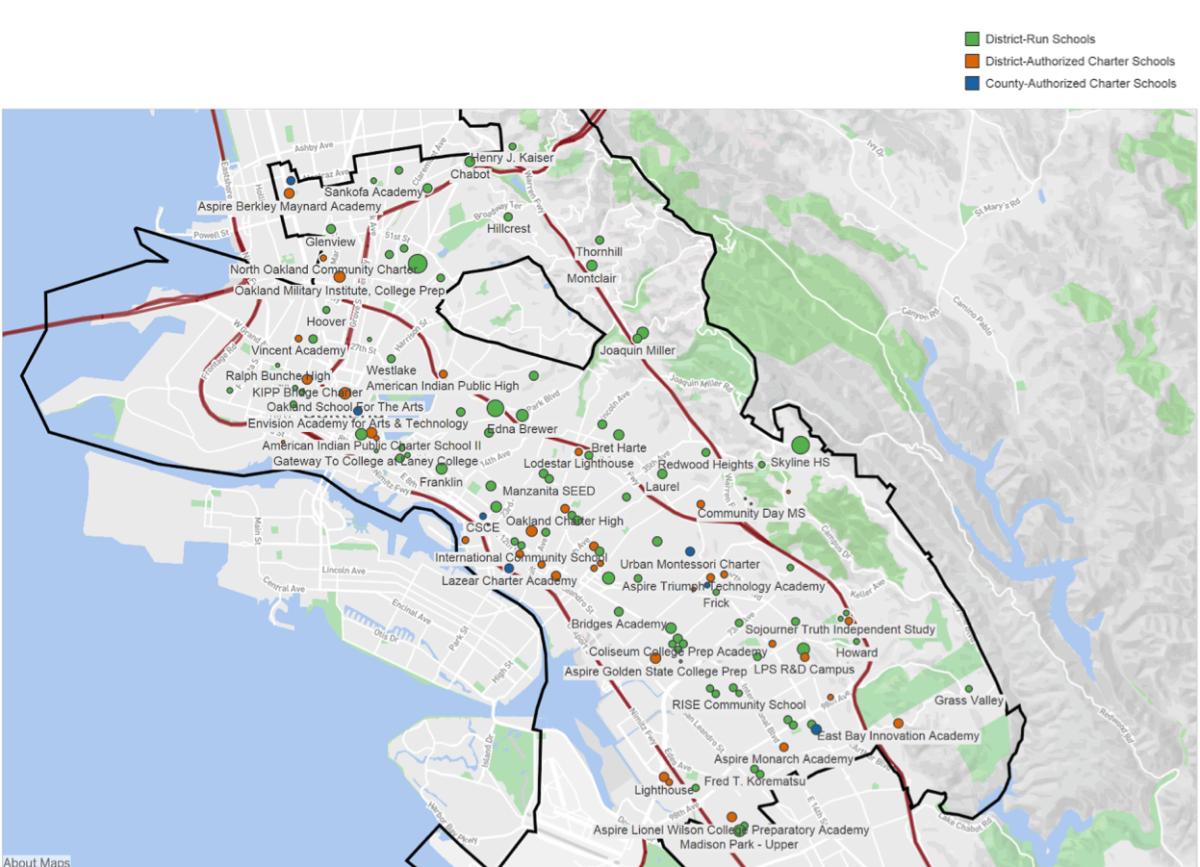
Oakland Unified School District has about 37,000 students in 87 non-charter public schools, or an average of roughly 425 students per school. That comparatively high school-to-student ratio is largely due to an earlier reform movement to create smaller, more intimate educational settings for students. Today, amid a serious budget crisis, district leaders are revisiting the premise of the small schools experiment, and have suggested paring down the number of schools by upward of 25 percent. Here’s a look at how Oakland ended up with so many small schools.
Does OUSD really have that many schools?
Yes. The number of public schools OUSD oversees is much higher than Bay Area districts of similar size. Take nearby Fremont Unified, which has just over 35,000 students but only 42 schools. Or San Jose Unified, where about 32,000 students attend 46 schools.
Of course, Oakland still has its fair share of larger schools. About 1,800 students were enrolled at Skyline High School during the 2017-2018 school year, and nearly 2,000 at Oakland Tech. But a good number of district schools have fewer than 300 students. Among them: Roots International Academy, one of the schools slated for closure, which now has just about 260 students and Sankofa Academy, which has fewer than 200.
Why were so many new schools created?
Since 2000, the district has opened a huge number of small schools, even as its enrollment dropped by about 45 percent. Here’s how it unfolded:
In the late 1990s, Oakland’s public school district was dealing with many of the same issues it faces today, including financial problems, low test scores and high teacher turnover. Most of the under-performing schools were concentrated in the city’s “flatlands” neighborhoods and primarily attended by lower-income, minority students.
Unlike now, though, many of those schools were bursting at the seams and straining to manage far more students than they were designed to accommodate, particularly elementary schools.
In light of these overcrowded and sometimes chaotic conditions, a group of concerned parents teamed up with an alliance of religious and civic leaders, called Oakland Community Organizations, to push for a major overhaul of the district’s most troubled campuses.
Members of the group called attention to the glaring disparities between their kids’ schools and the markedly smaller, safer and better performing schools largely concentrated in wealthier neighborhoods in the Oakland hills.
“I couldn’t believe that the same school district would be failing thousands of children, while the other kids in the more affluent neighborhoods were very successful,” said Emma Paulino, an immigrant from Guadalajara, Mexico, who was appalled by the conditions at Hawthorne Elementary, the East Oakland school her son attended. “It was like a slap in my face. My child is not a third-class kid just because he’s brown.”
Paulino became involved with OCO and its grassroots campaign to push the district to break apart some of its long-struggling, large flatlands schools and replace them with smaller autonomous academies. It was part of a growing small schools movement that had taken root in urban districts across the country, including New York, Chicago and Milwaukee, and touted as a transformational tool to help narrow the growing achievement gap between poor, mostly minority students and their more affluent peers.
Advocates believed that schools with fewer than 400 students could provide a stronger sense of community and security and create more engaging learning environments, particularly for students from underserved neighborhoods.
The small schools were also intended to empower a new generation of community and educational leaders who could help shape their school’s vision.
Oakland’s school board and its superintendent went all in, approving a new small schools policy in 2000 that jump-started the opening of nine new schools over the next three years. (To put that in perspective: the district hadn’t opened a single new school in the previous 20 years.)
Dennis Chaconas, who was the district’s superintendent from 2000 to 2003, said that besides reducing overcrowding, the goal was to create more community-focused and academically rigorous institutions.
“We wanted to get a group of teachers and community members to design schools in which they felt they would own the kids more, and actually end up getting better performance,” he said.
Paulino helped start ASCEND, an arts-based kindergarten- through eighth-grade school in East Oakland that opened its doors in 2001 (it has since become a charter school).
“At ASCEND, we the parents had a voice,” she said. “We worked really closely with the teachers. And all the adults were responsible for the children, including the custodians, people in the cafeteria, every person at the school. We were like a family. Parents really owned the school and all the kids were accountable.”