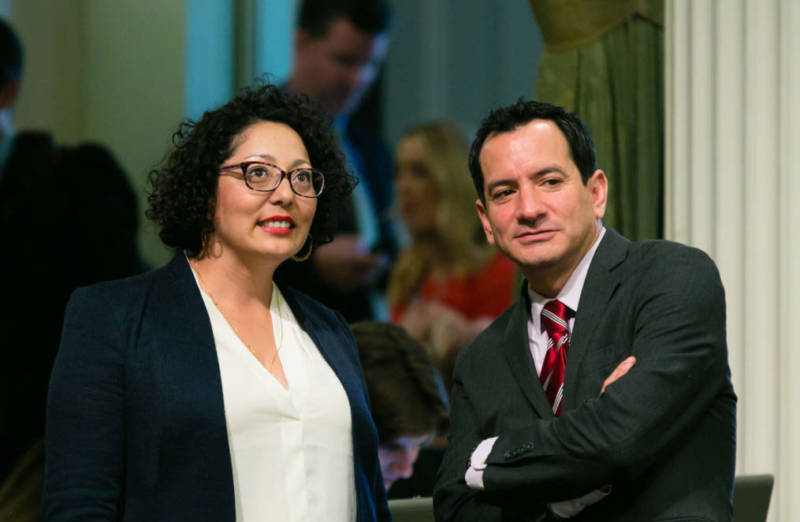
Assemblywoman Cristina Garcia, D-Bell Gardens, faces allegations that she groped and harassed legislative staffers. (California Assembly)
On Thursday, March 22, Assemblywoman Cristina Garcia sat down with KQED’s The California Report for an extensive interview about allegations she sexually assaulted and harassed legislative staff members.
Garcia and her allies have been pushing back against the allegations, saying political opponents started a campaign to discredit her soon after she emerged as a leader in the state Capitol’s #MeToo movement.
The interview was conducted in her district of Bell Gardens.
KQED: You have been very quiet. Some would say uncharacteristically so. Tell us why you decided not to talk to the press the past few months.
GARCIA: You know I’ve just been trying to be respectful of the investigation and the process and there’s an ongoing investigation. I can’t really talk about that I can’t talk about personnel issues. And so I’ve just been sitting back letting people do their job and waiting to be cleared.
KQED: One of the things that came up in this investigation are the allegations against you I should say is this idea that you somehow sexually assaulted someone physically. Did you ever sexually assault anyone?
GARCIA: I’ve never assaulted anyone physically.
KQED: Sexual or otherwise.
GARCIA: Sexual or otherwise. I try to treat everyone with dignity and respect. Similar to how I want to be treated.
KQED: So this one gentleman says that you tried to grab his butt reached for his crotch, to be graphic about it. You never did that.
GARCIA: Never.
KQED: There’s another allegation that you played or encouraged people to play spin the bottle in a hotel room. Did you ever encourage anyone to play such a game?
GARCIA: I’ve never encouraged anyone to play spin the bottle and I’ve actually never played spin the bottle myself.
KQED: Never in your life.
GARCIA: Never.
KQED: You’re not missing much…
GARCIA: Thanks (laughter)
KQED: …to be perfectly honest.
One of the other things that has come up in this… These accusations against you that you are an alcoholic or that you have some type of alcohol problem. Dan Gilleon, the attorney for the people who brought the claims against you, has not only told me that he believes you have an alcohol problem, and offered photographs to suggest that you do, but he said so very publicly. How do you respond to this idea that you have an alcohol problem?
GARCIA: First and foremost I want to be clear that alcoholism is a serious disease and we need to be working and giving support to folks who are ready to deal with that. It’s something that is in my family as well it’s personal to me. And so there’s respect there.
And I’m not an alcoholic, I drink, yes. There’s a culture of drinking in the Capitol and I’ve definitely participated in that. But I don’t think that makes you an alcoholic. But you know all I have to say is if I thought I was an alcoholic I would have already said that the same way I’m saying, ‘yes I drink.’
KQED: One of the things that these detractors have come out and said is that you had a keg in your office and that this keg is somehow evidence that you have a drinking problem. How do you respond to that?
GARCIA: I think that’s a similar saying ‘Do I have beer in my fridge and so I’m am alcoholic?’ Yes I have beer in my fridge. Yes. At some point I’ve had a keg at my office. A lot of us do. It’s part of the culture of socializing after the way business gets done. I think we can have a discussion about that and discuss whether or not that’s appropriate. But because you have alcohol or you are in the possession of alcohol doesn’t make you an alcoholic. I think that’s a really gross generalization.
KQED: The other issue that came up was that you are someone who is very intense. You’re very intense to work for. You demand a lot from your employees and that you had them do things like pick up your dogs or household items that shouldn’t necessarily fall under the spectrum of what it means to work for a state representative. How do you respond to that?
GARCIA: I’ve been honest from the beginning and I put out a public statement that I do demand a lot of my staff. I have a lot of needs in my community. We have issues with lead. We have issues with arsenic. We have issues with corruption. We have a community that has been ignored for a long time. We have a lot of folks that need help with their Medi-Cal. They need help with the DMV, they need help with veterans issues. And so we are busy.
We also are a district that hasn’t been very engaged, and so it’s been my goal to help educate, empower and engage my constituents. And so we’re out there on the grounds constantly trying to interact with my constituents, trying to make sure that they know we’re here for them. But also that they’re part of this and I need them to be engaged. And that’s how we’re going to become better leaders together.
And so it is a demanding job that I have and I try to be fair. I try to provide support for my staff out there. They need breaks, we give it to them. So I think that’s not anything I’ve ever hidden. I work hard. I do a lot on a daily basis, whether it’s for my district, whether it’s for the women’s caucus, whether it’s on the policies that I’m pushing forward. You know I’m not shy. I pick fights on a regular basis to do the right thing looking for justice. And so I think that’s fair. That’s not a crime.
California State Assembly members Cristina Garcia (L) and Anthony Rendon in Sacramento on May 15, 2017. Garcia is the leader of the Legislative Women’s Caucus. (Bert Johnson/KQED)
KQED: Is it true though that you did have staff do you things that would be considered domestic chores or anything… You’re shaking your head no.
GARCIA: No. We tried really hard to make sure that we have separation out there. Are there times where we’re in binds? Yeah there’s been times when I’m in a bind and I was like ‘I need you to do this. Can you help me out? You want to volunteer to help me out?’ And staff will do it. I think all of us as members do that when we’re out there working from 9:00 a.m. to 10:00 p.m. and it’s like, ‘Shoot you know what my dog sitter just canceled. Can you put the dog in the yard? Do you mind? They always have the option to say ‘no,’ including to the point where it wasn’t a regular thing and often times I’d come home and there’d be a mess here with the dogs. But I’ve had a dog sitter most years, and so it’s just those rare moments where my dog sitter’s not available.
I think that’s the only thing in there that I would say that… Am I demanding? Yes. At some point have I asked someone to get me out of a bind? Yes. I think we all do that on occasion. But it’s always been on a voluntary basis and it’s been very minimal. To the point where my mom always jokes that she’s my staff because I’m always asking my parents to run my personal errands for me.
KQED: So this wasn’t a requirement or a condition of employment, as it’s been presented to me?
GARCIA: Definitely not. And it was always a ‘volunteer if you wanted’ and it was a very rare occasion.
KQED: The other thing I heard that I think might be concerning for some people both in the Capitol and perhaps in your district is this idea that you use slurs, or something other than respectful words to describe the former speaker who is gay. Did you ever use slurs like “faggot” or “homo”? Did you ever say anything like that to your staff?
GARCIA: Oh I will be clear. There’s no one in politics that doesn’t talk about some of the peers we work with, and we use candid language. And so along the way I’ve used candid language. I curse. I mean I’ve been vocal about some of my favorite words, and I don’t know if I can say them on the radio, are “shit” and “fuck.”
You know I think if I would see staff who didn’t want to engage in that conversation, I would stop, but they never seemed to have any problem with it. But even then it’s pretty limited, but these are in places where you think you’re in a safe space and you could speak your mind and be vocal.
I don’t use the word ‘faggot.’ It’s not in my vocabulary. Have I at some point used the word ‘homo’? Yeah I’ve used that word ‘homo.’ I don’t know that I’ve used it in derogatory context. I think you need to think about the context in which it was used. But anything can be taken out of context clearly here in this situation.
KQED: Well, I bring that up because I grew up in a neighborhood where – the word “homo” for example, people still say “no homo” as a way to express their identities of masculinity. And as I was telling you before we started, this neighborhood where we’re located right now is very similar to my neighborhood. The reason I’m asking you this though, is there’s what has been presented to me is this question of whether these words were used in a professional setting, and whether they made people uncomfortable. So did you ever use that to describe the speaker, the word “homo?”
GARCIA: I can’t remember but I wouldn’t be surprised if I used that word. Right? So I think that that’s fair. I think terms like ‘faggot’ are period derogatory. There’s no good way to use that word. I think a term like ‘homo’ can also be derogatory, right? I’m not going to sit here and pretend I’m an angel. Was I using those as derogatory terms? No. It’s almost like I would say I’m a brown person sometimes.
Am I perfect? I think all of us at some point have biases, but I try to be open and accepting of all communities including the LGBT community and I think you could look at my voting record, look at the advocacy I’ve been doing well before I was elected in conjunction not just with the LGBT community, but with communities that have been marginalized.
KQED: If you didn’t commit these — this act of sexual assault — and to be very clear you’ve been a leader in the #MeToo movement in Sacramento – but if you didn’t commit these acts of sexual harassment and sexual assault, why do you think people are saying this against you? You surely have had the time to think about why this is happening. What reason do you give for it?
GARCIA: I think this is about shutting me up. Making sure that my advocacy stops. Making sure that I don’t ensure that my community has a voice. And it’s not just shutting me up, or shutting people like me up. Whether it’s on the #MeToo movement, whether it’s on environmental justice or whatever injustices that are out there, I have been very vocal. I’m not afraid to take on fights. I do the work that other people don’t want to do. I think you know I’ve been very critical. I want to make sure we have a high standard. I want to make sure we’re running with ethics. I have been fighting against corruption. I think along the way my work speaks for itself and why I’ve accumulated some enemies. But I think more than anything, over the last few years, I’ve started to be effective. I’ve started to get things done.
I started to make sure that when we talk about the environmental movement, I’m not just talking about the pristine mountains and the good ocean, but I’m talking about the health issues that communities like mine are dealing with. Communities that have been treated like wastelands for all my life. For the first time we’re going to start to identify those hotspots and start to change that situation. I started to bring attention to the chromium 6 issue and how that poisons us on a regular basis. What does that mean? That means that some of these businesses may be in danger. That means that some of these jobs that make us sick might go away. And we’ve been told that I have to pick between bad jobs that make me sick, but pay me. And what I’m saying is I shouldn’t have to pick between my health and my job.
Why can’t I have some good green jobs like the rest of the communities that are out there?
Why do I have to settle for shit?
And so I’m starting to finally move the pendulum in a direction for communities that have been ignored. And this is about making sure I don’t have any more advocacy. That I don’t have any more voice. And it sends a message to people that I have mentored. I spend a lot of time trying to create advocates in the community. That’s my legacy. To make sure they’re told ‘if you rise up and you speak up this is going to happen you. So sit down and don’t say anything.’
And so it’s happening right now, because what’s happening is that I’m home. I’m being respectful of the process. These people are trying to extend the timeline. The Assembly is taking it seriously. But in the meantime I’m not doing work. I’m not fighting on Exide. We have real issues there to clean that up.
I’m not fighting on the lead and paint companies as they’re trying to make the consumers pay for their bad doings. I am not working on the #MeToo movement. I’m not working to make sure we have safer work environments. I’m not working to get rid of the the tax on tampons. I’m not working to make sure our kids are safer. There’s a lot of things that I’m not working on.
And then on top of it all, my community and our regular day-to-day interaction where we try to empower them and engage them and then more importantly celebrate them, isn’t happening. Right? I didn’t have my “Pride of the 58 Gala.” This area is dubbed ‘the corridor of corruption,’ it’s known for its bad air quality. But it has a lot of good people and we celebrate them on a monthly basis. We have a gala for them, and that didn’t happen now. I didn’t get to participate in Woman of the Year and celebrate the heroes of our communities. I didn’t get to do my Cesar Chavez – Larry Elong celebration where we celebrate the two cultures coming together and how important that’s been to our communities. I don’t get to do my walk and talks. We go out there and I knock on doors. I bring services to my constituents. I don’t get to do any of that. And so I think more than anything my constituents are confused. They don’t know if they can show up to my office for services that they need.
Let me be clear, offices are open whether or not I’m there and we’re there for constituent services.
But it’s really a disservice to my constituents. It’s a disservice to the works I work with, and to the good work that needs to be done for these communities. And to me this is about shutting me up. And shutting people like me up. And I will say this is not about me. I hope that folks out there who have been marginalized who have felt empowered the last few years continue to do the good work and we continue to fight and have that voice.
KQED: Let’s talk a little bit about how you feel that you’ve been silenced. Why is it that you decided not to continue your work in the Legislature, and how has it affected your campaign for re-election?
GARCIA: If we were in any other private setting — I was a teacher for 13 years and that’s usually my examples — I would have been put on administrative leave immediately, because first and foremost you want to make sure that everyone’s safe. And then once we get the facts together and we have a conclusion they make decisions. So for me it just felt like I should be treated the same as anyone else who’s not in this job. And all the other industries. And so for me it just made sense that I was going to put myself on a leave. No one asked me to do it. I didn’t expect this to go on this long. You know, people initially told me this will take a couple of weeks. It’s almost two months now.
And so the reality has changed and it is frustrating that I’m not working. That I’m not being the voice that I’m used to being out there, that I’m having to be silenced this way. It means that people are winning and when I’m silenced. But I felt it was the right thing to do. I think at this point, we have to have that discussion of ‘Is this the best way to proceed? Is it ok to have half a million people without representation? Is it ok not to have these issues, you know, brought up in the Capitol, whether it’s clean air issues?’
No one’s going to make sure my bills are being properly implemented out there, and so I don’t get to participate in that. So that’s my legacy and it is frustrating because it’s my legacy but it’s also the clean air that I want to breathe one day. It’s the lack of lead that I want to have in my community so that kids are able to learn and grow. We know all that lead around us doesn’t allow us to learn. And then we show up at school and we’re behind, and we have these developmental issues because of the environment we grew up in. I would like that to end.
KQED: Let’s go back to the investigation. You said it was going to be a few weeks, you were told apparently it was going to be a few weeks. It is now a few months. I’ve been told through my sources — and I don’t know if this is where you heard — that it’s going to be at least another six weeks. Do you have any idea how long this is going to continue?
GARCIA: This has a process, right?
I want to be clear. It’s not that there’s not a process here. But the timeline that it takes the investigator to do their job — where there’s no guarantees. For lots of reasons. But it’s hard on her because when you have anonymous sources that are refusing to come forward to speak to her in a confidential manner, she’s out there running in circles trying to figure out how to decide if these claims are real or not and how to do her job. When you have anonymous sources that are taking months to even respond to something — you have anonymous sources that are choosing to, you know, dribble out information. Again most of these are anonymous sources. Every time, she’s like, well I have to include this somehow, and it adds time. And so I feel confident that she’s trying to do her job as quickly as possible.
KQED: It sounds like you’re almost empathetic with her.
GARCIA: No, it’s not empathetic. It’s respectful. It’s respectful. And I think she’s taking her job seriously. I take this seriously as well. I feel like people are playing a game and they’re not taking it seriously, and this game is at the expense of my constituency and advocacy, and advocacy groups that need my voice out there.
KQED: One thing, you just reminded me, when you were telling me about “the dribble,” was that an anonymous source actually sent me through Signal copies of texts that you had that appear to be flirty. Did you ever send flirty texts?
GARCIA: Have you sent flirty texts? I think most of us have at some point. It’s not a crime. It’s not a crime and it’s something that happens in all kinds of settings.
KQED: Getting back to this idea that you’re being silenced. How is this affecting your run for re-election? Are you campaigning during this time or are you showing up at events in your community? You said that there were a whole host of events you couldn’t go to. Why can’t you still show up for them as a private citizen?
GARCIA: I can show up to things as a private citizen, but when I show up I’m not just a private citizen. Everyone knows who I am. I am Cristina Garcia, a state assemblymember that’s worked really hard to have a footprint in this community. And I think that’s naïve to think I could just show up. And people expect me to show up and they want me to have that voice out there, right? But I till have a title no matter what, and a leave is a leave, and I’m being respectful of that. It doesn’t mean that I don’t have a campaign to run. I do. I have an election in June and I have to get through that.
KQED: Are you fundraising?
GARCIA: I haven’t been fundraising. You know I’ve been making decisions based on this timeline that this will be over in a timely manner. And because I feel that we all deserve answers but at some point you know time is running out and I’m going to be forced to get out there. I’m going to be forced to campaign. I’m going to be forced to fundraise, and I’m going to be forced to tell folks ‘Take the plunge with me, without answers. Not because I don’t want you to have them, but that’s out of my control. I’d like to give you all the answers if possible, but I’m allowing the investigator to do their job.’
And again I have been responsive, I have been participating in anything that they have asked me to, which has been limited actually. And these anonymous sources have refused to come forward. And so how does she do her job? When do we say “enough” with the anonymous sources? We need some real dates and some real situations and some names. How am I supposed to defend myself to anonymous sources?
Let me also be clear — as an elected official, as a public figure — I can’t even use like ‘Oh I’m going to sue someone.’ People have asked me ‘Why haven’t you sued anyone?’ I say well, they’re anonymous. And the standard for these lawsuits is really hard for a public official. I really can’t win that. But I could be sued, and I can lose.
KQED: You would have to be able to prove that things beyond a reasonable doubt were not only demonstrably false, but designed to hurt you. That’s a very high standard like you were saying.
Not that I per se agree with this line of thinking, but I have heard many “men’s rights activists” say a lot of the same things that you’re saying right now. That when people make claims against alleged sexual harassers or alleged sexual assaulters, that many of these claims are allowed to be anonymous to protect the victim. That the investigation takes a long time and that this disrupts life for a long, long time. I wonder if you see any bit of irony.
GARCIA: I don’t see any irony. I mean I have said constantly that everything should be taken seriously and the investigators should do their job. That’s why I’ve just been sitting back and you know letting her do her job and I haven’t been attending anything and I’ve been quiet. And so I think there’s no irony. I, you know, I’m being consistent from the beginning to the end of that decision.
KQED: I imagine it must be frustrating.
GARCIA: Yeah you definitely get frustrated. I mostly get frustrated that I don’t get to get out there and do the work that I was going to do. I have a package of bills that I didn’t get to introduce, issues that I think are important for us to be discussing out there that other people are not discussing. Some of the bills I was going to introduce thankfully got picked up by other members. But there’s issues that are still out there that no one’s talking about.
For example I’ve been working on stealthing. A crime, trying to make a crime to remove a condom without permission. No one’s working on that. I’ve been working on…
KQED: You’re talking about a condom during the intercourse.
GARCIA: During intercourse, yes. I’ve been working on trying to remove the tax on tampons. No one’s working on that. I’ve been working on trying to get money to turn brownfields — these are contaminated fields that are just sitting there, blighting communities — finding money to try to clean them up to become open spaces and parks. In communities like mine that’s a big deal. I have a lot of brownfields but I’m really park poor. It’s work I’m not doing now.
I’ve been trying to do work for my cities. They have needs, specifically related to budget and bills that I can’t work on. I was going to be working on abandoned wells — oil wells — and how do we make sure that they’re being cleaned up properly and that they’re not making us sick anymore. That’s work that no one’s doing now.
For my constituents who are out there, I think that they should know that my office is open for any services that they need. And that they should be vocal about what they want and what they want from this process, and make that clear to the Legislature and to the public. They should be clear about the burden that’s being put on them by individuals who are playing a game. And what it means to not have an advocate out there working for them.
We are getting ready to work on the budget, and I’m not there to make sure my district gets their piece of the pie. And I think at some point, while I’ve been out here trying to sit back, we need to think about ‘is it fair that my district keeps missing out on these opportunities to get their fair share of the pie?’ Or ‘do we have to find other ways to make sure that they get what they need, and there’s an advocate for them?’
There are women running for office right now that I would normally be helping. You know, we have opportunities to grow the Women’s Caucus. We’re only at 22 percent in the Legislature. Those are women that I can’t fundraise for, that I can’t advocate for. There are real consequences to this. Know that I’m taking this seriously. I’m eager to get back to work.
I’m here today to cooperate. I am confident I’m going to be cleared at the end of this. It’s just a matter of when that happens and I hope it’s sooner than later. And I’m not confident because there’s any sort of special treatment to me. I think I’ve proven through my actions that we should have a higher standard and I’m holding myself to that standard. But I’m confident because I’m innocent. I didn’t do these things. I treat people with dignity every day.
And so, you know, I am guilty of having a big mouth. Being outspoken and speaking truth. And that pisses off a lot of people. And it’s about power. And maybe I’m finally starting to get things done and that power structure is being disturbed, and they’re going to do everything they can to make sure things stay the way they are. And communities like mine don’t get their piece of the pie. And I’m going to fight. I’m going to fight. It is not about me, it’s about my community and the need to have the work I’ve been doing. And so I’m going to fight hard and I hope folks out there fight with me.
KQED: One last question about this, this kind of waiting period. Did Democrats ask you not to come to the convention in San Diego this year, or did you decide not to go?
GARCIA: No. No one has asked me anything. This is a decision I have made for myself. And again, I take this seriously and I’m trying to hold myself to the standard that we would in any other setting that’s not this one.
I think the irony is that as an elected official, as an assemblymember, a member of the California Legislature, we are the sixth biggest economy. We have a lot of power. And things are usually unbalanced on our behalf. And that’s something I’ve always been very aware of. That power. And I always try to use that power to make sure I empower others around me and I tell them, ‘You shouldn’t have to know an assemblymember for the system to work for you. But let’s take advantage of it when needed.’
In these situations, the balance is tipped the other way. Where anonymous sources and special interests, people that are playing the game, can really silence an individual and take away power from a community like this.
And normally we wouldn’t see this, but they’re able to take something, make it a tool through innuendos, through allegations that are false, through being anonymous, through trying to paint whatever picture they want. And I can’t defend myself because I’m not going to open myself up to that liability. I just have to sit back and let the investigation take its course. No matter how long that is. And so that’s the irony of the situation here. This is about power, and they’ve done a good job, because at least temporarily my power has been taken away and I’ve been silenced. And my advocacy isn’t happening.
KQED: So based on the conversation we’ve had today, I kind of imagine you getting on a motorcycle and taking revenge “Kill Bill” style when you’re reinstated. That doesn’t seem doable, at least legally. How are you going to handle it moving forward? And are you keeping names right now of the people who supported you and didn’t in Sacramento?
GARCIA: None of that matters. I have to have an open door and I have to work with everyone.
You don’t forget — but the best revenge is getting back there and continuing the good work that I’m doing, on behalf of women, on behalf of working class communities, on behalf of communities like mine that have been wastelands for all my life. And in getting those good jobs in my community and getting rid of the dirty jobs. That’s the best revenge. And so when I get back, I could spend my time trying to get back at people, or I can spend my energy and my power on trying to get my community what they need and being the voice that I’ve always been. And so that’s going to take discipline because yeah I’m human and sometimes — you know you want to have those moments — but it doesn’t get me anything.
It doesn’t get me anything, and it’s squandering an opportunity to do the good work for my community, to make sure I change the culture here. To make sure I have more ethical local elected officials. To make sure I have cleaner air and have clean water. To make sure I have a constituency that knows how to navigate the system and are able to advocate for themselves, and are able to work with us on a day-to-day basis to get what they need. To make sure I’m getting a fair share of the budget down here on a regular basis with things that I need. That’s the best revenge.
Making sure that my voice and the voice of other advocates like me is out there and it gets stronger. And I think that’s a much better use of my time out there, and so if I’m making plans, my plans are about how am I going to get my bills done, and how am I going to make sure that the good work that needs to be done continues.
KQED: Do you think — you’re assuming that you do get to go back. So you assume that this this, you believe that this investigation is not going to produce anything that’s going to require you to either resign or be sidelined further?
GARCIA: I — again I have — I am confident in the results because I know I’m innocent.
KQED: Do you go back to Sacramento a weaker Cristina Garcia because of this?
GARCIA: These moments change you. You don’t have to go back a weaker Cristina Garcia, you go back a smarter Cristina Garcia.
You take advantage of the situation, and you learn and you grow and you do better. But I’m scrappy. If you are from a community like this, if you’re a woman of color and you’ve risen to any ranks of power, you have had to figure it out and overcome barriers by being innovative about it.
And so I just have to learn some new tricks, and so I don’t think that this weakens me. I think the situation has taught me some new tricks. It has also exposed some allies and some enemies out there that maybe I wasn’t aware of, and having that information makes me smarter also, and stronger.
KQED: Assemblymember, is there anything else I should ask her or that you want to cover? Or is there anything that you didn’t think was fair that I asked?
GARCIA: No no no. Just, you know, this process needs to get done because the real injustice here is that my community doesn’t have a voice and I don’t get to be the advocate that they elected me to be. And so I hope that the people that are playing these games take this seriously like I have, and help move this investigation along.
KQED [to Leo Briones, Garcia’s spokesman]: Leo is there anything else you think should be covered?
BRIONES: No, I think we’re good.
KQED: I just want to make sure I give you all ample opportunity. You want to take five minutes and that way y’all can think about it?
BRIONES AND GARCIA: No, no.
KQED: OK. Assembly Member Garcia, thank you so much for joining us.
window.__IS_SSR__=true
window.__INITIAL_STATE__={
"attachmentsReducer": {
"audio_0": {
"type": "attachments",
"id": "audio_0",
"imgSizes": {
"kqedFullSize": {
"file": "https://ww2.kqed.org/news/wp-content/themes/KQED-unified/img/audio_bgs/background0.jpg"
}
}
},
"audio_1": {
"type": "attachments",
"id": "audio_1",
"imgSizes": {
"kqedFullSize": {
"file": "https://ww2.kqed.org/news/wp-content/themes/KQED-unified/img/audio_bgs/background1.jpg"
}
}
},
"audio_2": {
"type": "attachments",
"id": "audio_2",
"imgSizes": {
"kqedFullSize": {
"file": "https://ww2.kqed.org/news/wp-content/themes/KQED-unified/img/audio_bgs/background2.jpg"
}
}
},
"audio_3": {
"type": "attachments",
"id": "audio_3",
"imgSizes": {
"kqedFullSize": {
"file": "https://ww2.kqed.org/news/wp-content/themes/KQED-unified/img/audio_bgs/background3.jpg"
}
}
},
"audio_4": {
"type": "attachments",
"id": "audio_4",
"imgSizes": {
"kqedFullSize": {
"file": "https://ww2.kqed.org/news/wp-content/themes/KQED-unified/img/audio_bgs/background4.jpg"
}
}
},
"placeholder": {
"type": "attachments",
"id": "placeholder",
"imgSizes": {
"thumbnail": {
"file": "https://cdn.kqed.org/wp-content/uploads/2024/12/KQED-Default-Image-816638274-2000x1333-1-160x107.jpg",
"width": 160,
"height": 107,
"mimeType": "image/jpeg"
},
"medium": {
"file": "https://cdn.kqed.org/wp-content/uploads/2024/12/KQED-Default-Image-816638274-2000x1333-1-800x533.jpg",
"width": 800,
"height": 533,
"mimeType": "image/jpeg"
},
"medium_large": {
"file": "https://cdn.kqed.org/wp-content/uploads/2024/12/KQED-Default-Image-816638274-2000x1333-1-768x512.jpg",
"width": 768,
"height": 512,
"mimeType": "image/jpeg"
},
"large": {
"file": "https://cdn.kqed.org/wp-content/uploads/2024/12/KQED-Default-Image-816638274-2000x1333-1-1020x680.jpg",
"width": 1020,
"height": 680,
"mimeType": "image/jpeg"
},
"1536x1536": {
"file": "https://cdn.kqed.org/wp-content/uploads/2024/12/KQED-Default-Image-816638274-2000x1333-1-1536x1024.jpg",
"width": 1536,
"height": 1024,
"mimeType": "image/jpeg"
},
"fd-lrg": {
"file": "https://cdn.kqed.org/wp-content/uploads/2024/12/KQED-Default-Image-816638274-2000x1333-1-1536x1024.jpg",
"width": 1536,
"height": 1024,
"mimeType": "image/jpeg"
},
"fd-med": {
"file": "https://cdn.kqed.org/wp-content/uploads/2024/12/KQED-Default-Image-816638274-2000x1333-1-1020x680.jpg",
"width": 1020,
"height": 680,
"mimeType": "image/jpeg"
},
"fd-sm": {
"file": "https://cdn.kqed.org/wp-content/uploads/2024/12/KQED-Default-Image-816638274-2000x1333-1-800x533.jpg",
"width": 800,
"height": 533,
"mimeType": "image/jpeg"
},
"post-thumbnail": {
"file": "https://cdn.kqed.org/wp-content/uploads/2024/12/KQED-Default-Image-816638274-2000x1333-1-672x372.jpg",
"width": 672,
"height": 372,
"mimeType": "image/jpeg"
},
"twentyfourteen-full-width": {
"file": "https://cdn.kqed.org/wp-content/uploads/2024/12/KQED-Default-Image-816638274-2000x1333-1-1038x576.jpg",
"width": 1038,
"height": 576,
"mimeType": "image/jpeg"
},
"xxsmall": {
"file": "https://cdn.kqed.org/wp-content/uploads/2024/12/KQED-Default-Image-816638274-2000x1333-1-160x107.jpg",
"width": 160,
"height": 107,
"mimeType": "image/jpeg"
},
"xsmall": {
"file": "https://cdn.kqed.org/wp-content/uploads/2024/12/KQED-Default-Image-816638274-2000x1333-1-672x372.jpg",
"width": 672,
"height": 372,
"mimeType": "image/jpeg"
},
"small": {
"file": "https://cdn.kqed.org/wp-content/uploads/2024/12/KQED-Default-Image-816638274-2000x1333-1-672x372.jpg",
"width": 672,
"height": 372,
"mimeType": "image/jpeg"
},
"xlarge": {
"file": "https://cdn.kqed.org/wp-content/uploads/2024/12/KQED-Default-Image-816638274-2000x1333-1-1020x680.jpg",
"width": 1020,
"height": 680,
"mimeType": "image/jpeg"
},
"full-width": {
"file": "https://cdn.kqed.org/wp-content/uploads/2024/12/KQED-Default-Image-816638274-2000x1333-1-1920x1280.jpg",
"width": 1920,
"height": 1280,
"mimeType": "image/jpeg"
},
"guest-author-32": {
"file": "https://cdn.kqed.org/wp-content/uploads/2025/01/KQED-Default-Image-816638274-1333x1333-1-160x160.jpg",
"width": 32,
"height": 32,
"mimeType": "image/jpeg"
},
"guest-author-50": {
"file": "https://cdn.kqed.org/wp-content/uploads/2025/01/KQED-Default-Image-816638274-1333x1333-1-160x160.jpg",
"width": 50,
"height": 50,
"mimeType": "image/jpeg"
},
"guest-author-64": {
"file": "https://cdn.kqed.org/wp-content/uploads/2025/01/KQED-Default-Image-816638274-1333x1333-1-160x160.jpg",
"width": 64,
"height": 64,
"mimeType": "image/jpeg"
},
"guest-author-96": {
"file": "https://cdn.kqed.org/wp-content/uploads/2025/01/KQED-Default-Image-816638274-1333x1333-1-160x160.jpg",
"width": 96,
"height": 96,
"mimeType": "image/jpeg"
},
"guest-author-128": {
"file": "https://cdn.kqed.org/wp-content/uploads/2025/01/KQED-Default-Image-816638274-1333x1333-1-160x160.jpg",
"width": 128,
"height": 128,
"mimeType": "image/jpeg"
},
"detail": {
"file": "https://cdn.kqed.org/wp-content/uploads/2025/01/KQED-Default-Image-816638274-1333x1333-1-160x160.jpg",
"width": 160,
"height": 160,
"mimeType": "image/jpeg"
},
"kqedFullSize": {
"file": "https://cdn.kqed.org/wp-content/uploads/2024/12/KQED-Default-Image-816638274-2000x1333-1.jpg",
"width": 2000,
"height": 1333
}
}
},
"news_11658084": {
"type": "attachments",
"id": "news_11658084",
"meta": {
"index": "attachments_1716263798",
"site": "news",
"id": "11658084",
"found": true
},
"parent": 11658070,
"imgSizes": {
"small": {
"file": "https://ww2.kqed.org/app/uploads/sites/10/2018/03/CristinaGarcia-520x412.jpg",
"width": 520,
"mimeType": "image/jpeg",
"height": 412
},
"twentyfourteen-full-width": {
"file": "https://ww2.kqed.org/app/uploads/sites/10/2018/03/CristinaGarcia-1038x576.jpg",
"width": 1038,
"mimeType": "image/jpeg",
"height": 576
},
"thumbnail": {
"file": "https://ww2.kqed.org/app/uploads/sites/10/2018/03/CristinaGarcia-160x127.jpg",
"width": 160,
"mimeType": "image/jpeg",
"height": 127
},
"fd-sm": {
"file": "https://ww2.kqed.org/app/uploads/sites/10/2018/03/CristinaGarcia-960x760.jpg",
"width": 960,
"mimeType": "image/jpeg",
"height": 760
},
"post-thumbnail": {
"file": "https://ww2.kqed.org/app/uploads/sites/10/2018/03/CristinaGarcia-672x372.jpg",
"width": 672,
"mimeType": "image/jpeg",
"height": 372
},
"xsmall": {
"file": "https://ww2.kqed.org/app/uploads/sites/10/2018/03/CristinaGarcia-375x297.jpg",
"width": 375,
"mimeType": "image/jpeg",
"height": 297
},
"kqedFullSize": {
"file": "https://ww2.kqed.org/app/uploads/sites/10/2018/03/CristinaGarcia.jpg",
"width": 1920,
"height": 1520
},
"large": {
"file": "https://ww2.kqed.org/app/uploads/sites/10/2018/03/CristinaGarcia-1020x808.jpg",
"width": 1020,
"mimeType": "image/jpeg",
"height": 808
},
"xlarge": {
"file": "https://ww2.kqed.org/app/uploads/sites/10/2018/03/CristinaGarcia-1180x934.jpg",
"width": 1180,
"mimeType": "image/jpeg",
"height": 934
},
"guest-author-50": {
"file": "https://ww2.kqed.org/app/uploads/sites/10/2018/03/CristinaGarcia-50x50.jpg",
"width": 50,
"mimeType": "image/jpeg",
"height": 50
},
"guest-author-96": {
"file": "https://ww2.kqed.org/app/uploads/sites/10/2018/03/CristinaGarcia-96x96.jpg",
"width": 96,
"mimeType": "image/jpeg",
"height": 96
},
"medium": {
"file": "https://ww2.kqed.org/app/uploads/sites/10/2018/03/CristinaGarcia-800x633.jpg",
"width": 800,
"mimeType": "image/jpeg",
"height": 633
},
"guest-author-64": {
"file": "https://ww2.kqed.org/app/uploads/sites/10/2018/03/CristinaGarcia-64x64.jpg",
"width": 64,
"mimeType": "image/jpeg",
"height": 64
},
"guest-author-32": {
"file": "https://ww2.kqed.org/app/uploads/sites/10/2018/03/CristinaGarcia-32x32.jpg",
"width": 32,
"mimeType": "image/jpeg",
"height": 32
},
"fd-lrg": {
"file": "https://ww2.kqed.org/app/uploads/sites/10/2018/03/CristinaGarcia-1920x1520.jpg",
"width": 1920,
"mimeType": "image/jpeg",
"height": 1520
},
"fd-med": {
"file": "https://ww2.kqed.org/app/uploads/sites/10/2018/03/CristinaGarcia-1180x934.jpg",
"width": 1180,
"mimeType": "image/jpeg",
"height": 934
},
"full-width": {
"file": "https://ww2.kqed.org/app/uploads/sites/10/2018/03/CristinaGarcia-1920x1520.jpg",
"width": 1920,
"mimeType": "image/jpeg",
"height": 1520
},
"detail": {
"file": "https://ww2.kqed.org/app/uploads/sites/10/2018/03/CristinaGarcia-150x150.jpg",
"width": 150,
"mimeType": "image/jpeg",
"height": 150
},
"guest-author-128": {
"file": "https://ww2.kqed.org/app/uploads/sites/10/2018/03/CristinaGarcia-128x128.jpg",
"width": 128,
"mimeType": "image/jpeg",
"height": 128
},
"xxsmall": {
"file": "https://ww2.kqed.org/app/uploads/sites/10/2018/03/CristinaGarcia-240x190.jpg",
"width": 240,
"mimeType": "image/jpeg",
"height": 190
}
},
"publishDate": 1522100761,
"modified": 1522100813,
"caption": "Assemblywoman Cristina Garcia, D-Bell Gardens, faces allegations that she groped and harassed legislative staffers.",
"description": "Assemblywoman Cristina Garcia, D-Bell Gardens, faces allegations that she groped and harassed legislative staffers.",
"title": "CristinaGarcia",
"credit": "California Assembly",
"status": "inherit",
"isLoading": false,
"fetchFailed": false
}
},
"audioPlayerReducer": {
"postId": "stream_live",
"isPaused": true,
"isPlaying": false,
"pfsActive": false,
"pledgeModalIsOpen": true,
"playerDrawerIsOpen": false,
"liveAudioPlayStartedAt": 0,
"liveAudioPlayContext": ""
},
"authorsReducer": {
"jsepulvado": {
"type": "authors",
"id": "11298",
"meta": {
"index": "authors_1716337520",
"id": "11298",
"found": true
},
"name": "John Sepulvado",
"firstName": "John",
"lastName": "Sepulvado",
"slug": "jsepulvado",
"email": "jsepulvado@KQED.org",
"display_author_email": false,
"staff_mastheads": [],
"title": null,
"bio": "John Sepulvado is a former morning host of \u003cem>The California Report\u003c/em>. Prior to joining KQED in September 2016, John was the local host of NPR’s \u003cem>Weekend Edition\u003c/em> at Oregon Public Broadcasting (OPB). He has also served as a producer for America Public Media’s \u003cem>Marketplace Weekend\u003c/em> and worked as a national correspondent for CNN and as news director at WUSF in Tampa, Florida. John has earned prestigious RTDNA Murrow and PRNDI awards for investigative reporting, and helped CNN take home a Peabody Award for coverage of the 2010 Gulf oil spill. John attended Florida A&M in Tallahassee and is also a member of Phi Theta Kappa. He left KQED in 2019.",
"avatar": "https://secure.gravatar.com/avatar/b976d3c4cf11750a793b670e5acb7a1c?s=600&d=blank&r=g",
"twitter": null,
"facebook": null,
"instagram": null,
"linkedin": null,
"sites": [
{
"site": "news",
"roles": [
"author",
"edit_others_posts"
]
}
],
"headData": {
"title": "John Sepulvado | KQED",
"description": null,
"ogImgSrc": "https://secure.gravatar.com/avatar/b976d3c4cf11750a793b670e5acb7a1c?s=600&d=blank&r=g",
"twImgSrc": "https://secure.gravatar.com/avatar/b976d3c4cf11750a793b670e5acb7a1c?s=600&d=blank&r=g"
},
"isLoading": false,
"link": "/author/jsepulvado"
}
},
"pagesReducer": {},
"pfsSessionReducer": {},
"postsReducer": {
"stream_live": {
"type": "live",
"id": "stream_live",
"audioUrl": "https://streams.kqed.org/kqedradio",
"title": "Live Stream",
"excerpt": "Live Stream information currently unavailable.",
"link": "/radio",
"featImg": "",
"label": {
"name": "KQED Live",
"link": "/"
}
},
"stream_kqedNewscast": {
"type": "posts",
"id": "stream_kqedNewscast",
"audioUrl": "https://www.kqed.org/.stream/anon/radio/RDnews/newscast.mp3?_=1",
"title": "KQED Newscast",
"featImg": "",
"label": {
"name": "88.5 FM",
"link": "/"
}
},
"news_11658070": {
"type": "posts",
"id": "news_11658070",
"meta": {
"index": "posts_1716263798",
"site": "news",
"id": "11658070",
"found": true
},
"articlePosition": 0,
"parent": 0,
"labelTerm": {
"site": "news",
"term": 72
},
"blocks": [],
"publishDate": 1522111459,
"format": "audio",
"title": "Assemblywoman Cristina Garcia Denies Groping and Harassment, But Not Sending Flirty Texts",
"headTitle": "Assemblywoman Cristina Garcia Denies Groping and Harassment, But Not Sending Flirty Texts | KQED",
"content": "\u003cp>On Thursday, March 22, Assemblywoman Cristina Garcia sat down with KQED’s The California Report for an extensive interview about \u003ca href=\"https://www.kqed.org/news/11648927/leader-of-legislative-womens-caucus-accused-of-sexual-harassment\" target=\"_blank\" rel=\"noopener\">allegations she sexually assaulted and harassed\u003c/a> legislative staff members.\u003c/p>\n\u003cp>Garcia and her allies \u003ca href=\"https://www.kqed.org/news/11651502/garcia-camp-alleges-political-smear-while-alleged-harassment-victims-prepare-to-sue\" target=\"_blank\" rel=\"noopener\">have been pushing back against the allegations\u003c/a>, saying political opponents started a campaign to discredit her soon after she emerged as a leader in the state Capitol’s #MeToo movement.\u003c/p>\n\u003cp>The interview was conducted in her district of Bell Gardens.\u003c/p>\n\u003cp>\u003cstrong>KQED\u003c/strong>: You have been very quiet. Some would say uncharacteristically so. Tell us why you decided not to talk to the press the past few months.\u003c/p>\n\u003cp>\u003cstrong>GARCIA\u003c/strong>: You know I’ve just been trying to be respectful of the investigation and the process and there’s an ongoing investigation. I can’t really talk about that I can’t talk about personnel issues. And so I’ve just been sitting back letting people do their job and waiting to be cleared.\u003c/p>\n\u003cp>[ad fullwidth]\u003c/p>\n\u003cp>\u003cstrong>KQED\u003c/strong>: One of the things that came up in this investigation are the allegations against you I should say is this idea that you somehow sexually assaulted someone physically. Did you ever sexually assault anyone?\u003c/p>\n\u003cp>\u003cstrong>GARCIA\u003c/strong>: I’ve never assaulted anyone physically.\u003c/p>\n\u003cp>\u003cstrong>KQED\u003c/strong>: Sexual or otherwise.\u003c/p>\n\u003cp>\u003cstrong>GARCIA\u003c/strong>: Sexual or otherwise. I try to treat everyone with dignity and respect. Similar to how I want to be treated.\u003c/p>\n\u003cp>\u003cstrong>KQED\u003c/strong>: So this one gentleman says that you tried to grab his butt reached for his crotch, to be graphic about it. You never did that.\u003c/p>\n\u003cp>\u003cstrong>GARCIA\u003c/strong>: Never.\u003c/p>\n\u003cp>\u003cstrong>KQED\u003c/strong>: There’s another allegation that you played or encouraged people to play spin the bottle in a hotel room. Did you ever encourage anyone to play such a game?\u003c/p>\n\u003cp>\u003cstrong>GARCIA\u003c/strong>: I’ve never encouraged anyone to play spin the bottle and I’ve actually never played spin the bottle myself.\u003c/p>\n\u003cp>\u003cstrong>KQED\u003c/strong>: Never in your life.\u003c/p>\n\u003cp>\u003cstrong>GARCIA\u003c/strong>: Never.\u003c/p>\n\u003cp>\u003cstrong>KQED\u003c/strong>: You’re not missing much…\u003c/p>\n\u003cp>\u003cstrong>GARCIA\u003c/strong>: Thanks (laughter)\u003c/p>\n\u003cp>\u003cstrong>KQED\u003c/strong>: …to be perfectly honest.\u003c/p>\n\u003cp>One of the other things that has come up in this… These accusations against you that you are an alcoholic or that you have some type of alcohol problem. Dan Gilleon, the attorney for the people who brought the claims against you, has not only told me that he believes you have an alcohol problem, and offered photographs to suggest that you do, but he said so very publicly. How do you respond to this idea that you have an alcohol problem?\u003c/p>\n\u003cp>\u003cstrong>GARCIA\u003c/strong>: First and foremost I want to be clear that alcoholism is a serious disease and we need to be working and giving support to folks who are ready to deal with that. It’s something that is in my family as well it’s personal to me. And so there’s respect there.\u003c/p>\n\u003cp>And I’m not an alcoholic, I drink, yes. There’s a culture of drinking in the Capitol and I’ve definitely participated in that. But I don’t think that makes you an alcoholic. But you know all I have to say is if I thought I was an alcoholic I would have already said that the same way I’m saying, ‘yes I drink.’\u003c/p>\n\u003caside class=\"pullquote alignright\">‘I’m not going to sit here and pretend I’m an angel.’\u003c/aside>\n\u003cp>\u003cstrong>KQED\u003c/strong>: One of the things that these detractors have come out and said is that you had a keg in your office and that this keg is somehow evidence that you have a drinking problem. How do you respond to that?\u003c/p>\n\u003cp>\u003cstrong>GARCIA\u003c/strong>: I think that’s a similar saying ‘Do I have beer in my fridge and so I’m am alcoholic?’ Yes I have beer in my fridge. Yes. At some point I’ve had a keg at my office. A lot of us do. It’s part of the culture of socializing after the way business gets done. I think we can have a discussion about that and discuss whether or not that’s appropriate. But because you have alcohol or you are in the possession of alcohol doesn’t make you an alcoholic. I think that’s a really gross generalization.\u003c/p>\n\u003cp>\u003cstrong>KQED\u003c/strong>: The other issue that came up was that you are someone who is very intense. You’re very intense to work for. You demand a lot from your employees and that you had them do things like pick up your dogs or household items that shouldn’t necessarily fall under the spectrum of what it means to work for a state representative. How do you respond to that?\u003c/p>\n\u003cp>\u003cstrong>GARCIA\u003c/strong>: I’ve been honest from the beginning and I put out a public statement that I do demand a lot of my staff. I have a lot of needs in my community. We have issues with lead. We have issues with arsenic. We have issues with corruption. We have a community that has been ignored for a long time. We have a lot of folks that need help with their Medi-Cal. They need help with the DMV, they need help with veterans issues. And so we are busy.\u003c/p>\n\u003cp>We also are a district that hasn’t been very engaged, and so it’s been my goal to help educate, empower and engage my constituents. And so we’re out there on the grounds constantly trying to interact with my constituents, trying to make sure that they know we’re here for them. But also that they’re part of this and I need them to be engaged. And that’s how we’re going to become better leaders together.\u003c/p>\n\u003cp>And so it is a demanding job that I have and I try to be fair. I try to provide support for my staff out there. They need breaks, we give it to them. So I think that’s not anything I’ve ever hidden. I work hard. I do a lot on a daily basis, whether it’s for my district, whether it’s for the women’s caucus, whether it’s on the policies that I’m pushing forward. You know I’m not shy. I pick fights on a regular basis to do the right thing looking for justice. And so I think that’s fair. That’s not a crime.\u003c/p>\n\u003cfigure id=\"attachment_11649048\" class=\"wp-caption aligncenter\" style=\"max-width: 800px\">\u003cimg decoding=\"async\" loading=\"lazy\" src=\"https://ww2.kqed.org/news/wp-content/uploads/sites/10/2018/02/Garcia-800x522.jpg\" alt=\"California State Assembly members Cristina Garcia (L) and Anthony Rendon in Sacramento on May 15, 2017. Garcia is the leader of the Legislative Women's Caucus.\" width=\"800\" height=\"522\" class=\"size-medium wp-image-11649048\" srcset=\"https://ww2.kqed.org/app/uploads/sites/10/2018/02/Garcia-800x522.jpg 800w, https://ww2.kqed.org/app/uploads/sites/10/2018/02/Garcia-160x104.jpg 160w, https://ww2.kqed.org/app/uploads/sites/10/2018/02/Garcia-960x626.jpg 960w, https://ww2.kqed.org/app/uploads/sites/10/2018/02/Garcia-240x157.jpg 240w, https://ww2.kqed.org/app/uploads/sites/10/2018/02/Garcia-375x245.jpg 375w, https://ww2.kqed.org/app/uploads/sites/10/2018/02/Garcia-520x339.jpg 520w, https://ww2.kqed.org/app/uploads/sites/10/2018/02/Garcia.jpg 1015w\" sizes=\"(max-width: 800px) 100vw, 800px\">\u003cfigcaption class=\"wp-caption-text\">California State Assembly members Cristina Garcia (L) and Anthony Rendon in Sacramento on May 15, 2017. Garcia is the leader of the Legislative Women’s Caucus. \u003ccite>(Bert Johnson/KQED)\u003c/cite>\u003c/figcaption>\u003c/figure>\n\u003cp>\u003cstrong>KQED\u003c/strong>: Is it true though that you did have staff do you things that would be considered domestic chores or anything… You’re shaking your head no.\u003c/p>\n\u003cp>\u003cstrong>GARCIA\u003c/strong>: No. We tried really hard to make sure that we have separation out there. Are there times where we’re in binds? Yeah there’s been times when I’m in a bind and I was like ‘I need you to do this. Can you help me out? You want to volunteer to help me out?’ And staff will do it. I think all of us as members do that when we’re out there working from 9:00 a.m. to 10:00 p.m. and it’s like, ‘Shoot you know what my dog sitter just canceled. Can you put the dog in the yard? Do you mind? They always have the option to say ‘no,’ including to the point where it wasn’t a regular thing and often times I’d come home and there’d be a mess here with the dogs. But I’ve had a dog sitter most years, and so it’s just those rare moments where my dog sitter’s not available.\u003c/p>\n\u003cp>I think that’s the only thing in there that I would say that… Am I demanding? Yes. At some point have I asked someone to get me out of a bind? Yes. I think we all do that on occasion. But it’s always been on a voluntary basis and it’s been very minimal. To the point where my mom always jokes that she’s my staff because I’m always asking my parents to run my personal errands for me.\u003c/p>\n\u003cp>\u003cstrong>KQED\u003c/strong>: So this wasn’t a requirement or a condition of employment, as it’s been presented to me?\u003c/p>\n\u003cp>\u003cstrong>GARCIA\u003c/strong>: Definitely not. And it was always a ‘volunteer if you wanted’ and it was a very rare occasion.\u003c/p>\n\u003caside class=\"pullquote alignright\">‘I don’t use the word ‘faggot.’ It’s not in my vocabulary. Have I at some point used the word ‘homo’? Yeah I’ve used that word ‘homo.’ I don’t know that I’ve used it in derogatory context.’\u003c/aside>\n\u003cp>\u003cstrong>KQED\u003c/strong>: The other thing I heard that I think might be concerning for some people both in the Capitol and perhaps in your district is this idea that you use slurs, or something other than respectful words to describe the former speaker who is gay. Did you ever use slurs like “faggot” or “homo”? Did you ever say anything like that to your staff?\u003c/p>\n\u003cp>\u003cstrong>GARCIA\u003c/strong>: Oh I will be clear. There’s no one in politics that doesn’t talk about some of the peers we work with, and we use candid language. And so along the way I’ve used candid language. I curse. I mean I’ve been vocal about some of my favorite words, and I don’t know if I can say them on the radio, are “shit” and “fuck.”\u003c/p>\n\u003cp>You know I think if I would see staff who didn’t want to engage in that conversation, I would stop, but they never seemed to have any problem with it. But even then it’s pretty limited, but these are in places where you think you’re in a safe space and you could speak your mind and be vocal.\u003c/p>\n\u003cp>I don’t use the word ‘faggot.’ It’s not in my vocabulary. Have I at some point used the word ‘homo’? Yeah I’ve used that word ‘homo.’ I don’t know that I’ve used it in derogatory context. I think you need to think about the context in which it was used. But anything can be taken out of context clearly here in this situation.\u003c/p>\n\u003cp>\u003cstrong>KQED\u003c/strong>: Well, I bring that up because I grew up in a neighborhood where – the word “homo” for example, people still say “no homo” as a way to express their identities of masculinity. And as I was telling you before we started, this neighborhood where we’re located right now is very similar to my neighborhood. The reason I’m asking you this though, is there’s what has been presented to me is this question of whether these words were used in a professional setting, and whether they made people uncomfortable. So did you ever use that to describe the speaker, the word “homo?”\u003c/p>\n\u003cp>\u003cstrong>GARCIA\u003c/strong>: I can’t remember but I wouldn’t be surprised if I used that word. Right? So I think that that’s fair. I think terms like ‘faggot’ are period derogatory. There’s no good way to use that word. I think a term like ‘homo’ can also be derogatory, right? I’m not going to sit here and pretend I’m an angel. Was I using those as derogatory terms? No. It’s almost like I would say I’m a brown person sometimes.\u003c/p>\n\u003cp>Am I perfect? I think all of us at some point have biases, but I try to be open and accepting of all communities including the LGBT community and I think you could look at my voting record, look at the advocacy I’ve been doing well before I was elected in conjunction not just with the LGBT community, but with communities that have been marginalized.\u003c/p>\n\u003cp>\u003cstrong>KQED\u003c/strong>: If you didn’t commit these — this act of sexual assault — and to be very clear you’ve been a leader in the #MeToo movement in Sacramento – but if you didn’t commit these acts of sexual harassment and sexual assault, why do you think people are saying this against you? You surely have had the time to think about why this is happening. What reason do you give for it?\u003c/p>\n\u003cp>\u003cstrong>GARCIA\u003c/strong>: I think this is about shutting me up. Making sure that my advocacy stops. Making sure that I don’t ensure that my community has a voice. And it’s not just shutting me up, or shutting people like me up. Whether it’s on the #MeToo movement, whether it’s on environmental justice or whatever injustices that are out there, I have been very vocal. I’m not afraid to take on fights. I do the work that other people don’t want to do. I think you know I’ve been very critical. I want to make sure we have a high standard. I want to make sure we’re running with ethics. I have been fighting against corruption. I think along the way my work speaks for itself and why I’ve accumulated some enemies. But I think more than anything, over the last few years, I’ve started to be effective. I’ve started to get things done.\u003c/p>\n\u003cp>I started to make sure that when we talk about the environmental movement, I’m not just talking about the pristine mountains and the good ocean, but I’m talking about the health issues that communities like mine are dealing with. Communities that have been treated like wastelands for all my life. For the first time we’re going to start to identify those hotspots and start to change that situation. I started to bring attention to the chromium 6 issue and how that poisons us on a regular basis. What does that mean? That means that some of these businesses may be in danger. That means that some of these jobs that make us sick might go away. And we’ve been told that I have to pick between bad jobs that make me sick, but pay me. And what I’m saying is I shouldn’t have to pick between my health and my job.\u003c/p>\n\u003cp>Why can’t I have some good green jobs like the rest of the communities that are out there?\u003c/p>\n\u003cp>Why do I have to settle for shit?\u003c/p>\n\u003cp>And so I’m starting to finally move the pendulum in a direction for communities that have been ignored. And this is about making sure I don’t have any more advocacy. That I don’t have any more voice. And it sends a message to people that I have mentored. I spend a lot of time trying to create advocates in the community. That’s my legacy. To make sure they’re told ‘if you rise up and you speak up this is going to happen you. So sit down and don’t say anything.’\u003c/p>\n\u003cp>And so it’s happening right now, because what’s happening is that I’m home. I’m being respectful of the process. These people are trying to extend the timeline. The Assembly is taking it seriously. But in the meantime I’m not doing work. I’m not fighting on Exide. We have real issues there to clean that up.\u003c/p>\n\u003cp>I’m not fighting on the lead and paint companies as they’re trying to make the consumers pay for their bad doings. I am not working on the #MeToo movement. I’m not working to make sure we have safer work environments. I’m not working to get rid of the the tax on tampons. I’m not working to make sure our kids are safer. There’s a lot of things that I’m not working on.\u003c/p>\n\u003cp>And then on top of it all, my community and our regular day-to-day interaction where we try to empower them and engage them and then more importantly celebrate them, isn’t happening. Right? I didn’t have my “Pride of the 58 Gala.” This area is dubbed ‘the corridor of corruption,’ it’s known for its bad air quality. But it has a lot of good people and we celebrate them on a monthly basis. We have a gala for them, and that didn’t happen now. I didn’t get to participate in Woman of the Year and celebrate the heroes of our communities. I didn’t get to do my Cesar Chavez – Larry Elong celebration where we celebrate the two cultures coming together and how important that’s been to our communities. I don’t get to do my walk and talks. We go out there and I knock on doors. I bring services to my constituents. I don’t get to do any of that. And so I think more than anything my constituents are confused. They don’t know if they can show up to my office for services that they need.\u003c/p>\n\u003cp>Let me be clear, offices are open whether or not I’m there and we’re there for constituent services.\u003c/p>\n\u003cp>But it’s really a disservice to my constituents. It’s a disservice to the works I work with, and to the good work that needs to be done for these communities. And to me this is about shutting me up. And shutting people like me up. And I will say this is not about me. I hope that folks out there who have been marginalized who have felt empowered the last few years continue to do the good work and we continue to fight and have that voice.\u003c/p>\n\u003cp>\u003cstrong>KQED\u003c/strong>: Let’s talk a little bit about how you feel that you’ve been silenced. Why is it that you decided not to continue your work in the Legislature, and how has it affected your campaign for re-election?\u003c/p>\n\u003cp>\u003cstrong>GARCIA\u003c/strong>: If we were in any other private setting — I was a teacher for 13 years and that’s usually my examples — I would have been put on administrative leave immediately, because first and foremost you want to make sure that everyone’s safe. And then once we get the facts together and we have a conclusion they make decisions. So for me it just felt like I should be treated the same as anyone else who’s not in this job. And all the other industries. And so for me it just made sense that I was going to put myself on a leave. No one asked me to do it. I didn’t expect this to go on this long. You know, people initially told me this will take a couple of weeks. It’s almost two months now.\u003c/p>\n\u003cp>And so the reality has changed and it is frustrating that I’m not working. That I’m not being the voice that I’m used to being out there, that I’m having to be silenced this way. It means that people are winning and when I’m silenced. But I felt it was the right thing to do. I think at this point, we have to have that discussion of ‘Is this the best way to proceed? Is it ok to have half a million people without representation? Is it ok not to have these issues, you know, brought up in the Capitol, whether it’s clean air issues?’\u003c/p>\n\u003cp>No one’s going to make sure my bills are being properly implemented out there, and so I don’t get to participate in that. So that’s my legacy and it is frustrating because it’s my legacy but it’s also the clean air that I want to breathe one day. It’s the lack of lead that I want to have in my community so that kids are able to learn and grow. We know all that lead around us doesn’t allow us to learn. And then we show up at school and we’re behind, and we have these developmental issues because of the environment we grew up in. I would like that to end.\u003c/p>\n\u003cp>\u003cstrong>KQED\u003c/strong>: Let’s go back to the investigation. You said it was going to be a few weeks, you were told apparently it was going to be a few weeks. It is now a few months. I’ve been told through my sources — and I don’t know if this is where you heard — that it’s going to be at least another six weeks. Do you have any idea how long this is going to continue?\u003c/p>\n\u003cp>\u003cstrong>GARCIA\u003c/strong>: This has a process, right?\u003c/p>\n\u003cp>I want to be clear. It’s not that there’s not a process here. But the timeline that it takes the investigator to do their job — where there’s no guarantees. For lots of reasons. But it’s hard on her because when you have anonymous sources that are refusing to come forward to speak to her in a confidential manner, she’s out there running in circles trying to figure out how to decide if these claims are real or not and how to do her job. When you have anonymous sources that are taking months to even respond to something — you have anonymous sources that are choosing to, you know, dribble out information. Again most of these are anonymous sources. Every time, she’s like, well I have to include this somehow, and it adds time. And so I feel confident that she’s trying to do her job as quickly as possible.\u003c/p>\n\u003cp>\u003cstrong>KQED\u003c/strong>: It sounds like you’re almost empathetic with her.\u003c/p>\n\u003cp>\u003cstrong>GARCIA\u003c/strong>: No, it’s not empathetic. It’s respectful. It’s respectful. And I think she’s taking her job seriously. I take this seriously as well. I feel like people are playing a game and they’re not taking it seriously, and this game is at the expense of my constituency and advocacy, and advocacy groups that need my voice out there.\u003c/p>\n\u003cp>\u003cstrong>KQED\u003c/strong>: One thing, you just reminded me, when you were telling me about “the dribble,” was that an anonymous source actually sent me through Signal copies of texts that you had that appear to be flirty. Did you ever send flirty texts?\u003c/p>\n\u003cp>\u003cstrong>GARCIA\u003c/strong>: Have you sent flirty texts? I think most of us have at some point. It’s not a crime. It’s not a crime and it’s something that happens in all kinds of settings.\u003c/p>\n\u003cp>\u003cstrong>KQED\u003c/strong>: Getting back to this idea that you’re being silenced. How is this affecting your run for re-election? Are you campaigning during this time or are you showing up at events in your community? You said that there were a whole host of events you couldn’t go to. Why can’t you still show up for them as a private citizen?\u003c/p>\n\u003cp>\u003cstrong>GARCIA\u003c/strong>: I can show up to things as a private citizen, but when I show up I’m not just a private citizen. Everyone knows who I am. I am Cristina Garcia, a state assemblymember that’s worked really hard to have a footprint in this community. And I think that’s naïve to think I could just show up. And people expect me to show up and they want me to have that voice out there, right? But I till have a title no matter what, and a leave is a leave, and I’m being respectful of that. It doesn’t mean that I don’t have a campaign to run. I do. I have an election in June and I have to get through that.\u003c/p>\n\u003cp>\u003cstrong>KQED\u003c/strong>: Are you fundraising?\u003c/p>\n\u003cp>\u003cstrong>GARCIA\u003c/strong>: I haven’t been fundraising. You know I’ve been making decisions based on this timeline that this will be over in a timely manner. And because I feel that we all deserve answers but at some point you know time is running out and I’m going to be forced to get out there. I’m going to be forced to campaign. I’m going to be forced to fundraise, and I’m going to be forced to tell folks ‘Take the plunge with me, without answers. Not because I don’t want you to have them, but that’s out of my control. I’d like to give you all the answers if possible, but I’m allowing the investigator to do their job.’\u003c/p>\n\u003cp>And again I have been responsive, I have been participating in anything that they have asked me to, which has been limited actually. And these anonymous sources have refused to come forward. And so how does she do her job? When do we say “enough” with the anonymous sources? We need some real dates and some real situations and some names. How am I supposed to defend myself to anonymous sources?\u003c/p>\n\u003cp>Let me also be clear — as an elected official, as a public figure — I can’t even use like ‘Oh I’m going to sue someone.’ People have asked me ‘Why haven’t you sued anyone?’ I say well, they’re anonymous. And the standard for these lawsuits is really hard for a public official. I really can’t win that. But I could be sued, and I can lose.\u003c/p>\n\u003cp>\u003cstrong>KQED\u003c/strong>: You would have to be able to prove that things beyond a reasonable doubt were not only demonstrably false, but designed to hurt you. That’s a very high standard like you were saying.\u003c/p>\n\u003cp>Not that I per se agree with this line of thinking, but I have heard many “men’s rights activists” say a lot of the same things that you’re saying right now. That when people make claims against alleged sexual harassers or alleged sexual assaulters, that many of these claims are allowed to be anonymous to protect the victim. That the investigation takes a long time and that this disrupts life for a long, long time. I wonder if you see any bit of irony.\u003c/p>\n\u003cp>\u003cstrong>GARCIA\u003c/strong>: I don’t see any irony. I mean I have said constantly that everything should be taken seriously and the investigators should do their job. That’s why I’ve just been sitting back and you know letting her do her job and I haven’t been attending anything and I’ve been quiet. And so I think there’s no irony. I, you know, I’m being consistent from the beginning to the end of that decision.\u003c/p>\n\u003cp>\u003cstrong>KQED\u003c/strong>: I imagine it must be frustrating.\u003c/p>\n\u003cp>\u003cstrong>GARCIA\u003c/strong>: Yeah you definitely get frustrated. I mostly get frustrated that I don’t get to get out there and do the work that I was going to do. I have a package of bills that I didn’t get to introduce, issues that I think are important for us to be discussing out there that other people are not discussing. Some of the bills I was going to introduce thankfully got picked up by other members. But there’s issues that are still out there that no one’s talking about.\u003c/p>\n\u003cp>For example I’ve been working on stealthing. A crime, trying to make a crime to remove a condom without permission. No one’s working on that. I’ve been working on…\u003c/p>\n\u003cp>\u003cstrong>KQED\u003c/strong>: You’re talking about a condom during the intercourse.\u003c/p>\n\u003cp>\u003cstrong>GARCIA\u003c/strong>: During intercourse, yes. I’ve been working on trying to remove the tax on tampons. No one’s working on that. I’ve been working on trying to get money to turn brownfields — these are contaminated fields that are just sitting there, blighting communities — finding money to try to clean them up to become open spaces and parks. In communities like mine that’s a big deal. I have a lot of brownfields but I’m really park poor. It’s work I’m not doing now.\u003c/p>\n\u003cp>I’ve been trying to do work for my cities. They have needs, specifically related to budget and bills that I can’t work on. I was going to be working on abandoned wells — oil wells — and how do we make sure that they’re being cleaned up properly and that they’re not making us sick anymore. That’s work that no one’s doing now.\u003c/p>\n\u003cp>For my constituents who are out there, I think that they should know that my office is open for any services that they need. And that they should be vocal about what they want and what they want from this process, and make that clear to the Legislature and to the public. They should be clear about the burden that’s being put on them by individuals who are playing a game. And what it means to not have an advocate out there working for them.\u003c/p>\n\u003cp>We are getting ready to work on the budget, and I’m not there to make sure my district gets their piece of the pie. And I think at some point, while I’ve been out here trying to sit back, we need to think about ‘is it fair that my district keeps missing out on these opportunities to get their fair share of the pie?’ Or ‘do we have to find other ways to make sure that they get what they need, and there’s an advocate for them?’\u003c/p>\n\u003cp>There are women running for office right now that I would normally be helping. You know, we have opportunities to grow the Women’s Caucus. We’re only at 22 percent in the Legislature. Those are women that I can’t fundraise for, that I can’t advocate for. There are real consequences to this. Know that I’m taking this seriously. I’m eager to get back to work.\u003c/p>\n\u003cp>I’m here today to cooperate. I am confident I’m going to be cleared at the end of this. It’s just a matter of when that happens and I hope it’s sooner than later. And I’m not confident because there’s any sort of special treatment to me. I think I’ve proven through my actions that we should have a higher standard and I’m holding myself to that standard. But I’m confident because I’m innocent. I didn’t do these things. I treat people with dignity every day.\u003c/p>\n\u003cp>And so, you know, I am guilty of having a big mouth. Being outspoken and speaking truth. And that pisses off a lot of people. And it’s about power. And maybe I’m finally starting to get things done and that power structure is being disturbed, and they’re going to do everything they can to make sure things stay the way they are. And communities like mine don’t get their piece of the pie. And I’m going to fight. I’m going to fight. It is not about me, it’s about my community and the need to have the work I’ve been doing. And so I’m going to fight hard and I hope folks out there fight with me.\u003c/p>\n\u003cp>\u003cstrong>KQED\u003c/strong>: One last question about this, this kind of waiting period. Did Democrats ask you not to come to the convention in San Diego this year, or did you decide not to go?\u003c/p>\n\u003cp>\u003cstrong>GARCIA\u003c/strong>: No. No one has asked me anything. This is a decision I have made for myself. And again, I take this seriously and I’m trying to hold myself to the standard that we would in any other setting that’s not this one.\u003c/p>\n\u003cp>I think the irony is that as an elected official, as an assemblymember, a member of the California Legislature, we are the sixth biggest economy. We have a lot of power. And things are usually unbalanced on our behalf. And that’s something I’ve always been very aware of. That power. And I always try to use that power to make sure I empower others around me and I tell them, ‘You shouldn’t have to know an assemblymember for the system to work for you. But let’s take advantage of it when needed.’\u003c/p>\n\u003cp>In these situations, the balance is tipped the other way. Where anonymous sources and special interests, people that are playing the game, can really silence an individual and take away power from a community like this.\u003c/p>\n\u003cp>And normally we wouldn’t see this, but they’re able to take something, make it a tool through innuendos, through allegations that are false, through being anonymous, through trying to paint whatever picture they want. And I can’t defend myself because I’m not going to open myself up to that liability. I just have to sit back and let the investigation take its course. No matter how long that is. And so that’s the irony of the situation here. This is about power, and they’ve done a good job, because at least temporarily my power has been taken away and I’ve been silenced. And my advocacy isn’t happening.\u003c/p>\n\u003cp>\u003cstrong>KQED\u003c/strong>: So based on the conversation we’ve had today, I kind of imagine you getting on a motorcycle and taking revenge “Kill Bill” style when you’re reinstated. That doesn’t seem doable, at least legally. How are you going to handle it moving forward? And are you keeping names right now of the people who supported you and didn’t in Sacramento?\u003c/p>\n\u003cp>\u003cstrong>GARCIA\u003c/strong>: None of that matters. I have to have an open door and I have to work with everyone.\u003c/p>\n\u003cp>You don’t forget — but the best revenge is getting back there and continuing the good work that I’m doing, on behalf of women, on behalf of working class communities, on behalf of communities like mine that have been wastelands for all my life. And in getting those good jobs in my community and getting rid of the dirty jobs. That’s the best revenge. And so when I get back, I could spend my time trying to get back at people, or I can spend my energy and my power on trying to get my community what they need and being the voice that I’ve always been. And so that’s going to take discipline because yeah I’m human and sometimes — you know you want to have those moments — but it doesn’t get me anything.\u003c/p>\n\u003cp>It doesn’t get me anything, and it’s squandering an opportunity to do the good work for my community, to make sure I change the culture here. To make sure I have more ethical local elected officials. To make sure I have cleaner air and have clean water. To make sure I have a constituency that knows how to navigate the system and are able to advocate for themselves, and are able to work with us on a day-to-day basis to get what they need. To make sure I’m getting a fair share of the budget down here on a regular basis with things that I need. That’s the best revenge.\u003c/p>\n\u003cp>Making sure that my voice and the voice of other advocates like me is out there and it gets stronger. And I think that’s a much better use of my time out there, and so if I’m making plans, my plans are about how am I going to get my bills done, and how am I going to make sure that the good work that needs to be done continues.\u003c/p>\n\u003cp>\u003cstrong>KQED\u003c/strong>: Do you think — you’re assuming that you do get to go back. So you assume that this this, you believe that this investigation is not going to produce anything that’s going to require you to either resign or be sidelined further?\u003c/p>\n\u003cp>\u003cstrong>GARCIA\u003c/strong>: I — again I have — I am confident in the results because I know I’m innocent.\u003c/p>\n\u003cp>\u003cstrong>KQED\u003c/strong>: Do you go back to Sacramento a weaker Cristina Garcia because of this?\u003c/p>\n\u003cp>\u003cstrong>GARCIA\u003c/strong>: These moments change you. You don’t have to go back a weaker Cristina Garcia, you go back a smarter Cristina Garcia.\u003c/p>\n\u003cp>You take advantage of the situation, and you learn and you grow and you do better. But I’m scrappy. If you are from a community like this, if you’re a woman of color and you’ve risen to any ranks of power, you have had to figure it out and overcome barriers by being innovative about it.\u003c/p>\n\u003cp>And so I just have to learn some new tricks, and so I don’t think that this weakens me. I think the situation has taught me some new tricks. It has also exposed some allies and some enemies out there that maybe I wasn’t aware of, and having that information makes me smarter also, and stronger.\u003c/p>\n\u003cp>\u003cstrong>KQED\u003c/strong>: Assemblymember, is there anything else I should ask her or that you want to cover? Or is there anything that you didn’t think was fair that I asked?\u003c/p>\n\u003cp>\u003cstrong>GARCIA\u003c/strong>: No no no. Just, you know, this process needs to get done because the real injustice here is that my community doesn’t have a voice and I don’t get to be the advocate that they elected me to be. And so I hope that the people that are playing these games take this seriously like I have, and help move this investigation along.\u003c/p>\n\u003cp>\u003cstrong>KQED\u003c/strong> [to Leo Briones, Garcia’s spokesman]: Leo is there anything else you think should be covered?\u003c/p>\n\u003cp>\u003cstrong>BRIONES\u003c/strong>: No, I think we’re good.\u003c/p>\n\u003cp>\u003cstrong>KQED\u003c/strong>: I just want to make sure I give you all ample opportunity. You want to take five minutes and that way y’all can think about it?\u003c/p>\n\u003cp>\u003cstrong>BRIONES AND GARCIA\u003c/strong>: No, no.\u003c/p>\n\u003cp>\u003cstrong>KQED\u003c/strong>: OK. Assembly Member Garcia, thank you so much for joining us.\u003c/p>\n\u003cp>\u003cstrong>GARCIA\u003c/strong>: Yes thank you for having me.\u003c/p>\n\u003cp>[ad floatright]\u003c/p>\n\u003cp>\u003cem>\u003ca href=\"https://itunes.apple.com/us/podcast/kqeds-the-california-report/id79681292?mt=2\" target=\"_blank\" rel=\"noopener\">Subscribe to The California Report’s daily podcast.\u003c/a>\u003c/em>\u003c/p>\n\n",
"stats": {
"hasVideo": false,
"hasChartOrMap": false,
"hasAudio": false,
"hasPolis": false,
"wordCount": 6700,
"hasGoogleForm": false,
"hasGallery": false,
"hasHearkenModule": false,
"iframeSrcs": [],
"paragraphCount": 108
},
"modified": 1690401698,
"excerpt": "Garcia and her allies say political opponents started a campaign to discredit her soon after she emerged as a leader in the #MeToo movement.",
"headData": {
"twImgId": "",
"twTitle": "",
"ogTitle": "",
"ogImgId": "",
"twDescription": "",
"description": "Garcia and her allies say political opponents started a campaign to discredit her soon after she emerged as a leader in the #MeToo movement.",
"title": "Assemblywoman Cristina Garcia Denies Groping and Harassment, But Not Sending Flirty Texts | KQED",
"ogDescription": "",
"schema": {
"@context": "https://schema.org",
"@type": "NewsArticle",
"headline": "Assemblywoman Cristina Garcia Denies Groping and Harassment, But Not Sending Flirty Texts",
"datePublished": "2018-03-26T17:44:19-07:00",
"dateModified": "2023-07-26T13:01:38-07:00",
"image": "https://ww2.kqed.org/app/uploads/sites/10/2018/03/CristinaGarcia-1020x808.jpg",
"isAccessibleForFree": "True",
"publisher": {
"@type": "NewsMediaOrganization",
"@id": "https://www.kqed.org/#organization",
"name": "KQED",
"logo": "https://cdn.kqed.org/wp-content/uploads/2020/02/KQED-OG-Image@1x.png",
"url": "https://www.kqed.org",
"sameAs": [
"https://www.facebook.com/KQED",
"https://twitter.com/KQED",
"https://www.instagram.com/kqed/",
"https://www.tiktok.com/@kqedofficial",
"https://www.linkedin.com/company/kqed",
"https://www.youtube.com/channel/UCeC0IOo7i1P_61zVUWbJ4nw"
]
},
"author": {
"@type": "Person",
"name": "John Sepulvado",
"jobTitle": "Journalist",
"url": "https://www.kqed.org/author/jsepulvado"
}
},
"authorsData": [],
"tagData": []
},
"guestAuthors": [],
"slug": "assemblywoman-cristina-garcia-denies-groping-and-harassment-but-not-sending-flirty-texts",
"status": "publish",
"audioUrl": "https://www.kqed.org/.stream/anon/radio/tcrmag/2018/03/GarciaFullInterview.mp3",
"path": "/news/11658070/assemblywoman-cristina-garcia-denies-groping-and-harassment-but-not-sending-flirty-texts",
"audioDuration": 1655000,
"audioTrackLength": null,
"parsedContent": [
{
"type": "contentString",
"content": "\u003cdiv class=\"post-body\">\u003cp>\u003cp>On Thursday, March 22, Assemblywoman Cristina Garcia sat down with KQED’s The California Report for an extensive interview about \u003ca href=\"https://www.kqed.org/news/11648927/leader-of-legislative-womens-caucus-accused-of-sexual-harassment\" target=\"_blank\" rel=\"noopener\">allegations she sexually assaulted and harassed\u003c/a> legislative staff members.\u003c/p>\n\u003cp>Garcia and her allies \u003ca href=\"https://www.kqed.org/news/11651502/garcia-camp-alleges-political-smear-while-alleged-harassment-victims-prepare-to-sue\" target=\"_blank\" rel=\"noopener\">have been pushing back against the allegations\u003c/a>, saying political opponents started a campaign to discredit her soon after she emerged as a leader in the state Capitol’s #MeToo movement.\u003c/p>\n\u003cp>The interview was conducted in her district of Bell Gardens.\u003c/p>\n\u003cp>\u003cstrong>KQED\u003c/strong>: You have been very quiet. Some would say uncharacteristically so. Tell us why you decided not to talk to the press the past few months.\u003c/p>\n\u003cp>\u003cstrong>GARCIA\u003c/strong>: You know I’ve just been trying to be respectful of the investigation and the process and there’s an ongoing investigation. I can’t really talk about that I can’t talk about personnel issues. And so I’ve just been sitting back letting people do their job and waiting to be cleared.\u003c/p>\n\u003cp>\u003c/p>\u003c/div>",
"attributes": {
"named": {},
"numeric": []
}
},
{
"type": "component",
"content": "",
"name": "ad",
"attributes": {
"named": {
"label": "fullwidth"
},
"numeric": [
"fullwidth"
]
}
},
{
"type": "contentString",
"content": "\u003cdiv class=\"post-body\">\u003cp>\u003c/p>\n\u003cp>\u003cstrong>KQED\u003c/strong>: One of the things that came up in this investigation are the allegations against you I should say is this idea that you somehow sexually assaulted someone physically. Did you ever sexually assault anyone?\u003c/p>\n\u003cp>\u003cstrong>GARCIA\u003c/strong>: I’ve never assaulted anyone physically.\u003c/p>\n\u003cp>\u003cstrong>KQED\u003c/strong>: Sexual or otherwise.\u003c/p>\n\u003cp>\u003cstrong>GARCIA\u003c/strong>: Sexual or otherwise. I try to treat everyone with dignity and respect. Similar to how I want to be treated.\u003c/p>\n\u003cp>\u003cstrong>KQED\u003c/strong>: So this one gentleman says that you tried to grab his butt reached for his crotch, to be graphic about it. You never did that.\u003c/p>\n\u003cp>\u003cstrong>GARCIA\u003c/strong>: Never.\u003c/p>\n\u003cp>\u003cstrong>KQED\u003c/strong>: There’s another allegation that you played or encouraged people to play spin the bottle in a hotel room. Did you ever encourage anyone to play such a game?\u003c/p>\n\u003cp>\u003cstrong>GARCIA\u003c/strong>: I’ve never encouraged anyone to play spin the bottle and I’ve actually never played spin the bottle myself.\u003c/p>\n\u003cp>\u003cstrong>KQED\u003c/strong>: Never in your life.\u003c/p>\n\u003cp>\u003cstrong>GARCIA\u003c/strong>: Never.\u003c/p>\n\u003cp>\u003cstrong>KQED\u003c/strong>: You’re not missing much…\u003c/p>\n\u003cp>\u003cstrong>GARCIA\u003c/strong>: Thanks (laughter)\u003c/p>\n\u003cp>\u003cstrong>KQED\u003c/strong>: …to be perfectly honest.\u003c/p>\n\u003cp>One of the other things that has come up in this… These accusations against you that you are an alcoholic or that you have some type of alcohol problem. Dan Gilleon, the attorney for the people who brought the claims against you, has not only told me that he believes you have an alcohol problem, and offered photographs to suggest that you do, but he said so very publicly. How do you respond to this idea that you have an alcohol problem?\u003c/p>\n\u003cp>\u003cstrong>GARCIA\u003c/strong>: First and foremost I want to be clear that alcoholism is a serious disease and we need to be working and giving support to folks who are ready to deal with that. It’s something that is in my family as well it’s personal to me. And so there’s respect there.\u003c/p>\n\u003cp>And I’m not an alcoholic, I drink, yes. There’s a culture of drinking in the Capitol and I’ve definitely participated in that. But I don’t think that makes you an alcoholic. But you know all I have to say is if I thought I was an alcoholic I would have already said that the same way I’m saying, ‘yes I drink.’\u003c/p>\n\u003caside class=\"pullquote alignright\">‘I’m not going to sit here and pretend I’m an angel.’\u003c/aside>\n\u003cp>\u003cstrong>KQED\u003c/strong>: One of the things that these detractors have come out and said is that you had a keg in your office and that this keg is somehow evidence that you have a drinking problem. How do you respond to that?\u003c/p>\n\u003cp>\u003cstrong>GARCIA\u003c/strong>: I think that’s a similar saying ‘Do I have beer in my fridge and so I’m am alcoholic?’ Yes I have beer in my fridge. Yes. At some point I’ve had a keg at my office. A lot of us do. It’s part of the culture of socializing after the way business gets done. I think we can have a discussion about that and discuss whether or not that’s appropriate. But because you have alcohol or you are in the possession of alcohol doesn’t make you an alcoholic. I think that’s a really gross generalization.\u003c/p>\n\u003cp>\u003cstrong>KQED\u003c/strong>: The other issue that came up was that you are someone who is very intense. You’re very intense to work for. You demand a lot from your employees and that you had them do things like pick up your dogs or household items that shouldn’t necessarily fall under the spectrum of what it means to work for a state representative. How do you respond to that?\u003c/p>\n\u003cp>\u003cstrong>GARCIA\u003c/strong>: I’ve been honest from the beginning and I put out a public statement that I do demand a lot of my staff. I have a lot of needs in my community. We have issues with lead. We have issues with arsenic. We have issues with corruption. We have a community that has been ignored for a long time. We have a lot of folks that need help with their Medi-Cal. They need help with the DMV, they need help with veterans issues. And so we are busy.\u003c/p>\n\u003cp>We also are a district that hasn’t been very engaged, and so it’s been my goal to help educate, empower and engage my constituents. And so we’re out there on the grounds constantly trying to interact with my constituents, trying to make sure that they know we’re here for them. But also that they’re part of this and I need them to be engaged. And that’s how we’re going to become better leaders together.\u003c/p>\n\u003cp>And so it is a demanding job that I have and I try to be fair. I try to provide support for my staff out there. They need breaks, we give it to them. So I think that’s not anything I’ve ever hidden. I work hard. I do a lot on a daily basis, whether it’s for my district, whether it’s for the women’s caucus, whether it’s on the policies that I’m pushing forward. You know I’m not shy. I pick fights on a regular basis to do the right thing looking for justice. And so I think that’s fair. That’s not a crime.\u003c/p>\n\u003cfigure id=\"attachment_11649048\" class=\"wp-caption aligncenter\" style=\"max-width: 800px\">\u003cimg decoding=\"async\" loading=\"lazy\" src=\"https://ww2.kqed.org/news/wp-content/uploads/sites/10/2018/02/Garcia-800x522.jpg\" alt=\"California State Assembly members Cristina Garcia (L) and Anthony Rendon in Sacramento on May 15, 2017. Garcia is the leader of the Legislative Women's Caucus.\" width=\"800\" height=\"522\" class=\"size-medium wp-image-11649048\" srcset=\"https://ww2.kqed.org/app/uploads/sites/10/2018/02/Garcia-800x522.jpg 800w, https://ww2.kqed.org/app/uploads/sites/10/2018/02/Garcia-160x104.jpg 160w, https://ww2.kqed.org/app/uploads/sites/10/2018/02/Garcia-960x626.jpg 960w, https://ww2.kqed.org/app/uploads/sites/10/2018/02/Garcia-240x157.jpg 240w, https://ww2.kqed.org/app/uploads/sites/10/2018/02/Garcia-375x245.jpg 375w, https://ww2.kqed.org/app/uploads/sites/10/2018/02/Garcia-520x339.jpg 520w, https://ww2.kqed.org/app/uploads/sites/10/2018/02/Garcia.jpg 1015w\" sizes=\"(max-width: 800px) 100vw, 800px\">\u003cfigcaption class=\"wp-caption-text\">California State Assembly members Cristina Garcia (L) and Anthony Rendon in Sacramento on May 15, 2017. Garcia is the leader of the Legislative Women’s Caucus. \u003ccite>(Bert Johnson/KQED)\u003c/cite>\u003c/figcaption>\u003c/figure>\n\u003cp>\u003cstrong>KQED\u003c/strong>: Is it true though that you did have staff do you things that would be considered domestic chores or anything… You’re shaking your head no.\u003c/p>\n\u003cp>\u003cstrong>GARCIA\u003c/strong>: No. We tried really hard to make sure that we have separation out there. Are there times where we’re in binds? Yeah there’s been times when I’m in a bind and I was like ‘I need you to do this. Can you help me out? You want to volunteer to help me out?’ And staff will do it. I think all of us as members do that when we’re out there working from 9:00 a.m. to 10:00 p.m. and it’s like, ‘Shoot you know what my dog sitter just canceled. Can you put the dog in the yard? Do you mind? They always have the option to say ‘no,’ including to the point where it wasn’t a regular thing and often times I’d come home and there’d be a mess here with the dogs. But I’ve had a dog sitter most years, and so it’s just those rare moments where my dog sitter’s not available.\u003c/p>\n\u003cp>I think that’s the only thing in there that I would say that… Am I demanding? Yes. At some point have I asked someone to get me out of a bind? Yes. I think we all do that on occasion. But it’s always been on a voluntary basis and it’s been very minimal. To the point where my mom always jokes that she’s my staff because I’m always asking my parents to run my personal errands for me.\u003c/p>\n\u003cp>\u003cstrong>KQED\u003c/strong>: So this wasn’t a requirement or a condition of employment, as it’s been presented to me?\u003c/p>\n\u003cp>\u003cstrong>GARCIA\u003c/strong>: Definitely not. And it was always a ‘volunteer if you wanted’ and it was a very rare occasion.\u003c/p>\n\u003caside class=\"pullquote alignright\">‘I don’t use the word ‘faggot.’ It’s not in my vocabulary. Have I at some point used the word ‘homo’? Yeah I’ve used that word ‘homo.’ I don’t know that I’ve used it in derogatory context.’\u003c/aside>\n\u003cp>\u003cstrong>KQED\u003c/strong>: The other thing I heard that I think might be concerning for some people both in the Capitol and perhaps in your district is this idea that you use slurs, or something other than respectful words to describe the former speaker who is gay. Did you ever use slurs like “faggot” or “homo”? Did you ever say anything like that to your staff?\u003c/p>\n\u003cp>\u003cstrong>GARCIA\u003c/strong>: Oh I will be clear. There’s no one in politics that doesn’t talk about some of the peers we work with, and we use candid language. And so along the way I’ve used candid language. I curse. I mean I’ve been vocal about some of my favorite words, and I don’t know if I can say them on the radio, are “shit” and “fuck.”\u003c/p>\n\u003cp>You know I think if I would see staff who didn’t want to engage in that conversation, I would stop, but they never seemed to have any problem with it. But even then it’s pretty limited, but these are in places where you think you’re in a safe space and you could speak your mind and be vocal.\u003c/p>\n\u003cp>I don’t use the word ‘faggot.’ It’s not in my vocabulary. Have I at some point used the word ‘homo’? Yeah I’ve used that word ‘homo.’ I don’t know that I’ve used it in derogatory context. I think you need to think about the context in which it was used. But anything can be taken out of context clearly here in this situation.\u003c/p>\n\u003cp>\u003cstrong>KQED\u003c/strong>: Well, I bring that up because I grew up in a neighborhood where – the word “homo” for example, people still say “no homo” as a way to express their identities of masculinity. And as I was telling you before we started, this neighborhood where we’re located right now is very similar to my neighborhood. The reason I’m asking you this though, is there’s what has been presented to me is this question of whether these words were used in a professional setting, and whether they made people uncomfortable. So did you ever use that to describe the speaker, the word “homo?”\u003c/p>\n\u003cp>\u003cstrong>GARCIA\u003c/strong>: I can’t remember but I wouldn’t be surprised if I used that word. Right? So I think that that’s fair. I think terms like ‘faggot’ are period derogatory. There’s no good way to use that word. I think a term like ‘homo’ can also be derogatory, right? I’m not going to sit here and pretend I’m an angel. Was I using those as derogatory terms? No. It’s almost like I would say I’m a brown person sometimes.\u003c/p>\n\u003cp>Am I perfect? I think all of us at some point have biases, but I try to be open and accepting of all communities including the LGBT community and I think you could look at my voting record, look at the advocacy I’ve been doing well before I was elected in conjunction not just with the LGBT community, but with communities that have been marginalized.\u003c/p>\n\u003cp>\u003cstrong>KQED\u003c/strong>: If you didn’t commit these — this act of sexual assault — and to be very clear you’ve been a leader in the #MeToo movement in Sacramento – but if you didn’t commit these acts of sexual harassment and sexual assault, why do you think people are saying this against you? You surely have had the time to think about why this is happening. What reason do you give for it?\u003c/p>\n\u003cp>\u003cstrong>GARCIA\u003c/strong>: I think this is about shutting me up. Making sure that my advocacy stops. Making sure that I don’t ensure that my community has a voice. And it’s not just shutting me up, or shutting people like me up. Whether it’s on the #MeToo movement, whether it’s on environmental justice or whatever injustices that are out there, I have been very vocal. I’m not afraid to take on fights. I do the work that other people don’t want to do. I think you know I’ve been very critical. I want to make sure we have a high standard. I want to make sure we’re running with ethics. I have been fighting against corruption. I think along the way my work speaks for itself and why I’ve accumulated some enemies. But I think more than anything, over the last few years, I’ve started to be effective. I’ve started to get things done.\u003c/p>\n\u003cp>I started to make sure that when we talk about the environmental movement, I’m not just talking about the pristine mountains and the good ocean, but I’m talking about the health issues that communities like mine are dealing with. Communities that have been treated like wastelands for all my life. For the first time we’re going to start to identify those hotspots and start to change that situation. I started to bring attention to the chromium 6 issue and how that poisons us on a regular basis. What does that mean? That means that some of these businesses may be in danger. That means that some of these jobs that make us sick might go away. And we’ve been told that I have to pick between bad jobs that make me sick, but pay me. And what I’m saying is I shouldn’t have to pick between my health and my job.\u003c/p>\n\u003cp>Why can’t I have some good green jobs like the rest of the communities that are out there?\u003c/p>\n\u003cp>Why do I have to settle for shit?\u003c/p>\n\u003cp>And so I’m starting to finally move the pendulum in a direction for communities that have been ignored. And this is about making sure I don’t have any more advocacy. That I don’t have any more voice. And it sends a message to people that I have mentored. I spend a lot of time trying to create advocates in the community. That’s my legacy. To make sure they’re told ‘if you rise up and you speak up this is going to happen you. So sit down and don’t say anything.’\u003c/p>\n\u003cp>And so it’s happening right now, because what’s happening is that I’m home. I’m being respectful of the process. These people are trying to extend the timeline. The Assembly is taking it seriously. But in the meantime I’m not doing work. I’m not fighting on Exide. We have real issues there to clean that up.\u003c/p>\n\u003cp>I’m not fighting on the lead and paint companies as they’re trying to make the consumers pay for their bad doings. I am not working on the #MeToo movement. I’m not working to make sure we have safer work environments. I’m not working to get rid of the the tax on tampons. I’m not working to make sure our kids are safer. There’s a lot of things that I’m not working on.\u003c/p>\n\u003cp>And then on top of it all, my community and our regular day-to-day interaction where we try to empower them and engage them and then more importantly celebrate them, isn’t happening. Right? I didn’t have my “Pride of the 58 Gala.” This area is dubbed ‘the corridor of corruption,’ it’s known for its bad air quality. But it has a lot of good people and we celebrate them on a monthly basis. We have a gala for them, and that didn’t happen now. I didn’t get to participate in Woman of the Year and celebrate the heroes of our communities. I didn’t get to do my Cesar Chavez – Larry Elong celebration where we celebrate the two cultures coming together and how important that’s been to our communities. I don’t get to do my walk and talks. We go out there and I knock on doors. I bring services to my constituents. I don’t get to do any of that. And so I think more than anything my constituents are confused. They don’t know if they can show up to my office for services that they need.\u003c/p>\n\u003cp>Let me be clear, offices are open whether or not I’m there and we’re there for constituent services.\u003c/p>\n\u003cp>But it’s really a disservice to my constituents. It’s a disservice to the works I work with, and to the good work that needs to be done for these communities. And to me this is about shutting me up. And shutting people like me up. And I will say this is not about me. I hope that folks out there who have been marginalized who have felt empowered the last few years continue to do the good work and we continue to fight and have that voice.\u003c/p>\n\u003cp>\u003cstrong>KQED\u003c/strong>: Let’s talk a little bit about how you feel that you’ve been silenced. Why is it that you decided not to continue your work in the Legislature, and how has it affected your campaign for re-election?\u003c/p>\n\u003cp>\u003cstrong>GARCIA\u003c/strong>: If we were in any other private setting — I was a teacher for 13 years and that’s usually my examples — I would have been put on administrative leave immediately, because first and foremost you want to make sure that everyone’s safe. And then once we get the facts together and we have a conclusion they make decisions. So for me it just felt like I should be treated the same as anyone else who’s not in this job. And all the other industries. And so for me it just made sense that I was going to put myself on a leave. No one asked me to do it. I didn’t expect this to go on this long. You know, people initially told me this will take a couple of weeks. It’s almost two months now.\u003c/p>\n\u003cp>And so the reality has changed and it is frustrating that I’m not working. That I’m not being the voice that I’m used to being out there, that I’m having to be silenced this way. It means that people are winning and when I’m silenced. But I felt it was the right thing to do. I think at this point, we have to have that discussion of ‘Is this the best way to proceed? Is it ok to have half a million people without representation? Is it ok not to have these issues, you know, brought up in the Capitol, whether it’s clean air issues?’\u003c/p>\n\u003cp>No one’s going to make sure my bills are being properly implemented out there, and so I don’t get to participate in that. So that’s my legacy and it is frustrating because it’s my legacy but it’s also the clean air that I want to breathe one day. It’s the lack of lead that I want to have in my community so that kids are able to learn and grow. We know all that lead around us doesn’t allow us to learn. And then we show up at school and we’re behind, and we have these developmental issues because of the environment we grew up in. I would like that to end.\u003c/p>\n\u003cp>\u003cstrong>KQED\u003c/strong>: Let’s go back to the investigation. You said it was going to be a few weeks, you were told apparently it was going to be a few weeks. It is now a few months. I’ve been told through my sources — and I don’t know if this is where you heard — that it’s going to be at least another six weeks. Do you have any idea how long this is going to continue?\u003c/p>\n\u003cp>\u003cstrong>GARCIA\u003c/strong>: This has a process, right?\u003c/p>\n\u003cp>I want to be clear. It’s not that there’s not a process here. But the timeline that it takes the investigator to do their job — where there’s no guarantees. For lots of reasons. But it’s hard on her because when you have anonymous sources that are refusing to come forward to speak to her in a confidential manner, she’s out there running in circles trying to figure out how to decide if these claims are real or not and how to do her job. When you have anonymous sources that are taking months to even respond to something — you have anonymous sources that are choosing to, you know, dribble out information. Again most of these are anonymous sources. Every time, she’s like, well I have to include this somehow, and it adds time. And so I feel confident that she’s trying to do her job as quickly as possible.\u003c/p>\n\u003cp>\u003cstrong>KQED\u003c/strong>: It sounds like you’re almost empathetic with her.\u003c/p>\n\u003cp>\u003cstrong>GARCIA\u003c/strong>: No, it’s not empathetic. It’s respectful. It’s respectful. And I think she’s taking her job seriously. I take this seriously as well. I feel like people are playing a game and they’re not taking it seriously, and this game is at the expense of my constituency and advocacy, and advocacy groups that need my voice out there.\u003c/p>\n\u003cp>\u003cstrong>KQED\u003c/strong>: One thing, you just reminded me, when you were telling me about “the dribble,” was that an anonymous source actually sent me through Signal copies of texts that you had that appear to be flirty. Did you ever send flirty texts?\u003c/p>\n\u003cp>\u003cstrong>GARCIA\u003c/strong>: Have you sent flirty texts? I think most of us have at some point. It’s not a crime. It’s not a crime and it’s something that happens in all kinds of settings.\u003c/p>\n\u003cp>\u003cstrong>KQED\u003c/strong>: Getting back to this idea that you’re being silenced. How is this affecting your run for re-election? Are you campaigning during this time or are you showing up at events in your community? You said that there were a whole host of events you couldn’t go to. Why can’t you still show up for them as a private citizen?\u003c/p>\n\u003cp>\u003cstrong>GARCIA\u003c/strong>: I can show up to things as a private citizen, but when I show up I’m not just a private citizen. Everyone knows who I am. I am Cristina Garcia, a state assemblymember that’s worked really hard to have a footprint in this community. And I think that’s naïve to think I could just show up. And people expect me to show up and they want me to have that voice out there, right? But I till have a title no matter what, and a leave is a leave, and I’m being respectful of that. It doesn’t mean that I don’t have a campaign to run. I do. I have an election in June and I have to get through that.\u003c/p>\n\u003cp>\u003cstrong>KQED\u003c/strong>: Are you fundraising?\u003c/p>\n\u003cp>\u003cstrong>GARCIA\u003c/strong>: I haven’t been fundraising. You know I’ve been making decisions based on this timeline that this will be over in a timely manner. And because I feel that we all deserve answers but at some point you know time is running out and I’m going to be forced to get out there. I’m going to be forced to campaign. I’m going to be forced to fundraise, and I’m going to be forced to tell folks ‘Take the plunge with me, without answers. Not because I don’t want you to have them, but that’s out of my control. I’d like to give you all the answers if possible, but I’m allowing the investigator to do their job.’\u003c/p>\n\u003cp>And again I have been responsive, I have been participating in anything that they have asked me to, which has been limited actually. And these anonymous sources have refused to come forward. And so how does she do her job? When do we say “enough” with the anonymous sources? We need some real dates and some real situations and some names. How am I supposed to defend myself to anonymous sources?\u003c/p>\n\u003cp>Let me also be clear — as an elected official, as a public figure — I can’t even use like ‘Oh I’m going to sue someone.’ People have asked me ‘Why haven’t you sued anyone?’ I say well, they’re anonymous. And the standard for these lawsuits is really hard for a public official. I really can’t win that. But I could be sued, and I can lose.\u003c/p>\n\u003cp>\u003cstrong>KQED\u003c/strong>: You would have to be able to prove that things beyond a reasonable doubt were not only demonstrably false, but designed to hurt you. That’s a very high standard like you were saying.\u003c/p>\n\u003cp>Not that I per se agree with this line of thinking, but I have heard many “men’s rights activists” say a lot of the same things that you’re saying right now. That when people make claims against alleged sexual harassers or alleged sexual assaulters, that many of these claims are allowed to be anonymous to protect the victim. That the investigation takes a long time and that this disrupts life for a long, long time. I wonder if you see any bit of irony.\u003c/p>\n\u003cp>\u003cstrong>GARCIA\u003c/strong>: I don’t see any irony. I mean I have said constantly that everything should be taken seriously and the investigators should do their job. That’s why I’ve just been sitting back and you know letting her do her job and I haven’t been attending anything and I’ve been quiet. And so I think there’s no irony. I, you know, I’m being consistent from the beginning to the end of that decision.\u003c/p>\n\u003cp>\u003cstrong>KQED\u003c/strong>: I imagine it must be frustrating.\u003c/p>\n\u003cp>\u003cstrong>GARCIA\u003c/strong>: Yeah you definitely get frustrated. I mostly get frustrated that I don’t get to get out there and do the work that I was going to do. I have a package of bills that I didn’t get to introduce, issues that I think are important for us to be discussing out there that other people are not discussing. Some of the bills I was going to introduce thankfully got picked up by other members. But there’s issues that are still out there that no one’s talking about.\u003c/p>\n\u003cp>For example I’ve been working on stealthing. A crime, trying to make a crime to remove a condom without permission. No one’s working on that. I’ve been working on…\u003c/p>\n\u003cp>\u003cstrong>KQED\u003c/strong>: You’re talking about a condom during the intercourse.\u003c/p>\n\u003cp>\u003cstrong>GARCIA\u003c/strong>: During intercourse, yes. I’ve been working on trying to remove the tax on tampons. No one’s working on that. I’ve been working on trying to get money to turn brownfields — these are contaminated fields that are just sitting there, blighting communities — finding money to try to clean them up to become open spaces and parks. In communities like mine that’s a big deal. I have a lot of brownfields but I’m really park poor. It’s work I’m not doing now.\u003c/p>\n\u003cp>I’ve been trying to do work for my cities. They have needs, specifically related to budget and bills that I can’t work on. I was going to be working on abandoned wells — oil wells — and how do we make sure that they’re being cleaned up properly and that they’re not making us sick anymore. That’s work that no one’s doing now.\u003c/p>\n\u003cp>For my constituents who are out there, I think that they should know that my office is open for any services that they need. And that they should be vocal about what they want and what they want from this process, and make that clear to the Legislature and to the public. They should be clear about the burden that’s being put on them by individuals who are playing a game. And what it means to not have an advocate out there working for them.\u003c/p>\n\u003cp>We are getting ready to work on the budget, and I’m not there to make sure my district gets their piece of the pie. And I think at some point, while I’ve been out here trying to sit back, we need to think about ‘is it fair that my district keeps missing out on these opportunities to get their fair share of the pie?’ Or ‘do we have to find other ways to make sure that they get what they need, and there’s an advocate for them?’\u003c/p>\n\u003cp>There are women running for office right now that I would normally be helping. You know, we have opportunities to grow the Women’s Caucus. We’re only at 22 percent in the Legislature. Those are women that I can’t fundraise for, that I can’t advocate for. There are real consequences to this. Know that I’m taking this seriously. I’m eager to get back to work.\u003c/p>\n\u003cp>I’m here today to cooperate. I am confident I’m going to be cleared at the end of this. It’s just a matter of when that happens and I hope it’s sooner than later. And I’m not confident because there’s any sort of special treatment to me. I think I’ve proven through my actions that we should have a higher standard and I’m holding myself to that standard. But I’m confident because I’m innocent. I didn’t do these things. I treat people with dignity every day.\u003c/p>\n\u003cp>And so, you know, I am guilty of having a big mouth. Being outspoken and speaking truth. And that pisses off a lot of people. And it’s about power. And maybe I’m finally starting to get things done and that power structure is being disturbed, and they’re going to do everything they can to make sure things stay the way they are. And communities like mine don’t get their piece of the pie. And I’m going to fight. I’m going to fight. It is not about me, it’s about my community and the need to have the work I’ve been doing. And so I’m going to fight hard and I hope folks out there fight with me.\u003c/p>\n\u003cp>\u003cstrong>KQED\u003c/strong>: One last question about this, this kind of waiting period. Did Democrats ask you not to come to the convention in San Diego this year, or did you decide not to go?\u003c/p>\n\u003cp>\u003cstrong>GARCIA\u003c/strong>: No. No one has asked me anything. This is a decision I have made for myself. And again, I take this seriously and I’m trying to hold myself to the standard that we would in any other setting that’s not this one.\u003c/p>\n\u003cp>I think the irony is that as an elected official, as an assemblymember, a member of the California Legislature, we are the sixth biggest economy. We have a lot of power. And things are usually unbalanced on our behalf. And that’s something I’ve always been very aware of. That power. And I always try to use that power to make sure I empower others around me and I tell them, ‘You shouldn’t have to know an assemblymember for the system to work for you. But let’s take advantage of it when needed.’\u003c/p>\n\u003cp>In these situations, the balance is tipped the other way. Where anonymous sources and special interests, people that are playing the game, can really silence an individual and take away power from a community like this.\u003c/p>\n\u003cp>And normally we wouldn’t see this, but they’re able to take something, make it a tool through innuendos, through allegations that are false, through being anonymous, through trying to paint whatever picture they want. And I can’t defend myself because I’m not going to open myself up to that liability. I just have to sit back and let the investigation take its course. No matter how long that is. And so that’s the irony of the situation here. This is about power, and they’ve done a good job, because at least temporarily my power has been taken away and I’ve been silenced. And my advocacy isn’t happening.\u003c/p>\n\u003cp>\u003cstrong>KQED\u003c/strong>: So based on the conversation we’ve had today, I kind of imagine you getting on a motorcycle and taking revenge “Kill Bill” style when you’re reinstated. That doesn’t seem doable, at least legally. How are you going to handle it moving forward? And are you keeping names right now of the people who supported you and didn’t in Sacramento?\u003c/p>\n\u003cp>\u003cstrong>GARCIA\u003c/strong>: None of that matters. I have to have an open door and I have to work with everyone.\u003c/p>\n\u003cp>You don’t forget — but the best revenge is getting back there and continuing the good work that I’m doing, on behalf of women, on behalf of working class communities, on behalf of communities like mine that have been wastelands for all my life. And in getting those good jobs in my community and getting rid of the dirty jobs. That’s the best revenge. And so when I get back, I could spend my time trying to get back at people, or I can spend my energy and my power on trying to get my community what they need and being the voice that I’ve always been. And so that’s going to take discipline because yeah I’m human and sometimes — you know you want to have those moments — but it doesn’t get me anything.\u003c/p>\n\u003cp>It doesn’t get me anything, and it’s squandering an opportunity to do the good work for my community, to make sure I change the culture here. To make sure I have more ethical local elected officials. To make sure I have cleaner air and have clean water. To make sure I have a constituency that knows how to navigate the system and are able to advocate for themselves, and are able to work with us on a day-to-day basis to get what they need. To make sure I’m getting a fair share of the budget down here on a regular basis with things that I need. That’s the best revenge.\u003c/p>\n\u003cp>Making sure that my voice and the voice of other advocates like me is out there and it gets stronger. And I think that’s a much better use of my time out there, and so if I’m making plans, my plans are about how am I going to get my bills done, and how am I going to make sure that the good work that needs to be done continues.\u003c/p>\n\u003cp>\u003cstrong>KQED\u003c/strong>: Do you think — you’re assuming that you do get to go back. So you assume that this this, you believe that this investigation is not going to produce anything that’s going to require you to either resign or be sidelined further?\u003c/p>\n\u003cp>\u003cstrong>GARCIA\u003c/strong>: I — again I have — I am confident in the results because I know I’m innocent.\u003c/p>\n\u003cp>\u003cstrong>KQED\u003c/strong>: Do you go back to Sacramento a weaker Cristina Garcia because of this?\u003c/p>\n\u003cp>\u003cstrong>GARCIA\u003c/strong>: These moments change you. You don’t have to go back a weaker Cristina Garcia, you go back a smarter Cristina Garcia.\u003c/p>\n\u003cp>You take advantage of the situation, and you learn and you grow and you do better. But I’m scrappy. If you are from a community like this, if you’re a woman of color and you’ve risen to any ranks of power, you have had to figure it out and overcome barriers by being innovative about it.\u003c/p>\n\u003cp>And so I just have to learn some new tricks, and so I don’t think that this weakens me. I think the situation has taught me some new tricks. It has also exposed some allies and some enemies out there that maybe I wasn’t aware of, and having that information makes me smarter also, and stronger.\u003c/p>\n\u003cp>\u003cstrong>KQED\u003c/strong>: Assemblymember, is there anything else I should ask her or that you want to cover? Or is there anything that you didn’t think was fair that I asked?\u003c/p>\n\u003cp>\u003cstrong>GARCIA\u003c/strong>: No no no. Just, you know, this process needs to get done because the real injustice here is that my community doesn’t have a voice and I don’t get to be the advocate that they elected me to be. And so I hope that the people that are playing these games take this seriously like I have, and help move this investigation along.\u003c/p>\n\u003cp>\u003cstrong>KQED\u003c/strong> [to Leo Briones, Garcia’s spokesman]: Leo is there anything else you think should be covered?\u003c/p>\n\u003cp>\u003cstrong>BRIONES\u003c/strong>: No, I think we’re good.\u003c/p>\n\u003cp>\u003cstrong>KQED\u003c/strong>: I just want to make sure I give you all ample opportunity. You want to take five minutes and that way y’all can think about it?\u003c/p>\n\u003cp>\u003cstrong>BRIONES AND GARCIA\u003c/strong>: No, no.\u003c/p>\n\u003cp>\u003cstrong>KQED\u003c/strong>: OK. Assembly Member Garcia, thank you so much for joining us.\u003c/p>\n\u003cp>\u003cstrong>GARCIA\u003c/strong>: Yes thank you for having me.\u003c/p>\n\u003cp>\u003c/p>\u003c/div>",
"attributes": {
"named": {},
"numeric": []
}
},
{
"type": "component",
"content": "",
"name": "ad",
"attributes": {
"named": {
"label": "floatright"
},
"numeric": [
"floatright"
]
}
},
{
"type": "contentString",
"content": "\u003cdiv class=\"post-body\">\u003cp>\u003c/p>\n\u003cp>\u003cem>\u003ca href=\"https://itunes.apple.com/us/podcast/kqeds-the-california-report/id79681292?mt=2\" target=\"_blank\" rel=\"noopener\">Subscribe to The California Report’s daily podcast.\u003c/a>\u003c/em>\u003c/p>\n\n\u003c/div>\u003c/p>",
"attributes": {
"named": {},
"numeric": []
}
}
],
"link": "/news/11658070/assemblywoman-cristina-garcia-denies-groping-and-harassment-but-not-sending-flirty-texts",
"authors": [
"11298"
],
"programs": [
"news_72"
],
"categories": [
"news_6188",
"news_8",
"news_13"
],
"tags": [
"news_21001",
"news_19542",
"news_5568",
"news_21804",
"news_1527",
"news_2838",
"news_17041"
],
"featImg": "news_11658084",
"label": "news_72",
"isLoading": false,
"hasAllInfo": true
}
},
"podcastsReducer": {
"isFetching": false,
"fetchFailed": false,
"hasFetched": false,
"podcasts": {}
},
"radioProgramsReducer": {
"isFetching": false,
"fetchFailed": false,
"hasFetched": false,
"radioPrograms": {}
},
"radioSearchSegmentsReducer": {},
"programsReducer": {
"all-things-considered": {
"id": "all-things-considered",
"title": "All Things Considered",
"info": "Every weekday, \u003cem>All Things Considered\u003c/em> hosts Robert Siegel, Audie Cornish, Ari Shapiro, and Kelly McEvers present the program's trademark mix of news, interviews, commentaries, reviews, and offbeat features. Michel Martin hosts on the weekends.",
"airtime": "MON-FRI 1pm-2pm, 4:30pm-6:30pm\u003cbr />SAT-SUN 5pm-6pm",
"imageSrc": "https://cdn.kqed.org/wp-content/uploads/2024/04/All-Things-Considered-Podcast-Tile-360x360-1.jpg",
"officialWebsiteLink": "https://www.npr.org/programs/all-things-considered/",
"meta": {
"site": "news",
"source": "npr"
},
"link": "/radio/program/all-things-considered"
},
"american-suburb-podcast": {
"id": "american-suburb-podcast",
"title": "American Suburb: The Podcast",
"tagline": "The flip side of gentrification, told through one town",
"info": "Gentrification is changing cities across America, forcing people from neighborhoods they have long called home. Call them the displaced. Now those priced out of the Bay Area are looking for a better life in an unlikely place. American Suburb follows this migration to one California town along the Delta, 45 miles from San Francisco. But is this once sleepy suburb ready for them?",
"imageSrc": "https://cdn.kqed.org/wp-content/uploads/2024/04/American-Suburb-Podcast-Tile-703x703-1.jpg",
"officialWebsiteLink": "/news/series/american-suburb-podcast",
"meta": {
"site": "news",
"source": "kqed",
"order": 19
},
"link": "/news/series/american-suburb-podcast/",
"subscribe": {
"npr": "https://rpb3r.app.goo.gl/RBrW",
"apple": "https://itunes.apple.com/WebObjects/MZStore.woa/wa/viewPodcast?mt=2&id=1287748328",
"tuneIn": "https://tunein.com/radio/American-Suburb-p1086805/",
"rss": "https://ww2.kqed.org/news/series/american-suburb-podcast/feed/podcast",
"google": "https://podcasts.google.com/feed/aHR0cHM6Ly9mZWVkcy5tZWdhcGhvbmUuZm0vS1FJTkMzMDExODgxNjA5"
}
},
"baycurious": {
"id": "baycurious",
"title": "Bay Curious",
"tagline": "Exploring the Bay Area, one question at a time",
"info": "KQED’s new podcast, Bay Curious, gets to the bottom of the mysteries — both profound and peculiar — that give the Bay Area its unique identity. And we’ll do it with your help! You ask the questions. You decide what Bay Curious investigates. And you join us on the journey to find the answers.",
"imageSrc": "https://cdn.kqed.org/wp-content/uploads/2024/04/Bay-Curious-Podcast-Tile-703x703-1.jpg",
"imageAlt": "KQED Bay Curious",
"officialWebsiteLink": "/news/series/baycurious",
"meta": {
"site": "news",
"source": "kqed",
"order": 3
},
"link": "/podcasts/baycurious",
"subscribe": {
"apple": "https://podcasts.apple.com/us/podcast/bay-curious/id1172473406",
"npr": "https://www.npr.org/podcasts/500557090/bay-curious",
"rss": "https://ww2.kqed.org/news/category/bay-curious-podcast/feed/podcast",
"amazon": "https://music.amazon.com/podcasts/9a90d476-aa04-455d-9a4c-0871ed6216d4/bay-curious",
"stitcher": "https://www.stitcher.com/podcast/kqed/bay-curious",
"spotify": "https://open.spotify.com/show/6O76IdmhixfijmhTZLIJ8k"
}
},
"bbc-world-service": {
"id": "bbc-world-service",
"title": "BBC World Service",
"info": "The day's top stories from BBC News compiled twice daily in the week, once at weekends.",
"airtime": "MON-FRI 9pm-10pm, TUE-FRI 1am-2am",
"imageSrc": "https://cdn.kqed.org/wp-content/uploads/2024/04/BBC-World-Service-Podcast-Tile-360x360-1.jpg",
"officialWebsiteLink": "https://www.bbc.co.uk/sounds/play/live:bbc_world_service",
"meta": {
"site": "news",
"source": "BBC World Service"
},
"link": "/radio/program/bbc-world-service",
"subscribe": {
"apple": "https://itunes.apple.com/us/podcast/global-news-podcast/id135067274?mt=2",
"tuneIn": "https://tunein.com/radio/BBC-World-Service-p455581/",
"rss": "https://podcasts.files.bbci.co.uk/p02nq0gn.rss"
}
},
"californiareport": {
"id": "californiareport",
"title": "The California Report",
"tagline": "California, day by day",
"info": "KQED’s statewide radio news program providing daily coverage of issues, trends and public policy decisions.",
"imageSrc": "https://cdn.kqed.org/wp-content/uploads/2024/04/The-California-Report-Podcast-Tile-703x703-1.jpg",
"imageAlt": "KQED The California Report",
"officialWebsiteLink": "/californiareport",
"meta": {
"site": "news",
"source": "kqed",
"order": 8
},
"link": "/californiareport",
"subscribe": {
"apple": "https://podcasts.apple.com/us/podcast/kqeds-the-california-report/id79681292",
"amazon": "https://music.amazon.com/podcasts/26099305-72af-4542-9dde-ac1807fe36d5/kqed-s-the-california-report",
"npr": "https://www.npr.org/podcasts/432285393/the-california-report",
"stitcher": "https://www.stitcher.com/podcast/kqedfm-kqeds-the-california-report-podcast-8838",
"rss": "https://ww2.kqed.org/news/tag/tcram/feed/podcast"
}
},
"californiareportmagazine": {
"id": "californiareportmagazine",
"title": "The California Report Magazine",
"tagline": "Your state, your stories",
"info": "Every week, The California Report Magazine takes you on a road trip for the ears: to visit the places and meet the people who make California unique. The in-depth storytelling podcast from the California Report.",
"airtime": "FRI 4:30pm-5pm, 6:30pm-7pm, 11pm-11:30pm",
"imageSrc": "https://cdn.kqed.org/wp-content/uploads/2024/04/The-California-Report-Magazine-Podcast-Tile-703x703-1.jpg",
"imageAlt": "KQED The California Report Magazine",
"officialWebsiteLink": "/californiareportmagazine",
"meta": {
"site": "news",
"source": "kqed",
"order": 10
},
"link": "/californiareportmagazine",
"subscribe": {
"apple": "https://podcasts.apple.com/us/podcast/the-california-report-magazine/id1314750545",
"google": "https://podcasts.google.com/feed/aHR0cHM6Ly9mZWVkcy5tZWdhcGhvbmUuZm0vS1FJTkM3NjkwNjk1OTAz",
"npr": "https://www.npr.org/podcasts/564733126/the-california-report-magazine",
"stitcher": "https://www.stitcher.com/podcast/kqed/the-california-report-magazine",
"rss": "https://ww2.kqed.org/news/tag/tcrmag/feed/podcast"
}
},
"city-arts": {
"id": "city-arts",
"title": "City Arts & Lectures",
"info": "A one-hour radio program to hear celebrated writers, artists and thinkers address contemporary ideas and values, often discussing the creative process. Please note: tapes or transcripts are not available",
"imageSrc": "https://ww2.kqed.org/radio/wp-content/uploads/sites/50/2018/05/cityartsandlecture-300x300.jpg",
"officialWebsiteLink": "https://www.cityarts.net/",
"airtime": "SUN 1pm-2pm, TUE 10pm, WED 1am",
"meta": {
"site": "news",
"source": "City Arts & Lectures"
},
"link": "https://www.cityarts.net",
"subscribe": {
"tuneIn": "https://tunein.com/radio/City-Arts-and-Lectures-p692/",
"rss": "https://www.cityarts.net/feed/"
}
},
"closealltabs": {
"id": "closealltabs",
"title": "Close All Tabs",
"tagline": "Your irreverent guide to the trends redefining our world",
"info": "Close All Tabs breaks down how digital culture shapes our world through thoughtful insights and irreverent humor.",
"imageSrc": "https://cdn.kqed.org/wp-content/uploads/2025/02/CAT_2_Tile-scaled.jpg",
"imageAlt": "KQED Close All Tabs",
"officialWebsiteLink": "/podcasts/closealltabs",
"meta": {
"site": "news",
"source": "kqed",
"order": 1
},
"link": "/podcasts/closealltabs",
"subscribe": {
"apple": "https://podcasts.apple.com/us/podcast/close-all-tabs/id214663465",
"rss": "https://feeds.megaphone.fm/KQINC6993880386",
"amazon": "https://music.amazon.com/podcasts/92d9d4ac-67a3-4eed-b10a-fb45d45b1ef2/close-all-tabs",
"spotify": "https://open.spotify.com/show/6LAJFHnGK1pYXYzv6SIol6?si=deb0cae19813417c"
}
},
"code-switch-life-kit": {
"id": "code-switch-life-kit",
"title": "Code Switch / Life Kit",
"info": "\u003cem>Code Switch\u003c/em>, which listeners will hear in the first part of the hour, has fearless and much-needed conversations about race. Hosted by journalists of color, the show tackles the subject of race head-on, exploring how it impacts every part of society — from politics and pop culture to history, sports and more.\u003cbr />\u003cbr />\u003cem>Life Kit\u003c/em>, which will be in the second part of the hour, guides you through spaces and feelings no one prepares you for — from finances to mental health, from workplace microaggressions to imposter syndrome, from relationships to parenting. The show features experts with real world experience and shares their knowledge. Because everyone needs a little help being human.\u003cbr />\u003cbr />\u003ca href=\"https://www.npr.org/podcasts/510312/codeswitch\">\u003cem>Code Switch\u003c/em> offical site and podcast\u003c/a>\u003cbr />\u003ca href=\"https://www.npr.org/lifekit\">\u003cem>Life Kit\u003c/em> offical site and podcast\u003c/a>\u003cbr />",
"airtime": "SUN 9pm-10pm",
"imageSrc": "https://cdn.kqed.org/wp-content/uploads/2024/04/Code-Switch-Life-Kit-Podcast-Tile-360x360-1.jpg",
"meta": {
"site": "radio",
"source": "npr"
},
"link": "/radio/program/code-switch-life-kit",
"subscribe": {
"apple": "https://podcasts.apple.com/podcast/1112190608?mt=2&at=11l79Y&ct=nprdirectory",
"google": "https://podcasts.google.com/feed/aHR0cHM6Ly93d3cubnByLm9yZy9yc3MvcG9kY2FzdC5waHA_aWQ9NTEwMzEy",
"spotify": "https://open.spotify.com/show/3bExJ9JQpkwNhoHvaIIuyV",
"rss": "https://feeds.npr.org/510312/podcast.xml"
}
},
"commonwealth-club": {
"id": "commonwealth-club",
"title": "Commonwealth Club of California Podcast",
"info": "The Commonwealth Club of California is the nation's oldest and largest public affairs forum. As a non-partisan forum, The Club brings to the public airwaves diverse viewpoints on important topics. The Club's weekly radio broadcast - the oldest in the U.S., dating back to 1924 - is carried across the nation on public radio stations and is now podcasting. Our website archive features audio of our recent programs, as well as selected speeches from our long and distinguished history. This podcast feed is usually updated twice a week and is always un-edited.",
"airtime": "THU 10pm, FRI 1am",
"imageSrc": "https://cdn.kqed.org/wp-content/uploads/2024/04/Commonwealth-Club-Podcast-Tile-360x360-1.jpg",
"officialWebsiteLink": "https://www.commonwealthclub.org/podcasts",
"meta": {
"site": "news",
"source": "Commonwealth Club of California"
},
"link": "/radio/program/commonwealth-club",
"subscribe": {
"apple": "https://itunes.apple.com/us/podcast/commonwealth-club-of-california-podcast/id976334034?mt=2",
"google": "https://podcasts.google.com/feed/aHR0cDovL3d3dy5jb21tb253ZWFsdGhjbHViLm9yZy9hdWRpby9wb2RjYXN0L3dlZWtseS54bWw",
"tuneIn": "https://tunein.com/radio/Commonwealth-Club-of-California-p1060/"
}
},
"forum": {
"id": "forum",
"title": "Forum",
"tagline": "The conversation starts here",
"info": "KQED’s live call-in program discussing local, state, national and international issues, as well as in-depth interviews.",
"airtime": "MON-FRI 9am-11am, 10pm-11pm",
"imageSrc": "https://cdn.kqed.org/wp-content/uploads/2024/04/Forum-Podcast-Tile-703x703-1.jpg",
"imageAlt": "KQED Forum with Mina Kim and Alexis Madrigal",
"officialWebsiteLink": "/forum",
"meta": {
"site": "news",
"source": "kqed",
"order": 9
},
"link": "/forum",
"subscribe": {
"apple": "https://podcasts.apple.com/us/podcast/kqeds-forum/id73329719",
"google": "https://podcasts.google.com/feed/aHR0cHM6Ly9mZWVkcy5tZWdhcGhvbmUuZm0vS1FJTkM5NTU3MzgxNjMz",
"npr": "https://www.npr.org/podcasts/432307980/forum",
"stitcher": "https://www.stitcher.com/podcast/kqedfm-kqeds-forum-podcast",
"rss": "https://feeds.megaphone.fm/KQINC9557381633"
}
},
"freakonomics-radio": {
"id": "freakonomics-radio",
"title": "Freakonomics Radio",
"info": "Freakonomics Radio is a one-hour award-winning podcast and public-radio project hosted by Stephen Dubner, with co-author Steve Levitt as a regular guest. It is produced in partnership with WNYC.",
"imageSrc": "https://ww2.kqed.org/news/wp-content/uploads/sites/10/2018/05/freakonomicsRadio.png",
"officialWebsiteLink": "http://freakonomics.com/",
"airtime": "SUN 1am-2am, SAT 3pm-4pm",
"meta": {
"site": "radio",
"source": "WNYC"
},
"link": "/radio/program/freakonomics-radio",
"subscribe": {
"npr": "https://rpb3r.app.goo.gl/4s8b",
"apple": "https://itunes.apple.com/us/podcast/freakonomics-radio/id354668519",
"tuneIn": "https://tunein.com/podcasts/WNYC-Podcasts/Freakonomics-Radio-p272293/",
"rss": "https://feeds.feedburner.com/freakonomicsradio"
}
},
"fresh-air": {
"id": "fresh-air",
"title": "Fresh Air",
"info": "Hosted by Terry Gross, \u003cem>Fresh Air from WHYY\u003c/em> is the Peabody Award-winning weekday magazine of contemporary arts and issues. One of public radio's most popular programs, Fresh Air features intimate conversations with today's biggest luminaries.",
"airtime": "MON-FRI 7pm-8pm",
"imageSrc": "https://cdn.kqed.org/wp-content/uploads/2024/04/Fresh-Air-Podcast-Tile-360x360-1.jpg",
"officialWebsiteLink": "https://www.npr.org/programs/fresh-air/",
"meta": {
"site": "radio",
"source": "npr"
},
"link": "/radio/program/fresh-air",
"subscribe": {
"npr": "https://rpb3r.app.goo.gl/4s8b",
"apple": "https://itunes.apple.com/WebObjects/MZStore.woa/wa/viewPodcast?s=143441&mt=2&id=214089682&at=11l79Y&ct=nprdirectory",
"tuneIn": "https://tunein.com/radio/Fresh-Air-p17/",
"rss": "https://feeds.npr.org/381444908/podcast.xml"
}
},
"here-and-now": {
"id": "here-and-now",
"title": "Here & Now",
"info": "A live production of NPR and WBUR Boston, in collaboration with stations across the country, Here & Now reflects the fluid world of news as it's happening in the middle of the day, with timely, in-depth news, interviews and conversation. Hosted by Robin Young, Jeremy Hobson and Tonya Mosley.",
"airtime": "MON-THU 11am-12pm",
"imageSrc": "https://cdn.kqed.org/wp-content/uploads/2024/04/Here-And-Now-Podcast-Tile-360x360-1.jpg",
"officialWebsiteLink": "http://www.wbur.org/hereandnow",
"meta": {
"site": "news",
"source": "npr"
},
"link": "/radio/program/here-and-now",
"subsdcribe": {
"apple": "https://itunes.apple.com/WebObjects/MZStore.woa/wa/viewPodcast?mt=2&id=426698661",
"tuneIn": "https://tunein.com/radio/Here--Now-p211/",
"rss": "https://feeds.npr.org/510051/podcast.xml"
}
},
"hidden-brain": {
"id": "hidden-brain",
"title": "Hidden Brain",
"info": "Shankar Vedantam uses science and storytelling to reveal the unconscious patterns that drive human behavior, shape our choices and direct our relationships.",
"imageSrc": "https://ww2.kqed.org/radio/wp-content/uploads/sites/50/2018/05/hiddenbrain.jpg",
"officialWebsiteLink": "https://www.npr.org/series/423302056/hidden-brain",
"airtime": "SUN 7pm-8pm",
"meta": {
"site": "news",
"source": "NPR"
},
"link": "/radio/program/hidden-brain",
"subscribe": {
"apple": "https://itunes.apple.com/us/podcast/hidden-brain/id1028908750?mt=2",
"tuneIn": "https://tunein.com/podcasts/Science-Podcasts/Hidden-Brain-p787503/",
"rss": "https://feeds.npr.org/510308/podcast.xml"
}
},
"how-i-built-this": {
"id": "how-i-built-this",
"title": "How I Built This with Guy Raz",
"info": "Guy Raz dives into the stories behind some of the world's best known companies. How I Built This weaves a narrative journey about innovators, entrepreneurs and idealists—and the movements they built.",
"imageSrc": "https://ww2.kqed.org/news/wp-content/uploads/sites/10/2018/05/howIBuiltThis.png",
"officialWebsiteLink": "https://www.npr.org/podcasts/510313/how-i-built-this",
"airtime": "SUN 7:30pm-8pm",
"meta": {
"site": "news",
"source": "npr"
},
"link": "/radio/program/how-i-built-this",
"subscribe": {
"npr": "https://rpb3r.app.goo.gl/3zxy",
"apple": "https://itunes.apple.com/us/podcast/how-i-built-this-with-guy-raz/id1150510297?mt=2",
"tuneIn": "https://tunein.com/podcasts/Arts--Culture-Podcasts/How-I-Built-This-p910896/",
"rss": "https://feeds.npr.org/510313/podcast.xml"
}
},
"hyphenacion": {
"id": "hyphenacion",
"title": "Hyphenación",
"tagline": "Where conversation and cultura meet",
"info": "What kind of no sabo word is Hyphenación? For us, it’s about living within a hyphenation. Like being a third-gen Mexican-American from the Texas border now living that Bay Area Chicano life. Like Xorje! Each week we bring together a couple of hyphenated Latinos to talk all about personal life choices: family, careers, relationships, belonging … everything is on the table. ",
"imageSrc": "https://cdn.kqed.org/wp-content/uploads/2025/03/Hyphenacion_FinalAssets_PodcastTile.png",
"imageAlt": "KQED Hyphenación",
"officialWebsiteLink": "/podcasts/hyphenacion",
"meta": {
"site": "news",
"source": "kqed",
"order": 15
},
"link": "/podcasts/hyphenacion",
"subscribe": {
"apple": "https://podcasts.apple.com/us/podcast/hyphenaci%C3%B3n/id1191591838",
"spotify": "https://open.spotify.com/show/2p3Fifq96nw9BPcmFdIq0o?si=39209f7b25774f38",
"youtube": "https://www.youtube.com/c/kqedarts",
"amazon": "https://music.amazon.com/podcasts/6c3dd23c-93fb-4aab-97ba-1725fa6315f1/hyphenaci%C3%B3n",
"rss": "https://feeds.megaphone.fm/KQINC2275451163"
}
},
"jerrybrown": {
"id": "jerrybrown",
"title": "The Political Mind of Jerry Brown",
"tagline": "Lessons from a lifetime in politics",
"info": "The Political Mind of Jerry Brown brings listeners the wisdom of the former Governor, Mayor, and presidential candidate. Scott Shafer interviewed Brown for more than 40 hours, covering the former governor's life and half-century in the political game – and Brown has some lessons he'd like to share. ",
"imageSrc": "https://cdn.kqed.org/wp-content/uploads/2024/04/The-Political-Mind-of-Jerry-Brown-Podcast-Tile-703x703-1.jpg",
"imageAlt": "KQED The Political Mind of Jerry Brown",
"officialWebsiteLink": "/podcasts/jerrybrown",
"meta": {
"site": "news",
"source": "kqed",
"order": 18
},
"link": "/podcasts/jerrybrown",
"subscribe": {
"npr": "https://www.npr.org/podcasts/790253322/the-political-mind-of-jerry-brown",
"apple": "https://itunes.apple.com/us/podcast/id1492194549",
"rss": "https://ww2.kqed.org/news/series/jerrybrown/feed/podcast/",
"tuneIn": "http://tun.in/pjGcK",
"stitcher": "https://www.stitcher.com/podcast/kqed/the-political-mind-of-jerry-brown",
"spotify": "https://open.spotify.com/show/54C1dmuyFyKMFttY6X2j6r?si=K8SgRCoISNK6ZbjpXrX5-w",
"amazon": "https://music.amazon.com/podcasts/44420f75-3b0e-4301-ab3b-16da6b09e543/the-political-mind-of-jerry-brown"
}
},
"latino-usa": {
"id": "latino-usa",
"title": "Latino USA",
"airtime": "MON 1am-2am, SUN 6pm-7pm",
"info": "Latino USA, the radio journal of news and culture, is the only national, English-language radio program produced from a Latino perspective.",
"imageSrc": "https://ww2.kqed.org/radio/wp-content/uploads/sites/50/2018/04/latinoUsa.jpg",
"officialWebsiteLink": "http://latinousa.org/",
"meta": {
"site": "news",
"source": "npr"
},
"link": "/radio/program/latino-usa",
"subscribe": {
"npr": "https://rpb3r.app.goo.gl/xtTd",
"apple": "https://itunes.apple.com/WebObjects/MZStore.woa/wa/viewPodcast?s=143441&mt=2&id=79681317&at=11l79Y&ct=nprdirectory",
"tuneIn": "https://tunein.com/radio/Latino-USA-p621/",
"rss": "https://feeds.npr.org/510016/podcast.xml"
}
},
"marketplace": {
"id": "marketplace",
"title": "Marketplace",
"info": "Our flagship program, helmed by Kai Ryssdal, examines what the day in money delivered, through stories, conversations, newsworthy numbers and more. Updated Monday through Friday at about 3:30 p.m. PT.",
"airtime": "MON-FRI 4pm-4:30pm, MON-WED 6:30pm-7pm",
"imageSrc": "https://cdn.kqed.org/wp-content/uploads/2024/04/Marketplace-Podcast-Tile-360x360-1.jpg",
"officialWebsiteLink": "https://www.marketplace.org/",
"meta": {
"site": "news",
"source": "American Public Media"
},
"link": "/radio/program/marketplace",
"subscribe": {
"apple": "https://itunes.apple.com/WebObjects/MZStore.woa/wa/viewPodcast?s=143441&mt=2&id=201853034&at=11l79Y&ct=nprdirectory",
"tuneIn": "https://tunein.com/radio/APM-Marketplace-p88/",
"rss": "https://feeds.publicradio.org/public_feeds/marketplace-pm/rss/rss"
}
},
"masters-of-scale": {
"id": "masters-of-scale",
"title": "Masters of Scale",
"info": "Masters of Scale is an original podcast in which LinkedIn co-founder and Greylock Partner Reid Hoffman sets out to describe and prove theories that explain how great entrepreneurs take their companies from zero to a gazillion in ingenious fashion.",
"airtime": "Every other Wednesday June 12 through October 16 at 8pm (repeats Thursdays at 2am)",
"imageSrc": "https://cdn.kqed.org/wp-content/uploads/2024/04/Masters-of-Scale-Podcast-Tile-360x360-1.jpg",
"officialWebsiteLink": "https://mastersofscale.com/",
"meta": {
"site": "radio",
"source": "WaitWhat"
},
"link": "/radio/program/masters-of-scale",
"subscribe": {
"apple": "http://mastersofscale.app.link/",
"rss": "https://rss.art19.com/masters-of-scale"
}
},
"mindshift": {
"id": "mindshift",
"title": "MindShift",
"tagline": "A podcast about the future of learning and how we raise our kids",
"info": "The MindShift podcast explores the innovations in education that are shaping how kids learn. Hosts Ki Sung and Katrina Schwartz introduce listeners to educators, researchers, parents and students who are developing effective ways to improve how kids learn. We cover topics like how fed-up administrators are developing surprising tactics to deal with classroom disruptions; how listening to podcasts are helping kids develop reading skills; the consequences of overparenting; and why interdisciplinary learning can engage students on all ends of the traditional achievement spectrum. This podcast is part of the MindShift education site, a division of KQED News. KQED is an NPR/PBS member station based in San Francisco. You can also visit the MindShift website for episodes and supplemental blog posts or tweet us \u003ca href=\"https://twitter.com/MindShiftKQED\">@MindShiftKQED\u003c/a> or visit us at \u003ca href=\"/mindshift\">MindShift.KQED.org\u003c/a>",
"imageSrc": "https://cdn.kqed.org/wp-content/uploads/2024/04/Mindshift-Podcast-Tile-703x703-1.jpg",
"imageAlt": "KQED MindShift: How We Will Learn",
"officialWebsiteLink": "/mindshift/",
"meta": {
"site": "news",
"source": "kqed",
"order": 12
},
"link": "/podcasts/mindshift",
"subscribe": {
"apple": "https://podcasts.apple.com/us/podcast/mindshift-podcast/id1078765985",
"google": "https://podcasts.google.com/feed/aHR0cHM6Ly9mZWVkcy5tZWdhcGhvbmUuZm0vS1FJTkM1NzY0NjAwNDI5",
"npr": "https://www.npr.org/podcasts/464615685/mind-shift-podcast",
"stitcher": "https://www.stitcher.com/podcast/kqed/stories-teachers-share",
"spotify": "https://open.spotify.com/show/0MxSpNYZKNprFLCl7eEtyx"
}
},
"morning-edition": {
"id": "morning-edition",
"title": "Morning Edition",
"info": "\u003cem>Morning Edition\u003c/em> takes listeners around the country and the world with multi-faceted stories and commentaries every weekday. Hosts Steve Inskeep, David Greene and Rachel Martin bring you the latest breaking news and features to prepare you for the day.",
"airtime": "MON-FRI 3am-9am",
"imageSrc": "https://cdn.kqed.org/wp-content/uploads/2024/04/Morning-Edition-Podcast-Tile-360x360-1.jpg",
"officialWebsiteLink": "https://www.npr.org/programs/morning-edition/",
"meta": {
"site": "news",
"source": "npr"
},
"link": "/radio/program/morning-edition"
},
"onourwatch": {
"id": "onourwatch",
"title": "On Our Watch",
"tagline": "Deeply-reported investigative journalism",
"info": "For decades, the process for how police police themselves has been inconsistent – if not opaque. In some states, like California, these proceedings were completely hidden. After a new police transparency law unsealed scores of internal affairs files, our reporters set out to examine these cases and the shadow world of police discipline. On Our Watch brings listeners into the rooms where officers are questioned and witnesses are interrogated to find out who this system is really protecting. Is it the officers, or the public they've sworn to serve?",
"imageSrc": "https://cdn.kqed.org/wp-content/uploads/2024/04/On-Our-Watch-Podcast-Tile-703x703-1.jpg",
"imageAlt": "On Our Watch from NPR and KQED",
"officialWebsiteLink": "/podcasts/onourwatch",
"meta": {
"site": "news",
"source": "kqed",
"order": 11
},
"link": "/podcasts/onourwatch",
"subscribe": {
"apple": "https://podcasts.apple.com/podcast/id1567098962",
"google": "https://podcasts.google.com/feed/aHR0cHM6Ly9mZWVkcy5ucHIub3JnLzUxMDM2MC9wb2RjYXN0LnhtbD9zYz1nb29nbGVwb2RjYXN0cw",
"npr": "https://rpb3r.app.goo.gl/onourwatch",
"spotify": "https://open.spotify.com/show/0OLWoyizopu6tY1XiuX70x",
"tuneIn": "https://tunein.com/radio/On-Our-Watch-p1436229/",
"stitcher": "https://www.stitcher.com/show/on-our-watch",
"rss": "https://feeds.npr.org/510360/podcast.xml"
}
},
"on-the-media": {
"id": "on-the-media",
"title": "On The Media",
"info": "Our weekly podcast explores how the media 'sausage' is made, casts an incisive eye on fluctuations in the marketplace of ideas, and examines threats to the freedom of information and expression in America and abroad. For one hour a week, the show tries to lift the veil from the process of \"making media,\" especially news media, because it's through that lens that we see the world and the world sees us",
"airtime": "SUN 2pm-3pm, MON 12am-1am",
"imageSrc": "https://ww2.kqed.org/radio/wp-content/uploads/sites/50/2018/04/onTheMedia.png",
"officialWebsiteLink": "https://www.wnycstudios.org/shows/otm",
"meta": {
"site": "news",
"source": "wnyc"
},
"link": "/radio/program/on-the-media",
"subscribe": {
"apple": "https://itunes.apple.com/us/podcast/on-the-media/id73330715?mt=2",
"tuneIn": "https://tunein.com/radio/On-the-Media-p69/",
"rss": "http://feeds.wnyc.org/onthemedia"
}
},
"pbs-newshour": {
"id": "pbs-newshour",
"title": "PBS NewsHour",
"info": "Analysis, background reports and updates from the PBS NewsHour putting today's news in context.",
"airtime": "MON-FRI 3pm-4pm",
"imageSrc": "https://cdn.kqed.org/wp-content/uploads/2024/04/PBS-News-Hour-Podcast-Tile-360x360-1.jpg",
"officialWebsiteLink": "https://www.pbs.org/newshour/",
"meta": {
"site": "news",
"source": "pbs"
},
"link": "/radio/program/pbs-newshour",
"subscribe": {
"apple": "https://itunes.apple.com/us/podcast/pbs-newshour-full-show/id394432287?mt=2",
"tuneIn": "https://tunein.com/radio/PBS-NewsHour---Full-Show-p425698/",
"rss": "https://www.pbs.org/newshour/feeds/rss/podcasts/show"
}
},
"perspectives": {
"id": "perspectives",
"title": "Perspectives",
"tagline": "KQED's series of daily listener commentaries since 1991",
"info": "KQED's series of daily listener commentaries since 1991.",
"imageSrc": "https://cdn.kqed.org/wp-content/uploads/2025/01/Perspectives_Tile_Final.jpg",
"imageAlt": "KQED Perspectives",
"officialWebsiteLink": "/perspectives/",
"meta": {
"site": "radio",
"source": "kqed",
"order": 14
},
"link": "/perspectives",
"subscribe": {
"apple": "https://podcasts.apple.com/us/podcast/id73801135",
"npr": "https://www.npr.org/podcasts/432309616/perspectives",
"rss": "https://ww2.kqed.org/perspectives/category/perspectives/feed/",
"google": "https://podcasts.google.com/feed/aHR0cHM6Ly93dzIua3FlZC5vcmcvcGVyc3BlY3RpdmVzL2NhdGVnb3J5L3BlcnNwZWN0aXZlcy9mZWVkLw"
}
},
"planet-money": {
"id": "planet-money",
"title": "Planet Money",
"info": "The economy explained. Imagine you could call up a friend and say, Meet me at the bar and tell me what's going on with the economy. Now imagine that's actually a fun evening.",
"airtime": "SUN 3pm-4pm",
"imageSrc": "https://ww2.kqed.org/radio/wp-content/uploads/sites/50/2018/04/planetmoney.jpg",
"officialWebsiteLink": "https://www.npr.org/sections/money/",
"meta": {
"site": "news",
"source": "npr"
},
"link": "/radio/program/planet-money",
"subscribe": {
"npr": "https://rpb3r.app.goo.gl/M4f5",
"apple": "https://itunes.apple.com/us/podcast/planet-money/id290783428?mt=2",
"tuneIn": "https://tunein.com/podcasts/Business--Economics-Podcasts/Planet-Money-p164680/",
"rss": "https://feeds.npr.org/510289/podcast.xml"
}
},
"politicalbreakdown": {
"id": "politicalbreakdown",
"title": "Political Breakdown",
"tagline": "Politics from a personal perspective",
"info": "Political Breakdown is a new series that explores the political intersection of California and the nation. Each week hosts Scott Shafer and Marisa Lagos are joined with a new special guest to unpack politics -- with personality — and offer an insider’s glimpse at how politics happens.",
"airtime": "THU 6:30pm-7pm",
"imageSrc": "https://cdn.kqed.org/wp-content/uploads/2024/04/Political-Breakdown-2024-Podcast-Tile-703x703-1.jpg",
"imageAlt": "KQED Political Breakdown",
"officialWebsiteLink": "/podcasts/politicalbreakdown",
"meta": {
"site": "radio",
"source": "kqed",
"order": 5
},
"link": "/podcasts/politicalbreakdown",
"subscribe": {
"apple": "https://podcasts.apple.com/us/podcast/political-breakdown/id1327641087",
"amazon": "https://music.amazon.com/podcasts/e0c2d153-ad36-4c8d-901d-f1da6a724824/political-breakdown",
"npr": "https://www.npr.org/podcasts/572155894/political-breakdown",
"stitcher": "https://www.stitcher.com/podcast/kqed/political-breakdown",
"spotify": "https://open.spotify.com/show/07RVyIjIdk2WDuVehvBMoN",
"rss": "https://ww2.kqed.org/news/tag/political-breakdown/feed/podcast"
}
},
"possible": {
"id": "possible",
"title": "Possible",
"info": "Possible is hosted by entrepreneur Reid Hoffman and writer Aria Finger. Together in Possible, Hoffman and Finger lead enlightening discussions about building a brighter collective future. The show features interviews with visionary guests like Trevor Noah, Sam Altman and Janette Sadik-Khan. Possible paints an optimistic portrait of the world we can create through science, policy, business, art and our shared humanity. It asks: What if everything goes right for once? How can we get there? Each episode also includes a short fiction story generated by advanced AI GPT-4, serving as a thought-provoking springboard to speculate how humanity could leverage technology for good.",
"airtime": "SUN 2pm",
"imageSrc": "https://cdn.kqed.org/wp-content/uploads/2024/04/Possible-Podcast-Tile-360x360-1.jpg",
"officialWebsiteLink": "https://www.possible.fm/",
"meta": {
"site": "news",
"source": "Possible"
},
"link": "/radio/program/possible",
"subscribe": {
"apple": "https://podcasts.apple.com/us/podcast/possible/id1677184070",
"spotify": "https://open.spotify.com/show/730YpdUSNlMyPQwNnyjp4k"
}
},
"pri-the-world": {
"id": "pri-the-world",
"title": "PRI's The World: Latest Edition",
"info": "Each weekday, host Marco Werman and his team of producers bring you the world's most interesting stories in an hour of radio that reminds us just how small our planet really is.",
"airtime": "MON-FRI 2pm-3pm",
"imageSrc": "https://cdn.kqed.org/wp-content/uploads/2024/04/The-World-Podcast-Tile-360x360-1.jpg",
"officialWebsiteLink": "https://www.pri.org/programs/the-world",
"meta": {
"site": "news",
"source": "PRI"
},
"link": "/radio/program/pri-the-world",
"subscribe": {
"apple": "https://itunes.apple.com/us/podcast/pris-the-world-latest-edition/id278196007?mt=2",
"tuneIn": "https://tunein.com/podcasts/News--Politics-Podcasts/PRIs-The-World-p24/",
"rss": "http://feeds.feedburner.com/pri/theworld"
}
},
"radiolab": {
"id": "radiolab",
"title": "Radiolab",
"info": "A two-time Peabody Award-winner, Radiolab is an investigation told through sounds and stories, and centered around one big idea. In the Radiolab world, information sounds like music and science and culture collide. Hosted by Jad Abumrad and Robert Krulwich, the show is designed for listeners who demand skepticism, but appreciate wonder. WNYC Studios is the producer of other leading podcasts including Freakonomics Radio, Death, Sex & Money, On the Media and many more.",
"airtime": "SUN 12am-1am, SAT 2pm-3pm",
"imageSrc": "https://ww2.kqed.org/radio/wp-content/uploads/sites/50/2018/04/radiolab1400.png",
"officialWebsiteLink": "https://www.wnycstudios.org/shows/radiolab/",
"meta": {
"site": "science",
"source": "WNYC"
},
"link": "/radio/program/radiolab",
"subscribe": {
"apple": "https://itunes.apple.com/us/podcast/radiolab/id152249110?mt=2",
"tuneIn": "https://tunein.com/radio/RadioLab-p68032/",
"rss": "https://feeds.wnyc.org/radiolab"
}
},
"reveal": {
"id": "reveal",
"title": "Reveal",
"info": "Created by The Center for Investigative Reporting and PRX, Reveal is public radios first one-hour weekly radio show and podcast dedicated to investigative reporting. Credible, fact based and without a partisan agenda, Reveal combines the power and artistry of driveway moment storytelling with data-rich reporting on critically important issues. The result is stories that inform and inspire, arming our listeners with information to right injustices, hold the powerful accountable and improve lives.Reveal is hosted by Al Letson and showcases the award-winning work of CIR and newsrooms large and small across the nation. In a radio and podcast market crowded with choices, Reveal focuses on important and often surprising stories that illuminate the world for our listeners.",
"airtime": "SAT 4pm-5pm",
"imageSrc": "https://ww2.kqed.org/radio/wp-content/uploads/sites/50/2018/04/reveal300px.png",
"officialWebsiteLink": "https://www.revealnews.org/episodes/",
"meta": {
"site": "news",
"source": "npr"
},
"link": "/radio/program/reveal",
"subscribe": {
"apple": "https://itunes.apple.com/us/podcast/reveal/id886009669",
"tuneIn": "https://tunein.com/radio/Reveal-p679597/",
"rss": "http://feeds.revealradio.org/revealpodcast"
}
},
"rightnowish": {
"id": "rightnowish",
"title": "Rightnowish",
"tagline": "Art is where you find it",
"info": "Rightnowish digs into life in the Bay Area right now… ish. Journalist Pendarvis Harshaw takes us to galleries painted on the sides of liquor stores in West Oakland. We'll dance in warehouses in the Bayview, make smoothies with kids in South Berkeley, and listen to classical music in a 1984 Cutlass Supreme in Richmond. Every week, Pen talks to movers and shakers about how the Bay Area shapes what they create, and how they shape the place we call home.",
"imageSrc": "https://cdn.kqed.org/wp-content/uploads/2024/04/Rightnowish-Podcast-Tile-500x500-1.jpg",
"imageAlt": "KQED Rightnowish with Pendarvis Harshaw",
"officialWebsiteLink": "/podcasts/rightnowish",
"meta": {
"site": "arts",
"source": "kqed",
"order": 16
},
"link": "/podcasts/rightnowish",
"subscribe": {
"npr": "https://www.npr.org/podcasts/721590300/rightnowish",
"rss": "https://ww2.kqed.org/arts/programs/rightnowish/feed/podcast",
"apple": "https://podcasts.apple.com/us/podcast/rightnowish/id1482187648",
"stitcher": "https://www.stitcher.com/podcast/kqed/rightnowish",
"google": "https://podcasts.google.com/feed/aHR0cHM6Ly9mZWVkcy5tZWdhcGhvbmUuZm0vS1FJTkMxMjU5MTY3NDc4",
"spotify": "https://open.spotify.com/show/7kEJuafTzTVan7B78ttz1I"
}
},
"science-friday": {
"id": "science-friday",
"title": "Science Friday",
"info": "Science Friday is a weekly science talk show, broadcast live over public radio stations nationwide. Each week, the show focuses on science topics that are in the news and tries to bring an educated, balanced discussion to bear on the scientific issues at hand. Panels of expert guests join host Ira Flatow, a veteran science journalist, to discuss science and to take questions from listeners during the call-in portion of the program.",
"airtime": "FRI 11am-1pm",
"imageSrc": "https://cdn.kqed.org/wp-content/uploads/2024/04/Science-Friday-Podcast-Tile-360x360-1.jpg",
"officialWebsiteLink": "https://www.wnycstudios.org/shows/science-friday",
"meta": {
"site": "news",
"source": "npr"
},
"link": "/radio/program/science-friday",
"subscribe": {
"apple": "https://itunes.apple.com/WebObjects/MZStore.woa/wa/viewPodcast?s=143441&mt=2&id=73329284&at=11l79Y&ct=nprdirectory",
"tuneIn": "https://tunein.com/radio/Science-Friday-p394/",
"rss": "http://feeds.wnyc.org/science-friday"
}
},
"snap-judgment": {
"id": "snap-judgment",
"title": "Snap Judgment",
"tagline": "Real stories with killer beats",
"info": "The Snap Judgment radio show and podcast mixes real stories with killer beats to produce cinematic, dramatic radio. Snap's musical brand of storytelling dares listeners to see the world through the eyes of another. This is storytelling... with a BEAT!! Snap first aired on public radio stations nationwide in July 2010. Today, Snap Judgment airs on over 450 public radio stations and is brought to the airwaves by KQED & PRX.",
"airtime": "SAT 1pm-2pm, 9pm-10pm",
"imageSrc": "https://cdn.kqed.org/wp-content/uploads/2024/05/Snap-Judgment-Podcast-Tile-703x703-1.jpg",
"imageAlt": "KQED Snap Judgment",
"officialWebsiteLink": "https://snapjudgment.org",
"meta": {
"site": "arts",
"source": "kqed",
"order": 4
},
"link": "https://snapjudgment.org",
"subscribe": {
"apple": "https://podcasts.apple.com/us/podcast/snap-judgment/id283657561",
"npr": "https://www.npr.org/podcasts/449018144/snap-judgment",
"stitcher": "https://www.pandora.com/podcast/snap-judgment/PC:241?source=stitcher-sunset",
"spotify": "https://open.spotify.com/show/3Cct7ZWmxHNAtLgBTqjC5v",
"rss": "https://snap.feed.snapjudgment.org/"
}
},
"soldout": {
"id": "soldout",
"title": "SOLD OUT: Rethinking Housing in America",
"tagline": "A new future for housing",
"info": "Sold Out: Rethinking Housing in America",
"imageSrc": "https://cdn.kqed.org/wp-content/uploads/2024/04/Sold-Out-Podcast-Tile-703x703-1.jpg",
"imageAlt": "KQED Sold Out: Rethinking Housing in America",
"officialWebsiteLink": "/podcasts/soldout",
"meta": {
"site": "news",
"source": "kqed",
"order": 13
},
"link": "/podcasts/soldout",
"subscribe": {
"npr": "https://www.npr.org/podcasts/911586047/s-o-l-d-o-u-t-a-new-future-for-housing",
"apple": "https://podcasts.apple.com/us/podcast/introducing-sold-out-rethinking-housing-in-america/id1531354937",
"rss": "https://feeds.megaphone.fm/soldout",
"spotify": "https://open.spotify.com/show/38dTBSk2ISFoPiyYNoKn1X",
"stitcher": "https://www.stitcher.com/podcast/kqed/sold-out-rethinking-housing-in-america",
"tunein": "https://tunein.com/radio/SOLD-OUT-Rethinking-Housing-in-America-p1365871/"
}
},
"spooked": {
"id": "spooked",
"title": "Spooked",
"tagline": "True-life supernatural stories",
"info": "",
"imageSrc": "https://cdn.kqed.org/wp-content/uploads/2024/10/Spooked-Podcast-Tile-703x703-1.jpg",
"imageAlt": "KQED Spooked",
"officialWebsiteLink": "https://spookedpodcast.org/",
"meta": {
"site": "news",
"source": "kqed",
"order": 7
},
"link": "https://spookedpodcast.org/",
"subscribe": {
"apple": "https://podcasts.apple.com/us/podcast/spooked/id1279361017",
"npr": "https://www.npr.org/podcasts/549547848/snap-judgment-presents-spooked",
"spotify": "https://open.spotify.com/show/76571Rfl3m7PLJQZKQIGCT",
"rss": "https://feeds.simplecast.com/TBotaapn"
}
},
"tech-nation": {
"id": "tech-nation",
"title": "Tech Nation Radio Podcast",
"info": "Tech Nation is a weekly public radio program, hosted by Dr. Moira Gunn. Founded in 1993, it has grown from a simple interview show to a multi-faceted production, featuring conversations with noted technology and science leaders, and a weekly science and technology-related commentary.",
"airtime": "FRI 10pm",
"imageSrc": "https://cdn.kqed.org/wp-content/uploads/2024/04/Tech-Nation-Radio-Podcast-Tile-360x360-1.jpg",
"officialWebsiteLink": "http://technation.podomatic.com/",
"meta": {
"site": "science",
"source": "Tech Nation Media"
},
"link": "/radio/program/tech-nation",
"subscribe": {
"rss": "https://technation.podomatic.com/rss2.xml"
}
},
"ted-radio-hour": {
"id": "ted-radio-hour",
"title": "TED Radio Hour",
"info": "The TED Radio Hour is a journey through fascinating ideas, astonishing inventions, fresh approaches to old problems, and new ways to think and create.",
"airtime": "SUN 3pm-4pm, SAT 10pm-11pm",
"imageSrc": "https://ww2.kqed.org/radio/wp-content/uploads/sites/50/2018/04/tedRadioHour.jpg",
"officialWebsiteLink": "https://www.npr.org/programs/ted-radio-hour/?showDate=2018-06-22",
"meta": {
"site": "news",
"source": "npr"
},
"link": "/radio/program/ted-radio-hour",
"subscribe": {
"npr": "https://rpb3r.app.goo.gl/8vsS",
"apple": "https://itunes.apple.com/WebObjects/MZStore.woa/wa/viewPodcast?s=143441&mt=2&id=523121474&at=11l79Y&ct=nprdirectory",
"tuneIn": "https://tunein.com/radio/TED-Radio-Hour-p418021/",
"rss": "https://feeds.npr.org/510298/podcast.xml"
}
},
"thebay": {
"id": "thebay",
"title": "The Bay",
"tagline": "Local news to keep you rooted",
"info": "Host Devin Katayama walks you through the biggest story of the day with reporters and newsmakers.",
"imageSrc": "https://cdn.kqed.org/wp-content/uploads/2024/04/The-Bay-Podcast-Tile-703x703-1.jpg",
"imageAlt": "KQED The Bay",
"officialWebsiteLink": "/podcasts/thebay",
"meta": {
"site": "radio",
"source": "kqed",
"order": 2
},
"link": "/podcasts/thebay",
"subscribe": {
"apple": "https://podcasts.apple.com/us/podcast/the-bay/id1350043452",
"amazon": "https://music.amazon.com/podcasts/d800ea4c-7a2c-42f2-b861-edaf78a5db0b/the-bay",
"npr": "https://www.npr.org/podcasts/586725995/the-bay",
"stitcher": "https://www.stitcher.com/podcast/kqed/the-bay",
"spotify": "https://open.spotify.com/show/4BIKBKIujizLHlIlBNaAqQ",
"rss": "https://feeds.megaphone.fm/KQINC8259786327"
}
},
"thelatest": {
"id": "thelatest",
"title": "The Latest",
"tagline": "Trusted local news in real time",
"info": "",
"imageSrc": "https://cdn.kqed.org/wp-content/uploads/2025/05/The-Latest-2025-Podcast-Tile-703x703-1.jpg",
"imageAlt": "KQED The Latest",
"officialWebsiteLink": "/thelatest",
"meta": {
"site": "news",
"source": "kqed",
"order": 6
},
"link": "/thelatest",
"subscribe": {
"apple": "https://podcasts.apple.com/us/podcast/the-latest-from-kqed/id1197721799",
"npr": "https://www.npr.org/podcasts/1257949365/the-latest-from-k-q-e-d",
"spotify": "https://open.spotify.com/show/5KIIXMgM9GTi5AepwOYvIZ?si=bd3053fec7244dba",
"rss": "https://feeds.megaphone.fm/KQINC9137121918"
}
},
"theleap": {
"id": "theleap",
"title": "The Leap",
"tagline": "What if you closed your eyes, and jumped?",
"info": "Stories about people making dramatic, risky changes, told by award-winning public radio reporter Judy Campbell.",
"imageSrc": "https://cdn.kqed.org/wp-content/uploads/2024/04/The-Leap-Podcast-Tile-703x703-1.jpg",
"imageAlt": "KQED The Leap",
"officialWebsiteLink": "/podcasts/theleap",
"meta": {
"site": "news",
"source": "kqed",
"order": 17
},
"link": "/podcasts/theleap",
"subscribe": {
"apple": "https://podcasts.apple.com/us/podcast/the-leap/id1046668171",
"npr": "https://www.npr.org/podcasts/447248267/the-leap",
"stitcher": "https://www.stitcher.com/podcast/kqed/the-leap",
"spotify": "https://open.spotify.com/show/3sSlVHHzU0ytLwuGs1SD1U",
"rss": "https://ww2.kqed.org/news/programs/the-leap/feed/podcast"
}
},
"the-moth-radio-hour": {
"id": "the-moth-radio-hour",
"title": "The Moth Radio Hour",
"info": "Since its launch in 1997, The Moth has presented thousands of true stories, told live and without notes, to standing-room-only crowds worldwide. Moth storytellers stand alone, under a spotlight, with only a microphone and a roomful of strangers. The storyteller and the audience embark on a high-wire act of shared experience which is both terrifying and exhilarating. Since 2008, The Moth podcast has featured many of our favorite stories told live on Moth stages around the country. For information on all of our programs and live events, visit themoth.org.",
"airtime": "SAT 8pm-9pm and SUN 11am-12pm",
"imageSrc": "https://ww2.kqed.org/radio/wp-content/uploads/sites/50/2018/04/theMoth.jpg",
"officialWebsiteLink": "https://themoth.org/",
"meta": {
"site": "arts",
"source": "prx"
},
"link": "/radio/program/the-moth-radio-hour",
"subscribe": {
"apple": "https://itunes.apple.com/us/podcast/the-moth-podcast/id275699983?mt=2",
"tuneIn": "https://tunein.com/radio/The-Moth-p273888/",
"rss": "http://feeds.themoth.org/themothpodcast"
}
},
"the-new-yorker-radio-hour": {
"id": "the-new-yorker-radio-hour",
"title": "The New Yorker Radio Hour",
"info": "The New Yorker Radio Hour is a weekly program presented by the magazine's editor, David Remnick, and produced by WNYC Studios and The New Yorker. Each episode features a diverse mix of interviews, profiles, storytelling, and an occasional burst of humor inspired by the magazine, and shaped by its writers, artists, and editors. This isn't a radio version of a magazine, but something all its own, reflecting the rich possibilities of audio storytelling and conversation. Theme music for the show was composed and performed by Merrill Garbus of tUnE-YArDs.",
"airtime": "SAT 10am-11am",
"imageSrc": "https://cdn.kqed.org/wp-content/uploads/2024/04/The-New-Yorker-Podcast-Tile-360x360-1.jpg",
"officialWebsiteLink": "https://www.wnycstudios.org/shows/tnyradiohour",
"meta": {
"site": "arts",
"source": "WNYC"
},
"link": "/radio/program/the-new-yorker-radio-hour",
"subscribe": {
"apple": "https://itunes.apple.com/us/podcast/id1050430296",
"tuneIn": "https://tunein.com/podcasts/WNYC-Podcasts/New-Yorker-Radio-Hour-p803804/",
"rss": "https://feeds.feedburner.com/newyorkerradiohour"
}
},
"the-sam-sanders-show": {
"id": "the-sam-sanders-show",
"title": "The Sam Sanders Show",
"info": "One of public radio's most dynamic voices, Sam Sanders helped launch The NPR Politics Podcast and hosted NPR's hit show It's Been A Minute. Now, the award-winning host returns with something brand new, The Sam Sanders Show. Every week, Sam Sanders and friends dig into the culture that shapes our lives: what's driving the biggest trends, how artists really think, and even the memes you can't stop scrolling past. Sam is beloved for his way of unpacking the world and bringing you up close to fresh currents and engaging conversations. The Sam Sanders Show is smart, funny and always a good time.",
"airtime": "FRI 12-1pm AND SAT 11am-12pm",
"imageSrc": "https://cdn.kqed.org/wp-content/uploads/2025/11/The-Sam-Sanders-Show-Podcast-Tile-400x400-1.jpg",
"officialWebsiteLink": "https://www.kcrw.com/shows/the-sam-sanders-show/latest",
"meta": {
"site": "arts",
"source": "KCRW"
},
"link": "https://www.kcrw.com/shows/the-sam-sanders-show/latest",
"subscribe": {
"rss": "https://feed.cdnstream1.com/zjb/feed/download/ac/28/59/ac28594c-e1d0-4231-8728-61865cdc80e8.xml"
}
},
"the-splendid-table": {
"id": "the-splendid-table",
"title": "The Splendid Table",
"info": "\u003cem>The Splendid Table\u003c/em> hosts our nation's conversations about cooking, sustainability and food culture.",
"imageSrc": "https://cdn.kqed.org/wp-content/uploads/2024/04/The-Splendid-Table-Podcast-Tile-360x360-1.jpg",
"officialWebsiteLink": "https://www.splendidtable.org/",
"airtime": "SUN 10-11 pm",
"meta": {
"site": "radio",
"source": "npr"
},
"link": "/radio/program/the-splendid-table"
},
"this-american-life": {
"id": "this-american-life",
"title": "This American Life",
"info": "This American Life is a weekly public radio show, heard by 2.2 million people on more than 500 stations. Another 2.5 million people download the weekly podcast. It is hosted by Ira Glass, produced in collaboration with Chicago Public Media, delivered to stations by PRX The Public Radio Exchange, and has won all of the major broadcasting awards.",
"airtime": "SAT 12pm-1pm, 7pm-8pm",
"imageSrc": "https://ww2.kqed.org/radio/wp-content/uploads/sites/50/2018/04/thisAmericanLife.png",
"officialWebsiteLink": "https://www.thisamericanlife.org/",
"meta": {
"site": "news",
"source": "wbez"
},
"link": "/radio/program/this-american-life",
"subscribe": {
"apple": "https://itunes.apple.com/WebObjects/MZStore.woa/wa/viewPodcast?s=143441&mt=2&id=201671138&at=11l79Y&ct=nprdirectory",
"rss": "https://www.thisamericanlife.org/podcast/rss.xml"
}
},
"tinydeskradio": {
"id": "tinydeskradio",
"title": "Tiny Desk Radio",
"info": "We're bringing the best of Tiny Desk to the airwaves, only on public radio.",
"airtime": "SUN 8pm and SAT 9pm",
"imageSrc": "https://cdn.kqed.org/wp-content/uploads/2025/04/300x300-For-Member-Station-Logo-Tiny-Desk-Radio-@2x.png",
"officialWebsiteLink": "https://www.npr.org/series/g-s1-52030/tiny-desk-radio",
"meta": {
"site": "news",
"source": "npr"
},
"link": "/radio/program/tinydeskradio",
"subscribe": {
"rss": "https://feeds.npr.org/g-s1-52030/rss.xml"
}
},
"wait-wait-dont-tell-me": {
"id": "wait-wait-dont-tell-me",
"title": "Wait Wait... Don't Tell Me!",
"info": "Peter Sagal and Bill Kurtis host the weekly NPR News quiz show alongside some of the best and brightest news and entertainment personalities.",
"airtime": "SUN 10am-11am, SAT 11am-12pm, SAT 6pm-7pm",
"imageSrc": "https://cdn.kqed.org/wp-content/uploads/2024/04/Wait-Wait-Podcast-Tile-300x300-1.jpg",
"officialWebsiteLink": "https://www.npr.org/programs/wait-wait-dont-tell-me/",
"meta": {
"site": "news",
"source": "npr"
},
"link": "/radio/program/wait-wait-dont-tell-me",
"subscribe": {
"npr": "https://rpb3r.app.goo.gl/Xogv",
"apple": "https://itunes.apple.com/WebObjects/MZStore.woa/wa/viewPodcast?s=143441&mt=2&id=121493804&at=11l79Y&ct=nprdirectory",
"tuneIn": "https://tunein.com/radio/Wait-Wait-Dont-Tell-Me-p46/",
"rss": "https://feeds.npr.org/344098539/podcast.xml"
}
},
"weekend-edition-saturday": {
"id": "weekend-edition-saturday",
"title": "Weekend Edition Saturday",
"info": "Weekend Edition Saturday wraps up the week's news and offers a mix of analysis and features on a wide range of topics, including arts, sports, entertainment, and human interest stories. The two-hour program is hosted by NPR's Peabody Award-winning Scott Simon.",
"airtime": "SAT 5am-10am",
"imageSrc": "https://cdn.kqed.org/wp-content/uploads/2024/04/Weekend-Edition-Podcast-Tile-360x360-1.jpg",
"officialWebsiteLink": "https://www.npr.org/programs/weekend-edition-saturday/",
"meta": {
"site": "news",
"source": "npr"
},
"link": "/radio/program/weekend-edition-saturday"
},
"weekend-edition-sunday": {
"id": "weekend-edition-sunday",
"title": "Weekend Edition Sunday",
"info": "Weekend Edition Sunday features interviews with newsmakers, artists, scientists, politicians, musicians, writers, theologians and historians. The program has covered news events from Nelson Mandela's 1990 release from a South African prison to the capture of Saddam Hussein.",
"airtime": "SUN 5am-10am",
"imageSrc": "https://cdn.kqed.org/wp-content/uploads/2024/04/Weekend-Edition-Podcast-Tile-360x360-1.jpg",
"officialWebsiteLink": "https://www.npr.org/programs/weekend-edition-sunday/",
"meta": {
"site": "news",
"source": "npr"
},
"link": "/radio/program/weekend-edition-sunday"
}
},
"racesReducer": {},
"racesGenElectionReducer": {},
"racesGenElection2026Reducer": {},
"racesGenElection2026PresidentialReducer": {},
"radioSchedulesReducer": {},
"listsReducer": {},
"recallGuideReducer": {
"intros": {},
"policy": {},
"candidates": {}
},
"savedArticleReducer": {
"articles": [],
"status": {}
},
"newslettersReducer": {
"isFetching": false,
"fetchFailed": false,
"hasFetched": false,
"newsletters": {},
"isSubscribing": false,
"isUnsubscribing": false,
"subscribedNewsletters": {}
},
"termsReducer": {
"about": {
"name": "About",
"type": "terms",
"id": "about",
"slug": "about",
"link": "/about",
"taxonomy": "site"
},
"arts": {
"name": "Arts & Culture",
"grouping": [
"arts",
"pop",
"trulyca"
],
"description": "KQED Arts provides daily in-depth coverage of the Bay Area's music, art, film, performing arts, literature and arts news, as well as cultural commentary and criticism.",
"type": "terms",
"id": "arts",
"slug": "arts",
"link": "/arts",
"taxonomy": "site"
},
"artschool": {
"name": "Art School",
"parent": "arts",
"type": "terms",
"id": "artschool",
"slug": "artschool",
"link": "/artschool",
"taxonomy": "site"
},
"bayareabites": {
"name": "KQED food",
"grouping": [
"food",
"bayareabites",
"checkplease"
],
"parent": "food",
"type": "terms",
"id": "bayareabites",
"slug": "bayareabites",
"link": "/food",
"taxonomy": "site"
},
"bayareahiphop": {
"name": "Bay Area Hiphop",
"type": "terms",
"id": "bayareahiphop",
"slug": "bayareahiphop",
"link": "/bayareahiphop",
"taxonomy": "site"
},
"campaign21": {
"name": "Campaign 21",
"type": "terms",
"id": "campaign21",
"slug": "campaign21",
"link": "/campaign21",
"taxonomy": "site"
},
"careers": {
"name": "Careers",
"type": "terms",
"id": "careers",
"slug": "careers",
"link": "/careers",
"taxonomy": "site"
},
"checkplease": {
"name": "KQED food",
"grouping": [
"food",
"bayareabites",
"checkplease"
],
"parent": "food",
"type": "terms",
"id": "checkplease",
"slug": "checkplease",
"link": "/food",
"taxonomy": "site"
},
"education": {
"name": "Education",
"grouping": [
"education"
],
"type": "terms",
"id": "education",
"slug": "education",
"link": "/education",
"taxonomy": "site"
},
"elections": {
"name": "Elections",
"type": "terms",
"id": "elections",
"slug": "elections",
"link": "/elections",
"taxonomy": "site"
},
"events": {
"name": "Events",
"type": "terms",
"id": "events",
"slug": "events",
"link": "/events",
"taxonomy": "site"
},
"event": {
"name": "Event",
"alias": "events",
"type": "terms",
"id": "event",
"slug": "event",
"link": "/event",
"taxonomy": "site"
},
"filmschoolshorts": {
"name": "Film School Shorts",
"type": "terms",
"id": "filmschoolshorts",
"slug": "filmschoolshorts",
"link": "/filmschoolshorts",
"taxonomy": "site"
},
"food": {
"name": "KQED food",
"grouping": [
"food",
"bayareabites",
"checkplease"
],
"type": "terms",
"id": "food",
"slug": "food",
"link": "/food",
"taxonomy": "site"
},
"forum": {
"name": "Forum",
"relatedContentQuery": "posts/forum?",
"parent": "news",
"type": "terms",
"id": "forum",
"slug": "forum",
"link": "/forum",
"taxonomy": "site"
},
"futureofyou": {
"name": "Future of You",
"grouping": [
"science",
"futureofyou"
],
"parent": "science",
"type": "terms",
"id": "futureofyou",
"slug": "futureofyou",
"link": "/futureofyou",
"taxonomy": "site"
},
"jpepinheart": {
"name": "KQED food",
"relatedContentQuery": "posts/food,bayareabites,checkplease",
"parent": "food",
"type": "terms",
"id": "jpepinheart",
"slug": "jpepinheart",
"link": "/food",
"taxonomy": "site"
},
"liveblog": {
"name": "Live Blog",
"type": "terms",
"id": "liveblog",
"slug": "liveblog",
"link": "/liveblog",
"taxonomy": "site"
},
"livetv": {
"name": "Live TV",
"parent": "tv",
"type": "terms",
"id": "livetv",
"slug": "livetv",
"link": "/livetv",
"taxonomy": "site"
},
"lowdown": {
"name": "The Lowdown",
"relatedContentQuery": "posts/lowdown?",
"parent": "news",
"type": "terms",
"id": "lowdown",
"slug": "lowdown",
"link": "/lowdown",
"taxonomy": "site"
},
"mindshift": {
"name": "Mindshift",
"parent": "news",
"description": "MindShift explores the future of education by highlighting the innovative – and sometimes counterintuitive – ways educators and parents are helping all children succeed.",
"type": "terms",
"id": "mindshift",
"slug": "mindshift",
"link": "/mindshift",
"taxonomy": "site"
},
"news": {
"name": "News",
"grouping": [
"news",
"forum"
],
"type": "terms",
"id": "news",
"slug": "news",
"link": "/news",
"taxonomy": "site"
},
"newsletters": {
"name": "newsletters",
"type": "terms",
"id": "newsletters",
"slug": "newsletters",
"link": "/newsletters",
"taxonomy": "site"
},
"perspectives": {
"name": "Perspectives",
"parent": "radio",
"type": "terms",
"id": "perspectives",
"slug": "perspectives",
"link": "/perspectives",
"taxonomy": "site"
},
"podcasts": {
"name": "Podcasts",
"type": "terms",
"id": "podcasts",
"slug": "podcasts",
"link": "/podcasts",
"taxonomy": "site"
},
"pop": {
"name": "Pop",
"parent": "arts",
"type": "terms",
"id": "pop",
"slug": "pop",
"link": "/pop",
"taxonomy": "site"
},
"pressroom": {
"name": "Pressroom",
"type": "terms",
"id": "pressroom",
"slug": "pressroom",
"link": "/pressroom",
"taxonomy": "site"
},
"quest": {
"name": "Quest",
"parent": "science",
"type": "terms",
"id": "quest",
"slug": "quest",
"link": "/quest",
"taxonomy": "site"
},
"radio": {
"name": "Radio",
"grouping": [
"forum",
"perspectives"
],
"description": "Listen to KQED Public Radio – home of Forum and The California Report – on 88.5 FM in San Francisco, 89.3 FM in Sacramento, 88.3 FM in Santa Rosa and 88.1 FM in Martinez.",
"type": "terms",
"id": "radio",
"slug": "radio",
"link": "/radio",
"taxonomy": "site"
},
"root": {
"name": "KQED",
"image": "https://ww2.kqed.org/app/uploads/2020/02/KQED-OG-Image@1x.png",
"imageWidth": 1200,
"imageHeight": 630,
"headData": {
"title": "KQED | News, Radio, Podcasts, TV | Public Media for Northern California",
"description": "KQED provides public radio, television, and independent reporting on issues that matter to the Bay Area. We’re the NPR and PBS member station for Northern California."
},
"type": "terms",
"id": "root",
"slug": "root",
"link": "/root",
"taxonomy": "site"
},
"science": {
"name": "Science",
"grouping": [
"science",
"futureofyou"
],
"description": "KQED Science brings you award-winning science and environment coverage from the Bay Area and beyond.",
"type": "terms",
"id": "science",
"slug": "science",
"link": "/science",
"taxonomy": "site"
},
"stateofhealth": {
"name": "State of Health",
"parent": "science",
"type": "terms",
"id": "stateofhealth",
"slug": "stateofhealth",
"link": "/stateofhealth",
"taxonomy": "site"
},
"support": {
"name": "Support",
"type": "terms",
"id": "support",
"slug": "support",
"link": "/support",
"taxonomy": "site"
},
"thedolist": {
"name": "The Do List",
"parent": "arts",
"type": "terms",
"id": "thedolist",
"slug": "thedolist",
"link": "/thedolist",
"taxonomy": "site"
},
"trulyca": {
"name": "Truly CA",
"grouping": [
"arts",
"pop",
"trulyca"
],
"parent": "arts",
"type": "terms",
"id": "trulyca",
"slug": "trulyca",
"link": "/trulyca",
"taxonomy": "site"
},
"tv": {
"name": "TV",
"type": "terms",
"id": "tv",
"slug": "tv",
"link": "/tv",
"taxonomy": "site"
},
"voterguide": {
"name": "Voter Guide",
"parent": "elections",
"alias": "elections",
"type": "terms",
"id": "voterguide",
"slug": "voterguide",
"link": "/voterguide",
"taxonomy": "site"
},
"guiaelectoral": {
"name": "Guia Electoral",
"parent": "elections",
"alias": "elections",
"type": "terms",
"id": "guiaelectoral",
"slug": "guiaelectoral",
"link": "/guiaelectoral",
"taxonomy": "site"
},
"news_72": {
"type": "terms",
"id": "news_72",
"meta": {
"index": "terms_1716263798",
"site": "news",
"id": "72",
"found": true
},
"relationships": {},
"featImg": "https://ww2.kqed.org/app/uploads/sites/10/2014/10/TCR-2-Logo-Web-Banners-03.png",
"name": "The California Report",
"description": null,
"taxonomy": "program",
"headData": {
"twImgId": null,
"twTitle": null,
"ogTitle": null,
"ogImgId": null,
"twDescription": null,
"description": null,
"title": "The California Report Archives | KQED News",
"ogDescription": null
},
"ttid": 6969,
"slug": "the-california-report",
"isLoading": false,
"link": "/news/program/the-california-report"
},
"news_6188": {
"type": "terms",
"id": "news_6188",
"meta": {
"index": "terms_1716263798",
"site": "news",
"id": "6188",
"found": true
},
"relationships": {},
"featImg": null,
"name": "Law and Justice",
"description": null,
"taxonomy": "category",
"headData": {
"twImgId": null,
"twTitle": null,
"ogTitle": null,
"ogImgId": null,
"twDescription": null,
"description": null,
"title": "Law and Justice Archives | KQED News",
"ogDescription": null
},
"ttid": 6212,
"slug": "law-and-justice",
"isLoading": false,
"link": "/news/category/law-and-justice"
},
"news_8": {
"type": "terms",
"id": "news_8",
"meta": {
"index": "terms_1716263798",
"site": "news",
"id": "8",
"found": true
},
"relationships": {},
"featImg": null,
"name": "News",
"description": null,
"taxonomy": "category",
"headData": {
"twImgId": null,
"twTitle": null,
"ogTitle": null,
"ogImgId": null,
"twDescription": null,
"description": null,
"title": "News Archives | KQED News",
"ogDescription": null
},
"ttid": 8,
"slug": "news",
"isLoading": false,
"link": "/news/category/news"
},
"news_13": {
"type": "terms",
"id": "news_13",
"meta": {
"index": "terms_1716263798",
"site": "news",
"id": "13",
"found": true
},
"relationships": {},
"name": "Politics",
"slug": "politics",
"taxonomy": "category",
"description": null,
"featImg": null,
"headData": {
"title": "Politics | KQED News",
"description": null,
"ogTitle": null,
"ogDescription": null,
"ogImgId": null,
"twTitle": null,
"twDescription": null,
"twImgId": null
},
"ttid": 13,
"isLoading": false,
"link": "/news/category/politics"
},
"news_21001": {
"type": "terms",
"id": "news_21001",
"meta": {
"index": "terms_1716263798",
"site": "news",
"id": "21001",
"found": true
},
"relationships": {},
"featImg": null,
"name": "Cristina Garcia",
"description": null,
"taxonomy": "tag",
"headData": {
"twImgId": null,
"twTitle": null,
"ogTitle": null,
"ogImgId": null,
"twDescription": null,
"description": null,
"title": "Cristina Garcia Archives | KQED News",
"ogDescription": null
},
"ttid": 21018,
"slug": "cristina-garcia",
"isLoading": false,
"link": "/news/tag/cristina-garcia"
},
"news_19542": {
"type": "terms",
"id": "news_19542",
"meta": {
"index": "terms_1716263798",
"site": "news",
"id": "19542",
"found": true
},
"relationships": {},
"featImg": null,
"name": "featured",
"description": null,
"taxonomy": "tag",
"headData": {
"twImgId": null,
"twTitle": null,
"ogTitle": null,
"ogImgId": null,
"twDescription": null,
"description": null,
"title": "featured Archives | KQED News",
"ogDescription": null
},
"ttid": 19559,
"slug": "featured",
"isLoading": false,
"link": "/news/tag/featured"
},
"news_5568": {
"type": "terms",
"id": "news_5568",
"meta": {
"index": "terms_1716263798",
"site": "news",
"id": "5568",
"found": true
},
"relationships": {},
"featImg": null,
"name": "isanyoneup",
"description": null,
"taxonomy": "tag",
"headData": {
"twImgId": null,
"twTitle": null,
"ogTitle": null,
"ogImgId": null,
"twDescription": null,
"description": null,
"title": "isanyoneup Archives | KQED News",
"ogDescription": null
},
"ttid": 5592,
"slug": "isanyoneup",
"isLoading": false,
"link": "/news/tag/isanyoneup"
},
"news_21804": {
"type": "terms",
"id": "news_21804",
"meta": {
"index": "terms_1716263798",
"site": "news",
"id": "21804",
"found": true
},
"relationships": {},
"featImg": null,
"name": "MeToo",
"description": null,
"taxonomy": "tag",
"headData": {
"twImgId": null,
"twTitle": null,
"ogTitle": null,
"ogImgId": null,
"twDescription": null,
"description": null,
"title": "MeToo Archives | KQED News",
"ogDescription": null
},
"ttid": 21821,
"slug": "metoo",
"isLoading": false,
"link": "/news/tag/metoo"
},
"news_1527": {
"type": "terms",
"id": "news_1527",
"meta": {
"index": "terms_1716263798",
"site": "news",
"id": "1527",
"found": true
},
"relationships": {},
"featImg": null,
"name": "sexual assault",
"description": null,
"taxonomy": "tag",
"headData": {
"twImgId": null,
"twTitle": null,
"ogTitle": null,
"ogImgId": null,
"twDescription": null,
"description": null,
"title": "sexual assault Archives | KQED News",
"ogDescription": null
},
"ttid": 1539,
"slug": "sexual-assault",
"isLoading": false,
"link": "/news/tag/sexual-assault"
},
"news_2838": {
"type": "terms",
"id": "news_2838",
"meta": {
"index": "terms_1716263798",
"site": "news",
"id": "2838",
"found": true
},
"relationships": {},
"featImg": null,
"name": "sexual harassment",
"description": null,
"taxonomy": "tag",
"headData": {
"twImgId": null,
"twTitle": null,
"ogTitle": null,
"ogImgId": null,
"twDescription": null,
"description": null,
"title": "sexual harassment Archives | KQED News",
"ogDescription": null
},
"ttid": 2856,
"slug": "sexual-harassment",
"isLoading": false,
"link": "/news/tag/sexual-harassment"
},
"news_17041": {
"type": "terms",
"id": "news_17041",
"meta": {
"index": "terms_1716263798",
"site": "news",
"id": "17041",
"found": true
},
"relationships": {},
"featImg": null,
"name": "the-california-report-featured",
"description": null,
"taxonomy": "tag",
"headData": {
"twImgId": null,
"twTitle": null,
"ogTitle": null,
"ogImgId": null,
"twDescription": null,
"description": null,
"title": "the-california-report-featured Archives | KQED News",
"ogDescription": null
},
"ttid": 17067,
"slug": "the-california-report-featured",
"isLoading": false,
"link": "/news/tag/the-california-report-featured"
}
},
"userPermissionsReducer": {
"wpLoggedIn": false
},
"eventsReducer": {},
"fssReducer": {},
"tvDailyScheduleReducer": {},
"tvWeeklyScheduleReducer": {},
"tvPrimetimeScheduleReducer": {},
"tvMonthlyScheduleReducer": {},
"userAccountReducer": {
"user": {
"email": null,
"emailStatus": "EMAIL_UNVALIDATED",
"loggedStatus": "LOGGED_OUT",
"loggingChecked": false,
"articles": [],
"firstName": null,
"lastName": null,
"phoneNumber": null,
"fetchingMembership": false,
"membershipError": false,
"memberships": [
{
"id": null,
"startDate": null,
"firstName": null,
"lastName": null,
"familyNumber": null,
"memberNumber": null,
"memberSince": null,
"expirationDate": null,
"pfsEligible": false,
"isSustaining": false,
"membershipLevel": "Prospect",
"membershipStatus": "Non Member",
"lastGiftDate": null,
"renewalDate": null,
"lastDonationAmount": null
}
]
},
"authModal": {
"isOpen": false,
"view": "LANDING_VIEW"
},
"error": null
},
"youthMediaReducer": {},
"checkPleaseReducer": {
"filterData": {
"region": {
"key": "Restaurant Region",
"filters": [
"Any Region"
]
},
"cuisine": {
"key": "Restaurant Cuisine",
"filters": [
"Any Cuisine"
]
}
},
"restaurantDataById": {},
"restaurantIdsSorted": [],
"error": null
},
"userAgentReducer": {
"userAgent": "Mozilla/5.0 AppleWebKit/537.36 (KHTML, like Gecko; compatible; ClaudeBot/1.0; +claudebot@anthropic.com)",
"isBot": true
},
"requestOutcomesReducer": {
"notFound": []
},
"navPromosReducer": {
"isFetching": false,
"fetchFailed": false,
"hasFetched": true,
"promos": {
"news": {
"name": "2026 Voter Guide",
"link": "/voterguide",
"imageURL": "https://cdn.kqed.org/wp-content/uploads/2026/10/Nav-News-Nov2026ElectionCoverage@2x-7bd4aad4.png",
"description": "Get informed in minutes with our Voter Guide for California’s November 3 election."
},
"podcasts-radio": {},
"video-tv": {},
"events": {},
"support": {}
}
}
}