In 1978, the year I graduated from college with a degree in economics, most voters in my state chose to turn their backs on the “California dream.”
Not unlike the American dream, California’s iteration focused on the limitless possibilities awaiting anyone who moved to the state. It was the state’s basic philosophic footing, a social compact that connected generations, geographies and economic classes in a common destiny.
Proposition 13, which Californians approved in a referendum in June 1978, marked a turning point away from the kind of public investment in education, infrastructure and social services – as well as a shift in an attitude that welcomed all comers – that made the California dream a reality for so many.
The highly controversial measure slashed property taxes, impoverished local governments and made it very hard for the state to raise new revenues. Besides ushering in an era of underinvestment, it spread the fantasy – since gone national – that governments can cut taxes without reducing services.
Sponsored
Almost 40 years later, California is at a crossroads and may finally be ready to begin to reverse Prop 13’s damage. As I explore in a forthcoming book, the state is pushing against the national grain by protecting immigrants, tackling climate change and raising the minimum wage. And most significantly for the legacy of Proposition 13, more residents are coming to see how replenishing the state’s coffers is key to restoring prosperity.
Pulling Up the Drawbridge
Just days after Proposition 13 passed, I stood in front of my fellow graduates at the University of California, Santa Cruz, to give the student address. I chose to talk about the result of the vote – not because it had anything to do with my chosen field of study but because of the sharp rift with the past it represented.
California had invested in me, like millions of others, by funding quality public schools, a world-class university system and economic growth. Now, a majority of voters were seeking to selfishly pull up the drawbridge on future generations. So I spent my 15 minutes of fame in front of classmates, professors and parents explaining why I thought Prop 13 would shipwreck the state.
I wish I had been wrong – and that I’d spent more of my allotted time thanking my parents, neither of whom had finished high school and were beaming with pride because the California dream had come true for their son. Sadly, Prop 13 meant that dream would be much less likely to come true for others.
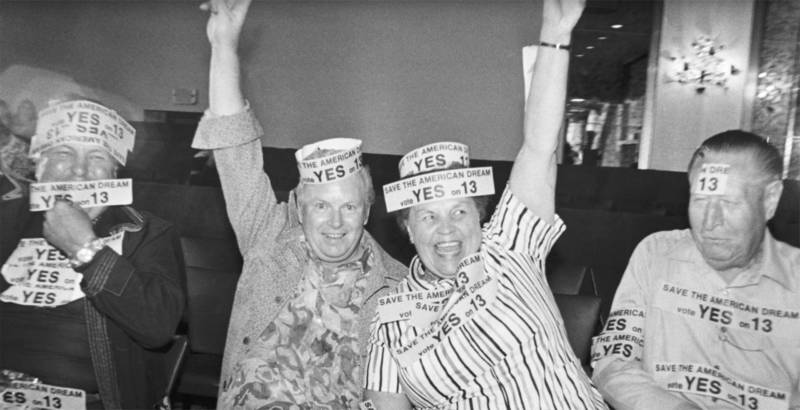
Proposition 13 backers celebrate the measure's passage in 1978. (RetroReport/YouTube)
At its core, Proposition 13 was written as an amendment to the state’s constitution with three key elements and affected all types of property, from residential to commercial:
It rolled back assessed property values to their estimated market value in 1975 and limited annual increases to no more than 2 percent as long as the property wasn’t sold. With any new sale, the assessed value could climb to the actual sale price, essentially locking in the property tax for long-time homeowners and shifting the burden to newcomers.
It capped the property tax rate at 1 percent of the assessed value for city, county, school and other local governments, down from an average of 2.6 percent before the measure, draining local coffers.
It mandated that any change in state taxes that would increase the tax take would require a two-thirds vote in the Legislature (while tax cuts required only a majority vote) and that any increase in designated or special purpose taxes by local governments would require two-thirds voter approval. This effectively staightjacketed the ability of a changing electorate to raise new revenues.
Prop 13 and its Racial Undertones
One reason for Prop 13’s popularity was that the median value of a house in California rose by over 250 percent from 1970 to 1980, more than twice as fast as median household income in the state. With reassessments triggering property tax hikes that outpaced family finances, the die was cast for a taxpayer rebellion.
But the roots of this suburban-based revolt were far deeper than a fight over taxes. The forces behind it were the same ones that fought against fair housing in the 1960s and busing to promote school integration throughout the 1970s. And they were goaded by a series of court decisions that mandated the equalization of school spending across districts, stirring white resentment that local property tax dollars were not being spent on “our kids.”
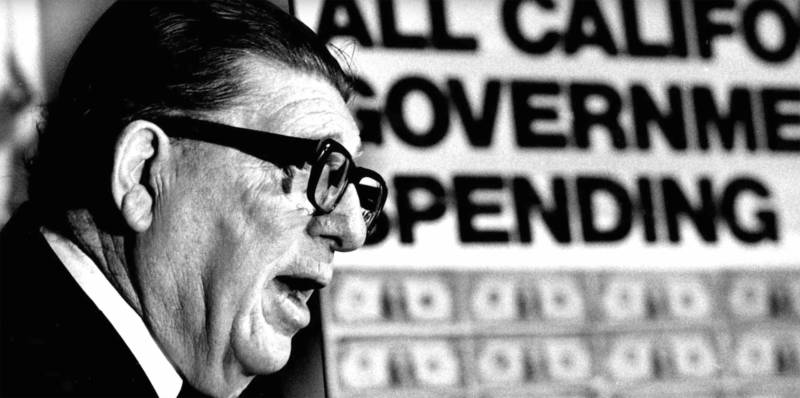
Indeed, at the same time that property rates were soaring, the share of youths who were minorities rose from 30 percent in 1970 to 44 percent by 1980 – the largest decadal change in California’s history. And while these racial undertones were, well, undertones, the resentment of the changing demography was clear when Prop 13’s main architect, Orange County businessman Howard Jarvis, wrote after it passed that immigrants “just come over here to get on the taxpayers’ gravy train.”
Howard Jarvis (RetroReport/YouTube)
In essence, Proposition 13 became the first shot across the bow in a series of referendums some dubbed “racial propositions” that reached their apogee with Proposition 187, the famous 1994 measure that sought to cut off nearly all public services, including education, to undocumented immigrants.
That was followed by voter-approved measures to ban affirmative action, eliminate bilingual education and expand a prison system marred by racial disproportionality in its sentencing and rates of incarceration.
That Prop 13 itself was a sort of generational warfare with overtones of race was clear in its structure. Since the assessment didn’t increase more than 2 percent unless property changed hands, incumbent homeowners (who were older and whiter) wouldn’t see their tax burden change much as long as they didn’t sell. Meanwhile, new homeowners (more likely to be younger, minority and eventually immigrant) would have to pay higher tax rates and thus bear a disproportionate share of the costs of local services.
And that wasn’t the only bias against the future. The requirement for a supermajority to pass legislation to raise taxes effectively constrained the ability of future state governments to pour in the sort of money that had built the state’s famed transportation, water and university systems.
The Consequences
The immediate damage from Prop 13, however, was masked. When local property tax revenues quickly fell by about 60 percent, the state government stepped in to fill the gaps.
But over time, the damaging effects of Proposition 13 in terms of education spending and income inequality became increasingly apparent. In the 1960s, California ranked among the top 10 states in terms of per-pupil spending. By 2014, its ranking had plunged to as low as 46. And while California’s level of income inequality was in the middle of the pack nationally in 1969, it is now the fourth most unequal state in the country.
While Proposition 13 was the not the only culprit behind these trends, it didn’t help. About half of the total residential property tax relief provided by Prop 13 went to homeowners with incomes in excess of US$120,000 a year – or about 15 percent of all households.
And because the property tax was no longer a growing source of revenue for local governments, cities and counties had more reason to chase sales taxes with retail development and less incentive to promote housing, helping to set in motion the severe housing shortage that wracks the state today.
Its political appeal remains, particularly to older residents who vote and to businesses worried about any increase in taxes. Efforts to keep the protections for residential homeowners but allow commercial and industrial property to be assessed at market rates – a so-called “split roll” – have failed or stalled and currently command the thinnest possible majority in public polling.
So while the split role remains a goal for some reformers, many concerned about the effects of Prop 13 have simply tried to raise taxes elsewhere to offset the lost revenue. California voters approved a temporary “millionaire’s tax” in 2012 and its long-term extension in 2016. And more than two-thirds of voting taxpayers in Los Angeles County approved sales tax hikes in 2008 and 2016 that will generate $160 billion over the next 40 years for transportation investments ranging from rail expansion to highway improvement to new bike paths.
But such tinkering does not solve the fundamental problems with Prop 13 that I’ve noted above. Addressing those will require a new set of conversations about optimal tax policy and how to address legitimate concerns such as how to protect older homeowners with a fixed income from the potential end of Prop 13.
California – and the Country – at a Crossroads
Unfortunately, the same demographic shifts, economic anxieties and political polarization that spurred Prop 13 have since gone national. The president’s plan to “Make America Great Again” similarly involves slashing taxes while underinvesting in education and social services – the kinds of investments that actually made America great in the 20th century.
California has the opportunity to show the nation how to get this right and invest in our future and our collective dreams rather than shortchange them. And a growing number of voices, including local governments, unions and political groups, are calling for reform.
So while the discussion about Prop 13 might seem to be about a few obscure tax rules, it is highly symbolic: At stake is the future of the state and, indeed, the nation. A day of reckoning for a measure that seems increasingly out of date may soon be upon us.
The California Dream series is a statewide media collaboration of CALmatters, KPBS, KPCC, KQED and Capital Public Radio with support from the Corporation for Public Broadcasting, the James Irvine Foundation and the College Futures Foundation.
http://bit.ly/kqedcadream
lower waypoint
Stay in touch. Sign up for our daily newsletter.
To learn more about how we use your information, please read our privacy policy.
window.__IS_SSR__=true
window.__INITIAL_STATE__={"attachmentsReducer":{"audio_0":{"type":"attachments","id":"audio_0","imgSizes":{"kqedFullSize":{"file":"https://ww2.kqed.org/news/wp-content/themes/KQED-unified/img/audio_bgs/background0.jpg"}}},"audio_1":{"type":"attachments","id":"audio_1","imgSizes":{"kqedFullSize":{"file":"https://ww2.kqed.org/news/wp-content/themes/KQED-unified/img/audio_bgs/background1.jpg"}}},"audio_2":{"type":"attachments","id":"audio_2","imgSizes":{"kqedFullSize":{"file":"https://ww2.kqed.org/news/wp-content/themes/KQED-unified/img/audio_bgs/background2.jpg"}}},"audio_3":{"type":"attachments","id":"audio_3","imgSizes":{"kqedFullSize":{"file":"https://ww2.kqed.org/news/wp-content/themes/KQED-unified/img/audio_bgs/background3.jpg"}}},"audio_4":{"type":"attachments","id":"audio_4","imgSizes":{"kqedFullSize":{"file":"https://ww2.kqed.org/news/wp-content/themes/KQED-unified/img/audio_bgs/background4.jpg"}}},"placeholder":{"type":"attachments","id":"placeholder","imgSizes":{"thumbnail":{"file":"https://ww2.kqed.org/wp-content/uploads/sites/10/2018/01/GettyImages-896326950-160x96.jpg","width":160,"height":96,"mimeType":"image/jpeg"},"medium":{"file":"https://ww2.kqed.org/wp-content/uploads/sites/10/2018/01/GettyImages-896326950-800x478.jpg","width":800,"height":478,"mimeType":"image/jpeg"},"large":{"file":"https://ww2.kqed.org/wp-content/uploads/sites/10/2018/01/GettyImages-896326950-1020x610.jpg","width":1020,"height":610,"mimeType":"image/jpeg"},"fd-lrg":{"file":"https://ww2.kqed.org/wp-content/uploads/sites/10/2018/01/GettyImages-896326950-1920x1148.jpg","width":1920,"height":1148,"mimeType":"image/jpeg"},"fd-med":{"file":"https://ww2.kqed.org/wp-content/uploads/sites/10/2018/01/GettyImages-896326950-1180x705.jpg","width":1180,"height":705,"mimeType":"image/jpeg"},"fd-sm":{"file":"https://ww2.kqed.org/wp-content/uploads/sites/10/2018/01/GettyImages-896326950-960x574.jpg","width":960,"height":574,"mimeType":"image/jpeg"},"post-thumbnail":{"file":"https://ww2.kqed.org/wp-content/uploads/sites/10/2018/01/GettyImages-896326950-672x372.jpg","width":672,"height":372,"mimeType":"image/jpeg"},"twentyfourteen-full-width":{"file":"https://ww2.kqed.org/wp-content/uploads/sites/10/2018/01/GettyImages-896326950-1038x576.jpg","width":1038,"height":576,"mimeType":"image/jpeg"},"xxsmall":{"file":"https://ww2.kqed.org/wp-content/uploads/sites/10/2018/01/GettyImages-896326950-240x143.jpg","width":240,"height":143,"mimeType":"image/jpeg"},"xsmall":{"file":"https://ww2.kqed.org/wp-content/uploads/sites/10/2018/01/GettyImages-896326950-375x224.jpg","width":375,"height":224,"mimeType":"image/jpeg"},"small":{"file":"https://ww2.kqed.org/wp-content/uploads/sites/10/2018/01/GettyImages-896326950-520x311.jpg","width":520,"height":311,"mimeType":"image/jpeg"},"xlarge":{"file":"https://ww2.kqed.org/wp-content/uploads/sites/10/2018/01/GettyImages-896326950-1180x705.jpg","width":1180,"height":705,"mimeType":"image/jpeg"},"full-width":{"file":"https://ww2.kqed.org/wp-content/uploads/sites/10/2018/01/GettyImages-896326950-1920x1148.jpg","width":1920,"height":1148,"mimeType":"image/jpeg"},"guest-author-32":{"file":"https://ww2.kqed.org/wp-content/uploads/sites/10/2018/01/GettyImages-896326950-32x32.jpg","width":32,"height":32,"mimeType":"image/jpeg"},"guest-author-50":{"file":"https://ww2.kqed.org/wp-content/uploads/sites/10/2018/01/GettyImages-896326950-50x50.jpg","width":50,"height":50,"mimeType":"image/jpeg"},"guest-author-64":{"file":"https://ww2.kqed.org/wp-content/uploads/sites/10/2018/01/GettyImages-896326950-64x64.jpg","width":64,"height":64,"mimeType":"image/jpeg"},"guest-author-96":{"file":"https://ww2.kqed.org/wp-content/uploads/sites/10/2018/01/GettyImages-896326950-96x96.jpg","width":96,"height":96,"mimeType":"image/jpeg"},"guest-author-128":{"file":"https://ww2.kqed.org/wp-content/uploads/sites/10/2018/01/GettyImages-896326950-128x128.jpg","width":128,"height":128,"mimeType":"image/jpeg"},"detail":{"file":"https://ww2.kqed.org/wp-content/uploads/sites/10/2018/01/GettyImages-896326950-150x150.jpg","width":150,"height":150,"mimeType":"image/jpeg"},"kqedFullSize":{"file":"https://ww2.kqed.org/wp-content/uploads/sites/10/2018/01/GettyImages-896326950-e1514998105161.jpg","width":1920,"height":1148}}},"news_11977003":{"type":"attachments","id":"news_11977003","meta":{"index":"attachments_1591205162","site":"news","id":"11977003","found":true},"title":"240224-Chinese-new-year-parade-KSM-3_qut","publishDate":1708838557,"status":"inherit","parent":11976974,"modified":1708838598,"caption":"Awkwafina, grand marshal of the Chinese New Year Festival and Parade in San Francisco on Feb. 24, 2024.","credit":"Kathryn Styer Martínez/KQED","altTag":null,"description":null,"imgSizes":{"medium":{"file":"https://cdn.kqed.org/wp-content/uploads/sites/10/2024/02/240224-Chinese-new-year-parade-KSM-3_qut-800x533.jpg","width":800,"height":533,"mimeType":"image/jpeg"},"large":{"file":"https://cdn.kqed.org/wp-content/uploads/sites/10/2024/02/240224-Chinese-new-year-parade-KSM-3_qut-1020x680.jpg","width":1020,"height":680,"mimeType":"image/jpeg"},"thumbnail":{"file":"https://cdn.kqed.org/wp-content/uploads/sites/10/2024/02/240224-Chinese-new-year-parade-KSM-3_qut-160x107.jpg","width":160,"height":107,"mimeType":"image/jpeg"},"1536x1536":{"file":"https://cdn.kqed.org/wp-content/uploads/sites/10/2024/02/240224-Chinese-new-year-parade-KSM-3_qut-1536x1024.jpg","width":1536,"height":1024,"mimeType":"image/jpeg"},"post-thumbnail":{"file":"https://cdn.kqed.org/wp-content/uploads/sites/10/2024/02/240224-Chinese-new-year-parade-KSM-3_qut-672x372.jpg","width":672,"height":372,"mimeType":"image/jpeg"},"twentyfourteen-full-width":{"file":"https://cdn.kqed.org/wp-content/uploads/sites/10/2024/02/240224-Chinese-new-year-parade-KSM-3_qut-1038x576.jpg","width":1038,"height":576,"mimeType":"image/jpeg"},"kqedFullSize":{"file":"https://cdn.kqed.org/wp-content/uploads/sites/10/2024/02/240224-Chinese-new-year-parade-KSM-3_qut.jpg","width":1920,"height":1280}},"fetchFailed":false,"isLoading":false},"news_11976954":{"type":"attachments","id":"news_11976954","meta":{"index":"attachments_1591205162","site":"news","id":"11976954","found":true},"title":"U.S. Senate Democratic candidates Dianne Feinstein","publishDate":1708721222,"status":"inherit","parent":11976949,"modified":1708812631,"caption":"US Senate Democratic candidates Dianne Feinstein (Right) and Barbara Boxer at a get-out-the-vote rally Nov. 2, 1992, a day before Election Day. Feinstein and Boxer, both from Northern California, were running against 2 Republican men from Southern California.","credit":"MIKE NELSON/AFP via Getty Images","altTag":null,"description":null,"imgSizes":{"medium":{"file":"https://cdn.kqed.org/wp-content/uploads/sites/10/2024/02/GettyImages-51622967-800x562.jpg","width":800,"height":562,"mimeType":"image/jpeg"},"thumbnail":{"file":"https://cdn.kqed.org/wp-content/uploads/sites/10/2024/02/GettyImages-51622967-160x112.jpg","width":160,"height":112,"mimeType":"image/jpeg"},"post-thumbnail":{"file":"https://cdn.kqed.org/wp-content/uploads/sites/10/2024/02/GettyImages-51622967-672x372.jpg","width":672,"height":372,"mimeType":"image/jpeg"},"twentyfourteen-full-width":{"file":"https://cdn.kqed.org/wp-content/uploads/sites/10/2024/02/GettyImages-51622967-1010x576.jpg","width":1010,"height":576,"mimeType":"image/jpeg"},"kqedFullSize":{"file":"https://cdn.kqed.org/wp-content/uploads/sites/10/2024/02/GettyImages-51622967.jpg","width":1010,"height":710}},"fetchFailed":false,"isLoading":false},"news_11976031":{"type":"attachments","id":"news_11976031","meta":{"index":"attachments_1591205162","site":"news","id":"11976031","found":true},"title":"240214-NONCITIZENVOTING-12-BL-KQED","publishDate":1708018370,"status":"inherit","parent":0,"modified":1708029051,"caption":"Aaron Peskin, President of the Board of Supervisors, swears in appointee Kelly Wong to the San Francisco Elections Commission at City Hall in San Francisco on Feb. 14, 2024.","credit":"Beth LaBerge/KQED","altTag":"An Asian woman wearing a black dress raises her right hand in front of a man wearing a black suit who is also raising his and holding a document inside a building.","description":null,"imgSizes":{"medium":{"file":"https://cdn.kqed.org/wp-content/uploads/sites/10/2024/02/240214-NONCITIZENVOTING-12-BL-KQED-800x533.jpg","width":800,"height":533,"mimeType":"image/jpeg"},"large":{"file":"https://cdn.kqed.org/wp-content/uploads/sites/10/2024/02/240214-NONCITIZENVOTING-12-BL-KQED-1020x680.jpg","width":1020,"height":680,"mimeType":"image/jpeg"},"thumbnail":{"file":"https://cdn.kqed.org/wp-content/uploads/sites/10/2024/02/240214-NONCITIZENVOTING-12-BL-KQED-160x107.jpg","width":160,"height":107,"mimeType":"image/jpeg"},"1536x1536":{"file":"https://cdn.kqed.org/wp-content/uploads/sites/10/2024/02/240214-NONCITIZENVOTING-12-BL-KQED-1536x1024.jpg","width":1536,"height":1024,"mimeType":"image/jpeg"},"post-thumbnail":{"file":"https://cdn.kqed.org/wp-content/uploads/sites/10/2024/02/240214-NONCITIZENVOTING-12-BL-KQED-672x372.jpg","width":672,"height":372,"mimeType":"image/jpeg"},"twentyfourteen-full-width":{"file":"https://cdn.kqed.org/wp-content/uploads/sites/10/2024/02/240214-NONCITIZENVOTING-12-BL-KQED-1038x576.jpg","width":1038,"height":576,"mimeType":"image/jpeg"},"full-width":{"file":"https://cdn.kqed.org/wp-content/uploads/sites/10/2024/02/240214-NONCITIZENVOTING-12-BL-KQED-1920x1280.jpg","width":1920,"height":1280,"mimeType":"image/jpeg"},"kqedFullSize":{"file":"https://cdn.kqed.org/wp-content/uploads/sites/10/2024/02/240214-NONCITIZENVOTING-12-BL-KQED.jpg","width":2000,"height":1333}},"fetchFailed":false,"isLoading":false},"forum_2010101904829":{"type":"attachments","id":"forum_2010101904829","meta":{"index":"attachments_1591205162","site":"forum","id":"2010101904829","found":true},"title":"1920 x 1080 template (6)","publishDate":1708730822,"status":"inherit","parent":2010101904826,"modified":1708730900,"caption":"Gretchen Sisson's new book is \"Relinquished: The Politics of Adoption and the Privilege of American Motherhood\"","credit":"Photo Credit: Liz Corman","altTag":null,"description":null,"imgSizes":{"medium":{"file":"https://cdn.kqed.org/wp-content/uploads/sites/43/2024/02/1920-x-1080-template-6-800x450.png","width":800,"height":450,"mimeType":"image/png"},"large":{"file":"https://cdn.kqed.org/wp-content/uploads/sites/43/2024/02/1920-x-1080-template-6-1020x574.png","width":1020,"height":574,"mimeType":"image/png"},"thumbnail":{"file":"https://cdn.kqed.org/wp-content/uploads/sites/43/2024/02/1920-x-1080-template-6-160x90.png","width":160,"height":90,"mimeType":"image/png"},"medium_large":{"file":"https://cdn.kqed.org/wp-content/uploads/sites/43/2024/02/1920-x-1080-template-6-768x432.png","width":768,"height":432,"mimeType":"image/png"},"1536x1536":{"file":"https://cdn.kqed.org/wp-content/uploads/sites/43/2024/02/1920-x-1080-template-6-1536x864.png","width":1536,"height":864,"mimeType":"image/png"},"post-thumbnail":{"file":"https://cdn.kqed.org/wp-content/uploads/sites/43/2024/02/1920-x-1080-template-6-672x372.png","width":672,"height":372,"mimeType":"image/png"},"twentyfourteen-full-width":{"file":"https://cdn.kqed.org/wp-content/uploads/sites/43/2024/02/1920-x-1080-template-6-1038x576.png","width":1038,"height":576,"mimeType":"image/png"},"kqedFullSize":{"file":"https://cdn.kqed.org/wp-content/uploads/sites/43/2024/02/1920-x-1080-template-6.png","width":1920,"height":1080}},"fetchFailed":false,"isLoading":false},"news_11976632":{"type":"attachments","id":"news_11976632","meta":{"index":"attachments_1591205162","site":"news","id":"11976632","found":true},"title":"057_SanFrancisco_YauKungMoonPerformance_01302022_qut","publishDate":1708555775,"status":"inherit","parent":11976610,"modified":1708555857,"caption":"The Yau Kung Moon Richard Ow and Susan Yee Kung Fu lion dance teams perform during the Chinese New Year Flower Market Fair in Chinatown, San Francisco, on Jan. 30, 2022.","credit":"Beth LaBerge/KQED","altTag":null,"description":null,"imgSizes":{"medium":{"file":"https://cdn.kqed.org/wp-content/uploads/sites/10/2024/02/057_SanFrancisco_YauKungMoonPerformance_01302022_qut-800x533.jpg","width":800,"height":533,"mimeType":"image/jpeg"},"large":{"file":"https://cdn.kqed.org/wp-content/uploads/sites/10/2024/02/057_SanFrancisco_YauKungMoonPerformance_01302022_qut-1020x679.jpg","width":1020,"height":679,"mimeType":"image/jpeg"},"thumbnail":{"file":"https://cdn.kqed.org/wp-content/uploads/sites/10/2024/02/057_SanFrancisco_YauKungMoonPerformance_01302022_qut-160x107.jpg","width":160,"height":107,"mimeType":"image/jpeg"},"1536x1536":{"file":"https://cdn.kqed.org/wp-content/uploads/sites/10/2024/02/057_SanFrancisco_YauKungMoonPerformance_01302022_qut-1536x1022.jpg","width":1536,"height":1022,"mimeType":"image/jpeg"},"post-thumbnail":{"file":"https://cdn.kqed.org/wp-content/uploads/sites/10/2024/02/057_SanFrancisco_YauKungMoonPerformance_01302022_qut-672x372.jpg","width":672,"height":372,"mimeType":"image/jpeg"},"twentyfourteen-full-width":{"file":"https://cdn.kqed.org/wp-content/uploads/sites/10/2024/02/057_SanFrancisco_YauKungMoonPerformance_01302022_qut-1038x576.jpg","width":1038,"height":576,"mimeType":"image/jpeg"},"kqedFullSize":{"file":"https://cdn.kqed.org/wp-content/uploads/sites/10/2024/02/057_SanFrancisco_YauKungMoonPerformance_01302022_qut.jpg","width":1920,"height":1278}},"fetchFailed":false,"isLoading":false},"news_11974709":{"type":"attachments","id":"news_11974709","meta":{"index":"attachments_1591205162","site":"news","id":"11974709","found":true},"title":"240202-FIXITCLINIC-KSM-15-KQED","publishDate":1707157141,"status":"inherit","parent":11976367,"modified":1708452375,"caption":"Andy Caughman (right) holds a clock while Charlie Kennedy (left) inspects it at a Fixit clinic in Millbrae on Feb. 3, 2024.","credit":"Kathryn Styer Martínez/KQED","altTag":"Two people work closely on the inside of a wooden device.","description":null,"imgSizes":{"medium":{"file":"https://cdn.kqed.org/wp-content/uploads/sites/10/2024/02/240202-FIXITCLINIC-KSM-15-KQED-800x533.jpg","width":800,"height":533,"mimeType":"image/jpeg"},"large":{"file":"https://cdn.kqed.org/wp-content/uploads/sites/10/2024/02/240202-FIXITCLINIC-KSM-15-KQED-1020x680.jpg","width":1020,"height":680,"mimeType":"image/jpeg"},"thumbnail":{"file":"https://cdn.kqed.org/wp-content/uploads/sites/10/2024/02/240202-FIXITCLINIC-KSM-15-KQED-160x107.jpg","width":160,"height":107,"mimeType":"image/jpeg"},"1536x1536":{"file":"https://cdn.kqed.org/wp-content/uploads/sites/10/2024/02/240202-FIXITCLINIC-KSM-15-KQED-1536x1024.jpg","width":1536,"height":1024,"mimeType":"image/jpeg"},"post-thumbnail":{"file":"https://cdn.kqed.org/wp-content/uploads/sites/10/2024/02/240202-FIXITCLINIC-KSM-15-KQED-672x372.jpg","width":672,"height":372,"mimeType":"image/jpeg"},"twentyfourteen-full-width":{"file":"https://cdn.kqed.org/wp-content/uploads/sites/10/2024/02/240202-FIXITCLINIC-KSM-15-KQED-1038x576.jpg","width":1038,"height":576,"mimeType":"image/jpeg"},"full-width":{"file":"https://cdn.kqed.org/wp-content/uploads/sites/10/2024/02/240202-FIXITCLINIC-KSM-15-KQED-1920x1280.jpg","width":1920,"height":1280,"mimeType":"image/jpeg"},"kqedFullSize":{"file":"https://cdn.kqed.org/wp-content/uploads/sites/10/2024/02/240202-FIXITCLINIC-KSM-15-KQED.jpg","width":2000,"height":1333}},"fetchFailed":false,"isLoading":false},"news_11977024":{"type":"attachments","id":"news_11977024","meta":{"index":"attachments_1591205162","site":"news","id":"11977024","found":true},"title":"Sunday Music Drop Photo Collages-22","publishDate":1708893960,"status":"inherit","parent":11977020,"modified":1708894023,"caption":null,"credit":null,"altTag":"A black and white collage of five images of a side profile of an asian woman looking down.","description":null,"imgSizes":{"medium":{"file":"https://cdn.kqed.org/wp-content/uploads/sites/10/2024/02/Sunday-Music-Drop-Photo-Collages-22-800x640.png","width":800,"height":640,"mimeType":"image/png"},"large":{"file":"https://cdn.kqed.org/wp-content/uploads/sites/10/2024/02/Sunday-Music-Drop-Photo-Collages-22-1020x816.png","width":1020,"height":816,"mimeType":"image/png"},"thumbnail":{"file":"https://cdn.kqed.org/wp-content/uploads/sites/10/2024/02/Sunday-Music-Drop-Photo-Collages-22-160x128.png","width":160,"height":128,"mimeType":"image/png"},"post-thumbnail":{"file":"https://cdn.kqed.org/wp-content/uploads/sites/10/2024/02/Sunday-Music-Drop-Photo-Collages-22-672x372.png","width":672,"height":372,"mimeType":"image/png"},"twentyfourteen-full-width":{"file":"https://cdn.kqed.org/wp-content/uploads/sites/10/2024/02/Sunday-Music-Drop-Photo-Collages-22-1038x576.png","width":1038,"height":576,"mimeType":"image/png"},"kqedFullSize":{"file":"https://cdn.kqed.org/wp-content/uploads/sites/10/2024/02/Sunday-Music-Drop-Photo-Collages-22.png","width":1500,"height":1200}},"fetchFailed":false,"isLoading":false},"news_11932019":{"type":"attachments","id":"news_11932019","meta":{"index":"attachments_1591205162","site":"news","id":"11932019","found":true},"title":"U.S. Rep. Katie Porter election watch party 2022","publishDate":1668136042,"status":"inherit","parent":11932012,"modified":1673387268,"caption":"US Rep. Katie Porter (D-Orange County) attends an election night watch party in Costa Mesa on Nov. 8, 2022. Porter, who won reelection in a close race against former state Assemblymember Scott Baugh, a Republican, in the newly redrawn 47th Congressional District, announced on Tuesday her bid for Dianne Feinstein's US Senate seat.","credit":"Mindy Schauer/MediaNews Group-Orange County Register via Getty Images","altTag":"Katie Porter with supporters at her election watch party.","description":null,"imgSizes":{"medium":{"file":"https://ww2.kqed.org/app/uploads/sites/10/2022/11/GettyImages-1440583508-800x442.jpg","width":800,"height":442,"mimeType":"image/jpeg"},"large":{"file":"https://ww2.kqed.org/app/uploads/sites/10/2022/11/GettyImages-1440583508-1020x564.jpg","width":1020,"height":564,"mimeType":"image/jpeg"},"thumbnail":{"file":"https://ww2.kqed.org/app/uploads/sites/10/2022/11/GettyImages-1440583508-160x88.jpg","width":160,"height":88,"mimeType":"image/jpeg"},"post-thumbnail":{"file":"https://ww2.kqed.org/app/uploads/sites/10/2022/11/GettyImages-1440583508-672x372.jpg","width":672,"height":372,"mimeType":"image/jpeg"},"kqedFullSize":{"file":"https://ww2.kqed.org/app/uploads/sites/10/2022/11/GettyImages-1440583508.jpg","width":1024,"height":566}},"fetchFailed":false,"isLoading":false},"news_11976721":{"type":"attachments","id":"news_11976721","meta":{"index":"attachments_1591205162","site":"news","id":"11976721","found":true},"title":"madonna-chase-center-san-francisco","publishDate":1708626702,"status":"inherit","parent":11976698,"modified":1708637996,"caption":"Madonna performs during the opening night of The Celebration Tour at The O2 Arena on Oct. 14, 2023, in London, England. ","credit":"Kevin Mazur/ WireImage for Live Nation","altTag":"A white woman dressed in an elaborate black gown and wearing a halo crown holds a microphone on stage.","description":null,"imgSizes":{"medium":{"file":"https://cdn.kqed.org/wp-content/uploads/sites/10/2024/02/GettyImages-1736271104-800x534.jpg","width":800,"height":534,"mimeType":"image/jpeg"},"large":{"file":"https://cdn.kqed.org/wp-content/uploads/sites/10/2024/02/GettyImages-1736271104-1020x680.jpg","width":1020,"height":680,"mimeType":"image/jpeg"},"thumbnail":{"file":"https://cdn.kqed.org/wp-content/uploads/sites/10/2024/02/GettyImages-1736271104-160x107.jpg","width":160,"height":107,"mimeType":"image/jpeg"},"post-thumbnail":{"file":"https://cdn.kqed.org/wp-content/uploads/sites/10/2024/02/GettyImages-1736271104-672x372.jpg","width":672,"height":372,"mimeType":"image/jpeg"},"twentyfourteen-full-width":{"file":"https://cdn.kqed.org/wp-content/uploads/sites/10/2024/02/GettyImages-1736271104-1024x576.jpg","width":1024,"height":576,"mimeType":"image/jpeg"},"kqedFullSize":{"file":"https://cdn.kqed.org/wp-content/uploads/sites/10/2024/02/GettyImages-1736271104.jpg","width":1024,"height":683}},"fetchFailed":false,"isLoading":false},"news_11971001":{"type":"attachments","id":"news_11971001","meta":{"index":"attachments_1591205162","site":"news","id":"11971001","found":true},"title":"002_KQED_Housing_MountainView_02192020_3308-qut","publishDate":1703706845,"status":"inherit","parent":11970993,"modified":1703706994,"caption":"Apartment construction in Mountain View on Feb. 19, 2020.","credit":"Beth LaBerge/KQED","altTag":"A house under construction.","description":null,"imgSizes":{"medium":{"file":"https://cdn.kqed.org/wp-content/uploads/sites/10/2023/12/002_KQED_Housing_MountainView_02192020_3308-qut-800x533.jpg","width":800,"height":533,"mimeType":"image/jpeg"},"large":{"file":"https://cdn.kqed.org/wp-content/uploads/sites/10/2023/12/002_KQED_Housing_MountainView_02192020_3308-qut-1020x680.jpg","width":1020,"height":680,"mimeType":"image/jpeg"},"thumbnail":{"file":"https://cdn.kqed.org/wp-content/uploads/sites/10/2023/12/002_KQED_Housing_MountainView_02192020_3308-qut-160x107.jpg","width":160,"height":107,"mimeType":"image/jpeg"},"1536x1536":{"file":"https://cdn.kqed.org/wp-content/uploads/sites/10/2023/12/002_KQED_Housing_MountainView_02192020_3308-qut-1536x1024.jpg","width":1536,"height":1024,"mimeType":"image/jpeg"},"post-thumbnail":{"file":"https://cdn.kqed.org/wp-content/uploads/sites/10/2023/12/002_KQED_Housing_MountainView_02192020_3308-qut-672x372.jpg","width":672,"height":372,"mimeType":"image/jpeg"},"twentyfourteen-full-width":{"file":"https://cdn.kqed.org/wp-content/uploads/sites/10/2023/12/002_KQED_Housing_MountainView_02192020_3308-qut-1038x576.jpg","width":1038,"height":576,"mimeType":"image/jpeg"},"kqedFullSize":{"file":"https://cdn.kqed.org/wp-content/uploads/sites/10/2023/12/002_KQED_Housing_MountainView_02192020_3308-qut.jpg","width":1920,"height":1280}},"fetchFailed":false,"isLoading":false},"news_11627340":{"type":"attachments","id":"news_11627340","meta":{"index":"attachments_1591205162","site":"news","id":"11627340","found":true},"title":"JarvisFist","publishDate":1509499283,"status":"inherit","parent":11624431,"modified":1509499353,"caption":"Orange County businessman Howard Jarvis, the architect of Proposition 13.","credit":"RetroReport/YouTube","description":"Orange County businessman Howard Jarvis, the architect of Proposition 13.","imgSizes":{"thumbnail":{"file":"https://ww2.kqed.org/app/uploads/sites/10/2017/10/JarvisFist-160x92.jpg","width":160,"height":92,"mimeType":"image/jpeg"},"medium":{"file":"https://ww2.kqed.org/app/uploads/sites/10/2017/10/JarvisFist-800x458.jpg","width":800,"height":458,"mimeType":"image/jpeg"},"large":{"file":"https://ww2.kqed.org/app/uploads/sites/10/2017/10/JarvisFist-1020x584.jpg","width":1020,"height":584,"mimeType":"image/jpeg"},"fd-lrg":{"file":"https://ww2.kqed.org/app/uploads/sites/10/2017/10/JarvisFist-1920x1100.jpg","width":1920,"height":1100,"mimeType":"image/jpeg"},"fd-med":{"file":"https://ww2.kqed.org/app/uploads/sites/10/2017/10/JarvisFist-1180x676.jpg","width":1180,"height":676,"mimeType":"image/jpeg"},"fd-sm":{"file":"https://ww2.kqed.org/app/uploads/sites/10/2017/10/JarvisFist-960x550.jpg","width":960,"height":550,"mimeType":"image/jpeg"},"post-thumbnail":{"file":"https://ww2.kqed.org/app/uploads/sites/10/2017/10/JarvisFist-672x372.jpg","width":672,"height":372,"mimeType":"image/jpeg"},"twentyfourteen-full-width":{"file":"https://ww2.kqed.org/app/uploads/sites/10/2017/10/JarvisFist-1038x576.jpg","width":1038,"height":576,"mimeType":"image/jpeg"},"xxsmall":{"file":"https://ww2.kqed.org/app/uploads/sites/10/2017/10/JarvisFist-240x138.jpg","width":240,"height":138,"mimeType":"image/jpeg"},"xsmall":{"file":"https://ww2.kqed.org/app/uploads/sites/10/2017/10/JarvisFist-375x215.jpg","width":375,"height":215,"mimeType":"image/jpeg"},"small":{"file":"https://ww2.kqed.org/app/uploads/sites/10/2017/10/JarvisFist-520x298.jpg","width":520,"height":298,"mimeType":"image/jpeg"},"xlarge":{"file":"https://ww2.kqed.org/app/uploads/sites/10/2017/10/JarvisFist-1180x676.jpg","width":1180,"height":676,"mimeType":"image/jpeg"},"full-width":{"file":"https://ww2.kqed.org/app/uploads/sites/10/2017/10/JarvisFist-1920x1100.jpg","width":1920,"height":1100,"mimeType":"image/jpeg"},"guest-author-32":{"file":"https://ww2.kqed.org/app/uploads/sites/10/2017/10/JarvisFist-32x32.jpg","width":32,"height":32,"mimeType":"image/jpeg"},"guest-author-50":{"file":"https://ww2.kqed.org/app/uploads/sites/10/2017/10/JarvisFist-50x50.jpg","width":50,"height":50,"mimeType":"image/jpeg"},"guest-author-64":{"file":"https://ww2.kqed.org/app/uploads/sites/10/2017/10/JarvisFist-64x64.jpg","width":64,"height":64,"mimeType":"image/jpeg"},"guest-author-96":{"file":"https://ww2.kqed.org/app/uploads/sites/10/2017/10/JarvisFist-96x96.jpg","width":96,"height":96,"mimeType":"image/jpeg"},"guest-author-128":{"file":"https://ww2.kqed.org/app/uploads/sites/10/2017/10/JarvisFist-128x128.jpg","width":128,"height":128,"mimeType":"image/jpeg"},"detail":{"file":"https://ww2.kqed.org/app/uploads/sites/10/2017/10/JarvisFist-150x150.jpg","width":150,"height":150,"mimeType":"image/jpeg"},"kqedFullSize":{"file":"https://ww2.kqed.org/app/uploads/sites/10/2017/10/JarvisFist.jpg","width":1920,"height":1100}},"fetchFailed":false,"isLoading":false}},"audioPlayerReducer":{"postId":"stream_live"},"authorsReducer":{"gmarzorati":{"type":"authors","id":"227","meta":{"index":"authors_1591205172","id":"227","found":true},"name":"Guy Marzorati","firstName":"Guy","lastName":"Marzorati","slug":"gmarzorati","email":"gmarzorati@KQED.org","display_author_email":true,"staff_mastheads":["news"],"title":"Correspondent","bio":"Guy Marzorati is a correspondent on KQED's California Politics and Government Desk, based in San Jose. Guy joined KQED in 2013, and reports on state and local politics. He produces KQED's weekly radio show and podcast \u003cem>Political Breakdown \u003c/em>and KQED's digital voter guide. Guy is a graduate of Santa Clara University.","avatar":"https://secure.gravatar.com/avatar/e7038b8dbfd55b104369b76b1cd0b9de?s=600&d=mm&r=g","twitter":"guymarzorati","facebook":null,"instagram":null,"linkedin":null,"sites":[{"site":"","roles":["editor"]},{"site":"news","roles":["editor"]},{"site":"forum","roles":["editor"]},{"site":"elections","roles":["editor"]},{"site":"liveblog","roles":["editor"]}],"headData":{"title":"Guy Marzorati | KQED","description":"Correspondent","ogImgSrc":"https://secure.gravatar.com/avatar/e7038b8dbfd55b104369b76b1cd0b9de?s=600&d=mm&r=g","twImgSrc":"https://secure.gravatar.com/avatar/e7038b8dbfd55b104369b76b1cd0b9de?s=600&d=mm&r=g"},"isLoading":false,"link":"/author/gmarzorati"},"kqed":{"type":"authors","id":"236","meta":{"index":"authors_1591205172","id":"236","found":true},"name":"KQED News Staff","firstName":"KQED News Staff","lastName":null,"slug":"kqed","email":"faq@kqed.org","display_author_email":false,"staff_mastheads":[],"title":null,"bio":null,"avatar":"https://secure.gravatar.com/avatar/ef0e801a68c4c54afa9180db14084167?s=600&d=blank&r=g","twitter":null,"facebook":null,"instagram":null,"linkedin":null,"sites":[{"site":"arts","roles":["contributor"]},{"site":"news","roles":["editor"]},{"site":"futureofyou","roles":["author"]}],"headData":{"title":"KQED News Staff | KQED","description":null,"ogImgSrc":"https://secure.gravatar.com/avatar/ef0e801a68c4c54afa9180db14084167?s=600&d=blank&r=g","twImgSrc":"https://secure.gravatar.com/avatar/ef0e801a68c4c54afa9180db14084167?s=600&d=blank&r=g"},"isLoading":false,"link":"/author/kqed"},"minakim":{"type":"authors","id":"243","meta":{"index":"authors_1591205172","id":"243","found":true},"name":"Mina Kim","firstName":"Mina","lastName":"Kim","slug":"minakim","email":"mkim@kqed.org","display_author_email":false,"staff_mastheads":["news"],"title":"Host, Forum","bio":"Mina Kim is host of the 10 a.m. statewide hour of Forum; a live daily talk show for curious Californians on issues that matter to the state and nation, with a particular emphasis on race and equity.\r\n\r\nBefore joining the Forum team, Mina was KQED’s evening news anchor, and health reporter for The California Report. Her award-winning work has included natural disasters in Napa and gun violence in Oakland. Mina grew up in St. John’s, Newfoundland.","avatar":"https://secure.gravatar.com/avatar/145ce657a2d08cb86d93686beb958982?s=600&d=blank&r=g","twitter":"mkimreporter","facebook":null,"instagram":null,"linkedin":null,"sites":[{"site":"news","roles":["contributor"]},{"site":"stateofhealth","roles":["author"]},{"site":"forum","roles":["editor"]}],"headData":{"title":"Mina Kim | KQED","description":"Host, Forum","ogImgSrc":"https://secure.gravatar.com/avatar/145ce657a2d08cb86d93686beb958982?s=600&d=blank&r=g","twImgSrc":"https://secure.gravatar.com/avatar/145ce657a2d08cb86d93686beb958982?s=600&d=blank&r=g"},"isLoading":false,"link":"/author/minakim"},"scottshafer":{"type":"authors","id":"255","meta":{"index":"authors_1591205172","id":"255","found":true},"name":"Scott Shafer","firstName":"Scott","lastName":"Shafer","slug":"scottshafer","email":"sshafer@kqed.org","display_author_email":false,"staff_mastheads":["news"],"title":"KQED Contributor","bio":"Scott Shafer came to KQED in 1998 to host the statewide\u003cem> California Report\u003c/em>. Prior to that he had extended stints in politics and government\u003cem>.\u003c/em> Using that inside experience, he is now Senior Editor for KQED's Politics and Government Desk where he provides reporting, hosting and analysis while also overseeing the politics desk. Scott co-hosts the weekly show and podcast \u003cem>Political Breakdown a\u003c/em>nd he collaborated on \u003cem>The Political Mind of Jerry Brown, \u003c/em>an eight-part series about the life and extraordinary political career of the former governor. For fun, he plays water polo with the San Francisco Tsunami.","avatar":"https://secure.gravatar.com/avatar/a62ebae45b79d7aed1a39a0e3bf68104?s=600&d=blank&r=g","twitter":"scottshafer","facebook":null,"instagram":null,"linkedin":null,"sites":[{"site":"news","roles":["editor"]},{"site":"stateofhealth","roles":["author"]},{"site":"science","roles":["author"]},{"site":"forum","roles":["subscriber"]}],"headData":{"title":"Scott Shafer | KQED","description":"KQED Contributor","ogImgSrc":"https://secure.gravatar.com/avatar/a62ebae45b79d7aed1a39a0e3bf68104?s=600&d=blank&r=g","twImgSrc":"https://secure.gravatar.com/avatar/a62ebae45b79d7aed1a39a0e3bf68104?s=600&d=blank&r=g"},"isLoading":false,"link":"/author/scottshafer"},"mlagos":{"type":"authors","id":"3239","meta":{"index":"authors_1591205172","id":"3239","found":true},"name":"Marisa Lagos","firstName":"Marisa","lastName":"Lagos","slug":"mlagos","email":"mlagos@kqed.org","display_author_email":false,"staff_mastheads":["news"],"title":"KQED Contributor","bio":"\u003cspan style=\"font-weight: 400;\">Marisa Lagos is a correspondent for KQED’s California Politics and Government Desk and co-hosts a weekly show and podcast, \u003c/span>\u003ci>\u003cspan style=\"font-weight: 400;\">Political Breakdown.\u003c/span>\u003c/i> \u003cspan style=\"font-weight: 400;\">At KQED, Lagos conducts reporting, analysis and investigations into state, local and national politics for radio, TV and online. Every week, she and cohost Scott Shafer sit down with political insiders on \u003c/span>\u003ci>\u003cspan style=\"font-weight: 400;\">Political Breakdown\u003c/span>\u003c/i>\u003cspan style=\"font-weight: 400;\">, where they offer a peek into lives and personalities of those driving politics in California and beyond. \u003c/span>\r\n\r\n\u003cspan style=\"font-weight: 400;\">Previously, she worked for nine years at the San Francisco Chronicle covering San Francisco City Hall and state politics; and at the San Francisco Examiner and Los Angeles Time,. She has won awards for her work investigating the 2017 wildfires and her ongoing coverage of criminal justice issues in California. She lives in San Francisco with her two sons and husband.\u003c/span>","avatar":"https://secure.gravatar.com/avatar/a261a0d3696fc066871ef96b85b5e7d2?s=600&d=blank&r=g","twitter":"@mlagos","facebook":null,"instagram":null,"linkedin":null,"sites":[{"site":"news","roles":["editor"]},{"site":"science","roles":["editor"]},{"site":"forum","roles":["author"]}],"headData":{"title":"Marisa Lagos | KQED","description":"KQED Contributor","ogImgSrc":"https://secure.gravatar.com/avatar/a261a0d3696fc066871ef96b85b5e7d2?s=600&d=blank&r=g","twImgSrc":"https://secure.gravatar.com/avatar/a261a0d3696fc066871ef96b85b5e7d2?s=600&d=blank&r=g"},"isLoading":false,"link":"/author/mlagos"},"ecruzguevarra":{"type":"authors","id":"8654","meta":{"index":"authors_1591205172","id":"8654","found":true},"name":"Ericka Cruz Guevarra","firstName":"Ericka","lastName":"Cruz Guevarra","slug":"ecruzguevarra","email":"ecruzguevarra@kqed.org","display_author_email":true,"staff_mastheads":["news"],"title":"Producer, The Bay Podcast","bio":"Ericka Cruz Guevarra is host of \u003ca href=\"https://www.kqed.org/podcasts/thebay\">\u003cem>The Bay\u003c/em>\u003c/a> podcast at KQED. Before host, she was the show’s producer. Her work in that capacity includes a three-part reported series on policing in Vallejo, which won a 2020 excellence in journalism award from the Society of Professional Journalists. Ericka has worked as a breaking news reporter at Oregon Public Broadcasting, helped produce the Code Switch podcast, and was KQED’s inaugural Raul Ramirez Diversity Fund intern. She’s also an alumna of NPR’s Next Generation Radio program. Send her an email if you have strong feelings about whether Fairfield and Suisun City are the Bay.","avatar":"https://secure.gravatar.com/avatar/25e5ab8d3d53fad2dcc7bb2b5c506b1a?s=600&d=blank&r=g","twitter":"NotoriousECG","facebook":null,"instagram":null,"linkedin":null,"sites":[{"site":"arts","roles":["subscriber"]},{"site":"news","roles":["editor"]},{"site":"futureofyou","roles":["subscriber"]},{"site":"stateofhealth","roles":["subscriber"]},{"site":"science","roles":["editor"]},{"site":"forum","roles":["subscriber"]}],"headData":{"title":"Ericka Cruz Guevarra | KQED","description":"Producer, The Bay Podcast","ogImgSrc":"https://secure.gravatar.com/avatar/25e5ab8d3d53fad2dcc7bb2b5c506b1a?s=600&d=blank&r=g","twImgSrc":"https://secure.gravatar.com/avatar/25e5ab8d3d53fad2dcc7bb2b5c506b1a?s=600&d=blank&r=g"},"isLoading":false,"link":"/author/ecruzguevarra"},"amontecillo":{"type":"authors","id":"11649","meta":{"index":"authors_1591205172","id":"11649","found":true},"name":"Alan Montecillo","firstName":"Alan","lastName":"Montecillo","slug":"amontecillo","email":"amontecillo@kqed.org","display_author_email":false,"staff_mastheads":["news"],"title":"KQED Contributor","bio":"Alan Montecillo is editor of \u003cem>\u003ca href=\"http://kqed.org/thebay\">The Bay\u003c/a>, \u003c/em>a local news and storytelling podcast from KQED. He's worked as a senior talk show producer for WILL in Champaign-Urbana, Illinois, and was the founding producer and editor of \u003cem>Racist Sandwich\u003c/em>, a podcast about food, race, class, and gender. He is a Filipino-American from Hong Kong and a graduate of Reed College in Portland, Oregon.","avatar":"https://secure.gravatar.com/avatar/d5e4e7a76481969ccba76f4e2b5ccabc?s=600&d=blank&r=g","twitter":"alanmontecillo","facebook":null,"instagram":null,"linkedin":null,"sites":[{"site":"","roles":["editor"]},{"site":"news","roles":["editor"]}],"headData":{"title":"Alan Montecillo | KQED","description":"KQED Contributor","ogImgSrc":"https://secure.gravatar.com/avatar/d5e4e7a76481969ccba76f4e2b5ccabc?s=600&d=blank&r=g","twImgSrc":"https://secure.gravatar.com/avatar/d5e4e7a76481969ccba76f4e2b5ccabc?s=600&d=blank&r=g"},"isLoading":false,"link":"/author/amontecillo"},"ebaldassari":{"type":"authors","id":"11652","meta":{"index":"authors_1591205172","id":"11652","found":true},"name":"Erin Baldassari","firstName":"Erin","lastName":"Baldassari","slug":"ebaldassari","email":"ebaldassari@KQED.org","display_author_email":true,"staff_mastheads":["news"],"title":"Staff Writer","bio":"Erin Baldassari covers housing for KQED. She's a former print journalist and most recently worked as the transportation reporter for the \u003cem>Mercury News\u003c/em> and \u003cem>East Bay Times. \u003c/em>There, she focused on how the Bay Area’s housing shortage has changed the way people move around the region. She also served on the \u003cem>East Bay Times\u003c/em>’ 2017 Pulitzer Prize-winning team for coverage of the Ghost Ship Fire in Oakland. Prior to that, Erin worked as a breaking news and general assignment reporter for a variety of outlets in the Bay Area and the greater Boston area. A Tufts University alumna, Erin grew up in the foothills of the Sierra Nevada mountains and in Sonoma County. She is a life-long KQED listener.","avatar":"https://secure.gravatar.com/avatar/660ce35d088ca54ad606d7e941abc652?s=600&d=blank&r=g","twitter":"e_baldi","facebook":null,"instagram":null,"linkedin":null,"sites":[{"site":"news","roles":["author","edit_others_posts"]},{"site":"science","roles":["editor"]}],"headData":{"title":"Erin Baldassari | KQED","description":"Staff Writer","ogImgSrc":"https://secure.gravatar.com/avatar/660ce35d088ca54ad606d7e941abc652?s=600&d=blank&r=g","twImgSrc":"https://secure.gravatar.com/avatar/660ce35d088ca54ad606d7e941abc652?s=600&d=blank&r=g"},"isLoading":false,"link":"/author/ebaldassari"},"afinney":{"type":"authors","id":"11772","meta":{"index":"authors_1591205172","id":"11772","found":true},"name":"Annelise Finney","firstName":"Annelise","lastName":"Finney","slug":"afinney","email":"afinney@kqed.org","display_author_email":true,"staff_mastheads":["news"],"title":"Weekend Reporter","bio":"Annelise reports on reparations and daily news for the weekend desk. She is also the co-producer the Sunday Music Drop, a radio series featuring Bay Area musicians. She joined KQED in 2021 as a general assignment reporter and is an alumna of KALW's Audio Academy. She was born and raised in the East Bay and holds a B.A. in Urban Studies from Barnard College.","avatar":"https://secure.gravatar.com/avatar/5fded66cae47704cdfc5021cde0f3aa4?s=600&d=blank&r=g","twitter":"sharkfinney","facebook":null,"instagram":null,"linkedin":null,"sites":[{"site":"news","roles":["editor"]}],"headData":{"title":"Annelise Finney | KQED","description":"Weekend Reporter","ogImgSrc":"https://secure.gravatar.com/avatar/5fded66cae47704cdfc5021cde0f3aa4?s=600&d=blank&r=g","twImgSrc":"https://secure.gravatar.com/avatar/5fded66cae47704cdfc5021cde0f3aa4?s=600&d=blank&r=g"},"isLoading":false,"link":"/author/afinney"},"swhitney":{"type":"authors","id":"11784","meta":{"index":"authors_1591205172","id":"11784","found":true},"name":"Spencer Whitney","firstName":"Spencer","lastName":"Whitney","slug":"swhitney","email":"swhitney@kqed.org","display_author_email":false,"staff_mastheads":[],"title":"KQED Digital Editor","bio":"Spencer Whitney is currently a Digital Editor for KQED News. Prior to joining KQED News, Spencer worked as the Multimedia Editor at the Oakland Post and an Assistant Editor in the Editorial department at the San Francisco Chronicle. He attended Howard University as an undergraduate and interned with SiriusXM. He also attended UC Berkeley's Graduate School of Journalism and had the opportunity to write for the hyperlocal news sites Richmond Confidential and Oakland North.","avatar":"https://secure.gravatar.com/avatar/aedfae46322917626352337ecd4f0981?s=600&d=blank&r=g","twitter":null,"facebook":null,"instagram":null,"linkedin":null,"sites":[{"site":"arts","roles":["editor"]},{"site":"news","roles":["editor"]},{"site":"science","roles":["editor"]},{"site":"perspectives","roles":["editor"]}],"headData":{"title":"Spencer Whitney | KQED","description":"KQED Digital Editor","ogImgSrc":"https://secure.gravatar.com/avatar/aedfae46322917626352337ecd4f0981?s=600&d=blank&r=g","twImgSrc":"https://secure.gravatar.com/avatar/aedfae46322917626352337ecd4f0981?s=600&d=blank&r=g"},"isLoading":false,"link":"/author/swhitney"},"adahlstromeckman":{"type":"authors","id":"11785","meta":{"index":"authors_1591205172","id":"11785","found":true},"name":"Azul Dahlstrom-Eckman","firstName":"Azul","lastName":"Dahlstrom-Eckman","slug":"adahlstromeckman","email":"adahlstrom-eckman@kqed.org","display_author_email":true,"staff_mastheads":[],"title":"Weekend News Editor","bio":"Azul is the Weekend News Editor at KQED, responsible for overseeing radio and digital news on the weekends. He joined KQED in 2021 as an alumna of KALW's Audio Academy radio journalism training program. He was born and raised on Potrero Hill in San Francisco and holds a B.A. in Environmental Studies from the University of Oregon.","avatar":"https://secure.gravatar.com/avatar/99c0cfc680078897572931b34e941e1e?s=600&d=blank&r=g","twitter":"@zuliemann","facebook":null,"instagram":null,"linkedin":null,"sites":[{"site":"arts","roles":["editor"]},{"site":"news","roles":["editor"]},{"site":"science","roles":["editor"]}],"headData":{"title":"Azul Dahlstrom-Eckman | KQED","description":"Weekend News Editor","ogImgSrc":"https://secure.gravatar.com/avatar/99c0cfc680078897572931b34e941e1e?s=600&d=blank&r=g","twImgSrc":"https://secure.gravatar.com/avatar/99c0cfc680078897572931b34e941e1e?s=600&d=blank&r=g"},"isLoading":false,"link":"/author/adahlstromeckman"},"mesquinca":{"type":"authors","id":"11802","meta":{"index":"authors_1591205172","id":"11802","found":true},"name":"Maria Esquinca","firstName":"Maria","lastName":"Esquinca","slug":"mesquinca","email":"mesquinca@kqed.org","display_author_email":false,"staff_mastheads":[],"title":"Producer, The Bay","bio":"María Esquinca is a producer of The Bay. Before that, she was a New York Women’s Foundation IGNITE Fellow at Latino USA. She worked at Radio Bilingue where she covered the San Joaquin Valley. Maria has interned at WLRN, News 21, The New York Times Student Journalism Institute and at Crain’s Detroit Business as a Dow Jones News Fund Business Reporting Intern. She is an MFA graduate from the University of Miami. In 2017, she graduated from the Walter Cronkite School of Journalism and Mass Communication with a Master of Mass Communication. A fronteriza, she was born in Ciudad Juárez, Chihuahua, Mexico and grew up in El Paso, Texas.","avatar":"https://secure.gravatar.com/avatar/77cedba18aae91da775038ba06dcd8d0?s=600&d=blank&r=g","twitter":"@m_esquinca","facebook":null,"instagram":null,"linkedin":null,"sites":[{"site":"news","roles":["editor"]}],"headData":{"title":"Maria Esquinca | KQED","description":"Producer, The Bay","ogImgSrc":"https://secure.gravatar.com/avatar/77cedba18aae91da775038ba06dcd8d0?s=600&d=blank&r=g","twImgSrc":"https://secure.gravatar.com/avatar/77cedba18aae91da775038ba06dcd8d0?s=600&d=blank&r=g"},"isLoading":false,"link":"/author/mesquinca"},"nkhan":{"type":"authors","id":"11867","meta":{"index":"authors_1591205172","id":"11867","found":true},"name":"Nisa Khan","firstName":"Nisa","lastName":"Khan","slug":"nkhan","email":"nkhan@kqed.org","display_author_email":false,"staff_mastheads":[],"title":"KQED Contributor","bio":null,"avatar":"https://secure.gravatar.com/avatar/a3bf1efcfbe7658d13a434cc54d0b2e3?s=600&d=blank&r=g","twitter":null,"facebook":null,"instagram":null,"linkedin":null,"sites":[{"site":"news","roles":["editor"]}],"headData":{"title":"Nisa Khan | KQED","description":"KQED Contributor","ogImgSrc":"https://secure.gravatar.com/avatar/a3bf1efcfbe7658d13a434cc54d0b2e3?s=600&d=blank&r=g","twImgSrc":"https://secure.gravatar.com/avatar/a3bf1efcfbe7658d13a434cc54d0b2e3?s=600&d=blank&r=g"},"isLoading":false,"link":"/author/nkhan"},"udursun":{"type":"authors","id":"11883","meta":{"index":"authors_1591205172","id":"11883","found":true},"name":"Ugur Dursun","firstName":"Ugur","lastName":"Dursun","slug":"udursun","email":"udursun@kqed.org","display_author_email":false,"staff_mastheads":["arts"],"title":"Engagement Producer, KQED Arts & Culture","bio":"Ugur Dursun is a reporter and audience engagement producer for KQED Arts. Previously, her reporting has appeared on SFGate, East Bay Times, The Mercury News, KTVU, NBC Bay Area, The Stanford Daily, and other Bay Area local news outlets. In 2023, she was a recipient of Online News Association's \u003ca href=\"https://journalists.org/programs/mj-bear-fellowship/\">MJ Bear Fellowship\u003c/a>, which honors six standout journalists under the age of 30 who are pushing innovation in digital news.","avatar":"https://secure.gravatar.com/avatar/5275bbdc74da8a8845f2b9f9f7d94a5f?s=600&d=blank&r=g","twitter":null,"facebook":null,"instagram":null,"linkedin":null,"sites":[{"site":"arts","roles":["editor"]},{"site":"news","roles":["editor"]}],"headData":{"title":"Ugur Dursun | KQED","description":"Engagement Producer, KQED Arts & Culture","ogImgSrc":"https://secure.gravatar.com/avatar/5275bbdc74da8a8845f2b9f9f7d94a5f?s=600&d=blank&r=g","twImgSrc":"https://secure.gravatar.com/avatar/5275bbdc74da8a8845f2b9f9f7d94a5f?s=600&d=blank&r=g"},"isLoading":false,"link":"/author/udursun"},"byline_news_11624431":{"type":"authors","id":"byline_news_11624431","meta":{"override":true},"slug":"byline_news_11624431","name":"Manuel Pastor, University of Southern California – Dornsife College, for The Conversation","isLoading":false}},"breakingNewsReducer":{},"campaignFinanceReducer":{},"firebase":{"requesting":{},"requested":{},"timestamps":{},"data":{},"ordered":{},"auth":{"isLoaded":false,"isEmpty":true},"authError":null,"profile":{"isLoaded":false,"isEmpty":true},"listeners":{"byId":{},"allIds":[]},"isInitializing":false,"errors":[]},"navBarReducer":{"navBarId":"news","fullView":true,"showPlayer":false},"navMenuReducer":{"menus":[{"key":"menu1","items":[{"name":"News","link":"/","type":"title"},{"name":"Politics","link":"/politics"},{"name":"Science","link":"/science"},{"name":"Education","link":"/educationnews"},{"name":"Housing","link":"/housing"},{"name":"Immigration","link":"/immigration"},{"name":"Criminal Justice","link":"/criminaljustice"},{"name":"Silicon Valley","link":"/siliconvalley"},{"name":"Forum","link":"/forum"},{"name":"The California Report","link":"/californiareport"}]},{"key":"menu2","items":[{"name":"Arts & Culture","link":"/arts","type":"title"},{"name":"Critics’ Picks","link":"/thedolist"},{"name":"Cultural Commentary","link":"/artscommentary"},{"name":"Food & Drink","link":"/food"},{"name":"Bay Area Hip-Hop","link":"/bayareahiphop"},{"name":"Rebel Girls","link":"/rebelgirls"},{"name":"Arts Video","link":"/artsvideos"}]},{"key":"menu3","items":[{"name":"Podcasts","link":"/podcasts","type":"title"},{"name":"Bay Curious","link":"/podcasts/baycurious"},{"name":"Rightnowish","link":"/podcasts/rightnowish"},{"name":"The Bay","link":"/podcasts/thebay"},{"name":"On Our Watch","link":"/podcasts/onourwatch"},{"name":"Mindshift","link":"/podcasts/mindshift"},{"name":"Consider This","link":"/podcasts/considerthis"},{"name":"Political Breakdown","link":"/podcasts/politicalbreakdown"}]},{"key":"menu4","items":[{"name":"Live Radio","link":"/radio","type":"title"},{"name":"TV","link":"/tv","type":"title"},{"name":"Events","link":"/events","type":"title"},{"name":"For Educators","link":"/education","type":"title"},{"name":"Support KQED","link":"/support","type":"title"},{"name":"About","link":"/about","type":"title"},{"name":"Help Center","link":"https://kqed-helpcenter.kqed.org/s","type":"title"}]}]},"pagesReducer":{},"postsReducer":{"stream_live":{"type":"live","id":"stream_live","audioUrl":"https://streams.kqed.org/kqedradio","title":"Live Stream","excerpt":"Live Stream information currently unavailable.","link":"/radio","featImg":"","label":{"name":"KQED Live","link":"/"}},"stream_kqedNewscast":{"type":"posts","id":"stream_kqedNewscast","audioUrl":"https://www.kqed.org/.stream/anon/radio/RDnews/newscast.mp3?_=1","title":"KQED Newscast","featImg":"","label":{"name":"88.5 FM","link":"/"}},"news_11976974":{"type":"posts","id":"news_11976974","meta":{"index":"posts_1591205157","site":"news","id":"11976974","found":true},"guestAuthors":[],"slug":"crowds-and-dragons-pack-chinatown-for-san-franciscos-chinese-new-year-parade","title":"Crowds (and Dragons) Pack Chinatown for San Francisco's Chinese New Year Parade","publishDate":1708840800,"format":"standard","headTitle":"Crowds (and Dragons) Pack Chinatown for San Francisco’s Chinese New Year Parade | KQED","labelTerm":{"site":"news"},"content":"\u003cp>Thousands lined the streets of Chinatown Saturday for San Francisco’s dazzling annual \u003ca href=\"https://www.kqed.org/news/11976610/your-guide-to-the-2024-san-francisco-chinese-new-year-parade\">Chinese New Year Parade\u003c/a> that celebrates the Lunar New Year and the Chinese \u003ca href=\"https://www.kqed.org/arts/13951648/lunar-new-year-of-the-dragon-superstitions-celebrations\">Year of the Dragon\u003c/a>.\u003c/p>\n\u003cp>Beginning at Second and Market streets in downtown San Francisco at 5:15 p.m., the nearly three-hour parade made its way through Chinatown on a 1.3 mile course that rounded Union Square before ending at Kearny and Columbus Avenue.\u003c/p>\n\u003cfigure id=\"attachment_11977001\" class=\"wp-caption alignnone\" style=\"max-width: 1920px\">\u003cimg loading=\"lazy\" decoding=\"async\" class=\"size-full wp-image-11977001\" src=\"https://cdn.kqed.org/wp-content/uploads/sites/10/2024/02/240224-Chinese-new-year-parade-KSM-10_qut.jpg\" alt=\"\" width=\"1920\" height=\"1280\" srcset=\"https://cdn.kqed.org/wp-content/uploads/sites/10/2024/02/240224-Chinese-new-year-parade-KSM-10_qut.jpg 1920w, https://cdn.kqed.org/wp-content/uploads/sites/10/2024/02/240224-Chinese-new-year-parade-KSM-10_qut-800x533.jpg 800w, https://cdn.kqed.org/wp-content/uploads/sites/10/2024/02/240224-Chinese-new-year-parade-KSM-10_qut-1020x680.jpg 1020w, https://cdn.kqed.org/wp-content/uploads/sites/10/2024/02/240224-Chinese-new-year-parade-KSM-10_qut-160x107.jpg 160w, https://cdn.kqed.org/wp-content/uploads/sites/10/2024/02/240224-Chinese-new-year-parade-KSM-10_qut-1536x1024.jpg 1536w\" sizes=\"(max-width: 1920px) 100vw, 1920px\">\u003cfigcaption class=\"wp-caption-text\">A dragon passes by at the Chinese New Year Festival and Parade in San Francisco on Feb. 24, 2024. \u003ccite>(Kathryn Styer Martínez/KQED)\u003c/cite>\u003c/figcaption>\u003c/figure>\n\u003cp>Organizers of the parade say it’s considered one of the top ten parades in the world by the International Festivals & Events Association and \u003ca href=\"https://www.sfchronicle.com/bayarea/article/sf-chinese-new-year-18678491.php\">the biggest Lunar New Year parade outside of Asia\u003c/a>.\u003c/p>\n\u003cfigure id=\"attachment_11977004\" class=\"wp-caption alignnone\" style=\"max-width: 1920px\">\u003cimg loading=\"lazy\" decoding=\"async\" class=\"size-full wp-image-11977004\" src=\"https://cdn.kqed.org/wp-content/uploads/sites/10/2024/02/240224-ChineseNYParade-38-BL_qut.jpg\" alt=\"\" width=\"1920\" height=\"1280\" srcset=\"https://cdn.kqed.org/wp-content/uploads/sites/10/2024/02/240224-ChineseNYParade-38-BL_qut.jpg 1920w, https://cdn.kqed.org/wp-content/uploads/sites/10/2024/02/240224-ChineseNYParade-38-BL_qut-800x533.jpg 800w, https://cdn.kqed.org/wp-content/uploads/sites/10/2024/02/240224-ChineseNYParade-38-BL_qut-1020x680.jpg 1020w, https://cdn.kqed.org/wp-content/uploads/sites/10/2024/02/240224-ChineseNYParade-38-BL_qut-160x107.jpg 160w, https://cdn.kqed.org/wp-content/uploads/sites/10/2024/02/240224-ChineseNYParade-38-BL_qut-1536x1024.jpg 1536w\" sizes=\"(max-width: 1920px) 100vw, 1920px\">\u003cfigcaption class=\"wp-caption-text\">Lisa Performing Arts perform during the Chinese New Year Parade in San Francisco on Feb. 24, 2024. \u003ccite>(Beth LaBerge/KQED)\u003c/cite>\u003c/figcaption>\u003c/figure>\n\u003cfigure id=\"attachment_11977014\" class=\"wp-caption alignnone\" style=\"max-width: 1920px\">\u003cimg loading=\"lazy\" decoding=\"async\" class=\"size-full wp-image-11977014\" src=\"https://cdn.kqed.org/wp-content/uploads/sites/10/2024/02/240224-ChineseNYParade-22-BL_qut.jpg\" alt=\"\" width=\"1920\" height=\"1280\" srcset=\"https://cdn.kqed.org/wp-content/uploads/sites/10/2024/02/240224-ChineseNYParade-22-BL_qut.jpg 1920w, https://cdn.kqed.org/wp-content/uploads/sites/10/2024/02/240224-ChineseNYParade-22-BL_qut-800x533.jpg 800w, https://cdn.kqed.org/wp-content/uploads/sites/10/2024/02/240224-ChineseNYParade-22-BL_qut-1020x680.jpg 1020w, https://cdn.kqed.org/wp-content/uploads/sites/10/2024/02/240224-ChineseNYParade-22-BL_qut-160x107.jpg 160w, https://cdn.kqed.org/wp-content/uploads/sites/10/2024/02/240224-ChineseNYParade-22-BL_qut-1536x1024.jpg 1536w\" sizes=\"(max-width: 1920px) 100vw, 1920px\">\u003cfigcaption class=\"wp-caption-text\">Members of Lisa Performing Arts watch the Chinese New Year Parade in San Francisco on Feb. 24, 2024. \u003ccite>(Beth LaBerge/KQED)\u003c/cite>\u003c/figcaption>\u003c/figure>\n\u003cp>Many arrived early to get a good spot or a seat ahead of the parade. Cynthia Lee and her family, who’ve been coming to the annual event for the last five years, were there an hour before the parade start with their lawn chairs set up against the barricade.\u003c/p>\n\u003cp>“We have family members who are born in the year of the dragon and this is their year,” said Lee. “It only comes around once every 12 years and we’ve got a couple people reaching 96 this year so the fact that they’re still around is already a big deal.”\u003c/p>\n\u003cfigure id=\"attachment_11977008\" class=\"wp-caption alignnone\" style=\"max-width: 1920px\">\u003cimg loading=\"lazy\" decoding=\"async\" class=\"size-full wp-image-11977008\" src=\"https://cdn.kqed.org/wp-content/uploads/sites/10/2024/02/240224-ChineseNYParade-55-BL_qut.jpg\" alt=\"\" width=\"1920\" height=\"1280\" srcset=\"https://cdn.kqed.org/wp-content/uploads/sites/10/2024/02/240224-ChineseNYParade-55-BL_qut.jpg 1920w, https://cdn.kqed.org/wp-content/uploads/sites/10/2024/02/240224-ChineseNYParade-55-BL_qut-800x533.jpg 800w, https://cdn.kqed.org/wp-content/uploads/sites/10/2024/02/240224-ChineseNYParade-55-BL_qut-1020x680.jpg 1020w, https://cdn.kqed.org/wp-content/uploads/sites/10/2024/02/240224-ChineseNYParade-55-BL_qut-160x107.jpg 160w, https://cdn.kqed.org/wp-content/uploads/sites/10/2024/02/240224-ChineseNYParade-55-BL_qut-1536x1024.jpg 1536w\" sizes=\"(max-width: 1920px) 100vw, 1920px\">\u003cfigcaption class=\"wp-caption-text\">Mayor London Breed (left) and City Administrator Carmen Chu wave to the crowd during the Chinese New Year Parade in San Francisco on Feb. 24, 2024. \u003ccite>(Beth LaBerge/KQED)\u003c/cite>\u003c/figcaption>\u003c/figure>\n\u003cfigure id=\"attachment_11977015\" class=\"wp-caption alignnone\" style=\"max-width: 1920px\">\u003cimg loading=\"lazy\" decoding=\"async\" class=\"size-full wp-image-11977015\" src=\"https://cdn.kqed.org/wp-content/uploads/sites/10/2024/02/240224-Chinese-new-year-parade-KSM-14_qut.jpg\" alt=\"\" width=\"1920\" height=\"1280\" srcset=\"https://cdn.kqed.org/wp-content/uploads/sites/10/2024/02/240224-Chinese-new-year-parade-KSM-14_qut.jpg 1920w, https://cdn.kqed.org/wp-content/uploads/sites/10/2024/02/240224-Chinese-new-year-parade-KSM-14_qut-800x533.jpg 800w, https://cdn.kqed.org/wp-content/uploads/sites/10/2024/02/240224-Chinese-new-year-parade-KSM-14_qut-1020x680.jpg 1020w, https://cdn.kqed.org/wp-content/uploads/sites/10/2024/02/240224-Chinese-new-year-parade-KSM-14_qut-160x107.jpg 160w, https://cdn.kqed.org/wp-content/uploads/sites/10/2024/02/240224-Chinese-new-year-parade-KSM-14_qut-1536x1024.jpg 1536w\" sizes=\"(max-width: 1920px) 100vw, 1920px\">\u003cfigcaption class=\"wp-caption-text\">Paricipants walk with a dragon at the Chinese New Year Festival and Parade in San Francisco on Feb. 24, 2024. \u003ccite>(Kathryn Styer Martínez/KQED)\u003c/cite>\u003c/figcaption>\u003c/figure>\n\u003cp>Calvin Hom, 73, started coming to the parade when he was 12 years old, but this year’s is the first he’s been to in 10 years.\u003c/p>\n\u003cp>“After the weather we’ve been having, it’s so beautiful tonight, and after the pandemic we gotta come out and celebrate,” said Hom, who was gifted a seat in the bleachers by a “fabulous, fabulous” friend.\u003c/p>\n\u003cp>“It’s a celebration of life. … It’s wall-to-wall people, I love it.”\u003c/p>\n\u003cfigure id=\"attachment_11977016\" class=\"wp-caption alignnone\" style=\"max-width: 1920px\">\u003cimg loading=\"lazy\" decoding=\"async\" class=\"size-full wp-image-11977016\" src=\"https://cdn.kqed.org/wp-content/uploads/sites/10/2024/02/240224-Chinese-new-year-parade-KSM-12_qut.jpg\" alt=\"\" width=\"1920\" height=\"1280\" srcset=\"https://cdn.kqed.org/wp-content/uploads/sites/10/2024/02/240224-Chinese-new-year-parade-KSM-12_qut.jpg 1920w, https://cdn.kqed.org/wp-content/uploads/sites/10/2024/02/240224-Chinese-new-year-parade-KSM-12_qut-800x533.jpg 800w, https://cdn.kqed.org/wp-content/uploads/sites/10/2024/02/240224-Chinese-new-year-parade-KSM-12_qut-1020x680.jpg 1020w, https://cdn.kqed.org/wp-content/uploads/sites/10/2024/02/240224-Chinese-new-year-parade-KSM-12_qut-160x107.jpg 160w, https://cdn.kqed.org/wp-content/uploads/sites/10/2024/02/240224-Chinese-new-year-parade-KSM-12_qut-1536x1024.jpg 1536w\" sizes=\"(max-width: 1920px) 100vw, 1920px\">\u003cfigcaption class=\"wp-caption-text\">Calvin Hom, 74, attends the Chinese New Festival and Parade in San Francisco on Feb. 24, 2024. Hom is a San Francisco native and was born in the SF Chinese Hospital. \u003ccite>(Kathryn Styer Martínez/KQED)\u003c/cite>\u003c/figcaption>\u003c/figure>\n\u003cfigure id=\"attachment_11977002\" class=\"wp-caption alignnone\" style=\"max-width: 1920px\">\u003cimg loading=\"lazy\" decoding=\"async\" class=\"size-full wp-image-11977002\" src=\"https://cdn.kqed.org/wp-content/uploads/sites/10/2024/02/240224-ChineseNYParade-29-BL_qut.jpg\" alt=\"\" width=\"1920\" height=\"1280\" srcset=\"https://cdn.kqed.org/wp-content/uploads/sites/10/2024/02/240224-ChineseNYParade-29-BL_qut.jpg 1920w, https://cdn.kqed.org/wp-content/uploads/sites/10/2024/02/240224-ChineseNYParade-29-BL_qut-800x533.jpg 800w, https://cdn.kqed.org/wp-content/uploads/sites/10/2024/02/240224-ChineseNYParade-29-BL_qut-1020x680.jpg 1020w, https://cdn.kqed.org/wp-content/uploads/sites/10/2024/02/240224-ChineseNYParade-29-BL_qut-160x107.jpg 160w, https://cdn.kqed.org/wp-content/uploads/sites/10/2024/02/240224-ChineseNYParade-29-BL_qut-1536x1024.jpg 1536w\" sizes=\"(max-width: 1920px) 100vw, 1920px\">\u003cfigcaption class=\"wp-caption-text\">Yau Kung Moon performs during the Chinese New Year Parade in San Francisco on Feb. 24, 2024. \u003ccite>(Beth LaBerge/KQED)\u003c/cite>\u003c/figcaption>\u003c/figure>\n\u003cp>The parade featured floats and a nearly 300-foot dragon puppet, with Golden Globe-winning comedian and actor Awkwafina as grand marshal. There are also five wooden dragon statues across the city, produced by local artists for the Lunar New Year celebrations, which will continue through March 3.\u003c/p>\n\u003cfigure id=\"attachment_11977009\" class=\"wp-caption alignnone\" style=\"max-width: 1920px\">\u003cimg loading=\"lazy\" decoding=\"async\" class=\"size-full wp-image-11977009\" src=\"https://cdn.kqed.org/wp-content/uploads/sites/10/2024/02/240224-ChineseNYParade-10-BL_qut.jpg\" alt=\"\" width=\"1920\" height=\"1280\" srcset=\"https://cdn.kqed.org/wp-content/uploads/sites/10/2024/02/240224-ChineseNYParade-10-BL_qut.jpg 1920w, https://cdn.kqed.org/wp-content/uploads/sites/10/2024/02/240224-ChineseNYParade-10-BL_qut-800x533.jpg 800w, https://cdn.kqed.org/wp-content/uploads/sites/10/2024/02/240224-ChineseNYParade-10-BL_qut-1020x680.jpg 1020w, https://cdn.kqed.org/wp-content/uploads/sites/10/2024/02/240224-ChineseNYParade-10-BL_qut-160x107.jpg 160w, https://cdn.kqed.org/wp-content/uploads/sites/10/2024/02/240224-ChineseNYParade-10-BL_qut-1536x1024.jpg 1536w\" sizes=\"(max-width: 1920px) 100vw, 1920px\">\u003cfigcaption class=\"wp-caption-text\">Spectators watch the Chinese New Year Parade in San Francisco on Feb. 24, 2024. \u003ccite>(Beth LaBerge/KQED)\u003c/cite>\u003c/figcaption>\u003c/figure>\n\u003cp>Elianna Goldstein, who used to go to the parade when she was a kid, was back for the first time in 20 years with her two kids, aged 7 and 11.\u003c/p>\n\u003cp>“I remember always dodging between legs trying to see anything, so I’m very excited that we have this spot and [my kids are] going to be able to see everything up close.”\u003c/p>\n\u003cfigure id=\"attachment_11977010\" class=\"wp-caption alignnone\" style=\"max-width: 1920px\">\u003cimg loading=\"lazy\" decoding=\"async\" class=\"size-full wp-image-11977010\" src=\"https://cdn.kqed.org/wp-content/uploads/sites/10/2024/02/240224-ChineseNYParade-27-BL_qut.jpg\" alt=\"\" width=\"1920\" height=\"1280\" srcset=\"https://cdn.kqed.org/wp-content/uploads/sites/10/2024/02/240224-ChineseNYParade-27-BL_qut.jpg 1920w, https://cdn.kqed.org/wp-content/uploads/sites/10/2024/02/240224-ChineseNYParade-27-BL_qut-800x533.jpg 800w, https://cdn.kqed.org/wp-content/uploads/sites/10/2024/02/240224-ChineseNYParade-27-BL_qut-1020x680.jpg 1020w, https://cdn.kqed.org/wp-content/uploads/sites/10/2024/02/240224-ChineseNYParade-27-BL_qut-160x107.jpg 160w, https://cdn.kqed.org/wp-content/uploads/sites/10/2024/02/240224-ChineseNYParade-27-BL_qut-1536x1024.jpg 1536w\" sizes=\"(max-width: 1920px) 100vw, 1920px\">\u003cfigcaption class=\"wp-caption-text\">Firecrackers are set off at the Chinese New Year Parade in San Francisco on Feb. 24, 2024. \u003ccite>(Beth LaBerge/KQED)\u003c/cite>\u003c/figcaption>\u003c/figure>\n\u003cp>The Year of the Dragon officially began on Feb. 10 and is the fifth of the 12-year cycle of animals in the Chinese zodiac, considered a powerful and lucky sign, with those born that year being considered innovative thinkers with inquisitive minds. This is the year of the wood dragon, one of five elements along with water, earth, fire and metal. It lasts until Jan. 28 and will be followed by the Year of the Snake.\u003c/p>\n\u003cfigure id=\"attachment_11977011\" class=\"wp-caption alignnone\" style=\"max-width: 1920px\">\u003cimg loading=\"lazy\" decoding=\"async\" class=\"size-full wp-image-11977011\" src=\"https://cdn.kqed.org/wp-content/uploads/sites/10/2024/02/240224-ChineseNYParade-31-BL_qut.jpg\" alt=\"\" width=\"1920\" height=\"1280\" srcset=\"https://cdn.kqed.org/wp-content/uploads/sites/10/2024/02/240224-ChineseNYParade-31-BL_qut.jpg 1920w, https://cdn.kqed.org/wp-content/uploads/sites/10/2024/02/240224-ChineseNYParade-31-BL_qut-800x533.jpg 800w, https://cdn.kqed.org/wp-content/uploads/sites/10/2024/02/240224-ChineseNYParade-31-BL_qut-1020x680.jpg 1020w, https://cdn.kqed.org/wp-content/uploads/sites/10/2024/02/240224-ChineseNYParade-31-BL_qut-160x107.jpg 160w, https://cdn.kqed.org/wp-content/uploads/sites/10/2024/02/240224-ChineseNYParade-31-BL_qut-1536x1024.jpg 1536w\" sizes=\"(max-width: 1920px) 100vw, 1920px\">\u003cfigcaption class=\"wp-caption-text\">Yau Kung Moon performs during the Chinese New Year Parade in San Francisco on Feb. 24, 2024. \u003ccite>(Beth LaBerge/KQED)\u003c/cite>\u003c/figcaption>\u003c/figure>\n\u003cfigure id=\"attachment_11977018\" class=\"wp-caption alignnone\" style=\"max-width: 1920px\">\u003cimg loading=\"lazy\" decoding=\"async\" class=\"size-full wp-image-11977018\" src=\"https://cdn.kqed.org/wp-content/uploads/sites/10/2024/02/240224-Chinese-new-year-parade-KSM-18_qut.jpg\" alt=\"\" width=\"1920\" height=\"1280\" srcset=\"https://cdn.kqed.org/wp-content/uploads/sites/10/2024/02/240224-Chinese-new-year-parade-KSM-18_qut.jpg 1920w, https://cdn.kqed.org/wp-content/uploads/sites/10/2024/02/240224-Chinese-new-year-parade-KSM-18_qut-800x533.jpg 800w, https://cdn.kqed.org/wp-content/uploads/sites/10/2024/02/240224-Chinese-new-year-parade-KSM-18_qut-1020x680.jpg 1020w, https://cdn.kqed.org/wp-content/uploads/sites/10/2024/02/240224-Chinese-new-year-parade-KSM-18_qut-160x107.jpg 160w, https://cdn.kqed.org/wp-content/uploads/sites/10/2024/02/240224-Chinese-new-year-parade-KSM-18_qut-1536x1024.jpg 1536w\" sizes=\"(max-width: 1920px) 100vw, 1920px\">\u003cfigcaption class=\"wp-caption-text\">Lion dancers at the Chinese New Year Festival and Parade in San Francisco on Feb. 24, 2024. \u003ccite>(Kathryn Styer Martínez/KQED)\u003c/cite>\u003c/figcaption>\u003c/figure>\n\u003cp>For Alex Rodriguez, who was there with her 5-year-old, the experience this year was nostalgic.\u003c/p>\n\u003cp>“It was really fun when I was young, I grew up in Castro Valley and [[our school]] would do a little dragon parade for us when I was little so I wanted to pass on the joy,” she said. “It’s amazing, I love the costumes, the people, everybody’s so friendly. … The lion dances have also been my favorite since I was little.”\u003c/p>\n\u003cfigure id=\"attachment_11977012\" class=\"wp-caption alignnone\" style=\"max-width: 1920px\">\u003cimg loading=\"lazy\" decoding=\"async\" class=\"size-full wp-image-11977012\" src=\"https://cdn.kqed.org/wp-content/uploads/sites/10/2024/02/240224-ChineseNYParade-03-BL_qut.jpg\" alt=\"\" width=\"1920\" height=\"1280\" srcset=\"https://cdn.kqed.org/wp-content/uploads/sites/10/2024/02/240224-ChineseNYParade-03-BL_qut.jpg 1920w, https://cdn.kqed.org/wp-content/uploads/sites/10/2024/02/240224-ChineseNYParade-03-BL_qut-800x533.jpg 800w, https://cdn.kqed.org/wp-content/uploads/sites/10/2024/02/240224-ChineseNYParade-03-BL_qut-1020x680.jpg 1020w, https://cdn.kqed.org/wp-content/uploads/sites/10/2024/02/240224-ChineseNYParade-03-BL_qut-160x107.jpg 160w, https://cdn.kqed.org/wp-content/uploads/sites/10/2024/02/240224-ChineseNYParade-03-BL_qut-1536x1024.jpg 1536w\" sizes=\"(max-width: 1920px) 100vw, 1920px\">\u003cfigcaption class=\"wp-caption-text\">Garfield Elementary School prepares to march at the Chinese New Year Parade in San Francisco on Feb. 24, 2024. \u003ccite>(Beth LaBerge/KQED)\u003c/cite>\u003c/figcaption>\u003c/figure>\n\u003cp>Besides the parade, there is also a Community Street Fair on Saturday and Sunday, 5:15-8 p.m., with food vendors, activities, folk dancing, opera and drumming performances organized by the San Francisco Chinese Chamber of Commerce.\u003c/p>\n\u003cfigure id=\"attachment_11977013\" class=\"wp-caption alignnone\" style=\"max-width: 1920px\">\u003cimg loading=\"lazy\" decoding=\"async\" class=\"size-full wp-image-11977013\" src=\"https://cdn.kqed.org/wp-content/uploads/sites/10/2024/02/240224-ChineseNYParade-60-BL_qut.jpg\" alt=\"\" width=\"1920\" height=\"1280\" srcset=\"https://cdn.kqed.org/wp-content/uploads/sites/10/2024/02/240224-ChineseNYParade-60-BL_qut.jpg 1920w, https://cdn.kqed.org/wp-content/uploads/sites/10/2024/02/240224-ChineseNYParade-60-BL_qut-800x533.jpg 800w, https://cdn.kqed.org/wp-content/uploads/sites/10/2024/02/240224-ChineseNYParade-60-BL_qut-1020x680.jpg 1020w, https://cdn.kqed.org/wp-content/uploads/sites/10/2024/02/240224-ChineseNYParade-60-BL_qut-160x107.jpg 160w, https://cdn.kqed.org/wp-content/uploads/sites/10/2024/02/240224-ChineseNYParade-60-BL_qut-1536x1024.jpg 1536w\" sizes=\"(max-width: 1920px) 100vw, 1920px\">\u003cfigcaption class=\"wp-caption-text\">Fireworks go off at the Chinese New Year Parade in San Francisco on Feb. 24, 2024. \u003ccite>(Beth LaBerge/KQED)\u003c/cite>\u003c/figcaption>\u003c/figure>\n\u003cp>\u003cem>KQED’s Juan Carlos Lara, Lakshmi Sarah, Dana Cronin and Attila Pelit contributed to this story.\u003c/em>\u003c/p>\n\u003cp>[ad fullwidth]\u003c/p>\n\u003cp>\u003c/p>\n","blocks":[],"excerpt":"Thousands gathered to celebrate the Lunar New Year and the Year of the Dragon in downtown San Francisco, with an impressive dragon puppet and Awkwafina as grand marshal.","status":"publish","parent":0,"modified":1708841144,"stats":{"hasAudio":false,"hasVideo":false,"hasChartOrMap":false,"iframeSrcs":[],"hasGoogleForm":false,"hasGallery":false,"hasHearkenModule":false,"hasPolis":false,"paragraphCount":18,"wordCount":946},"headData":{"title":"Crowds (and Dragons) Pack Chinatown for San Francisco's Chinese New Year Parade | KQED","description":"Thousands gathered to celebrate the Lunar New Year and the Year of the Dragon in downtown San Francisco, with an impressive dragon puppet and Awkwafina as grand marshal.","ogTitle":"","ogDescription":"","ogImgId":"","twTitle":"","twDescription":"","twImgId":""},"sticky":false,"excludeFromSiteSearch":"Include","articleAge":"0","path":"/news/11976974/crowds-and-dragons-pack-chinatown-for-san-franciscos-chinese-new-year-parade","audioTrackLength":null,"parsedContent":[{"type":"contentString","content":"\u003cdiv class=\"post-body\">\u003cp>\u003cp>Thousands lined the streets of Chinatown Saturday for San Francisco’s dazzling annual \u003ca href=\"https://www.kqed.org/news/11976610/your-guide-to-the-2024-san-francisco-chinese-new-year-parade\">Chinese New Year Parade\u003c/a> that celebrates the Lunar New Year and the Chinese \u003ca href=\"https://www.kqed.org/arts/13951648/lunar-new-year-of-the-dragon-superstitions-celebrations\">Year of the Dragon\u003c/a>.\u003c/p>\n\u003cp>Beginning at Second and Market streets in downtown San Francisco at 5:15 p.m., the nearly three-hour parade made its way through Chinatown on a 1.3 mile course that rounded Union Square before ending at Kearny and Columbus Avenue.\u003c/p>\n\u003cfigure id=\"attachment_11977001\" class=\"wp-caption alignnone\" style=\"max-width: 1920px\">\u003cimg loading=\"lazy\" decoding=\"async\" class=\"size-full wp-image-11977001\" src=\"https://cdn.kqed.org/wp-content/uploads/sites/10/2024/02/240224-Chinese-new-year-parade-KSM-10_qut.jpg\" alt=\"\" width=\"1920\" height=\"1280\" srcset=\"https://cdn.kqed.org/wp-content/uploads/sites/10/2024/02/240224-Chinese-new-year-parade-KSM-10_qut.jpg 1920w, https://cdn.kqed.org/wp-content/uploads/sites/10/2024/02/240224-Chinese-new-year-parade-KSM-10_qut-800x533.jpg 800w, https://cdn.kqed.org/wp-content/uploads/sites/10/2024/02/240224-Chinese-new-year-parade-KSM-10_qut-1020x680.jpg 1020w, https://cdn.kqed.org/wp-content/uploads/sites/10/2024/02/240224-Chinese-new-year-parade-KSM-10_qut-160x107.jpg 160w, https://cdn.kqed.org/wp-content/uploads/sites/10/2024/02/240224-Chinese-new-year-parade-KSM-10_qut-1536x1024.jpg 1536w\" sizes=\"(max-width: 1920px) 100vw, 1920px\">\u003cfigcaption class=\"wp-caption-text\">A dragon passes by at the Chinese New Year Festival and Parade in San Francisco on Feb. 24, 2024. \u003ccite>(Kathryn Styer Martínez/KQED)\u003c/cite>\u003c/figcaption>\u003c/figure>\n\u003cp>Organizers of the parade say it’s considered one of the top ten parades in the world by the International Festivals & Events Association and \u003ca href=\"https://www.sfchronicle.com/bayarea/article/sf-chinese-new-year-18678491.php\">the biggest Lunar New Year parade outside of Asia\u003c/a>.\u003c/p>\n\u003cfigure id=\"attachment_11977004\" class=\"wp-caption alignnone\" style=\"max-width: 1920px\">\u003cimg loading=\"lazy\" decoding=\"async\" class=\"size-full wp-image-11977004\" src=\"https://cdn.kqed.org/wp-content/uploads/sites/10/2024/02/240224-ChineseNYParade-38-BL_qut.jpg\" alt=\"\" width=\"1920\" height=\"1280\" srcset=\"https://cdn.kqed.org/wp-content/uploads/sites/10/2024/02/240224-ChineseNYParade-38-BL_qut.jpg 1920w, https://cdn.kqed.org/wp-content/uploads/sites/10/2024/02/240224-ChineseNYParade-38-BL_qut-800x533.jpg 800w, https://cdn.kqed.org/wp-content/uploads/sites/10/2024/02/240224-ChineseNYParade-38-BL_qut-1020x680.jpg 1020w, https://cdn.kqed.org/wp-content/uploads/sites/10/2024/02/240224-ChineseNYParade-38-BL_qut-160x107.jpg 160w, https://cdn.kqed.org/wp-content/uploads/sites/10/2024/02/240224-ChineseNYParade-38-BL_qut-1536x1024.jpg 1536w\" sizes=\"(max-width: 1920px) 100vw, 1920px\">\u003cfigcaption class=\"wp-caption-text\">Lisa Performing Arts perform during the Chinese New Year Parade in San Francisco on Feb. 24, 2024. \u003ccite>(Beth LaBerge/KQED)\u003c/cite>\u003c/figcaption>\u003c/figure>\n\u003cfigure id=\"attachment_11977014\" class=\"wp-caption alignnone\" style=\"max-width: 1920px\">\u003cimg loading=\"lazy\" decoding=\"async\" class=\"size-full wp-image-11977014\" src=\"https://cdn.kqed.org/wp-content/uploads/sites/10/2024/02/240224-ChineseNYParade-22-BL_qut.jpg\" alt=\"\" width=\"1920\" height=\"1280\" srcset=\"https://cdn.kqed.org/wp-content/uploads/sites/10/2024/02/240224-ChineseNYParade-22-BL_qut.jpg 1920w, https://cdn.kqed.org/wp-content/uploads/sites/10/2024/02/240224-ChineseNYParade-22-BL_qut-800x533.jpg 800w, https://cdn.kqed.org/wp-content/uploads/sites/10/2024/02/240224-ChineseNYParade-22-BL_qut-1020x680.jpg 1020w, https://cdn.kqed.org/wp-content/uploads/sites/10/2024/02/240224-ChineseNYParade-22-BL_qut-160x107.jpg 160w, https://cdn.kqed.org/wp-content/uploads/sites/10/2024/02/240224-ChineseNYParade-22-BL_qut-1536x1024.jpg 1536w\" sizes=\"(max-width: 1920px) 100vw, 1920px\">\u003cfigcaption class=\"wp-caption-text\">Members of Lisa Performing Arts watch the Chinese New Year Parade in San Francisco on Feb. 24, 2024. \u003ccite>(Beth LaBerge/KQED)\u003c/cite>\u003c/figcaption>\u003c/figure>\n\u003cp>Many arrived early to get a good spot or a seat ahead of the parade. Cynthia Lee and her family, who’ve been coming to the annual event for the last five years, were there an hour before the parade start with their lawn chairs set up against the barricade.\u003c/p>\n\u003cp>“We have family members who are born in the year of the dragon and this is their year,” said Lee. “It only comes around once every 12 years and we’ve got a couple people reaching 96 this year so the fact that they’re still around is already a big deal.”\u003c/p>\n\u003cfigure id=\"attachment_11977008\" class=\"wp-caption alignnone\" style=\"max-width: 1920px\">\u003cimg loading=\"lazy\" decoding=\"async\" class=\"size-full wp-image-11977008\" src=\"https://cdn.kqed.org/wp-content/uploads/sites/10/2024/02/240224-ChineseNYParade-55-BL_qut.jpg\" alt=\"\" width=\"1920\" height=\"1280\" srcset=\"https://cdn.kqed.org/wp-content/uploads/sites/10/2024/02/240224-ChineseNYParade-55-BL_qut.jpg 1920w, https://cdn.kqed.org/wp-content/uploads/sites/10/2024/02/240224-ChineseNYParade-55-BL_qut-800x533.jpg 800w, https://cdn.kqed.org/wp-content/uploads/sites/10/2024/02/240224-ChineseNYParade-55-BL_qut-1020x680.jpg 1020w, https://cdn.kqed.org/wp-content/uploads/sites/10/2024/02/240224-ChineseNYParade-55-BL_qut-160x107.jpg 160w, https://cdn.kqed.org/wp-content/uploads/sites/10/2024/02/240224-ChineseNYParade-55-BL_qut-1536x1024.jpg 1536w\" sizes=\"(max-width: 1920px) 100vw, 1920px\">\u003cfigcaption class=\"wp-caption-text\">Mayor London Breed (left) and City Administrator Carmen Chu wave to the crowd during the Chinese New Year Parade in San Francisco on Feb. 24, 2024. \u003ccite>(Beth LaBerge/KQED)\u003c/cite>\u003c/figcaption>\u003c/figure>\n\u003cfigure id=\"attachment_11977015\" class=\"wp-caption alignnone\" style=\"max-width: 1920px\">\u003cimg loading=\"lazy\" decoding=\"async\" class=\"size-full wp-image-11977015\" src=\"https://cdn.kqed.org/wp-content/uploads/sites/10/2024/02/240224-Chinese-new-year-parade-KSM-14_qut.jpg\" alt=\"\" width=\"1920\" height=\"1280\" srcset=\"https://cdn.kqed.org/wp-content/uploads/sites/10/2024/02/240224-Chinese-new-year-parade-KSM-14_qut.jpg 1920w, https://cdn.kqed.org/wp-content/uploads/sites/10/2024/02/240224-Chinese-new-year-parade-KSM-14_qut-800x533.jpg 800w, https://cdn.kqed.org/wp-content/uploads/sites/10/2024/02/240224-Chinese-new-year-parade-KSM-14_qut-1020x680.jpg 1020w, https://cdn.kqed.org/wp-content/uploads/sites/10/2024/02/240224-Chinese-new-year-parade-KSM-14_qut-160x107.jpg 160w, https://cdn.kqed.org/wp-content/uploads/sites/10/2024/02/240224-Chinese-new-year-parade-KSM-14_qut-1536x1024.jpg 1536w\" sizes=\"(max-width: 1920px) 100vw, 1920px\">\u003cfigcaption class=\"wp-caption-text\">Paricipants walk with a dragon at the Chinese New Year Festival and Parade in San Francisco on Feb. 24, 2024. \u003ccite>(Kathryn Styer Martínez/KQED)\u003c/cite>\u003c/figcaption>\u003c/figure>\n\u003cp>Calvin Hom, 73, started coming to the parade when he was 12 years old, but this year’s is the first he’s been to in 10 years.\u003c/p>\n\u003cp>“After the weather we’ve been having, it’s so beautiful tonight, and after the pandemic we gotta come out and celebrate,” said Hom, who was gifted a seat in the bleachers by a “fabulous, fabulous” friend.\u003c/p>\n\u003cp>“It’s a celebration of life. … It’s wall-to-wall people, I love it.”\u003c/p>\n\u003cfigure id=\"attachment_11977016\" class=\"wp-caption alignnone\" style=\"max-width: 1920px\">\u003cimg loading=\"lazy\" decoding=\"async\" class=\"size-full wp-image-11977016\" src=\"https://cdn.kqed.org/wp-content/uploads/sites/10/2024/02/240224-Chinese-new-year-parade-KSM-12_qut.jpg\" alt=\"\" width=\"1920\" height=\"1280\" srcset=\"https://cdn.kqed.org/wp-content/uploads/sites/10/2024/02/240224-Chinese-new-year-parade-KSM-12_qut.jpg 1920w, https://cdn.kqed.org/wp-content/uploads/sites/10/2024/02/240224-Chinese-new-year-parade-KSM-12_qut-800x533.jpg 800w, https://cdn.kqed.org/wp-content/uploads/sites/10/2024/02/240224-Chinese-new-year-parade-KSM-12_qut-1020x680.jpg 1020w, https://cdn.kqed.org/wp-content/uploads/sites/10/2024/02/240224-Chinese-new-year-parade-KSM-12_qut-160x107.jpg 160w, https://cdn.kqed.org/wp-content/uploads/sites/10/2024/02/240224-Chinese-new-year-parade-KSM-12_qut-1536x1024.jpg 1536w\" sizes=\"(max-width: 1920px) 100vw, 1920px\">\u003cfigcaption class=\"wp-caption-text\">Calvin Hom, 74, attends the Chinese New Festival and Parade in San Francisco on Feb. 24, 2024. Hom is a San Francisco native and was born in the SF Chinese Hospital. \u003ccite>(Kathryn Styer Martínez/KQED)\u003c/cite>\u003c/figcaption>\u003c/figure>\n\u003cfigure id=\"attachment_11977002\" class=\"wp-caption alignnone\" style=\"max-width: 1920px\">\u003cimg loading=\"lazy\" decoding=\"async\" class=\"size-full wp-image-11977002\" src=\"https://cdn.kqed.org/wp-content/uploads/sites/10/2024/02/240224-ChineseNYParade-29-BL_qut.jpg\" alt=\"\" width=\"1920\" height=\"1280\" srcset=\"https://cdn.kqed.org/wp-content/uploads/sites/10/2024/02/240224-ChineseNYParade-29-BL_qut.jpg 1920w, https://cdn.kqed.org/wp-content/uploads/sites/10/2024/02/240224-ChineseNYParade-29-BL_qut-800x533.jpg 800w, https://cdn.kqed.org/wp-content/uploads/sites/10/2024/02/240224-ChineseNYParade-29-BL_qut-1020x680.jpg 1020w, https://cdn.kqed.org/wp-content/uploads/sites/10/2024/02/240224-ChineseNYParade-29-BL_qut-160x107.jpg 160w, https://cdn.kqed.org/wp-content/uploads/sites/10/2024/02/240224-ChineseNYParade-29-BL_qut-1536x1024.jpg 1536w\" sizes=\"(max-width: 1920px) 100vw, 1920px\">\u003cfigcaption class=\"wp-caption-text\">Yau Kung Moon performs during the Chinese New Year Parade in San Francisco on Feb. 24, 2024. \u003ccite>(Beth LaBerge/KQED)\u003c/cite>\u003c/figcaption>\u003c/figure>\n\u003cp>The parade featured floats and a nearly 300-foot dragon puppet, with Golden Globe-winning comedian and actor Awkwafina as grand marshal. There are also five wooden dragon statues across the city, produced by local artists for the Lunar New Year celebrations, which will continue through March 3.\u003c/p>\n\u003cfigure id=\"attachment_11977009\" class=\"wp-caption alignnone\" style=\"max-width: 1920px\">\u003cimg loading=\"lazy\" decoding=\"async\" class=\"size-full wp-image-11977009\" src=\"https://cdn.kqed.org/wp-content/uploads/sites/10/2024/02/240224-ChineseNYParade-10-BL_qut.jpg\" alt=\"\" width=\"1920\" height=\"1280\" srcset=\"https://cdn.kqed.org/wp-content/uploads/sites/10/2024/02/240224-ChineseNYParade-10-BL_qut.jpg 1920w, https://cdn.kqed.org/wp-content/uploads/sites/10/2024/02/240224-ChineseNYParade-10-BL_qut-800x533.jpg 800w, https://cdn.kqed.org/wp-content/uploads/sites/10/2024/02/240224-ChineseNYParade-10-BL_qut-1020x680.jpg 1020w, https://cdn.kqed.org/wp-content/uploads/sites/10/2024/02/240224-ChineseNYParade-10-BL_qut-160x107.jpg 160w, https://cdn.kqed.org/wp-content/uploads/sites/10/2024/02/240224-ChineseNYParade-10-BL_qut-1536x1024.jpg 1536w\" sizes=\"(max-width: 1920px) 100vw, 1920px\">\u003cfigcaption class=\"wp-caption-text\">Spectators watch the Chinese New Year Parade in San Francisco on Feb. 24, 2024. \u003ccite>(Beth LaBerge/KQED)\u003c/cite>\u003c/figcaption>\u003c/figure>\n\u003cp>Elianna Goldstein, who used to go to the parade when she was a kid, was back for the first time in 20 years with her two kids, aged 7 and 11.\u003c/p>\n\u003cp>“I remember always dodging between legs trying to see anything, so I’m very excited that we have this spot and [my kids are] going to be able to see everything up close.”\u003c/p>\n\u003cfigure id=\"attachment_11977010\" class=\"wp-caption alignnone\" style=\"max-width: 1920px\">\u003cimg loading=\"lazy\" decoding=\"async\" class=\"size-full wp-image-11977010\" src=\"https://cdn.kqed.org/wp-content/uploads/sites/10/2024/02/240224-ChineseNYParade-27-BL_qut.jpg\" alt=\"\" width=\"1920\" height=\"1280\" srcset=\"https://cdn.kqed.org/wp-content/uploads/sites/10/2024/02/240224-ChineseNYParade-27-BL_qut.jpg 1920w, https://cdn.kqed.org/wp-content/uploads/sites/10/2024/02/240224-ChineseNYParade-27-BL_qut-800x533.jpg 800w, https://cdn.kqed.org/wp-content/uploads/sites/10/2024/02/240224-ChineseNYParade-27-BL_qut-1020x680.jpg 1020w, https://cdn.kqed.org/wp-content/uploads/sites/10/2024/02/240224-ChineseNYParade-27-BL_qut-160x107.jpg 160w, https://cdn.kqed.org/wp-content/uploads/sites/10/2024/02/240224-ChineseNYParade-27-BL_qut-1536x1024.jpg 1536w\" sizes=\"(max-width: 1920px) 100vw, 1920px\">\u003cfigcaption class=\"wp-caption-text\">Firecrackers are set off at the Chinese New Year Parade in San Francisco on Feb. 24, 2024. \u003ccite>(Beth LaBerge/KQED)\u003c/cite>\u003c/figcaption>\u003c/figure>\n\u003cp>The Year of the Dragon officially began on Feb. 10 and is the fifth of the 12-year cycle of animals in the Chinese zodiac, considered a powerful and lucky sign, with those born that year being considered innovative thinkers with inquisitive minds. This is the year of the wood dragon, one of five elements along with water, earth, fire and metal. It lasts until Jan. 28 and will be followed by the Year of the Snake.\u003c/p>\n\u003cfigure id=\"attachment_11977011\" class=\"wp-caption alignnone\" style=\"max-width: 1920px\">\u003cimg loading=\"lazy\" decoding=\"async\" class=\"size-full wp-image-11977011\" src=\"https://cdn.kqed.org/wp-content/uploads/sites/10/2024/02/240224-ChineseNYParade-31-BL_qut.jpg\" alt=\"\" width=\"1920\" height=\"1280\" srcset=\"https://cdn.kqed.org/wp-content/uploads/sites/10/2024/02/240224-ChineseNYParade-31-BL_qut.jpg 1920w, https://cdn.kqed.org/wp-content/uploads/sites/10/2024/02/240224-ChineseNYParade-31-BL_qut-800x533.jpg 800w, https://cdn.kqed.org/wp-content/uploads/sites/10/2024/02/240224-ChineseNYParade-31-BL_qut-1020x680.jpg 1020w, https://cdn.kqed.org/wp-content/uploads/sites/10/2024/02/240224-ChineseNYParade-31-BL_qut-160x107.jpg 160w, https://cdn.kqed.org/wp-content/uploads/sites/10/2024/02/240224-ChineseNYParade-31-BL_qut-1536x1024.jpg 1536w\" sizes=\"(max-width: 1920px) 100vw, 1920px\">\u003cfigcaption class=\"wp-caption-text\">Yau Kung Moon performs during the Chinese New Year Parade in San Francisco on Feb. 24, 2024. \u003ccite>(Beth LaBerge/KQED)\u003c/cite>\u003c/figcaption>\u003c/figure>\n\u003cfigure id=\"attachment_11977018\" class=\"wp-caption alignnone\" style=\"max-width: 1920px\">\u003cimg loading=\"lazy\" decoding=\"async\" class=\"size-full wp-image-11977018\" src=\"https://cdn.kqed.org/wp-content/uploads/sites/10/2024/02/240224-Chinese-new-year-parade-KSM-18_qut.jpg\" alt=\"\" width=\"1920\" height=\"1280\" srcset=\"https://cdn.kqed.org/wp-content/uploads/sites/10/2024/02/240224-Chinese-new-year-parade-KSM-18_qut.jpg 1920w, https://cdn.kqed.org/wp-content/uploads/sites/10/2024/02/240224-Chinese-new-year-parade-KSM-18_qut-800x533.jpg 800w, https://cdn.kqed.org/wp-content/uploads/sites/10/2024/02/240224-Chinese-new-year-parade-KSM-18_qut-1020x680.jpg 1020w, https://cdn.kqed.org/wp-content/uploads/sites/10/2024/02/240224-Chinese-new-year-parade-KSM-18_qut-160x107.jpg 160w, https://cdn.kqed.org/wp-content/uploads/sites/10/2024/02/240224-Chinese-new-year-parade-KSM-18_qut-1536x1024.jpg 1536w\" sizes=\"(max-width: 1920px) 100vw, 1920px\">\u003cfigcaption class=\"wp-caption-text\">Lion dancers at the Chinese New Year Festival and Parade in San Francisco on Feb. 24, 2024. \u003ccite>(Kathryn Styer Martínez/KQED)\u003c/cite>\u003c/figcaption>\u003c/figure>\n\u003cp>For Alex Rodriguez, who was there with her 5-year-old, the experience this year was nostalgic.\u003c/p>\n\u003cp>“It was really fun when I was young, I grew up in Castro Valley and [[our school]] would do a little dragon parade for us when I was little so I wanted to pass on the joy,” she said. “It’s amazing, I love the costumes, the people, everybody’s so friendly. … The lion dances have also been my favorite since I was little.”\u003c/p>\n\u003cfigure id=\"attachment_11977012\" class=\"wp-caption alignnone\" style=\"max-width: 1920px\">\u003cimg loading=\"lazy\" decoding=\"async\" class=\"size-full wp-image-11977012\" src=\"https://cdn.kqed.org/wp-content/uploads/sites/10/2024/02/240224-ChineseNYParade-03-BL_qut.jpg\" alt=\"\" width=\"1920\" height=\"1280\" srcset=\"https://cdn.kqed.org/wp-content/uploads/sites/10/2024/02/240224-ChineseNYParade-03-BL_qut.jpg 1920w, https://cdn.kqed.org/wp-content/uploads/sites/10/2024/02/240224-ChineseNYParade-03-BL_qut-800x533.jpg 800w, https://cdn.kqed.org/wp-content/uploads/sites/10/2024/02/240224-ChineseNYParade-03-BL_qut-1020x680.jpg 1020w, https://cdn.kqed.org/wp-content/uploads/sites/10/2024/02/240224-ChineseNYParade-03-BL_qut-160x107.jpg 160w, https://cdn.kqed.org/wp-content/uploads/sites/10/2024/02/240224-ChineseNYParade-03-BL_qut-1536x1024.jpg 1536w\" sizes=\"(max-width: 1920px) 100vw, 1920px\">\u003cfigcaption class=\"wp-caption-text\">Garfield Elementary School prepares to march at the Chinese New Year Parade in San Francisco on Feb. 24, 2024. \u003ccite>(Beth LaBerge/KQED)\u003c/cite>\u003c/figcaption>\u003c/figure>\n\u003cp>Besides the parade, there is also a Community Street Fair on Saturday and Sunday, 5:15-8 p.m., with food vendors, activities, folk dancing, opera and drumming performances organized by the San Francisco Chinese Chamber of Commerce.\u003c/p>\n\u003cfigure id=\"attachment_11977013\" class=\"wp-caption alignnone\" style=\"max-width: 1920px\">\u003cimg loading=\"lazy\" decoding=\"async\" class=\"size-full wp-image-11977013\" src=\"https://cdn.kqed.org/wp-content/uploads/sites/10/2024/02/240224-ChineseNYParade-60-BL_qut.jpg\" alt=\"\" width=\"1920\" height=\"1280\" srcset=\"https://cdn.kqed.org/wp-content/uploads/sites/10/2024/02/240224-ChineseNYParade-60-BL_qut.jpg 1920w, https://cdn.kqed.org/wp-content/uploads/sites/10/2024/02/240224-ChineseNYParade-60-BL_qut-800x533.jpg 800w, https://cdn.kqed.org/wp-content/uploads/sites/10/2024/02/240224-ChineseNYParade-60-BL_qut-1020x680.jpg 1020w, https://cdn.kqed.org/wp-content/uploads/sites/10/2024/02/240224-ChineseNYParade-60-BL_qut-160x107.jpg 160w, https://cdn.kqed.org/wp-content/uploads/sites/10/2024/02/240224-ChineseNYParade-60-BL_qut-1536x1024.jpg 1536w\" sizes=\"(max-width: 1920px) 100vw, 1920px\">\u003cfigcaption class=\"wp-caption-text\">Fireworks go off at the Chinese New Year Parade in San Francisco on Feb. 24, 2024. \u003ccite>(Beth LaBerge/KQED)\u003c/cite>\u003c/figcaption>\u003c/figure>\n\u003cp>\u003cem>KQED’s Juan Carlos Lara, Lakshmi Sarah, Dana Cronin and Attila Pelit contributed to this story.\u003c/em>\u003c/p>\n\u003cp>\u003c/p>\u003c/div>","attributes":{"named":{},"numeric":[]}},{"type":"component","content":"","name":"ad","attributes":{"named":{"label":"fullwidth"},"numeric":["fullwidth"]}},{"type":"contentString","content":"\u003cdiv class=\"post-body\">\u003cp>\u003c/p>\n\u003cp>\u003c/p>\n\u003c/div>\u003c/p>","attributes":{"named":{},"numeric":[]}}],"link":"/news/11976974/crowds-and-dragons-pack-chinatown-for-san-franciscos-chinese-new-year-parade","authors":["236"],"categories":["news_29992","news_223","news_8"],"tags":["news_32662","news_393","news_23078","news_876","news_30924","news_27626","news_24932","news_38"],"featImg":"news_11977003","label":"news"},"news_11976949":{"type":"posts","id":"news_11976949","meta":{"index":"posts_1591205157","site":"news","id":"11976949","found":true},"guestAuthors":[],"slug":"are-women-to-blame-if-california-ends-up-with-2-male-senators","title":"Are Women to Blame if California Ends Up With 2 Male Senators?","publishDate":1708738237,"format":"audio","headTitle":"Are Women to Blame if California Ends Up With 2 Male Senators? | KQED","labelTerm":{},"content":"\u003cp>For most of the last three decades, California had two female senators — Dianne Feinstein and Barbara Boxer. But after the November election, there’s a chance we’ll have two men. Scott, Marisa and Guy are joined by \u003cem>Los Angeles Times\u003c/em> reporter Benjamin Oreskes, who recently wrote about how women appear to be the reason \u003ca href=\"https://www.latimes.com/california/story/2024-02-22/2024-california-senate-election-women-female-katie-porter-barbara-lee-dianne-feinstein\">why California’s streak of female senators may be ending\u003c/a>.\u003c/p>\n\u003cp>[ad fullwidth]\u003c/p>\u003cp>\u003c/p>\n","blocks":[],"excerpt":null,"status":"publish","parent":0,"modified":1708812634,"stats":{"hasAudio":false,"hasVideo":false,"hasChartOrMap":false,"iframeSrcs":[],"hasGoogleForm":false,"hasGallery":false,"hasHearkenModule":false,"hasPolis":false,"paragraphCount":3,"wordCount":71},"headData":{"title":"Are Women to Blame if California Ends Up With 2 Male Senators? | KQED","description":"For most of the last three decades, California had two female senators — Dianne Feinstein and Barbara Boxer. But after the November election, there’s a chance we’ll have two men. Scott, Marisa and Guy are joined by Los Angeles Times reporter Benjamin Oreskes, who recently wrote about how women appear to be the reason why California’s streak of female senators may be ending.","ogTitle":"","ogDescription":"","ogImgId":"","twTitle":"","twDescription":"","twImgId":""},"source":"Political Breakdown","audioUrl":"https://www.podtrac.com/pts/redirect.mp3/chrt.fm/track/G6C7C3/traffic.megaphone.fm/KQINC4379536527.mp3?updated=1708728305","sticky":false,"excludeFromSiteSearch":"Include","articleAge":"0","path":"/news/11976949/are-women-to-blame-if-california-ends-up-with-2-male-senators","audioTrackLength":null,"parsedContent":[{"type":"contentString","content":"\u003cdiv class=\"post-body\">\u003cp>\u003cp>For most of the last three decades, California had two female senators — Dianne Feinstein and Barbara Boxer. But after the November election, there’s a chance we’ll have two men. Scott, Marisa and Guy are joined by \u003cem>Los Angeles Times\u003c/em> reporter Benjamin Oreskes, who recently wrote about how women appear to be the reason \u003ca href=\"https://www.latimes.com/california/story/2024-02-22/2024-california-senate-election-women-female-katie-porter-barbara-lee-dianne-feinstein\">why California’s streak of female senators may be ending\u003c/a>.\u003c/p>\n\u003cp>\u003c/p>\u003c/div>","attributes":{"named":{},"numeric":[]}},{"type":"component","content":"","name":"ad","attributes":{"named":{"label":"fullwidth"},"numeric":["fullwidth"]}},{"type":"contentString","content":"\u003cdiv class=\"post-body\">\u003cp>\u003c/p>\u003cp>\u003c/p>\n\u003c/div>\u003c/p>","attributes":{"named":{},"numeric":[]}}],"link":"/news/11976949/are-women-to-blame-if-california-ends-up-with-2-male-senators","authors":["255","3239","227"],"programs":["news_33544"],"categories":["news_8"],"tags":["news_32839","news_22235","news_17968"],"featImg":"news_11976954","label":"source_news_11976949"},"news_11976026":{"type":"posts","id":"news_11976026","meta":{"index":"posts_1591205157","site":"news","id":"11976026","found":true},"guestAuthors":[],"slug":"san-francisco-appoints-first-non-citizen-to-serve-on-elections-commission","title":"San Francisco Appoints First Noncitizen to Serve on Elections Commission","publishDate":1708027208,"format":"standard","headTitle":"San Francisco Appoints First Noncitizen to Serve on Elections Commission | KQED","labelTerm":{"site":"news"},"content":"\u003cp>The newest member of the San Francisco Elections Commission, a seven-member civilian body that oversees and creates policy for the city’s Department of Elections, isn’t legally allowed to vote.\u003c/p>\n\u003cp>Kelly Wong, an immigrant rights advocate, is believed to be the first noncitizen appointed to the commission. At a swearing-in ceremony administered by Board of Supervisors President Aaron Peskin on Wednesday at San Francisco City Hall, dozens of people gathered to commemorate the occasion.\u003c/p>\n\u003cp>Wong said she hopes her appointment is a beacon of hope for other immigrants living in the city.\u003c/p>\n\u003cp>[pullquote size=\"medium\" align=\"right\" citation=\"Kelly Wong, member, San Francisco Elections Commission\"]‘I’ve seen how language and cultural barriers prevent immigrants with limited English proficiency from fully exercising their right to vote.’[/pullquote]“There are always voices inside my head. Like, ‘You can’t do it. You’re not competent. You’re an immigrant. This is not your country.’ That’s not true,” said Wong, who immigrated to the U.S. in 2019 from Hong Kong to pursue graduate studies. “If I can do it, you can do it.”\u003c/p>\n\u003cp>Wong’s appointment is the result of a 2020 voter-approved measure that removed the citizenship requirement to serve on San Francisco boards, commissions and advisory bodies. Each of the commission’s seven members is appointed by a different city official, such as the mayor, city attorney or district attorney. The Board of Supervisors voted unanimously to appoint Wong.\u003c/p>\n\u003cfigure id=\"attachment_11976030\" class=\"wp-caption aligncenter\" style=\"max-width: 2000px\">\u003ca href=\"https://cdn.kqed.org/wp-content/uploads/sites/10/2024/02/240214-NONCITIZENVOTING-03-BL-KQED.jpg\">\u003cimg loading=\"lazy\" decoding=\"async\" class=\"size-full wp-image-11976030\" src=\"https://cdn.kqed.org/wp-content/uploads/sites/10/2024/02/240214-NONCITIZENVOTING-03-BL-KQED.jpg\" alt=\"A man wearing glasses and a business suit faces a group of people seated in a court room.\" width=\"2000\" height=\"1333\" srcset=\"https://cdn.kqed.org/wp-content/uploads/sites/10/2024/02/240214-NONCITIZENVOTING-03-BL-KQED.jpg 2000w, https://cdn.kqed.org/wp-content/uploads/sites/10/2024/02/240214-NONCITIZENVOTING-03-BL-KQED-800x533.jpg 800w, https://cdn.kqed.org/wp-content/uploads/sites/10/2024/02/240214-NONCITIZENVOTING-03-BL-KQED-1020x680.jpg 1020w, https://cdn.kqed.org/wp-content/uploads/sites/10/2024/02/240214-NONCITIZENVOTING-03-BL-KQED-160x107.jpg 160w, https://cdn.kqed.org/wp-content/uploads/sites/10/2024/02/240214-NONCITIZENVOTING-03-BL-KQED-1536x1024.jpg 1536w, https://cdn.kqed.org/wp-content/uploads/sites/10/2024/02/240214-NONCITIZENVOTING-03-BL-KQED-1920x1280.jpg 1920w\" sizes=\"(max-width: 2000px) 100vw, 2000px\">\u003c/a>\u003cfigcaption class=\"wp-caption-text\">Board of Supervisors President Aaron Peskin begins the swearing-in ceremony for appointee Kelly Wong to San Francisco’s Elections Commission at City Hall on Feb. 14, 2024. \u003ccite>(Beth LaBerge/KQED)\u003c/cite>\u003c/figcaption>\u003c/figure>\n\u003cp>“I’m very impressed by her commitment to enfranchising people who rarely vote, to educating people about the voting process, and to bring in noncitizens and get them the tools they need as they become citizens,” Peskin said.\u003c/p>\n\u003cp>[ad fullwidth]\u003c/p>\n\u003cp>Drawing on her lived experience, Wong said she wants to increase engagement among the city’s immigrant and non-English speaking communities. Anyone who has delved into San Francisco’s ballot knows it can be just as confusing for native English speakers to decipher the myriad propositions, their arguments, and the city’s ranked-choice voting system.\u003c/p>\n\u003cp>“Even though I’m fluent in English, I still encounter challenges in navigating a new system, let alone participating in political conversation and activities,” Wong said in an interview with KQED before Wednesday’s swearing-in ceremony.\u003c/p>\n\u003cp>One of Wong’s priorities is to ensure that voter materials are translated in a way that people can understand – she pointed out, for example, that there isn’t an equivalent term for the word “reparations” in Cantonese or Mandarin.\u003c/p>\n\u003cp>“I’ve seen how language and cultural barriers prevent immigrants with limited English proficiency from fully exercising their right to vote,” Wong said. “Is there a way to do voter outreach that is not just about translation but can touch on political education while maintaining neutrality and impartiality in elections?”\u003c/p>\n\u003cp>Since 2022, Wong has done this kind of work as an immigrant rights advocate at Chinese for Affirmative Action, a civil rights group in San Francisco that focuses on the city’s Chinese community. Since commissioners are unpaid, Wong will continue her work as an advocate, helping people like Christina Ouyang, who immigrated here from China 13 years ago.\u003c/p>\n\u003cp>“Whenever I experience a language barrier or difficulties around access, I can come to Kelly for help,” Ouyang said in Cantonese. (She spoke to KQED through an interpreter.)\u003c/p>\n\u003cfigure id=\"attachment_11976032\" class=\"wp-caption aligncenter\" style=\"max-width: 2000px\">\u003ca href=\"https://cdn.kqed.org/wp-content/uploads/sites/10/2024/02/240214-NONCITIZENVOTING-26-BL-KQED.jpg\">\u003cimg loading=\"lazy\" decoding=\"async\" class=\"size-full wp-image-11976032\" src=\"https://cdn.kqed.org/wp-content/uploads/sites/10/2024/02/240214-NONCITIZENVOTING-26-BL-KQED.jpg\" alt=\"A group of people with some wearing masks, applaud in a room.\" width=\"2000\" height=\"1333\" srcset=\"https://cdn.kqed.org/wp-content/uploads/sites/10/2024/02/240214-NONCITIZENVOTING-26-BL-KQED.jpg 2000w, https://cdn.kqed.org/wp-content/uploads/sites/10/2024/02/240214-NONCITIZENVOTING-26-BL-KQED-800x533.jpg 800w, https://cdn.kqed.org/wp-content/uploads/sites/10/2024/02/240214-NONCITIZENVOTING-26-BL-KQED-1020x680.jpg 1020w, https://cdn.kqed.org/wp-content/uploads/sites/10/2024/02/240214-NONCITIZENVOTING-26-BL-KQED-160x107.jpg 160w, https://cdn.kqed.org/wp-content/uploads/sites/10/2024/02/240214-NONCITIZENVOTING-26-BL-KQED-1536x1024.jpg 1536w, https://cdn.kqed.org/wp-content/uploads/sites/10/2024/02/240214-NONCITIZENVOTING-26-BL-KQED-1920x1280.jpg 1920w\" sizes=\"(max-width: 2000px) 100vw, 2000px\">\u003c/a>\u003cfigcaption class=\"wp-caption-text\">A crowd claps after appointee Kelly Wong is sworn in to San Francisco’s Elections Commission at City Hall. \u003ccite>(Beth LaBerge/KQED)\u003c/cite>\u003c/figcaption>\u003c/figure>\n\u003cp>Noncitizens aren’t totally barred from voting in San Francisco. In 2016, after multiple attempts in previous years to pass a similar measure, voters approved Proposition N, which allowed San Francisco noncitizens to vote in school board elections if they had a child who went to school in the district. In 2022, a state Superior Court judge \u003ca href=\"https://www.kqed.org/news/11923048/a-fight-is-brewing-over-local-noncitizen-voting\">struck down\u003c/a> the law in a case brought by the United States Justice Foundation, a conservative nonprofit. The California Court of Appeal ultimately reversed the ruling.\u003c/p>\n\u003cp>“I think that we have to go beyond, ‘Are we doing the bare minimum to how we can get everyone fully involved?’” said Vincent Pan, co-executive director of Chinese for Affirmative Action.\u003c/p>\n\u003cp>He hopes that Wong’s appointment reasserts the commitment of recent measures to get more San Franciscans civically involved.\u003c/p>\n\u003cp>\u003c/p>\n\u003cp>“I’m hoping there will be a day where it won’t be as newsworthy that you have someone who’s an immigrant and a noncitizen involved in helping make the city run better, especially in a city where such a large percentage of the community is immigrants,” Pan said.\u003c/p>\n\n","blocks":[],"excerpt":"Kelly Wong's appointment is the result of a 2020 voter-approved measure that removed the citizenship requirement to serve on San Francisco boards, commissions and advisory bodies.","status":"publish","parent":0,"modified":1708034488,"stats":{"hasAudio":false,"hasVideo":false,"hasChartOrMap":false,"iframeSrcs":[],"hasGoogleForm":false,"hasGallery":false,"hasHearkenModule":false,"hasPolis":false,"paragraphCount":18,"wordCount":847},"headData":{"title":"San Francisco Appoints First Noncitizen to Serve on Elections Commission | KQED","description":"Kelly Wong's appointment is the result of a 2020 voter-approved measure that removed the citizenship requirement to serve on San Francisco boards, commissions and advisory bodies.","ogTitle":"","ogDescription":"","ogImgId":"","twTitle":"","twDescription":"","twImgId":""},"audioUrl":"https://traffic.omny.fm/d/clips/0af137ef-751e-4b19-a055-aaef00d2d578/ffca7e9f-6831-41c5-bcaf-aaef00f5a073/9aa9b6cb-d187-467a-aadf-b116011b9005/audio.mp3","sticky":false,"excludeFromSiteSearch":"Include","articleAge":"0","path":"/news/11976026/san-francisco-appoints-first-non-citizen-to-serve-on-elections-commission","audioTrackLength":null,"parsedContent":[{"type":"contentString","content":"\u003cdiv class=\"post-body\">\u003cp>\u003cp>The newest member of the San Francisco Elections Commission, a seven-member civilian body that oversees and creates policy for the city’s Department of Elections, isn’t legally allowed to vote.\u003c/p>\n\u003cp>Kelly Wong, an immigrant rights advocate, is believed to be the first noncitizen appointed to the commission. At a swearing-in ceremony administered by Board of Supervisors President Aaron Peskin on Wednesday at San Francisco City Hall, dozens of people gathered to commemorate the occasion.\u003c/p>\n\u003cp>Wong said she hopes her appointment is a beacon of hope for other immigrants living in the city.\u003c/p>\n\u003cp>\u003c/p>\u003c/div>","attributes":{"named":{},"numeric":[]}},{"type":"component","content":"‘I’ve seen how language and cultural barriers prevent immigrants with limited English proficiency from fully exercising their right to vote.’","name":"pullquote","attributes":{"named":{"size":"medium","align":"right","citation":"Kelly Wong, member, San Francisco Elections Commission","label":""},"numeric":[]}},{"type":"contentString","content":"\u003cdiv class=\"post-body\">\u003cp>“There are always voices inside my head. Like, ‘You can’t do it. You’re not competent. You’re an immigrant. This is not your country.’ That’s not true,” said Wong, who immigrated to the U.S. in 2019 from Hong Kong to pursue graduate studies. “If I can do it, you can do it.”\u003c/p>\n\u003cp>Wong’s appointment is the result of a 2020 voter-approved measure that removed the citizenship requirement to serve on San Francisco boards, commissions and advisory bodies. Each of the commission’s seven members is appointed by a different city official, such as the mayor, city attorney or district attorney. The Board of Supervisors voted unanimously to appoint Wong.\u003c/p>\n\u003cfigure id=\"attachment_11976030\" class=\"wp-caption aligncenter\" style=\"max-width: 2000px\">\u003ca href=\"https://cdn.kqed.org/wp-content/uploads/sites/10/2024/02/240214-NONCITIZENVOTING-03-BL-KQED.jpg\">\u003cimg loading=\"lazy\" decoding=\"async\" class=\"size-full wp-image-11976030\" src=\"https://cdn.kqed.org/wp-content/uploads/sites/10/2024/02/240214-NONCITIZENVOTING-03-BL-KQED.jpg\" alt=\"A man wearing glasses and a business suit faces a group of people seated in a court room.\" width=\"2000\" height=\"1333\" srcset=\"https://cdn.kqed.org/wp-content/uploads/sites/10/2024/02/240214-NONCITIZENVOTING-03-BL-KQED.jpg 2000w, https://cdn.kqed.org/wp-content/uploads/sites/10/2024/02/240214-NONCITIZENVOTING-03-BL-KQED-800x533.jpg 800w, https://cdn.kqed.org/wp-content/uploads/sites/10/2024/02/240214-NONCITIZENVOTING-03-BL-KQED-1020x680.jpg 1020w, https://cdn.kqed.org/wp-content/uploads/sites/10/2024/02/240214-NONCITIZENVOTING-03-BL-KQED-160x107.jpg 160w, https://cdn.kqed.org/wp-content/uploads/sites/10/2024/02/240214-NONCITIZENVOTING-03-BL-KQED-1536x1024.jpg 1536w, https://cdn.kqed.org/wp-content/uploads/sites/10/2024/02/240214-NONCITIZENVOTING-03-BL-KQED-1920x1280.jpg 1920w\" sizes=\"(max-width: 2000px) 100vw, 2000px\">\u003c/a>\u003cfigcaption class=\"wp-caption-text\">Board of Supervisors President Aaron Peskin begins the swearing-in ceremony for appointee Kelly Wong to San Francisco’s Elections Commission at City Hall on Feb. 14, 2024. \u003ccite>(Beth LaBerge/KQED)\u003c/cite>\u003c/figcaption>\u003c/figure>\n\u003cp>“I’m very impressed by her commitment to enfranchising people who rarely vote, to educating people about the voting process, and to bring in noncitizens and get them the tools they need as they become citizens,” Peskin said.\u003c/p>\n\u003cp>\u003c/p>\u003c/div>","attributes":{"named":{},"numeric":[]}},{"type":"component","content":"","name":"ad","attributes":{"named":{"label":"fullwidth"},"numeric":["fullwidth"]}},{"type":"contentString","content":"\u003cdiv class=\"post-body\">\u003cp>\u003c/p>\n\u003cp>Drawing on her lived experience, Wong said she wants to increase engagement among the city’s immigrant and non-English speaking communities. Anyone who has delved into San Francisco’s ballot knows it can be just as confusing for native English speakers to decipher the myriad propositions, their arguments, and the city’s ranked-choice voting system.\u003c/p>\n\u003cp>“Even though I’m fluent in English, I still encounter challenges in navigating a new system, let alone participating in political conversation and activities,” Wong said in an interview with KQED before Wednesday’s swearing-in ceremony.\u003c/p>\n\u003cp>One of Wong’s priorities is to ensure that voter materials are translated in a way that people can understand – she pointed out, for example, that there isn’t an equivalent term for the word “reparations” in Cantonese or Mandarin.\u003c/p>\n\u003cp>“I’ve seen how language and cultural barriers prevent immigrants with limited English proficiency from fully exercising their right to vote,” Wong said. “Is there a way to do voter outreach that is not just about translation but can touch on political education while maintaining neutrality and impartiality in elections?”\u003c/p>\n\u003cp>Since 2022, Wong has done this kind of work as an immigrant rights advocate at Chinese for Affirmative Action, a civil rights group in San Francisco that focuses on the city’s Chinese community. Since commissioners are unpaid, Wong will continue her work as an advocate, helping people like Christina Ouyang, who immigrated here from China 13 years ago.\u003c/p>\n\u003cp>“Whenever I experience a language barrier or difficulties around access, I can come to Kelly for help,” Ouyang said in Cantonese. (She spoke to KQED through an interpreter.)\u003c/p>\n\u003cfigure id=\"attachment_11976032\" class=\"wp-caption aligncenter\" style=\"max-width: 2000px\">\u003ca href=\"https://cdn.kqed.org/wp-content/uploads/sites/10/2024/02/240214-NONCITIZENVOTING-26-BL-KQED.jpg\">\u003cimg loading=\"lazy\" decoding=\"async\" class=\"size-full wp-image-11976032\" src=\"https://cdn.kqed.org/wp-content/uploads/sites/10/2024/02/240214-NONCITIZENVOTING-26-BL-KQED.jpg\" alt=\"A group of people with some wearing masks, applaud in a room.\" width=\"2000\" height=\"1333\" srcset=\"https://cdn.kqed.org/wp-content/uploads/sites/10/2024/02/240214-NONCITIZENVOTING-26-BL-KQED.jpg 2000w, https://cdn.kqed.org/wp-content/uploads/sites/10/2024/02/240214-NONCITIZENVOTING-26-BL-KQED-800x533.jpg 800w, https://cdn.kqed.org/wp-content/uploads/sites/10/2024/02/240214-NONCITIZENVOTING-26-BL-KQED-1020x680.jpg 1020w, https://cdn.kqed.org/wp-content/uploads/sites/10/2024/02/240214-NONCITIZENVOTING-26-BL-KQED-160x107.jpg 160w, https://cdn.kqed.org/wp-content/uploads/sites/10/2024/02/240214-NONCITIZENVOTING-26-BL-KQED-1536x1024.jpg 1536w, https://cdn.kqed.org/wp-content/uploads/sites/10/2024/02/240214-NONCITIZENVOTING-26-BL-KQED-1920x1280.jpg 1920w\" sizes=\"(max-width: 2000px) 100vw, 2000px\">\u003c/a>\u003cfigcaption class=\"wp-caption-text\">A crowd claps after appointee Kelly Wong is sworn in to San Francisco’s Elections Commission at City Hall. \u003ccite>(Beth LaBerge/KQED)\u003c/cite>\u003c/figcaption>\u003c/figure>\n\u003cp>Noncitizens aren’t totally barred from voting in San Francisco. In 2016, after multiple attempts in previous years to pass a similar measure, voters approved Proposition N, which allowed San Francisco noncitizens to vote in school board elections if they had a child who went to school in the district. In 2022, a state Superior Court judge \u003ca href=\"https://www.kqed.org/news/11923048/a-fight-is-brewing-over-local-noncitizen-voting\">struck down\u003c/a> the law in a case brought by the United States Justice Foundation, a conservative nonprofit. The California Court of Appeal ultimately reversed the ruling.\u003c/p>\n\u003cp>“I think that we have to go beyond, ‘Are we doing the bare minimum to how we can get everyone fully involved?’” said Vincent Pan, co-executive director of Chinese for Affirmative Action.\u003c/p>\n\u003cp>He hopes that Wong’s appointment reasserts the commitment of recent measures to get more San Franciscans civically involved.\u003c/p>\n\u003cp>\u003c/p>\n\u003cp>“I’m hoping there will be a day where it won’t be as newsworthy that you have someone who’s an immigrant and a noncitizen involved in helping make the city run better, especially in a city where such a large percentage of the community is immigrants,” Pan said.\u003c/p>\n\n\u003c/div>\u003c/p>","attributes":{"named":{},"numeric":[]}}],"link":"/news/11976026/san-francisco-appoints-first-non-citizen-to-serve-on-elections-commission","authors":["11785"],"categories":["news_8"],"tags":["news_195","news_23394","news_27626","news_20611","news_20579","news_38","news_2027"],"featImg":"news_11976031","label":"news"},"forum_2010101904826":{"type":"posts","id":"forum_2010101904826","meta":{"index":"posts_1591205157","site":"forum","id":"2010101904826","found":true},"guestAuthors":[],"slug":"ucsfs-gretchen-sisson-spotlights-experiences-of-birth-mothers-in-relinquished","title":"UCSF’s Gretchen Sisson Spotlights Experiences of Birth Mothers in ‘Relinquished’","publishDate":1708732881,"format":"audio","headTitle":"UCSF’s Gretchen Sisson Spotlights Experiences of Birth Mothers in ‘Relinquished’ | KQED","labelTerm":{"term":3,"site":"forum"},"content":"\u003cp>We like to think of adoption as an unmitigated social good – a practice that UCSF sociologist Gretchen Sisson says “makes possible the maintenance of both the heteronormative family ideal beloved by the right and the nontraditional, chosen family ideals embraced by the left.” But Sisson says that framing ignores the experiences of birth mothers, who tend to have far less socioeconomic power than adoptive parents and who bear the complicated and even traumatic consequences of relinquishing an infant. Sisson conducted more than 100 interviews with birth mothers who relinquished their children to learn how they came to decide on adoption and the impact that decision has had on them and their families. Her new book is “Relinquished: The Politics of Adoption and the Privilege of American Motherhood.”\u003c/p>\n\u003cp>[ad fullwidth]\u003c/p>\u003cp>\u003c/p>\n","blocks":[],"excerpt":null,"status":"publish","parent":0,"modified":1708732881,"stats":{"hasAudio":false,"hasVideo":false,"hasChartOrMap":false,"iframeSrcs":[],"hasGoogleForm":false,"hasGallery":false,"hasHearkenModule":false,"hasPolis":false,"paragraphCount":3,"wordCount":134},"headData":{"title":"UCSF’s Gretchen Sisson Spotlights Experiences of Birth Mothers in ‘Relinquished’ | KQED","description":"We like to think of adoption as an unmitigated social good – a practice that UCSF sociologist Gretchen Sisson says “makes possible the maintenance of both the heteronormative family ideal beloved by the right and the nontraditional, chosen family ideals embraced by the left.” But Sisson says that framing ignores the experiences of birth mothers, who tend to have far less socioeconomic power than adoptive parents and who bear the complicated and even traumatic consequences of relinquishing an infant. Sisson conducted more than 100 interviews with birth mothers who relinquished their children to learn how they came to decide on","ogTitle":"","ogDescription":"","ogImgId":"","twTitle":"","twDescription":"","twImgId":""},"airdate":1708970400,"forumGuests":[{"name":"Gretchen Sisson","bio":"qualitative sociologist studying abortion and adoption at Advancing New Standards in Reproductive Health (ANSIRH) in the Department of Obstetrics, Gynecology, and Reproductive Sciences, UCSF; author, \"Relinquished: The Politics of Adoption and the Privilege of American Motherhood” - her research was cited in the Supreme Court’s dissent in Dobbs v. Jackson Women’s Health Organization."},{"name":"Serina Chacon","bio":"birth mother based in Northern California"}],"sticky":false,"excludeFromSiteSearch":"Include","articleAge":"0","path":"/forum/2010101904826/ucsfs-gretchen-sisson-spotlights-experiences-of-birth-mothers-in-relinquished","audioTrackLength":null,"parsedContent":[{"type":"contentString","content":"\u003cdiv class=\"post-body\">\u003cp>\u003cp>We like to think of adoption as an unmitigated social good – a practice that UCSF sociologist Gretchen Sisson says “makes possible the maintenance of both the heteronormative family ideal beloved by the right and the nontraditional, chosen family ideals embraced by the left.” But Sisson says that framing ignores the experiences of birth mothers, who tend to have far less socioeconomic power than adoptive parents and who bear the complicated and even traumatic consequences of relinquishing an infant. Sisson conducted more than 100 interviews with birth mothers who relinquished their children to learn how they came to decide on adoption and the impact that decision has had on them and their families. Her new book is “Relinquished: The Politics of Adoption and the Privilege of American Motherhood.”\u003c/p>\n\u003cp>\u003c/p>\u003c/div>","attributes":{"named":{},"numeric":[]}},{"type":"component","content":"","name":"ad","attributes":{"named":{"label":"fullwidth"},"numeric":["fullwidth"]}},{"type":"contentString","content":"\u003cdiv class=\"post-body\">\u003cp>\u003c/p>\u003cp>\u003c/p>\n\u003c/div>\u003c/p>","attributes":{"named":{},"numeric":[]}}],"link":"/forum/2010101904826/ucsfs-gretchen-sisson-spotlights-experiences-of-birth-mothers-in-relinquished","authors":["243"],"programs":["forum_3"],"categories":["forum_165"],"featImg":"forum_2010101904829","label":"forum_3"},"news_11976610":{"type":"posts","id":"news_11976610","meta":{"index":"posts_1591205157","site":"news","id":"11976610","found":true},"guestAuthors":[],"slug":"your-guide-to-the-2024-san-francisco-chinese-new-year-parade","title":"Your Guide to the 2024 San Francisco Chinese New Year Parade","publishDate":1708603225,"format":"standard","headTitle":"Your Guide to the 2024 San Francisco Chinese New Year Parade | KQED","labelTerm":{"site":"news"},"content":"\u003cp>Celebrate the Year of the Dragon with San Francisco’s dazzling \u003ca href=\"https://chineseparade.com/\">Chinese New Year Parade\u003c/a> on Saturday, Feb. 24, with comedian and actor Awkafina as the Grand Marshall and a new dragon arriving in the city from China.\u003c/p>\n\u003cp>Harlan Wong — this year’s parade director — calls the Year of the Dragon the most “powerful sign” in the Chinese Zodiac.\u003c/p>\n\u003cp>\u003cstrong>Jump straight to:\u003c/strong>\u003c/p>\n\u003cul>\n\u003cli>\u003cstrong>\u003ca href=\"#sfchinesenewyearparaderoutemap\">What’s the San Francisco Chinese New Year parade route?\u003c/a>\u003c/strong>\u003c/li>\n\u003cli>\u003cstrong>\u003ca href=\"#sfchinesenewyearparadestreetclosures\">What streets will be closed Saturday for the parade?\u003c/a>\u003c/strong>\u003c/li>\n\u003cli>\u003cstrong>\u003ca href=\"#lunarnewyearpartiesbayarea\">Where are other Lunar New Year celebrations in the next few weeks?\u003c/a>\u003c/strong>\u003c/li>\n\u003c/ul>\n\u003cp>“This is the Year of the Dragon and, more importantly, is the Year of the Wood Dragon,” he said, explaining the association with trees and the color green. “So this is definitely hoping for a new beginning. A new growth for the society, for the economy.”\u003c/p>\n\u003cfigure id=\"attachment_11939659\" class=\"wp-caption aligncenter\" style=\"max-width: 1920px\">\u003ca href=\"https://cdn.kqed.org/wp-content/uploads/sites/10/2023/01/043_KQED_OaklandLunarNewYearParade_01292023.jpg\">\u003cimg loading=\"lazy\" decoding=\"async\" class=\"size-full wp-image-11939659\" src=\"https://cdn.kqed.org/wp-content/uploads/sites/10/2023/01/043_KQED_OaklandLunarNewYearParade_01292023.jpg\" alt=\"A man wearing a red t shirt holds a dragon's head prop outdoors.\" width=\"1920\" height=\"1280\" srcset=\"https://cdn.kqed.org/wp-content/uploads/sites/10/2023/01/043_KQED_OaklandLunarNewYearParade_01292023.jpg 1920w, https://cdn.kqed.org/wp-content/uploads/sites/10/2023/01/043_KQED_OaklandLunarNewYearParade_01292023-800x533.jpg 800w, https://cdn.kqed.org/wp-content/uploads/sites/10/2023/01/043_KQED_OaklandLunarNewYearParade_01292023-1020x680.jpg 1020w, https://cdn.kqed.org/wp-content/uploads/sites/10/2023/01/043_KQED_OaklandLunarNewYearParade_01292023-160x107.jpg 160w, https://cdn.kqed.org/wp-content/uploads/sites/10/2023/01/043_KQED_OaklandLunarNewYearParade_01292023-1536x1024.jpg 1536w\" sizes=\"(max-width: 1920px) 100vw, 1920px\">\u003c/a>\u003cfigcaption class=\"wp-caption-text\">Dylan Gong leads Boy Scout Troop 201 during the Lunar New Year parade in Oakland’s Chinatown neighborhood on Jan. 29, 2023. \u003ccite>(Beth LaBerge/KQED)\u003c/cite>\u003c/figcaption>\u003c/figure>\n\u003cp>The \u003ca href=\"https://www.kqed.org/arts/13951648/lunar-new-year-of-the-dragon-superstitions-celebrations\">Year of the Dragon is also a lucky one\u003c/a>. Those born under the dragon sign are considered to be \u003ca href=\"https://multimedia.scmp.com/infographics/culture/article/3250661/year-of-the-dragon/index.html\">innovative thinkers and have an inquisitive mind.\u003c/a> Birth years that fall under the Year of the Dragon include \u003ca href=\"https://www.usatoday.com/story/news/nation/2024/02/08/what-are-years-of-the-dragon/72402804007/\">1940, 1952, 1964, 1976, 1988, 2000 and 2012. \u003c/a>(You can \u003ca href=\"https://abc7news.com/year-of-the-dragon-lunar-new-statues-san-francisco-heavenly-jade-thrive-city/14368640/\">find five dragon sculptures\u003c/a> throughout San Francisco.)\u003c/p>\n\u003cp>Keep reading for our guide to attending one of the biggest celebrations in the Bay Area to mark Lunar New Year 2024.\u003c/p>\n\u003ch2>\u003ca id=\"sfchinesenewyearparaderoutemap\">\u003c/a>What is the San Francisco Chinese New Year Parade route?\u003c/h2>\n\u003cp>Saturday’s Chinese New Year parade will begin at Second and Market streets at 5:15 p.m. PT. (Remember, \u003ca href=\"https://www.timeanddate.com/sun/usa/san-francisco\">sunset will be just before 6 p.m. that evening\u003c/a>.)\u003c/p>\n\u003cfigure id=\"attachment_11976618\" class=\"wp-caption aligncenter\" style=\"max-width: 1200px\">\u003ca href=\"https://cdn.kqed.org/wp-content/uploads/sites/10/2024/02/muni_reroute_map_for_chinese_new_year_parade_2023_0.png\">\u003cimg loading=\"lazy\" decoding=\"async\" class=\"size-full wp-image-11976618\" src=\"https://cdn.kqed.org/wp-content/uploads/sites/10/2024/02/muni_reroute_map_for_chinese_new_year_parade_2023_0.png\" alt=\"A map showing transit lines within a city.\" width=\"1200\" height=\"975\" srcset=\"https://cdn.kqed.org/wp-content/uploads/sites/10/2024/02/muni_reroute_map_for_chinese_new_year_parade_2023_0.png 1200w, https://cdn.kqed.org/wp-content/uploads/sites/10/2024/02/muni_reroute_map_for_chinese_new_year_parade_2023_0-800x650.png 800w, https://cdn.kqed.org/wp-content/uploads/sites/10/2024/02/muni_reroute_map_for_chinese_new_year_parade_2023_0-1020x829.png 1020w, https://cdn.kqed.org/wp-content/uploads/sites/10/2024/02/muni_reroute_map_for_chinese_new_year_parade_2023_0-160x130.png 160w\" sizes=\"(max-width: 1200px) 100vw, 1200px\">\u003c/a>\u003cfigcaption class=\"wp-caption-text\">A map detailing the Chinese Lunar New Year parade route and transportation reroutes. \u003ccite>(Courtesy ofSFMTA)\u003c/cite>\u003c/figcaption>\u003c/figure>\n\u003cp>Crowds will get busier as the route approaches Chinatown, so depending on where you’re hoping to watch from, you may want to get there early to secure a good viewing spot.\u003c/p>\n\u003cp>The parade then goes around Union Square and ends at Kearny and Columbus Avenue. The parade is around 1.3 miles and will last around two and a half hours.\u003c/p>\n\u003ch2>Do I need tickets to the San Francisco Chinese New Year parade?\u003c/h2>\n\u003cp>The parade is \u003ca href=\"https://chineseparade.com/faq/\">a free event\u003c/a>. However, if you want to sit on the bleachers, you will need paid tickets to be assigned a specific section (but not a specific seat).\u003c/p>\n\u003cp>You can \u003ca href=\"https://chineseparade.com/tickets/\">purchase tickets online\u003c/a> or \u003ca href=\"https://chineseparade.com/tickets/\">on the Chinese New Year Parade official website\u003c/a>, which range from $41 to $70. The $70 tickets come with a gift bag. The bleacher seating is free for children under two years, as long as they are sitting on the lap of a caregiver. Organizers suggest that if you buy tickets, you’ll need to be seated close to 4 p.m. to be ready for the start of the parade.\u003c/p>\n\u003cfigure id=\"attachment_11939668\" class=\"wp-caption aligncenter\" style=\"max-width: 1920px\">\u003ca href=\"https://cdn.kqed.org/wp-content/uploads/sites/10/2023/01/RS62390_026_KQED_OaklandLunarNewYearParade_01292023-qut.jpg\">\u003cimg loading=\"lazy\" decoding=\"async\" class=\"size-full wp-image-11939668\" src=\"https://cdn.kqed.org/wp-content/uploads/sites/10/2023/01/RS62390_026_KQED_OaklandLunarNewYearParade_01292023-qut.jpg\" alt=\"People dressed in bright green costumes and pink hats with face masks walk in formation while holding red drums and drum sticks.\" width=\"1920\" height=\"1280\" srcset=\"https://cdn.kqed.org/wp-content/uploads/sites/10/2023/01/RS62390_026_KQED_OaklandLunarNewYearParade_01292023-qut.jpg 1920w, https://cdn.kqed.org/wp-content/uploads/sites/10/2023/01/RS62390_026_KQED_OaklandLunarNewYearParade_01292023-qut-800x533.jpg 800w, https://cdn.kqed.org/wp-content/uploads/sites/10/2023/01/RS62390_026_KQED_OaklandLunarNewYearParade_01292023-qut-1020x680.jpg 1020w, https://cdn.kqed.org/wp-content/uploads/sites/10/2023/01/RS62390_026_KQED_OaklandLunarNewYearParade_01292023-qut-160x107.jpg 160w, https://cdn.kqed.org/wp-content/uploads/sites/10/2023/01/RS62390_026_KQED_OaklandLunarNewYearParade_01292023-qut-1536x1024.jpg 1536w\" sizes=\"(max-width: 1920px) 100vw, 1920px\">\u003c/a>\u003cfigcaption class=\"wp-caption-text\">A group performs a waist drum dance followed by traditional fan dancers during the Lunar New Year parade in Oakland’s Chinatown neighborhood on Jan. 29, 2023. \u003ccite>(Beth LaBerge/KQED)\u003c/cite>\u003c/figcaption>\u003c/figure>\n\u003cp>If you need accessible spaces, you will also need a ticket. All sections of the bleachers will have wheelchair seating, but you will need a ticket.\u003c/p>\n\u003cp>\u003ca href=\"https://i0.wp.com/chineseparade.com/wp-content/uploads/2022/10/bleachers.png?resize=720%2C344&ssl=1\">There are four bleacher sections\u003c/a>, each on:\u003c/p>\n\u003cul>\n\u003cli style=\"font-weight: 400\">Washington and Jackson streets\u003c/li>\n\u003cli style=\"font-weight: 400\">California and Sacramento streets\u003c/li>\n\u003cli style=\"font-weight: 400\">Kearny and Grant streets\u003c/li>\n\u003cli style=\"font-weight: 400\">Stockton and Powell streets\u003c/li>\n\u003c/ul>\n\u003cp>Portable restrooms will be available near the bleachers.\u003c/p>\n\u003ch2>\u003ca id=\"sfchinesenewyearparadestreetclosures\">\u003c/a>How can I get to the San Francisco Chinese New Year parade? Are there street closures?\u003c/h2>\n\u003cp>Chinese New Year organizers \u003ca href=\"https://chineseparade.com/transportation/\">strongly encourage public transportation\u003c/a> with their list of transportation options.\u003c/p>\n\u003cp>The SF Muni bus system has \u003ca href=\"https://www.sfmta.com/project-updates/chinese-new-year-parade-service-alert\">a page where you can view updates and changes\u003c/a> to the MUNI service and reroutes.\u003c/p>\n\u003cp>Street closures for the parade will be on Saturday from \u003ca href=\"https://www.sfmta.com/project-updates/chinese-new-year-parade-service-alert\">3 p.m. to around 9:30 p.m.\u003c/a>\u003c/p>\n\u003cul>\n\u003cli style=\"font-weight: 400\">Second Street between Market and Mission (starting earlier, at 2 p.m.)\u003c/li>\n\u003cli style=\"font-weight: 400\">Market between Second Street and Geary\u003c/li>\n\u003cli style=\"font-weight: 400\">Geary between Market and Powell\u003c/li>\n\u003cli style=\"font-weight: 400\">Powell between Geary and Post\u003c/li>\n\u003cli style=\"font-weight: 400\">Post between Kearny to Powell\u003c/li>\n\u003cli style=\"font-weight: 400\">Kearny between Geary and Pacific\u003c/li>\n\u003c/ul>\n\u003cfigure id=\"attachment_11976618\" class=\"wp-caption aligncenter\" style=\"max-width: 1200px\">\u003ca href=\"https://cdn.kqed.org/wp-content/uploads/sites/10/2024/02/muni_reroute_map_for_chinese_new_year_parade_2023_0.png\">\u003cimg loading=\"lazy\" decoding=\"async\" class=\"size-full wp-image-11976618\" src=\"https://cdn.kqed.org/wp-content/uploads/sites/10/2024/02/muni_reroute_map_for_chinese_new_year_parade_2023_0.png\" alt=\"A map showing transit lines within a city.\" width=\"1200\" height=\"975\" srcset=\"https://cdn.kqed.org/wp-content/uploads/sites/10/2024/02/muni_reroute_map_for_chinese_new_year_parade_2023_0.png 1200w, https://cdn.kqed.org/wp-content/uploads/sites/10/2024/02/muni_reroute_map_for_chinese_new_year_parade_2023_0-800x650.png 800w, https://cdn.kqed.org/wp-content/uploads/sites/10/2024/02/muni_reroute_map_for_chinese_new_year_parade_2023_0-1020x829.png 1020w, https://cdn.kqed.org/wp-content/uploads/sites/10/2024/02/muni_reroute_map_for_chinese_new_year_parade_2023_0-160x130.png 160w\" sizes=\"(max-width: 1200px) 100vw, 1200px\">\u003c/a>\u003cfigcaption class=\"wp-caption-text\">A map detailing the Chinese Lunar New Year parade route and transportation reroutes. \u003ccite>(Courtesy ofSFMTA)\u003c/cite>\u003c/figcaption>\u003c/figure>\n\u003ch2>Is there any parking for the Chinese New Year parade?\u003c/h2>\n\u003cp>There are \u003ca href=\"https://chineseparade.com/transportation/\">parking garages\u003c/a> at:\u003c/p>\n\u003cul>\n\u003cli style=\"font-weight: 400\">Union Street at \u003cb>123 O’Farrell Street\u003c/b>\u003c/li>\n\u003cli style=\"font-weight: 400\">Chinatown at \u003cb>250 Clay Street \u003c/b>and \u003cb>733 Kearny Street\u003c/b>\u003c/li>\n\u003cli style=\"font-weight: 400\">North Beach at \u003cb>735 Vallejo Street \u003c/b>and \u003cb>766 Vallejo Street\u003c/b>\u003c/li>\n\u003c/ul>\n\u003cp>You can also get \u003ca href=\"https://spothero.com/search?kind=destination&id=49876&%243p=a_hasoffers&%24affiliate_json=http%3A%2F%2Ftracking.spothero.com%2Faff_c%3Foffer_id%3D1%26aff_id%3D1391%26file_id%3D28%26source%3Dsanfranciscochinesenewyearandfestival%26aff_sub2%3Dparkingpage%26format%3Djson&_branch_match_id=1200175964809914211&utm_source=Partnerships&utm_campaign=Tune_Platform&utm_medium=paid+advertising&_branch_referrer=H4sIAAAAAAAAA5WSW2%2FjIBCFf415zAUnsbsSWlVK%2B7gvVZ%2BtCR4CGwdYBrfKv%2B8Qp1F60WpX4mUOzOHMBzbnSD%2Fmc4ohW0xhBjHOBucP80zLKH%2F9ecLlz4PzveqRsvOQXfDC9Wp11zYbUclVHRV0FigYg4mKAsa4wUHG7jcFryxfUdX3lXzklRNottvPrhfqcGSdezpd1Y9nl871Vb1dVnJT5Kmo70rNxjgJsuWSwpg0ckXgTQKvHemgrfNI6PH1hMBib0ryFxgufjTuJLdESCVIhD0W45COkFkukcWYhnNsuub%2BwqfMciXEwSu5LizY4YYGG38aqGoe9OD04aIsZN%2F02Mp2bVYGzLpdMNa6MVg3dXs5Hih3ekwJvT5xz%2FPT9maDxxoLgMWkEerge0inLo67wRFH5s1CykJ3fZeL9L%2Fw9gGGQk4K0haPOCESlnOoL3xEhGzVB0rf%2FJazpZLinZJaiimW%2BqdQ4gan%2BjtM8RmlYpDiA0a1eANaxB3DDgMAAA%3D%3D&view=dl\">a parking pass on websites like SpotHero\u003c/a>.\u003c/p>\n\u003ch2>What will the weather be like on Saturday for the Chinese New Year parade?\u003c/h2>\n\u003cp>The parade will be happening rain or shine, according to the \u003ca href=\"https://chineseparade.com/faq/\">Chinese New Year parade’s official website\u003c/a>. The current forecast calls for a low of \u003ca href=\"https://forecast.weather.gov/MapClick.php?lat=37.74518500000005&lon=-122.41590499999995\">51 F, with a mostly clear sky\u003c/a>, so bring warm layers — this is San Francisco, you know the drill — and perhaps an umbrella, just in case.\u003c/p>\n\u003cp>You can also adorn yourself in lucky colors like \u003ca href=\"https://www.lofficielusa.com/fashion/chinese-new-year-fashion-red-and-gold-runway-looks\">red and gold\u003c/a> to mark the Lunar New Year.\u003c/p>\n\u003cp>[ad fullwidth]\u003c/p>\n\u003ch2>What can I \u003cb>\u003ci>not \u003c/i>\u003c/b>\u003cb>bring to the Chinese New Year parade?\u003c/b>\u003c/h2>\n\u003cp>The organizers say the parade is a public event, so \u003ca href=\"https://chineseparade.com/faq/\">you should not bring things like weapons, firearms, explosives or drones. \u003c/a>\u003c/p>\n\u003cp>“In consideration of others. We also ask that no coolers, pets, selfie sticks or camera tripods are allowed in the bleacher sections,” the website reads.\u003c/p>\n\u003ch2>\u003ca id=\"lunarnewyearpartiesbayarea\">\u003c/a>What other events are happening to mark the Lunar New Year?\u003c/h2>\n\u003cp>You can view the official Chinese New Year event calendar \u003ca href=\"https://chineseparade.com/eventscalendar/\">on their website\u003c/a>.\u003c/p>\n\u003cul>\n\u003cli style=\"font-weight: 400\">Friday, Feb. 3: \u003ca href=\"https://chineseparade.com/eventscalendar/\">Miss Chinatown U.S.A. Pageant & Coronation Ball\u003c/a>\u003c/li>\n\u003cli style=\"font-weight: 400\">Friday, Feb. 23: \u003ca href=\"https://www.eventbrite.com/e/lunar-new-years-vegan-family-style-feast-and-francis-wong-solo-tickets-769403024157?aff=ebdssbdestsearch\">Lunar New Years Vegan Family Style Feast and Francis Wong solo\u003c/a>\u003c/li>\n\u003cli style=\"font-weight: 400\">Friday, Feb. 23: \u003ca href=\"https://www.eventbrite.com/e/uspaacc-western-lunar-new-year-celebration-feb-23-tickets-806594123737?aff=ebdssbdestsearch\">USPAACC Western Lunar New Year Celebration\u003c/a>\u003c/li>\n\u003cli style=\"font-weight: 400\">Friday, Feb. 23: \u003ca href=\"https://www.eventbrite.com/e/chinese-new-year-event-at-pacific-rim-plaza-i-ii-tickets-846140217167?aff=ebdssbdestsearch\">Chinese New Year Event at Pacific Rim Plaza I & II\u003c/a>\u003c/li>\n\u003cli style=\"font-weight: 400\">Saturday, Feb. 24 and Sunday, Feb. 25: \u003ca href=\"https://chineseparade.com/communityfair/\">Community Street Fair\u003c/a>\u003c/li>\n\u003cli style=\"font-weight: 400\">Saturday, Feb. 24: \u003ca href=\"https://www.eventbrite.com/e/2024-chinese-new-year-treasure-hunt-tickets-795734281657?aff=ebdssbdestsearch\">2024 Chinese New Year Treasure Hunt\u003c/a>\u003c/li>\n\u003cli style=\"font-weight: 400\">Saturday, Feb. 24: \u003ca href=\"https://thethirdplace.is/event/happy-lunar-new-queer\">Union St. Lunar New Year Scavenger Celebration \u003c/a>(in San Francisco)\u003c/li>\n\u003cli style=\"font-weight: 400\">Saturday, Feb. 24: \u003ca href=\"https://www.eventbrite.com/e/st-paul-parents-2024-dragon-new-year-parade-at-washington-and-grant-tickets-829251011097?aff=ebdssbdestsearch\">St. Paul Parents at 2024 Dragon New Year Parade at Washington and Grant\u003c/a>\u003c/li>\n\u003cli style=\"font-weight: 400\">Sunday, Feb. 25: \u003ca href=\"https://thethirdplace.is/event/lunar-new-year-with-the-happy-crane\">Lunar New Year Pop-Up Tasting with The Happy Crane\u003c/a> (in San Francisco)\u003c/li>\n\u003cli style=\"font-weight: 400\">Sunday, Feb. 25: \u003ca href=\"https://www.eventbrite.com/e/lunar-tickets-808544487327?aff=ebdssbdestsearch\">LUNAR at Oasis (in San Francisco)\u003c/a>\u003c/li>\n\u003cli style=\"font-weight: 400\">Sunday, March 3: \u003ca href=\"https://www.eventbrite.com/e/rcmis-lunar-new-year-banquet-tickets-814571514327?aff=ebdssbdestsearch\">RCMIS Lunar New Year Banquet\u003c/a>\u003c/li>\n\u003cli style=\"font-weight: 400\">Sunday, March 3: \u003ca href=\"https://chineseparade.com/eventscalendar/\">YMCA Run/Walk\u003c/a>\u003c/li>\n\u003c/ul>\n\u003cp>\u003ci>KQED’s Caroline Smith contributed reporting to this story.\u003c/i>\u003c/p>\n\u003cp>[ad floatright]\u003c/p>\n","blocks":[],"excerpt":"Read our guide to find out how to attend one of the biggest celebrations in the Bay Area to mark Lunar New Year 2024.","status":"publish","parent":0,"modified":1708629996,"stats":{"hasAudio":false,"hasVideo":false,"hasChartOrMap":false,"iframeSrcs":[],"hasGoogleForm":false,"hasGallery":false,"hasHearkenModule":false,"hasPolis":false,"paragraphCount":27,"wordCount":1078},"headData":{"title":"Your Guide to the 2024 San Francisco Chinese New Year Parade | KQED","description":"Read our guide to find out how to attend one of the biggest celebrations in the Bay Area to mark Lunar New Year 2024.","ogTitle":"","ogDescription":"","ogImgId":"","twTitle":"","twDescription":"","twImgId":""},"sticky":false,"excludeFromSiteSearch":"Include","articleAge":"0","path":"/news/11976610/your-guide-to-the-2024-san-francisco-chinese-new-year-parade","audioTrackLength":null,"parsedContent":[{"type":"contentString","content":"\u003cdiv class=\"post-body\">\u003cp>\u003cp>Celebrate the Year of the Dragon with San Francisco’s dazzling \u003ca href=\"https://chineseparade.com/\">Chinese New Year Parade\u003c/a> on Saturday, Feb. 24, with comedian and actor Awkafina as the Grand Marshall and a new dragon arriving in the city from China.\u003c/p>\n\u003cp>Harlan Wong — this year’s parade director — calls the Year of the Dragon the most “powerful sign” in the Chinese Zodiac.\u003c/p>\n\u003cp>\u003cstrong>Jump straight to:\u003c/strong>\u003c/p>\n\u003cul>\n\u003cli>\u003cstrong>\u003ca href=\"#sfchinesenewyearparaderoutemap\">What’s the San Francisco Chinese New Year parade route?\u003c/a>\u003c/strong>\u003c/li>\n\u003cli>\u003cstrong>\u003ca href=\"#sfchinesenewyearparadestreetclosures\">What streets will be closed Saturday for the parade?\u003c/a>\u003c/strong>\u003c/li>\n\u003cli>\u003cstrong>\u003ca href=\"#lunarnewyearpartiesbayarea\">Where are other Lunar New Year celebrations in the next few weeks?\u003c/a>\u003c/strong>\u003c/li>\n\u003c/ul>\n\u003cp>“This is the Year of the Dragon and, more importantly, is the Year of the Wood Dragon,” he said, explaining the association with trees and the color green. “So this is definitely hoping for a new beginning. A new growth for the society, for the economy.”\u003c/p>\n\u003cfigure id=\"attachment_11939659\" class=\"wp-caption aligncenter\" style=\"max-width: 1920px\">\u003ca href=\"https://cdn.kqed.org/wp-content/uploads/sites/10/2023/01/043_KQED_OaklandLunarNewYearParade_01292023.jpg\">\u003cimg loading=\"lazy\" decoding=\"async\" class=\"size-full wp-image-11939659\" src=\"https://cdn.kqed.org/wp-content/uploads/sites/10/2023/01/043_KQED_OaklandLunarNewYearParade_01292023.jpg\" alt=\"A man wearing a red t shirt holds a dragon's head prop outdoors.\" width=\"1920\" height=\"1280\" srcset=\"https://cdn.kqed.org/wp-content/uploads/sites/10/2023/01/043_KQED_OaklandLunarNewYearParade_01292023.jpg 1920w, https://cdn.kqed.org/wp-content/uploads/sites/10/2023/01/043_KQED_OaklandLunarNewYearParade_01292023-800x533.jpg 800w, https://cdn.kqed.org/wp-content/uploads/sites/10/2023/01/043_KQED_OaklandLunarNewYearParade_01292023-1020x680.jpg 1020w, https://cdn.kqed.org/wp-content/uploads/sites/10/2023/01/043_KQED_OaklandLunarNewYearParade_01292023-160x107.jpg 160w, https://cdn.kqed.org/wp-content/uploads/sites/10/2023/01/043_KQED_OaklandLunarNewYearParade_01292023-1536x1024.jpg 1536w\" sizes=\"(max-width: 1920px) 100vw, 1920px\">\u003c/a>\u003cfigcaption class=\"wp-caption-text\">Dylan Gong leads Boy Scout Troop 201 during the Lunar New Year parade in Oakland’s Chinatown neighborhood on Jan. 29, 2023. \u003ccite>(Beth LaBerge/KQED)\u003c/cite>\u003c/figcaption>\u003c/figure>\n\u003cp>The \u003ca href=\"https://www.kqed.org/arts/13951648/lunar-new-year-of-the-dragon-superstitions-celebrations\">Year of the Dragon is also a lucky one\u003c/a>. Those born under the dragon sign are considered to be \u003ca href=\"https://multimedia.scmp.com/infographics/culture/article/3250661/year-of-the-dragon/index.html\">innovative thinkers and have an inquisitive mind.\u003c/a> Birth years that fall under the Year of the Dragon include \u003ca href=\"https://www.usatoday.com/story/news/nation/2024/02/08/what-are-years-of-the-dragon/72402804007/\">1940, 1952, 1964, 1976, 1988, 2000 and 2012. \u003c/a>(You can \u003ca href=\"https://abc7news.com/year-of-the-dragon-lunar-new-statues-san-francisco-heavenly-jade-thrive-city/14368640/\">find five dragon sculptures\u003c/a> throughout San Francisco.)\u003c/p>\n\u003cp>Keep reading for our guide to attending one of the biggest celebrations in the Bay Area to mark Lunar New Year 2024.\u003c/p>\n\u003ch2>\u003ca id=\"sfchinesenewyearparaderoutemap\">\u003c/a>What is the San Francisco Chinese New Year Parade route?\u003c/h2>\n\u003cp>Saturday’s Chinese New Year parade will begin at Second and Market streets at 5:15 p.m. PT. (Remember, \u003ca href=\"https://www.timeanddate.com/sun/usa/san-francisco\">sunset will be just before 6 p.m. that evening\u003c/a>.)\u003c/p>\n\u003cfigure id=\"attachment_11976618\" class=\"wp-caption aligncenter\" style=\"max-width: 1200px\">\u003ca href=\"https://cdn.kqed.org/wp-content/uploads/sites/10/2024/02/muni_reroute_map_for_chinese_new_year_parade_2023_0.png\">\u003cimg loading=\"lazy\" decoding=\"async\" class=\"size-full wp-image-11976618\" src=\"https://cdn.kqed.org/wp-content/uploads/sites/10/2024/02/muni_reroute_map_for_chinese_new_year_parade_2023_0.png\" alt=\"A map showing transit lines within a city.\" width=\"1200\" height=\"975\" srcset=\"https://cdn.kqed.org/wp-content/uploads/sites/10/2024/02/muni_reroute_map_for_chinese_new_year_parade_2023_0.png 1200w, https://cdn.kqed.org/wp-content/uploads/sites/10/2024/02/muni_reroute_map_for_chinese_new_year_parade_2023_0-800x650.png 800w, https://cdn.kqed.org/wp-content/uploads/sites/10/2024/02/muni_reroute_map_for_chinese_new_year_parade_2023_0-1020x829.png 1020w, https://cdn.kqed.org/wp-content/uploads/sites/10/2024/02/muni_reroute_map_for_chinese_new_year_parade_2023_0-160x130.png 160w\" sizes=\"(max-width: 1200px) 100vw, 1200px\">\u003c/a>\u003cfigcaption class=\"wp-caption-text\">A map detailing the Chinese Lunar New Year parade route and transportation reroutes. \u003ccite>(Courtesy ofSFMTA)\u003c/cite>\u003c/figcaption>\u003c/figure>\n\u003cp>Crowds will get busier as the route approaches Chinatown, so depending on where you’re hoping to watch from, you may want to get there early to secure a good viewing spot.\u003c/p>\n\u003cp>The parade then goes around Union Square and ends at Kearny and Columbus Avenue. The parade is around 1.3 miles and will last around two and a half hours.\u003c/p>\n\u003ch2>Do I need tickets to the San Francisco Chinese New Year parade?\u003c/h2>\n\u003cp>The parade is \u003ca href=\"https://chineseparade.com/faq/\">a free event\u003c/a>. However, if you want to sit on the bleachers, you will need paid tickets to be assigned a specific section (but not a specific seat).\u003c/p>\n\u003cp>You can \u003ca href=\"https://chineseparade.com/tickets/\">purchase tickets online\u003c/a> or \u003ca href=\"https://chineseparade.com/tickets/\">on the Chinese New Year Parade official website\u003c/a>, which range from $41 to $70. The $70 tickets come with a gift bag. The bleacher seating is free for children under two years, as long as they are sitting on the lap of a caregiver. Organizers suggest that if you buy tickets, you’ll need to be seated close to 4 p.m. to be ready for the start of the parade.\u003c/p>\n\u003cfigure id=\"attachment_11939668\" class=\"wp-caption aligncenter\" style=\"max-width: 1920px\">\u003ca href=\"https://cdn.kqed.org/wp-content/uploads/sites/10/2023/01/RS62390_026_KQED_OaklandLunarNewYearParade_01292023-qut.jpg\">\u003cimg loading=\"lazy\" decoding=\"async\" class=\"size-full wp-image-11939668\" src=\"https://cdn.kqed.org/wp-content/uploads/sites/10/2023/01/RS62390_026_KQED_OaklandLunarNewYearParade_01292023-qut.jpg\" alt=\"People dressed in bright green costumes and pink hats with face masks walk in formation while holding red drums and drum sticks.\" width=\"1920\" height=\"1280\" srcset=\"https://cdn.kqed.org/wp-content/uploads/sites/10/2023/01/RS62390_026_KQED_OaklandLunarNewYearParade_01292023-qut.jpg 1920w, https://cdn.kqed.org/wp-content/uploads/sites/10/2023/01/RS62390_026_KQED_OaklandLunarNewYearParade_01292023-qut-800x533.jpg 800w, https://cdn.kqed.org/wp-content/uploads/sites/10/2023/01/RS62390_026_KQED_OaklandLunarNewYearParade_01292023-qut-1020x680.jpg 1020w, https://cdn.kqed.org/wp-content/uploads/sites/10/2023/01/RS62390_026_KQED_OaklandLunarNewYearParade_01292023-qut-160x107.jpg 160w, https://cdn.kqed.org/wp-content/uploads/sites/10/2023/01/RS62390_026_KQED_OaklandLunarNewYearParade_01292023-qut-1536x1024.jpg 1536w\" sizes=\"(max-width: 1920px) 100vw, 1920px\">\u003c/a>\u003cfigcaption class=\"wp-caption-text\">A group performs a waist drum dance followed by traditional fan dancers during the Lunar New Year parade in Oakland’s Chinatown neighborhood on Jan. 29, 2023. \u003ccite>(Beth LaBerge/KQED)\u003c/cite>\u003c/figcaption>\u003c/figure>\n\u003cp>If you need accessible spaces, you will also need a ticket. All sections of the bleachers will have wheelchair seating, but you will need a ticket.\u003c/p>\n\u003cp>\u003ca href=\"https://i0.wp.com/chineseparade.com/wp-content/uploads/2022/10/bleachers.png?resize=720%2C344&ssl=1\">There are four bleacher sections\u003c/a>, each on:\u003c/p>\n\u003cul>\n\u003cli style=\"font-weight: 400\">Washington and Jackson streets\u003c/li>\n\u003cli style=\"font-weight: 400\">California and Sacramento streets\u003c/li>\n\u003cli style=\"font-weight: 400\">Kearny and Grant streets\u003c/li>\n\u003cli style=\"font-weight: 400\">Stockton and Powell streets\u003c/li>\n\u003c/ul>\n\u003cp>Portable restrooms will be available near the bleachers.\u003c/p>\n\u003ch2>\u003ca id=\"sfchinesenewyearparadestreetclosures\">\u003c/a>How can I get to the San Francisco Chinese New Year parade? Are there street closures?\u003c/h2>\n\u003cp>Chinese New Year organizers \u003ca href=\"https://chineseparade.com/transportation/\">strongly encourage public transportation\u003c/a> with their list of transportation options.\u003c/p>\n\u003cp>The SF Muni bus system has \u003ca href=\"https://www.sfmta.com/project-updates/chinese-new-year-parade-service-alert\">a page where you can view updates and changes\u003c/a> to the MUNI service and reroutes.\u003c/p>\n\u003cp>Street closures for the parade will be on Saturday from \u003ca href=\"https://www.sfmta.com/project-updates/chinese-new-year-parade-service-alert\">3 p.m. to around 9:30 p.m.\u003c/a>\u003c/p>\n\u003cul>\n\u003cli style=\"font-weight: 400\">Second Street between Market and Mission (starting earlier, at 2 p.m.)\u003c/li>\n\u003cli style=\"font-weight: 400\">Market between Second Street and Geary\u003c/li>\n\u003cli style=\"font-weight: 400\">Geary between Market and Powell\u003c/li>\n\u003cli style=\"font-weight: 400\">Powell between Geary and Post\u003c/li>\n\u003cli style=\"font-weight: 400\">Post between Kearny to Powell\u003c/li>\n\u003cli style=\"font-weight: 400\">Kearny between Geary and Pacific\u003c/li>\n\u003c/ul>\n\u003cfigure id=\"attachment_11976618\" class=\"wp-caption aligncenter\" style=\"max-width: 1200px\">\u003ca href=\"https://cdn.kqed.org/wp-content/uploads/sites/10/2024/02/muni_reroute_map_for_chinese_new_year_parade_2023_0.png\">\u003cimg loading=\"lazy\" decoding=\"async\" class=\"size-full wp-image-11976618\" src=\"https://cdn.kqed.org/wp-content/uploads/sites/10/2024/02/muni_reroute_map_for_chinese_new_year_parade_2023_0.png\" alt=\"A map showing transit lines within a city.\" width=\"1200\" height=\"975\" srcset=\"https://cdn.kqed.org/wp-content/uploads/sites/10/2024/02/muni_reroute_map_for_chinese_new_year_parade_2023_0.png 1200w, https://cdn.kqed.org/wp-content/uploads/sites/10/2024/02/muni_reroute_map_for_chinese_new_year_parade_2023_0-800x650.png 800w, https://cdn.kqed.org/wp-content/uploads/sites/10/2024/02/muni_reroute_map_for_chinese_new_year_parade_2023_0-1020x829.png 1020w, https://cdn.kqed.org/wp-content/uploads/sites/10/2024/02/muni_reroute_map_for_chinese_new_year_parade_2023_0-160x130.png 160w\" sizes=\"(max-width: 1200px) 100vw, 1200px\">\u003c/a>\u003cfigcaption class=\"wp-caption-text\">A map detailing the Chinese Lunar New Year parade route and transportation reroutes. \u003ccite>(Courtesy ofSFMTA)\u003c/cite>\u003c/figcaption>\u003c/figure>\n\u003ch2>Is there any parking for the Chinese New Year parade?\u003c/h2>\n\u003cp>There are \u003ca href=\"https://chineseparade.com/transportation/\">parking garages\u003c/a> at:\u003c/p>\n\u003cul>\n\u003cli style=\"font-weight: 400\">Union Street at \u003cb>123 O’Farrell Street\u003c/b>\u003c/li>\n\u003cli style=\"font-weight: 400\">Chinatown at \u003cb>250 Clay Street \u003c/b>and \u003cb>733 Kearny Street\u003c/b>\u003c/li>\n\u003cli style=\"font-weight: 400\">North Beach at \u003cb>735 Vallejo Street \u003c/b>and \u003cb>766 Vallejo Street\u003c/b>\u003c/li>\n\u003c/ul>\n\u003cp>You can also get \u003ca href=\"https://spothero.com/search?kind=destination&id=49876&%243p=a_hasoffers&%24affiliate_json=http%3A%2F%2Ftracking.spothero.com%2Faff_c%3Foffer_id%3D1%26aff_id%3D1391%26file_id%3D28%26source%3Dsanfranciscochinesenewyearandfestival%26aff_sub2%3Dparkingpage%26format%3Djson&_branch_match_id=1200175964809914211&utm_source=Partnerships&utm_campaign=Tune_Platform&utm_medium=paid+advertising&_branch_referrer=H4sIAAAAAAAAA5WSW2%2FjIBCFf415zAUnsbsSWlVK%2B7gvVZ%2BtCR4CGwdYBrfKv%2B8Qp1F60WpX4mUOzOHMBzbnSD%2Fmc4ohW0xhBjHOBucP80zLKH%2F9ecLlz4PzveqRsvOQXfDC9Wp11zYbUclVHRV0FigYg4mKAsa4wUHG7jcFryxfUdX3lXzklRNottvPrhfqcGSdezpd1Y9nl871Vb1dVnJT5Kmo70rNxjgJsuWSwpg0ckXgTQKvHemgrfNI6PH1hMBib0ryFxgufjTuJLdESCVIhD0W45COkFkukcWYhnNsuub%2BwqfMciXEwSu5LizY4YYGG38aqGoe9OD04aIsZN%2F02Mp2bVYGzLpdMNa6MVg3dXs5Hih3ekwJvT5xz%2FPT9maDxxoLgMWkEerge0inLo67wRFH5s1CykJ3fZeL9L%2Fw9gGGQk4K0haPOCESlnOoL3xEhGzVB0rf%2FJazpZLinZJaiimW%2BqdQ4gan%2BjtM8RmlYpDiA0a1eANaxB3DDgMAAA%3D%3D&view=dl\">a parking pass on websites like SpotHero\u003c/a>.\u003c/p>\n\u003ch2>What will the weather be like on Saturday for the Chinese New Year parade?\u003c/h2>\n\u003cp>The parade will be happening rain or shine, according to the \u003ca href=\"https://chineseparade.com/faq/\">Chinese New Year parade’s official website\u003c/a>. The current forecast calls for a low of \u003ca href=\"https://forecast.weather.gov/MapClick.php?lat=37.74518500000005&lon=-122.41590499999995\">51 F, with a mostly clear sky\u003c/a>, so bring warm layers — this is San Francisco, you know the drill — and perhaps an umbrella, just in case.\u003c/p>\n\u003cp>You can also adorn yourself in lucky colors like \u003ca href=\"https://www.lofficielusa.com/fashion/chinese-new-year-fashion-red-and-gold-runway-looks\">red and gold\u003c/a> to mark the Lunar New Year.\u003c/p>\n\u003cp>\u003c/p>\u003c/div>","attributes":{"named":{},"numeric":[]}},{"type":"component","content":"","name":"ad","attributes":{"named":{"label":"fullwidth"},"numeric":["fullwidth"]}},{"type":"contentString","content":"\u003cdiv class=\"post-body\">\u003cp>\u003c/p>\n\u003ch2>What can I \u003cb>\u003ci>not \u003c/i>\u003c/b>\u003cb>bring to the Chinese New Year parade?\u003c/b>\u003c/h2>\n\u003cp>The organizers say the parade is a public event, so \u003ca href=\"https://chineseparade.com/faq/\">you should not bring things like weapons, firearms, explosives or drones. \u003c/a>\u003c/p>\n\u003cp>“In consideration of others. We also ask that no coolers, pets, selfie sticks or camera tripods are allowed in the bleacher sections,” the website reads.\u003c/p>\n\u003ch2>\u003ca id=\"lunarnewyearpartiesbayarea\">\u003c/a>What other events are happening to mark the Lunar New Year?\u003c/h2>\n\u003cp>You can view the official Chinese New Year event calendar \u003ca href=\"https://chineseparade.com/eventscalendar/\">on their website\u003c/a>.\u003c/p>\n\u003cul>\n\u003cli style=\"font-weight: 400\">Friday, Feb. 3: \u003ca href=\"https://chineseparade.com/eventscalendar/\">Miss Chinatown U.S.A. Pageant & Coronation Ball\u003c/a>\u003c/li>\n\u003cli style=\"font-weight: 400\">Friday, Feb. 23: \u003ca href=\"https://www.eventbrite.com/e/lunar-new-years-vegan-family-style-feast-and-francis-wong-solo-tickets-769403024157?aff=ebdssbdestsearch\">Lunar New Years Vegan Family Style Feast and Francis Wong solo\u003c/a>\u003c/li>\n\u003cli style=\"font-weight: 400\">Friday, Feb. 23: \u003ca href=\"https://www.eventbrite.com/e/uspaacc-western-lunar-new-year-celebration-feb-23-tickets-806594123737?aff=ebdssbdestsearch\">USPAACC Western Lunar New Year Celebration\u003c/a>\u003c/li>\n\u003cli style=\"font-weight: 400\">Friday, Feb. 23: \u003ca href=\"https://www.eventbrite.com/e/chinese-new-year-event-at-pacific-rim-plaza-i-ii-tickets-846140217167?aff=ebdssbdestsearch\">Chinese New Year Event at Pacific Rim Plaza I & II\u003c/a>\u003c/li>\n\u003cli style=\"font-weight: 400\">Saturday, Feb. 24 and Sunday, Feb. 25: \u003ca href=\"https://chineseparade.com/communityfair/\">Community Street Fair\u003c/a>\u003c/li>\n\u003cli style=\"font-weight: 400\">Saturday, Feb. 24: \u003ca href=\"https://www.eventbrite.com/e/2024-chinese-new-year-treasure-hunt-tickets-795734281657?aff=ebdssbdestsearch\">2024 Chinese New Year Treasure Hunt\u003c/a>\u003c/li>\n\u003cli style=\"font-weight: 400\">Saturday, Feb. 24: \u003ca href=\"https://thethirdplace.is/event/happy-lunar-new-queer\">Union St. Lunar New Year Scavenger Celebration \u003c/a>(in San Francisco)\u003c/li>\n\u003cli style=\"font-weight: 400\">Saturday, Feb. 24: \u003ca href=\"https://www.eventbrite.com/e/st-paul-parents-2024-dragon-new-year-parade-at-washington-and-grant-tickets-829251011097?aff=ebdssbdestsearch\">St. Paul Parents at 2024 Dragon New Year Parade at Washington and Grant\u003c/a>\u003c/li>\n\u003cli style=\"font-weight: 400\">Sunday, Feb. 25: \u003ca href=\"https://thethirdplace.is/event/lunar-new-year-with-the-happy-crane\">Lunar New Year Pop-Up Tasting with The Happy Crane\u003c/a> (in San Francisco)\u003c/li>\n\u003cli style=\"font-weight: 400\">Sunday, Feb. 25: \u003ca href=\"https://www.eventbrite.com/e/lunar-tickets-808544487327?aff=ebdssbdestsearch\">LUNAR at Oasis (in San Francisco)\u003c/a>\u003c/li>\n\u003cli style=\"font-weight: 400\">Sunday, March 3: \u003ca href=\"https://www.eventbrite.com/e/rcmis-lunar-new-year-banquet-tickets-814571514327?aff=ebdssbdestsearch\">RCMIS Lunar New Year Banquet\u003c/a>\u003c/li>\n\u003cli style=\"font-weight: 400\">Sunday, March 3: \u003ca href=\"https://chineseparade.com/eventscalendar/\">YMCA Run/Walk\u003c/a>\u003c/li>\n\u003c/ul>\n\u003cp>\u003ci>KQED’s Caroline Smith contributed reporting to this story.\u003c/i>\u003c/p>\n\u003cp>\u003c/p>\u003c/div>","attributes":{"named":{},"numeric":[]}},{"type":"component","content":"","name":"ad","attributes":{"named":{"label":"floatright"},"numeric":["floatright"]}},{"type":"contentString","content":"\u003cdiv class=\"post-body\">\u003cp>\u003c/p>\n\u003c/div>\u003c/p>","attributes":{"named":{},"numeric":[]}}],"link":"/news/11976610/your-guide-to-the-2024-san-francisco-chinese-new-year-parade","authors":["11867"],"categories":["news_8"],"tags":["news_32707","news_32319","news_27626","news_3409","news_1159","news_38","news_20517"],"featImg":"news_11976632","label":"news"},"news_11976969":{"type":"posts","id":"news_11976969","meta":{"index":"posts_1591205157","site":"news","id":"11976969","found":true},"guestAuthors":[],"slug":"a-growing-right-to-repair-culture-in-california","title":"A Growing ‘Right to Repair’ Culture in California","publishDate":1708945229,"format":"audio","headTitle":"A Growing ‘Right to Repair’ Culture in California | KQED","labelTerm":{},"content":"\u003cdiv class=\"c-message_kit__blocks c-message_kit__blocks--rich_text\">\n\u003cdiv class=\"c-message__message_blocks c-message__message_blocks--rich_text\" data-qa=\"message-text\">\n\u003cdiv class=\"p-block_kit_renderer\" data-qa=\"block-kit-renderer\">\n\u003cdiv class=\"p-block_kit_renderer__block_wrapper p-block_kit_renderer__block_wrapper--first\">\n\u003cdiv class=\"p-rich_text_block\" dir=\"auto\">\n\u003cdiv class=\"p-rich_text_section\">\u003ci data-stringify-type=\"italic\">A full transcript will be available 1–2 workdays after the episode’s publication.\u003c/i>\u003c/div>\n\u003cdiv>\u003c/div>\n\u003c/div>\n\u003c/div>\n\u003c/div>\n\u003c/div>\n\u003c/div>\n\u003cp>When one of your appliances or electronics breaks, do you buy a new one or try to fix it yourself?\u003c/p>\n\u003cp>Manufacturers have made it hard for consumers to fix their own stuff. But people have been pushing back in what’s called the “right to repair” movement. KQED’s Azul Dahlstrom-Eckman takes us to a “Fixit clinic” in Redwood City, where people learn how to fix their broken items.\u003c/p>\n\u003cp>\u003c!-- iframe plugin v.4.3 wordpress.org/plugins/iframe/ -->\u003cbr>\n\u003ciframe loading=\"lazy\" frameborder=\"0\" height=\"200\" scrolling=\"no\" src=\"https://playlist.megaphone.fm/?e=KQINC9641462784\" width=\"100%\" class=\"iframe-class\">\u003c/iframe>\u003c/p>\n\u003cp>[ad fullwidth]\u003c/p>\u003cp>\u003c/p>\n","blocks":[],"excerpt":null,"status":"publish","parent":0,"modified":1708731956,"stats":{"hasAudio":true,"hasVideo":false,"hasChartOrMap":false,"iframeSrcs":[],"hasGoogleForm":false,"hasGallery":false,"hasHearkenModule":false,"hasPolis":false,"paragraphCount":5,"wordCount":95},"headData":{"title":"A Growing ‘Right to Repair’ Culture in California | KQED","description":"A full transcript will be available 1–2 workdays after the episode’s publication. When one of your appliances or electronics breaks, do you buy a new one or try to fix it yourself? Manufacturers have made it hard for consumers to fix their own stuff. But people have been pushing back in what’s called the “right","ogTitle":"","ogDescription":"","ogImgId":"","twTitle":"","twDescription":"","twImgId":""},"source":"The Bay","sourceUrl":"https://www.kqed.org/podcasts/thebay","sticky":false,"excludeFromSiteSearch":"Include","articleAge":"0","path":"/news/11976969/a-growing-right-to-repair-culture-in-california","audioTrackLength":null,"parsedContent":[{"type":"contentString","content":"\u003cdiv class=\"post-body\">\u003cp>\u003cdiv class=\"c-message_kit__blocks c-message_kit__blocks--rich_text\">\n\u003cdiv class=\"c-message__message_blocks c-message__message_blocks--rich_text\" data-qa=\"message-text\">\n\u003cdiv class=\"p-block_kit_renderer\" data-qa=\"block-kit-renderer\">\n\u003cdiv class=\"p-block_kit_renderer__block_wrapper p-block_kit_renderer__block_wrapper--first\">\n\u003cdiv class=\"p-rich_text_block\" dir=\"auto\">\n\u003cdiv class=\"p-rich_text_section\">\u003ci data-stringify-type=\"italic\">A full transcript will be available 1–2 workdays after the episode’s publication.\u003c/i>\u003c/div>\n\u003cdiv>\u003c/div>\n\u003c/div>\n\u003c/div>\n\u003c/div>\n\u003c/div>\n\u003c/div>\n\u003cp>When one of your appliances or electronics breaks, do you buy a new one or try to fix it yourself?\u003c/p>\n\u003cp>Manufacturers have made it hard for consumers to fix their own stuff. But people have been pushing back in what’s called the “right to repair” movement. KQED’s Azul Dahlstrom-Eckman takes us to a “Fixit clinic” in Redwood City, where people learn how to fix their broken items.\u003c/p>\n\u003cp>\u003c!-- iframe plugin v.4.3 wordpress.org/plugins/iframe/ -->\u003cbr>\n\u003ciframe loading=\"lazy\" frameborder=\"0\" height=\"200\" scrolling=\"no\" src=\"https://playlist.megaphone.fm/?e=KQINC9641462784\" width=\"100%\" class=\"iframe-class\">\u003c/iframe>\u003c/p>\n\u003cp>\u003c/p>\u003c/div>","attributes":{"named":{},"numeric":[]}},{"type":"component","content":"","name":"ad","attributes":{"named":{"label":"fullwidth"},"numeric":["fullwidth"]}},{"type":"contentString","content":"\u003cdiv class=\"post-body\">\u003cp>\u003c/p>\u003cp>\u003c/p>\n\u003c/div>\u003c/p>","attributes":{"named":{},"numeric":[]}}],"link":"/news/11976969/a-growing-right-to-repair-culture-in-california","authors":["8654","11785","11802","11649"],"categories":["news_8"],"tags":["news_19182","news_2704","news_551","news_22598"],"featImg":"news_11974709","label":"source_news_11976969"},"news_11977020":{"type":"posts","id":"news_11977020","meta":{"index":"posts_1591205157","site":"news","id":"11977020","found":true},"guestAuthors":[],"slug":"eileen-sho-ji-genesis","title":"Eileen Sho Ji: 'Genesis'","publishDate":1708911009,"format":"standard","headTitle":"Eileen Sho Ji: ‘Genesis’ | KQED","labelTerm":{},"content":"\u003cp>\u003cem>\u003ca href=\"https://www.kqed.org/sundaymusicdrop\">The Sunday Music Drop is a weekly radio series hosted by the KQED weekend news team.\u003c/a> In each segment, we feature a song from a local musician or band with an upcoming show and hear about what inspires their music.\u003c/em>\u003c/p>\n\u003cp>Eileen Sho Ji grew up in Hayward with a family that was constantly consuming and creating art, including her parents and brother. She began experimenting with music as a teenager by playing the piano and making beats using her iPhone. Part of her experimentation involves different genres of music. \u003c/p>\n\u003cp>“Some days I’m making folk, some days I’m just playing my guitar and singing and I’m not recording it and I’m just enjoying the sound of a voice over an acoustic guitar or like my electric guitar through a bunch of interesting pedals and filters,” she said.\u003c/p>\n\u003cp>While enrolled in UC Berkeley’s music program, Sho Ji said she struggled to stay on top of her schoolwork and couldn’t focus the way she’d liked on making her music.\u003c/p>\n\u003cp>“I would go to sessions and make things, but it was from this really stressed out space that almost felt obligatory, like, in order to maintain that identity as an artist in my own mind and in the mind of my community, I was kind of forcing it, I think,” said Sho Ji.\u003c/p>\n\u003cp>[ad fullwidth]\u003c/p>\n\u003cp>After graduating during the height of the pandemic, she worked as a freelance artist for around two years. However, it became unsustainable when she realized that she didn’t have time to pursue her own music. Now, she is trying a different approach by creating songs in isolation. While making her song “Genesis,” she thought a lot about capitalism and feeling worn down from having to work all the time to pay bills.\u003c/p>\n\u003cp>“I was watching myself commodify my body and mind as somebody who’s constantly posting on the internet trying to get engagement, get the music heard, make artwork that is engaging, and then I was modeling as well, and so I’m literally, like, I am a product,” she said.\u003c/p>\n\u003cp>\u003c/p>\n\u003cp>To hear Eileen Sho Ji live, she will be performing at Gray Area in San Francisco on Feb. 29 — part of San Francisco’s \u003ca href=\"http://schedule.noisepopfest.com/events/2024/2/29/actress-live-av-tickets\">Noise Pop Festival\u003c/a>.\u003c/p>\n\n","blocks":[],"excerpt":"In this episode of the Sunday Music Drop, musician Eileen Sho Ji shares her song 'Genesis.' She says she made the song while thinking about her frustrations with capitalism.","status":"publish","parent":0,"modified":1708913202,"stats":{"hasAudio":false,"hasVideo":false,"hasChartOrMap":false,"iframeSrcs":[],"hasGoogleForm":false,"hasGallery":false,"hasHearkenModule":false,"hasPolis":false,"paragraphCount":10,"wordCount":398},"headData":{"title":"Eileen Sho Ji: 'Genesis' | KQED","description":"In this episode of the Sunday Music Drop, musician Eileen Sho Ji shares her song 'Genesis.' She says she made the song while thinking about her frustrations with capitalism.","ogTitle":"","ogDescription":"","ogImgId":"","twTitle":"","twDescription":"","twImgId":""},"source":"Sunday Music Drop","sourceUrl":"https://www.kqed.org/sundaymusicdrop","audioUrl":"https://cdn.kqed.org/wp-content/uploads/sites/10/2024/02/Eileen-Sho-Ji-SELECTS-Mix_mixdown_FINAL.mp3","sticky":false,"excludeFromSiteSearch":"Include","articleAge":"0","path":"/news/11977020/eileen-sho-ji-genesis","audioTrackLength":null,"parsedContent":[{"type":"contentString","content":"\u003cdiv class=\"post-body\">\u003cp>\u003cp>\u003cem>\u003ca href=\"https://www.kqed.org/sundaymusicdrop\">The Sunday Music Drop is a weekly radio series hosted by the KQED weekend news team.\u003c/a> In each segment, we feature a song from a local musician or band with an upcoming show and hear about what inspires their music.\u003c/em>\u003c/p>\n\u003cp>Eileen Sho Ji grew up in Hayward with a family that was constantly consuming and creating art, including her parents and brother. She began experimenting with music as a teenager by playing the piano and making beats using her iPhone. Part of her experimentation involves different genres of music. \u003c/p>\n\u003cp>“Some days I’m making folk, some days I’m just playing my guitar and singing and I’m not recording it and I’m just enjoying the sound of a voice over an acoustic guitar or like my electric guitar through a bunch of interesting pedals and filters,” she said.\u003c/p>\n\u003cp>While enrolled in UC Berkeley’s music program, Sho Ji said she struggled to stay on top of her schoolwork and couldn’t focus the way she’d liked on making her music.\u003c/p>\n\u003cp>“I would go to sessions and make things, but it was from this really stressed out space that almost felt obligatory, like, in order to maintain that identity as an artist in my own mind and in the mind of my community, I was kind of forcing it, I think,” said Sho Ji.\u003c/p>\n\u003cp>\u003c/p>\u003c/div>","attributes":{"named":{},"numeric":[]}},{"type":"component","content":"","name":"ad","attributes":{"named":{"label":"fullwidth"},"numeric":["fullwidth"]}},{"type":"contentString","content":"\u003cdiv class=\"post-body\">\u003cp>\u003c/p>\n\u003cp>After graduating during the height of the pandemic, she worked as a freelance artist for around two years. However, it became unsustainable when she realized that she didn’t have time to pursue her own music. Now, she is trying a different approach by creating songs in isolation. While making her song “Genesis,” she thought a lot about capitalism and feeling worn down from having to work all the time to pay bills.\u003c/p>\n\u003cp>“I was watching myself commodify my body and mind as somebody who’s constantly posting on the internet trying to get engagement, get the music heard, make artwork that is engaging, and then I was modeling as well, and so I’m literally, like, I am a product,” she said.\u003c/p>\n\u003cp>\u003c/p>\n\u003cp>To hear Eileen Sho Ji live, she will be performing at Gray Area in San Francisco on Feb. 29 — part of San Francisco’s \u003ca href=\"http://schedule.noisepopfest.com/events/2024/2/29/actress-live-av-tickets\">Noise Pop Festival\u003c/a>.\u003c/p>\n\n\u003c/div>\u003c/p>","attributes":{"named":{},"numeric":[]}}],"link":"/news/11977020/eileen-sho-ji-genesis","authors":["11772","11784"],"categories":["news_8"],"tags":["news_19133","news_32662","news_31662","news_31663"],"featImg":"news_11977024","label":"source_news_11977020"},"news_11976805":{"type":"posts","id":"news_11976805","meta":{"index":"posts_1591205157","site":"news","id":"11976805","found":true},"guestAuthors":[],"slug":"katie-porter-on-israel-hamas-war-not-taking-pac-money-and-her-expert-quilter-mother","title":"Katie Porter on Israel-Hamas War, Not Taking PAC Money and Her Expert Quilter Mother","publishDate":1708655403,"format":"audio","headTitle":"Katie Porter on Israel-Hamas War, Not Taking PAC Money and Her Expert Quilter Mother | KQED","labelTerm":{},"content":"\u003cp>Katie Porter won the Orange County House seat in 2018, flipping a Republican district blue. Now, the self-described “mini-van driving mom” is in a tight race for the U.S. Senate seat \u003cspan style=\"font-weight: 400\">once held by Dianne Feinstein. Marisa and Scott chat with Congresswoman Porter about her Iowa roots, consumer advocacy and the key differences between herself and fellow Democrats Adam Schiff and Barbara Lee. \u003c/span>\u003c/p>\n\u003cp>[ad fullwidth]\u003c/p>\u003cp>\u003c/p>\n","blocks":[],"excerpt":null,"status":"publish","parent":0,"modified":1708640693,"stats":{"hasAudio":false,"hasVideo":false,"hasChartOrMap":false,"iframeSrcs":[],"hasGoogleForm":false,"hasGallery":false,"hasHearkenModule":false,"hasPolis":false,"paragraphCount":3,"wordCount":72},"headData":{"title":"Katie Porter on Israel-Hamas War, Not Taking PAC Money and Her Expert Quilter Mother | KQED","description":"Katie Porter won the Orange County House seat in 2018, flipping a Republican district blue. Now, the self-described “mini-van driving mom” is in a tight race for the U.S. Senate seat once held by Dianne Feinstein. Marisa and Scott chat with Congresswoman Porter about her Iowa roots, consumer advocacy and the key differences between herself","ogTitle":"","ogDescription":"","ogImgId":"","twTitle":"","twDescription":"","twImgId":""},"source":"Political Breakdown","audioUrl":"https://www.podtrac.com/pts/redirect.mp3/chrt.fm/track/G6C7C3/traffic.megaphone.fm/KQINC2555979378.mp3?updated=1708640965","sticky":false,"excludeFromSiteSearch":"Include","articleAge":"0","path":"/news/11976805/katie-porter-on-israel-hamas-war-not-taking-pac-money-and-her-expert-quilter-mother","audioTrackLength":null,"parsedContent":[{"type":"contentString","content":"\u003cdiv class=\"post-body\">\u003cp>\u003cp>Katie Porter won the Orange County House seat in 2018, flipping a Republican district blue. Now, the self-described “mini-van driving mom” is in a tight race for the U.S. Senate seat \u003cspan style=\"font-weight: 400\">once held by Dianne Feinstein. Marisa and Scott chat with Congresswoman Porter about her Iowa roots, consumer advocacy and the key differences between herself and fellow Democrats Adam Schiff and Barbara Lee. \u003c/span>\u003c/p>\n\u003cp>\u003c/p>\u003c/div>","attributes":{"named":{},"numeric":[]}},{"type":"component","content":"","name":"ad","attributes":{"named":{"label":"fullwidth"},"numeric":["fullwidth"]}},{"type":"contentString","content":"\u003cdiv class=\"post-body\">\u003cp>\u003c/p>\u003cp>\u003c/p>\n\u003c/div>\u003c/p>","attributes":{"named":{},"numeric":[]}}],"link":"/news/11976805/katie-porter-on-israel-hamas-war-not-taking-pac-money-and-her-expert-quilter-mother","authors":["3239","255"],"programs":["news_33544"],"categories":["news_8"],"tags":["news_32839","news_24206","news_22235","news_17968","news_33761"],"featImg":"news_11932019","label":"source_news_11976805"},"news_11976698":{"type":"posts","id":"news_11976698","meta":{"index":"posts_1591205157","site":"news","id":"11976698","found":true},"guestAuthors":[],"slug":"madonna-chase-center-san-francisco-parking-bag-policy","title":"Seeing Madonna at SF's Chase Center? From Parking to Bag Policies and Parties, What to Know","publishDate":1708639213,"format":"image","headTitle":"Seeing Madonna at SF’s Chase Center? From Parking to Bag Policies and Parties, What to Know | KQED","labelTerm":{"site":"news"},"content":"\u003cp>\u003ca href=\"https://www.kqed.org/pop/tag/madonna\">Pop music icon Madonna\u003c/a> is bringing her Celebration Tour — her first since 2019’s \u003ca href=\"https://www.rollingstone.com/music/music-live-reviews/madonna-madame-x-tour-sheffield-887601/\">modest theater affair in support of her album \u003ci>Madame X\u003c/i>\u003c/a> — to San Francisco with two consecutive nights of shows at Chase Center on Tuesday, Feb. 27 and Wednesday, Feb. 28.\u003c/p>\n\u003cp>The tour was off to a bumpy start: Last June, while rehearsals were underway, the 65-year-old singer was \u003ca href=\"https://www.nytimes.com/2023/06/28/arts/music/madonna-hospitalized-celebration-tour-postponed.html\">hospitalized due to a severe bacterial infection\u003c/a>, which postponed the entire North American leg of the tour.\u003c/p>\n\u003cp>\u003ca href=\"https://www.chasecenter.com/news/madonna-announcement-20240227-20240228\">Madonna’s two rescheduled San Francisco shows\u003c/a> were originally intended to take place on Oct. 4 and 5, 2023. \u003ca href=\"https://www.chasecenter.com/news/madonna-announcement-20240227-20240228\">A third San Francisco show, initially set for Jan. 15, was ultimately canceled\u003c/a> due to scheduling conflicts and refunds were issued to ticket holders.\u003c/p>\n\u003cp>Despite setbacks, \u003ca href=\"https://www.billboard.com/music/pop/madonna-tour-opener-london-1235442708/\">The Celebration Tour kicked off in October with an emotional show\u003c/a> in London before making its way to North American cities. The tour, coming off the heels of her remix album \u003ca href=\"https://open.spotify.com/album/5WWD7T6lI2JV1oyABrFq10\">\u003ci>Finally Enough Love: 50 Number Ones\u003c/i>\u003c/a>, celebrates the artist’s vast catalog of hits over four decades.\u003c/p>\n\u003cp>So if you’ve got tickets for one of Madonna’s SF shows — and you want to quit worrying about logistics and enjoy screaming every word to “Like a Prayer” like your life depends on it — keep reading our guide to everything from Chase Center parking, bag policies, Madonna-themed parties and more. (And for the most up-to-date details, \u003ca href=\"https://twitter.com/ChaseCenter\">follow Chase Center on social media \u003c/a>for any last-minute updates.)\u003c/p>\n\u003cp>\u003cstrong>Jump straight to:\u003c/strong>\u003c/p>\n\u003cul>\n\u003cli>\u003cstrong>\u003ca href=\"#bagpolicy\">What’s the Chase Center bag policy?\u003c/a>\u003c/strong>\u003c/li>\n\u003cli>\u003cstrong>\u003ca href=\"#accessibility\">What should I know about accessibility at Chase Center?\u003c/a>\u003c/strong>\u003c/li>\n\u003cli>\u003cstrong>\u003ca href=\"#ticket\">Can I still get a ticket for the Madonna shows?\u003c/a>\u003c/strong>\u003c/li>\n\u003c/ul>\n\u003ch2>What time do Madonna’s shows at Chase Center start?\u003c/h2>\n\u003cp>This is … a loaded question for those in the know.\u003c/p>\n\u003cp>Last month, \u003ca href=\"https://www.billboard.com/business/legal/madonna-fans-lawsuit-delayed-concert-start-times-1235584585/\">concertgoers in New York City filed a federal class action lawsuit\u003c/a> against the Queen of Pop, claiming that she breached her contract with ticket buyers and violated New York state laws by starting three December shows at Brooklyn’s Barclays Center past 10:30 p.m. rather than the scheduled 8:30 p.m. (And \u003ca href=\"https://www.vulture.com/2024/01/madonna-concert-lawsuit-explainer.html\">it’s not even the \u003ci>first \u003c/i>time she’s been sued for this\u003c/a>.)\u003c/p>\n\u003cp>\u003ca href=\"https://www.chasecenter.com/events/madonna-20240227\">The Chase Center website similarly notes the same 8:30 p.m. start time\u003c/a> for her two San Francisco shows. However, Madonna has routinely been starting her set around or after 10 p.m., based on reports from her past concerts in \u003ca href=\"https://www.latimes.com/entertainment-arts/music/story/2023-12-14/madonna-starts-barclays-brooklyn-late-us-celebration-tour\">New York\u003c/a>, \u003ca href=\"https://www.chicagotribune.com/2024/02/02/madonna-celebration-tour-chicago-review/\">Chicago\u003c/a>, \u003ca href=\"https://www.cbsnews.com/philadelphia/news/madonna-concert-philadelphia-setlist-time-stage-10-pm/\">Philadelphia\u003c/a> and \u003ca href=\"https://www.reddit.com/r/Madonna/comments/191q8qx/at_what_time_madonna_will_be_on_the_stage_and_how/\">Boston\u003c/a>.\u003c/p>\n\u003cp>The superstar usually brings along a DJ to keep the crowd entertained before showtime, with Honey Dijon, Arca and Diplo among the list of names who have opened for her on this tour so far.\u003c/p>\n\u003cp>The doors open at 7:30 p.m. — so we recommend aiming to get to the venue \u003ci>by \u003c/i>8:30 p.m. if you don’t want to miss any of the fun. And maybe prepare for a late night and know when your last train home is.\u003c/p>\n\u003ch2>\u003ca id=\"bagpolicy\">\u003c/a>What’s the Chase Center bag policy?\u003c/h2>\n\u003cp>Backpacks (except for single-compartment drawstring bags) and hard-sided bags of any kind are prohibited from entering Chase Center. Any other bag you bring must be smaller than 14” x 14” x 6” in size.\u003c/p>\n\u003cp>Bags that do not meet the requirements can be checked at one of two bag check locations for a fee of $10. Chase Center says that proceeds generated from the bag check counters will be donated to the \u003ca href=\"https://community.warriors.com/foundation/\">Warriors Community Foundation\u003c/a>, which supports education and youth development in the Bay Area.\u003c/p>\n\u003cp>Here are some more \u003ca href=\"https://www.chasecenter.com/a-to-z-guide\">things you cannot bring into the Madonna shows at Chase Center\u003c/a>:\u003c/p>\n\u003cul>\n\u003cli style=\"font-weight: 400\">Bottles and cans.\u003c/li>\n\u003cli style=\"font-weight: 400\">Refillable water bottles.\u003c/li>\n\u003cli style=\"font-weight: 400\">Signs over 11 x 17 inches or attached to any pole or stick.\u003c/li>\n\u003cli style=\"font-weight: 400\">Masks that cover the whole face. (Face coverings to lower your risks of catching — or spreading — COVID-19, like N95 masks, are allowed.)\u003c/li>\n\u003cli style=\"font-weight: 400\">Lights, tripods and professional recording equipment. Flash photography is not allowed.\u003c/li>\n\u003cli style=\"font-weight: 400\">Noise-making devices, such as air horns, whistles or cow bells.\u003c/li>\n\u003cli style=\"font-weight: 400\">Weapons and self-defense items of any kind, including mace, knives and tasers.\u003c/li>\n\u003cli style=\"font-weight: 400\">Selfie sticks.\u003c/li>\n\u003c/ul>\n\u003cp>What else \u003ci>can \u003c/i>you bring to Chase Center? These items include:\u003c/p>\n\u003cul>\n\u003cli style=\"font-weight: 400\">Baby bags, plastic bottles and formula.\u003c/li>\n\u003cli style=\"font-weight: 400\">Diaper bags (with a child).\u003c/li>\n\u003cli style=\"font-weight: 400\">Bags accepted as medical bags.\u003c/li>\n\u003cli style=\"font-weight: 400\">Umbrellas.\u003c/li>\n\u003cli style=\"font-weight: 400\">Binoculars.\u003c/li>\n\u003c/ul>\n\u003cp>While portable phone chargers are not on the prohibited items list (\u003ca href=\"https://www.kqed.org/news/11956083/taylor-swift-levis-stadium-eras-santa-clara-tickets\">like they initially were at Levi’s Stadium for Taylor Swift’s Eras tour dates last year\u003c/a>), Chase Center also offers charging stations compatible with most cellphone devices. Guests may rent a portable charger to take back to their seats at a cost of $2 for every 30 minutes.\u003c/p>\n\u003ch2>How do I know if I’ve got a good seat at the Madonna Chase Center show?\u003c/h2>\n\u003cp>If you are anxious about anything obscuring your sight of the stage or how you want to get to your seat fast, you can \u003ca href=\"https://warriors.io-media.com/web/index.html#\">check out the view from your seat using Chase Center’s Virtual Venue map\u003c/a>.\u003c/p>\n\u003ch2>\u003ca id=\"accessibility\">\u003c/a>What should I know about accessibility at Chase Center?\u003c/h2>\n\u003cp>Chase Center addresses questions about accessibility in their online \u003ca href=\"https://www.chasecenter.com/a-to-z-guide\">A to Z Guide\u003c/a>, where you can find information about accessible parking, hearing assistance, ADA-compliant restrooms and service animals.\u003c/p>\n\u003cp>The venue says guests can request complimentary wheelchair escorts by visiting the kiosks located at \u003ca href=\"https://cdn.nba.com/teams/uploads/sites/1610612744/2024/02/CC_Portals_Map_Update_3202x2550_2024-.jpg\">Portal 13 and Portal 52\u003c/a> or texting 833-CC4FANS.\u003c/p>\n\u003cp>To schedule an American Sign Language interpreter, guests should contact \u003ca href=\"mailto:guestexperiences@warriors.com\">guestexperiences@warriors.com\u003c/a> ahead of time.\u003c/p>\n\u003cp>[ad fullwidth]\u003c/p>\n\u003ch2>What should I know about parking at and near Chase Center?\u003c/h2>\n\u003cp>At the time of publication, parking tickets for the official onsite parking facilities at Chase Center are \u003ca href=\"https://www.ticketmaster.com/chase-center-tickets-san-francisco/venue/230012?tab=addOns&daterange=all&addOnType=all&utm_source=cc-digital&utm_medium=parking-page&utm_campaign=cta&_ga=2.79552919.2026375834.1708029043-1914965787.1708029043\">sold out for both shows\u003c/a>.\u003c/p>\n\u003cp>A limited number of \u003ca href=\"https://chasecenter.com/parking\">accessible parking spaces\u003c/a> are available for purchase on a first-come, first-served basis and cost between $60 and $100, depending on the size of your vehicle and the event, a Chase Center representative confirmed.\u003c/p>\n\u003cp>The venue’s website refers fans to the third-party parking website \u003ca href=\"https://www.parkwhiz.com/chase-center-parking/\">ParkWhiz\u003c/a> for other non-Chase Center parking options nearby. It costs $45 to reserve a spot at the nearest garage, which is about a 10-minute walk from the venue. Cheaper options starting at $12 are available for those willing and able to trek over a mile on foot — or take public transit for your last mile or two. So, if you’re driving to the show but haven’t secured your parking yet, consider wearing comfier shoes.\u003c/p>\n\u003ch2>What about using rideshare services at Chase Center?\u003c/h2>\n\u003cp>While getting \u003ci>to \u003c/i>the venue using a rideshare service might be fairly smooth, trying to find a car after the show is almost certainly going to be a challenge — speaking from personal experience. Due to surge pricing, it will also be far more expensive to get an Uber or Lyft as you exit the venue.\u003c/p>\n\u003cp>There are multiple \u003ca href=\"https://images.ctfassets.net/0lzgl3qjkmm1/6k8OJ6yu4tTfjV4wHsmKTG/0b4cc696d2b3f2360ad34bbc16ffbffd/uber-map.png\">designated pick-up and drop-off zones\u003c/a> located within one block of Chase Center. Upon arrival, use one of the designated passenger loading zones (white curbs) along Terry A Francois Boulevard for a safe curbside drop-off.\u003c/p>\n\u003cp>As you leave the show, the rideshare apps will automatically show you the best places to get picked up \u003ca href=\"https://images.ctfassets.net/0lzgl3qjkmm1/6k8OJ6yu4tTfjV4wHsmKTG/0b4cc696d2b3f2360ad34bbc16ffbffd/uber-map.png\">within a five-minute walk radius\u003c/a>. The Chase Center website recommends walking a few blocks away before requesting a ride.\u003c/p>\n\u003cp>Accessible drop-offs and pick-ups are along the curb of 16th Street and Terry Francois Boulevard, with accessible entry and exit from the East Entrance. For folks with mobility considerations, the venue can provide a wheelchair to transport guests from Thrive City Plaza or the main lobby to their seats.\u003c/p>\n\u003ch2>What’s the best way to take public transit to the Madonna concert?\u003c/h2>\n\u003cp>Public transit schedules can always be subject to change. Check the timings for your route on the day of the show itself, and be sure of your very last service home. (Remember, as above, Madonna is known for not starting her shows exactly on time.)\u003c/p>\n\u003cfigure id=\"attachment_11976704\" class=\"wp-caption aligncenter\" style=\"max-width: 1080px\">\u003ca href=\"https://cdn.kqed.org/wp-content/uploads/sites/10/2024/02/CC_BM_20231005_CC_Transportation_MapCC_BM_20231005_CC_Transportation_Map_1080x1080.jpg\">\u003cimg loading=\"lazy\" decoding=\"async\" class=\"size-full wp-image-11976704\" src=\"https://cdn.kqed.org/wp-content/uploads/sites/10/2024/02/CC_BM_20231005_CC_Transportation_MapCC_BM_20231005_CC_Transportation_Map_1080x1080.jpg\" alt=\"A map showing different transportation routes in San Francisco.\" width=\"1080\" height=\"1080\" srcset=\"https://cdn.kqed.org/wp-content/uploads/sites/10/2024/02/CC_BM_20231005_CC_Transportation_MapCC_BM_20231005_CC_Transportation_Map_1080x1080.jpg 1080w, https://cdn.kqed.org/wp-content/uploads/sites/10/2024/02/CC_BM_20231005_CC_Transportation_MapCC_BM_20231005_CC_Transportation_Map_1080x1080-800x800.jpg 800w, https://cdn.kqed.org/wp-content/uploads/sites/10/2024/02/CC_BM_20231005_CC_Transportation_MapCC_BM_20231005_CC_Transportation_Map_1080x1080-1020x1020.jpg 1020w, https://cdn.kqed.org/wp-content/uploads/sites/10/2024/02/CC_BM_20231005_CC_Transportation_MapCC_BM_20231005_CC_Transportation_Map_1080x1080-160x160.jpg 160w\" sizes=\"(max-width: 1080px) 100vw, 1080px\">\u003c/a>\u003cfigcaption class=\"wp-caption-text\">A map showing different transportation routes in San Francisco. \u003ccite>(Courtesy of the SFMTA)\u003c/cite>\u003c/figcaption>\u003c/figure>\n\u003cp>\u003cstrong>SF Muni\u003c/strong>\u003c/p>\n\u003cp>Any Chase Center patron who shows their event ticket at Muni turnstiles and boarding platforms can \u003ca href=\"https://www.chasecenter.com/transportation-guide\">ride Muni without charge\u003c/a>.\u003c/p>\n\u003cp>There is a Muni Metro rail stop serving the venue on the T-Third Street line, which connects Chinatown and Sunnydale. \u003ca href=\"https://www.sfmta.com/routes/t-third-street\">See the Muni Metro schedule.\u003c/a>\u003c/p>\n\u003cp>\u003cstrong>BART\u003c/strong>\u003c/p>\n\u003cp>Several BART stations have convenient connections to get to the venue.\u003c/p>\n\u003cp>Muni Route 22 connects to the 16th Street Mission BART station. This stop is located on Third Street and Gene Friend Way.\u003c/p>\n\u003cp>Muni Route 15 serves as a connection to Montgomery Street BART station. This stop is located on Third Street and Warriors Way.\u003c/p>\n\u003cp>You can transfer to the new Union Square Muni Metro rail station from Powell BART station via the underground corridor to take the T-Third Street line or S-Shuttle Mission Bay line to the UCSF/Chase Center stop.\u003c/p>\n\u003cp>You can \u003ca href=\"https://www.bart.gov/\">find more information and schedules on the BART website\u003c/a>.\u003c/p>\n\u003cp>\u003cstrong>Caltrain\u003c/strong>\u003c/p>\n\u003cp>If you take Caltrain to San Francisco, you can walk 15–20 minutes along Fourth Street and turn left on Gene Friend Way to Chase Center.\u003c/p>\n\u003cp>You can also transfer from the Caltrain station to the Muni Metro T-Third Street platform located across the street and take Muni to the UCSF/Chase Center stop.\u003c/p>\n\u003cp>On weekdays, the last Caltrain from San Francisco departs at 12:03 a.m. \u003ca href=\"https://www.caltrain.com/\">See the Caltrain schedule here.\u003c/a>\u003c/p>\n\u003cp>\u003cstrong>Biking\u003c/strong>\u003c/p>\n\u003cp>Chase Center offers guests free secure bike storage from 1 hour before doors open until one hour after the end of the event.\u003c/p>\n\u003cp>Public bike parking is available along 16th Street and Terry Francois Boulevard.\u003c/p>\n\u003cp>There is also a Lyft/Bay Wheels bike share station at the intersection of Warriors Way and Terry Francois Boulevard. While they’re convenient and easy to use, the limited availability of these bikes means you should have a backup plan — or you might get stranded.\u003c/p>\n\u003ch2>\u003ca id=\"ticket\">\u003c/a>Can I still get a ticket for the Madonna shows?\u003c/h2>\n\u003cp>Some \u003ca href=\"https://www.ticketmaster.com/madonna-tickets/artist/768011?landing=c&awtrc=true&c=SEM_TMMCONCERTS_ggl_20462663432_151203248534_madonna%20tour&GCID=0&&gad_source=1&gclid=CjwKCAiArLyuBhA7EiwA-qo80Fmnest6OwH7GTjMdmMGoA3Bi0hwbEpQPtMXOHZYbeT78qqSfXWoRBoCi_8QAvD_BwE&gclsrc=aw.ds\">side-view tickets were made available for both nights\u003c/a>, starting at a steep $167.50. These are the only face-value tickets remaining for the otherwise sold-out shows.\u003c/p>\n\u003cp>However, Ticketmaster is allowing resale on their platform for Madonna’s tour, which is the most secure way to buy second-hand tickets. \u003ca href=\"https://www.ticketmaster.com/madonna-tickets/artist/768011?landing=c&awtrc=true&c=SEM_TMMCONCERTS_ggl_20462663432_151203248534_madonna%20tour&GCID=0&&gad_source=1&gclid=CjwKCAiArLyuBhA7EiwA-qo80Fmnest6OwH7GTjMdmMGoA3Bi0hwbEpQPtMXOHZYbeT78qqSfXWoRBoCi_8QAvD_BwE&gclsrc=aw.ds\">Floor seats\u003c/a> are available starting at $1,125 for the Tuesday show and $800 for the Wednesday show. You can also find \u003ca href=\"https://www.stubhub.com/madonna-tickets/performer/13127?AffiliateID=49&adposition=&PCID=PSUSGOOCONMADONFA34EDF2DF&AdID=690699587673&MetroRegionID=&psc=&psc=&ps=&ps=&ps_p=0&ps_c=20499395943&ps_ag=153156841139&ps_tg=kwd-1994819690067&ps_ad=690699587673&ps_adp=&ps_adp=&ps_fi=&ps_fi=&ps_li=&ps_li=&ps_lp=9061268&ps_n=g&ps_d=c&ps_ex=&gcid=C12289X486&utm_source=google&utm_medium=paid-search&utm_sub_medium=prospecting&utm_term=nb&utm_campaign=20499395943%3adefault&utm_content=default&keyword=153156841139_kwd-1994819690067_c&creative=690699587673&utm_kxconfid=s2rshsbmv&kwt=nb&mt=b&kw=madonna+celebration+tour+tickets&gad_source=1&gclid=CjwKCAiArLyuBhA7EiwA-qo80G6SEPjE2xB4ltF_QooQwGLPRXsqvZ_Aod2X8qBjIfF-lFV8EyM9SBoCEcAQAvD_BwE\">resale tickets on sites like StubHub\u003c/a>, but make sure you’re not purchasing fake tickets. \u003ca href=\"https://www.kqed.org/news/11956083/taylor-swift-levis-stadium-eras-santa-clara-tickets#taylorswifttickets\">Read more tips about avoiding ticket resale scams\u003c/a>.\u003c/p>\n\u003ch2>Are there Madonna-themed after-parties?\u003c/h2>\n\u003cp>For those attending the Wednesday show, Castro nightclub \u003ca href=\"https://www.eventbrite.com/e/pan-dulce-madonna-tribute-concert-hump-day-after-party-beaux-sf-tickets-828207279267\">Beaux SF is turning their weekly Wednesday event, Pan Dulce, into an after-party\u003c/a>.\u003c/p>\n\u003cp>If you want to keep the Madonna energy going through the weekend, Cat Club is hosting a \u003ca href=\"https://www.eventbrite.com/e/madonnapocalypse-bootie-mashup-tickets-821046741907\">Madonnapocalypse\u003c/a> event on Saturday, March 2, with drag and burlesque tributes to the musician and project her iconic music videos all night.\u003c/p>\n\u003cp>[ad floatright]\u003c/p>\n","blocks":[],"excerpt":"Madonna is making a return to the stage this month. Here’s everything you need to know to prepare for her concerts at Chase Center in San Francisco.","status":"publish","parent":0,"modified":1708656118,"stats":{"hasAudio":false,"hasVideo":false,"hasChartOrMap":false,"iframeSrcs":[],"hasGoogleForm":false,"hasGallery":false,"hasHearkenModule":false,"hasPolis":false,"paragraphCount":51,"wordCount":1862},"headData":{"title":"Seeing Madonna at SF's Chase Center? From Parking to Bag Policies and Parties, What to Know | KQED","description":"Madonna is making a return to the stage this month. Here’s everything you need to know to prepare for her concerts at Chase Center in San Francisco.","ogTitle":"","ogDescription":"","ogImgId":"","twTitle":"","twDescription":"","twImgId":""},"sticky":false,"excludeFromSiteSearch":"Include","showOnAuthorArchivePages":"No","articleAge":"0","path":"/news/11976698/madonna-chase-center-san-francisco-parking-bag-policy","audioTrackLength":null,"parsedContent":[{"type":"contentString","content":"\u003cdiv class=\"post-body\">\u003cp>\u003cp>\u003ca href=\"https://www.kqed.org/pop/tag/madonna\">Pop music icon Madonna\u003c/a> is bringing her Celebration Tour — her first since 2019’s \u003ca href=\"https://www.rollingstone.com/music/music-live-reviews/madonna-madame-x-tour-sheffield-887601/\">modest theater affair in support of her album \u003ci>Madame X\u003c/i>\u003c/a> — to San Francisco with two consecutive nights of shows at Chase Center on Tuesday, Feb. 27 and Wednesday, Feb. 28.\u003c/p>\n\u003cp>The tour was off to a bumpy start: Last June, while rehearsals were underway, the 65-year-old singer was \u003ca href=\"https://www.nytimes.com/2023/06/28/arts/music/madonna-hospitalized-celebration-tour-postponed.html\">hospitalized due to a severe bacterial infection\u003c/a>, which postponed the entire North American leg of the tour.\u003c/p>\n\u003cp>\u003ca href=\"https://www.chasecenter.com/news/madonna-announcement-20240227-20240228\">Madonna’s two rescheduled San Francisco shows\u003c/a> were originally intended to take place on Oct. 4 and 5, 2023. \u003ca href=\"https://www.chasecenter.com/news/madonna-announcement-20240227-20240228\">A third San Francisco show, initially set for Jan. 15, was ultimately canceled\u003c/a> due to scheduling conflicts and refunds were issued to ticket holders.\u003c/p>\n\u003cp>Despite setbacks, \u003ca href=\"https://www.billboard.com/music/pop/madonna-tour-opener-london-1235442708/\">The Celebration Tour kicked off in October with an emotional show\u003c/a> in London before making its way to North American cities. The tour, coming off the heels of her remix album \u003ca href=\"https://open.spotify.com/album/5WWD7T6lI2JV1oyABrFq10\">\u003ci>Finally Enough Love: 50 Number Ones\u003c/i>\u003c/a>, celebrates the artist’s vast catalog of hits over four decades.\u003c/p>\n\u003cp>So if you’ve got tickets for one of Madonna’s SF shows — and you want to quit worrying about logistics and enjoy screaming every word to “Like a Prayer” like your life depends on it — keep reading our guide to everything from Chase Center parking, bag policies, Madonna-themed parties and more. (And for the most up-to-date details, \u003ca href=\"https://twitter.com/ChaseCenter\">follow Chase Center on social media \u003c/a>for any last-minute updates.)\u003c/p>\n\u003cp>\u003cstrong>Jump straight to:\u003c/strong>\u003c/p>\n\u003cul>\n\u003cli>\u003cstrong>\u003ca href=\"#bagpolicy\">What’s the Chase Center bag policy?\u003c/a>\u003c/strong>\u003c/li>\n\u003cli>\u003cstrong>\u003ca href=\"#accessibility\">What should I know about accessibility at Chase Center?\u003c/a>\u003c/strong>\u003c/li>\n\u003cli>\u003cstrong>\u003ca href=\"#ticket\">Can I still get a ticket for the Madonna shows?\u003c/a>\u003c/strong>\u003c/li>\n\u003c/ul>\n\u003ch2>What time do Madonna’s shows at Chase Center start?\u003c/h2>\n\u003cp>This is … a loaded question for those in the know.\u003c/p>\n\u003cp>Last month, \u003ca href=\"https://www.billboard.com/business/legal/madonna-fans-lawsuit-delayed-concert-start-times-1235584585/\">concertgoers in New York City filed a federal class action lawsuit\u003c/a> against the Queen of Pop, claiming that she breached her contract with ticket buyers and violated New York state laws by starting three December shows at Brooklyn’s Barclays Center past 10:30 p.m. rather than the scheduled 8:30 p.m. (And \u003ca href=\"https://www.vulture.com/2024/01/madonna-concert-lawsuit-explainer.html\">it’s not even the \u003ci>first \u003c/i>time she’s been sued for this\u003c/a>.)\u003c/p>\n\u003cp>\u003ca href=\"https://www.chasecenter.com/events/madonna-20240227\">The Chase Center website similarly notes the same 8:30 p.m. start time\u003c/a> for her two San Francisco shows. However, Madonna has routinely been starting her set around or after 10 p.m., based on reports from her past concerts in \u003ca href=\"https://www.latimes.com/entertainment-arts/music/story/2023-12-14/madonna-starts-barclays-brooklyn-late-us-celebration-tour\">New York\u003c/a>, \u003ca href=\"https://www.chicagotribune.com/2024/02/02/madonna-celebration-tour-chicago-review/\">Chicago\u003c/a>, \u003ca href=\"https://www.cbsnews.com/philadelphia/news/madonna-concert-philadelphia-setlist-time-stage-10-pm/\">Philadelphia\u003c/a> and \u003ca href=\"https://www.reddit.com/r/Madonna/comments/191q8qx/at_what_time_madonna_will_be_on_the_stage_and_how/\">Boston\u003c/a>.\u003c/p>\n\u003cp>The superstar usually brings along a DJ to keep the crowd entertained before showtime, with Honey Dijon, Arca and Diplo among the list of names who have opened for her on this tour so far.\u003c/p>\n\u003cp>The doors open at 7:30 p.m. — so we recommend aiming to get to the venue \u003ci>by \u003c/i>8:30 p.m. if you don’t want to miss any of the fun. And maybe prepare for a late night and know when your last train home is.\u003c/p>\n\u003ch2>\u003ca id=\"bagpolicy\">\u003c/a>What’s the Chase Center bag policy?\u003c/h2>\n\u003cp>Backpacks (except for single-compartment drawstring bags) and hard-sided bags of any kind are prohibited from entering Chase Center. Any other bag you bring must be smaller than 14” x 14” x 6” in size.\u003c/p>\n\u003cp>Bags that do not meet the requirements can be checked at one of two bag check locations for a fee of $10. Chase Center says that proceeds generated from the bag check counters will be donated to the \u003ca href=\"https://community.warriors.com/foundation/\">Warriors Community Foundation\u003c/a>, which supports education and youth development in the Bay Area.\u003c/p>\n\u003cp>Here are some more \u003ca href=\"https://www.chasecenter.com/a-to-z-guide\">things you cannot bring into the Madonna shows at Chase Center\u003c/a>:\u003c/p>\n\u003cul>\n\u003cli style=\"font-weight: 400\">Bottles and cans.\u003c/li>\n\u003cli style=\"font-weight: 400\">Refillable water bottles.\u003c/li>\n\u003cli style=\"font-weight: 400\">Signs over 11 x 17 inches or attached to any pole or stick.\u003c/li>\n\u003cli style=\"font-weight: 400\">Masks that cover the whole face. (Face coverings to lower your risks of catching — or spreading — COVID-19, like N95 masks, are allowed.)\u003c/li>\n\u003cli style=\"font-weight: 400\">Lights, tripods and professional recording equipment. Flash photography is not allowed.\u003c/li>\n\u003cli style=\"font-weight: 400\">Noise-making devices, such as air horns, whistles or cow bells.\u003c/li>\n\u003cli style=\"font-weight: 400\">Weapons and self-defense items of any kind, including mace, knives and tasers.\u003c/li>\n\u003cli style=\"font-weight: 400\">Selfie sticks.\u003c/li>\n\u003c/ul>\n\u003cp>What else \u003ci>can \u003c/i>you bring to Chase Center? These items include:\u003c/p>\n\u003cul>\n\u003cli style=\"font-weight: 400\">Baby bags, plastic bottles and formula.\u003c/li>\n\u003cli style=\"font-weight: 400\">Diaper bags (with a child).\u003c/li>\n\u003cli style=\"font-weight: 400\">Bags accepted as medical bags.\u003c/li>\n\u003cli style=\"font-weight: 400\">Umbrellas.\u003c/li>\n\u003cli style=\"font-weight: 400\">Binoculars.\u003c/li>\n\u003c/ul>\n\u003cp>While portable phone chargers are not on the prohibited items list (\u003ca href=\"https://www.kqed.org/news/11956083/taylor-swift-levis-stadium-eras-santa-clara-tickets\">like they initially were at Levi’s Stadium for Taylor Swift’s Eras tour dates last year\u003c/a>), Chase Center also offers charging stations compatible with most cellphone devices. Guests may rent a portable charger to take back to their seats at a cost of $2 for every 30 minutes.\u003c/p>\n\u003ch2>How do I know if I’ve got a good seat at the Madonna Chase Center show?\u003c/h2>\n\u003cp>If you are anxious about anything obscuring your sight of the stage or how you want to get to your seat fast, you can \u003ca href=\"https://warriors.io-media.com/web/index.html#\">check out the view from your seat using Chase Center’s Virtual Venue map\u003c/a>.\u003c/p>\n\u003ch2>\u003ca id=\"accessibility\">\u003c/a>What should I know about accessibility at Chase Center?\u003c/h2>\n\u003cp>Chase Center addresses questions about accessibility in their online \u003ca href=\"https://www.chasecenter.com/a-to-z-guide\">A to Z Guide\u003c/a>, where you can find information about accessible parking, hearing assistance, ADA-compliant restrooms and service animals.\u003c/p>\n\u003cp>The venue says guests can request complimentary wheelchair escorts by visiting the kiosks located at \u003ca href=\"https://cdn.nba.com/teams/uploads/sites/1610612744/2024/02/CC_Portals_Map_Update_3202x2550_2024-.jpg\">Portal 13 and Portal 52\u003c/a> or texting 833-CC4FANS.\u003c/p>\n\u003cp>To schedule an American Sign Language interpreter, guests should contact \u003ca href=\"mailto:guestexperiences@warriors.com\">guestexperiences@warriors.com\u003c/a> ahead of time.\u003c/p>\n\u003cp>\u003c/p>\u003c/div>","attributes":{"named":{},"numeric":[]}},{"type":"component","content":"","name":"ad","attributes":{"named":{"label":"fullwidth"},"numeric":["fullwidth"]}},{"type":"contentString","content":"\u003cdiv class=\"post-body\">\u003cp>\u003c/p>\n\u003ch2>What should I know about parking at and near Chase Center?\u003c/h2>\n\u003cp>At the time of publication, parking tickets for the official onsite parking facilities at Chase Center are \u003ca href=\"https://www.ticketmaster.com/chase-center-tickets-san-francisco/venue/230012?tab=addOns&daterange=all&addOnType=all&utm_source=cc-digital&utm_medium=parking-page&utm_campaign=cta&_ga=2.79552919.2026375834.1708029043-1914965787.1708029043\">sold out for both shows\u003c/a>.\u003c/p>\n\u003cp>A limited number of \u003ca href=\"https://chasecenter.com/parking\">accessible parking spaces\u003c/a> are available for purchase on a first-come, first-served basis and cost between $60 and $100, depending on the size of your vehicle and the event, a Chase Center representative confirmed.\u003c/p>\n\u003cp>The venue’s website refers fans to the third-party parking website \u003ca href=\"https://www.parkwhiz.com/chase-center-parking/\">ParkWhiz\u003c/a> for other non-Chase Center parking options nearby. It costs $45 to reserve a spot at the nearest garage, which is about a 10-minute walk from the venue. Cheaper options starting at $12 are available for those willing and able to trek over a mile on foot — or take public transit for your last mile or two. So, if you’re driving to the show but haven’t secured your parking yet, consider wearing comfier shoes.\u003c/p>\n\u003ch2>What about using rideshare services at Chase Center?\u003c/h2>\n\u003cp>While getting \u003ci>to \u003c/i>the venue using a rideshare service might be fairly smooth, trying to find a car after the show is almost certainly going to be a challenge — speaking from personal experience. Due to surge pricing, it will also be far more expensive to get an Uber or Lyft as you exit the venue.\u003c/p>\n\u003cp>There are multiple \u003ca href=\"https://images.ctfassets.net/0lzgl3qjkmm1/6k8OJ6yu4tTfjV4wHsmKTG/0b4cc696d2b3f2360ad34bbc16ffbffd/uber-map.png\">designated pick-up and drop-off zones\u003c/a> located within one block of Chase Center. Upon arrival, use one of the designated passenger loading zones (white curbs) along Terry A Francois Boulevard for a safe curbside drop-off.\u003c/p>\n\u003cp>As you leave the show, the rideshare apps will automatically show you the best places to get picked up \u003ca href=\"https://images.ctfassets.net/0lzgl3qjkmm1/6k8OJ6yu4tTfjV4wHsmKTG/0b4cc696d2b3f2360ad34bbc16ffbffd/uber-map.png\">within a five-minute walk radius\u003c/a>. The Chase Center website recommends walking a few blocks away before requesting a ride.\u003c/p>\n\u003cp>Accessible drop-offs and pick-ups are along the curb of 16th Street and Terry Francois Boulevard, with accessible entry and exit from the East Entrance. For folks with mobility considerations, the venue can provide a wheelchair to transport guests from Thrive City Plaza or the main lobby to their seats.\u003c/p>\n\u003ch2>What’s the best way to take public transit to the Madonna concert?\u003c/h2>\n\u003cp>Public transit schedules can always be subject to change. Check the timings for your route on the day of the show itself, and be sure of your very last service home. (Remember, as above, Madonna is known for not starting her shows exactly on time.)\u003c/p>\n\u003cfigure id=\"attachment_11976704\" class=\"wp-caption aligncenter\" style=\"max-width: 1080px\">\u003ca href=\"https://cdn.kqed.org/wp-content/uploads/sites/10/2024/02/CC_BM_20231005_CC_Transportation_MapCC_BM_20231005_CC_Transportation_Map_1080x1080.jpg\">\u003cimg loading=\"lazy\" decoding=\"async\" class=\"size-full wp-image-11976704\" src=\"https://cdn.kqed.org/wp-content/uploads/sites/10/2024/02/CC_BM_20231005_CC_Transportation_MapCC_BM_20231005_CC_Transportation_Map_1080x1080.jpg\" alt=\"A map showing different transportation routes in San Francisco.\" width=\"1080\" height=\"1080\" srcset=\"https://cdn.kqed.org/wp-content/uploads/sites/10/2024/02/CC_BM_20231005_CC_Transportation_MapCC_BM_20231005_CC_Transportation_Map_1080x1080.jpg 1080w, https://cdn.kqed.org/wp-content/uploads/sites/10/2024/02/CC_BM_20231005_CC_Transportation_MapCC_BM_20231005_CC_Transportation_Map_1080x1080-800x800.jpg 800w, https://cdn.kqed.org/wp-content/uploads/sites/10/2024/02/CC_BM_20231005_CC_Transportation_MapCC_BM_20231005_CC_Transportation_Map_1080x1080-1020x1020.jpg 1020w, https://cdn.kqed.org/wp-content/uploads/sites/10/2024/02/CC_BM_20231005_CC_Transportation_MapCC_BM_20231005_CC_Transportation_Map_1080x1080-160x160.jpg 160w\" sizes=\"(max-width: 1080px) 100vw, 1080px\">\u003c/a>\u003cfigcaption class=\"wp-caption-text\">A map showing different transportation routes in San Francisco. \u003ccite>(Courtesy of the SFMTA)\u003c/cite>\u003c/figcaption>\u003c/figure>\n\u003cp>\u003cstrong>SF Muni\u003c/strong>\u003c/p>\n\u003cp>Any Chase Center patron who shows their event ticket at Muni turnstiles and boarding platforms can \u003ca href=\"https://www.chasecenter.com/transportation-guide\">ride Muni without charge\u003c/a>.\u003c/p>\n\u003cp>There is a Muni Metro rail stop serving the venue on the T-Third Street line, which connects Chinatown and Sunnydale. \u003ca href=\"https://www.sfmta.com/routes/t-third-street\">See the Muni Metro schedule.\u003c/a>\u003c/p>\n\u003cp>\u003cstrong>BART\u003c/strong>\u003c/p>\n\u003cp>Several BART stations have convenient connections to get to the venue.\u003c/p>\n\u003cp>Muni Route 22 connects to the 16th Street Mission BART station. This stop is located on Third Street and Gene Friend Way.\u003c/p>\n\u003cp>Muni Route 15 serves as a connection to Montgomery Street BART station. This stop is located on Third Street and Warriors Way.\u003c/p>\n\u003cp>You can transfer to the new Union Square Muni Metro rail station from Powell BART station via the underground corridor to take the T-Third Street line or S-Shuttle Mission Bay line to the UCSF/Chase Center stop.\u003c/p>\n\u003cp>You can \u003ca href=\"https://www.bart.gov/\">find more information and schedules on the BART website\u003c/a>.\u003c/p>\n\u003cp>\u003cstrong>Caltrain\u003c/strong>\u003c/p>\n\u003cp>If you take Caltrain to San Francisco, you can walk 15–20 minutes along Fourth Street and turn left on Gene Friend Way to Chase Center.\u003c/p>\n\u003cp>You can also transfer from the Caltrain station to the Muni Metro T-Third Street platform located across the street and take Muni to the UCSF/Chase Center stop.\u003c/p>\n\u003cp>On weekdays, the last Caltrain from San Francisco departs at 12:03 a.m. \u003ca href=\"https://www.caltrain.com/\">See the Caltrain schedule here.\u003c/a>\u003c/p>\n\u003cp>\u003cstrong>Biking\u003c/strong>\u003c/p>\n\u003cp>Chase Center offers guests free secure bike storage from 1 hour before doors open until one hour after the end of the event.\u003c/p>\n\u003cp>Public bike parking is available along 16th Street and Terry Francois Boulevard.\u003c/p>\n\u003cp>There is also a Lyft/Bay Wheels bike share station at the intersection of Warriors Way and Terry Francois Boulevard. While they’re convenient and easy to use, the limited availability of these bikes means you should have a backup plan — or you might get stranded.\u003c/p>\n\u003ch2>\u003ca id=\"ticket\">\u003c/a>Can I still get a ticket for the Madonna shows?\u003c/h2>\n\u003cp>Some \u003ca href=\"https://www.ticketmaster.com/madonna-tickets/artist/768011?landing=c&awtrc=true&c=SEM_TMMCONCERTS_ggl_20462663432_151203248534_madonna%20tour&GCID=0&&gad_source=1&gclid=CjwKCAiArLyuBhA7EiwA-qo80Fmnest6OwH7GTjMdmMGoA3Bi0hwbEpQPtMXOHZYbeT78qqSfXWoRBoCi_8QAvD_BwE&gclsrc=aw.ds\">side-view tickets were made available for both nights\u003c/a>, starting at a steep $167.50. These are the only face-value tickets remaining for the otherwise sold-out shows.\u003c/p>\n\u003cp>However, Ticketmaster is allowing resale on their platform for Madonna’s tour, which is the most secure way to buy second-hand tickets. \u003ca href=\"https://www.ticketmaster.com/madonna-tickets/artist/768011?landing=c&awtrc=true&c=SEM_TMMCONCERTS_ggl_20462663432_151203248534_madonna%20tour&GCID=0&&gad_source=1&gclid=CjwKCAiArLyuBhA7EiwA-qo80Fmnest6OwH7GTjMdmMGoA3Bi0hwbEpQPtMXOHZYbeT78qqSfXWoRBoCi_8QAvD_BwE&gclsrc=aw.ds\">Floor seats\u003c/a> are available starting at $1,125 for the Tuesday show and $800 for the Wednesday show. You can also find \u003ca href=\"https://www.stubhub.com/madonna-tickets/performer/13127?AffiliateID=49&adposition=&PCID=PSUSGOOCONMADONFA34EDF2DF&AdID=690699587673&MetroRegionID=&psc=&psc=&ps=&ps=&ps_p=0&ps_c=20499395943&ps_ag=153156841139&ps_tg=kwd-1994819690067&ps_ad=690699587673&ps_adp=&ps_adp=&ps_fi=&ps_fi=&ps_li=&ps_li=&ps_lp=9061268&ps_n=g&ps_d=c&ps_ex=&gcid=C12289X486&utm_source=google&utm_medium=paid-search&utm_sub_medium=prospecting&utm_term=nb&utm_campaign=20499395943%3adefault&utm_content=default&keyword=153156841139_kwd-1994819690067_c&creative=690699587673&utm_kxconfid=s2rshsbmv&kwt=nb&mt=b&kw=madonna+celebration+tour+tickets&gad_source=1&gclid=CjwKCAiArLyuBhA7EiwA-qo80G6SEPjE2xB4ltF_QooQwGLPRXsqvZ_Aod2X8qBjIfF-lFV8EyM9SBoCEcAQAvD_BwE\">resale tickets on sites like StubHub\u003c/a>, but make sure you’re not purchasing fake tickets. \u003ca href=\"https://www.kqed.org/news/11956083/taylor-swift-levis-stadium-eras-santa-clara-tickets#taylorswifttickets\">Read more tips about avoiding ticket resale scams\u003c/a>.\u003c/p>\n\u003ch2>Are there Madonna-themed after-parties?\u003c/h2>\n\u003cp>For those attending the Wednesday show, Castro nightclub \u003ca href=\"https://www.eventbrite.com/e/pan-dulce-madonna-tribute-concert-hump-day-after-party-beaux-sf-tickets-828207279267\">Beaux SF is turning their weekly Wednesday event, Pan Dulce, into an after-party\u003c/a>.\u003c/p>\n\u003cp>If you want to keep the Madonna energy going through the weekend, Cat Club is hosting a \u003ca href=\"https://www.eventbrite.com/e/madonnapocalypse-bootie-mashup-tickets-821046741907\">Madonnapocalypse\u003c/a> event on Saturday, March 2, with drag and burlesque tributes to the musician and project her iconic music videos all night.\u003c/p>\n\u003cp>\u003c/p>\u003c/div>","attributes":{"named":{},"numeric":[]}},{"type":"component","content":"","name":"ad","attributes":{"named":{"label":"floatright"},"numeric":["floatright"]}},{"type":"contentString","content":"\u003cdiv class=\"post-body\">\u003cp>\u003c/p>\n\u003c/div>\u003c/p>","attributes":{"named":{},"numeric":[]}}],"link":"/news/11976698/madonna-chase-center-san-francisco-parking-bag-policy","authors":["11883"],"categories":["news_8"],"tags":["news_19133","news_32707","news_26589","news_3772","news_30924","news_27626","news_1425","news_4086"],"featImg":"news_11976721","label":"news"},"news_11970993":{"type":"posts","id":"news_11970993","meta":{"index":"posts_1591205157","site":"news","id":"11970993","found":true},"guestAuthors":[],"slug":"these-new-california-housing-laws-are-going-into-effect-in-2024","title":"These New California Housing Laws Are Going Into Effect in 2024","publishDate":1704196809,"format":"standard","headTitle":"These New California Housing Laws Are Going Into Effect in 2024 | KQED","labelTerm":{"site":"news"},"content":"\u003cp>\u003cem>\u003ca href=\"#anchor\">This report contains a correction.\u003c/a>\u003c/em>\u003c/p>\n\u003cp>In 2017, California lawmakers broke through a longstanding logjam of anti-housing sentiment, unleashing 15 landmark bills that sought to boost new construction across the state. Six years later, the 2023 legislative session saw 56 housing bills signed into law, evidence the tide has yet to turn on efforts to increase home affordability in the state.\u003c/p>\n\u003cp>Unlike the controversial 2017 session — and the years of big housing battles that followed — 2023 was largely free of contentious fights over blockbuster bills, replaced with the steady shearing of restrictions on new housing and shoring up of protections designed to keep renters in their homes.\u003c/p>\n\u003cul>\n\u003cli>\u003cstrong>Jump to: \u003ca href=\"#housinghighlights\">Housing bill highlights from the 2023 Legislative session\u003c/a>\u003c/strong>\u003c/li>\n\u003c/ul>\n\u003cp>Matthew Lewis, spokesman for California YIMBY, which advocates for building more housing, said the lack of controversy has a simple explanation: There were more legislators from all the parts of the state carrying housing bills.[pullquote size=\"medium\" align=\"right\" citation=\"Amie Fishman, executive director, Non-Profit Housing Association of Northern California\"]‘We do not have to accept the status quo of the intensifying housing and homelessness crisis that our communities are experiencing across the state.’[/pullquote]\u003c/p>\n\u003cp>“The legislature is essentially now pro-housing,” he said. “Pretty unequivocally and objectively, you can say that the legislature wants to solve the housing crisis.”\u003c/p>\n\u003cp>The coming year appears poised to continue the trend of incremental legislative change, in part because of how many bills have already been approved. More than \u003ca href=\"https://ternercenter.berkeley.edu/wp-content/uploads/2023/04/New-Pathways-to-Encourage-Housing-Production-Evaluating-Californias-Recent-Housing-Legislation-April-2023-Final-1.pdf\">100 housing production\u003c/a> laws have gone into effect since 2017, and new construction has indeed increased, with nearly 114,000 homes and apartment units permitted, on average, since 2018, up roughly 17% compared to the five-year average between 2013–2017, according to the \u003ca href=\"https://cbia.org/wp-content/uploads/2022/08/Housing-Production-2005-to-2022.pdf\">Construction Industry Research Board (PDF)\u003c/a>.\u003c/p>\n\u003cp>Laws to increase granny flats and backyard cottages have been particularly successful, with accessory dwelling units now accounting for more than \u003ca href=\"https://www.hcd.ca.gov/planning-and-community-development/housing-open-data-tools/housing-element-implementation-and-apr-dashboard\">10% of all housing units built since 2018\u003c/a> and 18% of all completed units in 2022.\u003c/p>\n\u003cp>[aside postID=\"news_11965492,news_11969623,news_11970242\" label=\"Related Stories\"]But despite this success, it hasn’t been enough to move the needle on affordability, which remains at historic lows. According to the California Association of Realtors, just \u003ca href=\"https://www.car.org/en/marketdata/data/haitraditional\">15% of Californians\u003c/a> could afford the median-priced single-family home in 2023, down from \u003ca href=\"https://www.mercurynews.com/2018/11/16/auto-draft-2/\">27% in 2018\u003c/a>. And more than half of all tenants \u003ca href=\"https://chpc.net/housingneeds/\">spent over a third of their income on rent\u003c/a>, indicating housing insecurity.\u003c/p>\n\u003cp>Meanwhile, homelessness increased — up nearly 40% since 2018, compared to an 18% rise nationally, according to the federal \u003ca href=\"https://www.huduser.gov/portal/sites/default/files/pdf/2023-AHAR-Part-1.pdf\">Department of Housing and Urban Development (PDF)\u003c/a>. And while California \u003ca href=\"https://chpc.net/wp-content/uploads/2023/03/HNR_CA_CHPC-Master2023-FINAL.pdf\">more than tripled the number of homes built (PDF)\u003c/a> for low-income renters between 2019 and 2022, it is still building only around 20% of its goals, according to the California Housing Partnership.\u003c/p>\n\u003cp>As the state stares down a projected \u003ca href=\"https://www.counties.org/csac-bulletin-article/lao-releases-gloomy-2024-25-state-revenue-forecast#:~:text=Today%2C%20the%202024%2D25%20Budget,%2D23%20and%202023%2D24%20.\">$68 billion budget deficit\u003c/a>, securing additional funding will be especially critical in 2024, said Amie Fishman, executive director of the Non-Profit Housing Association of Northern California. Her organization is currently working to put a $10 billion regional housing bond for the Bay Area on the ballot, which might coincide with another proposed $10 billion statewide housing bond.\u003c/p>\n\u003cp>Already on the March 2024 ballot is \u003ca href=\"https://www.gov.ca.gov/2023/10/12/governor-newsom-puts-historic-mental-health-transformation-on-march-2024-ballot/\">Prop 1\u003c/a>, a $6.38 billion bond championed by Gov. Gavin Newsom to build new housing and treatment centers for people undergoing behavioral and mental health treatment.\u003c/p>\n\u003cp>[ad fullwidth]\u003c/p>\n\u003cp>“The forward motion [last] year was a reinforcement that we can make forward progress, that there are solutions, that we can make a difference,” she said. “We do not have to accept the status quo of the intensifying housing and homelessness crisis that our communities are experiencing across the state.”\u003c/p>\n\u003cp>The proposed funding comes amid a tough environment for builders, renters and home buyers alike as high interest rates and the \u003ca href=\"https://www.sfchronicle.com/california/article/california-loses-four-home-insurance-companies-18457381.php\">struggling insurance market\u003c/a> continue to drive up housing costs.\u003cbr>\nHome prices are expected to continue to grow at a roughly 6% pace in 2024, said Sanjay Wagle, head of government affairs for the California Association of Realtors. He said the supply of homes for sale will likely improve, but not enough to offset the corresponding increase in demand that is expected to be further boosted by decreasing mortgage rates.\u003c/p>\n\u003cp>Joshua Howard, with the California Apartment Association, said uncertainty in the job market could lead to uncertainty in the rental market. But, with mortgage rates still higher than they had been in the past, some would-be homebuyers will choose to continue renting.\u003c/p>\n\u003cp>“So, it’ll be an interesting 2024,” he said.\u003c/p>\n\u003cp>Here are some of the housing bills going into effect in 2024:\u003c/p>\n\u003ch2>\u003ca id=\"housinghighlights\">\u003c/a>Housing Production\u003c/h2>\n\u003cp>\u003ca href=\"https://leginfo.legislature.ca.gov/faces/billNavClient.xhtml?bill_id=202320240SB4\">\u003cstrong>SB 4 (Wiener):\u003c/strong>\u003c/a> The \u003ca href=\"https://www.kqed.org/news/11922784/california-churches-want-to-build-affordable-housing-on-their-land-so-why-is-it-so-hard\">third year was the charm\u003c/a> for the so-called “Yes in God’s Backyard” law. It allows 100% affordable housing developments to be built on land owned by religious institutions and nonprofit colleges or universities. It also exempts those projects from the California Environmental Quality Act and requires construction workers to be paid the prevailing wage. The Terner Center for Housing Innovation at UC Berkeley estimates \u003ca href=\"https://ternercenter.berkeley.edu/blog/faith-based-and-college-land-housing/\">171,000 acres of developable land\u003c/a> would be eligible to take advantage of the new law, which goes into effect on Jan. 1.\u003c/p>\n\u003cp>\u003ca href=\"https://leginfo.legislature.ca.gov/faces/billNavClient.xhtml?bill_id=202320240SB423\">\u003cstrong>SB 423 (Wiener)\u003c/strong>\u003c/a>\u003cstrong>:\u003c/strong> In 2017, lawmakers passed SB 35 as one of more than a dozen landmark housing bills. The law, which was set to sunset in 2026, requires cities to approve certain housing projects that meet minimum affordable housing requirements if the city has not met its state-mandated housing targets. Another \u003ca href=\"https://ternercenter.berkeley.edu/wp-content/uploads/2023/08/Terner-Center-SB-35-Paper-August-2023-Final.pdf\">Terner Center report (PDF)\u003c/a> credited the bill with adding some 18,000 housing units between 2018 and 2021. SB 423 extends the provisions of SB 35 through 2036.\u003c/p>\n\u003cp>\u003ca href=\"https://leginfo.legislature.ca.gov/faces/billNavClient.xhtml?bill_id=202320240SB684\">\u003cstrong>SB 684 (Caballero)\u003c/strong>\u003c/a>\u003cstrong>:\u003c/strong> The law streamlines the approval process for small, infill apartment buildings with up to 10 units on vacant lots in neighborhoods where apartments are already allowed. It also includes protections against demolishing existing rent-controlled or affordable housing. The bill initially included single-family neighborhoods, which tend to be \u003ca href=\"https://www.kqed.org/news/11840548/the-racist-history-of-single-family-home-zoning#:~:text=Single%2Dfamily%20zoning%20makes%20it,type%20of%20building%20as%20well.\">wealthier and whiter\u003c/a> than neighborhoods with existing apartment buildings, but that provision was later removed. Adam Briones, CEO of California Community Builders, said the move “reinforces an unfortunate message that many people of color still feel is true: Our neighborhoods matter less to those in power than wealthy, white neighborhoods. This echo of California’s discriminatory past will unfortunately make it harder to build support for housing production in communities of color.” Matthew Lewis from California YIMBY said his organization would be lobbying for a new bill in 2024 to allow small apartment buildings in single-family neighborhoods.\u003c/p>\n\u003ch2>Tenants’ Rights\u003c/h2>\n\u003cp>\u003ca href=\"https://leginfo.legislature.ca.gov/faces/billNavClient.xhtml?bill_id=202320240AB12\">\u003cstrong>AB 12 (Haney):\u003c/strong>\u003c/a> Landlords in California have been allowed to charge two months’ rent as a security deposit for unfurnished apartments or homes and up to three months’ rent for furnished ones. AB 12 limits security deposits to one month’s rent, regardless of whether the residential property is furnished or unfurnished. It goes into effect on July 1, 2024.\u003c/p>\n\u003cp>\u003ca href=\"https://leginfo.legislature.ca.gov/faces/billNavClient.xhtml?bill_id=202320240SB567\">\u003cstrong>SB 567 (Durazo):\u003c/strong>\u003c/a> In 2019, California lawmakers passed the \u003ca href=\"https://leginfo.legislature.ca.gov/faces/billTextClient.xhtml?bill_id=201920200AB1482\">Tenant Protection Act\u003c/a>, which was hailed at the time as one of the \u003ca href=\"https://www.latimes.com/california/story/2019-10-08/california-rent-cap-tenant-protections-signed\">strongest laws of its kind in the nation\u003c/a>. It capped rent increases at 10% in most rental properties that were built at least 15 years ago and imposed new eviction protections. Many tenant activists, however, felt it didn’t go far enough. SB 567 sought to strengthen the eviction protections in the 2019 law by limiting so-called “\u003ca href=\"https://www.kqed.org/news/11945257/california-landlords-can-evict-renters-for-repairs-a-new-bill-could-limit-that\">renovictions\u003c/a>,” where landlords evict tenants to complete major repairs on the property. It also heightens the penalties for landlords who claim they are taking the property off the rental market only to re-rent the units, among other provisions. It goes into effect on April 1, 2024.\u003c/p>\n\u003cp>\u003cb>AB 1418 (McKinnor): \u003c/b>The law aims for “crime-free housing” policies, which often require landlords to evict or otherwise penalize tenants if they have been arrested or had a criminal conviction or refuse to rent to them in the first place. The policies have been shown to impact people of color disproportionately. The new law does not stop landlords from performing background checks, only city policies that require them.\u003c/p>\n\u003ch2>Environmental Restrictions Removed\u003c/h2>\n\u003cp>\u003ca href=\"https://leginfo.legislature.ca.gov/faces/billNavClient.xhtml?bill_id=202320240AB1449\">\u003cstrong>AB 1449 (Alvarez):\u003c/strong>\u003c/a> This law exempts 100% affordable housing projects from the California Environmental Quality Act, which can delay projects for years. Christopher Martin, policy director for Housing California, described it as one of the most impactful bills of the year. “It’s going to open up a lot more affordable housing,” he said. The law is scheduled to sunset in Jan. 2033.\u003c/p>\n\u003cp>\u003ca href=\"https://leginfo.legislature.ca.gov/faces/billNavClient.xhtml?bill_id=202320240AB1307\">\u003cstrong>AB 1307 (Wicks):\u003c/strong>\u003c/a> The law makes clear that noise from students in university housing does not fall under the purview of the California Environmental Quality Act. It resulted from a California appeals court ruling in February that ruled it could. The case arose after a neighborhood group brought suit over UC Berkeley’s \u003ca href=\"https://www.sfchronicle.com/eastbay/article/court-halts-uc-berkeley-housing-people-s-park-17805643.php\">plan to construct housing\u003c/a> for 1,100 students and more than 100 homeless residents at People’s Park.\u003c/p>\n\u003cp>\u003ca href=\"https://cayimby.org/legislation/ab-1633/\">\u003cstrong>AB 1633 (Ting):\u003c/strong>\u003c/a> In 2021, the San Francisco Board of Supervisors failed to approve a \u003ca href=\"https://www.sfchronicle.com/sf/article/State-investigating-S-F-s-decision-to-reject-16573167.php\">500-unit housing project atop a parking lot\u003c/a>, claiming the project needed “further environmental study,” though it did not specify a clear direction for how to bring the project into compliance. AB 1633 clarifies that withholding clearance of a housing development that otherwise meets the requirements of the California Environmental Quality Act is a violation of state housing law.\u003c/p>\n\u003ch2>ADUs\u003c/h2>\n\u003cp>\u003ca href=\"https://leginfo.legislature.ca.gov/faces/billNavClient.xhtml?bill_id=202320240AB976\">\u003cstrong>AB 976 (Ting):\u003c/strong>\u003c/a> When accessory dwelling units, also known as casitas, granny flats or in-law units, were first legalized, many local governments required they only be built on properties where the owner also lived, a rule that stymied construction. A 2019 bill, \u003ca href=\"https://leginfo.legislature.ca.gov/faces/billTextClient.xhtml?bill_id=201920200AB881\">AB 881\u003c/a>, made it illegal to require owners to live on-site. That was set to sunset in 2025, but AB 976 makes it permanent.\u003c/p>\n\u003cp>\u003ca href=\"https://leginfo.legislature.ca.gov/faces/billNavClient.xhtml?bill_id=202320240AB1033\">\u003cstrong>AB 1033 (Ting)\u003c/strong>\u003c/a>: Under this new law, local governments can allow property owners to sell an accessory dwelling unit separately from the primary residence, essentially turning that casita into a condominium.\u003c/p>\n\u003ch2>Other\u003c/h2>\n\u003cp>\u003ca href=\"https://leginfo.legislature.ca.gov/faces/billNavClient.xhtml?bill_id=202320240ACA1\">\u003cstrong>ACA 1 (Aguiar-Curry)\u003c/strong>\u003c/a>: If voters approve this\u003ca href=\"https://www.sos.ca.gov/elections/ballot-measures/qualified-ballot-measures\"> constitutional amendment\u003c/a> in November, it would lower the threshold to approve bonds and special taxes for affordable housing and public infrastructure projects from a two-thirds supermajority to 55%. If it passes, any bonds on the same ballot would be approved under the new threshold.\u003c/p>\n\u003cp>\u003ca id=\"anchor\">\u003c/a>\u003ci data-stringify-type=\"italic\">The original version of this report contained inaccurate data. Assembly Bill 1532 (Haney) did not pass the Legislature. The story has been edited to correct the inaccuracy.\u003c/i>\u003c/p>\n\u003cp>[ad floatright]\u003c/p>\n","blocks":[],"excerpt":"The past legislative session saw 56 housing bills signed into law, but whether the momentum can be sustained in 2024 is still an open question as the state faces a tough budget year and challenging home building environment. ","status":"publish","parent":0,"modified":1704307485,"stats":{"hasAudio":false,"hasVideo":false,"hasChartOrMap":false,"iframeSrcs":[],"hasGoogleForm":false,"hasGallery":false,"hasHearkenModule":false,"hasPolis":false,"paragraphCount":31,"wordCount":1788},"headData":{"title":"These New California Housing Laws Are Going Into Effect in 2024 | KQED","description":"The past legislative session saw 56 housing bills signed into law, but whether the momentum can be sustained in 2024 is still an open question as the state faces a tough budget year and challenging home building environment. ","ogTitle":"","ogDescription":"","ogImgId":"","twTitle":"","twDescription":"","twImgId":""},"sticky":false,"excludeFromSiteSearch":"Include","articleAge":"0","path":"/news/11970993/these-new-california-housing-laws-are-going-into-effect-in-2024","audioTrackLength":null,"parsedContent":[{"type":"contentString","content":"\u003cdiv class=\"post-body\">\u003cp>\u003cp>\u003cem>\u003ca href=\"#anchor\">This report contains a correction.\u003c/a>\u003c/em>\u003c/p>\n\u003cp>In 2017, California lawmakers broke through a longstanding logjam of anti-housing sentiment, unleashing 15 landmark bills that sought to boost new construction across the state. Six years later, the 2023 legislative session saw 56 housing bills signed into law, evidence the tide has yet to turn on efforts to increase home affordability in the state.\u003c/p>\n\u003cp>Unlike the controversial 2017 session — and the years of big housing battles that followed — 2023 was largely free of contentious fights over blockbuster bills, replaced with the steady shearing of restrictions on new housing and shoring up of protections designed to keep renters in their homes.\u003c/p>\n\u003cul>\n\u003cli>\u003cstrong>Jump to: \u003ca href=\"#housinghighlights\">Housing bill highlights from the 2023 Legislative session\u003c/a>\u003c/strong>\u003c/li>\n\u003c/ul>\n\u003cp>Matthew Lewis, spokesman for California YIMBY, which advocates for building more housing, said the lack of controversy has a simple explanation: There were more legislators from all the parts of the state carrying housing bills.\u003c/p>\u003c/div>","attributes":{"named":{},"numeric":[]}},{"type":"component","content":"‘We do not have to accept the status quo of the intensifying housing and homelessness crisis that our communities are experiencing across the state.’","name":"pullquote","attributes":{"named":{"size":"medium","align":"right","citation":"Amie Fishman, executive director, Non-Profit Housing Association of Northern California","label":""},"numeric":[]}},{"type":"contentString","content":"\u003cdiv class=\"post-body\">\u003cp>\u003c/p>\n\u003cp>“The legislature is essentially now pro-housing,” he said. “Pretty unequivocally and objectively, you can say that the legislature wants to solve the housing crisis.”\u003c/p>\n\u003cp>The coming year appears poised to continue the trend of incremental legislative change, in part because of how many bills have already been approved. More than \u003ca href=\"https://ternercenter.berkeley.edu/wp-content/uploads/2023/04/New-Pathways-to-Encourage-Housing-Production-Evaluating-Californias-Recent-Housing-Legislation-April-2023-Final-1.pdf\">100 housing production\u003c/a> laws have gone into effect since 2017, and new construction has indeed increased, with nearly 114,000 homes and apartment units permitted, on average, since 2018, up roughly 17% compared to the five-year average between 2013–2017, according to the \u003ca href=\"https://cbia.org/wp-content/uploads/2022/08/Housing-Production-2005-to-2022.pdf\">Construction Industry Research Board (PDF)\u003c/a>.\u003c/p>\n\u003cp>Laws to increase granny flats and backyard cottages have been particularly successful, with accessory dwelling units now accounting for more than \u003ca href=\"https://www.hcd.ca.gov/planning-and-community-development/housing-open-data-tools/housing-element-implementation-and-apr-dashboard\">10% of all housing units built since 2018\u003c/a> and 18% of all completed units in 2022.\u003c/p>\n\u003cp>\u003c/p>\u003c/div>","attributes":{"named":{},"numeric":[]}},{"type":"component","content":"","name":"aside","attributes":{"named":{"postid":"news_11965492,news_11969623,news_11970242","label":"Related Stories "},"numeric":[]}},{"type":"contentString","content":"\u003cdiv class=\"post-body\">\u003cp>But despite this success, it hasn’t been enough to move the needle on affordability, which remains at historic lows. According to the California Association of Realtors, just \u003ca href=\"https://www.car.org/en/marketdata/data/haitraditional\">15% of Californians\u003c/a> could afford the median-priced single-family home in 2023, down from \u003ca href=\"https://www.mercurynews.com/2018/11/16/auto-draft-2/\">27% in 2018\u003c/a>. And more than half of all tenants \u003ca href=\"https://chpc.net/housingneeds/\">spent over a third of their income on rent\u003c/a>, indicating housing insecurity.\u003c/p>\n\u003cp>Meanwhile, homelessness increased — up nearly 40% since 2018, compared to an 18% rise nationally, according to the federal \u003ca href=\"https://www.huduser.gov/portal/sites/default/files/pdf/2023-AHAR-Part-1.pdf\">Department of Housing and Urban Development (PDF)\u003c/a>. And while California \u003ca href=\"https://chpc.net/wp-content/uploads/2023/03/HNR_CA_CHPC-Master2023-FINAL.pdf\">more than tripled the number of homes built (PDF)\u003c/a> for low-income renters between 2019 and 2022, it is still building only around 20% of its goals, according to the California Housing Partnership.\u003c/p>\n\u003cp>As the state stares down a projected \u003ca href=\"https://www.counties.org/csac-bulletin-article/lao-releases-gloomy-2024-25-state-revenue-forecast#:~:text=Today%2C%20the%202024%2D25%20Budget,%2D23%20and%202023%2D24%20.\">$68 billion budget deficit\u003c/a>, securing additional funding will be especially critical in 2024, said Amie Fishman, executive director of the Non-Profit Housing Association of Northern California. Her organization is currently working to put a $10 billion regional housing bond for the Bay Area on the ballot, which might coincide with another proposed $10 billion statewide housing bond.\u003c/p>\n\u003cp>Already on the March 2024 ballot is \u003ca href=\"https://www.gov.ca.gov/2023/10/12/governor-newsom-puts-historic-mental-health-transformation-on-march-2024-ballot/\">Prop 1\u003c/a>, a $6.38 billion bond championed by Gov. Gavin Newsom to build new housing and treatment centers for people undergoing behavioral and mental health treatment.\u003c/p>\n\u003cp>\u003c/p>\u003c/div>","attributes":{"named":{},"numeric":[]}},{"type":"component","content":"","name":"ad","attributes":{"named":{"label":"fullwidth"},"numeric":["fullwidth"]}},{"type":"contentString","content":"\u003cdiv class=\"post-body\">\u003cp>\u003c/p>\n\u003cp>“The forward motion [last] year was a reinforcement that we can make forward progress, that there are solutions, that we can make a difference,” she said. “We do not have to accept the status quo of the intensifying housing and homelessness crisis that our communities are experiencing across the state.”\u003c/p>\n\u003cp>The proposed funding comes amid a tough environment for builders, renters and home buyers alike as high interest rates and the \u003ca href=\"https://www.sfchronicle.com/california/article/california-loses-four-home-insurance-companies-18457381.php\">struggling insurance market\u003c/a> continue to drive up housing costs.\u003cbr>\nHome prices are expected to continue to grow at a roughly 6% pace in 2024, said Sanjay Wagle, head of government affairs for the California Association of Realtors. He said the supply of homes for sale will likely improve, but not enough to offset the corresponding increase in demand that is expected to be further boosted by decreasing mortgage rates.\u003c/p>\n\u003cp>Joshua Howard, with the California Apartment Association, said uncertainty in the job market could lead to uncertainty in the rental market. But, with mortgage rates still higher than they had been in the past, some would-be homebuyers will choose to continue renting.\u003c/p>\n\u003cp>“So, it’ll be an interesting 2024,” he said.\u003c/p>\n\u003cp>Here are some of the housing bills going into effect in 2024:\u003c/p>\n\u003ch2>\u003ca id=\"housinghighlights\">\u003c/a>Housing Production\u003c/h2>\n\u003cp>\u003ca href=\"https://leginfo.legislature.ca.gov/faces/billNavClient.xhtml?bill_id=202320240SB4\">\u003cstrong>SB 4 (Wiener):\u003c/strong>\u003c/a> The \u003ca href=\"https://www.kqed.org/news/11922784/california-churches-want-to-build-affordable-housing-on-their-land-so-why-is-it-so-hard\">third year was the charm\u003c/a> for the so-called “Yes in God’s Backyard” law. It allows 100% affordable housing developments to be built on land owned by religious institutions and nonprofit colleges or universities. It also exempts those projects from the California Environmental Quality Act and requires construction workers to be paid the prevailing wage. The Terner Center for Housing Innovation at UC Berkeley estimates \u003ca href=\"https://ternercenter.berkeley.edu/blog/faith-based-and-college-land-housing/\">171,000 acres of developable land\u003c/a> would be eligible to take advantage of the new law, which goes into effect on Jan. 1.\u003c/p>\n\u003cp>\u003ca href=\"https://leginfo.legislature.ca.gov/faces/billNavClient.xhtml?bill_id=202320240SB423\">\u003cstrong>SB 423 (Wiener)\u003c/strong>\u003c/a>\u003cstrong>:\u003c/strong> In 2017, lawmakers passed SB 35 as one of more than a dozen landmark housing bills. The law, which was set to sunset in 2026, requires cities to approve certain housing projects that meet minimum affordable housing requirements if the city has not met its state-mandated housing targets. Another \u003ca href=\"https://ternercenter.berkeley.edu/wp-content/uploads/2023/08/Terner-Center-SB-35-Paper-August-2023-Final.pdf\">Terner Center report (PDF)\u003c/a> credited the bill with adding some 18,000 housing units between 2018 and 2021. SB 423 extends the provisions of SB 35 through 2036.\u003c/p>\n\u003cp>\u003ca href=\"https://leginfo.legislature.ca.gov/faces/billNavClient.xhtml?bill_id=202320240SB684\">\u003cstrong>SB 684 (Caballero)\u003c/strong>\u003c/a>\u003cstrong>:\u003c/strong> The law streamlines the approval process for small, infill apartment buildings with up to 10 units on vacant lots in neighborhoods where apartments are already allowed. It also includes protections against demolishing existing rent-controlled or affordable housing. The bill initially included single-family neighborhoods, which tend to be \u003ca href=\"https://www.kqed.org/news/11840548/the-racist-history-of-single-family-home-zoning#:~:text=Single%2Dfamily%20zoning%20makes%20it,type%20of%20building%20as%20well.\">wealthier and whiter\u003c/a> than neighborhoods with existing apartment buildings, but that provision was later removed. Adam Briones, CEO of California Community Builders, said the move “reinforces an unfortunate message that many people of color still feel is true: Our neighborhoods matter less to those in power than wealthy, white neighborhoods. This echo of California’s discriminatory past will unfortunately make it harder to build support for housing production in communities of color.” Matthew Lewis from California YIMBY said his organization would be lobbying for a new bill in 2024 to allow small apartment buildings in single-family neighborhoods.\u003c/p>\n\u003ch2>Tenants’ Rights\u003c/h2>\n\u003cp>\u003ca href=\"https://leginfo.legislature.ca.gov/faces/billNavClient.xhtml?bill_id=202320240AB12\">\u003cstrong>AB 12 (Haney):\u003c/strong>\u003c/a> Landlords in California have been allowed to charge two months’ rent as a security deposit for unfurnished apartments or homes and up to three months’ rent for furnished ones. AB 12 limits security deposits to one month’s rent, regardless of whether the residential property is furnished or unfurnished. It goes into effect on July 1, 2024.\u003c/p>\n\u003cp>\u003ca href=\"https://leginfo.legislature.ca.gov/faces/billNavClient.xhtml?bill_id=202320240SB567\">\u003cstrong>SB 567 (Durazo):\u003c/strong>\u003c/a> In 2019, California lawmakers passed the \u003ca href=\"https://leginfo.legislature.ca.gov/faces/billTextClient.xhtml?bill_id=201920200AB1482\">Tenant Protection Act\u003c/a>, which was hailed at the time as one of the \u003ca href=\"https://www.latimes.com/california/story/2019-10-08/california-rent-cap-tenant-protections-signed\">strongest laws of its kind in the nation\u003c/a>. It capped rent increases at 10% in most rental properties that were built at least 15 years ago and imposed new eviction protections. Many tenant activists, however, felt it didn’t go far enough. SB 567 sought to strengthen the eviction protections in the 2019 law by limiting so-called “\u003ca href=\"https://www.kqed.org/news/11945257/california-landlords-can-evict-renters-for-repairs-a-new-bill-could-limit-that\">renovictions\u003c/a>,” where landlords evict tenants to complete major repairs on the property. It also heightens the penalties for landlords who claim they are taking the property off the rental market only to re-rent the units, among other provisions. It goes into effect on April 1, 2024.\u003c/p>\n\u003cp>\u003cb>AB 1418 (McKinnor): \u003c/b>The law aims for “crime-free housing” policies, which often require landlords to evict or otherwise penalize tenants if they have been arrested or had a criminal conviction or refuse to rent to them in the first place. The policies have been shown to impact people of color disproportionately. The new law does not stop landlords from performing background checks, only city policies that require them.\u003c/p>\n\u003ch2>Environmental Restrictions Removed\u003c/h2>\n\u003cp>\u003ca href=\"https://leginfo.legislature.ca.gov/faces/billNavClient.xhtml?bill_id=202320240AB1449\">\u003cstrong>AB 1449 (Alvarez):\u003c/strong>\u003c/a> This law exempts 100% affordable housing projects from the California Environmental Quality Act, which can delay projects for years. Christopher Martin, policy director for Housing California, described it as one of the most impactful bills of the year. “It’s going to open up a lot more affordable housing,” he said. The law is scheduled to sunset in Jan. 2033.\u003c/p>\n\u003cp>\u003ca href=\"https://leginfo.legislature.ca.gov/faces/billNavClient.xhtml?bill_id=202320240AB1307\">\u003cstrong>AB 1307 (Wicks):\u003c/strong>\u003c/a> The law makes clear that noise from students in university housing does not fall under the purview of the California Environmental Quality Act. It resulted from a California appeals court ruling in February that ruled it could. The case arose after a neighborhood group brought suit over UC Berkeley’s \u003ca href=\"https://www.sfchronicle.com/eastbay/article/court-halts-uc-berkeley-housing-people-s-park-17805643.php\">plan to construct housing\u003c/a> for 1,100 students and more than 100 homeless residents at People’s Park.\u003c/p>\n\u003cp>\u003ca href=\"https://cayimby.org/legislation/ab-1633/\">\u003cstrong>AB 1633 (Ting):\u003c/strong>\u003c/a> In 2021, the San Francisco Board of Supervisors failed to approve a \u003ca href=\"https://www.sfchronicle.com/sf/article/State-investigating-S-F-s-decision-to-reject-16573167.php\">500-unit housing project atop a parking lot\u003c/a>, claiming the project needed “further environmental study,” though it did not specify a clear direction for how to bring the project into compliance. AB 1633 clarifies that withholding clearance of a housing development that otherwise meets the requirements of the California Environmental Quality Act is a violation of state housing law.\u003c/p>\n\u003ch2>ADUs\u003c/h2>\n\u003cp>\u003ca href=\"https://leginfo.legislature.ca.gov/faces/billNavClient.xhtml?bill_id=202320240AB976\">\u003cstrong>AB 976 (Ting):\u003c/strong>\u003c/a> When accessory dwelling units, also known as casitas, granny flats or in-law units, were first legalized, many local governments required they only be built on properties where the owner also lived, a rule that stymied construction. A 2019 bill, \u003ca href=\"https://leginfo.legislature.ca.gov/faces/billTextClient.xhtml?bill_id=201920200AB881\">AB 881\u003c/a>, made it illegal to require owners to live on-site. That was set to sunset in 2025, but AB 976 makes it permanent.\u003c/p>\n\u003cp>\u003ca href=\"https://leginfo.legislature.ca.gov/faces/billNavClient.xhtml?bill_id=202320240AB1033\">\u003cstrong>AB 1033 (Ting)\u003c/strong>\u003c/a>: Under this new law, local governments can allow property owners to sell an accessory dwelling unit separately from the primary residence, essentially turning that casita into a condominium.\u003c/p>\n\u003ch2>Other\u003c/h2>\n\u003cp>\u003ca href=\"https://leginfo.legislature.ca.gov/faces/billNavClient.xhtml?bill_id=202320240ACA1\">\u003cstrong>ACA 1 (Aguiar-Curry)\u003c/strong>\u003c/a>: If voters approve this\u003ca href=\"https://www.sos.ca.gov/elections/ballot-measures/qualified-ballot-measures\"> constitutional amendment\u003c/a> in November, it would lower the threshold to approve bonds and special taxes for affordable housing and public infrastructure projects from a two-thirds supermajority to 55%. If it passes, any bonds on the same ballot would be approved under the new threshold.\u003c/p>\n\u003cp>\u003ca id=\"anchor\">\u003c/a>\u003ci data-stringify-type=\"italic\">The original version of this report contained inaccurate data. Assembly Bill 1532 (Haney) did not pass the Legislature. The story has been edited to correct the inaccuracy.\u003c/i>\u003c/p>\n\u003cp>\u003c/p>\u003c/div>","attributes":{"named":{},"numeric":[]}},{"type":"component","content":"","name":"ad","attributes":{"named":{"label":"floatright"},"numeric":["floatright"]}},{"type":"contentString","content":"\u003cdiv class=\"post-body\">\u003cp>\u003c/p>\n\u003c/div>\u003c/p>","attributes":{"named":{},"numeric":[]}}],"link":"/news/11970993/these-new-california-housing-laws-are-going-into-effect-in-2024","authors":["11652"],"categories":["news_6266","news_8"],"tags":["news_3921","news_27626","news_31500"],"featImg":"news_11971001","label":"news"},"news_11624431":{"type":"posts","id":"news_11624431","meta":{"index":"posts_1591205157","site":"news","id":"11624431","found":true},"guestAuthors":[],"slug":"after-tax-cuts-derailed-the-california-dream-can-the-state-get-back-on-track","title":"After Tax Cuts Derailed the 'California Dream,' Can the State Get Back on Track?","publishDate":1509559236,"format":"standard","headTitle":"The California Dream | The California Report | KQED News","labelTerm":{"term":72,"site":"news"},"content":"\u003cp>\u003cem>\u003ca href=\"https://theconversation.com/profiles/manuel-pastor-378283\">Manuel Pastor\u003c/a> is Professor of Sociology at \u003ca href=\"http://theconversation.com/institutions/university-of-southern-california-dornsife-college-of-letters-arts-and-sciences-2669\">University of Southern California – Dornsife College of Letters, Arts and Sciences. \u003c/a>\u003c/em>\u003cem>This article was originally published on \u003ca href=\"http://theconversation.com\">The Conversation\u003c/a>. Read the \u003ca href=\"https://theconversation.com/after-tax-cuts-derailed-the-california-dream-can-the-state-get-back-on-track-77919\">original article\u003c/a>.\u003c/em>\u003c/p>\n\u003cp>In 1978, the year I graduated from college with a degree in economics, most voters in my state chose to turn their backs on the “California dream.”\u003c/p>\n\u003cp>Not unlike the American dream, California’s iteration focused on the limitless possibilities awaiting anyone who moved to the state. It was the state’s basic philosophic footing, a \u003ca href=\"https://www.russellsage.org/publications/immigrants-and-boomers-0\">social compact\u003c/a> that connected generations, geographies and economic classes in a common destiny.\u003c/p>\n\u003cp>Proposition 13, which Californians approved in a referendum in June 1978, marked a turning point away from the kind of public investment in education, infrastructure and social services – as well as a shift in an attitude that welcomed all comers – that made the California dream a reality for so many.\u003c/p>\n\u003cp>[contextly_sidebar id=\"AgEvOMGuTdBnpmOt37Y2DzDNTZCWwsxc\"]\u003c/p>\n\u003cp>The \u003ca href=\"http://www.sfgate.com/politics/article/Prop-13-remains-controversial-after-a-quarter-of-2595918.php\">highly controversial measure\u003c/a> slashed property taxes, impoverished local governments and made it very hard for the state to raise new revenues. Besides ushering in an era of underinvestment, it spread the fantasy – since gone national – that governments can cut taxes without reducing services.\u003c/p>\n\u003cp>[ad fullwidth]\u003c/p>\n\u003cp>Almost 40 years later, California \u003ca href=\"https://www.thenation.com/article/have-california-voters-finally-had-enough-of-prop-13/\">is at a crossroads\u003c/a> and may finally be ready to begin to reverse Prop 13’s damage. As \u003ca href=\"https://stateofresistancebook.com/\">I explore in a forthcoming book\u003c/a>, the state is pushing against the national grain by protecting immigrants, tackling climate change and raising the minimum wage. And most significantly for the legacy of Proposition 13, more residents are coming to see how replenishing the state’s coffers is key to restoring prosperity.\u003c/p>\n\u003ch2>Pulling Up the Drawbridge\u003c/h2>\n\u003cp>Just days after Proposition 13 passed, I stood in front of my fellow graduates at the University of California, Santa Cruz, to give the student address. I chose to talk about the result of the vote – not because it had anything to do with my chosen field of study but because of the sharp rift with the past it represented.\u003c/p>\n\u003cp>California had invested in me, like millions of others, by funding quality public schools, a world-class university system and economic growth. Now, a majority of voters were seeking to selfishly pull up the drawbridge on future generations. So I spent my 15 minutes of fame in front of classmates, professors and parents explaining why I thought Prop 13 would shipwreck the state.\u003c/p>\n\u003cp>I wish I had been wrong – and that I’d spent more of my allotted time thanking my parents, neither of whom had finished high school and were beaming with pride because the California dream had come true for their son. Sadly, Prop 13 meant that dream would be much less likely to come true for others.\u003c/p>\n\u003cfigure id=\"attachment_11627344\" class=\"wp-caption aligncenter\" style=\"max-width: 800px\">\u003cimg class=\"size-medium wp-image-11627344\" src=\"https://ww2.kqed.org/news/wp-content/uploads/sites/10/2017/11/Prop13Celebrants-800x410.jpg\" alt=\"Proposition 13 backers celebrate the measure's passage in 1978.\" width=\"800\" height=\"410\" srcset=\"https://ww2.kqed.org/app/uploads/sites/10/2017/11/Prop13Celebrants-800x410.jpg 800w, https://ww2.kqed.org/app/uploads/sites/10/2017/11/Prop13Celebrants-160x82.jpg 160w, https://ww2.kqed.org/app/uploads/sites/10/2017/11/Prop13Celebrants-1020x523.jpg 1020w, https://ww2.kqed.org/app/uploads/sites/10/2017/11/Prop13Celebrants.jpg 1920w, https://ww2.kqed.org/app/uploads/sites/10/2017/11/Prop13Celebrants-1180x605.jpg 1180w, https://ww2.kqed.org/app/uploads/sites/10/2017/11/Prop13Celebrants-960x493.jpg 960w, https://ww2.kqed.org/app/uploads/sites/10/2017/11/Prop13Celebrants-240x123.jpg 240w, https://ww2.kqed.org/app/uploads/sites/10/2017/11/Prop13Celebrants-375x192.jpg 375w, https://ww2.kqed.org/app/uploads/sites/10/2017/11/Prop13Celebrants-520x267.jpg 520w\" sizes=\"(max-width: 800px) 100vw, 800px\">\u003cfigcaption class=\"wp-caption-text\">Proposition 13 backers celebrate the measure's passage in 1978. \u003ccite>(RetroReport/YouTube)\u003c/cite>\u003c/figcaption>\u003c/figure>\n\u003cp>At its core, Proposition 13 was written as an amendment to the state’s constitution with \u003ca href=\"https://www.nationalaffairs.com/public_interest/detail/on-understanding-proposition-13\">three key elements\u003c/a> and affected all types of property, from residential to commercial:\u003c/p>\n\u003cul>\n\u003cli>It rolled back assessed property values to their estimated market value in 1975 and limited annual increases to no more than 2 percent as long as the property wasn’t sold. With any new sale, the assessed value could climb to the actual sale price, essentially locking in the property tax for long-time homeowners and shifting the burden to newcomers.\u003c/li>\n\u003cli>It capped the property tax rate at 1 percent of the assessed value for city, county, school and other local governments, down from an \u003ca href=\"https://www.nationalaffairs.com/public_interest/detail/on-understanding-proposition-13\">average of 2.6 percent\u003c/a> before the measure, draining local coffers.\u003c/li>\n\u003cli>It mandated that any change in state taxes that would increase the tax take would require a two-thirds vote in the Legislature (while tax cuts required only a majority vote) and that any increase in designated or special purpose taxes by local governments would require two-thirds voter approval. This effectively staightjacketed the ability of a changing electorate to raise new revenues.\u003c/li>\n\u003c/ul>\n\u003ch2>Prop 13 and its Racial Undertones\u003c/h2>\n\u003cp>One reason for Prop 13’s popularity was that the median value of a house in California rose by over \u003ca href=\"http://www.census.gov/hhes/www/housing/census/histcensushsg.html\">250 percent\u003c/a> from 1970 to 1980, more than twice as fast as \u003ca href=\"http://www.fiscalpolicy.org/Databank/Income/state1.xls\">median household income\u003c/a> in the state. With reassessments triggering property tax hikes that outpaced family finances, the die was cast for a taxpayer rebellion.\u003c/p>\n\u003cp>But the roots of this \u003ca href=\"http://press.princeton.edu/titles/7634.html\">suburban-based revolt\u003c/a> were far deeper than a fight over taxes. The forces behind it were the same ones that fought against fair housing in the 1960s and busing to promote \u003ca href=\"https://www.ucpress.edu/book.php?isbn=9780520266568\">school integration\u003c/a> throughout the 1970s. And they were goaded by a series of court decisions that mandated the \u003ca href=\"https://heydaybooks.com/book/game-changers/\">equalization of school spending\u003c/a> across districts, stirring white resentment that local property tax dollars were not being spent on “our kids.”\u003c/p>\n\u003cp>Indeed, at the same time that property rates were soaring, the \u003ca href=\"https://usa.ipums.org/usa\">share of youths who were minorities\u003c/a> rose from 30 percent in 1970 to 44 percent by 1980 – the largest decadal change in California’s history. And while these racial undertones were, well, undertones, the resentment of the changing demography was clear when Prop 13’s main architect, Orange County businessman \u003ca href=\"https://www.hjta.org\">Howard Jarvis\u003c/a>, wrote after it passed that immigrants “\u003ca href=\"https://web.stanford.edu/%7Emrosenfe/Hanono_Thesis_California_Dreamin.pdf\">just come over here to get on the taxpayers’ gravy train\u003c/a>.”\u003c/p>\n\u003cfigure id=\"attachment_11627346\" class=\"wp-caption aligncenter\" style=\"max-width: 800px\">\u003cimg class=\"size-medium wp-image-11627346\" src=\"https://ww2.kqed.org/news/wp-content/uploads/sites/10/2017/11/HowardJarvis2-800x398.jpg\" alt=\"Howard Jarvis\" width=\"800\" height=\"398\" srcset=\"https://ww2.kqed.org/app/uploads/sites/10/2017/11/HowardJarvis2-800x398.jpg 800w, https://ww2.kqed.org/app/uploads/sites/10/2017/11/HowardJarvis2-160x80.jpg 160w, https://ww2.kqed.org/app/uploads/sites/10/2017/11/HowardJarvis2-1020x507.jpg 1020w, https://ww2.kqed.org/app/uploads/sites/10/2017/11/HowardJarvis2.jpg 1920w, https://ww2.kqed.org/app/uploads/sites/10/2017/11/HowardJarvis2-1180x586.jpg 1180w, https://ww2.kqed.org/app/uploads/sites/10/2017/11/HowardJarvis2-960x477.jpg 960w, https://ww2.kqed.org/app/uploads/sites/10/2017/11/HowardJarvis2-240x119.jpg 240w, https://ww2.kqed.org/app/uploads/sites/10/2017/11/HowardJarvis2-375x186.jpg 375w, https://ww2.kqed.org/app/uploads/sites/10/2017/11/HowardJarvis2-520x258.jpg 520w\" sizes=\"(max-width: 800px) 100vw, 800px\">\u003cfigcaption class=\"wp-caption-text\">Howard Jarvis \u003ccite>(RetroReport/YouTube)\u003c/cite>\u003c/figcaption>\u003c/figure>\n\u003cp>In essence, Proposition 13 became the first shot across the bow in a series of referendums some dubbed “\u003ca href=\"https://www.ucpress.edu/book.php?isbn=9780520266643\">racial propositions\u003c/a>” that reached their apogee with \u003ca href=\"https://ballotpedia.org/California_Proposition_187,_Illegal_Aliens_Ineligible_for_Public_Benefits_(1994)\">Proposition 187\u003c/a>, the famous 1994 measure that sought to cut off nearly all public services, including education, to undocumented immigrants.\u003c/p>\n\u003cp>That was followed by voter-approved measures to ban affirmative action, eliminate bilingual education and expand a prison system \u003ca href=\"https://www.ucpress.edu/book.php?isbn=9780520266643\">marred by racial disproportionality\u003c/a> in its sentencing and rates of incarceration.\u003c/p>\n\u003cp>That Prop 13 itself was a sort of generational warfare with overtones of race was clear in its structure. Since the assessment didn’t increase more than 2 percent unless property changed hands, incumbent homeowners (\u003ca href=\"https://www.census.gov/prod/www/decennial.html\">who were older and whiter\u003c/a>) wouldn’t see their tax burden change much as long as they didn’t sell. Meanwhile, \u003ca href=\"http://popdynamics.usc.edu/pdf/2009_Myers_Demographics-Prop-13.pdf\">new homeowners\u003c/a> (more likely to be younger, minority and eventually immigrant) would have to pay higher tax rates and thus bear a disproportionate share of the costs of local services.\u003c/p>\n\u003cp>And that wasn’t the only bias against the future. The requirement for a supermajority to pass legislation to raise taxes effectively constrained the ability of future state governments to pour in the sort of money that had built the state’s \u003ca href=\"http://www.penguinrandomhouse.com/books/171974/california-by-kevin-starr/9780812977530/\">famed transportation, water and university systems\u003c/a>.\u003c/p>\n\u003ch2>The Consequences\u003c/h2>\n\u003cp>The immediate damage from Prop 13, however, was masked. When local property tax revenues quickly fell by about 60 percent, the \u003ca href=\"https://www.nationalaffairs.com/public_interest/detail/on-understanding-proposition-13\">state government stepped in\u003c/a> to fill the gaps.\u003c/p>\n\u003cp>But over time, the damaging effects of Proposition 13 in terms of education spending and income inequality became increasingly apparent. In the 1960s, California \u003ca href=\"http://www.dailybreeze.com/article/zz/20130727/NEWS/130728685\">ranked among the top 10 states\u003c/a> in terms of per-pupil spending. By 2014, its ranking \u003ca href=\"http://www.edweek.org/media/2016/12/29/school-finance-education-week-quality-counts-2017.pdf\">had plunged to as low as 46\u003c/a>. And while California’s level of income inequality was in the middle of the pack nationally in 1969, it is now the \u003ca href=\"https://stateofresistancebook.com/\">fourth most unequal state in the country\u003c/a>.\u003c/p>\n\u003cp>[contextly_sidebar id=\"ht7XVyAenz69bBdQY7t08y60z8JPdqyo\"]\u003c/p>\n\u003cp>While Proposition 13 was the not the only culprit behind these trends, it didn’t help. About \u003ca href=\"http://lao.ca.gov/Publications/Report/3497\">half of the total residential property tax relief\u003c/a> provided by Prop 13 went to homeowners with incomes in excess of US$120,000 a year – or about 15 percent of all households.\u003c/p>\n\u003cp>And because the property tax was no longer a growing source of revenue for local governments, cities and counties had more reason to chase sales taxes with retail development and less incentive to promote housing, helping to set in motion the \u003ca href=\"http://www.ocregister.com/2017/03/29/amending-prop-13-by-raising-property-taxes-could-help-solve-housing-affordability-crisis-expert-says/\">severe housing shortage that wracks the state today\u003c/a>.\u003c/p>\n\u003cp>The final irony is that Prop 13 – a measure promoted by those in favor of smaller government – \u003ca href=\"https://www.ucpress.edu/book.php?isbn=9780520266568\">pushed authority and decision-making to the state capitol\u003c/a>, which became the main source to bail out local municipalities.\u003c/p>\n\u003ch2>Efforts to Change It\u003c/h2>\n\u003cp>So why has Proposition 13 not been overturned?\u003c/p>\n\u003cp>Its political appeal remains, particularly to older residents who vote and to businesses worried about any increase in taxes. Efforts to keep the protections for residential homeowners but allow commercial and industrial property to be assessed at market rates – a so-called “split roll” – have \u003ca href=\"https://www.boe.ca.gov/meetings/pdf/3a_101911_Split_Roll.pdf\">failed or stalled\u003c/a> and currently command the \u003ca href=\"http://www.ppic.org/content/pubs/survey/S_515MBS.pdf\">thinnest possible majority in public polling\u003c/a>.\u003c/p>\n\u003cp>So while the split role remains \u003ca href=\"http://makeitfairca.com/\">a goal for some reformers\u003c/a>, many concerned about the effects of Prop 13 have simply tried to raise taxes elsewhere to offset the lost revenue. California voters approved a \u003ca href=\"https://ballotpedia.org/California_Proposition_30,_Sales_and_Income_Tax_Increase_(2012)\">temporary “millionaire’s tax”\u003c/a> in 2012 and its \u003ca href=\"https://ballotpedia.org/California_Proposition_55,_Extension_of_the_Proposition_30_Income_Tax_Increase_(2016)\">long-term extension\u003c/a> in 2016. And more than two-thirds of voting taxpayers in Los Angeles County approved sales tax hikes in 2008 and 2016 that will generate \u003ca href=\"http://prospect.org/article/great-los-angeles-revolt-against-cars\">$160 billion over the next 40 years\u003c/a> for transportation investments ranging from rail expansion to highway improvement to new bike paths.\u003c/p>\n\u003cp>But such tinkering does not solve the fundamental problems with Prop 13 that I’ve noted above. Addressing those will require a new set of conversations about optimal tax policy and how to address legitimate concerns such as how to protect older homeowners with a fixed income from the potential end of Prop 13.\u003c/p>\n\u003ch2>California – and the Country – at a Crossroads\u003c/h2>\n\u003cp>Unfortunately, the same demographic shifts, economic anxieties and political polarization that spurred Prop 13 have since gone national. The president’s plan to “Make America Great Again” similarly involves slashing taxes while underinvesting in \u003ca href=\"http://www.npr.org/sections/ed/2017/05/22/529534031/president-trumps-budget-proposal-calls-for-deep-cuts-to-education\">education\u003c/a> and social services – the kinds of investments that actually made America great in the 20th century.\u003c/p>\n\u003cp>California has the opportunity to show the nation how to get this right and invest in our future and our collective dreams rather than shortchange them. And a \u003ca href=\"http://makeitfairca.com/endorsements/\">growing number of voices\u003c/a>, including local governments, unions and political groups, are calling for reform.\u003c/p>\n\u003cp>\u003cimg src=\"https://counter.theconversation.com/content/77919/count.gif\" alt=\"The Conversation\" width=\"1\" height=\"1\">So while the discussion about Prop 13 might seem to be about a few obscure tax rules, it is highly symbolic: At stake is the future of the state and, indeed, the nation. A day of reckoning for a measure that seems increasingly out of date may soon be upon us.\u003c/p>\n\u003cp>\u003cem>\u003ca href=\"https://theconversation.com/profiles/manuel-pastor-378283\">Manuel Pastor\u003c/a> is Professor of Sociology at \u003ca href=\"http://theconversation.com/institutions/university-of-southern-california-dornsife-college-of-letters-arts-and-sciences-2669\">University of Southern California – Dornsife College of Letters, Arts and Sciences. \u003c/a>\u003c/em>\u003cem>This article was originally published on \u003ca href=\"http://theconversation.com\">The Conversation\u003c/a>. Read the \u003ca href=\"https://theconversation.com/after-tax-cuts-derailed-the-california-dream-can-the-state-get-back-on-track-77919\">original article\u003c/a>.\u003c/em>\u003c/p>\n\u003cp>\u003cem>\u003ca href=\"https://www.kqed.org/news/series/californiadream/\" target=\"_blank\" rel=\"noopener\">The California Dream series\u003c/a> is a statewide media collaboration of CALmatters, KPBS, KPCC, KQED and Capital Public Radio with support from the Corporation for Public Broadcasting, the James Irvine Foundation and the College Futures Foundation.\u003c/em>\u003c/p>\n\u003cp>\u003cimg class=\"aligncenter size-medium wp-image-11660142\" src=\"https://ww2.kqed.org/news/wp-content/uploads/sites/10/2018/04/CADreamBanner-800x219.jpg\" alt=\"\" width=\"800\" height=\"219\" srcset=\"https://ww2.kqed.org/app/uploads/sites/10/2018/04/CADreamBanner-800x219.jpg 800w, https://ww2.kqed.org/app/uploads/sites/10/2018/04/CADreamBanner-160x44.jpg 160w, https://ww2.kqed.org/app/uploads/sites/10/2018/04/CADreamBanner-1020x280.jpg 1020w, https://ww2.kqed.org/app/uploads/sites/10/2018/04/CADreamBanner-1180x324.jpg 1180w, https://ww2.kqed.org/app/uploads/sites/10/2018/04/CADreamBanner-960x263.jpg 960w, https://ww2.kqed.org/app/uploads/sites/10/2018/04/CADreamBanner-240x66.jpg 240w, https://ww2.kqed.org/app/uploads/sites/10/2018/04/CADreamBanner-375x103.jpg 375w, https://ww2.kqed.org/app/uploads/sites/10/2018/04/CADreamBanner-520x143.jpg 520w, https://ww2.kqed.org/app/uploads/sites/10/2018/04/CADreamBanner.jpg 1867w\" sizes=\"(max-width: 800px) 100vw, 800px\">\u003c/p>\n\u003cp>http://bit.ly/kqedcadream\u003c/p>\n\u003cp>[ad floatright]\u003c/p>\n\u003cp> \u003c/p>\n\n","blocks":[],"excerpt":"USC's Manuel Pastor argues Prop. 13, approved in '78, marked a turning away from the kind of public investment in education, infrastructure and social services that made the California dream a reality for so many.","status":"publish","parent":0,"modified":1523647558,"stats":{"hasAudio":false,"hasVideo":false,"hasChartOrMap":false,"iframeSrcs":[],"hasGoogleForm":false,"hasGallery":false,"hasHearkenModule":false,"hasPolis":false,"paragraphCount":36,"wordCount":1828},"headData":{"title":"After Tax Cuts Derailed the 'California Dream,' Can the State Get Back on Track? | KQED","description":"USC's Manuel Pastor argues Prop. 13, approved in '78, marked a turning away from the kind of public investment in education, infrastructure and social services that made the California dream a reality for so many.","ogTitle":"","ogDescription":"","ogImgId":"","twTitle":"","twDescription":"","twImgId":"","authorsData":[{"type":"authors","id":"byline_news_11624431","meta":{"override":true},"slug":"byline_news_11624431","name":"Manuel Pastor, University of Southern California – Dornsife College, for The Conversation","isLoading":false}],"imageData":{"ogImageSize":{"file":"https://ww2.kqed.org/app/uploads/sites/10/2017/10/JarvisFist-1020x584.jpg","width":1020,"height":584,"mimeType":"image/jpeg"},"twImageSize":{"file":"https://ww2.kqed.org/app/uploads/sites/10/2017/10/JarvisFist-1020x584.jpg","width":1020,"height":584,"mimeType":"image/jpeg"},"twitterCard":"summary_large_image"},"tagData":{"tags":["California Dream","California history","Proposition 13","taxes","tcr"]}},"disqusIdentifier":"11624431 https://ww2.kqed.org/news/?p=11624431","disqusUrl":"https://ww2.kqed.org/news/2017/11/01/after-tax-cuts-derailed-the-california-dream-can-the-state-get-back-on-track/","disqusTitle":"After Tax Cuts Derailed the 'California Dream,' Can the State Get Back on Track?","nprByline":"Manuel Pastor, University of Southern California – Dornsife College, for The Conversation","path":"/news/11624431/after-tax-cuts-derailed-the-california-dream-can-the-state-get-back-on-track","audioTrackLength":null,"parsedContent":[{"type":"contentString","content":"\u003cdiv class=\"post-body\">\u003cp>\u003cp>\u003cem>\u003ca href=\"https://theconversation.com/profiles/manuel-pastor-378283\">Manuel Pastor\u003c/a> is Professor of Sociology at \u003ca href=\"http://theconversation.com/institutions/university-of-southern-california-dornsife-college-of-letters-arts-and-sciences-2669\">University of Southern California – Dornsife College of Letters, Arts and Sciences. \u003c/a>\u003c/em>\u003cem>This article was originally published on \u003ca href=\"http://theconversation.com\">The Conversation\u003c/a>. Read the \u003ca href=\"https://theconversation.com/after-tax-cuts-derailed-the-california-dream-can-the-state-get-back-on-track-77919\">original article\u003c/a>.\u003c/em>\u003c/p>\n\u003cp>In 1978, the year I graduated from college with a degree in economics, most voters in my state chose to turn their backs on the “California dream.”\u003c/p>\n\u003cp>Not unlike the American dream, California’s iteration focused on the limitless possibilities awaiting anyone who moved to the state. It was the state’s basic philosophic footing, a \u003ca href=\"https://www.russellsage.org/publications/immigrants-and-boomers-0\">social compact\u003c/a> that connected generations, geographies and economic classes in a common destiny.\u003c/p>\n\u003cp>Proposition 13, which Californians approved in a referendum in June 1978, marked a turning point away from the kind of public investment in education, infrastructure and social services – as well as a shift in an attitude that welcomed all comers – that made the California dream a reality for so many.\u003c/p>\n\u003cp>\u003c/p>\u003cp>\u003c/p>\u003cp>\u003c/p>\n\u003cp>The \u003ca href=\"http://www.sfgate.com/politics/article/Prop-13-remains-controversial-after-a-quarter-of-2595918.php\">highly controversial measure\u003c/a> slashed property taxes, impoverished local governments and made it very hard for the state to raise new revenues. Besides ushering in an era of underinvestment, it spread the fantasy – since gone national – that governments can cut taxes without reducing services.\u003c/p>\n\u003cp>\u003c/p>\u003c/div>","attributes":{"named":{},"numeric":[]}},{"type":"component","content":"","name":"ad","attributes":{"named":{"label":"fullwidth"},"numeric":["fullwidth"]}},{"type":"contentString","content":"\u003cdiv class=\"post-body\">\u003cp>\u003c/p>\n\u003cp>Almost 40 years later, California \u003ca href=\"https://www.thenation.com/article/have-california-voters-finally-had-enough-of-prop-13/\">is at a crossroads\u003c/a> and may finally be ready to begin to reverse Prop 13’s damage. As \u003ca href=\"https://stateofresistancebook.com/\">I explore in a forthcoming book\u003c/a>, the state is pushing against the national grain by protecting immigrants, tackling climate change and raising the minimum wage. And most significantly for the legacy of Proposition 13, more residents are coming to see how replenishing the state’s coffers is key to restoring prosperity.\u003c/p>\n\u003ch2>Pulling Up the Drawbridge\u003c/h2>\n\u003cp>Just days after Proposition 13 passed, I stood in front of my fellow graduates at the University of California, Santa Cruz, to give the student address. I chose to talk about the result of the vote – not because it had anything to do with my chosen field of study but because of the sharp rift with the past it represented.\u003c/p>\n\u003cp>California had invested in me, like millions of others, by funding quality public schools, a world-class university system and economic growth. Now, a majority of voters were seeking to selfishly pull up the drawbridge on future generations. So I spent my 15 minutes of fame in front of classmates, professors and parents explaining why I thought Prop 13 would shipwreck the state.\u003c/p>\n\u003cp>I wish I had been wrong – and that I’d spent more of my allotted time thanking my parents, neither of whom had finished high school and were beaming with pride because the California dream had come true for their son. Sadly, Prop 13 meant that dream would be much less likely to come true for others.\u003c/p>\n\u003cfigure id=\"attachment_11627344\" class=\"wp-caption aligncenter\" style=\"max-width: 800px\">\u003cimg class=\"size-medium wp-image-11627344\" src=\"https://ww2.kqed.org/news/wp-content/uploads/sites/10/2017/11/Prop13Celebrants-800x410.jpg\" alt=\"Proposition 13 backers celebrate the measure's passage in 1978.\" width=\"800\" height=\"410\" srcset=\"https://ww2.kqed.org/app/uploads/sites/10/2017/11/Prop13Celebrants-800x410.jpg 800w, https://ww2.kqed.org/app/uploads/sites/10/2017/11/Prop13Celebrants-160x82.jpg 160w, https://ww2.kqed.org/app/uploads/sites/10/2017/11/Prop13Celebrants-1020x523.jpg 1020w, https://ww2.kqed.org/app/uploads/sites/10/2017/11/Prop13Celebrants.jpg 1920w, https://ww2.kqed.org/app/uploads/sites/10/2017/11/Prop13Celebrants-1180x605.jpg 1180w, https://ww2.kqed.org/app/uploads/sites/10/2017/11/Prop13Celebrants-960x493.jpg 960w, https://ww2.kqed.org/app/uploads/sites/10/2017/11/Prop13Celebrants-240x123.jpg 240w, https://ww2.kqed.org/app/uploads/sites/10/2017/11/Prop13Celebrants-375x192.jpg 375w, https://ww2.kqed.org/app/uploads/sites/10/2017/11/Prop13Celebrants-520x267.jpg 520w\" sizes=\"(max-width: 800px) 100vw, 800px\">\u003cfigcaption class=\"wp-caption-text\">Proposition 13 backers celebrate the measure's passage in 1978. \u003ccite>(RetroReport/YouTube)\u003c/cite>\u003c/figcaption>\u003c/figure>\n\u003cp>At its core, Proposition 13 was written as an amendment to the state’s constitution with \u003ca href=\"https://www.nationalaffairs.com/public_interest/detail/on-understanding-proposition-13\">three key elements\u003c/a> and affected all types of property, from residential to commercial:\u003c/p>\n\u003cul>\n\u003cli>It rolled back assessed property values to their estimated market value in 1975 and limited annual increases to no more than 2 percent as long as the property wasn’t sold. With any new sale, the assessed value could climb to the actual sale price, essentially locking in the property tax for long-time homeowners and shifting the burden to newcomers.\u003c/li>\n\u003cli>It capped the property tax rate at 1 percent of the assessed value for city, county, school and other local governments, down from an \u003ca href=\"https://www.nationalaffairs.com/public_interest/detail/on-understanding-proposition-13\">average of 2.6 percent\u003c/a> before the measure, draining local coffers.\u003c/li>\n\u003cli>It mandated that any change in state taxes that would increase the tax take would require a two-thirds vote in the Legislature (while tax cuts required only a majority vote) and that any increase in designated or special purpose taxes by local governments would require two-thirds voter approval. This effectively staightjacketed the ability of a changing electorate to raise new revenues.\u003c/li>\n\u003c/ul>\n\u003ch2>Prop 13 and its Racial Undertones\u003c/h2>\n\u003cp>One reason for Prop 13’s popularity was that the median value of a house in California rose by over \u003ca href=\"http://www.census.gov/hhes/www/housing/census/histcensushsg.html\">250 percent\u003c/a> from 1970 to 1980, more than twice as fast as \u003ca href=\"http://www.fiscalpolicy.org/Databank/Income/state1.xls\">median household income\u003c/a> in the state. With reassessments triggering property tax hikes that outpaced family finances, the die was cast for a taxpayer rebellion.\u003c/p>\n\u003cp>But the roots of this \u003ca href=\"http://press.princeton.edu/titles/7634.html\">suburban-based revolt\u003c/a> were far deeper than a fight over taxes. The forces behind it were the same ones that fought against fair housing in the 1960s and busing to promote \u003ca href=\"https://www.ucpress.edu/book.php?isbn=9780520266568\">school integration\u003c/a> throughout the 1970s. And they were goaded by a series of court decisions that mandated the \u003ca href=\"https://heydaybooks.com/book/game-changers/\">equalization of school spending\u003c/a> across districts, stirring white resentment that local property tax dollars were not being spent on “our kids.”\u003c/p>\n\u003cp>Indeed, at the same time that property rates were soaring, the \u003ca href=\"https://usa.ipums.org/usa\">share of youths who were minorities\u003c/a> rose from 30 percent in 1970 to 44 percent by 1980 – the largest decadal change in California’s history. And while these racial undertones were, well, undertones, the resentment of the changing demography was clear when Prop 13’s main architect, Orange County businessman \u003ca href=\"https://www.hjta.org\">Howard Jarvis\u003c/a>, wrote after it passed that immigrants “\u003ca href=\"https://web.stanford.edu/%7Emrosenfe/Hanono_Thesis_California_Dreamin.pdf\">just come over here to get on the taxpayers’ gravy train\u003c/a>.”\u003c/p>\n\u003cfigure id=\"attachment_11627346\" class=\"wp-caption aligncenter\" style=\"max-width: 800px\">\u003cimg class=\"size-medium wp-image-11627346\" src=\"https://ww2.kqed.org/news/wp-content/uploads/sites/10/2017/11/HowardJarvis2-800x398.jpg\" alt=\"Howard Jarvis\" width=\"800\" height=\"398\" srcset=\"https://ww2.kqed.org/app/uploads/sites/10/2017/11/HowardJarvis2-800x398.jpg 800w, https://ww2.kqed.org/app/uploads/sites/10/2017/11/HowardJarvis2-160x80.jpg 160w, https://ww2.kqed.org/app/uploads/sites/10/2017/11/HowardJarvis2-1020x507.jpg 1020w, https://ww2.kqed.org/app/uploads/sites/10/2017/11/HowardJarvis2.jpg 1920w, https://ww2.kqed.org/app/uploads/sites/10/2017/11/HowardJarvis2-1180x586.jpg 1180w, https://ww2.kqed.org/app/uploads/sites/10/2017/11/HowardJarvis2-960x477.jpg 960w, https://ww2.kqed.org/app/uploads/sites/10/2017/11/HowardJarvis2-240x119.jpg 240w, https://ww2.kqed.org/app/uploads/sites/10/2017/11/HowardJarvis2-375x186.jpg 375w, https://ww2.kqed.org/app/uploads/sites/10/2017/11/HowardJarvis2-520x258.jpg 520w\" sizes=\"(max-width: 800px) 100vw, 800px\">\u003cfigcaption class=\"wp-caption-text\">Howard Jarvis \u003ccite>(RetroReport/YouTube)\u003c/cite>\u003c/figcaption>\u003c/figure>\n\u003cp>In essence, Proposition 13 became the first shot across the bow in a series of referendums some dubbed “\u003ca href=\"https://www.ucpress.edu/book.php?isbn=9780520266643\">racial propositions\u003c/a>” that reached their apogee with \u003ca href=\"https://ballotpedia.org/California_Proposition_187,_Illegal_Aliens_Ineligible_for_Public_Benefits_(1994)\">Proposition 187\u003c/a>, the famous 1994 measure that sought to cut off nearly all public services, including education, to undocumented immigrants.\u003c/p>\n\u003cp>That was followed by voter-approved measures to ban affirmative action, eliminate bilingual education and expand a prison system \u003ca href=\"https://www.ucpress.edu/book.php?isbn=9780520266643\">marred by racial disproportionality\u003c/a> in its sentencing and rates of incarceration.\u003c/p>\n\u003cp>That Prop 13 itself was a sort of generational warfare with overtones of race was clear in its structure. Since the assessment didn’t increase more than 2 percent unless property changed hands, incumbent homeowners (\u003ca href=\"https://www.census.gov/prod/www/decennial.html\">who were older and whiter\u003c/a>) wouldn’t see their tax burden change much as long as they didn’t sell. Meanwhile, \u003ca href=\"http://popdynamics.usc.edu/pdf/2009_Myers_Demographics-Prop-13.pdf\">new homeowners\u003c/a> (more likely to be younger, minority and eventually immigrant) would have to pay higher tax rates and thus bear a disproportionate share of the costs of local services.\u003c/p>\n\u003cp>And that wasn’t the only bias against the future. The requirement for a supermajority to pass legislation to raise taxes effectively constrained the ability of future state governments to pour in the sort of money that had built the state’s \u003ca href=\"http://www.penguinrandomhouse.com/books/171974/california-by-kevin-starr/9780812977530/\">famed transportation, water and university systems\u003c/a>.\u003c/p>\n\u003ch2>The Consequences\u003c/h2>\n\u003cp>The immediate damage from Prop 13, however, was masked. When local property tax revenues quickly fell by about 60 percent, the \u003ca href=\"https://www.nationalaffairs.com/public_interest/detail/on-understanding-proposition-13\">state government stepped in\u003c/a> to fill the gaps.\u003c/p>\n\u003cp>But over time, the damaging effects of Proposition 13 in terms of education spending and income inequality became increasingly apparent. In the 1960s, California \u003ca href=\"http://www.dailybreeze.com/article/zz/20130727/NEWS/130728685\">ranked among the top 10 states\u003c/a> in terms of per-pupil spending. By 2014, its ranking \u003ca href=\"http://www.edweek.org/media/2016/12/29/school-finance-education-week-quality-counts-2017.pdf\">had plunged to as low as 46\u003c/a>. And while California’s level of income inequality was in the middle of the pack nationally in 1969, it is now the \u003ca href=\"https://stateofresistancebook.com/\">fourth most unequal state in the country\u003c/a>.\u003c/p>\n\u003cp>\u003c/p>\u003cp>\u003c/p>\u003cp>\u003c/p>\n\u003cp>While Proposition 13 was the not the only culprit behind these trends, it didn’t help. About \u003ca href=\"http://lao.ca.gov/Publications/Report/3497\">half of the total residential property tax relief\u003c/a> provided by Prop 13 went to homeowners with incomes in excess of US$120,000 a year – or about 15 percent of all households.\u003c/p>\n\u003cp>And because the property tax was no longer a growing source of revenue for local governments, cities and counties had more reason to chase sales taxes with retail development and less incentive to promote housing, helping to set in motion the \u003ca href=\"http://www.ocregister.com/2017/03/29/amending-prop-13-by-raising-property-taxes-could-help-solve-housing-affordability-crisis-expert-says/\">severe housing shortage that wracks the state today\u003c/a>.\u003c/p>\n\u003cp>The final irony is that Prop 13 – a measure promoted by those in favor of smaller government – \u003ca href=\"https://www.ucpress.edu/book.php?isbn=9780520266568\">pushed authority and decision-making to the state capitol\u003c/a>, which became the main source to bail out local municipalities.\u003c/p>\n\u003ch2>Efforts to Change It\u003c/h2>\n\u003cp>So why has Proposition 13 not been overturned?\u003c/p>\n\u003cp>Its political appeal remains, particularly to older residents who vote and to businesses worried about any increase in taxes. Efforts to keep the protections for residential homeowners but allow commercial and industrial property to be assessed at market rates – a so-called “split roll” – have \u003ca href=\"https://www.boe.ca.gov/meetings/pdf/3a_101911_Split_Roll.pdf\">failed or stalled\u003c/a> and currently command the \u003ca href=\"http://www.ppic.org/content/pubs/survey/S_515MBS.pdf\">thinnest possible majority in public polling\u003c/a>.\u003c/p>\n\u003cp>So while the split role remains \u003ca href=\"http://makeitfairca.com/\">a goal for some reformers\u003c/a>, many concerned about the effects of Prop 13 have simply tried to raise taxes elsewhere to offset the lost revenue. California voters approved a \u003ca href=\"https://ballotpedia.org/California_Proposition_30,_Sales_and_Income_Tax_Increase_(2012)\">temporary “millionaire’s tax”\u003c/a> in 2012 and its \u003ca href=\"https://ballotpedia.org/California_Proposition_55,_Extension_of_the_Proposition_30_Income_Tax_Increase_(2016)\">long-term extension\u003c/a> in 2016. And more than two-thirds of voting taxpayers in Los Angeles County approved sales tax hikes in 2008 and 2016 that will generate \u003ca href=\"http://prospect.org/article/great-los-angeles-revolt-against-cars\">$160 billion over the next 40 years\u003c/a> for transportation investments ranging from rail expansion to highway improvement to new bike paths.\u003c/p>\n\u003cp>But such tinkering does not solve the fundamental problems with Prop 13 that I’ve noted above. Addressing those will require a new set of conversations about optimal tax policy and how to address legitimate concerns such as how to protect older homeowners with a fixed income from the potential end of Prop 13.\u003c/p>\n\u003ch2>California – and the Country – at a Crossroads\u003c/h2>\n\u003cp>Unfortunately, the same demographic shifts, economic anxieties and political polarization that spurred Prop 13 have since gone national. The president’s plan to “Make America Great Again” similarly involves slashing taxes while underinvesting in \u003ca href=\"http://www.npr.org/sections/ed/2017/05/22/529534031/president-trumps-budget-proposal-calls-for-deep-cuts-to-education\">education\u003c/a> and social services – the kinds of investments that actually made America great in the 20th century.\u003c/p>\n\u003cp>California has the opportunity to show the nation how to get this right and invest in our future and our collective dreams rather than shortchange them. And a \u003ca href=\"http://makeitfairca.com/endorsements/\">growing number of voices\u003c/a>, including local governments, unions and political groups, are calling for reform.\u003c/p>\n\u003cp>\u003cimg src=\"https://counter.theconversation.com/content/77919/count.gif\" alt=\"The Conversation\" width=\"1\" height=\"1\">So while the discussion about Prop 13 might seem to be about a few obscure tax rules, it is highly symbolic: At stake is the future of the state and, indeed, the nation. A day of reckoning for a measure that seems increasingly out of date may soon be upon us.\u003c/p>\n\u003cp>\u003cem>\u003ca href=\"https://theconversation.com/profiles/manuel-pastor-378283\">Manuel Pastor\u003c/a> is Professor of Sociology at \u003ca href=\"http://theconversation.com/institutions/university-of-southern-california-dornsife-college-of-letters-arts-and-sciences-2669\">University of Southern California – Dornsife College of Letters, Arts and Sciences. \u003c/a>\u003c/em>\u003cem>This article was originally published on \u003ca href=\"http://theconversation.com\">The Conversation\u003c/a>. Read the \u003ca href=\"https://theconversation.com/after-tax-cuts-derailed-the-california-dream-can-the-state-get-back-on-track-77919\">original article\u003c/a>.\u003c/em>\u003c/p>\n\u003cp>\u003cem>\u003ca href=\"https://www.kqed.org/news/series/californiadream/\" target=\"_blank\" rel=\"noopener\">The California Dream series\u003c/a> is a statewide media collaboration of CALmatters, KPBS, KPCC, KQED and Capital Public Radio with support from the Corporation for Public Broadcasting, the James Irvine Foundation and the College Futures Foundation.\u003c/em>\u003c/p>\n\u003cp>\u003cimg class=\"aligncenter size-medium wp-image-11660142\" src=\"https://ww2.kqed.org/news/wp-content/uploads/sites/10/2018/04/CADreamBanner-800x219.jpg\" alt=\"\" width=\"800\" height=\"219\" srcset=\"https://ww2.kqed.org/app/uploads/sites/10/2018/04/CADreamBanner-800x219.jpg 800w, https://ww2.kqed.org/app/uploads/sites/10/2018/04/CADreamBanner-160x44.jpg 160w, https://ww2.kqed.org/app/uploads/sites/10/2018/04/CADreamBanner-1020x280.jpg 1020w, https://ww2.kqed.org/app/uploads/sites/10/2018/04/CADreamBanner-1180x324.jpg 1180w, https://ww2.kqed.org/app/uploads/sites/10/2018/04/CADreamBanner-960x263.jpg 960w, https://ww2.kqed.org/app/uploads/sites/10/2018/04/CADreamBanner-240x66.jpg 240w, https://ww2.kqed.org/app/uploads/sites/10/2018/04/CADreamBanner-375x103.jpg 375w, https://ww2.kqed.org/app/uploads/sites/10/2018/04/CADreamBanner-520x143.jpg 520w, https://ww2.kqed.org/app/uploads/sites/10/2018/04/CADreamBanner.jpg 1867w\" sizes=\"(max-width: 800px) 100vw, 800px\">\u003c/p>\n\u003cp>http://bit.ly/kqedcadream\u003c/p>\n\u003cp>\u003c/p>\u003c/div>","attributes":{"named":{},"numeric":[]}},{"type":"component","content":"","name":"ad","attributes":{"named":{"label":"floatright"},"numeric":["floatright"]}},{"type":"contentString","content":"\u003cdiv class=\"post-body\">\u003cp>\u003c/p>\n\u003cp> \u003c/p>\n\n\u003c/div>\u003c/p>","attributes":{"named":{},"numeric":[]}}],"link":"/news/11624431/after-tax-cuts-derailed-the-california-dream-can-the-state-get-back-on-track","authors":["byline_news_11624431"],"programs":["news_6944","news_72"],"series":["news_21879"],"categories":["news_1758","news_8","news_13"],"tags":["news_21840","news_20397","news_725","news_423","news_17286"],"featImg":"news_11627340","label":"news_72","isLoading":false,"hasAllInfo":true}},"programsReducer":{"possible":{"id":"possible","title":"Possible","info":"Possible is hosted by entrepreneur Reid Hoffman and writer Aria Finger. Together in Possible, Hoffman and Finger lead enlightening discussions about building a brighter collective future. The show features interviews with visionary guests like Trevor Noah, Sam Altman and Janette Sadik-Khan. Possible paints an optimistic portrait of the world we can create through science, policy, business, art and our shared humanity. It asks: What if everything goes right for once? How can we get there? Each episode also includes a short fiction story generated by advanced AI GPT-4, serving as a thought-provoking springboard to speculate how humanity could leverage technology for good.","airtime":"SUN 2pm","imageSrc":"https://cdn.kqed.org/wp-content/uploads/2023/08/possible-5gxfizEbKOJ-pbF5ASgxrs_.1400x1400.jpg","officialWebsiteLink":"https://www.possible.fm/","meta":{"site":"news","source":"Possible"},"link":"/radio/program/possible","subscribe":{"apple":"https://podcasts.apple.com/us/podcast/possible/id1677184070","spotify":"https://open.spotify.com/show/730YpdUSNlMyPQwNnyjp4k"}},"1a":{"id":"1a","title":"1A","info":"1A is home to the national conversation. 1A brings on great guests and frames the best debate in ways that make you think, share and engage.","airtime":"MON-THU 11pm-12am","imageSrc":"https://ww2.kqed.org/radio/wp-content/uploads/sites/50/2018/04/1a.jpg","officialWebsiteLink":"https://the1a.org/","meta":{"site":"news","source":"npr"},"link":"/radio/program/1a","subscribe":{"npr":"https://rpb3r.app.goo.gl/RBrW","apple":"https://itunes.apple.com/WebObjects/MZStore.woa/wa/viewPodcast?s=143441&mt=2&id=1188724250&at=11l79Y&ct=nprdirectory","tuneIn":"https://tunein.com/radio/1A-p947376/","rss":"https://feeds.npr.org/510316/podcast.xml"}},"all-things-considered":{"id":"all-things-considered","title":"All Things Considered","info":"Every weekday, \u003cem>All Things Considered\u003c/em> hosts Robert Siegel, Audie Cornish, Ari Shapiro, and Kelly McEvers present the program's trademark mix of news, interviews, commentaries, reviews, and offbeat features. Michel Martin hosts on the weekends.","airtime":"MON-FRI 1pm-2pm, 4:30pm-6:30pm\u003cbr />SAT-SUN 5pm-6pm","imageSrc":"https://cdn.kqed.org/wp-content/uploads/2021/10/ATC_1400.jpg","officialWebsiteLink":"https://www.npr.org/programs/all-things-considered/","meta":{"site":"news","source":"npr"},"link":"/radio/program/all-things-considered"},"american-suburb-podcast":{"id":"american-suburb-podcast","title":"American Suburb: The Podcast","tagline":"The flip side of gentrification, told through one town","info":"Gentrification is changing cities across America, forcing people from neighborhoods they have long called home. Call them the displaced. Now those priced out of the Bay Area are looking for a better life in an unlikely place. American Suburb follows this migration to one California town along the Delta, 45 miles from San Francisco. But is this once sleepy suburb ready for them?","imageSrc":"https://ww2.kqed.org/news/wp-content/uploads/sites/10/powerpress/1440_0018_AmericanSuburb_iTunesTile_01.jpg","officialWebsiteLink":"/news/series/american-suburb-podcast","meta":{"site":"news","source":"kqed","order":"13"},"link":"/news/series/american-suburb-podcast/","subscribe":{"npr":"https://rpb3r.app.goo.gl/RBrW","apple":"https://itunes.apple.com/WebObjects/MZStore.woa/wa/viewPodcast?mt=2&id=1287748328","tuneIn":"https://tunein.com/radio/American-Suburb-p1086805/","rss":"https://ww2.kqed.org/news/series/american-suburb-podcast/feed/podcast","google":"https://podcasts.google.com/feed/aHR0cHM6Ly9mZWVkcy5tZWdhcGhvbmUuZm0vS1FJTkMzMDExODgxNjA5"}},"baycurious":{"id":"baycurious","title":"Bay Curious","tagline":"Exploring the Bay Area, one question at a time","info":"KQED’s new podcast, Bay Curious, gets to the bottom of the mysteries — both profound and peculiar — that give the Bay Area its unique identity. And we’ll do it with your help! You ask the questions. You decide what Bay Curious investigates. And you join us on the journey to find the answers.","imageSrc":"https://ww2.kqed.org/news/wp-content/uploads/sites/10/powerpress/1440_0017_BayCurious_iTunesTile_01.jpg","imageAlt":"\"KQED Bay Curious","officialWebsiteLink":"/news/series/baycurious","meta":{"site":"news","source":"kqed","order":"4"},"link":"/podcasts/baycurious","subscribe":{"apple":"https://podcasts.apple.com/us/podcast/bay-curious/id1172473406","npr":"https://www.npr.org/podcasts/500557090/bay-curious","rss":"https://ww2.kqed.org/news/category/bay-curious-podcast/feed/podcast","google":"https://podcasts.google.com/feed/aHR0cHM6Ly93dzIua3FlZC5vcmcvbmV3cy9jYXRlZ29yeS9iYXktY3VyaW91cy1wb2RjYXN0L2ZlZWQvcG9kY2FzdA","stitcher":"https://www.stitcher.com/podcast/kqed/bay-curious","spotify":"https://open.spotify.com/show/6O76IdmhixfijmhTZLIJ8k"}},"bbc-world-service":{"id":"bbc-world-service","title":"BBC World Service","info":"The day's top stories from BBC News compiled twice daily in the week, once at weekends.","airtime":"MON-FRI 9pm-10pm, TUE-FRI 1am-2am","imageSrc":"https://ww2.kqed.org/app/uploads/2021/10/BBC_1400.jpg","officialWebsiteLink":"https://www.bbc.co.uk/sounds/play/live:bbc_world_service","meta":{"site":"news","source":"BBC World Service"},"link":"/radio/program/bbc-world-service","subscribe":{"apple":"https://itunes.apple.com/us/podcast/global-news-podcast/id135067274?mt=2","tuneIn":"https://tunein.com/radio/BBC-World-Service-p455581/","rss":"https://podcasts.files.bbci.co.uk/p02nq0gn.rss"}},"code-switch-life-kit":{"id":"code-switch-life-kit","title":"Code Switch / Life Kit","info":"\u003cem>Code Switch\u003c/em>, which listeners will hear in the first part of the hour, has fearless and much-needed conversations about race. Hosted by journalists of color, the show tackles the subject of race head-on, exploring how it impacts every part of society — from politics and pop culture to history, sports and more.\u003cbr />\u003cbr />\u003cem>Life Kit\u003c/em>, which will be in the second part of the hour, guides you through spaces and feelings no one prepares you for — from finances to mental health, from workplace microaggressions to imposter syndrome, from relationships to parenting. The show features experts with real world experience and shares their knowledge. Because everyone needs a little help being human.\u003cbr />\u003cbr />\u003ca href=\"https://www.npr.org/podcasts/510312/codeswitch\">\u003cem>Code Switch\u003c/em> offical site and podcast\u003c/a>\u003cbr />\u003ca href=\"https://www.npr.org/lifekit\">\u003cem>Life Kit\u003c/em> offical site and podcast\u003c/a>\u003cbr />","airtime":"SUN 9pm-10pm","imageSrc":"https://cdn.kqed.org/wp-content/uploads/2021/12/CodeSwitchLifeKit_StationGraphics_300x300EmailGraphic.png","meta":{"site":"radio","source":"npr"},"link":"/radio/program/code-switch-life-kit","subscribe":{"apple":"https://podcasts.apple.com/podcast/1112190608?mt=2&at=11l79Y&ct=nprdirectory","google":"https://podcasts.google.com/feed/aHR0cHM6Ly93d3cubnByLm9yZy9yc3MvcG9kY2FzdC5waHA_aWQ9NTEwMzEy","spotify":"https://open.spotify.com/show/3bExJ9JQpkwNhoHvaIIuyV","rss":"https://feeds.npr.org/510312/podcast.xml"}},"commonwealth-club":{"id":"commonwealth-club","title":"Commonwealth Club of California Podcast","info":"The Commonwealth Club of California is the nation's oldest and largest public affairs forum. As a non-partisan forum, The Club brings to the public airwaves diverse viewpoints on important topics. The Club's weekly radio broadcast - the oldest in the U.S., dating back to 1924 - is carried across the nation on public radio stations and is now podcasting. Our website archive features audio of our recent programs, as well as selected speeches from our long and distinguished history. This podcast feed is usually updated twice a week and is always un-edited.","airtime":"THU 10pm, FRI 1am","imageSrc":"https://ww2.kqed.org/radio/wp-content/uploads/sites/50/2019/07/commonwealthclub.jpg","officialWebsiteLink":"https://www.commonwealthclub.org/podcasts","meta":{"site":"news","source":"Commonwealth Club of California"},"link":"/radio/program/commonwealth-club","subscribe":{"apple":"https://itunes.apple.com/us/podcast/commonwealth-club-of-california-podcast/id976334034?mt=2","google":"https://podcasts.google.com/feed/aHR0cDovL3d3dy5jb21tb253ZWFsdGhjbHViLm9yZy9hdWRpby9wb2RjYXN0L3dlZWtseS54bWw","tuneIn":"https://tunein.com/radio/Commonwealth-Club-of-California-p1060/"}},"considerthis":{"id":"considerthis","title":"Consider This","tagline":"Make sense of the day","info":"Make sense of the day. Every weekday afternoon, Consider This helps you consider the major stories of the day in less than 15 minutes, featuring the reporting and storytelling resources of NPR. Plus, KQED’s Bianca Taylor brings you the local KQED news you need to know.","imageSrc":"https://cdn.kqed.org/wp-content/uploads/2022/02/Consider-This_3000_V3-copy-scaled-1.jpg","imageAlt":"Consider This from NPR and KQED","officialWebsiteLink":"/podcasts/considerthis","meta":{"site":"news","source":"kqed","order":"7"},"link":"/podcasts/considerthis","subscribe":{"apple":"https://podcasts.apple.com/podcast/id1503226625?mt=2&at=11l79Y&ct=nprdirectory","npr":"https://rpb3r.app.goo.gl/coronavirusdaily","google":"https://podcasts.google.com/feed/aHR0cHM6Ly9mZWVkcy5ucHIub3JnLzUxMDM1NS9wb2RjYXN0LnhtbA","spotify":"https://open.spotify.com/show/3Z6JdCS2d0eFEpXHKI6WqH"}},"forum":{"id":"forum","title":"Forum","tagline":"The conversation starts here","info":"KQED’s live call-in program discussing local, state, national and international issues, as well as in-depth interviews.","airtime":"MON-FRI 9am-11am, 10pm-11pm","imageSrc":"https://ww2.kqed.org/app/uploads/2022/06/forum-logo-900x900tile-1.gif","imageAlt":"KQED Forum with Mina Kim and Alexis Madrigal","officialWebsiteLink":"/forum","meta":{"site":"news","source":"kqed","order":"8"},"link":"/forum","subscribe":{"apple":"https://podcasts.apple.com/us/podcast/kqeds-forum/id73329719","google":"https://podcasts.google.com/feed/aHR0cHM6Ly9mZWVkcy5tZWdhcGhvbmUuZm0vS1FJTkM5NTU3MzgxNjMz","npr":"https://www.npr.org/podcasts/432307980/forum","stitcher":"https://www.stitcher.com/podcast/kqedfm-kqeds-forum-podcast","rss":"https://feeds.megaphone.fm/KQINC9557381633"}},"freakonomics-radio":{"id":"freakonomics-radio","title":"Freakonomics Radio","info":"Freakonomics Radio is a one-hour award-winning podcast and public-radio project hosted by Stephen Dubner, with co-author Steve Levitt as a regular guest. It is produced in partnership with WNYC.","imageSrc":"https://ww2.kqed.org/news/wp-content/uploads/sites/10/2018/05/freakonomicsRadio.png","officialWebsiteLink":"http://freakonomics.com/","airtime":"SUN 1am-2am, SAT 3pm-4pm","meta":{"site":"radio","source":"WNYC"},"link":"/radio/program/freakonomics-radio","subscribe":{"npr":"https://rpb3r.app.goo.gl/4s8b","apple":"https://itunes.apple.com/us/podcast/freakonomics-radio/id354668519","tuneIn":"https://tunein.com/podcasts/WNYC-Podcasts/Freakonomics-Radio-p272293/","rss":"https://feeds.feedburner.com/freakonomicsradio"}},"fresh-air":{"id":"fresh-air","title":"Fresh Air","info":"Hosted by Terry Gross, \u003cem>Fresh Air from WHYY\u003c/em> is the Peabody Award-winning weekday magazine of contemporary arts and issues. One of public radio's most popular programs, Fresh Air features intimate conversations with today's biggest luminaries.","airtime":"MON-FRI 7pm-8pm","imageSrc":"https://ww2.kqed.org/app/uploads/2021/10/FreshAir_1400.jpg","officialWebsiteLink":"https://www.npr.org/programs/fresh-air/","meta":{"site":"radio","source":"npr"},"link":"/radio/program/fresh-air","subscribe":{"npr":"https://rpb3r.app.goo.gl/4s8b","apple":"https://itunes.apple.com/WebObjects/MZStore.woa/wa/viewPodcast?s=143441&mt=2&id=214089682&at=11l79Y&ct=nprdirectory","tuneIn":"https://tunein.com/radio/Fresh-Air-p17/","rss":"https://feeds.npr.org/381444908/podcast.xml"}},"here-and-now":{"id":"here-and-now","title":"Here & Now","info":"A live production of NPR and WBUR Boston, in collaboration with stations across the country, Here & Now reflects the fluid world of news as it's happening in the middle of the day, with timely, in-depth news, interviews and conversation. Hosted by Robin Young, Jeremy Hobson and Tonya Mosley.","airtime":"MON-THU 11am-12pm","imageSrc":"https://ww2.kqed.org/app/uploads/2021/10/HereNow_1400.jpg","officialWebsiteLink":"http://www.wbur.org/hereandnow","meta":{"site":"news","source":"npr"},"link":"/radio/program/here-and-now","subsdcribe":{"apple":"https://itunes.apple.com/WebObjects/MZStore.woa/wa/viewPodcast?mt=2&id=426698661","tuneIn":"https://tunein.com/radio/Here--Now-p211/","rss":"https://feeds.npr.org/510051/podcast.xml"}},"how-i-built-this":{"id":"how-i-built-this","title":"How I Built This with Guy Raz","info":"Guy Raz dives into the stories behind some of the world's best known companies. How I Built This weaves a narrative journey about innovators, entrepreneurs and idealists—and the movements they built.","imageSrc":"https://ww2.kqed.org/news/wp-content/uploads/sites/10/2018/05/howIBuiltThis.png","officialWebsiteLink":"https://www.npr.org/podcasts/510313/how-i-built-this","airtime":"SUN 7:30pm-8pm","meta":{"site":"news","source":"npr"},"link":"/radio/program/how-i-built-this","subscribe":{"npr":"https://rpb3r.app.goo.gl/3zxy","apple":"https://itunes.apple.com/us/podcast/how-i-built-this-with-guy-raz/id1150510297?mt=2","tuneIn":"https://tunein.com/podcasts/Arts--Culture-Podcasts/How-I-Built-This-p910896/","rss":"https://feeds.npr.org/510313/podcast.xml"}},"inside-europe":{"id":"inside-europe","title":"Inside Europe","info":"Inside Europe, a one-hour weekly news magazine hosted by Helen Seeney and Keith Walker, explores the topical issues shaping the continent. No other part of the globe has experienced such dynamic political and social change in recent years.","airtime":"SAT 3am-4am","imageSrc":"https://ww2.kqed.org/radio/wp-content/uploads/sites/50/2018/04/insideEurope.jpg","meta":{"site":"news","source":"Deutsche Welle"},"link":"/radio/program/inside-europe","subscribe":{"apple":"https://itunes.apple.com/us/podcast/inside-europe/id80106806?mt=2","tuneIn":"https://tunein.com/radio/Inside-Europe-p731/","rss":"https://partner.dw.com/xml/podcast_inside-europe"}},"latino-usa":{"id":"latino-usa","title":"Latino USA","airtime":"MON 1am-2am, SUN 6pm-7pm","info":"Latino USA, the radio journal of news and culture, is the only national, English-language radio program produced from a Latino perspective.","imageSrc":"https://ww2.kqed.org/radio/wp-content/uploads/sites/50/2018/04/latinoUsa.jpg","officialWebsiteLink":"http://latinousa.org/","meta":{"site":"news","source":"npr"},"link":"/radio/program/latino-usa","subscribe":{"npr":"https://rpb3r.app.goo.gl/xtTd","apple":"https://itunes.apple.com/WebObjects/MZStore.woa/wa/viewPodcast?s=143441&mt=2&id=79681317&at=11l79Y&ct=nprdirectory","tuneIn":"https://tunein.com/radio/Latino-USA-p621/","rss":"https://feeds.npr.org/510016/podcast.xml"}},"live-from-here-highlights":{"id":"live-from-here-highlights","title":"Live from Here Highlights","info":"Chris Thile steps to the mic as the host of Live from Here (formerly A Prairie Home Companion), a live public radio variety show. Download Chris’s Song of the Week plus other highlights from the broadcast. Produced by American Public Media.","airtime":"SAT 6pm-8pm, SUN 11am-1pm","imageSrc":"https://ww2.kqed.org/radio/wp-content/uploads/sites/50/2018/04/liveFromHere.png","officialWebsiteLink":"https://www.livefromhere.org/","meta":{"site":"arts","source":"american public media"},"link":"/radio/program/live-from-here-highlights","subscribe":{"apple":"https://itunes.apple.com/us/podcast/id1167173941","tuneIn":"https://tunein.com/radio/Live-from-Here-Highlights-p921744/","rss":"https://feeds.publicradio.org/public_feeds/a-prairie-home-companion-highlights/rss/rss"}},"marketplace":{"id":"marketplace","title":"Marketplace","info":"Our flagship program, helmed by Kai Ryssdal, examines what the day in money delivered, through stories, conversations, newsworthy numbers and more. Updated Monday through Friday at about 3:30 p.m. PT.","airtime":"MON-FRI 4pm-4:30pm, MON-WED 6:30pm-7pm","imageSrc":"https://ww2.kqed.org/app/uploads/2021/10/Marketplace_1400.jpg","officialWebsiteLink":"https://www.marketplace.org/","meta":{"site":"news","source":"American Public Media"},"link":"/radio/program/marketplace","subscribe":{"apple":"https://itunes.apple.com/WebObjects/MZStore.woa/wa/viewPodcast?s=143441&mt=2&id=201853034&at=11l79Y&ct=nprdirectory","tuneIn":"https://tunein.com/radio/APM-Marketplace-p88/","rss":"https://feeds.publicradio.org/public_feeds/marketplace-pm/rss/rss"}},"mindshift":{"id":"mindshift","title":"MindShift","tagline":"A podcast about the future of learning and how we raise our kids","info":"The MindShift podcast explores the innovations in education that are shaping how kids learn. Hosts Ki Sung and Katrina Schwartz introduce listeners to educators, researchers, parents and students who are developing effective ways to improve how kids learn. We cover topics like how fed-up administrators are developing surprising tactics to deal with classroom disruptions; how listening to podcasts are helping kids develop reading skills; the consequences of overparenting; and why interdisciplinary learning can engage students on all ends of the traditional achievement spectrum. This podcast is part of the MindShift education site, a division of KQED News. KQED is an NPR/PBS member station based in San Francisco. You can also visit the MindShift website for episodes and supplemental blog posts or tweet us \u003ca href=\"https://twitter.com/MindShiftKQED\">@MindShiftKQED\u003c/a> or visit us at \u003ca href=\"/mindshift\">MindShift.KQED.org\u003c/a>","imageSrc":"https://cdn.kqed.org/wp-content/uploads/2022/02/mindshift2021-tile-3000x3000-1-scaled-1.jpg","imageAlt":"KQED MindShift: How We Will Learn","officialWebsiteLink":"/mindshift/","meta":{"site":"news","source":"kqed","order":"2"},"link":"/podcasts/mindshift","subscribe":{"apple":"https://podcasts.apple.com/us/podcast/mindshift-podcast/id1078765985","google":"https://podcasts.google.com/feed/aHR0cHM6Ly9mZWVkcy5tZWdhcGhvbmUuZm0vS1FJTkM1NzY0NjAwNDI5","npr":"https://www.npr.org/podcasts/464615685/mind-shift-podcast","stitcher":"https://www.stitcher.com/podcast/kqed/stories-teachers-share","spotify":"https://open.spotify.com/show/0MxSpNYZKNprFLCl7eEtyx"}},"morning-edition":{"id":"morning-edition","title":"Morning Edition","info":"\u003cem>Morning Edition\u003c/em> takes listeners around the country and the world with multi-faceted stories and commentaries every weekday. Hosts Steve Inskeep, David Greene and Rachel Martin bring you the latest breaking news and features to prepare you for the day.","airtime":"MON-FRI 3am-9am","imageSrc":"https://ww2.kqed.org/app/uploads/2021/10/ME_1400.jpg","officialWebsiteLink":"https://www.npr.org/programs/morning-edition/","meta":{"site":"news","source":"npr"},"link":"/radio/program/morning-edition"},"onourwatch":{"id":"onourwatch","title":"On Our Watch","tagline":"Police secrets, unsealed","info":"For decades, the process for how police police themselves has been inconsistent – if not opaque. In some states, like California, these proceedings were completely hidden. After a new police transparency law unsealed scores of internal affairs files, our reporters set out to examine these cases and the shadow world of police discipline. On Our Watch brings listeners into the rooms where officers are questioned and witnesses are interrogated to find out who this system is really protecting. Is it the officers, or the public they've sworn to serve?","imageSrc":"https://cdn.kqed.org/wp-content/uploads/2024/01/OOW_Tile_Final.png","imageAlt":"On Our Watch from NPR and KQED","officialWebsiteLink":"/podcasts/onourwatch","meta":{"site":"news","source":"kqed","order":"1"},"link":"/podcasts/onourwatch","subscribe":{"apple":"https://podcasts.apple.com/podcast/id1567098962","google":"https://podcasts.google.com/feed/aHR0cHM6Ly9mZWVkcy5ucHIub3JnLzUxMDM2MC9wb2RjYXN0LnhtbD9zYz1nb29nbGVwb2RjYXN0cw","npr":"https://rpb3r.app.goo.gl/onourwatch","spotify":"https://open.spotify.com/show/0OLWoyizopu6tY1XiuX70x","tuneIn":"https://tunein.com/radio/On-Our-Watch-p1436229/","stitcher":"https://www.stitcher.com/show/on-our-watch","rss":"https://feeds.npr.org/510360/podcast.xml"}},"on-the-media":{"id":"on-the-media","title":"On The Media","info":"Our weekly podcast explores how the media 'sausage' is made, casts an incisive eye on fluctuations in the marketplace of ideas, and examines threats to the freedom of information and expression in America and abroad. For one hour a week, the show tries to lift the veil from the process of \"making media,\" especially news media, because it's through that lens that we see the world and the world sees us","airtime":"SUN 2pm-3pm, MON 12am-1am","imageSrc":"https://ww2.kqed.org/radio/wp-content/uploads/sites/50/2018/04/onTheMedia.png","officialWebsiteLink":"https://www.wnycstudios.org/shows/otm","meta":{"site":"news","source":"wnyc"},"link":"/radio/program/on-the-media","subscribe":{"apple":"https://itunes.apple.com/us/podcast/on-the-media/id73330715?mt=2","tuneIn":"https://tunein.com/radio/On-the-Media-p69/","rss":"http://feeds.wnyc.org/onthemedia"}},"our-body-politic":{"id":"our-body-politic","title":"Our Body Politic","info":"Presented by KQED, KCRW and KPCC, and created and hosted by award-winning journalist Farai Chideya, Our Body Politic is unapologetically centered on reporting on not just how women of color experience the major political events of today, but how they’re impacting those very issues.","airtime":"SAT 6pm-7pm, SUN 1am-2am","imageSrc":"https://cdn.kqed.org/wp-content/uploads/sites/77/2020/10/Our-Body-Politic_1600.jpg","officialWebsiteLink":"https://our-body-politic.simplecast.com/","meta":{"site":"news","source":"kcrw"},"link":"/radio/program/our-body-politic","subscribe":{"apple":"https://podcasts.apple.com/us/podcast/our-body-politic/id1533069868","google":"https://podcasts.google.com/feed/aHR0cHM6Ly9mZWVkcy5zaW1wbGVjYXN0LmNvbS9feGFQaHMxcw","spotify":"https://open.spotify.com/show/4ApAiLT1kV153TttWAmqmc","rss":"https://feeds.simplecast.com/_xaPhs1s","tuneIn":"https://tunein.com/podcasts/News--Politics-Podcasts/Our-Body-Politic-p1369211/"}},"pbs-newshour":{"id":"pbs-newshour","title":"PBS NewsHour","info":"Analysis, background reports and updates from the PBS NewsHour putting today's news in context.","airtime":"MON-FRI 3pm-4pm","imageSrc":"https://ww2.kqed.org/app/uploads/2021/10/PBS_1400.jpg","officialWebsiteLink":"https://www.pbs.org/newshour/","meta":{"site":"news","source":"pbs"},"link":"/radio/program/pbs-newshour","subscribe":{"apple":"https://itunes.apple.com/us/podcast/pbs-newshour-full-show/id394432287?mt=2","tuneIn":"https://tunein.com/radio/PBS-NewsHour---Full-Show-p425698/","rss":"https://www.pbs.org/newshour/feeds/rss/podcasts/show"}},"perspectives":{"id":"perspectives","title":"Perspectives","tagline":"KQED's series of of daily listener commentaries since 1991","info":"KQED's series of of daily listener commentaries since 1991.","imageSrc":"https://ww2.kqed.org/perspectives/wp-content/uploads/sites/44/powerpress/1440_0010_Perspectives_iTunesTile_01.jpg","officialWebsiteLink":"/perspectives/","meta":{"site":"radio","source":"kqed","order":"15"},"link":"/perspectives","subscribe":{"apple":"https://podcasts.apple.com/us/podcast/id73801135","npr":"https://www.npr.org/podcasts/432309616/perspectives","rss":"https://ww2.kqed.org/perspectives/category/perspectives/feed/","google":"https://podcasts.google.com/feed/aHR0cHM6Ly93dzIua3FlZC5vcmcvcGVyc3BlY3RpdmVzL2NhdGVnb3J5L3BlcnNwZWN0aXZlcy9mZWVkLw"}},"planet-money":{"id":"planet-money","title":"Planet Money","info":"The economy explained. Imagine you could call up a friend and say, Meet me at the bar and tell me what's going on with the economy. Now imagine that's actually a fun evening.","airtime":"SUN 3pm-4pm","imageSrc":"https://ww2.kqed.org/radio/wp-content/uploads/sites/50/2018/04/planetmoney.jpg","officialWebsiteLink":"https://www.npr.org/sections/money/","meta":{"site":"news","source":"npr"},"link":"/radio/program/planet-money","subscribe":{"npr":"https://rpb3r.app.goo.gl/M4f5","apple":"https://itunes.apple.com/us/podcast/planet-money/id290783428?mt=2","tuneIn":"https://tunein.com/podcasts/Business--Economics-Podcasts/Planet-Money-p164680/","rss":"https://feeds.npr.org/510289/podcast.xml"}},"politicalbreakdown":{"id":"politicalbreakdown","title":"Political Breakdown","tagline":"Politics from a personal perspective","info":"Political Breakdown is a new series that explores the political intersection of California and the nation. Each week hosts Scott Shafer and Marisa Lagos are joined with a new special guest to unpack politics -- with personality — and offer an insider’s glimpse at how politics happens.","airtime":"THU 6:30pm-7pm","imageSrc":"https://cdn.kqed.org/wp-content/uploads/2024/01/PB24_Final-scaled.jpg","imageAlt":"KQED Political Breakdown","officialWebsiteLink":"/podcasts/politicalbreakdown","meta":{"site":"radio","source":"kqed","order":"11"},"link":"/podcasts/politicalbreakdown","subscribe":{"apple":"https://podcasts.apple.com/us/podcast/political-breakdown/id1327641087","google":"https://podcasts.google.com/feed/aHR0cHM6Ly9mZWVkcy5tZWdhcGhvbmUuZm0vS1FJTkM5Nzk2MzI2MTEx","npr":"https://www.npr.org/podcasts/572155894/political-breakdown","stitcher":"https://www.stitcher.com/podcast/kqed/political-breakdown","spotify":"https://open.spotify.com/show/07RVyIjIdk2WDuVehvBMoN","rss":"https://ww2.kqed.org/news/tag/political-breakdown/feed/podcast"}},"pri-the-world":{"id":"pri-the-world","title":"PRI's The World: Latest Edition","info":"Each weekday, host Marco Werman and his team of producers bring you the world's most interesting stories in an hour of radio that reminds us just how small our planet really is.","airtime":"MON-FRI 2pm-3pm","imageSrc":"https://ww2.kqed.org/app/uploads/2021/10/TheWorld_1400.jpg","officialWebsiteLink":"https://www.pri.org/programs/the-world","meta":{"site":"news","source":"PRI"},"link":"/radio/program/pri-the-world","subscribe":{"apple":"https://itunes.apple.com/us/podcast/pris-the-world-latest-edition/id278196007?mt=2","tuneIn":"https://tunein.com/podcasts/News--Politics-Podcasts/PRIs-The-World-p24/","rss":"http://feeds.feedburner.com/pri/theworld"}},"radiolab":{"id":"radiolab","title":"Radiolab","info":"A two-time Peabody Award-winner, Radiolab is an investigation told through sounds and stories, and centered around one big idea. In the Radiolab world, information sounds like music and science and culture collide. Hosted by Jad Abumrad and Robert Krulwich, the show is designed for listeners who demand skepticism, but appreciate wonder. WNYC Studios is the producer of other leading podcasts including Freakonomics Radio, Death, Sex & Money, On the Media and many more.","airtime":"SUN 12am-1am, SAT 2pm-3pm","imageSrc":"https://ww2.kqed.org/radio/wp-content/uploads/sites/50/2018/04/radiolab1400.png","officialWebsiteLink":"https://www.wnycstudios.org/shows/radiolab/","meta":{"site":"science","source":"WNYC"},"link":"/radio/program/radiolab","subscribe":{"apple":"https://itunes.apple.com/us/podcast/radiolab/id152249110?mt=2","tuneIn":"https://tunein.com/radio/RadioLab-p68032/","rss":"https://feeds.wnyc.org/radiolab"}},"reveal":{"id":"reveal","title":"Reveal","info":"Created by The Center for Investigative Reporting and PRX, Reveal is public radios first one-hour weekly radio show and podcast dedicated to investigative reporting. Credible, fact based and without a partisan agenda, Reveal combines the power and artistry of driveway moment storytelling with data-rich reporting on critically important issues. The result is stories that inform and inspire, arming our listeners with information to right injustices, hold the powerful accountable and improve lives.Reveal is hosted by Al Letson and showcases the award-winning work of CIR and newsrooms large and small across the nation. In a radio and podcast market crowded with choices, Reveal focuses on important and often surprising stories that illuminate the world for our listeners.","airtime":"SAT 4pm-5pm","imageSrc":"https://ww2.kqed.org/radio/wp-content/uploads/sites/50/2018/04/reveal300px.png","officialWebsiteLink":"https://www.revealnews.org/episodes/","meta":{"site":"news","source":"npr"},"link":"/radio/program/reveal","subscribe":{"apple":"https://itunes.apple.com/us/podcast/reveal/id886009669","tuneIn":"https://tunein.com/radio/Reveal-p679597/","rss":"http://feeds.revealradio.org/revealpodcast"}},"says-you":{"id":"says-you","title":"Says You!","info":"Public radio's game show of bluff and bluster, words and whimsy. The warmest, wittiest cocktail party - it's spirited and civil, brainy and boisterous, peppered with musical interludes. Fast paced and playful, it's the most fun you can have with language without getting your mouth washed out with soap. Our motto: It's not important to know the answers, it's important to like the answers!","airtime":"SUN 4pm-5pm","imageSrc":"https://ww2.kqed.org/radio/wp-content/uploads/sites/50/2018/04/saysYou.jpg","officialWebsiteLink":"http://www.saysyouradio.com/","meta":{"site":"comedy","source":"Pipit and Finch"},"link":"/radio/program/says-you","subscribe":{"apple":"https://itunes.apple.com/us/podcast/says-you!/id1050199826","tuneIn":"https://tunein.com/radio/Says-You-p480/","rss":"https://saysyou.libsyn.com/rss"}},"science-friday":{"id":"science-friday","title":"Science Friday","info":"Science Friday is a weekly science talk show, broadcast live over public radio stations nationwide. Each week, the show focuses on science topics that are in the news and tries to bring an educated, balanced discussion to bear on the scientific issues at hand. Panels of expert guests join host Ira Flatow, a veteran science journalist, to discuss science and to take questions from listeners during the call-in portion of the program.","airtime":"FRI 11am-1pm","imageSrc":"https://ww2.kqed.org/radio/wp-content/uploads/sites/50/2018/04/scienceFriday.jpg","officialWebsiteLink":"https://www.wnycstudios.org/shows/science-friday","meta":{"site":"news","source":"npr"},"link":"/radio/program/science-friday","subscribe":{"apple":"https://itunes.apple.com/WebObjects/MZStore.woa/wa/viewPodcast?s=143441&mt=2&id=73329284&at=11l79Y&ct=nprdirectory","tuneIn":"https://tunein.com/radio/Science-Friday-p394/","rss":"http://feeds.wnyc.org/science-friday"}},"science-podcast":{"id":"science-podcast","title":"KQED Science News","tagline":"From the lab, to your ears","info":"KQED Science explores science and environment news, trends, and events from the Bay Area and beyond.","imageSrc":"https://ww2.kqed.org/science/wp-content/uploads/sites/35/powerpress/1440_0006_SciNews_iTunesTile_01.jpg","officialWebsiteLink":"https://ww2.kqed.org/science/category/science-podcast/","meta":{"site":"science","source":"kqed","order":"17"},"link":"/science/category/science-podcast","subscribe":{"apple":"https://podcasts.apple.com/us/podcast/kqed-science-news/id214663465","google":"https://podcasts.google.com/feed/aHR0cDovL2Jsb2dzLmtxZWQub3JnL3NjaWVuY2UvZmVlZC8","stitcher":"https://www.stitcher.com/podcast/kqed-science-news","rss":"https://ww2.kqed.org/science/category/science-podcast/feed/podcast"}},"selected-shorts":{"id":"selected-shorts","title":"Selected Shorts","info":"Spellbinding short stories by established and emerging writers take on a new life when they are performed by stars of the stage and screen.","airtime":"SAT 8pm-9pm","imageSrc":"https://ww2.kqed.org/radio/wp-content/uploads/sites/50/2018/04/selectedShorts.jpg","officialWebsiteLink":"https://www.pri.org/programs/selected-shorts","meta":{"site":"arts","source":"pri"},"link":"/radio/program/selected-shorts","subscribe":{"apple":"https://itunes.apple.com/WebObjects/MZStore.woa/wa/viewPodcast?s=143441&mt=2&id=253191824&at=11l79Y&ct=nprdirectory","tuneIn":"https://tunein.com/radio/Selected-Shorts-p31792/","rss":"https://feeds.megaphone.fm/selectedshorts"}},"snap-judgment":{"id":"snap-judgment","title":"Snap Judgment","info":"Snap Judgment (Storytelling, with a BEAT) mixes real stories with killer beats to produce cinematic, dramatic, kick-ass radio. Snap’s raw, musical brand of storytelling dares listeners to see the world through the eyes of another. WNYC studios is the producer of leading podcasts including Radiolab, Freakonomics Radio, Note To Self, Here’s The Thing With Alec Baldwin, and more.","airtime":"SAT 1pm-2pm, 9pm-10pm","imageSrc":"https://ww2.kqed.org/radio/wp-content/uploads/sites/50/2018/04/snapJudgement.jpg","officialWebsiteLink":"https://snapjudgment.org","meta":{"site":"arts","source":"WNYC"},"link":"/radio/program/snap-judgment","subscribe":{"apple":"https://itunes.apple.com/WebObjects/MZStore.woa/wa/viewPodcast?s=143441&mt=2&id=283657561&at=11l79Y&ct=nprdirectory","tuneIn":"https://tunein.com/radio/Snap-Judgment-p243817/","rss":"https://feeds.feedburner.com/snapjudgment-wnyc"}},"soldout":{"id":"soldout","title":"SOLD OUT: Rethinking Housing in America","tagline":"A new future for housing","info":"Sold Out: Rethinking Housing in America","imageSrc":"https://cdn.kqed.org/wp-content/uploads/2023/10/Final-Tile-Design.png","imageAlt":"KQED Sold Out: Rethinking Housing in America","officialWebsiteLink":"/podcasts/soldout","meta":{"site":"news","source":"kqed","order":3},"link":"/podcasts/soldout","subscribe":{"npr":"https://www.npr.org/podcasts/911586047/s-o-l-d-o-u-t-a-new-future-for-housing","apple":"https://podcasts.apple.com/us/podcast/introducing-sold-out-rethinking-housing-in-america/id1531354937","rss":"https://feeds.megaphone.fm/soldout","spotify":"https://open.spotify.com/show/38dTBSk2ISFoPiyYNoKn1X","stitcher":"https://www.stitcher.com/podcast/kqed/sold-out-rethinking-housing-in-america","tunein":"https://tunein.com/radio/SOLD-OUT-Rethinking-Housing-in-America-p1365871/","google":"https://podcasts.google.com/feed/aHR0cHM6Ly9mZWVkcy5tZWdhcGhvbmUuZm0vc29sZG91dA"}},"ted-radio-hour":{"id":"ted-radio-hour","title":"TED Radio Hour","info":"The TED Radio Hour is a journey through fascinating ideas, astonishing inventions, fresh approaches to old problems, and new ways to think and create.","airtime":"SUN 3pm-4pm, SAT 10pm-11pm","imageSrc":"https://ww2.kqed.org/radio/wp-content/uploads/sites/50/2018/04/tedRadioHour.jpg","officialWebsiteLink":"https://www.npr.org/programs/ted-radio-hour/?showDate=2018-06-22","meta":{"site":"news","source":"npr"},"link":"/radio/program/ted-radio-hour","subscribe":{"npr":"https://rpb3r.app.goo.gl/8vsS","apple":"https://itunes.apple.com/WebObjects/MZStore.woa/wa/viewPodcast?s=143441&mt=2&id=523121474&at=11l79Y&ct=nprdirectory","tuneIn":"https://tunein.com/radio/TED-Radio-Hour-p418021/","rss":"https://feeds.npr.org/510298/podcast.xml"}},"tech-nation":{"id":"tech-nation","title":"Tech Nation Radio Podcast","info":"Tech Nation is a weekly public radio program, hosted by Dr. Moira Gunn. Founded in 1993, it has grown from a simple interview show to a multi-faceted production, featuring conversations with noted technology and science leaders, and a weekly science and technology-related commentary.","airtime":"FRI 10pm","imageSrc":"https://ww2.kqed.org/radio/wp-content/uploads/sites/50/2018/04/techNation.jpg","officialWebsiteLink":"http://technation.podomatic.com/","meta":{"site":"science","source":"Tech Nation Media"},"link":"/radio/program/tech-nation","subscribe":{"rss":"https://technation.podomatic.com/rss2.xml"}},"thebay":{"id":"thebay","title":"The Bay","tagline":"Local news to keep you rooted","info":"Host Devin Katayama walks you through the biggest story of the day with reporters and newsmakers.","imageSrc":"https://cdn.kqed.org/wp-content/uploads/2022/02/1440_0002_TheBay_iTunesTile_01.jpg","imageAlt":"\"KQED The Bay","officialWebsiteLink":"/podcasts/thebay","meta":{"site":"radio","source":"kqed","order":"6"},"link":"/podcasts/thebay","subscribe":{"apple":"https://podcasts.apple.com/us/podcast/the-bay/id1350043452","google":"https://podcasts.google.com/feed/aHR0cHM6Ly9mZWVkcy5tZWdhcGhvbmUuZm0vS1FJTkM4MjU5Nzg2MzI3","npr":"https://www.npr.org/podcasts/586725995/the-bay","stitcher":"https://www.stitcher.com/podcast/kqed/the-bay","spotify":"https://open.spotify.com/show/4BIKBKIujizLHlIlBNaAqQ","rss":"https://feeds.megaphone.fm/KQINC8259786327"}},"californiareport":{"id":"californiareport","title":"The California Report","tagline":"California, day by day","info":"KQED’s statewide radio news program providing daily coverage of issues, trends and public policy decisions.","imageSrc":"https://cdn.kqed.org/wp-content/uploads/sites/77/2020/12/TCR-scaled.jpg","imageAlt":"KQED The California Report","officialWebsiteLink":"/californiareport","meta":{"site":"news","source":"kqed","order":"9"},"link":"/californiareport","subscribe":{"apple":"https://podcasts.apple.com/us/podcast/kqeds-the-california-report/id79681292","google":"https://podcasts.google.com/feed/aHR0cHM6Ly9mZWVkcy5tZWdhcGhvbmUuZm0vS1FJTkM1MDAyODE4NTgz","npr":"https://www.npr.org/podcasts/432285393/the-california-report","stitcher":"https://www.stitcher.com/podcast/kqedfm-kqeds-the-california-report-podcast-8838","rss":"https://ww2.kqed.org/news/tag/tcram/feed/podcast"}},"californiareportmagazine":{"id":"californiareportmagazine","title":"The California Report Magazine","tagline":"Your state, your stories","info":"Every week, The California Report Magazine takes you on a road trip for the ears: to visit the places and meet the people who make California unique. The in-depth storytelling podcast from the California Report.","airtime":"FRI 4:30pm-5pm, 6:30pm-7pm, 11pm-11:30pm","imageSrc":"https://cdn.kqed.org/wp-content/uploads/sites/77/2020/12/TCRmag-scaled.jpg","officialWebsiteLink":"/californiareportmagazine","meta":{"site":"news","source":"kqed","order":"10"},"link":"/californiareportmagazine","subscribe":{"apple":"https://podcasts.apple.com/us/podcast/the-california-report-magazine/id1314750545","google":"https://podcasts.google.com/feed/aHR0cHM6Ly9mZWVkcy5tZWdhcGhvbmUuZm0vS1FJTkM3NjkwNjk1OTAz","npr":"https://www.npr.org/podcasts/564733126/the-california-report-magazine","stitcher":"https://www.stitcher.com/podcast/kqed/the-california-report-magazine","rss":"https://ww2.kqed.org/news/tag/tcrmag/feed/podcast"}},"theleap":{"id":"theleap","title":"The Leap","tagline":"What if you closed your eyes, and jumped?","info":"Stories about people making dramatic, risky changes, told by award-winning public radio reporter Judy Campbell.","imageSrc":"https://ww2.kqed.org/news/wp-content/uploads/sites/10/powerpress/1440_0000_TheLeap_iTunestile_01.jpg","imageAlt":"KQED The Leap","officialWebsiteLink":"/podcasts/theleap","meta":{"site":"news","source":"kqed","order":"14"},"link":"/podcasts/theleap","subscribe":{"apple":"https://podcasts.apple.com/us/podcast/the-leap/id1046668171","google":"https://podcasts.google.com/feed/aHR0cHM6Ly9mZWVkcy5tZWdhcGhvbmUuZm0vS1FJTkM0NTcwODQ2MjY2","npr":"https://www.npr.org/podcasts/447248267/the-leap","stitcher":"https://www.stitcher.com/podcast/kqed/the-leap","spotify":"https://open.spotify.com/show/3sSlVHHzU0ytLwuGs1SD1U","rss":"https://ww2.kqed.org/news/programs/the-leap/feed/podcast"}},"masters-of-scale":{"id":"masters-of-scale","title":"Masters of Scale","info":"Masters of Scale is an original podcast in which LinkedIn co-founder and Greylock Partner Reid Hoffman sets out to describe and prove theories that explain how great entrepreneurs take their companies from zero to a gazillion in ingenious fashion.","airtime":"Every other Wednesday June 12 through October 16 at 8pm (repeats Thursdays at 2am)","imageSrc":"https://ww2.kqed.org/radio/wp-content/uploads/sites/50/2019/06/mastersofscale.jpeg","officialWebsiteLink":"https://mastersofscale.com/","meta":{"site":"radio","source":"WaitWhat"},"link":"/radio/program/masters-of-scale","subscribe":{"apple":"http://mastersofscale.app.link/","rss":"https://rss.art19.com/masters-of-scale"}},"the-moth-radio-hour":{"id":"the-moth-radio-hour","title":"The Moth Radio Hour","info":"Since its launch in 1997, The Moth has presented thousands of true stories, told live and without notes, to standing-room-only crowds worldwide. Moth storytellers stand alone, under a spotlight, with only a microphone and a roomful of strangers. The storyteller and the audience embark on a high-wire act of shared experience which is both terrifying and exhilarating. Since 2008, The Moth podcast has featured many of our favorite stories told live on Moth stages around the country. For information on all of our programs and live events, visit themoth.org.","airtime":"SAT 8pm-9pm and SUN 11am-12pm","imageSrc":"https://ww2.kqed.org/radio/wp-content/uploads/sites/50/2018/04/theMoth.jpg","officialWebsiteLink":"https://themoth.org/","meta":{"site":"arts","source":"prx"},"link":"/radio/program/the-moth-radio-hour","subscribe":{"apple":"https://itunes.apple.com/us/podcast/the-moth-podcast/id275699983?mt=2","tuneIn":"https://tunein.com/radio/The-Moth-p273888/","rss":"http://feeds.themoth.org/themothpodcast"}},"the-new-yorker-radio-hour":{"id":"the-new-yorker-radio-hour","title":"The New Yorker Radio Hour","info":"The New Yorker Radio Hour is a weekly program presented by the magazine's editor, David Remnick, and produced by WNYC Studios and The New Yorker. Each episode features a diverse mix of interviews, profiles, storytelling, and an occasional burst of humor inspired by the magazine, and shaped by its writers, artists, and editors. This isn't a radio version of a magazine, but something all its own, reflecting the rich possibilities of audio storytelling and conversation. Theme music for the show was composed and performed by Merrill Garbus of tUnE-YArDs.","airtime":"SAT 10am-11am","imageSrc":"https://ww2.kqed.org/radio/wp-content/uploads/sites/50/2018/04/theNewYorker.png","officialWebsiteLink":"https://www.wnycstudios.org/shows/tnyradiohour","meta":{"site":"arts","source":"WNYC"},"link":"/radio/program/the-new-yorker-radio-hour","subscribe":{"apple":"https://itunes.apple.com/us/podcast/id1050430296","tuneIn":"https://tunein.com/podcasts/WNYC-Podcasts/New-Yorker-Radio-Hour-p803804/","rss":"https://feeds.feedburner.com/newyorkerradiohour"}},"the-takeaway":{"id":"the-takeaway","title":"The Takeaway","info":"The Takeaway is produced in partnership with its national audience. It delivers perspective and analysis to help us better understand the day’s news. Be a part of the American conversation on-air and online.","airtime":"MON-THU 12pm-1pm","imageSrc":"https://ww2.kqed.org/app/uploads/2021/10/TheTakeaway_1400.jpg","officialWebsiteLink":"https://www.wnycstudios.org/shows/takeaway","meta":{"site":"news","source":"WNYC"},"link":"/radio/program/the-takeaway","subscribe":{"apple":"https://itunes.apple.com/us/podcast/the-takeaway/id363143310?mt=2","tuneIn":"http://tunein.com/radio/The-Takeaway-p150731/","rss":"https://feeds.feedburner.com/takeawaypodcast"}},"this-american-life":{"id":"this-american-life","title":"This American Life","info":"This American Life is a weekly public radio show, heard by 2.2 million people on more than 500 stations. Another 2.5 million people download the weekly podcast. It is hosted by Ira Glass, produced in collaboration with Chicago Public Media, delivered to stations by PRX The Public Radio Exchange, and has won all of the major broadcasting awards.","airtime":"SAT 12pm-1pm, 7pm-8pm","imageSrc":"https://ww2.kqed.org/radio/wp-content/uploads/sites/50/2018/04/thisAmericanLife.png","officialWebsiteLink":"https://www.thisamericanlife.org/","meta":{"site":"news","source":"wbez"},"link":"/radio/program/this-american-life","subscribe":{"apple":"https://itunes.apple.com/WebObjects/MZStore.woa/wa/viewPodcast?s=143441&mt=2&id=201671138&at=11l79Y&ct=nprdirectory","rss":"https://www.thisamericanlife.org/podcast/rss.xml"}},"truthbetold":{"id":"truthbetold","title":"Truth Be Told","tagline":"Advice by and for people of color","info":"We’re the friend you call after a long day, the one who gets it. Through wisdom from some of the greatest thinkers of our time, host Tonya Mosley explores what it means to grow and thrive as a Black person in America, while discovering new ways of being that serve as a portal to more love, more healing, and more joy.","airtime":"","imageSrc":"https://ww2.kqed.org/app/uploads/sites/10/2020/08/TBT_2020tile_3000x3000-scaled.jpg","imageAlt":"KQED Truth Be Told with Tonya Mosley","officialWebsiteLink":"https://www.kqed.ord/podcasts/truthbetold","meta":{"site":"news","source":"npr","order":"12"},"link":"/podcasts/truthbetold","subscribe":{"apple":"https://podcasts.apple.com/us/podcast/truth-be-told/id1462216572","google":"https://podcasts.google.com/feed/aHR0cHM6Ly93dzIua3FlZC5vcmcvbmV3cy9jYXRlZ29yeS90cnV0aC1iZS10b2xkLXBvZGNhc3QvZmVlZA","npr":"https://www.npr.org/podcasts/719210818/truth-be-told","stitcher":"https://www.stitcher.com/s?fid=398170&refid=stpr","spotify":"https://open.spotify.com/show/587DhwTBxke6uvfwDfaV5N"}},"wait-wait-dont-tell-me":{"id":"wait-wait-dont-tell-me","title":"Wait Wait... Don't Tell Me!","info":"Peter Sagal and Bill Kurtis host the weekly NPR News quiz show alongside some of the best and brightest news and entertainment personalities.","airtime":"SUN 10am-11am, SAT 11am-12pm, SAT 6pm-7pm","imageSrc":"https://ww2.kqed.org/radio/wp-content/uploads/sites/50/2018/04/waitWait.jpg","officialWebsiteLink":"https://www.npr.org/programs/wait-wait-dont-tell-me/","meta":{"site":"news","source":"npr"},"link":"/radio/program/wait-wait-dont-tell-me","subscribe":{"npr":"https://rpb3r.app.goo.gl/Xogv","apple":"https://itunes.apple.com/WebObjects/MZStore.woa/wa/viewPodcast?s=143441&mt=2&id=121493804&at=11l79Y&ct=nprdirectory","tuneIn":"https://tunein.com/radio/Wait-Wait-Dont-Tell-Me-p46/","rss":"https://feeds.npr.org/344098539/podcast.xml"}},"washington-week":{"id":"washington-week","title":"Washington Week","info":"For 50 years, Washington Week has been the most intelligent and up to date conversation about the most important news stories of the week. Washington Week is the longest-running news and public affairs program on PBS and features journalists -- not pundits -- lending insight and perspective to the week's important news stories.","airtime":"SAT 1:30am-2am","imageSrc":"https://ww2.kqed.org/radio/wp-content/uploads/sites/50/2018/04/washington-week.jpg","officialWebsiteLink":"http://www.pbs.org/weta/washingtonweek/","meta":{"site":"news","source":"pbs"},"link":"/radio/program/washington-week","subscribe":{"apple":"https://itunes.apple.com/us/podcast/washington-week-audio-pbs/id83324702?mt=2","tuneIn":"https://tunein.com/podcasts/Current-Affairs/Washington-Week-p693/","rss":"http://feeds.pbs.org/pbs/weta/washingtonweek-audio"}},"weekend-edition-saturday":{"id":"weekend-edition-saturday","title":"Weekend Edition Saturday","info":"Weekend Edition Saturday wraps up the week's news and offers a mix of analysis and features on a wide range of topics, including arts, sports, entertainment, and human interest stories. The two-hour program is hosted by NPR's Peabody Award-winning Scott Simon.","airtime":"SAT 5am-10am","imageSrc":"https://ww2.kqed.org/app/uploads/2021/10/WE_1400.jpg","officialWebsiteLink":"https://www.npr.org/programs/weekend-edition-saturday/","meta":{"site":"news","source":"npr"},"link":"/radio/program/weekend-edition-saturday"},"weekend-edition-sunday":{"id":"weekend-edition-sunday","title":"Weekend Edition Sunday","info":"Weekend Edition Sunday features interviews with newsmakers, artists, scientists, politicians, musicians, writers, theologians and historians. The program has covered news events from Nelson Mandela's 1990 release from a South African prison to the capture of Saddam Hussein.","airtime":"SUN 5am-10am","imageSrc":"https://ww2.kqed.org/app/uploads/2021/10/WE_1400.jpg","officialWebsiteLink":"https://www.npr.org/programs/weekend-edition-sunday/","meta":{"site":"news","source":"npr"},"link":"/radio/program/weekend-edition-sunday"},"world-affairs":{"id":"world-affairs","title":"World Affairs","info":"The world as we knew it is undergoing a rapid transformation…so what's next? Welcome to WorldAffairs, your guide to a changing world. We give you the context you need to navigate across borders and ideologies. Through sound-rich stories and in-depth interviews, we break down what it means to be a global citizen on a hot, crowded planet. Our hosts, Ray Suarez, Teresa Cotsirilos and Philip Yun help you make sense of an uncertain world, one story at a time.","airtime":"MON 10pm, TUE 1am, SAT 3am","imageSrc":"https://cdn.kqed.org/wp-content/uploads/2021/09/worldaffairs-podcastlogo2021-scaled.jpg","officialWebsiteLink":"https://www.worldaffairs.org/","meta":{"site":"news","source":"World Affairs"},"link":"/radio/program/world-affairs","subscribe":{"apple":"https://itunes.apple.com/us/podcast/world-affairs/id101215657?mt=2","tuneIn":"https://tunein.com/radio/WorldAffairs-p1665/","rss":"https://worldaffairs.libsyn.com/rss"}},"on-shifting-ground":{"id":"on-shifting-ground","title":"On Shifting Ground with Ray Suarez","info":"Geopolitical turmoil. A warming planet. Authoritarians on the rise. We live in a chaotic world that’s rapidly shifting around us. “On Shifting Ground with Ray Suarez” explores international fault lines and how they impact us all. Each week, NPR veteran Ray Suarez hosts conversations with journalists, leaders and policy experts to help us read between the headlines – and give us hope for human resilience.","airtime":"MON 10pm, TUE 1am, SAT 3am","imageSrc":"https://ww2.kqed.org/app/uploads/2022/12/onshiftingground-600x600-1.png","officialWebsiteLink":"https://worldaffairs.org/radio-podcast/","meta":{"site":"news","source":"On Shifting Ground"},"link":"/radio/program/on-shifting-ground","subscribe":{"apple":"https://podcasts.apple.com/ie/podcast/on-shifting-ground/id101215657","rss":"https://feeds.libsyn.com/36668/rss"}},"hidden-brain":{"id":"hidden-brain","title":"Hidden Brain","info":"Shankar Vedantam uses science and storytelling to reveal the unconscious patterns that drive human behavior, shape our choices and direct our relationships.","imageSrc":"https://ww2.kqed.org/radio/wp-content/uploads/sites/50/2018/05/hiddenbrain.jpg","officialWebsiteLink":"https://www.npr.org/series/423302056/hidden-brain","airtime":"SUN 7pm-8pm","meta":{"site":"news","source":"NPR"},"link":"/radio/program/hidden-brain","subscribe":{"apple":"https://itunes.apple.com/us/podcast/hidden-brain/id1028908750?mt=2","tuneIn":"https://tunein.com/podcasts/Science-Podcasts/Hidden-Brain-p787503/","rss":"https://feeds.npr.org/510308/podcast.xml"}},"city-arts":{"id":"city-arts","title":"City Arts & Lectures","info":"A one-hour radio program to hear celebrated writers, artists and thinkers address contemporary ideas and values, often discussing the creative process. Please note: tapes or transcripts are not available","imageSrc":"https://ww2.kqed.org/radio/wp-content/uploads/sites/50/2018/05/cityartsandlecture-300x300.jpg","officialWebsiteLink":"https://www.cityarts.net/","airtime":"SUN 1pm-2pm, TUE 10pm, WED 1am","meta":{"site":"news","source":"City Arts & Lectures"},"link":"https://www.cityarts.net","subscribe":{"tuneIn":"https://tunein.com/radio/City-Arts-and-Lectures-p692/","rss":"https://www.cityarts.net/feed/"}},"white-lies":{"id":"white-lies","title":"White Lies","info":"In 1965, Rev. James Reeb was murdered in Selma, Alabama. Three men were tried and acquitted, but no one was ever held to account. Fifty years later, two journalists from Alabama return to the city where it happened, expose the lies that kept the murder from being solved and uncover a story about guilt and memory that says as much about America today as it does about the past.","imageSrc":"https://media.npr.org/assets/img/2019/04/16/white-lies_final_sq-b1391789cfa7562bf3a4cd0c9cdae27fc4fa01b9.jpg?s=800","officialWebsiteLink":"https://www.npr.org/podcasts/510343/white-lies","meta":{"site":"news","source":"npr"},"link":"/radio/program/white-lies","subscribe":{"npr":"https://rpb3r.app.goo.gl/whitelies","apple":"https://podcasts.apple.com/podcast/id1462650519?mt=2&at=11l79Y&ct=nprdirectory","google":"https://podcasts.google.com/feed/aHR0cHM6Ly9mZWVkcy5ucHIub3JnLzUxMDM0My9wb2RjYXN0LnhtbA","spotify":"https://open.spotify.com/show/12yZ2j8vxqhc0QZyRES3ft?si=LfWYEK6URA63hueKVxRLAw","rss":"https://feeds.npr.org/510343/podcast.xml"}},"rightnowish":{"id":"rightnowish","title":"Rightnowish","tagline":"Art is where you find it","info":"Rightnowish digs into life in the Bay Area right now… ish. Journalist Pendarvis Harshaw takes us to galleries painted on the sides of liquor stores in West Oakland. We'll dance in warehouses in the Bayview, make smoothies with kids in South Berkeley, and listen to classical music in a 1984 Cutlass Supreme in Richmond. Every week, Pen talks to movers and shakers about how the Bay Area shapes what they create, and how they shape the place we call home.","imageSrc":"https://cdn.kqed.org/wp-content/uploads/2022/02/Rightnowish_tile2021.jpg","imageAlt":"KQED Rightnowish with Pendarvis Harshaw","officialWebsiteLink":"/podcasts/rightnowish","meta":{"site":"arts","source":"kqed","order":"5"},"link":"/podcasts/rightnowish","subscribe":{"npr":"https://www.npr.org/podcasts/721590300/rightnowish","rss":"https://ww2.kqed.org/arts/programs/rightnowish/feed/podcast","apple":"https://podcasts.apple.com/us/podcast/rightnowish/id1482187648","stitcher":"https://www.stitcher.com/podcast/kqed/rightnowish","google":"https://podcasts.google.com/feed/aHR0cHM6Ly9mZWVkcy5tZWdhcGhvbmUuZm0vS1FJTkMxMjU5MTY3NDc4","spotify":"https://open.spotify.com/show/7kEJuafTzTVan7B78ttz1I"}},"jerrybrown":{"id":"jerrybrown","title":"The Political Mind of Jerry Brown","tagline":"Lessons from a lifetime in politics","info":"The Political Mind of Jerry Brown brings listeners the wisdom of the former Governor, Mayor, and presidential candidate. Scott Shafer interviewed Brown for more than 40 hours, covering the former governor's life and half-century in the political game and Brown has some lessons he'd like to share. ","imageSrc":"https://ww2.kqed.org/app/uploads/sites/10/powerpress/jerrybrownpodcast.jpg","imageAlt":"KQED The Political Mind of Jerry Brown","officialWebsiteLink":"/podcasts/jerrybrown","meta":{"site":"news","source":"kqed","order":"16"},"link":"/podcasts/jerrybrown","subscribe":{"npr":"https://www.npr.org/podcasts/790253322/the-political-mind-of-jerry-brown","apple":"https://itunes.apple.com/us/podcast/id1492194549","rss":"https://ww2.kqed.org/news/series/jerrybrown/feed/podcast/","tuneIn":"http://tun.in/pjGcK","stitcher":"https://www.stitcher.com/podcast/kqed/the-political-mind-of-jerry-brown","spotify":"https://open.spotify.com/show/54C1dmuyFyKMFttY6X2j6r?si=K8SgRCoISNK6ZbjpXrX5-w","google":"https://podcasts.google.com/feed/aHR0cHM6Ly93dzIua3FlZC5vcmcvbmV3cy9zZXJpZXMvamVycnlicm93bi9mZWVkL3BvZGNhc3Qv"}},"the-splendid-table":{"id":"the-splendid-table","title":"The Splendid Table","info":"\u003cem>The Splendid Table\u003c/em> hosts our nation's conversations about cooking, sustainability and food culture.","imageSrc":"https://cdn.kqed.org/wp-content/uploads/sites/10/2022/08/splendidtable-logo.jpeg","officialWebsiteLink":"https://www.splendidtable.org/","airtime":"SUN 10-11 pm","meta":{"site":"radio","source":"npr"},"link":"/radio/program/the-splendid-table"}},"racesReducer":{},"radioSchedulesReducer":{},"listsReducer":{"trending/news,forum?daysPublished=2":{"isFetching":false,"latestQuery":{"from":0,"size":10},"tag":null,"vitalsOnly":true,"totalRequested":10,"isLoading":false,"isLoadingMore":false,"total":10,"items":["news_11976974","news_11976949","news_11976026","forum_2010101904826","news_11976610","news_11976969","news_11977020","news_11976805","news_11976698","news_11970993"]}},"recallGuideReducer":{"intros":{},"policy":{},"candidates":{}},"savedPostsReducer":{},"sessionReducer":{},"siteSettingsReducer":{},"subscriptionsReducer":{},"termsReducer":{"about":{"name":"About","type":"terms","id":"about","slug":"about","link":"/about","taxonomy":"site"},"arts":{"name":"Arts & Culture","grouping":["arts","pop","trulyca"],"description":"KQED Arts provides daily in-depth coverage of the Bay Area's music, art, film, performing arts, literature and arts news, as well as cultural commentary and criticism.","type":"terms","id":"arts","slug":"arts","link":"/arts","taxonomy":"site"},"artschool":{"name":"Art School","parent":"arts","type":"terms","id":"artschool","slug":"artschool","link":"/artschool","taxonomy":"site"},"bayareabites":{"name":"KQED food","grouping":["food","bayareabites","checkplease"],"parent":"food","type":"terms","id":"bayareabites","slug":"bayareabites","link":"/food","taxonomy":"site"},"bayareahiphop":{"name":"Bay Area Hiphop","type":"terms","id":"bayareahiphop","slug":"bayareahiphop","link":"/bayareahiphop","taxonomy":"site"},"campaign21":{"name":"Campaign 21","type":"terms","id":"campaign21","slug":"campaign21","link":"/campaign21","taxonomy":"site"},"checkplease":{"name":"KQED food","grouping":["food","bayareabites","checkplease"],"parent":"food","type":"terms","id":"checkplease","slug":"checkplease","link":"/food","taxonomy":"site"},"education":{"name":"Education","grouping":["education"],"type":"terms","id":"education","slug":"education","link":"/education","taxonomy":"site"},"events":{"name":"Events","type":"terms","id":"events","slug":"events","link":"/events","taxonomy":"site"},"event":{"name":"Event","alias":"events","type":"terms","id":"event","slug":"event","link":"/event","taxonomy":"site"},"filmschoolshorts":{"name":"Film School Shorts","type":"terms","id":"filmschoolshorts","slug":"filmschoolshorts","link":"/filmschoolshorts","taxonomy":"site"},"food":{"name":"KQED food","grouping":["food","bayareabites","checkplease"],"type":"terms","id":"food","slug":"food","link":"/food","taxonomy":"site"},"forum":{"name":"Forum","relatedContentQuery":"posts/forum?","parent":"news","type":"terms","id":"forum","slug":"forum","link":"/forum","taxonomy":"site"},"futureofyou":{"name":"Future of You","grouping":["science","futureofyou"],"parent":"science","type":"terms","id":"futureofyou","slug":"futureofyou","link":"/futureofyou","taxonomy":"site"},"jpepinheart":{"name":"KQED food","relatedContentQuery":"trending/food,bayareabites,checkplease","parent":"food","type":"terms","id":"jpepinheart","slug":"jpepinheart","link":"/food","taxonomy":"site"},"livetv":{"name":"Live TV","parent":"tv","type":"terms","id":"livetv","slug":"livetv","link":"/livetv","taxonomy":"site"},"lowdown":{"name":"The Lowdown","relatedContentQuery":"posts/lowdown?","parent":"news","type":"terms","id":"lowdown","slug":"lowdown","link":"/lowdown","taxonomy":"site"},"mindshift":{"name":"Mindshift","parent":"news","description":"MindShift explores the future of education by highlighting the innovative – and sometimes counterintuitive – ways educators and parents are helping all children succeed.","type":"terms","id":"mindshift","slug":"mindshift","link":"/mindshift","taxonomy":"site"},"news":{"name":"News","grouping":["news","forum"],"type":"terms","id":"news","slug":"news","link":"/news","taxonomy":"site"},"perspectives":{"name":"Perspectives","parent":"radio","type":"terms","id":"perspectives","slug":"perspectives","link":"/perspectives","taxonomy":"site"},"podcasts":{"name":"Podcasts","type":"terms","id":"podcasts","slug":"podcasts","link":"/podcasts","taxonomy":"site"},"pop":{"name":"Pop","parent":"arts","type":"terms","id":"pop","slug":"pop","link":"/pop","taxonomy":"site"},"pressroom":{"name":"Pressroom","type":"terms","id":"pressroom","slug":"pressroom","link":"/pressroom","taxonomy":"site"},"quest":{"name":"Quest","parent":"science","type":"terms","id":"quest","slug":"quest","link":"/quest","taxonomy":"site"},"radio":{"name":"Radio","grouping":["forum","perspectives"],"description":"Listen to KQED Public Radio – home of Forum and The California Report – on 88.5 FM in San Francisco, 89.3 FM in Sacramento, 88.3 FM in Santa Rosa and 88.1 FM in Martinez.","type":"terms","id":"radio","slug":"radio","link":"/radio","taxonomy":"site"},"root":{"name":"KQED","image":"https://ww2.kqed.org/app/uploads/2020/02/KQED-OG-Image@1x.png","imageWidth":1200,"imageHeight":630,"headData":{"title":"KQED | News, Radio, Podcasts, TV | Public Media for Northern California","description":"KQED provides public radio, television, and independent reporting on issues that matter to the Bay Area. We’re the NPR and PBS member station for Northern California."},"type":"terms","id":"root","slug":"root","link":"/root","taxonomy":"site"},"science":{"name":"Science","grouping":["science","futureofyou"],"description":"KQED Science brings you award-winning science and environment coverage from the Bay Area and beyond.","type":"terms","id":"science","slug":"science","link":"/science","taxonomy":"site"},"stateofhealth":{"name":"State of Health","parent":"science","type":"terms","id":"stateofhealth","slug":"stateofhealth","link":"/stateofhealth","taxonomy":"site"},"support":{"name":"Support","type":"terms","id":"support","slug":"support","link":"/support","taxonomy":"site"},"thedolist":{"name":"The Do List","parent":"arts","type":"terms","id":"thedolist","slug":"thedolist","link":"/thedolist","taxonomy":"site"},"trulyca":{"name":"Truly CA","grouping":["arts","pop","trulyca"],"parent":"arts","type":"terms","id":"trulyca","slug":"trulyca","link":"/trulyca","taxonomy":"site"},"tv":{"name":"TV","type":"terms","id":"tv","slug":"tv","link":"/tv","taxonomy":"site"},"source_news_11976949":{"type":"terms","id":"source_news_11976949","meta":{"override":true},"name":"Political Breakdown","isLoading":false},"source_news_11976969":{"type":"terms","id":"source_news_11976969","meta":{"override":true},"name":"The Bay","link":"https://www.kqed.org/podcasts/thebay","isLoading":false},"source_news_11977020":{"type":"terms","id":"source_news_11977020","meta":{"override":true},"name":"Sunday Music Drop","link":"https://www.kqed.org/sundaymusicdrop","isLoading":false},"source_news_11976805":{"type":"terms","id":"source_news_11976805","meta":{"override":true},"name":"Political Breakdown","isLoading":false},"news_29992":{"type":"terms","id":"news_29992","meta":{"index":"terms_1591234321","site":"news","id":"29992","found":true},"relationships":{},"included":{},"name":"Arts","slug":"arts","taxonomy":"category","description":null,"featImg":null,"headData":{"title":"Arts Archives | KQED News","description":null,"ogTitle":null,"ogDescription":null,"ogImgId":null,"twTitle":null,"twDescription":null,"twImgId":null},"ttid":30009,"isLoading":false,"link":"/news/category/arts"},"news_223":{"type":"terms","id":"news_223","meta":{"index":"terms_1591234321","site":"news","id":"223","found":true},"relationships":{},"included":{},"name":"Arts and Culture","slug":"arts-and-culture","taxonomy":"category","description":null,"featImg":null,"headData":{"title":"Arts and Culture Archives | KQED News","description":null,"ogTitle":null,"ogDescription":null,"ogImgId":null,"twTitle":null,"twDescription":null,"twImgId":null},"ttid":231,"isLoading":false,"link":"/news/category/arts-and-culture"},"news_8":{"type":"terms","id":"news_8","meta":{"index":"terms_1591234321","site":"news","id":"8","found":true},"relationships":{},"included":{},"name":"News","slug":"news","taxonomy":"category","description":null,"featImg":null,"headData":{"title":"News Archives | KQED News","description":null,"ogTitle":null,"ogDescription":null,"ogImgId":null,"twTitle":null,"twDescription":null,"twImgId":null},"ttid":8,"isLoading":false,"link":"/news/category/news"},"news_32662":{"type":"terms","id":"news_32662","meta":{"index":"terms_1591234321","site":"news","id":"32662","found":true},"relationships":{},"included":{},"name":"arts and culture","slug":"arts-and-culture","taxonomy":"tag","description":null,"featImg":null,"headData":{"title":"arts and culture Archives | KQED News","description":null,"ogTitle":null,"ogDescription":null,"ogImgId":null,"twTitle":null,"twDescription":null,"twImgId":null},"ttid":32679,"isLoading":false,"link":"/news/tag/arts-and-culture"},"news_393":{"type":"terms","id":"news_393","meta":{"index":"terms_1591234321","site":"news","id":"393","found":true},"relationships":{},"included":{},"name":"Chinatown","slug":"chinatown","taxonomy":"tag","description":null,"featImg":null,"headData":{"title":"Chinatown Archives | KQED News","description":null,"ogTitle":null,"ogDescription":null,"ogImgId":null,"twTitle":null,"twDescription":null,"twImgId":null},"ttid":401,"isLoading":false,"link":"/news/tag/chinatown"},"news_23078":{"type":"terms","id":"news_23078","meta":{"index":"terms_1591234321","site":"news","id":"23078","found":true},"relationships":{},"included":{},"name":"Chinese Americans","slug":"chinese-americans","taxonomy":"tag","description":null,"featImg":null,"headData":{"title":"Chinese Americans Archives | KQED News","description":null,"ogTitle":null,"ogDescription":null,"ogImgId":null,"twTitle":null,"twDescription":null,"twImgId":null},"ttid":23095,"isLoading":false,"link":"/news/tag/chinese-americans"},"news_876":{"type":"terms","id":"news_876","meta":{"index":"terms_1591234321","site":"news","id":"876","found":true},"relationships":{},"included":{},"name":"Chinese New Year parade","slug":"chinese-new-year-parade","taxonomy":"tag","description":null,"featImg":null,"headData":{"title":"Chinese New Year parade Archives | KQED News","description":null,"ogTitle":null,"ogDescription":null,"ogImgId":null,"twTitle":null,"twDescription":null,"twImgId":null},"ttid":886,"isLoading":false,"link":"/news/tag/chinese-new-year-parade"},"news_30924":{"type":"terms","id":"news_30924","meta":{"index":"terms_1591234321","site":"news","id":"30924","found":true},"relationships":{},"included":{},"name":"featured-arts","slug":"featured-arts","taxonomy":"tag","description":null,"featImg":null,"headData":{"title":"featured-arts Archives | KQED News","description":null,"ogTitle":null,"ogDescription":null,"ogImgId":null,"twTitle":null,"twDescription":null,"twImgId":null},"ttid":30941,"isLoading":false,"link":"/news/tag/featured-arts"},"news_27626":{"type":"terms","id":"news_27626","meta":{"index":"terms_1591234321","site":"news","id":"27626","found":true},"relationships":{},"included":{},"name":"featured-news","slug":"featured-news","taxonomy":"tag","description":null,"featImg":null,"headData":{"title":"featured-news Archives | KQED News","description":null,"ogTitle":null,"ogDescription":null,"ogImgId":null,"twTitle":null,"twDescription":null,"twImgId":null},"ttid":27643,"isLoading":false,"link":"/news/tag/featured-news"},"news_24932":{"type":"terms","id":"news_24932","meta":{"index":"terms_1591234321","site":"news","id":"24932","found":true},"relationships":{},"included":{},"name":"Lunar new year","slug":"lunar-new-year","taxonomy":"tag","description":null,"featImg":null,"headData":{"title":"Lunar new year Archives | KQED News","description":null,"ogTitle":null,"ogDescription":null,"ogImgId":null,"twTitle":null,"twDescription":null,"twImgId":null},"ttid":24949,"isLoading":false,"link":"/news/tag/lunar-new-year"},"news_38":{"type":"terms","id":"news_38","meta":{"index":"terms_1591234321","site":"news","id":"38","found":true},"relationships":{},"included":{},"name":"San Francisco","slug":"san-francisco","taxonomy":"tag","description":null,"featImg":null,"headData":{"title":"San Francisco Archives | KQED News","description":null,"ogTitle":null,"ogDescription":null,"ogImgId":null,"twTitle":null,"twDescription":null,"twImgId":null},"ttid":58,"isLoading":false,"link":"/news/tag/san-francisco"},"news_33544":{"type":"terms","id":"news_33544","meta":{"index":"terms_1591234321","site":"news","id":"33544","found":true},"relationships":{},"included":{},"name":"Political Breakdown","slug":"political-breakdown","taxonomy":"program","description":null,"featImg":null,"headData":{"title":"Political Breakdown Archives | KQED News","description":null,"ogTitle":null,"ogDescription":null,"ogImgId":null,"twTitle":null,"twDescription":null,"twImgId":null},"ttid":33561,"isLoading":false,"link":"/news/program/political-breakdown"},"news_32839":{"type":"terms","id":"news_32839","meta":{"index":"terms_1591234321","site":"news","id":"32839","found":true},"relationships":{},"included":{},"name":"Election 2024","slug":"election-2024","taxonomy":"tag","description":null,"featImg":null,"headData":{"title":"Election 2024 Archives | KQED News","description":null,"ogTitle":null,"ogDescription":null,"ogImgId":null,"twTitle":null,"twDescription":null,"twImgId":null},"ttid":32856,"isLoading":false,"link":"/news/tag/election-2024"},"news_22235":{"type":"terms","id":"news_22235","meta":{"index":"terms_1591234321","site":"news","id":"22235","found":true},"relationships":{},"included":{},"name":"Political Breakdown","slug":"political-breakdown","taxonomy":"tag","description":"\u003cimg class=\"alignnone size-medium wp-image-11638190\" src=\"https://ww2.kqed.org/news/wp-content/uploads/sites/10/2018/01/PB-for-FB-links.png\" alt=\"\" />\r\n\r\nJoin hosts\u003cstrong> Scott Shafer\u003c/strong> and \u003cstrong>Marisa Lagos\u003c/strong> as they unpack the week in politics with a California perspective. Featuring interviews with reporters and other insiders involved in the craft of politics—including elected officials, candidates, pollsters, campaign managers, fundraisers, and other political players—\u003ci>Political Breakdown \u003c/i>pulls back the curtain to offer an insider’s glimpse at how politics works today.\r\n\r\n\u003ca href=\"https://itunes.apple.com/us/podcast/political-breakdown/id1327641087?mt=2\">\u003cimg src=\"https://ww2.kqed.org/news/wp-content/uploads/sites/10/2018/01/Listen_on_Apple_Podcasts_sRGB_US-e1515635079510.png\" />\u003c/a>","featImg":null,"headData":{"title":"Political Breakdown Archives | KQED News","description":"Join hosts Scott Shafer and Marisa Lagos as they unpack the week in politics with a California perspective. Featuring interviews with reporters and other insiders involved in the craft of politics—including elected officials, candidates, pollsters, campaign managers, fundraisers, and other political players—Political Breakdown pulls back the curtain to offer an insider’s glimpse at how politics works today.","ogTitle":null,"ogDescription":null,"ogImgId":null,"twTitle":null,"twDescription":null,"twImgId":null},"ttid":22252,"isLoading":false,"link":"/news/tag/political-breakdown"},"news_17968":{"type":"terms","id":"news_17968","meta":{"index":"terms_1591234321","site":"news","id":"17968","found":true},"relationships":{},"included":{},"name":"politics","slug":"politics","taxonomy":"tag","description":null,"featImg":null,"headData":{"title":"politics Archives | KQED News","description":null,"ogTitle":null,"ogDescription":null,"ogImgId":null,"twTitle":null,"twDescription":null,"twImgId":null},"ttid":18002,"isLoading":false,"link":"/news/tag/politics"},"news_195":{"type":"terms","id":"news_195","meta":{"index":"terms_1591234321","site":"news","id":"195","found":true},"relationships":{},"included":{},"name":"Aaron Peskin","slug":"aaron-peskin","taxonomy":"tag","description":null,"featImg":null,"headData":{"title":"Aaron Peskin Archives | KQED News","description":null,"ogTitle":null,"ogDescription":null,"ogImgId":null,"twTitle":null,"twDescription":null,"twImgId":null},"ttid":203,"isLoading":false,"link":"/news/tag/aaron-peskin"},"news_23394":{"type":"terms","id":"news_23394","meta":{"index":"terms_1591234321","site":"news","id":"23394","found":true},"relationships":{},"included":{},"name":"elections","slug":"elections","taxonomy":"tag","description":null,"featImg":null,"headData":{"title":"elections Archives | KQED News","description":null,"ogTitle":null,"ogDescription":null,"ogImgId":null,"twTitle":null,"twDescription":null,"twImgId":null},"ttid":23411,"isLoading":false,"link":"/news/tag/elections"},"news_20611":{"type":"terms","id":"news_20611","meta":{"index":"terms_1591234321","site":"news","id":"20611","found":true},"relationships":{},"included":{},"name":"immigrant","slug":"immigrant","taxonomy":"tag","description":null,"featImg":null,"headData":{"title":"immigrant Archives | KQED News","description":null,"ogTitle":null,"ogDescription":null,"ogImgId":null,"twTitle":null,"twDescription":null,"twImgId":null},"ttid":20628,"isLoading":false,"link":"/news/tag/immigrant"},"news_20579":{"type":"terms","id":"news_20579","meta":{"index":"terms_1591234321","site":"news","id":"20579","found":true},"relationships":{},"included":{},"name":"immigrant rights","slug":"immigrant-rights","taxonomy":"tag","description":null,"featImg":null,"headData":{"title":"immigrant rights Archives | KQED News","description":null,"ogTitle":null,"ogDescription":null,"ogImgId":null,"twTitle":null,"twDescription":null,"twImgId":null},"ttid":20596,"isLoading":false,"link":"/news/tag/immigrant-rights"},"news_2027":{"type":"terms","id":"news_2027","meta":{"index":"terms_1591234321","site":"news","id":"2027","found":true},"relationships":{},"included":{},"name":"voting","slug":"voting","taxonomy":"tag","description":null,"featImg":null,"headData":{"title":"voting Archives | KQED News","description":null,"ogTitle":null,"ogDescription":null,"ogImgId":null,"twTitle":null,"twDescription":null,"twImgId":null},"ttid":2042,"isLoading":false,"link":"/news/tag/voting"},"forum_3":{"type":"terms","id":"forum_3","meta":{"index":"terms_1591234321","site":"forum","id":"3","found":true},"relationships":{},"included":{},"name":"Forum","slug":"forum","taxonomy":"program","description":"\u003cp>\u003cem>Forum\u003c/em> finds the most interesting stories about where we live and who we are, and charts where our region and world are headed. Hosts Mina Kim and Alexis Madrigal invite communities in the Bay Area and California to engage in meaningful conversation in a two-hour live show that informs and challenges listeners with big ideas and different viewpoints.\u003c/p>\r\n\u003cp>At 9 a.m., Alexis gives the mic to the Bay Area, from San Rafael to San Jose, and at 10 a.m. with Mina, the perspective widens to all of California.Want to call/submit your comments during our live \u003cem>Forum\u003c/em> program Mon-Fri, 9am-11am? We'd love to hear from you! Please dial 866.SF.FORUM or \u003cstrong>(866) 733-6786\u003c/strong>, email \u003ca href=\"mailto:forum@kqed.org\" target=\"_blank\" rel=\"noreferrer noopener\">forum@kqed.org\u003c/a>, \u003ca href=\"https://twitter.com/search?q=%40kqedforum\" target=\"_blank\" rel=\"noreferrer noopener\">tweet\u003c/a>, or post on \u003ca href=\"https://www.facebook.com/KQEDForum/\" target=\"_blank\" rel=\"noreferrer noopener\">Facebook\u003c/a>.\u003c/p>","featImg":null,"headData":{"title":"Forum Archives | KQED Arts","description":"Forum finds the most interesting stories about where we live and who we are, and charts where our region and world are headed. Hosts Mina Kim and Alexis Madrigal invite communities in the Bay Area and California to engage in meaningful conversation in a two-hour live show that informs and challenges listeners with big ideas and different viewpoints. At 9 a.m., Alexis gives the mic to the Bay Area, from San Rafael to San Jose, and at 10 a.m. with Mina, the perspective widens to all of California.Want to call/submit your comments during our live Forum program Mon-Fri, 9am-11am? We'd love to hear from you! Please dial 866.SF.FORUM or (866) 733-6786, email forum@kqed.org, tweet, or post on Facebook.","ogTitle":null,"ogDescription":null,"ogImgId":null,"twTitle":null,"twDescription":null,"twImgId":null},"ttid":3,"isLoading":false,"link":"/forum/program/forum"},"forum_165":{"type":"terms","id":"forum_165","meta":{"index":"terms_1591234321","site":"forum","id":"165","found":true},"relationships":{},"included":{},"name":"Default","slug":"default","taxonomy":"category","description":null,"featImg":null,"headData":{"title":"Default Archives | KQED Forum","description":null,"ogTitle":null,"ogDescription":null,"ogImgId":null,"twTitle":null,"twDescription":null,"twImgId":null},"ttid":165,"isLoading":false,"link":"/forum/category/default"},"news_32707":{"type":"terms","id":"news_32707","meta":{"index":"terms_1591234321","site":"news","id":"32707","found":true},"relationships":{},"included":{},"name":"audience-news","slug":"audience-news","taxonomy":"tag","description":null,"featImg":null,"headData":{"title":"audience-news Archives | KQED News","description":null,"ogTitle":null,"ogDescription":null,"ogImgId":null,"twTitle":null,"twDescription":null,"twImgId":null},"ttid":32724,"isLoading":false,"link":"/news/tag/audience-news"},"news_32319":{"type":"terms","id":"news_32319","meta":{"index":"terms_1591234321","site":"news","id":"32319","found":true},"relationships":{},"included":{},"name":"Chinese Lunar New Year","slug":"chinese-lunar-new-year","taxonomy":"tag","description":null,"featImg":null,"headData":{"title":"Chinese Lunar New Year Archives | KQED News","description":null,"ogTitle":null,"ogDescription":null,"ogImgId":null,"twTitle":null,"twDescription":null,"twImgId":null},"ttid":32336,"isLoading":false,"link":"/news/tag/chinese-lunar-new-year"},"news_3409":{"type":"terms","id":"news_3409","meta":{"index":"terms_1591234321","site":"news","id":"3409","found":true},"relationships":{},"included":{},"name":"parade","slug":"parade","taxonomy":"tag","description":null,"featImg":null,"headData":{"title":"parade Archives | KQED News","description":null,"ogTitle":null,"ogDescription":null,"ogImgId":null,"twTitle":null,"twDescription":null,"twImgId":null},"ttid":3427,"isLoading":false,"link":"/news/tag/parade"},"news_1159":{"type":"terms","id":"news_1159","meta":{"index":"terms_1591234321","site":"news","id":"1159","found":true},"relationships":{},"included":{},"name":"Parking","slug":"parking","taxonomy":"tag","description":null,"featImg":null,"headData":{"title":"Parking Archives | KQED News","description":null,"ogTitle":null,"ogDescription":null,"ogImgId":null,"twTitle":null,"twDescription":null,"twImgId":null},"ttid":1170,"isLoading":false,"link":"/news/tag/parking"},"news_20517":{"type":"terms","id":"news_20517","meta":{"index":"terms_1591234321","site":"news","id":"20517","found":true},"relationships":{},"included":{},"name":"transportation","slug":"transportation","taxonomy":"tag","description":null,"featImg":null,"headData":{"title":"transportation Archives | KQED News","description":null,"ogTitle":null,"ogDescription":null,"ogImgId":null,"twTitle":null,"twDescription":null,"twImgId":null},"ttid":20534,"isLoading":false,"link":"/news/tag/transportation"},"news_19182":{"type":"terms","id":"news_19182","meta":{"index":"terms_1591234321","site":"news","id":"19182","found":true},"relationships":{},"included":{},"name":"Apple","slug":"apple","taxonomy":"tag","description":null,"featImg":null,"headData":{"title":"Apple Archives | KQED News","description":null,"ogTitle":null,"ogDescription":null,"ogImgId":null,"twTitle":null,"twDescription":null,"twImgId":null},"ttid":19199,"isLoading":false,"link":"/news/tag/apple"},"news_2704":{"type":"terms","id":"news_2704","meta":{"index":"terms_1591234321","site":"news","id":"2704","found":true},"relationships":{},"included":{},"name":"California Legislature","slug":"california-legislature","taxonomy":"tag","description":null,"featImg":null,"headData":{"title":"California Legislature Archives | KQED News","description":null,"ogTitle":null,"ogDescription":null,"ogImgId":null,"twTitle":null,"twDescription":null,"twImgId":null},"ttid":2722,"isLoading":false,"link":"/news/tag/california-legislature"},"news_551":{"type":"terms","id":"news_551","meta":{"index":"terms_1591234321","site":"news","id":"551","found":true},"relationships":{},"included":{},"name":"San Mateo County","slug":"san-mateo-county","taxonomy":"tag","description":null,"featImg":null,"headData":{"title":"San Mateo County Archives | KQED News","description":null,"ogTitle":null,"ogDescription":null,"ogImgId":null,"twTitle":null,"twDescription":null,"twImgId":null},"ttid":560,"isLoading":false,"link":"/news/tag/san-mateo-county"},"news_22598":{"type":"terms","id":"news_22598","meta":{"index":"terms_1591234321","site":"news","id":"22598","found":true},"relationships":{},"included":{},"name":"The Bay","slug":"the-bay","taxonomy":"tag","description":"\u003cimg class=\"alignnone size-medium wp-image-11638190\" src=\"https://ww2.kqed.org/news/wp-content/uploads/sites/10/2018/02/TheBay_1200x6301.png\" alt=\"\" />\r\n\u003cbr/>\r\n\r\nEvery good story starts local. So that’s where we start. \u003ci>The Bay\u003c/i> is storytelling for daily news. KQED host Devin Katayama talks with reporters to help us make sense of what’s happening in the Bay Area. One story. One conversation. One idea.\r\n\r\n\u003cstrong>Subscribe to The Bay:\u003c/strong>\r\n\r\n\u003ca href=\"https://itunes.apple.com/us/podcast/the-bay/id1350043452?mt=2\">\u003cimg src=\"https://ww2.kqed.org/news/wp-content/uploads/sites/10/2018/01/Listen_on_Apple_Podcasts_sRGB_US-e1515635079510.png\" />\u003c/a>","featImg":null,"headData":{"title":"The Bay Archives | KQED News","description":"Every good story starts local. So that’s where we start. The Bay is storytelling for daily news. KQED host Devin Katayama talks with reporters to help us make sense of what’s happening in the Bay Area. One story. One conversation. One idea. Subscribe to The Bay:","ogTitle":null,"ogDescription":null,"ogImgId":null,"twTitle":null,"twDescription":null,"twImgId":null},"ttid":22615,"isLoading":false,"link":"/news/tag/the-bay"},"news_19133":{"type":"terms","id":"news_19133","meta":{"index":"terms_1591234321","site":"news","id":"19133","found":true},"relationships":{},"included":{},"name":"Arts","slug":"arts","taxonomy":"tag","description":null,"featImg":null,"headData":{"title":"Arts Archives | KQED News","description":null,"ogTitle":null,"ogDescription":null,"ogImgId":null,"twTitle":null,"twDescription":null,"twImgId":null},"ttid":19150,"isLoading":false,"link":"/news/tag/arts"},"news_31662":{"type":"terms","id":"news_31662","meta":{"index":"terms_1591234321","site":"news","id":"31662","found":true},"relationships":{},"included":{},"name":"Sunday Music Drop","slug":"sunday-music-drop","taxonomy":"tag","description":null,"featImg":null,"headData":{"title":"Sunday Music Drop Archives | KQED News","description":null,"ogTitle":null,"ogDescription":null,"ogImgId":null,"twTitle":null,"twDescription":null,"twImgId":null},"ttid":31679,"isLoading":false,"link":"/news/tag/sunday-music-drop"},"news_31663":{"type":"terms","id":"news_31663","meta":{"index":"terms_1591234321","site":"news","id":"31663","found":true},"relationships":{},"included":{},"name":"sundaymusicdrop","slug":"sundaymusicdrop","taxonomy":"tag","description":null,"featImg":null,"headData":{"title":"sundaymusicdrop Archives | KQED News","description":null,"ogTitle":null,"ogDescription":null,"ogImgId":null,"twTitle":null,"twDescription":null,"twImgId":null},"ttid":31680,"isLoading":false,"link":"/news/tag/sundaymusicdrop"},"news_33736":{"type":"terms","id":"news_33736","meta":{"index":"terms_1591234321","site":"news","id":"33736","found":true},"relationships":{},"included":{},"name":"Arts and Culture","slug":"arts-and-culture","taxonomy":"interest","description":null,"featImg":null,"headData":{"title":"Arts and Culture Archives | KQED News","description":null,"ogTitle":null,"ogDescription":null,"ogImgId":null,"twTitle":null,"twDescription":null,"twImgId":null},"ttid":33753,"isLoading":false,"link":"/news/interest/arts-and-culture"},"news_24206":{"type":"terms","id":"news_24206","meta":{"index":"terms_1591234321","site":"news","id":"24206","found":true},"relationships":{},"included":{},"name":"Katie Porter","slug":"katie-porter","taxonomy":"tag","description":null,"featImg":null,"headData":{"title":"Katie Porter Archives | KQED News","description":null,"ogTitle":null,"ogDescription":null,"ogImgId":null,"twTitle":null,"twDescription":null,"twImgId":null},"ttid":24223,"isLoading":false,"link":"/news/tag/katie-porter"},"news_33761":{"type":"terms","id":"news_33761","meta":{"index":"terms_1591234321","site":"news","id":"33761","found":true},"relationships":{},"included":{},"name":"us senate race","slug":"us-senate-race","taxonomy":"tag","description":null,"featImg":null,"headData":{"title":"us senate race Archives | KQED News","description":null,"ogTitle":null,"ogDescription":null,"ogImgId":null,"twTitle":null,"twDescription":null,"twImgId":null},"ttid":33778,"isLoading":false,"link":"/news/tag/us-senate-race"},"news_26589":{"type":"terms","id":"news_26589","meta":{"index":"terms_1591234321","site":"news","id":"26589","found":true},"relationships":{},"included":{},"name":"chase center","slug":"chase-center","taxonomy":"tag","description":null,"featImg":null,"headData":{"title":"chase center Archives | KQED News","description":null,"ogTitle":null,"ogDescription":null,"ogImgId":null,"twTitle":null,"twDescription":null,"twImgId":null},"ttid":26606,"isLoading":false,"link":"/news/tag/chase-center"},"news_3772":{"type":"terms","id":"news_3772","meta":{"index":"terms_1591234321","site":"news","id":"3772","found":true},"relationships":{},"included":{},"name":"concert","slug":"concert","taxonomy":"tag","description":null,"featImg":null,"headData":{"title":"concert Archives | KQED News","description":null,"ogTitle":null,"ogDescription":null,"ogImgId":null,"twTitle":null,"twDescription":null,"twImgId":null},"ttid":3790,"isLoading":false,"link":"/news/tag/concert"},"news_1425":{"type":"terms","id":"news_1425","meta":{"index":"terms_1591234321","site":"news","id":"1425","found":true},"relationships":{},"included":{},"name":"music","slug":"music","taxonomy":"tag","description":null,"featImg":null,"headData":{"title":"music Archives | KQED News","description":null,"ogTitle":null,"ogDescription":null,"ogImgId":null,"twTitle":null,"twDescription":null,"twImgId":null},"ttid":1437,"isLoading":false,"link":"/news/tag/music"},"news_4086":{"type":"terms","id":"news_4086","meta":{"index":"terms_1591234321","site":"news","id":"4086","found":true},"relationships":{},"included":{},"name":"tour","slug":"tour","taxonomy":"tag","description":null,"featImg":null,"headData":{"title":"tour Archives | KQED News","description":null,"ogTitle":null,"ogDescription":null,"ogImgId":null,"twTitle":null,"twDescription":null,"twImgId":null},"ttid":4105,"isLoading":false,"link":"/news/tag/tour"},"news_6266":{"type":"terms","id":"news_6266","meta":{"index":"terms_1591234321","site":"news","id":"6266","found":true},"relationships":{},"included":{},"name":"Housing","slug":"housing","taxonomy":"category","description":null,"featImg":null,"headData":{"title":"Housing Archives | KQED News","description":null,"ogTitle":null,"ogDescription":null,"ogImgId":null,"twTitle":null,"twDescription":null,"twImgId":null},"ttid":6290,"isLoading":false,"link":"/news/category/housing"},"news_3921":{"type":"terms","id":"news_3921","meta":{"index":"terms_1591234321","site":"news","id":"3921","found":true},"relationships":{},"included":{},"name":"affordable housing","slug":"affordable-housing","taxonomy":"tag","description":null,"featImg":null,"headData":{"title":"affordable housing Archives | KQED News","description":null,"ogTitle":null,"ogDescription":null,"ogImgId":null,"twTitle":null,"twDescription":null,"twImgId":null},"ttid":3940,"isLoading":false,"link":"/news/tag/affordable-housing"},"news_31500":{"type":"terms","id":"news_31500","meta":{"index":"terms_1591234321","site":"news","id":"31500","found":true},"relationships":{},"included":{},"name":"housing bills","slug":"housing-bills","taxonomy":"tag","description":null,"featImg":null,"headData":{"title":"housing bills Archives | KQED News","description":null,"ogTitle":null,"ogDescription":null,"ogImgId":null,"twTitle":null,"twDescription":null,"twImgId":null},"ttid":31517,"isLoading":false,"link":"/news/tag/housing-bills"},"news_6944":{"type":"terms","id":"news_6944","meta":{"index":"terms_1591234321","site":"news","id":"6944","found":true},"relationships":{},"included":{},"name":"News Fix","slug":"news-fix","taxonomy":"program","description":null,"featImg":"https://ww2.kqed.org/app/uploads/sites/10/2014/10/News-Fix-Logo-Web-Banners-04.png","headData":{"title":"News Fix - Daily Dose of Bay Area News | KQED","description":"The News Fix is a daily news podcast from KQED that breaks down the latest headlines and provides in-depth analysis of the stories that matter to the Bay Area.","ogTitle":null,"ogDescription":null,"ogImgId":null,"twTitle":null,"twDescription":null,"twImgId":null},"ttid":6968,"isLoading":false,"link":"/news/program/news-fix"},"news_72":{"type":"terms","id":"news_72","meta":{"index":"terms_1591234321","site":"news","id":"72","found":true},"relationships":{},"included":{},"name":"The California Report","slug":"the-california-report","taxonomy":"program","description":null,"featImg":"https://ww2.kqed.org/app/uploads/sites/10/2014/10/TCR-2-Logo-Web-Banners-03.png","headData":{"title":"The California Report Archives | KQED News","description":null,"ogTitle":null,"ogDescription":null,"ogImgId":null,"twTitle":null,"twDescription":null,"twImgId":null},"ttid":6969,"isLoading":false,"link":"/news/program/the-california-report"},"news_21879":{"type":"terms","id":"news_21879","meta":{"index":"terms_1591234321","site":"news","id":"21879","found":true},"relationships":{},"included":{},"name":"The California Dream","slug":"californiadream","taxonomy":"series","description":"\u003ch1>The California Dream\u003c/h1>\r\nYou became a Californian because someone in your family believed in a dream. A strong public education. The promise of a job. The weather. (Ahhh, the weather.) In its long history, the California Dream has meant different things to different people. Today, the state’s identity is in marked contrast to the rest of the country. The dream may still be alive, but it’s challenged at every corner.\r\n\r\nWhat does it mean today?\r\n\r\nKQED and mission-driven media organizations around the state will explore the California Dream starting this year. Reporters and producers will tell the personal stories and discuss the ideas that make up the history, future and current state of the California Dream.\r\n\r\nIs the dream still attainable for most people who live here? \u003ca href=\"https://www.kqed.org/news/11671006/what-was-your-familys-california-dream\">\u003cstrong>Tell us your California Dream story\u003c/strong>\u003c/a>.\r\n\r\n\u003ca href=\"https://www.kqed.org/news/11671006/what-was-your-familys-california-dream\">\u003cimg class=\"aligncenter size-medium wp-image-11660152\" src=\"https://ww2.kqed.org/news/wp-content/uploads/sites/10/2018/04/CADreamBanner-1-800x219.jpg\" alt=\"\" width=\"800\" height=\"219\" />\u003c/a>","featImg":"https://ww2.kqed.org/app/uploads/sites/10/2017/10/interstate-1920x1080-tight-crop.jpg","headData":{"title":"The California Dream Archives | KQED News","description":"The California Dream You became a Californian because someone in your family believed in a dream. A strong public education. The promise of a job. The weather. (Ahhh, the weather.) In its long history, the California Dream has meant different things to different people. Today, the state’s identity is in marked contrast to the rest of the country. The dream may still be alive, but it’s challenged at every corner. What does it mean today? KQED and mission-driven media organizations around the state will explore the California Dream starting this year. Reporters and producers will tell the personal stories and discuss the ideas that make up the history, future and current state of the California Dream. Is the dream still attainable for most people who live here? Tell us your California Dream story.","ogTitle":null,"ogDescription":null,"ogImgId":null,"twTitle":null,"twDescription":null,"twImgId":null},"ttid":21896,"isLoading":false,"link":"/news/series/californiadream"},"news_1758":{"type":"terms","id":"news_1758","meta":{"index":"terms_1591234321","site":"news","id":"1758","found":true},"relationships":{},"included":{},"name":"Economy","slug":"economy","taxonomy":"category","description":null,"featImg":null,"headData":{"title":"Economy Archives | KQED News","description":"Full coverage of the economy","ogTitle":null,"ogDescription":null,"ogImgId":null,"twTitle":null,"twDescription":null,"twImgId":null},"ttid":2648,"isLoading":false,"link":"/news/category/economy"},"news_13":{"type":"terms","id":"news_13","meta":{"index":"terms_1591234321","site":"news","id":"13","found":true},"relationships":{},"included":{},"name":"Politics and Government","slug":"politics-and-government","taxonomy":"category","description":null,"featImg":null,"headData":{"title":"Politics and Government Archives | KQED News","description":null,"ogTitle":null,"ogDescription":null,"ogImgId":null,"twTitle":null,"twDescription":null,"twImgId":null},"ttid":13,"isLoading":false,"link":"/news/category/politics-and-government"},"news_21840":{"type":"terms","id":"news_21840","meta":{"index":"terms_1591234321","site":"news","id":"21840","found":true},"relationships":{},"included":{},"name":"California Dream","slug":"california-dream","taxonomy":"tag","description":null,"featImg":null,"headData":{"title":"California Dream Archives | KQED News","description":null,"ogTitle":null,"ogDescription":null,"ogImgId":null,"twTitle":null,"twDescription":null,"twImgId":null},"ttid":21857,"isLoading":false,"link":"/news/tag/california-dream"},"news_20397":{"type":"terms","id":"news_20397","meta":{"index":"terms_1591234321","site":"news","id":"20397","found":true},"relationships":{},"included":{},"name":"California history","slug":"california-history","taxonomy":"tag","description":null,"featImg":null,"headData":{"title":"California history Archives | KQED News","description":null,"ogTitle":null,"ogDescription":null,"ogImgId":null,"twTitle":null,"twDescription":null,"twImgId":null},"ttid":20414,"isLoading":false,"link":"/news/tag/california-history"},"news_725":{"type":"terms","id":"news_725","meta":{"index":"terms_1591234321","site":"news","id":"725","found":true},"relationships":{},"included":{},"name":"Proposition 13","slug":"proposition-13","taxonomy":"tag","description":null,"featImg":null,"headData":{"title":"Proposition 13 Archives | KQED News","description":null,"ogTitle":null,"ogDescription":null,"ogImgId":null,"twTitle":null,"twDescription":null,"twImgId":null},"ttid":734,"isLoading":false,"link":"/news/tag/proposition-13"},"news_423":{"type":"terms","id":"news_423","meta":{"index":"terms_1591234321","site":"news","id":"423","found":true},"relationships":{},"included":{},"name":"taxes","slug":"taxes","taxonomy":"tag","description":null,"featImg":null,"headData":{"title":"taxes Archives | KQED News","description":null,"ogTitle":null,"ogDescription":null,"ogImgId":null,"twTitle":null,"twDescription":null,"twImgId":null},"ttid":432,"isLoading":false,"link":"/news/tag/taxes"},"news_17286":{"type":"terms","id":"news_17286","meta":{"index":"terms_1591234321","site":"news","id":"17286","found":true},"relationships":{},"included":{},"name":"tcr","slug":"tcr","taxonomy":"tag","description":null,"featImg":null,"headData":{"title":"tcr Archives | KQED News","description":null,"ogTitle":null,"ogDescription":null,"ogImgId":null,"twTitle":null,"twDescription":null,"twImgId":null},"ttid":17318,"isLoading":false,"link":"/news/tag/tcr"}},"userAgentReducer":{},"userPermissionsReducer":{"wpLoggedIn":false},"localStorageReducer":{},"browserHistoryReducer":[],"eventsReducer":{},"fssReducer":{},"tvDailyScheduleReducer":{},"tvWeeklyScheduleReducer":{},"tvPrimetimeScheduleReducer":{},"tvMonthlyScheduleReducer":{},"userAccountReducer":{"routeTo":"","showDeleteConfirmModal":false,"user":{"userId":"","isFound":false,"firstName":"","lastName":"","phoneNumber":"","email":"","articles":[]}},"voterGuideReducer":{"intros":{},"propositions":{},"measures":{}},"voterGuide2022Reducer":{"intros":{},"races":{}},"youthMediaReducer":{},"checkPleaseReducer":{"filterData":{},"restaurantData":[]},"voterGuide2024Reducer":{},"location":{"pathname":"/news/11624431/after-tax-cuts-derailed-the-california-dream-can-the-state-get-back-on-track","previousPathname":"/"}}