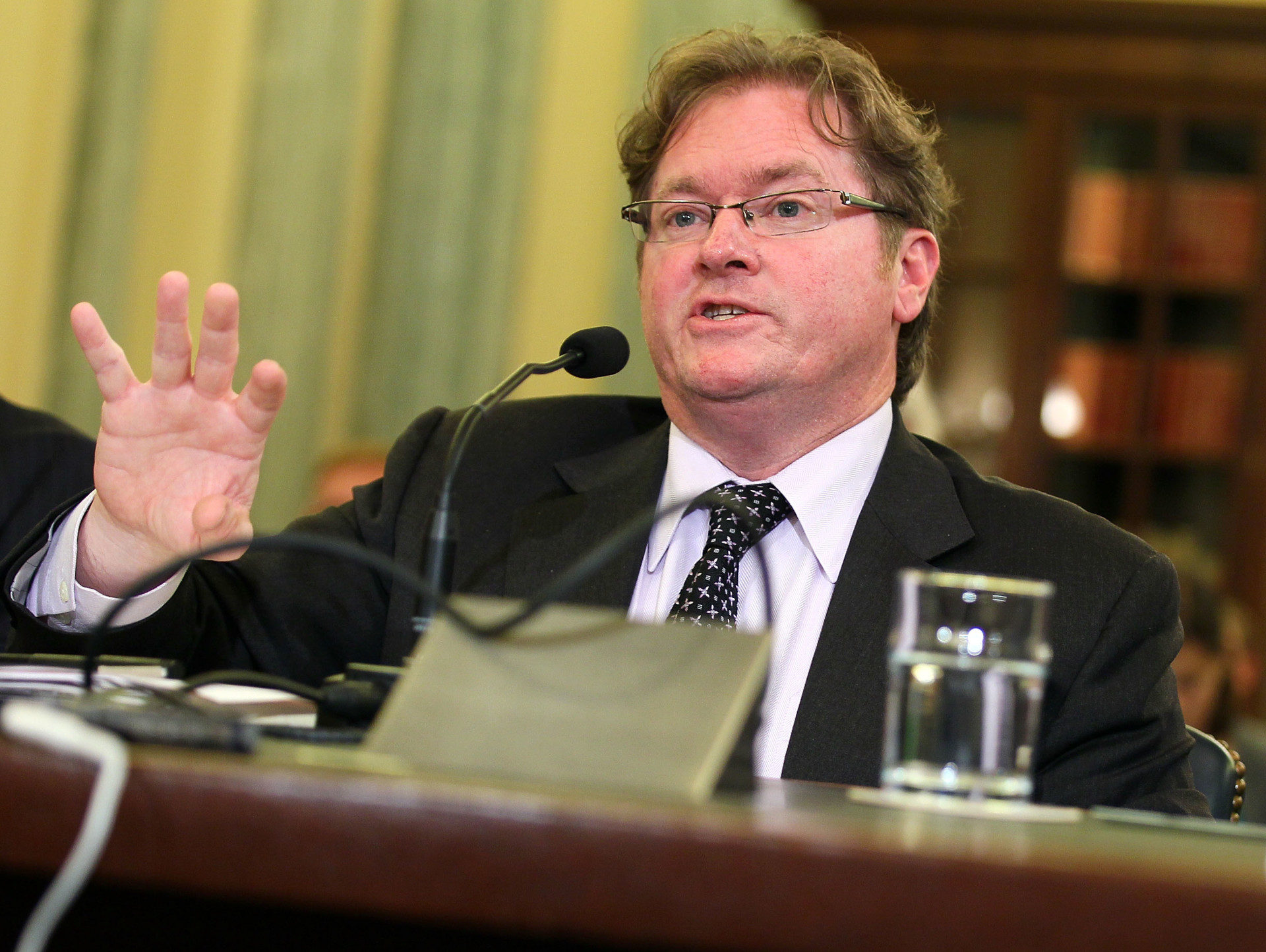
Former California Public Utilities Commission Executive Director Paul Clanon (center) sits between San Bruno Mayor Jim Ruane and PG&E President Chris Johns at a September 28, 2010 Senate committee hearing. (Justin Sullivan/Getty Images)
In the years since the September 2010 natural gas pipeline explosion that killed eight people in San Bruno, the relationship between pipeline operator Pacific Gas and Electric Co. and high-ranking officials at the California Public Utilities Commission has come under intense scrutiny, undermining public trust in the state agency tasked with ensuring safe pipeline operations.
State prosecutors and a federal grand jury are currently zeroing in on alleged improper ties between PG&E and top state regulators. State investigators acting on a search warrant earlier this year seized iPhones, a laptop and bank statements from the residence of former CPUC President Michael Peevey and took similar items from the home of PG&E's former Vice President of Regulatory Affairs, Brian Cherry, all on suspicion of felony activity relating to a judge-shopping scandal brought to light by email records.
Those exchanges were made public in the wake of civil litigation brought on behalf of San Bruno, when a judge ordered PG&E to release records consisting of some 65,000 emails and 123,000 documents.
KQED has taken a detailed look into this correspondence, which reveals in granular detail the familiar relationships between key decision-makers and PG&E executives that lasted well beyond the San Bruno incident. There are multiple instances of Peevey arranging to meet with Cherry for holiday visits that involved sipping wine — a keyword search of the email records for the words “pinot” or “cabernet,” for example, yielded 16 separate items.
But two of the closest confidants were Cherry and then-CPUC Executive Director Paul Clanon. The collection of documents provided by PG&E shows that between 2010 and 2014, Cherry and Clanon were on 2,369 of the same email threads using their official email addresses -- that's an average of 11 times a week.
Although some of these emails were sent years ago, an attempt to force a cultural change at the CPUC is only now making its way through the California Legislature. In an attempt to reform CPUC operations, the Senate recently approved SB 660, a bill that would overhaul decision-making processes and restrict private exchanges.
In an interview with KQED, CPUC President Michael Picker said that the agency read every email released, conducted legal reviews and went through the state personnel process when breaches occurred.
The agency focused on correspondence from about 80 people below the level of commissioner. Some individuals left the CPUC prior to or during the review. The agency determined that action was not warranted against 54 of the people who remained on staff. CPUC spokeswoman Constance Gordon said "individuals whose emails raised more serious issues" -- the agency won't say how many -- received "counseling memos" or "letters of correction." The agency also held a staff training in appropriate email decorum in April.
"The challenge is that we are built for a different era, we were built in a time before emails," Picker said. "Emails tend toward much more casual relationships. That’s a problem because when you start to get at a certain level of casualness, then you can slide into other kinds of ethical breaches."
Picker said that communications between PG&E staff and CPUC employees are currently banned for procedural cases. However, he said, the two staffs must be able to talk to each other.
"We can’t do our jobs. We can’t guarantee that the electric system, the gas system work properly, we can’t make sure that people are being protected against unsafe infrastructure unless we are always in communication with the utilities. So if we’re not in contact with PG&E that’s as big of a problem and maybe a larger problem then some of the improper comportment," he said.
PG&E fired Cherry, as well as Senior Vice President of Regulatory Affairs Tom Bottorff and Vice President of Regulatory Proceedings Trina Horner, following the company's internal investigation into the emails.
PG&E spokesman Nick Stimmel wrote in a statement: "With respect to the email issue, we have produced tens of thousands of emails voluntarily and in response to regulatory and legal requirements and we continue to cooperate with all investigations. In the meantime, we will let the content of the emails speak for themselves; we are not going to speculate about motivations or the actions of people who are no longer in roles with the CPUC or the company or about events that may or may not have occurred."
Below we highlight 10 email exchanges that demonstrate just how cozy ties between regulators and the regulated have been in day-to-day CPUC operations.
In the aftermath of the pipeline rupture that caused the San Bruno explosion, PG&E’s control room management became a focal point for safety improvement.
Natural gas pipelines may traverse thousands of miles. In a control room, pressure and flow across the underground network are monitored remotely. The federal Pipeline and Hazardous Materials Safety Administration moved to amend federal pipeline safety regulations in the months after San Bruno, imposing tougher regulations on control room operations.
But according to an email from PG&E’s Brian Cherry to CPUC’s then-Executive Director Paul Clanon, dated Sept. 14, 2011, the company encountered “some pressing problems” relating to a “control room audit.” Accordingly, Cherry wondered whether Clanon would be willing to “focus elsewhere.”
In this photo from May of 2011, federal Transportation Secretary Ray LaHood tours the site of the PG&E San Bruno pipeline explosion with Congressional Representative Jackie Speier. (Justin Sullivan/Getty Images)
“Paul – hope you are enjoying yourself in Jellystone but stay away from the wayward bison,” Cherry wrote. “I received a request from Nick [Stavropoulos, PG&E’s executive vice president of gas operations] and Chris [Johns, president of PG&E] … to seek your advice and counsel on the control room audit.
“Nick and Chris know we have problems in this area and would like you to focus elsewhere for the moment so that we can address some pressing problems. … Nick stated that you once offered to help out in any way you could if the Commission was becoming an obstacle to us getting the work done.”
A formal letter sent to Clanon about two weeks later on PG&E stationary shows the company was preparing for a visit from an independent consultant hired by the CPUC to inspect control-room operations. This audit was conducted to ensure compliance with federal rules. So was PG&E granted a delay? CPUC spokeswoman Constance Gordon said she could not comment on Clanon’s email directly, since he no longer works at the CPUC.
Commission President Michael Picker, who replaced Peevey after he stepped down last year, said that he could not comment directly on the contents of the email, either, since he was unfamiliar with the audit. However, he said, "No one’s ever asked me to focus elsewhere. Chances are that would make me want to focus more."
Reached by phone, Clanon declined to comment.
2) “Charlie’s Angels” -- Oct. 18, 2011
On Oct. 18, 2011, PG&E’s Brian Cherry forwarded CPUC President Mike Peevey an email attachment with the note “FYI.” It was a letter from Rep. Jackie Speier to U.S. Department of Transportation Secretary Ray LaHood, urging LaHood to require natural gas operators to remove from their networks a kind of plastic pipe, Aldyl-A, which is prone to cracking. PG&E has 1,231 miles of the pipe in its system.
Roughly six weeks earlier, a Cupertino condominium had been destroyed, in an explosion and fire caused by a gas leak due to a cracked fitting in a plastic Aldyl-A pipe. When it investigated the cause of the blast, PG&E found six other plastic pipe failures near the blast site, records show.
Former California Public Utilities Commission President Michael Peevey and PG&E executive Brian Cherry made dinner plans at the Bernardus Lodge & Spa, shown here, in October of 2011. (Courtesy Bernardus Lodge & Spa)
In response to Cherry's email, Peevey thanked Cherry for the update. Then the CPUC president moved onto another topic.
“See you for dinner Sunday night,” he wrote. “Where and when? Are you bringing Charlie's Angels too?”
Cherry responded: “7:30 at Marinus in the Bernardus Lodge in the Carmel Valley. About 20 minutes or so from Monterey but well worth the drive. We can make it earlier if you wish.”
He added, “Some angels may attend.”
"Sunday night" would have marked the start of the annual meeting of the The Conference of California Public Utility Counsel (CCPUC) at the Monterey Plaza Hotel. The nonprofit organization, which describes itself on the web as a “non-profit mutual benefit corporation,” has representatives from PG&E and other utilities on its board of directors. According to the conference agenda, Peevey was scheduled to speak at the conference on Monday, Oct. 24, 2011.
The conference itinerary shows that the evening activity on Sunday, Oct. 23 was a group activity –- attendees would be treated to a “reception and strolling dinner” at the Monterey Bay Aquarium from 7 to 9:30 p.m. But this email thread suggests Peevey and Cherry had other plans. The Bernardus Lodge & Spa is a luxury facility often booked for off-site corporate retreats, according to its website.
While it’s unclear who, or what, the men were referring to when they discussed whether “Charlie’s Angels” would attend, at the very least the detail illustrates close enough ties for them to share a mutual understanding about a coded phrase. Attempts to reach Cherry and Peevey by phone were unsuccessful.
3) “Sea Ranch over Thanksgiving” -- Nov. 24, 2010
On Nov. 24, 2010, about six weeks after the San Bruno pipeline explosion, PG&E’s Brian Cherry emailed CPUC President Mike Peevey with some good news -- plus an invitation.
“Mike – FYI. Fish and Game letter on Manzana. Very positive,” he wrote. “Also – Sara and I will be in Sea Ranch over Thanksgiving. We’d be happy to have you and Carol [Peevey’s wife, Democratic Sen. Carol Liu] over for drinks or dinner if you are free. I’ve got plenty of great wine to drink.”
Less than an hour later, Peevey responded. “Thanks for the offer but all tied up with family. Next time.”
Records show that while Peevey at that time declined Cherry’s invitation to the Sonoma County vacation spot, he took him up on similar offers on other occasions. The men shared “two bottles of good pinot” over Memorial Day weekend in 2010, for example, while they discussed renewable energy, gas rate increases and a ballot measure campaign.
Meanwhile, “Manzana” refers to PG&E’s proposed Manzana Wind Project in Kern County’s Tehachapi region, a $911 million, 246-megawatt renewable energy project that PG&E proposed in late 2009 and was then before the commission for approval. The California Department of Fish and Wildlife had reviewed the project’s environmental impacts out of concern that the wind turbines could kill endangered California condors.
Earlier that year, Cherry had emailed Peevey with information from PG&E’s investor relations division, citing a report from a Deutsche Bank financial analyst about the Manzana project. “Analysts are tracking Manzana … closely,” that email noted, with bankers considering it one of “the largest upcoming cases for the rest of the year.”
However, the Manzana project never came to fruition. An independent review by the CPUC’s Division of Ratepayer Advocates ultimately found that the wind project would have left customers bearing “significant risk and an unreasonable price tag.” The commission ultimately denied PG&E’s application.
4) “Can you guys help me with this?” -- Sept. 12, 2010
Only three days had passed since the fatal San Bruno pipeline explosion. With images of the blaze still fresh in the media, the CPUC issued a press release to outline its planned response.
State and federal investigations were already underway. In an open memo, then-CPUC President Michael Peevey directed then-Executive Director Paul Clanon to compel PG&E to survey its lines for gas leaks. He demanded an inquiry into PG&E’s spending on pipeline safety and promised, “We are taking immediate action.”
But that same afternoon, Peevey emailed Clanon with a different request entirely.
“First thing tomorrow,” he wrote, “See if you can schedule Darbee and Johns in my office at 2 PM Thursday.”
He was referring to PG&E's then-CEO Peter Darbee and then-President Chris Johns. Clanon immediately forwarded the request to two PG&E executives, including Vice President of Regulatory Affairs Brian Cherry, asking, “Can you guys help me with this?”
Chimneys remain during a massive fire in a residential neighborhood in September 2010 in San Bruno. (Max Whittaker/Getty Images)
Under many circumstances, a meeting between Peevey, a key decision-maker, and PG&E’s top brass about a matter under investigation would be a violation of state regulations designed to ensure fair dealing.
Under state law, contact between decision-makers and interested parties held outside the formal public process are known as ex parte communications. Whether they take the form of face-to-face meetings, texts or emails, these communications are subject to detailed regulations. And when a formal investigation is involved -- designated as an “adjudicatory proceeding” since commissioners act in the capacity of a judge -- no ex parte contact is allowed.
Nevertheless, CPUC spokesperson Constance Gordon told KQED that this particular meeting did not violate ex parte rules.
“The investigation that began immediately following PG&E’s pipeline rupture was a staff investigation,” Gordon said, “not a formal investigation opened by a vote of the Commissioners,” which came later. “As such, ex parte rules would not apply.”
After the meeting arrangements were made, Clanon switched to a lighter topic: “How was Jellystone?” he asked Cherry, a possible reference to Yellowstone National Park.
“Amazing,” Cherry responded. “Saw so much wildlife. But it snowed the other day and I brought shorts!”
Cherry urged Clanon to plan his own vacation there. Meanwhile not 72 hours had passed since the fatal San Bruno pipeline explosion.
“Things keep coming up at my work,” Clanon responded.
“Uh. Yes,” Cherry shot back. “You have a challenging job. Guess that’s why they pay you the big bucks.”
Four years worth of emails show that former PG&E executive
Brian Cherry and former CPUC Executive Director Paul Clanon consulted with each other hundreds of times. While the below emails are not illegal, they are good examples of how Cherry and Clanon often bounced ideas off of each other or problem-solved together. On Oct. 20, 2010, Clanon wrote to Cherry:
“What are we going to do about the San Bruno demand that the pipeline be moved? I can certainly understand on the human level why they'd want that, even though it might not make a lot of operational or design sense.”
Cherry responded, “We are struggling with that. There are a couple different re-routes ... Between you and me, I think we should repair 132 temporarily while offering up a longer-term solution involving re-routing. … Any thoughts - non-attributed of course ?”
Clanon did have an idea on how PG&E could “frame” moving the pipeline.
“I think the way to frame the pipe-replacement issue is not to think of it as Line 132, but to think of it as, what, two or three miles?”
The next week, then-PG&E President Chris Johns released a statement pledging to move the pipeline.
The section of Line 132 that exploded was not repaired in the end. PG&E rerouted the transmission line so that the gas now flows through Line 109 at San Andreas Station and returns to Line 132 at Healy Station, both in San Bruno.
The CPUC had ordered PG&E to examine shutoff valves. In the same email, Cherry said that the agency had identified more than 200 valves that needed to be replaced. However, he was concerned that there would be a public outcry if he released that number.
“If we tell you the number of valves that have been identified and don't have these kinds of estimates, everyone will demand immediate replacement - which just can't be done for a variety of reasons.”
Clanon responded to Cherry: “Yeah, cost and time estimates for the valves are crucial.”
PG&E's lack of automatic shutoff valves had come under scrutiny by federal officials at the time. National Transportation Safety Board officials found that it took the utility almost 95 minutes to shut off the gas rushing from the ruptured San Bruno pipeline.
Keith Slibasager, PG&E’s gas system operations manager, testified during the NTSB’s public hearing on the San Bruno explosion that the company could have cut the gas within 20 minutes if the utility had installed automatic valves.
A 2006 PG&E memo shows that PG&E considered installing automatic safety valves, but did not. A PG&E senior gas-consulting engineer, Chi-hung Lee Sr., wrote in the memo that he found most of the damage from a pipeline explosion occurs within 30 seconds.
The engineer later testified at the NTSB hearing that his research was limited. The Pipeline and Hazardous Materials Safety Administration and other safety groups had reached different conclusions about shutoff valves. Federal safety officials have suggested, but not required, the use of automatic shutoff valves since 1999. PG&E officials acknowledged at the hearing that after Lee's memo they made no effort to further install the valves.
Since the San Bruno explosion, PG&E has installed 208 automated valves that the utility can shut off remotely from a control room and 14 automatic shutoff valves that can shut themselves off in areas where transmission pipelines cross major fault lines.
6) “We live in parallel universes…” — Jan. 10, 2011
In 2008, PG&E purposely boosted pressure on the San Bruno natural gas line to 400 pounds per square inch, the maximum legal limit. Normally, the line ran at 375 psi.
The next time the pressure on that gas line exceeded 375 psi was on Sept. 9, 2010, when a malfunction spiked the pressure to 386 psi, coinciding with the deadly explosion in San Bruno killing eight people and destroying 28 homes.
PG&E later said they increased the pressure in 2008 under a mistaken understanding of federal law. The utility believed that to maintain the ability to run gas at 400 psi, the legal limit, they needed to do so once every five years.
PG&E and CPUC officials referenced the story the next day, Jan. 10. At 9:35 a.m. Paul Clanon, then-executive director of the California Public Utilities Commission, wrote to senior CPUC staff asking about the spike:
“The Chronicle's story on the 2008 temporary rise in pressure on Line 132 to 400 psi doesn't match what I've heard. What are the facts? Is it standard practice or not to raise pressure up to MAOP [maximum allowable operating pressure] to preserve the maximum? Is 2008 really the only time PG&E has raised pressure on that line above 375 until the explosion?”
About 30 minutes later he contacted former PG&E executive Brian Cherry: “What are your guys saying about the facts in the Chron story yesterday? Contradicted my understanding of the rules, anyway.”
Paul Clanon speaks at a September 28, 2010 Senate committee hearing on gas pipeline safety. (Alex Wong/Getty Images)
Two minutes later Cherry shared his confusion: “Not sure. Let me follow up. I was under the same understanding.”
Clanon wrote back at 10:48: “Our guys are doing the same thing, and you and I can triangulate.”
It is not standard practice for utilities to raise pressure on transmission lines, and federal law requires utilities to conduct a costly inspection on any pipeline when the pressure exceeds the maximum limit. PG&E had not conducted such an inspection, nor did Clanon ask if they had in the emails released.
By 4:53 p.m. Cherry and Clanon began to be concerned that neither PG&E nor CPUC staff could come up with an answer about whether such pressure spiking on a gas line was a normal practice. The two sympathized with each other.
Clanon wrote Cherry: “Nothing back yet?” Cherry responded “Nothing yet…” and later “We live in parallel universes.”
About an hour later, Clanon had received research from CPUC staff and wanted to run it by Cherry:
“Here's what I get from my people. You agree? Follows: PG&E raises the pressure in transmission lines to MAOP once every five years based on its conservative interpretation of 192.917(e)(4)…”
The next day, a Chronicle story included a statement from a PG&E spokesperson that was very similar to what Clanon had written. “PG&E initially said it had conducted the pressure test on the San Bruno line to ‘preserve’ the pipe's legal capacity, saying federal law required it. A spokesman later backtracked and conceded there was no such requirement.”
CPUC spokesperson Constance Gordon says that Clanon and Cherry were discussing each other's understanding of the rules, so "if PG&E had a different understanding than that of CPUC staff the issue could be further discussed."
The Utility Reform Network is one of PG&E’s sharpest critics. TURN spokesperson Mindy Spatt said such conversations are concerning.
"Well, it’s a question of whether the commission should be a watchdog or a lapdog. A watchdog would say, wait a minute PG&E what’s going on here? And a lapdog would say, let’s coordinate our message."
7) “Investor relations” — Sept. 26, 2011
An email exchange between Commissioner Mark Ferron and PG&E’s Brian Cherry shows Ferron sought advice from PG&E on which Wall Street analysts he should meet with privately on a trip to New York.
“Mark,” Cherry wrote to Ferron in a Sept. 26, 2011 email, “Commissioner Florio was over at PG&E the other day and mentioned that you might need some help meeting with the buy and sell side analysts in New York. If you are interested, Gabe Togneri, our VP of Investor Relations, would be happy to reach out to some of them and have them sponsor a meeting. Our only role would be to make the contact. The analysts would sponsor the meetings themselves and you would meet with them privately.”
Ferron responded: “[PG&E CEO] Tony Earley … highlighted Dan Ford at Barclays Capital as a thought leader worthwhile meeting if I can find the time. Who else might Gabe recommend?”
While there’s no record here of Ferron discussing the proposed San Bruno penalty with Ford, the Barclays analyst was clearly focused on that question.
In September 2012, Ford authored a report noting that PG&E would have difficulty raising $2.2 billion in equity to cover the expected San Bruno fine amount. (The actual penalty amount, finally determined on April 9 this year, was set at $1.6 billion.)
And in a report authored by Ferron, made public in October 2013, the commissioner related investors’ concerns that levying too large a fine against PG&E would cause them to view California as a “capital-unfriendly, ‘banana republic.’” That could lead to an increase in the cost of financing capital for utilities, warned Ferron, who had worked at Deutsche Bank prior to being appointed as a commissioner in March 2011.
Ferron stepped down as a commissioner in 2014, citing health problems. CPUC spokesperson Constance Gordon said she was unable to offer comment on emails sent by individuals who no longer worked at the commission. Attempts to reach Ferron were unsuccessful.
The question as to whether commissioners had inappropriate ex parte communications with Wall Street analysts was raised in a brief filed by the CPUC’s Division of Ratepayer Advocates. (Since renamed Office of Ratepayer Advocates).
“Some, if not all, of the financial industry representatives who reported discussing the San Bruno investigations with Commission offices represent firms or clients with a financial interest in PG&E Corporation,” the CPUC’s consumer advocacy branch pointed out. “The size of the fine and other penalties the Commission may impose in the San Bruno Investigations is a substantive issue in all three [CPUC] investigations.”
8) “Happy Birthday!” — Sept. 16, 2010
It was 7 a.m. on Sept. 16, 2010, one week after the San Bruno pipeline explosion. CPUC executive director Paul Clanon emailed PG&E’s Brian Cherry with a simple message in the subject line: “Happy Birthday!”
“Thanks,” Cherry replied. He shared his birthday wish. “I’d love a nice muzzle for Mark Toney.”
Mark Toney is executive director of The Utility Reform Network (TURN), a leading critic of PG&E.
Mark Toney, executive director of consumer advocacy group The Utility Reform Network, was the target of an unkind remark in an email from a PG&E executive to the regulatory agency director. (Courtesy The Utility Reform Network)
As for why Cherry would have wanted a “muzzle” for Toney, TURN spokesperson Mindy Spatt told KQED that Toney had issued a public statement about customer safety just before this exchange took place.
“He was saying: Demand that PG&E put customer safety first – that is the message that PG&E wanted muzzled, a message that said ‘no more San Brunos,’” Spatt said.
On Sept. 15, Cherry had emailed Clanon to tell him then-PG&E CEO Peter Darbee believed “TURN’s behavior has bordered on the irresponsible.” He wondered whether the CPUC would be willing to make a statement publicly discounting TURN’s claims. While it’s not clear from the emails how Clanon reacted to this request, his email reply to Cherry was: “Call me when you can.”
“It was actually six days after the fatal San Bruno explosion that Brian Cherry referred to TURN’s behavior as irresponsible,” Spatt said when asked about this. “His company has just killed eight people and incinerated an entire neighborhood."
While it’s obvious why a major utility company would be concerned that its stock had been downgraded, it’s not as clear why a commissioner would care. Upon learning about a financial downgrade, then-CPUC president Michael Peevey recommended that PG&E find a way to indirectly alert Gov. Jerry Brown, who was then in the process of determining new commission appointments.
The email thread begins Jan. 11, 2011, when PG&E’s Brian Cherry forwarded Peevey a message from PG&E’s investor relations division about a financial analyst’s report.
“Citigroup downgraded … PG&E,” the email explained. The note showed that analysts feared “uncertainty and potential shifting dynamics in the regulatory arena.”
In response, Peevey wrote in an email to Cherry: “You should find a way to get this info to Brown as he makes his decisions on Commissioners ASAP. Probably best coming from a non-utility source, such as investment banker(s).”
When asked why Peevey would provide this advice, CPUC spokesperson Constance Gordon responded, “The questions you’ve asked involve individuals who are no longer with the CPUC, so we cannot ask them your questions.”
PG&E officials had no idea what they were getting into when the utility began installing smart meters in California in 2006. Smart meters are a critical component of the "smart grid” -- the devices track energy usage and transmit data back to customers and utilities, with the goal of reducing electricity consumption and distributing power more efficiently across the electric grid.
Smart meters faced an almost immediate backlash. Users first complained that the devices gave artificially high readings. Later the CPUC found that about 1,480 meters inaccurately recorded electricity consumption in ambient temperatures ranging from 100– 115 degrees Fahrenheit due to a defective chip. Nevertheless, a study conducted by an independent consultant, The Structure Group, determined that the meters generally functioned as intended.
Next, consumer advocacy groups, including TURN, raised concerns that the meters would harm people like seniors who sometimes have no choice but to run their air conditioners in the sweltering Central Valley. TURN also noted that with smart meters, PG&E could simply turn off people’s power if they couldn’t keep up with the bills. Privacy advocates expressed concern about utilities gaining access to information about their use of personal home appliances.
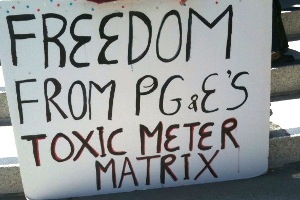
A sign from a smart meter protest in 2010. (Amy Standen/KQED)
The biggest battle over smart meters, though, centered on electromagnetic fields (EMFs) emitted by smart meters. The possible health effects of EMFs have been a subject of debate since the Cold War, and fear has intensified in the wireless age with the introduction of countless devices that emit EMFs, such as cellphones, laptops and Wi-Fi routers.
The National Institutes of Health’s National Cancer Institute says that “several early epidemiologic studies raised the possibility of an association between certain cancers, especially childhood cancers, and ELF-EMFs. Most subsequent studies have not shown such an association.”
Unlike high-energy radiation emitted from devices like X-rays, low-energy emissions from devices like smart meters cannot damage DNA or cells directly, the NIH writes. The World Health Organization concluded that low-energy emissions cause “no substantive health issues.” Smart-meter emissions are 60 times lower than the federal health guidelines.
EMF activists remain concerned, however, about the accumulated exposure people face from being surrounded by so many low-emission devices. And they’ve flooded the CPUC and PG&E with complaints.
By June 4, 2010, Carol Brown, then-CPUC President Michael Peevey’s chief-of-staff, wanted an answer for the people contacting her about EMFs. She wrote to then-PG&E executive Brian Cherry: “So far I have done OK just listening to the sad tales of EMF poisoning - and telling them thank you for bringing it to our attention - but then not offering them any solution!!! I just wanted to have a resource in case! Have a nice weekend.”
Cherry responded: “Prozac might be a solution!”
In the meantime, cities, including San Francisco, began petitioning the CPUC to make smart meters optional.
Peevey recommended to Cherry in an email in September 2010 that PG&E consider making the meters optional:
“One thought for the company: If it were my decision I would let anyone who wants to keep their old meter keep it, if they claim they suffer from EMF and/or related electronic-related illnesses and they can produce a doctor's letter saying so (or expressing concern about the likelihood of suffering same). I would institute such a policy quietly and solely on an individual basis. There really are people who feel pain, etc., related to EMF, etc., and rather than have them becoming hysterical, etc., I would quietly leave them alone. Kick it around. And, it sounds like the company may already have taken this step, based on a couple of the comments at yesterday's public hearing.”
Cherry said that he would consider it: “I do worry that this policy, no matter how discrete (sic) we try to make it, will surface and town councils and cities in our territory will ask for similar treatment. That said, we will take the matter up and get back to you with our feedback.”
In March 2011, PG&E proposed allowing smart meter users to opt out. The CPUC approved that plan in February 2012. Customers who opt out of the program must pay an initial fee and monthly charge.
Where Are They Now?
Brian Cherry, PG&E’s vice president of regulatory affairs, was fired from PG&E in September of 2014, after inappropriate email exchanges came to light.
Thomas Bottorff, PG&E’s senior vice president of regulatory affairs and Cherry’s boss, was fired along with Cherry. According to a San Jose Mercury News article he was to receive a severance payment totaling more than $1 million.
Chris Johns, president of PG&E, announced several weeks ago that he would retire by the end of the year.
Michael Peevey, president of the California Public Utilities Commission, stepped down from his role after his term came to an end in December of 2014. Peevey came under fire for inappropriate email exchanges.
Paul Clanon, executive director of the California Public Utilities Commission, announced at the end of December that he would retire to study music.
Mark Ferron, former commissioner at the California Public Utilities Commission, resigned in December of 2014 due to health problems.
Carol Brown, former commission president Peevey’s chief of staff, stepped down in the wake of revelations that she had agreed to intervene on a judge appointment for a case involving PG&E. Despite news reports that she might return to the agency as an administrative law judge, a CPUC spokesperson confirmed to KQED that Brown has retired.
Michael Florio, who was also entangled in the judge-shopping scandal, remains as a commissioner at the California Public Utilities Commission.
lower waypointnext waypoint
Player sponsored by
window.__IS_SSR__=true
window.__INITIAL_STATE__={
"attachmentsReducer": {
"audio_0": {
"type": "attachments",
"id": "audio_0",
"imgSizes": {
"kqedFullSize": {
"file": "https://ww2.kqed.org/news/wp-content/themes/KQED-unified/img/audio_bgs/background0.jpg"
}
}
},
"audio_1": {
"type": "attachments",
"id": "audio_1",
"imgSizes": {
"kqedFullSize": {
"file": "https://ww2.kqed.org/news/wp-content/themes/KQED-unified/img/audio_bgs/background1.jpg"
}
}
},
"audio_2": {
"type": "attachments",
"id": "audio_2",
"imgSizes": {
"kqedFullSize": {
"file": "https://ww2.kqed.org/news/wp-content/themes/KQED-unified/img/audio_bgs/background2.jpg"
}
}
},
"audio_3": {
"type": "attachments",
"id": "audio_3",
"imgSizes": {
"kqedFullSize": {
"file": "https://ww2.kqed.org/news/wp-content/themes/KQED-unified/img/audio_bgs/background3.jpg"
}
}
},
"audio_4": {
"type": "attachments",
"id": "audio_4",
"imgSizes": {
"kqedFullSize": {
"file": "https://ww2.kqed.org/news/wp-content/themes/KQED-unified/img/audio_bgs/background4.jpg"
}
}
},
"placeholder": {
"type": "attachments",
"id": "placeholder",
"imgSizes": {
"thumbnail": {
"file": "https://cdn.kqed.org/wp-content/uploads/2024/12/KQED-Default-Image-816638274-2000x1333-1-160x107.jpg",
"width": 160,
"height": 107,
"mimeType": "image/jpeg"
},
"medium": {
"file": "https://cdn.kqed.org/wp-content/uploads/2024/12/KQED-Default-Image-816638274-2000x1333-1-800x533.jpg",
"width": 800,
"height": 533,
"mimeType": "image/jpeg"
},
"medium_large": {
"file": "https://cdn.kqed.org/wp-content/uploads/2024/12/KQED-Default-Image-816638274-2000x1333-1-768x512.jpg",
"width": 768,
"height": 512,
"mimeType": "image/jpeg"
},
"large": {
"file": "https://cdn.kqed.org/wp-content/uploads/2024/12/KQED-Default-Image-816638274-2000x1333-1-1020x680.jpg",
"width": 1020,
"height": 680,
"mimeType": "image/jpeg"
},
"1536x1536": {
"file": "https://cdn.kqed.org/wp-content/uploads/2024/12/KQED-Default-Image-816638274-2000x1333-1-1536x1024.jpg",
"width": 1536,
"height": 1024,
"mimeType": "image/jpeg"
},
"fd-lrg": {
"file": "https://cdn.kqed.org/wp-content/uploads/2024/12/KQED-Default-Image-816638274-2000x1333-1-1536x1024.jpg",
"width": 1536,
"height": 1024,
"mimeType": "image/jpeg"
},
"fd-med": {
"file": "https://cdn.kqed.org/wp-content/uploads/2024/12/KQED-Default-Image-816638274-2000x1333-1-1020x680.jpg",
"width": 1020,
"height": 680,
"mimeType": "image/jpeg"
},
"fd-sm": {
"file": "https://cdn.kqed.org/wp-content/uploads/2024/12/KQED-Default-Image-816638274-2000x1333-1-800x533.jpg",
"width": 800,
"height": 533,
"mimeType": "image/jpeg"
},
"post-thumbnail": {
"file": "https://cdn.kqed.org/wp-content/uploads/2024/12/KQED-Default-Image-816638274-2000x1333-1-672x372.jpg",
"width": 672,
"height": 372,
"mimeType": "image/jpeg"
},
"twentyfourteen-full-width": {
"file": "https://cdn.kqed.org/wp-content/uploads/2024/12/KQED-Default-Image-816638274-2000x1333-1-1038x576.jpg",
"width": 1038,
"height": 576,
"mimeType": "image/jpeg"
},
"xxsmall": {
"file": "https://cdn.kqed.org/wp-content/uploads/2024/12/KQED-Default-Image-816638274-2000x1333-1-160x107.jpg",
"width": 160,
"height": 107,
"mimeType": "image/jpeg"
},
"xsmall": {
"file": "https://cdn.kqed.org/wp-content/uploads/2024/12/KQED-Default-Image-816638274-2000x1333-1-672x372.jpg",
"width": 672,
"height": 372,
"mimeType": "image/jpeg"
},
"small": {
"file": "https://cdn.kqed.org/wp-content/uploads/2024/12/KQED-Default-Image-816638274-2000x1333-1-672x372.jpg",
"width": 672,
"height": 372,
"mimeType": "image/jpeg"
},
"xlarge": {
"file": "https://cdn.kqed.org/wp-content/uploads/2024/12/KQED-Default-Image-816638274-2000x1333-1-1020x680.jpg",
"width": 1020,
"height": 680,
"mimeType": "image/jpeg"
},
"full-width": {
"file": "https://cdn.kqed.org/wp-content/uploads/2024/12/KQED-Default-Image-816638274-2000x1333-1-1920x1280.jpg",
"width": 1920,
"height": 1280,
"mimeType": "image/jpeg"
},
"guest-author-32": {
"file": "https://cdn.kqed.org/wp-content/uploads/2025/01/KQED-Default-Image-816638274-1333x1333-1-160x160.jpg",
"width": 32,
"height": 32,
"mimeType": "image/jpeg"
},
"guest-author-50": {
"file": "https://cdn.kqed.org/wp-content/uploads/2025/01/KQED-Default-Image-816638274-1333x1333-1-160x160.jpg",
"width": 50,
"height": 50,
"mimeType": "image/jpeg"
},
"guest-author-64": {
"file": "https://cdn.kqed.org/wp-content/uploads/2025/01/KQED-Default-Image-816638274-1333x1333-1-160x160.jpg",
"width": 64,
"height": 64,
"mimeType": "image/jpeg"
},
"guest-author-96": {
"file": "https://cdn.kqed.org/wp-content/uploads/2025/01/KQED-Default-Image-816638274-1333x1333-1-160x160.jpg",
"width": 96,
"height": 96,
"mimeType": "image/jpeg"
},
"guest-author-128": {
"file": "https://cdn.kqed.org/wp-content/uploads/2025/01/KQED-Default-Image-816638274-1333x1333-1-160x160.jpg",
"width": 128,
"height": 128,
"mimeType": "image/jpeg"
},
"detail": {
"file": "https://cdn.kqed.org/wp-content/uploads/2025/01/KQED-Default-Image-816638274-1333x1333-1-160x160.jpg",
"width": 160,
"height": 160,
"mimeType": "image/jpeg"
},
"kqedFullSize": {
"file": "https://cdn.kqed.org/wp-content/uploads/2024/12/KQED-Default-Image-816638274-2000x1333-1.jpg",
"width": 2000,
"height": 1333
}
}
},
"news_10568610": {
"type": "attachments",
"id": "news_10568610",
"meta": {
"index": "attachments_1716263798",
"site": "news",
"id": "10568610",
"found": true
},
"parent": 10564656,
"imgSizes": {
"twentyfourteen-full-width": {
"file": "https://ww2.kqed.org/app/uploads/sites/10/2015/06/Clanon-Johns-hearing-1038x576.jpg",
"width": 1038,
"mimeType": "image/jpeg",
"height": 576
},
"thumbnail": {
"file": "https://ww2.kqed.org/app/uploads/sites/10/2015/06/Clanon-Johns-hearing-400x267.jpg",
"width": 400,
"mimeType": "image/jpeg",
"height": 267
},
"fd-sm": {
"file": "https://ww2.kqed.org/app/uploads/sites/10/2015/06/Clanon-Johns-hearing-960x641.jpg",
"width": 960,
"mimeType": "image/jpeg",
"height": 641
},
"post-thumbnail": {
"file": "https://ww2.kqed.org/app/uploads/sites/10/2015/06/Clanon-Johns-hearing-672x372.jpg",
"width": 672,
"mimeType": "image/jpeg",
"height": 372
},
"kqedFullSize": {
"file": "https://ww2.kqed.org/app/uploads/sites/10/2015/06/Clanon-Johns-hearing-e1434682583165.jpg",
"width": 1920,
"height": 1283
},
"large": {
"file": "https://ww2.kqed.org/app/uploads/sites/10/2015/06/Clanon-Johns-hearing-1440x962.jpg",
"width": 1440,
"mimeType": "image/jpeg",
"height": 962
},
"guest-author-96": {
"file": "https://ww2.kqed.org/app/uploads/sites/10/2015/06/Clanon-Johns-hearing-96x96.jpg",
"width": 96,
"mimeType": "image/jpeg",
"height": 96
},
"medium": {
"file": "https://ww2.kqed.org/app/uploads/sites/10/2015/06/Clanon-Johns-hearing-800x534.jpg",
"width": 800,
"mimeType": "image/jpeg",
"height": 534
},
"guest-author-64": {
"file": "https://ww2.kqed.org/app/uploads/sites/10/2015/06/Clanon-Johns-hearing-64x64.jpg",
"width": 64,
"mimeType": "image/jpeg",
"height": 64
},
"guest-author-32": {
"file": "https://ww2.kqed.org/app/uploads/sites/10/2015/06/Clanon-Johns-hearing-32x32.jpg",
"width": 32,
"mimeType": "image/jpeg",
"height": 32
},
"jmtc-small-thumb": {
"file": "https://ww2.kqed.org/app/uploads/sites/10/2015/06/Clanon-Johns-hearing-280x150.jpg",
"width": 280,
"mimeType": "image/jpeg",
"height": 150
},
"fd-med": {
"file": "https://ww2.kqed.org/app/uploads/sites/10/2015/06/Clanon-Johns-hearing-1180x788.jpg",
"width": 1180,
"mimeType": "image/jpeg",
"height": 788
},
"detail": {
"file": "https://ww2.kqed.org/app/uploads/sites/10/2015/06/Clanon-Johns-hearing-75x75.jpg",
"width": 75,
"mimeType": "image/jpeg",
"height": 75
},
"guest-author-128": {
"file": "https://ww2.kqed.org/app/uploads/sites/10/2015/06/Clanon-Johns-hearing-128x128.jpg",
"width": 128,
"mimeType": "image/jpeg",
"height": 128
}
},
"publishDate": 1434682574,
"modified": 1434682620,
"caption": "Former California Public Utilities Commission Executive Director Paul Clanon (center) sits between San Bruno Mayor Jim Ruane and PG&E President Chris Johns at a September 28, 2010 Senate committee hearing.",
"description": "Former California Public Utilities Commission Executive Director Paul Clanon (center) sits between San Bruno Mayor Jim Ruane and PG&E President Chris Johns at a September 28, 2010 Senate committee hearing.",
"title": "Senate Commerce Committee Holds Gas Pipeline Safety Hearing",
"credit": "Justin Sullivan/Getty Images",
"status": "inherit",
"isLoading": false,
"fetchFailed": false
}
},
"audioPlayerReducer": {
"postId": "stream_live",
"isPaused": true,
"isPlaying": false,
"pfsActive": false,
"pledgeModalIsOpen": true,
"playerDrawerIsOpen": false,
"liveAudioPlayStartedAt": 0,
"liveAudioPlayContext": ""
},
"authorsReducer": {
"lisapickoffwhite-2": {
"type": "authors",
"id": "199",
"meta": {
"index": "authors_1716337520",
"id": "199",
"found": true
},
"name": "Lisa Pickoff-White",
"firstName": "Lisa",
"lastName": "Pickoff-White",
"slug": "lisapickoffwhite-2",
"email": "lpickoffwhite@kqed.org",
"display_author_email": false,
"staff_mastheads": [
"news"
],
"title": "Data Journalist, Senior Producer",
"bio": "Lisa Pickoff-White is KQED's data reporter. Lisa specializes in simplifying complex topics and bringing them to life through compelling visuals, including photography and data visualizations. She previously has worked at the Center for Investigative Reporting and other national outlets. Her work has been honored with awards from the Online News Association, Investigative Reporters and Editors, the Society of Professional Journalists and SXSW Interactive. \u003cstrong> \u003c/strong>",
"avatar": "https://secure.gravatar.com/avatar/5513c5f3967df792aa65bee2501e84d6?s=600&d=blank&r=g",
"twitter": "pickoffwhite",
"facebook": null,
"instagram": null,
"linkedin": null,
"sites": [
{
"site": "",
"roles": [
"editor"
]
},
{
"site": "arts",
"roles": []
},
{
"site": "news",
"roles": [
"administrator"
]
},
{
"site": "about",
"roles": [
"editor"
]
},
{
"site": "stateofhealth",
"roles": [
"administrator"
]
},
{
"site": "science",
"roles": [
"editor"
]
},
{
"site": "quest",
"roles": [
"editor"
]
},
{
"site": "forum",
"roles": [
"editor"
]
}
],
"headData": {
"title": "Lisa Pickoff-White | KQED",
"description": "Data Journalist, Senior Producer",
"ogImgSrc": "https://secure.gravatar.com/avatar/5513c5f3967df792aa65bee2501e84d6?s=600&d=blank&r=g",
"twImgSrc": "https://secure.gravatar.com/avatar/5513c5f3967df792aa65bee2501e84d6?s=600&d=blank&r=g"
},
"isLoading": false,
"link": "/author/lisapickoffwhite-2"
},
"rbowe": {
"type": "authors",
"id": "3231",
"meta": {
"index": "authors_1716337520",
"id": "3231",
"found": true
},
"name": "Rebecca Bowe",
"firstName": "Rebecca",
"lastName": "Bowe",
"slug": "rbowe",
"email": "rbowe@kqed.org",
"display_author_email": false,
"staff_mastheads": [],
"title": null,
"bio": "Rebecca Bowe is a journalist based in San Francisco. She's covered Bay Area news since 2009, and previously served as News Editor of the San Francisco Bay Guardian. Follow her on Twitter @ByRebeccaBowe.",
"avatar": "https://secure.gravatar.com/avatar/50e1da0639521639108e89c123a76c9c?s=600&d=blank&r=g",
"twitter": null,
"facebook": null,
"instagram": null,
"linkedin": null,
"sites": [
{
"site": "news",
"roles": [
"subscriber"
]
},
{
"site": "science",
"roles": [
"editor"
]
}
],
"headData": {
"title": "Rebecca Bowe | KQED",
"description": null,
"ogImgSrc": "https://secure.gravatar.com/avatar/50e1da0639521639108e89c123a76c9c?s=600&d=blank&r=g",
"twImgSrc": "https://secure.gravatar.com/avatar/50e1da0639521639108e89c123a76c9c?s=600&d=blank&r=g"
},
"isLoading": false,
"link": "/author/rbowe"
}
},
"pagesReducer": {},
"pfsSessionReducer": {},
"postsReducer": {
"stream_live": {
"type": "live",
"id": "stream_live",
"audioUrl": "https://streams.kqed.org/kqedradio",
"title": "Live Stream",
"excerpt": "Live Stream information currently unavailable.",
"link": "/radio",
"featImg": "",
"label": {
"name": "KQED Live",
"link": "/"
}
},
"stream_kqedNewscast": {
"type": "posts",
"id": "stream_kqedNewscast",
"audioUrl": "https://www.kqed.org/.stream/anon/radio/RDnews/newscast.mp3?_=1",
"title": "KQED Newscast",
"featImg": "",
"label": {
"name": "88.5 FM",
"link": "/"
}
},
"news_10564656": {
"type": "posts",
"id": "news_10564656",
"meta": {
"index": "posts_1716263798",
"site": "news",
"id": "10564656",
"found": true
},
"articlePosition": 0,
"parent": 0,
"labelTerm": {
"site": "news",
"term": 6944
},
"blocks": [],
"publishDate": 1434697277,
"format": "standard",
"disqusTitle": "10 Emails That Detail PG&E’s Cozy Relationship With Regulators",
"title": "10 Emails That Detail PG&E’s Cozy Relationship With Regulators",
"headTitle": "News Fix | KQED News",
"content": "\u003cp>\u003cspan style=\"font-size: 4.6875em;float: left;line-height: 0.733em;padding: 0.05em 0.1em 0 0;font-family: times, serif, georgia\">I\u003c/span>n the years since the September 2010 natural gas pipeline explosion that killed eight people in San Bruno, the relationship between pipeline operator Pacific Gas and Electric Co. and high-ranking officials at the California Public Utilities Commission has come under intense scrutiny, undermining public trust in the state agency tasked with ensuring safe pipeline operations.\u003c/p>\n\u003cp>State prosecutors and a federal grand jury are currently zeroing in on alleged improper ties between PG&E and top state regulators. \u003ca href=\"http://ww2.kqed.org/news/2015/01/29/report-former-cpuc-chief-targeted-in-state-probe\" target=\"_blank\">State investigators\u003c/a> acting on a search warrant earlier this year seized iPhones, a laptop and bank statements from the residence of former CPUC President Michael Peevey and took similar items from the home of PG&E's former Vice President of Regulatory Affairs, Brian Cherry, all on suspicion of felony activity relating to a judge-shopping scandal brought to light by email records.\u003c/p>\n\u003cp>Those exchanges were made public in the wake of civil litigation brought on behalf of San Bruno, when a judge ordered PG&E to release records consisting of some 65,000 emails and 123,000 documents.\u003c/p>\n\u003caside class=\"alignright pullquote\">A PG&E executive and CPUC official were on 2,369 of the same email threads using their official email addresses — that’s an average of 11 times a week.\u003c/aside>\n\u003cp>KQED has taken a detailed look into this correspondence, which reveals in granular detail the familiar relationships between key decision-makers and PG&E executives that lasted well beyond the San Bruno incident. There are multiple instances of Peevey arranging to meet with Cherry for holiday visits that involved sipping wine — a keyword search of the email records for the words “pinot” or “cabernet,” for example, yielded 16 separate items.\u003c/p>\n\u003cp>But two of the closest confidants were Cherry and then-CPUC Executive Director Paul Clanon. The collection of documents provided by PG&E shows that between 2010 and 2014, Cherry and Clanon were on 2,369 of the same email threads using their official email addresses -- that's an average of 11 times a week.\u003c/p>\n\u003cp>[ad fullwidth]\u003c/p>\n\u003cp>Although some of these emails were sent years ago, an attempt to force a cultural change at the CPUC is only now making its way through the California Legislature. In an attempt to reform CPUC operations, the Senate recently approved \u003ca href=\"https://leginfo.legislature.ca.gov/faces/billTextClient.xhtml;jsessionid=ccfbe52d6f35026fdd9d2a7e2414?bill_id=201520160SB660\" target=\"_blank\">SB 660\u003c/a>, a bill that would overhaul decision-making processes and restrict private exchanges.\u003c/p>\n\u003cp>In an interview with KQED, CPUC President Michael Picker said that the agency read every email released, conducted legal reviews and went through the state personnel process when breaches occurred.\u003c/p>\n\u003cp>The agency focused on correspondence from about 80 people below the level of commissioner. Some individuals left the CPUC prior to or during the review. The agency determined that action was not warranted against 54 of the people who remained on staff. CPUC spokeswoman Constance Gordon said \"individuals whose emails raised more serious issues\" -- the agency won't say how many -- received \"counseling memos\" or \"letters of correction.\" The agency also held a staff training in appropriate email decorum in April.\u003c/p>\n\u003cp>\"The challenge is that we are built for a different era, we were built in a time before emails,\" Picker said. \"Emails tend toward much more casual relationships. That’s a problem because when you start to get at a certain level of casualness, then you can slide into other kinds of ethical breaches.\"\u003c/p>\n\u003cp>Picker said that communications between PG&E staff and CPUC employees are currently banned for procedural cases. However, he said, the two staffs must be able to talk to each other.\u003c/p>\n\u003cp>\"We can’t do our jobs. We can’t guarantee that the electric system, the gas system work properly, we can’t make sure that people are being protected against unsafe infrastructure unless we are always in communication with the utilities. So if we’re not in contact with PG&E that’s as big of a problem and maybe a larger problem then some of the improper comportment,\" he said.\u003c/p>\n\u003cp>PG&E fired Cherry, as well as Senior Vice President of Regulatory Affairs Tom Bottorff and Vice President of Regulatory Proceedings Trina Horner, following the company's internal investigation into the emails.\u003c/p>\n\u003cp>PG&E spokesman Nick Stimmel \u003ca href=\"https://www.scribd.com/doc/269092248/CPUC-and-PG-E-Emails-PG-E-Statement-to-KQED\" target=\"_blank\">wrote in a statement\u003c/a>: \"With respect to the email issue, we have produced tens of thousands of emails voluntarily and in response to regulatory and legal requirements and we continue to cooperate with all investigations. In the meantime, we will let the content of the emails speak for themselves; we are not going to speculate about motivations or the actions of people who are no longer in roles with the CPUC or the company or about events that may or may not have occurred.\"\u003c/p>\n\u003cp>Below we highlight 10 email exchanges that demonstrate just how cozy ties between regulators and the regulated have been in day-to-day CPUC operations.\u003c/p>\n\u003cp>Read the emails\u003c/p>\n\u003ctable>\n\u003ctbody>\n\u003ctr>\n\u003ctd>1) \u003cstrong>\u003ca href=\"#controlRoom\">“The Control Room Audit”\u003c/a>\u003c/strong> Sept. 14, 2011\u003cbr>\n2) \u003cstrong>\u003ca href=\"#angels\">“Charlie’s Angels”\u003c/a>\u003c/strong> Oct. 18, 2011\u003cbr>\n3) \u003cstrong>\u003ca href=\"#seaRanch\">“Sea Ranch over Thanksgiving”\u003c/a>\u003c/strong> Nov. 24, 2010\u003cbr>\n4) \u003cstrong>\u003ca href=\"#Jellystone\">“How was Jellystone?”\u003c/a>\u003c/strong> Sept. 12, 2010\u003cbr>\n5) \u003cstrong>\u003ca href=\"#anyThoughts\">“Any thoughts – non-attributed of course?”\u003c/a>\u003c/strong> Oct. 20, 2010\u003c/td>\n\u003ctd>6) \u003cstrong>\u003ca href=\"#parallelUniverses\">“We live in parallel universes…”\u003c/a>\u003c/strong> January 10, 2011\u003cbr>\n7) \u003cstrong>\u003ca href=\"#investorRelations\">“Investor relations”\u003c/a>\u003c/strong> Sept. 26, 2011\u003cbr>\n8)\u003cstrong>\u003ca href=\"#happyBirthday\"> “Happy Birthday!”\u003c/a>\u003c/strong> Sept. 16, 2010\u003cbr>\n9) \u003cstrong>\u003ca href=\"#jerryBrown\">“Get this info to [Jerry] Brown”\u003c/a>\u003c/strong> January 11, 2011\u003cbr>\n10) \u003cstrong>\u003ca href=\"#prozac\">“Prozac might be a solution!”\u003c/a>\u003c/strong> June 4, 2010\u003cbr>\n\u003cstrong>\u003ca href=\"#whatHappened\">Where Are They Now?\u003c/a>\u003c/strong>\u003c/td>\n\u003c/tr>\n\u003c/tbody>\n\u003c/table>\n\u003cp>\u003cstrong>1) \u003ca name=\"controlRoom\">\u003c/a>“The Control Room Audit” -- Sept. 14, 2011\u003c/strong>\u003c/p>\n\u003cp>In the aftermath of the pipeline rupture that caused the San Bruno explosion, PG&E’s control room management became a focal point for safety improvement.\u003c/p>\n\u003cp>Natural gas pipelines may traverse thousands of miles. In a control room, pressure and flow across the underground network are monitored remotely. The federal Pipeline and Hazardous Materials Safety Administration moved to amend federal pipeline safety regulations in the months after San Bruno, imposing tougher regulations on control room operations.\u003c/p>\n\u003cp>But according to an email from PG&E’s Brian Cherry to CPUC’s then-Executive Director Paul Clanon, dated Sept. 14, 2011, the company encountered “some pressing problems” relating to a “control room audit.” Accordingly, Cherry wondered whether Clanon would be willing to “focus elsewhere.”\u003c/p>\n\u003cfigure id=\"attachment_10568616\" class=\"wp-caption alignright\" style=\"max-width: 800px\">\u003ca href=\"http://ww2.kqed.org/news/wp-content/uploads/sites/10/2015/06/LaHood-Speier-San-Bruno-e1434683321797.jpg\">\u003cimg class=\"size-medium wp-image-10568616\" src=\"http://ww2.kqed.org/news/wp-content/uploads/sites/10/2015/06/LaHood-Speier-San-Bruno-800x619.jpg\" alt=\"In this photo from May of 2011, federal Transportation Secretary Ray LaHood tours the site of the PG&E San Bruno pipeline explosion with Congressional Representative Jackie Speier.\" width=\"800\" height=\"619\">\u003c/a>\u003cfigcaption class=\"wp-caption-text\">In this photo from May of 2011, federal Transportation Secretary Ray LaHood tours the site of the PG&E San Bruno pipeline explosion with Congressional Representative Jackie Speier. \u003ccite>(Justin Sullivan/Getty Images)\u003c/cite>\u003c/figcaption>\u003c/figure>\n\u003cp>“Paul – hope you are enjoying yourself in Jellystone but stay away from the wayward bison,” Cherry wrote. “I received a request from Nick [Stavropoulos, PG&E’s executive vice president of gas operations] and Chris [Johns, president of PG&E] … to seek your advice and counsel on the control room audit.\u003c/p>\n\u003cp>“Nick and Chris know we have problems in this area and would like you to focus elsewhere for the moment so that we can address some pressing problems. … Nick stated that you once offered to help out in any way you could if the Commission was becoming an obstacle to us getting the work done.”\u003c/p>\n\u003cp>A formal letter sent to Clanon about two weeks later on PG&E stationary shows the company was preparing for a visit from an independent consultant hired by the CPUC to inspect control-room operations. This audit was conducted to ensure compliance with federal rules. So was PG&E granted a delay? CPUC spokeswoman Constance Gordon said she could not comment on Clanon’s email directly, since he no longer works at the CPUC.\u003c/p>\n\u003cp>Commission President Michael Picker, who replaced Peevey after he stepped down last year, said that he could not comment directly on the contents of the email, either, since he was unfamiliar with the audit. However, he said, \"No one’s ever asked me to focus elsewhere. Chances are that would make me want to focus more.\"\u003c/p>\n\u003cp>Reached by phone, Clanon declined to comment.\u003c/p>\n\u003cp>\u003c!-- iframe plugin v.4.3 wordpress.org/plugins/iframe/ -->\u003cbr>\n\u003ciframe src=\"https://www.scribd.com/embeds/269089045/content?start_page=1&view_mode=scroll&access_key=key-LCWXLFaD7vmtymd0YBHr&show_recommendations=true\" data-auto-height=\"false\" data-aspect-ratio=\"0.7586206896551724\" scrolling=\"no\" id=\"doc_25733\" width=\"100%\" height=\"600\" frameborder=\"0\" class=\"iframe-class\">\u003c/iframe>\u003c/p>\n\u003cp>\u003cstrong>2) \u003ca name=\"angels\">\u003c/a>“Charlie’s Angels” -- Oct. 18, 2011\u003c/strong>\u003c/p>\n\u003cp>On Oct. 18, 2011, PG&E’s Brian Cherry forwarded CPUC President Mike Peevey an email attachment with the note “FYI.” It was a letter from Rep. Jackie Speier to U.S. Department of Transportation Secretary Ray LaHood, urging LaHood to require natural gas operators to remove from their networks a kind of plastic pipe, Aldyl-A, which is prone to cracking. PG&E has 1,231 miles of the pipe in its system.\u003c/p>\n\u003cp>Roughly six weeks earlier, \u003ca href=\"http://www.sfgate.com/news/article/Plastic-natural-gas-pipe-failure-data-kept-secret-2308629.php\" target=\"_blank\">a Cupertino condominium had been destroyed\u003c/a>, in an explosion and fire caused by a gas leak due to a cracked fitting in a plastic Aldyl-A pipe. When it investigated the cause of the blast, PG&E found six other plastic pipe failures near the blast site, records show.\u003c/p>\n\u003cfigure id=\"attachment_10568615\" class=\"wp-caption alignright\" style=\"max-width: 800px\">\u003ca href=\"http://ww2.kqed.org/news/wp-content/uploads/sites/10/2015/06/Bernardus_Site-Photos-from-Everett_Medium-Resolution_04-17-15-17317.jpg\">\u003cimg class=\"size-medium wp-image-10568615\" src=\"http://ww2.kqed.org/news/wp-content/uploads/sites/10/2015/06/Bernardus_Site-Photos-from-Everett_Medium-Resolution_04-17-15-17317-800x532.jpg\" alt=\"Former California Public Utilities Commission President Michael Peevey and PG&E executive Brian Cherry made dinner plans at the Bernardus Lodge & Spa, shown here, in October of 2011.\" width=\"800\" height=\"532\" srcset=\"https://ww2.kqed.org/app/uploads/sites/10/2015/06/Bernardus_Site-Photos-from-Everett_Medium-Resolution_04-17-15-17317-800x532.jpg 800w, https://ww2.kqed.org/app/uploads/sites/10/2015/06/Bernardus_Site-Photos-from-Everett_Medium-Resolution_04-17-15-17317-400x266.jpg 400w, https://ww2.kqed.org/app/uploads/sites/10/2015/06/Bernardus_Site-Photos-from-Everett_Medium-Resolution_04-17-15-17317-960x639.jpg 960w, https://ww2.kqed.org/app/uploads/sites/10/2015/06/Bernardus_Site-Photos-from-Everett_Medium-Resolution_04-17-15-17317.jpg 1100w\" sizes=\"(max-width: 800px) 100vw, 800px\">\u003c/a>\u003cfigcaption class=\"wp-caption-text\">Former California Public Utilities Commission President Michael Peevey and PG&E executive Brian Cherry made dinner plans at the Bernardus Lodge & Spa, shown here, in October of 2011. \u003ccite>(Courtesy Bernardus Lodge & Spa)\u003c/cite>\u003c/figcaption>\u003c/figure>\n\u003cp>In response to Cherry's email, Peevey thanked Cherry for the update. Then the CPUC president moved onto another topic.\u003c/p>\n\u003cp>“See you for dinner Sunday night,” he wrote. “Where and when? Are you bringing Charlie's Angels too?”\u003c/p>\n\u003cp>Cherry responded: “7:30 at Marinus in the Bernardus Lodge in the Carmel Valley. About 20 minutes or so from Monterey but well worth the drive. We can make it earlier if you wish.”\u003c/p>\n\u003cp>He added, “Some angels may attend.”\u003c/p>\n\u003cp>\u003ca href=\"http://ww2.kqed.org/news/wp-content/uploads/sites/10/2015/06/angelstext.png\">\u003cimg class=\"aligncenter size-full wp-image-10568675\" src=\"http://ww2.kqed.org/news/wp-content/uploads/sites/10/2015/06/angelstext.png\" alt=\"angelstext\" width=\"796\" height=\"357\" srcset=\"https://ww2.kqed.org/app/uploads/sites/10/2015/06/angelstext.png 796w, https://ww2.kqed.org/app/uploads/sites/10/2015/06/angelstext-400x179.png 400w\" sizes=\"(max-width: 796px) 100vw, 796px\">\u003c/a>\u003c/p>\n\u003cp>\"Sunday night\" would have marked the start of the annual meeting of the The Conference of California Public Utility Counsel (CCPUC) at the Monterey Plaza Hotel. The nonprofit organization, which describes itself on the web as a “non-profit mutual benefit corporation,” has representatives from PG&E and other utilities on its board of directors. According to the \u003ca href=\"http://www.ccpuc.org/Past_Events?action=setup_form&formID=57\" target=\"_blank\">conference agenda\u003c/a>, Peevey was scheduled to speak at the conference on Monday, Oct. 24, 2011.\u003c/p>\n\u003cp>The conference itinerary shows that the evening activity on Sunday, Oct. 23 was a group activity –- attendees would be treated to a “reception and strolling dinner” at the Monterey Bay Aquarium from 7 to 9:30 p.m. But this email thread suggests Peevey and Cherry had other plans. The Bernardus Lodge & Spa is a luxury facility often booked for off-site corporate retreats, according to its website.\u003c/p>\n\u003cp>While it’s unclear who, or what, the men were referring to when they discussed whether “Charlie’s Angels” would attend, at the very least the detail illustrates close enough ties for them to share a mutual understanding about a coded phrase. Attempts to reach Cherry and Peevey by phone were unsuccessful.\u003c/p>\n\u003cp>\u003c!-- iframe plugin v.4.3 wordpress.org/plugins/iframe/ -->\u003cbr>\n\u003ciframe src=\"https://www.scribd.com/embeds/269090620/content?start_page=1&view_mode=scroll&show_recommendations=true\" data-auto-height=\"false\" data-aspect-ratio=\"undefined\" scrolling=\"no\" id=\"doc_59557\" width=\"100%\" height=\"600\" frameborder=\"0\" class=\"iframe-class\">\u003c/iframe>\u003c/p>\n\u003cp>\u003cstrong>3) \u003ca name=\"seaRanch\">\u003c/a>“Sea Ranch over Thanksgiving” -- Nov. 24, 2010\u003c/strong>\u003c/p>\n\u003cp>On Nov. 24, 2010, about six weeks after the San Bruno pipeline explosion, PG&E’s Brian Cherry emailed CPUC President Mike Peevey with some good news -- plus an invitation.\u003c/p>\n\u003cfigure id=\"attachment_10568674\" class=\"wp-caption aligncenter\" style=\"max-width: 796px\">\u003ca href=\"http://ww2.kqed.org/news/wp-content/uploads/sites/10/2015/06/thanksgivingtext.png\">\u003cimg class=\"size-full wp-image-10568674\" src=\"http://ww2.kqed.org/news/wp-content/uploads/sites/10/2015/06/thanksgivingtext.png\" alt=\"“Mike – FYI. Fish and Game letter on Manzana. Very positive,” he wrote. “Also – Sara and I will be in Sea Ranch over Thanksgiving. We’d be happy to have you and Carol [Peevey’s wife, Democratic Sen. Carol Liu] over for drinks or dinner if you are free. I’ve got plenty of great wine to drink.”\" width=\"796\" height=\"260\" srcset=\"https://ww2.kqed.org/app/uploads/sites/10/2015/06/thanksgivingtext.png 796w, https://ww2.kqed.org/app/uploads/sites/10/2015/06/thanksgivingtext-400x131.png 400w\" sizes=\"(max-width: 796px) 100vw, 796px\">\u003c/a>\u003cfigcaption class=\"wp-caption-text\">“Mike – FYI. Fish and Game letter on Manzana. Very positive,” he wrote. “Also – Sara and I will be in Sea Ranch over Thanksgiving. We’d be happy to have you and Carol [Peevey’s wife, Democratic Sen. Carol Liu] over for drinks or dinner if you are free. I’ve got plenty of great wine to drink.”\u003c/figcaption>\u003c/figure>\n\u003cp>Less than an hour later, Peevey responded. “Thanks for the offer but all tied up with family. Next time.”\u003c/p>\n\u003cp>Records show that while Peevey at that time declined Cherry’s invitation to the Sonoma County vacation spot, he took him up on similar offers on other occasions. The men shared “\u003ca href=\"http://www.latimes.com/business/la-fi-puc-scandal-20141009-story.html\" target=\"_blank\">two bottles of good pinot\u003c/a>” over Memorial Day weekend in 2010, for example, while they discussed renewable energy, gas rate increases and a ballot measure campaign.\u003c/p>\n\u003cp>Meanwhile, “Manzana” refers to PG&E’s proposed \u003ca href=\"http://www.pge.com/about/newsroom/newsreleases/20091203/pge_agrees_to_purchase_and_operate_major_california_wind_energy_project.shtml\" target=\"_blank\">Manzana Wind Project\u003c/a> in Kern County’s Tehachapi region, a $911 million, 246-megawatt renewable energy project that PG&E proposed in late 2009 and was then before the commission for approval. The California Department of Fish and Wildlife had reviewed the project’s environmental impacts out of concern that the wind turbines \u003ca href=\"http://www.forbes.com/sites/toddwoody/2012/01/04/revival-of-iconic-california-condor-threatens-states-wind-farm-boom/\" target=\"_blank\">could kill endangered California condors\u003c/a>.\u003c/p>\n\u003cp>Earlier that year, Cherry had emailed Peevey with information from PG&E’s investor relations division, citing a report from a Deutsche Bank financial analyst about the Manzana project. “Analysts are tracking Manzana … closely,” that email noted, with bankers considering it one of “the largest upcoming cases for the rest of the year.”\u003c/p>\n\u003cp>However, the Manzana project never came to fruition. An independent review by the CPUC’s Division of Ratepayer Advocates ultimately found that the wind project would have left customers bearing “significant risk and an unreasonable price tag.” The commission ultimately denied PG&E’s application.\u003c/p>\n\u003cp>\u003c!-- iframe plugin v.4.3 wordpress.org/plugins/iframe/ -->\u003cbr>\n\u003ciframe src=\"https://www.scribd.com/embeds/269091741/content?start_page=1&view_mode=scroll&show_recommendations=true\" data-auto-height=\"false\" data-aspect-ratio=\"undefined\" scrolling=\"no\" id=\"doc_58078\" width=\"100%\" height=\"600\" frameborder=\"0\" class=\"iframe-class\">\u003c/iframe>\u003c/p>\n\u003cp>\u003cstrong>4) \u003ca name=\"Jellystone\">\u003c/a>“Can you guys help me with this?” -- Sept. 12, 2010\u003c/strong>\u003c/p>\n\u003cp>Only three days had passed since the fatal San Bruno pipeline explosion. With images of the blaze still fresh in the media, the CPUC issued a press release to outline its planned response.\u003c/p>\n\u003cp>State and federal investigations were already underway. In an open memo, then-CPUC President Michael Peevey directed then-Executive Director Paul Clanon to compel PG&E to survey its lines for gas leaks. He demanded an inquiry into PG&E’s spending on pipeline safety and promised, “We are taking immediate action.”\u003c/p>\n\u003cp>But that same afternoon, Peevey emailed Clanon with a different request entirely.\u003c/p>\n\u003cp>“First thing tomorrow,” he wrote, “See if you can schedule Darbee and Johns in my office at 2 PM Thursday.”\u003c/p>\n\u003cp>He was referring to PG&E's then-CEO Peter Darbee and then-President Chris Johns. Clanon immediately forwarded the request to two PG&E executives, including Vice President of Regulatory Affairs Brian Cherry, asking, “Can you guys help me with this?”\u003c/p>\n\u003cfigure id=\"attachment_10568681\" class=\"wp-caption alignright\" style=\"max-width: 800px\">\u003ca href=\"http://ww2.kqed.org/news/wp-content/uploads/sites/10/2015/06/SB-explosion.jpg\">\u003cimg class=\"size-medium wp-image-10568681\" src=\"http://ww2.kqed.org/news/wp-content/uploads/sites/10/2015/06/SB-explosion-800x534.jpg\" alt=\"Chimneys remain during a massive fire in a residential neighborhood in September 2010 in San Bruno.\" width=\"800\" height=\"534\" srcset=\"https://ww2.kqed.org/app/uploads/sites/10/2015/06/SB-explosion-800x534.jpg 800w, https://ww2.kqed.org/app/uploads/sites/10/2015/06/SB-explosion-400x267.jpg 400w, https://ww2.kqed.org/app/uploads/sites/10/2015/06/SB-explosion.jpg 1180w, https://ww2.kqed.org/app/uploads/sites/10/2015/06/SB-explosion-960x640.jpg 960w\" sizes=\"(max-width: 800px) 100vw, 800px\">\u003c/a>\u003cfigcaption class=\"wp-caption-text\">Chimneys remain during a massive fire in a residential neighborhood in September 2010 in San Bruno. \u003ccite>(Max Whittaker/Getty Images)\u003c/cite>\u003c/figcaption>\u003c/figure>\n\u003cp>Under many circumstances, a meeting between Peevey, a key decision-maker, and PG&E’s top brass about a matter under investigation would be a violation of state regulations designed to ensure fair dealing.\u003c/p>\n\u003cp>Under state law, contact between decision-makers and interested parties held outside the formal public process are known as ex parte communications. Whether they take the form of face-to-face meetings, texts or emails, these communications are subject to detailed regulations. And when a formal investigation is involved -- designated as an “adjudicatory proceeding” since commissioners act in the capacity of a judge -- no ex parte contact is allowed.\u003c/p>\n\u003cp>Nevertheless, CPUC spokesperson Constance Gordon told KQED that this particular meeting did not violate ex parte rules.\u003c/p>\n\u003cp>“The investigation that began immediately following PG&E’s pipeline rupture was a staff investigation,” Gordon said, “not a formal investigation opened by a vote of the Commissioners,” which came later. “As such, ex parte rules would not apply.”\u003c/p>\n\u003cp>After the meeting arrangements were made, Clanon switched to a lighter topic: “How was Jellystone?” he asked Cherry, a possible reference to Yellowstone National Park.\u003c/p>\n\u003cp>“Amazing,” Cherry responded. “Saw so much wildlife. But it snowed the other day and I brought shorts!”\u003c/p>\n\u003cp>Cherry urged Clanon to plan his own vacation there. Meanwhile not 72 hours had passed since the fatal San Bruno pipeline explosion.\u003c/p>\n\u003cp>“Things keep coming up at my work,” Clanon responded.\u003c/p>\n\u003cp>“Uh. Yes,” Cherry shot back. “You have a challenging job. Guess that’s why they pay you the big bucks.”\u003c/p>\n\u003cp>\u003c!-- iframe plugin v.4.3 wordpress.org/plugins/iframe/ -->\u003cbr>\n\u003ciframe src=\"https://www.scribd.com/embeds/269090271/content?start_page=1&view_mode=scroll&access_key=key-GgrivqLXfuWWWUDiHNXu&show_recommendations=true\" data-auto-height=\"false\" data-aspect-ratio=\"0.7586206896551724\" scrolling=\"no\" id=\"doc_42402\" width=\"100%\" height=\"600\" frameborder=\"0\" class=\"iframe-class\">\u003c/iframe>\u003c/p>\n\u003cp>\u003cstrong>5) \u003ca name=\"anyThoughts\">\u003c/a>“Any thoughts – non-attributed of course?” — Oct. 20, 2010\u003c/strong>\u003c/p>\n\u003cp>Four years worth of emails show that former PG&E executive\u003cbr>\nBrian Cherry and former CPUC Executive Director Paul Clanon consulted with each other hundreds of times. While the below emails are not illegal, they are good examples of how Cherry and Clanon often bounced ideas off of each other or problem-solved together. On Oct. 20, 2010, Clanon wrote to Cherry:\u003c/p>\n\u003cp>“What are we going to do about the San Bruno demand that the pipeline be moved? I can certainly understand on the human level why they'd want that, even though it might not make a lot of operational or design sense.”\u003c/p>\n\u003cp>Cherry responded, “We are struggling with that. There are a couple different re-routes ... Between you and me, I think we should repair 132 temporarily while offering up a longer-term solution involving re-routing. … Any thoughts - non-attributed of course ?”\u003c/p>\n\u003cp>Clanon did have an idea on how PG&E could “frame” moving the pipeline.\u003c/p>\n\u003cp>“I think the way to frame the pipe-replacement issue is not to think of it as Line 132, but to think of it as, what, two or three miles?”\u003c/p>\n\u003cp>The next week, then-PG&E President Chris Johns \u003ca href=\"http://www.cpuc.ca.gov/NR/rdonlyres/339C7284-F731-46B1-BB51-8A1D86B3BE0A/0/20101027134941.pdf\" target=\"_blank\">released a statement\u003c/a> pledging to move the pipeline.\u003c/p>\n\u003cp>The section of Line 132 that exploded was not repaired in the end. PG&E \u003ca href=\"http://www.rebuildcrestmoor.org/files/managed/Document/221/Line%20132_109%20Alignment.pdf\" target=\"_blank\">rerouted\u003c/a> the transmission line so that the gas now flows through Line 109 at San Andreas Station and returns to Line 132 at Healy Station, both in San Bruno.\u003c/p>\n\u003caside class=\"alignright pullquote\">'Any thoughts — non-attributed of course?'\u003cbr>\n\u003ccite>Former PG&E executive Brian Cherry\u003c/cite>\u003c/aside>\n\u003cp>The CPUC had ordered PG&E to examine shutoff valves. In the same email, Cherry said that the agency had identified more than 200 valves that needed to be replaced. However, he was concerned that there would be a public outcry if he released that number.\u003c/p>\n\u003cp>“If we tell you the number of valves that have been identified and don't have these kinds of estimates, everyone will demand immediate replacement - which just can't be done for a variety of reasons.”\u003c/p>\n\u003cp>Clanon responded to Cherry: “Yeah, cost and time estimates for the valves are crucial.”\u003c/p>\n\u003cp>PG&E's lack of automatic shutoff valves had come under scrutiny by federal officials at the time. National Transportation Safety Board officials found that it took the utility almost 95 minutes to shut off the gas rushing from the ruptured San Bruno pipeline.\u003c/p>\n\u003cp>Keith Slibasager, PG&E’s gas system operations manager, testified during the NTSB’s public hearing on the San Bruno explosion that the company could have cut the gas within 20 minutes if the utility had installed automatic valves.\u003c/p>\n\u003cp>A \u003ca href=\"http://www.ntsb.gov/investigations/AccidentReports/Reports/PAR1101.pdf\" target=\"_blank\">2006 PG&E memo\u003c/a> shows that PG&E considered installing automatic safety valves, but did not. A PG&E senior gas-consulting engineer, Chi-hung Lee Sr., wrote in the memo that he found most of the damage from a pipeline explosion occurs within 30 seconds.\u003c/p>\n\u003cp>The engineer later testified at the NTSB hearing that his research was limited. The Pipeline and Hazardous Materials Safety Administration and other safety groups had reached different conclusions about shutoff valves. Federal safety officials have suggested, but not required, the use of automatic shutoff valves since 1999. PG&E officials acknowledged at the hearing that after Lee's memo they made no effort to further install the valves.\u003c/p>\n\u003cp>Since the San Bruno explosion, PG&E has installed 208 automated valves that the utility can shut off remotely from a control room and 14 automatic shutoff valves that can shut themselves off in areas where transmission pipelines cross major fault lines.\u003c/p>\n\u003cp>\u003c!-- iframe plugin v.4.3 wordpress.org/plugins/iframe/ -->\u003cbr>\n\u003ciframe src=\"https://www.scribd.com/embeds/269090994/content?start_page=1&view_mode=scroll&show_recommendations=true\" data-auto-height=\"false\" data-aspect-ratio=\"undefined\" scrolling=\"no\" id=\"doc_43929\" width=\"100%\" height=\"600\" frameborder=\"0\" class=\"iframe-class\">\u003c/iframe>\u003c/p>\n\u003cp>\u003cstrong>6) \u003ca name=\"paralellUniverses\">\u003c/a>“We live in parallel universes…” — Jan. 10, 2011\u003c/strong>\u003c/p>\n\u003cp>In 2008, PG&E purposely boosted pressure on the San Bruno natural gas line to 400 pounds per square inch, the maximum legal limit. Normally, the line ran at 375 psi.\u003c/p>\n\u003cp>The next time the pressure on that gas line exceeded 375 psi was on Sept. 9, 2010, when a malfunction spiked the pressure to 386 psi, coinciding with the deadly explosion in San Bruno killing eight people and destroying 28 homes.\u003c/p>\n\u003cp>PG&E later said they increased the pressure in 2008 under a mistaken understanding of federal law. The utility believed that to maintain the ability to run gas at 400 psi, the legal limit, they needed to do so once every five years.\u003c/p>\n\u003cp>A \u003ca href=\"http://www.sfchronicle.com/bayarea/article/PG-E-surge-may-have-stressed-San-Bruno-line-in-08-2478734.php\" target=\"_blank\">San Francisco Chronicle investigation\u003c/a> published on Jan. 9, 2011, revealed that the earlier pressure surge could have weakened the pipeline.\u003c/p>\n\u003cp>PG&E and CPUC officials referenced the story the next day, Jan. 10. At 9:35 a.m. Paul Clanon, then-executive director of the California Public Utilities Commission, wrote to senior CPUC staff asking about the spike:\u003c/p>\n\u003cp>“The Chronicle's story on the 2008 temporary rise in pressure on Line 132 to 400 psi doesn't match what I've heard. What are the facts? Is it standard practice or not to raise pressure up to MAOP [maximum allowable operating pressure] to preserve the maximum? Is 2008 really the only time PG&E has raised pressure on that line above 375 until the explosion?”\u003c/p>\n\u003cp>About 30 minutes later he contacted former PG&E executive Brian Cherry: “What are your guys saying about the facts in the Chron story yesterday? Contradicted my understanding of the rules, anyway.”\u003c/p>\n\u003cfigure id=\"attachment_10568621\" class=\"wp-caption alignright\" style=\"max-width: 800px\">\u003ca href=\"http://ww2.kqed.org/news/wp-content/uploads/sites/10/2015/06/Paul-Clanon-e1434683647732.jpg\">\u003cimg class=\"size-medium wp-image-10568621\" src=\"http://ww2.kqed.org/news/wp-content/uploads/sites/10/2015/06/Paul-Clanon-800x602.jpg\" alt=\"Paul Clanon speaks at a September 28, 2010 Senate committee hearing on gas pipeline safety. \" width=\"800\" height=\"602\">\u003c/a>\u003cfigcaption class=\"wp-caption-text\">Paul Clanon speaks at a September 28, 2010 Senate committee hearing on gas pipeline safety. \u003ccite>(Alex Wong/Getty Images)\u003c/cite>\u003c/figcaption>\u003c/figure>\n\u003cp>Two minutes later Cherry shared his confusion: “Not sure. Let me follow up. I was under the same understanding.”\u003c/p>\n\u003cp>Clanon wrote back at 10:48: “Our guys are doing the same thing, and you and I can triangulate.”\u003c/p>\n\u003cp>It is not standard practice for utilities to raise pressure on transmission lines, and federal law requires utilities to conduct a costly inspection on any pipeline when the pressure exceeds the maximum limit. PG&E had not conducted such an inspection, nor did Clanon ask if they had in the emails released.\u003c/p>\n\u003cp>By 4:53 p.m. Cherry and Clanon began to be concerned that neither PG&E nor CPUC staff could come up with an answer about whether such pressure spiking on a gas line was a normal practice. The two sympathized with each other.\u003c/p>\n\u003cp>Clanon wrote Cherry: “Nothing back yet?” Cherry responded “Nothing yet…” and later “We live in parallel universes.”\u003c/p>\n\u003cp>About an hour later, Clanon had received research from CPUC staff and wanted to run it by Cherry:\u003c/p>\n\u003cp>“Here's what I get from my people. You agree? Follows: PG&E raises the pressure in transmission lines to MAOP once every five years based on its conservative interpretation of 192.917(e)(4)…”\u003c/p>\n\u003cp>The next day, \u003ca href=\"http://www.sfchronicle.com/bayarea/article/PG-E-halts-intentional-gas-line-pressure-spikes-2478613.php\" target=\"_blank\">a Chronicle story\u003c/a> included a statement from a PG&E spokesperson that was very similar to what Clanon had written. “PG&E initially said it had conducted the pressure test on the San Bruno line to ‘preserve’ the pipe's legal capacity, saying federal law required it. A spokesman later backtracked and conceded there was no such requirement.”\u003c/p>\n\u003cp>CPUC spokesperson Constance Gordon says that Clanon and Cherry were discussing each other's understanding of the rules, so \"if PG&E had a different understanding than that of CPUC staff the issue could be further discussed.\"\u003c/p>\n\u003cp>The Utility Reform Network is one of PG&E’s sharpest critics. TURN spokesperson Mindy Spatt said such conversations are concerning.\u003c/p>\n\u003cp>\"Well, it’s a question of whether the commission should be a watchdog or a lapdog. A watchdog would say, wait a minute PG&E what’s going on here? And a lapdog would say, let’s coordinate our message.\"\u003c/p>\n\u003cp>\u003c!-- iframe plugin v.4.3 wordpress.org/plugins/iframe/ -->\u003cbr>\n\u003ciframe src=\"https://www.scribd.com/embeds/269089050/content?start_page=1&view_mode=scroll&show_recommendations=true\" data-auto-height=\"false\" data-aspect-ratio=\"undefined\" scrolling=\"no\" id=\"doc_86669\" width=\"100%\" height=\"600\" frameborder=\"0\" class=\"iframe-class\">\u003c/iframe>\u003c/p>\n\u003cp>\u003cstrong>7) \u003ca name=\"investorRelations\">\u003c/a>“Investor relations” — Sept. 26, 2011\u003c/strong>\u003c/p>\n\u003cp>An email exchange between Commissioner Mark Ferron and PG&E’s Brian Cherry shows Ferron sought advice from PG&E on which Wall Street analysts he should meet with privately on a trip to New York.\u003c/p>\n\u003cp>“Mark,” Cherry wrote to Ferron in a Sept. 26, 2011 email, “Commissioner Florio was over at PG&E the other day and mentioned that you might need some help meeting with the buy and sell side analysts in New York. If you are interested, Gabe Togneri, our VP of Investor Relations, would be happy to reach out to some of them and have them sponsor a meeting. Our only role would be to make the contact. The analysts would sponsor the meetings themselves and you would meet with them privately.”\u003c/p>\n\u003cp>Ferron responded: “[PG&E CEO] Tony Earley … highlighted Dan Ford at Barclays Capital as a thought leader worthwhile meeting if I can find the time. Who else might Gabe recommend?”\u003c/p>\n\u003cp>While there’s no record here of Ferron discussing the proposed San Bruno penalty with Ford, the Barclays analyst was clearly focused on that question.\u003c/p>\n\u003cp>In September 2012, Ford authored a report noting that PG&E would have difficulty raising $2.2 billion in equity to cover the expected San Bruno fine amount. (The actual penalty amount, finally determined on April 9 this year, was set at $1.6 billion.)\u003c/p>\n\u003cp>And in \u003ca href=\"http://www.ocregister.com/articles/california-530091-puc-state.html\" target=\"_blank\">a report authored by Ferron\u003c/a>, made public in October 2013, the commissioner related investors’ concerns that levying too large a fine against PG&E would cause them to view California as a “capital-unfriendly, ‘banana republic.’” That could lead to an increase in the cost of financing capital for utilities, warned Ferron, who had worked at Deutsche Bank prior to being appointed as a commissioner in March 2011.\u003c/p>\n\u003cp>Ferron stepped down as a commissioner in 2014, citing health problems. CPUC spokesperson Constance Gordon said she was unable to offer comment on emails sent by individuals who no longer worked at the commission. Attempts to reach Ferron were unsuccessful.\u003c/p>\n\u003cp>The question as to whether commissioners had inappropriate ex parte communications with Wall Street analysts was raised in a brief filed by the CPUC’s Division of Ratepayer Advocates. (Since renamed Office of Ratepayer Advocates).\u003c/p>\n\u003cp>“Some, if not all, of the financial industry representatives who reported discussing the San Bruno investigations with Commission offices represent firms or clients with a financial interest in PG&E Corporation,” the CPUC’s consumer advocacy branch pointed out. “The size of the fine and other penalties the Commission may impose in the San Bruno Investigations is a substantive issue in all three [CPUC] investigations.”\u003c/p>\n\u003cp>\u003c!-- iframe plugin v.4.3 wordpress.org/plugins/iframe/ -->\u003cbr>\n\u003ciframe src=\"https://www.scribd.com/embeds/269089048/content?start_page=1&view_mode=scroll&access_key=key-Mn9jh61Mxr2k4WEJWObu&show_recommendations=true\" data-auto-height=\"false\" data-aspect-ratio=\"0.7586206896551724\" scrolling=\"no\" id=\"doc_86425\" width=\"100%\" height=\"600\" frameborder=\"0\" class=\"iframe-class\">\u003c/iframe>\u003c/p>\n\u003cp>\u003cstrong>8) \u003ca name=\"happyBirthday\">\u003c/a>“Happy Birthday!” — Sept. 16, 2010\u003c/strong>\u003c/p>\n\u003cp>It was 7 a.m. on Sept. 16, 2010, one week after the San Bruno pipeline explosion. CPUC executive director Paul Clanon emailed PG&E’s Brian Cherry with a simple message in the subject line: “Happy Birthday!”\u003c/p>\n\u003cp>“Thanks,” Cherry replied. He shared his birthday wish. “I’d love a nice muzzle for Mark Toney.”\u003c/p>\n\u003cp>Mark Toney is executive director of The Utility Reform Network (TURN), a leading critic of PG&E.\u003c/p>\n\u003cfigure id=\"attachment_10568624\" class=\"wp-caption alignleft\" style=\"max-width: 600px\">\u003ca href=\"http://ww2.kqed.org/news/wp-content/uploads/sites/10/2015/06/Mark-Toney.jpg\">\u003cimg class=\"size-full wp-image-10568624\" src=\"http://ww2.kqed.org/news/wp-content/uploads/sites/10/2015/06/Mark-Toney.jpg\" alt=\"Mark Toney, executive director of consumer advocacy group The Utility Reform Network, was the target of an unkind remark in an email from a PG&E executive to the regulatory agency director.\" width=\"600\" height=\"420\" srcset=\"https://ww2.kqed.org/app/uploads/sites/10/2015/06/Mark-Toney.jpg 600w, https://ww2.kqed.org/app/uploads/sites/10/2015/06/Mark-Toney-400x280.jpg 400w\" sizes=\"(max-width: 600px) 100vw, 600px\">\u003c/a>\u003cfigcaption class=\"wp-caption-text\">Mark Toney, executive director of consumer advocacy group The Utility Reform Network, was the target of an unkind remark in an email from a PG&E executive to the regulatory agency director. \u003ccite>(Courtesy The Utility Reform Network)\u003c/cite>\u003c/figcaption>\u003c/figure>\n\u003cp>As for why Cherry would have wanted a “muzzle” for Toney, TURN spokesperson Mindy Spatt told KQED that Toney had issued a public statement about customer safety just before this exchange took place.\u003c/p>\n\u003cp>“He was saying: Demand that PG&E put customer safety first – that is the message that PG&E wanted muzzled, a message that said ‘no more San Brunos,’” Spatt said.\u003c/p>\n\u003cp>On Sept. 15, Cherry had emailed Clanon to tell him then-PG&E CEO Peter Darbee believed “TURN’s behavior \u003ca href=\"http://www.sfgate.com/bayarea/article/PG-E-targeted-critics-after-San-Bruno-blast-6054156.php\" target=\"_blank\">has bordered on the irresponsible\u003c/a>.” He wondered whether the CPUC would be willing to make a statement publicly discounting TURN’s claims. While it’s not clear from the emails how Clanon reacted to this request, his email reply to Cherry was: “Call me when you can.”\u003c/p>\n\u003cp>“It was actually six days after the fatal San Bruno explosion that Brian Cherry referred to TURN’s behavior as irresponsible,” Spatt said when asked about this. “His company has just killed eight people and incinerated an entire neighborhood.\"\u003c/p>\n\u003cp>\u003c!-- iframe plugin v.4.3 wordpress.org/plugins/iframe/ -->\u003cbr>\n\u003ciframe src=\"https://www.scribd.com/embeds/269090899/content?start_page=1&view_mode=scroll&show_recommendations=true\" data-auto-height=\"false\" data-aspect-ratio=\"undefined\" scrolling=\"no\" id=\"doc_38056\" width=\"100%\" height=\"600\" frameborder=\"0\" class=\"iframe-class\">\u003c/iframe>\u003c/p>\n\u003cp>\u003cstrong>9) \u003ca href=\"jerryBrown\">“Get this info to Brown”\u003c/a> -- Jan. 11, 2011\u003c/strong>\u003c/p>\n\u003cp>While it’s obvious why a major utility company would be concerned that its stock had been downgraded, it’s not as clear why a commissioner would care. Upon learning about a financial downgrade, then-CPUC president Michael Peevey recommended that PG&E find a way to indirectly alert Gov. Jerry Brown, who was then in the process of determining new commission appointments.\u003c/p>\n\u003cp>The email thread begins Jan. 11, 2011, when PG&E’s Brian Cherry forwarded Peevey a message from PG&E’s investor relations division about a financial analyst’s report.\u003c/p>\n\u003cp>“Citigroup downgraded … PG&E,” the email explained. The note showed that analysts feared “uncertainty and potential shifting dynamics in the regulatory arena.”\u003c/p>\n\u003cp>In response, Peevey wrote in an email to Cherry: “You should find a way to get this info to Brown as he makes his decisions on Commissioners ASAP. Probably best coming from a non-utility source, such as investment banker(s).”\u003c/p>\n\u003cp>When asked why Peevey would provide this advice, CPUC spokesperson Constance Gordon responded, “The questions you’ve asked involve individuals who are no longer with the CPUC, so we cannot ask them your questions.”\u003c/p>\n\u003cp>\u003c!-- iframe plugin v.4.3 wordpress.org/plugins/iframe/ -->\u003cbr>\n\u003ciframe src=\"https://www.scribd.com/embeds/269091157/content?start_page=1&view_mode=scroll&show_recommendations=true\" data-auto-height=\"false\" data-aspect-ratio=\"undefined\" scrolling=\"no\" id=\"doc_69098\" width=\"100%\" height=\"600\" frameborder=\"0\" class=\"iframe-class\">\u003c/iframe>\u003c/p>\n\u003cp>\u003cstrong>10. \u003ca href=\"prozac\">“Prozac might be a solution!”\u003c/a> -- June 4, 2010\u003c/strong>\u003c/p>\n\u003cp>PG&E officials had no idea what they were getting into when the utility began installing smart meters in California in 2006. Smart meters are a critical component of the \"smart grid” -- the devices track energy usage and transmit data back to customers and utilities, with the goal of reducing electricity consumption and distributing power more efficiently across the electric grid.\u003c/p>\n\u003cp>Smart meters faced an almost \u003ca href=\"http://blogs.kqed.org/climatewatch/2010/03/10/the-backlash-against-smartmeters/\" target=\"_blank\">immediate backlash\u003c/a>. Users first complained that the devices gave artificially high readings. Later the \u003ca href=\"https://www.scribd.com/doc/269092309/Smart-Meter-Investigation-Findings-by-CPUC\" target=\"_blank\">CPUC found\u003c/a> that about 1,480 meters inaccurately recorded electricity consumption in ambient temperatures ranging from 100– 115 degrees Fahrenheit due to a defective chip. Nevertheless, \u003ca href=\"http://docs.cpuc.ca.gov/EFILE/RULINGS/122935.PDF\" target=\"_blank\">a study\u003c/a> conducted by an independent consultant, The Structure Group, determined that the meters generally functioned as intended.\u003c/p>\n\u003cp>Next, consumer advocacy groups, including TURN, \u003ca href=\"http://blogs.kqed.org/climatewatch/2010/06/13/dumbfounded-by-smartmeters/\" target=\"_blank\">raised concerns\u003c/a> that the meters would harm people like seniors who sometimes have no choice but to run their air conditioners in the sweltering Central Valley. TURN also noted that with smart meters, PG&E could simply turn off people’s power if they couldn’t keep up with the bills. Privacy advocates expressed concern about utilities gaining access to information about their use of personal home appliances.\u003c/p>\n\u003cfigure id=\"attachment_10568672\" class=\"wp-caption alignright\" style=\"max-width: 300px\">\u003ca href=\"http://ww2.kqed.org/news/wp-content/uploads/sites/10/2015/06/4-43EMF_300.jpg\">\u003cimg class=\"size-full wp-image-10568672\" src=\"http://ww2.kqed.org/news/wp-content/uploads/sites/10/2015/06/4-43EMF_300.jpg\" alt=\"A sign from a smart meter protest in 2010.\" width=\"300\" height=\"200\">\u003c/a>\u003cfigcaption class=\"wp-caption-text\">A sign from a smart meter protest in 2010. \u003ccite>(Amy Standen/KQED)\u003c/cite>\u003c/figcaption>\u003c/figure>\n\u003cp>The biggest battle over smart meters, though, centered on electromagnetic fields (EMFs) emitted by smart meters. The possible health effects of EMFs have been a subject of debate since the \u003ca href=\"http://content.time.com/time/magazine/article/0,9171,918076,00.html\" target=\"_blank\">Cold War\u003c/a>, and fear has intensified in the wireless age with the introduction of countless devices that emit EMFs, such as cellphones, laptops and Wi-Fi routers.\u003c/p>\n\u003cp>\u003ca href=\"http://www.cancer.gov/about-cancer/causes-prevention/risk/radiation/magnetic-fields-fact-sheet\" target=\"_blank\">The National Institutes of Health’s National Cancer Institute\u003c/a> says that “several early epidemiologic studies raised the possibility of an association between certain cancers, especially childhood cancers, and ELF-EMFs. Most subsequent studies have not shown such an association.”\u003c/p>\n\u003cp>Unlike high-energy radiation emitted from devices like X-rays, low-energy emissions from devices like smart meters cannot damage DNA or cells directly, the NIH writes. \u003ca href=\"http://www.who.int/peh-emf/research/en/\" target=\"_blank\">The World Health Organization concluded\u003c/a> that low-energy emissions cause “no substantive health issues.” Smart-meter emissions are 60 times lower than the federal health guidelines.\u003c/p>\n\u003cp>EMF activists remain concerned, however, about the accumulated exposure people face from being surrounded by so many low-emission devices. And they’ve flooded the CPUC and PG&E with complaints.\u003c/p>\n\u003cp>By June 4, 2010, Carol Brown, then-CPUC President Michael Peevey’s chief-of-staff, wanted an answer for the people contacting her about EMFs. She wrote to then-PG&E executive Brian Cherry: “So far I have done OK just listening to the sad tales of EMF poisoning - and telling them thank you for bringing it to our attention - but then not offering them any solution!!! I just wanted to have a resource in case! Have a nice weekend.”\u003c/p>\n\u003cp>Cherry responded: “Prozac might be a solution!”\u003c/p>\n\u003cp>In the meantime, cities, including San Francisco, began petitioning the CPUC to make smart meters optional.\u003c/p>\n\u003cp>Peevey recommended to Cherry in an email in September 2010 that PG&E consider making the meters optional:\u003c/p>\n\u003cp>“One thought for the company: If it were my decision I would let anyone who wants to keep their old meter keep it, if they claim they suffer from EMF and/or related electronic-related illnesses and they can produce a doctor's letter saying so (or expressing concern about the likelihood of suffering same). I would institute such a policy quietly and solely on an individual basis. There really are people who feel pain, etc., related to EMF, etc., and rather than have them becoming hysterical, etc., I would quietly leave them alone. Kick it around. And, it sounds like the company may already have taken this step, based on a couple of the comments at yesterday's public hearing.”\u003c/p>\n\u003cp>Cherry said that he would consider it: “I do worry that this policy, no matter how discrete (sic) we try to make it, will surface and town councils and cities in our territory will ask for similar treatment. That said, we will take the matter up and get back to you with our feedback.”\u003c/p>\n\u003cp>In March 2011, PG&E proposed allowing smart meter users to opt out. The CPUC approved that plan in February 2012. Customers who opt out of the program must pay an initial fee and monthly charge.\u003c/p>\n\u003cp>\u003c!-- iframe plugin v.4.3 wordpress.org/plugins/iframe/ -->\u003cbr>\n\u003ciframe src=\"https://www.scribd.com/embeds/269089051/content?start_page=1&view_mode=scroll&show_recommendations=true\" data-auto-height=\"false\" data-aspect-ratio=\"undefined\" scrolling=\"no\" id=\"doc_26891\" width=\"100%\" height=\"600\" frameborder=\"0\" class=\"iframe-class\">\u003c/iframe>\u003c/p>\n\u003cp>\u003cstrong>\u003ca name=\"whatHappened\">\u003c/a>Where Are They Now?\u003c/strong>\u003c/p>\n\u003cp>\u003cstrong>Brian Cherry\u003c/strong>, PG&E’s vice president of regulatory affairs, was fired from PG&E in September of 2014, after inappropriate email exchanges came to light.\u003c/p>\n\u003cp>\u003cstrong>Thomas Bottorff\u003c/strong>, PG&E’s senior vice president of regulatory affairs and Cherry’s boss, was fired along with Cherry. According to a San Jose Mercury News article he was to receive a severance payment totaling more than $1 million.\u003c/p>\n\u003cp>\u003cstrong>Chris Johns\u003c/strong>, president of PG&E, \u003ca href=\"http://ww2.kqed.org/news/2015/05/27/pge-president-to-retire-as-utility-faces-mounting-scrutiny\" target=\"_blank\">announced several weeks\u003c/a> ago that he would retire by the end of the year.\u003c/p>\n\u003cp>\u003cstrong>Michael Peevey\u003c/strong>, president of the California Public Utilities Commission, stepped down from his role after his term came to an end in December of 2014. Peevey came under fire for inappropriate email exchanges.\u003c/p>\n\u003cp>\u003cstrong>Paul Clanon\u003c/strong>, executive director of the California Public Utilities Commission, announced at the end of December that he would retire to study music.\u003c/p>\n\u003cp>\u003cstrong>Mark Ferron\u003c/strong>, former commissioner at the California Public Utilities Commission, resigned in December of 2014 due to health problems.\u003c/p>\n\u003cp>\u003cstrong>Carol Brown\u003c/strong>, former commission president Peevey’s chief of staff, stepped down in the wake of revelations that she had agreed to intervene on a judge appointment for a case involving PG&E. Despite news reports that she might return to the agency as an administrative law judge, a CPUC spokesperson confirmed to KQED that Brown has retired.\u003c/p>\n\u003cp>[ad floatright]\u003c/p>\n\u003cp>\u003cstrong>Michael Florio\u003c/strong>, who was also entangled in the judge-shopping scandal, remains as a commissioner at the California Public Utilities Commission.\u003c/p>\n\n",
"disqusIdentifier": "10564656 http://ww2.kqed.org/news/?p=10564656",
"disqusUrl": "https://ww2.kqed.org/news/2015/06/19/10-emails-detail-pges-cozy-relationship-with-its-regulators/",
"stats": {
"hasVideo": false,
"hasChartOrMap": false,
"hasAudio": false,
"hasPolis": false,
"wordCount": 6076,
"hasGoogleForm": false,
"hasGallery": false,
"hasHearkenModule": false,
"iframeSrcs": [],
"paragraphCount": 152
},
"modified": 1434741667,
"excerpt": "The correspondence reveals in detail the familiar relationships between key decision-makers and PG&E executives .",
"headData": {
"twImgId": "",
"twTitle": "",
"ogTitle": "",
"ogImgId": "",
"twDescription": "",
"description": "The correspondence reveals in detail the familiar relationships between key decision-makers and PG&E executives .",
"title": "10 Emails That Detail PG&E’s Cozy Relationship With Regulators | KQED",
"ogDescription": "",
"schema": {
"@context": "https://schema.org",
"@type": "NewsArticle",
"headline": "10 Emails That Detail PG&E’s Cozy Relationship With Regulators",
"datePublished": "2015-06-19T00:01:17-07:00",
"dateModified": "2015-06-19T12:21:07-07:00",
"image": "https://ww2.kqed.org/app/uploads/sites/10/2015/06/Clanon-Johns-hearing-1440x962.jpg",
"isAccessibleForFree": "True",
"publisher": {
"@type": "NewsMediaOrganization",
"@id": "https://www.kqed.org/#organization",
"name": "KQED",
"logo": "https://cdn.kqed.org/wp-content/uploads/2020/02/KQED-OG-Image@1x.png",
"url": "https://www.kqed.org",
"sameAs": [
"https://www.facebook.com/KQED",
"https://twitter.com/KQED",
"https://www.instagram.com/kqed/",
"https://www.tiktok.com/@kqedofficial",
"https://www.linkedin.com/company/kqed",
"https://www.youtube.com/channel/UCeC0IOo7i1P_61zVUWbJ4nw"
]
},
"author": {
"@type": "Person",
"name": "Lisa Pickoff-White",
"jobTitle": "Data Journalist, Senior Producer",
"url": "https://www.kqed.org/author/lisapickoffwhite-2"
}
},
"authorsData": [],
"tagData": []
},
"guestAuthors": [],
"slug": "10-emails-detail-pges-cozy-relationship-with-its-regulators",
"status": "publish",
"path": "/news/10564656/10-emails-detail-pges-cozy-relationship-with-its-regulators",
"audioTrackLength": null,
"parsedContent": [
{
"type": "contentString",
"content": "\u003cdiv class=\"post-body\">\u003cp>\u003cp>\u003cspan style=\"font-size: 4.6875em;float: left;line-height: 0.733em;padding: 0.05em 0.1em 0 0;font-family: times, serif, georgia\">I\u003c/span>n the years since the September 2010 natural gas pipeline explosion that killed eight people in San Bruno, the relationship between pipeline operator Pacific Gas and Electric Co. and high-ranking officials at the California Public Utilities Commission has come under intense scrutiny, undermining public trust in the state agency tasked with ensuring safe pipeline operations.\u003c/p>\n\u003cp>State prosecutors and a federal grand jury are currently zeroing in on alleged improper ties between PG&E and top state regulators. \u003ca href=\"http://ww2.kqed.org/news/2015/01/29/report-former-cpuc-chief-targeted-in-state-probe\" target=\"_blank\">State investigators\u003c/a> acting on a search warrant earlier this year seized iPhones, a laptop and bank statements from the residence of former CPUC President Michael Peevey and took similar items from the home of PG&E's former Vice President of Regulatory Affairs, Brian Cherry, all on suspicion of felony activity relating to a judge-shopping scandal brought to light by email records.\u003c/p>\n\u003cp>Those exchanges were made public in the wake of civil litigation brought on behalf of San Bruno, when a judge ordered PG&E to release records consisting of some 65,000 emails and 123,000 documents.\u003c/p>\n\u003caside class=\"alignright pullquote\">A PG&E executive and CPUC official were on 2,369 of the same email threads using their official email addresses — that’s an average of 11 times a week.\u003c/aside>\n\u003cp>KQED has taken a detailed look into this correspondence, which reveals in granular detail the familiar relationships between key decision-makers and PG&E executives that lasted well beyond the San Bruno incident. There are multiple instances of Peevey arranging to meet with Cherry for holiday visits that involved sipping wine — a keyword search of the email records for the words “pinot” or “cabernet,” for example, yielded 16 separate items.\u003c/p>\n\u003cp>But two of the closest confidants were Cherry and then-CPUC Executive Director Paul Clanon. The collection of documents provided by PG&E shows that between 2010 and 2014, Cherry and Clanon were on 2,369 of the same email threads using their official email addresses -- that's an average of 11 times a week.\u003c/p>\n\u003cp>\u003c/p>\u003c/div>",
"attributes": {
"named": {},
"numeric": []
}
},
{
"type": "component",
"content": "",
"name": "ad",
"attributes": {
"named": {
"label": "fullwidth"
},
"numeric": [
"fullwidth"
]
}
},
{
"type": "contentString",
"content": "\u003cdiv class=\"post-body\">\u003cp>\u003c/p>\n\u003cp>Although some of these emails were sent years ago, an attempt to force a cultural change at the CPUC is only now making its way through the California Legislature. In an attempt to reform CPUC operations, the Senate recently approved \u003ca href=\"https://leginfo.legislature.ca.gov/faces/billTextClient.xhtml;jsessionid=ccfbe52d6f35026fdd9d2a7e2414?bill_id=201520160SB660\" target=\"_blank\">SB 660\u003c/a>, a bill that would overhaul decision-making processes and restrict private exchanges.\u003c/p>\n\u003cp>In an interview with KQED, CPUC President Michael Picker said that the agency read every email released, conducted legal reviews and went through the state personnel process when breaches occurred.\u003c/p>\n\u003cp>The agency focused on correspondence from about 80 people below the level of commissioner. Some individuals left the CPUC prior to or during the review. The agency determined that action was not warranted against 54 of the people who remained on staff. CPUC spokeswoman Constance Gordon said \"individuals whose emails raised more serious issues\" -- the agency won't say how many -- received \"counseling memos\" or \"letters of correction.\" The agency also held a staff training in appropriate email decorum in April.\u003c/p>\n\u003cp>\"The challenge is that we are built for a different era, we were built in a time before emails,\" Picker said. \"Emails tend toward much more casual relationships. That’s a problem because when you start to get at a certain level of casualness, then you can slide into other kinds of ethical breaches.\"\u003c/p>\n\u003cp>Picker said that communications between PG&E staff and CPUC employees are currently banned for procedural cases. However, he said, the two staffs must be able to talk to each other.\u003c/p>\n\u003cp>\"We can’t do our jobs. We can’t guarantee that the electric system, the gas system work properly, we can’t make sure that people are being protected against unsafe infrastructure unless we are always in communication with the utilities. So if we’re not in contact with PG&E that’s as big of a problem and maybe a larger problem then some of the improper comportment,\" he said.\u003c/p>\n\u003cp>PG&E fired Cherry, as well as Senior Vice President of Regulatory Affairs Tom Bottorff and Vice President of Regulatory Proceedings Trina Horner, following the company's internal investigation into the emails.\u003c/p>\n\u003cp>PG&E spokesman Nick Stimmel \u003ca href=\"https://www.scribd.com/doc/269092248/CPUC-and-PG-E-Emails-PG-E-Statement-to-KQED\" target=\"_blank\">wrote in a statement\u003c/a>: \"With respect to the email issue, we have produced tens of thousands of emails voluntarily and in response to regulatory and legal requirements and we continue to cooperate with all investigations. In the meantime, we will let the content of the emails speak for themselves; we are not going to speculate about motivations or the actions of people who are no longer in roles with the CPUC or the company or about events that may or may not have occurred.\"\u003c/p>\n\u003cp>Below we highlight 10 email exchanges that demonstrate just how cozy ties between regulators and the regulated have been in day-to-day CPUC operations.\u003c/p>\n\u003cp>Read the emails\u003c/p>\n\u003ctable>\n\u003ctbody>\n\u003ctr>\n\u003ctd>1) \u003cstrong>\u003ca href=\"#controlRoom\">“The Control Room Audit”\u003c/a>\u003c/strong> Sept. 14, 2011\u003cbr>\n2) \u003cstrong>\u003ca href=\"#angels\">“Charlie’s Angels”\u003c/a>\u003c/strong> Oct. 18, 2011\u003cbr>\n3) \u003cstrong>\u003ca href=\"#seaRanch\">“Sea Ranch over Thanksgiving”\u003c/a>\u003c/strong> Nov. 24, 2010\u003cbr>\n4) \u003cstrong>\u003ca href=\"#Jellystone\">“How was Jellystone?”\u003c/a>\u003c/strong> Sept. 12, 2010\u003cbr>\n5) \u003cstrong>\u003ca href=\"#anyThoughts\">“Any thoughts – non-attributed of course?”\u003c/a>\u003c/strong> Oct. 20, 2010\u003c/td>\n\u003ctd>6) \u003cstrong>\u003ca href=\"#parallelUniverses\">“We live in parallel universes…”\u003c/a>\u003c/strong> January 10, 2011\u003cbr>\n7) \u003cstrong>\u003ca href=\"#investorRelations\">“Investor relations”\u003c/a>\u003c/strong> Sept. 26, 2011\u003cbr>\n8)\u003cstrong>\u003ca href=\"#happyBirthday\"> “Happy Birthday!”\u003c/a>\u003c/strong> Sept. 16, 2010\u003cbr>\n9) \u003cstrong>\u003ca href=\"#jerryBrown\">“Get this info to [Jerry] Brown”\u003c/a>\u003c/strong> January 11, 2011\u003cbr>\n10) \u003cstrong>\u003ca href=\"#prozac\">“Prozac might be a solution!”\u003c/a>\u003c/strong> June 4, 2010\u003cbr>\n\u003cstrong>\u003ca href=\"#whatHappened\">Where Are They Now?\u003c/a>\u003c/strong>\u003c/td>\n\u003c/tr>\n\u003c/tbody>\n\u003c/table>\n\u003cp>\u003cstrong>1) \u003ca name=\"controlRoom\">\u003c/a>“The Control Room Audit” -- Sept. 14, 2011\u003c/strong>\u003c/p>\n\u003cp>In the aftermath of the pipeline rupture that caused the San Bruno explosion, PG&E’s control room management became a focal point for safety improvement.\u003c/p>\n\u003cp>Natural gas pipelines may traverse thousands of miles. In a control room, pressure and flow across the underground network are monitored remotely. The federal Pipeline and Hazardous Materials Safety Administration moved to amend federal pipeline safety regulations in the months after San Bruno, imposing tougher regulations on control room operations.\u003c/p>\n\u003cp>But according to an email from PG&E’s Brian Cherry to CPUC’s then-Executive Director Paul Clanon, dated Sept. 14, 2011, the company encountered “some pressing problems” relating to a “control room audit.” Accordingly, Cherry wondered whether Clanon would be willing to “focus elsewhere.”\u003c/p>\n\u003cfigure id=\"attachment_10568616\" class=\"wp-caption alignright\" style=\"max-width: 800px\">\u003ca href=\"http://ww2.kqed.org/news/wp-content/uploads/sites/10/2015/06/LaHood-Speier-San-Bruno-e1434683321797.jpg\">\u003cimg class=\"size-medium wp-image-10568616\" src=\"http://ww2.kqed.org/news/wp-content/uploads/sites/10/2015/06/LaHood-Speier-San-Bruno-800x619.jpg\" alt=\"In this photo from May of 2011, federal Transportation Secretary Ray LaHood tours the site of the PG&E San Bruno pipeline explosion with Congressional Representative Jackie Speier.\" width=\"800\" height=\"619\">\u003c/a>\u003cfigcaption class=\"wp-caption-text\">In this photo from May of 2011, federal Transportation Secretary Ray LaHood tours the site of the PG&E San Bruno pipeline explosion with Congressional Representative Jackie Speier. \u003ccite>(Justin Sullivan/Getty Images)\u003c/cite>\u003c/figcaption>\u003c/figure>\n\u003cp>“Paul – hope you are enjoying yourself in Jellystone but stay away from the wayward bison,” Cherry wrote. “I received a request from Nick [Stavropoulos, PG&E’s executive vice president of gas operations] and Chris [Johns, president of PG&E] … to seek your advice and counsel on the control room audit.\u003c/p>\n\u003cp>“Nick and Chris know we have problems in this area and would like you to focus elsewhere for the moment so that we can address some pressing problems. … Nick stated that you once offered to help out in any way you could if the Commission was becoming an obstacle to us getting the work done.”\u003c/p>\n\u003cp>A formal letter sent to Clanon about two weeks later on PG&E stationary shows the company was preparing for a visit from an independent consultant hired by the CPUC to inspect control-room operations. This audit was conducted to ensure compliance with federal rules. So was PG&E granted a delay? CPUC spokeswoman Constance Gordon said she could not comment on Clanon’s email directly, since he no longer works at the CPUC.\u003c/p>\n\u003cp>Commission President Michael Picker, who replaced Peevey after he stepped down last year, said that he could not comment directly on the contents of the email, either, since he was unfamiliar with the audit. However, he said, \"No one’s ever asked me to focus elsewhere. Chances are that would make me want to focus more.\"\u003c/p>\n\u003cp>Reached by phone, Clanon declined to comment.\u003c/p>\n\u003cp>\u003c!-- iframe plugin v.4.3 wordpress.org/plugins/iframe/ -->\u003cbr>\n\u003ciframe src=\"https://www.scribd.com/embeds/269089045/content?start_page=1&view_mode=scroll&access_key=key-LCWXLFaD7vmtymd0YBHr&show_recommendations=true\" data-auto-height=\"false\" data-aspect-ratio=\"0.7586206896551724\" scrolling=\"no\" id=\"doc_25733\" width=\"100%\" height=\"600\" frameborder=\"0\" class=\"iframe-class\">\u003c/iframe>\u003c/p>\n\u003cp>\u003cstrong>2) \u003ca name=\"angels\">\u003c/a>“Charlie’s Angels” -- Oct. 18, 2011\u003c/strong>\u003c/p>\n\u003cp>On Oct. 18, 2011, PG&E’s Brian Cherry forwarded CPUC President Mike Peevey an email attachment with the note “FYI.” It was a letter from Rep. Jackie Speier to U.S. Department of Transportation Secretary Ray LaHood, urging LaHood to require natural gas operators to remove from their networks a kind of plastic pipe, Aldyl-A, which is prone to cracking. PG&E has 1,231 miles of the pipe in its system.\u003c/p>\n\u003cp>Roughly six weeks earlier, \u003ca href=\"http://www.sfgate.com/news/article/Plastic-natural-gas-pipe-failure-data-kept-secret-2308629.php\" target=\"_blank\">a Cupertino condominium had been destroyed\u003c/a>, in an explosion and fire caused by a gas leak due to a cracked fitting in a plastic Aldyl-A pipe. When it investigated the cause of the blast, PG&E found six other plastic pipe failures near the blast site, records show.\u003c/p>\n\u003cfigure id=\"attachment_10568615\" class=\"wp-caption alignright\" style=\"max-width: 800px\">\u003ca href=\"http://ww2.kqed.org/news/wp-content/uploads/sites/10/2015/06/Bernardus_Site-Photos-from-Everett_Medium-Resolution_04-17-15-17317.jpg\">\u003cimg class=\"size-medium wp-image-10568615\" src=\"http://ww2.kqed.org/news/wp-content/uploads/sites/10/2015/06/Bernardus_Site-Photos-from-Everett_Medium-Resolution_04-17-15-17317-800x532.jpg\" alt=\"Former California Public Utilities Commission President Michael Peevey and PG&E executive Brian Cherry made dinner plans at the Bernardus Lodge & Spa, shown here, in October of 2011.\" width=\"800\" height=\"532\" srcset=\"https://ww2.kqed.org/app/uploads/sites/10/2015/06/Bernardus_Site-Photos-from-Everett_Medium-Resolution_04-17-15-17317-800x532.jpg 800w, https://ww2.kqed.org/app/uploads/sites/10/2015/06/Bernardus_Site-Photos-from-Everett_Medium-Resolution_04-17-15-17317-400x266.jpg 400w, https://ww2.kqed.org/app/uploads/sites/10/2015/06/Bernardus_Site-Photos-from-Everett_Medium-Resolution_04-17-15-17317-960x639.jpg 960w, https://ww2.kqed.org/app/uploads/sites/10/2015/06/Bernardus_Site-Photos-from-Everett_Medium-Resolution_04-17-15-17317.jpg 1100w\" sizes=\"(max-width: 800px) 100vw, 800px\">\u003c/a>\u003cfigcaption class=\"wp-caption-text\">Former California Public Utilities Commission President Michael Peevey and PG&E executive Brian Cherry made dinner plans at the Bernardus Lodge & Spa, shown here, in October of 2011. \u003ccite>(Courtesy Bernardus Lodge & Spa)\u003c/cite>\u003c/figcaption>\u003c/figure>\n\u003cp>In response to Cherry's email, Peevey thanked Cherry for the update. Then the CPUC president moved onto another topic.\u003c/p>\n\u003cp>“See you for dinner Sunday night,” he wrote. “Where and when? Are you bringing Charlie's Angels too?”\u003c/p>\n\u003cp>Cherry responded: “7:30 at Marinus in the Bernardus Lodge in the Carmel Valley. About 20 minutes or so from Monterey but well worth the drive. We can make it earlier if you wish.”\u003c/p>\n\u003cp>He added, “Some angels may attend.”\u003c/p>\n\u003cp>\u003ca href=\"http://ww2.kqed.org/news/wp-content/uploads/sites/10/2015/06/angelstext.png\">\u003cimg class=\"aligncenter size-full wp-image-10568675\" src=\"http://ww2.kqed.org/news/wp-content/uploads/sites/10/2015/06/angelstext.png\" alt=\"angelstext\" width=\"796\" height=\"357\" srcset=\"https://ww2.kqed.org/app/uploads/sites/10/2015/06/angelstext.png 796w, https://ww2.kqed.org/app/uploads/sites/10/2015/06/angelstext-400x179.png 400w\" sizes=\"(max-width: 796px) 100vw, 796px\">\u003c/a>\u003c/p>\n\u003cp>\"Sunday night\" would have marked the start of the annual meeting of the The Conference of California Public Utility Counsel (CCPUC) at the Monterey Plaza Hotel. The nonprofit organization, which describes itself on the web as a “non-profit mutual benefit corporation,” has representatives from PG&E and other utilities on its board of directors. According to the \u003ca href=\"http://www.ccpuc.org/Past_Events?action=setup_form&formID=57\" target=\"_blank\">conference agenda\u003c/a>, Peevey was scheduled to speak at the conference on Monday, Oct. 24, 2011.\u003c/p>\n\u003cp>The conference itinerary shows that the evening activity on Sunday, Oct. 23 was a group activity –- attendees would be treated to a “reception and strolling dinner” at the Monterey Bay Aquarium from 7 to 9:30 p.m. But this email thread suggests Peevey and Cherry had other plans. The Bernardus Lodge & Spa is a luxury facility often booked for off-site corporate retreats, according to its website.\u003c/p>\n\u003cp>While it’s unclear who, or what, the men were referring to when they discussed whether “Charlie’s Angels” would attend, at the very least the detail illustrates close enough ties for them to share a mutual understanding about a coded phrase. Attempts to reach Cherry and Peevey by phone were unsuccessful.\u003c/p>\n\u003cp>\u003c!-- iframe plugin v.4.3 wordpress.org/plugins/iframe/ -->\u003cbr>\n\u003ciframe src=\"https://www.scribd.com/embeds/269090620/content?start_page=1&view_mode=scroll&show_recommendations=true\" data-auto-height=\"false\" data-aspect-ratio=\"undefined\" scrolling=\"no\" id=\"doc_59557\" width=\"100%\" height=\"600\" frameborder=\"0\" class=\"iframe-class\">\u003c/iframe>\u003c/p>\n\u003cp>\u003cstrong>3) \u003ca name=\"seaRanch\">\u003c/a>“Sea Ranch over Thanksgiving” -- Nov. 24, 2010\u003c/strong>\u003c/p>\n\u003cp>On Nov. 24, 2010, about six weeks after the San Bruno pipeline explosion, PG&E’s Brian Cherry emailed CPUC President Mike Peevey with some good news -- plus an invitation.\u003c/p>\n\u003cfigure id=\"attachment_10568674\" class=\"wp-caption aligncenter\" style=\"max-width: 796px\">\u003ca href=\"http://ww2.kqed.org/news/wp-content/uploads/sites/10/2015/06/thanksgivingtext.png\">\u003cimg class=\"size-full wp-image-10568674\" src=\"http://ww2.kqed.org/news/wp-content/uploads/sites/10/2015/06/thanksgivingtext.png\" alt=\"“Mike – FYI. Fish and Game letter on Manzana. Very positive,” he wrote. “Also – Sara and I will be in Sea Ranch over Thanksgiving. We’d be happy to have you and Carol [Peevey’s wife, Democratic Sen. Carol Liu] over for drinks or dinner if you are free. I’ve got plenty of great wine to drink.”\" width=\"796\" height=\"260\" srcset=\"https://ww2.kqed.org/app/uploads/sites/10/2015/06/thanksgivingtext.png 796w, https://ww2.kqed.org/app/uploads/sites/10/2015/06/thanksgivingtext-400x131.png 400w\" sizes=\"(max-width: 796px) 100vw, 796px\">\u003c/a>\u003cfigcaption class=\"wp-caption-text\">“Mike – FYI. Fish and Game letter on Manzana. Very positive,” he wrote. “Also – Sara and I will be in Sea Ranch over Thanksgiving. We’d be happy to have you and Carol [Peevey’s wife, Democratic Sen. Carol Liu] over for drinks or dinner if you are free. I’ve got plenty of great wine to drink.”\u003c/figcaption>\u003c/figure>\n\u003cp>Less than an hour later, Peevey responded. “Thanks for the offer but all tied up with family. Next time.”\u003c/p>\n\u003cp>Records show that while Peevey at that time declined Cherry’s invitation to the Sonoma County vacation spot, he took him up on similar offers on other occasions. The men shared “\u003ca href=\"http://www.latimes.com/business/la-fi-puc-scandal-20141009-story.html\" target=\"_blank\">two bottles of good pinot\u003c/a>” over Memorial Day weekend in 2010, for example, while they discussed renewable energy, gas rate increases and a ballot measure campaign.\u003c/p>\n\u003cp>Meanwhile, “Manzana” refers to PG&E’s proposed \u003ca href=\"http://www.pge.com/about/newsroom/newsreleases/20091203/pge_agrees_to_purchase_and_operate_major_california_wind_energy_project.shtml\" target=\"_blank\">Manzana Wind Project\u003c/a> in Kern County’s Tehachapi region, a $911 million, 246-megawatt renewable energy project that PG&E proposed in late 2009 and was then before the commission for approval. The California Department of Fish and Wildlife had reviewed the project’s environmental impacts out of concern that the wind turbines \u003ca href=\"http://www.forbes.com/sites/toddwoody/2012/01/04/revival-of-iconic-california-condor-threatens-states-wind-farm-boom/\" target=\"_blank\">could kill endangered California condors\u003c/a>.\u003c/p>\n\u003cp>Earlier that year, Cherry had emailed Peevey with information from PG&E’s investor relations division, citing a report from a Deutsche Bank financial analyst about the Manzana project. “Analysts are tracking Manzana … closely,” that email noted, with bankers considering it one of “the largest upcoming cases for the rest of the year.”\u003c/p>\n\u003cp>However, the Manzana project never came to fruition. An independent review by the CPUC’s Division of Ratepayer Advocates ultimately found that the wind project would have left customers bearing “significant risk and an unreasonable price tag.” The commission ultimately denied PG&E’s application.\u003c/p>\n\u003cp>\u003c!-- iframe plugin v.4.3 wordpress.org/plugins/iframe/ -->\u003cbr>\n\u003ciframe src=\"https://www.scribd.com/embeds/269091741/content?start_page=1&view_mode=scroll&show_recommendations=true\" data-auto-height=\"false\" data-aspect-ratio=\"undefined\" scrolling=\"no\" id=\"doc_58078\" width=\"100%\" height=\"600\" frameborder=\"0\" class=\"iframe-class\">\u003c/iframe>\u003c/p>\n\u003cp>\u003cstrong>4) \u003ca name=\"Jellystone\">\u003c/a>“Can you guys help me with this?” -- Sept. 12, 2010\u003c/strong>\u003c/p>\n\u003cp>Only three days had passed since the fatal San Bruno pipeline explosion. With images of the blaze still fresh in the media, the CPUC issued a press release to outline its planned response.\u003c/p>\n\u003cp>State and federal investigations were already underway. In an open memo, then-CPUC President Michael Peevey directed then-Executive Director Paul Clanon to compel PG&E to survey its lines for gas leaks. He demanded an inquiry into PG&E’s spending on pipeline safety and promised, “We are taking immediate action.”\u003c/p>\n\u003cp>But that same afternoon, Peevey emailed Clanon with a different request entirely.\u003c/p>\n\u003cp>“First thing tomorrow,” he wrote, “See if you can schedule Darbee and Johns in my office at 2 PM Thursday.”\u003c/p>\n\u003cp>He was referring to PG&E's then-CEO Peter Darbee and then-President Chris Johns. Clanon immediately forwarded the request to two PG&E executives, including Vice President of Regulatory Affairs Brian Cherry, asking, “Can you guys help me with this?”\u003c/p>\n\u003cfigure id=\"attachment_10568681\" class=\"wp-caption alignright\" style=\"max-width: 800px\">\u003ca href=\"http://ww2.kqed.org/news/wp-content/uploads/sites/10/2015/06/SB-explosion.jpg\">\u003cimg class=\"size-medium wp-image-10568681\" src=\"http://ww2.kqed.org/news/wp-content/uploads/sites/10/2015/06/SB-explosion-800x534.jpg\" alt=\"Chimneys remain during a massive fire in a residential neighborhood in September 2010 in San Bruno.\" width=\"800\" height=\"534\" srcset=\"https://ww2.kqed.org/app/uploads/sites/10/2015/06/SB-explosion-800x534.jpg 800w, https://ww2.kqed.org/app/uploads/sites/10/2015/06/SB-explosion-400x267.jpg 400w, https://ww2.kqed.org/app/uploads/sites/10/2015/06/SB-explosion.jpg 1180w, https://ww2.kqed.org/app/uploads/sites/10/2015/06/SB-explosion-960x640.jpg 960w\" sizes=\"(max-width: 800px) 100vw, 800px\">\u003c/a>\u003cfigcaption class=\"wp-caption-text\">Chimneys remain during a massive fire in a residential neighborhood in September 2010 in San Bruno. \u003ccite>(Max Whittaker/Getty Images)\u003c/cite>\u003c/figcaption>\u003c/figure>\n\u003cp>Under many circumstances, a meeting between Peevey, a key decision-maker, and PG&E’s top brass about a matter under investigation would be a violation of state regulations designed to ensure fair dealing.\u003c/p>\n\u003cp>Under state law, contact between decision-makers and interested parties held outside the formal public process are known as ex parte communications. Whether they take the form of face-to-face meetings, texts or emails, these communications are subject to detailed regulations. And when a formal investigation is involved -- designated as an “adjudicatory proceeding” since commissioners act in the capacity of a judge -- no ex parte contact is allowed.\u003c/p>\n\u003cp>Nevertheless, CPUC spokesperson Constance Gordon told KQED that this particular meeting did not violate ex parte rules.\u003c/p>\n\u003cp>“The investigation that began immediately following PG&E’s pipeline rupture was a staff investigation,” Gordon said, “not a formal investigation opened by a vote of the Commissioners,” which came later. “As such, ex parte rules would not apply.”\u003c/p>\n\u003cp>After the meeting arrangements were made, Clanon switched to a lighter topic: “How was Jellystone?” he asked Cherry, a possible reference to Yellowstone National Park.\u003c/p>\n\u003cp>“Amazing,” Cherry responded. “Saw so much wildlife. But it snowed the other day and I brought shorts!”\u003c/p>\n\u003cp>Cherry urged Clanon to plan his own vacation there. Meanwhile not 72 hours had passed since the fatal San Bruno pipeline explosion.\u003c/p>\n\u003cp>“Things keep coming up at my work,” Clanon responded.\u003c/p>\n\u003cp>“Uh. Yes,” Cherry shot back. “You have a challenging job. Guess that’s why they pay you the big bucks.”\u003c/p>\n\u003cp>\u003c!-- iframe plugin v.4.3 wordpress.org/plugins/iframe/ -->\u003cbr>\n\u003ciframe src=\"https://www.scribd.com/embeds/269090271/content?start_page=1&view_mode=scroll&access_key=key-GgrivqLXfuWWWUDiHNXu&show_recommendations=true\" data-auto-height=\"false\" data-aspect-ratio=\"0.7586206896551724\" scrolling=\"no\" id=\"doc_42402\" width=\"100%\" height=\"600\" frameborder=\"0\" class=\"iframe-class\">\u003c/iframe>\u003c/p>\n\u003cp>\u003cstrong>5) \u003ca name=\"anyThoughts\">\u003c/a>“Any thoughts – non-attributed of course?” — Oct. 20, 2010\u003c/strong>\u003c/p>\n\u003cp>Four years worth of emails show that former PG&E executive\u003cbr>\nBrian Cherry and former CPUC Executive Director Paul Clanon consulted with each other hundreds of times. While the below emails are not illegal, they are good examples of how Cherry and Clanon often bounced ideas off of each other or problem-solved together. On Oct. 20, 2010, Clanon wrote to Cherry:\u003c/p>\n\u003cp>“What are we going to do about the San Bruno demand that the pipeline be moved? I can certainly understand on the human level why they'd want that, even though it might not make a lot of operational or design sense.”\u003c/p>\n\u003cp>Cherry responded, “We are struggling with that. There are a couple different re-routes ... Between you and me, I think we should repair 132 temporarily while offering up a longer-term solution involving re-routing. … Any thoughts - non-attributed of course ?”\u003c/p>\n\u003cp>Clanon did have an idea on how PG&E could “frame” moving the pipeline.\u003c/p>\n\u003cp>“I think the way to frame the pipe-replacement issue is not to think of it as Line 132, but to think of it as, what, two or three miles?”\u003c/p>\n\u003cp>The next week, then-PG&E President Chris Johns \u003ca href=\"http://www.cpuc.ca.gov/NR/rdonlyres/339C7284-F731-46B1-BB51-8A1D86B3BE0A/0/20101027134941.pdf\" target=\"_blank\">released a statement\u003c/a> pledging to move the pipeline.\u003c/p>\n\u003cp>The section of Line 132 that exploded was not repaired in the end. PG&E \u003ca href=\"http://www.rebuildcrestmoor.org/files/managed/Document/221/Line%20132_109%20Alignment.pdf\" target=\"_blank\">rerouted\u003c/a> the transmission line so that the gas now flows through Line 109 at San Andreas Station and returns to Line 132 at Healy Station, both in San Bruno.\u003c/p>\n\u003caside class=\"alignright pullquote\">'Any thoughts — non-attributed of course?'\u003cbr>\n\u003ccite>Former PG&E executive Brian Cherry\u003c/cite>\u003c/aside>\n\u003cp>The CPUC had ordered PG&E to examine shutoff valves. In the same email, Cherry said that the agency had identified more than 200 valves that needed to be replaced. However, he was concerned that there would be a public outcry if he released that number.\u003c/p>\n\u003cp>“If we tell you the number of valves that have been identified and don't have these kinds of estimates, everyone will demand immediate replacement - which just can't be done for a variety of reasons.”\u003c/p>\n\u003cp>Clanon responded to Cherry: “Yeah, cost and time estimates for the valves are crucial.”\u003c/p>\n\u003cp>PG&E's lack of automatic shutoff valves had come under scrutiny by federal officials at the time. National Transportation Safety Board officials found that it took the utility almost 95 minutes to shut off the gas rushing from the ruptured San Bruno pipeline.\u003c/p>\n\u003cp>Keith Slibasager, PG&E’s gas system operations manager, testified during the NTSB’s public hearing on the San Bruno explosion that the company could have cut the gas within 20 minutes if the utility had installed automatic valves.\u003c/p>\n\u003cp>A \u003ca href=\"http://www.ntsb.gov/investigations/AccidentReports/Reports/PAR1101.pdf\" target=\"_blank\">2006 PG&E memo\u003c/a> shows that PG&E considered installing automatic safety valves, but did not. A PG&E senior gas-consulting engineer, Chi-hung Lee Sr., wrote in the memo that he found most of the damage from a pipeline explosion occurs within 30 seconds.\u003c/p>\n\u003cp>The engineer later testified at the NTSB hearing that his research was limited. The Pipeline and Hazardous Materials Safety Administration and other safety groups had reached different conclusions about shutoff valves. Federal safety officials have suggested, but not required, the use of automatic shutoff valves since 1999. PG&E officials acknowledged at the hearing that after Lee's memo they made no effort to further install the valves.\u003c/p>\n\u003cp>Since the San Bruno explosion, PG&E has installed 208 automated valves that the utility can shut off remotely from a control room and 14 automatic shutoff valves that can shut themselves off in areas where transmission pipelines cross major fault lines.\u003c/p>\n\u003cp>\u003c!-- iframe plugin v.4.3 wordpress.org/plugins/iframe/ -->\u003cbr>\n\u003ciframe src=\"https://www.scribd.com/embeds/269090994/content?start_page=1&view_mode=scroll&show_recommendations=true\" data-auto-height=\"false\" data-aspect-ratio=\"undefined\" scrolling=\"no\" id=\"doc_43929\" width=\"100%\" height=\"600\" frameborder=\"0\" class=\"iframe-class\">\u003c/iframe>\u003c/p>\n\u003cp>\u003cstrong>6) \u003ca name=\"paralellUniverses\">\u003c/a>“We live in parallel universes…” — Jan. 10, 2011\u003c/strong>\u003c/p>\n\u003cp>In 2008, PG&E purposely boosted pressure on the San Bruno natural gas line to 400 pounds per square inch, the maximum legal limit. Normally, the line ran at 375 psi.\u003c/p>\n\u003cp>The next time the pressure on that gas line exceeded 375 psi was on Sept. 9, 2010, when a malfunction spiked the pressure to 386 psi, coinciding with the deadly explosion in San Bruno killing eight people and destroying 28 homes.\u003c/p>\n\u003cp>PG&E later said they increased the pressure in 2008 under a mistaken understanding of federal law. The utility believed that to maintain the ability to run gas at 400 psi, the legal limit, they needed to do so once every five years.\u003c/p>\n\u003cp>A \u003ca href=\"http://www.sfchronicle.com/bayarea/article/PG-E-surge-may-have-stressed-San-Bruno-line-in-08-2478734.php\" target=\"_blank\">San Francisco Chronicle investigation\u003c/a> published on Jan. 9, 2011, revealed that the earlier pressure surge could have weakened the pipeline.\u003c/p>\n\u003cp>PG&E and CPUC officials referenced the story the next day, Jan. 10. At 9:35 a.m. Paul Clanon, then-executive director of the California Public Utilities Commission, wrote to senior CPUC staff asking about the spike:\u003c/p>\n\u003cp>“The Chronicle's story on the 2008 temporary rise in pressure on Line 132 to 400 psi doesn't match what I've heard. What are the facts? Is it standard practice or not to raise pressure up to MAOP [maximum allowable operating pressure] to preserve the maximum? Is 2008 really the only time PG&E has raised pressure on that line above 375 until the explosion?”\u003c/p>\n\u003cp>About 30 minutes later he contacted former PG&E executive Brian Cherry: “What are your guys saying about the facts in the Chron story yesterday? Contradicted my understanding of the rules, anyway.”\u003c/p>\n\u003cfigure id=\"attachment_10568621\" class=\"wp-caption alignright\" style=\"max-width: 800px\">\u003ca href=\"http://ww2.kqed.org/news/wp-content/uploads/sites/10/2015/06/Paul-Clanon-e1434683647732.jpg\">\u003cimg class=\"size-medium wp-image-10568621\" src=\"http://ww2.kqed.org/news/wp-content/uploads/sites/10/2015/06/Paul-Clanon-800x602.jpg\" alt=\"Paul Clanon speaks at a September 28, 2010 Senate committee hearing on gas pipeline safety. \" width=\"800\" height=\"602\">\u003c/a>\u003cfigcaption class=\"wp-caption-text\">Paul Clanon speaks at a September 28, 2010 Senate committee hearing on gas pipeline safety. \u003ccite>(Alex Wong/Getty Images)\u003c/cite>\u003c/figcaption>\u003c/figure>\n\u003cp>Two minutes later Cherry shared his confusion: “Not sure. Let me follow up. I was under the same understanding.”\u003c/p>\n\u003cp>Clanon wrote back at 10:48: “Our guys are doing the same thing, and you and I can triangulate.”\u003c/p>\n\u003cp>It is not standard practice for utilities to raise pressure on transmission lines, and federal law requires utilities to conduct a costly inspection on any pipeline when the pressure exceeds the maximum limit. PG&E had not conducted such an inspection, nor did Clanon ask if they had in the emails released.\u003c/p>\n\u003cp>By 4:53 p.m. Cherry and Clanon began to be concerned that neither PG&E nor CPUC staff could come up with an answer about whether such pressure spiking on a gas line was a normal practice. The two sympathized with each other.\u003c/p>\n\u003cp>Clanon wrote Cherry: “Nothing back yet?” Cherry responded “Nothing yet…” and later “We live in parallel universes.”\u003c/p>\n\u003cp>About an hour later, Clanon had received research from CPUC staff and wanted to run it by Cherry:\u003c/p>\n\u003cp>“Here's what I get from my people. You agree? Follows: PG&E raises the pressure in transmission lines to MAOP once every five years based on its conservative interpretation of 192.917(e)(4)…”\u003c/p>\n\u003cp>The next day, \u003ca href=\"http://www.sfchronicle.com/bayarea/article/PG-E-halts-intentional-gas-line-pressure-spikes-2478613.php\" target=\"_blank\">a Chronicle story\u003c/a> included a statement from a PG&E spokesperson that was very similar to what Clanon had written. “PG&E initially said it had conducted the pressure test on the San Bruno line to ‘preserve’ the pipe's legal capacity, saying federal law required it. A spokesman later backtracked and conceded there was no such requirement.”\u003c/p>\n\u003cp>CPUC spokesperson Constance Gordon says that Clanon and Cherry were discussing each other's understanding of the rules, so \"if PG&E had a different understanding than that of CPUC staff the issue could be further discussed.\"\u003c/p>\n\u003cp>The Utility Reform Network is one of PG&E’s sharpest critics. TURN spokesperson Mindy Spatt said such conversations are concerning.\u003c/p>\n\u003cp>\"Well, it’s a question of whether the commission should be a watchdog or a lapdog. A watchdog would say, wait a minute PG&E what’s going on here? And a lapdog would say, let’s coordinate our message.\"\u003c/p>\n\u003cp>\u003c!-- iframe plugin v.4.3 wordpress.org/plugins/iframe/ -->\u003cbr>\n\u003ciframe src=\"https://www.scribd.com/embeds/269089050/content?start_page=1&view_mode=scroll&show_recommendations=true\" data-auto-height=\"false\" data-aspect-ratio=\"undefined\" scrolling=\"no\" id=\"doc_86669\" width=\"100%\" height=\"600\" frameborder=\"0\" class=\"iframe-class\">\u003c/iframe>\u003c/p>\n\u003cp>\u003cstrong>7) \u003ca name=\"investorRelations\">\u003c/a>“Investor relations” — Sept. 26, 2011\u003c/strong>\u003c/p>\n\u003cp>An email exchange between Commissioner Mark Ferron and PG&E’s Brian Cherry shows Ferron sought advice from PG&E on which Wall Street analysts he should meet with privately on a trip to New York.\u003c/p>\n\u003cp>“Mark,” Cherry wrote to Ferron in a Sept. 26, 2011 email, “Commissioner Florio was over at PG&E the other day and mentioned that you might need some help meeting with the buy and sell side analysts in New York. If you are interested, Gabe Togneri, our VP of Investor Relations, would be happy to reach out to some of them and have them sponsor a meeting. Our only role would be to make the contact. The analysts would sponsor the meetings themselves and you would meet with them privately.”\u003c/p>\n\u003cp>Ferron responded: “[PG&E CEO] Tony Earley … highlighted Dan Ford at Barclays Capital as a thought leader worthwhile meeting if I can find the time. Who else might Gabe recommend?”\u003c/p>\n\u003cp>While there’s no record here of Ferron discussing the proposed San Bruno penalty with Ford, the Barclays analyst was clearly focused on that question.\u003c/p>\n\u003cp>In September 2012, Ford authored a report noting that PG&E would have difficulty raising $2.2 billion in equity to cover the expected San Bruno fine amount. (The actual penalty amount, finally determined on April 9 this year, was set at $1.6 billion.)\u003c/p>\n\u003cp>And in \u003ca href=\"http://www.ocregister.com/articles/california-530091-puc-state.html\" target=\"_blank\">a report authored by Ferron\u003c/a>, made public in October 2013, the commissioner related investors’ concerns that levying too large a fine against PG&E would cause them to view California as a “capital-unfriendly, ‘banana republic.’” That could lead to an increase in the cost of financing capital for utilities, warned Ferron, who had worked at Deutsche Bank prior to being appointed as a commissioner in March 2011.\u003c/p>\n\u003cp>Ferron stepped down as a commissioner in 2014, citing health problems. CPUC spokesperson Constance Gordon said she was unable to offer comment on emails sent by individuals who no longer worked at the commission. Attempts to reach Ferron were unsuccessful.\u003c/p>\n\u003cp>The question as to whether commissioners had inappropriate ex parte communications with Wall Street analysts was raised in a brief filed by the CPUC’s Division of Ratepayer Advocates. (Since renamed Office of Ratepayer Advocates).\u003c/p>\n\u003cp>“Some, if not all, of the financial industry representatives who reported discussing the San Bruno investigations with Commission offices represent firms or clients with a financial interest in PG&E Corporation,” the CPUC’s consumer advocacy branch pointed out. “The size of the fine and other penalties the Commission may impose in the San Bruno Investigations is a substantive issue in all three [CPUC] investigations.”\u003c/p>\n\u003cp>\u003c!-- iframe plugin v.4.3 wordpress.org/plugins/iframe/ -->\u003cbr>\n\u003ciframe src=\"https://www.scribd.com/embeds/269089048/content?start_page=1&view_mode=scroll&access_key=key-Mn9jh61Mxr2k4WEJWObu&show_recommendations=true\" data-auto-height=\"false\" data-aspect-ratio=\"0.7586206896551724\" scrolling=\"no\" id=\"doc_86425\" width=\"100%\" height=\"600\" frameborder=\"0\" class=\"iframe-class\">\u003c/iframe>\u003c/p>\n\u003cp>\u003cstrong>8) \u003ca name=\"happyBirthday\">\u003c/a>“Happy Birthday!” — Sept. 16, 2010\u003c/strong>\u003c/p>\n\u003cp>It was 7 a.m. on Sept. 16, 2010, one week after the San Bruno pipeline explosion. CPUC executive director Paul Clanon emailed PG&E’s Brian Cherry with a simple message in the subject line: “Happy Birthday!”\u003c/p>\n\u003cp>“Thanks,” Cherry replied. He shared his birthday wish. “I’d love a nice muzzle for Mark Toney.”\u003c/p>\n\u003cp>Mark Toney is executive director of The Utility Reform Network (TURN), a leading critic of PG&E.\u003c/p>\n\u003cfigure id=\"attachment_10568624\" class=\"wp-caption alignleft\" style=\"max-width: 600px\">\u003ca href=\"http://ww2.kqed.org/news/wp-content/uploads/sites/10/2015/06/Mark-Toney.jpg\">\u003cimg class=\"size-full wp-image-10568624\" src=\"http://ww2.kqed.org/news/wp-content/uploads/sites/10/2015/06/Mark-Toney.jpg\" alt=\"Mark Toney, executive director of consumer advocacy group The Utility Reform Network, was the target of an unkind remark in an email from a PG&E executive to the regulatory agency director.\" width=\"600\" height=\"420\" srcset=\"https://ww2.kqed.org/app/uploads/sites/10/2015/06/Mark-Toney.jpg 600w, https://ww2.kqed.org/app/uploads/sites/10/2015/06/Mark-Toney-400x280.jpg 400w\" sizes=\"(max-width: 600px) 100vw, 600px\">\u003c/a>\u003cfigcaption class=\"wp-caption-text\">Mark Toney, executive director of consumer advocacy group The Utility Reform Network, was the target of an unkind remark in an email from a PG&E executive to the regulatory agency director. \u003ccite>(Courtesy The Utility Reform Network)\u003c/cite>\u003c/figcaption>\u003c/figure>\n\u003cp>As for why Cherry would have wanted a “muzzle” for Toney, TURN spokesperson Mindy Spatt told KQED that Toney had issued a public statement about customer safety just before this exchange took place.\u003c/p>\n\u003cp>“He was saying: Demand that PG&E put customer safety first – that is the message that PG&E wanted muzzled, a message that said ‘no more San Brunos,’” Spatt said.\u003c/p>\n\u003cp>On Sept. 15, Cherry had emailed Clanon to tell him then-PG&E CEO Peter Darbee believed “TURN’s behavior \u003ca href=\"http://www.sfgate.com/bayarea/article/PG-E-targeted-critics-after-San-Bruno-blast-6054156.php\" target=\"_blank\">has bordered on the irresponsible\u003c/a>.” He wondered whether the CPUC would be willing to make a statement publicly discounting TURN’s claims. While it’s not clear from the emails how Clanon reacted to this request, his email reply to Cherry was: “Call me when you can.”\u003c/p>\n\u003cp>“It was actually six days after the fatal San Bruno explosion that Brian Cherry referred to TURN’s behavior as irresponsible,” Spatt said when asked about this. “His company has just killed eight people and incinerated an entire neighborhood.\"\u003c/p>\n\u003cp>\u003c!-- iframe plugin v.4.3 wordpress.org/plugins/iframe/ -->\u003cbr>\n\u003ciframe src=\"https://www.scribd.com/embeds/269090899/content?start_page=1&view_mode=scroll&show_recommendations=true\" data-auto-height=\"false\" data-aspect-ratio=\"undefined\" scrolling=\"no\" id=\"doc_38056\" width=\"100%\" height=\"600\" frameborder=\"0\" class=\"iframe-class\">\u003c/iframe>\u003c/p>\n\u003cp>\u003cstrong>9) \u003ca href=\"jerryBrown\">“Get this info to Brown”\u003c/a> -- Jan. 11, 2011\u003c/strong>\u003c/p>\n\u003cp>While it’s obvious why a major utility company would be concerned that its stock had been downgraded, it’s not as clear why a commissioner would care. Upon learning about a financial downgrade, then-CPUC president Michael Peevey recommended that PG&E find a way to indirectly alert Gov. Jerry Brown, who was then in the process of determining new commission appointments.\u003c/p>\n\u003cp>The email thread begins Jan. 11, 2011, when PG&E’s Brian Cherry forwarded Peevey a message from PG&E’s investor relations division about a financial analyst’s report.\u003c/p>\n\u003cp>“Citigroup downgraded … PG&E,” the email explained. The note showed that analysts feared “uncertainty and potential shifting dynamics in the regulatory arena.”\u003c/p>\n\u003cp>In response, Peevey wrote in an email to Cherry: “You should find a way to get this info to Brown as he makes his decisions on Commissioners ASAP. Probably best coming from a non-utility source, such as investment banker(s).”\u003c/p>\n\u003cp>When asked why Peevey would provide this advice, CPUC spokesperson Constance Gordon responded, “The questions you’ve asked involve individuals who are no longer with the CPUC, so we cannot ask them your questions.”\u003c/p>\n\u003cp>\u003c!-- iframe plugin v.4.3 wordpress.org/plugins/iframe/ -->\u003cbr>\n\u003ciframe src=\"https://www.scribd.com/embeds/269091157/content?start_page=1&view_mode=scroll&show_recommendations=true\" data-auto-height=\"false\" data-aspect-ratio=\"undefined\" scrolling=\"no\" id=\"doc_69098\" width=\"100%\" height=\"600\" frameborder=\"0\" class=\"iframe-class\">\u003c/iframe>\u003c/p>\n\u003cp>\u003cstrong>10. \u003ca href=\"prozac\">“Prozac might be a solution!”\u003c/a> -- June 4, 2010\u003c/strong>\u003c/p>\n\u003cp>PG&E officials had no idea what they were getting into when the utility began installing smart meters in California in 2006. Smart meters are a critical component of the \"smart grid” -- the devices track energy usage and transmit data back to customers and utilities, with the goal of reducing electricity consumption and distributing power more efficiently across the electric grid.\u003c/p>\n\u003cp>Smart meters faced an almost \u003ca href=\"http://blogs.kqed.org/climatewatch/2010/03/10/the-backlash-against-smartmeters/\" target=\"_blank\">immediate backlash\u003c/a>. Users first complained that the devices gave artificially high readings. Later the \u003ca href=\"https://www.scribd.com/doc/269092309/Smart-Meter-Investigation-Findings-by-CPUC\" target=\"_blank\">CPUC found\u003c/a> that about 1,480 meters inaccurately recorded electricity consumption in ambient temperatures ranging from 100– 115 degrees Fahrenheit due to a defective chip. Nevertheless, \u003ca href=\"http://docs.cpuc.ca.gov/EFILE/RULINGS/122935.PDF\" target=\"_blank\">a study\u003c/a> conducted by an independent consultant, The Structure Group, determined that the meters generally functioned as intended.\u003c/p>\n\u003cp>Next, consumer advocacy groups, including TURN, \u003ca href=\"http://blogs.kqed.org/climatewatch/2010/06/13/dumbfounded-by-smartmeters/\" target=\"_blank\">raised concerns\u003c/a> that the meters would harm people like seniors who sometimes have no choice but to run their air conditioners in the sweltering Central Valley. TURN also noted that with smart meters, PG&E could simply turn off people’s power if they couldn’t keep up with the bills. Privacy advocates expressed concern about utilities gaining access to information about their use of personal home appliances.\u003c/p>\n\u003cfigure id=\"attachment_10568672\" class=\"wp-caption alignright\" style=\"max-width: 300px\">\u003ca href=\"http://ww2.kqed.org/news/wp-content/uploads/sites/10/2015/06/4-43EMF_300.jpg\">\u003cimg class=\"size-full wp-image-10568672\" src=\"http://ww2.kqed.org/news/wp-content/uploads/sites/10/2015/06/4-43EMF_300.jpg\" alt=\"A sign from a smart meter protest in 2010.\" width=\"300\" height=\"200\">\u003c/a>\u003cfigcaption class=\"wp-caption-text\">A sign from a smart meter protest in 2010. \u003ccite>(Amy Standen/KQED)\u003c/cite>\u003c/figcaption>\u003c/figure>\n\u003cp>The biggest battle over smart meters, though, centered on electromagnetic fields (EMFs) emitted by smart meters. The possible health effects of EMFs have been a subject of debate since the \u003ca href=\"http://content.time.com/time/magazine/article/0,9171,918076,00.html\" target=\"_blank\">Cold War\u003c/a>, and fear has intensified in the wireless age with the introduction of countless devices that emit EMFs, such as cellphones, laptops and Wi-Fi routers.\u003c/p>\n\u003cp>\u003ca href=\"http://www.cancer.gov/about-cancer/causes-prevention/risk/radiation/magnetic-fields-fact-sheet\" target=\"_blank\">The National Institutes of Health’s National Cancer Institute\u003c/a> says that “several early epidemiologic studies raised the possibility of an association between certain cancers, especially childhood cancers, and ELF-EMFs. Most subsequent studies have not shown such an association.”\u003c/p>\n\u003cp>Unlike high-energy radiation emitted from devices like X-rays, low-energy emissions from devices like smart meters cannot damage DNA or cells directly, the NIH writes. \u003ca href=\"http://www.who.int/peh-emf/research/en/\" target=\"_blank\">The World Health Organization concluded\u003c/a> that low-energy emissions cause “no substantive health issues.” Smart-meter emissions are 60 times lower than the federal health guidelines.\u003c/p>\n\u003cp>EMF activists remain concerned, however, about the accumulated exposure people face from being surrounded by so many low-emission devices. And they’ve flooded the CPUC and PG&E with complaints.\u003c/p>\n\u003cp>By June 4, 2010, Carol Brown, then-CPUC President Michael Peevey’s chief-of-staff, wanted an answer for the people contacting her about EMFs. She wrote to then-PG&E executive Brian Cherry: “So far I have done OK just listening to the sad tales of EMF poisoning - and telling them thank you for bringing it to our attention - but then not offering them any solution!!! I just wanted to have a resource in case! Have a nice weekend.”\u003c/p>\n\u003cp>Cherry responded: “Prozac might be a solution!”\u003c/p>\n\u003cp>In the meantime, cities, including San Francisco, began petitioning the CPUC to make smart meters optional.\u003c/p>\n\u003cp>Peevey recommended to Cherry in an email in September 2010 that PG&E consider making the meters optional:\u003c/p>\n\u003cp>“One thought for the company: If it were my decision I would let anyone who wants to keep their old meter keep it, if they claim they suffer from EMF and/or related electronic-related illnesses and they can produce a doctor's letter saying so (or expressing concern about the likelihood of suffering same). I would institute such a policy quietly and solely on an individual basis. There really are people who feel pain, etc., related to EMF, etc., and rather than have them becoming hysterical, etc., I would quietly leave them alone. Kick it around. And, it sounds like the company may already have taken this step, based on a couple of the comments at yesterday's public hearing.”\u003c/p>\n\u003cp>Cherry said that he would consider it: “I do worry that this policy, no matter how discrete (sic) we try to make it, will surface and town councils and cities in our territory will ask for similar treatment. That said, we will take the matter up and get back to you with our feedback.”\u003c/p>\n\u003cp>In March 2011, PG&E proposed allowing smart meter users to opt out. The CPUC approved that plan in February 2012. Customers who opt out of the program must pay an initial fee and monthly charge.\u003c/p>\n\u003cp>\u003c!-- iframe plugin v.4.3 wordpress.org/plugins/iframe/ -->\u003cbr>\n\u003ciframe src=\"https://www.scribd.com/embeds/269089051/content?start_page=1&view_mode=scroll&show_recommendations=true\" data-auto-height=\"false\" data-aspect-ratio=\"undefined\" scrolling=\"no\" id=\"doc_26891\" width=\"100%\" height=\"600\" frameborder=\"0\" class=\"iframe-class\">\u003c/iframe>\u003c/p>\n\u003cp>\u003cstrong>\u003ca name=\"whatHappened\">\u003c/a>Where Are They Now?\u003c/strong>\u003c/p>\n\u003cp>\u003cstrong>Brian Cherry\u003c/strong>, PG&E’s vice president of regulatory affairs, was fired from PG&E in September of 2014, after inappropriate email exchanges came to light.\u003c/p>\n\u003cp>\u003cstrong>Thomas Bottorff\u003c/strong>, PG&E’s senior vice president of regulatory affairs and Cherry’s boss, was fired along with Cherry. According to a San Jose Mercury News article he was to receive a severance payment totaling more than $1 million.\u003c/p>\n\u003cp>\u003cstrong>Chris Johns\u003c/strong>, president of PG&E, \u003ca href=\"http://ww2.kqed.org/news/2015/05/27/pge-president-to-retire-as-utility-faces-mounting-scrutiny\" target=\"_blank\">announced several weeks\u003c/a> ago that he would retire by the end of the year.\u003c/p>\n\u003cp>\u003cstrong>Michael Peevey\u003c/strong>, president of the California Public Utilities Commission, stepped down from his role after his term came to an end in December of 2014. Peevey came under fire for inappropriate email exchanges.\u003c/p>\n\u003cp>\u003cstrong>Paul Clanon\u003c/strong>, executive director of the California Public Utilities Commission, announced at the end of December that he would retire to study music.\u003c/p>\n\u003cp>\u003cstrong>Mark Ferron\u003c/strong>, former commissioner at the California Public Utilities Commission, resigned in December of 2014 due to health problems.\u003c/p>\n\u003cp>\u003cstrong>Carol Brown\u003c/strong>, former commission president Peevey’s chief of staff, stepped down in the wake of revelations that she had agreed to intervene on a judge appointment for a case involving PG&E. Despite news reports that she might return to the agency as an administrative law judge, a CPUC spokesperson confirmed to KQED that Brown has retired.\u003c/p>\n\u003cp>\u003c/p>\u003c/div>",
"attributes": {
"named": {},
"numeric": []
}
},
{
"type": "component",
"content": "",
"name": "ad",
"attributes": {
"named": {
"label": "floatright"
},
"numeric": [
"floatright"
]
}
},
{
"type": "contentString",
"content": "\u003cdiv class=\"post-body\">\u003cp>\u003c/p>\n\u003cp>\u003cstrong>Michael Florio\u003c/strong>, who was also entangled in the judge-shopping scandal, remains as a commissioner at the California Public Utilities Commission.\u003c/p>\n\n\u003c/div>\u003c/p>",
"attributes": {
"named": {},
"numeric": []
}
}
],
"link": "/news/10564656/10-emails-detail-pges-cozy-relationship-with-its-regulators",
"authors": [
"3231",
"199"
],
"programs": [
"news_6944"
],
"categories": [
"news_19906",
"news_6188",
"news_8",
"news_13"
],
"tags": [
"news_1066",
"news_140",
"news_18235"
],
"featImg": "news_10568610",
"label": "news_6944",
"isLoading": false,
"hasAllInfo": true
}
},
"podcastsReducer": {
"isFetching": false,
"fetchFailed": false,
"hasFetched": false,
"podcasts": {}
},
"radioProgramsReducer": {
"isFetching": false,
"fetchFailed": false,
"hasFetched": false,
"radioPrograms": {}
},
"radioSearchSegmentsReducer": {},
"programsReducer": {
"all-things-considered": {
"id": "all-things-considered",
"title": "All Things Considered",
"info": "Every weekday, \u003cem>All Things Considered\u003c/em> hosts Robert Siegel, Audie Cornish, Ari Shapiro, and Kelly McEvers present the program's trademark mix of news, interviews, commentaries, reviews, and offbeat features. Michel Martin hosts on the weekends.",
"airtime": "MON-FRI 1pm-2pm, 4:30pm-6:30pm\u003cbr />SAT-SUN 5pm-6pm",
"imageSrc": "https://cdn.kqed.org/wp-content/uploads/2024/04/All-Things-Considered-Podcast-Tile-360x360-1.jpg",
"officialWebsiteLink": "https://www.npr.org/programs/all-things-considered/",
"meta": {
"site": "news",
"source": "npr"
},
"link": "/radio/program/all-things-considered"
},
"american-suburb-podcast": {
"id": "american-suburb-podcast",
"title": "American Suburb: The Podcast",
"tagline": "The flip side of gentrification, told through one town",
"info": "Gentrification is changing cities across America, forcing people from neighborhoods they have long called home. Call them the displaced. Now those priced out of the Bay Area are looking for a better life in an unlikely place. American Suburb follows this migration to one California town along the Delta, 45 miles from San Francisco. But is this once sleepy suburb ready for them?",
"imageSrc": "https://cdn.kqed.org/wp-content/uploads/2024/04/American-Suburb-Podcast-Tile-703x703-1.jpg",
"officialWebsiteLink": "/news/series/american-suburb-podcast",
"meta": {
"site": "news",
"source": "kqed",
"order": 19
},
"link": "/news/series/american-suburb-podcast/",
"subscribe": {
"npr": "https://rpb3r.app.goo.gl/RBrW",
"apple": "https://itunes.apple.com/WebObjects/MZStore.woa/wa/viewPodcast?mt=2&id=1287748328",
"tuneIn": "https://tunein.com/radio/American-Suburb-p1086805/",
"rss": "https://ww2.kqed.org/news/series/american-suburb-podcast/feed/podcast",
"google": "https://podcasts.google.com/feed/aHR0cHM6Ly9mZWVkcy5tZWdhcGhvbmUuZm0vS1FJTkMzMDExODgxNjA5"
}
},
"baycurious": {
"id": "baycurious",
"title": "Bay Curious",
"tagline": "Exploring the Bay Area, one question at a time",
"info": "KQED’s new podcast, Bay Curious, gets to the bottom of the mysteries — both profound and peculiar — that give the Bay Area its unique identity. And we’ll do it with your help! You ask the questions. You decide what Bay Curious investigates. And you join us on the journey to find the answers.",
"imageSrc": "https://cdn.kqed.org/wp-content/uploads/2024/04/Bay-Curious-Podcast-Tile-703x703-1.jpg",
"imageAlt": "KQED Bay Curious",
"officialWebsiteLink": "/news/series/baycurious",
"meta": {
"site": "news",
"source": "kqed",
"order": 3
},
"link": "/podcasts/baycurious",
"subscribe": {
"apple": "https://podcasts.apple.com/us/podcast/bay-curious/id1172473406",
"npr": "https://www.npr.org/podcasts/500557090/bay-curious",
"rss": "https://ww2.kqed.org/news/category/bay-curious-podcast/feed/podcast",
"amazon": "https://music.amazon.com/podcasts/9a90d476-aa04-455d-9a4c-0871ed6216d4/bay-curious",
"stitcher": "https://www.stitcher.com/podcast/kqed/bay-curious",
"spotify": "https://open.spotify.com/show/6O76IdmhixfijmhTZLIJ8k"
}
},
"bbc-world-service": {
"id": "bbc-world-service",
"title": "BBC World Service",
"info": "The day's top stories from BBC News compiled twice daily in the week, once at weekends.",
"airtime": "MON-FRI 9pm-10pm, TUE-FRI 1am-2am",
"imageSrc": "https://cdn.kqed.org/wp-content/uploads/2024/04/BBC-World-Service-Podcast-Tile-360x360-1.jpg",
"officialWebsiteLink": "https://www.bbc.co.uk/sounds/play/live:bbc_world_service",
"meta": {
"site": "news",
"source": "BBC World Service"
},
"link": "/radio/program/bbc-world-service",
"subscribe": {
"apple": "https://itunes.apple.com/us/podcast/global-news-podcast/id135067274?mt=2",
"tuneIn": "https://tunein.com/radio/BBC-World-Service-p455581/",
"rss": "https://podcasts.files.bbci.co.uk/p02nq0gn.rss"
}
},
"californiareport": {
"id": "californiareport",
"title": "The California Report",
"tagline": "California, day by day",
"info": "KQED’s statewide radio news program providing daily coverage of issues, trends and public policy decisions.",
"imageSrc": "https://cdn.kqed.org/wp-content/uploads/2024/04/The-California-Report-Podcast-Tile-703x703-1.jpg",
"imageAlt": "KQED The California Report",
"officialWebsiteLink": "/californiareport",
"meta": {
"site": "news",
"source": "kqed",
"order": 8
},
"link": "/californiareport",
"subscribe": {
"apple": "https://podcasts.apple.com/us/podcast/kqeds-the-california-report/id79681292",
"amazon": "https://music.amazon.com/podcasts/26099305-72af-4542-9dde-ac1807fe36d5/kqed-s-the-california-report",
"npr": "https://www.npr.org/podcasts/432285393/the-california-report",
"stitcher": "https://www.stitcher.com/podcast/kqedfm-kqeds-the-california-report-podcast-8838",
"rss": "https://ww2.kqed.org/news/tag/tcram/feed/podcast"
}
},
"californiareportmagazine": {
"id": "californiareportmagazine",
"title": "The California Report Magazine",
"tagline": "Your state, your stories",
"info": "Every week, The California Report Magazine takes you on a road trip for the ears: to visit the places and meet the people who make California unique. The in-depth storytelling podcast from the California Report.",
"airtime": "FRI 4:30pm-5pm, 6:30pm-7pm, 11pm-11:30pm",
"imageSrc": "https://cdn.kqed.org/wp-content/uploads/2024/04/The-California-Report-Magazine-Podcast-Tile-703x703-1.jpg",
"imageAlt": "KQED The California Report Magazine",
"officialWebsiteLink": "/californiareportmagazine",
"meta": {
"site": "news",
"source": "kqed",
"order": 10
},
"link": "/californiareportmagazine",
"subscribe": {
"apple": "https://podcasts.apple.com/us/podcast/the-california-report-magazine/id1314750545",
"google": "https://podcasts.google.com/feed/aHR0cHM6Ly9mZWVkcy5tZWdhcGhvbmUuZm0vS1FJTkM3NjkwNjk1OTAz",
"npr": "https://www.npr.org/podcasts/564733126/the-california-report-magazine",
"stitcher": "https://www.stitcher.com/podcast/kqed/the-california-report-magazine",
"rss": "https://ww2.kqed.org/news/tag/tcrmag/feed/podcast"
}
},
"city-arts": {
"id": "city-arts",
"title": "City Arts & Lectures",
"info": "A one-hour radio program to hear celebrated writers, artists and thinkers address contemporary ideas and values, often discussing the creative process. Please note: tapes or transcripts are not available",
"imageSrc": "https://ww2.kqed.org/radio/wp-content/uploads/sites/50/2018/05/cityartsandlecture-300x300.jpg",
"officialWebsiteLink": "https://www.cityarts.net/",
"airtime": "SUN 1pm-2pm, TUE 10pm, WED 1am",
"meta": {
"site": "news",
"source": "City Arts & Lectures"
},
"link": "https://www.cityarts.net",
"subscribe": {
"tuneIn": "https://tunein.com/radio/City-Arts-and-Lectures-p692/",
"rss": "https://www.cityarts.net/feed/"
}
},
"closealltabs": {
"id": "closealltabs",
"title": "Close All Tabs",
"tagline": "Your irreverent guide to the trends redefining our world",
"info": "Close All Tabs breaks down how digital culture shapes our world through thoughtful insights and irreverent humor.",
"imageSrc": "https://cdn.kqed.org/wp-content/uploads/2025/02/CAT_2_Tile-scaled.jpg",
"imageAlt": "KQED Close All Tabs",
"officialWebsiteLink": "/podcasts/closealltabs",
"meta": {
"site": "news",
"source": "kqed",
"order": 1
},
"link": "/podcasts/closealltabs",
"subscribe": {
"apple": "https://podcasts.apple.com/us/podcast/close-all-tabs/id214663465",
"rss": "https://feeds.megaphone.fm/KQINC6993880386",
"amazon": "https://music.amazon.com/podcasts/92d9d4ac-67a3-4eed-b10a-fb45d45b1ef2/close-all-tabs",
"spotify": "https://open.spotify.com/show/6LAJFHnGK1pYXYzv6SIol6?si=deb0cae19813417c"
}
},
"code-switch-life-kit": {
"id": "code-switch-life-kit",
"title": "Code Switch / Life Kit",
"info": "\u003cem>Code Switch\u003c/em>, which listeners will hear in the first part of the hour, has fearless and much-needed conversations about race. Hosted by journalists of color, the show tackles the subject of race head-on, exploring how it impacts every part of society — from politics and pop culture to history, sports and more.\u003cbr />\u003cbr />\u003cem>Life Kit\u003c/em>, which will be in the second part of the hour, guides you through spaces and feelings no one prepares you for — from finances to mental health, from workplace microaggressions to imposter syndrome, from relationships to parenting. The show features experts with real world experience and shares their knowledge. Because everyone needs a little help being human.\u003cbr />\u003cbr />\u003ca href=\"https://www.npr.org/podcasts/510312/codeswitch\">\u003cem>Code Switch\u003c/em> offical site and podcast\u003c/a>\u003cbr />\u003ca href=\"https://www.npr.org/lifekit\">\u003cem>Life Kit\u003c/em> offical site and podcast\u003c/a>\u003cbr />",
"airtime": "SUN 9pm-10pm",
"imageSrc": "https://cdn.kqed.org/wp-content/uploads/2024/04/Code-Switch-Life-Kit-Podcast-Tile-360x360-1.jpg",
"meta": {
"site": "radio",
"source": "npr"
},
"link": "/radio/program/code-switch-life-kit",
"subscribe": {
"apple": "https://podcasts.apple.com/podcast/1112190608?mt=2&at=11l79Y&ct=nprdirectory",
"google": "https://podcasts.google.com/feed/aHR0cHM6Ly93d3cubnByLm9yZy9yc3MvcG9kY2FzdC5waHA_aWQ9NTEwMzEy",
"spotify": "https://open.spotify.com/show/3bExJ9JQpkwNhoHvaIIuyV",
"rss": "https://feeds.npr.org/510312/podcast.xml"
}
},
"commonwealth-club": {
"id": "commonwealth-club",
"title": "Commonwealth Club of California Podcast",
"info": "The Commonwealth Club of California is the nation's oldest and largest public affairs forum. As a non-partisan forum, The Club brings to the public airwaves diverse viewpoints on important topics. The Club's weekly radio broadcast - the oldest in the U.S., dating back to 1924 - is carried across the nation on public radio stations and is now podcasting. Our website archive features audio of our recent programs, as well as selected speeches from our long and distinguished history. This podcast feed is usually updated twice a week and is always un-edited.",
"airtime": "THU 10pm, FRI 1am",
"imageSrc": "https://cdn.kqed.org/wp-content/uploads/2024/04/Commonwealth-Club-Podcast-Tile-360x360-1.jpg",
"officialWebsiteLink": "https://www.commonwealthclub.org/podcasts",
"meta": {
"site": "news",
"source": "Commonwealth Club of California"
},
"link": "/radio/program/commonwealth-club",
"subscribe": {
"apple": "https://itunes.apple.com/us/podcast/commonwealth-club-of-california-podcast/id976334034?mt=2",
"google": "https://podcasts.google.com/feed/aHR0cDovL3d3dy5jb21tb253ZWFsdGhjbHViLm9yZy9hdWRpby9wb2RjYXN0L3dlZWtseS54bWw",
"tuneIn": "https://tunein.com/radio/Commonwealth-Club-of-California-p1060/"
}
},
"forum": {
"id": "forum",
"title": "Forum",
"tagline": "The conversation starts here",
"info": "KQED’s live call-in program discussing local, state, national and international issues, as well as in-depth interviews.",
"airtime": "MON-FRI 9am-11am, 10pm-11pm",
"imageSrc": "https://cdn.kqed.org/wp-content/uploads/2024/04/Forum-Podcast-Tile-703x703-1.jpg",
"imageAlt": "KQED Forum with Mina Kim and Alexis Madrigal",
"officialWebsiteLink": "/forum",
"meta": {
"site": "news",
"source": "kqed",
"order": 9
},
"link": "/forum",
"subscribe": {
"apple": "https://podcasts.apple.com/us/podcast/kqeds-forum/id73329719",
"google": "https://podcasts.google.com/feed/aHR0cHM6Ly9mZWVkcy5tZWdhcGhvbmUuZm0vS1FJTkM5NTU3MzgxNjMz",
"npr": "https://www.npr.org/podcasts/432307980/forum",
"stitcher": "https://www.stitcher.com/podcast/kqedfm-kqeds-forum-podcast",
"rss": "https://feeds.megaphone.fm/KQINC9557381633"
}
},
"freakonomics-radio": {
"id": "freakonomics-radio",
"title": "Freakonomics Radio",
"info": "Freakonomics Radio is a one-hour award-winning podcast and public-radio project hosted by Stephen Dubner, with co-author Steve Levitt as a regular guest. It is produced in partnership with WNYC.",
"imageSrc": "https://ww2.kqed.org/news/wp-content/uploads/sites/10/2018/05/freakonomicsRadio.png",
"officialWebsiteLink": "http://freakonomics.com/",
"airtime": "SUN 1am-2am, SAT 3pm-4pm",
"meta": {
"site": "radio",
"source": "WNYC"
},
"link": "/radio/program/freakonomics-radio",
"subscribe": {
"npr": "https://rpb3r.app.goo.gl/4s8b",
"apple": "https://itunes.apple.com/us/podcast/freakonomics-radio/id354668519",
"tuneIn": "https://tunein.com/podcasts/WNYC-Podcasts/Freakonomics-Radio-p272293/",
"rss": "https://feeds.feedburner.com/freakonomicsradio"
}
},
"fresh-air": {
"id": "fresh-air",
"title": "Fresh Air",
"info": "Hosted by Terry Gross, \u003cem>Fresh Air from WHYY\u003c/em> is the Peabody Award-winning weekday magazine of contemporary arts and issues. One of public radio's most popular programs, Fresh Air features intimate conversations with today's biggest luminaries.",
"airtime": "MON-FRI 7pm-8pm",
"imageSrc": "https://cdn.kqed.org/wp-content/uploads/2024/04/Fresh-Air-Podcast-Tile-360x360-1.jpg",
"officialWebsiteLink": "https://www.npr.org/programs/fresh-air/",
"meta": {
"site": "radio",
"source": "npr"
},
"link": "/radio/program/fresh-air",
"subscribe": {
"npr": "https://rpb3r.app.goo.gl/4s8b",
"apple": "https://itunes.apple.com/WebObjects/MZStore.woa/wa/viewPodcast?s=143441&mt=2&id=214089682&at=11l79Y&ct=nprdirectory",
"tuneIn": "https://tunein.com/radio/Fresh-Air-p17/",
"rss": "https://feeds.npr.org/381444908/podcast.xml"
}
},
"here-and-now": {
"id": "here-and-now",
"title": "Here & Now",
"info": "A live production of NPR and WBUR Boston, in collaboration with stations across the country, Here & Now reflects the fluid world of news as it's happening in the middle of the day, with timely, in-depth news, interviews and conversation. Hosted by Robin Young, Jeremy Hobson and Tonya Mosley.",
"airtime": "MON-THU 11am-12pm",
"imageSrc": "https://cdn.kqed.org/wp-content/uploads/2024/04/Here-And-Now-Podcast-Tile-360x360-1.jpg",
"officialWebsiteLink": "http://www.wbur.org/hereandnow",
"meta": {
"site": "news",
"source": "npr"
},
"link": "/radio/program/here-and-now",
"subsdcribe": {
"apple": "https://itunes.apple.com/WebObjects/MZStore.woa/wa/viewPodcast?mt=2&id=426698661",
"tuneIn": "https://tunein.com/radio/Here--Now-p211/",
"rss": "https://feeds.npr.org/510051/podcast.xml"
}
},
"hidden-brain": {
"id": "hidden-brain",
"title": "Hidden Brain",
"info": "Shankar Vedantam uses science and storytelling to reveal the unconscious patterns that drive human behavior, shape our choices and direct our relationships.",
"imageSrc": "https://ww2.kqed.org/radio/wp-content/uploads/sites/50/2018/05/hiddenbrain.jpg",
"officialWebsiteLink": "https://www.npr.org/series/423302056/hidden-brain",
"airtime": "SUN 7pm-8pm",
"meta": {
"site": "news",
"source": "NPR"
},
"link": "/radio/program/hidden-brain",
"subscribe": {
"apple": "https://itunes.apple.com/us/podcast/hidden-brain/id1028908750?mt=2",
"tuneIn": "https://tunein.com/podcasts/Science-Podcasts/Hidden-Brain-p787503/",
"rss": "https://feeds.npr.org/510308/podcast.xml"
}
},
"how-i-built-this": {
"id": "how-i-built-this",
"title": "How I Built This with Guy Raz",
"info": "Guy Raz dives into the stories behind some of the world's best known companies. How I Built This weaves a narrative journey about innovators, entrepreneurs and idealists—and the movements they built.",
"imageSrc": "https://ww2.kqed.org/news/wp-content/uploads/sites/10/2018/05/howIBuiltThis.png",
"officialWebsiteLink": "https://www.npr.org/podcasts/510313/how-i-built-this",
"airtime": "SUN 7:30pm-8pm",
"meta": {
"site": "news",
"source": "npr"
},
"link": "/radio/program/how-i-built-this",
"subscribe": {
"npr": "https://rpb3r.app.goo.gl/3zxy",
"apple": "https://itunes.apple.com/us/podcast/how-i-built-this-with-guy-raz/id1150510297?mt=2",
"tuneIn": "https://tunein.com/podcasts/Arts--Culture-Podcasts/How-I-Built-This-p910896/",
"rss": "https://feeds.npr.org/510313/podcast.xml"
}
},
"hyphenacion": {
"id": "hyphenacion",
"title": "Hyphenación",
"tagline": "Where conversation and cultura meet",
"info": "What kind of no sabo word is Hyphenación? For us, it’s about living within a hyphenation. Like being a third-gen Mexican-American from the Texas border now living that Bay Area Chicano life. Like Xorje! Each week we bring together a couple of hyphenated Latinos to talk all about personal life choices: family, careers, relationships, belonging … everything is on the table. ",
"imageSrc": "https://cdn.kqed.org/wp-content/uploads/2025/03/Hyphenacion_FinalAssets_PodcastTile.png",
"imageAlt": "KQED Hyphenación",
"officialWebsiteLink": "/podcasts/hyphenacion",
"meta": {
"site": "news",
"source": "kqed",
"order": 15
},
"link": "/podcasts/hyphenacion",
"subscribe": {
"apple": "https://podcasts.apple.com/us/podcast/hyphenaci%C3%B3n/id1191591838",
"spotify": "https://open.spotify.com/show/2p3Fifq96nw9BPcmFdIq0o?si=39209f7b25774f38",
"youtube": "https://www.youtube.com/c/kqedarts",
"amazon": "https://music.amazon.com/podcasts/6c3dd23c-93fb-4aab-97ba-1725fa6315f1/hyphenaci%C3%B3n",
"rss": "https://feeds.megaphone.fm/KQINC2275451163"
}
},
"jerrybrown": {
"id": "jerrybrown",
"title": "The Political Mind of Jerry Brown",
"tagline": "Lessons from a lifetime in politics",
"info": "The Political Mind of Jerry Brown brings listeners the wisdom of the former Governor, Mayor, and presidential candidate. Scott Shafer interviewed Brown for more than 40 hours, covering the former governor's life and half-century in the political game – and Brown has some lessons he'd like to share. ",
"imageSrc": "https://cdn.kqed.org/wp-content/uploads/2024/04/The-Political-Mind-of-Jerry-Brown-Podcast-Tile-703x703-1.jpg",
"imageAlt": "KQED The Political Mind of Jerry Brown",
"officialWebsiteLink": "/podcasts/jerrybrown",
"meta": {
"site": "news",
"source": "kqed",
"order": 18
},
"link": "/podcasts/jerrybrown",
"subscribe": {
"npr": "https://www.npr.org/podcasts/790253322/the-political-mind-of-jerry-brown",
"apple": "https://itunes.apple.com/us/podcast/id1492194549",
"rss": "https://ww2.kqed.org/news/series/jerrybrown/feed/podcast/",
"tuneIn": "http://tun.in/pjGcK",
"stitcher": "https://www.stitcher.com/podcast/kqed/the-political-mind-of-jerry-brown",
"spotify": "https://open.spotify.com/show/54C1dmuyFyKMFttY6X2j6r?si=K8SgRCoISNK6ZbjpXrX5-w",
"amazon": "https://music.amazon.com/podcasts/44420f75-3b0e-4301-ab3b-16da6b09e543/the-political-mind-of-jerry-brown"
}
},
"latino-usa": {
"id": "latino-usa",
"title": "Latino USA",
"airtime": "MON 1am-2am, SUN 6pm-7pm",
"info": "Latino USA, the radio journal of news and culture, is the only national, English-language radio program produced from a Latino perspective.",
"imageSrc": "https://ww2.kqed.org/radio/wp-content/uploads/sites/50/2018/04/latinoUsa.jpg",
"officialWebsiteLink": "http://latinousa.org/",
"meta": {
"site": "news",
"source": "npr"
},
"link": "/radio/program/latino-usa",
"subscribe": {
"npr": "https://rpb3r.app.goo.gl/xtTd",
"apple": "https://itunes.apple.com/WebObjects/MZStore.woa/wa/viewPodcast?s=143441&mt=2&id=79681317&at=11l79Y&ct=nprdirectory",
"tuneIn": "https://tunein.com/radio/Latino-USA-p621/",
"rss": "https://feeds.npr.org/510016/podcast.xml"
}
},
"marketplace": {
"id": "marketplace",
"title": "Marketplace",
"info": "Our flagship program, helmed by Kai Ryssdal, examines what the day in money delivered, through stories, conversations, newsworthy numbers and more. Updated Monday through Friday at about 3:30 p.m. PT.",
"airtime": "MON-FRI 4pm-4:30pm, MON-WED 6:30pm-7pm",
"imageSrc": "https://cdn.kqed.org/wp-content/uploads/2024/04/Marketplace-Podcast-Tile-360x360-1.jpg",
"officialWebsiteLink": "https://www.marketplace.org/",
"meta": {
"site": "news",
"source": "American Public Media"
},
"link": "/radio/program/marketplace",
"subscribe": {
"apple": "https://itunes.apple.com/WebObjects/MZStore.woa/wa/viewPodcast?s=143441&mt=2&id=201853034&at=11l79Y&ct=nprdirectory",
"tuneIn": "https://tunein.com/radio/APM-Marketplace-p88/",
"rss": "https://feeds.publicradio.org/public_feeds/marketplace-pm/rss/rss"
}
},
"masters-of-scale": {
"id": "masters-of-scale",
"title": "Masters of Scale",
"info": "Masters of Scale is an original podcast in which LinkedIn co-founder and Greylock Partner Reid Hoffman sets out to describe and prove theories that explain how great entrepreneurs take their companies from zero to a gazillion in ingenious fashion.",
"airtime": "Every other Wednesday June 12 through October 16 at 8pm (repeats Thursdays at 2am)",
"imageSrc": "https://cdn.kqed.org/wp-content/uploads/2024/04/Masters-of-Scale-Podcast-Tile-360x360-1.jpg",
"officialWebsiteLink": "https://mastersofscale.com/",
"meta": {
"site": "radio",
"source": "WaitWhat"
},
"link": "/radio/program/masters-of-scale",
"subscribe": {
"apple": "http://mastersofscale.app.link/",
"rss": "https://rss.art19.com/masters-of-scale"
}
},
"mindshift": {
"id": "mindshift",
"title": "MindShift",
"tagline": "A podcast about the future of learning and how we raise our kids",
"info": "The MindShift podcast explores the innovations in education that are shaping how kids learn. Hosts Ki Sung and Katrina Schwartz introduce listeners to educators, researchers, parents and students who are developing effective ways to improve how kids learn. We cover topics like how fed-up administrators are developing surprising tactics to deal with classroom disruptions; how listening to podcasts are helping kids develop reading skills; the consequences of overparenting; and why interdisciplinary learning can engage students on all ends of the traditional achievement spectrum. This podcast is part of the MindShift education site, a division of KQED News. KQED is an NPR/PBS member station based in San Francisco. You can also visit the MindShift website for episodes and supplemental blog posts or tweet us \u003ca href=\"https://twitter.com/MindShiftKQED\">@MindShiftKQED\u003c/a> or visit us at \u003ca href=\"/mindshift\">MindShift.KQED.org\u003c/a>",
"imageSrc": "https://cdn.kqed.org/wp-content/uploads/2024/04/Mindshift-Podcast-Tile-703x703-1.jpg",
"imageAlt": "KQED MindShift: How We Will Learn",
"officialWebsiteLink": "/mindshift/",
"meta": {
"site": "news",
"source": "kqed",
"order": 12
},
"link": "/podcasts/mindshift",
"subscribe": {
"apple": "https://podcasts.apple.com/us/podcast/mindshift-podcast/id1078765985",
"google": "https://podcasts.google.com/feed/aHR0cHM6Ly9mZWVkcy5tZWdhcGhvbmUuZm0vS1FJTkM1NzY0NjAwNDI5",
"npr": "https://www.npr.org/podcasts/464615685/mind-shift-podcast",
"stitcher": "https://www.stitcher.com/podcast/kqed/stories-teachers-share",
"spotify": "https://open.spotify.com/show/0MxSpNYZKNprFLCl7eEtyx"
}
},
"morning-edition": {
"id": "morning-edition",
"title": "Morning Edition",
"info": "\u003cem>Morning Edition\u003c/em> takes listeners around the country and the world with multi-faceted stories and commentaries every weekday. Hosts Steve Inskeep, David Greene and Rachel Martin bring you the latest breaking news and features to prepare you for the day.",
"airtime": "MON-FRI 3am-9am",
"imageSrc": "https://cdn.kqed.org/wp-content/uploads/2024/04/Morning-Edition-Podcast-Tile-360x360-1.jpg",
"officialWebsiteLink": "https://www.npr.org/programs/morning-edition/",
"meta": {
"site": "news",
"source": "npr"
},
"link": "/radio/program/morning-edition"
},
"onourwatch": {
"id": "onourwatch",
"title": "On Our Watch",
"tagline": "Deeply-reported investigative journalism",
"info": "For decades, the process for how police police themselves has been inconsistent – if not opaque. In some states, like California, these proceedings were completely hidden. After a new police transparency law unsealed scores of internal affairs files, our reporters set out to examine these cases and the shadow world of police discipline. On Our Watch brings listeners into the rooms where officers are questioned and witnesses are interrogated to find out who this system is really protecting. Is it the officers, or the public they've sworn to serve?",
"imageSrc": "https://cdn.kqed.org/wp-content/uploads/2024/04/On-Our-Watch-Podcast-Tile-703x703-1.jpg",
"imageAlt": "On Our Watch from NPR and KQED",
"officialWebsiteLink": "/podcasts/onourwatch",
"meta": {
"site": "news",
"source": "kqed",
"order": 11
},
"link": "/podcasts/onourwatch",
"subscribe": {
"apple": "https://podcasts.apple.com/podcast/id1567098962",
"google": "https://podcasts.google.com/feed/aHR0cHM6Ly9mZWVkcy5ucHIub3JnLzUxMDM2MC9wb2RjYXN0LnhtbD9zYz1nb29nbGVwb2RjYXN0cw",
"npr": "https://rpb3r.app.goo.gl/onourwatch",
"spotify": "https://open.spotify.com/show/0OLWoyizopu6tY1XiuX70x",
"tuneIn": "https://tunein.com/radio/On-Our-Watch-p1436229/",
"stitcher": "https://www.stitcher.com/show/on-our-watch",
"rss": "https://feeds.npr.org/510360/podcast.xml"
}
},
"on-the-media": {
"id": "on-the-media",
"title": "On The Media",
"info": "Our weekly podcast explores how the media 'sausage' is made, casts an incisive eye on fluctuations in the marketplace of ideas, and examines threats to the freedom of information and expression in America and abroad. For one hour a week, the show tries to lift the veil from the process of \"making media,\" especially news media, because it's through that lens that we see the world and the world sees us",
"airtime": "SUN 2pm-3pm, MON 12am-1am",
"imageSrc": "https://ww2.kqed.org/radio/wp-content/uploads/sites/50/2018/04/onTheMedia.png",
"officialWebsiteLink": "https://www.wnycstudios.org/shows/otm",
"meta": {
"site": "news",
"source": "wnyc"
},
"link": "/radio/program/on-the-media",
"subscribe": {
"apple": "https://itunes.apple.com/us/podcast/on-the-media/id73330715?mt=2",
"tuneIn": "https://tunein.com/radio/On-the-Media-p69/",
"rss": "http://feeds.wnyc.org/onthemedia"
}
},
"pbs-newshour": {
"id": "pbs-newshour",
"title": "PBS NewsHour",
"info": "Analysis, background reports and updates from the PBS NewsHour putting today's news in context.",
"airtime": "MON-FRI 3pm-4pm",
"imageSrc": "https://cdn.kqed.org/wp-content/uploads/2024/04/PBS-News-Hour-Podcast-Tile-360x360-1.jpg",
"officialWebsiteLink": "https://www.pbs.org/newshour/",
"meta": {
"site": "news",
"source": "pbs"
},
"link": "/radio/program/pbs-newshour",
"subscribe": {
"apple": "https://itunes.apple.com/us/podcast/pbs-newshour-full-show/id394432287?mt=2",
"tuneIn": "https://tunein.com/radio/PBS-NewsHour---Full-Show-p425698/",
"rss": "https://www.pbs.org/newshour/feeds/rss/podcasts/show"
}
},
"perspectives": {
"id": "perspectives",
"title": "Perspectives",
"tagline": "KQED's series of daily listener commentaries since 1991",
"info": "KQED's series of daily listener commentaries since 1991.",
"imageSrc": "https://cdn.kqed.org/wp-content/uploads/2025/01/Perspectives_Tile_Final.jpg",
"imageAlt": "KQED Perspectives",
"officialWebsiteLink": "/perspectives/",
"meta": {
"site": "radio",
"source": "kqed",
"order": 14
},
"link": "/perspectives",
"subscribe": {
"apple": "https://podcasts.apple.com/us/podcast/id73801135",
"npr": "https://www.npr.org/podcasts/432309616/perspectives",
"rss": "https://ww2.kqed.org/perspectives/category/perspectives/feed/",
"google": "https://podcasts.google.com/feed/aHR0cHM6Ly93dzIua3FlZC5vcmcvcGVyc3BlY3RpdmVzL2NhdGVnb3J5L3BlcnNwZWN0aXZlcy9mZWVkLw"
}
},
"planet-money": {
"id": "planet-money",
"title": "Planet Money",
"info": "The economy explained. Imagine you could call up a friend and say, Meet me at the bar and tell me what's going on with the economy. Now imagine that's actually a fun evening.",
"airtime": "SUN 3pm-4pm",
"imageSrc": "https://ww2.kqed.org/radio/wp-content/uploads/sites/50/2018/04/planetmoney.jpg",
"officialWebsiteLink": "https://www.npr.org/sections/money/",
"meta": {
"site": "news",
"source": "npr"
},
"link": "/radio/program/planet-money",
"subscribe": {
"npr": "https://rpb3r.app.goo.gl/M4f5",
"apple": "https://itunes.apple.com/us/podcast/planet-money/id290783428?mt=2",
"tuneIn": "https://tunein.com/podcasts/Business--Economics-Podcasts/Planet-Money-p164680/",
"rss": "https://feeds.npr.org/510289/podcast.xml"
}
},
"politicalbreakdown": {
"id": "politicalbreakdown",
"title": "Political Breakdown",
"tagline": "Politics from a personal perspective",
"info": "Political Breakdown is a new series that explores the political intersection of California and the nation. Each week hosts Scott Shafer and Marisa Lagos are joined with a new special guest to unpack politics -- with personality — and offer an insider’s glimpse at how politics happens.",
"airtime": "THU 6:30pm-7pm",
"imageSrc": "https://cdn.kqed.org/wp-content/uploads/2024/04/Political-Breakdown-2024-Podcast-Tile-703x703-1.jpg",
"imageAlt": "KQED Political Breakdown",
"officialWebsiteLink": "/podcasts/politicalbreakdown",
"meta": {
"site": "radio",
"source": "kqed",
"order": 5
},
"link": "/podcasts/politicalbreakdown",
"subscribe": {
"apple": "https://podcasts.apple.com/us/podcast/political-breakdown/id1327641087",
"amazon": "https://music.amazon.com/podcasts/e0c2d153-ad36-4c8d-901d-f1da6a724824/political-breakdown",
"npr": "https://www.npr.org/podcasts/572155894/political-breakdown",
"stitcher": "https://www.stitcher.com/podcast/kqed/political-breakdown",
"spotify": "https://open.spotify.com/show/07RVyIjIdk2WDuVehvBMoN",
"rss": "https://ww2.kqed.org/news/tag/political-breakdown/feed/podcast"
}
},
"possible": {
"id": "possible",
"title": "Possible",
"info": "Possible is hosted by entrepreneur Reid Hoffman and writer Aria Finger. Together in Possible, Hoffman and Finger lead enlightening discussions about building a brighter collective future. The show features interviews with visionary guests like Trevor Noah, Sam Altman and Janette Sadik-Khan. Possible paints an optimistic portrait of the world we can create through science, policy, business, art and our shared humanity. It asks: What if everything goes right for once? How can we get there? Each episode also includes a short fiction story generated by advanced AI GPT-4, serving as a thought-provoking springboard to speculate how humanity could leverage technology for good.",
"airtime": "SUN 2pm",
"imageSrc": "https://cdn.kqed.org/wp-content/uploads/2024/04/Possible-Podcast-Tile-360x360-1.jpg",
"officialWebsiteLink": "https://www.possible.fm/",
"meta": {
"site": "news",
"source": "Possible"
},
"link": "/radio/program/possible",
"subscribe": {
"apple": "https://podcasts.apple.com/us/podcast/possible/id1677184070",
"spotify": "https://open.spotify.com/show/730YpdUSNlMyPQwNnyjp4k"
}
},
"pri-the-world": {
"id": "pri-the-world",
"title": "PRI's The World: Latest Edition",
"info": "Each weekday, host Marco Werman and his team of producers bring you the world's most interesting stories in an hour of radio that reminds us just how small our planet really is.",
"airtime": "MON-FRI 2pm-3pm",
"imageSrc": "https://cdn.kqed.org/wp-content/uploads/2024/04/The-World-Podcast-Tile-360x360-1.jpg",
"officialWebsiteLink": "https://www.pri.org/programs/the-world",
"meta": {
"site": "news",
"source": "PRI"
},
"link": "/radio/program/pri-the-world",
"subscribe": {
"apple": "https://itunes.apple.com/us/podcast/pris-the-world-latest-edition/id278196007?mt=2",
"tuneIn": "https://tunein.com/podcasts/News--Politics-Podcasts/PRIs-The-World-p24/",
"rss": "http://feeds.feedburner.com/pri/theworld"
}
},
"radiolab": {
"id": "radiolab",
"title": "Radiolab",
"info": "A two-time Peabody Award-winner, Radiolab is an investigation told through sounds and stories, and centered around one big idea. In the Radiolab world, information sounds like music and science and culture collide. Hosted by Jad Abumrad and Robert Krulwich, the show is designed for listeners who demand skepticism, but appreciate wonder. WNYC Studios is the producer of other leading podcasts including Freakonomics Radio, Death, Sex & Money, On the Media and many more.",
"airtime": "SUN 12am-1am, SAT 2pm-3pm",
"imageSrc": "https://ww2.kqed.org/radio/wp-content/uploads/sites/50/2018/04/radiolab1400.png",
"officialWebsiteLink": "https://www.wnycstudios.org/shows/radiolab/",
"meta": {
"site": "science",
"source": "WNYC"
},
"link": "/radio/program/radiolab",
"subscribe": {
"apple": "https://itunes.apple.com/us/podcast/radiolab/id152249110?mt=2",
"tuneIn": "https://tunein.com/radio/RadioLab-p68032/",
"rss": "https://feeds.wnyc.org/radiolab"
}
},
"reveal": {
"id": "reveal",
"title": "Reveal",
"info": "Created by The Center for Investigative Reporting and PRX, Reveal is public radios first one-hour weekly radio show and podcast dedicated to investigative reporting. Credible, fact based and without a partisan agenda, Reveal combines the power and artistry of driveway moment storytelling with data-rich reporting on critically important issues. The result is stories that inform and inspire, arming our listeners with information to right injustices, hold the powerful accountable and improve lives.Reveal is hosted by Al Letson and showcases the award-winning work of CIR and newsrooms large and small across the nation. In a radio and podcast market crowded with choices, Reveal focuses on important and often surprising stories that illuminate the world for our listeners.",
"airtime": "SAT 4pm-5pm",
"imageSrc": "https://ww2.kqed.org/radio/wp-content/uploads/sites/50/2018/04/reveal300px.png",
"officialWebsiteLink": "https://www.revealnews.org/episodes/",
"meta": {
"site": "news",
"source": "npr"
},
"link": "/radio/program/reveal",
"subscribe": {
"apple": "https://itunes.apple.com/us/podcast/reveal/id886009669",
"tuneIn": "https://tunein.com/radio/Reveal-p679597/",
"rss": "http://feeds.revealradio.org/revealpodcast"
}
},
"rightnowish": {
"id": "rightnowish",
"title": "Rightnowish",
"tagline": "Art is where you find it",
"info": "Rightnowish digs into life in the Bay Area right now… ish. Journalist Pendarvis Harshaw takes us to galleries painted on the sides of liquor stores in West Oakland. We'll dance in warehouses in the Bayview, make smoothies with kids in South Berkeley, and listen to classical music in a 1984 Cutlass Supreme in Richmond. Every week, Pen talks to movers and shakers about how the Bay Area shapes what they create, and how they shape the place we call home.",
"imageSrc": "https://cdn.kqed.org/wp-content/uploads/2024/04/Rightnowish-Podcast-Tile-500x500-1.jpg",
"imageAlt": "KQED Rightnowish with Pendarvis Harshaw",
"officialWebsiteLink": "/podcasts/rightnowish",
"meta": {
"site": "arts",
"source": "kqed",
"order": 16
},
"link": "/podcasts/rightnowish",
"subscribe": {
"npr": "https://www.npr.org/podcasts/721590300/rightnowish",
"rss": "https://ww2.kqed.org/arts/programs/rightnowish/feed/podcast",
"apple": "https://podcasts.apple.com/us/podcast/rightnowish/id1482187648",
"stitcher": "https://www.stitcher.com/podcast/kqed/rightnowish",
"google": "https://podcasts.google.com/feed/aHR0cHM6Ly9mZWVkcy5tZWdhcGhvbmUuZm0vS1FJTkMxMjU5MTY3NDc4",
"spotify": "https://open.spotify.com/show/7kEJuafTzTVan7B78ttz1I"
}
},
"science-friday": {
"id": "science-friday",
"title": "Science Friday",
"info": "Science Friday is a weekly science talk show, broadcast live over public radio stations nationwide. Each week, the show focuses on science topics that are in the news and tries to bring an educated, balanced discussion to bear on the scientific issues at hand. Panels of expert guests join host Ira Flatow, a veteran science journalist, to discuss science and to take questions from listeners during the call-in portion of the program.",
"airtime": "FRI 11am-1pm",
"imageSrc": "https://cdn.kqed.org/wp-content/uploads/2024/04/Science-Friday-Podcast-Tile-360x360-1.jpg",
"officialWebsiteLink": "https://www.wnycstudios.org/shows/science-friday",
"meta": {
"site": "news",
"source": "npr"
},
"link": "/radio/program/science-friday",
"subscribe": {
"apple": "https://itunes.apple.com/WebObjects/MZStore.woa/wa/viewPodcast?s=143441&mt=2&id=73329284&at=11l79Y&ct=nprdirectory",
"tuneIn": "https://tunein.com/radio/Science-Friday-p394/",
"rss": "http://feeds.wnyc.org/science-friday"
}
},
"snap-judgment": {
"id": "snap-judgment",
"title": "Snap Judgment",
"tagline": "Real stories with killer beats",
"info": "The Snap Judgment radio show and podcast mixes real stories with killer beats to produce cinematic, dramatic radio. Snap's musical brand of storytelling dares listeners to see the world through the eyes of another. This is storytelling... with a BEAT!! Snap first aired on public radio stations nationwide in July 2010. Today, Snap Judgment airs on over 450 public radio stations and is brought to the airwaves by KQED & PRX.",
"airtime": "SAT 1pm-2pm, 9pm-10pm",
"imageSrc": "https://cdn.kqed.org/wp-content/uploads/2024/05/Snap-Judgment-Podcast-Tile-703x703-1.jpg",
"imageAlt": "KQED Snap Judgment",
"officialWebsiteLink": "https://snapjudgment.org",
"meta": {
"site": "arts",
"source": "kqed",
"order": 4
},
"link": "https://snapjudgment.org",
"subscribe": {
"apple": "https://podcasts.apple.com/us/podcast/snap-judgment/id283657561",
"npr": "https://www.npr.org/podcasts/449018144/snap-judgment",
"stitcher": "https://www.pandora.com/podcast/snap-judgment/PC:241?source=stitcher-sunset",
"spotify": "https://open.spotify.com/show/3Cct7ZWmxHNAtLgBTqjC5v",
"rss": "https://snap.feed.snapjudgment.org/"
}
},
"soldout": {
"id": "soldout",
"title": "SOLD OUT: Rethinking Housing in America",
"tagline": "A new future for housing",
"info": "Sold Out: Rethinking Housing in America",
"imageSrc": "https://cdn.kqed.org/wp-content/uploads/2024/04/Sold-Out-Podcast-Tile-703x703-1.jpg",
"imageAlt": "KQED Sold Out: Rethinking Housing in America",
"officialWebsiteLink": "/podcasts/soldout",
"meta": {
"site": "news",
"source": "kqed",
"order": 13
},
"link": "/podcasts/soldout",
"subscribe": {
"npr": "https://www.npr.org/podcasts/911586047/s-o-l-d-o-u-t-a-new-future-for-housing",
"apple": "https://podcasts.apple.com/us/podcast/introducing-sold-out-rethinking-housing-in-america/id1531354937",
"rss": "https://feeds.megaphone.fm/soldout",
"spotify": "https://open.spotify.com/show/38dTBSk2ISFoPiyYNoKn1X",
"stitcher": "https://www.stitcher.com/podcast/kqed/sold-out-rethinking-housing-in-america",
"tunein": "https://tunein.com/radio/SOLD-OUT-Rethinking-Housing-in-America-p1365871/"
}
},
"spooked": {
"id": "spooked",
"title": "Spooked",
"tagline": "True-life supernatural stories",
"info": "",
"imageSrc": "https://cdn.kqed.org/wp-content/uploads/2024/10/Spooked-Podcast-Tile-703x703-1.jpg",
"imageAlt": "KQED Spooked",
"officialWebsiteLink": "https://spookedpodcast.org/",
"meta": {
"site": "news",
"source": "kqed",
"order": 7
},
"link": "https://spookedpodcast.org/",
"subscribe": {
"apple": "https://podcasts.apple.com/us/podcast/spooked/id1279361017",
"npr": "https://www.npr.org/podcasts/549547848/snap-judgment-presents-spooked",
"spotify": "https://open.spotify.com/show/76571Rfl3m7PLJQZKQIGCT",
"rss": "https://feeds.simplecast.com/TBotaapn"
}
},
"tech-nation": {
"id": "tech-nation",
"title": "Tech Nation Radio Podcast",
"info": "Tech Nation is a weekly public radio program, hosted by Dr. Moira Gunn. Founded in 1993, it has grown from a simple interview show to a multi-faceted production, featuring conversations with noted technology and science leaders, and a weekly science and technology-related commentary.",
"airtime": "FRI 10pm",
"imageSrc": "https://cdn.kqed.org/wp-content/uploads/2024/04/Tech-Nation-Radio-Podcast-Tile-360x360-1.jpg",
"officialWebsiteLink": "http://technation.podomatic.com/",
"meta": {
"site": "science",
"source": "Tech Nation Media"
},
"link": "/radio/program/tech-nation",
"subscribe": {
"rss": "https://technation.podomatic.com/rss2.xml"
}
},
"ted-radio-hour": {
"id": "ted-radio-hour",
"title": "TED Radio Hour",
"info": "The TED Radio Hour is a journey through fascinating ideas, astonishing inventions, fresh approaches to old problems, and new ways to think and create.",
"airtime": "SUN 3pm-4pm, SAT 10pm-11pm",
"imageSrc": "https://ww2.kqed.org/radio/wp-content/uploads/sites/50/2018/04/tedRadioHour.jpg",
"officialWebsiteLink": "https://www.npr.org/programs/ted-radio-hour/?showDate=2018-06-22",
"meta": {
"site": "news",
"source": "npr"
},
"link": "/radio/program/ted-radio-hour",
"subscribe": {
"npr": "https://rpb3r.app.goo.gl/8vsS",
"apple": "https://itunes.apple.com/WebObjects/MZStore.woa/wa/viewPodcast?s=143441&mt=2&id=523121474&at=11l79Y&ct=nprdirectory",
"tuneIn": "https://tunein.com/radio/TED-Radio-Hour-p418021/",
"rss": "https://feeds.npr.org/510298/podcast.xml"
}
},
"thebay": {
"id": "thebay",
"title": "The Bay",
"tagline": "Local news to keep you rooted",
"info": "Host Devin Katayama walks you through the biggest story of the day with reporters and newsmakers.",
"imageSrc": "https://cdn.kqed.org/wp-content/uploads/2024/04/The-Bay-Podcast-Tile-703x703-1.jpg",
"imageAlt": "KQED The Bay",
"officialWebsiteLink": "/podcasts/thebay",
"meta": {
"site": "radio",
"source": "kqed",
"order": 2
},
"link": "/podcasts/thebay",
"subscribe": {
"apple": "https://podcasts.apple.com/us/podcast/the-bay/id1350043452",
"amazon": "https://music.amazon.com/podcasts/d800ea4c-7a2c-42f2-b861-edaf78a5db0b/the-bay",
"npr": "https://www.npr.org/podcasts/586725995/the-bay",
"stitcher": "https://www.stitcher.com/podcast/kqed/the-bay",
"spotify": "https://open.spotify.com/show/4BIKBKIujizLHlIlBNaAqQ",
"rss": "https://feeds.megaphone.fm/KQINC8259786327"
}
},
"thelatest": {
"id": "thelatest",
"title": "The Latest",
"tagline": "Trusted local news in real time",
"info": "",
"imageSrc": "https://cdn.kqed.org/wp-content/uploads/2025/05/The-Latest-2025-Podcast-Tile-703x703-1.jpg",
"imageAlt": "KQED The Latest",
"officialWebsiteLink": "/thelatest",
"meta": {
"site": "news",
"source": "kqed",
"order": 6
},
"link": "/thelatest",
"subscribe": {
"apple": "https://podcasts.apple.com/us/podcast/the-latest-from-kqed/id1197721799",
"npr": "https://www.npr.org/podcasts/1257949365/the-latest-from-k-q-e-d",
"spotify": "https://open.spotify.com/show/5KIIXMgM9GTi5AepwOYvIZ?si=bd3053fec7244dba",
"rss": "https://feeds.megaphone.fm/KQINC9137121918"
}
},
"theleap": {
"id": "theleap",
"title": "The Leap",
"tagline": "What if you closed your eyes, and jumped?",
"info": "Stories about people making dramatic, risky changes, told by award-winning public radio reporter Judy Campbell.",
"imageSrc": "https://cdn.kqed.org/wp-content/uploads/2024/04/The-Leap-Podcast-Tile-703x703-1.jpg",
"imageAlt": "KQED The Leap",
"officialWebsiteLink": "/podcasts/theleap",
"meta": {
"site": "news",
"source": "kqed",
"order": 17
},
"link": "/podcasts/theleap",
"subscribe": {
"apple": "https://podcasts.apple.com/us/podcast/the-leap/id1046668171",
"npr": "https://www.npr.org/podcasts/447248267/the-leap",
"stitcher": "https://www.stitcher.com/podcast/kqed/the-leap",
"spotify": "https://open.spotify.com/show/3sSlVHHzU0ytLwuGs1SD1U",
"rss": "https://ww2.kqed.org/news/programs/the-leap/feed/podcast"
}
},
"the-moth-radio-hour": {
"id": "the-moth-radio-hour",
"title": "The Moth Radio Hour",
"info": "Since its launch in 1997, The Moth has presented thousands of true stories, told live and without notes, to standing-room-only crowds worldwide. Moth storytellers stand alone, under a spotlight, with only a microphone and a roomful of strangers. The storyteller and the audience embark on a high-wire act of shared experience which is both terrifying and exhilarating. Since 2008, The Moth podcast has featured many of our favorite stories told live on Moth stages around the country. For information on all of our programs and live events, visit themoth.org.",
"airtime": "SAT 8pm-9pm and SUN 11am-12pm",
"imageSrc": "https://ww2.kqed.org/radio/wp-content/uploads/sites/50/2018/04/theMoth.jpg",
"officialWebsiteLink": "https://themoth.org/",
"meta": {
"site": "arts",
"source": "prx"
},
"link": "/radio/program/the-moth-radio-hour",
"subscribe": {
"apple": "https://itunes.apple.com/us/podcast/the-moth-podcast/id275699983?mt=2",
"tuneIn": "https://tunein.com/radio/The-Moth-p273888/",
"rss": "http://feeds.themoth.org/themothpodcast"
}
},
"the-new-yorker-radio-hour": {
"id": "the-new-yorker-radio-hour",
"title": "The New Yorker Radio Hour",
"info": "The New Yorker Radio Hour is a weekly program presented by the magazine's editor, David Remnick, and produced by WNYC Studios and The New Yorker. Each episode features a diverse mix of interviews, profiles, storytelling, and an occasional burst of humor inspired by the magazine, and shaped by its writers, artists, and editors. This isn't a radio version of a magazine, but something all its own, reflecting the rich possibilities of audio storytelling and conversation. Theme music for the show was composed and performed by Merrill Garbus of tUnE-YArDs.",
"airtime": "SAT 10am-11am",
"imageSrc": "https://cdn.kqed.org/wp-content/uploads/2024/04/The-New-Yorker-Podcast-Tile-360x360-1.jpg",
"officialWebsiteLink": "https://www.wnycstudios.org/shows/tnyradiohour",
"meta": {
"site": "arts",
"source": "WNYC"
},
"link": "/radio/program/the-new-yorker-radio-hour",
"subscribe": {
"apple": "https://itunes.apple.com/us/podcast/id1050430296",
"tuneIn": "https://tunein.com/podcasts/WNYC-Podcasts/New-Yorker-Radio-Hour-p803804/",
"rss": "https://feeds.feedburner.com/newyorkerradiohour"
}
},
"the-sam-sanders-show": {
"id": "the-sam-sanders-show",
"title": "The Sam Sanders Show",
"info": "One of public radio's most dynamic voices, Sam Sanders helped launch The NPR Politics Podcast and hosted NPR's hit show It's Been A Minute. Now, the award-winning host returns with something brand new, The Sam Sanders Show. Every week, Sam Sanders and friends dig into the culture that shapes our lives: what's driving the biggest trends, how artists really think, and even the memes you can't stop scrolling past. Sam is beloved for his way of unpacking the world and bringing you up close to fresh currents and engaging conversations. The Sam Sanders Show is smart, funny and always a good time.",
"airtime": "FRI 12-1pm AND SAT 11am-12pm",
"imageSrc": "https://cdn.kqed.org/wp-content/uploads/2025/11/The-Sam-Sanders-Show-Podcast-Tile-400x400-1.jpg",
"officialWebsiteLink": "https://www.kcrw.com/shows/the-sam-sanders-show/latest",
"meta": {
"site": "arts",
"source": "KCRW"
},
"link": "https://www.kcrw.com/shows/the-sam-sanders-show/latest",
"subscribe": {
"rss": "https://feed.cdnstream1.com/zjb/feed/download/ac/28/59/ac28594c-e1d0-4231-8728-61865cdc80e8.xml"
}
},
"the-splendid-table": {
"id": "the-splendid-table",
"title": "The Splendid Table",
"info": "\u003cem>The Splendid Table\u003c/em> hosts our nation's conversations about cooking, sustainability and food culture.",
"imageSrc": "https://cdn.kqed.org/wp-content/uploads/2024/04/The-Splendid-Table-Podcast-Tile-360x360-1.jpg",
"officialWebsiteLink": "https://www.splendidtable.org/",
"airtime": "SUN 10-11 pm",
"meta": {
"site": "radio",
"source": "npr"
},
"link": "/radio/program/the-splendid-table"
},
"this-american-life": {
"id": "this-american-life",
"title": "This American Life",
"info": "This American Life is a weekly public radio show, heard by 2.2 million people on more than 500 stations. Another 2.5 million people download the weekly podcast. It is hosted by Ira Glass, produced in collaboration with Chicago Public Media, delivered to stations by PRX The Public Radio Exchange, and has won all of the major broadcasting awards.",
"airtime": "SAT 12pm-1pm, 7pm-8pm",
"imageSrc": "https://ww2.kqed.org/radio/wp-content/uploads/sites/50/2018/04/thisAmericanLife.png",
"officialWebsiteLink": "https://www.thisamericanlife.org/",
"meta": {
"site": "news",
"source": "wbez"
},
"link": "/radio/program/this-american-life",
"subscribe": {
"apple": "https://itunes.apple.com/WebObjects/MZStore.woa/wa/viewPodcast?s=143441&mt=2&id=201671138&at=11l79Y&ct=nprdirectory",
"rss": "https://www.thisamericanlife.org/podcast/rss.xml"
}
},
"tinydeskradio": {
"id": "tinydeskradio",
"title": "Tiny Desk Radio",
"info": "We're bringing the best of Tiny Desk to the airwaves, only on public radio.",
"airtime": "SUN 8pm and SAT 9pm",
"imageSrc": "https://cdn.kqed.org/wp-content/uploads/2025/04/300x300-For-Member-Station-Logo-Tiny-Desk-Radio-@2x.png",
"officialWebsiteLink": "https://www.npr.org/series/g-s1-52030/tiny-desk-radio",
"meta": {
"site": "news",
"source": "npr"
},
"link": "/radio/program/tinydeskradio",
"subscribe": {
"rss": "https://feeds.npr.org/g-s1-52030/rss.xml"
}
},
"wait-wait-dont-tell-me": {
"id": "wait-wait-dont-tell-me",
"title": "Wait Wait... Don't Tell Me!",
"info": "Peter Sagal and Bill Kurtis host the weekly NPR News quiz show alongside some of the best and brightest news and entertainment personalities.",
"airtime": "SUN 10am-11am, SAT 11am-12pm, SAT 6pm-7pm",
"imageSrc": "https://cdn.kqed.org/wp-content/uploads/2024/04/Wait-Wait-Podcast-Tile-300x300-1.jpg",
"officialWebsiteLink": "https://www.npr.org/programs/wait-wait-dont-tell-me/",
"meta": {
"site": "news",
"source": "npr"
},
"link": "/radio/program/wait-wait-dont-tell-me",
"subscribe": {
"npr": "https://rpb3r.app.goo.gl/Xogv",
"apple": "https://itunes.apple.com/WebObjects/MZStore.woa/wa/viewPodcast?s=143441&mt=2&id=121493804&at=11l79Y&ct=nprdirectory",
"tuneIn": "https://tunein.com/radio/Wait-Wait-Dont-Tell-Me-p46/",
"rss": "https://feeds.npr.org/344098539/podcast.xml"
}
},
"weekend-edition-saturday": {
"id": "weekend-edition-saturday",
"title": "Weekend Edition Saturday",
"info": "Weekend Edition Saturday wraps up the week's news and offers a mix of analysis and features on a wide range of topics, including arts, sports, entertainment, and human interest stories. The two-hour program is hosted by NPR's Peabody Award-winning Scott Simon.",
"airtime": "SAT 5am-10am",
"imageSrc": "https://cdn.kqed.org/wp-content/uploads/2024/04/Weekend-Edition-Podcast-Tile-360x360-1.jpg",
"officialWebsiteLink": "https://www.npr.org/programs/weekend-edition-saturday/",
"meta": {
"site": "news",
"source": "npr"
},
"link": "/radio/program/weekend-edition-saturday"
},
"weekend-edition-sunday": {
"id": "weekend-edition-sunday",
"title": "Weekend Edition Sunday",
"info": "Weekend Edition Sunday features interviews with newsmakers, artists, scientists, politicians, musicians, writers, theologians and historians. The program has covered news events from Nelson Mandela's 1990 release from a South African prison to the capture of Saddam Hussein.",
"airtime": "SUN 5am-10am",
"imageSrc": "https://cdn.kqed.org/wp-content/uploads/2024/04/Weekend-Edition-Podcast-Tile-360x360-1.jpg",
"officialWebsiteLink": "https://www.npr.org/programs/weekend-edition-sunday/",
"meta": {
"site": "news",
"source": "npr"
},
"link": "/radio/program/weekend-edition-sunday"
}
},
"racesReducer": {},
"racesGenElectionReducer": {},
"racesGenElection2026Reducer": {},
"racesGenElection2026PresidentialReducer": {},
"radioSchedulesReducer": {},
"listsReducer": {},
"recallGuideReducer": {
"intros": {},
"policy": {},
"candidates": {}
},
"savedArticleReducer": {
"articles": [],
"status": {}
},
"newslettersReducer": {
"isFetching": false,
"fetchFailed": false,
"hasFetched": false,
"newsletters": {},
"isSubscribing": false,
"isUnsubscribing": false,
"subscribedNewsletters": {}
},
"termsReducer": {
"about": {
"name": "About",
"type": "terms",
"id": "about",
"slug": "about",
"link": "/about",
"taxonomy": "site"
},
"arts": {
"name": "Arts & Culture",
"grouping": [
"arts",
"pop",
"trulyca"
],
"description": "KQED Arts provides daily in-depth coverage of the Bay Area's music, art, film, performing arts, literature and arts news, as well as cultural commentary and criticism.",
"type": "terms",
"id": "arts",
"slug": "arts",
"link": "/arts",
"taxonomy": "site"
},
"artschool": {
"name": "Art School",
"parent": "arts",
"type": "terms",
"id": "artschool",
"slug": "artschool",
"link": "/artschool",
"taxonomy": "site"
},
"bayareabites": {
"name": "KQED food",
"grouping": [
"food",
"bayareabites",
"checkplease"
],
"parent": "food",
"type": "terms",
"id": "bayareabites",
"slug": "bayareabites",
"link": "/food",
"taxonomy": "site"
},
"bayareahiphop": {
"name": "Bay Area Hiphop",
"type": "terms",
"id": "bayareahiphop",
"slug": "bayareahiphop",
"link": "/bayareahiphop",
"taxonomy": "site"
},
"campaign21": {
"name": "Campaign 21",
"type": "terms",
"id": "campaign21",
"slug": "campaign21",
"link": "/campaign21",
"taxonomy": "site"
},
"careers": {
"name": "Careers",
"type": "terms",
"id": "careers",
"slug": "careers",
"link": "/careers",
"taxonomy": "site"
},
"checkplease": {
"name": "KQED food",
"grouping": [
"food",
"bayareabites",
"checkplease"
],
"parent": "food",
"type": "terms",
"id": "checkplease",
"slug": "checkplease",
"link": "/food",
"taxonomy": "site"
},
"education": {
"name": "Education",
"grouping": [
"education"
],
"type": "terms",
"id": "education",
"slug": "education",
"link": "/education",
"taxonomy": "site"
},
"elections": {
"name": "Elections",
"type": "terms",
"id": "elections",
"slug": "elections",
"link": "/elections",
"taxonomy": "site"
},
"events": {
"name": "Events",
"type": "terms",
"id": "events",
"slug": "events",
"link": "/events",
"taxonomy": "site"
},
"event": {
"name": "Event",
"alias": "events",
"type": "terms",
"id": "event",
"slug": "event",
"link": "/event",
"taxonomy": "site"
},
"filmschoolshorts": {
"name": "Film School Shorts",
"type": "terms",
"id": "filmschoolshorts",
"slug": "filmschoolshorts",
"link": "/filmschoolshorts",
"taxonomy": "site"
},
"food": {
"name": "KQED food",
"grouping": [
"food",
"bayareabites",
"checkplease"
],
"type": "terms",
"id": "food",
"slug": "food",
"link": "/food",
"taxonomy": "site"
},
"forum": {
"name": "Forum",
"relatedContentQuery": "posts/forum?",
"parent": "news",
"type": "terms",
"id": "forum",
"slug": "forum",
"link": "/forum",
"taxonomy": "site"
},
"futureofyou": {
"name": "Future of You",
"grouping": [
"science",
"futureofyou"
],
"parent": "science",
"type": "terms",
"id": "futureofyou",
"slug": "futureofyou",
"link": "/futureofyou",
"taxonomy": "site"
},
"jpepinheart": {
"name": "KQED food",
"relatedContentQuery": "posts/food,bayareabites,checkplease",
"parent": "food",
"type": "terms",
"id": "jpepinheart",
"slug": "jpepinheart",
"link": "/food",
"taxonomy": "site"
},
"liveblog": {
"name": "Live Blog",
"type": "terms",
"id": "liveblog",
"slug": "liveblog",
"link": "/liveblog",
"taxonomy": "site"
},
"livetv": {
"name": "Live TV",
"parent": "tv",
"type": "terms",
"id": "livetv",
"slug": "livetv",
"link": "/livetv",
"taxonomy": "site"
},
"lowdown": {
"name": "The Lowdown",
"relatedContentQuery": "posts/lowdown?",
"parent": "news",
"type": "terms",
"id": "lowdown",
"slug": "lowdown",
"link": "/lowdown",
"taxonomy": "site"
},
"mindshift": {
"name": "Mindshift",
"parent": "news",
"description": "MindShift explores the future of education by highlighting the innovative – and sometimes counterintuitive – ways educators and parents are helping all children succeed.",
"type": "terms",
"id": "mindshift",
"slug": "mindshift",
"link": "/mindshift",
"taxonomy": "site"
},
"news": {
"name": "News",
"grouping": [
"news",
"forum"
],
"type": "terms",
"id": "news",
"slug": "news",
"link": "/news",
"taxonomy": "site"
},
"newsletters": {
"name": "newsletters",
"type": "terms",
"id": "newsletters",
"slug": "newsletters",
"link": "/newsletters",
"taxonomy": "site"
},
"perspectives": {
"name": "Perspectives",
"parent": "radio",
"type": "terms",
"id": "perspectives",
"slug": "perspectives",
"link": "/perspectives",
"taxonomy": "site"
},
"podcasts": {
"name": "Podcasts",
"type": "terms",
"id": "podcasts",
"slug": "podcasts",
"link": "/podcasts",
"taxonomy": "site"
},
"pop": {
"name": "Pop",
"parent": "arts",
"type": "terms",
"id": "pop",
"slug": "pop",
"link": "/pop",
"taxonomy": "site"
},
"pressroom": {
"name": "Pressroom",
"type": "terms",
"id": "pressroom",
"slug": "pressroom",
"link": "/pressroom",
"taxonomy": "site"
},
"quest": {
"name": "Quest",
"parent": "science",
"type": "terms",
"id": "quest",
"slug": "quest",
"link": "/quest",
"taxonomy": "site"
},
"radio": {
"name": "Radio",
"grouping": [
"forum",
"perspectives"
],
"description": "Listen to KQED Public Radio – home of Forum and The California Report – on 88.5 FM in San Francisco, 89.3 FM in Sacramento, 88.3 FM in Santa Rosa and 88.1 FM in Martinez.",
"type": "terms",
"id": "radio",
"slug": "radio",
"link": "/radio",
"taxonomy": "site"
},
"root": {
"name": "KQED",
"image": "https://ww2.kqed.org/app/uploads/2020/02/KQED-OG-Image@1x.png",
"imageWidth": 1200,
"imageHeight": 630,
"headData": {
"title": "KQED | News, Radio, Podcasts, TV | Public Media for Northern California",
"description": "KQED provides public radio, television, and independent reporting on issues that matter to the Bay Area. We’re the NPR and PBS member station for Northern California."
},
"type": "terms",
"id": "root",
"slug": "root",
"link": "/root",
"taxonomy": "site"
},
"science": {
"name": "Science",
"grouping": [
"science",
"futureofyou"
],
"description": "KQED Science brings you award-winning science and environment coverage from the Bay Area and beyond.",
"type": "terms",
"id": "science",
"slug": "science",
"link": "/science",
"taxonomy": "site"
},
"stateofhealth": {
"name": "State of Health",
"parent": "science",
"type": "terms",
"id": "stateofhealth",
"slug": "stateofhealth",
"link": "/stateofhealth",
"taxonomy": "site"
},
"support": {
"name": "Support",
"type": "terms",
"id": "support",
"slug": "support",
"link": "/support",
"taxonomy": "site"
},
"thedolist": {
"name": "The Do List",
"parent": "arts",
"type": "terms",
"id": "thedolist",
"slug": "thedolist",
"link": "/thedolist",
"taxonomy": "site"
},
"trulyca": {
"name": "Truly CA",
"grouping": [
"arts",
"pop",
"trulyca"
],
"parent": "arts",
"type": "terms",
"id": "trulyca",
"slug": "trulyca",
"link": "/trulyca",
"taxonomy": "site"
},
"tv": {
"name": "TV",
"type": "terms",
"id": "tv",
"slug": "tv",
"link": "/tv",
"taxonomy": "site"
},
"voterguide": {
"name": "Voter Guide",
"parent": "elections",
"alias": "elections",
"type": "terms",
"id": "voterguide",
"slug": "voterguide",
"link": "/voterguide",
"taxonomy": "site"
},
"guiaelectoral": {
"name": "Guia Electoral",
"parent": "elections",
"alias": "elections",
"type": "terms",
"id": "guiaelectoral",
"slug": "guiaelectoral",
"link": "/guiaelectoral",
"taxonomy": "site"
},
"news_6944": {
"type": "terms",
"id": "news_6944",
"meta": {
"index": "terms_1716263798",
"site": "news",
"id": "6944",
"found": true
},
"relationships": {},
"featImg": "https://ww2.kqed.org/app/uploads/sites/10/2014/10/News-Fix-Logo-Web-Banners-04.png",
"name": "News Fix",
"description": null,
"taxonomy": "program",
"headData": {
"twImgId": null,
"twTitle": null,
"ogTitle": null,
"ogImgId": null,
"twDescription": null,
"description": "The News Fix is a daily news podcast from KQED that breaks down the latest headlines and provides in-depth analysis of the stories that matter to the Bay Area.",
"title": "News Fix - Daily Dose of Bay Area News | KQED",
"ogDescription": null
},
"ttid": 6968,
"slug": "news-fix",
"isLoading": false,
"link": "/news/program/news-fix"
},
"news_19906": {
"type": "terms",
"id": "news_19906",
"meta": {
"index": "terms_1716263798",
"site": "news",
"id": "19906",
"found": true
},
"relationships": {},
"featImg": null,
"name": "Environment",
"description": null,
"taxonomy": "category",
"headData": {
"twImgId": null,
"twTitle": null,
"ogTitle": null,
"ogImgId": null,
"twDescription": null,
"description": null,
"title": "Environment Archives | KQED News",
"ogDescription": null
},
"ttid": 19923,
"slug": "environment",
"isLoading": false,
"link": "/news/category/environment"
},
"news_6188": {
"type": "terms",
"id": "news_6188",
"meta": {
"index": "terms_1716263798",
"site": "news",
"id": "6188",
"found": true
},
"relationships": {},
"featImg": null,
"name": "Law and Justice",
"description": null,
"taxonomy": "category",
"headData": {
"twImgId": null,
"twTitle": null,
"ogTitle": null,
"ogImgId": null,
"twDescription": null,
"description": null,
"title": "Law and Justice Archives | KQED News",
"ogDescription": null
},
"ttid": 6212,
"slug": "law-and-justice",
"isLoading": false,
"link": "/news/category/law-and-justice"
},
"news_8": {
"type": "terms",
"id": "news_8",
"meta": {
"index": "terms_1716263798",
"site": "news",
"id": "8",
"found": true
},
"relationships": {},
"featImg": null,
"name": "News",
"description": null,
"taxonomy": "category",
"headData": {
"twImgId": null,
"twTitle": null,
"ogTitle": null,
"ogImgId": null,
"twDescription": null,
"description": null,
"title": "News Archives | KQED News",
"ogDescription": null
},
"ttid": 8,
"slug": "news",
"isLoading": false,
"link": "/news/category/news"
},
"news_13": {
"type": "terms",
"id": "news_13",
"meta": {
"index": "terms_1716263798",
"site": "news",
"id": "13",
"found": true
},
"relationships": {},
"name": "Politics",
"slug": "politics",
"taxonomy": "category",
"description": null,
"featImg": null,
"headData": {
"title": "Politics | KQED News",
"description": null,
"ogTitle": null,
"ogDescription": null,
"ogImgId": null,
"twTitle": null,
"twDescription": null,
"twImgId": null
},
"ttid": 13,
"isLoading": false,
"link": "/news/category/politics"
},
"news_1066": {
"type": "terms",
"id": "news_1066",
"meta": {
"index": "terms_1716263798",
"site": "news",
"id": "1066",
"found": true
},
"relationships": {},
"featImg": null,
"name": "California Public Utilities Commission",
"description": null,
"taxonomy": "tag",
"headData": {
"twImgId": null,
"twTitle": null,
"ogTitle": null,
"ogImgId": null,
"twDescription": null,
"description": null,
"title": "California Public Utilities Commission Archives | KQED News",
"ogDescription": null
},
"ttid": 1077,
"slug": "california-public-utilities-commission",
"isLoading": false,
"link": "/news/tag/california-public-utilities-commission"
},
"news_140": {
"type": "terms",
"id": "news_140",
"meta": {
"index": "terms_1716263798",
"site": "news",
"id": "140",
"found": true
},
"relationships": {},
"featImg": null,
"name": "PG&E",
"description": null,
"taxonomy": "tag",
"headData": {
"twImgId": null,
"twTitle": null,
"ogTitle": null,
"ogImgId": null,
"twDescription": null,
"description": null,
"title": "PG&E Archives | KQED News",
"ogDescription": null
},
"ttid": 144,
"slug": "pge",
"isLoading": false,
"link": "/news/tag/pge"
},
"news_18235": {
"type": "terms",
"id": "news_18235",
"meta": {
"index": "terms_1716263798",
"site": "news",
"id": "18235",
"found": true
},
"relationships": {},
"featImg": null,
"name": "San Bruno gas explosion",
"description": null,
"taxonomy": "tag",
"headData": {
"twImgId": null,
"twTitle": null,
"ogTitle": null,
"ogImgId": null,
"twDescription": null,
"description": null,
"title": "San Bruno gas explosion Archives | KQED News",
"ogDescription": null
},
"ttid": 18269,
"slug": "san-bruno-gas-explosion",
"isLoading": false,
"link": "/news/tag/san-bruno-gas-explosion"
}
},
"userPermissionsReducer": {
"wpLoggedIn": false
},
"eventsReducer": {},
"fssReducer": {},
"tvDailyScheduleReducer": {},
"tvWeeklyScheduleReducer": {},
"tvPrimetimeScheduleReducer": {},
"tvMonthlyScheduleReducer": {},
"userAccountReducer": {
"user": {
"email": null,
"emailStatus": "EMAIL_UNVALIDATED",
"loggedStatus": "LOGGED_OUT",
"loggingChecked": false,
"articles": [],
"firstName": null,
"lastName": null,
"phoneNumber": null,
"fetchingMembership": false,
"membershipError": false,
"memberships": [
{
"id": null,
"startDate": null,
"firstName": null,
"lastName": null,
"familyNumber": null,
"memberNumber": null,
"memberSince": null,
"expirationDate": null,
"pfsEligible": false,
"isSustaining": false,
"membershipLevel": "Prospect",
"membershipStatus": "Non Member",
"lastGiftDate": null,
"renewalDate": null,
"lastDonationAmount": null
}
]
},
"authModal": {
"isOpen": false,
"view": "LANDING_VIEW"
},
"error": null
},
"youthMediaReducer": {},
"checkPleaseReducer": {
"filterData": {
"region": {
"key": "Restaurant Region",
"filters": [
"Any Region"
]
},
"cuisine": {
"key": "Restaurant Cuisine",
"filters": [
"Any Cuisine"
]
}
},
"restaurantDataById": {},
"restaurantIdsSorted": [],
"error": null
},
"userAgentReducer": {
"userAgent": "Mozilla/5.0 AppleWebKit/537.36 (KHTML, like Gecko; compatible; ClaudeBot/1.0; +claudebot@anthropic.com)",
"isBot": true
},
"requestOutcomesReducer": {
"notFound": []
}
}



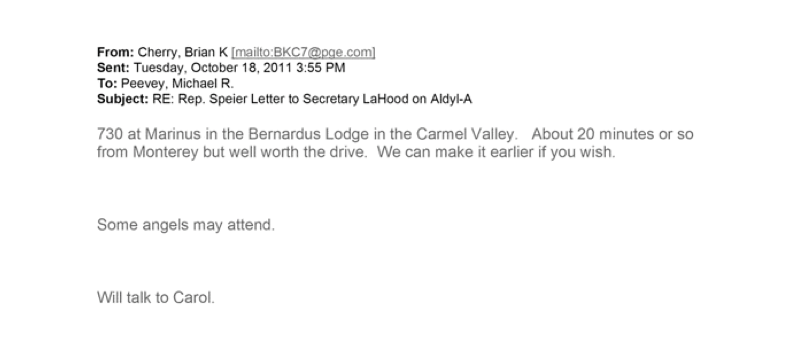
![“Mike – FYI. Fish and Game letter on Manzana. Very positive,” he wrote. “Also – Sara and I will be in Sea Ranch over Thanksgiving. We’d be happy to have you and Carol [Peevey’s wife, Democratic Sen. Carol Liu] over for drinks or dinner if you are free. I’ve got plenty of great wine to drink.”](http://ww2.kqed.org/news/wp-content/uploads/sites/10/2015/06/thanksgivingtext.png)