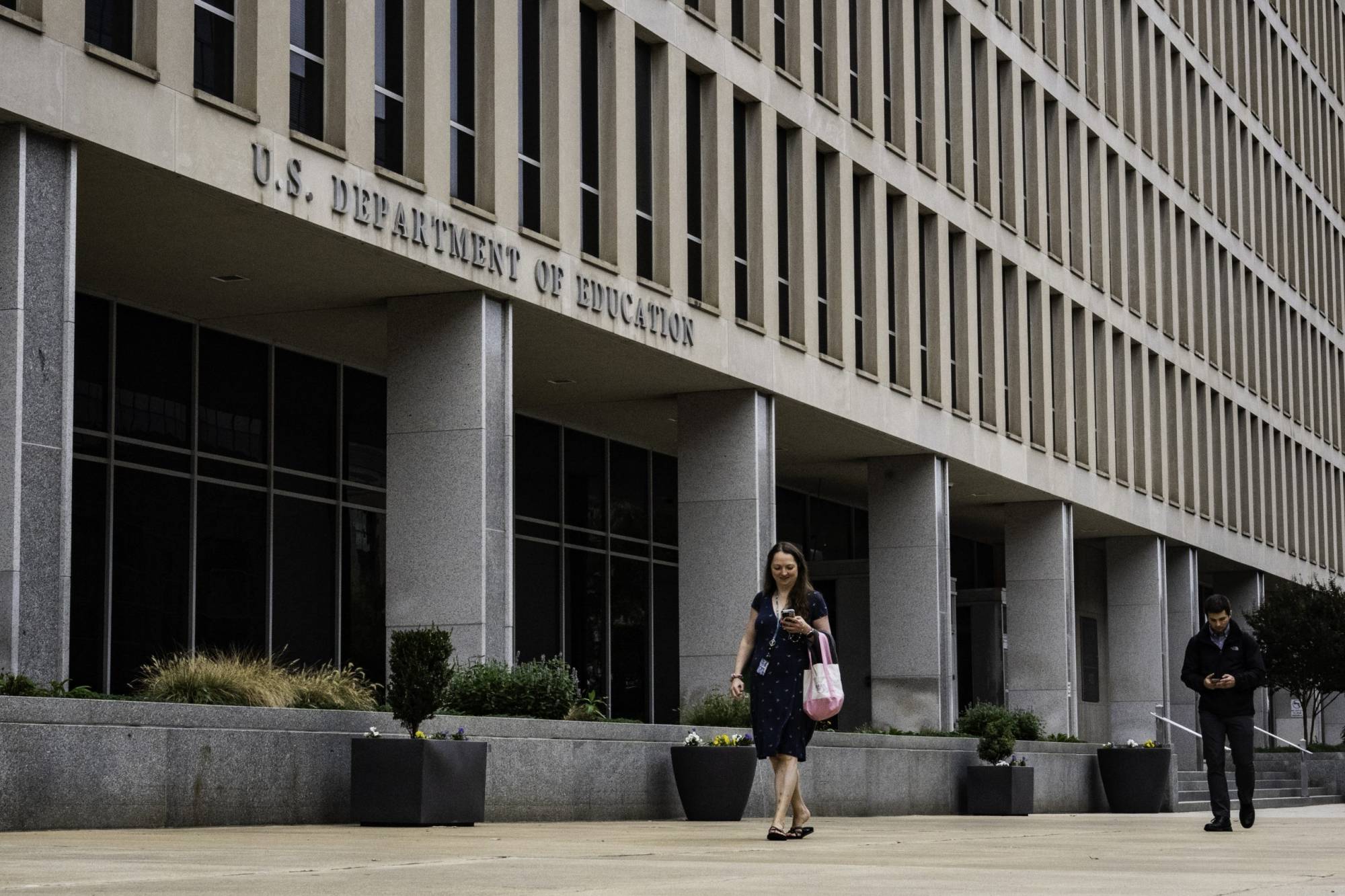
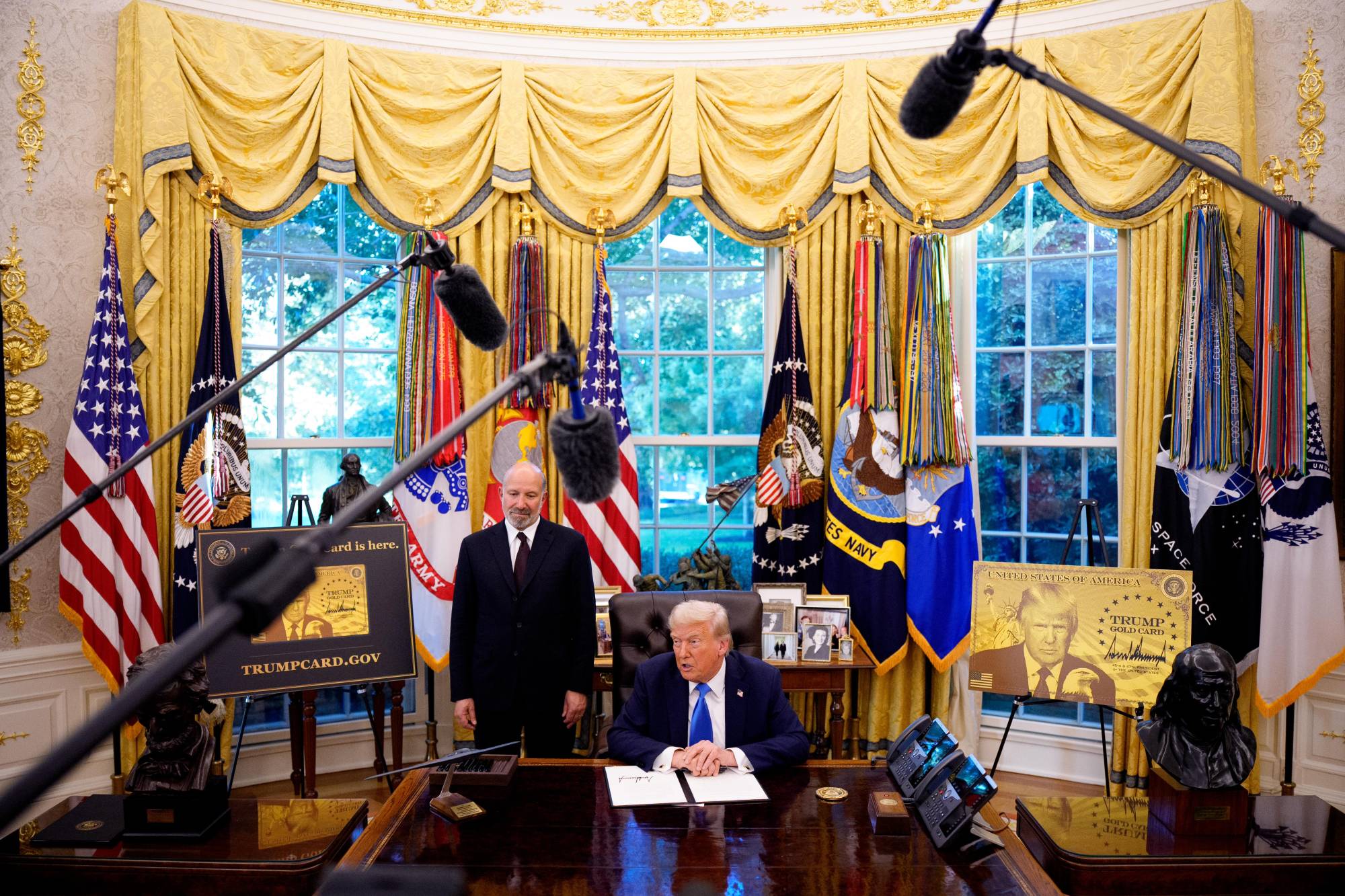
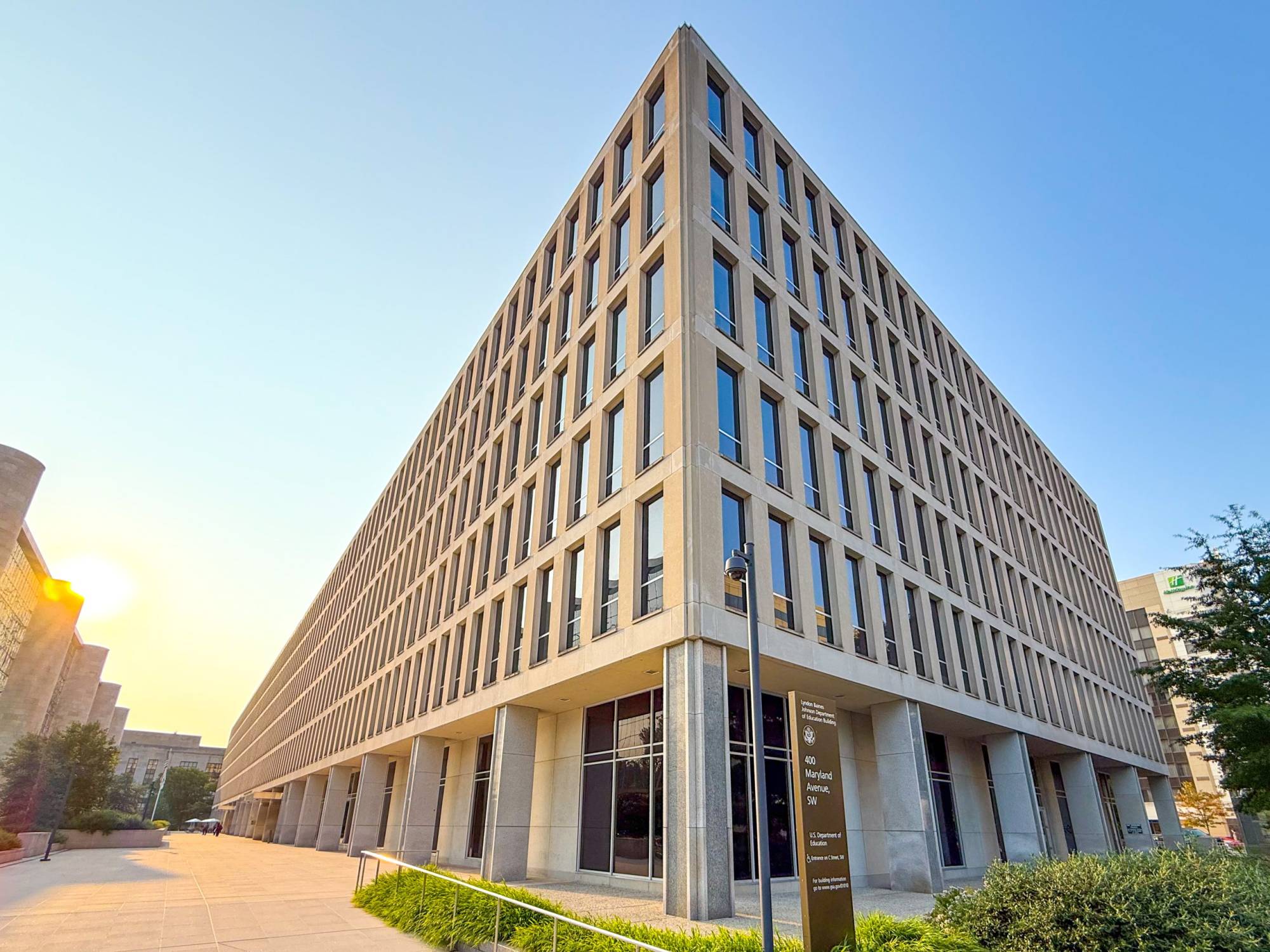
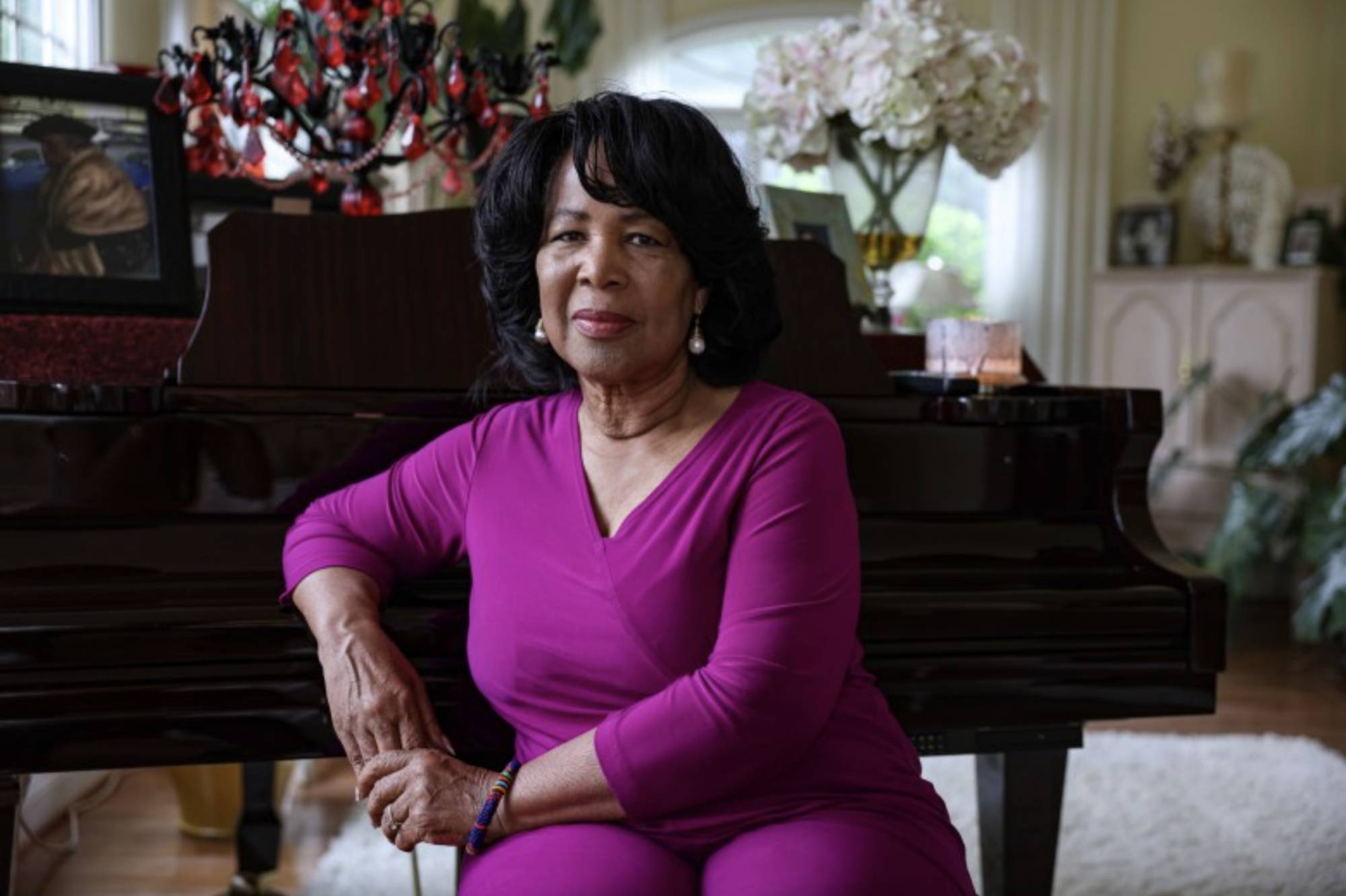
U.S. Department of EducationU.S. Department of Education
How Trump 2.0 Upended Education Research and Statistics in One Year
Advocates Warn of Risks to Higher Ed Data if Education Department is Shuttered
Many Rural Schools Rely on International Teachers. Trump's Visa Changes Threaten That
Education Department Takes a Preliminary Step Toward Revamping Its Research and Statistics Arm
What Schools Stand to Lose in the Battle Over the Next Federal Education Budget
Suddenly Sacked: The Final Days of Former NCES Chief’s Term and the Future of Education Data
Another Education Department Delay: Release of NAEP Science Scores
On Teacher Appreciation Week, Union Leaders Say Teachers are Underpaid and Under Attack
Sponsored
Player sponsored by
window.__IS_SSR__=true
window.__INITIAL_STATE__={
"attachmentsReducer": {
"audio_0": {
"type": "attachments",
"id": "audio_0",
"imgSizes": {
"kqedFullSize": {
"file": "https://ww2.kqed.org/news/wp-content/themes/KQED-unified/img/audio_bgs/background0.jpg"
}
}
},
"audio_1": {
"type": "attachments",
"id": "audio_1",
"imgSizes": {
"kqedFullSize": {
"file": "https://ww2.kqed.org/news/wp-content/themes/KQED-unified/img/audio_bgs/background1.jpg"
}
}
},
"audio_2": {
"type": "attachments",
"id": "audio_2",
"imgSizes": {
"kqedFullSize": {
"file": "https://ww2.kqed.org/news/wp-content/themes/KQED-unified/img/audio_bgs/background2.jpg"
}
}
},
"audio_3": {
"type": "attachments",
"id": "audio_3",
"imgSizes": {
"kqedFullSize": {
"file": "https://ww2.kqed.org/news/wp-content/themes/KQED-unified/img/audio_bgs/background3.jpg"
}
}
},
"audio_4": {
"type": "attachments",
"id": "audio_4",
"imgSizes": {
"kqedFullSize": {
"file": "https://ww2.kqed.org/news/wp-content/themes/KQED-unified/img/audio_bgs/background4.jpg"
}
}
},
"placeholder": {
"type": "attachments",
"id": "placeholder",
"imgSizes": {
"thumbnail": {
"file": "https://cdn.kqed.org/wp-content/uploads/2024/12/KQED-Default-Image-816638274-2000x1333-1-160x107.jpg",
"width": 160,
"height": 107,
"mimeType": "image/jpeg"
},
"medium": {
"file": "https://cdn.kqed.org/wp-content/uploads/2024/12/KQED-Default-Image-816638274-2000x1333-1-800x533.jpg",
"width": 800,
"height": 533,
"mimeType": "image/jpeg"
},
"medium_large": {
"file": "https://cdn.kqed.org/wp-content/uploads/2024/12/KQED-Default-Image-816638274-2000x1333-1-768x512.jpg",
"width": 768,
"height": 512,
"mimeType": "image/jpeg"
},
"large": {
"file": "https://cdn.kqed.org/wp-content/uploads/2024/12/KQED-Default-Image-816638274-2000x1333-1-1020x680.jpg",
"width": 1020,
"height": 680,
"mimeType": "image/jpeg"
},
"1536x1536": {
"file": "https://cdn.kqed.org/wp-content/uploads/2024/12/KQED-Default-Image-816638274-2000x1333-1-1536x1024.jpg",
"width": 1536,
"height": 1024,
"mimeType": "image/jpeg"
},
"fd-lrg": {
"file": "https://cdn.kqed.org/wp-content/uploads/2024/12/KQED-Default-Image-816638274-2000x1333-1-1536x1024.jpg",
"width": 1536,
"height": 1024,
"mimeType": "image/jpeg"
},
"fd-med": {
"file": "https://cdn.kqed.org/wp-content/uploads/2024/12/KQED-Default-Image-816638274-2000x1333-1-1020x680.jpg",
"width": 1020,
"height": 680,
"mimeType": "image/jpeg"
},
"fd-sm": {
"file": "https://cdn.kqed.org/wp-content/uploads/2024/12/KQED-Default-Image-816638274-2000x1333-1-800x533.jpg",
"width": 800,
"height": 533,
"mimeType": "image/jpeg"
},
"post-thumbnail": {
"file": "https://cdn.kqed.org/wp-content/uploads/2024/12/KQED-Default-Image-816638274-2000x1333-1-672x372.jpg",
"width": 672,
"height": 372,
"mimeType": "image/jpeg"
},
"twentyfourteen-full-width": {
"file": "https://cdn.kqed.org/wp-content/uploads/2024/12/KQED-Default-Image-816638274-2000x1333-1-1038x576.jpg",
"width": 1038,
"height": 576,
"mimeType": "image/jpeg"
},
"xxsmall": {
"file": "https://cdn.kqed.org/wp-content/uploads/2024/12/KQED-Default-Image-816638274-2000x1333-1-160x107.jpg",
"width": 160,
"height": 107,
"mimeType": "image/jpeg"
},
"xsmall": {
"file": "https://cdn.kqed.org/wp-content/uploads/2024/12/KQED-Default-Image-816638274-2000x1333-1-672x372.jpg",
"width": 672,
"height": 372,
"mimeType": "image/jpeg"
},
"small": {
"file": "https://cdn.kqed.org/wp-content/uploads/2024/12/KQED-Default-Image-816638274-2000x1333-1-672x372.jpg",
"width": 672,
"height": 372,
"mimeType": "image/jpeg"
},
"xlarge": {
"file": "https://cdn.kqed.org/wp-content/uploads/2024/12/KQED-Default-Image-816638274-2000x1333-1-1020x680.jpg",
"width": 1020,
"height": 680,
"mimeType": "image/jpeg"
},
"full-width": {
"file": "https://cdn.kqed.org/wp-content/uploads/2024/12/KQED-Default-Image-816638274-2000x1333-1-1920x1280.jpg",
"width": 1920,
"height": 1280,
"mimeType": "image/jpeg"
},
"guest-author-32": {
"file": "https://cdn.kqed.org/wp-content/uploads/2025/01/KQED-Default-Image-816638274-1333x1333-1-160x160.jpg",
"width": 32,
"height": 32,
"mimeType": "image/jpeg"
},
"guest-author-50": {
"file": "https://cdn.kqed.org/wp-content/uploads/2025/01/KQED-Default-Image-816638274-1333x1333-1-160x160.jpg",
"width": 50,
"height": 50,
"mimeType": "image/jpeg"
},
"guest-author-64": {
"file": "https://cdn.kqed.org/wp-content/uploads/2025/01/KQED-Default-Image-816638274-1333x1333-1-160x160.jpg",
"width": 64,
"height": 64,
"mimeType": "image/jpeg"
},
"guest-author-96": {
"file": "https://cdn.kqed.org/wp-content/uploads/2025/01/KQED-Default-Image-816638274-1333x1333-1-160x160.jpg",
"width": 96,
"height": 96,
"mimeType": "image/jpeg"
},
"guest-author-128": {
"file": "https://cdn.kqed.org/wp-content/uploads/2025/01/KQED-Default-Image-816638274-1333x1333-1-160x160.jpg",
"width": 128,
"height": 128,
"mimeType": "image/jpeg"
},
"detail": {
"file": "https://cdn.kqed.org/wp-content/uploads/2025/01/KQED-Default-Image-816638274-1333x1333-1-160x160.jpg",
"width": 160,
"height": 160,
"mimeType": "image/jpeg"
},
"kqedFullSize": {
"file": "https://cdn.kqed.org/wp-content/uploads/2024/12/KQED-Default-Image-816638274-2000x1333-1.jpg",
"width": 2000,
"height": 1333
}
}
},
"mindshift_65992": {
"type": "attachments",
"id": "mindshift_65992",
"meta": {
"index": "attachments_1716263798",
"site": "mindshift",
"id": "65992",
"found": true
},
"title": "The US Department of Education",
"publishDate": 1764563587,
"status": "inherit",
"parent": 65991,
"modified": 1764563623,
"caption": "The Entrance of the Lyndon B. Johnson Department of Education building in Washington, DC",
"credit": "Greggory DiSalvo/iStock",
"altTag": "Federal building entrance",
"description": null,
"imgSizes": {
"medium": {
"file": "https://cdn.kqed.org/wp-content/uploads/sites/23/2025/11/iStock-1973372833-2000x1333.jpg",
"width": 2000,
"height": 1333,
"mimeType": "image/jpeg"
},
"large": {
"file": "https://cdn.kqed.org/wp-content/uploads/sites/23/2025/11/iStock-1973372833-2000x1333.jpg",
"width": 2000,
"height": 1333,
"mimeType": "image/jpeg"
},
"thumbnail": {
"file": "https://cdn.kqed.org/wp-content/uploads/sites/23/2025/11/iStock-1973372833-160x107.jpg",
"width": 160,
"height": 107,
"mimeType": "image/jpeg"
},
"medium_large": {
"file": "https://cdn.kqed.org/wp-content/uploads/sites/23/2025/11/iStock-1973372833-768x512.jpg",
"width": 768,
"height": 512,
"mimeType": "image/jpeg"
},
"1536x1536": {
"file": "https://cdn.kqed.org/wp-content/uploads/sites/23/2025/11/iStock-1973372833-1536x1024.jpg",
"width": 1536,
"height": 1024,
"mimeType": "image/jpeg"
},
"2048x2048": {
"file": "https://cdn.kqed.org/wp-content/uploads/sites/23/2025/11/iStock-1973372833-2048x1365.jpg",
"width": 2048,
"height": 1365,
"mimeType": "image/jpeg"
},
"post-thumbnail": {
"file": "https://cdn.kqed.org/wp-content/uploads/sites/23/2025/11/iStock-1973372833-672x372.jpg",
"width": 672,
"height": 372,
"mimeType": "image/jpeg"
},
"twentyfourteen-full-width": {
"file": "https://cdn.kqed.org/wp-content/uploads/sites/23/2025/11/iStock-1973372833-1038x576.jpg",
"width": 1038,
"height": 576,
"mimeType": "image/jpeg"
},
"full-width": {
"file": "https://cdn.kqed.org/wp-content/uploads/sites/23/2025/11/iStock-1973372833-2000x1333.jpg",
"width": 2000,
"height": 1333,
"mimeType": "image/jpeg"
},
"npr-cds-wide": {
"file": "https://cdn.kqed.org/wp-content/uploads/sites/23/2025/11/iStock-1973372833-1200x675.jpg",
"width": 1200,
"height": 675,
"mimeType": "image/jpeg"
},
"kqedFullSize": {
"file": "https://cdn.kqed.org/wp-content/uploads/sites/23/2025/11/iStock-1973372833.jpg",
"width": 2121,
"height": 1414
}
},
"fetchFailed": false,
"isLoading": false
},
"mindshift_65957": {
"type": "attachments",
"id": "mindshift_65957",
"meta": {
"index": "attachments_1716263798",
"site": "mindshift",
"id": "65957",
"found": true
},
"title": "proof-ed-100525-scaled (1)",
"publishDate": 1762710651,
"status": "inherit",
"parent": 65956,
"modified": 1762710699,
"caption": null,
"credit": "Salwan Georges/The Washington Post via Getty Images",
"altTag": "Woman walking past federal building",
"description": null,
"imgSizes": {
"medium": {
"file": "https://cdn.kqed.org/wp-content/uploads/sites/23/2025/11/proof-ed-100525-scaled-1-2000x1333.jpg",
"width": 2000,
"height": 1333,
"mimeType": "image/jpeg"
},
"large": {
"file": "https://cdn.kqed.org/wp-content/uploads/sites/23/2025/11/proof-ed-100525-scaled-1-2000x1333.jpg",
"width": 2000,
"height": 1333,
"mimeType": "image/jpeg"
},
"thumbnail": {
"file": "https://cdn.kqed.org/wp-content/uploads/sites/23/2025/11/proof-ed-100525-scaled-1-160x107.jpg",
"width": 160,
"height": 107,
"mimeType": "image/jpeg"
},
"medium_large": {
"file": "https://cdn.kqed.org/wp-content/uploads/sites/23/2025/11/proof-ed-100525-scaled-1-768x512.jpg",
"width": 768,
"height": 512,
"mimeType": "image/jpeg"
},
"1536x1536": {
"file": "https://cdn.kqed.org/wp-content/uploads/sites/23/2025/11/proof-ed-100525-scaled-1-1536x1024.jpg",
"width": 1536,
"height": 1024,
"mimeType": "image/jpeg"
},
"2048x2048": {
"file": "https://cdn.kqed.org/wp-content/uploads/sites/23/2025/11/proof-ed-100525-scaled-1-2048x1365.jpg",
"width": 2048,
"height": 1365,
"mimeType": "image/jpeg"
},
"post-thumbnail": {
"file": "https://cdn.kqed.org/wp-content/uploads/sites/23/2025/11/proof-ed-100525-scaled-1-672x372.jpg",
"width": 672,
"height": 372,
"mimeType": "image/jpeg"
},
"twentyfourteen-full-width": {
"file": "https://cdn.kqed.org/wp-content/uploads/sites/23/2025/11/proof-ed-100525-scaled-1-1038x576.jpg",
"width": 1038,
"height": 576,
"mimeType": "image/jpeg"
},
"full-width": {
"file": "https://cdn.kqed.org/wp-content/uploads/sites/23/2025/11/proof-ed-100525-scaled-1-2000x1333.jpg",
"width": 2000,
"height": 1333,
"mimeType": "image/jpeg"
},
"npr-cds-wide": {
"file": "https://cdn.kqed.org/wp-content/uploads/sites/23/2025/11/proof-ed-100525-scaled-1-1200x675.jpg",
"width": 1200,
"height": 675,
"mimeType": "image/jpeg"
},
"kqedFullSize": {
"file": "https://cdn.kqed.org/wp-content/uploads/sites/23/2025/11/proof-ed-100525-scaled-1.jpg",
"width": 2560,
"height": 1706
}
},
"fetchFailed": false,
"isLoading": false
},
"mindshift_65921": {
"type": "attachments",
"id": "mindshift_65921",
"meta": {
"index": "attachments_1716263798",
"site": "mindshift",
"id": "65921",
"found": true
},
"title": "President Trump Signs Executive Order At The White House",
"publishDate": 1761341806,
"status": "inherit",
"parent": 65920,
"modified": 1761341818,
"caption": "President Trump, accompanied by U.S. Commerce Secretary Howard Lutnick, speaks on Sept. 19 after signing an executive order in the Oval Office at the White House. Trump signed two executive orders, establishing the \"Trump Gold Card\" and introducing a $100,000 fee for H-1B visas.",
"credit": null,
"altTag": null,
"description": "WASHINGTON, DC - SEPTEMBER 19: President Donald Trump, accompanied by U.S. Commerce Secretary Howard Lutnick (L), speaks after signing an executive order in the Oval Office at the White House on September 19, 2025 in Washington, DC. Trump signed two executive orders, establishing the \"Trump Gold Card\" and introducing a $100,000 fee for H-1B visas. The \"Trump Gold Card\" is a visa program that allows foreign nationals permanent residency and a pathway to U.S. citizenship for a $1 million investment in the United States. (Photo by Andrew Harnik/Getty Images)",
"imgSizes": {
"medium": {
"file": "https://cdn.kqed.org/wp-content/uploads/sites/23/2025/10/gettyimages-2235796232-2000x1333.jpeg",
"width": 2000,
"height": 1333,
"mimeType": "image/jpeg"
},
"large": {
"file": "https://cdn.kqed.org/wp-content/uploads/sites/23/2025/10/gettyimages-2235796232-2000x1333.jpeg",
"width": 2000,
"height": 1333,
"mimeType": "image/jpeg"
},
"thumbnail": {
"file": "https://cdn.kqed.org/wp-content/uploads/sites/23/2025/10/gettyimages-2235796232-160x107.jpeg",
"width": 160,
"height": 107,
"mimeType": "image/jpeg"
},
"medium_large": {
"file": "https://cdn.kqed.org/wp-content/uploads/sites/23/2025/10/gettyimages-2235796232-768x512.jpeg",
"width": 768,
"height": 512,
"mimeType": "image/jpeg"
},
"1536x1536": {
"file": "https://cdn.kqed.org/wp-content/uploads/sites/23/2025/10/gettyimages-2235796232-1536x1024.jpeg",
"width": 1536,
"height": 1024,
"mimeType": "image/jpeg"
},
"2048x2048": {
"file": "https://cdn.kqed.org/wp-content/uploads/sites/23/2025/10/gettyimages-2235796232-2048x1365.jpeg",
"width": 2048,
"height": 1365,
"mimeType": "image/jpeg"
},
"post-thumbnail": {
"file": "https://cdn.kqed.org/wp-content/uploads/sites/23/2025/10/gettyimages-2235796232-672x372.jpeg",
"width": 672,
"height": 372,
"mimeType": "image/jpeg"
},
"twentyfourteen-full-width": {
"file": "https://cdn.kqed.org/wp-content/uploads/sites/23/2025/10/gettyimages-2235796232-1038x576.jpeg",
"width": 1038,
"height": 576,
"mimeType": "image/jpeg"
},
"full-width": {
"file": "https://cdn.kqed.org/wp-content/uploads/sites/23/2025/10/gettyimages-2235796232-2000x1333.jpeg",
"width": 2000,
"height": 1333,
"mimeType": "image/jpeg"
},
"npr-cds-wide": {
"file": "https://cdn.kqed.org/wp-content/uploads/sites/23/2025/10/gettyimages-2235796232-1600x900.jpeg",
"width": 1600,
"height": 900,
"mimeType": "image/jpeg"
},
"kqedFullSize": {
"file": "https://cdn.kqed.org/wp-content/uploads/sites/23/2025/10/gettyimages-2235796232-scaled.jpeg",
"width": 2560,
"height": 1707
}
},
"fetchFailed": false,
"isLoading": false
},
"mindshift_65847": {
"type": "attachments",
"id": "mindshift_65847",
"meta": {
"index": "attachments_1716263798",
"site": "mindshift",
"id": "65847",
"found": true
},
"title": "barshay-IES-092525-scaled",
"publishDate": 1759120802,
"status": "inherit",
"parent": 65846,
"modified": 1759120845,
"caption": "Barry Winiker/Getty Images",
"credit": null,
"altTag": "Corner view of a 6-story building",
"description": null,
"imgSizes": {
"medium": {
"file": "https://cdn.kqed.org/wp-content/uploads/sites/23/2025/09/barshay-IES-092525-scaled-1-2000x1500.jpg",
"width": 2000,
"height": 1500,
"mimeType": "image/jpeg"
},
"large": {
"file": "https://cdn.kqed.org/wp-content/uploads/sites/23/2025/09/barshay-IES-092525-scaled-1-2000x1500.jpg",
"width": 2000,
"height": 1500,
"mimeType": "image/jpeg"
},
"thumbnail": {
"file": "https://cdn.kqed.org/wp-content/uploads/sites/23/2025/09/barshay-IES-092525-scaled-1-160x120.jpg",
"width": 160,
"height": 120,
"mimeType": "image/jpeg"
},
"medium_large": {
"file": "https://cdn.kqed.org/wp-content/uploads/sites/23/2025/09/barshay-IES-092525-scaled-1-768x576.jpg",
"width": 768,
"height": 576,
"mimeType": "image/jpeg"
},
"1536x1536": {
"file": "https://cdn.kqed.org/wp-content/uploads/sites/23/2025/09/barshay-IES-092525-scaled-1-1536x1152.jpg",
"width": 1536,
"height": 1152,
"mimeType": "image/jpeg"
},
"2048x2048": {
"file": "https://cdn.kqed.org/wp-content/uploads/sites/23/2025/09/barshay-IES-092525-scaled-1-2048x1536.jpg",
"width": 2048,
"height": 1536,
"mimeType": "image/jpeg"
},
"post-thumbnail": {
"file": "https://cdn.kqed.org/wp-content/uploads/sites/23/2025/09/barshay-IES-092525-scaled-1-672x372.jpg",
"width": 672,
"height": 372,
"mimeType": "image/jpeg"
},
"twentyfourteen-full-width": {
"file": "https://cdn.kqed.org/wp-content/uploads/sites/23/2025/09/barshay-IES-092525-scaled-1-1038x576.jpg",
"width": 1038,
"height": 576,
"mimeType": "image/jpeg"
},
"full-width": {
"file": "https://cdn.kqed.org/wp-content/uploads/sites/23/2025/09/barshay-IES-092525-scaled-1-2000x1500.jpg",
"width": 2000,
"height": 1500,
"mimeType": "image/jpeg"
},
"kqedFullSize": {
"file": "https://cdn.kqed.org/wp-content/uploads/sites/23/2025/09/barshay-IES-092525-scaled-1.jpg",
"width": 2560,
"height": 1920
}
},
"fetchFailed": false,
"isLoading": false
},
"mindshift_65842": {
"type": "attachments",
"id": "mindshift_65842",
"meta": {
"index": "attachments_1716263798",
"site": "mindshift",
"id": "65842",
"found": true
},
"title": "Woman and her children circle the Penrose stairs of funding.",
"publishDate": 1758909932,
"status": "inherit",
"parent": 65841,
"modified": 1758909987,
"caption": "LA Johnson/NPR",
"credit": null,
"altTag": "A woman and her children circle the Penrose stairs of funding.",
"description": null,
"imgSizes": {
"medium": {
"file": "https://cdn.kqed.org/wp-content/uploads/sites/23/2025/09/child-tax-credit-penrose-ljohnson_custom-822d711034e893aa1be1a137f613a5eb76c34212-2000x1248.jpeg",
"width": 2000,
"height": 1248,
"mimeType": "image/jpeg"
},
"large": {
"file": "https://cdn.kqed.org/wp-content/uploads/sites/23/2025/09/child-tax-credit-penrose-ljohnson_custom-822d711034e893aa1be1a137f613a5eb76c34212-2000x1248.jpeg",
"width": 2000,
"height": 1248,
"mimeType": "image/jpeg"
},
"thumbnail": {
"file": "https://cdn.kqed.org/wp-content/uploads/sites/23/2025/09/child-tax-credit-penrose-ljohnson_custom-822d711034e893aa1be1a137f613a5eb76c34212-160x100.jpeg",
"width": 160,
"height": 100,
"mimeType": "image/jpeg"
},
"medium_large": {
"file": "https://cdn.kqed.org/wp-content/uploads/sites/23/2025/09/child-tax-credit-penrose-ljohnson_custom-822d711034e893aa1be1a137f613a5eb76c34212-768x479.jpeg",
"width": 768,
"height": 479,
"mimeType": "image/jpeg"
},
"1536x1536": {
"file": "https://cdn.kqed.org/wp-content/uploads/sites/23/2025/09/child-tax-credit-penrose-ljohnson_custom-822d711034e893aa1be1a137f613a5eb76c34212-1536x958.jpeg",
"width": 1536,
"height": 958,
"mimeType": "image/jpeg"
},
"2048x2048": {
"file": "https://cdn.kqed.org/wp-content/uploads/sites/23/2025/09/child-tax-credit-penrose-ljohnson_custom-822d711034e893aa1be1a137f613a5eb76c34212-2048x1278.jpeg",
"width": 2048,
"height": 1278,
"mimeType": "image/jpeg"
},
"post-thumbnail": {
"file": "https://cdn.kqed.org/wp-content/uploads/sites/23/2025/09/child-tax-credit-penrose-ljohnson_custom-822d711034e893aa1be1a137f613a5eb76c34212-672x372.jpeg",
"width": 672,
"height": 372,
"mimeType": "image/jpeg"
},
"twentyfourteen-full-width": {
"file": "https://cdn.kqed.org/wp-content/uploads/sites/23/2025/09/child-tax-credit-penrose-ljohnson_custom-822d711034e893aa1be1a137f613a5eb76c34212-1038x576.jpeg",
"width": 1038,
"height": 576,
"mimeType": "image/jpeg"
},
"full-width": {
"file": "https://cdn.kqed.org/wp-content/uploads/sites/23/2025/09/child-tax-credit-penrose-ljohnson_custom-822d711034e893aa1be1a137f613a5eb76c34212-2000x1248.jpeg",
"width": 2000,
"height": 1248,
"mimeType": "image/jpeg"
},
"kqedFullSize": {
"file": "https://cdn.kqed.org/wp-content/uploads/sites/23/2025/09/child-tax-credit-penrose-ljohnson_custom-822d711034e893aa1be1a137f613a5eb76c34212-scaled.jpeg",
"width": 2560,
"height": 1597
}
},
"fetchFailed": false,
"isLoading": false
},
"mindshift_65605": {
"type": "attachments",
"id": "mindshift_65605",
"meta": {
"index": "attachments_1716263798",
"site": "mindshift",
"id": "65605",
"found": true
},
"title": "Hechinger Peggy Carr 3",
"publishDate": 1752417231,
"status": "inherit",
"parent": 65603,
"modified": 1752417421,
"caption": "Peggy Carr, the former commissioner of the National Center for Education Statistics, at her Maryland home on July 1. Carr worked for the Education Department for more than 35 years before the Trump administration placed her on administrative leave on Feb. 24. ",
"credit": "Valerie Plesch for The Hechinger Report",
"altTag": "Woman seated at home in front of a piano",
"description": null,
"imgSizes": {
"medium": {
"file": "https://cdn.kqed.org/wp-content/uploads/sites/23/2025/07/Hechinger-Peggy-Carr-3-2000x1332.jpg",
"width": 2000,
"height": 1332,
"mimeType": "image/jpeg"
},
"large": {
"file": "https://cdn.kqed.org/wp-content/uploads/sites/23/2025/07/Hechinger-Peggy-Carr-3-2000x1332.jpg",
"width": 2000,
"height": 1332,
"mimeType": "image/jpeg"
},
"thumbnail": {
"file": "https://cdn.kqed.org/wp-content/uploads/sites/23/2025/07/Hechinger-Peggy-Carr-3-160x107.jpg",
"width": 160,
"height": 107,
"mimeType": "image/jpeg"
},
"medium_large": {
"file": "https://cdn.kqed.org/wp-content/uploads/sites/23/2025/07/Hechinger-Peggy-Carr-3-768x511.jpg",
"width": 768,
"height": 511,
"mimeType": "image/jpeg"
},
"1536x1536": {
"file": "https://cdn.kqed.org/wp-content/uploads/sites/23/2025/07/Hechinger-Peggy-Carr-3-1536x1023.jpg",
"width": 1536,
"height": 1023,
"mimeType": "image/jpeg"
},
"2048x2048": {
"file": "https://cdn.kqed.org/wp-content/uploads/sites/23/2025/07/Hechinger-Peggy-Carr-3-2048x1364.jpg",
"width": 2048,
"height": 1364,
"mimeType": "image/jpeg"
},
"post-thumbnail": {
"file": "https://cdn.kqed.org/wp-content/uploads/sites/23/2025/07/Hechinger-Peggy-Carr-3-672x372.jpg",
"width": 672,
"height": 372,
"mimeType": "image/jpeg"
},
"twentyfourteen-full-width": {
"file": "https://cdn.kqed.org/wp-content/uploads/sites/23/2025/07/Hechinger-Peggy-Carr-3-1038x576.jpg",
"width": 1038,
"height": 576,
"mimeType": "image/jpeg"
},
"full-width": {
"file": "https://cdn.kqed.org/wp-content/uploads/sites/23/2025/07/Hechinger-Peggy-Carr-3-2000x1332.jpg",
"width": 2000,
"height": 1332,
"mimeType": "image/jpeg"
},
"kqedFullSize": {
"file": "https://cdn.kqed.org/wp-content/uploads/sites/23/2025/07/Hechinger-Peggy-Carr-3.jpg",
"width": 2382,
"height": 1586
}
},
"fetchFailed": false,
"isLoading": false
},
"mindshift_65595": {
"type": "attachments",
"id": "mindshift_65595",
"meta": {
"index": "attachments_1716263798",
"site": "mindshift",
"id": "65595",
"found": true
},
"title": "barshay_science_1-scaled",
"publishDate": 1751577146,
"status": "inherit",
"parent": 65594,
"modified": 1751577189,
"caption": null,
"credit": "Merrill Images/Getty Images",
"altTag": "Students conduct a science experiment wearing safety gear",
"description": null,
"imgSizes": {
"medium": {
"file": "https://cdn.kqed.org/wp-content/uploads/sites/23/2025/07/barshay_science_1-scaled-1-2000x1334.jpg",
"width": 2000,
"height": 1334,
"mimeType": "image/jpeg"
},
"large": {
"file": "https://cdn.kqed.org/wp-content/uploads/sites/23/2025/07/barshay_science_1-scaled-1-2000x1334.jpg",
"width": 2000,
"height": 1334,
"mimeType": "image/jpeg"
},
"thumbnail": {
"file": "https://cdn.kqed.org/wp-content/uploads/sites/23/2025/07/barshay_science_1-scaled-1-160x107.jpg",
"width": 160,
"height": 107,
"mimeType": "image/jpeg"
},
"medium_large": {
"file": "https://cdn.kqed.org/wp-content/uploads/sites/23/2025/07/barshay_science_1-scaled-1-768x512.jpg",
"width": 768,
"height": 512,
"mimeType": "image/jpeg"
},
"1536x1536": {
"file": "https://cdn.kqed.org/wp-content/uploads/sites/23/2025/07/barshay_science_1-scaled-1-1536x1024.jpg",
"width": 1536,
"height": 1024,
"mimeType": "image/jpeg"
},
"2048x2048": {
"file": "https://cdn.kqed.org/wp-content/uploads/sites/23/2025/07/barshay_science_1-scaled-1-2048x1366.jpg",
"width": 2048,
"height": 1366,
"mimeType": "image/jpeg"
},
"post-thumbnail": {
"file": "https://cdn.kqed.org/wp-content/uploads/sites/23/2025/07/barshay_science_1-scaled-1-672x372.jpg",
"width": 672,
"height": 372,
"mimeType": "image/jpeg"
},
"twentyfourteen-full-width": {
"file": "https://cdn.kqed.org/wp-content/uploads/sites/23/2025/07/barshay_science_1-scaled-1-1038x576.jpg",
"width": 1038,
"height": 576,
"mimeType": "image/jpeg"
},
"full-width": {
"file": "https://cdn.kqed.org/wp-content/uploads/sites/23/2025/07/barshay_science_1-scaled-1-2000x1334.jpg",
"width": 2000,
"height": 1334,
"mimeType": "image/jpeg"
},
"kqedFullSize": {
"file": "https://cdn.kqed.org/wp-content/uploads/sites/23/2025/07/barshay_science_1-scaled-1.jpg",
"width": 2560,
"height": 1707
}
},
"fetchFailed": false,
"isLoading": false
},
"mindshift_65488": {
"type": "attachments",
"id": "mindshift_65488",
"meta": {
"index": "attachments_1716263798",
"site": "mindshift",
"id": "65488",
"found": true
},
"title": "npr-k-147 copy.jpg",
"publishDate": 1746809371,
"status": "inherit",
"parent": 65487,
"modified": 1746809728,
"caption": "Kellen and his classmates, including his best friend, Nolan Robbins (left), learn about the structure of the U.S. government with teacher Robyn Fox.",
"credit": null,
"altTag": "Two students at their desks learn from a teacher.",
"description": null,
"imgSizes": {
"medium": {
"file": "https://cdn.kqed.org/wp-content/uploads/sites/23/2025/05/npr-k-147-copy-800x541.jpeg",
"width": 800,
"height": 541,
"mimeType": "image/jpeg"
},
"large": {
"file": "https://cdn.kqed.org/wp-content/uploads/sites/23/2025/05/npr-k-147-copy-1020x690.jpeg",
"width": 1020,
"height": 690,
"mimeType": "image/jpeg"
},
"thumbnail": {
"file": "https://cdn.kqed.org/wp-content/uploads/sites/23/2025/05/npr-k-147-copy-160x108.jpeg",
"width": 160,
"height": 108,
"mimeType": "image/jpeg"
},
"medium_large": {
"file": "https://cdn.kqed.org/wp-content/uploads/sites/23/2025/05/npr-k-147-copy-768x520.jpeg",
"width": 768,
"height": 520,
"mimeType": "image/jpeg"
},
"1536x1536": {
"file": "https://cdn.kqed.org/wp-content/uploads/sites/23/2025/05/npr-k-147-copy-1536x1039.jpeg",
"width": 1536,
"height": 1039,
"mimeType": "image/jpeg"
},
"2048x2048": {
"file": "https://cdn.kqed.org/wp-content/uploads/sites/23/2025/05/npr-k-147-copy-2048x1386.jpeg",
"width": 2048,
"height": 1386,
"mimeType": "image/jpeg"
},
"post-thumbnail": {
"file": "https://cdn.kqed.org/wp-content/uploads/sites/23/2025/05/npr-k-147-copy-672x372.jpeg",
"width": 672,
"height": 372,
"mimeType": "image/jpeg"
},
"twentyfourteen-full-width": {
"file": "https://cdn.kqed.org/wp-content/uploads/sites/23/2025/05/npr-k-147-copy-1038x576.jpeg",
"width": 1038,
"height": 576,
"mimeType": "image/jpeg"
},
"full-width": {
"file": "https://cdn.kqed.org/wp-content/uploads/sites/23/2025/05/npr-k-147-copy-1920x1299.jpeg",
"width": 1920,
"height": 1299,
"mimeType": "image/jpeg"
},
"kqedFullSize": {
"file": "https://cdn.kqed.org/wp-content/uploads/sites/23/2025/05/npr-k-147-copy-scaled.jpeg",
"width": 2560,
"height": 1732
}
},
"fetchFailed": false,
"isLoading": false
}
},
"audioPlayerReducer": {
"postId": "stream_live",
"isPaused": true,
"isPlaying": false,
"pfsActive": false,
"pledgeModalIsOpen": true,
"playerDrawerIsOpen": false
},
"authorsReducer": {
"byline_mindshift_65991": {
"type": "authors",
"id": "byline_mindshift_65991",
"meta": {
"override": true
},
"slug": "byline_mindshift_65991",
"name": "Jill Barshay, \u003ca href=\"https://hechingerreport.org/\">The Hechinger Report\u003c/a>",
"isLoading": false
},
"byline_mindshift_65956": {
"type": "authors",
"id": "byline_mindshift_65956",
"meta": {
"override": true
},
"slug": "byline_mindshift_65956",
"name": "Jill Barshay, \u003ca href=\"https://hechingerreport.org/\">The Hechinger Report\u003c/a>",
"isLoading": false
},
"byline_mindshift_65920": {
"type": "authors",
"id": "byline_mindshift_65920",
"meta": {
"override": true
},
"slug": "byline_mindshift_65920",
"name": "Sequoia Carrillo",
"isLoading": false
},
"byline_mindshift_65846": {
"type": "authors",
"id": "byline_mindshift_65846",
"meta": {
"override": true
},
"slug": "byline_mindshift_65846",
"name": "Jill Barshay, \u003ca href=\"https://hechingerreport.org/\" target=\"_blank\">The Hechinger Report\u003c/a>",
"isLoading": false
},
"byline_mindshift_65841": {
"type": "authors",
"id": "byline_mindshift_65841",
"meta": {
"override": true
},
"slug": "byline_mindshift_65841",
"name": "Cory Turner",
"isLoading": false
},
"byline_mindshift_65603": {
"type": "authors",
"id": "byline_mindshift_65603",
"meta": {
"override": true
},
"slug": "byline_mindshift_65603",
"name": "Jill Barshay, \u003ca href=\"https://hechingerreport.org/\" target=\"_blank\">The Hechinger Report\u003c/a>",
"isLoading": false
},
"byline_mindshift_65594": {
"type": "authors",
"id": "byline_mindshift_65594",
"meta": {
"override": true
},
"slug": "byline_mindshift_65594",
"name": "Jill Barshay, \u003ca href=\"https://hechingerreport.org/\" target=\"_blank\">The Hechinger Report\u003c/a>",
"isLoading": false
},
"byline_mindshift_65487": {
"type": "authors",
"id": "byline_mindshift_65487",
"meta": {
"override": true
},
"slug": "byline_mindshift_65487",
"name": "Ayana Archie",
"isLoading": false
}
},
"breakingNewsReducer": {},
"pagesReducer": {},
"postsReducer": {
"stream_live": {
"type": "live",
"id": "stream_live",
"audioUrl": "https://streams.kqed.org/kqedradio",
"title": "Live Stream",
"excerpt": "Live Stream information currently unavailable.",
"link": "/radio",
"featImg": "",
"label": {
"name": "KQED Live",
"link": "/"
}
},
"stream_kqedNewscast": {
"type": "posts",
"id": "stream_kqedNewscast",
"audioUrl": "https://www.kqed.org/.stream/anon/radio/RDnews/newscast.mp3?_=1",
"title": "KQED Newscast",
"featImg": "",
"label": {
"name": "88.5 FM",
"link": "/"
}
},
"mindshift_65991": {
"type": "posts",
"id": "mindshift_65991",
"meta": {
"index": "posts_1716263798",
"site": "mindshift",
"id": "65991",
"score": null,
"sort": [
1764586814000
]
},
"guestAuthors": [],
"slug": "how-trump-2-0-upended-education-research-and-statistics-in-one-year",
"title": "How Trump 2.0 Upended Education Research and Statistics in One Year",
"publishDate": 1764586814,
"format": "standard",
"headTitle": "How Trump 2.0 Upended Education Research and Statistics in One Year | KQED",
"labelTerm": {
"term": 21847,
"site": "mindshift"
},
"content": "\u003cp>Inauguration Day was a time of hope for the MAGA faithful who watched President Donald Trump take his second oath of office in the Capitol rotunda. But less than a mile away, at the Department of Education, fear and uncertainty reigned.\u003c/p>\n\u003cp>Researchers, contractors and federal staff — the corner of the Education Department that I cover — braced for potentially devastating upheaval. Would the department itself be eliminated, as Trump had promised during the campaign? Would congressionally mandated research and statistical programs move to other agencies? And, if so, which ones?\u003c/p>\n\u003cp>Amid the unease, a small but determined force was already at work. The consequences would be profound. As many as 16 members from Elon Musk’s Department of Government Efficiency (DOGE) team embedded within the agency in early February, according to news reports. These Young Turks reviewed contracts, identified vulnerabilities and quietly plotted what some would later call a blitzkrieg against federal research. As one senior researcher told me, decades of painstaking work vanished overnight in an attack by an inexperienced and ideologically driven staff intent on dismantling the bureaucracy without understanding its purpose.\u003c/p>\n\u003ch2>\u003cstrong>February: The carnage begins\u003c/strong>\u003c/h2>\n\u003cp>The first blow came in early February. In a single week, DOGE terminated more than \u003ca href=\"https://hechingerreport.org/proof-points-doge-death-blow-education-studies/\">100 research contracts\u003c/a> collectively worth over a billion dollars on paper. The consequences were immediate and staggering. Ten Regional Educational Laboratories (RELs), which had helped states pilot literacy and math interventions, were among these early casualties. Mississippi’s remarkable turnaround in reading achievement, commonly called the “Mississippi Miracle,” was nurtured by the Southeast laboratory, and the sudden loss of this infrastructure created uncertainty for other states in the midst of trying to copy Mississippi.\u003c/p>\n\u003cp>DOGE canceled an 11-year longitudinal study tracking youth with disabilities through high school into college and the workforce. Data painstakingly collected over five years was effectively discarded overnight. Instruction and support was suddenly yanked from 1,000 students in the study. Disability advocates described it as a “crushing loss.”\u003c/p>\n\u003cp>[ad fullwidth]\u003c/p>\n\u003cp>Even core federal datasets were not spared. The termination of a contract for EDFacts, which collects demographic data about students, was inconceivable. The data is essential for administering the highly regarded National Assessment of Educational Progress (NAEP), the federal test that tracks reading and math achievement. It is also critical for allocating $18 billion for the Title I program, which gives federal subsidies to high-poverty schools. DOGE killed evidence-based teacher guides for math instruction. Even data on homeschooling — long a conservative priority — was cut. A department spokeswoman said the cuts eliminated “waste, fraud and abuse.”\u003c/p>\n\u003cp>Much of the agency’s work is conducted by outside contractors, and DOGE pressured vendors to accept massive contract reductions; some payments were frozen entirely. The ripple effects were immediate: Research labs, university offices and federal contractors were thrown into chaos, scrambling to save data and unsure of their jobs.\u003c/p>\n\u003cp>The month ended with a shocking firing at the National Center for Education Statistics (NCES), a major source of reliable data. The commissioner, \u003ca href=\"https://hechingerreport.org/proof-points-peggy-carr-interview-nces/\">Peggy Carr\u003c/a>, was escorted out of the building by a security guard under circumstances that remain unclear. She was one of the first in a string of senior Black officials across the federal government who were tossed out by the Trump administration. Former department employees told me Carr had resisted DOGE’s demand to make severe cuts to NAEP. Her removal sent a clear signal that resistance would have consequences.\u003c/p>\n\u003ch2>\u003cstrong>March: Mass firings\u003c/strong>\u003c/h2>\n\u003cp>The unprecedented devastation continued in March, when nearly half of the Education Department’s workers lost their jobs, including almost 90 percent of staffers assigned to the research and statistics division. The agency Carr led was reduced to a skeletal staff of \u003ca href=\"https://hechingerreport.org/proof-points-chaos-confusion-statistics-education/\">three employees\u003c/a> from about 100. In another sign of the internal chaos, Chris Chapman, who had been installed to replace Carr, was fired after only 15 days, adding to the confusion about who, if anyone, was in charge.\u003c/p>\n\u003cp>Linda McMahon, newly confirmed as education secretary, publicly defended the cuts, describing them as “a first step” toward closing the agency. With so few staffers to oversee contracts, NAEP test development stalled. DOGE even suggested substituting off-the-shelf tests from private vendors, sources said, undermining decades of federal assessment development.\u003c/p>\n\u003cp>“My job was to make sure that the limited public dollars for education research were spent as best as they could be,” a former education official said in March. Her job was to issue grants for the development of new innovations. “We make sure there’s no fraud, waste and abuse. Now there’s no watchdog to oversee it.”\u003c/p>\n\u003ch2>\u003cstrong>April: More cuts, more chaos\u003c/strong>\u003c/h2>\n\u003cp>By April, the board that oversees the NAEP exam reluctantly killed more than a \u003ca href=\"https://hechingerreport.org/proof-points-smaller-naep/\">dozen assessments\u003c/a> scheduled over the next seven years. The cuts were painful. They meant not measuring how much American students know in science and history or measuring writing skills. They also meant eliminating some state comparisons, diminishing the ability to highlight states that are making progress. But board members described how DOGE threatened the whole NAEP program, and they hoped that these cuts would be enough to preserve the quality of the main biennial tests in math and reading. The board had effectively amputated limbs to save the brain and heart.\u003c/p>\n\u003cp>The destruction spread beyond the Education Department. At the National Science Foundation, DOGE-directed cuts targeted education more than any other area. Of the billion dollars in NSF grants that DOGE eliminated, \u003ca href=\"https://hechingerreport.org/proof-points-three-fourths-nsf-funding-cuts-education/\">three-quarters were for education\u003c/a> research, largely conducted at universities. Many of the killed projects focused on increasing the participation of women and minorities in the STEM fields of science, technology, engineering and mathematics and on combating misinformation.\u003c/p>\n\u003cp>By chance, thousands of researchers and statisticians were in Denver for the annual meeting of the American Educational Research Association (AERA) as DOGE was destroying their field. They fought back. Three lawsuits, including one led by AERA, challenged the legality of contract terminations and mass firings.\u003c/p>\n\u003cp>Public outcry grew. McMahon publicly admitted that some cuts had gone too far. “When you are restructuring a company, you hope that you’re just cutting fat,” McMahon said before Congress. “Sometimes you cut a little in the muscle.”\u003c/p>\n\u003cp>But by then the damage was deep and far-reaching. Data collections were paused midstream, rendering them useless. Evaluations of efforts to improve teaching and learning were left incomplete.\u003c/p>\n\u003cp>“Years of work have gone into these studies,” said Dan McGrath, a Democracy Forward lawyer who is representing plaintiffs in one of the lawsuits. “At some point it won’t be possible to put Humpty Dumpty back together again.”\u003c/p>\n\u003cp>Researchers were left navigating a landscape that had been transformed overnight, with no clear road map for survival. LinkedIn was flooded with new “open to work” updates. Many fled Washington and the field of education altogether, taking decades of institutional knowledge with them.\u003c/p>\n\u003cp>As the destruction continued, public scrutiny began to influence the department’s actions. Two days after I wrote a \u003ca href=\"https://hechingerreport.org/proof-points-eric-under-threat/\">column on the defunding\u003c/a> of the Education Resources Information Center, an online library of critical educational documents known as ERIC, the department restarted it — albeit with only half its previous budget.\u003c/p>\n\u003ch2>\u003cstrong>May and June: Mixed signals\u003c/strong>\u003c/h2>\n\u003cp>By late spring, the relentless onslaught of destruction shifted into a more confusing narrative of tentative reversals, with some contracts restarted and some staff rehired. The flagship “Condition of Education” report, a comprehensive data compilation about U.S. schools, students and teachers, wasn’t published by its June 1 deadline for the first time in history. Hours after I wrote \u003ca href=\"https://hechingerreport.org/proof-points-condition-of-education/\">about the missed deadline\u003c/a>, which is mandated by Congress, the department hastily posted some “coming soon” declarations on its website, but the information was late and incomplete. The 2025 report remains unfinished.\u003c/p>\n\u003cp>McMahon recognized that she could not operate her agency on such a thin staff. In May, she disclosed that she had quietly brought back \u003ca href=\"https://www.nasfaa.org/news-item/36360/McMahon_Defends_President_Trump_s_Skinny_Budget_and_ED_s_Restructuring_at_House_Appropriations_Hearing#:~:text=During%20questioning%2C%20McMahon%20confirmed%20that%20the%20department,who%20were%20initially%20eliminated%20as%20part%20of\">74 of those who had\u003c/a> been fired. Five employees of the board that oversees NAEP were loaned to the Education Department to keep the 2026 exam in reading and math on track. Of course, these numbers are a tiny fraction of the 2,000 employees who were let go, but they were also a sign that the Trump administration saw value in some of the department’s work.\u003c/p>\n\u003cp>More reversals — at least partial ones — followed. Lawsuits and public scrutiny prompted the \u003ca href=\"https://hechingerreport.org/proof-points-restart-ed-contracts/\">restart of roughly 20 research and data contracts\u003c/a> and the preservation of data access for researchers. EDFacts was among them. Even so, restorations were often incomplete, sometimes no more than symbolic and with little practical effect.\u003c/p>\n\u003cp>In one example, the department said it was reinstating a contract for operating the What Works Clearinghouse, a website that informs schools about evidence-based teaching practices, a congressionally mandated function. But, in that same legal disclosure, the department also said that it was not planning to reinstate any of the contracts to produce new content for the site.\u003c/p>\n\u003cp>Throughout the Institute of Education Sciences, budgets were slashed, leaving programs under-resourced. And no new research was being reviewed or approved for funding. Trump’s budget proposed slashing IES’ 2026 budget by two-thirds, a move that Republican Senate appropriators would later reject.\u003c/p>\n\u003cp>Still, there was a glimmer of hope: At the end of May, McMahon tapped Amber Northern, a respected researcher, to lead an effort to revamp and modernize IES.\u003c/p>\n\u003ch2>\u003cstrong>July–September: A Supreme Court ruling\u003c/strong>\u003c/h2>\n\u003cp>The fallout continued in July. NAEP scores were delayed because of a leadership vacuum. Matt Soldner, juggling multiple roles inside the Education Department, was assigned yet another one — acting director of NCES — in order to release reports. In August, the administration ordered a new data collection on college admissions, a politically charged project undertaken without sufficient staff or funding. Experts warned it could be weaponized to accuse universities of reverse discrimination. Still, it was an indication that the Trump administration had discovered that the Education Department could be useful in enforcing its political priorities, even if it wasn’t yet willing to fund them.\u003c/p>\n\u003cp>By September, some NAEP results were finally released, three months behind schedule. Higher education data slowly emerged, albeit incomplete. New job postings and public comment requests hinted at a slow rebuilding, but the system remained fragile. Across states, districts and universities, the consequences of eight months of disruption were already visible: delayed reports, stalled research and weakened trust in federal statistics.\u003c/p>\n\u003cp>In the spring, a federal court in Boston ordered the return of fired staffers, but in July, the Supreme Court sided with the Trump administration: The employees would remain fired. In addition, the vast majority of the research contracts would remain terminated while lawsuits slowly moved through the court system — which could take years. The damage was done and probably irreversible.\u003c/p>\n\u003ch2>\u003cstrong>October and November: Shutdown and uncertainty\u003c/strong>\u003c/h2>\n\u003cp>On Oct. 1, everything stopped. More than \u003ca href=\"https://www.regulations.gov/docket/ED-2025-IES-0844\">400 comments\u003c/a> on how to reform IES poured in by the Oct. 15 deadline, but the department couldn’t post them because of the government shutdown.\u003c/p>\n\u003cp>On Nov. 18, McMahon announced she was outsourcing a host of Education Department functions to other agencies, creating an end-run around Congress because she wasn’t technically transferring these divisions. (Only Congress has the authority to eliminate the department or transfer its congressionally mandated activities elsewhere.) But research and statistics weren’t mentioned on McMahon’s outsourcing list, and the fate of IES remained unclear. The Education Department didn’t respond to my requests in November to interview an official about IES’ future.\u003c/p>\n\u003ch2>\u003cstrong>Looking ahead\u003c/strong>\u003c/h2>\n\u003cp>Federal education research occupies a narrow but indispensable space. Unlike private foundations, which often chase novelty or seek to make a visible mark on the field, the federal system is designed for the slow, unglamorous work of establishing baseline data in reading and math, conducting large-scale evaluations and studying interventions that schools actually adopt. The system had its flaws — outdated methodologies, expensive vendor contracts, research adrift from classroom needs — and critics had long pushed for reform. But even those critics agreed that you don’t fix a system by gutting it midstream. Real reform requires investment, not indiscriminate cuts.\u003c/p>\n\u003cp>Some consequences are already evident. Almost no new grants or contracts for fresh research were awarded in 2025, meaning that a generation of studies may never materialize. There were exceptions. On the eve of the shutdown, IES quietly pushed through \u003ca href=\"https://ies.ed.gov/search-results?searchTerms=From%20Seedlings%20to%20Scale%20Grants%20Program%20(ALN%2084.305J)\">nine small education technology innovation grants\u003c/a>, initiated during the Biden administration, totaling $450,000. Then after the shutdown, IES announced \u003ca href=\"https://ies.ed.gov/funding/research/programs/small-business-innovation-research-sbir/sbir-awards?&mcontenttype=Contract&lawardstatus=Open&lyearaward=2025&pageNum=1\">$14 million in contracts \u003c/a>to 25 small businesses to develop and test new ed tech products.\u003c/p>\n\u003cp>Public confidence in federal data faltered as publications arrived late, abbreviated or not at all. What had once been the backbone of the American educational system began to feel fragile and unreliable.\u003c/p>\n\u003cp>Partial restorations have taken place, but they reveal the limits of what can be reclaimed. The online library ERIC survived on half its funding; NAEP continued, though scaled back; and the regional laboratories that were slated to restart still haven’t. Inside IES, the workforce had been gutted, leaving few people to execute the remaining programs. These restorations highlight the importance of public scrutiny, lawsuits and reporting, yet they cannot undo the carnage.\u003c/p>\n\u003cp>The damage is cumulative and will unfold over years. Longitudinal studies were cut off midstream, multiyear research programs collapsed, and promising lines of inquiry vanished before they could mature. Careers were derailed, but the deeper loss belongs to the children and teachers who will never benefit from the knowledge that would have been generated.\u003c/p>\n\u003cp>In a fragmented system where every district makes its own choices, evidence is one of the few forces capable of offering coherence. And the statistics that track the nation’s schools — achievement, inequality, enrollment, finances — are irreplaceable. As it stands now, there is a lot we won’t know, measure or trust in the future of education.\u003c/p>\n\u003cp>The deeper irony is that the cuts did not simply weaken the field of education research, they compromised the country’s ability to see its own school system clearly. Reform may indeed be overdue. But rebuilding confidence in federal data — and recovering the institutional knowledge lost in a single chaotic year — will take far longer than the dismantling.\u003c/p>\n\u003cp>[ad floatright]\u003c/p>\n\u003cp>\u003cem>This story about the \u003c/em>\u003ca href=\"https://hechingerreport.org/proof-points-trump-upended-education-research-2025/\">\u003cem>Trump administration and the Education Department\u003c/em>\u003c/a>\u003cem> was produced by \u003c/em>\u003ca href=\"https://hechingerreport.org/special-reports/higher-education/\">The Hechinger Report\u003c/a>\u003cem>, a nonprofit, independent news organization focused on inequality and innovation in education. Sign up for \u003c/em>\u003ca href=\"https://hechingerreport.org/proofpoints/\">\u003cem>Proof Points\u003c/em>\u003c/a>\u003cem> and other \u003c/em>\u003ca href=\"https://hechingerreport.org/newsletters/\">\u003cem>Hechinger newsletters\u003c/em>\u003c/a>\u003cem>.\u003c/em>\u003c/p>\n\n",
"blocks": [],
"excerpt": "Decades of carefully built infrastructure aimed at improving and tracking how American children learn vanished in an ideological attack.",
"status": "publish",
"parent": 0,
"modified": 1764567254,
"stats": {
"hasAudio": false,
"hasVideo": false,
"hasChartOrMap": false,
"iframeSrcs": [],
"hasGoogleForm": false,
"hasGallery": false,
"hasHearkenModule": false,
"hasPolis": false,
"paragraphCount": 40,
"wordCount": 2471
},
"headData": {
"title": "How Trump 2.0 Upended Education Research and Statistics in One Year | KQED",
"description": "Decades of carefully built infrastructure aimed at improving and tracking how American children learn vanished in an ideological attack.",
"ogTitle": "",
"ogDescription": "",
"ogImgId": "",
"twTitle": "",
"twDescription": "",
"twImgId": "",
"schema": {
"@context": "https://schema.org",
"@type": "Article",
"headline": "How Trump 2.0 Upended Education Research and Statistics in One Year",
"datePublished": "2025-12-01T03:00:14-08:00",
"dateModified": "2025-11-30T21:34:14-08:00",
"image": "https://cdn.kqed.org/wp-content/uploads/2020/02/KQED-OG-Image@1x.png"
}
},
"primaryCategory": {
"termId": 21504,
"slug": "education-research",
"name": "Education research"
},
"sticky": false,
"nprByline": "Jill Barshay, \u003ca href=\"https://hechingerreport.org/\">The Hechinger Report\u003c/a>",
"templateType": "standard",
"featuredImageType": "standard",
"excludeFromSiteSearch": "Include",
"showOnAuthorArchivePages": "No",
"articleAge": "0",
"path": "/mindshift/65991/how-trump-2-0-upended-education-research-and-statistics-in-one-year",
"audioTrackLength": null,
"parsedContent": [
{
"type": "contentString",
"content": "\u003cdiv class=\"post-body\">\u003cp>\u003cp>Inauguration Day was a time of hope for the MAGA faithful who watched President Donald Trump take his second oath of office in the Capitol rotunda. But less than a mile away, at the Department of Education, fear and uncertainty reigned.\u003c/p>\n\u003cp>Researchers, contractors and federal staff — the corner of the Education Department that I cover — braced for potentially devastating upheaval. Would the department itself be eliminated, as Trump had promised during the campaign? Would congressionally mandated research and statistical programs move to other agencies? And, if so, which ones?\u003c/p>\n\u003cp>Amid the unease, a small but determined force was already at work. The consequences would be profound. As many as 16 members from Elon Musk’s Department of Government Efficiency (DOGE) team embedded within the agency in early February, according to news reports. These Young Turks reviewed contracts, identified vulnerabilities and quietly plotted what some would later call a blitzkrieg against federal research. As one senior researcher told me, decades of painstaking work vanished overnight in an attack by an inexperienced and ideologically driven staff intent on dismantling the bureaucracy without understanding its purpose.\u003c/p>\n\u003ch2>\u003cstrong>February: The carnage begins\u003c/strong>\u003c/h2>\n\u003cp>The first blow came in early February. In a single week, DOGE terminated more than \u003ca href=\"https://hechingerreport.org/proof-points-doge-death-blow-education-studies/\">100 research contracts\u003c/a> collectively worth over a billion dollars on paper. The consequences were immediate and staggering. Ten Regional Educational Laboratories (RELs), which had helped states pilot literacy and math interventions, were among these early casualties. Mississippi’s remarkable turnaround in reading achievement, commonly called the “Mississippi Miracle,” was nurtured by the Southeast laboratory, and the sudden loss of this infrastructure created uncertainty for other states in the midst of trying to copy Mississippi.\u003c/p>\n\u003cp>DOGE canceled an 11-year longitudinal study tracking youth with disabilities through high school into college and the workforce. Data painstakingly collected over five years was effectively discarded overnight. Instruction and support was suddenly yanked from 1,000 students in the study. Disability advocates described it as a “crushing loss.”\u003c/p>\n\u003cp>\u003c/p>\u003c/div>",
"attributes": {
"named": {},
"numeric": []
}
},
{
"type": "component",
"content": "",
"name": "ad",
"attributes": {
"named": {
"label": "fullwidth"
},
"numeric": [
"fullwidth"
]
}
},
{
"type": "contentString",
"content": "\u003cdiv class=\"post-body\">\u003cp>\u003c/p>\n\u003cp>Even core federal datasets were not spared. The termination of a contract for EDFacts, which collects demographic data about students, was inconceivable. The data is essential for administering the highly regarded National Assessment of Educational Progress (NAEP), the federal test that tracks reading and math achievement. It is also critical for allocating $18 billion for the Title I program, which gives federal subsidies to high-poverty schools. DOGE killed evidence-based teacher guides for math instruction. Even data on homeschooling — long a conservative priority — was cut. A department spokeswoman said the cuts eliminated “waste, fraud and abuse.”\u003c/p>\n\u003cp>Much of the agency’s work is conducted by outside contractors, and DOGE pressured vendors to accept massive contract reductions; some payments were frozen entirely. The ripple effects were immediate: Research labs, university offices and federal contractors were thrown into chaos, scrambling to save data and unsure of their jobs.\u003c/p>\n\u003cp>The month ended with a shocking firing at the National Center for Education Statistics (NCES), a major source of reliable data. The commissioner, \u003ca href=\"https://hechingerreport.org/proof-points-peggy-carr-interview-nces/\">Peggy Carr\u003c/a>, was escorted out of the building by a security guard under circumstances that remain unclear. She was one of the first in a string of senior Black officials across the federal government who were tossed out by the Trump administration. Former department employees told me Carr had resisted DOGE’s demand to make severe cuts to NAEP. Her removal sent a clear signal that resistance would have consequences.\u003c/p>\n\u003ch2>\u003cstrong>March: Mass firings\u003c/strong>\u003c/h2>\n\u003cp>The unprecedented devastation continued in March, when nearly half of the Education Department’s workers lost their jobs, including almost 90 percent of staffers assigned to the research and statistics division. The agency Carr led was reduced to a skeletal staff of \u003ca href=\"https://hechingerreport.org/proof-points-chaos-confusion-statistics-education/\">three employees\u003c/a> from about 100. In another sign of the internal chaos, Chris Chapman, who had been installed to replace Carr, was fired after only 15 days, adding to the confusion about who, if anyone, was in charge.\u003c/p>\n\u003cp>Linda McMahon, newly confirmed as education secretary, publicly defended the cuts, describing them as “a first step” toward closing the agency. With so few staffers to oversee contracts, NAEP test development stalled. DOGE even suggested substituting off-the-shelf tests from private vendors, sources said, undermining decades of federal assessment development.\u003c/p>\n\u003cp>“My job was to make sure that the limited public dollars for education research were spent as best as they could be,” a former education official said in March. Her job was to issue grants for the development of new innovations. “We make sure there’s no fraud, waste and abuse. Now there’s no watchdog to oversee it.”\u003c/p>\n\u003ch2>\u003cstrong>April: More cuts, more chaos\u003c/strong>\u003c/h2>\n\u003cp>By April, the board that oversees the NAEP exam reluctantly killed more than a \u003ca href=\"https://hechingerreport.org/proof-points-smaller-naep/\">dozen assessments\u003c/a> scheduled over the next seven years. The cuts were painful. They meant not measuring how much American students know in science and history or measuring writing skills. They also meant eliminating some state comparisons, diminishing the ability to highlight states that are making progress. But board members described how DOGE threatened the whole NAEP program, and they hoped that these cuts would be enough to preserve the quality of the main biennial tests in math and reading. The board had effectively amputated limbs to save the brain and heart.\u003c/p>\n\u003cp>The destruction spread beyond the Education Department. At the National Science Foundation, DOGE-directed cuts targeted education more than any other area. Of the billion dollars in NSF grants that DOGE eliminated, \u003ca href=\"https://hechingerreport.org/proof-points-three-fourths-nsf-funding-cuts-education/\">three-quarters were for education\u003c/a> research, largely conducted at universities. Many of the killed projects focused on increasing the participation of women and minorities in the STEM fields of science, technology, engineering and mathematics and on combating misinformation.\u003c/p>\n\u003cp>By chance, thousands of researchers and statisticians were in Denver for the annual meeting of the American Educational Research Association (AERA) as DOGE was destroying their field. They fought back. Three lawsuits, including one led by AERA, challenged the legality of contract terminations and mass firings.\u003c/p>\n\u003cp>Public outcry grew. McMahon publicly admitted that some cuts had gone too far. “When you are restructuring a company, you hope that you’re just cutting fat,” McMahon said before Congress. “Sometimes you cut a little in the muscle.”\u003c/p>\n\u003cp>But by then the damage was deep and far-reaching. Data collections were paused midstream, rendering them useless. Evaluations of efforts to improve teaching and learning were left incomplete.\u003c/p>\n\u003cp>“Years of work have gone into these studies,” said Dan McGrath, a Democracy Forward lawyer who is representing plaintiffs in one of the lawsuits. “At some point it won’t be possible to put Humpty Dumpty back together again.”\u003c/p>\n\u003cp>Researchers were left navigating a landscape that had been transformed overnight, with no clear road map for survival. LinkedIn was flooded with new “open to work” updates. Many fled Washington and the field of education altogether, taking decades of institutional knowledge with them.\u003c/p>\n\u003cp>As the destruction continued, public scrutiny began to influence the department’s actions. Two days after I wrote a \u003ca href=\"https://hechingerreport.org/proof-points-eric-under-threat/\">column on the defunding\u003c/a> of the Education Resources Information Center, an online library of critical educational documents known as ERIC, the department restarted it — albeit with only half its previous budget.\u003c/p>\n\u003ch2>\u003cstrong>May and June: Mixed signals\u003c/strong>\u003c/h2>\n\u003cp>By late spring, the relentless onslaught of destruction shifted into a more confusing narrative of tentative reversals, with some contracts restarted and some staff rehired. The flagship “Condition of Education” report, a comprehensive data compilation about U.S. schools, students and teachers, wasn’t published by its June 1 deadline for the first time in history. Hours after I wrote \u003ca href=\"https://hechingerreport.org/proof-points-condition-of-education/\">about the missed deadline\u003c/a>, which is mandated by Congress, the department hastily posted some “coming soon” declarations on its website, but the information was late and incomplete. The 2025 report remains unfinished.\u003c/p>\n\u003cp>McMahon recognized that she could not operate her agency on such a thin staff. In May, she disclosed that she had quietly brought back \u003ca href=\"https://www.nasfaa.org/news-item/36360/McMahon_Defends_President_Trump_s_Skinny_Budget_and_ED_s_Restructuring_at_House_Appropriations_Hearing#:~:text=During%20questioning%2C%20McMahon%20confirmed%20that%20the%20department,who%20were%20initially%20eliminated%20as%20part%20of\">74 of those who had\u003c/a> been fired. Five employees of the board that oversees NAEP were loaned to the Education Department to keep the 2026 exam in reading and math on track. Of course, these numbers are a tiny fraction of the 2,000 employees who were let go, but they were also a sign that the Trump administration saw value in some of the department’s work.\u003c/p>\n\u003cp>More reversals — at least partial ones — followed. Lawsuits and public scrutiny prompted the \u003ca href=\"https://hechingerreport.org/proof-points-restart-ed-contracts/\">restart of roughly 20 research and data contracts\u003c/a> and the preservation of data access for researchers. EDFacts was among them. Even so, restorations were often incomplete, sometimes no more than symbolic and with little practical effect.\u003c/p>\n\u003cp>In one example, the department said it was reinstating a contract for operating the What Works Clearinghouse, a website that informs schools about evidence-based teaching practices, a congressionally mandated function. But, in that same legal disclosure, the department also said that it was not planning to reinstate any of the contracts to produce new content for the site.\u003c/p>\n\u003cp>Throughout the Institute of Education Sciences, budgets were slashed, leaving programs under-resourced. And no new research was being reviewed or approved for funding. Trump’s budget proposed slashing IES’ 2026 budget by two-thirds, a move that Republican Senate appropriators would later reject.\u003c/p>\n\u003cp>Still, there was a glimmer of hope: At the end of May, McMahon tapped Amber Northern, a respected researcher, to lead an effort to revamp and modernize IES.\u003c/p>\n\u003ch2>\u003cstrong>July–September: A Supreme Court ruling\u003c/strong>\u003c/h2>\n\u003cp>The fallout continued in July. NAEP scores were delayed because of a leadership vacuum. Matt Soldner, juggling multiple roles inside the Education Department, was assigned yet another one — acting director of NCES — in order to release reports. In August, the administration ordered a new data collection on college admissions, a politically charged project undertaken without sufficient staff or funding. Experts warned it could be weaponized to accuse universities of reverse discrimination. Still, it was an indication that the Trump administration had discovered that the Education Department could be useful in enforcing its political priorities, even if it wasn’t yet willing to fund them.\u003c/p>\n\u003cp>By September, some NAEP results were finally released, three months behind schedule. Higher education data slowly emerged, albeit incomplete. New job postings and public comment requests hinted at a slow rebuilding, but the system remained fragile. Across states, districts and universities, the consequences of eight months of disruption were already visible: delayed reports, stalled research and weakened trust in federal statistics.\u003c/p>\n\u003cp>In the spring, a federal court in Boston ordered the return of fired staffers, but in July, the Supreme Court sided with the Trump administration: The employees would remain fired. In addition, the vast majority of the research contracts would remain terminated while lawsuits slowly moved through the court system — which could take years. The damage was done and probably irreversible.\u003c/p>\n\u003ch2>\u003cstrong>October and November: Shutdown and uncertainty\u003c/strong>\u003c/h2>\n\u003cp>On Oct. 1, everything stopped. More than \u003ca href=\"https://www.regulations.gov/docket/ED-2025-IES-0844\">400 comments\u003c/a> on how to reform IES poured in by the Oct. 15 deadline, but the department couldn’t post them because of the government shutdown.\u003c/p>\n\u003cp>On Nov. 18, McMahon announced she was outsourcing a host of Education Department functions to other agencies, creating an end-run around Congress because she wasn’t technically transferring these divisions. (Only Congress has the authority to eliminate the department or transfer its congressionally mandated activities elsewhere.) But research and statistics weren’t mentioned on McMahon’s outsourcing list, and the fate of IES remained unclear. The Education Department didn’t respond to my requests in November to interview an official about IES’ future.\u003c/p>\n\u003ch2>\u003cstrong>Looking ahead\u003c/strong>\u003c/h2>\n\u003cp>Federal education research occupies a narrow but indispensable space. Unlike private foundations, which often chase novelty or seek to make a visible mark on the field, the federal system is designed for the slow, unglamorous work of establishing baseline data in reading and math, conducting large-scale evaluations and studying interventions that schools actually adopt. The system had its flaws — outdated methodologies, expensive vendor contracts, research adrift from classroom needs — and critics had long pushed for reform. But even those critics agreed that you don’t fix a system by gutting it midstream. Real reform requires investment, not indiscriminate cuts.\u003c/p>\n\u003cp>Some consequences are already evident. Almost no new grants or contracts for fresh research were awarded in 2025, meaning that a generation of studies may never materialize. There were exceptions. On the eve of the shutdown, IES quietly pushed through \u003ca href=\"https://ies.ed.gov/search-results?searchTerms=From%20Seedlings%20to%20Scale%20Grants%20Program%20(ALN%2084.305J)\">nine small education technology innovation grants\u003c/a>, initiated during the Biden administration, totaling $450,000. Then after the shutdown, IES announced \u003ca href=\"https://ies.ed.gov/funding/research/programs/small-business-innovation-research-sbir/sbir-awards?&mcontenttype=Contract&lawardstatus=Open&lyearaward=2025&pageNum=1\">$14 million in contracts \u003c/a>to 25 small businesses to develop and test new ed tech products.\u003c/p>\n\u003cp>Public confidence in federal data faltered as publications arrived late, abbreviated or not at all. What had once been the backbone of the American educational system began to feel fragile and unreliable.\u003c/p>\n\u003cp>Partial restorations have taken place, but they reveal the limits of what can be reclaimed. The online library ERIC survived on half its funding; NAEP continued, though scaled back; and the regional laboratories that were slated to restart still haven’t. Inside IES, the workforce had been gutted, leaving few people to execute the remaining programs. These restorations highlight the importance of public scrutiny, lawsuits and reporting, yet they cannot undo the carnage.\u003c/p>\n\u003cp>The damage is cumulative and will unfold over years. Longitudinal studies were cut off midstream, multiyear research programs collapsed, and promising lines of inquiry vanished before they could mature. Careers were derailed, but the deeper loss belongs to the children and teachers who will never benefit from the knowledge that would have been generated.\u003c/p>\n\u003cp>In a fragmented system where every district makes its own choices, evidence is one of the few forces capable of offering coherence. And the statistics that track the nation’s schools — achievement, inequality, enrollment, finances — are irreplaceable. As it stands now, there is a lot we won’t know, measure or trust in the future of education.\u003c/p>\n\u003cp>The deeper irony is that the cuts did not simply weaken the field of education research, they compromised the country’s ability to see its own school system clearly. Reform may indeed be overdue. But rebuilding confidence in federal data — and recovering the institutional knowledge lost in a single chaotic year — will take far longer than the dismantling.\u003c/p>\n\u003cp>\u003c/p>\u003c/div>",
"attributes": {
"named": {},
"numeric": []
}
},
{
"type": "component",
"content": "",
"name": "ad",
"attributes": {
"named": {
"label": "floatright"
},
"numeric": [
"floatright"
]
}
},
{
"type": "contentString",
"content": "\u003cdiv class=\"post-body\">\u003cp>\u003c/p>\n\u003cp>\u003cem>This story about the \u003c/em>\u003ca href=\"https://hechingerreport.org/proof-points-trump-upended-education-research-2025/\">\u003cem>Trump administration and the Education Department\u003c/em>\u003c/a>\u003cem> was produced by \u003c/em>\u003ca href=\"https://hechingerreport.org/special-reports/higher-education/\">The Hechinger Report\u003c/a>\u003cem>, a nonprofit, independent news organization focused on inequality and innovation in education. Sign up for \u003c/em>\u003ca href=\"https://hechingerreport.org/proofpoints/\">\u003cem>Proof Points\u003c/em>\u003c/a>\u003cem> and other \u003c/em>\u003ca href=\"https://hechingerreport.org/newsletters/\">\u003cem>Hechinger newsletters\u003c/em>\u003c/a>\u003cem>.\u003c/em>\u003c/p>\n\n\u003c/div>\u003c/p>",
"attributes": {
"named": {},
"numeric": []
}
}
],
"link": "/mindshift/65991/how-trump-2-0-upended-education-research-and-statistics-in-one-year",
"authors": [
"byline_mindshift_65991"
],
"programs": [
"mindshift_21847"
],
"categories": [
"mindshift_21504"
],
"tags": [
"mindshift_93",
"mindshift_21990"
],
"featImg": "mindshift_65992",
"label": "mindshift_21847"
},
"mindshift_65956": {
"type": "posts",
"id": "mindshift_65956",
"meta": {
"index": "posts_1716263798",
"site": "mindshift",
"id": "65956",
"score": null,
"sort": [
1762772413000
]
},
"guestAuthors": [],
"slug": "advocates-warn-of-risks-to-higher-ed-data-if-education-department-is-shuttered",
"title": "Advocates Warn of Risks to Higher Ed Data if Education Department is Shuttered",
"publishDate": 1762772413,
"format": "standard",
"headTitle": "Advocates Warn of Risks to Higher Ed Data if Education Department is Shuttered | KQED",
"labelTerm": {
"term": 21847,
"site": "mindshift"
},
"content": "\u003cp>Even with the government shut down, lots of people are thinking about how to reimagine federal education research. Public comments on how to reform the Institute of Education Sciences (IES), the Education Department’s research and statistics arm, were due on Oct. 15. A total of 434 suggestions were submitted, but no one can read them because the department isn’t allowed to post them publicly until the government reopens. (We know the number because the \u003ca href=\"https://www.regulations.gov/docket/ED-2025-IES-0844\">comment entry page\u003c/a> has an automatic counter.)\u003c/p>\n\u003ch2>\u003cstrong>A complex numbers game \u003c/strong>\u003c/h2>\n\u003cp>There’s broad agreement across the political spectrum that federal education statistics are essential. Even many critics of the Department of Education want its data collection efforts to survive — just somewhere else. Some have suggested moving the National Center for Education Statistics (NCES) to another agency, such as the Commerce Department, where the U.S. Census Bureau is housed.\u003c/p>\n\u003cp>But Diane Cheng, vice president of policy at the Institute for Higher Education Policy, a nonprofit organization that advocates for increasing college access and improving graduation rates, warns that shifting NCES risks the quality and usefulness of higher education data. Any move would have to be done carefully, planning for future interagency coordination, she said.\u003c/p>\n\u003cp>“Many of the federal data collections combine data from different sources within ED,” Cheng said, referring to the Education Department. “It has worked well to have everyone within the same agency.”\u003c/p>\n\u003cp>She points to the \u003ca href=\"https://collegescorecard.ed.gov/\">College Scorecard\u003c/a>, the website that lets families compare colleges by cost, student loan debt, graduation rates, and post-college earnings. It merges several data sources, including the Integrated Postsecondary Education Data System (IPEDS), run by NCES, and the National Student Loan Data System, housed in the Office of Federal Student Aid. Several other higher ed data collections on \u003ca href=\"https://nces.ed.gov/surveys/npsas/\">student aid\u003c/a> and \u003ca href=\"https://nces.ed.gov/surveys/bps/\">students’ pathways through college\u003c/a> also merge data collected at the statistical unit with student aid figures. Splitting those across different agencies could make such collaboration far more difficult.\u003c/p>\n\u003cp>[ad fullwidth]\u003c/p>\n\u003cp>“If those data are split across multiple federal agencies,” Cheng said, “there would likely be more bureaucratic hurdles required to combine the data.”\u003c/p>\n\u003cp>Information sharing across federal agencies is notoriously cumbersome, the very problem that led to the creation of the Department of Homeland Security after 9/11.\u003c/p>\n\u003ch2>\u003cstrong>Hiring and $4.5 million in fresh research grants\u003c/strong>\u003c/h2>\n\u003cp>Even as the Trump administration publicly insists it intends to shutter the Department of Education, it is quietly rebuilding small parts of it behind the scenes.\u003c/p>\n\u003cp>In September, the department \u003ca href=\"https://hechingerreport.org/proof-points-reforming-ies-education-research/\">posted eight new jobs\u003c/a> to replace fired staff who oversaw the National Assessment of Educational Progress (NAEP), the biennial test of American students’ achievement. In November, it advertised \u003ca href=\"https://www.usajobs.gov/job/849436800?fromemail=true\">four more openings for statisticians\u003c/a> inside the Federal Student Aid Office. Still, nothing is expected to be quick or smooth. The government shutdown stalled hiring for the NAEP jobs, and now a new Trump administration directive to form \u003ca href=\"https://www.semafor.com/article/11/05/2025/trump-administration-requires-federal-employee-hiring-committees-by-nov-17\">hiring committees by Nov. 17\u003c/a> to approve and fill open positions may further delay these hires.\u003c/p>\n\u003cp>At the same time, the demolition continues. Less than two weeks after the Oct. 1 government shutdown, 466 additional Education Department employees were terminated — on top of the roughly 2,000 lost since March 2025 through firings and voluntary departures. (The department employed about 4,000 at the start of the Trump administration.) A federal judge temporarily \u003ca href=\"https://www.nytimes.com/2025/10/15/us/politics/government-shutdown-trump-layoffs-unions.html\">blocked these latest layoffs\u003c/a> on Oct. 15.\u003c/p>\n\u003cp>There are also other small new signs of life. On Sept. 30 — just before the shutdown — the department quietly awarded \u003ca href=\"https://ies.ed.gov/search-results?searchTerms=From%20Seedlings%20to%20Scale%20Grants%20Program%20(ALN%2084.305J)\">nine new research and development grants\u003c/a> totaling $4.5 million. The grants, listed on the department’s website, are part of a new initiative called, “\u003ca href=\"https://ies.ed.gov/funding/research/programs/seedlings-scale-grants-program\">From Seedlings to Scale Grants Program\u003c/a>” (S2S), launched by the Biden administration in \u003ca href=\"https://ies.ed.gov/funding/grants/2025/seedlings-scale-84-305j\">August 2024\u003c/a> to test whether the Defense Department’s DARPA-style innovation model could work in education. DARPA, the Defense Advanced Research Projects Agency, invests in new technologies for national security. Its most celebrated project became the basis for the internet.\u003c/p>\n\u003cp>Each new project, mostly focused on AI-driven personalized learning, received $500,000 to produce early evidence of effectiveness. Recipients include universities, research organizations and ed tech firms. Projects that show promise could be eligible for future funding to scale up with more students.\u003c/p>\n\u003cp>According to a person familiar with the program who spoke on background, the nine projects had been selected before President Donald Trump took office, but the formal awards were delayed amid the department’s upheaval. The Institute of Education Sciences — which lost roughly 90 percent of its staff — was one of the hardest hit divisions.\u003c/p>\n\u003cp>Granted, $4.5 million is a rounding error compared with IES’s official annual budget of $800 million. Still, these are believed to be the first new federal education research grants of the Trump era and a faint signal that Washington may not be abandoning education innovation altogether.\u003c/p>\n\u003cp>\u003c/p>\n\u003cp>\u003cem>This story about \u003c/em>\u003ca href=\"https://hechingerreport.org/proof-points-risks-higher-ed-data/\">\u003cem>risks to federal education data\u003c/em>\u003c/a>\u003cem> was produced by \u003c/em>\u003ca href=\"https://hechingerreport.org/special-reports/higher-education/\">The Hechinger Report\u003c/a>\u003cem>, a nonprofit, independent news organization focused on inequality and innovation in education. Sign up for \u003c/em>\u003ca href=\"https://hechingerreport.org/proofpoints/\">\u003cem>Proof Points\u003c/em>\u003c/a>\u003cem> and other \u003c/em>\u003ca href=\"https://hechingerreport.org/newsletters/\">\u003cem>Hechinger newsletters\u003c/em>\u003c/a>\u003cem>.\u003c/em>\u003c/p>\n\n",
"blocks": [],
"excerpt": "Despite the cuts, new hires and fresh research grants hint at a quiet rebuilding effort.",
"status": "publish",
"parent": 0,
"modified": 1762711432,
"stats": {
"hasAudio": false,
"hasVideo": false,
"hasChartOrMap": false,
"iframeSrcs": [],
"hasGoogleForm": false,
"hasGallery": false,
"hasHearkenModule": false,
"hasPolis": false,
"paragraphCount": 17,
"wordCount": 867
},
"headData": {
"title": "Advocates Warn of Risks to Higher Ed Data if Education Department is Shuttered | KQED",
"description": "Despite the cuts, new hires and fresh research grants hint at a quiet rebuilding effort.",
"ogTitle": "",
"ogDescription": "",
"ogImgId": "",
"twTitle": "",
"twDescription": "",
"twImgId": "",
"schema": {
"@context": "https://schema.org",
"@type": "Article",
"headline": "Advocates Warn of Risks to Higher Ed Data if Education Department is Shuttered",
"datePublished": "2025-11-10T03:00:13-08:00",
"dateModified": "2025-11-09T10:03:52-08:00",
"image": "https://cdn.kqed.org/wp-content/uploads/2020/02/KQED-OG-Image@1x.png"
}
},
"primaryCategory": {
"termId": 21504,
"slug": "education-research",
"name": "Education research"
},
"sticky": false,
"nprByline": "Jill Barshay, \u003ca href=\"https://hechingerreport.org/\">The Hechinger Report\u003c/a>",
"templateType": "standard",
"featuredImageType": "standard",
"excludeFromSiteSearch": "Include",
"showOnAuthorArchivePages": "No",
"articleAge": "0",
"path": "/mindshift/65956/advocates-warn-of-risks-to-higher-ed-data-if-education-department-is-shuttered",
"audioTrackLength": null,
"parsedContent": [
{
"type": "contentString",
"content": "\u003cdiv class=\"post-body\">\u003cp>\u003cp>Even with the government shut down, lots of people are thinking about how to reimagine federal education research. Public comments on how to reform the Institute of Education Sciences (IES), the Education Department’s research and statistics arm, were due on Oct. 15. A total of 434 suggestions were submitted, but no one can read them because the department isn’t allowed to post them publicly until the government reopens. (We know the number because the \u003ca href=\"https://www.regulations.gov/docket/ED-2025-IES-0844\">comment entry page\u003c/a> has an automatic counter.)\u003c/p>\n\u003ch2>\u003cstrong>A complex numbers game \u003c/strong>\u003c/h2>\n\u003cp>There’s broad agreement across the political spectrum that federal education statistics are essential. Even many critics of the Department of Education want its data collection efforts to survive — just somewhere else. Some have suggested moving the National Center for Education Statistics (NCES) to another agency, such as the Commerce Department, where the U.S. Census Bureau is housed.\u003c/p>\n\u003cp>But Diane Cheng, vice president of policy at the Institute for Higher Education Policy, a nonprofit organization that advocates for increasing college access and improving graduation rates, warns that shifting NCES risks the quality and usefulness of higher education data. Any move would have to be done carefully, planning for future interagency coordination, she said.\u003c/p>\n\u003cp>“Many of the federal data collections combine data from different sources within ED,” Cheng said, referring to the Education Department. “It has worked well to have everyone within the same agency.”\u003c/p>\n\u003cp>She points to the \u003ca href=\"https://collegescorecard.ed.gov/\">College Scorecard\u003c/a>, the website that lets families compare colleges by cost, student loan debt, graduation rates, and post-college earnings. It merges several data sources, including the Integrated Postsecondary Education Data System (IPEDS), run by NCES, and the National Student Loan Data System, housed in the Office of Federal Student Aid. Several other higher ed data collections on \u003ca href=\"https://nces.ed.gov/surveys/npsas/\">student aid\u003c/a> and \u003ca href=\"https://nces.ed.gov/surveys/bps/\">students’ pathways through college\u003c/a> also merge data collected at the statistical unit with student aid figures. Splitting those across different agencies could make such collaboration far more difficult.\u003c/p>\n\u003cp>\u003c/p>\u003c/div>",
"attributes": {
"named": {},
"numeric": []
}
},
{
"type": "component",
"content": "",
"name": "ad",
"attributes": {
"named": {
"label": "fullwidth"
},
"numeric": [
"fullwidth"
]
}
},
{
"type": "contentString",
"content": "\u003cdiv class=\"post-body\">\u003cp>\u003c/p>\n\u003cp>“If those data are split across multiple federal agencies,” Cheng said, “there would likely be more bureaucratic hurdles required to combine the data.”\u003c/p>\n\u003cp>Information sharing across federal agencies is notoriously cumbersome, the very problem that led to the creation of the Department of Homeland Security after 9/11.\u003c/p>\n\u003ch2>\u003cstrong>Hiring and $4.5 million in fresh research grants\u003c/strong>\u003c/h2>\n\u003cp>Even as the Trump administration publicly insists it intends to shutter the Department of Education, it is quietly rebuilding small parts of it behind the scenes.\u003c/p>\n\u003cp>In September, the department \u003ca href=\"https://hechingerreport.org/proof-points-reforming-ies-education-research/\">posted eight new jobs\u003c/a> to replace fired staff who oversaw the National Assessment of Educational Progress (NAEP), the biennial test of American students’ achievement. In November, it advertised \u003ca href=\"https://www.usajobs.gov/job/849436800?fromemail=true\">four more openings for statisticians\u003c/a> inside the Federal Student Aid Office. Still, nothing is expected to be quick or smooth. The government shutdown stalled hiring for the NAEP jobs, and now a new Trump administration directive to form \u003ca href=\"https://www.semafor.com/article/11/05/2025/trump-administration-requires-federal-employee-hiring-committees-by-nov-17\">hiring committees by Nov. 17\u003c/a> to approve and fill open positions may further delay these hires.\u003c/p>\n\u003cp>At the same time, the demolition continues. Less than two weeks after the Oct. 1 government shutdown, 466 additional Education Department employees were terminated — on top of the roughly 2,000 lost since March 2025 through firings and voluntary departures. (The department employed about 4,000 at the start of the Trump administration.) A federal judge temporarily \u003ca href=\"https://www.nytimes.com/2025/10/15/us/politics/government-shutdown-trump-layoffs-unions.html\">blocked these latest layoffs\u003c/a> on Oct. 15.\u003c/p>\n\u003cp>There are also other small new signs of life. On Sept. 30 — just before the shutdown — the department quietly awarded \u003ca href=\"https://ies.ed.gov/search-results?searchTerms=From%20Seedlings%20to%20Scale%20Grants%20Program%20(ALN%2084.305J)\">nine new research and development grants\u003c/a> totaling $4.5 million. The grants, listed on the department’s website, are part of a new initiative called, “\u003ca href=\"https://ies.ed.gov/funding/research/programs/seedlings-scale-grants-program\">From Seedlings to Scale Grants Program\u003c/a>” (S2S), launched by the Biden administration in \u003ca href=\"https://ies.ed.gov/funding/grants/2025/seedlings-scale-84-305j\">August 2024\u003c/a> to test whether the Defense Department’s DARPA-style innovation model could work in education. DARPA, the Defense Advanced Research Projects Agency, invests in new technologies for national security. Its most celebrated project became the basis for the internet.\u003c/p>\n\u003cp>Each new project, mostly focused on AI-driven personalized learning, received $500,000 to produce early evidence of effectiveness. Recipients include universities, research organizations and ed tech firms. Projects that show promise could be eligible for future funding to scale up with more students.\u003c/p>\n\u003cp>According to a person familiar with the program who spoke on background, the nine projects had been selected before President Donald Trump took office, but the formal awards were delayed amid the department’s upheaval. The Institute of Education Sciences — which lost roughly 90 percent of its staff — was one of the hardest hit divisions.\u003c/p>\n\u003cp>Granted, $4.5 million is a rounding error compared with IES’s official annual budget of $800 million. Still, these are believed to be the first new federal education research grants of the Trump era and a faint signal that Washington may not be abandoning education innovation altogether.\u003c/p>\n\u003cp>\u003c/p>\n\u003cp>\u003cem>This story about \u003c/em>\u003ca href=\"https://hechingerreport.org/proof-points-risks-higher-ed-data/\">\u003cem>risks to federal education data\u003c/em>\u003c/a>\u003cem> was produced by \u003c/em>\u003ca href=\"https://hechingerreport.org/special-reports/higher-education/\">The Hechinger Report\u003c/a>\u003cem>, a nonprofit, independent news organization focused on inequality and innovation in education. Sign up for \u003c/em>\u003ca href=\"https://hechingerreport.org/proofpoints/\">\u003cem>Proof Points\u003c/em>\u003c/a>\u003cem> and other \u003c/em>\u003ca href=\"https://hechingerreport.org/newsletters/\">\u003cem>Hechinger newsletters\u003c/em>\u003c/a>\u003cem>.\u003c/em>\u003c/p>\n\n\u003c/div>\u003c/p>",
"attributes": {
"named": {},
"numeric": []
}
}
],
"link": "/mindshift/65956/advocates-warn-of-risks-to-higher-ed-data-if-education-department-is-shuttered",
"authors": [
"byline_mindshift_65956"
],
"programs": [
"mindshift_21847"
],
"categories": [
"mindshift_21504"
],
"tags": [
"mindshift_68",
"mindshift_21963",
"mindshift_21990"
],
"featImg": "mindshift_65957",
"label": "mindshift_21847"
},
"mindshift_65920": {
"type": "posts",
"id": "mindshift_65920",
"meta": {
"index": "posts_1716263798",
"site": "mindshift",
"id": "65920",
"score": null,
"sort": [
1760564360000
]
},
"guestAuthors": [],
"slug": "many-rural-schools-rely-on-international-teachers-trumps-visa-changes-threaten-that",
"title": "Many Rural Schools Rely on International Teachers. Trump's Visa Changes Threaten That",
"publishDate": 1760564360,
"format": "standard",
"headTitle": "Many Rural Schools Rely on International Teachers. Trump’s Visa Changes Threaten That | KQED",
"labelTerm": {
"term": 21847,
"site": "mindshift"
},
"content": "\u003cp>Maria Cristina Tomimbang has taught middle school math for 22 years — 18 years in the Philippines and four years in Montana.\u003c/p>\n\u003cp>“It’s really such a blessing,” she says of her job in the Hardin Public Schools. “I love the community.”\u003c/p>\n\u003cp>Hardin, a town of 4,000 about an hour east of Billings and just off the Crow Indian Reservation, is a place that has had trouble attracting teachers.\u003c/p>\n\u003cp>“We don’t have candidates,” says Tobin Novasio, the district’s superintendent. Earlier in his career, he says that if he posted an elementary teacher position, at least 20 people would apply. Now, “if we get two, we’re ecstatic.”\u003c/p>\n\u003cp>Hardin, like many rural districts, relies on international teachers to fill out its staff. Out of 150 teachers in the district, about 30 are in the U.S. on teaching visas. Many are on \u003ca href=\"https://j1visa.state.gov/teach/\" target=\"_blank\" rel=\"noopener\">short-term J1 visas\u003c/a>, with hopes to one day graduate to the longer-term \u003ca href=\"https://www.uscis.gov/working-in-the-united-states/h-1b-specialty-occupations\" target=\"_blank\" rel=\"noopener\">H-1B visa\u003c/a>.\u003c/p>\n\u003cp>[ad fullwidth]\u003c/p>\n\u003cp>Now, things are about to get even tougher — for the district and for teachers like Tomimbang.\u003c/p>\n\u003cp>Last month, President Trump \u003ca href=\"https://www.npr.org/2025/09/20/nx-s1-5548568/h1b-visa-fee-trump-tech\" target=\"_blank\" rel=\"noopener\">unveiled a plan that requires\u003c/a> employers pay a $100,000 fee for new H-1B visas. In his announcement, Trump specifically called out \u003ca href=\"https://www.whitehouse.gov/presidential-actions/2025/09/restriction-on-entry-of-certain-nonimmigrant-workers/\" target=\"_blank\" rel=\"noopener\">high-paying tech jobs\u003c/a> that he said were filled by too many foreign workers.\u003c/p>\n\u003cp>However, the impact on schools and educators will be significant. According to \u003ca href=\"https://www.uscis.gov/sites/default/files/document/reports/ola_signed_h1b_characteristics_congressional_report_FY24.pdf\" target=\"_blank\" rel=\"noopener\">data from the Department of Homeland Security\u003c/a>, more than 20,000 educators are in the country on H-1B visas — the third most common occupation group for the program.\u003c/p>\n\u003cp>“I don’t have a teacher in my district that makes $100,000 a year,” Novasio says. For school districts, “to pay that fee on top of a salary is just gonna kill the H-1B for education.”\u003c/p>\n\u003cp>The change is a blow to \u003ca href=\"https://www.cpr.org/2025/10/03/colorado-schools-impact-trump-visa-fee-international-teachers/\" target=\"_blank\" rel=\"noopener\">some districts’ long-term strategy\u003c/a> to keep teachers in classrooms.\u003c/p>\n\u003cp>Many of Hardin’s current teachers are on cultural exchange, or J1 visas; they must go back to their home countries every few years and stay for at least one year.\u003c/p>\n\u003cp>When that happens, Novasio struggles to fill those classrooms. His goal was to transition many of his current teachers to H-1B visas so they could stay three to six years, with options to extend. Now, that option is financially untenable.\u003c/p>\n\u003cp>To further add to the turmoil and uncertainty, the White House earlier this year \u003ca href=\"https://www.americanimmigrationcouncil.org/blog/department-of-state-pauses-visa-interview-for-j-f-and-m-visitors/\" target=\"_blank\" rel=\"noopener\">temporarily halted interviews for J1 visa applicants for about a month\u003c/a>, before reinstating the program. The pause made hiring for this year’s gaps even more stressful.\u003c/p>\n\u003cp>Despite the challenges, would Tomimbang recommend others come to the U.S. to teach, amid the changing immigration landscape? Yes, she says.\u003c/p>\n\u003cp>“It’s worth the wait, it’s worth the time and it’s worth the effort.”\u003c/p>\n\u003ch2>An “unintentional consequence”\u003c/h2>\n\u003cp>When asked about the impact of the H-1B proposal on teachers, Taylor Rogers, a White House spokesperson, told NPR that “President Trump promised to put American workers first, and this commonsense action does just that by discouraging companies from spamming the system and driving down American wages.”\u003c/p>\n\u003cp>Novasio isn’t sure that applies to teaching, especially in Hardin. International teachers in his district, he said, earn the same as their domestic counterparts. The salaries are dictated by the teachers union.\u003c/p>\n\u003cp>The White House, in a statement, also directed NPR to the text of the president’s proclamation — which would allow the Department of Homeland Security to grant exceptions to the fee. It’s unclear whether such an exemption might be granted to schools and school districts. When asked for comment, a DHS spokesperson deferred to the White House.\u003c/p>\n\u003cp>Sasha Pudelski, the director of advocacy for the AASA, an organization representing school superintendents that has been working to navigate the new rule in Washington, says she feels hopeful about that part of the text.\u003c/p>\n\u003cp>“We believe this is an unintentional consequence,” she says. “And we’re doing everything we can to ensure the Department of Homeland Security exempts educators.”\u003c/p>\n\u003cp>However, in tandem with the proclamation, the administration released a proposal to change the H-1B visa from a lottery system to a weighted scale that gives preference to the highest earners. The average teacher salary in the state of Montana \u003ca href=\"https://lmi.mt.gov/_docs/Publications/LMI-Pubs/Labor-Market-Publications/24_TeachersPayReport_Final.pdf\" target=\"_blank\" rel=\"noopener\">in 2023 was $58,600\u003c/a>, far below what many tech workers earn.\u003c/p>\n\u003cp>This proposal, Pudelski believes, could be the most harmful for schools and educators.\u003c/p>\n\u003cp>“As you might imagine, education is not a particularly lucrative profession,” she says. “So we’re very worried that this could present a more significant long-term barrier to utilizing these visas for educators.”\u003c/p>\n\u003cp>In the meantime, Novasio is already on the lookout for new teachers for next year — abroad and at home. He’s working with state officials to create an apprenticeship program for teachers and develop a stronger local pipeline.\u003c/p>\n\u003cp>His district already has partnerships with local colleges. “It’s not by a lack of trying that we’re not able to fill these positions.”\u003c/p>\n\u003cp>He hopes people will “have some empathy for those folks that are packing up their lives and coming to our country to help teach our kids.”\u003c/p>\n\u003cp>[ad floatright]\u003c/p>\n\u003cp>He says his school system could not function without them.\u003c/p>\n\u003cdiv class=\"npr-transcript\">\n\u003cp>\u003cstrong>Transcript:\u003c/strong>\u003c/p>\n\u003cp>MICHEL MARTIN, HOST:\u003c/p>\n\u003cp>When the Trump administration put new restrictions on hiring high-skilled workers from outside the country last month, it focused on how the move would affect the tech industry. NPR’s Sequoia Carrillo reports there may be an unintended consequence in rural school districts by keeping teachers out of classrooms.\u003c/p>\n\u003cp>SEQUOIA CARRILLO, BYLINE: Hardin, a town of 4,000 about an hour east of Billings, Montana, sits just off the Crow Indian Reservation. It’s a place that has had trouble attracting teachers. Tobin Novasio is the superintendent there.\u003c/p>\n\u003cp>TOBIN NOVASIO: Fifteen years ago, if I had an elementary ed opening, there was 20 to 25 candidates.\u003c/p>\n\u003cp>CARRILLO: Now?\u003c/p>\n\u003cp>NOVASIO: If we get two, we’re ecstatic.\u003c/p>\n\u003cp>CARRILLO: Hardin, like many rural districts, relies on international teachers to fill out its staff.\u003c/p>\n\u003cp>NOVASIO: There’s not American candidates for those jobs. We beat the bushes to try and get folks hired here.\u003c/p>\n\u003cp>CARRILLO: Out of 150 teachers in the district, about 30 are in the U.S. on visas. Most are from the Philippines. One of them is Maria Cristina Tomimbang, a middle school math teacher with more than 20 years of experience.\u003c/p>\n\u003cp>MARIA CRISTINA TOMIMBANG: It’s really such a blessing. I love being here.\u003c/p>\n\u003cp>CARRILLO: She’s on a short-term J-1 visa, with hopes to one day graduate to the longer-term H-1B visa that offers more job security and doesn’t require educators to periodically leave the U.S. for a year at a time. But things are about to get tougher for the district and for teachers like Tomimbang. Last month, President Trump unveiled a plan that now requires employers to pay a $100,000 fee for new H-1B visas. In his announcement, Trump specifically called out high-paying tech jobs that he said were filled by too many foreign workers. But Novasio and other educators say the impact on schools will be significant.\u003c/p>\n\u003cp>NOVASIO: I don’t have a teacher in my district that makes $100,000 a year. So to pay that fee on top of a salary is going to kill the H-1B for education.\u003c/p>\n\u003cp>CARRILLO: According to data from the Department of Homeland Security, more than 20,000 educators are in the country on H-1B visas – the third-highest occupation group for the program. When asked about the impact of the proclamation on teachers, Taylor Rogers, a White House spokeswoman, told NPR that, quote, “President Trump promised to put American workers first, and this common-sense action does just that by discouraging companies from spamming the system and driving down American wages.”\u003c/p>\n\u003cp>In a statement, the White House also directed NPR to the text of the proclamation, which would allow DHS to grant exceptions to the fee. It’s unclear whether such an exemption might be granted to schools and school districts. When asked for comment, DHS referred NPR back to the White House.\u003c/p>\n\u003cp>The AASA, an organization representing school superintendents, has been working on navigating the new rule in Washington. Sasha Pudelski, the director of advocacy there, says she feels hopeful about that part of the text.\u003c/p>\n\u003cp>SASHA PUDELSKI: We just believe this is an unintentional consequence, and we’re doing everything we can to ensure the Department of Homeland Security exempts educators.\u003c/p>\n\u003cp>CARRILLO: But in tandem with the proclamation, the administration released a proposal to change the H-1B visa from a lottery system to a weighted scale that gives preference to the highest earners. The average teacher salary in the state of Montana in 2023 was $58,600, far below what many tech workers make. Pudelski worries this proposal could be the most harmful for schools and educators.\u003c/p>\n\u003cp>PUDELSKI: As you might imagine, education is not a particularly lucrative profession. And so we’re very worried that this could present a more significant long-term barrier to utilizing these visas for educators.\u003c/p>\n\u003cp>CARRILLO: In Hardin, Montana, meanwhile, Superintendent Novasio hopes people will…\u003c/p>\n\u003cp>NOVASIO: Have some empathy for those folks that are packing up their lives and coming to our country to help teach our kids.\u003c/p>\n\u003cp>CARRILLO: He’s already on the lookout for teachers for next year, but he doesn’t know where he’s going to find them.\u003c/p>\n\u003cp>Sequoia Carrillo, NPR News.\u003c/p>\n\u003cp>(SOUNDBITE OF MUSIC)\u003c/p>\n\u003c/div>\n\n",
"blocks": [],
"excerpt": "The Trump administration announced a $100,000 fee to accompany each H1-B visa. The fee could wreak havoc on rural school districts that rely on them to bring in teachers.",
"status": "publish",
"parent": 0,
"modified": 1761341990,
"stats": {
"hasAudio": false,
"hasVideo": false,
"hasChartOrMap": false,
"iframeSrcs": [],
"hasGoogleForm": false,
"hasGallery": false,
"hasHearkenModule": false,
"hasPolis": false,
"paragraphCount": 53,
"wordCount": 1657
},
"headData": {
"title": "Many Rural Schools Rely on International Teachers. Trump's Visa Changes Threaten That | KQED",
"description": "The Trump administration announced a $100,000 fee to accompany each H1-B visa. The fee could wreak havoc on rural school districts that rely on them to bring in teachers.",
"ogTitle": "",
"ogDescription": "",
"ogImgId": "",
"twTitle": "",
"twDescription": "",
"twImgId": "",
"schema": {
"@context": "https://schema.org",
"@type": "Article",
"headline": "Many Rural Schools Rely on International Teachers. Trump's Visa Changes Threaten That",
"datePublished": "2025-10-15T14:39:20-07:00",
"dateModified": "2025-10-24T14:39:50-07:00",
"image": "https://cdn.kqed.org/wp-content/uploads/2020/02/KQED-OG-Image@1x.png"
}
},
"primaryCategory": {
"termId": 192,
"slug": "big-ideas",
"name": "Big Ideas"
},
"sticky": false,
"nprByline": "Sequoia Carrillo",
"nprStoryId": "nx-s1-5552240",
"nprHtmlLink": "https://www.npr.org/2025/10/15/nx-s1-5552240/trump-visa-cuts-schools-interational-teachers",
"nprRetrievedStory": "1",
"nprPubDate": "2025-10-15T05:00:00-04:00",
"nprStoryDate": "2025-10-15T05:00:00-04:00",
"nprLastModifiedDate": "2025-10-21T06:47:52.185-04:00",
"nprAudio": "https://ondemand.npr.org/anon.npr-mp3/npr/me/2025/10/20251021_me_many_rural_schools_rely_on_international_teachers._trump_s_visa_changes_threaten_that.mp3?t=progseg&e=nx-s1-5517058&p=3&seg=9&d=228&size=3654262",
"templateType": "standard",
"featuredImageType": "standard",
"excludeFromSiteSearch": "Include",
"showOnAuthorArchivePages": "No",
"articleAge": "0",
"path": "/mindshift/65920/many-rural-schools-rely-on-international-teachers-trumps-visa-changes-threaten-that",
"audioUrl": "https://ondemand.npr.org/anon.npr-mp3/npr/me/2025/10/20251021_me_many_rural_schools_rely_on_international_teachers._trump_s_visa_changes_threaten_that.mp3?t=progseg&e=nx-s1-5517058&p=3&seg=9&d=228&size=3654262",
"audioTrackLength": null,
"parsedContent": [
{
"type": "contentString",
"content": "\u003cdiv class=\"post-body\">\u003cp>\u003cp>Maria Cristina Tomimbang has taught middle school math for 22 years — 18 years in the Philippines and four years in Montana.\u003c/p>\n\u003cp>“It’s really such a blessing,” she says of her job in the Hardin Public Schools. “I love the community.”\u003c/p>\n\u003cp>Hardin, a town of 4,000 about an hour east of Billings and just off the Crow Indian Reservation, is a place that has had trouble attracting teachers.\u003c/p>\n\u003cp>“We don’t have candidates,” says Tobin Novasio, the district’s superintendent. Earlier in his career, he says that if he posted an elementary teacher position, at least 20 people would apply. Now, “if we get two, we’re ecstatic.”\u003c/p>\n\u003cp>Hardin, like many rural districts, relies on international teachers to fill out its staff. Out of 150 teachers in the district, about 30 are in the U.S. on teaching visas. Many are on \u003ca href=\"https://j1visa.state.gov/teach/\" target=\"_blank\" rel=\"noopener\">short-term J1 visas\u003c/a>, with hopes to one day graduate to the longer-term \u003ca href=\"https://www.uscis.gov/working-in-the-united-states/h-1b-specialty-occupations\" target=\"_blank\" rel=\"noopener\">H-1B visa\u003c/a>.\u003c/p>\n\u003cp>\u003c/p>\u003c/div>",
"attributes": {
"named": {},
"numeric": []
}
},
{
"type": "component",
"content": "",
"name": "ad",
"attributes": {
"named": {
"label": "fullwidth"
},
"numeric": [
"fullwidth"
]
}
},
{
"type": "contentString",
"content": "\u003cdiv class=\"post-body\">\u003cp>\u003c/p>\n\u003cp>Now, things are about to get even tougher — for the district and for teachers like Tomimbang.\u003c/p>\n\u003cp>Last month, President Trump \u003ca href=\"https://www.npr.org/2025/09/20/nx-s1-5548568/h1b-visa-fee-trump-tech\" target=\"_blank\" rel=\"noopener\">unveiled a plan that requires\u003c/a> employers pay a $100,000 fee for new H-1B visas. In his announcement, Trump specifically called out \u003ca href=\"https://www.whitehouse.gov/presidential-actions/2025/09/restriction-on-entry-of-certain-nonimmigrant-workers/\" target=\"_blank\" rel=\"noopener\">high-paying tech jobs\u003c/a> that he said were filled by too many foreign workers.\u003c/p>\n\u003cp>However, the impact on schools and educators will be significant. According to \u003ca href=\"https://www.uscis.gov/sites/default/files/document/reports/ola_signed_h1b_characteristics_congressional_report_FY24.pdf\" target=\"_blank\" rel=\"noopener\">data from the Department of Homeland Security\u003c/a>, more than 20,000 educators are in the country on H-1B visas — the third most common occupation group for the program.\u003c/p>\n\u003cp>“I don’t have a teacher in my district that makes $100,000 a year,” Novasio says. For school districts, “to pay that fee on top of a salary is just gonna kill the H-1B for education.”\u003c/p>\n\u003cp>The change is a blow to \u003ca href=\"https://www.cpr.org/2025/10/03/colorado-schools-impact-trump-visa-fee-international-teachers/\" target=\"_blank\" rel=\"noopener\">some districts’ long-term strategy\u003c/a> to keep teachers in classrooms.\u003c/p>\n\u003cp>Many of Hardin’s current teachers are on cultural exchange, or J1 visas; they must go back to their home countries every few years and stay for at least one year.\u003c/p>\n\u003cp>When that happens, Novasio struggles to fill those classrooms. His goal was to transition many of his current teachers to H-1B visas so they could stay three to six years, with options to extend. Now, that option is financially untenable.\u003c/p>\n\u003cp>To further add to the turmoil and uncertainty, the White House earlier this year \u003ca href=\"https://www.americanimmigrationcouncil.org/blog/department-of-state-pauses-visa-interview-for-j-f-and-m-visitors/\" target=\"_blank\" rel=\"noopener\">temporarily halted interviews for J1 visa applicants for about a month\u003c/a>, before reinstating the program. The pause made hiring for this year’s gaps even more stressful.\u003c/p>\n\u003cp>Despite the challenges, would Tomimbang recommend others come to the U.S. to teach, amid the changing immigration landscape? Yes, she says.\u003c/p>\n\u003cp>“It’s worth the wait, it’s worth the time and it’s worth the effort.”\u003c/p>\n\u003ch2>An “unintentional consequence”\u003c/h2>\n\u003cp>When asked about the impact of the H-1B proposal on teachers, Taylor Rogers, a White House spokesperson, told NPR that “President Trump promised to put American workers first, and this commonsense action does just that by discouraging companies from spamming the system and driving down American wages.”\u003c/p>\n\u003cp>Novasio isn’t sure that applies to teaching, especially in Hardin. International teachers in his district, he said, earn the same as their domestic counterparts. The salaries are dictated by the teachers union.\u003c/p>\n\u003cp>The White House, in a statement, also directed NPR to the text of the president’s proclamation — which would allow the Department of Homeland Security to grant exceptions to the fee. It’s unclear whether such an exemption might be granted to schools and school districts. When asked for comment, a DHS spokesperson deferred to the White House.\u003c/p>\n\u003cp>Sasha Pudelski, the director of advocacy for the AASA, an organization representing school superintendents that has been working to navigate the new rule in Washington, says she feels hopeful about that part of the text.\u003c/p>\n\u003cp>“We believe this is an unintentional consequence,” she says. “And we’re doing everything we can to ensure the Department of Homeland Security exempts educators.”\u003c/p>\n\u003cp>However, in tandem with the proclamation, the administration released a proposal to change the H-1B visa from a lottery system to a weighted scale that gives preference to the highest earners. The average teacher salary in the state of Montana \u003ca href=\"https://lmi.mt.gov/_docs/Publications/LMI-Pubs/Labor-Market-Publications/24_TeachersPayReport_Final.pdf\" target=\"_blank\" rel=\"noopener\">in 2023 was $58,600\u003c/a>, far below what many tech workers earn.\u003c/p>\n\u003cp>This proposal, Pudelski believes, could be the most harmful for schools and educators.\u003c/p>\n\u003cp>“As you might imagine, education is not a particularly lucrative profession,” she says. “So we’re very worried that this could present a more significant long-term barrier to utilizing these visas for educators.”\u003c/p>\n\u003cp>In the meantime, Novasio is already on the lookout for new teachers for next year — abroad and at home. He’s working with state officials to create an apprenticeship program for teachers and develop a stronger local pipeline.\u003c/p>\n\u003cp>His district already has partnerships with local colleges. “It’s not by a lack of trying that we’re not able to fill these positions.”\u003c/p>\n\u003cp>He hopes people will “have some empathy for those folks that are packing up their lives and coming to our country to help teach our kids.”\u003c/p>\n\u003cp>\u003c/p>\u003c/div>",
"attributes": {
"named": {},
"numeric": []
}
},
{
"type": "component",
"content": "",
"name": "ad",
"attributes": {
"named": {
"label": "floatright"
},
"numeric": [
"floatright"
]
}
},
{
"type": "contentString",
"content": "\u003cdiv class=\"post-body\">\u003cp>\u003c/p>\n\u003cp>He says his school system could not function without them.\u003c/p>\n\u003cdiv class=\"npr-transcript\">\n\u003cp>\u003cstrong>Transcript:\u003c/strong>\u003c/p>\n\u003cp>MICHEL MARTIN, HOST:\u003c/p>\n\u003cp>When the Trump administration put new restrictions on hiring high-skilled workers from outside the country last month, it focused on how the move would affect the tech industry. NPR’s Sequoia Carrillo reports there may be an unintended consequence in rural school districts by keeping teachers out of classrooms.\u003c/p>\n\u003cp>SEQUOIA CARRILLO, BYLINE: Hardin, a town of 4,000 about an hour east of Billings, Montana, sits just off the Crow Indian Reservation. It’s a place that has had trouble attracting teachers. Tobin Novasio is the superintendent there.\u003c/p>\n\u003cp>TOBIN NOVASIO: Fifteen years ago, if I had an elementary ed opening, there was 20 to 25 candidates.\u003c/p>\n\u003cp>CARRILLO: Now?\u003c/p>\n\u003cp>NOVASIO: If we get two, we’re ecstatic.\u003c/p>\n\u003cp>CARRILLO: Hardin, like many rural districts, relies on international teachers to fill out its staff.\u003c/p>\n\u003cp>NOVASIO: There’s not American candidates for those jobs. We beat the bushes to try and get folks hired here.\u003c/p>\n\u003cp>CARRILLO: Out of 150 teachers in the district, about 30 are in the U.S. on visas. Most are from the Philippines. One of them is Maria Cristina Tomimbang, a middle school math teacher with more than 20 years of experience.\u003c/p>\n\u003cp>MARIA CRISTINA TOMIMBANG: It’s really such a blessing. I love being here.\u003c/p>\n\u003cp>CARRILLO: She’s on a short-term J-1 visa, with hopes to one day graduate to the longer-term H-1B visa that offers more job security and doesn’t require educators to periodically leave the U.S. for a year at a time. But things are about to get tougher for the district and for teachers like Tomimbang. Last month, President Trump unveiled a plan that now requires employers to pay a $100,000 fee for new H-1B visas. In his announcement, Trump specifically called out high-paying tech jobs that he said were filled by too many foreign workers. But Novasio and other educators say the impact on schools will be significant.\u003c/p>\n\u003cp>NOVASIO: I don’t have a teacher in my district that makes $100,000 a year. So to pay that fee on top of a salary is going to kill the H-1B for education.\u003c/p>\n\u003cp>CARRILLO: According to data from the Department of Homeland Security, more than 20,000 educators are in the country on H-1B visas – the third-highest occupation group for the program. When asked about the impact of the proclamation on teachers, Taylor Rogers, a White House spokeswoman, told NPR that, quote, “President Trump promised to put American workers first, and this common-sense action does just that by discouraging companies from spamming the system and driving down American wages.”\u003c/p>\n\u003cp>In a statement, the White House also directed NPR to the text of the proclamation, which would allow DHS to grant exceptions to the fee. It’s unclear whether such an exemption might be granted to schools and school districts. When asked for comment, DHS referred NPR back to the White House.\u003c/p>\n\u003cp>The AASA, an organization representing school superintendents, has been working on navigating the new rule in Washington. Sasha Pudelski, the director of advocacy there, says she feels hopeful about that part of the text.\u003c/p>\n\u003cp>SASHA PUDELSKI: We just believe this is an unintentional consequence, and we’re doing everything we can to ensure the Department of Homeland Security exempts educators.\u003c/p>\n\u003cp>CARRILLO: But in tandem with the proclamation, the administration released a proposal to change the H-1B visa from a lottery system to a weighted scale that gives preference to the highest earners. The average teacher salary in the state of Montana in 2023 was $58,600, far below what many tech workers make. Pudelski worries this proposal could be the most harmful for schools and educators.\u003c/p>\n\u003cp>PUDELSKI: As you might imagine, education is not a particularly lucrative profession. And so we’re very worried that this could present a more significant long-term barrier to utilizing these visas for educators.\u003c/p>\n\u003cp>CARRILLO: In Hardin, Montana, meanwhile, Superintendent Novasio hopes people will…\u003c/p>\n\u003cp>NOVASIO: Have some empathy for those folks that are packing up their lives and coming to our country to help teach our kids.\u003c/p>\n\u003cp>CARRILLO: He’s already on the lookout for teachers for next year, but he doesn’t know where he’s going to find them.\u003c/p>\n\u003cp>Sequoia Carrillo, NPR News.\u003c/p>\n\u003cp>(SOUNDBITE OF MUSIC)\u003c/p>\n\u003c/div>\n\n\u003c/div>\u003c/p>",
"attributes": {
"named": {},
"numeric": []
}
}
],
"link": "/mindshift/65920/many-rural-schools-rely-on-international-teachers-trumps-visa-changes-threaten-that",
"authors": [
"byline_mindshift_65920"
],
"programs": [
"mindshift_21847"
],
"categories": [
"mindshift_192"
],
"tags": [
"mindshift_21017",
"mindshift_20627",
"mindshift_21990"
],
"featImg": "mindshift_65921",
"label": "mindshift_21847"
},
"mindshift_65846": {
"type": "posts",
"id": "mindshift_65846",
"meta": {
"index": "posts_1716263798",
"site": "mindshift",
"id": "65846",
"score": null,
"sort": [
1759140003000
]
},
"guestAuthors": [],
"slug": "education-department-takes-a-preliminary-step-toward-revamping-its-research-and-statistics-arm",
"title": "Education Department Takes a Preliminary Step Toward Revamping Its Research and Statistics Arm",
"publishDate": 1759140003,
"format": "standard",
"headTitle": "Education Department Takes a Preliminary Step Toward Revamping Its Research and Statistics Arm | KQED",
"labelTerm": {
"term": 21847,
"site": "mindshift"
},
"content": "\u003cp>In his first two months in office, President Donald Trump \u003ca href=\"https://www.whitehouse.gov/presidential-actions/2025/03/improving-education-outcomes-by-empowering-parents-states-and-communities/\">ordered\u003c/a> the closing of the Education Department and fired half of its staff. The department’s research and statistics division, called the Institute of Education Sciences (IES), was particularly hard hit. About \u003ca href=\"https://hechingerreport.org/proof-points-chaos-confusion-statistics-education/\">90 percent of its staff\u003c/a> lost their jobs and more than 100 federal contracts to conduct its primary activities were canceled.\u003c/p>\n\u003cp>But now there are signs that the Trump administration is partially reversing course and wants the federal government to retain a role in generating education statistics and evidence for what works in classrooms — at least to some extent. On Sept. 25, the department posted a \u003ca href=\"https://www.federalregister.gov/documents/2025/09/25/2025-18608/request-for-information-feedback-on-redesigning-the-institute-of-education-sciences-ies\">notice\u003c/a> in the Federal Register asking the public to \u003ca href=\"https://www.regulations.gov/docket/ED-2025-IES-0844\">submit feedback\u003c/a> by Oct. 15 on reforming IES to make research more relevant to student learning. The department also asked for suggestions on how to collect data more efficiently.\u003c/p>\n\u003cp>The timeline for revamping IES remains unclear, as is whether the administration will invest money into modernizing the agency. For example, it would take time and money to pilot new statistical techniques; in the meantime, statisticians would have to continue using current protocols.\u003c/p>\n\u003cp>Still, the signs of rebuilding are adding up.\u003c/p>\n\u003cp>At the end of May, the department \u003ca href=\"https://www.ed.gov/about/news/press-release/us-department-of-education-welcomes-dr-amber-northern-senior-advisor\">announced\u003c/a> that it had temporarily hired a researcher from the Thomas B. Fordham Institute, a conservative think tank, to recommend ways to reform education research and development. The researcher, \u003ca href=\"https://www.ed.gov/about/news/press-release/us-department-of-education-welcomes-dr-amber-northern-senior-advisor\">Amber Northern\u003c/a>, has been “listening” to suggestions from think tanks and research organizations, according to department spokeswoman Madi Biedermann, and now wants more public feedback.\u003c/p>\n\u003cp>[ad fullwidth]\u003c/p>\n\u003cp>Biedermann said that the Trump administration “absolutely” intends to retain a role in education research, even as it seeks to close the department. Closure will require congressional approval, which hasn’t happened yet. In the meantime, Biedermann said the department is looking across the government to find where its research and statistics activities “best fit.”\u003c/p>\n\u003cp>Other IES activities also appear to be resuming. In June, the department disclosed in a legal filing that it had or has plans to reinstate \u003ca href=\"https://hechingerreport.org/proof-points-restart-ed-contracts/\">20 of the 101 terminated contracts\u003c/a>. Among the activities slated to be restarted are 10 Regional Education Laboratories that partner with school districts and states to generate and apply evidence. It remains unclear how all 20 contracts can be restarted without federal employees to hold competitive bidding processes and oversee them.\u003c/p>\n\u003cp>Earlier in September, the department posted \u003ca href=\"https://www.linkedin.com/posts/lesley-muldoon-20010_search-results-activity-7371653279925161984-_UHR?utm_source=share&utm_medium=member_desktop&rcm=ACoAAABOsY8BDVlfLq8BBp90gugfoOY6nDIh4D8\">eight new jobs\u003c/a> to help administer the National Assessment of Educational Progress (NAEP), also called the Nation’s Report Card. These positions would be part of IES’s statistics division, the National Center for Education Statistics. Most of the work in developing and administering tests is handled by outside vendors, but federal employees are needed to award and oversee these contracts. After \u003ca href=\"https://hechingerreport.org/proof-points-chaos-confusion-statistics-education/\">mass firings\u003c/a> in March, employees at the board that oversees NAEP have been on loan to the Education Department to make sure the 2026 NAEP test is on schedule.\u003c/p>\n\u003cp>Only a small staff remains at IES. Some education statistics have trickled out since Trump took office, including its \u003ca href=\"https://www.insidehighered.com/news/faculty-issues/research/2025/09/25/gutted-nces-releases-first-batch-higher-ed-data\">first release of higher education data\u003c/a> on Sept. 23. But the data releases have been \u003ca href=\"https://hechingerreport.org/proof-points-condition-of-education/\">late\u003c/a> and \u003ca href=\"https://bsky.app/profile/robertkelchen.com/post/3lzj4ab7j7s2b\">incomplete\u003c/a>.\u003c/p>\n\u003cp>It is believed that no new grants have been issued for education studies since March, according to researchers who are familiar with the federal grant making process but asked not to be identified for fear of retaliation. A big obstacle is that a contract to conduct peer review of research proposals was canceled so new ideas cannot be properly vetted. The staff that remains is trying to make annual disbursements for older multi-year studies that haven’t been canceled.\u003c/p>\n\u003cp>With all these changes, it’s becoming increasingly difficult to figure out the status of federally funded education research. One potential source of clarity is a new \u003ca href=\"https://osf.io/6wrtn/\">project\u003c/a> launched by two researchers from George Washington University and Johns Hopkins University. Rob Olsen and Betsy Wolf, who was an IES researcher until March, are tracking cancellations and keeping a record of research results for policymakers.\u003c/p>\n\u003cp>If it’s successful, it will be a much-needed light through the chaos.\u003c/p>\n\u003cp>\u003cem>Contact staff writer \u003c/em>\u003ca href=\"https://hechingerreport.org/author/jill-barshay/\">\u003cem>Jill Barshay\u003c/em>\u003c/a>\u003cem> at 212-678-3595, jillbarshay.35 on Signal, or \u003c/em>\u003cem>barshay@hechingerreport.org\u003c/em>.\u003c/p>\n\u003cp>\u003cem>This story about \u003c/em>\u003ca href=\"https://hechingerreport.org/proof-points-reforming-ies-education-research/\">\u003cem>reforming IES\u003c/em>\u003c/a>\u003cem> was produced by \u003c/em>\u003ca href=\"https://hechingerreport.org/special-reports/higher-education/\">The Hechinger Report\u003c/a>\u003cem>, a nonprofit, independent news organization focused on inequality and innovation in education. Sign up for \u003c/em>\u003ca href=\"https://hechingerreport.org/proofpoints/\">\u003cem>Proof Points\u003c/em>\u003c/a>\u003cem> and other \u003c/em>\u003ca href=\"https://hechingerreport.org/newsletters/\">\u003cem>Hechinger newsletters\u003c/em>\u003c/a>\u003cem>.\u003c/em>\u003c/p>\n\u003cp> \u003c/p>\n\u003cp>\u003c/p>\n\u003cp> \u003c/p>\n\n",
"blocks": [],
"excerpt": "The public has until Oct. 15 to weigh in.",
"status": "publish",
"parent": 0,
"modified": 1759121030,
"stats": {
"hasAudio": false,
"hasVideo": false,
"hasChartOrMap": false,
"iframeSrcs": [],
"hasGoogleForm": false,
"hasGallery": false,
"hasHearkenModule": false,
"hasPolis": false,
"paragraphCount": 16,
"wordCount": 748
},
"headData": {
"title": "Education Department Takes a Preliminary Step Toward Revamping Its Research and Statistics Arm | KQED",
"description": "The public has until Oct. 15 to weigh in.",
"ogTitle": "",
"ogDescription": "",
"ogImgId": "",
"twTitle": "",
"twDescription": "",
"twImgId": "",
"schema": {
"@context": "https://schema.org",
"@type": "Article",
"headline": "Education Department Takes a Preliminary Step Toward Revamping Its Research and Statistics Arm",
"datePublished": "2025-09-29T03:00:03-07:00",
"dateModified": "2025-09-28T21:43:50-07:00",
"image": "https://cdn.kqed.org/wp-content/uploads/2020/02/KQED-OG-Image@1x.png"
}
},
"primaryCategory": {
"termId": 21504,
"slug": "education-research",
"name": "Education research"
},
"sticky": false,
"nprByline": "Jill Barshay, \u003ca href=\"https://hechingerreport.org/\" target=\"_blank\">The Hechinger Report\u003c/a>",
"templateType": "standard",
"featuredImageType": "standard",
"excludeFromSiteSearch": "Include",
"showOnAuthorArchivePages": "No",
"articleAge": "0",
"path": "/mindshift/65846/education-department-takes-a-preliminary-step-toward-revamping-its-research-and-statistics-arm",
"audioTrackLength": null,
"parsedContent": [
{
"type": "contentString",
"content": "\u003cdiv class=\"post-body\">\u003cp>\u003cp>In his first two months in office, President Donald Trump \u003ca href=\"https://www.whitehouse.gov/presidential-actions/2025/03/improving-education-outcomes-by-empowering-parents-states-and-communities/\">ordered\u003c/a> the closing of the Education Department and fired half of its staff. The department’s research and statistics division, called the Institute of Education Sciences (IES), was particularly hard hit. About \u003ca href=\"https://hechingerreport.org/proof-points-chaos-confusion-statistics-education/\">90 percent of its staff\u003c/a> lost their jobs and more than 100 federal contracts to conduct its primary activities were canceled.\u003c/p>\n\u003cp>But now there are signs that the Trump administration is partially reversing course and wants the federal government to retain a role in generating education statistics and evidence for what works in classrooms — at least to some extent. On Sept. 25, the department posted a \u003ca href=\"https://www.federalregister.gov/documents/2025/09/25/2025-18608/request-for-information-feedback-on-redesigning-the-institute-of-education-sciences-ies\">notice\u003c/a> in the Federal Register asking the public to \u003ca href=\"https://www.regulations.gov/docket/ED-2025-IES-0844\">submit feedback\u003c/a> by Oct. 15 on reforming IES to make research more relevant to student learning. The department also asked for suggestions on how to collect data more efficiently.\u003c/p>\n\u003cp>The timeline for revamping IES remains unclear, as is whether the administration will invest money into modernizing the agency. For example, it would take time and money to pilot new statistical techniques; in the meantime, statisticians would have to continue using current protocols.\u003c/p>\n\u003cp>Still, the signs of rebuilding are adding up.\u003c/p>\n\u003cp>At the end of May, the department \u003ca href=\"https://www.ed.gov/about/news/press-release/us-department-of-education-welcomes-dr-amber-northern-senior-advisor\">announced\u003c/a> that it had temporarily hired a researcher from the Thomas B. Fordham Institute, a conservative think tank, to recommend ways to reform education research and development. The researcher, \u003ca href=\"https://www.ed.gov/about/news/press-release/us-department-of-education-welcomes-dr-amber-northern-senior-advisor\">Amber Northern\u003c/a>, has been “listening” to suggestions from think tanks and research organizations, according to department spokeswoman Madi Biedermann, and now wants more public feedback.\u003c/p>\n\u003cp>\u003c/p>\u003c/div>",
"attributes": {
"named": {},
"numeric": []
}
},
{
"type": "component",
"content": "",
"name": "ad",
"attributes": {
"named": {
"label": "fullwidth"
},
"numeric": [
"fullwidth"
]
}
},
{
"type": "contentString",
"content": "\u003cdiv class=\"post-body\">\u003cp>\u003c/p>\n\u003cp>Biedermann said that the Trump administration “absolutely” intends to retain a role in education research, even as it seeks to close the department. Closure will require congressional approval, which hasn’t happened yet. In the meantime, Biedermann said the department is looking across the government to find where its research and statistics activities “best fit.”\u003c/p>\n\u003cp>Other IES activities also appear to be resuming. In June, the department disclosed in a legal filing that it had or has plans to reinstate \u003ca href=\"https://hechingerreport.org/proof-points-restart-ed-contracts/\">20 of the 101 terminated contracts\u003c/a>. Among the activities slated to be restarted are 10 Regional Education Laboratories that partner with school districts and states to generate and apply evidence. It remains unclear how all 20 contracts can be restarted without federal employees to hold competitive bidding processes and oversee them.\u003c/p>\n\u003cp>Earlier in September, the department posted \u003ca href=\"https://www.linkedin.com/posts/lesley-muldoon-20010_search-results-activity-7371653279925161984-_UHR?utm_source=share&utm_medium=member_desktop&rcm=ACoAAABOsY8BDVlfLq8BBp90gugfoOY6nDIh4D8\">eight new jobs\u003c/a> to help administer the National Assessment of Educational Progress (NAEP), also called the Nation’s Report Card. These positions would be part of IES’s statistics division, the National Center for Education Statistics. Most of the work in developing and administering tests is handled by outside vendors, but federal employees are needed to award and oversee these contracts. After \u003ca href=\"https://hechingerreport.org/proof-points-chaos-confusion-statistics-education/\">mass firings\u003c/a> in March, employees at the board that oversees NAEP have been on loan to the Education Department to make sure the 2026 NAEP test is on schedule.\u003c/p>\n\u003cp>Only a small staff remains at IES. Some education statistics have trickled out since Trump took office, including its \u003ca href=\"https://www.insidehighered.com/news/faculty-issues/research/2025/09/25/gutted-nces-releases-first-batch-higher-ed-data\">first release of higher education data\u003c/a> on Sept. 23. But the data releases have been \u003ca href=\"https://hechingerreport.org/proof-points-condition-of-education/\">late\u003c/a> and \u003ca href=\"https://bsky.app/profile/robertkelchen.com/post/3lzj4ab7j7s2b\">incomplete\u003c/a>.\u003c/p>\n\u003cp>It is believed that no new grants have been issued for education studies since March, according to researchers who are familiar with the federal grant making process but asked not to be identified for fear of retaliation. A big obstacle is that a contract to conduct peer review of research proposals was canceled so new ideas cannot be properly vetted. The staff that remains is trying to make annual disbursements for older multi-year studies that haven’t been canceled.\u003c/p>\n\u003cp>With all these changes, it’s becoming increasingly difficult to figure out the status of federally funded education research. One potential source of clarity is a new \u003ca href=\"https://osf.io/6wrtn/\">project\u003c/a> launched by two researchers from George Washington University and Johns Hopkins University. Rob Olsen and Betsy Wolf, who was an IES researcher until March, are tracking cancellations and keeping a record of research results for policymakers.\u003c/p>\n\u003cp>If it’s successful, it will be a much-needed light through the chaos.\u003c/p>\n\u003cp>\u003cem>Contact staff writer \u003c/em>\u003ca href=\"https://hechingerreport.org/author/jill-barshay/\">\u003cem>Jill Barshay\u003c/em>\u003c/a>\u003cem> at 212-678-3595, jillbarshay.35 on Signal, or \u003c/em>\u003cem>barshay@hechingerreport.org\u003c/em>.\u003c/p>\n\u003cp>\u003cem>This story about \u003c/em>\u003ca href=\"https://hechingerreport.org/proof-points-reforming-ies-education-research/\">\u003cem>reforming IES\u003c/em>\u003c/a>\u003cem> was produced by \u003c/em>\u003ca href=\"https://hechingerreport.org/special-reports/higher-education/\">The Hechinger Report\u003c/a>\u003cem>, a nonprofit, independent news organization focused on inequality and innovation in education. Sign up for \u003c/em>\u003ca href=\"https://hechingerreport.org/proofpoints/\">\u003cem>Proof Points\u003c/em>\u003c/a>\u003cem> and other \u003c/em>\u003ca href=\"https://hechingerreport.org/newsletters/\">\u003cem>Hechinger newsletters\u003c/em>\u003c/a>\u003cem>.\u003c/em>\u003c/p>\n\u003cp> \u003c/p>\n\u003cp>\u003c/p>\n\u003cp> \u003c/p>\n\n\u003c/div>\u003c/p>",
"attributes": {
"named": {},
"numeric": []
}
}
],
"link": "/mindshift/65846/education-department-takes-a-preliminary-step-toward-revamping-its-research-and-statistics-arm",
"authors": [
"byline_mindshift_65846"
],
"programs": [
"mindshift_21847"
],
"categories": [
"mindshift_21504"
],
"tags": [
"mindshift_21963",
"mindshift_93",
"mindshift_21990"
],
"featImg": "mindshift_65847",
"label": "mindshift_21847"
},
"mindshift_65841": {
"type": "posts",
"id": "mindshift_65841",
"meta": {
"index": "posts_1716263798",
"site": "mindshift",
"id": "65841",
"score": null,
"sort": [
1758910092000
]
},
"guestAuthors": [],
"slug": "what-schools-stand-to-lose-in-the-battle-over-the-next-federal-education-budget",
"title": "What Schools Stand to Lose in the Battle Over the Next Federal Education Budget",
"publishDate": 1758910092,
"format": "standard",
"headTitle": "What Schools Stand to Lose in the Battle Over the Next Federal Education Budget | KQED",
"labelTerm": {
"term": 21847,
"site": "mindshift"
},
"content": "\u003cp>The battle over next year’s federal education budget has begun.\u003c/p>\n\u003cp>Congress and the White House have released not one, not two, but \u003cem>three\u003c/em> competing funding visions for the nation’s K-12 schools in fiscal year 2026. And education researchers warn that two of those three proposals — from the White House and House Republicans — would impose steep cuts on some of the United States’ most vulnerable students and disadvantaged school communities.\u003c/p>\n\u003ch2>The three proposals on the table\u003c/h2>\n\u003cp>First up, \u003ca href=\"https://www.ed.gov/media/document/fy-2026-presidents-budget-request-110152.pdf\" target=\"_blank\" rel=\"noopener\">President Trump’s proposed budget\u003c/a> would cut U.S. Department of Education funding by 15%. It would eliminate all funding ($1.3 billion) for English language learners and migrant students. It would also combine 18 funding streams — including help for rural schools, civics education, at-risk youth and students experiencing homelessness — and cut them from roughly $6.5 billion down to $2 billion.\u003c/p>\n\u003cp>The White House has \u003ca href=\"https://www.whitehouse.gov/wp-content/uploads/2025/05/Fiscal-Year-2026-Discretionary-Budget-Request.pdf\" target=\"_blank\" rel=\"noopener\">defended this consolidation\u003c/a>, saying it “requires fewer Federal staff and empowers States and districts to make spending decisions based on their needs.”\u003c/p>\n\u003cp>The \u003ca href=\"https://appropriations.house.gov/sites/evo-subsites/republicans-appropriations.house.gov/files/evo-media-document/fy26-labor-health-and-human-services-education-and-related-agencies-subcommittee-mark.pdf\" target=\"_blank\" rel=\"noopener\">second proposal, from House Republicans\u003c/a>, would push for even deeper K-12 cuts, notably a $4.7 billion reduction in funding that supports schools in low-income communities. This funding stream, known as Title I, has enjoyed bipartisan support for decades and currently sends roughly \u003ca href=\"https://www.npr.org/2025/03/21/nx-s1-5330917/trump-schools-education-department-cuts-low-income\" target=\"_blank\" rel=\"noopener\">$18 billion to schools\u003c/a> in disadvantaged communities all over the United States.\u003c/p>\n\u003cp>[ad fullwidth]\u003c/p>\n\u003cp>In a \u003ca href=\"https://appropriations.house.gov/news/press-releases/committee-approves-fy26-labor-health-and-human-services-education-and-related\" target=\"_blank\" rel=\"noopener\">news release\u003c/a> heralding the legislation, the chairman of the House Appropriations Committee, Republican Tom Cole of Oklahoma, said, “Change doesn’t come from keeping the status quo—it comes from making bold, disciplined choices.”\u003c/p>\n\u003cp>And the \u003ca href=\"https://www.appropriations.senate.gov/imo/media/doc/fy26_lhhs_bill_text.pdf\" target=\"_blank\" rel=\"noopener\">third proposal, from the Senate\u003c/a>, would make minor cuts but largely maintain funding.\u003c/p>\n\u003cp>A quick reminder: Federal funding makes up a relatively small share of school budgets, roughly 11%, though cuts in low-income districts can still be painful and disruptive.\u003c/p>\n\u003ch2>Schools in blue congressional districts could lose more money\u003c/h2>\n\u003cp>Researchers at the liberal-leaning think tank New America \u003ca href=\"https://www.newamerica.org/education-policy/edcentral/congressional-districts-losing-the-most-k12-funding-under-trump-and-house-budgets/\" target=\"_blank\" rel=\"noopener\">wanted to know\u003c/a> how the impact of these proposals might vary depending on the politics of the congressional district receiving the money. They found that the Trump budget would subtract an average of about $35 million from each district’s K-12 schools, with those led by Democrats losing slightly more than those led by Republicans.\u003c/p>\n\u003cfigure class=\"wp-block-embed npr-promo-card insettwocolumn\">\n\u003cdiv class=\"wp-block-embed__wrapper\">\u003c/div>\n\u003c/figure>\n\u003cp>The House proposal would make deeper, more partisan cuts, with districts represented by Democrats losing an average of about $46 million and Republican-led districts losing about $36 million.\u003c/p>\n\u003cp>Republican leadership of the House Appropriations Committee, which is responsible for this budget proposal, did not respond to an NPR request for comment on this partisan divide.\u003c/p>\n\u003cp>“In several cases, we’ve had to make some very hard choices,” Rep. Robert Aderholt, R-Ala., a top Republican on the appropriations committee, said during the full-committee markup of the bill. “Americans must make priorities as they sit around their kitchen tables about the resources they have within their family. And we should be doing the same thing.”\u003c/p>\n\u003cp>The Senate proposal is more moderate and would leave the status quo largely intact.\u003c/p>\n\u003cp>In addition to the work of New America, the liberal-leaning Learning Policy Institute created \u003ca href=\"https://learningpolicyinstitute.org/blog/5-billion-federal-k-12-formula-funding-hangs-balance-between-white-house-and-senate-proposals\" target=\"_blank\" rel=\"noopener\">this tool\u003c/a> to compare the potential impact of the Senate bill with the president’s proposal.\u003c/p>\n\u003ch2>High-poverty schools could lose more than low-poverty schools\u003c/h2>\n\u003cp>The Trump and House proposals would disproportionately hurt high-poverty school districts, according to an \u003ca href=\"https://edtrust.org/rti/fy26-federal-funding-at-risk-for-americas-schools/\" target=\"_blank\" rel=\"noopener\">analysis by the liberal-leaning EdTrust\u003c/a>.\u003c/p>\n\u003cp>In Kentucky, for example, EdTrust estimates that the president’s budget could cost the state’s highest-poverty school districts $359 per student, nearly three times what it would cost its wealthiest districts.\u003c/p>\n\u003cp>The cuts are even steeper in the House proposal: Kentucky’s highest-poverty schools could lose $372 per student, while its lowest-poverty schools could lose $143 per child.\u003c/p>\n\u003cp>The Senate bill would cut far less: $37 per child in the state’s highest-poverty school districts versus $12 per student in its lowest-poverty districts.\u003c/p>\n\u003cp>New America researchers arrived at similar conclusions when studying congressional districts.\u003c/p>\n\u003cp>“The lowest-income congressional districts would lose one and a half times as much funding as the richest congressional districts under the Trump budget,” says New America’s Zahava Stadler.\u003c/p>\n\u003cp>The House proposal, Stadler says, would go further, imposing a cut the Trump budget does not on Title I.\u003c/p>\n\u003cp>“The House budget does something new and scary,” Stadler says, “which is it openly targets funding for students in poverty. This is not something that we see \u003cem>ever\u003c/em>.”\u003c/p>\n\u003cp>Republican leaders of the House Appropriations Committee did not respond to NPR requests for comment on their proposal’s outsize impact on low-income communities.\u003c/p>\n\u003cp>The Senate has proposed a modest increase to Title I for next year.\u003c/p>\n\u003ch2>Majority-minority schools could lose more than mostly white schools\u003c/h2>\n\u003cp>Just as the president’s budget would hit high-poverty schools hard, New America found that it would also have an outsize impact on congressional districts where schools serve predominantly children of color. These districts would lose nearly twice as much funding as predominantly white districts, in what Stadler calls “a huge, huge disparity\u003cem>.”\u003c/em>\u003c/p>\n\u003cp>One of several drivers of that disparity is the White House’s decision to end all funding for English language learners and \u003ca href=\"https://www.npr.org/2018/08/29/640862283/in-one-generation-a-farmworker-family-grows-college-ambitions\" target=\"_blank\" rel=\"noopener\">migrant students\u003c/a>. In \u003ca href=\"https://www.whitehouse.gov/wp-content/uploads/2025/05/Fiscal-Year-2026-Discretionary-Budget-Request.pdf\" target=\"_blank\" rel=\"noopener\">one budget document\u003c/a>, the White House justified cutting the former by arguing the program “deemphasizes English primacy. … The historically low reading scores for all students mean States and communities need to unite—not divide—classrooms.”\u003c/p>\n\u003cp>Under the House proposal, according to New America, congressional districts that serve predominantly white students would lose roughly $27 million on average, while districts with schools that serve mostly children of color would lose more than twice as much: nearly $58 million.\u003c/p>\n\u003cp>EdTrust’s data tool tells a similar story, state by state. For example, under the president’s budget, Pennsylvania school districts that serve the most students of color would lose $413 per student. Districts that serve the fewest students of color would lose just $101 per child.\u003c/p>\n\u003cp>The findings were similar for the House proposal: a $499-per-student cut in Pennsylvania districts that serve the most students of color versus a $128 cut per child in predominantly white districts.\u003c/p>\n\u003cp>“That was most surprising to me,” says EdTrust’s Ivy Morgan. “Overall, the House proposal really is worse [than the Trump budget] for high-poverty districts, districts with high percentages of students of color, city and rural districts. And we were not expecting to see that.”\u003c/p>\n\u003cp>The Trump and House proposals do share one common denominator: the belief that the federal government should be spending less on the nation’s schools.\u003c/p>\n\u003cp>When Trump \u003ca href=\"https://www.youtube.com/watch?v=CSbBNm5Pms0\" target=\"_blank\" rel=\"noopener\">pledged\u003c/a>, “We’re going to be returning education very simply back to the states where it belongs,” that apparently included scaling back some of the federal role in funding schools, too.\u003c/p>\n\u003cp>[ad floatright]\u003c/p>\n\u003cp>The challenge for states, communities and families, if one of these budgets becomes a reality, will be filling that funding void, especially since the federal government has always focused its dollars on helping students and schools that need it the most.\u003c/p>\n\n",
"blocks": [],
"excerpt": "Education researchers warn budget proposals from the White House and House Republicans would impose steep cuts on some of the nation's most vulnerable students and disadvantaged school communities.",
"status": "publish",
"parent": 0,
"modified": 1758910092,
"stats": {
"hasAudio": false,
"hasVideo": false,
"hasChartOrMap": false,
"iframeSrcs": [],
"hasGoogleForm": false,
"hasGallery": false,
"hasHearkenModule": false,
"hasPolis": false,
"paragraphCount": 35,
"wordCount": 1235
},
"headData": {
"title": "What Schools Stand to Lose in the Battle Over the Next Federal Education Budget | KQED",
"description": "Education researchers warn budget proposals from the White House and House Republicans would impose steep cuts on some of the nation's most vulnerable students and disadvantaged school communities.",
"ogTitle": "",
"ogDescription": "",
"ogImgId": "",
"twTitle": "",
"twDescription": "",
"twImgId": "",
"schema": {
"@context": "https://schema.org",
"@type": "Article",
"headline": "What Schools Stand to Lose in the Battle Over the Next Federal Education Budget",
"datePublished": "2025-09-26T11:08:12-07:00",
"dateModified": "2025-09-26T11:08:12-07:00",
"image": "https://cdn.kqed.org/wp-content/uploads/2020/02/KQED-OG-Image@1x.png"
}
},
"primaryCategory": {
"termId": 21504,
"slug": "education-research",
"name": "Education research"
},
"sticky": false,
"nprByline": "Cory Turner",
"nprStoryId": "nx-s1-5544177",
"nprHtmlLink": "https://www.npr.org/2025/09/26/nx-s1-5544177/trump-school-funding-federal-budget",
"nprRetrievedStory": "1",
"nprPubDate": "2025-09-26T05:00:00-04:00",
"nprStoryDate": "2025-09-26T05:00:00-04:00",
"nprLastModifiedDate": "2025-09-26T05:00:54.405-04:00",
"templateType": "standard",
"featuredImageType": "standard",
"excludeFromSiteSearch": "Include",
"showOnAuthorArchivePages": "No",
"articleAge": "0",
"path": "/mindshift/65841/what-schools-stand-to-lose-in-the-battle-over-the-next-federal-education-budget",
"audioTrackLength": null,
"parsedContent": [
{
"type": "contentString",
"content": "\u003cdiv class=\"post-body\">\u003cp>\u003cp>The battle over next year’s federal education budget has begun.\u003c/p>\n\u003cp>Congress and the White House have released not one, not two, but \u003cem>three\u003c/em> competing funding visions for the nation’s K-12 schools in fiscal year 2026. And education researchers warn that two of those three proposals — from the White House and House Republicans — would impose steep cuts on some of the United States’ most vulnerable students and disadvantaged school communities.\u003c/p>\n\u003ch2>The three proposals on the table\u003c/h2>\n\u003cp>First up, \u003ca href=\"https://www.ed.gov/media/document/fy-2026-presidents-budget-request-110152.pdf\" target=\"_blank\" rel=\"noopener\">President Trump’s proposed budget\u003c/a> would cut U.S. Department of Education funding by 15%. It would eliminate all funding ($1.3 billion) for English language learners and migrant students. It would also combine 18 funding streams — including help for rural schools, civics education, at-risk youth and students experiencing homelessness — and cut them from roughly $6.5 billion down to $2 billion.\u003c/p>\n\u003cp>The White House has \u003ca href=\"https://www.whitehouse.gov/wp-content/uploads/2025/05/Fiscal-Year-2026-Discretionary-Budget-Request.pdf\" target=\"_blank\" rel=\"noopener\">defended this consolidation\u003c/a>, saying it “requires fewer Federal staff and empowers States and districts to make spending decisions based on their needs.”\u003c/p>\n\u003cp>The \u003ca href=\"https://appropriations.house.gov/sites/evo-subsites/republicans-appropriations.house.gov/files/evo-media-document/fy26-labor-health-and-human-services-education-and-related-agencies-subcommittee-mark.pdf\" target=\"_blank\" rel=\"noopener\">second proposal, from House Republicans\u003c/a>, would push for even deeper K-12 cuts, notably a $4.7 billion reduction in funding that supports schools in low-income communities. This funding stream, known as Title I, has enjoyed bipartisan support for decades and currently sends roughly \u003ca href=\"https://www.npr.org/2025/03/21/nx-s1-5330917/trump-schools-education-department-cuts-low-income\" target=\"_blank\" rel=\"noopener\">$18 billion to schools\u003c/a> in disadvantaged communities all over the United States.\u003c/p>\n\u003cp>\u003c/p>\u003c/div>",
"attributes": {
"named": {},
"numeric": []
}
},
{
"type": "component",
"content": "",
"name": "ad",
"attributes": {
"named": {
"label": "fullwidth"
},
"numeric": [
"fullwidth"
]
}
},
{
"type": "contentString",
"content": "\u003cdiv class=\"post-body\">\u003cp>\u003c/p>\n\u003cp>In a \u003ca href=\"https://appropriations.house.gov/news/press-releases/committee-approves-fy26-labor-health-and-human-services-education-and-related\" target=\"_blank\" rel=\"noopener\">news release\u003c/a> heralding the legislation, the chairman of the House Appropriations Committee, Republican Tom Cole of Oklahoma, said, “Change doesn’t come from keeping the status quo—it comes from making bold, disciplined choices.”\u003c/p>\n\u003cp>And the \u003ca href=\"https://www.appropriations.senate.gov/imo/media/doc/fy26_lhhs_bill_text.pdf\" target=\"_blank\" rel=\"noopener\">third proposal, from the Senate\u003c/a>, would make minor cuts but largely maintain funding.\u003c/p>\n\u003cp>A quick reminder: Federal funding makes up a relatively small share of school budgets, roughly 11%, though cuts in low-income districts can still be painful and disruptive.\u003c/p>\n\u003ch2>Schools in blue congressional districts could lose more money\u003c/h2>\n\u003cp>Researchers at the liberal-leaning think tank New America \u003ca href=\"https://www.newamerica.org/education-policy/edcentral/congressional-districts-losing-the-most-k12-funding-under-trump-and-house-budgets/\" target=\"_blank\" rel=\"noopener\">wanted to know\u003c/a> how the impact of these proposals might vary depending on the politics of the congressional district receiving the money. They found that the Trump budget would subtract an average of about $35 million from each district’s K-12 schools, with those led by Democrats losing slightly more than those led by Republicans.\u003c/p>\n\u003cfigure class=\"wp-block-embed npr-promo-card insettwocolumn\">\n\u003cdiv class=\"wp-block-embed__wrapper\">\u003c/div>\n\u003c/figure>\n\u003cp>The House proposal would make deeper, more partisan cuts, with districts represented by Democrats losing an average of about $46 million and Republican-led districts losing about $36 million.\u003c/p>\n\u003cp>Republican leadership of the House Appropriations Committee, which is responsible for this budget proposal, did not respond to an NPR request for comment on this partisan divide.\u003c/p>\n\u003cp>“In several cases, we’ve had to make some very hard choices,” Rep. Robert Aderholt, R-Ala., a top Republican on the appropriations committee, said during the full-committee markup of the bill. “Americans must make priorities as they sit around their kitchen tables about the resources they have within their family. And we should be doing the same thing.”\u003c/p>\n\u003cp>The Senate proposal is more moderate and would leave the status quo largely intact.\u003c/p>\n\u003cp>In addition to the work of New America, the liberal-leaning Learning Policy Institute created \u003ca href=\"https://learningpolicyinstitute.org/blog/5-billion-federal-k-12-formula-funding-hangs-balance-between-white-house-and-senate-proposals\" target=\"_blank\" rel=\"noopener\">this tool\u003c/a> to compare the potential impact of the Senate bill with the president’s proposal.\u003c/p>\n\u003ch2>High-poverty schools could lose more than low-poverty schools\u003c/h2>\n\u003cp>The Trump and House proposals would disproportionately hurt high-poverty school districts, according to an \u003ca href=\"https://edtrust.org/rti/fy26-federal-funding-at-risk-for-americas-schools/\" target=\"_blank\" rel=\"noopener\">analysis by the liberal-leaning EdTrust\u003c/a>.\u003c/p>\n\u003cp>In Kentucky, for example, EdTrust estimates that the president’s budget could cost the state’s highest-poverty school districts $359 per student, nearly three times what it would cost its wealthiest districts.\u003c/p>\n\u003cp>The cuts are even steeper in the House proposal: Kentucky’s highest-poverty schools could lose $372 per student, while its lowest-poverty schools could lose $143 per child.\u003c/p>\n\u003cp>The Senate bill would cut far less: $37 per child in the state’s highest-poverty school districts versus $12 per student in its lowest-poverty districts.\u003c/p>\n\u003cp>New America researchers arrived at similar conclusions when studying congressional districts.\u003c/p>\n\u003cp>“The lowest-income congressional districts would lose one and a half times as much funding as the richest congressional districts under the Trump budget,” says New America’s Zahava Stadler.\u003c/p>\n\u003cp>The House proposal, Stadler says, would go further, imposing a cut the Trump budget does not on Title I.\u003c/p>\n\u003cp>“The House budget does something new and scary,” Stadler says, “which is it openly targets funding for students in poverty. This is not something that we see \u003cem>ever\u003c/em>.”\u003c/p>\n\u003cp>Republican leaders of the House Appropriations Committee did not respond to NPR requests for comment on their proposal’s outsize impact on low-income communities.\u003c/p>\n\u003cp>The Senate has proposed a modest increase to Title I for next year.\u003c/p>\n\u003ch2>Majority-minority schools could lose more than mostly white schools\u003c/h2>\n\u003cp>Just as the president’s budget would hit high-poverty schools hard, New America found that it would also have an outsize impact on congressional districts where schools serve predominantly children of color. These districts would lose nearly twice as much funding as predominantly white districts, in what Stadler calls “a huge, huge disparity\u003cem>.”\u003c/em>\u003c/p>\n\u003cp>One of several drivers of that disparity is the White House’s decision to end all funding for English language learners and \u003ca href=\"https://www.npr.org/2018/08/29/640862283/in-one-generation-a-farmworker-family-grows-college-ambitions\" target=\"_blank\" rel=\"noopener\">migrant students\u003c/a>. In \u003ca href=\"https://www.whitehouse.gov/wp-content/uploads/2025/05/Fiscal-Year-2026-Discretionary-Budget-Request.pdf\" target=\"_blank\" rel=\"noopener\">one budget document\u003c/a>, the White House justified cutting the former by arguing the program “deemphasizes English primacy. … The historically low reading scores for all students mean States and communities need to unite—not divide—classrooms.”\u003c/p>\n\u003cp>Under the House proposal, according to New America, congressional districts that serve predominantly white students would lose roughly $27 million on average, while districts with schools that serve mostly children of color would lose more than twice as much: nearly $58 million.\u003c/p>\n\u003cp>EdTrust’s data tool tells a similar story, state by state. For example, under the president’s budget, Pennsylvania school districts that serve the most students of color would lose $413 per student. Districts that serve the fewest students of color would lose just $101 per child.\u003c/p>\n\u003cp>The findings were similar for the House proposal: a $499-per-student cut in Pennsylvania districts that serve the most students of color versus a $128 cut per child in predominantly white districts.\u003c/p>\n\u003cp>“That was most surprising to me,” says EdTrust’s Ivy Morgan. “Overall, the House proposal really is worse [than the Trump budget] for high-poverty districts, districts with high percentages of students of color, city and rural districts. And we were not expecting to see that.”\u003c/p>\n\u003cp>The Trump and House proposals do share one common denominator: the belief that the federal government should be spending less on the nation’s schools.\u003c/p>\n\u003cp>When Trump \u003ca href=\"https://www.youtube.com/watch?v=CSbBNm5Pms0\" target=\"_blank\" rel=\"noopener\">pledged\u003c/a>, “We’re going to be returning education very simply back to the states where it belongs,” that apparently included scaling back some of the federal role in funding schools, too.\u003c/p>\n\u003cp>\u003c/p>\u003c/div>",
"attributes": {
"named": {},
"numeric": []
}
},
{
"type": "component",
"content": "",
"name": "ad",
"attributes": {
"named": {
"label": "floatright"
},
"numeric": [
"floatright"
]
}
},
{
"type": "contentString",
"content": "\u003cdiv class=\"post-body\">\u003cp>\u003c/p>\n\u003cp>The challenge for states, communities and families, if one of these budgets becomes a reality, will be filling that funding void, especially since the federal government has always focused its dollars on helping students and schools that need it the most.\u003c/p>\n\n\u003c/div>\u003c/p>",
"attributes": {
"named": {},
"numeric": []
}
}
],
"link": "/mindshift/65841/what-schools-stand-to-lose-in-the-battle-over-the-next-federal-education-budget",
"authors": [
"byline_mindshift_65841"
],
"programs": [
"mindshift_21847"
],
"categories": [
"mindshift_21504"
],
"tags": [
"mindshift_21990"
],
"featImg": "mindshift_65842",
"label": "mindshift_21847"
},
"mindshift_65603": {
"type": "posts",
"id": "mindshift_65603",
"meta": {
"index": "posts_1716263798",
"site": "mindshift",
"id": "65603",
"score": null,
"sort": [
1752487203000
]
},
"guestAuthors": [],
"slug": "suddenly-sacked-the-final-days-of-former-nces-chiefs-term-and-the-future-of-education-data",
"title": "Suddenly Sacked: The Final Days of Former NCES Chief’s Term and the Future of Education Data",
"publishDate": 1752487203,
"format": "standard",
"headTitle": "Suddenly Sacked: The Final Days of Former NCES Chief’s Term and the Future of Education Data | KQED",
"labelTerm": {
"term": 21847,
"site": "mindshift"
},
"content": "\u003cp>Peggy Carr’s last day on the job came so abruptly that she only had time to grab a few personal photos and her coat before a security officer escorted her out of her office and into a chilly February afternoon. She still doesn’t know why she was summarily dismissed as commissioner of the National Center for Education Statistics (NCES), where she helped build the National Assessment of Educational Progress into the influential Nation’s Report Card. NCES is the federal government’s third-largest statistical agency after the Census Bureau and the Bureau of Labor Statistics. Running it for three and a half years was the capstone of Carr’s 35-year career at the Education Department.\u003c/p>\n\u003cp>And suddenly, she was out in the cold with no explanation.\u003c/p>\n\u003cp>“I would say that what has happened is a professional tragedy, not just for me, but for all of NCES and my staff,” said Carr, 71, in a recent interview. “But for me, it really was a personal tragedy because I have spent my career helping NCES build its solid reputation as a premier statistical agency in the federal system.”\u003c/p>\n\u003cp>Carr doesn’t know if the decision to fire her came from the White House, Elon Musk’s Department of Government Efficiency or an outside policy advocate.\u003c/p>\n\u003cp>But she is clear about what was lost by the firing of the head of a nonpartisan statistical agency: an objective assessment of how American students are doing. And she finds it “ironic,” she said, that her increasingly grim reports were President Donald Trump’s public rationale for \u003ca href=\"https://www.whitehouse.gov/presidential-actions/2025/03/improving-education-outcomes-by-empowering-parents-states-and-communities/\">dismantling the Education Department\u003c/a>.\u003c/p>\n\u003cp>[ad fullwidth]\u003c/p>\n\u003cp>Although Carr was the first woman and the first Black person to run NCES, her “firsts” go back decades. She joined NCES in 1993, after teaching statistics at Howard University and a stint as a statistician in the Education Department’s Office of Civil Rights. “I was the first person of color in NCES to ever have a managerial job, period,” said Carr. She broke a long record: The education statistical agency dates back to 1867, created in the aftermath of the Civil War as part of an effort to help the South recover during Reconstruction. She was appointed commissioner by former President Joe Biden in 2021.\u003c/p>\n\u003cp>“It’s a kill-the-messenger strategy,” she said. “We have just been the messenger of how students in this country are faring.”\u003c/p>\n\u003cp>Congress established a six-year term for the commissioner so that the job would straddle administrations and insulate statistics from politics. Carr’s term was supposed to extend through 2027, but she made history with yet another first: the first NCES commissioner to be fired by a president.\u003c/p>\n\u003cp>Carr wasn’t thinking about her gender or her race, despite the fact that three days earlier, Trump had abruptly fired another Black senior official, Gen. Charles Q. Brown Jr., the chairman of the Joint Chiefs of Staff. “Maybe they found out I was the only Biden appointee left in the department,” Carr said. “Maybe they didn’t realize that until then.”\u003c/p>\n\u003cp>Carr has reason to be puzzled by her firing. She is hardly a radical. She defended standardized tests against charges that they are racist. She publicly made the case that the nation needs to pay attention to achievement gaps, even if it sometimes means putting a spotlight on the low achievement of Black and Hispanic students. “The data can reveal things about what people can do to improve it,” Carr said.\u003c/p>\n\u003cp>She was dismissed on Feb. 24, more than a week before Education Secretary Linda McMahon’s Senate confirmation on March 3. The department named Carr’s deputy, Chris Chapman, to act as her replacement, but subsequently fired him in a round of mass layoffs on March 11. The agency was then leaderless until July 7, when another senior department official was told to add NCES to his responsibilities.\u003c/p>\n\u003ch2>\u003cstrong>Civil servant\u003c/strong>\u003c/h2>\n\u003cp>In January, at the start of the second Trump administration, Carr thought her job was relatively safe. As a career civil servant, she’d worked with many Republican administrations and served as second in command under James “Lynn” Woodworth, whom Trump appointed as NCES commissioner in his first term. Both Woodworth and Carr say they had a good working relationship because they both cared about getting the numbers right. Indeed, Woodworth was so troubled and disturbed by Carr’s dismissal and the fate of the nation’s education statistics agency that he \u003ca href=\"https://hechingerreport.org/proof-points-former-trump-commissioner-blasts-education-data-cuts/\">spoke out publicly\u003c/a>, risking retaliation.\u003c/p>\n\u003cp>Even Carr’s fiercest critics, who contend she was an entrenched bureaucrat who failed to modernize the statistical service and allowed costs to balloon, condemned the humiliating way she was dismissed.\u003c/p>\n\u003cp>“She deserves the nation’s gratitude and thanks” for setting up a whole system of assessments, said Mark Schneider, who served as the director of the Institute of Education Sciences (IES), which oversees NCES, from 2018 to 2024 and as NCES commissioner from 2005 to 2008.\u003c/p>\n\u003cfigure id=\"attachment_65604\" class=\"wp-caption alignnone\" style=\"max-width: 2378px\">\u003cimg loading=\"lazy\" decoding=\"async\" class=\"size-full wp-image-65604\" src=\"https://cdn.kqed.org/wp-content/uploads/sites/23/2025/07/Hechinger-Peggy-Carr-2.jpg\" alt=\"Framed document on a table\" width=\"2378\" height=\"1586\" srcset=\"https://cdn.kqed.org/wp-content/uploads/sites/23/2025/07/Hechinger-Peggy-Carr-2.jpg 2378w, https://cdn.kqed.org/wp-content/uploads/sites/23/2025/07/Hechinger-Peggy-Carr-2-2000x1334.jpg 2000w, https://cdn.kqed.org/wp-content/uploads/sites/23/2025/07/Hechinger-Peggy-Carr-2-160x107.jpg 160w, https://cdn.kqed.org/wp-content/uploads/sites/23/2025/07/Hechinger-Peggy-Carr-2-768x512.jpg 768w, https://cdn.kqed.org/wp-content/uploads/sites/23/2025/07/Hechinger-Peggy-Carr-2-1536x1024.jpg 1536w, https://cdn.kqed.org/wp-content/uploads/sites/23/2025/07/Hechinger-Peggy-Carr-2-2048x1366.jpg 2048w\" sizes=\"auto, (max-width: 2378px) 100vw, 2378px\">\u003cfigcaption class=\"wp-caption-text\">The official appointment of Peggy Carr as commissioner of the National Center for Education Statistics by former President Joe Biden. \u003ccite>(Valerie Plesch for The Hechinger Report)\u003c/cite>\u003c/figcaption>\u003c/figure>\n\u003ch2>\u003cstrong>A landing team\u003c/strong>\u003c/h2>\n\u003cp>The transition seemed normal at first. A “landing team” — emissaries from the Trump transition team — arrived in mid-January and Carr briefed them three times. They asked questions about NCES’s statistical work. “They were quite pleasant, to be honest,” Carr said. “They seemed curious and interested.”\u003c/p>\n\u003cp>“But that was before DOGE got there,” she said.\u003c/p>\n\u003cp>Carr released the 2024 Nation’s Report Card on Jan. 29. \u003ca href=\"https://hechingerreport.org/naep-test-2024-dismal-report/\">More students lacked the most basic reading and math skills\u003c/a>. It was front-page news across the nation.\u003c/p>\n\u003cp>Days later, DOGE arrived. Still, Carr wasn’t worried. “We actually thought we were going to be OK,” Carr said. “We thought that their focus was going to be on grants, not contracts.”\u003c/p>\n\u003cp>The Institute of Education Sciences had awarded millions of dollars in grants to professors and private-sector researchers to study ways to improve diversity and equity in the classroom — priorities that were now out of favor with the Trump team. Carr’s agency is housed under the IES umbrella, but Carr’s work didn’t touch upon any of that.\u003c/p>\n\u003cp>However, NCES has an unusual structure. Unlike other statistics agencies, NCES has never had many statisticians on staff and didn’t do much in-house statistical work. Because Congress put restrictions on its staffing levels, NCES had to rely on outside contractors to do 90 percent of the data work. Only through outside contractors was the Education Department able to measure academic achievement, count students and track university tuition costs. Its small staff of 100 primarily managed and oversaw the contracts.\u003c/p>\n\u003ch2>\u003cstrong>Keyword searches\u003c/strong>\u003c/h2>\n\u003cp>Following DOGE instructions, Carr’s team conducted keyword searches of DEI language in her agency’s contracts. “Everyone was asked to do that,” she said. “That wasn’t so bad. The chaotic part really started when questions were being asked about reductions in the contracts themselves.”\u003c/p>\n\u003cp>Carr said she never had direct contact with anyone on Musk’s team, and she doesn’t even know how many of them descended upon the Education Department. Her interaction with DOGE was secondhand. Matthew Soldner, acting director of IES, summoned Carr and the rest of his executive team to his office to respond to DOGE’s demands. “We met constantly, trying to figure out what DOGE wanted,” Carr said. DOGE’s orders were primarily transmitted through Jonathan Bettis, an Education Department attorney, who was experienced with procurement and contracts. It was Bettis who talked directly with the DOGE team, Carr said.\u003c/p>\n\u003cp>The main DOGE representative who took an interest in NCES was “Conor.” “I don’t know his last name,” said Carr. “My staff never saw anyone else but Conor if they saw him at all.” Conor is \u003ca href=\"https://projects.propublica.org/elon-musk-doge-tracker/#Conor-Fennessy\">32-year-old Conor Fennessy\u003c/a>, according to several media reports. His deleted LinkedIn profile said he has a \u003ca href=\"https://www.nytimes.com/interactive/2025/02/27/us/politics/doge-staff-list.html\">background in finance\u003c/a>. (Fennessy has also been involved in getting access to data at Health and Human Services and spearheading cuts at the National Park Service, according to media reports.) Efforts to reach Fennessy through the Education Department and through DOGE were unsuccessful.\u003c/p>\n\u003cp>“It was chaotic,” said Carr. “Bettis would tell us what DOGE wanted, and we ran away to get it done. And then things might change the next day. ‘You need to cut more.’ ‘I need to understand more about what this contract does or that contract does.’”\u003c/p>\n\u003cp>It was a lot. Carr oversaw 60 data collections, some with multiple parts. “There were so many contracts and there were hundreds of lines on our acquisition plans,” she said. “It was a very complex and time-consuming task.”\u003c/p>\n\u003ch2>\u003cstrong>Lost in translation\u003c/strong>\u003c/h2>\n\u003cp>The questions kept coming. “It was like playing telephone tag when you have complicated data collections and you’re trying to explain it,” Carr said. Bettis “would sometimes not understand what my managers or I were saying about what we could cut or could not cut. And so there was this translation problem,” she said. (Efforts to reach Bettis were unsuccessful.) Eventually a couple of Carr’s managers were allowed to talk to DOGE employees directly.\u003c/p>\n\u003cp>Carr said her staff begged DOGE not to cut a technology platform called EDPass, which is used by state education agencies to submit data to the federal Education Department on everything from student enrollment to graduation rates. For Carr, EDPass was a particular point of pride in her effort to modernize and process data more efficiently. EDPass slashed the time it took to release data from 20 months in 2016-17 to just \u003ca href=\"https://nces.ed.gov/learn/blog/common-core-data-ccd-nonfiscal-data-releases-how-national-center-education-statistics-improved\">four months in 2023-24\u003c/a>.\u003c/p>\n\u003cp>Carr said DOGE did not spare EDPass. Indeed, DOGE did not spare much of NCES.\u003c/p>\n\u003cp>On Feb 10, only about a week after DOGE arrived, Carr learned that 89 of her contracts were terminated, which represented the vast majority of the statistical work that her agency conducts. “We were in shock,” said Carr. “What do you mean it’s all gone?”\u003c/p>\n\u003cp>Even its advocates concede that NCES needed reforms. The agency was slow to release data, it used some outdated collection methods and there were places where costs could be trimmed. Education Department spokesperson Madi Biedermann said that the department, “in partnership with DOGE employees,” found contracts with overhead and administrative expenses that exceeded 50 percent, “a clear example of contractors taking advantage of the American taxpayer.”\u003c/p>\n\u003ch2>\u003cstrong>Piloting an old airplane\u003c/strong>\u003c/h2>\n\u003cp>Carr said she was never a fan of the contracting system and wished she could have built an in-house statistical agency like those at the Census Bureau and the Bureau of Labor Statistics. But that would have required congressional authorization for the Education Department to increase its headcount. That never happened. Carr was piloting an old airplane, taped together through a complicated network of contracts, while attempting to modernize and fix it. She said she was trying to follow the \u003ca href=\"https://www.nationalacademies.org/our-work/a-vision-and-roadmap-for-education-statistics-in-2030-and-beyond\">2022 recommendations of a National Academies panel\u003c/a>, but it wasn’t easy.\u003c/p>\n\u003cp>The chaos continued over the next two weeks. DOGE provided guidelines for justifying the reinstatement of contracts it had just killed and Carr’s team worked long hours trying to save the data. Carr was particularly worried about preserving the interagency agreement with the Census Bureau, which was needed to calculate federal Title I allocations to high-poverty schools. Those calculations needed to be ready by June and the clock was ticking.\u003c/p>\n\u003cp>Her agency was also responsible for \u003ca href=\"https://nces.ed.gov/programs/edge/\">documenting geographic boundaries\u003c/a> for school districts and classifying locales as urban, rural, suburban or town. Title I allocations relied on this data, as did a \u003ca href=\"https://www.ed.gov/grants-and-programs/formula-grants/rural-education-achievement-program\">federal program for funding rural districts\u003c/a>. “My staff was panicking,” said Carr.\u003c/p>\n\u003cp>The DOGE sledgehammer came just as schools were administering an important international test — the Program for International Student Assessment (PISA). The department was also in the midst of a national teachers and principals survey. “People were worried about what was going to happen with those,” said Carr.\u003c/p>\n\u003cp>Even though DOGE terminated the PISA contract, the contractor continued testing in schools and finished its data collection in June. But now it’s unclear who will tabulate the scores and analyze them. The Education Department \u003ca href=\"https://www.courtlistener.com/docket/69896743/46/2/american-educational-research-association-v-us-department-of-education/\">disclosed\u003c/a> in a June legal brief that it is restarting PISA. “I was told that they’re not going to do the national report, which is a little concerning to me,” Carr said. Asked for confirmation, the Education Department did not respond.\u003c/p>\n\u003cp>Another widely used data collection, the Early Childhood Longitudinal Survey (ECLS-K 2024), which tracks a cohort of students from kindergarten through elementary school, was supposed to collect its second year of data as the kindergarteners progressed to first grade. “We had to give up on that,” said Carr.\u003c/p>\n\u003ch2>\u003cstrong>NAEP anxiety\u003c/strong>\u003c/h2>\n\u003cp>Carr said that behind the scenes, her priority was to save NAEP. DOGE was demanding aggressive cuts, and she worked throughout the weekend of Feb. 22-23 with her managers and the NAEP contractors to satisfy the demands. “We thought we could cut 28 percent — I even remember the number — without cutting into critical things,” she said. “That’s what I told them I could do.”\u003c/p>\n\u003cp>DOGE had been demanding 50 percent cuts to NAEP’s $185 million budget, according to several former Education Department employees. Carr could not see a way to cut that deep. The whole point of the exam is to track student achievement over time, and if too many corners were cut, it could “break the trend,” she said, making it impossible to compare the next test results in 2026 with historical scores.\u003c/p>\n\u003cp>“I am responsible in statute and I could not cut NAEP as much as they wanted to without cutting into congressionally mandated activities,” Carr said. “I told them that.”\u003c/p>\n\u003cp>While Carr and DOGE remained far apart in negotiations over cost, a security officer appeared at her office door at 3:50 p.m. on Feb. 24. Carr remembers the exact time because colleagues were waiting at her door to join her for a 4 p.m. Zoom meeting with the chair of the board that oversees NAEP.\u003c/p>\n\u003cp>The security officer closed the door to her office so he could tell her privately that he was there to escort her out. He said she had 15 minutes to leave. “Escort me where? What do you mean?” Carr asked. “I was in shock. I wasn’t even quite understanding what he was asking, to be honest.”\u003c/p>\n\u003cp>The security officer told her about an email saying she was put on administrative leave. Carr checked her inbox. It was there, sent within the previous hour.\u003c/p>\n\u003cp>The security officer “was very nice,” she said. “He refused to call me Peggy,” and addressed her as Dr. Carr. “He helped me collect my things, and I left.” He opened the doors for her and walked her to her car.\u003c/p>\n\u003cp>“I had no idea that this was going to happen, so it was shocking and unexpected,” Carr said. “I was working like I do every other day, a busy day where every minute is filled with something.”\u003c/p>\n\u003cp>She said she’s asked the department why she was dismissed so abruptly, but has not received a response. The Education Department said it does not comment to the public on its personnel actions.\u003c/p>\n\u003ch2>\u003cstrong>Packing via Zoom\u003c/strong>\u003c/h2>\n\u003cp>Two days later, Carr returned to pick up other belongings. Via Zoom, Carr’s staff had gone through her office with her — 35 years worth of papers and memorabilia — and packed up so many boxes that Carr had to bring a second car, an SUV.\u003c/p>\n\u003cp>When Carr and her husband arrived, she said, “there were all these people waiting in the front of the building cheering me on. The men helped me put the things in my husband’s car and my car. It was a real tearjerker. And that was before they would be dismissed. They didn’t know they would be next.”\u003c/p>\n\u003cp>Less than two weeks later, on March 11, most of Carr’s staff — more than 90 NCES staffers — was fired. Only three remained. “I thought maybe they just made a mistake, that it was going to be a ‘whoops moment’ like with the bird flu scientists or the people overseeing the weapons arsenal,” Carr said.\u003c/p>\n\u003cp>The fate of NCES remains uncertain. The Education Department says that it is restarting and reassessing some of the data collections that DOGE terminated, but the scope of the work might be much smaller. Carr says it will take years to understand the full extent of the damage. Carr was slated to issue a \u003ca href=\"https://hechingerreport.org/wp-content/uploads/2025/07/A-Message-from-Dr.-Peggy-Carr-July-14-2025.docx.pdf\">statement\u003c/a> about her thoughts on NCES on July 14.\u003c/p>\n\u003ch2>\u003cstrong>The damage\u003c/strong>\u003c/h2>\n\u003cp>The immediate problem is that there aren’t enough personnel to do the work that Congress mandates. So far, NCES \u003ca href=\"https://hechingerreport.org/proof-points-condition-of-education/\">has missed an annual deadline\u003c/a> for delivering a statistical report to Congress — a deadline NCES had “never, ever missed” in its history, Carr said — and \u003ca href=\"https://hechingerreport.org/proof-points-delay-release-naep-science/\">failed to release the 2024 NAEP science test scores\u003c/a> in June because there was no commissioner to sign off on them. But the department managed to calculate the Title I allocations to high-poverty schools “in the nick of time,” Carr said.\u003c/p>\n\u003cp>In addition to the collection of fresh data, Carr is concerned about the maintenance of historical datasets. When DOGE canceled the contracts, Carr counted that NCES had 550 datasets scattered in different locations. NCES doesn’t have its own data warehouse and Carr was trying to corral and store the datasets. She’s worried about protecting privacy and student confidentiality.\u003c/p>\n\u003cp>An Education Department official said that this data is safe and will soon be transferred to IES’s secure servers.\u003c/p>\n\u003cfigure id=\"attachment_65606\" class=\"wp-caption alignnone\" style=\"max-width: 2382px\">\u003cimg loading=\"lazy\" decoding=\"async\" class=\"size-full wp-image-65606\" src=\"https://cdn.kqed.org/wp-content/uploads/sites/23/2025/07/Hechinger-Peggy-Carr-NAEP.jpg\" alt='Person holding artwork that spells out \"NAEP\"' width=\"2382\" height=\"1586\" srcset=\"https://cdn.kqed.org/wp-content/uploads/sites/23/2025/07/Hechinger-Peggy-Carr-NAEP.jpg 2382w, https://cdn.kqed.org/wp-content/uploads/sites/23/2025/07/Hechinger-Peggy-Carr-NAEP-2000x1332.jpg 2000w, https://cdn.kqed.org/wp-content/uploads/sites/23/2025/07/Hechinger-Peggy-Carr-NAEP-160x107.jpg 160w, https://cdn.kqed.org/wp-content/uploads/sites/23/2025/07/Hechinger-Peggy-Carr-NAEP-768x511.jpg 768w, https://cdn.kqed.org/wp-content/uploads/sites/23/2025/07/Hechinger-Peggy-Carr-NAEP-1536x1023.jpg 1536w, https://cdn.kqed.org/wp-content/uploads/sites/23/2025/07/Hechinger-Peggy-Carr-NAEP-2048x1364.jpg 2048w\" sizes=\"auto, (max-width: 2382px) 100vw, 2382px\">\u003cfigcaption class=\"wp-caption-text\">Peggy Carr holds artwork made by a former colleague at the National Center for Education Statistics. NAEP stands for the National Assessment of Educational Progress, which Carr helped build into the influential barometer of how American students are faring. \u003ccite>(Valerie Plesch for The Hechinger Report)\u003c/cite>\u003c/figcaption>\u003c/figure>\n\u003cp>In the meantime, Carr says she plans to stay involved in education statistics — but from the outside. “With this administration wanting to push education down to the states, there are opportunities that I see in my next chapter,” Carr said. She said she’s been talking with states and school districts about calculating where they rank on an international yardstick.\u003c/p>\n\u003cp>Carr is in close touch with her former team. In May, 50 of them gathered at a church in Virginia to commiserate. A senior statistician gave Carr a homespun plaque of glued blue buttons spelling the letters NAEP with a shiny gold star above it. It was a fitting gift. NAEP is regarded as the best designed test in the country, the gold standard. Carr built that reputation, and now it has gone home with her.\u003c/p>\n\u003cp>\u003cem>Contact staff writer \u003c/em>\u003ca href=\"https://hechingerreport.org/author/jill-barshay/\">\u003cem>Jill Barshay\u003c/em>\u003c/a>\u003cem> at 212-678-3595, jillbarshay.35 on Signal, or \u003c/em>\u003cem>barshay@hechingerreport.org\u003c/em>.\u003c/p>\n\u003cp>[ad floatright]\u003c/p>\n\u003cp>\u003cem>This story about \u003c/em>\u003ca href=\"https://hechingerreport.org/proof-points-peggy-carr-interview-nces/\">\u003cem>Peggy Carr\u003c/em>\u003c/a>\u003cem> was written by Jill Barshay and produced by \u003c/em>\u003ca href=\"https://hechingerreport.org/special-reports/higher-education/\">The Hechinger Report\u003c/a>\u003cem>, a nonprofit, independent news organization focused on inequality and innovation in education. Sign up for \u003c/em>\u003ca href=\"https://hechingerreport.org/proofpoints/\">\u003cem>Proof Points\u003c/em>\u003c/a>\u003cem> and other \u003c/em>\u003ca href=\"https://hechingerreport.org/newsletters/\">\u003cem>Hechinger newsletters\u003c/em>\u003c/a>\u003cem>.\u003c/em>\u003c/p>\n\n",
"blocks": [],
"excerpt": "Dr. Peggy Carr, former education statistics chief, describes her final days under DOGE and what the ed department cuts mean for understanding what students in the United States are and are not learning through the NAEP. \r\n",
"status": "publish",
"parent": 0,
"modified": 1752449300,
"stats": {
"hasAudio": false,
"hasVideo": false,
"hasChartOrMap": false,
"iframeSrcs": [],
"hasGoogleForm": false,
"hasGallery": false,
"hasHearkenModule": false,
"hasPolis": false,
"paragraphCount": 58,
"wordCount": 3355
},
"headData": {
"title": "Suddenly Sacked: The Final Days of Former NCES Chief’s Term and the Future of Education Data | KQED",
"description": "Dr. Peggy Carr, former education statistics chief, describes her final days under DOGE and what the ed department cuts mean for understanding what students in the United States are and are not learning through the NAEP. \r\n",
"ogTitle": "",
"ogDescription": "",
"ogImgId": "",
"twTitle": "",
"twDescription": "",
"twImgId": "",
"schema": {
"@context": "https://schema.org",
"@type": "Article",
"headline": "Suddenly Sacked: The Final Days of Former NCES Chief’s Term and the Future of Education Data",
"datePublished": "2025-07-14T03:00:03-07:00",
"dateModified": "2025-07-13T16:28:20-07:00",
"image": "https://cdn.kqed.org/wp-content/uploads/2020/02/KQED-OG-Image@1x.png"
}
},
"primaryCategory": {
"termId": 21504,
"slug": "education-research",
"name": "Education research"
},
"sticky": false,
"nprByline": "Jill Barshay, \u003ca href=\"https://hechingerreport.org/\" target=\"_blank\">The Hechinger Report\u003c/a>",
"templateType": "standard",
"featuredImageType": "standard",
"excludeFromSiteSearch": "Include",
"showOnAuthorArchivePages": "No",
"articleAge": "0",
"path": "/mindshift/65603/suddenly-sacked-the-final-days-of-former-nces-chiefs-term-and-the-future-of-education-data",
"audioTrackLength": null,
"parsedContent": [
{
"type": "contentString",
"content": "\u003cdiv class=\"post-body\">\u003cp>\u003cp>Peggy Carr’s last day on the job came so abruptly that she only had time to grab a few personal photos and her coat before a security officer escorted her out of her office and into a chilly February afternoon. She still doesn’t know why she was summarily dismissed as commissioner of the National Center for Education Statistics (NCES), where she helped build the National Assessment of Educational Progress into the influential Nation’s Report Card. NCES is the federal government’s third-largest statistical agency after the Census Bureau and the Bureau of Labor Statistics. Running it for three and a half years was the capstone of Carr’s 35-year career at the Education Department.\u003c/p>\n\u003cp>And suddenly, she was out in the cold with no explanation.\u003c/p>\n\u003cp>“I would say that what has happened is a professional tragedy, not just for me, but for all of NCES and my staff,” said Carr, 71, in a recent interview. “But for me, it really was a personal tragedy because I have spent my career helping NCES build its solid reputation as a premier statistical agency in the federal system.”\u003c/p>\n\u003cp>Carr doesn’t know if the decision to fire her came from the White House, Elon Musk’s Department of Government Efficiency or an outside policy advocate.\u003c/p>\n\u003cp>But she is clear about what was lost by the firing of the head of a nonpartisan statistical agency: an objective assessment of how American students are doing. And she finds it “ironic,” she said, that her increasingly grim reports were President Donald Trump’s public rationale for \u003ca href=\"https://www.whitehouse.gov/presidential-actions/2025/03/improving-education-outcomes-by-empowering-parents-states-and-communities/\">dismantling the Education Department\u003c/a>.\u003c/p>\n\u003cp>\u003c/p>\u003c/div>",
"attributes": {
"named": {},
"numeric": []
}
},
{
"type": "component",
"content": "",
"name": "ad",
"attributes": {
"named": {
"label": "fullwidth"
},
"numeric": [
"fullwidth"
]
}
},
{
"type": "contentString",
"content": "\u003cdiv class=\"post-body\">\u003cp>\u003c/p>\n\u003cp>Although Carr was the first woman and the first Black person to run NCES, her “firsts” go back decades. She joined NCES in 1993, after teaching statistics at Howard University and a stint as a statistician in the Education Department’s Office of Civil Rights. “I was the first person of color in NCES to ever have a managerial job, period,” said Carr. She broke a long record: The education statistical agency dates back to 1867, created in the aftermath of the Civil War as part of an effort to help the South recover during Reconstruction. She was appointed commissioner by former President Joe Biden in 2021.\u003c/p>\n\u003cp>“It’s a kill-the-messenger strategy,” she said. “We have just been the messenger of how students in this country are faring.”\u003c/p>\n\u003cp>Congress established a six-year term for the commissioner so that the job would straddle administrations and insulate statistics from politics. Carr’s term was supposed to extend through 2027, but she made history with yet another first: the first NCES commissioner to be fired by a president.\u003c/p>\n\u003cp>Carr wasn’t thinking about her gender or her race, despite the fact that three days earlier, Trump had abruptly fired another Black senior official, Gen. Charles Q. Brown Jr., the chairman of the Joint Chiefs of Staff. “Maybe they found out I was the only Biden appointee left in the department,” Carr said. “Maybe they didn’t realize that until then.”\u003c/p>\n\u003cp>Carr has reason to be puzzled by her firing. She is hardly a radical. She defended standardized tests against charges that they are racist. She publicly made the case that the nation needs to pay attention to achievement gaps, even if it sometimes means putting a spotlight on the low achievement of Black and Hispanic students. “The data can reveal things about what people can do to improve it,” Carr said.\u003c/p>\n\u003cp>She was dismissed on Feb. 24, more than a week before Education Secretary Linda McMahon’s Senate confirmation on March 3. The department named Carr’s deputy, Chris Chapman, to act as her replacement, but subsequently fired him in a round of mass layoffs on March 11. The agency was then leaderless until July 7, when another senior department official was told to add NCES to his responsibilities.\u003c/p>\n\u003ch2>\u003cstrong>Civil servant\u003c/strong>\u003c/h2>\n\u003cp>In January, at the start of the second Trump administration, Carr thought her job was relatively safe. As a career civil servant, she’d worked with many Republican administrations and served as second in command under James “Lynn” Woodworth, whom Trump appointed as NCES commissioner in his first term. Both Woodworth and Carr say they had a good working relationship because they both cared about getting the numbers right. Indeed, Woodworth was so troubled and disturbed by Carr’s dismissal and the fate of the nation’s education statistics agency that he \u003ca href=\"https://hechingerreport.org/proof-points-former-trump-commissioner-blasts-education-data-cuts/\">spoke out publicly\u003c/a>, risking retaliation.\u003c/p>\n\u003cp>Even Carr’s fiercest critics, who contend she was an entrenched bureaucrat who failed to modernize the statistical service and allowed costs to balloon, condemned the humiliating way she was dismissed.\u003c/p>\n\u003cp>“She deserves the nation’s gratitude and thanks” for setting up a whole system of assessments, said Mark Schneider, who served as the director of the Institute of Education Sciences (IES), which oversees NCES, from 2018 to 2024 and as NCES commissioner from 2005 to 2008.\u003c/p>\n\u003cfigure id=\"attachment_65604\" class=\"wp-caption alignnone\" style=\"max-width: 2378px\">\u003cimg loading=\"lazy\" decoding=\"async\" class=\"size-full wp-image-65604\" src=\"https://cdn.kqed.org/wp-content/uploads/sites/23/2025/07/Hechinger-Peggy-Carr-2.jpg\" alt=\"Framed document on a table\" width=\"2378\" height=\"1586\" srcset=\"https://cdn.kqed.org/wp-content/uploads/sites/23/2025/07/Hechinger-Peggy-Carr-2.jpg 2378w, https://cdn.kqed.org/wp-content/uploads/sites/23/2025/07/Hechinger-Peggy-Carr-2-2000x1334.jpg 2000w, https://cdn.kqed.org/wp-content/uploads/sites/23/2025/07/Hechinger-Peggy-Carr-2-160x107.jpg 160w, https://cdn.kqed.org/wp-content/uploads/sites/23/2025/07/Hechinger-Peggy-Carr-2-768x512.jpg 768w, https://cdn.kqed.org/wp-content/uploads/sites/23/2025/07/Hechinger-Peggy-Carr-2-1536x1024.jpg 1536w, https://cdn.kqed.org/wp-content/uploads/sites/23/2025/07/Hechinger-Peggy-Carr-2-2048x1366.jpg 2048w\" sizes=\"auto, (max-width: 2378px) 100vw, 2378px\">\u003cfigcaption class=\"wp-caption-text\">The official appointment of Peggy Carr as commissioner of the National Center for Education Statistics by former President Joe Biden. \u003ccite>(Valerie Plesch for The Hechinger Report)\u003c/cite>\u003c/figcaption>\u003c/figure>\n\u003ch2>\u003cstrong>A landing team\u003c/strong>\u003c/h2>\n\u003cp>The transition seemed normal at first. A “landing team” — emissaries from the Trump transition team — arrived in mid-January and Carr briefed them three times. They asked questions about NCES’s statistical work. “They were quite pleasant, to be honest,” Carr said. “They seemed curious and interested.”\u003c/p>\n\u003cp>“But that was before DOGE got there,” she said.\u003c/p>\n\u003cp>Carr released the 2024 Nation’s Report Card on Jan. 29. \u003ca href=\"https://hechingerreport.org/naep-test-2024-dismal-report/\">More students lacked the most basic reading and math skills\u003c/a>. It was front-page news across the nation.\u003c/p>\n\u003cp>Days later, DOGE arrived. Still, Carr wasn’t worried. “We actually thought we were going to be OK,” Carr said. “We thought that their focus was going to be on grants, not contracts.”\u003c/p>\n\u003cp>The Institute of Education Sciences had awarded millions of dollars in grants to professors and private-sector researchers to study ways to improve diversity and equity in the classroom — priorities that were now out of favor with the Trump team. Carr’s agency is housed under the IES umbrella, but Carr’s work didn’t touch upon any of that.\u003c/p>\n\u003cp>However, NCES has an unusual structure. Unlike other statistics agencies, NCES has never had many statisticians on staff and didn’t do much in-house statistical work. Because Congress put restrictions on its staffing levels, NCES had to rely on outside contractors to do 90 percent of the data work. Only through outside contractors was the Education Department able to measure academic achievement, count students and track university tuition costs. Its small staff of 100 primarily managed and oversaw the contracts.\u003c/p>\n\u003ch2>\u003cstrong>Keyword searches\u003c/strong>\u003c/h2>\n\u003cp>Following DOGE instructions, Carr’s team conducted keyword searches of DEI language in her agency’s contracts. “Everyone was asked to do that,” she said. “That wasn’t so bad. The chaotic part really started when questions were being asked about reductions in the contracts themselves.”\u003c/p>\n\u003cp>Carr said she never had direct contact with anyone on Musk’s team, and she doesn’t even know how many of them descended upon the Education Department. Her interaction with DOGE was secondhand. Matthew Soldner, acting director of IES, summoned Carr and the rest of his executive team to his office to respond to DOGE’s demands. “We met constantly, trying to figure out what DOGE wanted,” Carr said. DOGE’s orders were primarily transmitted through Jonathan Bettis, an Education Department attorney, who was experienced with procurement and contracts. It was Bettis who talked directly with the DOGE team, Carr said.\u003c/p>\n\u003cp>The main DOGE representative who took an interest in NCES was “Conor.” “I don’t know his last name,” said Carr. “My staff never saw anyone else but Conor if they saw him at all.” Conor is \u003ca href=\"https://projects.propublica.org/elon-musk-doge-tracker/#Conor-Fennessy\">32-year-old Conor Fennessy\u003c/a>, according to several media reports. His deleted LinkedIn profile said he has a \u003ca href=\"https://www.nytimes.com/interactive/2025/02/27/us/politics/doge-staff-list.html\">background in finance\u003c/a>. (Fennessy has also been involved in getting access to data at Health and Human Services and spearheading cuts at the National Park Service, according to media reports.) Efforts to reach Fennessy through the Education Department and through DOGE were unsuccessful.\u003c/p>\n\u003cp>“It was chaotic,” said Carr. “Bettis would tell us what DOGE wanted, and we ran away to get it done. And then things might change the next day. ‘You need to cut more.’ ‘I need to understand more about what this contract does or that contract does.’”\u003c/p>\n\u003cp>It was a lot. Carr oversaw 60 data collections, some with multiple parts. “There were so many contracts and there were hundreds of lines on our acquisition plans,” she said. “It was a very complex and time-consuming task.”\u003c/p>\n\u003ch2>\u003cstrong>Lost in translation\u003c/strong>\u003c/h2>\n\u003cp>The questions kept coming. “It was like playing telephone tag when you have complicated data collections and you’re trying to explain it,” Carr said. Bettis “would sometimes not understand what my managers or I were saying about what we could cut or could not cut. And so there was this translation problem,” she said. (Efforts to reach Bettis were unsuccessful.) Eventually a couple of Carr’s managers were allowed to talk to DOGE employees directly.\u003c/p>\n\u003cp>Carr said her staff begged DOGE not to cut a technology platform called EDPass, which is used by state education agencies to submit data to the federal Education Department on everything from student enrollment to graduation rates. For Carr, EDPass was a particular point of pride in her effort to modernize and process data more efficiently. EDPass slashed the time it took to release data from 20 months in 2016-17 to just \u003ca href=\"https://nces.ed.gov/learn/blog/common-core-data-ccd-nonfiscal-data-releases-how-national-center-education-statistics-improved\">four months in 2023-24\u003c/a>.\u003c/p>\n\u003cp>Carr said DOGE did not spare EDPass. Indeed, DOGE did not spare much of NCES.\u003c/p>\n\u003cp>On Feb 10, only about a week after DOGE arrived, Carr learned that 89 of her contracts were terminated, which represented the vast majority of the statistical work that her agency conducts. “We were in shock,” said Carr. “What do you mean it’s all gone?”\u003c/p>\n\u003cp>Even its advocates concede that NCES needed reforms. The agency was slow to release data, it used some outdated collection methods and there were places where costs could be trimmed. Education Department spokesperson Madi Biedermann said that the department, “in partnership with DOGE employees,” found contracts with overhead and administrative expenses that exceeded 50 percent, “a clear example of contractors taking advantage of the American taxpayer.”\u003c/p>\n\u003ch2>\u003cstrong>Piloting an old airplane\u003c/strong>\u003c/h2>\n\u003cp>Carr said she was never a fan of the contracting system and wished she could have built an in-house statistical agency like those at the Census Bureau and the Bureau of Labor Statistics. But that would have required congressional authorization for the Education Department to increase its headcount. That never happened. Carr was piloting an old airplane, taped together through a complicated network of contracts, while attempting to modernize and fix it. She said she was trying to follow the \u003ca href=\"https://www.nationalacademies.org/our-work/a-vision-and-roadmap-for-education-statistics-in-2030-and-beyond\">2022 recommendations of a National Academies panel\u003c/a>, but it wasn’t easy.\u003c/p>\n\u003cp>The chaos continued over the next two weeks. DOGE provided guidelines for justifying the reinstatement of contracts it had just killed and Carr’s team worked long hours trying to save the data. Carr was particularly worried about preserving the interagency agreement with the Census Bureau, which was needed to calculate federal Title I allocations to high-poverty schools. Those calculations needed to be ready by June and the clock was ticking.\u003c/p>\n\u003cp>Her agency was also responsible for \u003ca href=\"https://nces.ed.gov/programs/edge/\">documenting geographic boundaries\u003c/a> for school districts and classifying locales as urban, rural, suburban or town. Title I allocations relied on this data, as did a \u003ca href=\"https://www.ed.gov/grants-and-programs/formula-grants/rural-education-achievement-program\">federal program for funding rural districts\u003c/a>. “My staff was panicking,” said Carr.\u003c/p>\n\u003cp>The DOGE sledgehammer came just as schools were administering an important international test — the Program for International Student Assessment (PISA). The department was also in the midst of a national teachers and principals survey. “People were worried about what was going to happen with those,” said Carr.\u003c/p>\n\u003cp>Even though DOGE terminated the PISA contract, the contractor continued testing in schools and finished its data collection in June. But now it’s unclear who will tabulate the scores and analyze them. The Education Department \u003ca href=\"https://www.courtlistener.com/docket/69896743/46/2/american-educational-research-association-v-us-department-of-education/\">disclosed\u003c/a> in a June legal brief that it is restarting PISA. “I was told that they’re not going to do the national report, which is a little concerning to me,” Carr said. Asked for confirmation, the Education Department did not respond.\u003c/p>\n\u003cp>Another widely used data collection, the Early Childhood Longitudinal Survey (ECLS-K 2024), which tracks a cohort of students from kindergarten through elementary school, was supposed to collect its second year of data as the kindergarteners progressed to first grade. “We had to give up on that,” said Carr.\u003c/p>\n\u003ch2>\u003cstrong>NAEP anxiety\u003c/strong>\u003c/h2>\n\u003cp>Carr said that behind the scenes, her priority was to save NAEP. DOGE was demanding aggressive cuts, and she worked throughout the weekend of Feb. 22-23 with her managers and the NAEP contractors to satisfy the demands. “We thought we could cut 28 percent — I even remember the number — without cutting into critical things,” she said. “That’s what I told them I could do.”\u003c/p>\n\u003cp>DOGE had been demanding 50 percent cuts to NAEP’s $185 million budget, according to several former Education Department employees. Carr could not see a way to cut that deep. The whole point of the exam is to track student achievement over time, and if too many corners were cut, it could “break the trend,” she said, making it impossible to compare the next test results in 2026 with historical scores.\u003c/p>\n\u003cp>“I am responsible in statute and I could not cut NAEP as much as they wanted to without cutting into congressionally mandated activities,” Carr said. “I told them that.”\u003c/p>\n\u003cp>While Carr and DOGE remained far apart in negotiations over cost, a security officer appeared at her office door at 3:50 p.m. on Feb. 24. Carr remembers the exact time because colleagues were waiting at her door to join her for a 4 p.m. Zoom meeting with the chair of the board that oversees NAEP.\u003c/p>\n\u003cp>The security officer closed the door to her office so he could tell her privately that he was there to escort her out. He said she had 15 minutes to leave. “Escort me where? What do you mean?” Carr asked. “I was in shock. I wasn’t even quite understanding what he was asking, to be honest.”\u003c/p>\n\u003cp>The security officer told her about an email saying she was put on administrative leave. Carr checked her inbox. It was there, sent within the previous hour.\u003c/p>\n\u003cp>The security officer “was very nice,” she said. “He refused to call me Peggy,” and addressed her as Dr. Carr. “He helped me collect my things, and I left.” He opened the doors for her and walked her to her car.\u003c/p>\n\u003cp>“I had no idea that this was going to happen, so it was shocking and unexpected,” Carr said. “I was working like I do every other day, a busy day where every minute is filled with something.”\u003c/p>\n\u003cp>She said she’s asked the department why she was dismissed so abruptly, but has not received a response. The Education Department said it does not comment to the public on its personnel actions.\u003c/p>\n\u003ch2>\u003cstrong>Packing via Zoom\u003c/strong>\u003c/h2>\n\u003cp>Two days later, Carr returned to pick up other belongings. Via Zoom, Carr’s staff had gone through her office with her — 35 years worth of papers and memorabilia — and packed up so many boxes that Carr had to bring a second car, an SUV.\u003c/p>\n\u003cp>When Carr and her husband arrived, she said, “there were all these people waiting in the front of the building cheering me on. The men helped me put the things in my husband’s car and my car. It was a real tearjerker. And that was before they would be dismissed. They didn’t know they would be next.”\u003c/p>\n\u003cp>Less than two weeks later, on March 11, most of Carr’s staff — more than 90 NCES staffers — was fired. Only three remained. “I thought maybe they just made a mistake, that it was going to be a ‘whoops moment’ like with the bird flu scientists or the people overseeing the weapons arsenal,” Carr said.\u003c/p>\n\u003cp>The fate of NCES remains uncertain. The Education Department says that it is restarting and reassessing some of the data collections that DOGE terminated, but the scope of the work might be much smaller. Carr says it will take years to understand the full extent of the damage. Carr was slated to issue a \u003ca href=\"https://hechingerreport.org/wp-content/uploads/2025/07/A-Message-from-Dr.-Peggy-Carr-July-14-2025.docx.pdf\">statement\u003c/a> about her thoughts on NCES on July 14.\u003c/p>\n\u003ch2>\u003cstrong>The damage\u003c/strong>\u003c/h2>\n\u003cp>The immediate problem is that there aren’t enough personnel to do the work that Congress mandates. So far, NCES \u003ca href=\"https://hechingerreport.org/proof-points-condition-of-education/\">has missed an annual deadline\u003c/a> for delivering a statistical report to Congress — a deadline NCES had “never, ever missed” in its history, Carr said — and \u003ca href=\"https://hechingerreport.org/proof-points-delay-release-naep-science/\">failed to release the 2024 NAEP science test scores\u003c/a> in June because there was no commissioner to sign off on them. But the department managed to calculate the Title I allocations to high-poverty schools “in the nick of time,” Carr said.\u003c/p>\n\u003cp>In addition to the collection of fresh data, Carr is concerned about the maintenance of historical datasets. When DOGE canceled the contracts, Carr counted that NCES had 550 datasets scattered in different locations. NCES doesn’t have its own data warehouse and Carr was trying to corral and store the datasets. She’s worried about protecting privacy and student confidentiality.\u003c/p>\n\u003cp>An Education Department official said that this data is safe and will soon be transferred to IES’s secure servers.\u003c/p>\n\u003cfigure id=\"attachment_65606\" class=\"wp-caption alignnone\" style=\"max-width: 2382px\">\u003cimg loading=\"lazy\" decoding=\"async\" class=\"size-full wp-image-65606\" src=\"https://cdn.kqed.org/wp-content/uploads/sites/23/2025/07/Hechinger-Peggy-Carr-NAEP.jpg\" alt='Person holding artwork that spells out \"NAEP\"' width=\"2382\" height=\"1586\" srcset=\"https://cdn.kqed.org/wp-content/uploads/sites/23/2025/07/Hechinger-Peggy-Carr-NAEP.jpg 2382w, https://cdn.kqed.org/wp-content/uploads/sites/23/2025/07/Hechinger-Peggy-Carr-NAEP-2000x1332.jpg 2000w, https://cdn.kqed.org/wp-content/uploads/sites/23/2025/07/Hechinger-Peggy-Carr-NAEP-160x107.jpg 160w, https://cdn.kqed.org/wp-content/uploads/sites/23/2025/07/Hechinger-Peggy-Carr-NAEP-768x511.jpg 768w, https://cdn.kqed.org/wp-content/uploads/sites/23/2025/07/Hechinger-Peggy-Carr-NAEP-1536x1023.jpg 1536w, https://cdn.kqed.org/wp-content/uploads/sites/23/2025/07/Hechinger-Peggy-Carr-NAEP-2048x1364.jpg 2048w\" sizes=\"auto, (max-width: 2382px) 100vw, 2382px\">\u003cfigcaption class=\"wp-caption-text\">Peggy Carr holds artwork made by a former colleague at the National Center for Education Statistics. NAEP stands for the National Assessment of Educational Progress, which Carr helped build into the influential barometer of how American students are faring. \u003ccite>(Valerie Plesch for The Hechinger Report)\u003c/cite>\u003c/figcaption>\u003c/figure>\n\u003cp>In the meantime, Carr says she plans to stay involved in education statistics — but from the outside. “With this administration wanting to push education down to the states, there are opportunities that I see in my next chapter,” Carr said. She said she’s been talking with states and school districts about calculating where they rank on an international yardstick.\u003c/p>\n\u003cp>Carr is in close touch with her former team. In May, 50 of them gathered at a church in Virginia to commiserate. A senior statistician gave Carr a homespun plaque of glued blue buttons spelling the letters NAEP with a shiny gold star above it. It was a fitting gift. NAEP is regarded as the best designed test in the country, the gold standard. Carr built that reputation, and now it has gone home with her.\u003c/p>\n\u003cp>\u003cem>Contact staff writer \u003c/em>\u003ca href=\"https://hechingerreport.org/author/jill-barshay/\">\u003cem>Jill Barshay\u003c/em>\u003c/a>\u003cem> at 212-678-3595, jillbarshay.35 on Signal, or \u003c/em>\u003cem>barshay@hechingerreport.org\u003c/em>.\u003c/p>\n\u003cp>\u003c/p>\u003c/div>",
"attributes": {
"named": {},
"numeric": []
}
},
{
"type": "component",
"content": "",
"name": "ad",
"attributes": {
"named": {
"label": "floatright"
},
"numeric": [
"floatright"
]
}
},
{
"type": "contentString",
"content": "\u003cdiv class=\"post-body\">\u003cp>\u003c/p>\n\u003cp>\u003cem>This story about \u003c/em>\u003ca href=\"https://hechingerreport.org/proof-points-peggy-carr-interview-nces/\">\u003cem>Peggy Carr\u003c/em>\u003c/a>\u003cem> was written by Jill Barshay and produced by \u003c/em>\u003ca href=\"https://hechingerreport.org/special-reports/higher-education/\">The Hechinger Report\u003c/a>\u003cem>, a nonprofit, independent news organization focused on inequality and innovation in education. Sign up for \u003c/em>\u003ca href=\"https://hechingerreport.org/proofpoints/\">\u003cem>Proof Points\u003c/em>\u003c/a>\u003cem> and other \u003c/em>\u003ca href=\"https://hechingerreport.org/newsletters/\">\u003cem>Hechinger newsletters\u003c/em>\u003c/a>\u003cem>.\u003c/em>\u003c/p>\n\n\u003c/div>\u003c/p>",
"attributes": {
"named": {},
"numeric": []
}
}
],
"link": "/mindshift/65603/suddenly-sacked-the-final-days-of-former-nces-chiefs-term-and-the-future-of-education-data",
"authors": [
"byline_mindshift_65603"
],
"programs": [
"mindshift_21847"
],
"categories": [
"mindshift_21504"
],
"tags": [
"mindshift_108",
"mindshift_93",
"mindshift_21990"
],
"featImg": "mindshift_65605",
"label": "mindshift_21847"
},
"mindshift_65594": {
"type": "posts",
"id": "mindshift_65594",
"meta": {
"index": "posts_1716263798",
"site": "mindshift",
"id": "65594",
"score": null,
"sort": [
1751882439000
]
},
"guestAuthors": [],
"slug": "another-education-department-delay-release-of-naep-science-scores",
"title": "Another Education Department Delay: Release of NAEP Science Scores",
"publishDate": 1751882439,
"format": "standard",
"headTitle": "Another Education Department Delay: Release of NAEP Science Scores | KQED",
"labelTerm": {
"term": 21847,
"site": "mindshift"
},
"content": "\u003cp>The repercussions from the decimation of staff at the Education Department keep coming. Last week, the fallout led to a delay in releasing results from a national science test.\u003c/p>\n\u003cp>The National Assessment of Educational Progress (NAEP) is best known for tests that track reading and math achievement but includes other subjects too. In early 2024, when the main reading and math tests were administered, there was also a science section for eighth graders.\u003c/p>\n\u003cp>The board that oversees NAEP had \u003ca href=\"https://www.nagb.gov/about-us/quarterly-board-meetings/2025/2025-may.html\">announced at its May meeting\u003c/a> that it planned to release the \u003ca href=\"https://www.nagb.gov/content/dam/nagb/en/documents/what-we-do/quarterly-board-meeting-materials/2025-05/3-plenary-sessions/discussion-and-action-release-plan-for-2024-naep-science/02-release-plan-for-2024-naep-science-results-r-d-approved-draft.pdf\">science results in June\u003c/a>. But that month has since come and gone.\u003c/p>\n\u003cp>Why the delay? There is no commissioner of education statistics to sign off on the score report, a requirement before it is released, according to five current and former officials who are familiar with the release of NAEP scores, but asked to remain anonymous because they were not authorized to speak to the press or feared retaliation.\u003c/p>\n\u003cp>Peggy Carr, a former Biden administration appointee, was dismissed as the commissioner of the National Center for Education Statistics in February, two years before the end of her six-year term set by Congress. Chris Chapman was named acting commissioner, but then he was \u003ca href=\"https://hechingerreport.org/proof-points-chaos-confusion-statistics-education/\">fired in March\u003c/a>, along with half the employees at the Education Department. The role has remained vacant since.\u003c/p>\n\u003cp>[ad fullwidth]\u003c/p>\n\u003cp>A spokesman for the National Assessment Governing Board, which oversees NAEP, said the science scores will be released later this summer, but denied that the lack of a commissioner is the obstacle. “The report building is proceeding so the naming of a commissioner is not a bureaucratic hold up to its progress,” Stephaan Harris said by email.\u003c/p>\n\u003cp>The delay matters. Education policymakers have been keen to learn if science achievement had held steady after the pandemic or tumbled along with reading and math. (Those reading and math scores were \u003ca href=\"https://hechingerreport.org/naep-test-2024-dismal-report/\">released in January\u003c/a>.)\u003c/p>\n\u003cp>The Trump administration has vowed to dismantle the Education Department and did not respond to an emailed question about when a new commissioner would be appointed.\u003c/p>\n\u003ch2>\u003cstrong>Researchers hang onto data\u003c/strong>\u003c/h2>\n\u003cp>Keeping up with administration policy can be head spinning these days. Education researchers were notified in March that they would have to relinquish federal data they were using for their studies. (The department shares restricted datasets, which can include personally identifiable information about students, with approved researchers.)\u003c/p>\n\u003cp>But researchers learned on June 30 that the department had changed its mind and decided not to terminate this remote access.\u003c/p>\n\u003cp>Lawyers who are suing the Trump administration on behalf of education researchers heralded this about-face as a “\u003ca href=\"https://www.citizen.org/news/big-win-education-department-restores-research-data-access-following-lawsuit/\">big win\u003c/a>.” Researchers can now finish projects in progress.\u003c/p>\n\u003cp>Still, researchers don’t have a way of publishing or presenting papers that use this data. Since the mass firings in mid-March, there is no one remaining inside the Education Department to review their papers for any inadvertent disclosure of student data, a required step before public release. And there is no process at the moment for researchers to request data access for future studies.\u003c/p>\n\u003cp>“While ED’s change-of-heart regarding remote access is welcome,” said Adam Pulver of Public Citizen Litigation Group, “other vital services provided by the Institute of Education Sciences have been senselessly, illogically halted without consideration of the impact on the nation’s educational researchers and the education community more broadly. We will continue to press ahead with our case as to the other arbitrarily canceled programs.”\u003c/p>\n\u003cp>Pulver is the lead attorney for one of three suits fighting the Education Department’s termination of research and statistics activities. Judges in the District of Columbia and Maryland have \u003ca href=\"https://democracyforward.org/updates/court-allows-unlawful-trump-cuts-to-education-research-after-agency-partly-reverses-course-during-litigation/\">denied researchers\u003c/a> a preliminary injunction to restore the research and data cuts. But the Maryland case is now fast-tracked and the court has asked the Trump administration to produce an administrative record of its decision making process by July 11. (See \u003ca href=\"https://hechingerreport.org/proof-points-researchers-sue-trump/\">this previous story\u003c/a> for more background on the court cases.)\u003c/p>\n\u003ch2>\u003cstrong>Some NSF grants restored in California\u003c/strong>\u003c/h2>\n\u003cp>Just as the Education Department is quietly \u003ca href=\"https://hechingerreport.org/proof-points-restart-ed-contracts/\">restarting some activities \u003c/a>that DOGE killed, so is the National Science Foundation (NSF). The federal science agency \u003ca href=\"https://www.nsf.gov/updates-on-priorities#reinstatement\">posted on its website\u003c/a> that it reinstated 114 awards to 45 institutions as of June 30. NSF said it was doing so to comply with a federal court order to reinstate awards to all University of California researchers. It was unclear how many of these research projects concerned education, one of the major areas that NSF funds.\u003c/p>\n\u003cp>Researchers and universities outside the University of California system are hoping for the same reversal. In June, the largest professional organization of education researchers, the American Educational Research Association, joined forces with a large coalition of organizations and institutions in filing a legal challenge to the mass termination of grants by the NSF. \u003ca href=\"https://hechingerreport.org/proof-points-three-fourths-nsf-funding-cuts-education/\">Education grants\u003c/a> were especially hard hit in a series of cuts in April and May. Democracy Forward, a public interest law firm, is \u003ca href=\"https://democracyforward.org/updates/coalition-files-suit-challenging-doge-attacks-on-congressionally-approved-stem-programs/\">spearheading this case\u003c/a>.\u003c/p>\n\u003cp>\u003cem>Contact staff writer \u003c/em>\u003ca href=\"https://hechingerreport.org/author/jill-barshay/\">\u003cem>Jill Barshay\u003c/em>\u003c/a>\u003cem> at 212-678-3595, jillbarshay.35 on Signal, or \u003c/em>\u003cem>barshay@hechingerreport.org\u003c/em>.\u003c/p>\n\u003cp>\u003c/p>\n\u003cp>\u003cem>This story about \u003c/em>\u003ca href=\"https://hechingerreport.org/proof-points-delay-release-naep-science/\">\u003cem>delaying the NAEP science score report\u003c/em>\u003c/a>\u003cem> was written by Jill Barshay and produced by \u003c/em>\u003ca href=\"https://hechingerreport.org/special-reports/higher-education/\">The Hechinger Report\u003c/a>\u003cem>, a nonprofit, independent news organization focused on inequality and innovation in education. Sign up for \u003c/em>\u003ca href=\"https://hechingerreport.org/proofpoints/\">\u003cem>Proof Points\u003c/em>\u003c/a>\u003cem> and other \u003c/em>\u003ca href=\"https://hechingerreport.org/newsletters/\">\u003cem>Hechinger newsletters\u003c/em>\u003c/a>\u003cem>.\u003c/em>\u003c/p>\n\n",
"blocks": [],
"excerpt": "But the administration relents on yanking data from researchers.",
"status": "publish",
"parent": 0,
"modified": 1751577287,
"stats": {
"hasAudio": false,
"hasVideo": false,
"hasChartOrMap": false,
"iframeSrcs": [],
"hasGoogleForm": false,
"hasGallery": false,
"hasHearkenModule": false,
"hasPolis": false,
"paragraphCount": 20,
"wordCount": 893
},
"headData": {
"title": "Another Education Department Delay: Release of NAEP Science Scores | KQED",
"description": "But the administration relents on yanking data from researchers.",
"ogTitle": "",
"ogDescription": "",
"ogImgId": "",
"twTitle": "",
"twDescription": "",
"twImgId": "",
"schema": {
"@context": "https://schema.org",
"@type": "Article",
"headline": "Another Education Department Delay: Release of NAEP Science Scores",
"datePublished": "2025-07-07T03:00:39-07:00",
"dateModified": "2025-07-03T14:14:47-07:00",
"image": "https://cdn.kqed.org/wp-content/uploads/2020/02/KQED-OG-Image@1x.png"
}
},
"primaryCategory": {
"termId": 21504,
"slug": "education-research",
"name": "Education research"
},
"sticky": false,
"nprByline": "Jill Barshay, \u003ca href=\"https://hechingerreport.org/\" target=\"_blank\">The Hechinger Report\u003c/a>",
"templateType": "standard",
"featuredImageType": "standard",
"excludeFromSiteSearch": "Include",
"showOnAuthorArchivePages": "No",
"articleAge": "0",
"path": "/mindshift/65594/another-education-department-delay-release-of-naep-science-scores",
"audioTrackLength": null,
"parsedContent": [
{
"type": "contentString",
"content": "\u003cdiv class=\"post-body\">\u003cp>\u003cp>The repercussions from the decimation of staff at the Education Department keep coming. Last week, the fallout led to a delay in releasing results from a national science test.\u003c/p>\n\u003cp>The National Assessment of Educational Progress (NAEP) is best known for tests that track reading and math achievement but includes other subjects too. In early 2024, when the main reading and math tests were administered, there was also a science section for eighth graders.\u003c/p>\n\u003cp>The board that oversees NAEP had \u003ca href=\"https://www.nagb.gov/about-us/quarterly-board-meetings/2025/2025-may.html\">announced at its May meeting\u003c/a> that it planned to release the \u003ca href=\"https://www.nagb.gov/content/dam/nagb/en/documents/what-we-do/quarterly-board-meeting-materials/2025-05/3-plenary-sessions/discussion-and-action-release-plan-for-2024-naep-science/02-release-plan-for-2024-naep-science-results-r-d-approved-draft.pdf\">science results in June\u003c/a>. But that month has since come and gone.\u003c/p>\n\u003cp>Why the delay? There is no commissioner of education statistics to sign off on the score report, a requirement before it is released, according to five current and former officials who are familiar with the release of NAEP scores, but asked to remain anonymous because they were not authorized to speak to the press or feared retaliation.\u003c/p>\n\u003cp>Peggy Carr, a former Biden administration appointee, was dismissed as the commissioner of the National Center for Education Statistics in February, two years before the end of her six-year term set by Congress. Chris Chapman was named acting commissioner, but then he was \u003ca href=\"https://hechingerreport.org/proof-points-chaos-confusion-statistics-education/\">fired in March\u003c/a>, along with half the employees at the Education Department. The role has remained vacant since.\u003c/p>\n\u003cp>\u003c/p>\u003c/div>",
"attributes": {
"named": {},
"numeric": []
}
},
{
"type": "component",
"content": "",
"name": "ad",
"attributes": {
"named": {
"label": "fullwidth"
},
"numeric": [
"fullwidth"
]
}
},
{
"type": "contentString",
"content": "\u003cdiv class=\"post-body\">\u003cp>\u003c/p>\n\u003cp>A spokesman for the National Assessment Governing Board, which oversees NAEP, said the science scores will be released later this summer, but denied that the lack of a commissioner is the obstacle. “The report building is proceeding so the naming of a commissioner is not a bureaucratic hold up to its progress,” Stephaan Harris said by email.\u003c/p>\n\u003cp>The delay matters. Education policymakers have been keen to learn if science achievement had held steady after the pandemic or tumbled along with reading and math. (Those reading and math scores were \u003ca href=\"https://hechingerreport.org/naep-test-2024-dismal-report/\">released in January\u003c/a>.)\u003c/p>\n\u003cp>The Trump administration has vowed to dismantle the Education Department and did not respond to an emailed question about when a new commissioner would be appointed.\u003c/p>\n\u003ch2>\u003cstrong>Researchers hang onto data\u003c/strong>\u003c/h2>\n\u003cp>Keeping up with administration policy can be head spinning these days. Education researchers were notified in March that they would have to relinquish federal data they were using for their studies. (The department shares restricted datasets, which can include personally identifiable information about students, with approved researchers.)\u003c/p>\n\u003cp>But researchers learned on June 30 that the department had changed its mind and decided not to terminate this remote access.\u003c/p>\n\u003cp>Lawyers who are suing the Trump administration on behalf of education researchers heralded this about-face as a “\u003ca href=\"https://www.citizen.org/news/big-win-education-department-restores-research-data-access-following-lawsuit/\">big win\u003c/a>.” Researchers can now finish projects in progress.\u003c/p>\n\u003cp>Still, researchers don’t have a way of publishing or presenting papers that use this data. Since the mass firings in mid-March, there is no one remaining inside the Education Department to review their papers for any inadvertent disclosure of student data, a required step before public release. And there is no process at the moment for researchers to request data access for future studies.\u003c/p>\n\u003cp>“While ED’s change-of-heart regarding remote access is welcome,” said Adam Pulver of Public Citizen Litigation Group, “other vital services provided by the Institute of Education Sciences have been senselessly, illogically halted without consideration of the impact on the nation’s educational researchers and the education community more broadly. We will continue to press ahead with our case as to the other arbitrarily canceled programs.”\u003c/p>\n\u003cp>Pulver is the lead attorney for one of three suits fighting the Education Department’s termination of research and statistics activities. Judges in the District of Columbia and Maryland have \u003ca href=\"https://democracyforward.org/updates/court-allows-unlawful-trump-cuts-to-education-research-after-agency-partly-reverses-course-during-litigation/\">denied researchers\u003c/a> a preliminary injunction to restore the research and data cuts. But the Maryland case is now fast-tracked and the court has asked the Trump administration to produce an administrative record of its decision making process by July 11. (See \u003ca href=\"https://hechingerreport.org/proof-points-researchers-sue-trump/\">this previous story\u003c/a> for more background on the court cases.)\u003c/p>\n\u003ch2>\u003cstrong>Some NSF grants restored in California\u003c/strong>\u003c/h2>\n\u003cp>Just as the Education Department is quietly \u003ca href=\"https://hechingerreport.org/proof-points-restart-ed-contracts/\">restarting some activities \u003c/a>that DOGE killed, so is the National Science Foundation (NSF). The federal science agency \u003ca href=\"https://www.nsf.gov/updates-on-priorities#reinstatement\">posted on its website\u003c/a> that it reinstated 114 awards to 45 institutions as of June 30. NSF said it was doing so to comply with a federal court order to reinstate awards to all University of California researchers. It was unclear how many of these research projects concerned education, one of the major areas that NSF funds.\u003c/p>\n\u003cp>Researchers and universities outside the University of California system are hoping for the same reversal. In June, the largest professional organization of education researchers, the American Educational Research Association, joined forces with a large coalition of organizations and institutions in filing a legal challenge to the mass termination of grants by the NSF. \u003ca href=\"https://hechingerreport.org/proof-points-three-fourths-nsf-funding-cuts-education/\">Education grants\u003c/a> were especially hard hit in a series of cuts in April and May. Democracy Forward, a public interest law firm, is \u003ca href=\"https://democracyforward.org/updates/coalition-files-suit-challenging-doge-attacks-on-congressionally-approved-stem-programs/\">spearheading this case\u003c/a>.\u003c/p>\n\u003cp>\u003cem>Contact staff writer \u003c/em>\u003ca href=\"https://hechingerreport.org/author/jill-barshay/\">\u003cem>Jill Barshay\u003c/em>\u003c/a>\u003cem> at 212-678-3595, jillbarshay.35 on Signal, or \u003c/em>\u003cem>barshay@hechingerreport.org\u003c/em>.\u003c/p>\n\u003cp>\u003c/p>\n\u003cp>\u003cem>This story about \u003c/em>\u003ca href=\"https://hechingerreport.org/proof-points-delay-release-naep-science/\">\u003cem>delaying the NAEP science score report\u003c/em>\u003c/a>\u003cem> was written by Jill Barshay and produced by \u003c/em>\u003ca href=\"https://hechingerreport.org/special-reports/higher-education/\">The Hechinger Report\u003c/a>\u003cem>, a nonprofit, independent news organization focused on inequality and innovation in education. Sign up for \u003c/em>\u003ca href=\"https://hechingerreport.org/proofpoints/\">\u003cem>Proof Points\u003c/em>\u003c/a>\u003cem> and other \u003c/em>\u003ca href=\"https://hechingerreport.org/newsletters/\">\u003cem>Hechinger newsletters\u003c/em>\u003c/a>\u003cem>.\u003c/em>\u003c/p>\n\n\u003c/div>\u003c/p>",
"attributes": {
"named": {},
"numeric": []
}
}
],
"link": "/mindshift/65594/another-education-department-delay-release-of-naep-science-scores",
"authors": [
"byline_mindshift_65594"
],
"programs": [
"mindshift_21847"
],
"categories": [
"mindshift_21504"
],
"tags": [
"mindshift_108",
"mindshift_93",
"mindshift_551",
"mindshift_21990"
],
"featImg": "mindshift_65595",
"label": "mindshift_21847"
},
"mindshift_65487": {
"type": "posts",
"id": "mindshift_65487",
"meta": {
"index": "posts_1716263798",
"site": "mindshift",
"id": "65487",
"score": null,
"sort": [
1746809915000
]
},
"guestAuthors": [],
"slug": "on-teacher-appreciation-week-union-leaders-say-teachers-are-underpaid-and-under-attack",
"title": "On Teacher Appreciation Week, Union Leaders Say Teachers are Underpaid and Under Attack",
"publishDate": 1746809915,
"format": "standard",
"headTitle": "On Teacher Appreciation Week, Union Leaders Say Teachers are Underpaid and Under Attack | KQED",
"labelTerm": {
"term": 21847,
"site": "mindshift"
},
"content": "\u003cp>It’s Teacher Appreciation Week — a time when educators often receive apples, mugs and gift cards from students and their families.\u003c/p>\n\u003cp>But union leaders say that, for many teachers, the outpouring of gratitude has not made up for the financial hardships and pressures they face the rest of the year.\u003c/p>\n\u003cp>For years, K-12 teachers have dealt with multiple challenges at underfunded schools, such as low salaries, large class sizes and unreimbursed out-of-pocket costs for student supplies and snacks.\u003c/p>\n\u003cp>Now, \u003ca href=\"https://www.npr.org/2025/04/10/nx-s1-5349474/trump-dei-education-teachers-fear\" target=\"_blank\" rel=\"noopener\">intense scrutiny\u003c/a> of their teaching methods as well as \u003ca href=\"https://www.npr.org/2025/03/21/nx-s1-5330917/trump-schools-education-department-cuts-low-income\" target=\"_blank\" rel=\"noopener\">proposed cuts by the Trump administration\u003c/a> to federal funding for schools and education programs have left many teachers feeling demoralized, union leaders say.\u003c/p>\n\u003cp>“That’s a crisis for our country. We need to have teachers,” said National Education Association President Becky Pringle. “So, it is of great concern as we end this year that our teachers are feeling overwhelmed by the attacks, and in too many places discouraged by the lack of support in every way.”\u003c/p>\n\u003ch2>Salaries aren’t keeping up with teachers’ skills, advocates say\u003c/h2>\n\u003cp>The median salary for a public K-12 school teacher was about $62,000 in 2024, according to the Bureau of Labor Statistics.\u003c/p>\n\u003cp>[ad fullwidth]\u003c/p>\n\u003cp>American Federation of Teachers President Randi Weingarten said with their skill sets and the amount of time they dedicate to their jobs, public school teachers could earn about 24% more than their current pay working in non-teaching jobs in the private sector.\u003c/p>\n\u003cp>But teachers often stay in the profession “because they’re making a difference in the lives of kids,” she said.\u003c/p>\n\u003cp>In 2021, about 82% of American students were enrolled in public school, according to the Census Bureau. But Weingarten said there are not enough teachers at public schools to adequately serve those millions of children.\u003c/p>\n\u003cp>More teachers would mean smaller class sizes, which give children a greater opportunity to have their individual needs met. It also ensures students are receiving a well-rounded education, she said.\u003c/p>\n\u003cp>“If you don’t have a physics teacher because of the shortage, and kids want to take physics or need physics, that’s going to impact kids,” she said. “If you don’t have a computer science teacher, that’s going to impact kids.”\u003c/p>\n\u003cfigure class=\"wp-block-embed npr-promo-card insettwocolumn\">\n\u003cdiv class=\"wp-block-embed__wrapper\">\u003c/div>\n\u003c/figure>\n\u003ch2>Federal money is on the chopping block\u003c/h2>\n\u003cp>President Trump has recently signed executive orders \u003ca href=\"https://www.npr.org/2025/04/23/nx-s1-5374365/trump-signs-education-executive-actions\" target=\"_blank\" rel=\"noopener\">aimed at eliminating diversity, equity and inclusion initiatives\u003c/a> in K-12 schools and to \u003ca href=\"https://www.npr.org/2025/03/19/nx-s1-5333861/trump-executive-action-education-department\" target=\"_blank\" rel=\"noopener\">eliminate the Department of Education\u003c/a>. The Education Department provided about 13.6% of total funding for public K-12 schools in fiscal year 2022, according to \u003ca href=\"https://www.census.gov/data/tables/2022/econ/school-finances/secondary-education-finance.html\" target=\"_blank\" rel=\"noopener\">Census data.\u003c/a>\u003c/p>\n\u003cp>The department is also responsible for upholding the rights of students with disabilities.\u003c/p>\n\u003cp>Trump’s requested federal budget cuts to the Education Department for fiscal year 2026 total about $12 billion, or some 15% of its current funding. The biggest portion of those cuts would be a reduction in K-12 funding by more than $4.5 billion.\u003c/p>\n\u003cp>The White House said the \u003ca href=\"https://www.whitehouse.gov/wp-content/uploads/2025/05/Fiscal-Year-2026-Discretionary-Budget-Request.pdf\" target=\"_blank\" rel=\"noopener\">budget proposal\u003c/a> “provides streamlined, flexible funding directly to States,” and would relieve the federal government of the costs of both administering the funds and enforcing compliance.\u003c/p>\n\u003cp>“When you see the federal government, this administration, threatening to pull back on those funds, to not have them at all, threatening us as educators who teach the truth about our nation’s history and the impact it has to this day — it’s a lot,” Pringle said.\u003c/p>\n\u003ch2>Teachers already feel stretched thin\u003c/h2>\n\u003cp>Pringle estimated teachers spend about $450 per year of their own money on students, while Weingarten said that figure is upward of $1,000.\u003c/p>\n\u003cp>Pringle, who taught 8th grade science for 31 years, said she remembers taking trips to the grocery store to buy vinegar and baking soda for her students’ science projects. ZIP codes also influence the money that is funneled to school districts, so teachers in lower income areas end up providing more financially for their students, she added.\u003c/p>\n\u003cp>“They’re taking money out of their own pockets when they don’t have enough already, and out of their family’s budgets, and that’s not OK,” she said. “This country needs to live up to its promise for its kids and provide the resources our teachers need to do the jobs they love.”\u003c/p>\n\u003cp>Pringle encourages students and their families to return the support to teachers by writing letters and emails to their representatives and senators, posting on social media and personalizing the gifts they give during Teacher Appreciation Week.\u003c/p>\n\u003cp>“Put a handwritten note in that mug and say, ‘You know what? We see you, and we care about you,’ ” she said.\u003c/p>\n\u003cp>\u003c/p>\n\u003cp>Weingarten added, “You’re seeing this over and over and over again that people in communities know the importance of teachers and the importance of public schools. That’s why teachers are one of the most trusted professions in the country. But they need to be supported 365 days a year, not just one day a year.”\u003c/p>\n\n",
"blocks": [],
"excerpt": "The presidents of the National Education Association and American Federation of Teachers say the political climate has added to age-old money problems for teachers, such as underfunded schools.",
"status": "publish",
"parent": 0,
"modified": 1746809915,
"stats": {
"hasAudio": false,
"hasVideo": false,
"hasChartOrMap": false,
"iframeSrcs": [],
"hasGoogleForm": false,
"hasGallery": false,
"hasHearkenModule": false,
"hasPolis": false,
"paragraphCount": 24,
"wordCount": 876
},
"headData": {
"title": "On Teacher Appreciation Week, Union Leaders Say Teachers are Underpaid and Under Attack | KQED",
"description": "The presidents of the National Education Association and American Federation of Teachers say the political climate has added to age-old money problems for teachers, such as underfunded schools.",
"ogTitle": "",
"ogDescription": "",
"ogImgId": "",
"twTitle": "",
"twDescription": "",
"twImgId": "",
"schema": {
"@context": "https://schema.org",
"@type": "Article",
"headline": "On Teacher Appreciation Week, Union Leaders Say Teachers are Underpaid and Under Attack",
"datePublished": "2025-05-09T09:58:35-07:00",
"dateModified": "2025-05-09T09:58:35-07:00",
"image": "https://cdn.kqed.org/wp-content/uploads/2020/02/KQED-OG-Image@1x.png"
}
},
"sticky": false,
"nprByline": "Ayana Archie",
"nprStoryId": "nx-s1-5388994",
"nprHtmlLink": "https://www.npr.org/2025/05/08/nx-s1-5388994/teacher-appreciation-week-salary-finances",
"nprRetrievedStory": "1",
"nprPubDate": "2025-05-08T05:00:00-04:00",
"nprStoryDate": "2025-05-08T05:00:00-04:00",
"nprLastModifiedDate": "2025-05-08T05:02:42.234-04:00",
"templateType": "standard",
"featuredImageType": "standard",
"excludeFromSiteSearch": "Include",
"showOnAuthorArchivePages": "No",
"articleAge": "0",
"path": "/mindshift/65487/on-teacher-appreciation-week-union-leaders-say-teachers-are-underpaid-and-under-attack",
"audioTrackLength": null,
"parsedContent": [
{
"type": "contentString",
"content": "\u003cdiv class=\"post-body\">\u003cp>\u003cp>It’s Teacher Appreciation Week — a time when educators often receive apples, mugs and gift cards from students and their families.\u003c/p>\n\u003cp>But union leaders say that, for many teachers, the outpouring of gratitude has not made up for the financial hardships and pressures they face the rest of the year.\u003c/p>\n\u003cp>For years, K-12 teachers have dealt with multiple challenges at underfunded schools, such as low salaries, large class sizes and unreimbursed out-of-pocket costs for student supplies and snacks.\u003c/p>\n\u003cp>Now, \u003ca href=\"https://www.npr.org/2025/04/10/nx-s1-5349474/trump-dei-education-teachers-fear\" target=\"_blank\" rel=\"noopener\">intense scrutiny\u003c/a> of their teaching methods as well as \u003ca href=\"https://www.npr.org/2025/03/21/nx-s1-5330917/trump-schools-education-department-cuts-low-income\" target=\"_blank\" rel=\"noopener\">proposed cuts by the Trump administration\u003c/a> to federal funding for schools and education programs have left many teachers feeling demoralized, union leaders say.\u003c/p>\n\u003cp>“That’s a crisis for our country. We need to have teachers,” said National Education Association President Becky Pringle. “So, it is of great concern as we end this year that our teachers are feeling overwhelmed by the attacks, and in too many places discouraged by the lack of support in every way.”\u003c/p>\n\u003ch2>Salaries aren’t keeping up with teachers’ skills, advocates say\u003c/h2>\n\u003cp>The median salary for a public K-12 school teacher was about $62,000 in 2024, according to the Bureau of Labor Statistics.\u003c/p>\n\u003cp>\u003c/p>\u003c/div>",
"attributes": {
"named": {},
"numeric": []
}
},
{
"type": "component",
"content": "",
"name": "ad",
"attributes": {
"named": {
"label": "fullwidth"
},
"numeric": [
"fullwidth"
]
}
},
{
"type": "contentString",
"content": "\u003cdiv class=\"post-body\">\u003cp>\u003c/p>\n\u003cp>American Federation of Teachers President Randi Weingarten said with their skill sets and the amount of time they dedicate to their jobs, public school teachers could earn about 24% more than their current pay working in non-teaching jobs in the private sector.\u003c/p>\n\u003cp>But teachers often stay in the profession “because they’re making a difference in the lives of kids,” she said.\u003c/p>\n\u003cp>In 2021, about 82% of American students were enrolled in public school, according to the Census Bureau. But Weingarten said there are not enough teachers at public schools to adequately serve those millions of children.\u003c/p>\n\u003cp>More teachers would mean smaller class sizes, which give children a greater opportunity to have their individual needs met. It also ensures students are receiving a well-rounded education, she said.\u003c/p>\n\u003cp>“If you don’t have a physics teacher because of the shortage, and kids want to take physics or need physics, that’s going to impact kids,” she said. “If you don’t have a computer science teacher, that’s going to impact kids.”\u003c/p>\n\u003cfigure class=\"wp-block-embed npr-promo-card insettwocolumn\">\n\u003cdiv class=\"wp-block-embed__wrapper\">\u003c/div>\n\u003c/figure>\n\u003ch2>Federal money is on the chopping block\u003c/h2>\n\u003cp>President Trump has recently signed executive orders \u003ca href=\"https://www.npr.org/2025/04/23/nx-s1-5374365/trump-signs-education-executive-actions\" target=\"_blank\" rel=\"noopener\">aimed at eliminating diversity, equity and inclusion initiatives\u003c/a> in K-12 schools and to \u003ca href=\"https://www.npr.org/2025/03/19/nx-s1-5333861/trump-executive-action-education-department\" target=\"_blank\" rel=\"noopener\">eliminate the Department of Education\u003c/a>. The Education Department provided about 13.6% of total funding for public K-12 schools in fiscal year 2022, according to \u003ca href=\"https://www.census.gov/data/tables/2022/econ/school-finances/secondary-education-finance.html\" target=\"_blank\" rel=\"noopener\">Census data.\u003c/a>\u003c/p>\n\u003cp>The department is also responsible for upholding the rights of students with disabilities.\u003c/p>\n\u003cp>Trump’s requested federal budget cuts to the Education Department for fiscal year 2026 total about $12 billion, or some 15% of its current funding. The biggest portion of those cuts would be a reduction in K-12 funding by more than $4.5 billion.\u003c/p>\n\u003cp>The White House said the \u003ca href=\"https://www.whitehouse.gov/wp-content/uploads/2025/05/Fiscal-Year-2026-Discretionary-Budget-Request.pdf\" target=\"_blank\" rel=\"noopener\">budget proposal\u003c/a> “provides streamlined, flexible funding directly to States,” and would relieve the federal government of the costs of both administering the funds and enforcing compliance.\u003c/p>\n\u003cp>“When you see the federal government, this administration, threatening to pull back on those funds, to not have them at all, threatening us as educators who teach the truth about our nation’s history and the impact it has to this day — it’s a lot,” Pringle said.\u003c/p>\n\u003ch2>Teachers already feel stretched thin\u003c/h2>\n\u003cp>Pringle estimated teachers spend about $450 per year of their own money on students, while Weingarten said that figure is upward of $1,000.\u003c/p>\n\u003cp>Pringle, who taught 8th grade science for 31 years, said she remembers taking trips to the grocery store to buy vinegar and baking soda for her students’ science projects. ZIP codes also influence the money that is funneled to school districts, so teachers in lower income areas end up providing more financially for their students, she added.\u003c/p>\n\u003cp>“They’re taking money out of their own pockets when they don’t have enough already, and out of their family’s budgets, and that’s not OK,” she said. “This country needs to live up to its promise for its kids and provide the resources our teachers need to do the jobs they love.”\u003c/p>\n\u003cp>Pringle encourages students and their families to return the support to teachers by writing letters and emails to their representatives and senators, posting on social media and personalizing the gifts they give during Teacher Appreciation Week.\u003c/p>\n\u003cp>“Put a handwritten note in that mug and say, ‘You know what? We see you, and we care about you,’ ” she said.\u003c/p>\n\u003cp>\u003c/p>\n\u003cp>Weingarten added, “You’re seeing this over and over and over again that people in communities know the importance of teachers and the importance of public schools. That’s why teachers are one of the most trusted professions in the country. But they need to be supported 365 days a year, not just one day a year.”\u003c/p>\n\n\u003c/div>\u003c/p>",
"attributes": {
"named": {},
"numeric": []
}
}
],
"link": "/mindshift/65487/on-teacher-appreciation-week-union-leaders-say-teachers-are-underpaid-and-under-attack",
"authors": [
"byline_mindshift_65487"
],
"programs": [
"mindshift_21847"
],
"categories": [
"mindshift_192"
],
"tags": [
"mindshift_21239",
"mindshift_20675",
"mindshift_21990"
],
"featImg": "mindshift_65488",
"label": "mindshift_21847"
}
},
"programsReducer": {
"all-things-considered": {
"id": "all-things-considered",
"title": "All Things Considered",
"info": "Every weekday, \u003cem>All Things Considered\u003c/em> hosts Robert Siegel, Audie Cornish, Ari Shapiro, and Kelly McEvers present the program's trademark mix of news, interviews, commentaries, reviews, and offbeat features. Michel Martin hosts on the weekends.",
"airtime": "MON-FRI 1pm-2pm, 4:30pm-6:30pm\u003cbr />SAT-SUN 5pm-6pm",
"imageSrc": "https://cdn.kqed.org/wp-content/uploads/2024/04/All-Things-Considered-Podcast-Tile-360x360-1.jpg",
"officialWebsiteLink": "https://www.npr.org/programs/all-things-considered/",
"meta": {
"site": "news",
"source": "npr"
},
"link": "/radio/program/all-things-considered"
},
"american-suburb-podcast": {
"id": "american-suburb-podcast",
"title": "American Suburb: The Podcast",
"tagline": "The flip side of gentrification, told through one town",
"info": "Gentrification is changing cities across America, forcing people from neighborhoods they have long called home. Call them the displaced. Now those priced out of the Bay Area are looking for a better life in an unlikely place. American Suburb follows this migration to one California town along the Delta, 45 miles from San Francisco. But is this once sleepy suburb ready for them?",
"imageSrc": "https://cdn.kqed.org/wp-content/uploads/2024/04/American-Suburb-Podcast-Tile-703x703-1.jpg",
"officialWebsiteLink": "/news/series/american-suburb-podcast",
"meta": {
"site": "news",
"source": "kqed",
"order": 19
},
"link": "/news/series/american-suburb-podcast/",
"subscribe": {
"npr": "https://rpb3r.app.goo.gl/RBrW",
"apple": "https://itunes.apple.com/WebObjects/MZStore.woa/wa/viewPodcast?mt=2&id=1287748328",
"tuneIn": "https://tunein.com/radio/American-Suburb-p1086805/",
"rss": "https://ww2.kqed.org/news/series/american-suburb-podcast/feed/podcast",
"google": "https://podcasts.google.com/feed/aHR0cHM6Ly9mZWVkcy5tZWdhcGhvbmUuZm0vS1FJTkMzMDExODgxNjA5"
}
},
"baycurious": {
"id": "baycurious",
"title": "Bay Curious",
"tagline": "Exploring the Bay Area, one question at a time",
"info": "KQED’s new podcast, Bay Curious, gets to the bottom of the mysteries — both profound and peculiar — that give the Bay Area its unique identity. And we’ll do it with your help! You ask the questions. You decide what Bay Curious investigates. And you join us on the journey to find the answers.",
"imageSrc": "https://cdn.kqed.org/wp-content/uploads/2024/04/Bay-Curious-Podcast-Tile-703x703-1.jpg",
"imageAlt": "\"KQED Bay Curious",
"officialWebsiteLink": "/news/series/baycurious",
"meta": {
"site": "news",
"source": "kqed",
"order": 3
},
"link": "/podcasts/baycurious",
"subscribe": {
"apple": "https://podcasts.apple.com/us/podcast/bay-curious/id1172473406",
"npr": "https://www.npr.org/podcasts/500557090/bay-curious",
"rss": "https://ww2.kqed.org/news/category/bay-curious-podcast/feed/podcast",
"google": "https://podcasts.google.com/feed/aHR0cHM6Ly93dzIua3FlZC5vcmcvbmV3cy9jYXRlZ29yeS9iYXktY3VyaW91cy1wb2RjYXN0L2ZlZWQvcG9kY2FzdA",
"stitcher": "https://www.stitcher.com/podcast/kqed/bay-curious",
"spotify": "https://open.spotify.com/show/6O76IdmhixfijmhTZLIJ8k"
}
},
"bbc-world-service": {
"id": "bbc-world-service",
"title": "BBC World Service",
"info": "The day's top stories from BBC News compiled twice daily in the week, once at weekends.",
"airtime": "MON-FRI 9pm-10pm, TUE-FRI 1am-2am",
"imageSrc": "https://cdn.kqed.org/wp-content/uploads/2024/04/BBC-World-Service-Podcast-Tile-360x360-1.jpg",
"officialWebsiteLink": "https://www.bbc.co.uk/sounds/play/live:bbc_world_service",
"meta": {
"site": "news",
"source": "BBC World Service"
},
"link": "/radio/program/bbc-world-service",
"subscribe": {
"apple": "https://itunes.apple.com/us/podcast/global-news-podcast/id135067274?mt=2",
"tuneIn": "https://tunein.com/radio/BBC-World-Service-p455581/",
"rss": "https://podcasts.files.bbci.co.uk/p02nq0gn.rss"
}
},
"californiareport": {
"id": "californiareport",
"title": "The California Report",
"tagline": "California, day by day",
"info": "KQED’s statewide radio news program providing daily coverage of issues, trends and public policy decisions.",
"imageSrc": "https://cdn.kqed.org/wp-content/uploads/2024/04/The-California-Report-Podcast-Tile-703x703-1.jpg",
"imageAlt": "KQED The California Report",
"officialWebsiteLink": "/californiareport",
"meta": {
"site": "news",
"source": "kqed",
"order": 8
},
"link": "/californiareport",
"subscribe": {
"apple": "https://podcasts.apple.com/us/podcast/kqeds-the-california-report/id79681292",
"google": "https://podcasts.google.com/feed/aHR0cHM6Ly9mZWVkcy5tZWdhcGhvbmUuZm0vS1FJTkM1MDAyODE4NTgz",
"npr": "https://www.npr.org/podcasts/432285393/the-california-report",
"stitcher": "https://www.stitcher.com/podcast/kqedfm-kqeds-the-california-report-podcast-8838",
"rss": "https://ww2.kqed.org/news/tag/tcram/feed/podcast"
}
},
"californiareportmagazine": {
"id": "californiareportmagazine",
"title": "The California Report Magazine",
"tagline": "Your state, your stories",
"info": "Every week, The California Report Magazine takes you on a road trip for the ears: to visit the places and meet the people who make California unique. The in-depth storytelling podcast from the California Report.",
"airtime": "FRI 4:30pm-5pm, 6:30pm-7pm, 11pm-11:30pm",
"imageSrc": "https://cdn.kqed.org/wp-content/uploads/2024/04/The-California-Report-Magazine-Podcast-Tile-703x703-1.jpg",
"imageAlt": "KQED The California Report Magazine",
"officialWebsiteLink": "/californiareportmagazine",
"meta": {
"site": "news",
"source": "kqed",
"order": 10
},
"link": "/californiareportmagazine",
"subscribe": {
"apple": "https://podcasts.apple.com/us/podcast/the-california-report-magazine/id1314750545",
"google": "https://podcasts.google.com/feed/aHR0cHM6Ly9mZWVkcy5tZWdhcGhvbmUuZm0vS1FJTkM3NjkwNjk1OTAz",
"npr": "https://www.npr.org/podcasts/564733126/the-california-report-magazine",
"stitcher": "https://www.stitcher.com/podcast/kqed/the-california-report-magazine",
"rss": "https://ww2.kqed.org/news/tag/tcrmag/feed/podcast"
}
},
"city-arts": {
"id": "city-arts",
"title": "City Arts & Lectures",
"info": "A one-hour radio program to hear celebrated writers, artists and thinkers address contemporary ideas and values, often discussing the creative process. Please note: tapes or transcripts are not available",
"imageSrc": "https://ww2.kqed.org/radio/wp-content/uploads/sites/50/2018/05/cityartsandlecture-300x300.jpg",
"officialWebsiteLink": "https://www.cityarts.net/",
"airtime": "SUN 1pm-2pm, TUE 10pm, WED 1am",
"meta": {
"site": "news",
"source": "City Arts & Lectures"
},
"link": "https://www.cityarts.net",
"subscribe": {
"tuneIn": "https://tunein.com/radio/City-Arts-and-Lectures-p692/",
"rss": "https://www.cityarts.net/feed/"
}
},
"closealltabs": {
"id": "closealltabs",
"title": "Close All Tabs",
"tagline": "Your irreverent guide to the trends redefining our world",
"info": "Close All Tabs breaks down how digital culture shapes our world through thoughtful insights and irreverent humor.",
"imageSrc": "https://cdn.kqed.org/wp-content/uploads/2025/02/CAT_2_Tile-scaled.jpg",
"imageAlt": "\"KQED Close All Tabs",
"officialWebsiteLink": "/podcasts/closealltabs",
"meta": {
"site": "news",
"source": "kqed",
"order": 1
},
"link": "/podcasts/closealltabs",
"subscribe": {
"apple": "https://podcasts.apple.com/us/podcast/close-all-tabs/id214663465",
"rss": "https://feeds.megaphone.fm/KQINC6993880386",
"amazon": "https://music.amazon.com/podcasts/92d9d4ac-67a3-4eed-b10a-fb45d45b1ef2/close-all-tabs",
"spotify": "https://open.spotify.com/show/6LAJFHnGK1pYXYzv6SIol6?si=deb0cae19813417c"
}
},
"code-switch-life-kit": {
"id": "code-switch-life-kit",
"title": "Code Switch / Life Kit",
"info": "\u003cem>Code Switch\u003c/em>, which listeners will hear in the first part of the hour, has fearless and much-needed conversations about race. Hosted by journalists of color, the show tackles the subject of race head-on, exploring how it impacts every part of society — from politics and pop culture to history, sports and more.\u003cbr />\u003cbr />\u003cem>Life Kit\u003c/em>, which will be in the second part of the hour, guides you through spaces and feelings no one prepares you for — from finances to mental health, from workplace microaggressions to imposter syndrome, from relationships to parenting. The show features experts with real world experience and shares their knowledge. Because everyone needs a little help being human.\u003cbr />\u003cbr />\u003ca href=\"https://www.npr.org/podcasts/510312/codeswitch\">\u003cem>Code Switch\u003c/em> offical site and podcast\u003c/a>\u003cbr />\u003ca href=\"https://www.npr.org/lifekit\">\u003cem>Life Kit\u003c/em> offical site and podcast\u003c/a>\u003cbr />",
"airtime": "SUN 9pm-10pm",
"imageSrc": "https://cdn.kqed.org/wp-content/uploads/2024/04/Code-Switch-Life-Kit-Podcast-Tile-360x360-1.jpg",
"meta": {
"site": "radio",
"source": "npr"
},
"link": "/radio/program/code-switch-life-kit",
"subscribe": {
"apple": "https://podcasts.apple.com/podcast/1112190608?mt=2&at=11l79Y&ct=nprdirectory",
"google": "https://podcasts.google.com/feed/aHR0cHM6Ly93d3cubnByLm9yZy9yc3MvcG9kY2FzdC5waHA_aWQ9NTEwMzEy",
"spotify": "https://open.spotify.com/show/3bExJ9JQpkwNhoHvaIIuyV",
"rss": "https://feeds.npr.org/510312/podcast.xml"
}
},
"commonwealth-club": {
"id": "commonwealth-club",
"title": "Commonwealth Club of California Podcast",
"info": "The Commonwealth Club of California is the nation's oldest and largest public affairs forum. As a non-partisan forum, The Club brings to the public airwaves diverse viewpoints on important topics. The Club's weekly radio broadcast - the oldest in the U.S., dating back to 1924 - is carried across the nation on public radio stations and is now podcasting. Our website archive features audio of our recent programs, as well as selected speeches from our long and distinguished history. This podcast feed is usually updated twice a week and is always un-edited.",
"airtime": "THU 10pm, FRI 1am",
"imageSrc": "https://cdn.kqed.org/wp-content/uploads/2024/04/Commonwealth-Club-Podcast-Tile-360x360-1.jpg",
"officialWebsiteLink": "https://www.commonwealthclub.org/podcasts",
"meta": {
"site": "news",
"source": "Commonwealth Club of California"
},
"link": "/radio/program/commonwealth-club",
"subscribe": {
"apple": "https://itunes.apple.com/us/podcast/commonwealth-club-of-california-podcast/id976334034?mt=2",
"google": "https://podcasts.google.com/feed/aHR0cDovL3d3dy5jb21tb253ZWFsdGhjbHViLm9yZy9hdWRpby9wb2RjYXN0L3dlZWtseS54bWw",
"tuneIn": "https://tunein.com/radio/Commonwealth-Club-of-California-p1060/"
}
},
"forum": {
"id": "forum",
"title": "Forum",
"tagline": "The conversation starts here",
"info": "KQED’s live call-in program discussing local, state, national and international issues, as well as in-depth interviews.",
"airtime": "MON-FRI 9am-11am, 10pm-11pm",
"imageSrc": "https://cdn.kqed.org/wp-content/uploads/2024/04/Forum-Podcast-Tile-703x703-1.jpg",
"imageAlt": "KQED Forum with Mina Kim and Alexis Madrigal",
"officialWebsiteLink": "/forum",
"meta": {
"site": "news",
"source": "kqed",
"order": 9
},
"link": "/forum",
"subscribe": {
"apple": "https://podcasts.apple.com/us/podcast/kqeds-forum/id73329719",
"google": "https://podcasts.google.com/feed/aHR0cHM6Ly9mZWVkcy5tZWdhcGhvbmUuZm0vS1FJTkM5NTU3MzgxNjMz",
"npr": "https://www.npr.org/podcasts/432307980/forum",
"stitcher": "https://www.stitcher.com/podcast/kqedfm-kqeds-forum-podcast",
"rss": "https://feeds.megaphone.fm/KQINC9557381633"
}
},
"freakonomics-radio": {
"id": "freakonomics-radio",
"title": "Freakonomics Radio",
"info": "Freakonomics Radio is a one-hour award-winning podcast and public-radio project hosted by Stephen Dubner, with co-author Steve Levitt as a regular guest. It is produced in partnership with WNYC.",
"imageSrc": "https://ww2.kqed.org/news/wp-content/uploads/sites/10/2018/05/freakonomicsRadio.png",
"officialWebsiteLink": "http://freakonomics.com/",
"airtime": "SUN 1am-2am, SAT 3pm-4pm",
"meta": {
"site": "radio",
"source": "WNYC"
},
"link": "/radio/program/freakonomics-radio",
"subscribe": {
"npr": "https://rpb3r.app.goo.gl/4s8b",
"apple": "https://itunes.apple.com/us/podcast/freakonomics-radio/id354668519",
"tuneIn": "https://tunein.com/podcasts/WNYC-Podcasts/Freakonomics-Radio-p272293/",
"rss": "https://feeds.feedburner.com/freakonomicsradio"
}
},
"fresh-air": {
"id": "fresh-air",
"title": "Fresh Air",
"info": "Hosted by Terry Gross, \u003cem>Fresh Air from WHYY\u003c/em> is the Peabody Award-winning weekday magazine of contemporary arts and issues. One of public radio's most popular programs, Fresh Air features intimate conversations with today's biggest luminaries.",
"airtime": "MON-FRI 7pm-8pm",
"imageSrc": "https://cdn.kqed.org/wp-content/uploads/2024/04/Fresh-Air-Podcast-Tile-360x360-1.jpg",
"officialWebsiteLink": "https://www.npr.org/programs/fresh-air/",
"meta": {
"site": "radio",
"source": "npr"
},
"link": "/radio/program/fresh-air",
"subscribe": {
"npr": "https://rpb3r.app.goo.gl/4s8b",
"apple": "https://itunes.apple.com/WebObjects/MZStore.woa/wa/viewPodcast?s=143441&mt=2&id=214089682&at=11l79Y&ct=nprdirectory",
"tuneIn": "https://tunein.com/radio/Fresh-Air-p17/",
"rss": "https://feeds.npr.org/381444908/podcast.xml"
}
},
"here-and-now": {
"id": "here-and-now",
"title": "Here & Now",
"info": "A live production of NPR and WBUR Boston, in collaboration with stations across the country, Here & Now reflects the fluid world of news as it's happening in the middle of the day, with timely, in-depth news, interviews and conversation. Hosted by Robin Young, Jeremy Hobson and Tonya Mosley.",
"airtime": "MON-THU 11am-12pm",
"imageSrc": "https://cdn.kqed.org/wp-content/uploads/2024/04/Here-And-Now-Podcast-Tile-360x360-1.jpg",
"officialWebsiteLink": "http://www.wbur.org/hereandnow",
"meta": {
"site": "news",
"source": "npr"
},
"link": "/radio/program/here-and-now",
"subsdcribe": {
"apple": "https://itunes.apple.com/WebObjects/MZStore.woa/wa/viewPodcast?mt=2&id=426698661",
"tuneIn": "https://tunein.com/radio/Here--Now-p211/",
"rss": "https://feeds.npr.org/510051/podcast.xml"
}
},
"hidden-brain": {
"id": "hidden-brain",
"title": "Hidden Brain",
"info": "Shankar Vedantam uses science and storytelling to reveal the unconscious patterns that drive human behavior, shape our choices and direct our relationships.",
"imageSrc": "https://ww2.kqed.org/radio/wp-content/uploads/sites/50/2018/05/hiddenbrain.jpg",
"officialWebsiteLink": "https://www.npr.org/series/423302056/hidden-brain",
"airtime": "SUN 7pm-8pm",
"meta": {
"site": "news",
"source": "NPR"
},
"link": "/radio/program/hidden-brain",
"subscribe": {
"apple": "https://itunes.apple.com/us/podcast/hidden-brain/id1028908750?mt=2",
"tuneIn": "https://tunein.com/podcasts/Science-Podcasts/Hidden-Brain-p787503/",
"rss": "https://feeds.npr.org/510308/podcast.xml"
}
},
"how-i-built-this": {
"id": "how-i-built-this",
"title": "How I Built This with Guy Raz",
"info": "Guy Raz dives into the stories behind some of the world's best known companies. How I Built This weaves a narrative journey about innovators, entrepreneurs and idealists—and the movements they built.",
"imageSrc": "https://ww2.kqed.org/news/wp-content/uploads/sites/10/2018/05/howIBuiltThis.png",
"officialWebsiteLink": "https://www.npr.org/podcasts/510313/how-i-built-this",
"airtime": "SUN 7:30pm-8pm",
"meta": {
"site": "news",
"source": "npr"
},
"link": "/radio/program/how-i-built-this",
"subscribe": {
"npr": "https://rpb3r.app.goo.gl/3zxy",
"apple": "https://itunes.apple.com/us/podcast/how-i-built-this-with-guy-raz/id1150510297?mt=2",
"tuneIn": "https://tunein.com/podcasts/Arts--Culture-Podcasts/How-I-Built-This-p910896/",
"rss": "https://feeds.npr.org/510313/podcast.xml"
}
},
"hyphenacion": {
"id": "hyphenacion",
"title": "Hyphenación",
"tagline": "Where conversation and cultura meet",
"info": "What kind of no sabo word is Hyphenación? For us, it’s about living within a hyphenation. Like being a third-gen Mexican-American from the Texas border now living that Bay Area Chicano life. Like Xorje! Each week we bring together a couple of hyphenated Latinos to talk all about personal life choices: family, careers, relationships, belonging … everything is on the table. ",
"imageSrc": "https://cdn.kqed.org/wp-content/uploads/2025/03/Hyphenacion_FinalAssets_PodcastTile.png",
"imageAlt": "KQED Hyphenación",
"officialWebsiteLink": "/podcasts/hyphenacion",
"meta": {
"site": "news",
"source": "kqed",
"order": 15
},
"link": "/podcasts/hyphenacion",
"subscribe": {
"apple": "https://podcasts.apple.com/us/podcast/hyphenaci%C3%B3n/id1191591838",
"spotify": "https://open.spotify.com/show/2p3Fifq96nw9BPcmFdIq0o?si=39209f7b25774f38",
"youtube": "https://www.youtube.com/c/kqedarts",
"amazon": "https://music.amazon.com/podcasts/6c3dd23c-93fb-4aab-97ba-1725fa6315f1/hyphenaci%C3%B3n",
"rss": "https://feeds.megaphone.fm/KQINC2275451163"
}
},
"jerrybrown": {
"id": "jerrybrown",
"title": "The Political Mind of Jerry Brown",
"tagline": "Lessons from a lifetime in politics",
"info": "The Political Mind of Jerry Brown brings listeners the wisdom of the former Governor, Mayor, and presidential candidate. Scott Shafer interviewed Brown for more than 40 hours, covering the former governor's life and half-century in the political game – and Brown has some lessons he'd like to share. ",
"imageSrc": "https://cdn.kqed.org/wp-content/uploads/2024/04/The-Political-Mind-of-Jerry-Brown-Podcast-Tile-703x703-1.jpg",
"imageAlt": "KQED The Political Mind of Jerry Brown",
"officialWebsiteLink": "/podcasts/jerrybrown",
"meta": {
"site": "news",
"source": "kqed",
"order": 18
},
"link": "/podcasts/jerrybrown",
"subscribe": {
"npr": "https://www.npr.org/podcasts/790253322/the-political-mind-of-jerry-brown",
"apple": "https://itunes.apple.com/us/podcast/id1492194549",
"rss": "https://ww2.kqed.org/news/series/jerrybrown/feed/podcast/",
"tuneIn": "http://tun.in/pjGcK",
"stitcher": "https://www.stitcher.com/podcast/kqed/the-political-mind-of-jerry-brown",
"spotify": "https://open.spotify.com/show/54C1dmuyFyKMFttY6X2j6r?si=K8SgRCoISNK6ZbjpXrX5-w",
"google": "https://podcasts.google.com/feed/aHR0cHM6Ly93dzIua3FlZC5vcmcvbmV3cy9zZXJpZXMvamVycnlicm93bi9mZWVkL3BvZGNhc3Qv"
}
},
"latino-usa": {
"id": "latino-usa",
"title": "Latino USA",
"airtime": "MON 1am-2am, SUN 6pm-7pm",
"info": "Latino USA, the radio journal of news and culture, is the only national, English-language radio program produced from a Latino perspective.",
"imageSrc": "https://ww2.kqed.org/radio/wp-content/uploads/sites/50/2018/04/latinoUsa.jpg",
"officialWebsiteLink": "http://latinousa.org/",
"meta": {
"site": "news",
"source": "npr"
},
"link": "/radio/program/latino-usa",
"subscribe": {
"npr": "https://rpb3r.app.goo.gl/xtTd",
"apple": "https://itunes.apple.com/WebObjects/MZStore.woa/wa/viewPodcast?s=143441&mt=2&id=79681317&at=11l79Y&ct=nprdirectory",
"tuneIn": "https://tunein.com/radio/Latino-USA-p621/",
"rss": "https://feeds.npr.org/510016/podcast.xml"
}
},
"marketplace": {
"id": "marketplace",
"title": "Marketplace",
"info": "Our flagship program, helmed by Kai Ryssdal, examines what the day in money delivered, through stories, conversations, newsworthy numbers and more. Updated Monday through Friday at about 3:30 p.m. PT.",
"airtime": "MON-FRI 4pm-4:30pm, MON-WED 6:30pm-7pm",
"imageSrc": "https://cdn.kqed.org/wp-content/uploads/2024/04/Marketplace-Podcast-Tile-360x360-1.jpg",
"officialWebsiteLink": "https://www.marketplace.org/",
"meta": {
"site": "news",
"source": "American Public Media"
},
"link": "/radio/program/marketplace",
"subscribe": {
"apple": "https://itunes.apple.com/WebObjects/MZStore.woa/wa/viewPodcast?s=143441&mt=2&id=201853034&at=11l79Y&ct=nprdirectory",
"tuneIn": "https://tunein.com/radio/APM-Marketplace-p88/",
"rss": "https://feeds.publicradio.org/public_feeds/marketplace-pm/rss/rss"
}
},
"masters-of-scale": {
"id": "masters-of-scale",
"title": "Masters of Scale",
"info": "Masters of Scale is an original podcast in which LinkedIn co-founder and Greylock Partner Reid Hoffman sets out to describe and prove theories that explain how great entrepreneurs take their companies from zero to a gazillion in ingenious fashion.",
"airtime": "Every other Wednesday June 12 through October 16 at 8pm (repeats Thursdays at 2am)",
"imageSrc": "https://cdn.kqed.org/wp-content/uploads/2024/04/Masters-of-Scale-Podcast-Tile-360x360-1.jpg",
"officialWebsiteLink": "https://mastersofscale.com/",
"meta": {
"site": "radio",
"source": "WaitWhat"
},
"link": "/radio/program/masters-of-scale",
"subscribe": {
"apple": "http://mastersofscale.app.link/",
"rss": "https://rss.art19.com/masters-of-scale"
}
},
"mindshift": {
"id": "mindshift",
"title": "MindShift",
"tagline": "A podcast about the future of learning and how we raise our kids",
"info": "The MindShift podcast explores the innovations in education that are shaping how kids learn. Hosts Ki Sung and Katrina Schwartz introduce listeners to educators, researchers, parents and students who are developing effective ways to improve how kids learn. We cover topics like how fed-up administrators are developing surprising tactics to deal with classroom disruptions; how listening to podcasts are helping kids develop reading skills; the consequences of overparenting; and why interdisciplinary learning can engage students on all ends of the traditional achievement spectrum. This podcast is part of the MindShift education site, a division of KQED News. KQED is an NPR/PBS member station based in San Francisco. You can also visit the MindShift website for episodes and supplemental blog posts or tweet us \u003ca href=\"https://twitter.com/MindShiftKQED\">@MindShiftKQED\u003c/a> or visit us at \u003ca href=\"/mindshift\">MindShift.KQED.org\u003c/a>",
"imageSrc": "https://cdn.kqed.org/wp-content/uploads/2024/04/Mindshift-Podcast-Tile-703x703-1.jpg",
"imageAlt": "KQED MindShift: How We Will Learn",
"officialWebsiteLink": "/mindshift/",
"meta": {
"site": "news",
"source": "kqed",
"order": 12
},
"link": "/podcasts/mindshift",
"subscribe": {
"apple": "https://podcasts.apple.com/us/podcast/mindshift-podcast/id1078765985",
"google": "https://podcasts.google.com/feed/aHR0cHM6Ly9mZWVkcy5tZWdhcGhvbmUuZm0vS1FJTkM1NzY0NjAwNDI5",
"npr": "https://www.npr.org/podcasts/464615685/mind-shift-podcast",
"stitcher": "https://www.stitcher.com/podcast/kqed/stories-teachers-share",
"spotify": "https://open.spotify.com/show/0MxSpNYZKNprFLCl7eEtyx"
}
},
"morning-edition": {
"id": "morning-edition",
"title": "Morning Edition",
"info": "\u003cem>Morning Edition\u003c/em> takes listeners around the country and the world with multi-faceted stories and commentaries every weekday. Hosts Steve Inskeep, David Greene and Rachel Martin bring you the latest breaking news and features to prepare you for the day.",
"airtime": "MON-FRI 3am-9am",
"imageSrc": "https://cdn.kqed.org/wp-content/uploads/2024/04/Morning-Edition-Podcast-Tile-360x360-1.jpg",
"officialWebsiteLink": "https://www.npr.org/programs/morning-edition/",
"meta": {
"site": "news",
"source": "npr"
},
"link": "/radio/program/morning-edition"
},
"onourwatch": {
"id": "onourwatch",
"title": "On Our Watch",
"tagline": "Deeply-reported investigative journalism",
"info": "For decades, the process for how police police themselves has been inconsistent – if not opaque. In some states, like California, these proceedings were completely hidden. After a new police transparency law unsealed scores of internal affairs files, our reporters set out to examine these cases and the shadow world of police discipline. On Our Watch brings listeners into the rooms where officers are questioned and witnesses are interrogated to find out who this system is really protecting. Is it the officers, or the public they've sworn to serve?",
"imageSrc": "https://cdn.kqed.org/wp-content/uploads/2024/04/On-Our-Watch-Podcast-Tile-703x703-1.jpg",
"imageAlt": "On Our Watch from NPR and KQED",
"officialWebsiteLink": "/podcasts/onourwatch",
"meta": {
"site": "news",
"source": "kqed",
"order": 11
},
"link": "/podcasts/onourwatch",
"subscribe": {
"apple": "https://podcasts.apple.com/podcast/id1567098962",
"google": "https://podcasts.google.com/feed/aHR0cHM6Ly9mZWVkcy5ucHIub3JnLzUxMDM2MC9wb2RjYXN0LnhtbD9zYz1nb29nbGVwb2RjYXN0cw",
"npr": "https://rpb3r.app.goo.gl/onourwatch",
"spotify": "https://open.spotify.com/show/0OLWoyizopu6tY1XiuX70x",
"tuneIn": "https://tunein.com/radio/On-Our-Watch-p1436229/",
"stitcher": "https://www.stitcher.com/show/on-our-watch",
"rss": "https://feeds.npr.org/510360/podcast.xml"
}
},
"on-the-media": {
"id": "on-the-media",
"title": "On The Media",
"info": "Our weekly podcast explores how the media 'sausage' is made, casts an incisive eye on fluctuations in the marketplace of ideas, and examines threats to the freedom of information and expression in America and abroad. For one hour a week, the show tries to lift the veil from the process of \"making media,\" especially news media, because it's through that lens that we see the world and the world sees us",
"airtime": "SUN 2pm-3pm, MON 12am-1am",
"imageSrc": "https://ww2.kqed.org/radio/wp-content/uploads/sites/50/2018/04/onTheMedia.png",
"officialWebsiteLink": "https://www.wnycstudios.org/shows/otm",
"meta": {
"site": "news",
"source": "wnyc"
},
"link": "/radio/program/on-the-media",
"subscribe": {
"apple": "https://itunes.apple.com/us/podcast/on-the-media/id73330715?mt=2",
"tuneIn": "https://tunein.com/radio/On-the-Media-p69/",
"rss": "http://feeds.wnyc.org/onthemedia"
}
},
"pbs-newshour": {
"id": "pbs-newshour",
"title": "PBS NewsHour",
"info": "Analysis, background reports and updates from the PBS NewsHour putting today's news in context.",
"airtime": "MON-FRI 3pm-4pm",
"imageSrc": "https://cdn.kqed.org/wp-content/uploads/2024/04/PBS-News-Hour-Podcast-Tile-360x360-1.jpg",
"officialWebsiteLink": "https://www.pbs.org/newshour/",
"meta": {
"site": "news",
"source": "pbs"
},
"link": "/radio/program/pbs-newshour",
"subscribe": {
"apple": "https://itunes.apple.com/us/podcast/pbs-newshour-full-show/id394432287?mt=2",
"tuneIn": "https://tunein.com/radio/PBS-NewsHour---Full-Show-p425698/",
"rss": "https://www.pbs.org/newshour/feeds/rss/podcasts/show"
}
},
"perspectives": {
"id": "perspectives",
"title": "Perspectives",
"tagline": "KQED's series of daily listener commentaries since 1991",
"info": "KQED's series of daily listener commentaries since 1991.",
"imageSrc": "https://cdn.kqed.org/wp-content/uploads/2025/01/Perspectives_Tile_Final.jpg",
"officialWebsiteLink": "/perspectives/",
"meta": {
"site": "radio",
"source": "kqed",
"order": 14
},
"link": "/perspectives",
"subscribe": {
"apple": "https://podcasts.apple.com/us/podcast/id73801135",
"npr": "https://www.npr.org/podcasts/432309616/perspectives",
"rss": "https://ww2.kqed.org/perspectives/category/perspectives/feed/",
"google": "https://podcasts.google.com/feed/aHR0cHM6Ly93dzIua3FlZC5vcmcvcGVyc3BlY3RpdmVzL2NhdGVnb3J5L3BlcnNwZWN0aXZlcy9mZWVkLw"
}
},
"planet-money": {
"id": "planet-money",
"title": "Planet Money",
"info": "The economy explained. Imagine you could call up a friend and say, Meet me at the bar and tell me what's going on with the economy. Now imagine that's actually a fun evening.",
"airtime": "SUN 3pm-4pm",
"imageSrc": "https://ww2.kqed.org/radio/wp-content/uploads/sites/50/2018/04/planetmoney.jpg",
"officialWebsiteLink": "https://www.npr.org/sections/money/",
"meta": {
"site": "news",
"source": "npr"
},
"link": "/radio/program/planet-money",
"subscribe": {
"npr": "https://rpb3r.app.goo.gl/M4f5",
"apple": "https://itunes.apple.com/us/podcast/planet-money/id290783428?mt=2",
"tuneIn": "https://tunein.com/podcasts/Business--Economics-Podcasts/Planet-Money-p164680/",
"rss": "https://feeds.npr.org/510289/podcast.xml"
}
},
"politicalbreakdown": {
"id": "politicalbreakdown",
"title": "Political Breakdown",
"tagline": "Politics from a personal perspective",
"info": "Political Breakdown is a new series that explores the political intersection of California and the nation. Each week hosts Scott Shafer and Marisa Lagos are joined with a new special guest to unpack politics -- with personality — and offer an insider’s glimpse at how politics happens.",
"airtime": "THU 6:30pm-7pm",
"imageSrc": "https://cdn.kqed.org/wp-content/uploads/2024/04/Political-Breakdown-2024-Podcast-Tile-703x703-1.jpg",
"imageAlt": "KQED Political Breakdown",
"officialWebsiteLink": "/podcasts/politicalbreakdown",
"meta": {
"site": "radio",
"source": "kqed",
"order": 5
},
"link": "/podcasts/politicalbreakdown",
"subscribe": {
"apple": "https://podcasts.apple.com/us/podcast/political-breakdown/id1327641087",
"google": "https://podcasts.google.com/feed/aHR0cHM6Ly9mZWVkcy5tZWdhcGhvbmUuZm0vS1FJTkM5Nzk2MzI2MTEx",
"npr": "https://www.npr.org/podcasts/572155894/political-breakdown",
"stitcher": "https://www.stitcher.com/podcast/kqed/political-breakdown",
"spotify": "https://open.spotify.com/show/07RVyIjIdk2WDuVehvBMoN",
"rss": "https://ww2.kqed.org/news/tag/political-breakdown/feed/podcast"
}
},
"possible": {
"id": "possible",
"title": "Possible",
"info": "Possible is hosted by entrepreneur Reid Hoffman and writer Aria Finger. Together in Possible, Hoffman and Finger lead enlightening discussions about building a brighter collective future. The show features interviews with visionary guests like Trevor Noah, Sam Altman and Janette Sadik-Khan. Possible paints an optimistic portrait of the world we can create through science, policy, business, art and our shared humanity. It asks: What if everything goes right for once? How can we get there? Each episode also includes a short fiction story generated by advanced AI GPT-4, serving as a thought-provoking springboard to speculate how humanity could leverage technology for good.",
"airtime": "SUN 2pm",
"imageSrc": "https://cdn.kqed.org/wp-content/uploads/2024/04/Possible-Podcast-Tile-360x360-1.jpg",
"officialWebsiteLink": "https://www.possible.fm/",
"meta": {
"site": "news",
"source": "Possible"
},
"link": "/radio/program/possible",
"subscribe": {
"apple": "https://podcasts.apple.com/us/podcast/possible/id1677184070",
"spotify": "https://open.spotify.com/show/730YpdUSNlMyPQwNnyjp4k"
}
},
"pri-the-world": {
"id": "pri-the-world",
"title": "PRI's The World: Latest Edition",
"info": "Each weekday, host Marco Werman and his team of producers bring you the world's most interesting stories in an hour of radio that reminds us just how small our planet really is.",
"airtime": "MON-FRI 2pm-3pm",
"imageSrc": "https://cdn.kqed.org/wp-content/uploads/2024/04/The-World-Podcast-Tile-360x360-1.jpg",
"officialWebsiteLink": "https://www.pri.org/programs/the-world",
"meta": {
"site": "news",
"source": "PRI"
},
"link": "/radio/program/pri-the-world",
"subscribe": {
"apple": "https://itunes.apple.com/us/podcast/pris-the-world-latest-edition/id278196007?mt=2",
"tuneIn": "https://tunein.com/podcasts/News--Politics-Podcasts/PRIs-The-World-p24/",
"rss": "http://feeds.feedburner.com/pri/theworld"
}
},
"radiolab": {
"id": "radiolab",
"title": "Radiolab",
"info": "A two-time Peabody Award-winner, Radiolab is an investigation told through sounds and stories, and centered around one big idea. In the Radiolab world, information sounds like music and science and culture collide. Hosted by Jad Abumrad and Robert Krulwich, the show is designed for listeners who demand skepticism, but appreciate wonder. WNYC Studios is the producer of other leading podcasts including Freakonomics Radio, Death, Sex & Money, On the Media and many more.",
"airtime": "SUN 12am-1am, SAT 2pm-3pm",
"imageSrc": "https://ww2.kqed.org/radio/wp-content/uploads/sites/50/2018/04/radiolab1400.png",
"officialWebsiteLink": "https://www.wnycstudios.org/shows/radiolab/",
"meta": {
"site": "science",
"source": "WNYC"
},
"link": "/radio/program/radiolab",
"subscribe": {
"apple": "https://itunes.apple.com/us/podcast/radiolab/id152249110?mt=2",
"tuneIn": "https://tunein.com/radio/RadioLab-p68032/",
"rss": "https://feeds.wnyc.org/radiolab"
}
},
"reveal": {
"id": "reveal",
"title": "Reveal",
"info": "Created by The Center for Investigative Reporting and PRX, Reveal is public radios first one-hour weekly radio show and podcast dedicated to investigative reporting. Credible, fact based and without a partisan agenda, Reveal combines the power and artistry of driveway moment storytelling with data-rich reporting on critically important issues. The result is stories that inform and inspire, arming our listeners with information to right injustices, hold the powerful accountable and improve lives.Reveal is hosted by Al Letson and showcases the award-winning work of CIR and newsrooms large and small across the nation. In a radio and podcast market crowded with choices, Reveal focuses on important and often surprising stories that illuminate the world for our listeners.",
"airtime": "SAT 4pm-5pm",
"imageSrc": "https://ww2.kqed.org/radio/wp-content/uploads/sites/50/2018/04/reveal300px.png",
"officialWebsiteLink": "https://www.revealnews.org/episodes/",
"meta": {
"site": "news",
"source": "npr"
},
"link": "/radio/program/reveal",
"subscribe": {
"apple": "https://itunes.apple.com/us/podcast/reveal/id886009669",
"tuneIn": "https://tunein.com/radio/Reveal-p679597/",
"rss": "http://feeds.revealradio.org/revealpodcast"
}
},
"rightnowish": {
"id": "rightnowish",
"title": "Rightnowish",
"tagline": "Art is where you find it",
"info": "Rightnowish digs into life in the Bay Area right now… ish. Journalist Pendarvis Harshaw takes us to galleries painted on the sides of liquor stores in West Oakland. We'll dance in warehouses in the Bayview, make smoothies with kids in South Berkeley, and listen to classical music in a 1984 Cutlass Supreme in Richmond. Every week, Pen talks to movers and shakers about how the Bay Area shapes what they create, and how they shape the place we call home.",
"imageSrc": "https://cdn.kqed.org/wp-content/uploads/2024/04/Rightnowish-Podcast-Tile-500x500-1.jpg",
"imageAlt": "KQED Rightnowish with Pendarvis Harshaw",
"officialWebsiteLink": "/podcasts/rightnowish",
"meta": {
"site": "arts",
"source": "kqed",
"order": 16
},
"link": "/podcasts/rightnowish",
"subscribe": {
"npr": "https://www.npr.org/podcasts/721590300/rightnowish",
"rss": "https://ww2.kqed.org/arts/programs/rightnowish/feed/podcast",
"apple": "https://podcasts.apple.com/us/podcast/rightnowish/id1482187648",
"stitcher": "https://www.stitcher.com/podcast/kqed/rightnowish",
"google": "https://podcasts.google.com/feed/aHR0cHM6Ly9mZWVkcy5tZWdhcGhvbmUuZm0vS1FJTkMxMjU5MTY3NDc4",
"spotify": "https://open.spotify.com/show/7kEJuafTzTVan7B78ttz1I"
}
},
"science-friday": {
"id": "science-friday",
"title": "Science Friday",
"info": "Science Friday is a weekly science talk show, broadcast live over public radio stations nationwide. Each week, the show focuses on science topics that are in the news and tries to bring an educated, balanced discussion to bear on the scientific issues at hand. Panels of expert guests join host Ira Flatow, a veteran science journalist, to discuss science and to take questions from listeners during the call-in portion of the program.",
"airtime": "FRI 11am-1pm",
"imageSrc": "https://cdn.kqed.org/wp-content/uploads/2024/04/Science-Friday-Podcast-Tile-360x360-1.jpg",
"officialWebsiteLink": "https://www.wnycstudios.org/shows/science-friday",
"meta": {
"site": "news",
"source": "npr"
},
"link": "/radio/program/science-friday",
"subscribe": {
"apple": "https://itunes.apple.com/WebObjects/MZStore.woa/wa/viewPodcast?s=143441&mt=2&id=73329284&at=11l79Y&ct=nprdirectory",
"tuneIn": "https://tunein.com/radio/Science-Friday-p394/",
"rss": "http://feeds.wnyc.org/science-friday"
}
},
"snap-judgment": {
"id": "snap-judgment",
"title": "Snap Judgment",
"tagline": "Real stories with killer beats",
"info": "The Snap Judgment radio show and podcast mixes real stories with killer beats to produce cinematic, dramatic radio. Snap's musical brand of storytelling dares listeners to see the world through the eyes of another. This is storytelling... with a BEAT!! Snap first aired on public radio stations nationwide in July 2010. Today, Snap Judgment airs on over 450 public radio stations and is brought to the airwaves by KQED & PRX.",
"airtime": "SAT 1pm-2pm, 9pm-10pm",
"imageSrc": "https://cdn.kqed.org/wp-content/uploads/2024/05/Snap-Judgment-Podcast-Tile-703x703-1.jpg",
"officialWebsiteLink": "https://snapjudgment.org",
"meta": {
"site": "arts",
"source": "kqed",
"order": 4
},
"link": "https://snapjudgment.org",
"subscribe": {
"apple": "https://podcasts.apple.com/us/podcast/snap-judgment/id283657561",
"npr": "https://www.npr.org/podcasts/449018144/snap-judgment",
"stitcher": "https://www.pandora.com/podcast/snap-judgment/PC:241?source=stitcher-sunset",
"spotify": "https://open.spotify.com/show/3Cct7ZWmxHNAtLgBTqjC5v",
"rss": "https://snap.feed.snapjudgment.org/"
}
},
"soldout": {
"id": "soldout",
"title": "SOLD OUT: Rethinking Housing in America",
"tagline": "A new future for housing",
"info": "Sold Out: Rethinking Housing in America",
"imageSrc": "https://cdn.kqed.org/wp-content/uploads/2024/04/Sold-Out-Podcast-Tile-703x703-1.jpg",
"imageAlt": "KQED Sold Out: Rethinking Housing in America",
"officialWebsiteLink": "/podcasts/soldout",
"meta": {
"site": "news",
"source": "kqed",
"order": 13
},
"link": "/podcasts/soldout",
"subscribe": {
"npr": "https://www.npr.org/podcasts/911586047/s-o-l-d-o-u-t-a-new-future-for-housing",
"apple": "https://podcasts.apple.com/us/podcast/introducing-sold-out-rethinking-housing-in-america/id1531354937",
"rss": "https://feeds.megaphone.fm/soldout",
"spotify": "https://open.spotify.com/show/38dTBSk2ISFoPiyYNoKn1X",
"stitcher": "https://www.stitcher.com/podcast/kqed/sold-out-rethinking-housing-in-america",
"tunein": "https://tunein.com/radio/SOLD-OUT-Rethinking-Housing-in-America-p1365871/",
"google": "https://podcasts.google.com/feed/aHR0cHM6Ly9mZWVkcy5tZWdhcGhvbmUuZm0vc29sZG91dA"
}
},
"spooked": {
"id": "spooked",
"title": "Spooked",
"tagline": "True-life supernatural stories",
"info": "",
"imageSrc": "https://cdn.kqed.org/wp-content/uploads/2024/10/Spooked-Podcast-Tile-703x703-1.jpg",
"imageAlt": "",
"officialWebsiteLink": "https://spookedpodcast.org/",
"meta": {
"site": "news",
"source": "kqed",
"order": 7
},
"link": "https://spookedpodcast.org/",
"subscribe": {
"apple": "https://podcasts.apple.com/us/podcast/spooked/id1279361017",
"npr": "https://www.npr.org/podcasts/549547848/snap-judgment-presents-spooked",
"spotify": "https://open.spotify.com/show/76571Rfl3m7PLJQZKQIGCT",
"rss": "https://feeds.simplecast.com/TBotaapn"
}
},
"tech-nation": {
"id": "tech-nation",
"title": "Tech Nation Radio Podcast",
"info": "Tech Nation is a weekly public radio program, hosted by Dr. Moira Gunn. Founded in 1993, it has grown from a simple interview show to a multi-faceted production, featuring conversations with noted technology and science leaders, and a weekly science and technology-related commentary.",
"airtime": "FRI 10pm",
"imageSrc": "https://cdn.kqed.org/wp-content/uploads/2024/04/Tech-Nation-Radio-Podcast-Tile-360x360-1.jpg",
"officialWebsiteLink": "http://technation.podomatic.com/",
"meta": {
"site": "science",
"source": "Tech Nation Media"
},
"link": "/radio/program/tech-nation",
"subscribe": {
"rss": "https://technation.podomatic.com/rss2.xml"
}
},
"ted-radio-hour": {
"id": "ted-radio-hour",
"title": "TED Radio Hour",
"info": "The TED Radio Hour is a journey through fascinating ideas, astonishing inventions, fresh approaches to old problems, and new ways to think and create.",
"airtime": "SUN 3pm-4pm, SAT 10pm-11pm",
"imageSrc": "https://ww2.kqed.org/radio/wp-content/uploads/sites/50/2018/04/tedRadioHour.jpg",
"officialWebsiteLink": "https://www.npr.org/programs/ted-radio-hour/?showDate=2018-06-22",
"meta": {
"site": "news",
"source": "npr"
},
"link": "/radio/program/ted-radio-hour",
"subscribe": {
"npr": "https://rpb3r.app.goo.gl/8vsS",
"apple": "https://itunes.apple.com/WebObjects/MZStore.woa/wa/viewPodcast?s=143441&mt=2&id=523121474&at=11l79Y&ct=nprdirectory",
"tuneIn": "https://tunein.com/radio/TED-Radio-Hour-p418021/",
"rss": "https://feeds.npr.org/510298/podcast.xml"
}
},
"thebay": {
"id": "thebay",
"title": "The Bay",
"tagline": "Local news to keep you rooted",
"info": "Host Devin Katayama walks you through the biggest story of the day with reporters and newsmakers.",
"imageSrc": "https://cdn.kqed.org/wp-content/uploads/2024/04/The-Bay-Podcast-Tile-703x703-1.jpg",
"imageAlt": "KQED The Bay",
"officialWebsiteLink": "/podcasts/thebay",
"meta": {
"site": "radio",
"source": "kqed",
"order": 2
},
"link": "/podcasts/thebay",
"subscribe": {
"apple": "https://podcasts.apple.com/us/podcast/the-bay/id1350043452",
"google": "https://podcasts.google.com/feed/aHR0cHM6Ly9mZWVkcy5tZWdhcGhvbmUuZm0vS1FJTkM4MjU5Nzg2MzI3",
"npr": "https://www.npr.org/podcasts/586725995/the-bay",
"stitcher": "https://www.stitcher.com/podcast/kqed/the-bay",
"spotify": "https://open.spotify.com/show/4BIKBKIujizLHlIlBNaAqQ",
"rss": "https://feeds.megaphone.fm/KQINC8259786327"
}
},
"thelatest": {
"id": "thelatest",
"title": "The Latest",
"tagline": "Trusted local news in real time",
"info": "",
"imageSrc": "https://cdn.kqed.org/wp-content/uploads/2025/05/The-Latest-2025-Podcast-Tile-703x703-1.jpg",
"imageAlt": "KQED The Latest",
"officialWebsiteLink": "/thelatest",
"meta": {
"site": "news",
"source": "kqed",
"order": 6
},
"link": "/thelatest",
"subscribe": {
"apple": "https://podcasts.apple.com/us/podcast/the-latest-from-kqed/id1197721799",
"npr": "https://www.npr.org/podcasts/1257949365/the-latest-from-k-q-e-d",
"spotify": "https://open.spotify.com/show/5KIIXMgM9GTi5AepwOYvIZ?si=bd3053fec7244dba",
"rss": "https://feeds.megaphone.fm/KQINC9137121918"
}
},
"theleap": {
"id": "theleap",
"title": "The Leap",
"tagline": "What if you closed your eyes, and jumped?",
"info": "Stories about people making dramatic, risky changes, told by award-winning public radio reporter Judy Campbell.",
"imageSrc": "https://cdn.kqed.org/wp-content/uploads/2024/04/The-Leap-Podcast-Tile-703x703-1.jpg",
"imageAlt": "KQED The Leap",
"officialWebsiteLink": "/podcasts/theleap",
"meta": {
"site": "news",
"source": "kqed",
"order": 17
},
"link": "/podcasts/theleap",
"subscribe": {
"apple": "https://podcasts.apple.com/us/podcast/the-leap/id1046668171",
"google": "https://podcasts.google.com/feed/aHR0cHM6Ly9mZWVkcy5tZWdhcGhvbmUuZm0vS1FJTkM0NTcwODQ2MjY2",
"npr": "https://www.npr.org/podcasts/447248267/the-leap",
"stitcher": "https://www.stitcher.com/podcast/kqed/the-leap",
"spotify": "https://open.spotify.com/show/3sSlVHHzU0ytLwuGs1SD1U",
"rss": "https://ww2.kqed.org/news/programs/the-leap/feed/podcast"
}
},
"the-moth-radio-hour": {
"id": "the-moth-radio-hour",
"title": "The Moth Radio Hour",
"info": "Since its launch in 1997, The Moth has presented thousands of true stories, told live and without notes, to standing-room-only crowds worldwide. Moth storytellers stand alone, under a spotlight, with only a microphone and a roomful of strangers. The storyteller and the audience embark on a high-wire act of shared experience which is both terrifying and exhilarating. Since 2008, The Moth podcast has featured many of our favorite stories told live on Moth stages around the country. For information on all of our programs and live events, visit themoth.org.",
"airtime": "SAT 8pm-9pm and SUN 11am-12pm",
"imageSrc": "https://ww2.kqed.org/radio/wp-content/uploads/sites/50/2018/04/theMoth.jpg",
"officialWebsiteLink": "https://themoth.org/",
"meta": {
"site": "arts",
"source": "prx"
},
"link": "/radio/program/the-moth-radio-hour",
"subscribe": {
"apple": "https://itunes.apple.com/us/podcast/the-moth-podcast/id275699983?mt=2",
"tuneIn": "https://tunein.com/radio/The-Moth-p273888/",
"rss": "http://feeds.themoth.org/themothpodcast"
}
},
"the-new-yorker-radio-hour": {
"id": "the-new-yorker-radio-hour",
"title": "The New Yorker Radio Hour",
"info": "The New Yorker Radio Hour is a weekly program presented by the magazine's editor, David Remnick, and produced by WNYC Studios and The New Yorker. Each episode features a diverse mix of interviews, profiles, storytelling, and an occasional burst of humor inspired by the magazine, and shaped by its writers, artists, and editors. This isn't a radio version of a magazine, but something all its own, reflecting the rich possibilities of audio storytelling and conversation. Theme music for the show was composed and performed by Merrill Garbus of tUnE-YArDs.",
"airtime": "SAT 10am-11am",
"imageSrc": "https://cdn.kqed.org/wp-content/uploads/2024/04/The-New-Yorker-Podcast-Tile-360x360-1.jpg",
"officialWebsiteLink": "https://www.wnycstudios.org/shows/tnyradiohour",
"meta": {
"site": "arts",
"source": "WNYC"
},
"link": "/radio/program/the-new-yorker-radio-hour",
"subscribe": {
"apple": "https://itunes.apple.com/us/podcast/id1050430296",
"tuneIn": "https://tunein.com/podcasts/WNYC-Podcasts/New-Yorker-Radio-Hour-p803804/",
"rss": "https://feeds.feedburner.com/newyorkerradiohour"
}
},
"the-sam-sanders-show": {
"id": "the-sam-sanders-show",
"title": "The Sam Sanders Show",
"info": "One of public radio's most dynamic voices, Sam Sanders helped launch The NPR Politics Podcast and hosted NPR's hit show It's Been A Minute. Now, the award-winning host returns with something brand new, The Sam Sanders Show. Every week, Sam Sanders and friends dig into the culture that shapes our lives: what's driving the biggest trends, how artists really think, and even the memes you can't stop scrolling past. Sam is beloved for his way of unpacking the world and bringing you up close to fresh currents and engaging conversations. The Sam Sanders Show is smart, funny and always a good time.",
"airtime": "FRI 12-1pm AND SAT 11am-12pm",
"imageSrc": "https://cdn.kqed.org/wp-content/uploads/2025/11/The-Sam-Sanders-Show-Podcast-Tile-400x400-1.jpg",
"officialWebsiteLink": "https://www.kcrw.com/shows/the-sam-sanders-show/latest",
"meta": {
"site": "arts",
"source": "KCRW"
},
"link": "https://www.kcrw.com/shows/the-sam-sanders-show/latest",
"subscribe": {
"rss": "https://feed.cdnstream1.com/zjb/feed/download/ac/28/59/ac28594c-e1d0-4231-8728-61865cdc80e8.xml"
}
},
"the-splendid-table": {
"id": "the-splendid-table",
"title": "The Splendid Table",
"info": "\u003cem>The Splendid Table\u003c/em> hosts our nation's conversations about cooking, sustainability and food culture.",
"imageSrc": "https://cdn.kqed.org/wp-content/uploads/2024/04/The-Splendid-Table-Podcast-Tile-360x360-1.jpg",
"officialWebsiteLink": "https://www.splendidtable.org/",
"airtime": "SUN 10-11 pm",
"meta": {
"site": "radio",
"source": "npr"
},
"link": "/radio/program/the-splendid-table"
},
"this-american-life": {
"id": "this-american-life",
"title": "This American Life",
"info": "This American Life is a weekly public radio show, heard by 2.2 million people on more than 500 stations. Another 2.5 million people download the weekly podcast. It is hosted by Ira Glass, produced in collaboration with Chicago Public Media, delivered to stations by PRX The Public Radio Exchange, and has won all of the major broadcasting awards.",
"airtime": "SAT 12pm-1pm, 7pm-8pm",
"imageSrc": "https://ww2.kqed.org/radio/wp-content/uploads/sites/50/2018/04/thisAmericanLife.png",
"officialWebsiteLink": "https://www.thisamericanlife.org/",
"meta": {
"site": "news",
"source": "wbez"
},
"link": "/radio/program/this-american-life",
"subscribe": {
"apple": "https://itunes.apple.com/WebObjects/MZStore.woa/wa/viewPodcast?s=143441&mt=2&id=201671138&at=11l79Y&ct=nprdirectory",
"rss": "https://www.thisamericanlife.org/podcast/rss.xml"
}
},
"tinydeskradio": {
"id": "tinydeskradio",
"title": "Tiny Desk Radio",
"info": "We're bringing the best of Tiny Desk to the airwaves, only on public radio.",
"airtime": "SUN 8pm and SAT 9pm",
"imageSrc": "https://cdn.kqed.org/wp-content/uploads/2025/04/300x300-For-Member-Station-Logo-Tiny-Desk-Radio-@2x.png",
"officialWebsiteLink": "https://www.npr.org/series/g-s1-52030/tiny-desk-radio",
"meta": {
"site": "news",
"source": "npr"
},
"link": "/radio/program/tinydeskradio",
"subscribe": {
"rss": "https://feeds.npr.org/g-s1-52030/rss.xml"
}
},
"wait-wait-dont-tell-me": {
"id": "wait-wait-dont-tell-me",
"title": "Wait Wait... Don't Tell Me!",
"info": "Peter Sagal and Bill Kurtis host the weekly NPR News quiz show alongside some of the best and brightest news and entertainment personalities.",
"airtime": "SUN 10am-11am, SAT 11am-12pm, SAT 6pm-7pm",
"imageSrc": "https://cdn.kqed.org/wp-content/uploads/2024/04/Wait-Wait-Podcast-Tile-300x300-1.jpg",
"officialWebsiteLink": "https://www.npr.org/programs/wait-wait-dont-tell-me/",
"meta": {
"site": "news",
"source": "npr"
},
"link": "/radio/program/wait-wait-dont-tell-me",
"subscribe": {
"npr": "https://rpb3r.app.goo.gl/Xogv",
"apple": "https://itunes.apple.com/WebObjects/MZStore.woa/wa/viewPodcast?s=143441&mt=2&id=121493804&at=11l79Y&ct=nprdirectory",
"tuneIn": "https://tunein.com/radio/Wait-Wait-Dont-Tell-Me-p46/",
"rss": "https://feeds.npr.org/344098539/podcast.xml"
}
},
"weekend-edition-saturday": {
"id": "weekend-edition-saturday",
"title": "Weekend Edition Saturday",
"info": "Weekend Edition Saturday wraps up the week's news and offers a mix of analysis and features on a wide range of topics, including arts, sports, entertainment, and human interest stories. The two-hour program is hosted by NPR's Peabody Award-winning Scott Simon.",
"airtime": "SAT 5am-10am",
"imageSrc": "https://cdn.kqed.org/wp-content/uploads/2024/04/Weekend-Edition-Podcast-Tile-360x360-1.jpg",
"officialWebsiteLink": "https://www.npr.org/programs/weekend-edition-saturday/",
"meta": {
"site": "news",
"source": "npr"
},
"link": "/radio/program/weekend-edition-saturday"
},
"weekend-edition-sunday": {
"id": "weekend-edition-sunday",
"title": "Weekend Edition Sunday",
"info": "Weekend Edition Sunday features interviews with newsmakers, artists, scientists, politicians, musicians, writers, theologians and historians. The program has covered news events from Nelson Mandela's 1990 release from a South African prison to the capture of Saddam Hussein.",
"airtime": "SUN 5am-10am",
"imageSrc": "https://cdn.kqed.org/wp-content/uploads/2024/04/Weekend-Edition-Podcast-Tile-360x360-1.jpg",
"officialWebsiteLink": "https://www.npr.org/programs/weekend-edition-sunday/",
"meta": {
"site": "news",
"source": "npr"
},
"link": "/radio/program/weekend-edition-sunday"
}
},
"racesReducer": {},
"racesGenElectionReducer": {},
"radioSchedulesReducer": {},
"listsReducer": {
"posts/mindshift?tag=u-s-department-of-education": {
"isFetching": false,
"latestQuery": {
"from": 0,
"postsToRender": 9
},
"tag": null,
"vitalsOnly": true,
"totalRequested": 8,
"isLoading": false,
"isLoadingMore": true,
"total": {
"value": 8,
"relation": "eq"
},
"items": [
"mindshift_65991",
"mindshift_65956",
"mindshift_65920",
"mindshift_65846",
"mindshift_65841",
"mindshift_65603",
"mindshift_65594",
"mindshift_65487"
]
}
},
"recallGuideReducer": {
"intros": {},
"policy": {},
"candidates": {}
},
"savedArticleReducer": {
"articles": [],
"status": {}
},
"pfsSessionReducer": {},
"subscriptionsReducer": {},
"termsReducer": {
"about": {
"name": "About",
"type": "terms",
"id": "about",
"slug": "about",
"link": "/about",
"taxonomy": "site"
},
"arts": {
"name": "Arts & Culture",
"grouping": [
"arts",
"pop",
"trulyca"
],
"description": "KQED Arts provides daily in-depth coverage of the Bay Area's music, art, film, performing arts, literature and arts news, as well as cultural commentary and criticism.",
"type": "terms",
"id": "arts",
"slug": "arts",
"link": "/arts",
"taxonomy": "site"
},
"artschool": {
"name": "Art School",
"parent": "arts",
"type": "terms",
"id": "artschool",
"slug": "artschool",
"link": "/artschool",
"taxonomy": "site"
},
"bayareabites": {
"name": "KQED food",
"grouping": [
"food",
"bayareabites",
"checkplease"
],
"parent": "food",
"type": "terms",
"id": "bayareabites",
"slug": "bayareabites",
"link": "/food",
"taxonomy": "site"
},
"bayareahiphop": {
"name": "Bay Area Hiphop",
"type": "terms",
"id": "bayareahiphop",
"slug": "bayareahiphop",
"link": "/bayareahiphop",
"taxonomy": "site"
},
"campaign21": {
"name": "Campaign 21",
"type": "terms",
"id": "campaign21",
"slug": "campaign21",
"link": "/campaign21",
"taxonomy": "site"
},
"checkplease": {
"name": "KQED food",
"grouping": [
"food",
"bayareabites",
"checkplease"
],
"parent": "food",
"type": "terms",
"id": "checkplease",
"slug": "checkplease",
"link": "/food",
"taxonomy": "site"
},
"education": {
"name": "Education",
"grouping": [
"education"
],
"type": "terms",
"id": "education",
"slug": "education",
"link": "/education",
"taxonomy": "site"
},
"elections": {
"name": "Elections",
"type": "terms",
"id": "elections",
"slug": "elections",
"link": "/elections",
"taxonomy": "site"
},
"events": {
"name": "Events",
"type": "terms",
"id": "events",
"slug": "events",
"link": "/events",
"taxonomy": "site"
},
"event": {
"name": "Event",
"alias": "events",
"type": "terms",
"id": "event",
"slug": "event",
"link": "/event",
"taxonomy": "site"
},
"filmschoolshorts": {
"name": "Film School Shorts",
"type": "terms",
"id": "filmschoolshorts",
"slug": "filmschoolshorts",
"link": "/filmschoolshorts",
"taxonomy": "site"
},
"food": {
"name": "KQED food",
"grouping": [
"food",
"bayareabites",
"checkplease"
],
"type": "terms",
"id": "food",
"slug": "food",
"link": "/food",
"taxonomy": "site"
},
"forum": {
"name": "Forum",
"relatedContentQuery": "posts/forum?",
"parent": "news",
"type": "terms",
"id": "forum",
"slug": "forum",
"link": "/forum",
"taxonomy": "site"
},
"futureofyou": {
"name": "Future of You",
"grouping": [
"science",
"futureofyou"
],
"parent": "science",
"type": "terms",
"id": "futureofyou",
"slug": "futureofyou",
"link": "/futureofyou",
"taxonomy": "site"
},
"jpepinheart": {
"name": "KQED food",
"relatedContentQuery": "posts/food,bayareabites,checkplease",
"parent": "food",
"type": "terms",
"id": "jpepinheart",
"slug": "jpepinheart",
"link": "/food",
"taxonomy": "site"
},
"liveblog": {
"name": "Live Blog",
"type": "terms",
"id": "liveblog",
"slug": "liveblog",
"link": "/liveblog",
"taxonomy": "site"
},
"livetv": {
"name": "Live TV",
"parent": "tv",
"type": "terms",
"id": "livetv",
"slug": "livetv",
"link": "/livetv",
"taxonomy": "site"
},
"lowdown": {
"name": "The Lowdown",
"relatedContentQuery": "posts/lowdown?",
"parent": "news",
"type": "terms",
"id": "lowdown",
"slug": "lowdown",
"link": "/lowdown",
"taxonomy": "site"
},
"mindshift": {
"name": "Mindshift",
"parent": "news",
"description": "MindShift explores the future of education by highlighting the innovative – and sometimes counterintuitive – ways educators and parents are helping all children succeed.",
"type": "terms",
"id": "mindshift",
"slug": "mindshift",
"link": "/mindshift",
"taxonomy": "site"
},
"news": {
"name": "News",
"grouping": [
"news",
"forum"
],
"type": "terms",
"id": "news",
"slug": "news",
"link": "/news",
"taxonomy": "site"
},
"perspectives": {
"name": "Perspectives",
"parent": "radio",
"type": "terms",
"id": "perspectives",
"slug": "perspectives",
"link": "/perspectives",
"taxonomy": "site"
},
"podcasts": {
"name": "Podcasts",
"type": "terms",
"id": "podcasts",
"slug": "podcasts",
"link": "/podcasts",
"taxonomy": "site"
},
"pop": {
"name": "Pop",
"parent": "arts",
"type": "terms",
"id": "pop",
"slug": "pop",
"link": "/pop",
"taxonomy": "site"
},
"pressroom": {
"name": "Pressroom",
"type": "terms",
"id": "pressroom",
"slug": "pressroom",
"link": "/pressroom",
"taxonomy": "site"
},
"quest": {
"name": "Quest",
"parent": "science",
"type": "terms",
"id": "quest",
"slug": "quest",
"link": "/quest",
"taxonomy": "site"
},
"radio": {
"name": "Radio",
"grouping": [
"forum",
"perspectives"
],
"description": "Listen to KQED Public Radio – home of Forum and The California Report – on 88.5 FM in San Francisco, 89.3 FM in Sacramento, 88.3 FM in Santa Rosa and 88.1 FM in Martinez.",
"type": "terms",
"id": "radio",
"slug": "radio",
"link": "/radio",
"taxonomy": "site"
},
"root": {
"name": "KQED",
"image": "https://ww2.kqed.org/app/uploads/2020/02/KQED-OG-Image@1x.png",
"imageWidth": 1200,
"imageHeight": 630,
"headData": {
"title": "KQED | News, Radio, Podcasts, TV | Public Media for Northern California",
"description": "KQED provides public radio, television, and independent reporting on issues that matter to the Bay Area. We’re the NPR and PBS member station for Northern California."
},
"type": "terms",
"id": "root",
"slug": "root",
"link": "/root",
"taxonomy": "site"
},
"science": {
"name": "Science",
"grouping": [
"science",
"futureofyou"
],
"description": "KQED Science brings you award-winning science and environment coverage from the Bay Area and beyond.",
"type": "terms",
"id": "science",
"slug": "science",
"link": "/science",
"taxonomy": "site"
},
"stateofhealth": {
"name": "State of Health",
"parent": "science",
"type": "terms",
"id": "stateofhealth",
"slug": "stateofhealth",
"link": "/stateofhealth",
"taxonomy": "site"
},
"support": {
"name": "Support",
"type": "terms",
"id": "support",
"slug": "support",
"link": "/support",
"taxonomy": "site"
},
"thedolist": {
"name": "The Do List",
"parent": "arts",
"type": "terms",
"id": "thedolist",
"slug": "thedolist",
"link": "/thedolist",
"taxonomy": "site"
},
"trulyca": {
"name": "Truly CA",
"grouping": [
"arts",
"pop",
"trulyca"
],
"parent": "arts",
"type": "terms",
"id": "trulyca",
"slug": "trulyca",
"link": "/trulyca",
"taxonomy": "site"
},
"tv": {
"name": "TV",
"type": "terms",
"id": "tv",
"slug": "tv",
"link": "/tv",
"taxonomy": "site"
},
"voterguide": {
"name": "Voter Guide",
"parent": "elections",
"alias": "elections",
"type": "terms",
"id": "voterguide",
"slug": "voterguide",
"link": "/voterguide",
"taxonomy": "site"
},
"guiaelectoral": {
"name": "Guia Electoral",
"parent": "elections",
"alias": "elections",
"type": "terms",
"id": "guiaelectoral",
"slug": "guiaelectoral",
"link": "/guiaelectoral",
"taxonomy": "site"
},
"mindshift_21990": {
"type": "terms",
"id": "mindshift_21990",
"meta": {
"index": "terms_1716263798",
"site": "mindshift",
"id": "21990",
"found": true
},
"relationships": {},
"name": "U.S. Department of Education",
"slug": "u-s-department-of-education",
"taxonomy": "tag",
"description": null,
"featImg": null,
"headData": {
"title": "U.S. Department of Education - KQED Mindshift",
"description": null,
"ogTitle": null,
"ogDescription": null,
"ogImgId": null,
"twTitle": null,
"twDescription": null,
"twImgId": null,
"imageData": {
"ogImageSize": {
"file": "https://cdn.kqed.org/wp-content/uploads/2020/02/KQED-OG-Image@1x.png",
"width": 1200,
"height": 630
},
"twImageSize": {
"file": "https://cdn.kqed.org/wp-content/uploads/2020/02/KQED-OG-Image@1x.png"
},
"twitterCard": "summary_large_image"
}
},
"ttid": 21262,
"isLoading": false,
"link": "/mindshift/tag/u-s-department-of-education"
},
"mindshift_21847": {
"type": "terms",
"id": "mindshift_21847",
"meta": {
"index": "terms_1716263798",
"site": "mindshift",
"id": "21847",
"found": true
},
"relationships": {},
"featImg": null,
"name": "MindShift",
"description": null,
"taxonomy": "program",
"headData": {
"twImgId": null,
"twTitle": null,
"ogTitle": null,
"ogImgId": null,
"twDescription": null,
"description": null,
"title": "MindShift Archives - KQED Mindshift",
"ogDescription": null
},
"ttid": 21119,
"slug": "mindshift",
"isLoading": false,
"link": "/mindshift/program/mindshift"
},
"mindshift_21504": {
"type": "terms",
"id": "mindshift_21504",
"meta": {
"index": "terms_1716263798",
"site": "mindshift",
"id": "21504",
"found": true
},
"relationships": {},
"featImg": null,
"name": "Education research",
"description": null,
"taxonomy": "category",
"headData": {
"twImgId": null,
"twTitle": null,
"ogTitle": null,
"ogImgId": null,
"twDescription": null,
"description": null,
"title": "Education research Archives | KQED Mindshift",
"ogDescription": null
},
"ttid": 20776,
"slug": "education-research",
"isLoading": false,
"link": "/mindshift/category/education-research"
},
"mindshift_93": {
"type": "terms",
"id": "mindshift_93",
"meta": {
"index": "terms_1716263798",
"site": "mindshift",
"id": "93",
"found": true
},
"relationships": {},
"featImg": null,
"name": "NAEP",
"description": null,
"taxonomy": "tag",
"headData": {
"twImgId": null,
"twTitle": null,
"ogTitle": null,
"ogImgId": null,
"twDescription": null,
"description": null,
"title": "NAEP Archives | KQED Mindshift",
"ogDescription": null
},
"ttid": 93,
"slug": "naep",
"isLoading": false,
"link": "/mindshift/tag/naep"
},
"mindshift_21892": {
"type": "terms",
"id": "mindshift_21892",
"meta": {
"index": "terms_1716263798",
"site": "mindshift",
"id": "21892",
"found": true
},
"relationships": {},
"featImg": null,
"name": "Education",
"description": null,
"taxonomy": "interest",
"headData": {
"twImgId": null,
"twTitle": null,
"ogTitle": null,
"ogImgId": null,
"twDescription": null,
"description": null,
"title": "Education Archives - MindShift",
"ogDescription": null
},
"ttid": 21164,
"slug": "education",
"isLoading": false,
"link": "/mindshift/interest/education"
},
"mindshift_68": {
"type": "terms",
"id": "mindshift_68",
"meta": {
"index": "terms_1716263798",
"site": "mindshift",
"id": "68",
"found": true
},
"relationships": {},
"featImg": null,
"name": "Higher Education",
"description": null,
"taxonomy": "tag",
"headData": {
"twImgId": null,
"twTitle": null,
"ogTitle": null,
"ogImgId": null,
"twDescription": null,
"description": null,
"title": "Higher Education Archives - KQED Mindshift",
"ogDescription": null
},
"ttid": 68,
"slug": "higher-education",
"isLoading": false,
"link": "/mindshift/tag/higher-education"
},
"mindshift_21963": {
"type": "terms",
"id": "mindshift_21963",
"meta": {
"index": "terms_1716263798",
"site": "mindshift",
"id": "21963",
"found": true
},
"relationships": {},
"name": "Institute of Education Sciences",
"slug": "institute-of-education-sciences",
"taxonomy": "tag",
"description": null,
"featImg": null,
"headData": {
"title": "Institute of Education Sciences - KQED Mindshift",
"description": null,
"ogTitle": null,
"ogDescription": null,
"ogImgId": null,
"twTitle": null,
"twDescription": null,
"twImgId": null
},
"ttid": 21235,
"isLoading": false,
"link": "/mindshift/tag/institute-of-education-sciences"
},
"mindshift_192": {
"type": "terms",
"id": "mindshift_192",
"meta": {
"index": "terms_1716263798",
"site": "mindshift",
"id": "192",
"found": true
},
"relationships": {},
"featImg": null,
"name": "Big Ideas",
"description": "The latest findings from experts in the field related to the future of learning.",
"taxonomy": "category",
"headData": {
"twImgId": null,
"twTitle": null,
"ogTitle": null,
"ogImgId": null,
"twDescription": null,
"description": "The latest findings from experts in the field related to the future of learning.",
"title": "Big Ideas Archives | KQED Mindshift",
"ogDescription": null
},
"ttid": 192,
"slug": "big-ideas",
"isLoading": false,
"link": "/mindshift/category/big-ideas"
},
"mindshift_21017": {
"type": "terms",
"id": "mindshift_21017",
"meta": {
"index": "terms_1716263798",
"site": "mindshift",
"id": "21017",
"found": true
},
"relationships": {},
"featImg": null,
"name": "immigration",
"description": null,
"taxonomy": "tag",
"headData": {
"twImgId": null,
"twTitle": null,
"ogTitle": null,
"ogImgId": null,
"twDescription": null,
"description": null,
"title": "immigration Archives | KQED Mindshift",
"ogDescription": null
},
"ttid": 20289,
"slug": "immigration",
"isLoading": false,
"link": "/mindshift/tag/immigration"
},
"mindshift_20627": {
"type": "terms",
"id": "mindshift_20627",
"meta": {
"index": "terms_1716263798",
"site": "mindshift",
"id": "20627",
"found": true
},
"relationships": {},
"featImg": null,
"name": "rural schools",
"description": null,
"taxonomy": "tag",
"headData": {
"twImgId": null,
"twTitle": null,
"ogTitle": null,
"ogImgId": null,
"twDescription": null,
"description": null,
"title": "rural schools Archives | KQED Mindshift",
"ogDescription": null
},
"ttid": 19904,
"slug": "rural-schools",
"isLoading": false,
"link": "/mindshift/tag/rural-schools"
},
"mindshift_108": {
"type": "terms",
"id": "mindshift_108",
"meta": {
"index": "terms_1716263798",
"site": "mindshift",
"id": "108",
"found": true
},
"relationships": {},
"featImg": null,
"name": "assessment",
"description": null,
"taxonomy": "tag",
"headData": {
"twImgId": null,
"twTitle": null,
"ogTitle": null,
"ogImgId": null,
"twDescription": null,
"description": null,
"title": "assessment Archives | KQED Mindshift",
"ogDescription": null
},
"ttid": 108,
"slug": "assessments",
"isLoading": false,
"link": "/mindshift/tag/assessments"
},
"mindshift_551": {
"type": "terms",
"id": "mindshift_551",
"meta": {
"index": "terms_1716263798",
"site": "mindshift",
"id": "551",
"found": true
},
"relationships": {},
"featImg": null,
"name": "science",
"description": null,
"taxonomy": "tag",
"headData": {
"twImgId": null,
"twTitle": null,
"ogTitle": null,
"ogImgId": null,
"twDescription": null,
"description": null,
"title": "science Archives | KQED Mindshift",
"ogDescription": null
},
"ttid": 554,
"slug": "science",
"isLoading": false,
"link": "/mindshift/tag/science"
},
"mindshift_21239": {
"type": "terms",
"id": "mindshift_21239",
"meta": {
"index": "terms_1716263798",
"site": "mindshift",
"id": "21239",
"found": true
},
"relationships": {},
"featImg": null,
"name": "teacher appreciation",
"description": null,
"taxonomy": "tag",
"headData": {
"twImgId": null,
"twTitle": null,
"ogTitle": null,
"ogImgId": null,
"twDescription": null,
"description": null,
"title": "teacher appreciation Archives | KQED Mindshift",
"ogDescription": null
},
"ttid": 20511,
"slug": "teacher-appreciation",
"isLoading": false,
"link": "/mindshift/tag/teacher-appreciation"
},
"mindshift_20675": {
"type": "terms",
"id": "mindshift_20675",
"meta": {
"index": "terms_1716263798",
"site": "mindshift",
"id": "20675",
"found": true
},
"relationships": {},
"featImg": null,
"name": "Teacher Appreciation Week",
"description": null,
"taxonomy": "tag",
"headData": {
"twImgId": null,
"twTitle": null,
"ogTitle": null,
"ogImgId": null,
"twDescription": null,
"description": null,
"title": "Teacher Appreciation Week Archives | KQED Mindshift",
"ogDescription": null
},
"ttid": 19952,
"slug": "teacher-appreciation-week",
"isLoading": false,
"link": "/mindshift/tag/teacher-appreciation-week"
}
},
"userAgentReducer": {
"userAgent": "Mozilla/5.0 AppleWebKit/537.36 (KHTML, like Gecko; compatible; ClaudeBot/1.0; +claudebot@anthropic.com)",
"isBot": true
},
"userPermissionsReducer": {
"wpLoggedIn": false
},
"localStorageReducer": {},
"browserHistoryReducer": [],
"eventsReducer": {},
"fssReducer": {},
"tvDailyScheduleReducer": {},
"tvWeeklyScheduleReducer": {},
"tvPrimetimeScheduleReducer": {},
"tvMonthlyScheduleReducer": {},
"userAccountReducer": {
"user": {
"email": null,
"emailStatus": "EMAIL_UNVALIDATED",
"loggedStatus": "LOGGED_OUT",
"loggingChecked": false,
"articles": [],
"firstName": null,
"lastName": null,
"phoneNumber": null,
"fetchingMembership": false,
"membershipError": false,
"memberships": [
{
"id": null,
"startDate": null,
"firstName": null,
"lastName": null,
"familyNumber": null,
"memberNumber": null,
"memberSince": null,
"expirationDate": null,
"pfsEligible": false,
"isSustaining": false,
"membershipLevel": "Prospect",
"membershipStatus": "Non Member",
"lastGiftDate": null,
"renewalDate": null,
"lastDonationAmount": null
}
]
},
"authModal": {
"isOpen": false,
"view": "LANDING_VIEW"
},
"error": null
},
"youthMediaReducer": {},
"checkPleaseReducer": {
"filterData": {},
"restaurantData": []
},
"location": {
"pathname": "/mindshift/tag/u-s-department-of-education",
"previousPathname": "/"
}
}