How Schools Struggle to Serve Gifted Students with Disabilities
“Twice exceptional,” or 2e students — believed to make up at least 6 percent of all students who have a disability — possess high academic aptitude but struggle with ADHD, mild autism, dyslexia or other learning and behavioral challenges. Parents say it’s often impossible to find schools to educate bright kids who have disabilities. Now some are fighting to change that.
Jennifer Choi, an advocate for “twice exceptional” children, says that teachers need to be trained in how to identify and accommodate students who have high academic aptitude but struggle with certain learning or behavioral challenges. (Courtesy of Joe Orrechio )
NEW YORK — To Eva Santiago, her son’s education has always felt like an impossible dilemma.
Before elementary school, the boy was diagnosed with autism, ADHD and anxiety, and in kindergarten he was placed in a small, self-contained class for kids with disabilities.
But he was articulate and curious, so when he was 6, Santiago took him to be tested for the city’s exclusive gifted-and-talented program. She was pleased when his score earned him one of the coveted spots.
But in his larger gifted-and-talented class, he became anxious and easily upset. He fought with students and teachers and spent most of the school day roaming the halls. After he kicked a security guard and the school called the police, Santiago said, she begged administrators to return him to a self-contained class. There, at least, his teachers could manage his behavioral challenges — even if it meant he breezed through his school work and learned little.
“Other kids would still be doing the assignments and he would be done,” recalled Santiago. “He just didn’t know what to do with himself.”
The boy’s experience is typical for a category of students known as “twice exceptional,” or 2e. These kids — believed to make up at least 6 percent of students who have a disability — have high academic aptitude but struggle with ADHD, mild autism, dyslexia or other learning and behavioral challenges.* They are notoriously difficult for schools to serve effectively for two reasons, say advocates, parents and some educators. Often, their intelligence masks their disability, so they are never assessed for special education or don’t receive the services best suited for them. In other cases, they’re placed in special education classes tailored to their disability but grade levels behind the school work they’re capable of.
“We see kids whose challenges don’t show up on their report card, so they aren’t getting services,” said Jennifer Choi, a parent and founder of the advocacy group 2eNYC and a trustee of the nonprofit Twice Exceptional Children’s Advocacy. “And we see kids who are gifted, but they also have a disability, who lose the ability to participate in any sort of accelerated program because those programs often decline to provide special education services.”
But a handful of school systems across the country are searching for better ways to accommodate bright students with disabilities. Colorado trains teachers across the state in twice exceptionality, for example, while Montgomery County, Maryland, is perhaps the only school district to offer self-contained classes for students in elementary school who need both an accelerated curriculum and more support than they would receive in a mainstream classroom.
Now parent activists in New York City are fighting to get the country’s largest school system to be more responsive to 2e students. Last fall, after Choi’s group presented the New York City Department of Education with a survey of more than 500 parents that described the challenges facing 2e students, the agency began to offer training to staff in gifted-and-talented programs on how to work more effectively with students who have ADHD. In the last few years, three of the city’s most selective public high schools — Brooklyn Technical, Bard College and Townshend Harris — have sent teachers to learn about twice exceptionality from employees of the Quad Preparatory School, a six-year-old private school that focuses on educating these students. And in New York state, lawmakers introducedbills in 2017 that would require teacher training about twice exceptionality and programming for twice exceptional students.
“We’re committed to meeting the unique needs of our students with disabilities, including those pursuing accelerated programs,” the city Department of Education said in a statement. “We hold trainings for school staff and parents on personalized learning strategies that can be used in the classroom or at home, and will continue to work with communities on innovative ways to serve all students.”
But parents say there’s a long way to go.
One of the biggest barriers to educating 2e students, advocates say, is simply proving they exist.
Under the federal Individuals with Disabilities Education Act, all students are entitled to the special services and accommodations necessary to enable them to learn. But to qualify for those services under the law, a student’s disability must “adversely affect educational performance.”
Schools and courts are left to determine what that means. If students are passing their classes and advancing from grade to grade, they’re more likely to be denied costly accommodations and services, which can include everything from a smaller student-teacher ratio to tutoring, to speech and occupational therapy. In the 2eNYC survey, more than a quarter of parents said they’d been told, “Your child is too smart for [special education services].”
Before kindergarten, Jennifer Choi’s son was denied special education services despite a diagnosis of ADHD. (Rachel Blustain for The Hechinger Report )
That’s essentially what happened to Choi. Her son struggled in preschool, bouncing from school to school to school. At 5, he was diagnosed with ADHD. Under special education law, ADHD is considered a disability under the “Other Health Impairment” category, and can contribute to a determination that a child is eligible for special education services if it interferes with learning. Choi brought both her son’s diagnosis and his preschool teachers with her to the meeting that would decide what special education accommodations and services he’d receive in elementary school. She was sure that with his teachers present to testify to the constant oversight he needed to stay on task, he would either be placed in a mainstream class with a special education co-teacher or in a self-contained classroom for students with greater disabilities.
She was shocked, she said, when the disabilities evaluator at her son’s public elementary school noted that he was performing at grade level and determined that he didn’t qualify for any special education accommodations or services. After that, Choi enrolled her son in private school and successfully sued the Department of Education to have his tuition reimbursed.
On the flip side, the academic pace of small, self-contained classes designed for children with severe disabilities is often too slow for kids with pronounced academic strengths, say parents and advocates. That was the case with Santiago’s son. He worked far faster than the other students in his self-contained classes, she said, and there was little of the in-depth learning that he thrived on.
After three years, Santiago decided her son needed a setting that better fit his academic abilities. The vice principal at her son’s school, a guidance counselor, a psychologist and lawyers from Advocates for Children, which provides educational legal advocacy for low-income families, all wrote letters in support of her claim that her son’s educational needs were not being met. With those letters, she was able to convince the Department of Education to pay upfront for her son to attend the Child’s School, a private school for students with disabilities.
Like Santiago, some frustrated parents are turning to private schools to serve their kids. In 2013, Kim Busi, a former professor of psychiatry whose son is on the autism spectrum, started the Quad Preparatory School with the goal of serving high-achieving kids with learning and emotional disabilities. The school opened in the basement of a synagogue with three students; today, it serves 113.
The Quad Preparatory School, in New York, tailors everything from curriculum to classroom design to the needs of its “twice exceptional” students. (Rachel Blustain for The Hechinger Report)
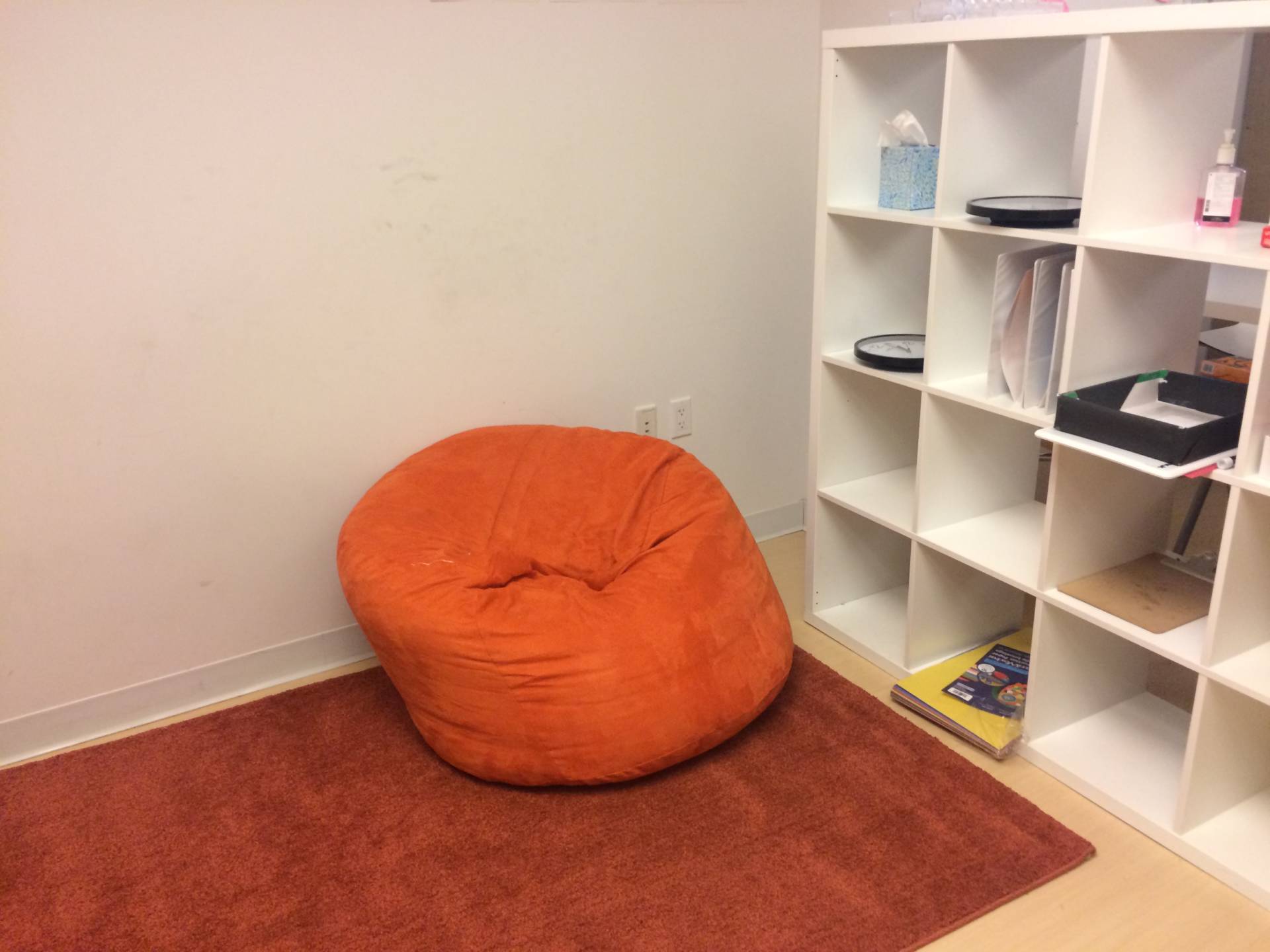
At the school, everything from curriculum to classroom design is tailored to students’ individual needs. On a recent weekday, two students were huddled with a teacher in a hallway strewn with orange and green bean bags, learning to code on a computer. In a nearby classroom, five students on striped beach chairs listened attentively to their teacher. The walls behind them were covered with colorful signs; the classroom was set up explicitly for kids who need stimulation, Busi said. In the room next door, the walls were bare and white — an educational setting meant to accommodate students who are easily distracted.
Class size never exceeds ten, and students spend a third of their day working individually with a teacher. The goal, Busi explained, is personalized learning that fully accommodates students’ abilities and disabilities. Two fourth graders, for example, are already studying with the school’s advanced high school math teacher, according to Busi. Students are also assigned a mental health counselor who works with them on developing goals for their social and emotional growth.
But this individualized education is expensive; Quad tuition is nearly $75,000 a year. And, because most parents have, like Choi, successfully sued the Department of Education for tuition reimbursement, it’s a cost that’s largely borne by taxpayers. In 2017, the agency spent $375 million for tuition to private schools for students with disabilities.
On their end, parents say that suing the DOE is a costly and exhausting process. They add that if the money were invested in public schools, some of those dollars would benefit other public school students as well.
Even without the resources of a place like the Quad, public schools could do a better job accommodating 2e kids, say some education experts.
The first step, according to Debbie Carroll, a private educational consultant in Connecticut and a co-chair of the subcommittee on Twice Exceptional Advocacy of the Council of Parent Attorneys and Advocates, is for schools to educate their staff about 2e students. Teachers need to be able to recognize when students aren’t reaching their potential even though they may be passing their classes, she said, and they need to understand that smart kids with behavioral problems may not just be willful or lazy, but may in fact need support. She also points to strategies that teachers in general education and accelerated classes can use to support kids with disabilities to keep them in mainstream classes, like giving autistic students more opportunities for breaks if they’re feeling overwhelmed.
Sarah Jackson, an instructional specialist who oversees programming for 2e kids in Montgomery County, Maryland, said she trains hundreds of teachers and administrators each year on twice exceptionality. Most of the district’s roughly 2,000 students designated 2e are served in general education classroom with an additional special education teacher. But roughly 40 elementary school students who need more individualized attention are taught in self-contained classes in grades three through five. District administrators believe that with the assistance of in-class supports and a special daily class focusing on self-advocacy and executive functioning, all 2e students should be mainstreamed into general education classes or into advanced programs by the time they reach sixth grade.
But given concerns over the use of scarce education dollars, some educators are skeptical about the 2e movement. While they acknowledge that children can be academically advanced yet struggle with disabilities, they worry that the 2e movement disproportionately benefits middle-class and affluent families. Well-off parents are the ones who typically agitate for special services and accommodations for their kids, even in cases where the child’s disabilities are not pronounced, these educators say. In New York City, affluent parents are also more likely to prepare their children for the admissions test to gifted-and-talented programs, which are under scrutiny for a lack of socioeconomic and racial diversity.
Some parents arrive at school with neuropsychological evaluations showing that their children are slightly above average in some academic areas while exhibiting minor behavioral or learning challenges, said one New York City school social worker. Then these parents insist that their children’s schoolwork and grades should mirror the capabilities indicated by the assessment.
“We all have strengths and weaknesses,” said the social worker, who declined to provide her name in order to protect her relationship with parents. “And it’s not always clear what’s a disability that the law requires us to address, and what’s just an area where a student struggles and could use a little more help.”
Wealthy parents are also more able to afford private neuropsychological evaluations, which tend to be more comprehensive than those conducted by education departments and can cost several thousand dollars. Often, assessments for children’s disabilities performed by public schools don’t cover areas such as attention, memory, language skills and social and emotional functioning, said Matthew Pagirsky, a neuropsychologist with the Child Mind Institute, which provides services to kids with mental health and learning challenges.
Some groups are trying to spread access to private evaluations to low-income families. The Robin Hood Foundation, a philanthropy in New York that supports anti-poverty programs, funds free neuropsychological assessments for poor children at Lenox Hill Hospital and Columbia University. (The Hechinger Report is an independent unit of Teachers College at Columbia University.) Despite these efforts, some low-income parents are resistant to having their children evaluated, fearing their kids will face stigma.
That’s how Veronica Rodriguez felt when teachers first started telling her that her youngest son might need special help. At 2, the boy was speaking in full sentences and, early on, he seemed to learn new concepts with little effort. But when he enrolled in public elementary school, she received daily calls from teachers complaining that he would get upset easily and leave class, or start crying or screaming.
“His teacher would tell me, ‘He doesn’t know his name,’ when he had been writing his name from age 2,” Rodriguez said. School officials asked if there was something wrong at home. “They thought I was an ignorant mom with issues herself,” she said.
School staff encouraged her to have the boy evaluated, but she refused: “I felt like they were saying my kid was slow and I wasn’t having it.”
But after a teacher at a school her son started attending in second grade explained to Rodriguez that the boy could be both bright and have a disability, she took her son for an assessment at Lenox Hill Hospital. There she was told what she already knew: Her son had many areas of above-average academic strengths. He also had ADHD and was at risk for a mood disorder.
While she continues to have trouble finding appropriate services for her son, Rodriguez said that learning about 2e children has been an awakening. She would like to see schools get the same kind of education in twice exceptionality that she received.
“Teachers need to be trained to recognize and understand children who are 2e,” she said. “They need to try to remove the stigma that kids who have a disability cannot be smart.”
*A previous version of this post incorrectly stated that 6-percent of kids nationwide have been identified as twice exceptional. We regret the error.
window.__IS_SSR__=true
window.__INITIAL_STATE__={
"attachmentsReducer": {
"audio_0": {
"type": "attachments",
"id": "audio_0",
"imgSizes": {
"kqedFullSize": {
"file": "https://ww2.kqed.org/news/wp-content/themes/KQED-unified/img/audio_bgs/background0.jpg"
}
}
},
"audio_1": {
"type": "attachments",
"id": "audio_1",
"imgSizes": {
"kqedFullSize": {
"file": "https://ww2.kqed.org/news/wp-content/themes/KQED-unified/img/audio_bgs/background1.jpg"
}
}
},
"audio_2": {
"type": "attachments",
"id": "audio_2",
"imgSizes": {
"kqedFullSize": {
"file": "https://ww2.kqed.org/news/wp-content/themes/KQED-unified/img/audio_bgs/background2.jpg"
}
}
},
"audio_3": {
"type": "attachments",
"id": "audio_3",
"imgSizes": {
"kqedFullSize": {
"file": "https://ww2.kqed.org/news/wp-content/themes/KQED-unified/img/audio_bgs/background3.jpg"
}
}
},
"audio_4": {
"type": "attachments",
"id": "audio_4",
"imgSizes": {
"kqedFullSize": {
"file": "https://ww2.kqed.org/news/wp-content/themes/KQED-unified/img/audio_bgs/background4.jpg"
}
}
},
"placeholder": {
"type": "attachments",
"id": "placeholder",
"imgSizes": {
"thumbnail": {
"file": "https://cdn.kqed.org/wp-content/uploads/2024/12/KQED-Default-Image-816638274-2000x1333-1-160x107.jpg",
"width": 160,
"height": 107,
"mimeType": "image/jpeg"
},
"medium": {
"file": "https://cdn.kqed.org/wp-content/uploads/2024/12/KQED-Default-Image-816638274-2000x1333-1-800x533.jpg",
"width": 800,
"height": 533,
"mimeType": "image/jpeg"
},
"medium_large": {
"file": "https://cdn.kqed.org/wp-content/uploads/2024/12/KQED-Default-Image-816638274-2000x1333-1-768x512.jpg",
"width": 768,
"height": 512,
"mimeType": "image/jpeg"
},
"large": {
"file": "https://cdn.kqed.org/wp-content/uploads/2024/12/KQED-Default-Image-816638274-2000x1333-1-1020x680.jpg",
"width": 1020,
"height": 680,
"mimeType": "image/jpeg"
},
"1536x1536": {
"file": "https://cdn.kqed.org/wp-content/uploads/2024/12/KQED-Default-Image-816638274-2000x1333-1-1536x1024.jpg",
"width": 1536,
"height": 1024,
"mimeType": "image/jpeg"
},
"fd-lrg": {
"file": "https://cdn.kqed.org/wp-content/uploads/2024/12/KQED-Default-Image-816638274-2000x1333-1-1536x1024.jpg",
"width": 1536,
"height": 1024,
"mimeType": "image/jpeg"
},
"fd-med": {
"file": "https://cdn.kqed.org/wp-content/uploads/2024/12/KQED-Default-Image-816638274-2000x1333-1-1020x680.jpg",
"width": 1020,
"height": 680,
"mimeType": "image/jpeg"
},
"fd-sm": {
"file": "https://cdn.kqed.org/wp-content/uploads/2024/12/KQED-Default-Image-816638274-2000x1333-1-800x533.jpg",
"width": 800,
"height": 533,
"mimeType": "image/jpeg"
},
"post-thumbnail": {
"file": "https://cdn.kqed.org/wp-content/uploads/2024/12/KQED-Default-Image-816638274-2000x1333-1-672x372.jpg",
"width": 672,
"height": 372,
"mimeType": "image/jpeg"
},
"twentyfourteen-full-width": {
"file": "https://cdn.kqed.org/wp-content/uploads/2024/12/KQED-Default-Image-816638274-2000x1333-1-1038x576.jpg",
"width": 1038,
"height": 576,
"mimeType": "image/jpeg"
},
"xxsmall": {
"file": "https://cdn.kqed.org/wp-content/uploads/2024/12/KQED-Default-Image-816638274-2000x1333-1-160x107.jpg",
"width": 160,
"height": 107,
"mimeType": "image/jpeg"
},
"xsmall": {
"file": "https://cdn.kqed.org/wp-content/uploads/2024/12/KQED-Default-Image-816638274-2000x1333-1-672x372.jpg",
"width": 672,
"height": 372,
"mimeType": "image/jpeg"
},
"small": {
"file": "https://cdn.kqed.org/wp-content/uploads/2024/12/KQED-Default-Image-816638274-2000x1333-1-672x372.jpg",
"width": 672,
"height": 372,
"mimeType": "image/jpeg"
},
"xlarge": {
"file": "https://cdn.kqed.org/wp-content/uploads/2024/12/KQED-Default-Image-816638274-2000x1333-1-1020x680.jpg",
"width": 1020,
"height": 680,
"mimeType": "image/jpeg"
},
"full-width": {
"file": "https://cdn.kqed.org/wp-content/uploads/2024/12/KQED-Default-Image-816638274-2000x1333-1-1920x1280.jpg",
"width": 1920,
"height": 1280,
"mimeType": "image/jpeg"
},
"guest-author-32": {
"file": "https://cdn.kqed.org/wp-content/uploads/2025/01/KQED-Default-Image-816638274-1333x1333-1-160x160.jpg",
"width": 32,
"height": 32,
"mimeType": "image/jpeg"
},
"guest-author-50": {
"file": "https://cdn.kqed.org/wp-content/uploads/2025/01/KQED-Default-Image-816638274-1333x1333-1-160x160.jpg",
"width": 50,
"height": 50,
"mimeType": "image/jpeg"
},
"guest-author-64": {
"file": "https://cdn.kqed.org/wp-content/uploads/2025/01/KQED-Default-Image-816638274-1333x1333-1-160x160.jpg",
"width": 64,
"height": 64,
"mimeType": "image/jpeg"
},
"guest-author-96": {
"file": "https://cdn.kqed.org/wp-content/uploads/2025/01/KQED-Default-Image-816638274-1333x1333-1-160x160.jpg",
"width": 96,
"height": 96,
"mimeType": "image/jpeg"
},
"guest-author-128": {
"file": "https://cdn.kqed.org/wp-content/uploads/2025/01/KQED-Default-Image-816638274-1333x1333-1-160x160.jpg",
"width": 128,
"height": 128,
"mimeType": "image/jpeg"
},
"detail": {
"file": "https://cdn.kqed.org/wp-content/uploads/2025/01/KQED-Default-Image-816638274-1333x1333-1-160x160.jpg",
"width": 160,
"height": 160,
"mimeType": "image/jpeg"
},
"kqedFullSize": {
"file": "https://cdn.kqed.org/wp-content/uploads/2024/12/KQED-Default-Image-816638274-2000x1333-1.jpg",
"width": 2000,
"height": 1333
}
}
},
"mindshift_53611": {
"type": "attachments",
"id": "mindshift_53611",
"meta": {
"index": "attachments_1716263798",
"site": "mindshift",
"id": "53611",
"found": true
},
"parent": 53602,
"imgSizes": {
"twentyfourteen-full-width": {
"file": "https://ww2.kqed.org/app/uploads/sites/23/2019/05/Choi-building-1038x576.png",
"width": 1038,
"mimeType": "image/png",
"height": 576
},
"thumbnail": {
"file": "https://ww2.kqed.org/app/uploads/sites/23/2019/05/Choi-building-160x107.png",
"width": 160,
"mimeType": "image/png",
"height": 107
},
"post-thumbnail": {
"file": "https://ww2.kqed.org/app/uploads/sites/23/2019/05/Choi-building-672x372.png",
"width": 672,
"mimeType": "image/png",
"height": 372
},
"kqedFullSize": {
"file": "https://ww2.kqed.org/app/uploads/sites/23/2019/05/Choi-building.png",
"width": 1920,
"height": 1278
},
"large": {
"file": "https://ww2.kqed.org/app/uploads/sites/23/2019/05/Choi-building-1020x679.png",
"width": 1020,
"mimeType": "image/png",
"height": 679
},
"complete_open_graph": {
"file": "https://ww2.kqed.org/app/uploads/sites/23/2019/05/Choi-building-1200x799.png",
"width": 1200,
"mimeType": "image/png",
"height": 799
},
"full-width": {
"file": "https://ww2.kqed.org/app/uploads/sites/23/2019/05/Choi-building-1920x1278.png",
"width": 1920,
"mimeType": "image/png",
"height": 1278
},
"medium": {
"file": "https://ww2.kqed.org/app/uploads/sites/23/2019/05/Choi-building-800x533.png",
"width": 800,
"mimeType": "image/png",
"height": 533
},
"medium_large": {
"file": "https://ww2.kqed.org/app/uploads/sites/23/2019/05/Choi-building-768x511.png",
"width": 768,
"mimeType": "image/png",
"height": 511
}
},
"publishDate": 1557123945,
"modified": 1557124225,
"caption": "Jennifer Choi, an advocate for “twice exceptional” children, says that teachers need to be trained in how to identify and accommodate students who have high academic aptitude but struggle with certain learning or behavioral challenges. ",
"description": null,
"title": "Choi-building",
"credit": "Courtesy of Joe Orrechio ",
"status": "inherit",
"isLoading": false,
"fetchFailed": false
}
},
"audioPlayerReducer": {
"postId": "stream_live",
"isPaused": true,
"isPlaying": false,
"pfsActive": false,
"pledgeModalIsOpen": true,
"playerDrawerIsOpen": false,
"liveAudioPlayStartedAt": 0,
"liveAudioPlayContext": ""
},
"authorsReducer": {
"byline_mindshift_53602": {
"type": "authors",
"id": "byline_mindshift_53602",
"meta": {
"override": true
},
"slug": "byline_mindshift_53602",
"name": "\u003ca href=\"https://hechingerreport.org/\">Rachel Blustain, The Hechinger Report\u003c/a>",
"isLoading": false
}
},
"pagesReducer": {},
"pfsSessionReducer": {},
"postsReducer": {
"stream_live": {
"type": "live",
"id": "stream_live",
"audioUrl": "https://hls.kqed.org/hls/kqed_app/playlist.m3u8",
"title": "Live Stream",
"excerpt": "Live Stream information currently unavailable.",
"link": "/radio",
"featImg": "",
"label": {
"name": "KQED Live",
"link": "/"
}
},
"stream_kqedNewscast": {
"type": "posts",
"id": "stream_kqedNewscast",
"audioUrl": "https://www.kqed.org/.stream/anon/radio/RDnews/newscast.mp3?_=1",
"title": "KQED Newscast",
"featImg": "",
"label": {
"name": "88.5 FM",
"link": "/"
}
},
"mindshift_53602": {
"type": "posts",
"id": "mindshift_53602",
"meta": {
"index": "posts_1716263798",
"site": "mindshift",
"id": "53602",
"found": true
},
"articlePosition": 0,
"parent": 0,
"labelTerm": {
"site": "mindshift"
},
"blocks": [],
"publishDate": 1557129812,
"format": "standard",
"disqusTitle": "How Schools Struggle to Serve Gifted Students with Disabilities",
"title": "How Schools Struggle to Serve Gifted Students with Disabilities",
"headTitle": "MindShift | KQED News",
"content": "\u003cp>\u003ci>This story about\u003c/i>\u003ca href=\"https://tely2.kqed.org/owa/redir.aspx?C=pFnPV1cGZow_PMTRG1KYG3vEM78SYy9ekGeoZT-O2WHHCcu76dHWCA..&URL=https%3a%2f%2fprotect-us.mimecast.com%2fs%2fdIioCR6LWDuvD8KGF9Sc1h%3fdomain%3dhechingerreport.org\" target=\"_blank\" rel=\"noopener noreferrer\">\u003ci> twice exceptional students\u003c/i>\u003c/a>\u003ci> was produced by \u003c/i>\u003ca href=\"https://tely2.kqed.org/owa/redir.aspx?C=A-QC5MpH39LVS1apI7scl39w6bZeqJH3lADvoulhZtfHCcu76dHWCA..&URL=https%3a%2f%2fprotect-us.mimecast.com%2fs%2fQHYfCVON1KCxn142hzCBLS%3fdomain%3dhechingerreport.org\" target=\"_blank\" rel=\"noopener noreferrer\">The Hechinger Report\u003c/a>\u003ci>, a nonprofit, independent news organization focused on inequality and innovation in education. Sign up for the \u003c/i>\u003ca href=\"https://tely2.kqed.org/owa/redir.aspx?C=8yIcR1ER8yZzRFm6I6IteT6MTjDQ5ZEM_pEYftHFZR7HCcu76dHWCA..&URL=https%3a%2f%2fprotect-us.mimecast.com%2fs%2fknP4CW682Xu5Lvp6iKPmL-%3fdomain%3dus2.list-manage.com\" target=\"_blank\" rel=\"noopener noreferrer\">\u003ci>Hechinger newsletter.\u003c/i>\u003c/a>\u003c/p>\n\u003cp>NEW YORK — To Eva Santiago, her son’s education has always felt like an impossible dilemma.\u003c/p>\n\u003cp>Before elementary school, the boy was diagnosed with autism, ADHD and anxiety, and in kindergarten he was placed in a small, self-contained class for kids with disabilities.\u003c/p>\n\u003cp>But he was articulate and curious, so when he was 6, Santiago took him to be tested for the city’s exclusive gifted-and-talented program. She was pleased when his score earned him one of the coveted spots.\u003c/p>\n\u003cp>But in his larger gifted-and-talented class, he became anxious and easily upset. He fought with students and teachers and spent most of the school day roaming the halls. After he kicked a security guard and the school called the police, Santiago said, she begged administrators to return him to a self-contained class. There, at least, his teachers could manage his behavioral challenges — even if it meant he breezed through his school work and learned little.\u003c/p>\n\u003cp>[ad fullwidth]\u003c/p>\n\u003cp>“Other kids would still be doing the assignments and he would be done,” recalled Santiago. “He just didn’t know what to do with himself.”\u003c/p>\n\u003cp>The boy’s experience is typical for a category of students known as “twice exceptional,” or 2e. These kids — believed to make up at least \u003ca href=\"http://www.nea.org/assets/docs/twiceexceptional.pdf\">6 percent of students\u003c/a> who have a disability — have high academic aptitude but struggle with ADHD, mild autism, dyslexia or other learning and behavioral challenges.* They are notoriously difficult for schools to serve effectively for two reasons, say advocates, parents and some educators. Often, their intelligence masks their disability, so they are never assessed for special education or don’t receive the services best suited for them. In other cases, they’re placed in special education classes tailored to their disability but grade levels behind the school work they’re capable of.\u003c/p>\n\u003cp>“We see kids whose challenges don’t show up on their report card, so they aren’t getting services,” said Jennifer Choi, a parent and founder of the advocacy group 2eNYC and a trustee of the nonprofit Twice Exceptional Children’s Advocacy. “And we see kids who are gifted, but they also have a disability, who lose the ability to participate in any sort of accelerated program because those programs often decline to provide special education services.”\u003c/p>\n\u003cp>But a handful of school systems across the country are searching for better ways to accommodate bright students with disabilities. Colorado trains teachers across the state in \u003ca href=\"https://www.cde.state.co.us/gt/summer20182e\">twice exceptionality\u003c/a>, for example, while Montgomery County, Maryland, is perhaps the only school district to offer \u003ca href=\"https://www.montgomeryschoolsmd.org/curriculum/enriched/gtld/\">self-contained classes\u003c/a> for students in elementary school who need both an accelerated curriculum and more support than they would receive in a mainstream classroom.\u003c/p>\n\u003cp>Now parent activists in New York City are fighting to get the country’s largest school system to be more responsive to 2e students. Last fall, after Choi’s group presented the New York City Department of Education with a survey of more than 500 parents that described the challenges facing 2e students, the agency began to offer training to staff in gifted-and-talented programs on how to work more effectively with students who have ADHD. In the last few years, three of the city’s most selective public high schools — Brooklyn Technical, Bard College and Townshend Harris — have sent teachers to learn about twice exceptionality from employees of the Quad Preparatory School, a six-year-old private school that focuses on educating these students. And in New York state, lawmakers \u003ca href=\"https://www.nysenate.gov/legislation/bills/2017/s3812\">introduced\u003c/a> \u003ca href=\"https://www.nysenate.gov/legislation/bills/2017/S3814\">bills\u003c/a> in 2017 that would require teacher training about twice exceptionality and programming for twice exceptional students.\u003c/p>\n\u003cp>“We’re committed to meeting the unique needs of our students with disabilities, including those pursuing accelerated programs,” the city Department of Education said in a statement. “We hold trainings for school staff and parents on personalized learning strategies that can be used in the classroom or at home, and will continue to work with communities on innovative ways to serve all students.”\u003c/p>\n\u003cp>But parents say there’s a long way to go.\u003c/p>\n\u003cp>One of the biggest barriers to educating 2e students, advocates say, is simply proving they exist.\u003c/p>\n\u003cp>Under the federal \u003ca href=\"https://sites.ed.gov/idea/\">Individuals with Disabilities Education Act\u003c/a>, all students are entitled to the special services and accommodations necessary to enable them to learn. But to qualify for those services under the law, a student’s disability must “adversely affect educational performance.”\u003c/p>\n\u003cp>Schools and courts are left to determine what that means. If students are passing their classes and advancing from grade to grade, they’re more likely to be denied costly accommodations and services, which can include everything from a smaller student-teacher ratio to tutoring, to speech and occupational therapy. In the 2eNYC survey, more than a quarter of parents said they’d been told, “Your child is too smart for [special education services].”\u003c/p>\n\u003cfigure id=\"attachment_53612\" class=\"wp-caption alignnone\" style=\"max-width: 1920px\">\u003cimg class=\"size-full wp-image-53612\" src=\"https://ww2.kqed.org/mindshift/wp-content/uploads/sites/23/2019/05/Blustain_Choison.png\" alt=\"\" width=\"1920\" height=\"1440\" srcset=\"https://ww2.kqed.org/app/uploads/sites/23/2019/05/Blustain_Choison.png 1920w, https://ww2.kqed.org/app/uploads/sites/23/2019/05/Blustain_Choison-160x120.png 160w, https://ww2.kqed.org/app/uploads/sites/23/2019/05/Blustain_Choison-800x600.png 800w, https://ww2.kqed.org/app/uploads/sites/23/2019/05/Blustain_Choison-768x576.png 768w, https://ww2.kqed.org/app/uploads/sites/23/2019/05/Blustain_Choison-1020x765.png 1020w, https://ww2.kqed.org/app/uploads/sites/23/2019/05/Blustain_Choison-1200x900.png 1200w\" sizes=\"(max-width: 1920px) 100vw, 1920px\">\u003cfigcaption class=\"wp-caption-text\">Before kindergarten, Jennifer Choi’s son was denied special education services despite a diagnosis of ADHD. \u003ccite>(Rachel Blustain for The Hechinger Report )\u003c/cite>\u003c/figcaption>\u003c/figure>\n\u003cp>That’s essentially what happened to Choi. Her son struggled in preschool, bouncing from school to school to school. At 5, he was diagnosed with ADHD. Under special education law, ADHD is considered a disability under the “Other Health Impairment” category, and can contribute to a determination that a child is eligible for special education services if it interferes with learning. Choi brought both her son’s diagnosis and his preschool teachers with her to the meeting that would decide what special education accommodations and services he’d receive in elementary school. She was sure that with his teachers present to testify to the constant oversight he needed to stay on task, he would either be placed in a mainstream class with a special education co-teacher or in a self-contained classroom for students with greater disabilities.\u003c/p>\n\u003cp>She was shocked, she said, when the disabilities evaluator at her son’s public elementary school noted that he was performing at grade level and determined that he didn’t qualify for any special education accommodations or services. After that, Choi enrolled her son in private school and successfully sued the Department of Education to have his tuition reimbursed.\u003c/p>\n\u003cp>On the flip side, the academic pace of small, self-contained classes designed for children with severe disabilities is often too slow for kids with pronounced academic strengths, say parents and advocates. That was the case with Santiago’s son. He worked far faster than the other students in his self-contained classes, she said, and there was little of the in-depth learning that he thrived on.\u003c/p>\n\u003cp>After three years, Santiago decided her son needed a setting that better fit his academic abilities. The vice principal at her son’s school, a guidance counselor, a psychologist and lawyers from \u003ca href=\"https://www.advocatesforchildren.org/who_we_are_afc\">Advocates for Children\u003c/a>, which provides educational legal advocacy for low-income families, all wrote letters in support of her claim that her son’s educational needs were not being met. With those letters, she was able to convince the Department of Education to pay upfront for her son to attend the Child’s School, a private school for students with disabilities.\u003c/p>\n\u003cp>Like Santiago, some frustrated parents are turning to private schools to serve their kids. In 2013, Kim Busi, a former professor of psychiatry whose son is on the autism spectrum, started the Quad Preparatory School with the goal of serving high-achieving kids with learning and emotional disabilities. The school opened in the basement of a synagogue with three students; today, it serves 113.\u003c/p>\n\u003cfigure id=\"attachment_53605\" class=\"wp-caption alignnone\" style=\"max-width: 1920px\">\u003cimg class=\"size-full wp-image-53605\" src=\"https://ww2.kqed.org/mindshift/wp-content/uploads/sites/23/2019/05/Rachel-Blustain-6547EECF-DE80-4225-81D3-512C3DBB8B32-e1557124352158.jpeg\" alt=\"\" width=\"1920\" height=\"1440\">\u003cfigcaption class=\"wp-caption-text\">The Quad Preparatory School, in New York, tailors everything from curriculum to classroom design to the needs of its “twice exceptional” students. \u003ccite>(Rachel Blustain for The Hechinger Report)\u003c/cite>\u003c/figcaption>\u003c/figure>\n\u003cp>At the school, everything from curriculum to classroom design is tailored to students’ individual needs. On a recent weekday, two students were huddled with a teacher in a hallway strewn with orange and green bean bags, learning to code on a computer. In a nearby classroom, five students on striped beach chairs listened attentively to their teacher. The walls behind them were covered with colorful signs; the classroom was set up explicitly for kids who need stimulation, Busi said. In the room next door, the walls were bare and white — an educational setting meant to accommodate students who are easily distracted.\u003c/p>\n\u003cp>Class size never exceeds ten, and students spend a third of their day working individually with a teacher. The goal, Busi explained, is personalized learning that fully accommodates students’ abilities and disabilities. Two fourth graders, for example, are already studying with the school’s advanced high school math teacher, according to Busi. Students are also assigned a mental health counselor who works with them on developing goals for their social and emotional growth.\u003c/p>\n\u003cp>But this individualized education is expensive; Quad tuition is nearly $75,000 a year. And, because most parents have, like Choi, successfully sued the Department of Education for tuition reimbursement, it’s a cost that’s largely borne by taxpayers. In 2017, the agency spent \u003ca href=\"https://www.chalkbeat.org/posts/ny/2019/01/07/private-school-tuition-reimbursement/\">$375 million for tuition\u003c/a> to private schools for students with disabilities.\u003c/p>\n\u003cp>On their end, parents say that suing the DOE is a costly and exhausting process. They add that if the money were invested in public schools, some of those dollars would benefit other public school students as well.\u003c/p>\n\u003cp>Even without the resources of a place like the Quad, public schools could do a better job accommodating 2e kids, say some education experts.\u003c/p>\n\u003cp>\u003cimg class=\"alignright size-full wp-image-53610\" src=\"https://ww2.kqed.org/mindshift/wp-content/uploads/sites/23/2019/05/Rachel-Blustain-464D9B43-F039-4243-B495-50285B3048A2-e1557124284970.jpeg\" alt=\"\" width=\"1920\" height=\"1440\">\u003c/p>\n\u003cp>The first step, according to Debbie Carroll, a private educational consultant in Connecticut and a co-chair of the subcommittee on Twice Exceptional Advocacy of the Council of Parent Attorneys and Advocates, is for schools to educate their staff about 2e students. Teachers need to be able to recognize when students aren’t reaching their potential even though they may be passing their classes, she said, and they need to understand that smart kids with behavioral problems may not just be willful or lazy, but may in fact need support. She also points to strategies that teachers in general education and accelerated classes can use to support kids with disabilities to keep them in mainstream classes, like giving autistic students more opportunities for breaks if they’re feeling overwhelmed.\u003c/p>\n\u003cp>Sarah Jackson, an instructional specialist who oversees programming for 2e kids in Montgomery County, Maryland, said she trains hundreds of teachers and administrators each year on twice exceptionality. Most of the district’s roughly 2,000 students designated 2e are served in general education classroom with an additional special education teacher. But roughly 40 elementary school students who need more individualized attention are taught in self-contained classes in grades three through five. District administrators believe that with the assistance of in-class supports and a special daily class focusing on self-advocacy and executive functioning, all 2e students should be mainstreamed into general education classes or into advanced programs by the time they reach sixth grade.\u003c/p>\n\u003cp>But given concerns over the use of scarce education dollars, some educators are skeptical about the 2e movement. While they acknowledge that children can be academically advanced yet struggle with disabilities, they worry that the 2e movement disproportionately benefits middle-class and affluent families. Well-off parents are the ones who typically agitate for special services and accommodations for their kids, even in cases where the child’s disabilities are not pronounced, these educators say. In New York City, affluent parents are also \u003ca href=\"https://hechingerreport.org/is-there-a-trade-off-between-racial-diversity-and-academic-excellence-in-gifted-classrooms/\">more likely\u003c/a> to prepare their children for the admissions test to gifted-and-talented programs, which are \u003ca href=\"https://www.chalkbeat.org/posts/ny/2018/07/17/to-integrate-specialized-high-schools-are-gifted-programs-part-of-the-problem-or-the-solution/\">under scrutiny\u003c/a> for a lack of socioeconomic and racial diversity.\u003c/p>\n\u003cp>Some parents arrive at school with neuropsychological evaluations showing that their children are slightly above average in some academic areas while exhibiting minor behavioral or learning challenges, said one New York City school social worker. Then these parents insist that their children’s schoolwork and grades should mirror the capabilities indicated by the assessment.\u003c/p>\n\u003cp>“We all have strengths and weaknesses,” said the social worker, who declined to provide her name in order to protect her relationship with parents. “And it’s not always clear what’s a disability that the law requires us to address, and what’s just an area where a student struggles and could use a little more help.”\u003c/p>\n\u003cp>Wealthy parents are also more able to afford private neuropsychological evaluations, which tend to be more comprehensive than those conducted by education departments and can cost several thousand dollars. Often, assessments for children’s disabilities performed by public schools don’t cover areas such as attention, memory, language skills and social and emotional functioning, said Matthew Pagirsky, a neuropsychologist with the Child Mind Institute, which provides services to kids with mental health and learning challenges.\u003c/p>\n\u003cp>Some groups are trying to spread access to private evaluations to low-income families. The Robin Hood Foundation, a philanthropy in New York that supports anti-poverty programs, funds free neuropsychological assessments for poor children at Lenox Hill Hospital and Columbia University. (The Hechinger Report is an independent unit of Teachers College at Columbia University.) Despite these efforts, some low-income parents are resistant to having their children evaluated, fearing their kids will face stigma.\u003c/p>\n\u003cp>That’s how Veronica Rodriguez felt when teachers first started telling her that her youngest son might need special help. At 2, the boy was speaking in full sentences and, early on, he seemed to learn new concepts with little effort. But when he enrolled in public elementary school, she received daily calls from teachers complaining that he would get upset easily and leave class, or start crying or screaming.\u003c/p>\n\u003cp>“His teacher would tell me, ‘He doesn’t know his name,’ when he had been writing his name from age 2,” Rodriguez said. School officials asked if there was something wrong at home. “They thought I was an ignorant mom with issues herself,” she said.\u003c/p>\n\u003cp>School staff encouraged her to have the boy evaluated, but she refused: “I felt like they were saying my kid was slow and I wasn’t having it.”\u003c/p>\n\u003cp>But after a teacher at a school her son started attending in second grade explained to Rodriguez that the boy could be both bright and have a disability, she took her son for an assessment at Lenox Hill Hospital. There she was told what she already knew: Her son had many areas of above-average academic strengths. He also had ADHD and was at risk for a mood disorder.\u003c/p>\n\u003cp>While she continues to have trouble finding appropriate services for her son, Rodriguez said that learning about 2e children has been an awakening. She would like to see schools get the same kind of education in twice exceptionality that she received.\u003c/p>\n\u003cp>“Teachers need to be trained to recognize and understand children who are 2e,” she said. “They need to try to remove the stigma that kids who have a disability cannot be smart.”\u003c/p>\n\u003cp>\u003cem>*A previous version of this post incorrectly stated that 6-percent of kids nationwide have been identified as twice exceptional. We regret the error.\u003c/em>\u003c/p>\n\u003cp>[ad floatright]\u003c/p>\n\u003cp>\u003ci>This story about\u003c/i>\u003ca href=\"https://tely2.kqed.org/owa/redir.aspx?C=pFnPV1cGZow_PMTRG1KYG3vEM78SYy9ekGeoZT-O2WHHCcu76dHWCA..&URL=https%3a%2f%2fprotect-us.mimecast.com%2fs%2fdIioCR6LWDuvD8KGF9Sc1h%3fdomain%3dhechingerreport.org\" target=\"_blank\" rel=\"noopener noreferrer\">\u003ci> twice exceptional students\u003c/i>\u003c/a>\u003ci> was produced by \u003c/i>\u003ca href=\"https://tely2.kqed.org/owa/redir.aspx?C=A-QC5MpH39LVS1apI7scl39w6bZeqJH3lADvoulhZtfHCcu76dHWCA..&URL=https%3a%2f%2fprotect-us.mimecast.com%2fs%2fQHYfCVON1KCxn142hzCBLS%3fdomain%3dhechingerreport.org\" target=\"_blank\" rel=\"noopener noreferrer\">The Hechinger Report\u003c/a>\u003ci>, a nonprofit, independent news organization focused on inequality and innovation in education. Sign up for the \u003c/i>\u003ca href=\"https://tely2.kqed.org/owa/redir.aspx?C=8yIcR1ER8yZzRFm6I6IteT6MTjDQ5ZEM_pEYftHFZR7HCcu76dHWCA..&URL=https%3a%2f%2fprotect-us.mimecast.com%2fs%2fknP4CW682Xu5Lvp6iKPmL-%3fdomain%3dus2.list-manage.com\" target=\"_blank\" rel=\"noopener noreferrer\">\u003ci>Hechinger newsletter.\u003c/i>\u003c/a>\u003c/p>\n\n",
"disqusIdentifier": "53602 https://ww2.kqed.org/mindshift/?p=53602",
"disqusUrl": "https://ww2.kqed.org/mindshift/2019/05/06/how-schools-struggle-to-serve-gifted-students-with-disabilities/",
"stats": {
"hasVideo": false,
"hasChartOrMap": false,
"hasAudio": false,
"hasPolis": false,
"wordCount": 2657,
"hasGoogleForm": false,
"hasGallery": false,
"hasHearkenModule": false,
"iframeSrcs": [],
"paragraphCount": 43
},
"modified": 1557519808,
"excerpt": "“Twice exceptional,” or 2e students — believed to make up at least 6 percent of all students who have a disability — possess high academic aptitude but struggle with ADHD, mild autism, dyslexia or other learning and behavioral challenges. Parents say it’s often impossible to find schools to educate bright kids who have disabilities. Now some are fighting to change that.",
"headData": {
"twImgId": "",
"twTitle": "",
"ogTitle": "",
"ogImgId": "",
"twDescription": "",
"description": "“Twice exceptional,” or 2e students — believed to make up at least 6 percent of all students who have a disability — possess high academic aptitude but struggle with ADHD, mild autism, dyslexia or other learning and behavioral challenges. Parents say it’s often impossible to find schools to educate bright kids who have disabilities. Now some are fighting to change that.",
"title": "How Schools Struggle to Serve Gifted Students with Disabilities | KQED",
"ogDescription": "",
"schema": {
"@context": "https://schema.org",
"@type": "Article",
"headline": "How Schools Struggle to Serve Gifted Students with Disabilities",
"datePublished": "2019-05-06T01:03:32-07:00",
"dateModified": "2019-05-10T13:23:28-07:00",
"image": "https://ww2.kqed.org/app/uploads/sites/23/2019/05/Choi-building-1020x679.png"
},
"authorsData": [],
"tagData": []
},
"guestAuthors": [],
"slug": "how-schools-struggle-to-serve-gifted-students-with-disabilities",
"status": "publish",
"nprByline": "\u003ca href=\"https://hechingerreport.org/\">Rachel Blustain, The Hechinger Report\u003c/a>",
"path": "/mindshift/53602/how-schools-struggle-to-serve-gifted-students-with-disabilities",
"audioTrackLength": null,
"parsedContent": [
{
"type": "contentString",
"content": "\u003cdiv class=\"post-body\">\u003cp>\u003cp>\u003ci>This story about\u003c/i>\u003ca href=\"https://tely2.kqed.org/owa/redir.aspx?C=pFnPV1cGZow_PMTRG1KYG3vEM78SYy9ekGeoZT-O2WHHCcu76dHWCA..&URL=https%3a%2f%2fprotect-us.mimecast.com%2fs%2fdIioCR6LWDuvD8KGF9Sc1h%3fdomain%3dhechingerreport.org\" target=\"_blank\" rel=\"noopener noreferrer\">\u003ci> twice exceptional students\u003c/i>\u003c/a>\u003ci> was produced by \u003c/i>\u003ca href=\"https://tely2.kqed.org/owa/redir.aspx?C=A-QC5MpH39LVS1apI7scl39w6bZeqJH3lADvoulhZtfHCcu76dHWCA..&URL=https%3a%2f%2fprotect-us.mimecast.com%2fs%2fQHYfCVON1KCxn142hzCBLS%3fdomain%3dhechingerreport.org\" target=\"_blank\" rel=\"noopener noreferrer\">The Hechinger Report\u003c/a>\u003ci>, a nonprofit, independent news organization focused on inequality and innovation in education. Sign up for the \u003c/i>\u003ca href=\"https://tely2.kqed.org/owa/redir.aspx?C=8yIcR1ER8yZzRFm6I6IteT6MTjDQ5ZEM_pEYftHFZR7HCcu76dHWCA..&URL=https%3a%2f%2fprotect-us.mimecast.com%2fs%2fknP4CW682Xu5Lvp6iKPmL-%3fdomain%3dus2.list-manage.com\" target=\"_blank\" rel=\"noopener noreferrer\">\u003ci>Hechinger newsletter.\u003c/i>\u003c/a>\u003c/p>\n\u003cp>NEW YORK — To Eva Santiago, her son’s education has always felt like an impossible dilemma.\u003c/p>\n\u003cp>Before elementary school, the boy was diagnosed with autism, ADHD and anxiety, and in kindergarten he was placed in a small, self-contained class for kids with disabilities.\u003c/p>\n\u003cp>But he was articulate and curious, so when he was 6, Santiago took him to be tested for the city’s exclusive gifted-and-talented program. She was pleased when his score earned him one of the coveted spots.\u003c/p>\n\u003cp>But in his larger gifted-and-talented class, he became anxious and easily upset. He fought with students and teachers and spent most of the school day roaming the halls. After he kicked a security guard and the school called the police, Santiago said, she begged administrators to return him to a self-contained class. There, at least, his teachers could manage his behavioral challenges — even if it meant he breezed through his school work and learned little.\u003c/p>\n\u003cp>\u003c/p>\u003c/div>",
"attributes": {
"named": {},
"numeric": []
}
},
{
"type": "component",
"content": "",
"name": "ad",
"attributes": {
"named": {
"label": "fullwidth"
},
"numeric": [
"fullwidth"
]
}
},
{
"type": "contentString",
"content": "\u003cdiv class=\"post-body\">\u003cp>\u003c/p>\n\u003cp>“Other kids would still be doing the assignments and he would be done,” recalled Santiago. “He just didn’t know what to do with himself.”\u003c/p>\n\u003cp>The boy’s experience is typical for a category of students known as “twice exceptional,” or 2e. These kids — believed to make up at least \u003ca href=\"http://www.nea.org/assets/docs/twiceexceptional.pdf\">6 percent of students\u003c/a> who have a disability — have high academic aptitude but struggle with ADHD, mild autism, dyslexia or other learning and behavioral challenges.* They are notoriously difficult for schools to serve effectively for two reasons, say advocates, parents and some educators. Often, their intelligence masks their disability, so they are never assessed for special education or don’t receive the services best suited for them. In other cases, they’re placed in special education classes tailored to their disability but grade levels behind the school work they’re capable of.\u003c/p>\n\u003cp>“We see kids whose challenges don’t show up on their report card, so they aren’t getting services,” said Jennifer Choi, a parent and founder of the advocacy group 2eNYC and a trustee of the nonprofit Twice Exceptional Children’s Advocacy. “And we see kids who are gifted, but they also have a disability, who lose the ability to participate in any sort of accelerated program because those programs often decline to provide special education services.”\u003c/p>\n\u003cp>But a handful of school systems across the country are searching for better ways to accommodate bright students with disabilities. Colorado trains teachers across the state in \u003ca href=\"https://www.cde.state.co.us/gt/summer20182e\">twice exceptionality\u003c/a>, for example, while Montgomery County, Maryland, is perhaps the only school district to offer \u003ca href=\"https://www.montgomeryschoolsmd.org/curriculum/enriched/gtld/\">self-contained classes\u003c/a> for students in elementary school who need both an accelerated curriculum and more support than they would receive in a mainstream classroom.\u003c/p>\n\u003cp>Now parent activists in New York City are fighting to get the country’s largest school system to be more responsive to 2e students. Last fall, after Choi’s group presented the New York City Department of Education with a survey of more than 500 parents that described the challenges facing 2e students, the agency began to offer training to staff in gifted-and-talented programs on how to work more effectively with students who have ADHD. In the last few years, three of the city’s most selective public high schools — Brooklyn Technical, Bard College and Townshend Harris — have sent teachers to learn about twice exceptionality from employees of the Quad Preparatory School, a six-year-old private school that focuses on educating these students. And in New York state, lawmakers \u003ca href=\"https://www.nysenate.gov/legislation/bills/2017/s3812\">introduced\u003c/a> \u003ca href=\"https://www.nysenate.gov/legislation/bills/2017/S3814\">bills\u003c/a> in 2017 that would require teacher training about twice exceptionality and programming for twice exceptional students.\u003c/p>\n\u003cp>“We’re committed to meeting the unique needs of our students with disabilities, including those pursuing accelerated programs,” the city Department of Education said in a statement. “We hold trainings for school staff and parents on personalized learning strategies that can be used in the classroom or at home, and will continue to work with communities on innovative ways to serve all students.”\u003c/p>\n\u003cp>But parents say there’s a long way to go.\u003c/p>\n\u003cp>One of the biggest barriers to educating 2e students, advocates say, is simply proving they exist.\u003c/p>\n\u003cp>Under the federal \u003ca href=\"https://sites.ed.gov/idea/\">Individuals with Disabilities Education Act\u003c/a>, all students are entitled to the special services and accommodations necessary to enable them to learn. But to qualify for those services under the law, a student’s disability must “adversely affect educational performance.”\u003c/p>\n\u003cp>Schools and courts are left to determine what that means. If students are passing their classes and advancing from grade to grade, they’re more likely to be denied costly accommodations and services, which can include everything from a smaller student-teacher ratio to tutoring, to speech and occupational therapy. In the 2eNYC survey, more than a quarter of parents said they’d been told, “Your child is too smart for [special education services].”\u003c/p>\n\u003cfigure id=\"attachment_53612\" class=\"wp-caption alignnone\" style=\"max-width: 1920px\">\u003cimg class=\"size-full wp-image-53612\" src=\"https://ww2.kqed.org/mindshift/wp-content/uploads/sites/23/2019/05/Blustain_Choison.png\" alt=\"\" width=\"1920\" height=\"1440\" srcset=\"https://ww2.kqed.org/app/uploads/sites/23/2019/05/Blustain_Choison.png 1920w, https://ww2.kqed.org/app/uploads/sites/23/2019/05/Blustain_Choison-160x120.png 160w, https://ww2.kqed.org/app/uploads/sites/23/2019/05/Blustain_Choison-800x600.png 800w, https://ww2.kqed.org/app/uploads/sites/23/2019/05/Blustain_Choison-768x576.png 768w, https://ww2.kqed.org/app/uploads/sites/23/2019/05/Blustain_Choison-1020x765.png 1020w, https://ww2.kqed.org/app/uploads/sites/23/2019/05/Blustain_Choison-1200x900.png 1200w\" sizes=\"(max-width: 1920px) 100vw, 1920px\">\u003cfigcaption class=\"wp-caption-text\">Before kindergarten, Jennifer Choi’s son was denied special education services despite a diagnosis of ADHD. \u003ccite>(Rachel Blustain for The Hechinger Report )\u003c/cite>\u003c/figcaption>\u003c/figure>\n\u003cp>That’s essentially what happened to Choi. Her son struggled in preschool, bouncing from school to school to school. At 5, he was diagnosed with ADHD. Under special education law, ADHD is considered a disability under the “Other Health Impairment” category, and can contribute to a determination that a child is eligible for special education services if it interferes with learning. Choi brought both her son’s diagnosis and his preschool teachers with her to the meeting that would decide what special education accommodations and services he’d receive in elementary school. She was sure that with his teachers present to testify to the constant oversight he needed to stay on task, he would either be placed in a mainstream class with a special education co-teacher or in a self-contained classroom for students with greater disabilities.\u003c/p>\n\u003cp>She was shocked, she said, when the disabilities evaluator at her son’s public elementary school noted that he was performing at grade level and determined that he didn’t qualify for any special education accommodations or services. After that, Choi enrolled her son in private school and successfully sued the Department of Education to have his tuition reimbursed.\u003c/p>\n\u003cp>On the flip side, the academic pace of small, self-contained classes designed for children with severe disabilities is often too slow for kids with pronounced academic strengths, say parents and advocates. That was the case with Santiago’s son. He worked far faster than the other students in his self-contained classes, she said, and there was little of the in-depth learning that he thrived on.\u003c/p>\n\u003cp>After three years, Santiago decided her son needed a setting that better fit his academic abilities. The vice principal at her son’s school, a guidance counselor, a psychologist and lawyers from \u003ca href=\"https://www.advocatesforchildren.org/who_we_are_afc\">Advocates for Children\u003c/a>, which provides educational legal advocacy for low-income families, all wrote letters in support of her claim that her son’s educational needs were not being met. With those letters, she was able to convince the Department of Education to pay upfront for her son to attend the Child’s School, a private school for students with disabilities.\u003c/p>\n\u003cp>Like Santiago, some frustrated parents are turning to private schools to serve their kids. In 2013, Kim Busi, a former professor of psychiatry whose son is on the autism spectrum, started the Quad Preparatory School with the goal of serving high-achieving kids with learning and emotional disabilities. The school opened in the basement of a synagogue with three students; today, it serves 113.\u003c/p>\n\u003cfigure id=\"attachment_53605\" class=\"wp-caption alignnone\" style=\"max-width: 1920px\">\u003cimg class=\"size-full wp-image-53605\" src=\"https://ww2.kqed.org/mindshift/wp-content/uploads/sites/23/2019/05/Rachel-Blustain-6547EECF-DE80-4225-81D3-512C3DBB8B32-e1557124352158.jpeg\" alt=\"\" width=\"1920\" height=\"1440\">\u003cfigcaption class=\"wp-caption-text\">The Quad Preparatory School, in New York, tailors everything from curriculum to classroom design to the needs of its “twice exceptional” students. \u003ccite>(Rachel Blustain for The Hechinger Report)\u003c/cite>\u003c/figcaption>\u003c/figure>\n\u003cp>At the school, everything from curriculum to classroom design is tailored to students’ individual needs. On a recent weekday, two students were huddled with a teacher in a hallway strewn with orange and green bean bags, learning to code on a computer. In a nearby classroom, five students on striped beach chairs listened attentively to their teacher. The walls behind them were covered with colorful signs; the classroom was set up explicitly for kids who need stimulation, Busi said. In the room next door, the walls were bare and white — an educational setting meant to accommodate students who are easily distracted.\u003c/p>\n\u003cp>Class size never exceeds ten, and students spend a third of their day working individually with a teacher. The goal, Busi explained, is personalized learning that fully accommodates students’ abilities and disabilities. Two fourth graders, for example, are already studying with the school’s advanced high school math teacher, according to Busi. Students are also assigned a mental health counselor who works with them on developing goals for their social and emotional growth.\u003c/p>\n\u003cp>But this individualized education is expensive; Quad tuition is nearly $75,000 a year. And, because most parents have, like Choi, successfully sued the Department of Education for tuition reimbursement, it’s a cost that’s largely borne by taxpayers. In 2017, the agency spent \u003ca href=\"https://www.chalkbeat.org/posts/ny/2019/01/07/private-school-tuition-reimbursement/\">$375 million for tuition\u003c/a> to private schools for students with disabilities.\u003c/p>\n\u003cp>On their end, parents say that suing the DOE is a costly and exhausting process. They add that if the money were invested in public schools, some of those dollars would benefit other public school students as well.\u003c/p>\n\u003cp>Even without the resources of a place like the Quad, public schools could do a better job accommodating 2e kids, say some education experts.\u003c/p>\n\u003cp>\u003cimg class=\"alignright size-full wp-image-53610\" src=\"https://ww2.kqed.org/mindshift/wp-content/uploads/sites/23/2019/05/Rachel-Blustain-464D9B43-F039-4243-B495-50285B3048A2-e1557124284970.jpeg\" alt=\"\" width=\"1920\" height=\"1440\">\u003c/p>\n\u003cp>The first step, according to Debbie Carroll, a private educational consultant in Connecticut and a co-chair of the subcommittee on Twice Exceptional Advocacy of the Council of Parent Attorneys and Advocates, is for schools to educate their staff about 2e students. Teachers need to be able to recognize when students aren’t reaching their potential even though they may be passing their classes, she said, and they need to understand that smart kids with behavioral problems may not just be willful or lazy, but may in fact need support. She also points to strategies that teachers in general education and accelerated classes can use to support kids with disabilities to keep them in mainstream classes, like giving autistic students more opportunities for breaks if they’re feeling overwhelmed.\u003c/p>\n\u003cp>Sarah Jackson, an instructional specialist who oversees programming for 2e kids in Montgomery County, Maryland, said she trains hundreds of teachers and administrators each year on twice exceptionality. Most of the district’s roughly 2,000 students designated 2e are served in general education classroom with an additional special education teacher. But roughly 40 elementary school students who need more individualized attention are taught in self-contained classes in grades three through five. District administrators believe that with the assistance of in-class supports and a special daily class focusing on self-advocacy and executive functioning, all 2e students should be mainstreamed into general education classes or into advanced programs by the time they reach sixth grade.\u003c/p>\n\u003cp>But given concerns over the use of scarce education dollars, some educators are skeptical about the 2e movement. While they acknowledge that children can be academically advanced yet struggle with disabilities, they worry that the 2e movement disproportionately benefits middle-class and affluent families. Well-off parents are the ones who typically agitate for special services and accommodations for their kids, even in cases where the child’s disabilities are not pronounced, these educators say. In New York City, affluent parents are also \u003ca href=\"https://hechingerreport.org/is-there-a-trade-off-between-racial-diversity-and-academic-excellence-in-gifted-classrooms/\">more likely\u003c/a> to prepare their children for the admissions test to gifted-and-talented programs, which are \u003ca href=\"https://www.chalkbeat.org/posts/ny/2018/07/17/to-integrate-specialized-high-schools-are-gifted-programs-part-of-the-problem-or-the-solution/\">under scrutiny\u003c/a> for a lack of socioeconomic and racial diversity.\u003c/p>\n\u003cp>Some parents arrive at school with neuropsychological evaluations showing that their children are slightly above average in some academic areas while exhibiting minor behavioral or learning challenges, said one New York City school social worker. Then these parents insist that their children’s schoolwork and grades should mirror the capabilities indicated by the assessment.\u003c/p>\n\u003cp>“We all have strengths and weaknesses,” said the social worker, who declined to provide her name in order to protect her relationship with parents. “And it’s not always clear what’s a disability that the law requires us to address, and what’s just an area where a student struggles and could use a little more help.”\u003c/p>\n\u003cp>Wealthy parents are also more able to afford private neuropsychological evaluations, which tend to be more comprehensive than those conducted by education departments and can cost several thousand dollars. Often, assessments for children’s disabilities performed by public schools don’t cover areas such as attention, memory, language skills and social and emotional functioning, said Matthew Pagirsky, a neuropsychologist with the Child Mind Institute, which provides services to kids with mental health and learning challenges.\u003c/p>\n\u003cp>Some groups are trying to spread access to private evaluations to low-income families. The Robin Hood Foundation, a philanthropy in New York that supports anti-poverty programs, funds free neuropsychological assessments for poor children at Lenox Hill Hospital and Columbia University. (The Hechinger Report is an independent unit of Teachers College at Columbia University.) Despite these efforts, some low-income parents are resistant to having their children evaluated, fearing their kids will face stigma.\u003c/p>\n\u003cp>That’s how Veronica Rodriguez felt when teachers first started telling her that her youngest son might need special help. At 2, the boy was speaking in full sentences and, early on, he seemed to learn new concepts with little effort. But when he enrolled in public elementary school, she received daily calls from teachers complaining that he would get upset easily and leave class, or start crying or screaming.\u003c/p>\n\u003cp>“His teacher would tell me, ‘He doesn’t know his name,’ when he had been writing his name from age 2,” Rodriguez said. School officials asked if there was something wrong at home. “They thought I was an ignorant mom with issues herself,” she said.\u003c/p>\n\u003cp>School staff encouraged her to have the boy evaluated, but she refused: “I felt like they were saying my kid was slow and I wasn’t having it.”\u003c/p>\n\u003cp>But after a teacher at a school her son started attending in second grade explained to Rodriguez that the boy could be both bright and have a disability, she took her son for an assessment at Lenox Hill Hospital. There she was told what she already knew: Her son had many areas of above-average academic strengths. He also had ADHD and was at risk for a mood disorder.\u003c/p>\n\u003cp>While she continues to have trouble finding appropriate services for her son, Rodriguez said that learning about 2e children has been an awakening. She would like to see schools get the same kind of education in twice exceptionality that she received.\u003c/p>\n\u003cp>“Teachers need to be trained to recognize and understand children who are 2e,” she said. “They need to try to remove the stigma that kids who have a disability cannot be smart.”\u003c/p>\n\u003cp>\u003cem>*A previous version of this post incorrectly stated that 6-percent of kids nationwide have been identified as twice exceptional. We regret the error.\u003c/em>\u003c/p>\n\u003cp>\u003c/p>\u003c/div>",
"attributes": {
"named": {},
"numeric": []
}
},
{
"type": "component",
"content": "",
"name": "ad",
"attributes": {
"named": {
"label": "floatright"
},
"numeric": [
"floatright"
]
}
},
{
"type": "contentString",
"content": "\u003cdiv class=\"post-body\">\u003cp>\u003c/p>\n\u003cp>\u003ci>This story about\u003c/i>\u003ca href=\"https://tely2.kqed.org/owa/redir.aspx?C=pFnPV1cGZow_PMTRG1KYG3vEM78SYy9ekGeoZT-O2WHHCcu76dHWCA..&URL=https%3a%2f%2fprotect-us.mimecast.com%2fs%2fdIioCR6LWDuvD8KGF9Sc1h%3fdomain%3dhechingerreport.org\" target=\"_blank\" rel=\"noopener noreferrer\">\u003ci> twice exceptional students\u003c/i>\u003c/a>\u003ci> was produced by \u003c/i>\u003ca href=\"https://tely2.kqed.org/owa/redir.aspx?C=A-QC5MpH39LVS1apI7scl39w6bZeqJH3lADvoulhZtfHCcu76dHWCA..&URL=https%3a%2f%2fprotect-us.mimecast.com%2fs%2fQHYfCVON1KCxn142hzCBLS%3fdomain%3dhechingerreport.org\" target=\"_blank\" rel=\"noopener noreferrer\">The Hechinger Report\u003c/a>\u003ci>, a nonprofit, independent news organization focused on inequality and innovation in education. Sign up for the \u003c/i>\u003ca href=\"https://tely2.kqed.org/owa/redir.aspx?C=8yIcR1ER8yZzRFm6I6IteT6MTjDQ5ZEM_pEYftHFZR7HCcu76dHWCA..&URL=https%3a%2f%2fprotect-us.mimecast.com%2fs%2fknP4CW682Xu5Lvp6iKPmL-%3fdomain%3dus2.list-manage.com\" target=\"_blank\" rel=\"noopener noreferrer\">\u003ci>Hechinger newsletter.\u003c/i>\u003c/a>\u003c/p>\n\n\u003c/div>\u003c/p>",
"attributes": {
"named": {},
"numeric": []
}
}
],
"link": "/mindshift/53602/how-schools-struggle-to-serve-gifted-students-with-disabilities",
"authors": [
"byline_mindshift_53602"
],
"categories": [
"mindshift_192"
],
"tags": [
"mindshift_20862",
"mindshift_20784",
"mindshift_1040",
"mindshift_20555",
"mindshift_21192"
],
"featImg": "mindshift_53611",
"label": "mindshift",
"isLoading": false,
"hasAllInfo": true
}
},
"podcastsReducer": {
"isFetching": false,
"fetchFailed": false,
"hasFetched": false,
"podcasts": {}
},
"radioProgramsReducer": {
"isFetching": false,
"fetchFailed": false,
"hasFetched": false,
"radioPrograms": {}
},
"radioSearchSegmentsReducer": {},
"programsReducer": {
"all-things-considered": {
"id": "all-things-considered",
"title": "All Things Considered",
"info": "Every weekday, \u003cem>All Things Considered\u003c/em> hosts Robert Siegel, Audie Cornish, Ari Shapiro, and Kelly McEvers present the program's trademark mix of news, interviews, commentaries, reviews, and offbeat features. Michel Martin hosts on the weekends.",
"airtime": "MON-FRI 1pm-2pm, 4:30pm-6:30pm\u003cbr />SAT-SUN 5pm-6pm",
"imageSrc": "https://cdn.kqed.org/wp-content/uploads/2024/04/All-Things-Considered-Podcast-Tile-360x360-1.jpg",
"officialWebsiteLink": "https://www.npr.org/programs/all-things-considered/",
"meta": {
"site": "news",
"source": "npr"
},
"link": "/radio/program/all-things-considered"
},
"american-suburb-podcast": {
"id": "american-suburb-podcast",
"title": "American Suburb: The Podcast",
"tagline": "The flip side of gentrification, told through one town",
"info": "Gentrification is changing cities across America, forcing people from neighborhoods they have long called home. Call them the displaced. Now those priced out of the Bay Area are looking for a better life in an unlikely place. American Suburb follows this migration to one California town along the Delta, 45 miles from San Francisco. But is this once sleepy suburb ready for them?",
"imageSrc": "https://cdn.kqed.org/wp-content/uploads/2024/04/American-Suburb-Podcast-Tile-703x703-1.jpg",
"officialWebsiteLink": "/news/series/american-suburb-podcast",
"meta": {
"site": "news",
"source": "kqed",
"order": 19
},
"link": "/news/series/american-suburb-podcast/",
"subscribe": {
"npr": "https://rpb3r.app.goo.gl/RBrW",
"apple": "https://itunes.apple.com/WebObjects/MZStore.woa/wa/viewPodcast?mt=2&id=1287748328",
"tuneIn": "https://tunein.com/radio/American-Suburb-p1086805/",
"rss": "https://ww2.kqed.org/news/series/american-suburb-podcast/feed/podcast",
"google": "https://podcasts.google.com/feed/aHR0cHM6Ly9mZWVkcy5tZWdhcGhvbmUuZm0vS1FJTkMzMDExODgxNjA5"
}
},
"baycurious": {
"id": "baycurious",
"title": "Bay Curious",
"tagline": "Exploring the Bay Area, one question at a time",
"info": "KQED’s new podcast, Bay Curious, gets to the bottom of the mysteries — both profound and peculiar — that give the Bay Area its unique identity. And we’ll do it with your help! You ask the questions. You decide what Bay Curious investigates. And you join us on the journey to find the answers.",
"imageSrc": "https://cdn.kqed.org/wp-content/uploads/2024/04/Bay-Curious-Podcast-Tile-703x703-1.jpg",
"imageAlt": "KQED Bay Curious",
"officialWebsiteLink": "/news/series/baycurious",
"meta": {
"site": "news",
"source": "kqed",
"order": 3
},
"link": "/podcasts/baycurious",
"subscribe": {
"apple": "https://podcasts.apple.com/us/podcast/bay-curious/id1172473406",
"npr": "https://www.npr.org/podcasts/500557090/bay-curious",
"rss": "https://ww2.kqed.org/news/category/bay-curious-podcast/feed/podcast",
"amazon": "https://music.amazon.com/podcasts/9a90d476-aa04-455d-9a4c-0871ed6216d4/bay-curious",
"stitcher": "https://www.stitcher.com/podcast/kqed/bay-curious",
"spotify": "https://open.spotify.com/show/6O76IdmhixfijmhTZLIJ8k"
}
},
"bbc-world-service": {
"id": "bbc-world-service",
"title": "BBC World Service",
"info": "The day's top stories from BBC News compiled twice daily in the week, once at weekends.",
"airtime": "MON-FRI 9pm-10pm, TUE-FRI 1am-2am",
"imageSrc": "https://cdn.kqed.org/wp-content/uploads/2024/04/BBC-World-Service-Podcast-Tile-360x360-1.jpg",
"officialWebsiteLink": "https://www.bbc.co.uk/sounds/play/live:bbc_world_service",
"meta": {
"site": "news",
"source": "BBC World Service"
},
"link": "/radio/program/bbc-world-service",
"subscribe": {
"apple": "https://itunes.apple.com/us/podcast/global-news-podcast/id135067274?mt=2",
"tuneIn": "https://tunein.com/radio/BBC-World-Service-p455581/",
"rss": "https://podcasts.files.bbci.co.uk/p02nq0gn.rss"
}
},
"californiareport": {
"id": "californiareport",
"title": "The California Report",
"tagline": "California, day by day",
"info": "KQED’s statewide radio news program providing daily coverage of issues, trends and public policy decisions.",
"imageSrc": "https://cdn.kqed.org/wp-content/uploads/2024/04/The-California-Report-Podcast-Tile-703x703-1.jpg",
"imageAlt": "KQED The California Report",
"officialWebsiteLink": "/californiareport",
"meta": {
"site": "news",
"source": "kqed",
"order": 8
},
"link": "/californiareport",
"subscribe": {
"apple": "https://podcasts.apple.com/us/podcast/kqeds-the-california-report/id79681292",
"amazon": "https://music.amazon.com/podcasts/26099305-72af-4542-9dde-ac1807fe36d5/kqed-s-the-california-report",
"npr": "https://www.npr.org/podcasts/432285393/the-california-report",
"stitcher": "https://www.stitcher.com/podcast/kqedfm-kqeds-the-california-report-podcast-8838",
"rss": "https://ww2.kqed.org/news/tag/tcram/feed/podcast"
}
},
"californiareportmagazine": {
"id": "californiareportmagazine",
"title": "The California Report Magazine",
"tagline": "Your state, your stories",
"info": "Every week, The California Report Magazine takes you on a road trip for the ears: to visit the places and meet the people who make California unique. The in-depth storytelling podcast from the California Report.",
"airtime": "FRI 4:30pm-5pm, 6:30pm-7pm, 11pm-11:30pm",
"imageSrc": "https://cdn.kqed.org/wp-content/uploads/2024/04/The-California-Report-Magazine-Podcast-Tile-703x703-1.jpg",
"imageAlt": "KQED The California Report Magazine",
"officialWebsiteLink": "/californiareportmagazine",
"meta": {
"site": "news",
"source": "kqed",
"order": 10
},
"link": "/californiareportmagazine",
"subscribe": {
"apple": "https://podcasts.apple.com/us/podcast/the-california-report-magazine/id1314750545",
"google": "https://podcasts.google.com/feed/aHR0cHM6Ly9mZWVkcy5tZWdhcGhvbmUuZm0vS1FJTkM3NjkwNjk1OTAz",
"npr": "https://www.npr.org/podcasts/564733126/the-california-report-magazine",
"stitcher": "https://www.stitcher.com/podcast/kqed/the-california-report-magazine",
"rss": "https://ww2.kqed.org/news/tag/tcrmag/feed/podcast"
}
},
"city-arts": {
"id": "city-arts",
"title": "City Arts & Lectures",
"info": "A one-hour radio program to hear celebrated writers, artists and thinkers address contemporary ideas and values, often discussing the creative process. Please note: tapes or transcripts are not available",
"imageSrc": "https://ww2.kqed.org/radio/wp-content/uploads/sites/50/2018/05/cityartsandlecture-300x300.jpg",
"officialWebsiteLink": "https://www.cityarts.net/",
"airtime": "SUN 1pm-2pm, TUE 10pm, WED 1am",
"meta": {
"site": "news",
"source": "City Arts & Lectures"
},
"link": "https://www.cityarts.net",
"subscribe": {
"tuneIn": "https://tunein.com/radio/City-Arts-and-Lectures-p692/",
"rss": "https://www.cityarts.net/feed/"
}
},
"closealltabs": {
"id": "closealltabs",
"title": "Close All Tabs",
"tagline": "Your irreverent guide to the trends redefining our world",
"info": "Close All Tabs breaks down how digital culture shapes our world through thoughtful insights and irreverent humor.",
"imageSrc": "https://cdn.kqed.org/wp-content/uploads/2025/02/CAT_2_Tile-scaled.jpg",
"imageAlt": "KQED Close All Tabs",
"officialWebsiteLink": "/podcasts/closealltabs",
"meta": {
"site": "news",
"source": "kqed",
"order": 1
},
"link": "/podcasts/closealltabs",
"subscribe": {
"apple": "https://podcasts.apple.com/us/podcast/close-all-tabs/id214663465",
"rss": "https://feeds.megaphone.fm/KQINC6993880386",
"amazon": "https://music.amazon.com/podcasts/92d9d4ac-67a3-4eed-b10a-fb45d45b1ef2/close-all-tabs",
"spotify": "https://open.spotify.com/show/6LAJFHnGK1pYXYzv6SIol6?si=deb0cae19813417c"
}
},
"code-switch-life-kit": {
"id": "code-switch-life-kit",
"title": "Code Switch / Life Kit",
"info": "\u003cem>Code Switch\u003c/em>, which listeners will hear in the first part of the hour, has fearless and much-needed conversations about race. Hosted by journalists of color, the show tackles the subject of race head-on, exploring how it impacts every part of society — from politics and pop culture to history, sports and more.\u003cbr />\u003cbr />\u003cem>Life Kit\u003c/em>, which will be in the second part of the hour, guides you through spaces and feelings no one prepares you for — from finances to mental health, from workplace microaggressions to imposter syndrome, from relationships to parenting. The show features experts with real world experience and shares their knowledge. Because everyone needs a little help being human.\u003cbr />\u003cbr />\u003ca href=\"https://www.npr.org/podcasts/510312/codeswitch\">\u003cem>Code Switch\u003c/em> offical site and podcast\u003c/a>\u003cbr />\u003ca href=\"https://www.npr.org/lifekit\">\u003cem>Life Kit\u003c/em> offical site and podcast\u003c/a>\u003cbr />",
"airtime": "SUN 9pm-10pm",
"imageSrc": "https://cdn.kqed.org/wp-content/uploads/2024/04/Code-Switch-Life-Kit-Podcast-Tile-360x360-1.jpg",
"meta": {
"site": "radio",
"source": "npr"
},
"link": "/radio/program/code-switch-life-kit",
"subscribe": {
"apple": "https://podcasts.apple.com/podcast/1112190608?mt=2&at=11l79Y&ct=nprdirectory",
"google": "https://podcasts.google.com/feed/aHR0cHM6Ly93d3cubnByLm9yZy9yc3MvcG9kY2FzdC5waHA_aWQ9NTEwMzEy",
"spotify": "https://open.spotify.com/show/3bExJ9JQpkwNhoHvaIIuyV",
"rss": "https://feeds.npr.org/510312/podcast.xml"
}
},
"commonwealth-club": {
"id": "commonwealth-club",
"title": "Commonwealth Club of California Podcast",
"info": "The Commonwealth Club of California is the nation's oldest and largest public affairs forum. As a non-partisan forum, The Club brings to the public airwaves diverse viewpoints on important topics. The Club's weekly radio broadcast - the oldest in the U.S., dating back to 1924 - is carried across the nation on public radio stations and is now podcasting. Our website archive features audio of our recent programs, as well as selected speeches from our long and distinguished history. This podcast feed is usually updated twice a week and is always un-edited.",
"airtime": "THU 10pm, FRI 1am",
"imageSrc": "https://cdn.kqed.org/wp-content/uploads/2024/04/Commonwealth-Club-Podcast-Tile-360x360-1.jpg",
"officialWebsiteLink": "https://www.commonwealthclub.org/podcasts",
"meta": {
"site": "news",
"source": "Commonwealth Club of California"
},
"link": "/radio/program/commonwealth-club",
"subscribe": {
"apple": "https://itunes.apple.com/us/podcast/commonwealth-club-of-california-podcast/id976334034?mt=2",
"google": "https://podcasts.google.com/feed/aHR0cDovL3d3dy5jb21tb253ZWFsdGhjbHViLm9yZy9hdWRpby9wb2RjYXN0L3dlZWtseS54bWw",
"tuneIn": "https://tunein.com/radio/Commonwealth-Club-of-California-p1060/"
}
},
"forum": {
"id": "forum",
"title": "Forum",
"tagline": "The conversation starts here",
"info": "KQED’s live call-in program discussing local, state, national and international issues, as well as in-depth interviews.",
"airtime": "MON-FRI 9am-11am, 10pm-11pm",
"imageSrc": "https://cdn.kqed.org/wp-content/uploads/2024/04/Forum-Podcast-Tile-703x703-1.jpg",
"imageAlt": "KQED Forum with Mina Kim and Alexis Madrigal",
"officialWebsiteLink": "/forum",
"meta": {
"site": "news",
"source": "kqed",
"order": 9
},
"link": "/forum",
"subscribe": {
"apple": "https://podcasts.apple.com/us/podcast/kqeds-forum/id73329719",
"google": "https://podcasts.google.com/feed/aHR0cHM6Ly9mZWVkcy5tZWdhcGhvbmUuZm0vS1FJTkM5NTU3MzgxNjMz",
"npr": "https://www.npr.org/podcasts/432307980/forum",
"stitcher": "https://www.stitcher.com/podcast/kqedfm-kqeds-forum-podcast",
"rss": "https://feeds.megaphone.fm/KQINC9557381633"
}
},
"freakonomics-radio": {
"id": "freakonomics-radio",
"title": "Freakonomics Radio",
"info": "Freakonomics Radio is a one-hour award-winning podcast and public-radio project hosted by Stephen Dubner, with co-author Steve Levitt as a regular guest. It is produced in partnership with WNYC.",
"imageSrc": "https://ww2.kqed.org/news/wp-content/uploads/sites/10/2018/05/freakonomicsRadio.png",
"officialWebsiteLink": "http://freakonomics.com/",
"airtime": "SUN 1am-2am, SAT 3pm-4pm",
"meta": {
"site": "radio",
"source": "WNYC"
},
"link": "/radio/program/freakonomics-radio",
"subscribe": {
"npr": "https://rpb3r.app.goo.gl/4s8b",
"apple": "https://itunes.apple.com/us/podcast/freakonomics-radio/id354668519",
"tuneIn": "https://tunein.com/podcasts/WNYC-Podcasts/Freakonomics-Radio-p272293/",
"rss": "https://feeds.feedburner.com/freakonomicsradio"
}
},
"fresh-air": {
"id": "fresh-air",
"title": "Fresh Air",
"info": "Hosted by Terry Gross, \u003cem>Fresh Air from WHYY\u003c/em> is the Peabody Award-winning weekday magazine of contemporary arts and issues. One of public radio's most popular programs, Fresh Air features intimate conversations with today's biggest luminaries.",
"airtime": "MON-FRI 7pm-8pm",
"imageSrc": "https://cdn.kqed.org/wp-content/uploads/2024/04/Fresh-Air-Podcast-Tile-360x360-1.jpg",
"officialWebsiteLink": "https://www.npr.org/programs/fresh-air/",
"meta": {
"site": "radio",
"source": "npr"
},
"link": "/radio/program/fresh-air",
"subscribe": {
"npr": "https://rpb3r.app.goo.gl/4s8b",
"apple": "https://itunes.apple.com/WebObjects/MZStore.woa/wa/viewPodcast?s=143441&mt=2&id=214089682&at=11l79Y&ct=nprdirectory",
"tuneIn": "https://tunein.com/radio/Fresh-Air-p17/",
"rss": "https://feeds.npr.org/381444908/podcast.xml"
}
},
"here-and-now": {
"id": "here-and-now",
"title": "Here & Now",
"info": "A live production of NPR and WBUR Boston, in collaboration with stations across the country, Here & Now reflects the fluid world of news as it's happening in the middle of the day, with timely, in-depth news, interviews and conversation. Hosted by Robin Young, Jeremy Hobson and Tonya Mosley.",
"airtime": "MON-THU 11am-12pm",
"imageSrc": "https://cdn.kqed.org/wp-content/uploads/2024/04/Here-And-Now-Podcast-Tile-360x360-1.jpg",
"officialWebsiteLink": "http://www.wbur.org/hereandnow",
"meta": {
"site": "news",
"source": "npr"
},
"link": "/radio/program/here-and-now",
"subsdcribe": {
"apple": "https://itunes.apple.com/WebObjects/MZStore.woa/wa/viewPodcast?mt=2&id=426698661",
"tuneIn": "https://tunein.com/radio/Here--Now-p211/",
"rss": "https://feeds.npr.org/510051/podcast.xml"
}
},
"hidden-brain": {
"id": "hidden-brain",
"title": "Hidden Brain",
"info": "Shankar Vedantam uses science and storytelling to reveal the unconscious patterns that drive human behavior, shape our choices and direct our relationships.",
"imageSrc": "https://ww2.kqed.org/radio/wp-content/uploads/sites/50/2018/05/hiddenbrain.jpg",
"officialWebsiteLink": "https://www.npr.org/series/423302056/hidden-brain",
"airtime": "SUN 7pm-8pm",
"meta": {
"site": "news",
"source": "NPR"
},
"link": "/radio/program/hidden-brain",
"subscribe": {
"apple": "https://itunes.apple.com/us/podcast/hidden-brain/id1028908750?mt=2",
"tuneIn": "https://tunein.com/podcasts/Science-Podcasts/Hidden-Brain-p787503/",
"rss": "https://feeds.npr.org/510308/podcast.xml"
}
},
"how-i-built-this": {
"id": "how-i-built-this",
"title": "How I Built This with Guy Raz",
"info": "Guy Raz dives into the stories behind some of the world's best known companies. How I Built This weaves a narrative journey about innovators, entrepreneurs and idealists—and the movements they built.",
"imageSrc": "https://ww2.kqed.org/news/wp-content/uploads/sites/10/2018/05/howIBuiltThis.png",
"officialWebsiteLink": "https://www.npr.org/podcasts/510313/how-i-built-this",
"airtime": "SUN 7:30pm-8pm",
"meta": {
"site": "news",
"source": "npr"
},
"link": "/radio/program/how-i-built-this",
"subscribe": {
"npr": "https://rpb3r.app.goo.gl/3zxy",
"apple": "https://itunes.apple.com/us/podcast/how-i-built-this-with-guy-raz/id1150510297?mt=2",
"tuneIn": "https://tunein.com/podcasts/Arts--Culture-Podcasts/How-I-Built-This-p910896/",
"rss": "https://feeds.npr.org/510313/podcast.xml"
}
},
"hyphenacion": {
"id": "hyphenacion",
"title": "Hyphenación",
"tagline": "Where conversation and cultura meet",
"info": "What kind of no sabo word is Hyphenación? For us, it’s about living within a hyphenation. Like being a third-gen Mexican-American from the Texas border now living that Bay Area Chicano life. Like Xorje! Each week we bring together a couple of hyphenated Latinos to talk all about personal life choices: family, careers, relationships, belonging … everything is on the table. ",
"imageSrc": "https://cdn.kqed.org/wp-content/uploads/2025/03/Hyphenacion_FinalAssets_PodcastTile.png",
"imageAlt": "KQED Hyphenación",
"officialWebsiteLink": "/podcasts/hyphenacion",
"meta": {
"site": "news",
"source": "kqed",
"order": 15
},
"link": "/podcasts/hyphenacion",
"subscribe": {
"apple": "https://podcasts.apple.com/us/podcast/hyphenaci%C3%B3n/id1191591838",
"spotify": "https://open.spotify.com/show/2p3Fifq96nw9BPcmFdIq0o?si=39209f7b25774f38",
"youtube": "https://www.youtube.com/c/kqedarts",
"amazon": "https://music.amazon.com/podcasts/6c3dd23c-93fb-4aab-97ba-1725fa6315f1/hyphenaci%C3%B3n",
"rss": "https://feeds.megaphone.fm/KQINC2275451163"
}
},
"jerrybrown": {
"id": "jerrybrown",
"title": "The Political Mind of Jerry Brown",
"tagline": "Lessons from a lifetime in politics",
"info": "The Political Mind of Jerry Brown brings listeners the wisdom of the former Governor, Mayor, and presidential candidate. Scott Shafer interviewed Brown for more than 40 hours, covering the former governor's life and half-century in the political game – and Brown has some lessons he'd like to share. ",
"imageSrc": "https://cdn.kqed.org/wp-content/uploads/2024/04/The-Political-Mind-of-Jerry-Brown-Podcast-Tile-703x703-1.jpg",
"imageAlt": "KQED The Political Mind of Jerry Brown",
"officialWebsiteLink": "/podcasts/jerrybrown",
"meta": {
"site": "news",
"source": "kqed",
"order": 18
},
"link": "/podcasts/jerrybrown",
"subscribe": {
"npr": "https://www.npr.org/podcasts/790253322/the-political-mind-of-jerry-brown",
"apple": "https://itunes.apple.com/us/podcast/id1492194549",
"rss": "https://ww2.kqed.org/news/series/jerrybrown/feed/podcast/",
"tuneIn": "http://tun.in/pjGcK",
"stitcher": "https://www.stitcher.com/podcast/kqed/the-political-mind-of-jerry-brown",
"spotify": "https://open.spotify.com/show/54C1dmuyFyKMFttY6X2j6r?si=K8SgRCoISNK6ZbjpXrX5-w",
"amazon": "https://music.amazon.com/podcasts/44420f75-3b0e-4301-ab3b-16da6b09e543/the-political-mind-of-jerry-brown"
}
},
"latino-usa": {
"id": "latino-usa",
"title": "Latino USA",
"airtime": "MON 1am-2am, SUN 6pm-7pm",
"info": "Latino USA, the radio journal of news and culture, is the only national, English-language radio program produced from a Latino perspective.",
"imageSrc": "https://ww2.kqed.org/radio/wp-content/uploads/sites/50/2018/04/latinoUsa.jpg",
"officialWebsiteLink": "http://latinousa.org/",
"meta": {
"site": "news",
"source": "npr"
},
"link": "/radio/program/latino-usa",
"subscribe": {
"npr": "https://rpb3r.app.goo.gl/xtTd",
"apple": "https://itunes.apple.com/WebObjects/MZStore.woa/wa/viewPodcast?s=143441&mt=2&id=79681317&at=11l79Y&ct=nprdirectory",
"tuneIn": "https://tunein.com/radio/Latino-USA-p621/",
"rss": "https://feeds.npr.org/510016/podcast.xml"
}
},
"marketplace": {
"id": "marketplace",
"title": "Marketplace",
"info": "Our flagship program, helmed by Kai Ryssdal, examines what the day in money delivered, through stories, conversations, newsworthy numbers and more. Updated Monday through Friday at about 3:30 p.m. PT.",
"airtime": "MON-FRI 4pm-4:30pm, MON-WED 6:30pm-7pm",
"imageSrc": "https://cdn.kqed.org/wp-content/uploads/2024/04/Marketplace-Podcast-Tile-360x360-1.jpg",
"officialWebsiteLink": "https://www.marketplace.org/",
"meta": {
"site": "news",
"source": "American Public Media"
},
"link": "/radio/program/marketplace",
"subscribe": {
"apple": "https://itunes.apple.com/WebObjects/MZStore.woa/wa/viewPodcast?s=143441&mt=2&id=201853034&at=11l79Y&ct=nprdirectory",
"tuneIn": "https://tunein.com/radio/APM-Marketplace-p88/",
"rss": "https://feeds.publicradio.org/public_feeds/marketplace-pm/rss/rss"
}
},
"masters-of-scale": {
"id": "masters-of-scale",
"title": "Masters of Scale",
"info": "Masters of Scale is an original podcast in which LinkedIn co-founder and Greylock Partner Reid Hoffman sets out to describe and prove theories that explain how great entrepreneurs take their companies from zero to a gazillion in ingenious fashion.",
"airtime": "Every other Wednesday June 12 through October 16 at 8pm (repeats Thursdays at 2am)",
"imageSrc": "https://cdn.kqed.org/wp-content/uploads/2024/04/Masters-of-Scale-Podcast-Tile-360x360-1.jpg",
"officialWebsiteLink": "https://mastersofscale.com/",
"meta": {
"site": "radio",
"source": "WaitWhat"
},
"link": "/radio/program/masters-of-scale",
"subscribe": {
"apple": "http://mastersofscale.app.link/",
"rss": "https://rss.art19.com/masters-of-scale"
}
},
"mindshift": {
"id": "mindshift",
"title": "MindShift",
"tagline": "A podcast about the future of learning and how we raise our kids",
"info": "The MindShift podcast explores the innovations in education that are shaping how kids learn. Hosts Ki Sung and Katrina Schwartz introduce listeners to educators, researchers, parents and students who are developing effective ways to improve how kids learn. We cover topics like how fed-up administrators are developing surprising tactics to deal with classroom disruptions; how listening to podcasts are helping kids develop reading skills; the consequences of overparenting; and why interdisciplinary learning can engage students on all ends of the traditional achievement spectrum. This podcast is part of the MindShift education site, a division of KQED News. KQED is an NPR/PBS member station based in San Francisco. You can also visit the MindShift website for episodes and supplemental blog posts or tweet us \u003ca href=\"https://twitter.com/MindShiftKQED\">@MindShiftKQED\u003c/a> or visit us at \u003ca href=\"/mindshift\">MindShift.KQED.org\u003c/a>",
"imageSrc": "https://cdn.kqed.org/wp-content/uploads/2024/04/Mindshift-Podcast-Tile-703x703-1.jpg",
"imageAlt": "KQED MindShift: How We Will Learn",
"officialWebsiteLink": "/mindshift/",
"meta": {
"site": "news",
"source": "kqed",
"order": 12
},
"link": "/podcasts/mindshift",
"subscribe": {
"apple": "https://podcasts.apple.com/us/podcast/mindshift-podcast/id1078765985",
"google": "https://podcasts.google.com/feed/aHR0cHM6Ly9mZWVkcy5tZWdhcGhvbmUuZm0vS1FJTkM1NzY0NjAwNDI5",
"npr": "https://www.npr.org/podcasts/464615685/mind-shift-podcast",
"stitcher": "https://www.stitcher.com/podcast/kqed/stories-teachers-share",
"spotify": "https://open.spotify.com/show/0MxSpNYZKNprFLCl7eEtyx"
}
},
"morning-edition": {
"id": "morning-edition",
"title": "Morning Edition",
"info": "\u003cem>Morning Edition\u003c/em> takes listeners around the country and the world with multi-faceted stories and commentaries every weekday. Hosts Steve Inskeep, David Greene and Rachel Martin bring you the latest breaking news and features to prepare you for the day.",
"airtime": "MON-FRI 3am-9am",
"imageSrc": "https://cdn.kqed.org/wp-content/uploads/2024/04/Morning-Edition-Podcast-Tile-360x360-1.jpg",
"officialWebsiteLink": "https://www.npr.org/programs/morning-edition/",
"meta": {
"site": "news",
"source": "npr"
},
"link": "/radio/program/morning-edition"
},
"onourwatch": {
"id": "onourwatch",
"title": "On Our Watch",
"tagline": "Deeply-reported investigative journalism",
"info": "For decades, the process for how police police themselves has been inconsistent – if not opaque. In some states, like California, these proceedings were completely hidden. After a new police transparency law unsealed scores of internal affairs files, our reporters set out to examine these cases and the shadow world of police discipline. On Our Watch brings listeners into the rooms where officers are questioned and witnesses are interrogated to find out who this system is really protecting. Is it the officers, or the public they've sworn to serve?",
"imageSrc": "https://cdn.kqed.org/wp-content/uploads/2024/04/On-Our-Watch-Podcast-Tile-703x703-1.jpg",
"imageAlt": "On Our Watch from NPR and KQED",
"officialWebsiteLink": "/podcasts/onourwatch",
"meta": {
"site": "news",
"source": "kqed",
"order": 11
},
"link": "/podcasts/onourwatch",
"subscribe": {
"apple": "https://podcasts.apple.com/podcast/id1567098962",
"google": "https://podcasts.google.com/feed/aHR0cHM6Ly9mZWVkcy5ucHIub3JnLzUxMDM2MC9wb2RjYXN0LnhtbD9zYz1nb29nbGVwb2RjYXN0cw",
"npr": "https://rpb3r.app.goo.gl/onourwatch",
"spotify": "https://open.spotify.com/show/0OLWoyizopu6tY1XiuX70x",
"tuneIn": "https://tunein.com/radio/On-Our-Watch-p1436229/",
"stitcher": "https://www.stitcher.com/show/on-our-watch",
"rss": "https://feeds.npr.org/510360/podcast.xml"
}
},
"on-the-media": {
"id": "on-the-media",
"title": "On The Media",
"info": "Our weekly podcast explores how the media 'sausage' is made, casts an incisive eye on fluctuations in the marketplace of ideas, and examines threats to the freedom of information and expression in America and abroad. For one hour a week, the show tries to lift the veil from the process of \"making media,\" especially news media, because it's through that lens that we see the world and the world sees us",
"airtime": "SUN 2pm-3pm, MON 12am-1am",
"imageSrc": "https://ww2.kqed.org/radio/wp-content/uploads/sites/50/2018/04/onTheMedia.png",
"officialWebsiteLink": "https://www.wnycstudios.org/shows/otm",
"meta": {
"site": "news",
"source": "wnyc"
},
"link": "/radio/program/on-the-media",
"subscribe": {
"apple": "https://itunes.apple.com/us/podcast/on-the-media/id73330715?mt=2",
"tuneIn": "https://tunein.com/radio/On-the-Media-p69/",
"rss": "http://feeds.wnyc.org/onthemedia"
}
},
"pbs-newshour": {
"id": "pbs-newshour",
"title": "PBS NewsHour",
"info": "Analysis, background reports and updates from the PBS NewsHour putting today's news in context.",
"airtime": "MON-FRI 3pm-4pm",
"imageSrc": "https://cdn.kqed.org/wp-content/uploads/2024/04/PBS-News-Hour-Podcast-Tile-360x360-1.jpg",
"officialWebsiteLink": "https://www.pbs.org/newshour/",
"meta": {
"site": "news",
"source": "pbs"
},
"link": "/radio/program/pbs-newshour",
"subscribe": {
"apple": "https://itunes.apple.com/us/podcast/pbs-newshour-full-show/id394432287?mt=2",
"tuneIn": "https://tunein.com/radio/PBS-NewsHour---Full-Show-p425698/",
"rss": "https://www.pbs.org/newshour/feeds/rss/podcasts/show"
}
},
"perspectives": {
"id": "perspectives",
"title": "Perspectives",
"tagline": "KQED's series of daily listener commentaries since 1991",
"info": "KQED's series of daily listener commentaries since 1991.",
"imageSrc": "https://cdn.kqed.org/wp-content/uploads/2025/01/Perspectives_Tile_Final.jpg",
"imageAlt": "KQED Perspectives",
"officialWebsiteLink": "/perspectives/",
"meta": {
"site": "radio",
"source": "kqed",
"order": 14
},
"link": "/perspectives",
"subscribe": {
"apple": "https://podcasts.apple.com/us/podcast/id73801135",
"npr": "https://www.npr.org/podcasts/432309616/perspectives",
"rss": "https://ww2.kqed.org/perspectives/category/perspectives/feed/",
"google": "https://podcasts.google.com/feed/aHR0cHM6Ly93dzIua3FlZC5vcmcvcGVyc3BlY3RpdmVzL2NhdGVnb3J5L3BlcnNwZWN0aXZlcy9mZWVkLw"
}
},
"planet-money": {
"id": "planet-money",
"title": "Planet Money",
"info": "The economy explained. Imagine you could call up a friend and say, Meet me at the bar and tell me what's going on with the economy. Now imagine that's actually a fun evening.",
"airtime": "SUN 3pm-4pm",
"imageSrc": "https://ww2.kqed.org/radio/wp-content/uploads/sites/50/2018/04/planetmoney.jpg",
"officialWebsiteLink": "https://www.npr.org/sections/money/",
"meta": {
"site": "news",
"source": "npr"
},
"link": "/radio/program/planet-money",
"subscribe": {
"npr": "https://rpb3r.app.goo.gl/M4f5",
"apple": "https://itunes.apple.com/us/podcast/planet-money/id290783428?mt=2",
"tuneIn": "https://tunein.com/podcasts/Business--Economics-Podcasts/Planet-Money-p164680/",
"rss": "https://feeds.npr.org/510289/podcast.xml"
}
},
"politicalbreakdown": {
"id": "politicalbreakdown",
"title": "Political Breakdown",
"tagline": "Politics from a personal perspective",
"info": "Political Breakdown is a new series that explores the political intersection of California and the nation. Each week hosts Scott Shafer and Marisa Lagos are joined with a new special guest to unpack politics -- with personality — and offer an insider’s glimpse at how politics happens.",
"airtime": "THU 6:30pm-7pm",
"imageSrc": "https://cdn.kqed.org/wp-content/uploads/2024/04/Political-Breakdown-2024-Podcast-Tile-703x703-1.jpg",
"imageAlt": "KQED Political Breakdown",
"officialWebsiteLink": "/podcasts/politicalbreakdown",
"meta": {
"site": "radio",
"source": "kqed",
"order": 5
},
"link": "/podcasts/politicalbreakdown",
"subscribe": {
"apple": "https://podcasts.apple.com/us/podcast/political-breakdown/id1327641087",
"amazon": "https://music.amazon.com/podcasts/e0c2d153-ad36-4c8d-901d-f1da6a724824/political-breakdown",
"npr": "https://www.npr.org/podcasts/572155894/political-breakdown",
"stitcher": "https://www.stitcher.com/podcast/kqed/political-breakdown",
"spotify": "https://open.spotify.com/show/07RVyIjIdk2WDuVehvBMoN",
"rss": "https://ww2.kqed.org/news/tag/political-breakdown/feed/podcast"
}
},
"possible": {
"id": "possible",
"title": "Possible",
"info": "Possible is hosted by entrepreneur Reid Hoffman and writer Aria Finger. Together in Possible, Hoffman and Finger lead enlightening discussions about building a brighter collective future. The show features interviews with visionary guests like Trevor Noah, Sam Altman and Janette Sadik-Khan. Possible paints an optimistic portrait of the world we can create through science, policy, business, art and our shared humanity. It asks: What if everything goes right for once? How can we get there? Each episode also includes a short fiction story generated by advanced AI GPT-4, serving as a thought-provoking springboard to speculate how humanity could leverage technology for good.",
"airtime": "SUN 2pm",
"imageSrc": "https://cdn.kqed.org/wp-content/uploads/2024/04/Possible-Podcast-Tile-360x360-1.jpg",
"officialWebsiteLink": "https://www.possible.fm/",
"meta": {
"site": "news",
"source": "Possible"
},
"link": "/radio/program/possible",
"subscribe": {
"apple": "https://podcasts.apple.com/us/podcast/possible/id1677184070",
"spotify": "https://open.spotify.com/show/730YpdUSNlMyPQwNnyjp4k"
}
},
"pri-the-world": {
"id": "pri-the-world",
"title": "PRI's The World: Latest Edition",
"info": "Each weekday, host Marco Werman and his team of producers bring you the world's most interesting stories in an hour of radio that reminds us just how small our planet really is.",
"airtime": "MON-FRI 2pm-3pm",
"imageSrc": "https://cdn.kqed.org/wp-content/uploads/2024/04/The-World-Podcast-Tile-360x360-1.jpg",
"officialWebsiteLink": "https://www.pri.org/programs/the-world",
"meta": {
"site": "news",
"source": "PRI"
},
"link": "/radio/program/pri-the-world",
"subscribe": {
"apple": "https://itunes.apple.com/us/podcast/pris-the-world-latest-edition/id278196007?mt=2",
"tuneIn": "https://tunein.com/podcasts/News--Politics-Podcasts/PRIs-The-World-p24/",
"rss": "http://feeds.feedburner.com/pri/theworld"
}
},
"radiolab": {
"id": "radiolab",
"title": "Radiolab",
"info": "A two-time Peabody Award-winner, Radiolab is an investigation told through sounds and stories, and centered around one big idea. In the Radiolab world, information sounds like music and science and culture collide. Hosted by Jad Abumrad and Robert Krulwich, the show is designed for listeners who demand skepticism, but appreciate wonder. WNYC Studios is the producer of other leading podcasts including Freakonomics Radio, Death, Sex & Money, On the Media and many more.",
"airtime": "SUN 12am-1am, SAT 2pm-3pm",
"imageSrc": "https://ww2.kqed.org/radio/wp-content/uploads/sites/50/2018/04/radiolab1400.png",
"officialWebsiteLink": "https://www.wnycstudios.org/shows/radiolab/",
"meta": {
"site": "science",
"source": "WNYC"
},
"link": "/radio/program/radiolab",
"subscribe": {
"apple": "https://itunes.apple.com/us/podcast/radiolab/id152249110?mt=2",
"tuneIn": "https://tunein.com/radio/RadioLab-p68032/",
"rss": "https://feeds.wnyc.org/radiolab"
}
},
"reveal": {
"id": "reveal",
"title": "Reveal",
"info": "Created by The Center for Investigative Reporting and PRX, Reveal is public radios first one-hour weekly radio show and podcast dedicated to investigative reporting. Credible, fact based and without a partisan agenda, Reveal combines the power and artistry of driveway moment storytelling with data-rich reporting on critically important issues. The result is stories that inform and inspire, arming our listeners with information to right injustices, hold the powerful accountable and improve lives.Reveal is hosted by Al Letson and showcases the award-winning work of CIR and newsrooms large and small across the nation. In a radio and podcast market crowded with choices, Reveal focuses on important and often surprising stories that illuminate the world for our listeners.",
"airtime": "SAT 4pm-5pm",
"imageSrc": "https://ww2.kqed.org/radio/wp-content/uploads/sites/50/2018/04/reveal300px.png",
"officialWebsiteLink": "https://www.revealnews.org/episodes/",
"meta": {
"site": "news",
"source": "npr"
},
"link": "/radio/program/reveal",
"subscribe": {
"apple": "https://itunes.apple.com/us/podcast/reveal/id886009669",
"tuneIn": "https://tunein.com/radio/Reveal-p679597/",
"rss": "http://feeds.revealradio.org/revealpodcast"
}
},
"rightnowish": {
"id": "rightnowish",
"title": "Rightnowish",
"tagline": "Art is where you find it",
"info": "Rightnowish digs into life in the Bay Area right now… ish. Journalist Pendarvis Harshaw takes us to galleries painted on the sides of liquor stores in West Oakland. We'll dance in warehouses in the Bayview, make smoothies with kids in South Berkeley, and listen to classical music in a 1984 Cutlass Supreme in Richmond. Every week, Pen talks to movers and shakers about how the Bay Area shapes what they create, and how they shape the place we call home.",
"imageSrc": "https://cdn.kqed.org/wp-content/uploads/2024/04/Rightnowish-Podcast-Tile-500x500-1.jpg",
"imageAlt": "KQED Rightnowish with Pendarvis Harshaw",
"officialWebsiteLink": "/podcasts/rightnowish",
"meta": {
"site": "arts",
"source": "kqed",
"order": 16
},
"link": "/podcasts/rightnowish",
"subscribe": {
"npr": "https://www.npr.org/podcasts/721590300/rightnowish",
"rss": "https://ww2.kqed.org/arts/programs/rightnowish/feed/podcast",
"apple": "https://podcasts.apple.com/us/podcast/rightnowish/id1482187648",
"stitcher": "https://www.stitcher.com/podcast/kqed/rightnowish",
"google": "https://podcasts.google.com/feed/aHR0cHM6Ly9mZWVkcy5tZWdhcGhvbmUuZm0vS1FJTkMxMjU5MTY3NDc4",
"spotify": "https://open.spotify.com/show/7kEJuafTzTVan7B78ttz1I"
}
},
"science-friday": {
"id": "science-friday",
"title": "Science Friday",
"info": "Science Friday is a weekly science talk show, broadcast live over public radio stations nationwide. Each week, the show focuses on science topics that are in the news and tries to bring an educated, balanced discussion to bear on the scientific issues at hand. Panels of expert guests join host Ira Flatow, a veteran science journalist, to discuss science and to take questions from listeners during the call-in portion of the program.",
"airtime": "FRI 11am-1pm",
"imageSrc": "https://cdn.kqed.org/wp-content/uploads/2024/04/Science-Friday-Podcast-Tile-360x360-1.jpg",
"officialWebsiteLink": "https://www.wnycstudios.org/shows/science-friday",
"meta": {
"site": "news",
"source": "npr"
},
"link": "/radio/program/science-friday",
"subscribe": {
"apple": "https://itunes.apple.com/WebObjects/MZStore.woa/wa/viewPodcast?s=143441&mt=2&id=73329284&at=11l79Y&ct=nprdirectory",
"tuneIn": "https://tunein.com/radio/Science-Friday-p394/",
"rss": "http://feeds.wnyc.org/science-friday"
}
},
"snap-judgment": {
"id": "snap-judgment",
"title": "Snap Judgment",
"tagline": "Real stories with killer beats",
"info": "The Snap Judgment radio show and podcast mixes real stories with killer beats to produce cinematic, dramatic radio. Snap's musical brand of storytelling dares listeners to see the world through the eyes of another. This is storytelling... with a BEAT!! Snap first aired on public radio stations nationwide in July 2010. Today, Snap Judgment airs on over 450 public radio stations and is brought to the airwaves by KQED & PRX.",
"airtime": "SAT 1pm-2pm, 9pm-10pm",
"imageSrc": "https://cdn.kqed.org/wp-content/uploads/2024/05/Snap-Judgment-Podcast-Tile-703x703-1.jpg",
"imageAlt": "KQED Snap Judgment",
"officialWebsiteLink": "https://snapjudgment.org",
"meta": {
"site": "arts",
"source": "kqed",
"order": 4
},
"link": "https://snapjudgment.org",
"subscribe": {
"apple": "https://podcasts.apple.com/us/podcast/snap-judgment/id283657561",
"npr": "https://www.npr.org/podcasts/449018144/snap-judgment",
"stitcher": "https://www.pandora.com/podcast/snap-judgment/PC:241?source=stitcher-sunset",
"spotify": "https://open.spotify.com/show/3Cct7ZWmxHNAtLgBTqjC5v",
"rss": "https://snap.feed.snapjudgment.org/"
}
},
"soldout": {
"id": "soldout",
"title": "SOLD OUT: Rethinking Housing in America",
"tagline": "A new future for housing",
"info": "Sold Out: Rethinking Housing in America",
"imageSrc": "https://cdn.kqed.org/wp-content/uploads/2024/04/Sold-Out-Podcast-Tile-703x703-1.jpg",
"imageAlt": "KQED Sold Out: Rethinking Housing in America",
"officialWebsiteLink": "/podcasts/soldout",
"meta": {
"site": "news",
"source": "kqed",
"order": 13
},
"link": "/podcasts/soldout",
"subscribe": {
"npr": "https://www.npr.org/podcasts/911586047/s-o-l-d-o-u-t-a-new-future-for-housing",
"apple": "https://podcasts.apple.com/us/podcast/introducing-sold-out-rethinking-housing-in-america/id1531354937",
"rss": "https://feeds.megaphone.fm/soldout",
"spotify": "https://open.spotify.com/show/38dTBSk2ISFoPiyYNoKn1X",
"stitcher": "https://www.stitcher.com/podcast/kqed/sold-out-rethinking-housing-in-america",
"tunein": "https://tunein.com/radio/SOLD-OUT-Rethinking-Housing-in-America-p1365871/"
}
},
"spooked": {
"id": "spooked",
"title": "Spooked",
"tagline": "True-life supernatural stories",
"info": "",
"imageSrc": "https://cdn.kqed.org/wp-content/uploads/2024/10/Spooked-Podcast-Tile-703x703-1.jpg",
"imageAlt": "KQED Spooked",
"officialWebsiteLink": "https://spookedpodcast.org/",
"meta": {
"site": "news",
"source": "kqed",
"order": 7
},
"link": "https://spookedpodcast.org/",
"subscribe": {
"apple": "https://podcasts.apple.com/us/podcast/spooked/id1279361017",
"npr": "https://www.npr.org/podcasts/549547848/snap-judgment-presents-spooked",
"spotify": "https://open.spotify.com/show/76571Rfl3m7PLJQZKQIGCT",
"rss": "https://feeds.simplecast.com/TBotaapn"
}
},
"tech-nation": {
"id": "tech-nation",
"title": "Tech Nation Radio Podcast",
"info": "Tech Nation is a weekly public radio program, hosted by Dr. Moira Gunn. Founded in 1993, it has grown from a simple interview show to a multi-faceted production, featuring conversations with noted technology and science leaders, and a weekly science and technology-related commentary.",
"airtime": "FRI 10pm",
"imageSrc": "https://cdn.kqed.org/wp-content/uploads/2024/04/Tech-Nation-Radio-Podcast-Tile-360x360-1.jpg",
"officialWebsiteLink": "http://technation.podomatic.com/",
"meta": {
"site": "science",
"source": "Tech Nation Media"
},
"link": "/radio/program/tech-nation",
"subscribe": {
"rss": "https://technation.podomatic.com/rss2.xml"
}
},
"ted-radio-hour": {
"id": "ted-radio-hour",
"title": "TED Radio Hour",
"info": "The TED Radio Hour is a journey through fascinating ideas, astonishing inventions, fresh approaches to old problems, and new ways to think and create.",
"airtime": "SUN 3pm-4pm, SAT 10pm-11pm",
"imageSrc": "https://ww2.kqed.org/radio/wp-content/uploads/sites/50/2018/04/tedRadioHour.jpg",
"officialWebsiteLink": "https://www.npr.org/programs/ted-radio-hour/?showDate=2018-06-22",
"meta": {
"site": "news",
"source": "npr"
},
"link": "/radio/program/ted-radio-hour",
"subscribe": {
"npr": "https://rpb3r.app.goo.gl/8vsS",
"apple": "https://itunes.apple.com/WebObjects/MZStore.woa/wa/viewPodcast?s=143441&mt=2&id=523121474&at=11l79Y&ct=nprdirectory",
"tuneIn": "https://tunein.com/radio/TED-Radio-Hour-p418021/",
"rss": "https://feeds.npr.org/510298/podcast.xml"
}
},
"thebay": {
"id": "thebay",
"title": "The Bay",
"tagline": "Local news to keep you rooted",
"info": "Host Devin Katayama walks you through the biggest story of the day with reporters and newsmakers.",
"imageSrc": "https://cdn.kqed.org/wp-content/uploads/2024/04/The-Bay-Podcast-Tile-703x703-1.jpg",
"imageAlt": "KQED The Bay",
"officialWebsiteLink": "/podcasts/thebay",
"meta": {
"site": "radio",
"source": "kqed",
"order": 2
},
"link": "/podcasts/thebay",
"subscribe": {
"apple": "https://podcasts.apple.com/us/podcast/the-bay/id1350043452",
"amazon": "https://music.amazon.com/podcasts/d800ea4c-7a2c-42f2-b861-edaf78a5db0b/the-bay",
"npr": "https://www.npr.org/podcasts/586725995/the-bay",
"stitcher": "https://www.stitcher.com/podcast/kqed/the-bay",
"spotify": "https://open.spotify.com/show/4BIKBKIujizLHlIlBNaAqQ",
"rss": "https://feeds.megaphone.fm/KQINC8259786327"
}
},
"thelatest": {
"id": "thelatest",
"title": "The Latest",
"tagline": "Trusted local news in real time",
"info": "",
"imageSrc": "https://cdn.kqed.org/wp-content/uploads/2025/05/The-Latest-2025-Podcast-Tile-703x703-1.jpg",
"imageAlt": "KQED The Latest",
"officialWebsiteLink": "/thelatest",
"meta": {
"site": "news",
"source": "kqed",
"order": 6
},
"link": "/thelatest",
"subscribe": {
"apple": "https://podcasts.apple.com/us/podcast/the-latest-from-kqed/id1197721799",
"npr": "https://www.npr.org/podcasts/1257949365/the-latest-from-k-q-e-d",
"spotify": "https://open.spotify.com/show/5KIIXMgM9GTi5AepwOYvIZ?si=bd3053fec7244dba",
"rss": "https://feeds.megaphone.fm/KQINC9137121918"
}
},
"theleap": {
"id": "theleap",
"title": "The Leap",
"tagline": "What if you closed your eyes, and jumped?",
"info": "Stories about people making dramatic, risky changes, told by award-winning public radio reporter Judy Campbell.",
"imageSrc": "https://cdn.kqed.org/wp-content/uploads/2024/04/The-Leap-Podcast-Tile-703x703-1.jpg",
"imageAlt": "KQED The Leap",
"officialWebsiteLink": "/podcasts/theleap",
"meta": {
"site": "news",
"source": "kqed",
"order": 17
},
"link": "/podcasts/theleap",
"subscribe": {
"apple": "https://podcasts.apple.com/us/podcast/the-leap/id1046668171",
"npr": "https://www.npr.org/podcasts/447248267/the-leap",
"stitcher": "https://www.stitcher.com/podcast/kqed/the-leap",
"spotify": "https://open.spotify.com/show/3sSlVHHzU0ytLwuGs1SD1U",
"rss": "https://ww2.kqed.org/news/programs/the-leap/feed/podcast"
}
},
"the-moth-radio-hour": {
"id": "the-moth-radio-hour",
"title": "The Moth Radio Hour",
"info": "Since its launch in 1997, The Moth has presented thousands of true stories, told live and without notes, to standing-room-only crowds worldwide. Moth storytellers stand alone, under a spotlight, with only a microphone and a roomful of strangers. The storyteller and the audience embark on a high-wire act of shared experience which is both terrifying and exhilarating. Since 2008, The Moth podcast has featured many of our favorite stories told live on Moth stages around the country. For information on all of our programs and live events, visit themoth.org.",
"airtime": "SAT 8pm-9pm and SUN 11am-12pm",
"imageSrc": "https://ww2.kqed.org/radio/wp-content/uploads/sites/50/2018/04/theMoth.jpg",
"officialWebsiteLink": "https://themoth.org/",
"meta": {
"site": "arts",
"source": "prx"
},
"link": "/radio/program/the-moth-radio-hour",
"subscribe": {
"apple": "https://itunes.apple.com/us/podcast/the-moth-podcast/id275699983?mt=2",
"tuneIn": "https://tunein.com/radio/The-Moth-p273888/",
"rss": "http://feeds.themoth.org/themothpodcast"
}
},
"the-new-yorker-radio-hour": {
"id": "the-new-yorker-radio-hour",
"title": "The New Yorker Radio Hour",
"info": "The New Yorker Radio Hour is a weekly program presented by the magazine's editor, David Remnick, and produced by WNYC Studios and The New Yorker. Each episode features a diverse mix of interviews, profiles, storytelling, and an occasional burst of humor inspired by the magazine, and shaped by its writers, artists, and editors. This isn't a radio version of a magazine, but something all its own, reflecting the rich possibilities of audio storytelling and conversation. Theme music for the show was composed and performed by Merrill Garbus of tUnE-YArDs.",
"airtime": "SAT 10am-11am",
"imageSrc": "https://cdn.kqed.org/wp-content/uploads/2024/04/The-New-Yorker-Podcast-Tile-360x360-1.jpg",
"officialWebsiteLink": "https://www.wnycstudios.org/shows/tnyradiohour",
"meta": {
"site": "arts",
"source": "WNYC"
},
"link": "/radio/program/the-new-yorker-radio-hour",
"subscribe": {
"apple": "https://itunes.apple.com/us/podcast/id1050430296",
"tuneIn": "https://tunein.com/podcasts/WNYC-Podcasts/New-Yorker-Radio-Hour-p803804/",
"rss": "https://feeds.feedburner.com/newyorkerradiohour"
}
},
"the-sam-sanders-show": {
"id": "the-sam-sanders-show",
"title": "The Sam Sanders Show",
"info": "One of public radio's most dynamic voices, Sam Sanders helped launch The NPR Politics Podcast and hosted NPR's hit show It's Been A Minute. Now, the award-winning host returns with something brand new, The Sam Sanders Show. Every week, Sam Sanders and friends dig into the culture that shapes our lives: what's driving the biggest trends, how artists really think, and even the memes you can't stop scrolling past. Sam is beloved for his way of unpacking the world and bringing you up close to fresh currents and engaging conversations. The Sam Sanders Show is smart, funny and always a good time.",
"airtime": "FRI 12-1pm AND SAT 11am-12pm",
"imageSrc": "https://cdn.kqed.org/wp-content/uploads/2025/11/The-Sam-Sanders-Show-Podcast-Tile-400x400-1.jpg",
"officialWebsiteLink": "https://www.kcrw.com/shows/the-sam-sanders-show/latest",
"meta": {
"site": "arts",
"source": "KCRW"
},
"link": "https://www.kcrw.com/shows/the-sam-sanders-show/latest",
"subscribe": {
"rss": "https://feed.cdnstream1.com/zjb/feed/download/ac/28/59/ac28594c-e1d0-4231-8728-61865cdc80e8.xml"
}
},
"the-splendid-table": {
"id": "the-splendid-table",
"title": "The Splendid Table",
"info": "\u003cem>The Splendid Table\u003c/em> hosts our nation's conversations about cooking, sustainability and food culture.",
"imageSrc": "https://cdn.kqed.org/wp-content/uploads/2024/04/The-Splendid-Table-Podcast-Tile-360x360-1.jpg",
"officialWebsiteLink": "https://www.splendidtable.org/",
"airtime": "SUN 10-11 pm",
"meta": {
"site": "radio",
"source": "npr"
},
"link": "/radio/program/the-splendid-table"
},
"this-american-life": {
"id": "this-american-life",
"title": "This American Life",
"info": "This American Life is a weekly public radio show, heard by 2.2 million people on more than 500 stations. Another 2.5 million people download the weekly podcast. It is hosted by Ira Glass, produced in collaboration with Chicago Public Media, delivered to stations by PRX The Public Radio Exchange, and has won all of the major broadcasting awards.",
"airtime": "SAT 12pm-1pm, 7pm-8pm",
"imageSrc": "https://ww2.kqed.org/radio/wp-content/uploads/sites/50/2018/04/thisAmericanLife.png",
"officialWebsiteLink": "https://www.thisamericanlife.org/",
"meta": {
"site": "news",
"source": "wbez"
},
"link": "/radio/program/this-american-life",
"subscribe": {
"apple": "https://itunes.apple.com/WebObjects/MZStore.woa/wa/viewPodcast?s=143441&mt=2&id=201671138&at=11l79Y&ct=nprdirectory",
"rss": "https://www.thisamericanlife.org/podcast/rss.xml"
}
},
"tinydeskradio": {
"id": "tinydeskradio",
"title": "Tiny Desk Radio",
"info": "We're bringing the best of Tiny Desk to the airwaves, only on public radio.",
"airtime": "SUN 8pm and SAT 9pm",
"imageSrc": "https://cdn.kqed.org/wp-content/uploads/2025/04/300x300-For-Member-Station-Logo-Tiny-Desk-Radio-@2x.png",
"officialWebsiteLink": "https://www.npr.org/series/g-s1-52030/tiny-desk-radio",
"meta": {
"site": "news",
"source": "npr"
},
"link": "/radio/program/tinydeskradio",
"subscribe": {
"rss": "https://feeds.npr.org/g-s1-52030/rss.xml"
}
},
"wait-wait-dont-tell-me": {
"id": "wait-wait-dont-tell-me",
"title": "Wait Wait... Don't Tell Me!",
"info": "Peter Sagal and Bill Kurtis host the weekly NPR News quiz show alongside some of the best and brightest news and entertainment personalities.",
"airtime": "SUN 10am-11am, SAT 11am-12pm, SAT 6pm-7pm",
"imageSrc": "https://cdn.kqed.org/wp-content/uploads/2024/04/Wait-Wait-Podcast-Tile-300x300-1.jpg",
"officialWebsiteLink": "https://www.npr.org/programs/wait-wait-dont-tell-me/",
"meta": {
"site": "news",
"source": "npr"
},
"link": "/radio/program/wait-wait-dont-tell-me",
"subscribe": {
"npr": "https://rpb3r.app.goo.gl/Xogv",
"apple": "https://itunes.apple.com/WebObjects/MZStore.woa/wa/viewPodcast?s=143441&mt=2&id=121493804&at=11l79Y&ct=nprdirectory",
"tuneIn": "https://tunein.com/radio/Wait-Wait-Dont-Tell-Me-p46/",
"rss": "https://feeds.npr.org/344098539/podcast.xml"
}
},
"weekend-edition-saturday": {
"id": "weekend-edition-saturday",
"title": "Weekend Edition Saturday",
"info": "Weekend Edition Saturday wraps up the week's news and offers a mix of analysis and features on a wide range of topics, including arts, sports, entertainment, and human interest stories. The two-hour program is hosted by NPR's Peabody Award-winning Scott Simon.",
"airtime": "SAT 5am-10am",
"imageSrc": "https://cdn.kqed.org/wp-content/uploads/2024/04/Weekend-Edition-Podcast-Tile-360x360-1.jpg",
"officialWebsiteLink": "https://www.npr.org/programs/weekend-edition-saturday/",
"meta": {
"site": "news",
"source": "npr"
},
"link": "/radio/program/weekend-edition-saturday"
},
"weekend-edition-sunday": {
"id": "weekend-edition-sunday",
"title": "Weekend Edition Sunday",
"info": "Weekend Edition Sunday features interviews with newsmakers, artists, scientists, politicians, musicians, writers, theologians and historians. The program has covered news events from Nelson Mandela's 1990 release from a South African prison to the capture of Saddam Hussein.",
"airtime": "SUN 5am-10am",
"imageSrc": "https://cdn.kqed.org/wp-content/uploads/2024/04/Weekend-Edition-Podcast-Tile-360x360-1.jpg",
"officialWebsiteLink": "https://www.npr.org/programs/weekend-edition-sunday/",
"meta": {
"site": "news",
"source": "npr"
},
"link": "/radio/program/weekend-edition-sunday"
}
},
"racesReducer": {},
"racesGenElectionReducer": {},
"racesGenElection2026Reducer": {},
"racesGenElection2026PresidentialReducer": {},
"radioSchedulesReducer": {},
"listsReducer": {},
"recallGuideReducer": {
"intros": {},
"policy": {},
"candidates": {}
},
"savedArticleReducer": {
"articles": [],
"status": {}
},
"newslettersReducer": {
"isFetching": false,
"fetchFailed": false,
"hasFetched": false,
"newsletters": {},
"isSubscribing": false,
"isUnsubscribing": false,
"subscribedNewsletters": {}
},
"termsReducer": {
"about": {
"name": "About",
"type": "terms",
"id": "about",
"slug": "about",
"link": "/about",
"taxonomy": "site"
},
"arts": {
"name": "Arts & Culture",
"grouping": [
"arts",
"pop",
"trulyca"
],
"description": "KQED Arts provides daily in-depth coverage of the Bay Area's music, art, film, performing arts, literature and arts news, as well as cultural commentary and criticism.",
"type": "terms",
"id": "arts",
"slug": "arts",
"link": "/arts",
"taxonomy": "site"
},
"artschool": {
"name": "Art School",
"parent": "arts",
"type": "terms",
"id": "artschool",
"slug": "artschool",
"link": "/artschool",
"taxonomy": "site"
},
"bayareabites": {
"name": "KQED food",
"grouping": [
"food",
"bayareabites",
"checkplease"
],
"parent": "food",
"type": "terms",
"id": "bayareabites",
"slug": "bayareabites",
"link": "/food",
"taxonomy": "site"
},
"bayareahiphop": {
"name": "Bay Area Hiphop",
"type": "terms",
"id": "bayareahiphop",
"slug": "bayareahiphop",
"link": "/bayareahiphop",
"taxonomy": "site"
},
"campaign21": {
"name": "Campaign 21",
"type": "terms",
"id": "campaign21",
"slug": "campaign21",
"link": "/campaign21",
"taxonomy": "site"
},
"careers": {
"name": "Careers",
"type": "terms",
"id": "careers",
"slug": "careers",
"link": "/careers",
"taxonomy": "site"
},
"checkplease": {
"name": "KQED food",
"grouping": [
"food",
"bayareabites",
"checkplease"
],
"parent": "food",
"type": "terms",
"id": "checkplease",
"slug": "checkplease",
"link": "/food",
"taxonomy": "site"
},
"education": {
"name": "Education",
"grouping": [
"education"
],
"type": "terms",
"id": "education",
"slug": "education",
"link": "/education",
"taxonomy": "site"
},
"elections": {
"name": "Elections",
"type": "terms",
"id": "elections",
"slug": "elections",
"link": "/elections",
"taxonomy": "site"
},
"events": {
"name": "Events",
"type": "terms",
"id": "events",
"slug": "events",
"link": "/events",
"taxonomy": "site"
},
"event": {
"name": "Event",
"alias": "events",
"type": "terms",
"id": "event",
"slug": "event",
"link": "/event",
"taxonomy": "site"
},
"filmschoolshorts": {
"name": "Film School Shorts",
"type": "terms",
"id": "filmschoolshorts",
"slug": "filmschoolshorts",
"link": "/filmschoolshorts",
"taxonomy": "site"
},
"food": {
"name": "KQED food",
"grouping": [
"food",
"bayareabites",
"checkplease"
],
"type": "terms",
"id": "food",
"slug": "food",
"link": "/food",
"taxonomy": "site"
},
"forum": {
"name": "Forum",
"relatedContentQuery": "posts/forum?",
"parent": "news",
"type": "terms",
"id": "forum",
"slug": "forum",
"link": "/forum",
"taxonomy": "site"
},
"futureofyou": {
"name": "Future of You",
"grouping": [
"science",
"futureofyou"
],
"parent": "science",
"type": "terms",
"id": "futureofyou",
"slug": "futureofyou",
"link": "/futureofyou",
"taxonomy": "site"
},
"jpepinheart": {
"name": "KQED food",
"relatedContentQuery": "posts/food,bayareabites,checkplease",
"parent": "food",
"type": "terms",
"id": "jpepinheart",
"slug": "jpepinheart",
"link": "/food",
"taxonomy": "site"
},
"liveblog": {
"name": "Live Blog",
"type": "terms",
"id": "liveblog",
"slug": "liveblog",
"link": "/liveblog",
"taxonomy": "site"
},
"livetv": {
"name": "Live TV",
"parent": "tv",
"type": "terms",
"id": "livetv",
"slug": "livetv",
"link": "/livetv",
"taxonomy": "site"
},
"lowdown": {
"name": "The Lowdown",
"relatedContentQuery": "posts/lowdown?",
"parent": "news",
"type": "terms",
"id": "lowdown",
"slug": "lowdown",
"link": "/lowdown",
"taxonomy": "site"
},
"mindshift": {
"name": "Mindshift",
"parent": "news",
"description": "MindShift explores the future of education by highlighting the innovative – and sometimes counterintuitive – ways educators and parents are helping all children succeed.",
"type": "terms",
"id": "mindshift",
"slug": "mindshift",
"link": "/mindshift",
"taxonomy": "site"
},
"news": {
"name": "News",
"grouping": [
"news",
"forum"
],
"type": "terms",
"id": "news",
"slug": "news",
"link": "/news",
"taxonomy": "site"
},
"newsletters": {
"name": "newsletters",
"type": "terms",
"id": "newsletters",
"slug": "newsletters",
"link": "/newsletters",
"taxonomy": "site"
},
"perspectives": {
"name": "Perspectives",
"parent": "radio",
"type": "terms",
"id": "perspectives",
"slug": "perspectives",
"link": "/perspectives",
"taxonomy": "site"
},
"podcasts": {
"name": "Podcasts",
"type": "terms",
"id": "podcasts",
"slug": "podcasts",
"link": "/podcasts",
"taxonomy": "site"
},
"pop": {
"name": "Pop",
"parent": "arts",
"type": "terms",
"id": "pop",
"slug": "pop",
"link": "/pop",
"taxonomy": "site"
},
"pressroom": {
"name": "Pressroom",
"type": "terms",
"id": "pressroom",
"slug": "pressroom",
"link": "/pressroom",
"taxonomy": "site"
},
"quest": {
"name": "Quest",
"parent": "science",
"type": "terms",
"id": "quest",
"slug": "quest",
"link": "/quest",
"taxonomy": "site"
},
"radio": {
"name": "Radio",
"grouping": [
"forum",
"perspectives"
],
"description": "Listen to KQED Public Radio – home of Forum and The California Report – on 88.5 FM in San Francisco, 89.3 FM in Sacramento, 88.3 FM in Santa Rosa and 88.1 FM in Martinez.",
"type": "terms",
"id": "radio",
"slug": "radio",
"link": "/radio",
"taxonomy": "site"
},
"root": {
"name": "KQED",
"image": "https://ww2.kqed.org/app/uploads/2020/02/KQED-OG-Image@1x.png",
"imageWidth": 1200,
"imageHeight": 630,
"headData": {
"title": "KQED | News, Radio, Podcasts, TV | Public Media for Northern California",
"description": "KQED provides public radio, television, and independent reporting on issues that matter to the Bay Area. We’re the NPR and PBS member station for Northern California."
},
"type": "terms",
"id": "root",
"slug": "root",
"link": "/root",
"taxonomy": "site"
},
"science": {
"name": "Science",
"grouping": [
"science",
"futureofyou"
],
"description": "KQED Science brings you award-winning science and environment coverage from the Bay Area and beyond.",
"type": "terms",
"id": "science",
"slug": "science",
"link": "/science",
"taxonomy": "site"
},
"stateofhealth": {
"name": "State of Health",
"parent": "science",
"type": "terms",
"id": "stateofhealth",
"slug": "stateofhealth",
"link": "/stateofhealth",
"taxonomy": "site"
},
"support": {
"name": "Support",
"type": "terms",
"id": "support",
"slug": "support",
"link": "/support",
"taxonomy": "site"
},
"thedolist": {
"name": "The Do List",
"parent": "arts",
"type": "terms",
"id": "thedolist",
"slug": "thedolist",
"link": "/thedolist",
"taxonomy": "site"
},
"trulyca": {
"name": "Truly CA",
"grouping": [
"arts",
"pop",
"trulyca"
],
"parent": "arts",
"type": "terms",
"id": "trulyca",
"slug": "trulyca",
"link": "/trulyca",
"taxonomy": "site"
},
"tv": {
"name": "TV",
"type": "terms",
"id": "tv",
"slug": "tv",
"link": "/tv",
"taxonomy": "site"
},
"voterguide": {
"name": "Voter Guide",
"parent": "elections",
"alias": "elections",
"type": "terms",
"id": "voterguide",
"slug": "voterguide",
"link": "/voterguide",
"taxonomy": "site"
},
"guiaelectoral": {
"name": "Guia Electoral",
"parent": "elections",
"alias": "elections",
"type": "terms",
"id": "guiaelectoral",
"slug": "guiaelectoral",
"link": "/guiaelectoral",
"taxonomy": "site"
},
"mindshift_192": {
"type": "terms",
"id": "mindshift_192",
"meta": {
"index": "terms_1716263798",
"site": "mindshift",
"id": "192",
"found": true
},
"relationships": {},
"featImg": null,
"name": "Big Ideas",
"description": "The latest findings from experts in the field related to the future of learning.",
"taxonomy": "category",
"headData": {
"twImgId": null,
"twTitle": null,
"ogTitle": null,
"ogImgId": null,
"twDescription": null,
"description": "The latest findings from experts in the field related to the future of learning.",
"title": "Big Ideas Archives | KQED Mindshift",
"ogDescription": null
},
"ttid": 192,
"slug": "big-ideas",
"isLoading": false,
"link": "/mindshift/category/big-ideas"
},
"mindshift_20862": {
"type": "terms",
"id": "mindshift_20862",
"meta": {
"index": "terms_1716263798",
"site": "mindshift",
"id": "20862",
"found": true
},
"relationships": {},
"featImg": null,
"name": "ADHD",
"description": null,
"taxonomy": "tag",
"headData": {
"twImgId": null,
"twTitle": null,
"ogTitle": null,
"ogImgId": null,
"twDescription": null,
"description": null,
"title": "ADHD Archives | KQED Mindshift",
"ogDescription": null
},
"ttid": 20140,
"slug": "adhd",
"isLoading": false,
"link": "/mindshift/tag/adhd"
},
"mindshift_20784": {
"type": "terms",
"id": "mindshift_20784",
"meta": {
"index": "terms_1716263798",
"site": "mindshift",
"id": "20784",
"found": true
},
"relationships": {},
"featImg": null,
"name": "featured",
"description": null,
"taxonomy": "tag",
"headData": {
"twImgId": null,
"twTitle": null,
"ogTitle": null,
"ogImgId": null,
"twDescription": null,
"description": null,
"title": "featured Archives | KQED Mindshift",
"ogDescription": null
},
"ttid": 20061,
"slug": "featured",
"isLoading": false,
"link": "/mindshift/tag/featured"
},
"mindshift_1040": {
"type": "terms",
"id": "mindshift_1040",
"meta": {
"index": "terms_1716263798",
"site": "mindshift",
"id": "1040",
"found": true
},
"relationships": {},
"featImg": null,
"name": "full-image",
"description": null,
"taxonomy": "tag",
"headData": {
"twImgId": null,
"twTitle": null,
"ogTitle": null,
"ogImgId": null,
"twDescription": null,
"description": null,
"title": "full-image Archives | KQED Mindshift",
"ogDescription": null
},
"ttid": 1045,
"slug": "full-image",
"isLoading": false,
"link": "/mindshift/tag/full-image"
},
"mindshift_20555": {
"type": "terms",
"id": "mindshift_20555",
"meta": {
"index": "terms_1716263798",
"site": "mindshift",
"id": "20555",
"found": true
},
"relationships": {},
"featImg": null,
"name": "gifted and talented",
"description": null,
"taxonomy": "tag",
"headData": {
"twImgId": null,
"twTitle": null,
"ogTitle": null,
"ogImgId": null,
"twDescription": null,
"description": null,
"title": "gifted and talented Archives | KQED Mindshift",
"ogDescription": null
},
"ttid": 19832,
"slug": "gifted-and-talented",
"isLoading": false,
"link": "/mindshift/tag/gifted-and-talented"
},
"mindshift_21192": {
"type": "terms",
"id": "mindshift_21192",
"meta": {
"index": "terms_1716263798",
"site": "mindshift",
"id": "21192",
"found": true
},
"relationships": {},
"featImg": null,
"name": "twice exceptional",
"description": null,
"taxonomy": "tag",
"headData": {
"twImgId": null,
"twTitle": null,
"ogTitle": null,
"ogImgId": null,
"twDescription": null,
"description": null,
"title": "twice exceptional Archives | KQED Mindshift",
"ogDescription": null
},
"ttid": 20464,
"slug": "twice-exceptional",
"isLoading": false,
"link": "/mindshift/tag/twice-exceptional"
}
},
"userPermissionsReducer": {
"wpLoggedIn": false
},
"eventsReducer": {},
"fssReducer": {},
"tvDailyScheduleReducer": {},
"tvWeeklyScheduleReducer": {},
"tvPrimetimeScheduleReducer": {},
"tvMonthlyScheduleReducer": {},
"userAccountReducer": {
"user": {
"email": null,
"emailStatus": "EMAIL_UNVALIDATED",
"loggedStatus": "LOGGED_OUT",
"loggingChecked": false,
"articles": [],
"firstName": null,
"lastName": null,
"phoneNumber": null,
"fetchingMembership": false,
"membershipError": false,
"memberships": [
{
"id": null,
"startDate": null,
"firstName": null,
"lastName": null,
"familyNumber": null,
"memberNumber": null,
"memberSince": null,
"expirationDate": null,
"pfsEligible": false,
"isSustaining": false,
"membershipLevel": "Prospect",
"membershipStatus": "Non Member",
"lastGiftDate": null,
"renewalDate": null,
"lastDonationAmount": null
}
]
},
"authModal": {
"isOpen": false,
"view": "LANDING_VIEW"
},
"error": null
},
"youthMediaReducer": {},
"checkPleaseReducer": {
"filterData": {
"region": {
"key": "Restaurant Region",
"filters": [
"Any Region"
]
},
"cuisine": {
"key": "Restaurant Cuisine",
"filters": [
"Any Cuisine"
]
}
},
"restaurantDataById": {},
"restaurantIdsSorted": [],
"error": null
},
"userAgentReducer": {
"userAgent": "Mozilla/5.0 AppleWebKit/537.36 (KHTML, like Gecko; compatible; ClaudeBot/1.0; +claudebot@anthropic.com)",
"isBot": true
},
"requestOutcomesReducer": {
"notFound": []
},
"navPromosReducer": {
"isFetching": false,
"fetchFailed": false,
"hasFetched": true,
"promos": {
"news": {
"name": "2026 Voter Guide",
"link": "/voterguide",
"imageURL": "https://cdn.kqed.org/wp-content/uploads/2026/10/Nav-News-Nov2026ElectionCoverage@2x-7bd4aad4.png",
"description": "Get informed in minutes with our Voter Guide for California’s November 3 election."
},
"podcasts-radio": {},
"video-tv": {},
"events": {},
"support": {}
}
}
}