How to Transform The Odyssey into an Epic Game in Alternate Reality
Teachers are discovering that through alternate reality games, students who were not typically motivated kicked into high gear, some laboring into the wee hours at home to untangle a conundrum.
How would Homer have told the story of The Odyssey as a game? What would participatory learning look like in ancient times? Learning about the lessons raised in classics like The Odyssey is getting a fresh perspective thanks to several educators who have started experimenting with how alternate reality games (ARGs) can be used as an immersive learning system that combines rich narrative, digital technology, and real-world game play.
John Fallon, a Fairfield Country Day School teacher and game enthusiast, brings game-based learning to The Odyssey with a game he designed called Dolus: Finding the Journal of Odysseus. Many educators today struggle to keep the classics relevant for a generation reared in the fast paced world of Internet and video games, and Fallon’s game bridges the classical past with the digital future for his seventh grade English students. Rather than merely reading about the adventures of Odysseus in English class, students can walk a mile in his shoes by channeling the skillset of the Greek hero who masterminded the Trojan Horse and outwitted the Cyclops. Students must exercise critical thinking, resilience, and creative problem solving to succeed in an ARG.
The idea came to Fallon while playing The Secret World, a video game that incorporates real-world browser searches to help solve puzzles. “It all hit me at once,” remembered Fallon. “The portability of cross-media ARG puzzles, the use of real world information in a fictional game world, and the ancient Siren-song of puzzle solving. Immediately, the game about the crafty thief who stole the journal of Odysseus was born.”
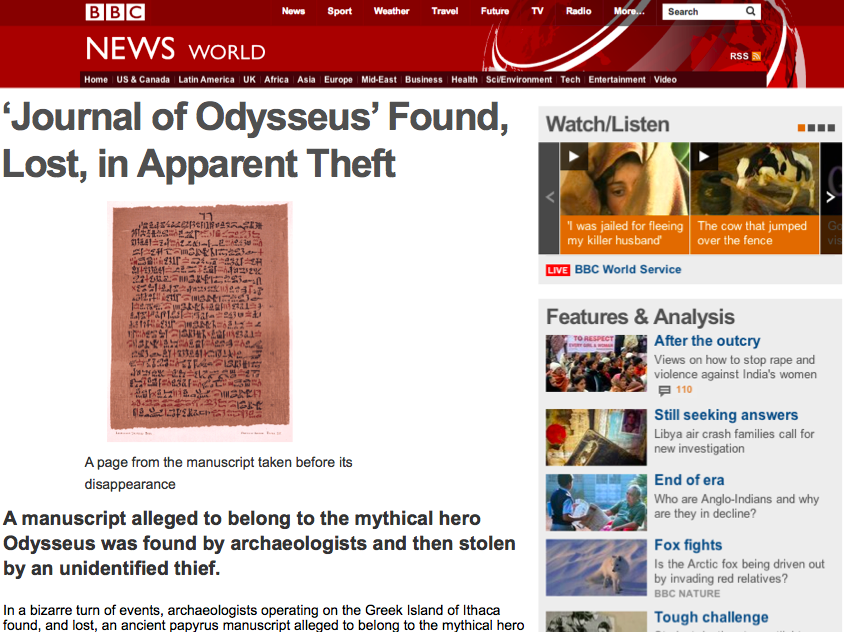
A screen grab of the fictitious BBC story used in John Fallon's Dolus ARG. (Courtesy of John Fallon)
Fallon drew his students into the game’s narrative with a bogus BBC News story about the theft of recently discovered ancient Greek manuscripts. A riddle concealed within the article led players to master-thief Dolus, who challenged them to follow his trail of clues and re-assemble the lost journal of Odysseus. Clues and puzzles were distributed across QR codes, password protected videos, PDF files, and a variety of web 2.0 tools. He also enlisted his school’s IT department and fellow teachers to help deliver hints in a variety of unexpected ways. One puzzle required finding a Freemason symbol, which a few perceptive players discovered pinned to the lapel of their History teacher, a practicing Mason. Once they gave him the correct password and passed a quick test on Masonic iconography, they received a key to help them unscramble a cipher that unlocked the next step.
Sticking to the “this is not a game” ethos common to ARGs, Fallon feigned ignorance and never admitted to know anything about the month-long caper. “Students had to identify, research, and master a variety of different codes and ciphers. They had to parse difficult riddles – with no guidance from me – and solve multiple phase problems and then synthesize their findings to succeed,” said Fallon.
This type of elaborate puzzle solving is standard fare for mainstream ARGs. Originating in the early 1990s, ARGs are designed and run by development teams called “puppet masters” who combine the digital and the real to deliver intricate narratives that blur the line between reality and fiction. Players enjoy a great deal of agency as they solve elaborate puzzles while they negotiate a world of phony websites and documents, midnight phone calls, and park bench envelope exchanges, to name a few of the tactics that can make these games indistinguishable from everyday life.
Educational versions tend to be scaled down to accommodate specific learning objectives and operate safely within a school setting. Fallon’s model shows that any motivated teacher can design and run their own ARG without programming skills, specialized technical knowledge or a big budget. This is assisted by the availability of free or inexpensive user-friendly, web-based tools, and digital software. The modular nature of ARGs also lets educators decide how simple or complex they want to make their game, and allows them to choose elements that best suit their unique circumstances.
Alternate Reality's Impact on Real Life
While they can be played from elementary school to college, most existing educational examples are found in middle schools. “It’s a developmental period of transition where kids begin to build and exercise critical thinking skills,” said Dr. Tanner Higgin, who helped produce the United Colonies ARG. “They are still relatively untainted by the social pressures and inhibitions that set in with growing older and they are also less entrenched/acclimated to the traditional school model.”
Despite the paucity of studies specific to educational ARGs, this new learning system combines three ingredients whose benefits are supported by a growing body of research: game-based learning, embodied learning and the use of transmedia in education. Jane McGonigal, author of Reality is Broken, draws one distinction between video games and ARGs:
Historically, in fact, most ARGs, like most computer and video games, have been designed simply to be fun and emotionally satisfying. But my research shows that because ARGs are played in real-world contexts, instead of in virtual spaces, they almost always have at least the side effect of improving our real lives.
ARGs are not for everybody, but Fallon noted that students who were not typically motivated in his class kicked into high gear, some laboring into the wee hours at home to untangle a conundrum. To succeed in Dolus, students had to inhere the very qualities that helped the cunning Odysseus to prevail on his journey. “Odysseus is mortal and without superpowers but, above all, he’s a tenacious problem solver,” explained Fallon. “He is put into seemingly impossible situations and, through sheer human ingenuity and persistence, he finds a way out.”
Students wrote their own creative adaptations of The Odyssey to conclude the unit. Fallon noticed a substantial improvement in the quality of the work over past more traditional deliveries of the lesson. “They did a better job of making their individual versions of Odysseus more clever and better problem solvers rather than just a cardboard cutout hero who bashes his way through problems. This likely stems from having experienced some difficult problem solving of their own in similar circumstances.”
Empathy for Injustice
The multidisciplinary potential for these games ranges far beyond English class, as their narrative and content can be tailored to accommodate a broad rang of subjects and learning outcomes.
“Any situated learning experience can most definitely promote learning better than traditional pedagogical strategies and there’s some good research to support the benefits,” said Randall Fujimoto, an instructional designer and former video game developer who founded GameTrain Learning, a not-for-profit that helps schools implement game-based learning initiatives. Inspired by The Beast, a sci-fi whodunit ARG designed to promote the film A.I. Artificial Intelligence, Fujimoto felt that the dynamic and embodied gameplay could make a potent learning tool.
Fujimoto was so enthralled with the idea that he decided to focus on how ARGs could be used in the classroom for his masters thesis, ultimately developing a game focused on the Japanese experience of internment camps during World War II. In Arising from Injustice, students are contacted to investigate why Dr. Alice Sasaki had been found unconscious in her lab. To wake her from her coma, players must access her high-tech Memory History Cognition device and reconstruct her memories as a Japanese American in the 1940s. In ARG parlance, this is known as the rabbit hole – the initial event or clue that pulls players into the game world.
The modular, web-based narrative relays the story of the Japanese Americans with eclectic historical documents and media, including pictures, letters, journals, videos and audio. In classic ARG style, players progress from Pearl Harbor to post-war resettlement by solving puzzles, following clues, and carrying out assignments and sharing their findings on a group discussion board. The game was designed to service a wide range of age groups and was trialed by eighth graders at Tomodachi Gakko, a summer camp whose focus on Japanese American heritage fit well with the game’s theme.
Arising from Injustice embeds clear learning objectives within the narrative. Players evaluate and analyze primary documents to determine the social conditions that precipitated prejudice and discrimination against Japanese Americans. They also hone their media literacy skills by synthesizing their learning in collaborative media projects where they support their research with primary sources. All of these fit with Common Core standards, and post-game surveys indicated that players were not only engaged, but that the intended learning outcomes were achieved.
But perhaps the most important lesson learned was one of empathy.
“The game puts players in a situated learning environment where they must interact and empathize with various characters in order to succeed,” said Fujimoto. While playing Arising from Injustice, students experienced the hardships and discriminations suffered by Japanese Americans through the eyes of the victim. One player reported that “you could really put yourself in Alice’s shoes," highlighting the game’s capacity to emotionally connect players to their subject. Dr. Mary Flanagan and Jonathan Belman’s research supports that games can be designed to foster empathy, a quality that not only produces better human beings, but also better learners.
The Anytime, Anywhere World of United Colonies
One fall morning, sixth grade students from the PlayMaker School in Santa Monica were surprised to find a mysterious note labeled “UV got a message” in their lockers. A few students eventually connected it to an ultraviolet bulb that had appeared in their classroom and, when the note was placed under the UV light, a secret set of instructions was revealed.
The UV message from the United Colonies game.
For the rest of the school year, the United Colonies ARG led players along an elaborate trail of clues that included books with hidden compartments, alien codes, meteors inscribed with cuneiforms, and even a bacon puzzle. Not tied to any one class or subject, but drawing from many, the game added an extracurricular layer that extended beyond the classroom. “The ARG made school an anytime, anywhere experience, a thread running between and within classes and carrying through to home,” said designer Mike Minadeo, the game’s creator.
Participation in the game was entirely voluntary and outcomes were not attached to grades or points. “Students self-selected to be involved and were driven purely by interest, curiosity, and excitement of the unknown to figure things out together,” said Higgin, who was lead researcher at GameDesk when he worked with Minadeo to develop United Colonies.
Any object in their midst might be a code, a message or the start of a puzzle, so their learning environment was transformed into a spatial text that was alive with possibilities. The school’s neglected online discussion board was reinvigorated as game-related updates and information were actively exchanged. Students crafted their own riddles, and even started a club for designing ARGs, an important shift from students consuming games to creating them.
“The United Colonies ARG explored how learning opportunities could be presented through a transmedia platform that inspired associative learning, gritty persistence, cross-disciplinary thinking, and critical analysis,” Minadeo said. The creators found academic support in Dr. Angela Lee Duckworth’s work on grit and a scholarly article from MIT press that identifies seven core literacies delivered by ARGs: gather, make sense, manage, solve, create, respect and collaborate. In an effort to make the project available to teachers, the game designers posted a detailed lesson plan to GameDesk’s Educade site, outlining how the game fulfills specific learning outcomes and Common Core standards.
A Rethinking of Roles
Some educators are convinced that alternate reality games have huge potential to invigorate learning environments, but they face some implementation challenges. Administrators operating in a risk-averse climate of national standards and testing want to see clearly defined learning outcomes and assessment strategies to accompany any new teaching strategy. ARGs also take time to plan and ask that teachers think differently about how they delivery their instructional material.
Good ARGs are often custom crafted to specific classrooms and schools, making them difficult to transfer into new environments, Fallon said. Further study, experimentation, dedicated technology and user-friendly ARG designs will not only help overcome hurdles, but also open the door for other dynamic, immersive games that combine digital media and reality. ARGs may also occasion a rethinking of the roles of teachers and schools.
United Colonies is a product of the collaboration between educators and game designers; a model espoused by schools like Quest to Learn in New York City and CICS ChicagoQuest in Chicago. These charters might be forecasting a future where game and learning environment designers become standard personnel who work in conjunction with teachers in schools and districts, making initiatives like ARGs more feasible.
The discovery of this Freemasons pin helped students unlock the next phase of the Dolus game.(Courtesy of John Fallon)
Alternately, John Fallon is a model of the autonomous teacher-designer, who relies more on holistic creativity and resourcefulness than specialized knowledge. Teachers may welcome the opportunity to engage their students and invigorate their practice with a unique creative outlet. Perhaps they need only take a page from Odysseus’s book and, like their students, push the creative boundaries, problem solve and overcome adversity with resilience.
lower waypointnext waypoint
Player sponsored by
window.__IS_SSR__=true
window.__INITIAL_STATE__={
"attachmentsReducer": {
"audio_0": {
"type": "attachments",
"id": "audio_0",
"imgSizes": {
"kqedFullSize": {
"file": "https://ww2.kqed.org/news/wp-content/themes/KQED-unified/img/audio_bgs/background0.jpg"
}
}
},
"audio_1": {
"type": "attachments",
"id": "audio_1",
"imgSizes": {
"kqedFullSize": {
"file": "https://ww2.kqed.org/news/wp-content/themes/KQED-unified/img/audio_bgs/background1.jpg"
}
}
},
"audio_2": {
"type": "attachments",
"id": "audio_2",
"imgSizes": {
"kqedFullSize": {
"file": "https://ww2.kqed.org/news/wp-content/themes/KQED-unified/img/audio_bgs/background2.jpg"
}
}
},
"audio_3": {
"type": "attachments",
"id": "audio_3",
"imgSizes": {
"kqedFullSize": {
"file": "https://ww2.kqed.org/news/wp-content/themes/KQED-unified/img/audio_bgs/background3.jpg"
}
}
},
"audio_4": {
"type": "attachments",
"id": "audio_4",
"imgSizes": {
"kqedFullSize": {
"file": "https://ww2.kqed.org/news/wp-content/themes/KQED-unified/img/audio_bgs/background4.jpg"
}
}
},
"placeholder": {
"type": "attachments",
"id": "placeholder",
"imgSizes": {
"thumbnail": {
"file": "https://cdn.kqed.org/wp-content/uploads/2024/12/KQED-Default-Image-816638274-2000x1333-1-160x107.jpg",
"width": 160,
"height": 107,
"mimeType": "image/jpeg"
},
"medium": {
"file": "https://cdn.kqed.org/wp-content/uploads/2024/12/KQED-Default-Image-816638274-2000x1333-1-800x533.jpg",
"width": 800,
"height": 533,
"mimeType": "image/jpeg"
},
"medium_large": {
"file": "https://cdn.kqed.org/wp-content/uploads/2024/12/KQED-Default-Image-816638274-2000x1333-1-768x512.jpg",
"width": 768,
"height": 512,
"mimeType": "image/jpeg"
},
"large": {
"file": "https://cdn.kqed.org/wp-content/uploads/2024/12/KQED-Default-Image-816638274-2000x1333-1-1020x680.jpg",
"width": 1020,
"height": 680,
"mimeType": "image/jpeg"
},
"1536x1536": {
"file": "https://cdn.kqed.org/wp-content/uploads/2024/12/KQED-Default-Image-816638274-2000x1333-1-1536x1024.jpg",
"width": 1536,
"height": 1024,
"mimeType": "image/jpeg"
},
"fd-lrg": {
"file": "https://cdn.kqed.org/wp-content/uploads/2024/12/KQED-Default-Image-816638274-2000x1333-1-1536x1024.jpg",
"width": 1536,
"height": 1024,
"mimeType": "image/jpeg"
},
"fd-med": {
"file": "https://cdn.kqed.org/wp-content/uploads/2024/12/KQED-Default-Image-816638274-2000x1333-1-1020x680.jpg",
"width": 1020,
"height": 680,
"mimeType": "image/jpeg"
},
"fd-sm": {
"file": "https://cdn.kqed.org/wp-content/uploads/2024/12/KQED-Default-Image-816638274-2000x1333-1-800x533.jpg",
"width": 800,
"height": 533,
"mimeType": "image/jpeg"
},
"post-thumbnail": {
"file": "https://cdn.kqed.org/wp-content/uploads/2024/12/KQED-Default-Image-816638274-2000x1333-1-672x372.jpg",
"width": 672,
"height": 372,
"mimeType": "image/jpeg"
},
"twentyfourteen-full-width": {
"file": "https://cdn.kqed.org/wp-content/uploads/2024/12/KQED-Default-Image-816638274-2000x1333-1-1038x576.jpg",
"width": 1038,
"height": 576,
"mimeType": "image/jpeg"
},
"xxsmall": {
"file": "https://cdn.kqed.org/wp-content/uploads/2024/12/KQED-Default-Image-816638274-2000x1333-1-160x107.jpg",
"width": 160,
"height": 107,
"mimeType": "image/jpeg"
},
"xsmall": {
"file": "https://cdn.kqed.org/wp-content/uploads/2024/12/KQED-Default-Image-816638274-2000x1333-1-672x372.jpg",
"width": 672,
"height": 372,
"mimeType": "image/jpeg"
},
"small": {
"file": "https://cdn.kqed.org/wp-content/uploads/2024/12/KQED-Default-Image-816638274-2000x1333-1-672x372.jpg",
"width": 672,
"height": 372,
"mimeType": "image/jpeg"
},
"xlarge": {
"file": "https://cdn.kqed.org/wp-content/uploads/2024/12/KQED-Default-Image-816638274-2000x1333-1-1020x680.jpg",
"width": 1020,
"height": 680,
"mimeType": "image/jpeg"
},
"full-width": {
"file": "https://cdn.kqed.org/wp-content/uploads/2024/12/KQED-Default-Image-816638274-2000x1333-1-1920x1280.jpg",
"width": 1920,
"height": 1280,
"mimeType": "image/jpeg"
},
"guest-author-32": {
"file": "https://cdn.kqed.org/wp-content/uploads/2025/01/KQED-Default-Image-816638274-1333x1333-1-160x160.jpg",
"width": 32,
"height": 32,
"mimeType": "image/jpeg"
},
"guest-author-50": {
"file": "https://cdn.kqed.org/wp-content/uploads/2025/01/KQED-Default-Image-816638274-1333x1333-1-160x160.jpg",
"width": 50,
"height": 50,
"mimeType": "image/jpeg"
},
"guest-author-64": {
"file": "https://cdn.kqed.org/wp-content/uploads/2025/01/KQED-Default-Image-816638274-1333x1333-1-160x160.jpg",
"width": 64,
"height": 64,
"mimeType": "image/jpeg"
},
"guest-author-96": {
"file": "https://cdn.kqed.org/wp-content/uploads/2025/01/KQED-Default-Image-816638274-1333x1333-1-160x160.jpg",
"width": 96,
"height": 96,
"mimeType": "image/jpeg"
},
"guest-author-128": {
"file": "https://cdn.kqed.org/wp-content/uploads/2025/01/KQED-Default-Image-816638274-1333x1333-1-160x160.jpg",
"width": 128,
"height": 128,
"mimeType": "image/jpeg"
},
"detail": {
"file": "https://cdn.kqed.org/wp-content/uploads/2025/01/KQED-Default-Image-816638274-1333x1333-1-160x160.jpg",
"width": 160,
"height": 160,
"mimeType": "image/jpeg"
},
"kqedFullSize": {
"file": "https://cdn.kqed.org/wp-content/uploads/2024/12/KQED-Default-Image-816638274-2000x1333-1.jpg",
"width": 2000,
"height": 1333
}
}
},
"mindshift_38068": {
"type": "attachments",
"id": "mindshift_38068",
"meta": {
"index": "attachments_1716263798",
"site": "mindshift",
"id": "38068",
"found": true
},
"parent": 37884,
"imgSizes": {
"thumbnail": {
"file": "https://ww2.kqed.org/app/uploads/sites/23/2014/10/Nick-Thompson-Odysseus-and-the-Sirens-400x225.png",
"width": 400,
"mimeType": "image/png",
"height": 225
},
"fd-sm": {
"file": "https://ww2.kqed.org/app/uploads/sites/23/2014/10/Nick-Thompson-Odysseus-and-the-Sirens-320x180.png",
"width": 320,
"mimeType": "image/png",
"height": 180
},
"post-thumbnail": {
"file": "https://ww2.kqed.org/app/uploads/sites/23/2014/10/Nick-Thompson-Odysseus-and-the-Sirens-672x372.png",
"width": 672,
"mimeType": "image/png",
"height": 372
},
"kqedFullSize": {
"file": "https://ww2.kqed.org/app/uploads/sites/23/2014/10/Nick-Thompson-Odysseus-and-the-Sirens.png",
"width": 832,
"height": 468
},
"fd-med": {
"file": "https://ww2.kqed.org/app/uploads/sites/23/2014/10/Nick-Thompson-Odysseus-and-the-Sirens-768x432.png",
"width": 768,
"mimeType": "image/png",
"height": 432
},
"guest-author-96": {
"file": "https://ww2.kqed.org/app/uploads/sites/23/2014/10/Nick-Thompson-Odysseus-and-the-Sirens-96x96.png",
"width": 96,
"mimeType": "image/png",
"height": 96
},
"medium": {
"file": "https://ww2.kqed.org/app/uploads/sites/23/2014/10/Nick-Thompson-Odysseus-and-the-Sirens-800x450.png",
"width": 800,
"mimeType": "image/png",
"height": 450
},
"guest-author-64": {
"file": "https://ww2.kqed.org/app/uploads/sites/23/2014/10/Nick-Thompson-Odysseus-and-the-Sirens-64x64.png",
"width": 64,
"mimeType": "image/png",
"height": 64
},
"guest-author-32": {
"file": "https://ww2.kqed.org/app/uploads/sites/23/2014/10/Nick-Thompson-Odysseus-and-the-Sirens-32x32.png",
"width": 32,
"mimeType": "image/png",
"height": 32
},
"guest-author-128": {
"file": "https://ww2.kqed.org/app/uploads/sites/23/2014/10/Nick-Thompson-Odysseus-and-the-Sirens-128x128.png",
"width": 128,
"mimeType": "image/png",
"height": 128
}
},
"publishDate": 1413206952,
"modified": 1413206952,
"caption": "(Flickr/Nick Thompson)",
"description": null,
"title": "Odysseus and the Sirens",
"credit": null,
"status": "inherit",
"isLoading": false,
"fetchFailed": false
}
},
"audioPlayerReducer": {
"postId": "stream_live",
"isPaused": true,
"isPlaying": false,
"pfsActive": false,
"pledgeModalIsOpen": true,
"playerDrawerIsOpen": false,
"liveAudioPlayStartedAt": 0,
"liveAudioPlayContext": ""
},
"authorsReducer": {
"pauldarvasi": {
"type": "authors",
"id": "11107",
"meta": {
"index": "authors_1716337520",
"id": "11107",
"found": true
},
"name": "Paul Darvasi",
"firstName": "Paul",
"lastName": "Darvasi",
"slug": "pauldarvasi",
"email": "pauldarvasi@gmail.com",
"display_author_email": false,
"staff_mastheads": [],
"title": null,
"bio": "Paul Darvasi is an experienced educator whose research, speaking and writing explore the intersections of learning, technology, narrative and games. You can follow him on Twitter:\u003ca href=\"https://twitter.com/PaulDarvasi\"> @pauldarvasi\u003c/a>",
"avatar": "https://secure.gravatar.com/avatar/df387897a1bf0cd4b720b8175112731a?s=600&d=blank&r=g",
"twitter": "pauldarvasi",
"facebook": null,
"instagram": null,
"linkedin": null,
"sites": [
{
"site": "mindshift",
"roles": [
"contributor"
]
}
],
"headData": {
"title": "Paul Darvasi | KQED",
"description": null,
"ogImgSrc": "https://secure.gravatar.com/avatar/df387897a1bf0cd4b720b8175112731a?s=600&d=blank&r=g",
"twImgSrc": "https://secure.gravatar.com/avatar/df387897a1bf0cd4b720b8175112731a?s=600&d=blank&r=g"
},
"isLoading": false,
"link": "/author/pauldarvasi"
}
},
"pagesReducer": {},
"pfsSessionReducer": {},
"postsReducer": {
"stream_live": {
"type": "live",
"id": "stream_live",
"audioUrl": "https://streams.kqed.org/kqedradio",
"title": "Live Stream",
"excerpt": "Live Stream information currently unavailable.",
"link": "/radio",
"featImg": "",
"label": {
"name": "KQED Live",
"link": "/"
}
},
"stream_kqedNewscast": {
"type": "posts",
"id": "stream_kqedNewscast",
"audioUrl": "https://www.kqed.org/.stream/anon/radio/RDnews/newscast.mp3?_=1",
"title": "KQED Newscast",
"featImg": "",
"label": {
"name": "88.5 FM",
"link": "/"
}
},
"mindshift_37884": {
"type": "posts",
"id": "mindshift_37884",
"meta": {
"index": "posts_1716263798",
"site": "mindshift",
"id": "37884",
"found": true
},
"articlePosition": 0,
"parent": 0,
"labelTerm": {
"site": "mindshift"
},
"blocks": [],
"publishDate": 1413210015,
"format": "aside",
"disqusTitle": "How to Transform The Odyssey into an Epic Game in Alternate Reality",
"title": "How to Transform The Odyssey into an Epic Game in Alternate Reality",
"headTitle": "MindShift | KQED News",
"content": "\u003cfigure id=\"attachment_38068\" class=\"wp-caption alignnone\" style=\"max-width: 640px\">\u003ca href=\"http://ww2.kqed.org/mindshift/wp-content/uploads/sites/23/2014/10/Nick-Thompson-Odysseus-and-the-Sirens.png\">\u003cimg class=\"size-large wp-image-38068\" src=\"http://ww2.kqed.org/mindshift/wp-content/uploads/sites/23/2014/10/Nick-Thompson-Odysseus-and-the-Sirens-640x360.png\" alt=\"(Flickr/Nick Thompson)\" width=\"640\" height=\"360\">\u003c/a>\u003cfigcaption class=\"wp-caption-text\">(Flickr/Nick Thompson)\u003c/figcaption>\u003c/figure>\n\u003cp>How would Homer have told the story of \u003cem>The Odyssey\u003c/em> as a game? What would participatory learning look like in ancient times? Learning about the lessons raised in classics like \u003cem>The Odyssey\u003c/em> is getting a fresh perspective thanks to several educators who have started experimenting with how alternate reality games (ARGs) can be used as an immersive learning system that combines rich narrative, digital technology, and real-world game play.\u003c/p>\n\u003cp>John Fallon, a Fairfield Country Day School teacher and game enthusiast, brings game-based learning to \u003cem>The Odyssey\u003c/em> with a game he designed called \u003cem>\u003ca href=\"http://www.workingexamples.org/example/show/633\">Dolus: Finding the Journal of Odysseus\u003c/a>\u003c/em>. Many educators today struggle to keep the classics relevant for a generation reared in the fast paced world of Internet and video games, and Fallon’s game bridges the classical past with the digital future for his seventh grade English students. Rather than merely reading about the adventures of Odysseus in English class, students can walk a mile in his shoes by channeling the skillset of the Greek hero who masterminded the Trojan Horse and outwitted the Cyclops. Students must exercise critical thinking, resilience, and creative problem solving to succeed in an ARG.\u003c/p>\n\u003cp>The idea came to Fallon while playing \u003cem>\u003ca href=\"http://www.thesecretworld.com/\">The Secret World\u003c/a>\u003c/em>, a video game that incorporates real-world browser searches to help solve puzzles. “It all hit me at once,” remembered Fallon. “The portability of cross-media ARG puzzles, the use of real world information in a fictional game world, and the ancient Siren-song of puzzle solving. Immediately, the game about the crafty thief who stole the journal of Odysseus was born.”\u003c/p>\n\u003cfigure id=\"attachment_38069\" class=\"wp-caption alignnone\" style=\"max-width: 640px\">\u003ca href=\"http://ww2.kqed.org/mindshift/wp-content/uploads/sites/23/2014/10/BBC-story.png\">\u003cimg class=\"size-large wp-image-38069\" src=\"http://ww2.kqed.org/mindshift/wp-content/uploads/sites/23/2014/10/BBC-story-640x479.png\" alt=\"Courtesy of John Fallon\" width=\"640\" height=\"479\">\u003c/a>\u003cfigcaption class=\"wp-caption-text\">A screen grab of the fictitious BBC story used in John Fallon's Dolus ARG. (Courtesy of John Fallon)\u003c/figcaption>\u003c/figure>\n\u003cp>Fallon drew his students into the game’s narrative with a bogus BBC News story about the theft of recently discovered ancient Greek manuscripts. A riddle concealed within the article led players to master-thief Dolus, who challenged them to follow his trail of clues and re-assemble the lost journal of Odysseus. Clues and puzzles were distributed across QR codes, password protected videos, PDF files, and a variety of web 2.0 tools. He also enlisted his school’s IT department and fellow teachers to help deliver hints in a variety of unexpected ways. One puzzle required finding a Freemason symbol, which a few perceptive players discovered pinned to the lapel of their History teacher, a practicing Mason. Once they gave him the correct password and passed a quick test on Masonic iconography, they received a key to help them unscramble a cipher that unlocked the next step.\u003c/p>\n\u003cp>Sticking to the “this is not a game” ethos common to ARGs, Fallon feigned ignorance and never admitted to know anything about the month-long caper. “Students had to identify, research, and master a variety of different codes and ciphers. They had to parse difficult riddles – with no guidance from me – and solve multiple phase problems and then synthesize their findings to succeed,” said Fallon.\u003c/p>\n\u003caside class=\"pullquote alignleft\">ARGs are not for everybody, but Fallon noted that students who were not typically motivated in his class kicked into high gear, some laboring into the wee hours at home to untangle a conundrum.\u003c/aside>\n\u003cp>This type of elaborate puzzle solving is standard fare for mainstream ARGs. Originating in the early 1990s, ARGs are designed and run by development teams called “puppet masters” who combine the digital and the real to deliver intricate narratives that blur the line between reality and fiction. Players enjoy a great deal of agency as they solve elaborate puzzles while they negotiate a world of phony websites and documents, midnight phone calls, and park bench envelope exchanges, to name a few of the tactics that can make these games indistinguishable from everyday life.\u003c/p>\n\u003cp>[ad fullwidth]\u003c/p>\n\u003cp>Educational versions tend to be scaled down to accommodate specific learning objectives and operate safely within a school setting. Fallon’s model shows that any motivated teacher can design and run their own ARG without programming skills, specialized technical knowledge or a big budget. This is assisted by the availability of free or inexpensive user-friendly, web-based tools, and digital software. The modular nature of ARGs also lets educators decide how simple or complex they want to make their game, and allows them to choose elements that best suit their unique circumstances.\u003c/p>\n\u003cp>\u003cstrong>Alternate Reality's Impact on Real Life\u003c/strong>\u003c/p>\n\u003cp>While they can be played from elementary school to college, most existing educational examples are found in middle schools. “It’s a developmental period of transition where kids begin to build and exercise critical thinking skills,” said \u003ca href=\"http://www.tannerhiggin.com/about/\">Dr. Tanner Higgin\u003c/a>, who helped produce the \u003cem>United Colonies\u003c/em> ARG. “They are still relatively untainted by the social pressures and inhibitions that set in with growing older and they are also less entrenched/acclimated to the traditional school model.”\u003c/p>\n\u003cp>Despite the paucity of studies specific to educational ARGs, this new learning system combines three ingredients whose benefits are supported by a growing body of research: \u003ca href=\"http://ww2.kqed.org/mindshift/2014/06/benefits-of-gaming-what-research-shows/\">game-based learning\u003c/a>, \u003ca href=\"http://hechingerreport.org/content/body-next-breakthrough-education-tech_16629/\">embodied learning\u003c/a> and the use of \u003ca href=\"http://digitalcommons.uri.edu/cgi/viewcontent.cgi?article=1124&context=jmle\">transmedia\u003c/a> in education. \u003ca href=\"http://janemcgonigal.com/\">Jane McGonigal\u003c/a>, author of \u003cem>Reality is Broken\u003c/em>, draws one distinction between video games and ARGs:\u003c/p>\n\u003cblockquote>\u003cp>Historically, in fact, most ARGs, like most computer and video games, have been designed simply to be fun and emotionally satisfying. But my research shows that because ARGs are played in real-world contexts, instead of in virtual spaces, they almost always have at least the \u003cem>side effect\u003c/em> of improving our real lives.\u003c/p>\u003c/blockquote>\n\u003cp>ARGs are not for everybody, but Fallon noted that students who were not typically motivated in his class kicked into high gear, some laboring into the wee hours at home to untangle a conundrum. To succeed in \u003cem>Dolus\u003c/em>, students had to inhere the very qualities that helped the cunning Odysseus to prevail on his journey. “Odysseus is mortal and without superpowers but, above all, he’s a tenacious problem solver,” explained Fallon. “He is put into seemingly impossible situations and, through sheer human ingenuity and persistence, he finds a way out.”\u003c/p>\n\u003cp>Students wrote their own creative adaptations of \u003cem>The Odyssey\u003c/em> to conclude the unit. Fallon noticed a substantial improvement in the quality of the work over past more traditional deliveries of the lesson. “They did a better job of making their individual versions of Odysseus more clever and better problem solvers rather than just a cardboard cutout hero who bashes his way through problems. This likely stems from having experienced some difficult problem solving of their own in similar circumstances.”\u003c/p>\n\u003cp>\u003cstrong>Empathy for Injustice\u003c/strong>\u003c/p>\n\u003cp>The multidisciplinary potential for these games ranges far beyond English class, as their narrative and content can be tailored to accommodate a broad rang of subjects and learning outcomes.\u003c/p>\n\u003cp>“Any situated learning experience can most definitely promote learning better than traditional pedagogical strategies and there’s some good research to support the benefits,” said Randall Fujimoto, an instructional designer and former video game developer who founded \u003ca href=\"http://gametrainlearning.org/\">GameTrain Learning\u003c/a>, a not-for-profit that helps schools implement game-based learning initiatives. Inspired by \u003ca href=\"http://www.unfiction.com/history/the-beast/\">The Beast\u003c/a>, a sci-fi whodunit ARG designed to promote the film \u003cem>A.I. Artificial Intelligence\u003c/em>, Fujimoto felt that the dynamic and embodied gameplay could make a potent learning tool.\u003c/p>\n\u003cp>Fujimoto was so enthralled with the idea that he decided to focus on how ARGs could be used in the classroom for his masters thesis, ultimately developing a game focused on the Japanese experience of internment camps during World War II. In \u003cem>Arising from Injustice\u003c/em>, students are contacted to investigate why Dr. Alice Sasaki had been found unconscious in her lab. To wake her from her coma, players must access her high-tech Memory History Cognition device and reconstruct her memories as a Japanese American in the 1940s. In ARG parlance, this is known as the rabbit hole – the initial event or clue that pulls players into the game world.\u003c/p>\n\u003cp>[contextly_sidebar id=\"AlDkWWDdW8nHP8JLazfttcMxBeugrjWD\"]\u003c/p>\n\u003cp>The modular, web-based narrative relays the story of the Japanese Americans with eclectic historical documents and media, including pictures, letters, journals, videos and audio. In classic ARG style, players progress from Pearl Harbor to post-war resettlement by solving puzzles, following clues, and carrying out assignments and sharing their findings on a group discussion board. The game was designed to service a wide range of age groups and was trialed by eighth graders at Tomodachi Gakko, a summer camp whose focus on Japanese American heritage fit well with the game’s theme.\u003c/p>\n\u003cp>\u003cem>Arising from Injustice\u003c/em> embeds clear learning objectives within the narrative. Players evaluate and analyze primary documents to determine the social conditions that precipitated prejudice and discrimination against Japanese Americans. They also hone their media literacy skills by synthesizing their learning in collaborative media projects where they support their research with primary sources. All of these fit with Common Core standards, and post-game surveys indicated that players were not only engaged, but that the intended learning outcomes were achieved.\u003c/p>\n\u003cp>But perhaps the most important lesson learned was one of empathy.\u003c/p>\n\u003cp>“The game puts players in a situated learning environment where they must interact and empathize with various characters in order to succeed,” said Fujimoto. While playing \u003cem>Arising from Injustice\u003c/em>, students experienced the hardships and discriminations suffered by Japanese Americans through the eyes of the victim. One player reported that “you could really put yourself in Alice’s shoes,\" highlighting the game’s capacity to emotionally connect players to their subject. Dr. Mary Flanagan and Jonathan Belman’s \u003ca href=\"http://www.maryflanagan.com/wp-content/uploads/cog-tech-si-g4g-article-1-belman-and-flanagan-designing-games-to-foster-empathy.pdf\">research\u003c/a> supports that games can be designed to \u003ca href=\"http://ww2.kqed.org/mindshift/2013/11/teaching-empathy-through-digital-game-play/\">foster empathy\u003c/a>, a quality that not only produces better human beings, but also \u003ca href=\"http://ww2.kqed.org/mindshift/2013/01/empathy-the-key-to-social-and-emotional-learning/\">better learners\u003c/a>.\u003c/p>\n\u003cp>\u003cstrong>The Anytime, Anywhere World of United Colonies\u003c/strong>\u003c/p>\n\u003cp>One fall morning, sixth grade students from the \u003ca href=\"http://ww2.kqed.org/mindshift/2014/07/a-school-that-ditches-all-the-rules-but-not-the-rigor-game-based-school-playmaker/\">PlayMaker School\u003c/a> in Santa Monica were surprised to find a mysterious note labeled “UV got a message” in their lockers. A few students eventually connected it to an ultraviolet bulb that had appeared in their classroom and, when the note was placed under the UV light, a secret set of instructions was revealed.\u003c/p>\n\u003cfigure id=\"attachment_38071\" class=\"wp-caption alignnone\" style=\"max-width: 640px\">\u003ca href=\"http://ww2.kqed.org/mindshift/wp-content/uploads/sites/23/2014/10/UV-Message.png\">\u003cimg class=\"size-large wp-image-38071\" src=\"http://ww2.kqed.org/mindshift/wp-content/uploads/sites/23/2014/10/UV-Message-640x88.png\" alt=\"The UV message from the United Colonies game. \" width=\"640\" height=\"88\">\u003c/a>\u003cfigcaption class=\"wp-caption-text\">The UV message from the United Colonies game.\u003c/figcaption>\u003c/figure>\n\u003cp>For the rest of the school year, the United Colonies ARG led players along an elaborate \u003ca href=\"https://www.youtube.com/watch?v=X5VZ_G8Pfz0\">trail of clues\u003c/a> that included books with hidden compartments, alien codes, meteors inscribed with cuneiforms, and even a bacon puzzle. Not tied to any one class or subject, but drawing from many, the game added an extracurricular layer that extended beyond the classroom. “The ARG made school an anytime, anywhere experience, a thread running between and within classes and carrying through to home,” said designer Mike Minadeo, the game’s creator.\u003c/p>\n\u003cp>Participation in the game was entirely voluntary and outcomes were not attached to grades or points. “Students self-selected to be involved and were driven purely by interest, curiosity, and excitement of the unknown to figure things out together,” said Higgin, who was lead researcher at \u003ca href=\"http://ww2.kqed.org/mindshift/2012/09/a-new-game-based-school-opens/\">GameDesk\u003c/a> when he worked with Minadeo to develop \u003cem>United Colonies\u003c/em>.\u003c/p>\n\u003cp>Any object in their midst might be a code, a message or the start of a puzzle, so their learning environment was transformed into a spatial text that was alive with possibilities. The school’s neglected online discussion board was reinvigorated as game-related updates and information were actively exchanged. Students crafted their own riddles, and even started a club for designing ARGs, an important shift from students consuming games to creating them.\u003c/p>\n\u003cp>Students were \u003ca href=\"https://www.youtube.com/watch?v=8dJfqeP3lFs\">clearly engaged\u003c/a>, but what did they learn?\u003c/p>\n\u003cp>“The \u003cem>United Colonies\u003c/em> ARG explored how learning opportunities could be presented through a transmedia platform that inspired associative learning, gritty persistence, cross-disciplinary thinking, and critical analysis,” Minadeo said. The creators found academic support in Dr. Angela Lee Duckworth’s work on grit and a scholarly article from MIT press that identifies seven core literacies delivered by ARGs: gather, make sense, manage, solve, create, respect and collaborate. In an effort to make the project available to teachers, the game designers posted a detailed lesson plan to GameDesk’s \u003ca href=\"http://educade.org/lesson_plans/united-colonies-arg-module-1\">Educade site\u003c/a>, outlining how the game fulfills specific learning outcomes and Common Core standards.\u003c/p>\n\u003cp>\u003cstrong>A Rethinking of Roles\u003c/strong>\u003c/p>\n\u003cp>Some educators are convinced that alternate reality games have huge potential to invigorate learning environments, but they face some \u003ca href=\"http://ww2.kqed.org/mindshift/2014/09/games-in-the-classroom-overcoming-the-obstacles/\">implementation challenges\u003c/a>. Administrators operating in a risk-averse climate of national standards and testing want to see clearly defined learning outcomes and assessment strategies to accompany any new teaching strategy. ARGs also take time to plan and ask that teachers think differently about how they delivery their instructional material.\u003c/p>\n\u003cp>Good ARGs are often custom crafted to specific classrooms and schools, making them difficult to transfer into new environments, Fallon said. Further study, experimentation, dedicated technology and user-friendly ARG designs will not only help overcome hurdles, but also open the door for other dynamic, immersive games that combine digital media and reality. ARGs may also occasion a rethinking of the roles of teachers and schools.\u003c/p>\n\u003cp>\u003cem>United Colonies\u003c/em> is a product of the collaboration between educators and game designers; a model espoused by schools like \u003ca href=\"http://www.instituteofplay.org/work/projects/quest-schools/quest-to-learn/\">Quest to Learn\u003c/a> in New York City and \u003ca href=\"http://www.chicagoquest.org/\">CICS ChicagoQuest\u003c/a> in Chicago. These charters might be forecasting a future where game and learning environment designers become standard personnel who work in conjunction with teachers in schools and districts, making initiatives like ARGs more feasible.\u003c/p>\n\u003cfigure id=\"attachment_38062\" class=\"wp-caption alignnone\" style=\"max-width: 640px\">\u003ca href=\"http://ww2.kqed.org/mindshift/wp-content/uploads/sites/23/2014/10/Fallon-Lapel.png\">\u003cimg class=\"size-large wp-image-38062\" src=\"http://ww2.kqed.org/mindshift/wp-content/uploads/sites/23/2014/10/Fallon-Lapel-640x356.png\" alt=\"The discovery of this Freemasons pin helped students unlock the next phase of the Dolus game. (Courtesy of John Fallon)\" width=\"640\" height=\"356\">\u003c/a>\u003cfigcaption class=\"wp-caption-text\">The discovery of this Freemasons pin helped students unlock the next phase of the Dolus game.(Courtesy of John Fallon)\u003c/figcaption>\u003c/figure>\n\u003cp>[ad floatright]\u003c/p>\n\u003cp>Alternately, John Fallon is a model of the autonomous teacher-designer, who relies more on holistic creativity and resourcefulness than specialized knowledge. Teachers may welcome the opportunity to engage their students and invigorate their practice with a unique creative outlet. Perhaps they need only take a page from Odysseus’s book and, like their students, push the creative boundaries, problem solve and overcome adversity with resilience.\u003c/p>\n\n",
"disqusIdentifier": "37884 http://blogs.kqed.org/mindshift/?p=37884",
"disqusUrl": "https://ww2.kqed.org/mindshift/2014/10/13/how-students-can-channel-the-odyssey-into-an-alternate-reality-epic/",
"stats": {
"hasVideo": false,
"hasChartOrMap": false,
"hasAudio": false,
"hasPolis": false,
"wordCount": 2336,
"hasGoogleForm": false,
"hasGallery": false,
"hasHearkenModule": false,
"iframeSrcs": [],
"paragraphCount": 36
},
"modified": 1466697634,
"excerpt": "Teachers are discovering that through alternate reality games, students who were not typically motivated kicked into high gear, some laboring into the wee hours at home to untangle a conundrum.",
"headData": {
"twImgId": "",
"twTitle": "",
"ogTitle": "",
"ogImgId": "",
"twDescription": "",
"description": "Teachers are discovering that through alternate reality games, students who were not typically motivated kicked into high gear, some laboring into the wee hours at home to untangle a conundrum.",
"title": "How to Transform The Odyssey into an Epic Game in Alternate Reality | KQED",
"ogDescription": "",
"schema": {
"@context": "https://schema.org",
"@type": "Article",
"headline": "How to Transform The Odyssey into an Epic Game in Alternate Reality",
"datePublished": "2014-10-13T07:20:15-07:00",
"dateModified": "2016-06-23T09:00:34-07:00",
"image": "https://cdn.kqed.org/wp-content/uploads/2020/02/KQED-OG-Image@1x.png",
"author": {
"@type": "Person",
"name": "Paul Darvasi",
"jobTitle": "Journalist",
"url": "https://www.kqed.org/author/pauldarvasi"
}
},
"authorsData": [],
"tagData": []
},
"guestAuthors": [],
"slug": "how-students-can-channel-the-odyssey-into-an-alternate-reality-epic",
"status": "publish",
"path": "/mindshift/37884/how-students-can-channel-the-odyssey-into-an-alternate-reality-epic",
"audioTrackLength": null,
"parsedContent": [
{
"type": "contentString",
"content": "\u003cdiv class=\"post-body\">\u003cp>\u003cfigure id=\"attachment_38068\" class=\"wp-caption alignnone\" style=\"max-width: 640px\">\u003ca href=\"http://ww2.kqed.org/mindshift/wp-content/uploads/sites/23/2014/10/Nick-Thompson-Odysseus-and-the-Sirens.png\">\u003cimg class=\"size-large wp-image-38068\" src=\"http://ww2.kqed.org/mindshift/wp-content/uploads/sites/23/2014/10/Nick-Thompson-Odysseus-and-the-Sirens-640x360.png\" alt=\"(Flickr/Nick Thompson)\" width=\"640\" height=\"360\">\u003c/a>\u003cfigcaption class=\"wp-caption-text\">(Flickr/Nick Thompson)\u003c/figcaption>\u003c/figure>\n\u003cp>How would Homer have told the story of \u003cem>The Odyssey\u003c/em> as a game? What would participatory learning look like in ancient times? Learning about the lessons raised in classics like \u003cem>The Odyssey\u003c/em> is getting a fresh perspective thanks to several educators who have started experimenting with how alternate reality games (ARGs) can be used as an immersive learning system that combines rich narrative, digital technology, and real-world game play.\u003c/p>\n\u003cp>John Fallon, a Fairfield Country Day School teacher and game enthusiast, brings game-based learning to \u003cem>The Odyssey\u003c/em> with a game he designed called \u003cem>\u003ca href=\"http://www.workingexamples.org/example/show/633\">Dolus: Finding the Journal of Odysseus\u003c/a>\u003c/em>. Many educators today struggle to keep the classics relevant for a generation reared in the fast paced world of Internet and video games, and Fallon’s game bridges the classical past with the digital future for his seventh grade English students. Rather than merely reading about the adventures of Odysseus in English class, students can walk a mile in his shoes by channeling the skillset of the Greek hero who masterminded the Trojan Horse and outwitted the Cyclops. Students must exercise critical thinking, resilience, and creative problem solving to succeed in an ARG.\u003c/p>\n\u003cp>The idea came to Fallon while playing \u003cem>\u003ca href=\"http://www.thesecretworld.com/\">The Secret World\u003c/a>\u003c/em>, a video game that incorporates real-world browser searches to help solve puzzles. “It all hit me at once,” remembered Fallon. “The portability of cross-media ARG puzzles, the use of real world information in a fictional game world, and the ancient Siren-song of puzzle solving. Immediately, the game about the crafty thief who stole the journal of Odysseus was born.”\u003c/p>\n\u003cfigure id=\"attachment_38069\" class=\"wp-caption alignnone\" style=\"max-width: 640px\">\u003ca href=\"http://ww2.kqed.org/mindshift/wp-content/uploads/sites/23/2014/10/BBC-story.png\">\u003cimg class=\"size-large wp-image-38069\" src=\"http://ww2.kqed.org/mindshift/wp-content/uploads/sites/23/2014/10/BBC-story-640x479.png\" alt=\"Courtesy of John Fallon\" width=\"640\" height=\"479\">\u003c/a>\u003cfigcaption class=\"wp-caption-text\">A screen grab of the fictitious BBC story used in John Fallon's Dolus ARG. (Courtesy of John Fallon)\u003c/figcaption>\u003c/figure>\n\u003cp>Fallon drew his students into the game’s narrative with a bogus BBC News story about the theft of recently discovered ancient Greek manuscripts. A riddle concealed within the article led players to master-thief Dolus, who challenged them to follow his trail of clues and re-assemble the lost journal of Odysseus. Clues and puzzles were distributed across QR codes, password protected videos, PDF files, and a variety of web 2.0 tools. He also enlisted his school’s IT department and fellow teachers to help deliver hints in a variety of unexpected ways. One puzzle required finding a Freemason symbol, which a few perceptive players discovered pinned to the lapel of their History teacher, a practicing Mason. Once they gave him the correct password and passed a quick test on Masonic iconography, they received a key to help them unscramble a cipher that unlocked the next step.\u003c/p>\n\u003cp>Sticking to the “this is not a game” ethos common to ARGs, Fallon feigned ignorance and never admitted to know anything about the month-long caper. “Students had to identify, research, and master a variety of different codes and ciphers. They had to parse difficult riddles – with no guidance from me – and solve multiple phase problems and then synthesize their findings to succeed,” said Fallon.\u003c/p>\n\u003caside class=\"pullquote alignleft\">ARGs are not for everybody, but Fallon noted that students who were not typically motivated in his class kicked into high gear, some laboring into the wee hours at home to untangle a conundrum.\u003c/aside>\n\u003cp>This type of elaborate puzzle solving is standard fare for mainstream ARGs. Originating in the early 1990s, ARGs are designed and run by development teams called “puppet masters” who combine the digital and the real to deliver intricate narratives that blur the line between reality and fiction. Players enjoy a great deal of agency as they solve elaborate puzzles while they negotiate a world of phony websites and documents, midnight phone calls, and park bench envelope exchanges, to name a few of the tactics that can make these games indistinguishable from everyday life.\u003c/p>\n\u003cp>\u003c/p>\u003c/div>",
"attributes": {
"named": {},
"numeric": []
}
},
{
"type": "component",
"content": "",
"name": "ad",
"attributes": {
"named": {
"label": "fullwidth"
},
"numeric": [
"fullwidth"
]
}
},
{
"type": "contentString",
"content": "\u003cdiv class=\"post-body\">\u003cp>\u003c/p>\n\u003cp>Educational versions tend to be scaled down to accommodate specific learning objectives and operate safely within a school setting. Fallon’s model shows that any motivated teacher can design and run their own ARG without programming skills, specialized technical knowledge or a big budget. This is assisted by the availability of free or inexpensive user-friendly, web-based tools, and digital software. The modular nature of ARGs also lets educators decide how simple or complex they want to make their game, and allows them to choose elements that best suit their unique circumstances.\u003c/p>\n\u003cp>\u003cstrong>Alternate Reality's Impact on Real Life\u003c/strong>\u003c/p>\n\u003cp>While they can be played from elementary school to college, most existing educational examples are found in middle schools. “It’s a developmental period of transition where kids begin to build and exercise critical thinking skills,” said \u003ca href=\"http://www.tannerhiggin.com/about/\">Dr. Tanner Higgin\u003c/a>, who helped produce the \u003cem>United Colonies\u003c/em> ARG. “They are still relatively untainted by the social pressures and inhibitions that set in with growing older and they are also less entrenched/acclimated to the traditional school model.”\u003c/p>\n\u003cp>Despite the paucity of studies specific to educational ARGs, this new learning system combines three ingredients whose benefits are supported by a growing body of research: \u003ca href=\"http://ww2.kqed.org/mindshift/2014/06/benefits-of-gaming-what-research-shows/\">game-based learning\u003c/a>, \u003ca href=\"http://hechingerreport.org/content/body-next-breakthrough-education-tech_16629/\">embodied learning\u003c/a> and the use of \u003ca href=\"http://digitalcommons.uri.edu/cgi/viewcontent.cgi?article=1124&context=jmle\">transmedia\u003c/a> in education. \u003ca href=\"http://janemcgonigal.com/\">Jane McGonigal\u003c/a>, author of \u003cem>Reality is Broken\u003c/em>, draws one distinction between video games and ARGs:\u003c/p>\n\u003cblockquote>\u003cp>Historically, in fact, most ARGs, like most computer and video games, have been designed simply to be fun and emotionally satisfying. But my research shows that because ARGs are played in real-world contexts, instead of in virtual spaces, they almost always have at least the \u003cem>side effect\u003c/em> of improving our real lives.\u003c/p>\u003c/blockquote>\n\u003cp>ARGs are not for everybody, but Fallon noted that students who were not typically motivated in his class kicked into high gear, some laboring into the wee hours at home to untangle a conundrum. To succeed in \u003cem>Dolus\u003c/em>, students had to inhere the very qualities that helped the cunning Odysseus to prevail on his journey. “Odysseus is mortal and without superpowers but, above all, he’s a tenacious problem solver,” explained Fallon. “He is put into seemingly impossible situations and, through sheer human ingenuity and persistence, he finds a way out.”\u003c/p>\n\u003cp>Students wrote their own creative adaptations of \u003cem>The Odyssey\u003c/em> to conclude the unit. Fallon noticed a substantial improvement in the quality of the work over past more traditional deliveries of the lesson. “They did a better job of making their individual versions of Odysseus more clever and better problem solvers rather than just a cardboard cutout hero who bashes his way through problems. This likely stems from having experienced some difficult problem solving of their own in similar circumstances.”\u003c/p>\n\u003cp>\u003cstrong>Empathy for Injustice\u003c/strong>\u003c/p>\n\u003cp>The multidisciplinary potential for these games ranges far beyond English class, as their narrative and content can be tailored to accommodate a broad rang of subjects and learning outcomes.\u003c/p>\n\u003cp>“Any situated learning experience can most definitely promote learning better than traditional pedagogical strategies and there’s some good research to support the benefits,” said Randall Fujimoto, an instructional designer and former video game developer who founded \u003ca href=\"http://gametrainlearning.org/\">GameTrain Learning\u003c/a>, a not-for-profit that helps schools implement game-based learning initiatives. Inspired by \u003ca href=\"http://www.unfiction.com/history/the-beast/\">The Beast\u003c/a>, a sci-fi whodunit ARG designed to promote the film \u003cem>A.I. Artificial Intelligence\u003c/em>, Fujimoto felt that the dynamic and embodied gameplay could make a potent learning tool.\u003c/p>\n\u003cp>Fujimoto was so enthralled with the idea that he decided to focus on how ARGs could be used in the classroom for his masters thesis, ultimately developing a game focused on the Japanese experience of internment camps during World War II. In \u003cem>Arising from Injustice\u003c/em>, students are contacted to investigate why Dr. Alice Sasaki had been found unconscious in her lab. To wake her from her coma, players must access her high-tech Memory History Cognition device and reconstruct her memories as a Japanese American in the 1940s. In ARG parlance, this is known as the rabbit hole – the initial event or clue that pulls players into the game world.\u003c/p>\n\u003cp>\u003c/p>\u003cp>\u003c/p>\u003cp>\u003c/p>\n\u003cp>The modular, web-based narrative relays the story of the Japanese Americans with eclectic historical documents and media, including pictures, letters, journals, videos and audio. In classic ARG style, players progress from Pearl Harbor to post-war resettlement by solving puzzles, following clues, and carrying out assignments and sharing their findings on a group discussion board. The game was designed to service a wide range of age groups and was trialed by eighth graders at Tomodachi Gakko, a summer camp whose focus on Japanese American heritage fit well with the game’s theme.\u003c/p>\n\u003cp>\u003cem>Arising from Injustice\u003c/em> embeds clear learning objectives within the narrative. Players evaluate and analyze primary documents to determine the social conditions that precipitated prejudice and discrimination against Japanese Americans. They also hone their media literacy skills by synthesizing their learning in collaborative media projects where they support their research with primary sources. All of these fit with Common Core standards, and post-game surveys indicated that players were not only engaged, but that the intended learning outcomes were achieved.\u003c/p>\n\u003cp>But perhaps the most important lesson learned was one of empathy.\u003c/p>\n\u003cp>“The game puts players in a situated learning environment where they must interact and empathize with various characters in order to succeed,” said Fujimoto. While playing \u003cem>Arising from Injustice\u003c/em>, students experienced the hardships and discriminations suffered by Japanese Americans through the eyes of the victim. One player reported that “you could really put yourself in Alice’s shoes,\" highlighting the game’s capacity to emotionally connect players to their subject. Dr. Mary Flanagan and Jonathan Belman’s \u003ca href=\"http://www.maryflanagan.com/wp-content/uploads/cog-tech-si-g4g-article-1-belman-and-flanagan-designing-games-to-foster-empathy.pdf\">research\u003c/a> supports that games can be designed to \u003ca href=\"http://ww2.kqed.org/mindshift/2013/11/teaching-empathy-through-digital-game-play/\">foster empathy\u003c/a>, a quality that not only produces better human beings, but also \u003ca href=\"http://ww2.kqed.org/mindshift/2013/01/empathy-the-key-to-social-and-emotional-learning/\">better learners\u003c/a>.\u003c/p>\n\u003cp>\u003cstrong>The Anytime, Anywhere World of United Colonies\u003c/strong>\u003c/p>\n\u003cp>One fall morning, sixth grade students from the \u003ca href=\"http://ww2.kqed.org/mindshift/2014/07/a-school-that-ditches-all-the-rules-but-not-the-rigor-game-based-school-playmaker/\">PlayMaker School\u003c/a> in Santa Monica were surprised to find a mysterious note labeled “UV got a message” in their lockers. A few students eventually connected it to an ultraviolet bulb that had appeared in their classroom and, when the note was placed under the UV light, a secret set of instructions was revealed.\u003c/p>\n\u003cfigure id=\"attachment_38071\" class=\"wp-caption alignnone\" style=\"max-width: 640px\">\u003ca href=\"http://ww2.kqed.org/mindshift/wp-content/uploads/sites/23/2014/10/UV-Message.png\">\u003cimg class=\"size-large wp-image-38071\" src=\"http://ww2.kqed.org/mindshift/wp-content/uploads/sites/23/2014/10/UV-Message-640x88.png\" alt=\"The UV message from the United Colonies game. \" width=\"640\" height=\"88\">\u003c/a>\u003cfigcaption class=\"wp-caption-text\">The UV message from the United Colonies game.\u003c/figcaption>\u003c/figure>\n\u003cp>For the rest of the school year, the United Colonies ARG led players along an elaborate \u003ca href=\"https://www.youtube.com/watch?v=X5VZ_G8Pfz0\">trail of clues\u003c/a> that included books with hidden compartments, alien codes, meteors inscribed with cuneiforms, and even a bacon puzzle. Not tied to any one class or subject, but drawing from many, the game added an extracurricular layer that extended beyond the classroom. “The ARG made school an anytime, anywhere experience, a thread running between and within classes and carrying through to home,” said designer Mike Minadeo, the game’s creator.\u003c/p>\n\u003cp>Participation in the game was entirely voluntary and outcomes were not attached to grades or points. “Students self-selected to be involved and were driven purely by interest, curiosity, and excitement of the unknown to figure things out together,” said Higgin, who was lead researcher at \u003ca href=\"http://ww2.kqed.org/mindshift/2012/09/a-new-game-based-school-opens/\">GameDesk\u003c/a> when he worked with Minadeo to develop \u003cem>United Colonies\u003c/em>.\u003c/p>\n\u003cp>Any object in their midst might be a code, a message or the start of a puzzle, so their learning environment was transformed into a spatial text that was alive with possibilities. The school’s neglected online discussion board was reinvigorated as game-related updates and information were actively exchanged. Students crafted their own riddles, and even started a club for designing ARGs, an important shift from students consuming games to creating them.\u003c/p>\n\u003cp>Students were \u003ca href=\"https://www.youtube.com/watch?v=8dJfqeP3lFs\">clearly engaged\u003c/a>, but what did they learn?\u003c/p>\n\u003cp>“The \u003cem>United Colonies\u003c/em> ARG explored how learning opportunities could be presented through a transmedia platform that inspired associative learning, gritty persistence, cross-disciplinary thinking, and critical analysis,” Minadeo said. The creators found academic support in Dr. Angela Lee Duckworth’s work on grit and a scholarly article from MIT press that identifies seven core literacies delivered by ARGs: gather, make sense, manage, solve, create, respect and collaborate. In an effort to make the project available to teachers, the game designers posted a detailed lesson plan to GameDesk’s \u003ca href=\"http://educade.org/lesson_plans/united-colonies-arg-module-1\">Educade site\u003c/a>, outlining how the game fulfills specific learning outcomes and Common Core standards.\u003c/p>\n\u003cp>\u003cstrong>A Rethinking of Roles\u003c/strong>\u003c/p>\n\u003cp>Some educators are convinced that alternate reality games have huge potential to invigorate learning environments, but they face some \u003ca href=\"http://ww2.kqed.org/mindshift/2014/09/games-in-the-classroom-overcoming-the-obstacles/\">implementation challenges\u003c/a>. Administrators operating in a risk-averse climate of national standards and testing want to see clearly defined learning outcomes and assessment strategies to accompany any new teaching strategy. ARGs also take time to plan and ask that teachers think differently about how they delivery their instructional material.\u003c/p>\n\u003cp>Good ARGs are often custom crafted to specific classrooms and schools, making them difficult to transfer into new environments, Fallon said. Further study, experimentation, dedicated technology and user-friendly ARG designs will not only help overcome hurdles, but also open the door for other dynamic, immersive games that combine digital media and reality. ARGs may also occasion a rethinking of the roles of teachers and schools.\u003c/p>\n\u003cp>\u003cem>United Colonies\u003c/em> is a product of the collaboration between educators and game designers; a model espoused by schools like \u003ca href=\"http://www.instituteofplay.org/work/projects/quest-schools/quest-to-learn/\">Quest to Learn\u003c/a> in New York City and \u003ca href=\"http://www.chicagoquest.org/\">CICS ChicagoQuest\u003c/a> in Chicago. These charters might be forecasting a future where game and learning environment designers become standard personnel who work in conjunction with teachers in schools and districts, making initiatives like ARGs more feasible.\u003c/p>\n\u003cfigure id=\"attachment_38062\" class=\"wp-caption alignnone\" style=\"max-width: 640px\">\u003ca href=\"http://ww2.kqed.org/mindshift/wp-content/uploads/sites/23/2014/10/Fallon-Lapel.png\">\u003cimg class=\"size-large wp-image-38062\" src=\"http://ww2.kqed.org/mindshift/wp-content/uploads/sites/23/2014/10/Fallon-Lapel-640x356.png\" alt=\"The discovery of this Freemasons pin helped students unlock the next phase of the Dolus game. (Courtesy of John Fallon)\" width=\"640\" height=\"356\">\u003c/a>\u003cfigcaption class=\"wp-caption-text\">The discovery of this Freemasons pin helped students unlock the next phase of the Dolus game.(Courtesy of John Fallon)\u003c/figcaption>\u003c/figure>\n\u003cp>\u003c/p>\u003c/div>",
"attributes": {
"named": {},
"numeric": []
}
},
{
"type": "component",
"content": "",
"name": "ad",
"attributes": {
"named": {
"label": "floatright"
},
"numeric": [
"floatright"
]
}
},
{
"type": "contentString",
"content": "\u003cdiv class=\"post-body\">\u003cp>\u003c/p>\n\u003cp>Alternately, John Fallon is a model of the autonomous teacher-designer, who relies more on holistic creativity and resourcefulness than specialized knowledge. Teachers may welcome the opportunity to engage their students and invigorate their practice with a unique creative outlet. Perhaps they need only take a page from Odysseus’s book and, like their students, push the creative boundaries, problem solve and overcome adversity with resilience.\u003c/p>\n\n\u003c/div>\u003c/p>",
"attributes": {
"named": {},
"numeric": []
}
}
],
"link": "/mindshift/37884/how-students-can-channel-the-odyssey-into-an-alternate-reality-epic",
"authors": [
"11107"
],
"categories": [
"mindshift_1"
],
"tags": [
"mindshift_20767",
"mindshift_20766",
"mindshift_20711",
"mindshift_1040",
"mindshift_548",
"mindshift_20704",
"mindshift_688",
"mindshift_20768"
],
"featImg": "mindshift_38068",
"label": "mindshift",
"isLoading": false,
"hasAllInfo": true
}
},
"podcastsReducer": {
"isFetching": false,
"fetchFailed": false,
"hasFetched": false,
"podcasts": {}
},
"radioProgramsReducer": {
"isFetching": false,
"fetchFailed": false,
"hasFetched": false,
"radioPrograms": {}
},
"radioSearchSegmentsReducer": {},
"programsReducer": {
"all-things-considered": {
"id": "all-things-considered",
"title": "All Things Considered",
"info": "Every weekday, \u003cem>All Things Considered\u003c/em> hosts Robert Siegel, Audie Cornish, Ari Shapiro, and Kelly McEvers present the program's trademark mix of news, interviews, commentaries, reviews, and offbeat features. Michel Martin hosts on the weekends.",
"airtime": "MON-FRI 1pm-2pm, 4:30pm-6:30pm\u003cbr />SAT-SUN 5pm-6pm",
"imageSrc": "https://cdn.kqed.org/wp-content/uploads/2024/04/All-Things-Considered-Podcast-Tile-360x360-1.jpg",
"officialWebsiteLink": "https://www.npr.org/programs/all-things-considered/",
"meta": {
"site": "news",
"source": "npr"
},
"link": "/radio/program/all-things-considered"
},
"american-suburb-podcast": {
"id": "american-suburb-podcast",
"title": "American Suburb: The Podcast",
"tagline": "The flip side of gentrification, told through one town",
"info": "Gentrification is changing cities across America, forcing people from neighborhoods they have long called home. Call them the displaced. Now those priced out of the Bay Area are looking for a better life in an unlikely place. American Suburb follows this migration to one California town along the Delta, 45 miles from San Francisco. But is this once sleepy suburb ready for them?",
"imageSrc": "https://cdn.kqed.org/wp-content/uploads/2024/04/American-Suburb-Podcast-Tile-703x703-1.jpg",
"officialWebsiteLink": "/news/series/american-suburb-podcast",
"meta": {
"site": "news",
"source": "kqed",
"order": 19
},
"link": "/news/series/american-suburb-podcast/",
"subscribe": {
"npr": "https://rpb3r.app.goo.gl/RBrW",
"apple": "https://itunes.apple.com/WebObjects/MZStore.woa/wa/viewPodcast?mt=2&id=1287748328",
"tuneIn": "https://tunein.com/radio/American-Suburb-p1086805/",
"rss": "https://ww2.kqed.org/news/series/american-suburb-podcast/feed/podcast",
"google": "https://podcasts.google.com/feed/aHR0cHM6Ly9mZWVkcy5tZWdhcGhvbmUuZm0vS1FJTkMzMDExODgxNjA5"
}
},
"baycurious": {
"id": "baycurious",
"title": "Bay Curious",
"tagline": "Exploring the Bay Area, one question at a time",
"info": "KQED’s new podcast, Bay Curious, gets to the bottom of the mysteries — both profound and peculiar — that give the Bay Area its unique identity. And we’ll do it with your help! You ask the questions. You decide what Bay Curious investigates. And you join us on the journey to find the answers.",
"imageSrc": "https://cdn.kqed.org/wp-content/uploads/2024/04/Bay-Curious-Podcast-Tile-703x703-1.jpg",
"imageAlt": "KQED Bay Curious",
"officialWebsiteLink": "/news/series/baycurious",
"meta": {
"site": "news",
"source": "kqed",
"order": 3
},
"link": "/podcasts/baycurious",
"subscribe": {
"apple": "https://podcasts.apple.com/us/podcast/bay-curious/id1172473406",
"npr": "https://www.npr.org/podcasts/500557090/bay-curious",
"rss": "https://ww2.kqed.org/news/category/bay-curious-podcast/feed/podcast",
"amazon": "https://music.amazon.com/podcasts/9a90d476-aa04-455d-9a4c-0871ed6216d4/bay-curious",
"stitcher": "https://www.stitcher.com/podcast/kqed/bay-curious",
"spotify": "https://open.spotify.com/show/6O76IdmhixfijmhTZLIJ8k"
}
},
"bbc-world-service": {
"id": "bbc-world-service",
"title": "BBC World Service",
"info": "The day's top stories from BBC News compiled twice daily in the week, once at weekends.",
"airtime": "MON-FRI 9pm-10pm, TUE-FRI 1am-2am",
"imageSrc": "https://cdn.kqed.org/wp-content/uploads/2024/04/BBC-World-Service-Podcast-Tile-360x360-1.jpg",
"officialWebsiteLink": "https://www.bbc.co.uk/sounds/play/live:bbc_world_service",
"meta": {
"site": "news",
"source": "BBC World Service"
},
"link": "/radio/program/bbc-world-service",
"subscribe": {
"apple": "https://itunes.apple.com/us/podcast/global-news-podcast/id135067274?mt=2",
"tuneIn": "https://tunein.com/radio/BBC-World-Service-p455581/",
"rss": "https://podcasts.files.bbci.co.uk/p02nq0gn.rss"
}
},
"californiareport": {
"id": "californiareport",
"title": "The California Report",
"tagline": "California, day by day",
"info": "KQED’s statewide radio news program providing daily coverage of issues, trends and public policy decisions.",
"imageSrc": "https://cdn.kqed.org/wp-content/uploads/2024/04/The-California-Report-Podcast-Tile-703x703-1.jpg",
"imageAlt": "KQED The California Report",
"officialWebsiteLink": "/californiareport",
"meta": {
"site": "news",
"source": "kqed",
"order": 8
},
"link": "/californiareport",
"subscribe": {
"apple": "https://podcasts.apple.com/us/podcast/kqeds-the-california-report/id79681292",
"amazon": "https://music.amazon.com/podcasts/26099305-72af-4542-9dde-ac1807fe36d5/kqed-s-the-california-report",
"npr": "https://www.npr.org/podcasts/432285393/the-california-report",
"stitcher": "https://www.stitcher.com/podcast/kqedfm-kqeds-the-california-report-podcast-8838",
"rss": "https://ww2.kqed.org/news/tag/tcram/feed/podcast"
}
},
"californiareportmagazine": {
"id": "californiareportmagazine",
"title": "The California Report Magazine",
"tagline": "Your state, your stories",
"info": "Every week, The California Report Magazine takes you on a road trip for the ears: to visit the places and meet the people who make California unique. The in-depth storytelling podcast from the California Report.",
"airtime": "FRI 4:30pm-5pm, 6:30pm-7pm, 11pm-11:30pm",
"imageSrc": "https://cdn.kqed.org/wp-content/uploads/2024/04/The-California-Report-Magazine-Podcast-Tile-703x703-1.jpg",
"imageAlt": "KQED The California Report Magazine",
"officialWebsiteLink": "/californiareportmagazine",
"meta": {
"site": "news",
"source": "kqed",
"order": 10
},
"link": "/californiareportmagazine",
"subscribe": {
"apple": "https://podcasts.apple.com/us/podcast/the-california-report-magazine/id1314750545",
"google": "https://podcasts.google.com/feed/aHR0cHM6Ly9mZWVkcy5tZWdhcGhvbmUuZm0vS1FJTkM3NjkwNjk1OTAz",
"npr": "https://www.npr.org/podcasts/564733126/the-california-report-magazine",
"stitcher": "https://www.stitcher.com/podcast/kqed/the-california-report-magazine",
"rss": "https://ww2.kqed.org/news/tag/tcrmag/feed/podcast"
}
},
"city-arts": {
"id": "city-arts",
"title": "City Arts & Lectures",
"info": "A one-hour radio program to hear celebrated writers, artists and thinkers address contemporary ideas and values, often discussing the creative process. Please note: tapes or transcripts are not available",
"imageSrc": "https://ww2.kqed.org/radio/wp-content/uploads/sites/50/2018/05/cityartsandlecture-300x300.jpg",
"officialWebsiteLink": "https://www.cityarts.net/",
"airtime": "SUN 1pm-2pm, TUE 10pm, WED 1am",
"meta": {
"site": "news",
"source": "City Arts & Lectures"
},
"link": "https://www.cityarts.net",
"subscribe": {
"tuneIn": "https://tunein.com/radio/City-Arts-and-Lectures-p692/",
"rss": "https://www.cityarts.net/feed/"
}
},
"closealltabs": {
"id": "closealltabs",
"title": "Close All Tabs",
"tagline": "Your irreverent guide to the trends redefining our world",
"info": "Close All Tabs breaks down how digital culture shapes our world through thoughtful insights and irreverent humor.",
"imageSrc": "https://cdn.kqed.org/wp-content/uploads/2025/02/CAT_2_Tile-scaled.jpg",
"imageAlt": "KQED Close All Tabs",
"officialWebsiteLink": "/podcasts/closealltabs",
"meta": {
"site": "news",
"source": "kqed",
"order": 1
},
"link": "/podcasts/closealltabs",
"subscribe": {
"apple": "https://podcasts.apple.com/us/podcast/close-all-tabs/id214663465",
"rss": "https://feeds.megaphone.fm/KQINC6993880386",
"amazon": "https://music.amazon.com/podcasts/92d9d4ac-67a3-4eed-b10a-fb45d45b1ef2/close-all-tabs",
"spotify": "https://open.spotify.com/show/6LAJFHnGK1pYXYzv6SIol6?si=deb0cae19813417c"
}
},
"code-switch-life-kit": {
"id": "code-switch-life-kit",
"title": "Code Switch / Life Kit",
"info": "\u003cem>Code Switch\u003c/em>, which listeners will hear in the first part of the hour, has fearless and much-needed conversations about race. Hosted by journalists of color, the show tackles the subject of race head-on, exploring how it impacts every part of society — from politics and pop culture to history, sports and more.\u003cbr />\u003cbr />\u003cem>Life Kit\u003c/em>, which will be in the second part of the hour, guides you through spaces and feelings no one prepares you for — from finances to mental health, from workplace microaggressions to imposter syndrome, from relationships to parenting. The show features experts with real world experience and shares their knowledge. Because everyone needs a little help being human.\u003cbr />\u003cbr />\u003ca href=\"https://www.npr.org/podcasts/510312/codeswitch\">\u003cem>Code Switch\u003c/em> offical site and podcast\u003c/a>\u003cbr />\u003ca href=\"https://www.npr.org/lifekit\">\u003cem>Life Kit\u003c/em> offical site and podcast\u003c/a>\u003cbr />",
"airtime": "SUN 9pm-10pm",
"imageSrc": "https://cdn.kqed.org/wp-content/uploads/2024/04/Code-Switch-Life-Kit-Podcast-Tile-360x360-1.jpg",
"meta": {
"site": "radio",
"source": "npr"
},
"link": "/radio/program/code-switch-life-kit",
"subscribe": {
"apple": "https://podcasts.apple.com/podcast/1112190608?mt=2&at=11l79Y&ct=nprdirectory",
"google": "https://podcasts.google.com/feed/aHR0cHM6Ly93d3cubnByLm9yZy9yc3MvcG9kY2FzdC5waHA_aWQ9NTEwMzEy",
"spotify": "https://open.spotify.com/show/3bExJ9JQpkwNhoHvaIIuyV",
"rss": "https://feeds.npr.org/510312/podcast.xml"
}
},
"commonwealth-club": {
"id": "commonwealth-club",
"title": "Commonwealth Club of California Podcast",
"info": "The Commonwealth Club of California is the nation's oldest and largest public affairs forum. As a non-partisan forum, The Club brings to the public airwaves diverse viewpoints on important topics. The Club's weekly radio broadcast - the oldest in the U.S., dating back to 1924 - is carried across the nation on public radio stations and is now podcasting. Our website archive features audio of our recent programs, as well as selected speeches from our long and distinguished history. This podcast feed is usually updated twice a week and is always un-edited.",
"airtime": "THU 10pm, FRI 1am",
"imageSrc": "https://cdn.kqed.org/wp-content/uploads/2024/04/Commonwealth-Club-Podcast-Tile-360x360-1.jpg",
"officialWebsiteLink": "https://www.commonwealthclub.org/podcasts",
"meta": {
"site": "news",
"source": "Commonwealth Club of California"
},
"link": "/radio/program/commonwealth-club",
"subscribe": {
"apple": "https://itunes.apple.com/us/podcast/commonwealth-club-of-california-podcast/id976334034?mt=2",
"google": "https://podcasts.google.com/feed/aHR0cDovL3d3dy5jb21tb253ZWFsdGhjbHViLm9yZy9hdWRpby9wb2RjYXN0L3dlZWtseS54bWw",
"tuneIn": "https://tunein.com/radio/Commonwealth-Club-of-California-p1060/"
}
},
"forum": {
"id": "forum",
"title": "Forum",
"tagline": "The conversation starts here",
"info": "KQED’s live call-in program discussing local, state, national and international issues, as well as in-depth interviews.",
"airtime": "MON-FRI 9am-11am, 10pm-11pm",
"imageSrc": "https://cdn.kqed.org/wp-content/uploads/2024/04/Forum-Podcast-Tile-703x703-1.jpg",
"imageAlt": "KQED Forum with Mina Kim and Alexis Madrigal",
"officialWebsiteLink": "/forum",
"meta": {
"site": "news",
"source": "kqed",
"order": 9
},
"link": "/forum",
"subscribe": {
"apple": "https://podcasts.apple.com/us/podcast/kqeds-forum/id73329719",
"google": "https://podcasts.google.com/feed/aHR0cHM6Ly9mZWVkcy5tZWdhcGhvbmUuZm0vS1FJTkM5NTU3MzgxNjMz",
"npr": "https://www.npr.org/podcasts/432307980/forum",
"stitcher": "https://www.stitcher.com/podcast/kqedfm-kqeds-forum-podcast",
"rss": "https://feeds.megaphone.fm/KQINC9557381633"
}
},
"freakonomics-radio": {
"id": "freakonomics-radio",
"title": "Freakonomics Radio",
"info": "Freakonomics Radio is a one-hour award-winning podcast and public-radio project hosted by Stephen Dubner, with co-author Steve Levitt as a regular guest. It is produced in partnership with WNYC.",
"imageSrc": "https://ww2.kqed.org/news/wp-content/uploads/sites/10/2018/05/freakonomicsRadio.png",
"officialWebsiteLink": "http://freakonomics.com/",
"airtime": "SUN 1am-2am, SAT 3pm-4pm",
"meta": {
"site": "radio",
"source": "WNYC"
},
"link": "/radio/program/freakonomics-radio",
"subscribe": {
"npr": "https://rpb3r.app.goo.gl/4s8b",
"apple": "https://itunes.apple.com/us/podcast/freakonomics-radio/id354668519",
"tuneIn": "https://tunein.com/podcasts/WNYC-Podcasts/Freakonomics-Radio-p272293/",
"rss": "https://feeds.feedburner.com/freakonomicsradio"
}
},
"fresh-air": {
"id": "fresh-air",
"title": "Fresh Air",
"info": "Hosted by Terry Gross, \u003cem>Fresh Air from WHYY\u003c/em> is the Peabody Award-winning weekday magazine of contemporary arts and issues. One of public radio's most popular programs, Fresh Air features intimate conversations with today's biggest luminaries.",
"airtime": "MON-FRI 7pm-8pm",
"imageSrc": "https://cdn.kqed.org/wp-content/uploads/2024/04/Fresh-Air-Podcast-Tile-360x360-1.jpg",
"officialWebsiteLink": "https://www.npr.org/programs/fresh-air/",
"meta": {
"site": "radio",
"source": "npr"
},
"link": "/radio/program/fresh-air",
"subscribe": {
"npr": "https://rpb3r.app.goo.gl/4s8b",
"apple": "https://itunes.apple.com/WebObjects/MZStore.woa/wa/viewPodcast?s=143441&mt=2&id=214089682&at=11l79Y&ct=nprdirectory",
"tuneIn": "https://tunein.com/radio/Fresh-Air-p17/",
"rss": "https://feeds.npr.org/381444908/podcast.xml"
}
},
"here-and-now": {
"id": "here-and-now",
"title": "Here & Now",
"info": "A live production of NPR and WBUR Boston, in collaboration with stations across the country, Here & Now reflects the fluid world of news as it's happening in the middle of the day, with timely, in-depth news, interviews and conversation. Hosted by Robin Young, Jeremy Hobson and Tonya Mosley.",
"airtime": "MON-THU 11am-12pm",
"imageSrc": "https://cdn.kqed.org/wp-content/uploads/2024/04/Here-And-Now-Podcast-Tile-360x360-1.jpg",
"officialWebsiteLink": "http://www.wbur.org/hereandnow",
"meta": {
"site": "news",
"source": "npr"
},
"link": "/radio/program/here-and-now",
"subsdcribe": {
"apple": "https://itunes.apple.com/WebObjects/MZStore.woa/wa/viewPodcast?mt=2&id=426698661",
"tuneIn": "https://tunein.com/radio/Here--Now-p211/",
"rss": "https://feeds.npr.org/510051/podcast.xml"
}
},
"hidden-brain": {
"id": "hidden-brain",
"title": "Hidden Brain",
"info": "Shankar Vedantam uses science and storytelling to reveal the unconscious patterns that drive human behavior, shape our choices and direct our relationships.",
"imageSrc": "https://ww2.kqed.org/radio/wp-content/uploads/sites/50/2018/05/hiddenbrain.jpg",
"officialWebsiteLink": "https://www.npr.org/series/423302056/hidden-brain",
"airtime": "SUN 7pm-8pm",
"meta": {
"site": "news",
"source": "NPR"
},
"link": "/radio/program/hidden-brain",
"subscribe": {
"apple": "https://itunes.apple.com/us/podcast/hidden-brain/id1028908750?mt=2",
"tuneIn": "https://tunein.com/podcasts/Science-Podcasts/Hidden-Brain-p787503/",
"rss": "https://feeds.npr.org/510308/podcast.xml"
}
},
"how-i-built-this": {
"id": "how-i-built-this",
"title": "How I Built This with Guy Raz",
"info": "Guy Raz dives into the stories behind some of the world's best known companies. How I Built This weaves a narrative journey about innovators, entrepreneurs and idealists—and the movements they built.",
"imageSrc": "https://ww2.kqed.org/news/wp-content/uploads/sites/10/2018/05/howIBuiltThis.png",
"officialWebsiteLink": "https://www.npr.org/podcasts/510313/how-i-built-this",
"airtime": "SUN 7:30pm-8pm",
"meta": {
"site": "news",
"source": "npr"
},
"link": "/radio/program/how-i-built-this",
"subscribe": {
"npr": "https://rpb3r.app.goo.gl/3zxy",
"apple": "https://itunes.apple.com/us/podcast/how-i-built-this-with-guy-raz/id1150510297?mt=2",
"tuneIn": "https://tunein.com/podcasts/Arts--Culture-Podcasts/How-I-Built-This-p910896/",
"rss": "https://feeds.npr.org/510313/podcast.xml"
}
},
"hyphenacion": {
"id": "hyphenacion",
"title": "Hyphenación",
"tagline": "Where conversation and cultura meet",
"info": "What kind of no sabo word is Hyphenación? For us, it’s about living within a hyphenation. Like being a third-gen Mexican-American from the Texas border now living that Bay Area Chicano life. Like Xorje! Each week we bring together a couple of hyphenated Latinos to talk all about personal life choices: family, careers, relationships, belonging … everything is on the table. ",
"imageSrc": "https://cdn.kqed.org/wp-content/uploads/2025/03/Hyphenacion_FinalAssets_PodcastTile.png",
"imageAlt": "KQED Hyphenación",
"officialWebsiteLink": "/podcasts/hyphenacion",
"meta": {
"site": "news",
"source": "kqed",
"order": 15
},
"link": "/podcasts/hyphenacion",
"subscribe": {
"apple": "https://podcasts.apple.com/us/podcast/hyphenaci%C3%B3n/id1191591838",
"spotify": "https://open.spotify.com/show/2p3Fifq96nw9BPcmFdIq0o?si=39209f7b25774f38",
"youtube": "https://www.youtube.com/c/kqedarts",
"amazon": "https://music.amazon.com/podcasts/6c3dd23c-93fb-4aab-97ba-1725fa6315f1/hyphenaci%C3%B3n",
"rss": "https://feeds.megaphone.fm/KQINC2275451163"
}
},
"jerrybrown": {
"id": "jerrybrown",
"title": "The Political Mind of Jerry Brown",
"tagline": "Lessons from a lifetime in politics",
"info": "The Political Mind of Jerry Brown brings listeners the wisdom of the former Governor, Mayor, and presidential candidate. Scott Shafer interviewed Brown for more than 40 hours, covering the former governor's life and half-century in the political game – and Brown has some lessons he'd like to share. ",
"imageSrc": "https://cdn.kqed.org/wp-content/uploads/2024/04/The-Political-Mind-of-Jerry-Brown-Podcast-Tile-703x703-1.jpg",
"imageAlt": "KQED The Political Mind of Jerry Brown",
"officialWebsiteLink": "/podcasts/jerrybrown",
"meta": {
"site": "news",
"source": "kqed",
"order": 18
},
"link": "/podcasts/jerrybrown",
"subscribe": {
"npr": "https://www.npr.org/podcasts/790253322/the-political-mind-of-jerry-brown",
"apple": "https://itunes.apple.com/us/podcast/id1492194549",
"rss": "https://ww2.kqed.org/news/series/jerrybrown/feed/podcast/",
"tuneIn": "http://tun.in/pjGcK",
"stitcher": "https://www.stitcher.com/podcast/kqed/the-political-mind-of-jerry-brown",
"spotify": "https://open.spotify.com/show/54C1dmuyFyKMFttY6X2j6r?si=K8SgRCoISNK6ZbjpXrX5-w",
"amazon": "https://music.amazon.com/podcasts/44420f75-3b0e-4301-ab3b-16da6b09e543/the-political-mind-of-jerry-brown"
}
},
"latino-usa": {
"id": "latino-usa",
"title": "Latino USA",
"airtime": "MON 1am-2am, SUN 6pm-7pm",
"info": "Latino USA, the radio journal of news and culture, is the only national, English-language radio program produced from a Latino perspective.",
"imageSrc": "https://ww2.kqed.org/radio/wp-content/uploads/sites/50/2018/04/latinoUsa.jpg",
"officialWebsiteLink": "http://latinousa.org/",
"meta": {
"site": "news",
"source": "npr"
},
"link": "/radio/program/latino-usa",
"subscribe": {
"npr": "https://rpb3r.app.goo.gl/xtTd",
"apple": "https://itunes.apple.com/WebObjects/MZStore.woa/wa/viewPodcast?s=143441&mt=2&id=79681317&at=11l79Y&ct=nprdirectory",
"tuneIn": "https://tunein.com/radio/Latino-USA-p621/",
"rss": "https://feeds.npr.org/510016/podcast.xml"
}
},
"marketplace": {
"id": "marketplace",
"title": "Marketplace",
"info": "Our flagship program, helmed by Kai Ryssdal, examines what the day in money delivered, through stories, conversations, newsworthy numbers and more. Updated Monday through Friday at about 3:30 p.m. PT.",
"airtime": "MON-FRI 4pm-4:30pm, MON-WED 6:30pm-7pm",
"imageSrc": "https://cdn.kqed.org/wp-content/uploads/2024/04/Marketplace-Podcast-Tile-360x360-1.jpg",
"officialWebsiteLink": "https://www.marketplace.org/",
"meta": {
"site": "news",
"source": "American Public Media"
},
"link": "/radio/program/marketplace",
"subscribe": {
"apple": "https://itunes.apple.com/WebObjects/MZStore.woa/wa/viewPodcast?s=143441&mt=2&id=201853034&at=11l79Y&ct=nprdirectory",
"tuneIn": "https://tunein.com/radio/APM-Marketplace-p88/",
"rss": "https://feeds.publicradio.org/public_feeds/marketplace-pm/rss/rss"
}
},
"masters-of-scale": {
"id": "masters-of-scale",
"title": "Masters of Scale",
"info": "Masters of Scale is an original podcast in which LinkedIn co-founder and Greylock Partner Reid Hoffman sets out to describe and prove theories that explain how great entrepreneurs take their companies from zero to a gazillion in ingenious fashion.",
"airtime": "Every other Wednesday June 12 through October 16 at 8pm (repeats Thursdays at 2am)",
"imageSrc": "https://cdn.kqed.org/wp-content/uploads/2024/04/Masters-of-Scale-Podcast-Tile-360x360-1.jpg",
"officialWebsiteLink": "https://mastersofscale.com/",
"meta": {
"site": "radio",
"source": "WaitWhat"
},
"link": "/radio/program/masters-of-scale",
"subscribe": {
"apple": "http://mastersofscale.app.link/",
"rss": "https://rss.art19.com/masters-of-scale"
}
},
"mindshift": {
"id": "mindshift",
"title": "MindShift",
"tagline": "A podcast about the future of learning and how we raise our kids",
"info": "The MindShift podcast explores the innovations in education that are shaping how kids learn. Hosts Ki Sung and Katrina Schwartz introduce listeners to educators, researchers, parents and students who are developing effective ways to improve how kids learn. We cover topics like how fed-up administrators are developing surprising tactics to deal with classroom disruptions; how listening to podcasts are helping kids develop reading skills; the consequences of overparenting; and why interdisciplinary learning can engage students on all ends of the traditional achievement spectrum. This podcast is part of the MindShift education site, a division of KQED News. KQED is an NPR/PBS member station based in San Francisco. You can also visit the MindShift website for episodes and supplemental blog posts or tweet us \u003ca href=\"https://twitter.com/MindShiftKQED\">@MindShiftKQED\u003c/a> or visit us at \u003ca href=\"/mindshift\">MindShift.KQED.org\u003c/a>",
"imageSrc": "https://cdn.kqed.org/wp-content/uploads/2024/04/Mindshift-Podcast-Tile-703x703-1.jpg",
"imageAlt": "KQED MindShift: How We Will Learn",
"officialWebsiteLink": "/mindshift/",
"meta": {
"site": "news",
"source": "kqed",
"order": 12
},
"link": "/podcasts/mindshift",
"subscribe": {
"apple": "https://podcasts.apple.com/us/podcast/mindshift-podcast/id1078765985",
"google": "https://podcasts.google.com/feed/aHR0cHM6Ly9mZWVkcy5tZWdhcGhvbmUuZm0vS1FJTkM1NzY0NjAwNDI5",
"npr": "https://www.npr.org/podcasts/464615685/mind-shift-podcast",
"stitcher": "https://www.stitcher.com/podcast/kqed/stories-teachers-share",
"spotify": "https://open.spotify.com/show/0MxSpNYZKNprFLCl7eEtyx"
}
},
"morning-edition": {
"id": "morning-edition",
"title": "Morning Edition",
"info": "\u003cem>Morning Edition\u003c/em> takes listeners around the country and the world with multi-faceted stories and commentaries every weekday. Hosts Steve Inskeep, David Greene and Rachel Martin bring you the latest breaking news and features to prepare you for the day.",
"airtime": "MON-FRI 3am-9am",
"imageSrc": "https://cdn.kqed.org/wp-content/uploads/2024/04/Morning-Edition-Podcast-Tile-360x360-1.jpg",
"officialWebsiteLink": "https://www.npr.org/programs/morning-edition/",
"meta": {
"site": "news",
"source": "npr"
},
"link": "/radio/program/morning-edition"
},
"onourwatch": {
"id": "onourwatch",
"title": "On Our Watch",
"tagline": "Deeply-reported investigative journalism",
"info": "For decades, the process for how police police themselves has been inconsistent – if not opaque. In some states, like California, these proceedings were completely hidden. After a new police transparency law unsealed scores of internal affairs files, our reporters set out to examine these cases and the shadow world of police discipline. On Our Watch brings listeners into the rooms where officers are questioned and witnesses are interrogated to find out who this system is really protecting. Is it the officers, or the public they've sworn to serve?",
"imageSrc": "https://cdn.kqed.org/wp-content/uploads/2024/04/On-Our-Watch-Podcast-Tile-703x703-1.jpg",
"imageAlt": "On Our Watch from NPR and KQED",
"officialWebsiteLink": "/podcasts/onourwatch",
"meta": {
"site": "news",
"source": "kqed",
"order": 11
},
"link": "/podcasts/onourwatch",
"subscribe": {
"apple": "https://podcasts.apple.com/podcast/id1567098962",
"google": "https://podcasts.google.com/feed/aHR0cHM6Ly9mZWVkcy5ucHIub3JnLzUxMDM2MC9wb2RjYXN0LnhtbD9zYz1nb29nbGVwb2RjYXN0cw",
"npr": "https://rpb3r.app.goo.gl/onourwatch",
"spotify": "https://open.spotify.com/show/0OLWoyizopu6tY1XiuX70x",
"tuneIn": "https://tunein.com/radio/On-Our-Watch-p1436229/",
"stitcher": "https://www.stitcher.com/show/on-our-watch",
"rss": "https://feeds.npr.org/510360/podcast.xml"
}
},
"on-the-media": {
"id": "on-the-media",
"title": "On The Media",
"info": "Our weekly podcast explores how the media 'sausage' is made, casts an incisive eye on fluctuations in the marketplace of ideas, and examines threats to the freedom of information and expression in America and abroad. For one hour a week, the show tries to lift the veil from the process of \"making media,\" especially news media, because it's through that lens that we see the world and the world sees us",
"airtime": "SUN 2pm-3pm, MON 12am-1am",
"imageSrc": "https://ww2.kqed.org/radio/wp-content/uploads/sites/50/2018/04/onTheMedia.png",
"officialWebsiteLink": "https://www.wnycstudios.org/shows/otm",
"meta": {
"site": "news",
"source": "wnyc"
},
"link": "/radio/program/on-the-media",
"subscribe": {
"apple": "https://itunes.apple.com/us/podcast/on-the-media/id73330715?mt=2",
"tuneIn": "https://tunein.com/radio/On-the-Media-p69/",
"rss": "http://feeds.wnyc.org/onthemedia"
}
},
"pbs-newshour": {
"id": "pbs-newshour",
"title": "PBS NewsHour",
"info": "Analysis, background reports and updates from the PBS NewsHour putting today's news in context.",
"airtime": "MON-FRI 3pm-4pm",
"imageSrc": "https://cdn.kqed.org/wp-content/uploads/2024/04/PBS-News-Hour-Podcast-Tile-360x360-1.jpg",
"officialWebsiteLink": "https://www.pbs.org/newshour/",
"meta": {
"site": "news",
"source": "pbs"
},
"link": "/radio/program/pbs-newshour",
"subscribe": {
"apple": "https://itunes.apple.com/us/podcast/pbs-newshour-full-show/id394432287?mt=2",
"tuneIn": "https://tunein.com/radio/PBS-NewsHour---Full-Show-p425698/",
"rss": "https://www.pbs.org/newshour/feeds/rss/podcasts/show"
}
},
"perspectives": {
"id": "perspectives",
"title": "Perspectives",
"tagline": "KQED's series of daily listener commentaries since 1991",
"info": "KQED's series of daily listener commentaries since 1991.",
"imageSrc": "https://cdn.kqed.org/wp-content/uploads/2025/01/Perspectives_Tile_Final.jpg",
"imageAlt": "KQED Perspectives",
"officialWebsiteLink": "/perspectives/",
"meta": {
"site": "radio",
"source": "kqed",
"order": 14
},
"link": "/perspectives",
"subscribe": {
"apple": "https://podcasts.apple.com/us/podcast/id73801135",
"npr": "https://www.npr.org/podcasts/432309616/perspectives",
"rss": "https://ww2.kqed.org/perspectives/category/perspectives/feed/",
"google": "https://podcasts.google.com/feed/aHR0cHM6Ly93dzIua3FlZC5vcmcvcGVyc3BlY3RpdmVzL2NhdGVnb3J5L3BlcnNwZWN0aXZlcy9mZWVkLw"
}
},
"planet-money": {
"id": "planet-money",
"title": "Planet Money",
"info": "The economy explained. Imagine you could call up a friend and say, Meet me at the bar and tell me what's going on with the economy. Now imagine that's actually a fun evening.",
"airtime": "SUN 3pm-4pm",
"imageSrc": "https://ww2.kqed.org/radio/wp-content/uploads/sites/50/2018/04/planetmoney.jpg",
"officialWebsiteLink": "https://www.npr.org/sections/money/",
"meta": {
"site": "news",
"source": "npr"
},
"link": "/radio/program/planet-money",
"subscribe": {
"npr": "https://rpb3r.app.goo.gl/M4f5",
"apple": "https://itunes.apple.com/us/podcast/planet-money/id290783428?mt=2",
"tuneIn": "https://tunein.com/podcasts/Business--Economics-Podcasts/Planet-Money-p164680/",
"rss": "https://feeds.npr.org/510289/podcast.xml"
}
},
"politicalbreakdown": {
"id": "politicalbreakdown",
"title": "Political Breakdown",
"tagline": "Politics from a personal perspective",
"info": "Political Breakdown is a new series that explores the political intersection of California and the nation. Each week hosts Scott Shafer and Marisa Lagos are joined with a new special guest to unpack politics -- with personality — and offer an insider’s glimpse at how politics happens.",
"airtime": "THU 6:30pm-7pm",
"imageSrc": "https://cdn.kqed.org/wp-content/uploads/2024/04/Political-Breakdown-2024-Podcast-Tile-703x703-1.jpg",
"imageAlt": "KQED Political Breakdown",
"officialWebsiteLink": "/podcasts/politicalbreakdown",
"meta": {
"site": "radio",
"source": "kqed",
"order": 5
},
"link": "/podcasts/politicalbreakdown",
"subscribe": {
"apple": "https://podcasts.apple.com/us/podcast/political-breakdown/id1327641087",
"amazon": "https://music.amazon.com/podcasts/e0c2d153-ad36-4c8d-901d-f1da6a724824/political-breakdown",
"npr": "https://www.npr.org/podcasts/572155894/political-breakdown",
"stitcher": "https://www.stitcher.com/podcast/kqed/political-breakdown",
"spotify": "https://open.spotify.com/show/07RVyIjIdk2WDuVehvBMoN",
"rss": "https://ww2.kqed.org/news/tag/political-breakdown/feed/podcast"
}
},
"possible": {
"id": "possible",
"title": "Possible",
"info": "Possible is hosted by entrepreneur Reid Hoffman and writer Aria Finger. Together in Possible, Hoffman and Finger lead enlightening discussions about building a brighter collective future. The show features interviews with visionary guests like Trevor Noah, Sam Altman and Janette Sadik-Khan. Possible paints an optimistic portrait of the world we can create through science, policy, business, art and our shared humanity. It asks: What if everything goes right for once? How can we get there? Each episode also includes a short fiction story generated by advanced AI GPT-4, serving as a thought-provoking springboard to speculate how humanity could leverage technology for good.",
"airtime": "SUN 2pm",
"imageSrc": "https://cdn.kqed.org/wp-content/uploads/2024/04/Possible-Podcast-Tile-360x360-1.jpg",
"officialWebsiteLink": "https://www.possible.fm/",
"meta": {
"site": "news",
"source": "Possible"
},
"link": "/radio/program/possible",
"subscribe": {
"apple": "https://podcasts.apple.com/us/podcast/possible/id1677184070",
"spotify": "https://open.spotify.com/show/730YpdUSNlMyPQwNnyjp4k"
}
},
"pri-the-world": {
"id": "pri-the-world",
"title": "PRI's The World: Latest Edition",
"info": "Each weekday, host Marco Werman and his team of producers bring you the world's most interesting stories in an hour of radio that reminds us just how small our planet really is.",
"airtime": "MON-FRI 2pm-3pm",
"imageSrc": "https://cdn.kqed.org/wp-content/uploads/2024/04/The-World-Podcast-Tile-360x360-1.jpg",
"officialWebsiteLink": "https://www.pri.org/programs/the-world",
"meta": {
"site": "news",
"source": "PRI"
},
"link": "/radio/program/pri-the-world",
"subscribe": {
"apple": "https://itunes.apple.com/us/podcast/pris-the-world-latest-edition/id278196007?mt=2",
"tuneIn": "https://tunein.com/podcasts/News--Politics-Podcasts/PRIs-The-World-p24/",
"rss": "http://feeds.feedburner.com/pri/theworld"
}
},
"radiolab": {
"id": "radiolab",
"title": "Radiolab",
"info": "A two-time Peabody Award-winner, Radiolab is an investigation told through sounds and stories, and centered around one big idea. In the Radiolab world, information sounds like music and science and culture collide. Hosted by Jad Abumrad and Robert Krulwich, the show is designed for listeners who demand skepticism, but appreciate wonder. WNYC Studios is the producer of other leading podcasts including Freakonomics Radio, Death, Sex & Money, On the Media and many more.",
"airtime": "SUN 12am-1am, SAT 2pm-3pm",
"imageSrc": "https://ww2.kqed.org/radio/wp-content/uploads/sites/50/2018/04/radiolab1400.png",
"officialWebsiteLink": "https://www.wnycstudios.org/shows/radiolab/",
"meta": {
"site": "science",
"source": "WNYC"
},
"link": "/radio/program/radiolab",
"subscribe": {
"apple": "https://itunes.apple.com/us/podcast/radiolab/id152249110?mt=2",
"tuneIn": "https://tunein.com/radio/RadioLab-p68032/",
"rss": "https://feeds.wnyc.org/radiolab"
}
},
"reveal": {
"id": "reveal",
"title": "Reveal",
"info": "Created by The Center for Investigative Reporting and PRX, Reveal is public radios first one-hour weekly radio show and podcast dedicated to investigative reporting. Credible, fact based and without a partisan agenda, Reveal combines the power and artistry of driveway moment storytelling with data-rich reporting on critically important issues. The result is stories that inform and inspire, arming our listeners with information to right injustices, hold the powerful accountable and improve lives.Reveal is hosted by Al Letson and showcases the award-winning work of CIR and newsrooms large and small across the nation. In a radio and podcast market crowded with choices, Reveal focuses on important and often surprising stories that illuminate the world for our listeners.",
"airtime": "SAT 4pm-5pm",
"imageSrc": "https://ww2.kqed.org/radio/wp-content/uploads/sites/50/2018/04/reveal300px.png",
"officialWebsiteLink": "https://www.revealnews.org/episodes/",
"meta": {
"site": "news",
"source": "npr"
},
"link": "/radio/program/reveal",
"subscribe": {
"apple": "https://itunes.apple.com/us/podcast/reveal/id886009669",
"tuneIn": "https://tunein.com/radio/Reveal-p679597/",
"rss": "http://feeds.revealradio.org/revealpodcast"
}
},
"rightnowish": {
"id": "rightnowish",
"title": "Rightnowish",
"tagline": "Art is where you find it",
"info": "Rightnowish digs into life in the Bay Area right now… ish. Journalist Pendarvis Harshaw takes us to galleries painted on the sides of liquor stores in West Oakland. We'll dance in warehouses in the Bayview, make smoothies with kids in South Berkeley, and listen to classical music in a 1984 Cutlass Supreme in Richmond. Every week, Pen talks to movers and shakers about how the Bay Area shapes what they create, and how they shape the place we call home.",
"imageSrc": "https://cdn.kqed.org/wp-content/uploads/2024/04/Rightnowish-Podcast-Tile-500x500-1.jpg",
"imageAlt": "KQED Rightnowish with Pendarvis Harshaw",
"officialWebsiteLink": "/podcasts/rightnowish",
"meta": {
"site": "arts",
"source": "kqed",
"order": 16
},
"link": "/podcasts/rightnowish",
"subscribe": {
"npr": "https://www.npr.org/podcasts/721590300/rightnowish",
"rss": "https://ww2.kqed.org/arts/programs/rightnowish/feed/podcast",
"apple": "https://podcasts.apple.com/us/podcast/rightnowish/id1482187648",
"stitcher": "https://www.stitcher.com/podcast/kqed/rightnowish",
"google": "https://podcasts.google.com/feed/aHR0cHM6Ly9mZWVkcy5tZWdhcGhvbmUuZm0vS1FJTkMxMjU5MTY3NDc4",
"spotify": "https://open.spotify.com/show/7kEJuafTzTVan7B78ttz1I"
}
},
"science-friday": {
"id": "science-friday",
"title": "Science Friday",
"info": "Science Friday is a weekly science talk show, broadcast live over public radio stations nationwide. Each week, the show focuses on science topics that are in the news and tries to bring an educated, balanced discussion to bear on the scientific issues at hand. Panels of expert guests join host Ira Flatow, a veteran science journalist, to discuss science and to take questions from listeners during the call-in portion of the program.",
"airtime": "FRI 11am-1pm",
"imageSrc": "https://cdn.kqed.org/wp-content/uploads/2024/04/Science-Friday-Podcast-Tile-360x360-1.jpg",
"officialWebsiteLink": "https://www.wnycstudios.org/shows/science-friday",
"meta": {
"site": "news",
"source": "npr"
},
"link": "/radio/program/science-friday",
"subscribe": {
"apple": "https://itunes.apple.com/WebObjects/MZStore.woa/wa/viewPodcast?s=143441&mt=2&id=73329284&at=11l79Y&ct=nprdirectory",
"tuneIn": "https://tunein.com/radio/Science-Friday-p394/",
"rss": "http://feeds.wnyc.org/science-friday"
}
},
"snap-judgment": {
"id": "snap-judgment",
"title": "Snap Judgment",
"tagline": "Real stories with killer beats",
"info": "The Snap Judgment radio show and podcast mixes real stories with killer beats to produce cinematic, dramatic radio. Snap's musical brand of storytelling dares listeners to see the world through the eyes of another. This is storytelling... with a BEAT!! Snap first aired on public radio stations nationwide in July 2010. Today, Snap Judgment airs on over 450 public radio stations and is brought to the airwaves by KQED & PRX.",
"airtime": "SAT 1pm-2pm, 9pm-10pm",
"imageSrc": "https://cdn.kqed.org/wp-content/uploads/2024/05/Snap-Judgment-Podcast-Tile-703x703-1.jpg",
"imageAlt": "KQED Snap Judgment",
"officialWebsiteLink": "https://snapjudgment.org",
"meta": {
"site": "arts",
"source": "kqed",
"order": 4
},
"link": "https://snapjudgment.org",
"subscribe": {
"apple": "https://podcasts.apple.com/us/podcast/snap-judgment/id283657561",
"npr": "https://www.npr.org/podcasts/449018144/snap-judgment",
"stitcher": "https://www.pandora.com/podcast/snap-judgment/PC:241?source=stitcher-sunset",
"spotify": "https://open.spotify.com/show/3Cct7ZWmxHNAtLgBTqjC5v",
"rss": "https://snap.feed.snapjudgment.org/"
}
},
"soldout": {
"id": "soldout",
"title": "SOLD OUT: Rethinking Housing in America",
"tagline": "A new future for housing",
"info": "Sold Out: Rethinking Housing in America",
"imageSrc": "https://cdn.kqed.org/wp-content/uploads/2024/04/Sold-Out-Podcast-Tile-703x703-1.jpg",
"imageAlt": "KQED Sold Out: Rethinking Housing in America",
"officialWebsiteLink": "/podcasts/soldout",
"meta": {
"site": "news",
"source": "kqed",
"order": 13
},
"link": "/podcasts/soldout",
"subscribe": {
"npr": "https://www.npr.org/podcasts/911586047/s-o-l-d-o-u-t-a-new-future-for-housing",
"apple": "https://podcasts.apple.com/us/podcast/introducing-sold-out-rethinking-housing-in-america/id1531354937",
"rss": "https://feeds.megaphone.fm/soldout",
"spotify": "https://open.spotify.com/show/38dTBSk2ISFoPiyYNoKn1X",
"stitcher": "https://www.stitcher.com/podcast/kqed/sold-out-rethinking-housing-in-america",
"tunein": "https://tunein.com/radio/SOLD-OUT-Rethinking-Housing-in-America-p1365871/"
}
},
"spooked": {
"id": "spooked",
"title": "Spooked",
"tagline": "True-life supernatural stories",
"info": "",
"imageSrc": "https://cdn.kqed.org/wp-content/uploads/2024/10/Spooked-Podcast-Tile-703x703-1.jpg",
"imageAlt": "KQED Spooked",
"officialWebsiteLink": "https://spookedpodcast.org/",
"meta": {
"site": "news",
"source": "kqed",
"order": 7
},
"link": "https://spookedpodcast.org/",
"subscribe": {
"apple": "https://podcasts.apple.com/us/podcast/spooked/id1279361017",
"npr": "https://www.npr.org/podcasts/549547848/snap-judgment-presents-spooked",
"spotify": "https://open.spotify.com/show/76571Rfl3m7PLJQZKQIGCT",
"rss": "https://feeds.simplecast.com/TBotaapn"
}
},
"tech-nation": {
"id": "tech-nation",
"title": "Tech Nation Radio Podcast",
"info": "Tech Nation is a weekly public radio program, hosted by Dr. Moira Gunn. Founded in 1993, it has grown from a simple interview show to a multi-faceted production, featuring conversations with noted technology and science leaders, and a weekly science and technology-related commentary.",
"airtime": "FRI 10pm",
"imageSrc": "https://cdn.kqed.org/wp-content/uploads/2024/04/Tech-Nation-Radio-Podcast-Tile-360x360-1.jpg",
"officialWebsiteLink": "http://technation.podomatic.com/",
"meta": {
"site": "science",
"source": "Tech Nation Media"
},
"link": "/radio/program/tech-nation",
"subscribe": {
"rss": "https://technation.podomatic.com/rss2.xml"
}
},
"ted-radio-hour": {
"id": "ted-radio-hour",
"title": "TED Radio Hour",
"info": "The TED Radio Hour is a journey through fascinating ideas, astonishing inventions, fresh approaches to old problems, and new ways to think and create.",
"airtime": "SUN 3pm-4pm, SAT 10pm-11pm",
"imageSrc": "https://ww2.kqed.org/radio/wp-content/uploads/sites/50/2018/04/tedRadioHour.jpg",
"officialWebsiteLink": "https://www.npr.org/programs/ted-radio-hour/?showDate=2018-06-22",
"meta": {
"site": "news",
"source": "npr"
},
"link": "/radio/program/ted-radio-hour",
"subscribe": {
"npr": "https://rpb3r.app.goo.gl/8vsS",
"apple": "https://itunes.apple.com/WebObjects/MZStore.woa/wa/viewPodcast?s=143441&mt=2&id=523121474&at=11l79Y&ct=nprdirectory",
"tuneIn": "https://tunein.com/radio/TED-Radio-Hour-p418021/",
"rss": "https://feeds.npr.org/510298/podcast.xml"
}
},
"thebay": {
"id": "thebay",
"title": "The Bay",
"tagline": "Local news to keep you rooted",
"info": "Host Devin Katayama walks you through the biggest story of the day with reporters and newsmakers.",
"imageSrc": "https://cdn.kqed.org/wp-content/uploads/2024/04/The-Bay-Podcast-Tile-703x703-1.jpg",
"imageAlt": "KQED The Bay",
"officialWebsiteLink": "/podcasts/thebay",
"meta": {
"site": "radio",
"source": "kqed",
"order": 2
},
"link": "/podcasts/thebay",
"subscribe": {
"apple": "https://podcasts.apple.com/us/podcast/the-bay/id1350043452",
"amazon": "https://music.amazon.com/podcasts/d800ea4c-7a2c-42f2-b861-edaf78a5db0b/the-bay",
"npr": "https://www.npr.org/podcasts/586725995/the-bay",
"stitcher": "https://www.stitcher.com/podcast/kqed/the-bay",
"spotify": "https://open.spotify.com/show/4BIKBKIujizLHlIlBNaAqQ",
"rss": "https://feeds.megaphone.fm/KQINC8259786327"
}
},
"thelatest": {
"id": "thelatest",
"title": "The Latest",
"tagline": "Trusted local news in real time",
"info": "",
"imageSrc": "https://cdn.kqed.org/wp-content/uploads/2025/05/The-Latest-2025-Podcast-Tile-703x703-1.jpg",
"imageAlt": "KQED The Latest",
"officialWebsiteLink": "/thelatest",
"meta": {
"site": "news",
"source": "kqed",
"order": 6
},
"link": "/thelatest",
"subscribe": {
"apple": "https://podcasts.apple.com/us/podcast/the-latest-from-kqed/id1197721799",
"npr": "https://www.npr.org/podcasts/1257949365/the-latest-from-k-q-e-d",
"spotify": "https://open.spotify.com/show/5KIIXMgM9GTi5AepwOYvIZ?si=bd3053fec7244dba",
"rss": "https://feeds.megaphone.fm/KQINC9137121918"
}
},
"theleap": {
"id": "theleap",
"title": "The Leap",
"tagline": "What if you closed your eyes, and jumped?",
"info": "Stories about people making dramatic, risky changes, told by award-winning public radio reporter Judy Campbell.",
"imageSrc": "https://cdn.kqed.org/wp-content/uploads/2024/04/The-Leap-Podcast-Tile-703x703-1.jpg",
"imageAlt": "KQED The Leap",
"officialWebsiteLink": "/podcasts/theleap",
"meta": {
"site": "news",
"source": "kqed",
"order": 17
},
"link": "/podcasts/theleap",
"subscribe": {
"apple": "https://podcasts.apple.com/us/podcast/the-leap/id1046668171",
"npr": "https://www.npr.org/podcasts/447248267/the-leap",
"stitcher": "https://www.stitcher.com/podcast/kqed/the-leap",
"spotify": "https://open.spotify.com/show/3sSlVHHzU0ytLwuGs1SD1U",
"rss": "https://ww2.kqed.org/news/programs/the-leap/feed/podcast"
}
},
"the-moth-radio-hour": {
"id": "the-moth-radio-hour",
"title": "The Moth Radio Hour",
"info": "Since its launch in 1997, The Moth has presented thousands of true stories, told live and without notes, to standing-room-only crowds worldwide. Moth storytellers stand alone, under a spotlight, with only a microphone and a roomful of strangers. The storyteller and the audience embark on a high-wire act of shared experience which is both terrifying and exhilarating. Since 2008, The Moth podcast has featured many of our favorite stories told live on Moth stages around the country. For information on all of our programs and live events, visit themoth.org.",
"airtime": "SAT 8pm-9pm and SUN 11am-12pm",
"imageSrc": "https://ww2.kqed.org/radio/wp-content/uploads/sites/50/2018/04/theMoth.jpg",
"officialWebsiteLink": "https://themoth.org/",
"meta": {
"site": "arts",
"source": "prx"
},
"link": "/radio/program/the-moth-radio-hour",
"subscribe": {
"apple": "https://itunes.apple.com/us/podcast/the-moth-podcast/id275699983?mt=2",
"tuneIn": "https://tunein.com/radio/The-Moth-p273888/",
"rss": "http://feeds.themoth.org/themothpodcast"
}
},
"the-new-yorker-radio-hour": {
"id": "the-new-yorker-radio-hour",
"title": "The New Yorker Radio Hour",
"info": "The New Yorker Radio Hour is a weekly program presented by the magazine's editor, David Remnick, and produced by WNYC Studios and The New Yorker. Each episode features a diverse mix of interviews, profiles, storytelling, and an occasional burst of humor inspired by the magazine, and shaped by its writers, artists, and editors. This isn't a radio version of a magazine, but something all its own, reflecting the rich possibilities of audio storytelling and conversation. Theme music for the show was composed and performed by Merrill Garbus of tUnE-YArDs.",
"airtime": "SAT 10am-11am",
"imageSrc": "https://cdn.kqed.org/wp-content/uploads/2024/04/The-New-Yorker-Podcast-Tile-360x360-1.jpg",
"officialWebsiteLink": "https://www.wnycstudios.org/shows/tnyradiohour",
"meta": {
"site": "arts",
"source": "WNYC"
},
"link": "/radio/program/the-new-yorker-radio-hour",
"subscribe": {
"apple": "https://itunes.apple.com/us/podcast/id1050430296",
"tuneIn": "https://tunein.com/podcasts/WNYC-Podcasts/New-Yorker-Radio-Hour-p803804/",
"rss": "https://feeds.feedburner.com/newyorkerradiohour"
}
},
"the-sam-sanders-show": {
"id": "the-sam-sanders-show",
"title": "The Sam Sanders Show",
"info": "One of public radio's most dynamic voices, Sam Sanders helped launch The NPR Politics Podcast and hosted NPR's hit show It's Been A Minute. Now, the award-winning host returns with something brand new, The Sam Sanders Show. Every week, Sam Sanders and friends dig into the culture that shapes our lives: what's driving the biggest trends, how artists really think, and even the memes you can't stop scrolling past. Sam is beloved for his way of unpacking the world and bringing you up close to fresh currents and engaging conversations. The Sam Sanders Show is smart, funny and always a good time.",
"airtime": "FRI 12-1pm AND SAT 11am-12pm",
"imageSrc": "https://cdn.kqed.org/wp-content/uploads/2025/11/The-Sam-Sanders-Show-Podcast-Tile-400x400-1.jpg",
"officialWebsiteLink": "https://www.kcrw.com/shows/the-sam-sanders-show/latest",
"meta": {
"site": "arts",
"source": "KCRW"
},
"link": "https://www.kcrw.com/shows/the-sam-sanders-show/latest",
"subscribe": {
"rss": "https://feed.cdnstream1.com/zjb/feed/download/ac/28/59/ac28594c-e1d0-4231-8728-61865cdc80e8.xml"
}
},
"the-splendid-table": {
"id": "the-splendid-table",
"title": "The Splendid Table",
"info": "\u003cem>The Splendid Table\u003c/em> hosts our nation's conversations about cooking, sustainability and food culture.",
"imageSrc": "https://cdn.kqed.org/wp-content/uploads/2024/04/The-Splendid-Table-Podcast-Tile-360x360-1.jpg",
"officialWebsiteLink": "https://www.splendidtable.org/",
"airtime": "SUN 10-11 pm",
"meta": {
"site": "radio",
"source": "npr"
},
"link": "/radio/program/the-splendid-table"
},
"this-american-life": {
"id": "this-american-life",
"title": "This American Life",
"info": "This American Life is a weekly public radio show, heard by 2.2 million people on more than 500 stations. Another 2.5 million people download the weekly podcast. It is hosted by Ira Glass, produced in collaboration with Chicago Public Media, delivered to stations by PRX The Public Radio Exchange, and has won all of the major broadcasting awards.",
"airtime": "SAT 12pm-1pm, 7pm-8pm",
"imageSrc": "https://ww2.kqed.org/radio/wp-content/uploads/sites/50/2018/04/thisAmericanLife.png",
"officialWebsiteLink": "https://www.thisamericanlife.org/",
"meta": {
"site": "news",
"source": "wbez"
},
"link": "/radio/program/this-american-life",
"subscribe": {
"apple": "https://itunes.apple.com/WebObjects/MZStore.woa/wa/viewPodcast?s=143441&mt=2&id=201671138&at=11l79Y&ct=nprdirectory",
"rss": "https://www.thisamericanlife.org/podcast/rss.xml"
}
},
"tinydeskradio": {
"id": "tinydeskradio",
"title": "Tiny Desk Radio",
"info": "We're bringing the best of Tiny Desk to the airwaves, only on public radio.",
"airtime": "SUN 8pm and SAT 9pm",
"imageSrc": "https://cdn.kqed.org/wp-content/uploads/2025/04/300x300-For-Member-Station-Logo-Tiny-Desk-Radio-@2x.png",
"officialWebsiteLink": "https://www.npr.org/series/g-s1-52030/tiny-desk-radio",
"meta": {
"site": "news",
"source": "npr"
},
"link": "/radio/program/tinydeskradio",
"subscribe": {
"rss": "https://feeds.npr.org/g-s1-52030/rss.xml"
}
},
"wait-wait-dont-tell-me": {
"id": "wait-wait-dont-tell-me",
"title": "Wait Wait... Don't Tell Me!",
"info": "Peter Sagal and Bill Kurtis host the weekly NPR News quiz show alongside some of the best and brightest news and entertainment personalities.",
"airtime": "SUN 10am-11am, SAT 11am-12pm, SAT 6pm-7pm",
"imageSrc": "https://cdn.kqed.org/wp-content/uploads/2024/04/Wait-Wait-Podcast-Tile-300x300-1.jpg",
"officialWebsiteLink": "https://www.npr.org/programs/wait-wait-dont-tell-me/",
"meta": {
"site": "news",
"source": "npr"
},
"link": "/radio/program/wait-wait-dont-tell-me",
"subscribe": {
"npr": "https://rpb3r.app.goo.gl/Xogv",
"apple": "https://itunes.apple.com/WebObjects/MZStore.woa/wa/viewPodcast?s=143441&mt=2&id=121493804&at=11l79Y&ct=nprdirectory",
"tuneIn": "https://tunein.com/radio/Wait-Wait-Dont-Tell-Me-p46/",
"rss": "https://feeds.npr.org/344098539/podcast.xml"
}
},
"weekend-edition-saturday": {
"id": "weekend-edition-saturday",
"title": "Weekend Edition Saturday",
"info": "Weekend Edition Saturday wraps up the week's news and offers a mix of analysis and features on a wide range of topics, including arts, sports, entertainment, and human interest stories. The two-hour program is hosted by NPR's Peabody Award-winning Scott Simon.",
"airtime": "SAT 5am-10am",
"imageSrc": "https://cdn.kqed.org/wp-content/uploads/2024/04/Weekend-Edition-Podcast-Tile-360x360-1.jpg",
"officialWebsiteLink": "https://www.npr.org/programs/weekend-edition-saturday/",
"meta": {
"site": "news",
"source": "npr"
},
"link": "/radio/program/weekend-edition-saturday"
},
"weekend-edition-sunday": {
"id": "weekend-edition-sunday",
"title": "Weekend Edition Sunday",
"info": "Weekend Edition Sunday features interviews with newsmakers, artists, scientists, politicians, musicians, writers, theologians and historians. The program has covered news events from Nelson Mandela's 1990 release from a South African prison to the capture of Saddam Hussein.",
"airtime": "SUN 5am-10am",
"imageSrc": "https://cdn.kqed.org/wp-content/uploads/2024/04/Weekend-Edition-Podcast-Tile-360x360-1.jpg",
"officialWebsiteLink": "https://www.npr.org/programs/weekend-edition-sunday/",
"meta": {
"site": "news",
"source": "npr"
},
"link": "/radio/program/weekend-edition-sunday"
}
},
"racesReducer": {},
"racesGenElectionReducer": {},
"racesGenElection2026Reducer": {},
"racesGenElection2026PresidentialReducer": {},
"radioSchedulesReducer": {},
"listsReducer": {},
"recallGuideReducer": {
"intros": {},
"policy": {},
"candidates": {}
},
"savedArticleReducer": {
"articles": [],
"status": {}
},
"newslettersReducer": {
"isFetching": false,
"fetchFailed": false,
"hasFetched": false,
"newsletters": {},
"isSubscribing": false,
"isUnsubscribing": false,
"subscribedNewsletters": {}
},
"termsReducer": {
"about": {
"name": "About",
"type": "terms",
"id": "about",
"slug": "about",
"link": "/about",
"taxonomy": "site"
},
"arts": {
"name": "Arts & Culture",
"grouping": [
"arts",
"pop",
"trulyca"
],
"description": "KQED Arts provides daily in-depth coverage of the Bay Area's music, art, film, performing arts, literature and arts news, as well as cultural commentary and criticism.",
"type": "terms",
"id": "arts",
"slug": "arts",
"link": "/arts",
"taxonomy": "site"
},
"artschool": {
"name": "Art School",
"parent": "arts",
"type": "terms",
"id": "artschool",
"slug": "artschool",
"link": "/artschool",
"taxonomy": "site"
},
"bayareabites": {
"name": "KQED food",
"grouping": [
"food",
"bayareabites",
"checkplease"
],
"parent": "food",
"type": "terms",
"id": "bayareabites",
"slug": "bayareabites",
"link": "/food",
"taxonomy": "site"
},
"bayareahiphop": {
"name": "Bay Area Hiphop",
"type": "terms",
"id": "bayareahiphop",
"slug": "bayareahiphop",
"link": "/bayareahiphop",
"taxonomy": "site"
},
"campaign21": {
"name": "Campaign 21",
"type": "terms",
"id": "campaign21",
"slug": "campaign21",
"link": "/campaign21",
"taxonomy": "site"
},
"careers": {
"name": "Careers",
"type": "terms",
"id": "careers",
"slug": "careers",
"link": "/careers",
"taxonomy": "site"
},
"checkplease": {
"name": "KQED food",
"grouping": [
"food",
"bayareabites",
"checkplease"
],
"parent": "food",
"type": "terms",
"id": "checkplease",
"slug": "checkplease",
"link": "/food",
"taxonomy": "site"
},
"education": {
"name": "Education",
"grouping": [
"education"
],
"type": "terms",
"id": "education",
"slug": "education",
"link": "/education",
"taxonomy": "site"
},
"elections": {
"name": "Elections",
"type": "terms",
"id": "elections",
"slug": "elections",
"link": "/elections",
"taxonomy": "site"
},
"events": {
"name": "Events",
"type": "terms",
"id": "events",
"slug": "events",
"link": "/events",
"taxonomy": "site"
},
"event": {
"name": "Event",
"alias": "events",
"type": "terms",
"id": "event",
"slug": "event",
"link": "/event",
"taxonomy": "site"
},
"filmschoolshorts": {
"name": "Film School Shorts",
"type": "terms",
"id": "filmschoolshorts",
"slug": "filmschoolshorts",
"link": "/filmschoolshorts",
"taxonomy": "site"
},
"food": {
"name": "KQED food",
"grouping": [
"food",
"bayareabites",
"checkplease"
],
"type": "terms",
"id": "food",
"slug": "food",
"link": "/food",
"taxonomy": "site"
},
"forum": {
"name": "Forum",
"relatedContentQuery": "posts/forum?",
"parent": "news",
"type": "terms",
"id": "forum",
"slug": "forum",
"link": "/forum",
"taxonomy": "site"
},
"futureofyou": {
"name": "Future of You",
"grouping": [
"science",
"futureofyou"
],
"parent": "science",
"type": "terms",
"id": "futureofyou",
"slug": "futureofyou",
"link": "/futureofyou",
"taxonomy": "site"
},
"jpepinheart": {
"name": "KQED food",
"relatedContentQuery": "posts/food,bayareabites,checkplease",
"parent": "food",
"type": "terms",
"id": "jpepinheart",
"slug": "jpepinheart",
"link": "/food",
"taxonomy": "site"
},
"liveblog": {
"name": "Live Blog",
"type": "terms",
"id": "liveblog",
"slug": "liveblog",
"link": "/liveblog",
"taxonomy": "site"
},
"livetv": {
"name": "Live TV",
"parent": "tv",
"type": "terms",
"id": "livetv",
"slug": "livetv",
"link": "/livetv",
"taxonomy": "site"
},
"lowdown": {
"name": "The Lowdown",
"relatedContentQuery": "posts/lowdown?",
"parent": "news",
"type": "terms",
"id": "lowdown",
"slug": "lowdown",
"link": "/lowdown",
"taxonomy": "site"
},
"mindshift": {
"name": "Mindshift",
"parent": "news",
"description": "MindShift explores the future of education by highlighting the innovative – and sometimes counterintuitive – ways educators and parents are helping all children succeed.",
"type": "terms",
"id": "mindshift",
"slug": "mindshift",
"link": "/mindshift",
"taxonomy": "site"
},
"news": {
"name": "News",
"grouping": [
"news",
"forum"
],
"type": "terms",
"id": "news",
"slug": "news",
"link": "/news",
"taxonomy": "site"
},
"newsletters": {
"name": "newsletters",
"type": "terms",
"id": "newsletters",
"slug": "newsletters",
"link": "/newsletters",
"taxonomy": "site"
},
"perspectives": {
"name": "Perspectives",
"parent": "radio",
"type": "terms",
"id": "perspectives",
"slug": "perspectives",
"link": "/perspectives",
"taxonomy": "site"
},
"podcasts": {
"name": "Podcasts",
"type": "terms",
"id": "podcasts",
"slug": "podcasts",
"link": "/podcasts",
"taxonomy": "site"
},
"pop": {
"name": "Pop",
"parent": "arts",
"type": "terms",
"id": "pop",
"slug": "pop",
"link": "/pop",
"taxonomy": "site"
},
"pressroom": {
"name": "Pressroom",
"type": "terms",
"id": "pressroom",
"slug": "pressroom",
"link": "/pressroom",
"taxonomy": "site"
},
"quest": {
"name": "Quest",
"parent": "science",
"type": "terms",
"id": "quest",
"slug": "quest",
"link": "/quest",
"taxonomy": "site"
},
"radio": {
"name": "Radio",
"grouping": [
"forum",
"perspectives"
],
"description": "Listen to KQED Public Radio – home of Forum and The California Report – on 88.5 FM in San Francisco, 89.3 FM in Sacramento, 88.3 FM in Santa Rosa and 88.1 FM in Martinez.",
"type": "terms",
"id": "radio",
"slug": "radio",
"link": "/radio",
"taxonomy": "site"
},
"root": {
"name": "KQED",
"image": "https://ww2.kqed.org/app/uploads/2020/02/KQED-OG-Image@1x.png",
"imageWidth": 1200,
"imageHeight": 630,
"headData": {
"title": "KQED | News, Radio, Podcasts, TV | Public Media for Northern California",
"description": "KQED provides public radio, television, and independent reporting on issues that matter to the Bay Area. We’re the NPR and PBS member station for Northern California."
},
"type": "terms",
"id": "root",
"slug": "root",
"link": "/root",
"taxonomy": "site"
},
"science": {
"name": "Science",
"grouping": [
"science",
"futureofyou"
],
"description": "KQED Science brings you award-winning science and environment coverage from the Bay Area and beyond.",
"type": "terms",
"id": "science",
"slug": "science",
"link": "/science",
"taxonomy": "site"
},
"stateofhealth": {
"name": "State of Health",
"parent": "science",
"type": "terms",
"id": "stateofhealth",
"slug": "stateofhealth",
"link": "/stateofhealth",
"taxonomy": "site"
},
"support": {
"name": "Support",
"type": "terms",
"id": "support",
"slug": "support",
"link": "/support",
"taxonomy": "site"
},
"thedolist": {
"name": "The Do List",
"parent": "arts",
"type": "terms",
"id": "thedolist",
"slug": "thedolist",
"link": "/thedolist",
"taxonomy": "site"
},
"trulyca": {
"name": "Truly CA",
"grouping": [
"arts",
"pop",
"trulyca"
],
"parent": "arts",
"type": "terms",
"id": "trulyca",
"slug": "trulyca",
"link": "/trulyca",
"taxonomy": "site"
},
"tv": {
"name": "TV",
"type": "terms",
"id": "tv",
"slug": "tv",
"link": "/tv",
"taxonomy": "site"
},
"voterguide": {
"name": "Voter Guide",
"parent": "elections",
"alias": "elections",
"type": "terms",
"id": "voterguide",
"slug": "voterguide",
"link": "/voterguide",
"taxonomy": "site"
},
"guiaelectoral": {
"name": "Guia Electoral",
"parent": "elections",
"alias": "elections",
"type": "terms",
"id": "guiaelectoral",
"slug": "guiaelectoral",
"link": "/guiaelectoral",
"taxonomy": "site"
},
"mindshift_1": {
"type": "terms",
"id": "mindshift_1",
"meta": {
"index": "terms_1716263798",
"site": "mindshift",
"id": "1",
"found": true
},
"relationships": {},
"featImg": null,
"name": "Uncategorized",
"description": null,
"taxonomy": "category",
"headData": {
"twImgId": null,
"twTitle": null,
"ogTitle": null,
"ogImgId": null,
"twDescription": null,
"description": null,
"title": "Uncategorized Archives | KQED Mindshift",
"ogDescription": null
},
"ttid": 1,
"slug": "uncategorized",
"isLoading": false,
"link": "/mindshift/category/uncategorized"
},
"mindshift_20767": {
"type": "terms",
"id": "mindshift_20767",
"meta": {
"index": "terms_1716263798",
"site": "mindshift",
"id": "20767",
"found": true
},
"relationships": {},
"featImg": null,
"name": "alternate reality games",
"description": null,
"taxonomy": "tag",
"headData": {
"twImgId": null,
"twTitle": null,
"ogTitle": null,
"ogImgId": null,
"twDescription": null,
"description": null,
"title": "alternate reality games Archives | KQED Mindshift",
"ogDescription": null
},
"ttid": 20044,
"slug": "alternate-reality-games",
"isLoading": false,
"link": "/mindshift/tag/alternate-reality-games"
},
"mindshift_20766": {
"type": "terms",
"id": "mindshift_20766",
"meta": {
"index": "terms_1716263798",
"site": "mindshift",
"id": "20766",
"found": true
},
"relationships": {},
"featImg": null,
"name": "ARG",
"description": null,
"taxonomy": "tag",
"headData": {
"twImgId": null,
"twTitle": null,
"ogTitle": null,
"ogImgId": null,
"twDescription": null,
"description": null,
"title": "ARG Archives | KQED Mindshift",
"ogDescription": null
},
"ttid": 20043,
"slug": "arg",
"isLoading": false,
"link": "/mindshift/tag/arg"
},
"mindshift_20711": {
"type": "terms",
"id": "mindshift_20711",
"meta": {
"index": "terms_1716263798",
"site": "mindshift",
"id": "20711",
"found": true
},
"relationships": {},
"featImg": null,
"name": "embodied learning",
"description": null,
"taxonomy": "tag",
"headData": {
"twImgId": null,
"twTitle": null,
"ogTitle": null,
"ogImgId": null,
"twDescription": null,
"description": null,
"title": "embodied learning Archives | KQED Mindshift",
"ogDescription": null
},
"ttid": 19988,
"slug": "embodied-learning",
"isLoading": false,
"link": "/mindshift/tag/embodied-learning"
},
"mindshift_1040": {
"type": "terms",
"id": "mindshift_1040",
"meta": {
"index": "terms_1716263798",
"site": "mindshift",
"id": "1040",
"found": true
},
"relationships": {},
"featImg": null,
"name": "full-image",
"description": null,
"taxonomy": "tag",
"headData": {
"twImgId": null,
"twTitle": null,
"ogTitle": null,
"ogImgId": null,
"twDescription": null,
"description": null,
"title": "full-image Archives | KQED Mindshift",
"ogDescription": null
},
"ttid": 1045,
"slug": "full-image",
"isLoading": false,
"link": "/mindshift/tag/full-image"
},
"mindshift_548": {
"type": "terms",
"id": "mindshift_548",
"meta": {
"index": "terms_1716263798",
"site": "mindshift",
"id": "548",
"found": true
},
"relationships": {},
"featImg": null,
"name": "game-based learning",
"description": null,
"taxonomy": "tag",
"headData": {
"twImgId": null,
"twTitle": null,
"ogTitle": null,
"ogImgId": null,
"twDescription": null,
"description": null,
"title": "game-based learning Archives | KQED Mindshift",
"ogDescription": null
},
"ttid": 551,
"slug": "game-based-learning",
"isLoading": false,
"link": "/mindshift/tag/game-based-learning"
},
"mindshift_20704": {
"type": "terms",
"id": "mindshift_20704",
"meta": {
"index": "terms_1716263798",
"site": "mindshift",
"id": "20704",
"found": true
},
"relationships": {},
"featImg": null,
"name": "Playmaker School",
"description": null,
"taxonomy": "tag",
"headData": {
"twImgId": null,
"twTitle": null,
"ogTitle": null,
"ogImgId": null,
"twDescription": null,
"description": null,
"title": "Playmaker School Archives | KQED Mindshift",
"ogDescription": null
},
"ttid": 19981,
"slug": "playmaker-school",
"isLoading": false,
"link": "/mindshift/tag/playmaker-school"
},
"mindshift_688": {
"type": "terms",
"id": "mindshift_688",
"meta": {
"index": "terms_1716263798",
"site": "mindshift",
"id": "688",
"found": true
},
"relationships": {},
"featImg": null,
"name": "transmedia",
"description": null,
"taxonomy": "tag",
"headData": {
"twImgId": null,
"twTitle": null,
"ogTitle": null,
"ogImgId": null,
"twDescription": null,
"description": null,
"title": "transmedia Archives | KQED Mindshift",
"ogDescription": null
},
"ttid": 691,
"slug": "transmedia",
"isLoading": false,
"link": "/mindshift/tag/transmedia"
},
"mindshift_20768": {
"type": "terms",
"id": "mindshift_20768",
"meta": {
"index": "terms_1716263798",
"site": "mindshift",
"id": "20768",
"found": true
},
"relationships": {},
"featImg": null,
"name": "United Colonies ARG",
"description": null,
"taxonomy": "tag",
"headData": {
"twImgId": null,
"twTitle": null,
"ogTitle": null,
"ogImgId": null,
"twDescription": null,
"description": null,
"title": "United Colonies ARG Archives | KQED Mindshift",
"ogDescription": null
},
"ttid": 20045,
"slug": "united-colonies-arg",
"isLoading": false,
"link": "/mindshift/tag/united-colonies-arg"
}
},
"userPermissionsReducer": {
"wpLoggedIn": false
},
"eventsReducer": {},
"fssReducer": {},
"tvDailyScheduleReducer": {},
"tvWeeklyScheduleReducer": {},
"tvPrimetimeScheduleReducer": {},
"tvMonthlyScheduleReducer": {},
"userAccountReducer": {
"user": {
"email": null,
"emailStatus": "EMAIL_UNVALIDATED",
"loggedStatus": "LOGGED_OUT",
"loggingChecked": false,
"articles": [],
"firstName": null,
"lastName": null,
"phoneNumber": null,
"fetchingMembership": false,
"membershipError": false,
"memberships": [
{
"id": null,
"startDate": null,
"firstName": null,
"lastName": null,
"familyNumber": null,
"memberNumber": null,
"memberSince": null,
"expirationDate": null,
"pfsEligible": false,
"isSustaining": false,
"membershipLevel": "Prospect",
"membershipStatus": "Non Member",
"lastGiftDate": null,
"renewalDate": null,
"lastDonationAmount": null
}
]
},
"authModal": {
"isOpen": false,
"view": "LANDING_VIEW"
},
"error": null
},
"youthMediaReducer": {},
"checkPleaseReducer": {
"filterData": {
"region": {
"key": "Restaurant Region",
"filters": [
"Any Region"
]
},
"cuisine": {
"key": "Restaurant Cuisine",
"filters": [
"Any Cuisine"
]
}
},
"restaurantDataById": {},
"restaurantIdsSorted": [],
"error": null
},
"userAgentReducer": {
"userAgent": "Mozilla/5.0 AppleWebKit/537.36 (KHTML, like Gecko; compatible; ClaudeBot/1.0; +claudebot@anthropic.com)",
"isBot": true
},
"requestOutcomesReducer": {
"notFound": []
},
"navPromosReducer": {
"isFetching": false,
"fetchFailed": false,
"hasFetched": true,
"promos": {
"news": {
"name": "2026 Voter Guide",
"link": "/voterguide",
"imageURL": "https://cdn.kqed.org/wp-content/uploads/2026/10/Nav-News-Nov2026ElectionCoverage@2x-7bd4aad4.png",
"description": "Get informed in minutes with our Voter Guide for California’s November 3 election."
},
"podcasts-radio": {},
"video-tv": {},
"events": {},
"support": {}
}
}
}