While the Iran war occupies domestic headlines, Russia’s war in Ukraine has entered its fifth year. As the Trump administration retreats from peace negotiations and Ukraine’s drone strikes reach deep into Russia, European allies are scrambling to fill the security vacuum. We’ll discuss the state of the war and how it has changed the face of modern conflict, U.S. policy, and NATO’s future.
The Ukraine War Is in Its Fifth Year. Is Peace Possible?
We'll discuss the state of the war and how it has changed the face of modern conflict, U.S. policy, and NATO's future.
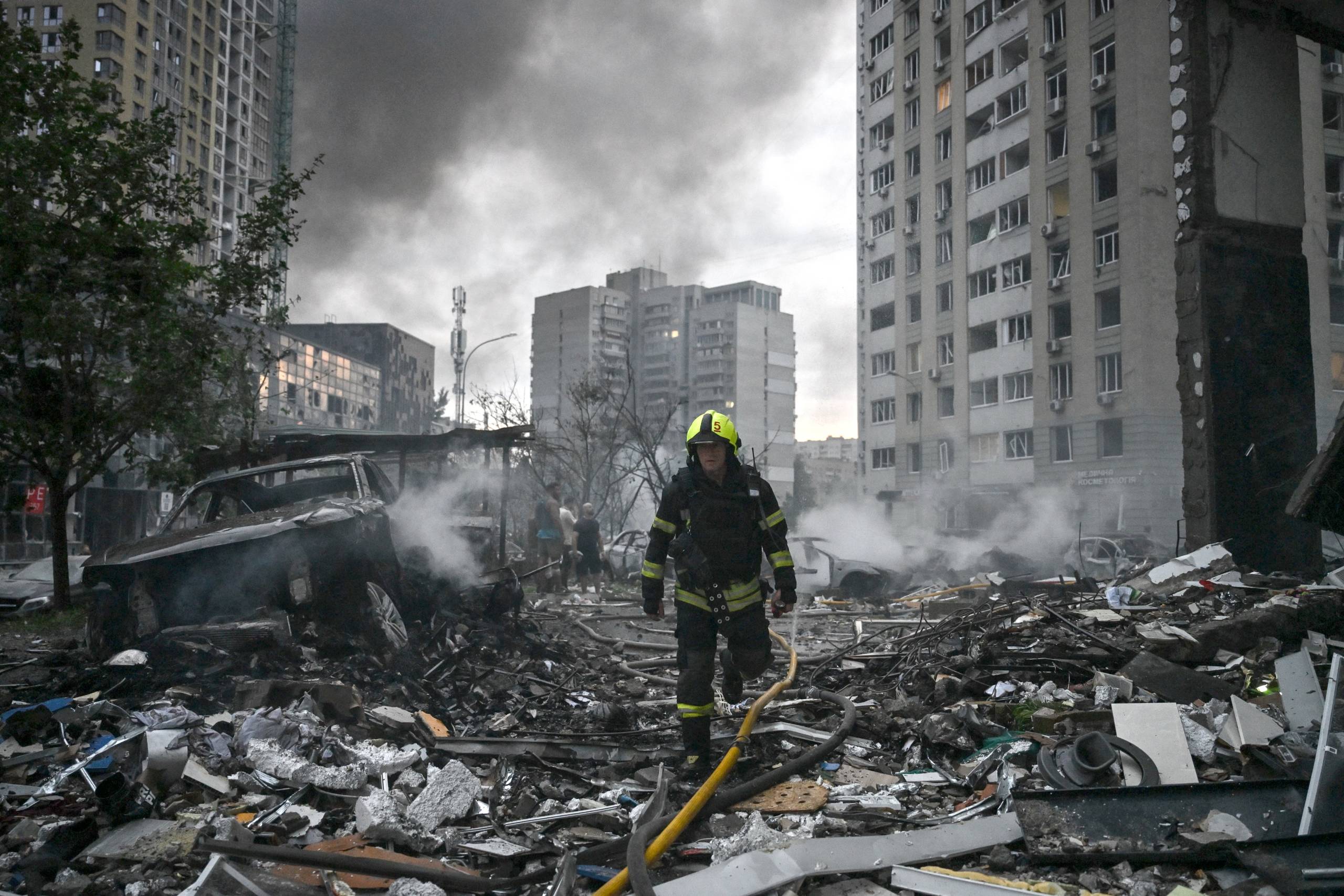
A rescuer walks through the rubble outside a multistorey residential building damaged following a Russian missile strike on the Ukrainian capital of Kyiv on July 6, 2026, amid the Russian invasion in Ukraine. Russia struck Ukraine's Kyiv region with ballistic missiles on July 6, killing at least eight people and wounding dozens, authorities said, on the eve of a NATO summit in Turkey. (Photo by Genya Savilov / AFP via Getty Images)
This partial transcript was computer-generated. While our team has reviewed it, there may be errors.
Grace Won: Welcome to Forum, I’m Grace Won, in for Alexis Madrigal. When Russian troops rolled into Ukraine in February 2022, many thought that conflict would be short-lived. Ukraine would surrender, and Russia, with its awesome firepower, would prevail. Five years later, the war continues at a cost of more than a million lives, but now the tide may be turning in Ukraine’s favor as it continues to bring the war to Russia’s doorstep. On Monday, Ukraine hit Russian oil depots, crippling shipping in the Sea of Azov. Two weeks earlier, it launched a drone attack that hit Moscow. Russia has responded in kind, but many, including President Trump, have opined that Ukraine’s new aggression may be the way toward peace.
Here to talk about the current state of the conflict, how it has changed modern warfare, and the impact that it’s had on alliances, including NATO, we’re joined by Rose Gottemoeller, former deputy secretary general of NATO and a former undersecretary for arms control and international security at the State Department during the Obama administration. She’s now at Stanford University, where she’s the William J. Perry lecturer at the Center for International Security and Cooperation at the Freeman Spogli Institute for International Studies. She’s also a research fellow at the Hoover Institution. Rose, welcome to Forum.
Rose Gottemoeller: Thank you so much, it’s great to be here.
Grace Won: We also have Simon Shuster, a staff writer for the Atlantic Magazine, and he’s the author of The Showman: Inside the Invasion that Shook the World and Made a Leader of Vladimir Zelensky. Simon, welcome to Forum.
Simon Shuster: Thank you. Pleasure to be with you.
Grace Won: Simon, I wanted to start with you and the death of Senator Lindsey Graham, who died from a heart attack over the weekend. Graham was a vocal defender of Ukraine and had just returned from Ukraine hours before he died. Lindsey Graham seemed to have Trump’s ear when it came to Ukraine. What does his death mean for Ukraine and its relationship with the U.S., specifically the Trump administration?
Simon Shuster: Yeah, it’s a major blow. I talked to a few senior Ukrainian officials who interacted a lot with Lindsey Graham over the years during the war, and they all had trouble naming anyone on Capitol Hill who was more of a useful guide, a friend, a tough ally for Ukraine than Lindsey Graham. So they are now thinking about who could fill those shoes, especially when it comes to pushing for stronger sanctions against Russia — to put that additional pressure on Vladimir Putin to try to get him to come to the negotiating table and negotiate a peace deal in good faith. Lindsey Graham was really instrumental in doing that, and he actually sponsored a bill that would impose very severe sanctions on Russia last year. And those officials I talked to in Kyiv yesterday all said that they really hope that, partly to honor his memory, the Senate would push that legislation through.
Grace Won: Well, this morning, Senator Jeanne Shaheen from New Hampshire said that she’d like to see that bill passed. What’s in that bill, and why would that be such a great weapon for Ukraine against Russia?
Simon Shuster: Well, it would complement a lot of the drone and missile strikes that Ukraine has been launching at Russian energy infrastructure — oil refineries, and sites like that — because these sanctions particularly target the Russian oil industry, energy industry, Russia’s ability to sell its oil, and in so doing finance the war. The hope in Ukraine and among many of its allies is that if you apply that pressure and cut off Russia’s ability to finance the war, then Putin will have no choice but to sit down at the negotiating table.
Grace Won: Well, many will remember that the Trump administration has had, sometimes, a very tense relationship with President Zelensky, the president of Ukraine. Let’s hear from the White House conference between the three — Trump, Vance, and Zelensky — from last year.
JD Vance: And do you think that it’s respectful to come to the Oval Office of the United States of America and attack the administration that is trying to prevent the destruction of your country?
Volodymyr Zelensky: A lot of questions — let’s start from the beginning. First of all, during the war, everybody has problems. Even you — but you have a nice ocean, and don’t feel it now, but you will feel it in the future. God bless, God bless, you will not have a war. God bless, God bless you, you will not have war.
Donald Trump: Don’t tell us what we’re going to feel. We’re trying to solve a problem. Don’t tell us what we’re going to feel. I’m not telling you — because you’re in no position to dictate that. Remember that. You’re in no position to dictate what we are going to feel.
Grace Won: Well, that exchange last February resulted in the U.S. pausing all aid to Ukraine for a week. And now that Lindsey Graham is no longer with us, who in the administration, Simon, do you think will take up that role of being not only a whisperer to Trump, but somebody to help Zelensky navigate the Trump administration?
Simon Shuster: Honestly, I can’t think of anyone who really had Trump’s ear who could play the same role. Around the time of that clip that you just played, that really contentious meeting in the Oval Office, Lindsey Graham was trying to coach Zelensky about how to behave toward Trump and Vance in that meeting. And Lindsey Graham watched as it all went off the rails. So he was really instrumental in setting up that meeting and then trying to help the Ukrainians recover from it, with various overtures and offers to the Trump administration to try to get Trump interested again in helping Ukraine and supporting Ukraine. It worked eventually, but really that kind of role — there’s no one who has the trust in Kyiv and the ear of Trump who can really try to bridge those two administrations and make them work together effectively.
Grace Won: Rose, the war in Ukraine is now in its fifth year. And as we’ve talked, there’s some possible momentum on Ukraine’s part, but can you give us a quick explainer of the current state of play when it comes to the war itself? Where are the boundaries? Who’s winning? Who’s losing?
Rose Gottemoeller: Right. And wow, Grace, it’s still painful after all this time to hear that Oval Office exchange. It was such a bullying exchange. I do want to say, though, it wasn’t just this past February — it was February of 2025, and quite a bit of water has flowed under the bridge since then. And in particular, the momentum on the battlefield has shifted a considerable amount in Ukraine’s direction. And that is because of the really unbelievable pace of innovation that Ukraine has been able to achieve with its drone and missile developments. I think they are really leading the way now in terms of showing what defense innovation is going to have to look like in the future.
As soon as they develop a good offensive capability, the Russians develop defenses against it, and then the Ukrainians up their software game and come in with an improved offensive capability. So it’s a fast-moving cycle. The Russians have been pretty good at it as well, but the Ukrainians, I think, have led the way with that. And the effect of that, I think, has been to change a lot of attitudes around the world about who’s going to be able to win this war. In particular, we’ve heard recently, including at the NATO summit last week, President Trump being much more forward-leaning toward Zelensky himself, but also toward Ukraine and its ability to somehow prevail in this war. We still don’t know exactly how, but unlike February of 2025, when Trump said peremptorily to Zelensky, “You have no cards,” I think today Trump feels that Zelensky maybe does have some cards — and it’s really born on the back of Ukrainian self-reliance, but a good deal of assistance and aid, including from Washington, but also from other NATO allies.
Grace Won: And where do the boundaries lie right now between the two countries? What is Russia occupying? Where has it been beaten back, if at all?
Rose Gottemoeller: The two armies have been contesting a line of contact that runs through the Donbas. These are the four provinces in the eastern part of Ukraine, which Russia really began to contest back in 2014, after it seized Crimea. It seized some of the territories in the Donbas and has been pressing ever since. Putin says his basic objective is to achieve control over all four provinces in the Donbas and to control what used to be the industrial heartland of Ukraine, and really of the Soviet Union. One might think of it as a kind of rust belt, but there’s quite a bit of mining there as well, and heavy manufacturing too. It’s not the economy of the future, but it has been quite valuable in the past. So I think it has a special meaning in many ways for Putin, a child of the Soviet Union, and also just someone thinking about the future of Russian resource requirements, no doubt, as well.
But to make a long story short, they have been contesting this territory for a long time, and Russia has been pressing Ukraine for many months to take significant territory toward achieving control of the entire Donbas, but they have not been able to move — strictly, I think, because of the Ukrainians pushing back so hard and making a killing zone where the two armies are in contact, with the drone innovations I spoke about a moment ago. For that reason, Ukraine has been able to succeed in holding Russia, even with many fewer troops, and Russia, in some places, has even been pushed back in recent weeks from the territorial gains it had made.
Grace Won: Simon, you know, Ukraine has made incursions into Russia going back as far as 2024, but there seems, as Rose has put it, an elevation in what Ukraine has been able to do. Reading the press about it, the word “MacGyver” keeps being used to describe how the Ukrainians are able to get their drones not just in the air, but on the ground. Tell me a little bit about how the Ukrainian system is working. Is it organized? Is it systematic, or is this just battlefield innovation on top of battlefield innovation?
Simon Shuster: I think it’s a question of scale at this point. You know, the Ukrainians have been innovative from the beginning of the war in terms of MacGyvering together various components that they buy on the open market from China, strapping a mortar or a bomb onto them, and flying them into a Russian tank. That was all going on in the early months. What we see today, after more than four and a half years of war, is a real, massive industrial capacity to produce advanced, long-range drones at scale — thousands of them per day.
I visited a factory in February that makes some of Ukraine’s most successful long-range, deep-strike drones, and it was an incredible sight — just the scale of it, the size of it. And they’re able to continue this production despite the consistent threat from Russian ballistic missiles hitting some of these production facilities. Nevertheless, they continue to churn out thousands of long-range drones per day that are launched nightly, almost, in waves at Russia now. So it’s the scale, I think, that’s making the difference today on the battlefield and bringing the war home to Russia with these deep strikes.
Grace Won: We’re talking about the war in Ukraine, which is now in its fifth year, the innovations in modern warfare made by Ukraine and Russia, and how this is changing alliances across NATO and Europe. We’re joined by Simon Shuster, a staff writer with the Atlantic Magazine — he’s also the author of The Showman: Inside the Invasion that Shook the World and Made a Leader of Volodymyr Zelensky. We also have Rose Gottemoeller. She’s a former deputy secretary general of NATO and a former undersecretary for arms control and international security at the State Department during the Obama administration. She’s now at Stanford University.
We want to hear from you. What are your questions about the war in Ukraine? Do you have family or friends in Ukraine, Russia? How are they feeling about this war? What role would you like to see the U.S. take in this conflict? You can give us a call now at 866-733-6786. That’s 866-733-6786. You can email your comments and questions to [email protected], or find us on social media — we’re at KQED Forum. I’m Grace Won, in for Alexis Madrigal. More Forum after the break.