This partial transcript was computer-generated. While our team has reviewed it, there may be errors.
Alexis Madrigal: Welcome to Forum. I’m Alexis Madrigal. With a ceasefire in place that at least portends an end to the U.S. war in Iran, the world’s attention has turned to what the peace may look like. In the initial deal, the Strait of Hormuz would be fully reopened, and Iran would get a $300 billion reconstruction fund. But what about the longstanding issues? The U.S. has wanted a new regime in Tehran for decades. The U.S. has wanted to prevent Iran from getting a nuclear weapon for decades. The U.S. has wanted to decrease the influence of the Iranian regime throughout the region for decades. Did the war help attain these long-term goals, or has it returned us to something like the status quo ante?
Here to discuss the ceasefire, the ongoing negotiations, and the medium-term future, we’re joined by three experts. David Sanger, White House and national security correspondent with The New York Times. His most recent book is New Cold Wars: China’s Rise, Russia’s Invasion, and America’s Struggle to Defend the West. Welcome.
David Sanger: Great to be with you.
Alexis Madrigal: Yeah. We’ve also got Jonathan Lemire, staff writer at The Atlantic, who also serves as the co-host of the MSNBC show Morning Joe. Welcome, Jonathan.
Jonathan Lemire: Thank you so much.
Alexis Madrigal: And we’ve got Alan Eyre, a distinguished diplomatic fellow with the Middle East Institute, an expert in Iran, former senior U.S. diplomat who was a key member of the U.S. negotiating team for the 2015 Iran nuclear agreement. Welcome.
Alan Eyre: Thanks for having me.
Alexis Madrigal: So, David Sanger, catch us up on the status of this ceasefire between the U.S. and Iran. It feels to me like everything coming out has been confusing and contradictory. So where do we stand?
David Sanger: Well, if it sounds confusing and contradictory, that’s largely because it is. You may recall that more than a week ago, the U.S. and Iran agreed on a 14-point document, just a page and a half, very vague, very general. Only one of the paragraphs on it even referred to Iran’s nuclear program.
And that document was supposed to be the guideline, really sort of a table of contents, for a bigger negotiation that much more resembles, or is intended to resemble, what the U.S. did in 2015 when it spent 18 months—and Alan can tell you the story from the inside—negotiating what became the Obama-era agreement. It had the awful and awkward name of the Joint Comprehensive Plan of Action, or JCPOA, an acronym that only the State Department could learn to love.
Alexis Madrigal: Only superior to the JCPOS.
David Sanger: Yes. That’s it. And it was about 159 pages, laid out very specifically what Iran was required to do, what sanctions would get lifted at what times. It was really fully down in the weeds.
The document that was put out the other day and that the president signed at Versailles was anything but. The president has described this as a peace agreement. And as you saw, he actually called me Sunday night before last just to argue what a great breakthrough it was.
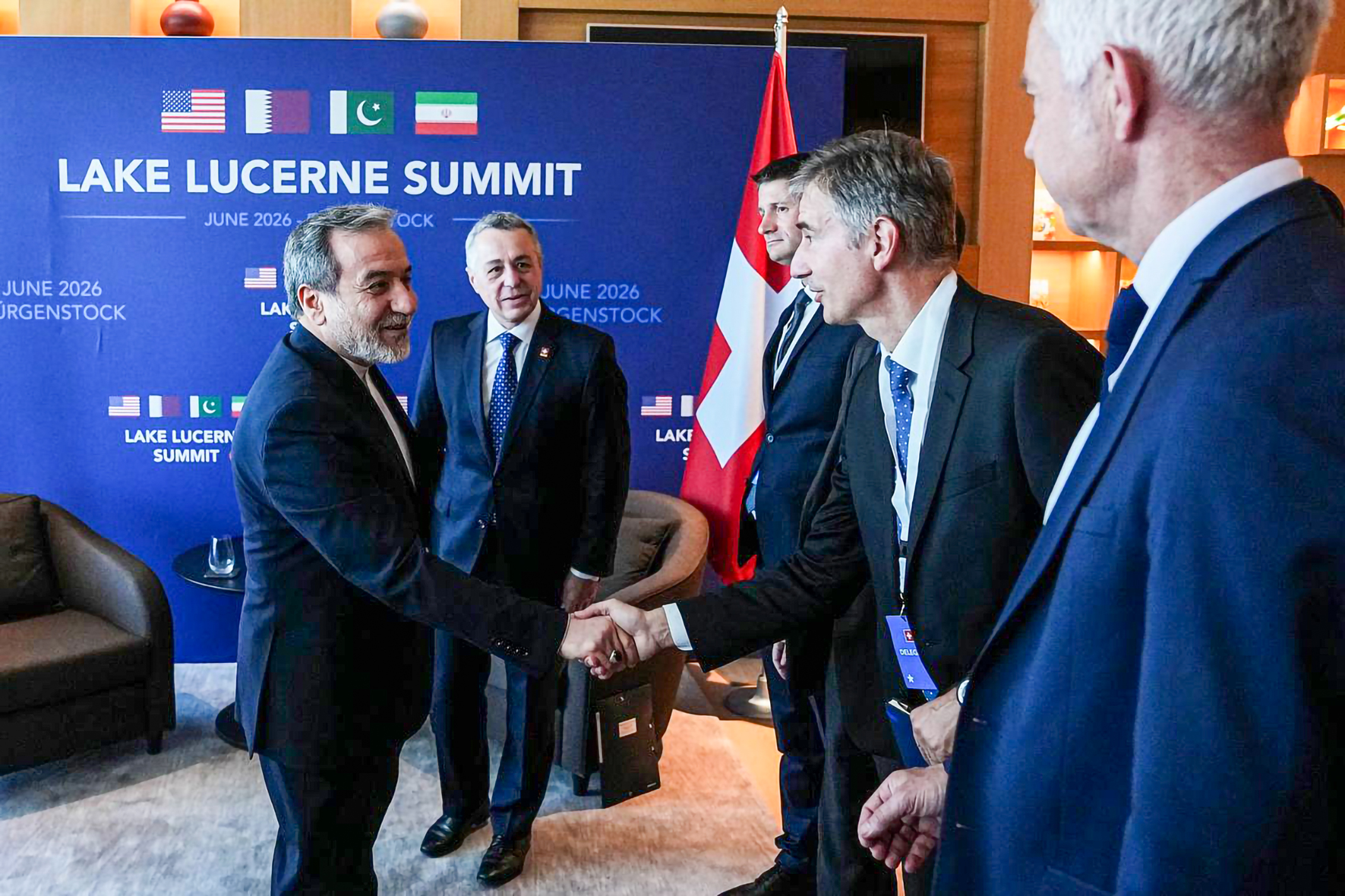
But what’s happened since is that, as JD Vance went to negotiate this in Switzerland, the Americans will come out and say, well, there’s been agreement now on allowing nuclear inspectors back in. And a few hours later, the Iranians say, well, no, there hasn’t. That topic barely came up.
Or the Americans will say, there’s been agreement now that we’ll unfreeze some funds, but they’ll go to buying U.S. farm goods for the hungry people of Iran. And the Iranians will come back and say, look, in your 14 points it says we can spend this money any way we want.
And in the interim, what this has accomplished is that the U.S. blockade has ended. Ships are beginning to move through the Strait of Hormuz. The Iranians are now free, having conceded nothing really at this point. They are free to go sell their oil on the world markets in dollars, which they haven’t been able to do in years, if not decades, which is bringing in—or should start bringing in—very large amounts of money to the Iranians, but also reduces to some degree the American leverage as they try to get to this agreement in the next 60 days.
And many experts, and I think Jonathan agrees, believe that 60 days will stretch to months or years.
Alexis Madrigal: Alan Eyre, is there anything in these 14 points or anything around these negotiations that you’ve heard so far that is new and good for the U.S. policy positions relative to where we were—not, you know, 2 weeks ago—but on January 1, say, 2026?
Alan Eyre: No. This is a massive strategic blunder. We’ve done irreparable harm to the region and to the globe and to the United States. But fortunately, this administration finally realized that when you’re in a hole, the first thing you do is stop digging.
So yeah, as David said, this MOU is very lopsided in Iran’s benefit. But again, there’s no international law here. This MOU is an invitation to the dance. What’s important now is what the two sides negotiate going forward.
No higher-level judge is going to punish the U.S. or Iran for violating the MOU. It’s purely a power relationship between the two sides. And unfortunately, in that, Iran has the upper hand because they can constrain, if not stop, maritime traffic through the Strait of Hormuz, which is the most important variable in this whole megillah.
Because Iran was not a nuclear threat before the war—an imminent nuclear threat. They had not sought to weaponize for a long time. Unfortunately, as a result of this war and our installation of a new, more radical, more militarized, less risk-averse, and more anti-U.S. regime, they might well seek a weapon.
That’s a problem that we’ll have to monitor. But the ticking time bomb here is maritime traffic through the Strait. So that’s beginning to increase.
My concern is that if there are bilateral talks between the U.S. and Iran, Iran will eat our lunch because the U.S. team, I don’t think, has the requisite expertise or inclination to do what’s necessary to get a deal that will—forget being better than Obama’s—as good as Obama’s.
Alexis Madrigal: Yeah. I mean, Jonathan, the other problem with the negotiations, it seems from the outside, is that there’s a lot of fractures within Trump’s team about Iran, about what’s happening, which sort of seems like it’s constraining the frontline negotiators and what they can actually do.
Jonathan Lemire: It’s remarkable in Trump’s second term when Republicans are willing to stand up to him and question his decisions. But we have seen that a few times, and most notably here with Iran.
There’s certainly some hawks—Senator Lindsey Graham among them, Ted Cruz, some outside voices like Mark Levin, the influential conservative radio host—who have been sharply critical of the decision to enter into this MOU, saying that Iran can’t be trusted.
Within the administration, there are those who feel—Secretary of State Rubio, Secretary of Defense Hegseth have voiced some concern—that Iran won’t uphold their end of the bargain.
But there are others in the White House who look, they can read a poll. They can read the sign on a gas station that says how high gas prices have been now for months. And they feel like this war needs to end because it’s taking such an economic toll, and it was in such a stalemate.
And then, of course, the other element of this is the third party to this war, Israel. Prime Minister Benjamin Netanyahu has received the focus of Trump’s wrath a number of times in recent weeks. Trump calling him extremely difficult and using far more colorful language than I can here, disagreeing with his assessment that the war needed to continue.
So all of that is clouding the picture of these negotiations, which, I agree with everything said so far, are really just, “Let’s agree to keep talking,” and all the thorny issues are yet to be addressed.
Alexis Madrigal: Yeah. You know, David, you mentioned the Strait of Hormuz and oil as being—or actually it was Alan who mentioned it as being the most important component of this.
When we’re looking at what’s actually happening in the Strait of Hormuz right now, this is what I’ve been most confused about because we’ve seen “open.” We’ve seen “closed.” We’ve seen ships are moving, according to reporting from some of your colleagues at The Times, David.
And yet we’ve also seen oil prices just plummet during this time back to 2024 levels. What do we know about how this is actually going to work under this new structure?
David Sanger: We don’t know a lot. I mean, what we heard from Secretary of State Rubio was that the goal here was to return things to the way they were in February 2026 before the war began.
And I just want to remind you, the closing of the Strait of Hormuz was not a cause of the war. It was a result of the war, right? Something that the Iranians had never done before—not during the American hostage crisis, not during the Iran-Iraq War, not during our cyber sabotage of their centrifuges in 2010 and 2012—but did it this time.
So the goal is to get back to where we were. The reality is we probably never will. And the reason for that is twofold.
First of all, the Iranians have discovered they have this superweapon, right? More useful than nuclear weapons ever are because you use nuclear weapons, you’re feeling great about it for about an hour, and then you know what happens. But with this, they can dial up and dial down access.
Second, the president said in his call to me that there would be no tolls permanently. But the agreement only holds off the tolls for 60 days while this negotiation is underway.
And the Iranians are already making it clear that, no, no, no, they don’t plan to impose tolls. But with Oman, which is on the other side of the Strait, they may begin charging for services. They haven’t explained what these services are.
Alexis Madrigal: Key services: letting you go through.
David Sanger: Right. And it may be keeping the Strait clear of mines. It might be an environmental fee. We certainly have that for transit on some waters, right? Keeping the waters clean and so forth.
But whatever it is, you’re going to need an E-ZPass.
Alexis Madrigal: We’re talking about the situation in Iran, the status of the peace deal between the U.S. and that country. We’ve got David Sanger of The New York Times, Jonathan Lemire of The Atlantic and MSNBC, and Alan Eyre, distinguished diplomatic fellow at the Middle East Institute.
We’re taking your questions, concerns, and comments about the Iran deal too. 866-733-6786. That’s 866-733-6786. [email protected].
We’ll be back with more right after the break.