This partial transcript was computer-generated. While our team has reviewed it, there may be errors.
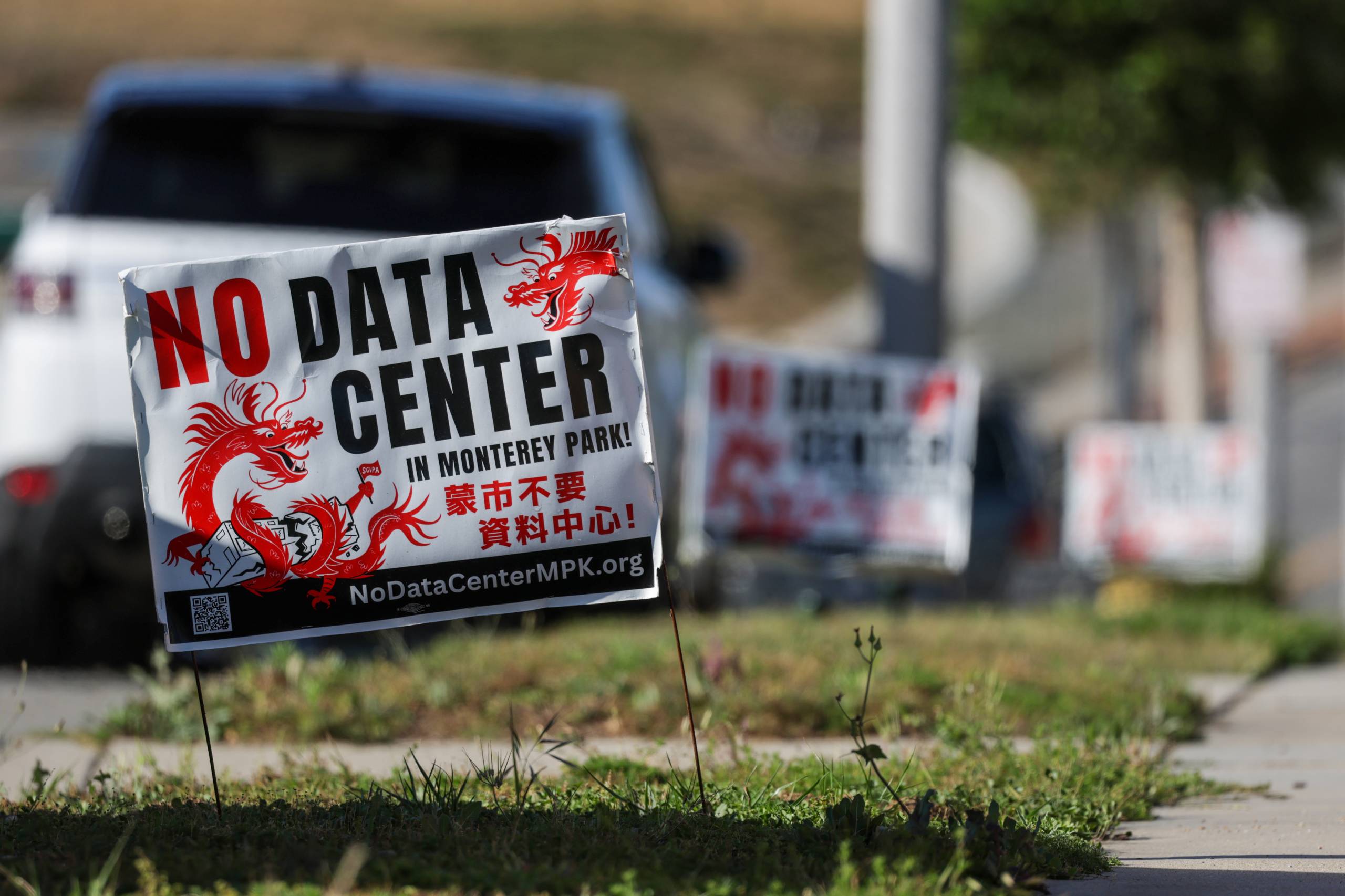
Alexis Madrigal: Welcome to Forum. I’m Alexis Madrigal. Americans, despite roughly half of us now using AI chatbots, are very wary of artificial intelligence. Polling shows that many people are worried about what AI will do to them personally, their work, and society at large. One area where those anxieties are coming out is in opposition to the massive data center building boom.
Here locally, Gilroy’s situation has grabbed headlines, with major opposition to the project showing up late but strong. Here to update us on what’s been going on down there, we’re joined by Britt Smith, a Gilroy resident, activist, and cofounder of Stop Gilroy Data Center. Welcome, Britt.
Britt Smith: Hi. Thank you so much for having me.
Alexis Madrigal: A way I understand it, Amazon started construction on a 436,000-square-foot data center last December. How did you actually hear about it, and how did you get involved?
Britt Smith: Yeah, that’s correct. So initially, even before it was the construction of a data center, Amazon had approached our town about developing a distribution center. Around December 2025 and January of this year, there were some conversations on our community Facebook pages asking about the status of this project. It was around the time that some fencing started to go up around the perimeter of the construction site.
Through some of those grassroots comments from my neighbors, I got very curious and started doing some digging. That’s when people really started to learn that this is now a data center, which is a very different use case than the distribution center that we were initially told about.
Alexis Madrigal: And the documents for all this stuff have been public, right, on city council records and things. But there weren’t large meetings or notices. What has actually gone out from the city government and Amazon to residents?
Britt Smith: Yeah, that’s a great question. Based on our ordinances here in Gilroy, which were last updated in 1981, the way that this process was approved was at the city staff level. Under no circumstances was this going to go before city council, any of the planning commissions, or really even have more of a public forum than what has been legally required for that type of use case.
What I found particularly interesting is that there are two signs up outside of the construction site that very loosely detail the scope of the project, but there really isn’t a lot of strong information. There could have been a QR code to learn more and point people to the city site.
Another issue I take is that the signage is not really accessible. The signs are at active intersections, and they’re only available in English. We know that I believe it’s something like 40% of our community primarily speaks languages other than English at home. I think there’s an accessibility issue with the information. Even if it’s available online, I think a lot more could have been done to bring it to the community.
Alexis Madrigal: Had you personally ever been involved in efforts like this, or is this kind of a new thing for you?
Britt Smith: This is a new thing for me. I grew up in Gilroy. I went to Gilroy High School and was part of leadership and tried to be involved in the community in that way. Then, when I moved back after my education, I heard the conversations that were going on with my neighbors and thought there’s a chance here for us to do something different, a chance for people to be more involved, and a chance for the information that’s going on around and at City Hall to be brought back out into the community.
Gilroy is pretty similar to a lot of communities in the Bay Area around the fringes of Silicon Valley, where most of our community is commuting to help grow the businesses in Silicon Valley. I think when people get home at the end of their long day, they are hoping that their city council and city government will be doing a little bit more to meet them where they are, as opposed to expecting all the onus to be on the citizens.
Alexis Madrigal: That’s interesting. If you have to reach back to student council in high school, you’re not a lifelong activist. For you, does this have to do with AI per se, or is it this data center itself that’s really driving your opposition? Or both?
Britt Smith: I’d say it’s a bit of both. But considering Gilroy’s agricultural history, for me and a lot of folks around town who are raising the flag on this, it’s really about the resource constraints.
Aside from the water usage, Amazon has told us that recycled water will be used at this facility. However, there’s no infrastructure yet to transport treated water from the Gilroy plant to the new data center site. It’s really unclear when that would even be constructed or go live.
Aside from that, we already have a constrained power grid. With PG&E, we have frequent outages in the South Bay. I believe it’s something like around two outages a month for customers served by PG&E. There’s already a lot of strain on our systems in this area, and I think adding something like a hyperscale data center with a lot of unknown variables in terms of usage adds a lot of concern for folks here in town.
Alexis Madrigal: Let’s bring in Hema Sivanandam, East Contra Costa County reporter for Bay Area News Group. Welcome, Hema.
Hema Sivanandam: Hi. Thank you. Good morning.
Alexis Madrigal: One of the interesting things is that this is going on down in Gilroy in the South Bay. You’re following this out in Contra Costa County. What’s going on out there in Pittsburg?
Hema Sivanandam: In Pittsburg, just to give a little background, it started in 2018 when the Delta View Golf Course shut down. That’s where this particular data center is being proposed, on 76 acres of the site and in three different phases.
Phase One was approved by city council in 2024. During the most recent meeting in June, city council had so many people coming in who were unhappy, frustrated, and angry because they felt they were caught off guard. They don’t want a data center because they are very worried about resource constraints and what the environmental and health implications would be. That’s what’s happening in Pittsburg in a nutshell at the moment.
Alexis Madrigal: Have you ever seen a turnout at a Pittsburg city council meeting like the one you saw opposing the data center?
Hema Sivanandam: To be very honest, no. I started covering the area in 2024, and usually the meetings are pretty chill. But that day, a lot of people showed up—more than 80 speakers and hundreds of speaker cards were submitted.
It was a bit tense because people were, at one point, heckling and saying to city leaders, especially the mayor, “Why aren’t you looking at us? We are here. We are concerned about this.” So there was a lot of drama.
Alexis Madrigal: That’s fascinating, too, because if you keep going east—for those who aren’t familiar with this part of the Bay Area—you hit Antioch, and then you keep going and you hit Oakley, which is basically in the Delta at that point. Oakley is the first city in the Bay Area, I believe, that’s passed a moratorium on new data center building. Is that right?
Hema Sivanandam: Yes. They passed a temporary moratorium. At first it was for 45 days, and then the city was told they could extend it, which they have done.
Until 2027, the city is not allowed to take applications for any data centers while it works out what can be done regarding land use and data centers. The city is still working out the details and is expecting to hold joint workshops with the planning commission and city council to determine what guardrails can be put in place.
Alexis Madrigal: Britt, back to you. Stop Gilroy Data Center is in your organization’s name, but this thing has already moved past that point, right? What are you hoping to get from your activism? Do you think it can still be stopped? Do you want to see a moratorium like the one in Oakley?
Britt Smith: Yeah. I think when we started this, we used the word “stop” very intentionally, with the idea that there’s a lot of people power, a lot of momentum behind this, and a real chance for our community to make change.
That being said, you’re totally right. Ground has been broken on this site. There are crews out there as we speak, and this project is off to the races.
But I do hope that, at least at this point, while the city doesn’t really have a path forward to stopping what’s underway, it can implement an oversight committee made up of local citizens, business owners, and people who are interested in the project. The goal would be to create guidelines and processes for reviewing the commitments Amazon has made to our city and ensuring that they are followed through on.
The other piece is making sure that something like this doesn’t happen again. We do have some members of our city council who are looking to amend our ordinances specifically to account for projects of this scale. While there aren’t any projects like this currently in the pipeline, I think it’s important to recognize that this community does not want a data center. If we are going to have one, it should be very closely monitored.
It would be in Amazon’s best interest to work closely with us and listen to us going forward. We also want to make sure that the resources we have in South County are reserved for the people of South County, not equipment and infrastructure that we’ve done fine without for this long. It’s important to respect our agricultural roots and the will of the people at this point.
Alexis Madrigal: Britt Smith, longtime Gilroy resident, activist, and cofounder of Stop Gilroy Data Center. Thanks so much for joining us.
Britt Smith: Thank you so much for having me. I appreciate it.
Alexis Madrigal: We are still joined by Hema Sivanandam, East Contra Costa County reporter with Bay Area News Group. We’re talking about the data center boom, how it’s playing out in the Bay Area, the opposition to it, and the forces behind it.
We want to hear from you. What are your questions and concerns about data centers? Do you have thoughts about a proposed data center in your community?
You can give us a call. The number is 866-733-6786. That’s 866-733-6786. The email is [email protected]. You can find us on social media—BlueSky, Instagram, and Discord. We’re KQED Forum.
I’m Alexis Madrigal. Stay tuned for more right after the break.