This partial transcript was computer-generated. While our team has reviewed it, there may be errors.
Grace Won: From KQED, welcome to Forum. I’m Grace Won, in for Alexis Madrigal.
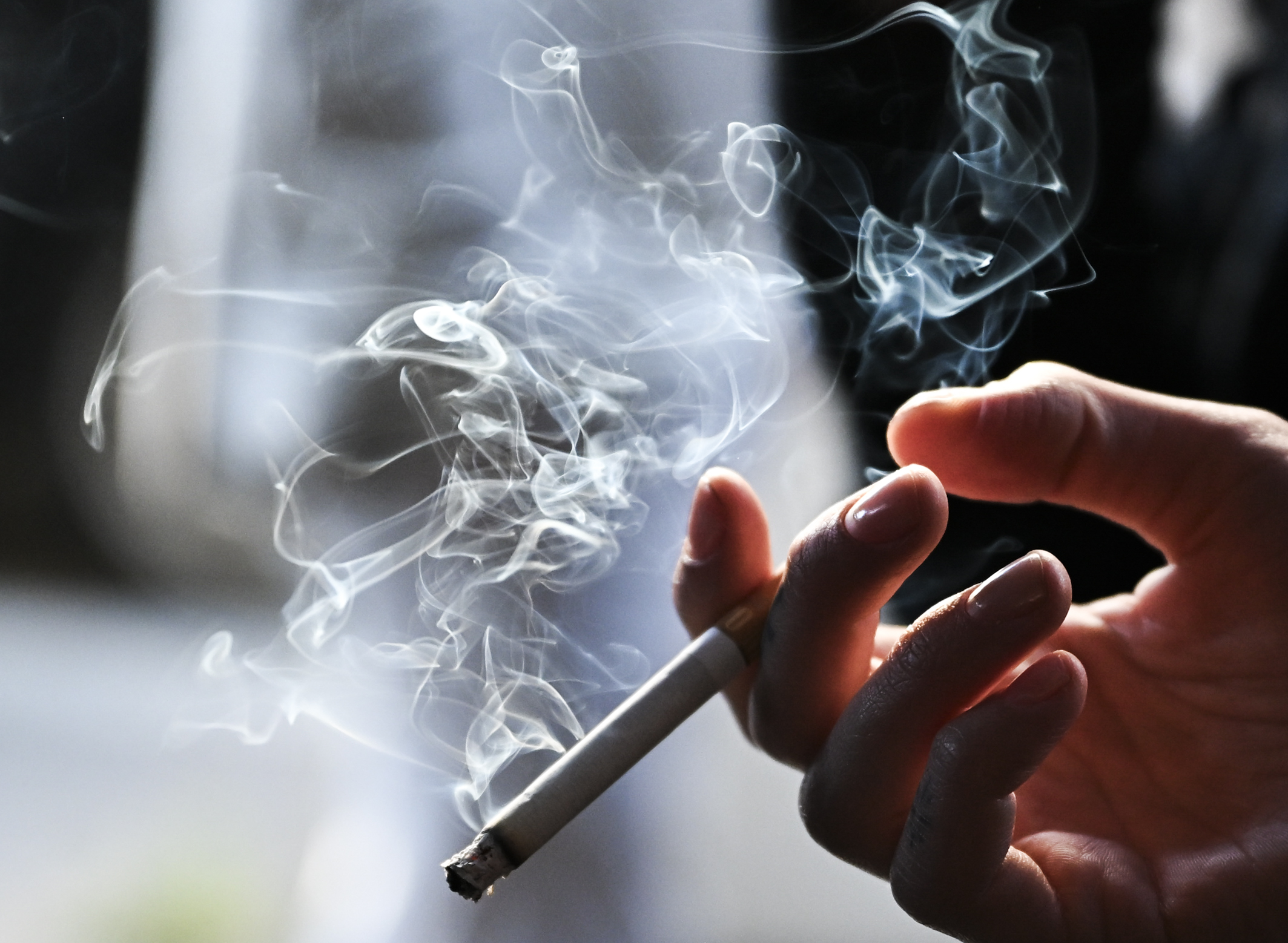
Smoking is creeping back into the zeitgeist. On film, TV, and social media, folks are casually lighting up as if they’ve never seen a surgeon general’s warning. There’s Dakota Johnson taking a drag in the film Materialists. There’s the girls of Girls maniacally lighting up. And in the Hulu series Love Story — which tells the tale of JFK Jr. and Carolyn Bessette — whatever else may or may not be based on truth, one thing resonated: people smoked a lot in the nineties.
In fact, half of all films released last year included scenes featuring smoking, a ten percent increase compared to 2023, according to researchers. And it’s not just in media — it’s real life too. As the social media account Sigfluencers documents, people, particularly young people, like to smoke. While smoking rates among young people are at historic lows, there seems to be a shift in the social acceptability of cigarettes.
To talk about this rise in cigarette popularity, we’re joined by Kevin Truong, business editor at the San Francisco Standard, who co-wrote the piece “They Know What Kills You. Gen Z Is Smoking Cigarettes Anyway.” Welcome to Forum, Kevin.
Kevin Truong: Thank you so much for having me.
Grace Won: We also have Degen Pener, a journalist who wrote a piece for The Anchor called “Cigarettes Get a Sequel: Hollywood’s Cool Habit Is Back.” Welcome to Forum, Degen.
Degen Pener: Thank you. Good morning.
Grace Won: And we have Dr. Pamela Ling, professor of medicine at UCSF and director of the UCSF Center for Tobacco Control Research and Education. She studies tobacco industry marketing strategies that target young adults, women, and other high-risk populations. Welcome to Forum, Dr. Ling.
Dr. Pamela Ling: Hi. Thanks for having me.
Grace Won: Kevin, let’s start with you. For your piece, you and your colleague Lawrence Sario ventured out into the, quote, tobacco-scented night to see what was up. What did you find?
Kevin Truong: We spent a lot of time on sidewalks and bar patios over the course of that night. What we were really trying to understand was how much knowledge Gen Z has about the public health impacts — and their own personal health risks — from smoking, and what’s driving them to smoke in the first place. What we found is a kind of general sense of youthful invulnerability that I think a lot of us had in our twenties, but also what we called in the article a sort of soft nihilism. A lot of people made the argument that the world is kind of collapsing around them, so why not light up a cigarette?
Grace Won: That seems like the least of all our problems. Right?
Kevin Truong: Exactly what they said.
Grace Won: One of the people you spoke to said, “Indie sleaze is back.” What does that mean?
Kevin Truong: It’s funny that I’m on KQED explaining indie sleaze. But it’s basically an aesthetic from the early 2000s — it wasn’t really called that at the time — exemplified by bands like The Strokes. A little bit punk, a little bit trashy. Kesha is another example of that aesthetic. A lot of the people I talked to wanted a return to that look and feel, and cigarettes and messy hair are part of it.
Grace Won: A little Charli XCX brat summer. Is that accurate?
Kevin Truong: Exactly.
Grace Won: The people you spoke to may have been aware of the health risks, but there was a lot of — as you said — I’m not going to worry about something that’s going to kill me twenty years from now. Is that the soft nihilism you’re talking about?
Kevin Truong: Yeah. And there’s also a kind of rationalization at work. A lot of the cigarette smokers I spoke to actually looked down on people who vape. One person told me, in a joking way, that cigarettes are “vintage vapes” — and they were also wearing a lot of vintage clothes, so I suppose it fit. There were also some dubious scientific theories floating around. One young woman, around twenty-two, told me smoking is better than drinking because she only smokes in moderation, as opposed to having a couple of drinks. Though we should be clear — smoking in any amount is dangerous to your health.
Grace Won: Yes — that’s what Dr. Pamela Ling is here for. But Degen, you’re based in LA, and smoking seems to be a feature of a certain Hollywood scene. As you note in your article, where there’s smoke, there’s smoking. What attitudes did you find in those circles?
Degen Pener: People see it as a way to connect. There’s a big social aspect to smoking, especially going out to bars right now. A lot of these young people in their early twenties missed out on time with others because of the COVID pandemic. Bumming a cigarette and starting up a conversation is an easy way to connect. That’s how they see it.
Grace Won: Asking someone for a light feels like a safe way to meet someone new.
Degen Pener: Exactly. And there is that sense of invulnerability too. A lot of the people I spoke to — I went out to bars, talked to people outside and even inside one bar in LA that has an exemption allowing smoking on its patio, which is rare — said they’re just going to keep it to social smoking. Which I think is a bit of denialism about how addictive nicotine can be.
Grace Won: It used to be that smoking wasn’t socially acceptable, and there seems to be a tension in your piece. Some people didn’t want their names used — they wanted to talk about their smoking habits but stay anonymous. And Kevin, in your piece, people seemed much more open about it. Degen, did you find in LA that most people didn’t want to be identified talking about their smoking?
Degen Pener: There were probably a couple of people I could have pushed a little more who might have given me their names. But a couple of people said, oh, I work at this talent agency, or I work at this animation studio — and because of that, they didn’t want their names out there. When you work at a high-profile company, you probably need to get approval before talking to a journalist.
Grace Won: Let’s talk about the way smoking is being depicted in film and TV. I mentioned Love Story, which takes place in the nineties and features a lot of smoking. Have you noticed any shifts in how smoking is portrayed in media?
Degen Pener: There have been a lot of shifts. A lot of people talked to me about how glamorous they found Carolyn Bessette smoking in Love Story. I was also struck to see cigarettes being used as signifiers of cool in fashion magazine shoots — in Interview Magazine, for instance, and I believe there was Kylie Jenner on the cover of Vanity Fair, boldly lighting up right on the cover. That felt like a shock wave when it landed a few months back.
Grace Won: What’s the idea behind it? Is it to shock people, or to document a current trend?
Degen Pener: I think there’s a rebellious streak to it — a “don’t tell us what to do” attitude. But I did go back to a couple of the people I’d spoken with and asked them about the rebellious and nihilistic angle, and they pushed back on that framing, at least in LA. They said the social aspect is what matters most to them — and looking cool.
Grace Won: Of course, looking cool. But cigarettes aren’t cheap — a pack in San Francisco runs about twenty dollars. And Kevin, it’s interesting to me that it’s still socially acceptable to ask someone for a cigarette, but you’d never just ask a stranger for a dollar, which is basically what a single cigarette costs.
Kevin Truong: The ritual of asking for a light is something I observed — that way of striking up a conversation has persisted across decades. You wouldn’t ask someone for a dollar, but asking for a cigarette carries a different social currency. A lot of people emphasized to me this idea of it being a shared social experience — you take out a pack, or your friends have one, and you end up making an entirely new group of friends over the course of the night.
Grace Won: Degen, one thing that surprised me — maybe it shouldn’t have — is that some people in Hollywood who built their brands around health and wellness, like Gwyneth Paltrow, aren’t afraid to light up. You mentioned a launch party for one of her brands. What were they giving out?
Degen Pener: They had cigarettes on trays at a launch party for her fashion brand, Gwen. There was also a fashion brand called Dôen that co-sponsored a benefit for Planned Parenthood in Hollywood, and they had cigarettes on trays as well.
Grace Won: Naturally.
Degen Pener: Right? All makes sense. And there was another brand called Khaite — K-H-A-I-T-E — that had branded cigarettes in a Marlboro-style box as a party favor.
Grace Won: Kevin, how much is nostalgia playing into the idea that smoking is cool?
Kevin Truong: It’s a big part of it. You mentioned Love Story and the glamorization of the nineties — and even something like Mad Men, which is basically half smoking across its entire run. When I talked to Gen Z smokers on the streets of San Francisco, a lot of them mentioned a nostalgia for something they never actually experienced, which was interesting. They wanted to return to something that felt pre-COVID — which was genuinely traumatic for their generation — and pre-smartphones. One person talked about she and her friends doing something they called “going nineties,” which will be alarming to people who actually lived through the nineties: they’d leave their cell phones at home, take out a pack of cigarettes, and go out for the night. There’s something in that about returning to a more in-person social experience, before social media started inundating them with messages.
Grace Won: Degen, you also found someone who compared it to vinyl records — going analog.
Degen Pener: Exactly. He said it was like having vinyl. And then one of his friends said she saw vapes as smoking a machine — something digital that nobody actually wanted — and said they’d go back to the real thing. To cigarettes.
Grace Won: We’re talking about cigarettes making a comeback, and why young people are picking up smoking again despite all the public health messaging. After the break, we’ll bring in Dr. Pamela Ling to talk about why that messaging is more complicated than it might seem. We’re joined by Kevin Truong, business editor at the San Francisco Standard, Degen Pener, journalist, and Dr. Pamela Ling, professor of medicine at UCSF. We want to hear from you — are you seeing an uptick in smoking among young people? Call us at 866-733-6786 or email [email protected]. I’m Grace Won, in for Alexis Madrigal. More Forum after the break.