This partial transcript was computer-generated. While our team has reviewed it, there may be errors.
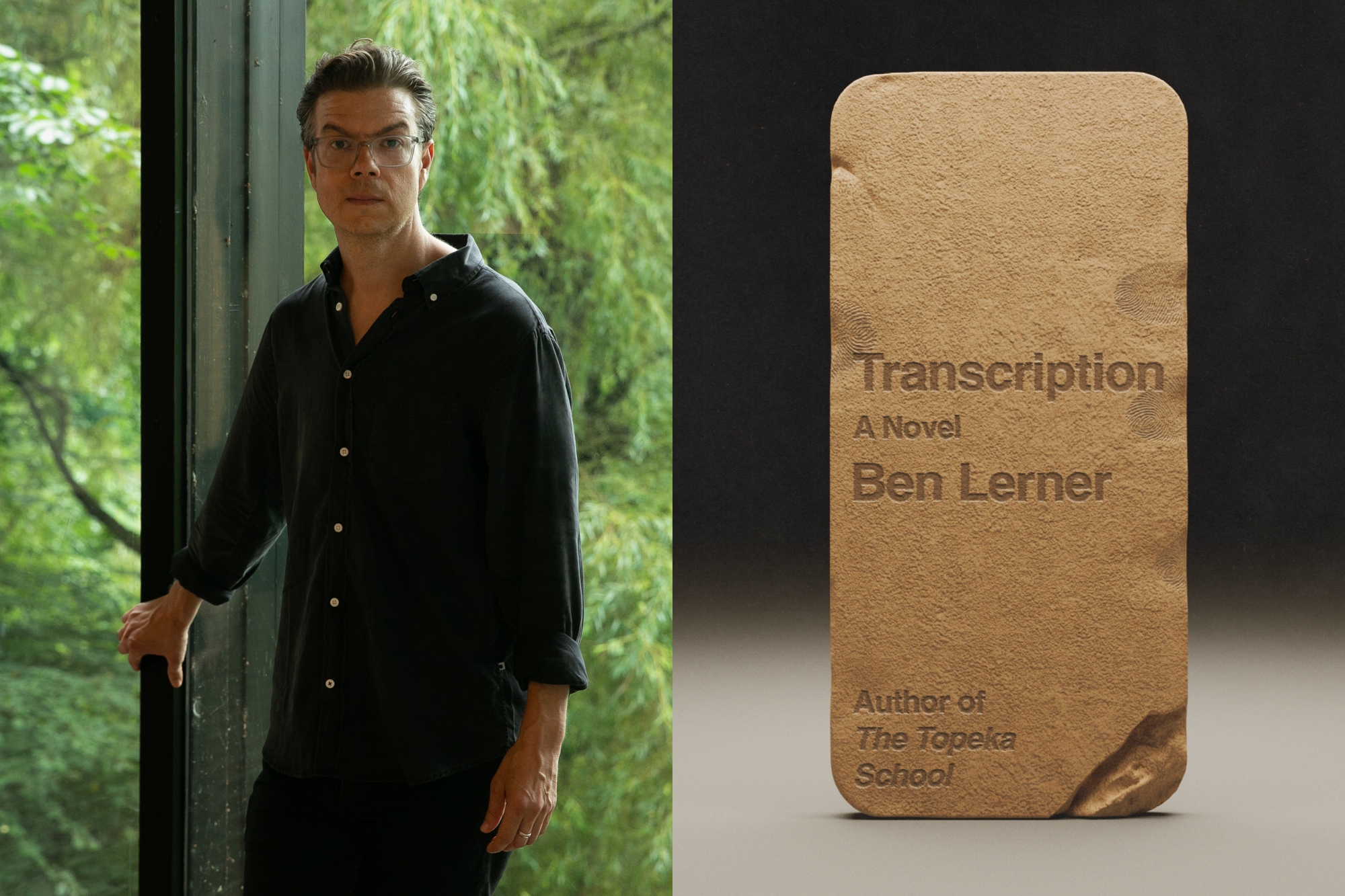
Alexis Madrigal: Welcome to Forum. I’m Alexis Madrigal. What can a novel be made of? Does it have to be grand in scale, or is there enough in a few small moments of daily life, filtered through the right consciousness, to transport and transform? Novelist and poet Ben Lerner’s latest novel, Transcription, is intentionally slim, circulating through the narrator’s experience interviewing his elderly mentor. The action is incited by the most prosaic of actions—knocking his phone into a sink full of water—but the world that swirls out of this broken device is powerful and enchanting. A novel in three moments and 100 pages doesn’t feel like it should have this weight, and yet that’s all Lerner needs to plunge us deep into the minds—some part of me wants to say souls—of his main characters and their anxious children. Maybe we should all throw our phones in the ocean.
In the meantime, Ben Lerner joins us. He’s the author of the books Leaving the Atocha Station, 10:04, and The Topeka School, which was a finalist for the Pulitzer Prize. The new book is Transcription. Welcome.
Ben Lerner: Thanks so much for having me.
Alexis Madrigal: So when’s the last time you broke your phone?
Ben Lerner: I think I totally broke it a couple years ago, but it’s always in some state of disrepair. It’s a very cracked screen that puts little pieces of glass in my thumb every time I scroll.
Alexis Madrigal: Do people tell you, “You need a case”? You need, like, a heavy-duty case?
Ben Lerner: Yeah. My daughter is scandalized by the state of the phone.
Alexis Madrigal: Yes. Do you feel that you can remember a moment before phones? Can you remember what it was like to be a person at that time?
Ben Lerner: That’s a really good question. I do think that it makes a big difference to have spent formative years before they were invented. I think, for a writer in particular, it matters a lot to have had a long time where the book—I mean, sure, I had TV and early Nintendo—but I got a good stretch where the book was the dominant medium for me.
Alexis Madrigal: The mobile entertainment?
Ben Lerner: Yeah, right. The little paperback you could carry around that was portable to read on the train or whatever. But I definitely remember the time before phones now in this kind of dreamlike way. How did we make a plan? What was our capacity for attention? How often were we bored, and what kinds of activities did we develop that were sponsored by that boredom? I remember it, but it’s dreamlike, and it’s increasingly difficult to recollect.
Alexis Madrigal: One thing I hear from writers occasionally is the sense that cell phones kind of ruined the idea of fiction because they make all these things that should take time for information to traverse between characters instantaneous, and therefore make it difficult to have the sort of selective and drawn-out narrative in which people find things out at different paces.
Ben Lerner: I think there’s a real attention crisis produced for us as readers that comes from how much we’re habituated to the small fragments of information that the algorithm delivers—the low-level addiction, or not even a low-level addiction, the total addiction to that kind of dopamine hit in 2-second increments. That’s real. It’s a crisis in reading. Maybe we’ll talk about attention more.
But I have to say, the novel as a technology is really great at depicting how new technologies change our experience of space and time and each other. The novel was an old technology that’s really great at depicting how new technologies change our experience of space and time and each other. So cell phones entering the—
Alexis Madrigal: Predating the phone, yeah.
Ben Lerner: Oh, yeah. The novel of all novels for me is Proust, and there’s no scene in literature more powerful than when Proust first has an experience of talking on the phone with his grandmother. When he first hears his grandmother’s disembodied voice, she’s suddenly grown old, and he rushes back to try to close the distance that’s opened up between them.
It’s a scene that’s totally new. The phone was totally new, but it’s also very ancient because the disembodied voice is like hearing a ghost or a god. The novel is good, just in general. I think the novel is a really good technology at capturing what’s new and what’s ancient about changes in the media environment. So while there are all kinds of things about cell phones that worry me, I actually think they make the novel all the more important as a way to think about how these technological changes restructure our experience.
Alexis Madrigal: I love it, too, because I’ve read a lot of the history of technology and science and technology studies, and there’s a guy named David Nye who talks about how the technologies of the late 19th and early 20th centuries annihilated space and time. That’s how they put it in that field. But what does it feel like to have space and time annihilated? That’s the role of the novel.
Ben Lerner: Yeah, exactly. It’s how we register those macro changes in micro interactions—what it does to the way you court someone or mourn someone or whatever. And the political changes that come with the conjunction of political movements and new technological situations. Novels are really good at tracking all that.
I think the funny thing is there are some people who always want the novel to be the new thing. The novel has to be like the internet, or the novel should be made out of tweets or whatever. That, to me, seems like a dead end. For me, it’s actually the distance that the novel opens up, where we’re able to use the technology of the novel and its specific affordances to think about these very different technologies, like cell phones, that matter.
Alexis Madrigal: One of the things I think really works in this book is that the novel opens with the narrator on a train and then in a hotel room, having the daily interactions that people have with their partners through their phones.
Ben Lerner: Yeah.
Alexis Madrigal: The novel made me ask the question: When you’re describing new technologies, what do you decide to abstract and have just be, “He sent a message”? And what do you have be very precise? “He sent an iMessage. The blue bubble came up.” What’s the right level at which to get into the specifics of this technology?
Ben Lerner: That’s a really good question about the craft of writing a novel. I’m not sure how to generalize about it. I think part of why dropping the phone in the sink—the state of phonelessness—becomes the way to think about all the ways that dependency can be felt.
There are some little things that texture the experience that did make it into the novel, like the end-call sound effect on a FaceTime conversation with the daughter. Being left alone with the loneliness of the end-call sound effect in a hotel room seemed poignant and important for the experience, while other markers fade into the background.
It’s about selecting detail or letting detail disappear into habit, which is really a big part of composing a novel in general. I think you’re right that sometimes the lighter touch is what works. I wanted to write a novel that was about COVID in part, but the way that happens is not by necessarily having a big essayistic disquisition on masking. It’s just by very casually working in that the narrator sees his masked reflection in the glass of the train or whatever. Often it’s the lighter touch that lets a reader realize how these historical changes get rendered mundane and become part of the texture of everyday life.
Alexis Madrigal: I also liked when you mentioned that end-call FaceTime sound effect. The other thing I loved about it was there was no introduction to it. They’re saying goodbye—saying goodbye to his daughter, the narrator—and just, “Okay. Love you. Bye.” End-call sound effect.
Ben Lerner: That’s right.
Alexis Madrigal: The bluntness of the end of the call.
We’re talking about the things we can only notice about the world and the tech that fills it when our phone dies. We’re really talking about Ben Lerner’s latest novel, which is called Transcription. Of course, he’s a poet and novelist, author of several other books, including 10:04 and The Topeka School, which was a finalist for the Pulitzer Prize.
And we want to hear from you. When’s the last time you experienced a state of phonelessness? What did you learn from a time when your phone was broken, or you dropped it in a lake, or it was unusable? Did you gain a new sense of space or dependency? Give us a call: 866-733-6786. That’s 866-733-6786. The email is [email protected]. BlueSky, Instagram, Discord—of course, KQED Forum.
I’m Alexis Madrigal. Stay tuned.