This partial transcript was computer-generated. While our team has reviewed it, there may be errors.
Alexis Madrigal: Welcome to Forum. I’m Alexis Madrigal.
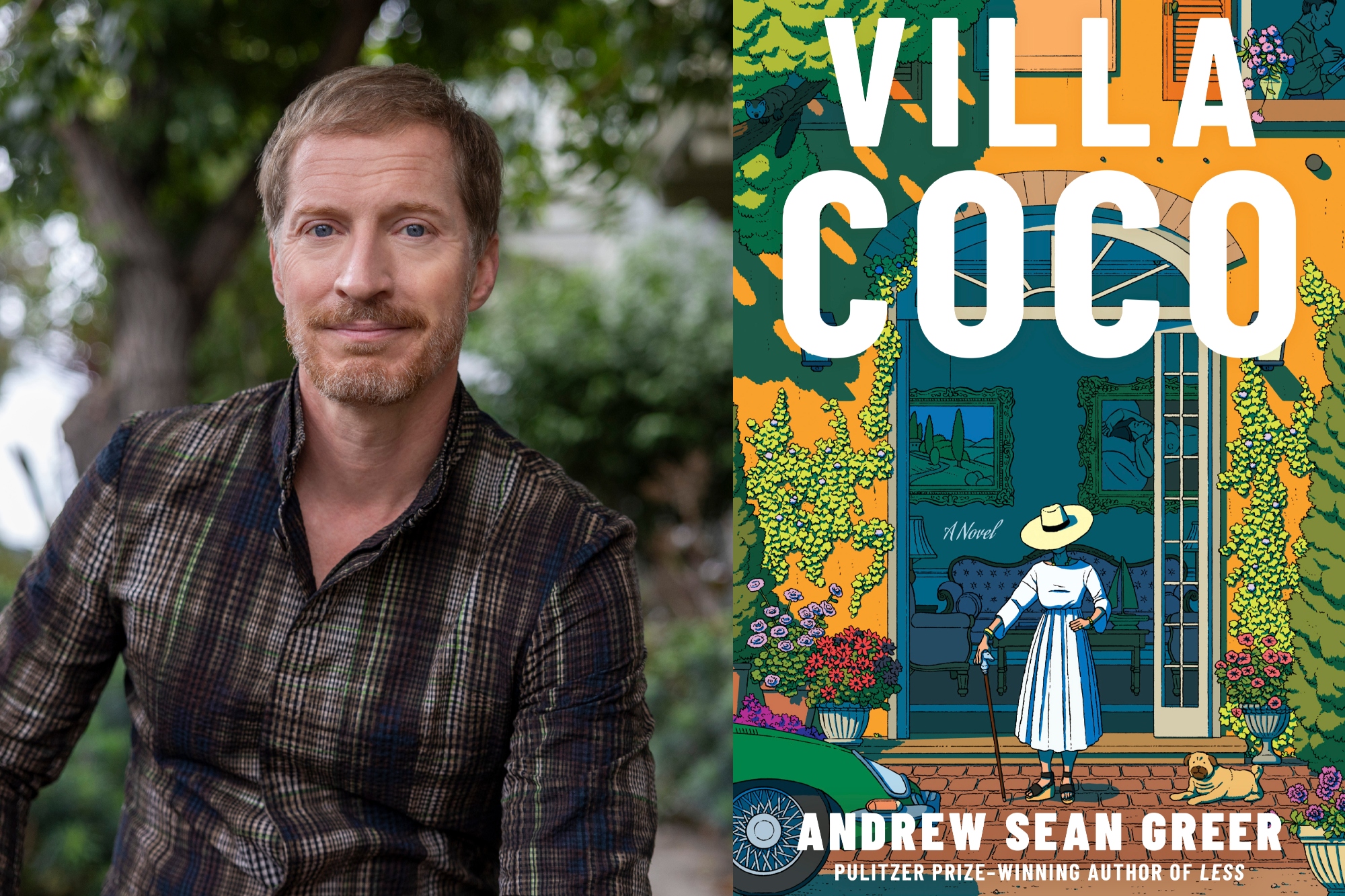
Before Andrew Sean Greer won the 2018 Pulitzer Prize for his novel Less, he was the executive director for a writers’ foundation based in Italy and sponsored by a Baronessa. It was a job he has compared to, quote, “running a bed and breakfast for maniacs.” That experience informs his latest comic novel, Villacoco, which centers on a young person adrift and, yes, a Baronessa.
This is sort of the Stanley Tucci of novels: small and elegant, funny and in search of pleasure. It’s in book form, and its author joins us this morning. Welcome to Forum, Andrew.
Andrew Sean Greer: Thank you for having me back here.
Alexis Madrigal: Yeah. So you have described Villacoco as a, quote, “charm novel.” What do you mean by that, and why did you want a novel that was charming?
Andrew Sean Greer: Well, I think I was looking around myself for something that would be sophisticated, but calming, and leave you with a sense of absurdity and hope and a sense of humor. I was thinking of Graham Greene’s entertainments or Mitford novels, and I thought, “Well, I guess I’m going to have to write one,” because those are all from the forties. So that’s what I did.
Alexis Madrigal: Yeah. I mean, it is not a romance novel in that it follows none of the genre tropes of romance. But those novels can have some of that feeling, just sort of with torrid sex scenes in between the charming parts.
Andrew Sean Greer: Yeah. I’m not much for torrid sex scenes—writing them, I mean. I’m all for them for everyone else. I’m too prudish. But I do think—and maybe I’m 1940s in that way—that charm comes from entering another world that is a romance, like a fantasy in a way, about what life could be if we didn’t read the newspaper every single day.
Alexis Madrigal: Tell us about the world that we enter into here.
Andrew Sean Greer: Well, our young man has just graduated from college. He’s an American, and he wants to take life seriously at last. He thinks a job in Europe is the perfect way to do that, which is foolishness.
Alexis Madrigal: What is Europe if not serious?
Andrew Sean Greer: Right? It’s old. They must be serious.
So he takes a job as an assistant. He’s not quite sure what the job is. He arrives, but he cannot tell where the villa is. There’s just an ivy-covered wall and a dusty road, and then a door opens in the wall, and there’s a sort of chaos of baskets and pots and pans inside that is kind of a view into the life he’s going to have.
Alexis Madrigal: So how familiar are you with this area of Italy? Right? I mean, this is rural Tuscany. This is not really tourist Tuscany. It’s some other part.
Andrew Sean Greer: Right. It’s not Chianti, the wine region. It’s really kind of rough, with bumpy dirt roads.
Well, I lived there. I visited for years and years, starting in 2005, and I lived there for two years. And you have to watch out for wild boar. You do not want to meet one.
Alexis Madrigal: And landscape-wise, it is the Tuscan countryside I’m imagining, right? Olive trees, sloping hills, some forest and field. It’s like that.
Andrew Sean Greer: It is all that. You’ve seen it in the background of Renaissance paintings over and over.
But we tend to ignore the forest part, and the forest is the fascinating part. It’s full of deer and boar and porcupines and all kinds of creatures that you have to live with.
Alexis Madrigal: Our young man in this novel goes on these glorious hikes through this countryside, and it gave you an opportunity to do some pretty serious nature writing. It felt like the changing of seasons in this part of Italy, as well as the flora and fauna.
Andrew Sean Greer: Well, I wanted to think about what people wouldn’t have seen if they were tourists.
Tuscany is pretty widely written about, and I thought, “People won’t have seen the approach of winter or late summer and how all of that changes.” Or how, in this forest, you see remnants of the old Roman roads that used to be there.
Even if you don’t feel like you’re in Florence itself or Rome, that history is all over the place, buried and tumbled down in the ivy and the honeysuckle and, later, the snow.
Alexis Madrigal: Yeah. You’ve had many jobs in your life, including one that was running this writers’ residency in Italy.
This writers’ residency is not normal. It’s been written up in The New York Times. Tell us about that experience and the Baronessa that you met in real life.
Andrew Sean Greer: I am not the only writer who went there with trepidations, wondering, “What in the world is this thing?” and then came away feeling that it was life-changing.
It is not an empty, Puritan space with just a chair and a place for you to write. You’re surrounded by art and objects from around the world. And at dinner, there’s this incredible person, Beatrice, who would lead everyone in conversation about topics of general interest—which is usually a fault.
Alexis Madrigal: Is that an Italian phrase you’re translating back into English?
Andrew Sean Greer: That’s right. I’m so caught up in the Italian language.
I always thought a dinner at a writers’ retreat with a Baronessa would involve the most important, deep conversations, but it was usually bawdy stories. That’s what’s of general interest.
Alexis Madrigal: It’s like The Decameron, you know?
Andrew Sean Greer: Yeah. Very much like The Decameron.
But I didn’t put any of the writers into this book, and I could never capture my Baronessa in all of her depth. So I invented a new Baronessa and a world in which I didn’t want to put in the writers’ private lives. Anyway, that’s too complicated for a novel. That will be for a memoir.
Alexis Madrigal: Although you did borrow some quirks, shall we say, from the real-life Baronessa.
One thing I noticed was that, in The New York Times profile of her, something happens if you put a hat on a bed.
Andrew Sean Greer: Yes. I had to put that in.
Alexis Madrigal: What happens? Are you cursed forever, or is there some way to deal with it?
Andrew Sean Greer: Someone’s going to die. That’s what’s going to happen.
Alexis Madrigal: If you put a hat on a bed?
Andrew Sean Greer: So it’s really dire. And the only way to fix it is to touch the testicles of the nearest man.
Alexis Madrigal: This is an actual real thing?
Andrew Sean Greer: Well, according to the Baronessa.
My Italian husband has never heard of that second part, but it definitely made it funnier. And I think that was the credo at the place where I worked: if it’s funnier, that’s how we’re going to do it.
Alexis Madrigal: Yeah. Yeah.
Let’s talk a little bit about this main character, this young man graduating from college. He shares a couple of your biographical details. We only get a couple of his biographical details.
How much was this sort of living back into the person you were at that time, and how much was imagining the perfect American from a suburban neighborhood and a two-parent home and all that kind of stuff?
Andrew Sean Greer: Some of his details I made my own because I wanted him, for purposes of the comedy, to be incredibly buttoned-up and serious. He’s an archivist.
I was raised by two scientists who believed in a very Newtonian version of the world, where everything works perfectly according to formulas. I thought, “Well, that’s perfect. I can give that to him.”
He can live where I lived in suburban Maryland, where he hasn’t seen very much of the world. From there, he just took off on his own.
Because if I’d made him myself, he would have been much more accident-prone, I think. He has more confidence than I did, and he makes some very wise choices at a very young age.
Alexis Madrigal: I loved the part where a person he becomes involved with in the book does an imitation of him as an American, which is all of his excited interjections:
“Wow.”
“Yeah.”
“What’s happening?”
That was me at that age, too, I believe.
Andrew Sean Greer: That is how my husband makes fun of me. He says I’m always saying, “Wow.”
No, “What’s happening?” is the funniest one to me because that’s clearly me in Italy saying, “What’s happening?”
Alexis Madrigal: Yes, because you now spend half your time in Venice, as I understand.
Andrew Sean Greer: I do. Of all crazy things, that’s where life has taken me.
Alexis Madrigal: Yeah. From suburban Maryland to Venice is actually a very good path, though, I think.
Andrew Sean Greer: I think I’ve done well.
At least, it’s a wonderful place to write, and it feeds into the fantasy, as an American, of what life could be.
Three years ago, I thought nobody lived in Venice. It’s like living in Sleeping Beauty’s Castle at Disneyland. Maybe you could get married there, but you can’t stay forever.
But you can. I live there.
Alexis Madrigal: Wow. That is amazing.
The era in which this book is set, I also think, is pretty important. The 1990s were a very different time. This was pre-9/11, pre-the long wars in the Middle East, and post-Cold War.
How do you think that informs the naivete of our young man as he approaches the grand old continent?
Andrew Sean Greer: I think those of us who were around in the early nineties didn’t feel like it was a time of innocence. It felt like we had to fight against this war and that war and all these political battles.
But looking back, it just seems like the sweetest time. It was the end of history. All problems were going to be solved.
Especially for a novelist, it was before the problem of having cell phones in a novel. They really ruin a novel. People can’t get lost. They can’t misunderstand. They can’t receive a message that means something else.
It’s wonderful not to have them—or email.
Alexis Madrigal: Yeah, right. I guess that’s true.
If narrative is about revealing facts in the right order or circumstances in the right order, cell phones make all of that instantaneous. It’s why there feel like so few good cell phone novels.
Andrew Sean Greer: Yeah. Well, I guess you can misunderstand on cell phones. We do it all the time.
But in this book, I got to have an important message reach the protagonist while he’s away from the villa. He misunderstands it, races home, and thinks something else has happened.
That could only happen with a crackly telephone conversation that cuts out.
Alexis Madrigal: Yeah. Yeah. Yeah.
Do you think that the people of this Italian villa saw the 1990s as anything special? Or was it just another decade in the millennia of this place?
Andrew Sean Greer: I’m sure it seems trapped, in this novel certainly, in a bubble of its own logic.
And also the place where I worked. Because things work in Italy not according to a schedule or a program the way they might in Sweden. Things are all done personally.
Every light switch turns on in a different way. Every toilet flushes using a different mechanism. Plugs are not identical throughout the house, and you need different adapters for different rooms for the same lamp.
That’s just because a different person fixed that plug long ago.
Alexis Madrigal: We’re talking with San Francisco writer Andrew Sean Greer about his latest novel, Villacoco. Greer won the 2018 Pulitzer Prize for his novel Less.
Of course, we want to hear from you as well. Was there an older person or mentor in your life who dispensed life-changing wisdom just when you needed it?
You can give us a call: 866-733-6786. That’s 866-733-6786.
You can also email [email protected].
I’m Alexis Madrigal. Stay tuned for more right after the break.