This partial transcript was computer-generated. While our team has reviewed it, there may be errors.
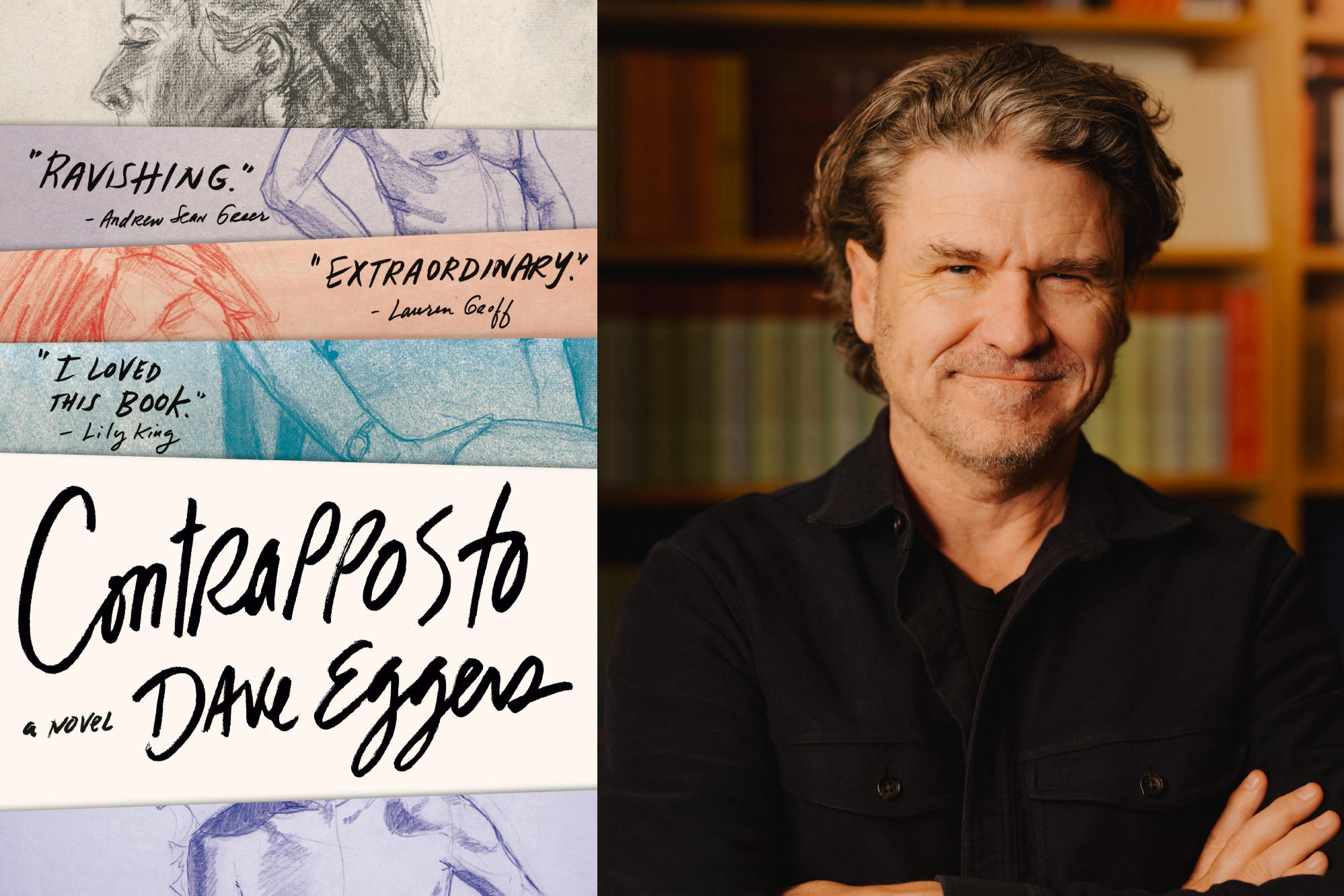
Alexis Madrigal: Welcome to Forum. I’m Alexis Madrigal. Dave Eggers’ latest novel, Contrapposto, is about artists. Yes, it’s about art, but it’s really about artists. Who’s an artist? And does it require that you — as we would have said in my school — can draw?
The novel revolves around the remarkable relationship between Cricket, a painter, and Olympia, an art world creature, who meet when neither is anything but a kid on the plains of Indiana. Over six decades, it follows their twists and turns as they try to figure out each other, what art actually is, and how an artist can make a living and make a life.
I savored this book, dipping into the world of these characters over the last couple of weeks, and when I finished it yesterday, I found my eyes filled with tears. I love a novel that reminds us how long life is and how powerful the persistence of being can be. Though all our biological parts might be replaced, the self remains — and is not diminished, but enlarged.
Dave Eggers, thanks for this book. Welcome to Forum.
Dave Eggers: Wow. Well done, Alexis. I can go home. That took care of it.
Alexis Madrigal: There we go. That’s it — it’s gonna be downhill from here. So, I know where the novel starts in the book. It starts in Indiana, a small town. But it also felt to me, as I went through this book, like it actually started for you somewhere else. Like, you encountered some artists with little bits of the main character Cricket in them. What scene did you actually write down first from this book?
Dave Eggers: Oh, that’s a good one. Yeah, I don’t write in order — I always write scenes just… I mean, I think it must have been ten, fifteen years ago, I wrote a scene that takes place when they’re in art school. And there’s a kind of brutal critique that happens that Cricket witnesses. I think that was it. I mean, I’ve been taking notes for this book for almost twenty years, and then I wrote that scene down maybe ten years ago. Then it took me a long time to build the rest of the novel around it.
They end up in art school, and where they think it’s going to be is this heavenly place — unicorns and rainbows and love, people playing guitar on the lawn — and it ends up being this hyper-competitive, kind of poisonous place. It comes as a shock to Cricket and Olympia. She’s much better at navigating it, and he basically flees.
Did you go to art school, Alexis? For a half a minute?
Alexis Madrigal: Yeah. I was mostly a journalism major, but I think for about a year I was a painting major. And growing up in Chicago, I’d take classes on summers and weekends at the Art Institute and places like that. I went to an academy and learned classical drawing. But I never really had the full art school experience.
Dave Eggers: Just enough to hate it.
Alexis Madrigal: Just enough to think there were parts that could be improved.
Dave Eggers: Over the years I’ve known so many people who did go to art school, and there are so many great things about it — certain schools especially. But you do hear from a lot of people who had strangely uncomfortable and miserable experiences in what should be the most joyful place. There is a better way to do it. In this book, there’s a character named Marcus Carpenter, a professor who offers an alternative. He has his own atelier out in the fields, and Cricket gravitates to him because it’s about craft, real teaching — there isn’t this overwhelming concentration on theory, and there’s no feeling that your success means my failure. That idea, which does pertain in some contexts, is really the strangest and worst idea of all time. It’s completely untrue.
Alexis Madrigal: Let’s have you read a passage — figure drawing is so significant in this book. Page seventy-seven, if you’re following along at home.
Dave Eggers: Okay. I’ll do my best. I don’t do my own audiobooks because I’m so bad at this.
Alexis Madrigal: Although the guy you did have do the audiobook — what a voice.
Dave Eggers: Dion Graham. He’s done all of my books for twenty years. He’s a real actor, a real artist. But I’ll try. This takes place in an academy. Cricket is taking a class.
“‘Let’s talk about measuring,’ Ms. Winter said.” She’s the teacher. “‘It all starts with that thumb of yours, the one you see artists sticking out toward whatever they’re painting. I want you all to extend your arm fully with your thumb up. Does anyone know why we extend our arm fully?’
‘Consistency,’ a woman in front of Cricket said.
‘Right,’ Ms. Winter said. ‘If you bend your arm, every time you do it, it will be a different distance. But with your arm fully extended, your elbow locked, you know it’s the same distance every time. This is about consistency and distances. Ratios, really.’
Instantly Cricket had a feeling of rebellion and loathing. The word ‘ratio’ felt like a slashing stab into the heart of everything he loved.
‘First, cover Rex’s face with your thumb. Sorry, Rex,’ she said, and Rex smiled indulgently.” Rex was the model. “He’d evidently gone through this demonstration with Ms. Winter before. ‘Everyone got it?’ she asked.
Cricket extended his arm and closed one eye, covering Rex’s face with his thumb.
‘Okay, now that’s your basic unit of measurement. Everything else on Rex will be measured in the number of Rex’s heads. How many heads tall do you think the rest of Rex’s body is?’
‘Five,’ a voice said.
‘Good. Anyone else?’
‘Eight,’ another voice said.
‘Closer,’ Ms. Winter said. ‘Now do it yourself. Take your thumb and go down the rest of Rex’s body and count how many heads it takes to get to the sole of his foot.’
Cricket guessed that the rest of Rex’s body could be no more than four heads, and wondered about the sanity of the person who had said eight. Then he lowered his thumb end to end until he got to Rex’s foot, and with each thumb-length he grew more surprised. Four heads took him only to Rex’s waist. It was three more until he got to his feet.
‘Seven,’ a man said.
‘Seven, eight. Right. Somewhere around there, depending on the human,’ Miss Winter said. ‘Rex is a bit shorter than some models, so it’ll vary. But I hope this gives you a solid idea of ratios. You’ll soon know what we call the canon of proportions — a whole litany of these ratios. Did you know that the space between your two eyes is the width of one eye?’
Cricket drew two eyes and sketched a third between. She was right! Why this wasn’t common knowledge to everyone, artist or not, was baffling.”
Alexis Madrigal: That was Dave Eggers reading from his new novel, Contrapposto. It comes out next week. You know, it’s interesting — I’m someone who cannot draw, and these sections about drawing, about Cricket being able to actually capture what he sees in front of him, or even more fundamentally, being able to see what’s in front of him, made me wildly jealous. You were a kid who could draw.
Dave Eggers: Yeah. And I’m pretty convinced that with the right amount of time and instruction, you could learn to draw pretty confidently. It used to be part of a full education — maybe among the aristocracy in the nineteenth century.
Alexis Madrigal: I’m pretty sure I was threshing wheat somewhere in my ancestry.
Dave Eggers: Right. But everybody would learn drawing and seeing. You look at Charles Darwin’s notebooks — they’re drawn beautifully, and I think he just had a basic level of teaching, not necessarily some incredible gift. Being able to see and render things accurately can be taught, just like writing competence can be taught. There’s something else on top of that which might be a gift, but a certain level of academic drawing and seeing can absolutely be taught.
In an academy, you’re sometimes doing one pose for eight hours. With that amount of time, you can render something with photographic accuracy — there’s a diligence, a tenacity to it. You don’t give up until you get it right.
Alexis Madrigal: Did you have that experience — being a teenage boy from the suburbs of Chicago, going into the city for figure drawing with nude models?
Dave Eggers: A few parts of Cricket overlap with me. One is being a kid who knows how to draw, and two is going into the city — I think I was fourteen. I would go on my own and take night classes. And the first time you get there and the model just drops their robe, you think, wow, this got very real very quickly. But after maybe ninety seconds, it’s no longer a stranger or some person four decades older than you who happens to be nude in front of you. It becomes a set of lines and planes and shapes, and you’re trying to get it right.
I recommend it to anybody — take a life drawing class anywhere you can. There are so many of them here in the Bay Area. It teaches you to become instantly so empathetic, because you develop a real relationship with this person you’re drawing for hours at a time, sometimes passing them in the hallway between poses.
As a teenager, you see your first model in his fifties or sixties, and you think — when you’re a teenager — this is some decrepit old person barely able to walk. And then you see this vibrant, strong body in front of you that’s not so different from your own. It gives you a deep empathy and worldliness about people. By the time I was in college, I’d drawn maybe fifty different people — every body shape imaginable — and you think, the human form is really beautiful in so many different ways.
Alexis Madrigal: Have you ever modeled yourself?
Dave Eggers: No. No. No.
Alexis Madrigal: People just do it so casually in this book — I thought maybe you were always ready to drop the robe.
Dave Eggers: At a certain point, Cricket does. In some classes when the model doesn’t show up, you have to model for each other. But in my experience that’s done clothed. And I never even did that — I can’t hold a pose to save my life.
But we actually have life drawing classes at 826 Valencia now. Among our staff at McSweeney’s, we hire a model from time to time. And honestly, the people who still model are some of the most interesting people in any given city — they’ve lived in Mongolia and the Philippines, been part of a circus, worked as dancers and magicians. With our classes, we talk while we draw, so you get to hear everyone’s life story. It’s a phenomenally meditative and fun experience, even if you don’t think you can draw.
Alexis Madrigal: We’re talking with writer Dave Eggers about his new novel, Contrapposto. We want to hear from you. Maybe you’re in a creative trade — an art hanger, canvas stretcher, print shop worker. Tell us about your art and your living. Call us at 866-733-6786. Email us at [email protected]. I’m Alexis Madrigal. Stay tuned.