This partial transcript was computer-generated. While our team has reviewed it, there may be errors.
Alexis Madrigal: Welcome to Forum. I’m Alexis Madrigal.
Here’s the thing about 911. For us in the public, 911 has exactly one job: to pick up the phone as quickly as possible. That’s the deal. When you’re calling with a true emergency, every second matters. The national standard that’s often cited for 911 calls is that 90% of calls should be picked up within 15 seconds. The state of California made that a mandate, relying on the Office of Emergency Services to bring down the hammer on local jurisdictions that fall out of compliance. But while that’s the standard, many areas do not experience such quick pickup times — including, prominently around here, Oakland. Nearly a third of calls to Oakland’s 911 emergency dispatch in 2024 took more than a minute to answer.
Here to talk about a big Type Investigations report for Reveal on why this is, we’re joined by Byard Duncan. Welcome.
Byard Duncan: Thanks for having me.
Alexis Madrigal: So how did you get into wanting to report on 911 response times — aside from being a resident of Oakland, where many of us know this is the case?
Byard Duncan: Around late 2022, I went out for a run in my neighborhood. I live about three miles east of Lake Merritt. Immediately, I smelled something smoky. I rounded a corner and saw this enormous brush fire on 580. I could tell right away it was serious — it was moving quickly, the flames were really high. But I also noticed there were no emergency responders on the scene yet. So I thought, okay, this must have just started. I called 911. I remember standing on an overpass looking at the fire and getting what I recall as basically a customer-service-style hold message: Nobody’s available to pick up the phone right now, so just hang tight. That was a moment for me. I didn’t know that could even happen.
Alexis Madrigal: Right. And you’re a journalist — an investigative reporter. The second you hit Google on this, you probably discovered that people have been worrying about this for a long time, that your experience was not yours alone but broadly shared. We’ll get into that in a second. But first, I think it helps to understand how these emergency call systems actually work. Until I started preparing for this show, I didn’t fully realize what a 911 system is. So — someone calls in, where does that call go, and why?
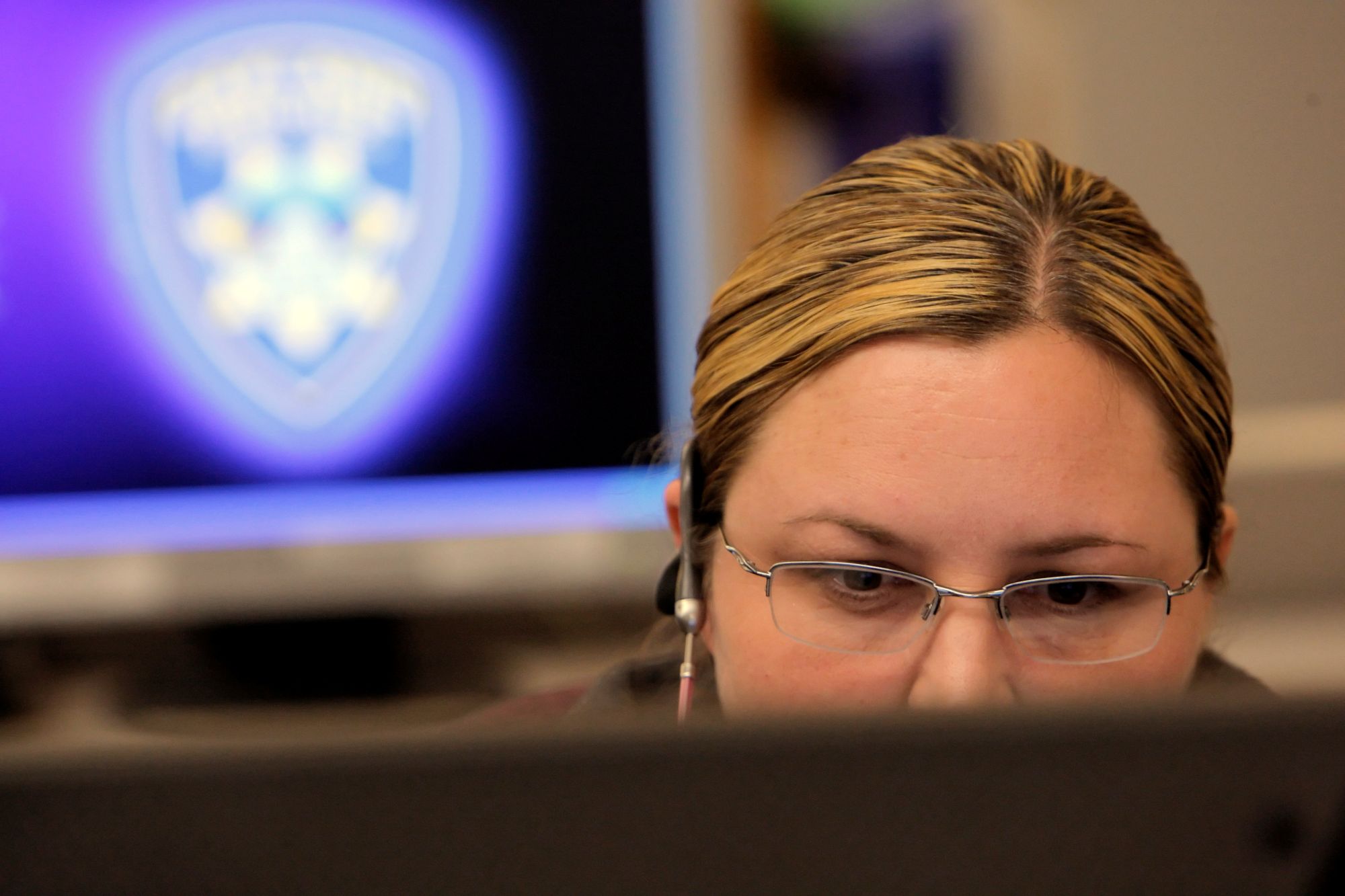
Byard Duncan: In Oakland’s dispatch center, there are two distinct sections. One is the call takers; the other is the dispatchers. Call takers pick up the calls. Dispatchers are responsible for sending first responders and communicating with them en route. Most 911 dispatchers do both jobs — in Oakland, they rotate between roles to stay fresh. A lot of big cities operate this way, with distinct call-taker shifts and dispatch shifts. Many smaller dispatch centers have one set of people doing both jobs simultaneously.
Alexis Madrigal: And just to illustrate how fragmented this system is — if you happen to be on or near a freeway, your call would go to the California Highway Patrol?
Byard Duncan: It depends, but yes — CHP has its own dispatch centers. There are actually 433 dispatch centers in California alone, and probably around 5,000 in the United States. There’s no federal agency overseeing them, so they have different standards, different personnel requirements, different training, different pay scales — all sorts of variation.
Alexis Madrigal: Interesting. And on the national standard — it’s really set by essentially a private organization negotiating between fire departments and national emergency call center representatives. Were you able to figure out why there isn’t more coordination at the federal level?
Byard Duncan: The standard itself has actually changed several times in recent years. Currently, best practice is that 90% of calls must be picked up in 15 seconds or less. It used to be 95%. The organization you’re referring to — NENA, the National Emergency Number Association — brought it down to 90%, I believe in an effort to align with a fire department advocacy group’s standard. The rationale is fairly straightforward: when someone is having an emergency — a cardiac incident, a drowning, bleeding — it’s critical to act fast. With cardiac incidents specifically, administering CPR within the first minute can double or even triple someone’s chances of surviving.
Alexis Madrigal: Let’s hear a clip from your Reveal reporting — a situation that shows just how much these seconds can matter.
[CLIP PLAYS]
Caitlin Ditta: I was sitting on the couch right there, and suddenly I felt like a rush of something coming out of me. I just remember thinking, please don’t be blood. Please don’t be blood.
Byard Duncan (narration): It wasn’t. She runs to the bathroom and yells for her husband.
Caitlin Ditta: I’m like, you call 911, I’ll call 911. And we’re both calling, and I remember at one point having both phones in my hand. No one was picking up, so I kept hanging up and calling back, hoping I’d get through to someone. I was like, where are the people who are supposed to pick up? Where are they?
Byard Duncan (narration): Postpartum hemorrhages like Caitlin’s can be fatal. It’s critical to act fast. Eventually, her husband gets through.
Caitlin Ditta: Felt like every second counted because there was blood pouring out of me.
Byard Duncan (narration): Firefighters get there first. They stay with Caitlin and her husband until an ambulance arrives. Meanwhile, 911 operators start calling Caitlin’s phone back.
Caitlin Ditta (voicemail): You’ve reached Caitlin Ditta. I can’t take your call right now.
911 Dispatcher: Hi, this is 911. Someone called and hung up. If you have an emergency, call back at 777…
[END CLIP]
Alexis Madrigal: There’s some practical takeaways from that clip. Don’t call on two phones simultaneously. Don’t hang up and call again — because then dispatchers have to call you back, taking time away from answering new calls. And staying on the line is better than redialing. Is that the “news you can use” from this?
Byard Duncan: That’s exactly it. What Caitlin did — understandably — was hang up and call back when she couldn’t get through. That’s a kind of chicken-and-egg problem with Oakland’s 911: if you call and get a busy signal or hold message, you might assume you should try again, when in fact you should stay on the line. The net result is a staggering percentage of what are called abandoned calls. According to Oakland’s 2025 911 data, something like 25% of 911 calls in 2024 were abandoned. We don’t know exactly why in every case, but I’d guess a large percentage were from people who hung up and redialed because no one answered quickly enough.
As for the freeway incident I witnessed — I learned in the course of this reporting that it’s actually not surprising I was put on hold. Freeway incidents are notorious for jamming 911 call volume, because dozens or even hundreds of drivers pass a scene and call in. From the dispatcher’s perspective, it’s a flood of calls about the same incident.
Alexis Madrigal: We’re talking about the long-term problems with Oakland’s 911 system, including delayed answers for many callers — and what can be done to fix them. We’re joined by investigative journalist Byard Duncan, whose story ran on Reveal and the Center for Investigative Reporting and Type Investigations. We’re also joined by two guests who have worked in and extensively studied Oakland’s 911 system: Antoinette Blue, a dispatcher for Oakland’s Emergency Communication Center. Welcome, Antoinette.
Antoinette Blue: Hi. Good morning, everybody.
Alexis Madrigal: We’ve also got Oakland City Auditor Michael Houston. Welcome.
Michael Houston: Hi. Thank you for having me.
Alexis Madrigal: Michael, over the past decade there have been two city audits of Oakland’s 911 system and two Alameda County grand jury reports — and pretty much all of them have reached the same conclusion: Oakland’s 911 service lags well behind state-mandated response times, with understaffing as the number one reason. Is that your understanding?
Michael Houston: Yes, that continues to be a challenge. Our most recent audit covered January 2019 through December 2024, and vacant positions were a constant problem throughout. In our report, we noted vacancies reached as high as 25% at one point. That leads to reliance on overtime, burnout among dispatchers, and — most fundamentally — not enough people in the Emergency Communication Center at the right times to answer calls.
Alexis Madrigal: Our own Tara Siler reported on this same issue back in 2015 — and here we are, eleven years later. Why do you think it hasn’t been fixed?
Michael Houston: This does predate my time at the city. But I think one thing we’ve learned is that it’s genuinely difficult to recruit and retain dispatchers — that’s a challenge jurisdictions across the country are grappling with. One thing I’m proud of from our audit is that we asked: given this persistent staffing challenge, what else can be done? And what we found was significant unevenness in how quickly staff are able to answer calls. For instance, between 5:00 and 8:00 AM, performance is relatively strong — but after 8:00 AM, it deteriorates significantly.
Alexis Madrigal: So it’s also about using data more strategically, not just filling vacancies.
Michael Houston: Exactly. In addition to getting the critical staff we need, using data to identify and address those gaps is essential.
Alexis Madrigal: We’re talking about the problems with Oakland’s 911 system and how they reflect a national challenge. We’ve got Oakland City Auditor Michael Houston, dispatcher Antoinette Blue, and investigative journalist Byard Duncan. We’ll be back with more right after the break.