This partial transcript was computer-generated. While our team has reviewed it, there may be errors.
Laura Klivens: This is Forum. I’m Laura Klivens in for Mina Kim.
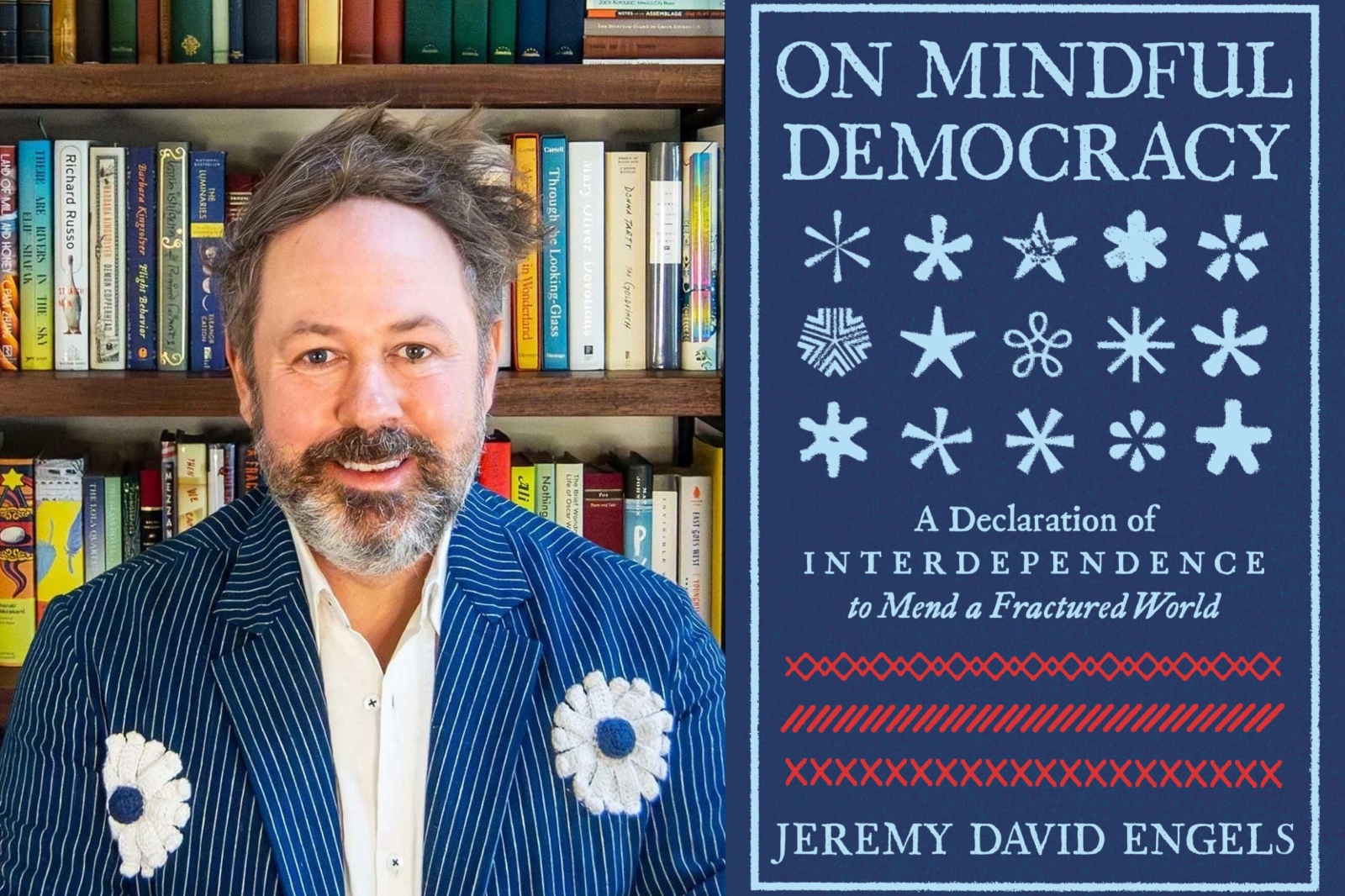
At first glance, mindfulness and democracy may not seem to go together. But as author, professor, and meditation teacher Jeremy David Engels argues, a mindful democracy may be essential for navigating this moment of political division and exhaustion.
In his new book, Engels writes that democracy is more than voting on election day. It’s about working together across disagreements and divisions and learning how to care for one another. While that may sound overly idealistic to some, he offers practical ways to engage in a moment when many people feel burned out and ready to tune out.
Jeremy David Engels, welcome.
Jeremy David Engels: Thanks for having me.
Laura Klivens: Tell us what you mean here. What is a mindful democracy?
Jeremy David Engels: I’m a professor of rhetoric, one of the oldest liberal arts disciplines. People who study rhetoric pay close attention to the power of language—its ability to build worlds and also break them.
Much of my early work focused on the Declaration of Independence, and with its 250th anniversary approaching, I’ve been thinking about our rhetoric as a society. What do you see when you look at online conversations, political discourse, or public debate? Democracy increasingly feels framed as battle.
Americans have become accustomed to language rooted in war, division, fear, and hatred—destructive language. It feels like we’re approaching a breaking point.
As both a rhetoric scholar and mindfulness teacher, I became interested in reimagining the Declaration of Independence as a declaration of interdependence.
Laura Klivens: In your book, you outline this through twenty-seven insights. For people who don’t meditate or who might hear “declaration of interdependence” and immediately tune out, why should they stay with you? Why do you see this as an answer to our current divisions?
Jeremy David Engels: Whenever we take a stand, we stand on common ground.
That’s easy to forget in a world of division, doomscrolling, and constant labeling. I’m a professor, and many of my students have become accustomed to engaging with people in person the way they interact online.
Once someone becomes “Democrat,” “Republican,” “MAGA,” or another label, that label can come to represent the entirety of who they are. And then it becomes much harder to connect.
What happens if we set labels aside and focus instead on shared humanity? All of us suffer. All of us want happiness. All of us care about people and communities.
When we focus on those shared qualities, democracy starts to become a practice of care rather than a battle or a war.
Laura Klivens: I’ve heard you say democracy isn’t a battle between enemies—it’s an argument between equals. What do you mean by that?
Jeremy David Engels: One thing I find fascinating about the Declaration of Independence is that it’s a document built around what I call “enemieship.”
Laura Klivens: “Enemieship.” Explain that.
Jeremy David Engels: The phrase comes from Thomas Paine in Common Sense. He argued that the thirteen colonies weren’t necessarily close friends or naturally united. What they shared was a common enemy: King George.
People today may think of King George through Hamilton, where he’s portrayed as a somewhat lovable figure, but that’s not how the founders saw him.
And I think we’ve become very accustomed to bonding through shared enemies. That can be powerful, but it’s not a stable foundation for long-term community.
If democracy is simply a battle between enemies, we end up where we are today. But if we reconceive democracy as a practice of care—care for ourselves, for each other, and for our shared lives—it opens the possibility for friendship and beloved community instead of anger and hostility.
Laura Klivens: We’re speaking with Jeremy David Engels, author of On Mindful Democracy and professor of communication arts and sciences at Penn State University.
Jeremy, I love this vision you’re laying out. But connect it for us: how do you get from mindful democracy to actual political change?
Jeremy David Engels: One of the mindfulness teachers I studied with was Thích Nhất Hạnh, who passed away a few years ago.
He had a beautiful phrase: “There is no way to peace. Peace is the way.”
You can’t fight a war for peace because the means undermine the ends.
In my book, I suggest something similar: there is no way to democracy. Democracy is the way.
If we want a thriving and caring democracy, we have to embody it in our daily lives. Elections matter—absolutely, vote—but we also need to return attention to everyday interactions: at work, at home, in coffee shops, grocery stores, or on picket lines.
If enough people practice the qualities of democracy in those everyday moments, we begin to change the culture around us.
Laura Klivens: One idea in your book really stood out to me: happiness is not a zero-sum game.
You don’t have to diminish someone else in order to increase your own happiness. Talk about that and how it relates to mindful democracy.
Jeremy David Engels: In the book I say happiness is not an apple pie with a limited number of slices.
Laura Klivens: A very American analogy.
Jeremy David Engels: I think many of us grow up with the belief that happiness is scarce—that there’s only so much of it available, and if someone else gets more, there’s less for us.
But that’s a story. It’s one we’ve been told and repeated until it feels true.
One of the beautiful things about mindfulness is that by slowing down and paying attention, we become more aware of the stories we tell ourselves. We begin to realize many of them aren’t truly ours. They come from culture, family, history, or habit.
Some of those stories may no longer serve us.
I think this scarcity story is one of them.
If you suffer less, I suffer less, because you become less likely to pass suffering onto me. And if we all suffer less, everyone benefits.
If that becomes the story we tell ourselves, democracy changes.
Laura Klivens: One listener writes: “Meditation should be taught from an early age.”
That’s interesting because even the idea that happiness isn’t a zero-sum game feels like something I talk about with my elementary school-aged children.
Jeremy David Engels: That’s true.
Laura Klivens: We’re talking about the role of mindfulness in small-d democracy at a time when political division and nonstop news cycles have left many people feeling disconnected and disengaged.
We’re speaking with Jeremy David Engels, author of On Mindful Democracy: A Declaration of Interdependence to Mend a Fractured World.
I’m Laura Klivens in for Mina Kim, and you’re listening to Forum.