This partial transcript was computer-generated. While our team has reviewed it, there may be errors.
Alexis Madrigal: Welcome to Forum. I’m Alexis Madrigal. Mac Barnett is a children’s book author, which means that his field is children’s literature. Some people are content to work in a field without knowing its history or the various camps and philosophies that have existed through the eras. Other people — Barnett is one of them — must know everything about the field, like jazz guys who know all the players on all the great albums, or poets who decide they must learn ancient Greek so they can read Sappho in the original.
Barnett goes deep into the archives of children’s literature and always has. This tendency is on glorious display in his new small book for adults, Make Believe: On Telling Stories to Children, first published in Italian and now finally out in English. In this book, Barnett marshals the history of the field to advance his argument that we should take children’s literature seriously because we should take children themselves seriously.
No surprise, Barnett is the National Ambassador for Young People’s Literature, and he joined us today in the studio. Welcome, Mac.
Mac Barnett: Thanks for having me.
Alexis Madrigal: One thing I love about this book is that it’s not really even about children’s literature. I mean, it is, but it’s really about children. How did you first start to develop a sense of what kids were like once you yourself had grown up?
Mac Barnett: Well, I think for me the big surprise was when I started actually working with kids in college. I grew up in the Bay Area, and I would come home from school and work as a camp counselor at a summer camp in the Berkeley Hills. I would tell stories to my kids there.
At school, I was an English major, and I studied difficult poetry. My mom was worried. But I was studying poetry that was intentionally hard to understand, and asking: Is there a reason we would wrestle with a difficult poem besides elite cultural formation, bragging rights, or snobbery? Could there be beauty in it? Pleasure in doing the work and engaging with the text?
To my surprise, I found my answer in these four-year-olds, who I thought were so much braver and more curious and open-minded about what a story could be and how a story could work than adults were. They were also a little less lazy than we are.
Alexis Madrigal: Were you bringing them challenging or unusual children’s literature? Were you reading them The Stinky Cheese Man, which even as an adult I’m not sure I fully understand, but love?
Mac Barnett: The Stinky Cheese Man is a great example. I didn’t have that book growing up, but it was in the camp library. It is no longer in the camp library because I took it home with me at the end of camp.
Alexis Madrigal: Sorry, kids.
Mac Barnett: Sorry, kids. Sorry to the Strawberry Canyon Recreational Area. But even books like Goodnight Moon, Where the Wild Things Are, Harriet the Spy, Stevie — there’s a long history here. The history of children’s literature is actually a pretty radical history.
Alexis Madrigal: Let’s talk a little bit about Goodnight Moon. You have a whole essay in here about it. For people who’ve forgotten, this is by Margaret Wise Brown, the famous children’s book author. How does Goodnight Moon work?
Mac Barnett: Okay, so if somebody were asked, “What’s the story of Goodnight Moon?” they might say it’s about a little bunny going to sleep. But the text never mentions a bunny. It never mentions anybody except for an old lady whispering “hush,” who is sometimes drawn as a bunny. Sometimes she’s in the room, sometimes she’s not. She sort of fades in and out.
It’s a poem — a beautiful modernist poem — laid alongside illustrations. That dance between words and pictures is how a picture book conveys its story. The pictures are also very strange. That cover, for example — the balloon is in the most annoying place possible. That’s on purpose. Clement Hurd, the illustrator, was an amazing painter.
Things also appear and disappear in the room. Objects go missing from the drying rack and then reappear. There’s that electric yellow that makes you wonder: What is this doing in a bedtime story?
I think the reason the book has endured is that it gets to the eeriness — even the scariness — of going to sleep. Going to sleep is the first really hard thing we ask kids to do all by themselves. Even if we’re in the room, they have to make that surrender to mystery on their own. The book mirrors that.
Alexis Madrigal: I never noticed this until reading your book, because of course I was reading it as an adult and not paying attention, but we actually know from the book how long bedtime takes. I think you said about an hour and ten minutes?
Mac Barnett: Ten minutes. Which, as the dad of a five-year-old, I have to say: not bad.
Alexis Madrigal: Nailed it. There’s also the line everyone remembers, if they remember the book at all. It’s going through saying goodnight to all the normal things, and then it says, “Goodnight nobody.” There’s nothing in the picture. Then immediately after that: “Goodnight mush.”
Mac Barnett: Yes. That spread — and a spread is two pages of a picture book open side by side — has “Goodnight nobody” on the left, with just emptiness. We’re used to there being a picture there. It’s like a trapdoor opening. We bid goodnight to the void, to nothingness, to the mystery of sleep.
To see that acknowledged — and acknowledged in a way only a picture book can — is incredible. It’s such a profound moment. Then immediately, on the right side, you’re back with “Goodnight mush,” which is a joke. But it also introduces that soft “sh” sound that carries through the final pages. After acknowledging the scariness, the book also acknowledges its opposite: It’s going to be okay. Both things are true.
Alexis Madrigal: Love that. As you go through the book, one thing you talk about is children as readers. Adult Mac Barnett can do exegesis on Goodnight Moon, but you argue that kids themselves have the capacity to experience and think about children’s books in all kinds of ways.
You have this amazing list of questions kids ask: Why do we dream? What happens after we die? Why do people get sick? Do trees have feelings? Why do we have to follow rules? Do dogs find things funny? Why do people fight wars? Why is my friend nice to me one day and mean the next?
Now that you’ve spent so much time thinking about children — and now that you have your own five-year-old — has your kid ever asked you a question that completely laid you out?
Mac Barnett: Honestly, it’s death. Questions about death, about me dying, about him dying. His real worry about it, but also the earnestness with which he wants to talk about it. It’s unbearable as a parent.
I think adults spend a lot of their lives avoiding thinking about death. And adults often see children as symbols of new life, of futurity. So we get really uncomfortable when kids want to talk about death.
It shuts down a huge part of my brain, but that’s also where literature comes in. Kids are coming to us earnestly with these huge questions. A lot of them are questions we as adults haven’t answered ourselves, though we like to pretend we have in front of our kids.
Books are a great way to say: We don’t have the answers. Let’s sit in the ambiguity together.
Alexis Madrigal: “We don’t know what happens after you die.” I mean, I remember walking down the street about fifteen years ago with Sarah, my wife, and there was a dad walking in front of us with his little kid, probably about five years old. The kid suddenly asked in this tiny voice: “Dad, can you die of amazement?”
We thought it was the cutest thing. It became a family meme for us: Can you die of amazement?
We want to hear from listeners. What’s a question you’ve heard a child ask that puzzled you, amazed you, delighted you, or stumped you? Give us a call now. The number is 866-733-6786. That’s 866-733-6786. The email is [email protected]. Social media — BlueSky, Instagram, Discord as well.
Really quickly: Why did this book come out in Italian before it came out in English?
Mac Barnett: My Italian publisher asked me to write it. I had just had lunch with them — a big Italian lunch where you’re in the mood to say yes to everything in the world. So I shook hands on the spot and wrote it. It came out in Italian, and many other languages, first. I think it was published there about three years ago.
Alexis Madrigal: Was it received differently in Italy?
Mac Barnett: It’s hard to tell because I’m not reading the Italian press directly.
Alexis Madrigal: Just screenshotting Italian Instagram posts into Google Translate?
Mac Barnett: Exactly. You’re hoping the character recognition is working.
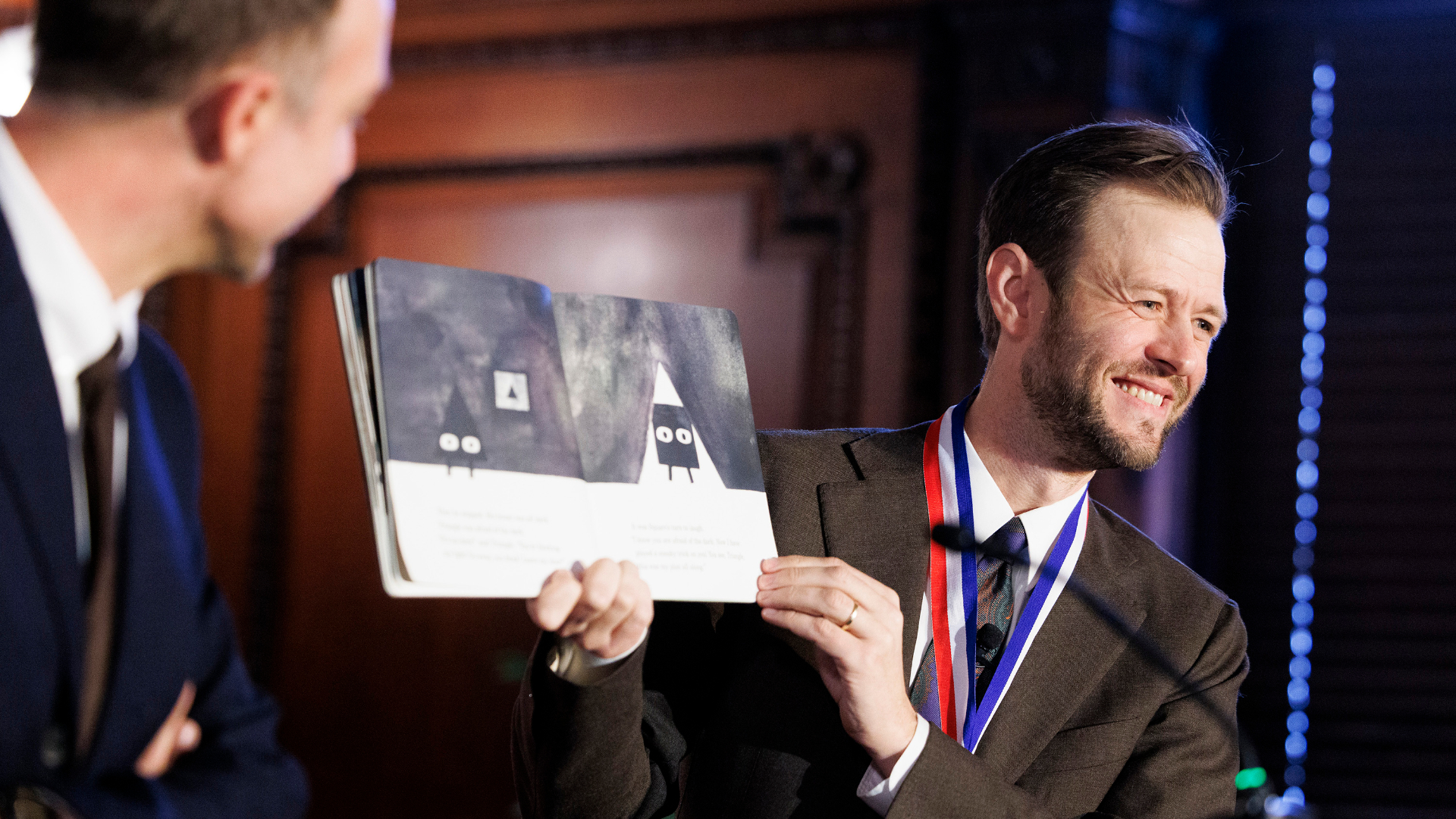
Alexis Madrigal: We are, of course, talking with Mac Barnett. He is the National Ambassador for Young People’s Literature and the author of many children’s books. If you have kids, you’ve probably read one of them, whether created with Shawn Harris or Jon Klassen. His new book, though, is for adults. It’s called Make Believe: On Telling Stories to Children, and it’s a defense of children themselves.
We’re taking your stories about questions kids have asked that puzzled you, amazed you, delighted you, or stumped you. The number is 866-733-6786. The email is [email protected]. And, of course, you can find us on social media — BlueSky, Instagram, and more — or over on Discord. In all those places, we’re KQED Forum.
I’m Alexis Madrigal. We’ll be back with more from Mac Barnett right after the break.