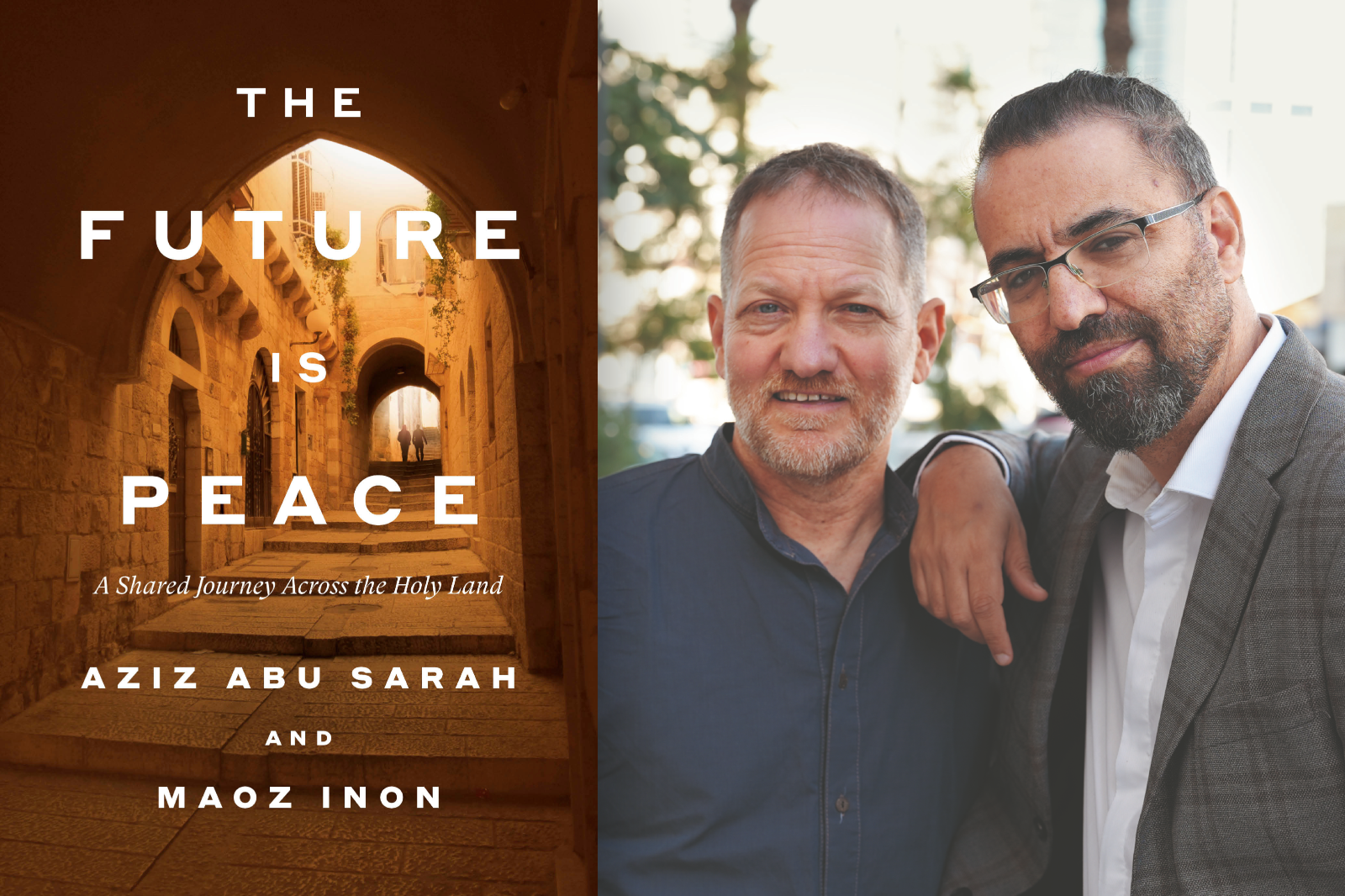
This partial transcript was computer-generated. While our team has reviewed it, there may be errors.
Mina Kim: From KQED, welcome to Forum. I’m Mina Kim. For many, the horrific Hamas-led attacks in Israel on October 7 and the appalling devastation of Israel’s war on Gaza have brought nightmares, rage, and hardened stances. For two men—an Israeli and a Palestinian—it has brought them together like brothers.
Maoz Inon lost his parents on October 7. Years earlier, Aziz Abu Sarah lost his brother to violence by Israeli soldiers. Together, they have written a new book detailing their extraordinary friendship and how and why they’ve rejected vengeance. It’s called The Future Is Peace. Aziz and Maoz are co-CEOs of Interact International, a nonprofit dedicated to Middle East peace. Maoz, welcome to Forum.
Maoz Inon: Thank you, Mina. It’s great to be with you.
Mina Kim: I appreciate you being here. Aziz, welcome to you.
Aziz Abu Sarah: Thank you. We’re happy to be with you.
Mina Kim: You’ve both lost family to the conflict, as I mentioned. Aziz, you were 10 when your older brother, Tayseer, died. What happened?
Aziz Abu Sarah: Yeah. I grew up in Jerusalem. We grew up under occupation. The first time I was shot at, I was seven or eight years old. So my upbringing—there was no normal day without living the reality we still have now.
When I was nine years old, a group of soldiers came into our house early in the morning, just after we got up to have our meal before fasting for Ramadan. They took my older brother, Tayseer, who was 18 at the time, on allegations of throwing rocks. He refused to confess to the charges, so he was tortured and sentenced to just over 10 months in prison.
When he was released, he was very ill from internal injuries due to the beatings. We took him to a hospital. After surgery, he died soon after. I was 10 years old at the time. You can imagine—I was very angry, very bitter. The idea of being a peacemaker wouldn’t have come anywhere close to my mind.
Mina Kim: You described Tayseer as your protector. What was he like?
Aziz Abu Sarah: Tayseer was the life of the party. He was charismatic, hardworking, funny. To me, he was more like a parent. I’m the youngest of seven—what some would call the “oops” child.
My parents had raised enough kids, so Tayseer was kind of in charge of me. He took me to school on my first day. When I got in trouble, he stood up for me. When I was bullied, he supported me.
So when I lost him, it felt like becoming an orphan more than just losing a brother. It changed everything. Who I am today has a lot to do with that loss. I stopped trusting people. I didn’t want to be close to anyone. When you lose someone so important, it affects every part of your life.
Mina Kim: Did you feel a duty to avenge his death?
Aziz Abu Sarah: Absolutely. It felt like if I didn’t avenge him, I was a terrible brother. How could you not be angry? Especially at 10 years old—kids don’t step back and think logically. Even adults don’t always do that.
You feel like you want to hit back. I was full of bitterness and anger, feeling like, “You took my brother. I want you to pay for it.”
Mina Kim: How did it affect how you saw Israelis?
Aziz Abu Sarah: I didn’t know any Israelis except soldiers and settlers. The segregation we live in—physical walls, mental walls—is very high.
Settlers would raid our village, something we still see happening in the West Bank. Soldiers would frisk me on my way to school. I wanted to throw rocks. I became very active in writing for a youth magazine, and my articles were angry, bitter, arguing against peace.
If my 16-year-old self could see what I’m doing now, he would say it’s absolutely unacceptable.
Mina Kim: What changed you?
Aziz Abu Sarah: After high school, I went to study Hebrew. It was mandatory in school, but I had refused to learn it—it was the language of the enemy to me.
But I realized that without Hebrew, I couldn’t go to college or find work. So I enrolled in an ulpan, where Jewish immigrants learn Hebrew. That was my first real interaction with Israelis who treated me like a human being.
My teacher saw I was uncomfortable. She greeted me in Arabic, shared Palestinian stories, and recognized my existence. I wasn’t a threat to her. The other students treated me well too.
Over time, I realized it’s not Israelis versus Palestinians. It’s those who believe in justice, equality, and peace, and those who don’t yet. The people in that classroom—like Maoz—were on the same side as me.
Mina Kim: Maoz, you lost your parents, Yakovi and Bilha, on October 7, 2023. What happened to them?
Maoz Inon: Yes. My parents lived in a community called Netiv HaAsara, the closest Israeli community to the Gaza border. Their house was less than a quarter mile from the border, near the wall Israel had built.
On Saturday morning, my father sent a message in our family WhatsApp group saying a war had started—that they could hear shooting, shouting, bombs, sirens. They locked themselves in the safe room.
I woke up and saw the message. I called my father—it was 7:30 in the morning. I live in Binyamina, about halfway between Tel Aviv and Haifa. He answered and told me the same thing he had written. I could hear my mom in the background. I told him I’d call back soon.
While getting dressed, I saw on social media that the border defenses had been breached—that Hamas was entering Israeli communities. I couldn’t tell which ones, but my parents lived in the closest one.
I called my father again—no answer. I called my mom—no answer. I woke up my three sisters and my younger brother. We tried calling neighbors—no one answered.
Only at 4 p.m. were we able to reach someone from the community. We told him, “Just tell us the truth.” He said my parents’ house had been burned to ashes and that there were two bodies inside.
Mina Kim: You describe feeling physical pain the night you learned they died—and an idea that came over you. What happened?
Maoz Inon: The day after October 7, we began shiva—the seven-day mourning period in Judaism. On the second day, my younger brother asked all five of us siblings to make a family decision: to reject revenge.
He said avenging our parents wouldn’t bring them back. It would only continue the cycle of violence, bloodshed, and trauma that Israelis and Palestinians are trapped in. He said it was up to our family to break that cycle.
It took only a few minutes for all of us to agree. That night, I had a vision. I was crying, my body in unbearable pain. I saw all humanity crying with me. Our bodies were burned, crushed, shot.
As we cried, our tears healed us. Then the tears fell to the earth, which was soaked in blood. As we kept crying, the tears purified the land, revealing a path—a path to peace and reconciliation.
In that moment, I decided that to heal myself, I had to follow that path.
A few hours later, I received a message from Aziz offering his condolences and standing with me. Over the past two and a half years, we’ve worked together—co-founding Interact, co-authoring The Future Is Peace.
Now I can say: yes, I lost so much, including my parents—but I gained Aziz. I gained a brother.
Mina Kim: Maoz Inon and Aziz Abu Sarah are sharing their story. Maoz is Israeli, Aziz is Palestinian, and they forged their relationship in the wake of October 7. We’ll have more with them—and with you—after the break.