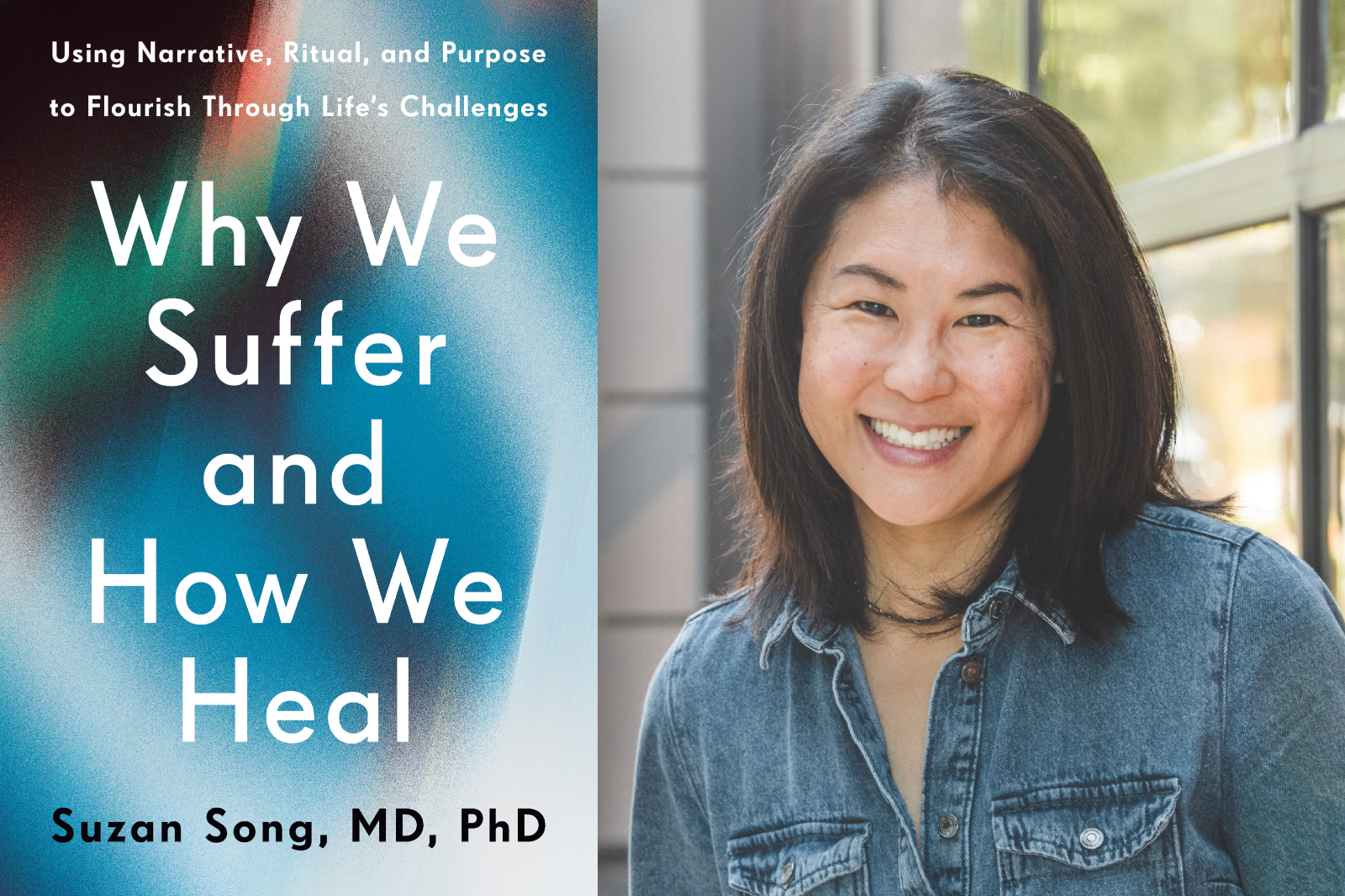
Psychiatrist Suzan Song has for decades worked with people who have experienced extreme traumas, like being trafficked or recruited as child soldiers. She says she became drawn to those who were able not just to survive, but thrive and flourish – even without access to traditional Western talk therapy. We talk to Song about where she thinks true healing comes from, and how we can apply that to more ordinary suffering, like a breakup or an unexpected loss. Song’s new book is “Why We Suffer and How We Heal.”
This partial transcript was computer-generated. While our team has reviewed it, there may be errors.
Mina Kim: Welcome to Forum. I’m Mina Kim. Dr. Suzan Song has worked with survivors of the 2023 mass shooting in Monterey Park, with unaccompanied minors at the southern border, and, farther from home, with child soldiers, survivors of torture and trafficking, and others who have endured egregious human rights violations. One thing that has fascinated Song is the people she’s met who have not only survived but flourished after extreme trauma. She realized they often share a common quality, which helped inspire her new book, Why We Suffer and How We Heal.
Dr. Song is a psychiatrist and humanitarian policy adviser with a private practice in Washington, D.C. and California. Suzan, welcome to Forum.
Suzan Song: Thanks so much for having me.
Mina Kim: You work with a really broad range of people, through both your research and private practice, right?
Suzan Song: I do—from people who have suffered the most egregious human rights violations to CEOs, founders, and executives, especially here in the Bay Area.
Mina Kim: What have you found that people who are able to flourish after difficult events tend to share?
Suzan Song: Most people think resilience means pushing through—being composed, competent, and getting on with things. But I actually think that can break people. The individuals I’ve seen who find grounding and even mastery amid instability don’t push through it; they engage with it and embrace it.
Mina Kim: So, accepting that instability is part of life. I was struck by a line in your book where you say that when life brings loss or rupture, the deepest pain doesn’t just come from the event itself, but from the friction between what is and what you wanted it to be. Can you say more about that?
Suzan Song: That’s right. Events can be painful, of course, but so much of our suffering comes from the meaning we assign to them—the narratives we create about who we are, our identities, and how those experiences shape us.
Mina Kim: You’ve studied this for decades. What drew you to working with people who’ve experienced deep trauma, even in very risky environments?
Suzan Song: I actually went to medical school intending to be a surgeon, but I realized I was less interested in saving lives than in easing suffering. That led me to ask bigger questions about why people suffer and how they heal. For me, it also traces back to losing my father when I was 15. Being exposed to that kind of suffering shaped the path I took.
Mina Kim: Can you talk about your experience in Burundi, where you worked with former child soldiers?
Suzan Song: I was in my third year there, conducting qualitative interviews and ethnographic research, when one former child soldier turned on me. He was targeting me for money and threatening my life, so I had to go into hiding. Sitting there, I thought, what am I doing here? How did I end up in this situation? And the answer came quickly—it was about my father.
He had been assaulted, carjacked, and kidnapped in an attempted murder, and later died from his injuries. I had continued on with school and life without fully processing it. But in that moment in Burundi, I realized I had, in some way, recreated a similar scene of violence.
Mina Kim: Why do you think that happened?
Suzan Song: I didn’t have a narrative for what had happened to me. I knew the facts, but I hadn’t processed the emotional depth. Until we unpack those experiences and piece together the story, those unresolved emotions can shape our lives in ways we don’t fully understand.
Mina Kim: That connects to what you describe as a key step in healing—narrative. Can you explain its power?
Suzan Song: Narratives are the stories and explanations we create about what’s happening to us. We all have them running constantly—interpretations of every interaction. Often, we mistake those interpretations for facts.
But narratives go deeper than that—they shape our identity. For example, I work with high-achieving women who are also mothers. They may logically understand they need to set boundaries, but they feel guilty doing so. That disconnect often comes from internalized narratives about what it means to be a “good” mother.
Mina Kim: You mean external expectations?
Suzan Song: Exactly—like the idea that motherhood requires constant sacrifice.
Mina Kim: How can we use narrative in a way that actually helps us heal?
Suzan Song: When we understand our backstory and give it meaning, we create coherence. We can’t know where we’re going until we understand where we’re starting from. Narrative helps us do that.
Mina Kim: I want to invite listeners into the conversation. What questions do you have for Dr. Song? Is there a narrative you’re struggling with? You can email [email protected], find us on social media at KQED Forum, or call 866-733-6786.
Examining our narratives is something Western talk therapy tends to emphasize.
Suzan Song: It does. In Western society, healing is often centered on autonomy and insight—talking through your experiences with a therapist and analyzing your thoughts. We’re very focused on understanding and managing our thinking.
But across cultures, I’ve seen people heal without access to therapy. In some places, there may be only one psychiatrist for an entire country. Yet people still find ways to heal and even flourish. So narrative is helpful, but it’s only one piece.
Mina Kim: And that led you to develop a broader framework. Can you introduce it?
Suzan Song: I call it the “three friends of winter”: narrative, ritual, and purpose. These are the elements I’ve seen help people engage with instability and find grounding.
Mina Kim: Why did you feel the need to expand beyond narrative?
Suzan Song: In the U.S., we often don’t have a roadmap beyond talking. Also, when I worked as medical director of an Asian American community organization in San Jose, I noticed that many groups—especially Korean Americans, including my own community—don’t typically seek therapy. I wanted to understand how people heal when they’re not engaging in traditional talk therapy.
Mina Kim: We’re talking with Dr. Suzan Song, author of Why We Suffer and How We Heal, about using narrative, ritual, and purpose to navigate life’s challenges. Listeners, have you benefited from talk therapy, or found its limits? What rituals have helped you heal? We’ll continue this conversation after the break. Stay with us. I’m Mina Kim.