This partial transcript was computer-generated. While our team has reviewed it, there may be errors.
Mina Kim: Welcome to Forum. I’m Mina Kim. When the independent news show Democracy Now! launched thirty years ago, it broadcast on some nine community radio stations. Today, it’s on more than fourteen hundred radio and television stations worldwide.
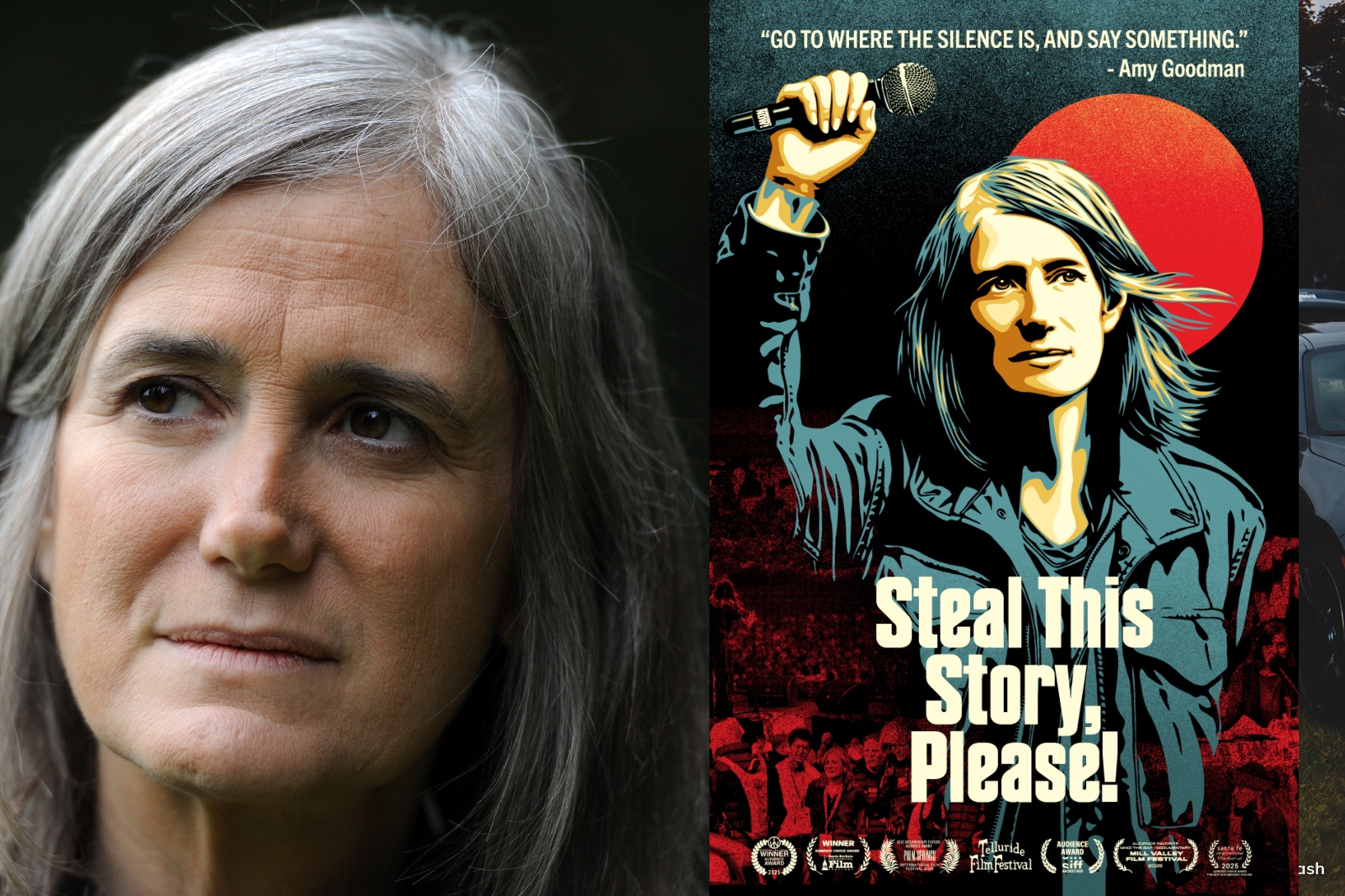
A new documentary looks at the life and career of its host since Democracy Now!‘s inception, Amy Goodman, with plenty of moments featuring what director Tia Lessin describes as Goodman’s sheer audacity. Here’s a clip from the film’s opening, where Goodman chases, for several minutes, a Trump policy adviser at the twenty eighteen U.N. Climate Summit as he tries to run away.
Steal This Story, Please! clip:
Amy Goodman: Can you explain why you won’t answer any questions on the issue of climate change, or why the U.S. is here?
Trump policy advisor: If you would like to set up an interview, we could do that. But you’re actually harassing me.
Amy Goodman: A reporter asking you a question, sir, is not harassment.
Mina Kim: The documentary is called Steal This Story, Please. And listeners, what do you want to ask or tell Amy Goodman? Amy, welcome to Forum.
Amy Goodman: Oh, it’s so great to be with you. A real honor.
Mina Kim: And happy birthday, I understand. It’s your birthday today.
Amy Goodman: It is. It’s great to be on this show doing this program. I can’t think of a better birthday, quite seriously.
I mean, for today, everything is so crazy because the film Steal This Story, Please just opened on Friday. And so it’s interview after interview, Q and A after Q and A, after the films. Tonight, Susan Sarandon is going to do the moderation, and yesterday it was Peter Sarsgaard and Maggie Gyllenhaal, and they conducted the Q and A with Tia Lessin, who we’ll hear from, and Carl Deal.
But the film opened with Rosario Dawson introducing it because she’s one of the executive producers. So it’s been quite an amazing weekend.
Mina Kim: Oh, wow. Well, we are honored that you are starting your birthday with us.
And, you know, speaking of the opening to your documentary, one of the things I learned off the bat that both surprised me and brought a big smile to my face was learning that you were a big fan of The Phil Donahue Show and wanted to work with them.
Amy Goodman: Absolutely. Are you kidding?
I started, at the end of college, watching him every day, and I lived in the bottom of my co-op. And the other person living there was, I guess you’d describe him as a hobo from World War II who had squatted there for decades.
Me and Damon Payne — there’s a whole Hollywood movie made about him, by the way — but me and Damon Payne, I’d go into the living room, and he would smoke up a storm, and I would say, “Damon, there’s one rule here. I have to be able to watch the show. You can only smoke during commercials. I can’t have to wave the smoke away.”
And at the end of the program, when I was graduating, I just wrote down — he helped me a little, Damon — I said, “Catch every other name.” You know, we didn’t have TiVo or playback, and it took me several weeks to write down every name. I thought the most important person was best boy because he was best, right? I didn’t know what the roles were.
But I wrote down every name and then sent them all my very thin résumé. And I knew that at some point I would get a call from Phil Donahue. And they did call, and they said, “Have you gotten a job yet?”
I said, “No, I haven’t.”
And they said, “Are you available tomorrow?”
And I said, “Absolutely. I’ll come in on the Long Island Rail Road.”
And they said, “Great, because we’re doing a show on the unemployed, and we’d like you in the audience.”
Mina Kim: So brutal! And I do just love imagining you trying to catch the names in the credits of the show as fast as you can so that you could send your résumé to the people, to try to get on a big commercial TV show, essentially.
But the other reason, Amy, that it brought such a smile to my face was because my mom was a fan of the show and watched it regularly when I was a kid. And now I really wish I’d watched it with her, given what I’m doing now, because Donahue, of course, is a live talk show that involved the audience.
Amy Goodman: Right. And as we say in the film, I came to know Phil, and he really dealt with serious issues. Yeah, a lot of superficial stuff and celebrity stuff, but also a lot of serious issues. And in two thousand three, I mean, he was the big guy on the block. He was Oprah before Oprah.
In two thousand three, when the U.S. invaded Iraq, he had a show on MSNBC. It was the most popular show. It was, I think, eight o’clock in the evenings, and he was bringing on a lot of anti-war voices. And they dumped him, even though he was their most popular show, right before the war. And there was a memo that we got and put into our book, which said, “We don’t want all these anti-war voices when the rest of the media is waving the American flag.”
And that is exactly the time, by the way, when we need an independent media. There’s no more serious decision than going to war, when we need the media not to circle the wagons around the White House, but to ask the serious questions, because it’s about whether U.S. service members kill or be killed. It’s about whether people at the target end are killed.
These are the times we need an independent press.
Mina Kim: Yeah. And you’ve been sounding the alarm for a long time about the dangers of corporate-owned media, and that’s an example, right?
But also, this past year has given us probably the starkest examples of why corporate media is so dangerous, no?
Amy Goodman: Oh, absolutely. For thirty years, we’ve been sounding the alarm about corporate media. And I must say, in the beginning, I’d come to know many journalists who work within the networks. I’d be invited on shows, and we’d have discussions off mic. And they would say, “Give us a break. Come on. We’re trying our hardest here.” And I understand. They want a wide platform, and this is the possibility. But how much can they get accomplished is a serious question, and you have to figure it out if you’re inside or outside that system. But those very journalists are saying now, “You’re not yelling about the corporate media loud enough.”
I mean, look at what just happened over the last weeks. You have The Washington Post gutted. A third of the journalists — hundreds — have been laid off. The Washington Post is owned by Amazon founder Jeff Bezos, who just gave forty million dollars to the Trumps for the Melania documentary, and then spent another thirty-five million on publicity for it.
That was really currying favor. And then I wonder if the newsroom cuts were currying favor. You know, President Trump was made by the media. There is no one who understands the media more than Donald Trump.
He attacks as hard as he can. He calls the media the enemy of the people, and nothing could be further from the truth. And the way he castigates and insults, especially women journalists of color — saying, “Be quiet, piggy,” saying, “You’re ugly, you’re stupid, why don’t you smile?” when they’re asking about dead service members — it is inexcusable.
And banning reporters, forcing them to sign oaths like at the Pentagon that they won’t reveal classified information unless it’s approved by the Pentagon. Of course, a judge has overturned this not once, but twice, and many journalists and news organizations have said no, they won’t sign.
Mina Kim: Talk about the greatest impacts, the greatest losses for a public, for a democracy, with not just the exercises of this president against the media, but also the capitulation that we’ve seen.
Amy Goodman: I mean, you have, as you said, Mina, CBS, right? 60 Minutes is part of CBS, and they do an interview with Kamala Harris. They edit that interview. I mean, we all do this.
When you’re taping an interview, you talk to someone for an hour, but you can only put ten minutes on. And President Trump sues CBS now because of the editing of that interview. I don’t think it would have stood up in court for much of a minute.
But instead, CBS settles because the fifteen or sixteen million dollars they give to President Trump pales in comparison to the something like six billion dollars in the merger between Paramount and Skydance taking over CBS. So they needed to curry favor there.
And now it’s the Ellisons who run that whole media network — Larry Ellison and his son, David Ellison. These are very serious times. And the critical issue here is media and newsrooms don’t necessarily make a multinational company money. They’re not the profit-making arm exactly.
If that’s the standard that’s going to be used, we’re going to lose all newsrooms, because newsrooms serve a different purpose. They’re essential to the functioning of a democratic society. And the First Amendment, which protects freedom of the press, is important because ultimately it’s about the public’s right to know.
Mina Kim: Yeah. It made me think so much about the title of your show, Democracy Now!, reminding us that democracy is something that we have to fight for every day, in the present and always.
We’re coming up on a break, and I want to remind listeners that you can call eight six six seven three three six seven eight six, email forum at KQED dot org, or find us on our social channels — Discord, Bluesky, Facebook, Instagram — to tell us what you want to ask Amy Goodman.
Are you a longtime listener or viewer of Democracy Now!? Tell us why. What questions do you have about independent news, the effects of the consolidation and corporatization of legacy media? Maybe there’s a story or moment from Goodman’s career at Democracy Now! that really stays with you. We’ll have more with her and with you after the break. I’m Mina Kim.