This partial transcript was computer-generated. While our team has reviewed it, there may be errors.
Mina Kim: Welcome to Forum. I’m Mina Kim. We’re less than a month until early voting begins in the June 2nd primary, when we’ll determine the final two contenders for California’s next governor. And the field remains very crowded. At least ten major candidates are still in the race: eight Democrats and two Republicans.
There’s been talk that, with so many Democrats potentially splitting the vote, California’s top-two primary system could send two Republican candidates to the November election. We’ll look at the likelihood of that scenario, especially now that the president has endorsed one of the top Republican candidates.
And listeners, do you know who you’ll be voting for? And if not, tell us why not. 866-733-6786 is the number to call. You can email [email protected], or you can find us on Discord, Bluesky, Facebook, Instagram, or Threads at KQED Forum.
With me is Marisa Lagos, correspondent on KQED’s government and politics desk and co-host of the Political Breakdown radio show and podcast. Marisa, welcome.
Marisa Lagos: Morning, Mina.
Mina Kim: Guy Marzorati is also with us, a correspondent on KQED’s government and politics desk as well. Hi, Guy.
Guy Marzorati: Hey, good morning.
Mina Kim: And Seema Mehta is with us, a staff writer at the LA Times covering government and politics. Seema, really glad to have you on Forum.
Seema Mehta: Thanks for having me on.
Mina Kim: So let me just start by asking you, Marisa. There are ten major candidates still in the running. As I said, two Republicans, eight Democrats. How unusual is this number of candidates at this stage in a governor’s race?
Marisa Lagos: Well, I mean, for the last two and a half decades, incredibly unusual. I guess going back to the recall was the last time we had sort of this big of a hot mess on the ballot, if you might call it that.
I mean, in that case, there were fewer, I would say, serious candidates, especially on the Democratic side. But let’s be clear: the last few governor elections have been kind of more coronations, right?
We had Gavin Newsom sort of beating out Antonio Villaraigosa in 2018 and facing off against Republican John Cox. So that was a pretty easy November election for him. Jerry Brown essentially cleared the field eight years before that. And, of course, Arnold Schwarzenegger sort of stormed into office and stayed there until he was termed out.
So it’s incredibly unusual not only to have this many candidates, but just to have a wide-open race in general.
Mina Kim: Yes. So the two leading Republicans, Guy, are pulling ahead of the eight Democrats that I mentioned?
Guy Marzorati: Yeah, and that’s entirely a function of there just being a lot more Democratic candidates splitting up the vote. It’s not as if suddenly the idea of a Republican governor is more popular for the broader electorate. It’s that you have really just two notable Republicans: Chad Bianco, the sheriff in Riverside County, and Steve Hilton, the Fox News Republican commentator.
Then you have a lot more Democratic candidates—eight Democrats that are well known to some extent, who have served in a variety of roles in government—that are really, at this point, splitting up the vote.
I think what we’ve seen in the last maybe four to six weeks, maybe two months, is really an emergence of a top five of candidates, where you have the two Republicans, and then three Democrats: Katie Porter, Eric Swalwell, and Tom Steyer, who have gained some separation from the other Democrats in the field.
But still, even among those three Democrats, it’s really close in any public poll you’re looking at.
Mina Kim: Yeah. Roughly around ten percent, I’ve seen, and then Steve Hilton and Chad Bianco sort of in the teens.
Guy Marzorati: Yeah, which honestly I think could change after yesterday’s endorsement from the president. I think that’s the biggest endorsement yet in this race and a really clear signal, I think, for a lot of Republicans to kind of rally around Steve Hilton.
And ironically, all of this kind of consternation among Democrats about having two Republicans in the general election—they tried calling on candidates to drop out, they tried public shaming, rolling out their own polls—ultimately what will probably make the biggest difference is Trump coming in and saying, “I’m endorsing Hilton,” and creating separation between him and Bianco, allowing a Democrat to get to the general election.
Mina Kim: Seema, you wrote about this, and I’m wondering what you think about the effect that Trump’s endorsement will have, and how much of an endorsement Hilton will benefit from if he does end up in the November election.
Seema Mehta: In talking to strategists in both parties, I think there’s a broad belief that this could make sure that Hilton wins one of the top two spots in the June primary.
However, if only one Republican wins a top spot, given California’s overwhelmingly Democratic electorate, that basically means that the race is done after June. The Democrat takes the other spot, as we saw with Newsom and John Cox, and in other races like Jerry Brown and Neel Kashkari in 2014.
But I do think the president’s endorsement comes days before the state Republican Party meets in San Diego this weekend for their endorsement conference and convention. I think at one point there was doubt that either Hilton or Bianco would be able to get the number of votes needed to get that endorsement.
Now I think people believe that Hilton actually has a chance of getting it because the people who show up at the convention—this is the president’s base. They listen to him. So it could really make a big difference this weekend.
Mina Kim: Yeah. And, Marisa, it wasn’t like the two Republican candidates, who would essentially need to split the Republican vote evenly, were helping each other do that before this, right?
Marisa Lagos: What do you mean?
Mina Kim: It doesn’t sound like they were trying to sort of make it so that they could lock out Democrats.
Marisa Lagos: I mean, I have no indication they’ve actually been working together. I think that was sort of a fever dream of Republicans that they could do that.
And the fact that you do have so many low-polling Democratic candidates certainly made it a possibility, but a very low one.
I think the bigger question at this point is who can kind of use these final months ahead of the June primary on the Democratic side to really make their case and engage an electorate that seems very distracted in this moment with what’s happening nationally, and just sort of not that excited about this race.
But I don’t think that’s crazy either. Guy and Seema and I live and breathe this stuff 365, 24/7, so you all don’t have to. And why would you be that invested yet?
I have a lot of friends who do follow the news relatively carefully who are still like, “Wait, who’s running?” So I think as people’s ballots drop and the ads ramp up, as they’re starting to, we will see some more engagement.
Mina Kim: Well, this listener writes: “This problem reminds me of RBG’s decision to hang on at the Supreme Court. Some of the Democratic candidates with no chance of winning need to show some political savvy and character and drop out.”
Guy, you were mentioning that people have tried shaming and other means for pushing or asking Democratic candidates to start leaving the race when this was more of a fear with regard to Democrats being locked out of the November election. Why didn’t any of that work?
Guy Marzorati: I think it could speak in part to the weakness of the party infrastructure, and also I think candidates feeling somewhat emboldened by those calls.
In the days right after Rusty Hicks, the Democratic Party chair, came out and said these lower-polling candidates should drop out, a lot of those candidates that I talked to said, “Well, since you said that, now I’m staying in.” They didn’t want to look like a chump and just get out of the race because of that.
That’s not to say that still isn’t going to come. I talked to Betty Yee, who’s been polling in kind of low single digits. She stayed in, she filed to run, she said it was a dream of hers to be on the ballot.
But she said that come mid-April, she’s going to reevaluate her chances in this campaign and decide whether to drop out.
Now at this point, you’re not going to get off the ballot. Your name is still going to be on the ballot. But I think you could easily see in the next few weeks some of these candidates decide to hang it up.
And to Marisa’s point, when ballots drop in early May, I think that’s when you’re really going to see the ad barrage—when you’re really going to see all these candidates who’ve been saving up a lot of money really try to get on the airwaves and match, to some extent, what we’ve seen from someone like Tom Steyer, who’s been on TV since the ball dropped.
I think that’s when you might see some more natural separation between these campaigns.
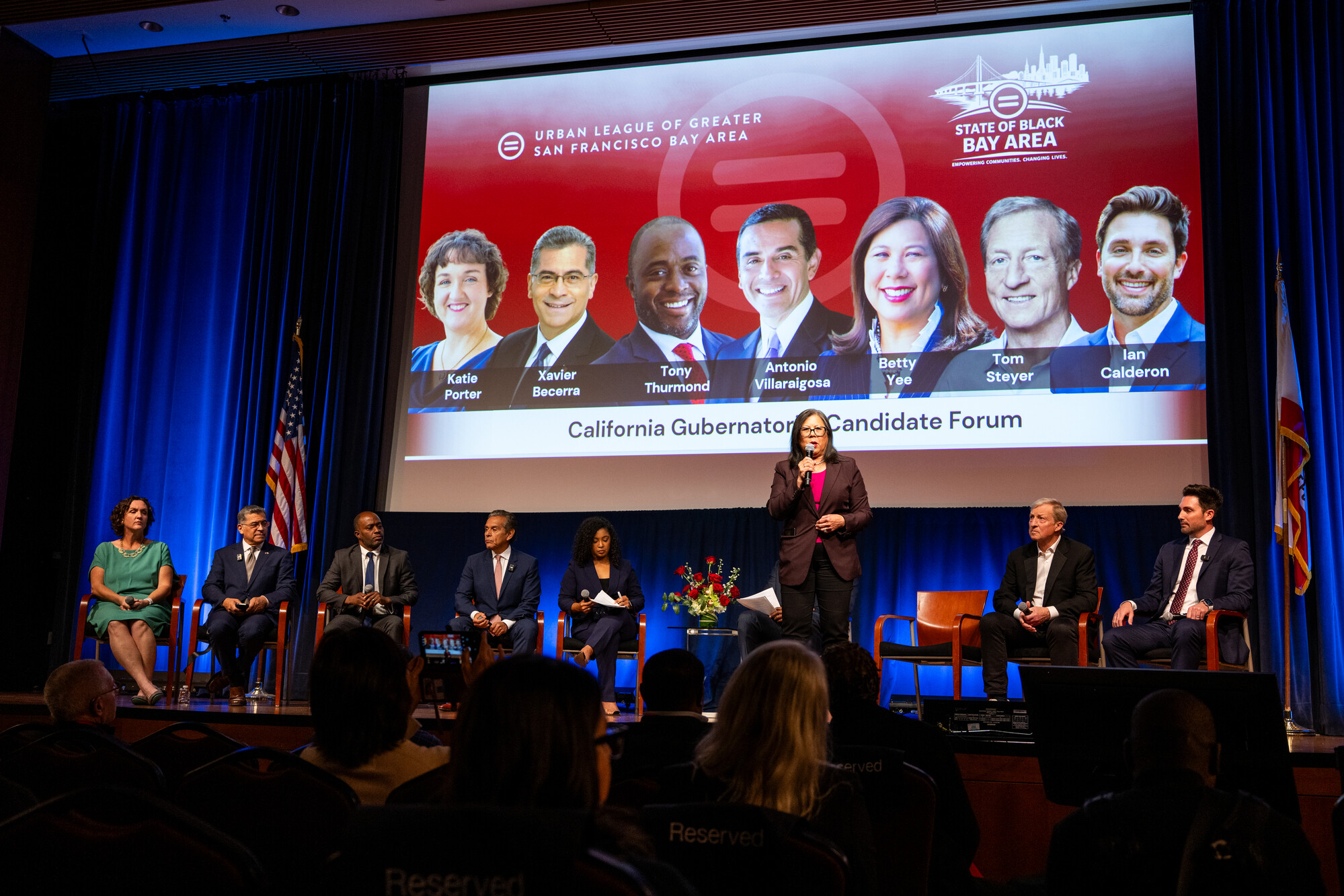
Mina Kim: Yeah. And those candidates polling roughly around three percent are Javier Becerra, Antonio Villaraigosa, Betty Yee, as you mentioned, Matt Mahan, and Tony Thurmond potentially.
And as you also note, Guy, vote-by-mail ballots are going out no later than May 4. But I guess I’m curious, Seema, if you feel like there is a lot of room for the race to change between now and then?
Seema Mehta: I mean, I think each of the leading Democrats has potential weaknesses, and I think that’s what the rest of the field is sort of counting on to see where we are a couple weeks from now.
Also, when Rusty made his request for people to sort of consider their viability—and this also ties into the USC debate that was canceled at the last minute because of questions around the methodology used to select the candidates who would participate—all of the candidates of color are polling low.
It was viewed in some quarters as just inappropriate because basically the state Democratic Party and other leaders were asking all the candidates of color to drop out. So that’s also a factor, I think.
Mina Kim: Yeah. And I also wanted to put the same question to you, Marisa, about room for this race to change in any particularly significant way.
Marisa Lagos: I mean, it has to, right?
Mina Kim: Do you think someone really is going to jump ahead in the next few weeks?
Marisa Lagos: I think it’s likely that we go into primary week with it still being a contest among some of these Democrats, but I do think that we will see at least some consolidation the closer we get to June 2, and that their numbers could at least jump up.
This is the point of the campaign where opposition research starts being dumped. I think we’re going to see—we’re already seeing someone like Eric Swalwell go up on TV for the first time. Steyer’s been there for a while. With Porter, I think we’re sort of waiting to see how she handles that.
Not that TV is the whole game anymore, and I think all these candidates have been really active on social media, which is obviously a really important place.
But I do think there will be some changes. And again, as voters check in, you’ll see—there’s still a pretty good chunk in a lot of these polls that are undecided. And then also, you could see a shift from some of these lower-polling candidates toward other ones.
Mina Kim: Yeah. About a quarter of voters are undecided.
Listener Sophie writes: “Californians have been put in a terrible position. I’m very frustrated with the Democratic Party with there being too many candidates and no clear front-runner. I’m taking the approach of looking at the polls and going with who is leading. Right now, that is Eric Swalwell.
“I would love for Javier Becerra to be governor and would vote for him if he were higher in the polls. He’s the most qualified by far, but sadly, we are placed in a position where we have to be strategic at this point to make sure we don’t have a Republican lockout.”
Right after the break, we’re going to dig into who the leading candidates are, their backgrounds, their promises, and their baggage as well.
But listeners, do tell us if there is a candidate that you would like to see be in the top two. And if not, why not? What has made it difficult for you to make that choice? What are the most important issues that you want the next governor to address?
Again, email address: [email protected]. Phone number: 866-733-6786. And you can find us on our social channels at KQED Forum.
More after the break. I’m Mina Kim.