This partial transcript was computer-generated. While our team has reviewed it, there may be errors.
Mina Kim: From KQED, welcome to Forum. I’m Mina Kim.
California is suing the U.S. Environmental Protection Agency for repealing the 2009 endangerment finding. That finding has been the legal and scientific basis for regulating planet-warming greenhouse gas emissions from cars and trucks. California is also opposing the Trump administration’s proposed fuel economy standards, which roll back stringent Biden-era rules.
As the Trump administration abandons policies to address climate change, can California help fill the void?
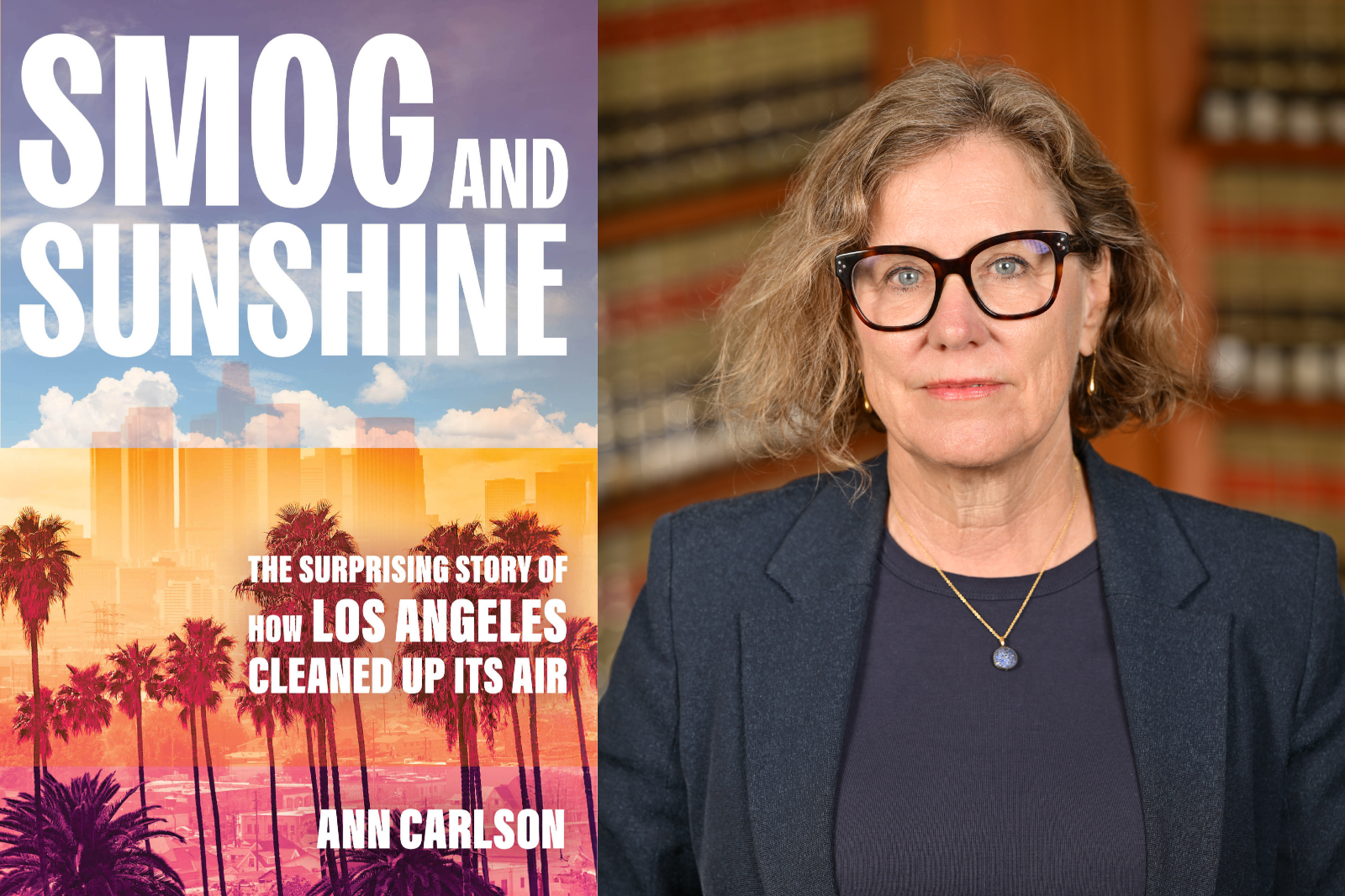
Anne Carlson thinks so. She’s an environmental law expert at UCLA, former acting administrator of the National Highway Traffic Safety Administration under Biden, and has written a new book called Smog and Sunshine: The Surprising Story of How Los Angeles Cleaned Up Its Air.
Anne, welcome to Forum.
Anne Carlson: Thank you. It’s great to be here.
Mina Kim: First, I want to ask you about the Trump administration’s withdrawal of the EPA’s 2009 endangerment finding. Remind us why that has been seen as so monumental. Remind us what the finding did.
Anne Carlson: The endangerment finding was actually directed by the United States Supreme Court after a case called Massachusetts v. EPA. The court told the EPA to determine whether greenhouse gases, when emitted by cars and trucks, endanger public health and welfare.
It was the George W. Bush administration that looked at all the science and said yes — greenhouse gases do endanger public health and welfare. That meant the EPA then had to issue regulations to cut greenhouse gases, first from cars and trucks and then from other sources like power plants, chemical plants, and other major emitters.
So that’s the basis for almost all of our regulations that cut greenhouse gases from the sources causing the planet to warm.
Mina Kim: Talk about how disruptive this revocation is in addressing climate change related to greenhouse gas emissions.
Anne Carlson: It is the foundation for the federal government to regulate greenhouse gases, so it basically takes the United States out of the game of regulating the emissions that we all know are causing the planet to warm. It’s a huge deal.
It’s also really important symbolically because the U.S. historically is the biggest emitter of greenhouse gases, and it’s basically saying to the rest of the globe: we don’t want to take responsibility for the greenhouse gases we’ve put into the atmosphere in the first place, and for those we continue to emit.
Mina Kim: Last month, California sued to stop the revocation of the endangerment finding, along with dozens of other states, cities, and counties. First, can you tell us how you think this will play out?
Anne Carlson: It’s a really good question. By all measures, this should be an easy case for California to win.
That’s because Massachusetts v. EPA already decided that the EPA needs to regulate greenhouse gases if it finds they endanger public health and welfare, and the science is overwhelming that those emissions do, in fact, harm public health and welfare.
But what the EPA is really playing for, I think, is to get the United States Supreme Court to revisit its decision. That’s because the decision was issued in 2007, and there are no longer any members of the court who were in the majority for that opinion. In fact, the chief justice, along with Justices Alito and Thomas, all dissented.
So I think they’re trying to roll the dice, get the court to take it up, and overturn its 2007 precedent.
Mina Kim: But you’ve also pointed out that while the endangerment finding revocation is very bad, it might actually give California more tools to potentially mitigate greenhouse gases. How so?
Anne Carlson: This is a kind of wonky legal argument, but California, under the federal Clean Air Act, is the only state that’s given permission to issue its own emission standards for cars and trucks. That power has been in place since the mid-1960s, when Los Angeles was choked with smog.
However, in order for California to exercise that power, it needs to get what’s called a waiver from the EPA. Congress actually stepped in a few months ago and took away from California three waivers that the Biden administration had issued to cut both greenhouse gases and conventional pollution from cars and trucks, especially heavy-duty trucks.
So here’s my argument: under the Clean Air Act, California is allowed to regulate emissions that are covered by the Act. The EPA is now saying greenhouse gases aren’t covered by the section that gives California that power, or by the section that prohibits any other state from regulating.
It seems to me to be a very strange argument to say both that we can’t regulate and no states can regulate. So I think there’s a good legal claim that California could, collectively with a number of other states, issue its own standards and not even need to seek permission from the EPA.
Mina Kim: And I understand that California is looking into that possibility. At the same time, are you hearing from other legal experts who feel that your interpretation is correct?
Anne Carlson: I think a number of other legal experts are intrigued by the possibility. It would clearly be challenged in court, and I’m sure the Trump administration would come in and say California can’t regulate any emissions without permission from us.
Mina Kim: We’re talking with Anne Carlson, Shirley Shapiro Professor of Environmental Law and founding director of the Emmett Institute on Climate Change and the Environment at UCLA.
Listeners, we want to hear from you. What concerns do you have about the Trump administration’s dismantling of climate protections? What role do you think California could play to fill that void?
What questions do you have about the impact of the administration’s rollbacks?
Email [email protected].
You can find us on Discord, BlueSky, Facebook, Instagram, or Threads at KQED Forum.
You can also call us at 866-733-6786. Again, that number is 866-733-6786.
So while the rescission of the endangerment finding by the EPA eliminates federal greenhouse gas emission standards for cars and trucks, it does not directly repeal CAFE standards, correct?
Anne Carlson: That’s right. The CAFE standards are issued under a different statute called the Energy Policy and Conservation Act, which was created during the oil crisis of the 1970s to reduce dependence on Middle Eastern oil by making cars and trucks more fuel-efficient.
The Trump administration has, however, proposed a really dramatic rollback of those standards, and Congress has passed legislation that reduces penalties for manufacturers that fail to comply with the standards to zero.
So right now there is no consequence for a car manufacturer refusing to comply.
Mina Kim: What were the standards during your time at the National Highway Traffic Safety Administration?
Anne Carlson: We had one set for model years 2024 to 2026, and then a new set for 2027 to 2031 model-year cars. We’d start to see fuel economy heading up toward about sixty miles per gallon.
The Trump administration is actually proposing to roll that back to under thirty-five miles per gallon. It’s an extraordinary proposal to basically eviscerate fuel economy standards.
Mina Kim: So essentially there’s no teeth to it right now?
Anne Carlson: Yeah, there’s no teeth to it. Whether manufacturers continue to comply remains to be seen, but the federal agency that administers the CAFE standards is doing nothing to hold their feet to the fire.
Mina Kim: What do you see as the impact?
Anne Carlson: We’re going to see bigger cars and trucks that are less fuel-efficient. In particular, we’ll continue seeing increased adoption of SUVs and trucks.
The Ford F-150 is the best-selling vehicle in the United States, and there will be no federal regulations of consequence directing manufacturers to improve fuel economy for those vehicles.
This is happening while gas prices are north of four dollars on average nationally, and much higher in California.
Mina Kim: Is there a chance manufacturers keep pursuing higher fuel economy because that’s what consumers want?
Anne Carlson: Yes. Manufacturers are still making electric vehicles, and we’re seeing an uptick in interest in EVs as gas prices increase. There are also a lot of used EVs on the market, and that market is getting tighter again as consumers think about what the future is going to hold.
Mina Kim: The Trump administration said the Biden standards would have raised the average cost of a new car by nearly a thousand dollars. Is that true?
Anne Carlson: The upfront costs of fuel-economy technology are higher, but the long-term savings over the life of the car, because you use less gasoline, are significantly higher.
So they’re taking into account costs without taking into account very real benefits, including environmental benefits from burning fewer fossil fuels.
Mina Kim: Taken together, do you think air pollution will get worse?
Anne Carlson: It won’t get better, and in some respects it is getting worse because of climate change.
But we are not going back to the days of the 1970s, ’80s, or ’90s, when smog alerts were a regular part of life in Los Angeles and the Bay Area.
Cars and trucks are much cleaner than they used to be. But in Southern California and the Central Valley, we still need a lot of work to meet pollution requirements, and the best way to do that is to clean up cars and trucks.
Mina Kim: After the break, I do want to dig deeper into how Los Angeles addressed its smog problem and what we can learn from that.
We’re talking with Anne Carlson, former administrator of the National Highway Traffic Safety Administration under Biden and an environmental law expert at UCLA.
Stay with us. This is Forum.