This partial transcript was computer-generated. While our team has reviewed it, there may be errors.
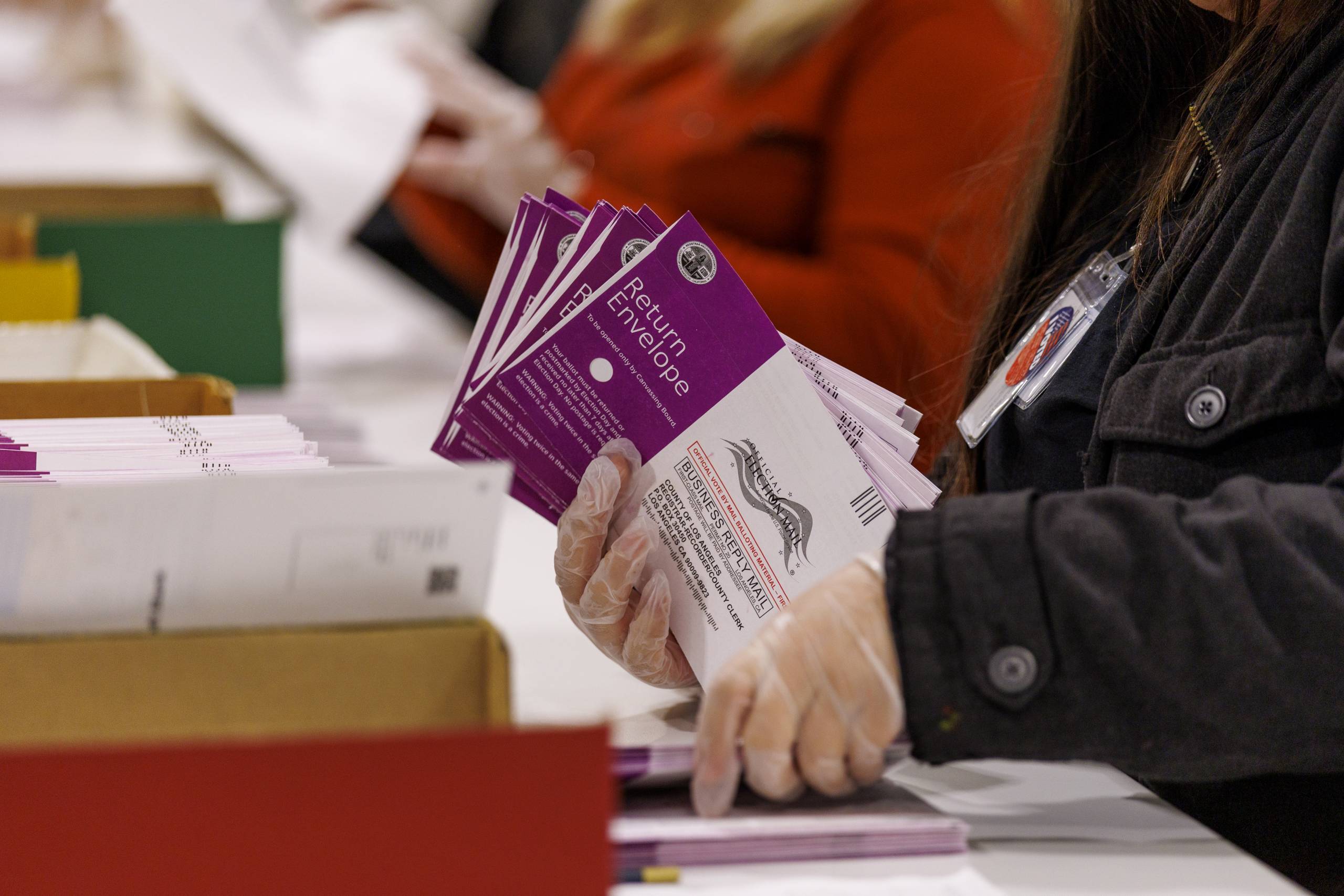
Guy Marzorati: This is Forum. I’m Guy Marzorati, in for Mina Kim. Nearly 90% of California voters cast a vote-by-mail ballot this past November, but the system faces new threats from the White House and from some local officials in California.
In Washington, President Donald Trump is continuing his crusade against vote-by-mail, driven by his unfounded claims of, quote, “massive cheating” with mail ballots. This week, Trump directed the U.S. Postal Service to oversee the administration of vote-by-mail—an executive order already drawing legal challenges.
We’re going to dive into all of this this hour. Joining us first is California’s top elections official, Dr. Shirley Weber, California Secretary of State. Secretary Weber, thank you so much for joining us.
Shirley Weber: Thank you for the invitation. I’m always happy to talk with folks and let them know what’s going on from our point of view—and the threats being levied against opportunities for our citizens to vote.
Guy Marzorati: Let’s start with that executive order Trump issued this week. It directs DHS and the states to create lists of eligible voters, and then essentially have the Postal Service cross-check that list before delivering or accepting ballots.
So this new responsibility for USPS—getting involved in elections—as I mentioned, is already facing legal challenges. What’s your response?
Shirley Weber: Well, there will be lots of legal challenges. There have already been efforts to obtain all of our data—names, Social Security numbers, and so forth. For what purpose? Who knows—but we can only imagine.
We fought that battle, and we won. It was declared they could not simply take all of our voter data. Voting resides with the states. So after winning that, we now see continued attempts to go around it—to challenge vote-by-mail, even though the president himself has voted by mail.
We face a constant battle. Every time we make progress, it’s challenged again with something like this—now involving the Postal Service and the Department of Homeland Security in ways they’re not qualified for. It creates confusion and potentially forces people to rely on federal systems just to vote.
These efforts are really attacks on systems that have been proven to work. If we were having a genuine conversation about improving voting, that would be one thing. But instead, we see continued attacks with no real solutions—often proposed by people who don’t work in elections.
It’s frustrating and disappointing, especially as we’re preparing for upcoming elections, trying to get people ready to vote in June and November—without any evidence that the system is corrupt. These claims have been made for years with no proof. I think citizens should be demanding more.
Guy Marzorati: As you mentioned, all of this is happening as we head toward an election in California—we’re about a month away from ballots being mailed out for the June primary.
There’s also a case before the Supreme Court challenging the practice of counting ballots that are cast by Election Day but arrive afterward. In California, there’s a seven-day window for ballots to arrive.
If the Court limits that practice or requires ballots to arrive by Election Day, do you see that affecting the vote count in the June primary?
Shirley Weber: It might—we’d have to see when such a decision takes effect. Any effort to change the rules around ballots that are cast on time but arrive later would be difficult.
But we’ve had to pivot before. When changes happen, we work with our networks—community groups and organizations—to get the word out about what voters need to do.
I tell people: when you see someone fighting this hard to take something away from you, it must be important. Sometimes we take voting for granted. But clearly, it matters—otherwise, it wouldn’t be under attack.
As an African American, I know how hard people fought for the right to vote—my parents, my grandparents, people who were denied that right for generations. Women, too, had to fight for it. So yes, it’s important.
No matter what changes come, we will do everything we can to help people vote and make sure their ballots are counted. This is a powerful right that empowers every Californian.
Guy Marzorati: A lot of these actions are being driven by false claims, whether from the White House or Republicans in Congress. I want to play you some recent comments from House Speaker Mike Johnson and get your response. Let’s listen.
Mike Johnson (clip): In some states like California, they hold elections open for weeks after Election Day. That bothers a lot of people. We had three House Republican candidates who were ahead on Election Day, and as new batches of ballots came in, their leads just magically disappeared.
Guy Marzorati: When you hear a comment like that—about leads “magically” disappearing—what’s your response?
Shirley Weber: I find it insulting. It suggests that we’re not doing our jobs—that ballots are just being manipulated or discarded.
In reality, we work to count every ballot in a state as large as California. I’d remind Speaker Johnson that states like Louisiana, where he’s from, have their own difficult history with voting access—especially for Black and low-income voters. I was born in Arkansas, my husband in Louisiana—we know what that history looks like.
People should look at their own record before criticizing others. And most importantly, they should provide data. Every time I hear claims like this, I ask: where is the evidence? Where are the court cases proving fraud?
There isn’t any. These are false narratives that undermine confidence in elections. It’s concerning to hear them repeated without basis.
Guy Marzorati: Setting aside false claims of fraud, some people point out that in close races, leads can change as ballots are counted. Does it take too long to count ballots in California?
Shirley Weber: Of course we’d like to count faster—but we also have to count correctly. California has created laws to expand access, and that takes time.
For example, we “cure” ballots. If there’s a missing or mismatched signature, we don’t discard the ballot—we track down the voter and give them a chance to fix it. That process takes time.
People often tell me: “Count them faster—but make sure you count them all.” And that’s what we do.
In most races, the outcome is clear quickly. It’s only in very tight contests—maybe one or two districts—where the final count takes longer. And interestingly, concerns about timing tend to arise only in those close races.
When one side is winning, they’re happy. When they’re losing, they want the count to stop. But our job is to count every vote.
We have up to 30 days to certify results, but most outcomes are known much sooner. The bottom line is that close races take time, and that’s part of ensuring accuracy.
Guy Marzorati: That was California Secretary of State Dr. Shirley Weber. Thank you so much for your time.
Shirley Weber: Thank you for having me. I hope people continue to stay informed—and most importantly, to vote.
Guy Marzorati: Thank you. We’re going to take a break. When we come back, we’ll dive further into the headwinds facing vote-by-mail in California. Stay with us.