This partial transcript was computer-generated. While our team has reviewed it, there may be errors.
Mina Kim: Welcome to Forum. I’m Mina Kim.
Flowers appear at nearly every significant human life transition and gathering place, says biologist David George Haskell—flowers on a grave, a shower of petals for newlyweds, floral garlands and altar pieces in places of worship. We may at times dismiss flowers as superficially pretty or box them into narrow symbolic roles, Haskell writes, but their presence at the center of acts of love, grief, community, worship, and cultivation reveals that, deep down, we understand the life-giving importance of flowers.
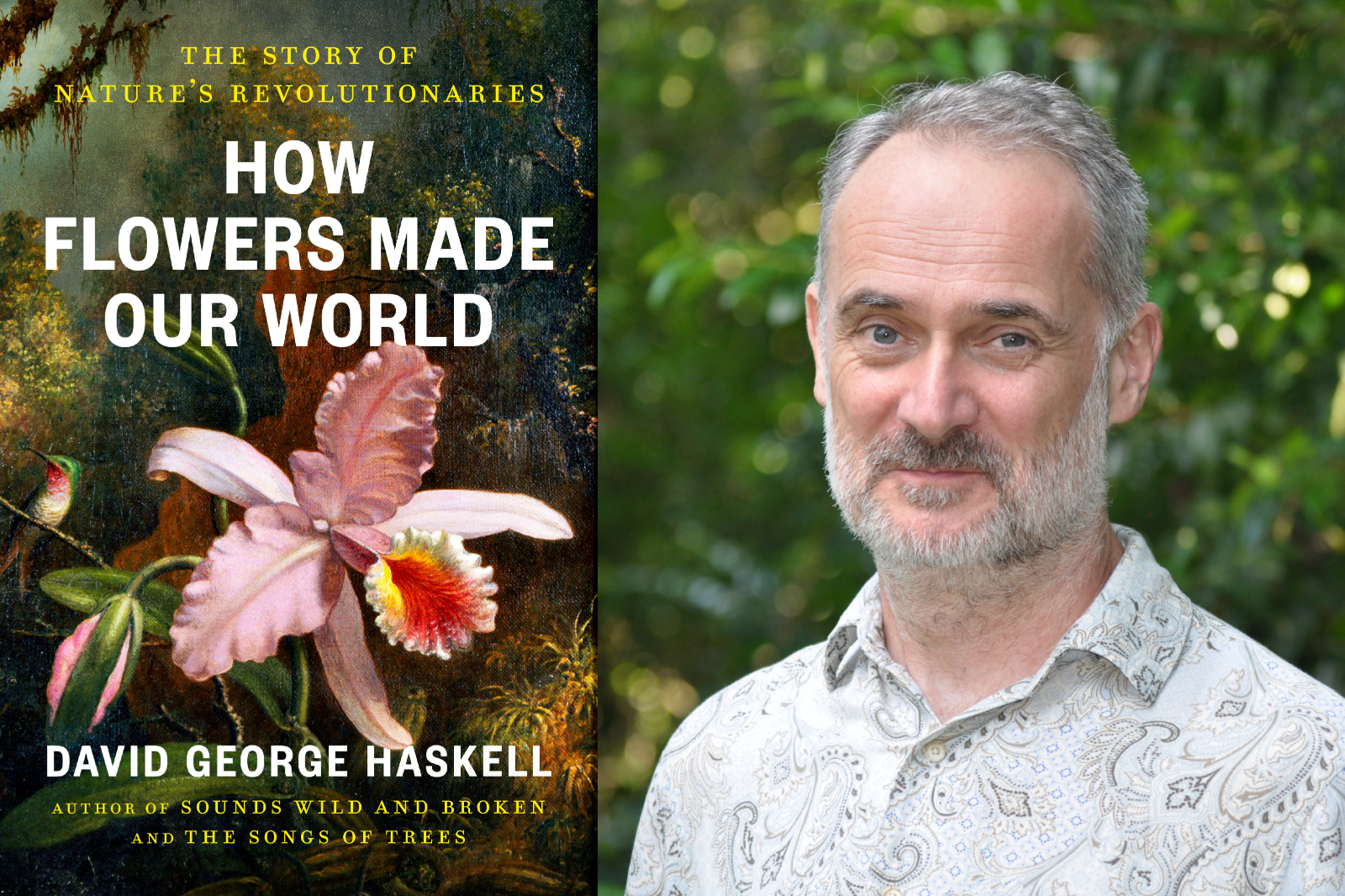
In a new book, Haskell deepens that intuitive understanding, showing that flowers are not just beautiful or ornamental, but powerful—setting Earth on an entirely new course when they appeared some 200 million years ago. His book is called How Flowers Made Our World: The Story of Nature’s Revolutionaries.
And listeners, tell us: what flower marks a significant moment or place for you? David Haskell, so glad to have you back on Forum. Welcome.
David Haskell: Thank you, Mina. It’s such a pleasure to be with you.
Mina Kim: I want to start by talking about a “flower” that many of us don’t even think of as one—grasses. Their effect on humans, animals, and habitats really illustrates what you mean when you say flowers are revolutionary.
David Haskell: Yes, I love that you’re leading with grasses because, of course, most of us think of grass as just a green carpet—we don’t pay much attention. But grasses are flowering plants. They’re a relatively recent arrival in the evolution of flowering plants, and when they appeared, they revolutionized the world.
They created steppes, prairies, and savannas—entirely new habitats. They did that partly by interacting with fire and grazing mammals in complex relationships that unfolded over millions of years. And then one clever little ape—our prehuman ancestors—came down out of the trees onto these grasslands and fed themselves from grasses and from animals that ate grasses.
So without grasses, we humans would not have evolved. Fast forward to today, and about 66 percent of all food calories eaten by humans come from just three species of grasses: wheat, maize, and rice. Much of the rest—pasture grasses, sugarcane, millet, oats, and barley—are also grasses.
If we named ourselves based on what we eat, we should be called “grass apes”—both for our diet and for the plants that catalyzed our evolution.
Mina Kim: How big do you think the human population would be if we hadn’t discovered how edible grasses are—how well they work for our bodies?
David Haskell: There wouldn’t even be a human population without grasses. Our ancestors were small-brained apes living in trees, eating fruits and insects. There’s a long evolutionary journey from that to modern Homo sapiens.
Without grasses, we might number in the thousands or tens of thousands—not the eight-plus billion we have today. Many predictions of mass starvation in the 19th and 20th centuries didn’t come true largely because of the enormous productivity of grasses. People at the time didn’t realize just how transformative grasses would be in feeding humanity.
Mina Kim: You also say that if we really look at how grasses survive—especially seeds—we can see what you call “mothering” at work. What do you mean by that?
David Haskell: One of the key innovations of flowering plants, which helped them take over the planet about 130 million years ago, is enhanced maternal care for seeds.
Part of that is the fruit that surrounds seeds. Fruits can be dry and explosive, or they can attract birds, or float in water. Inside the seed, there’s another gift from the mother plant: a tissue called the endosperm. It’s rich in starch, oils, and proteins—essentially a food reserve meant to nourish the embryo as it germinates.
We—and many other animals—figured out how to eat that. If you open a bag of flour, you’re mostly looking at ground-up endosperm. Birds, insects, and other animals that eat seeds are, in a sense, being “mothered” by flowering plants through this innovation.
Mina Kim: You describe the endosperm as a kind of disturbing sibling relationship—but fascinating nonetheless, right?
David Haskell: Yes. When pollen fertilizes a plant, two sperm cells are involved. One fertilizes the egg to form the embryo—that’s familiar. But the other joins with two cells to form the endosperm.
That endosperm is essentially a doomed sibling. Its role is to grow into a nutrient-rich tissue that will be consumed by the embryo. There’s something a bit unsettling about that—it’s a kind of sibling sacrifice.
But it’s also part of the intricate choreography of plant life—cells and genes moving in precise ways to ensure the next generation succeeds.
Mina Kim: We’re talking with David George Haskell, biologist and author of the new book How Flowers Made Our World. You may also remember him from his previous books Sounds Wild and Broken and The Songs of Trees.
Listeners, what questions do you have about flowers—their science and how they grow? What role do flowers play in your life? Do you have a favorite flower tied to a memory or place?
Email us at [email protected]. Find us on Discord, Bluesky, Facebook, Instagram, or Threads at @KQEDForum. Or call us at 866-733-6786.
David, you’ve described how flowering plants have shaped evolution and human life—and that about 90 percent of plant species today are flowering plants. Yet they’re not at the center of the story of how our world came to be. Why is that?
David Haskell: It’s a very old bias. If you look at Paleolithic cave paintings, they’re mostly focused on animals. In Europe, fewer than one percent depict plants, and virtually none show flowers.
Even today, we tend to focus on animals—whether in art, media, or natural history museums. Animals are edible, dangerous, or expressive in ways that grab our attention. Plants, by contrast, don’t have faces or behaviors that trigger our instincts in the same way.
In modern society, we’ve also boxed flowers into a narrow role: pretty, decorative, and often gendered as feminine—and therefore seen as less powerful.
All of this minimizes their importance. But over the last 100 million years, flowering plants have built the ecosystems—rainforests, prairies, and more—that support life on Earth. We have a long-standing bias against recognizing their central role.
Mina Kim: And you’re helping us rethink that. We’ll talk more after the break. I’m Mina Kim.