This partial transcript was computer-generated. While our team has reviewed it, there may be errors.
Mina Kim: Welcome to Forum. I’m Mina Kim.
President Trump may have backed away yesterday from his threat to strike power plants in Iran and has recently spoken of winding down the war. But in the meantime, the Pentagon has been sending a surge of additional U.S. forces to the Middle East, including thousands of California-based Marines, and has requested $200 billion in new funding for the war effort.
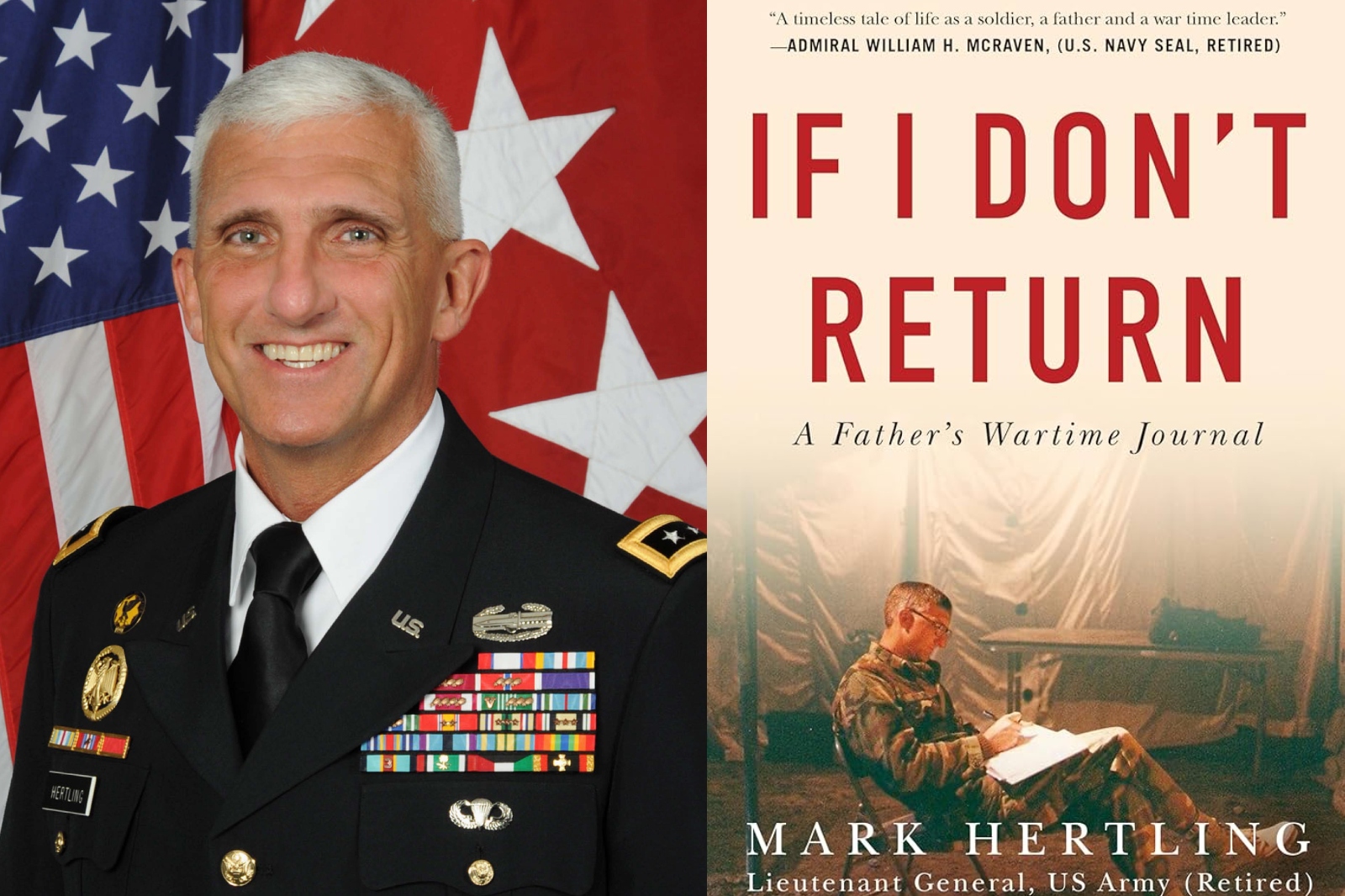
Retired Lieutenant General Mark Hertling has expressed concern about the administration’s mixed signals and lack of clear objectives in Iran, warning that this could lead to unnecessary loss of life. Hertling is a veteran of Desert Storm and the Iraq War, a military analyst for news outlets, and a columnist for The Bulwark. He also has a new memoir about his time in combat called If I Don’t Return: A Father’s Wartime Journal.
General Hertling, welcome to Forum.
Lt. Gen. Mark Hertling (Ret.): Mina, it’s great to be with you. Thanks for having me today.
Mina Kim: Thank you so much for being here. How do you interpret these latest developments on Iran? The president pulling back from his threat to strike Iran’s power plants if Iran didn’t open the Strait of Hormuz—just as he was reaching his own self-imposed deadline.
He cited what he called productive talks with Iran, but Iran disputes that characterization. So I’m curious how you’re assessing what happened.
Lt. Gen. Mark Hertling (Ret.): The entire conversation this weekend was about the president’s threat to take actions that, in my view, when I first heard them, seemed like potentially illegal orders—specifically targeting facilities that would have a major impact on Iranian civilians.
It took me aback. It also reinforced a concern I’ve had from the beginning: there appears to be a lack of clear strategy. I don’t see a defined end state—what we’re actually trying to achieve.
We’ve heard different objectives from different members of the administration. At various points, it’s been about regime change, then regime decapitation, then targeting nuclear capabilities, then ballistic missiles, and so on. Earlier on, the president also talked about helping the Iranian people rise up against the Ayatollah.
From a military perspective, before you begin a war, you need a strategic end state. Then you align operations—battles, resources, and logistics—to achieve that goal. When you go into conflict without clarity about your objective, that’s deeply concerning to anyone who has experienced combat.
Mina Kim: Another thing you’ve said, Mark, is that “the enemy gets a vote.” What do you mean by that?
Lt. Gen. Mark Hertling (Ret.): That’s something I wrote about in The Bulwark. When you go into conflict, you develop a plan—often over a long period of time—with many moving parts.
But history shows that the enemy also has a say in how things unfold. Your plan rarely plays out exactly as intended.
A mentor once told me: “The plan is nothing, but planning is everything.” What that means is that plans often fall apart in the chaos of war, but the process of planning—thinking through different scenarios, anticipating enemy reactions—prepares you for what you might face.
In conflicts I’ve been part of, we often made progress one day and lost ground the next because of unexpected enemy actions. That’s why adaptability is so critical when you send American troops into combat.
Mina Kim: What do you think are some of the mistakes or assumptions the Trump administration may have made about how Iran would respond?
Lt. Gen. Mark Hertling (Ret.): That’s a great question. The challenge is that we don’t actually know the original end state, so it’s hard to evaluate what went wrong.
But it does appear the administration didn’t anticipate Iran’s response. The president himself said something along those lines—that they didn’t expect this level of reaction.
He also seemed to shift some blame onto military leadership, but I can tell you from experience working in the Pentagon—particularly in war planning—every possible scenario is analyzed through war-gaming and red-teaming. Those possibilities are typically presented to policymakers, even if they aren’t fully accepted.
Meanwhile, Iran has continued to strike Gulf nations, launch weapons despite claims of depletion, and even carry out a strategic operation by closing the Strait of Hormuz. They’ve also used drones more effectively than many expected.
We’ve seen in Ukraine how advanced drone warfare has become, and Ukraine even offered the U.S. advice on defending against drones—advice that reportedly wasn’t fully adopted.
All of this suggests a lack of seriousness in defining a coherent strategy, beyond simply striking targets. There may also be some overconfidence, based on the relative ease of other recent operations, but this is a very different kind of conflict.
Mina Kim: Have we put ourselves in a corner now? What do you think is the likelihood of a ground invasion?
I’m thinking about Defense Secretary Jim Mattis saying yesterday that if the U.S. ends the war now, it could effectively cede control of the Strait of Hormuz to Iran indefinitely. Is a ground invasion the only way to prevent that?
Lt. Gen. Mark Hertling (Ret.): I wouldn’t say it’s the only option, but it is one of several very problematic ones. None of the available options clearly lead to a “winning” outcome.
For example, naval escorts could help ships pass through the Strait of Hormuz, but that would still carry significant risk.
As for putting troops on the ground—I don’t like the phrase “boots on the ground” because we’re talking about human beings—it would be extremely challenging.
From what we’re hearing, the deployment could include a couple of Marine expeditionary units and possibly a brigade from the 82nd Airborne Division—around 10,000 troops in total. That’s not a large force for a conflict of this scale.
Logistics alone would be a major challenge. Supplying and sustaining troops over time is critical—if you fail at logistics, you lose. It’s not just about what soldiers can do in combat; it’s about maintaining their ability to operate.
Then there’s the terrain. Iran is very different from Iraq. It’s about three times larger, much more mountainous, and has a population of around 92 million people, most of whom live in urban areas. That means a high likelihood of urban combat, which is extremely complex and dangerous.
All of these factors must be carefully considered before committing troops. Military leaders take these issues very seriously when asked to carry out political decisions through force.
Mina Kim: We’re talking with retired Lieutenant General Mark Hertling, former commanding general of U.S. Army Europe, a commander during the 2007–2009 Iraq surge, and author of the new memoir If I Don’t Return: A Father’s Wartime Journal.
We’ll have more with him—and we’ll invite your calls—right after the break. I’m Mina Kim.