This partial transcript was computer-generated. While our team has reviewed it, there may be errors.
Mina Kim: Welcome to Forum. I’m Mina Kim.
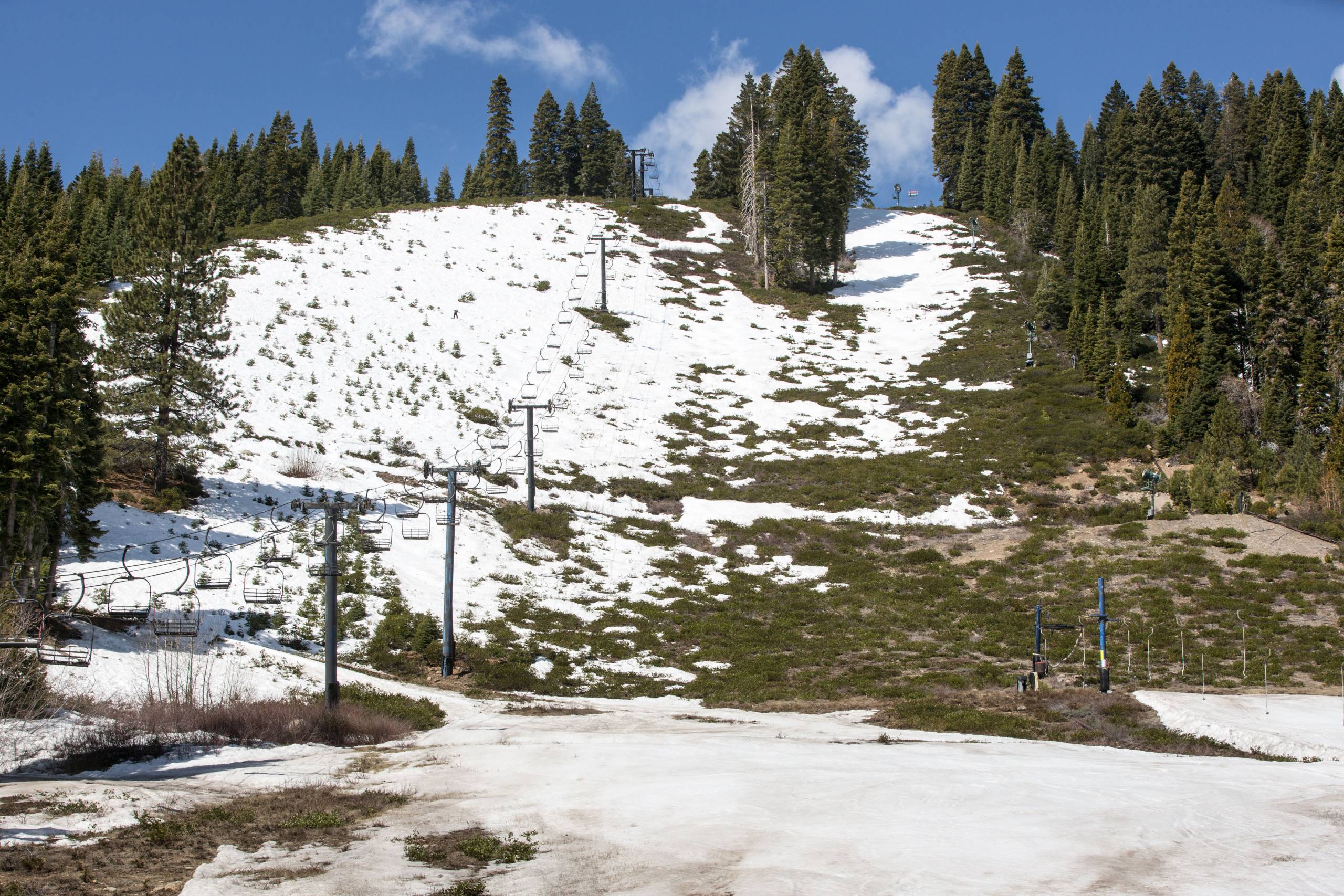
Several California ski resorts are calling it quits after the historic heat wave we had last week. Sierra-at-Tahoe and Tahoe Donner shut down their slopes yesterday, while Homewood closed its 2025–26 season last Tuesday—bringing the number of closures across the state, including Dodge Ridge and Mount Shasta earlier this month, to around eight.
Resorts can typically stay open to mid-April and sometimes later. The early closures come after a late start to the season, making it one of the shortest in a decade for some ski areas.
This hour, we look at what the tough ski season tells us about the long-term future of California resorts, and the outlook for this year’s snowpack and wildfires.
Joining me is Bryan Allegretto, California forecaster for OpenSnow and lead forecaster for Ski California. Bryan, welcome to Forum.
Bryan Allegretto: Thank you. Thanks for having me.
Mina Kim: It’s been a roller coaster of a ski season. Bryan, walk us through it—starting with that late start back in December.
Bryan Allegretto: We started really wet in November, but warm. It’s been a season of warmth. So we had a lot of rain and high-elevation snow in November, then went into a dry and mild period at the beginning of December, which made it really hard for ski areas to do much snowmaking early in the season.
But we got big, cold snowstorms just in time between the Christmas and New Year’s holidays, and that saved everyone. It opened most ski areas almost completely. Some didn’t open until mid-December, but everything looked good going into January.
Then we had another month-long dry spell until the third week of February. Luckily, the sun angle is lower that time of year, so we didn’t get a lot of melting. Then we had a huge storm—the second-biggest five-day snowfall on record since 1982—during that third week of February. It was very cold, snowed down to almost sea level, and brought everyone back to average for the season.
People were celebrating, and it seemed like that would be enough snow to carry us through spring. But now we’ve gone into another month-long dry spell, with zero snow in March. More importantly, temperatures are running about nine degrees above average for the month. That has caused the snow to melt at a record pace, and that’s really what’s shutting resorts down early. That snow would normally have lasted much longer.
Mina Kim: We have a listener writing in about the weather whiplash. They say: “This season was crazy—no snow, then what felt like the biggest storm in Tahoe’s history, then straight to summer.”
Are these swings the new normal?
Bryan Allegretto: There does seem to be more variability. In the last ten years, we’ve seen both the lowest and highest snowfall totals in the past 55 years.
In 2015, we had the lowest—about 130 inches recorded at the snow lab. Then just three seasons ago, we recorded the highest at 754 inches.
Right now, we’re at about 70% of average snowfall for the end of March. We were at average just a month ago. Precipitation overall is near average, but it’s coming in these wild swings—big seasons, then dry spells, cold storms, then warm storms. There’s definitely more variability.
Mina Kim: Let me invite listeners to join the conversation.
Did you manage to ski or snowboard this season? What were conditions like? Have you seen winters change in the Sierra—and is it making you rethink the cost or commitment of these sports?
Are you planning to get a season pass next year? Invest in lessons for your kids? Buy new gear?
You can email [email protected], find us on social media at KQED Forum, or call us at 866-733-6786.
Bryan, is there a precedent for a season like this? I’m thinking about that March heat dome about a decade ago.
Bryan Allegretto: It’s hard to say, because there’s always been variability, and we tend to focus on averages. Globally, temperatures have risen just over one degree Celsius in the past hundred years—it’s not like we’ve jumped ten degrees.
But we are gradually warming, and we’re watching how that affects seasonal patterns. Big snow years are still happening and can offset low snow years in the averages. In fact, the 10-year average snowfall is higher than the 50-year average by about two feet.
But averages don’t matter much when you get a March like this—nine degrees above average, the warmest on record—which melts snow rapidly.
Mina Kim: Even warmer than March 2015?
Bryan Allegretto: Yes. That was about five degrees above average. This year we’re at nine, so we’re going to surpass that by a lot.
Mina Kim: Does the condition of the snow itself also contribute to early closures?
Bryan Allegretto: That’s more of a question for resort operators, but I can say that snowmaking early in the season is crucial. Machine-made snow is dense and forms a solid base that melts slowly over time.
This year, resorts didn’t have much opportunity to build that base before the late-December storms. Natural snow—especially from cold storms like the one in February—is lighter and melts faster than well-established machine-made snow.
Mina Kim: Right—it’s lighter and more powdery.
There are some storms predicted for late March and early April. Could those help extend the season for resorts still open?
Bryan Allegretto: At higher elevations—especially north-facing slopes—there’s still a decent amount of snow. Many ski areas are designed with that in mind.
We are expecting colder temperatures next week and possibly some measurable snowfall. That should slow the melting and may even add some snow in early April.
We’re not expecting huge storms—April snowfall is typically about half of what we see in midwinter—but it should help extend the season a bit for resorts trying to make it into mid-April.
Mina Kim: How many resorts have already shut down, and how many more are expected to close soon?
Bryan Allegretto: Right now, including Mount Shasta, we have nine ski areas closed. Two more—Diamond Peak and Bear Valley—are expected to close this weekend.
That’ll bring us to about half of the roughly 20 ski areas in the Northern Sierra being closed.
The rest—Boreal, Sugar Bowl, Northstar, June, Kirkwood, Heavenly, Mount Rose, Mammoth, and Palisades—are aiming to stay open into April. If they make it through the next week, the colder weather should help them stay open a bit longer.
Mina Kim: We’re talking with Bryan Allegretto, California forecaster for OpenSnow and lead forecaster for Ski California.
Listeners, if you have questions about this heat wave, its impact on ski resorts, or broader effects like snowpack and wildfire risk—or if you want to share your experience skiing or snowboarding this season—we’d love to hear from you.
Has the changing winter climate made you reconsider your investment in these sports?
Call us at 866-733-6786, reach us on social media at KQED Forum, or email [email protected].
Stay with us. You’re listening to Forum. I’m Mina Kim.