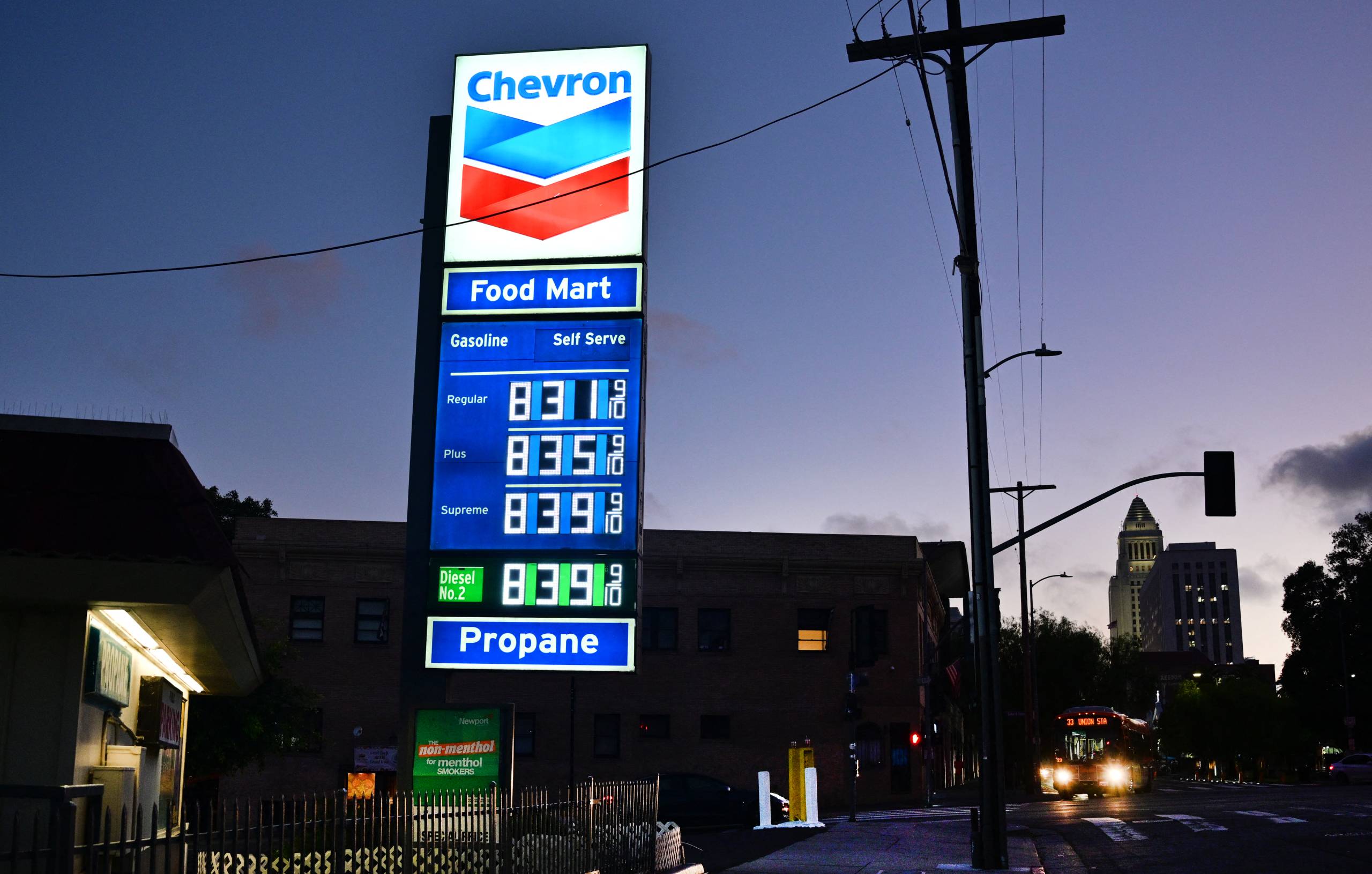
Mina Kim: From KQED, welcome to Forum. I’m Mina Kim. Gas prices are spiking as the war in Iran and the near-closure of the Strait of Hormuz cause major disruptions to the transport of about a fifth of the world’s oil. These disruptions can trigger higher prices in California than anywhere else in the country, and everyday Californians are feeling it—whether through less disposable income or higher costs to get to work or run a business.
This hour, we look at how bad things could get, with the latest tit-for-tat attacks on oil and gas infrastructure in the Persian Gulf sending prices to nearly $120 a barrel at one point this morning. Listeners, what’s the highest gas price you’ve seen lately, and what are you doing to limit your time at the pump? You can tell us by calling 866-733-6786, by emailing [email protected], or by finding us on Discord, BlueSky, Facebook, Instagram, or Threads.
Joining me this hour: Alejandro Lazo, climate reporter for CalMatters. Welcome, Alejandro.
Alejandro Lazo: Hi, thanks for having me.
Mina Kim: Also with us is Severin Borenstein, professor at UC Berkeley’s Haas School of Business and faculty director of the Energy Institute at Haas. He’s also on the board of the California Independent System Operator. Severin, really glad to have you on.
Severin Borenstein: Great to be with you.
Mina Kim: So, Alejandro, I’ll start with you. You drove today, and you drive a gas-powered car. How have you been dealing with high prices?
Alejandro Lazo: Yeah, absolutely. I fortunately drive a 2000 Toyota Echo, which is pretty efficient—they don’t make those cars anymore. But yeah, I filled up earlier this week and winced a little at even what that little eight-gallon tank cost.
Mina Kim: Yeah. Severin, what do you drive?
Severin Borenstein: I drive a plug-in hybrid RAV4, and luckily I’ve been able to drive it on electricity almost all the time since the war began. So I haven’t used any gasoline, but I’m certainly not looking forward to the next time I have to fill it up.
Mina Kim: Right. Because, Alejandro, the average price of gas in California right now, according to AAA, is $5.62, which is about a dollar more than it was a month ago. What are you hearing from people in your reporting about how high it could get?
Alejandro Lazo: Right, absolutely. Predictions are always difficult, but we are seeing, as you mentioned, big increases in the global price of oil. This spike we’re seeing—and I’m sure Severin will speak more about that—is fundamentally tied to that. I’ve talked to analysts who say $7 is plausible here in California, and $10 is a really extreme scenario at some gas stations—but not something to rule out at the moment.
Mina Kim: Severin, does that sound about right to you—that it could get to $7, with $10 as a worst-case scenario?
Severin Borenstein: I think $10 is pretty unlikely. Just to translate: when the price of oil goes up $1 a barrel, that translates to about 2.5 cents at the pump. So if we were to go to $200 a barrel, that would add about $2.50 to the price of gasoline, and we’d be around $8. I think that could happen.
Of course, it all depends on how the war evolves and how quickly it ends. The news over the last 24 hours is very bad because both sides have ramped up attacks on energy infrastructure. Even if the Strait of Hormuz reopens, if they can’t get oil and refined products out due to damage, that could further disrupt supply.
Mina Kim: Exactly. So even if the Strait of Hormuz reopens and the war ends, could infrastructure damage keep supplies depressed for an extended period?
Severin Borenstein: We don’t yet know how severe the damage is. In the past, they’ve been very effective at repairing oil fields and refineries quickly. But with the intensity of this conflict, it’s quite possible there could be extensive damage, leading to a long recovery before full production resumes. That would exacerbate the problem.
The reason we haven’t seen even higher prices so far is that we’ve been drawing down inventories around the world, including the U.S. Strategic Petroleum Reserve.
Mina Kim: Yes.
Severin Borenstein: But those aren’t infinite. If the war continues and the Strait of Hormuz remains closed, those inventories will eventually be depleted. If that happens, we could see a much bigger spike in oil prices.
Mina Kim: Right. Alejandro, I’ve heard that while those reserves help, they’re not meant to last forever. There’s an expectation they’ll run out, right?
Alejandro Lazo: That’s right. I mean, that’s something energy analysts can speak to in more detail, but absolutely—this supply is not infinite.
Mina Kim: I’ve heard estimates of around 20 days for coordinated releases from the International Energy Agency. But that suggests potential long-term effects for Californians. So what are you seeing people do—or what do you expect they’ll do—to make ends meet?
Alejandro Lazo: It really depends on your economic situation. If you drive and you’re a moderate-income person, the weekly cost of gasoline is a real factor in your life. People may try to drive less if they can. But if they rely on a daily commute, they may have to cut back in other areas, dip into savings, or use credit cards. It varies, but the key point is this is a real economic pressure in people’s lives.
Mina Kim: Well, Wayne writes, “I take public transit—SamTrans—for transportation. I also drive a plug-in hybrid.” We’re asking listeners what they’re doing to limit time at the pump and how they’ve been affected.
Let me go to Scott in Martinez. Hi, Scott, you’re on.
Scott (caller): Hi. You might have already answered this a bit, but I was telling your screener—I have a Chevron down the street from me, and I’m assuming the gas in their tanks is the same gas that was there before the war started. It’s already refined and sitting there. So why is that same gas now more expensive than it was three weeks ago?
Mina Kim: It’s a great question, Scott. Let me go to Severin.
Severin Borenstein: First of all, it’s probably not the same gas—stations typically get deliveries once or twice a week. But even before they get a new delivery, they know the replacement cost will be higher, so they raise prices.
More broadly, the oil and gasoline markets are globally integrated. Whether oil comes from California or the Middle East, prices move together. Gasoline—whether already refined or not—reflects the global price of crude.
An analogy: when you sell a house, you don’t price it based on what you paid—you sell it at the current market value. Oil companies do the same. I don’t begrudge them that. What I do push back on is the idea that drilling more locally would shield us—it wouldn’t. Oil prices are global, and we’re vulnerable regardless of where it’s produced.
Mina Kim: Right. So even though the U.S. is the world’s top oil producer, disruptions in the Middle East still raise domestic prices because producers follow global markets.
We’re talking about high gas prices—especially in California—and hearing from you about how you’re coping. We’re joined by Severin Borenstein of UC Berkeley’s Haas School of Business and Alejandro Lazo, climate reporter for CalMatters.
What’s the highest gas price you’ve seen lately? How are you dealing with rising fuel costs? Email us at [email protected], find us on social media @KQEDForum, or call 866-733-6786.
More after the break. I’m Mina Kim.