This partial transcript was computer-generated. While our team has reviewed it, there may be errors.
Mina Kim: Welcome to Forum. I’m Mina Kim.
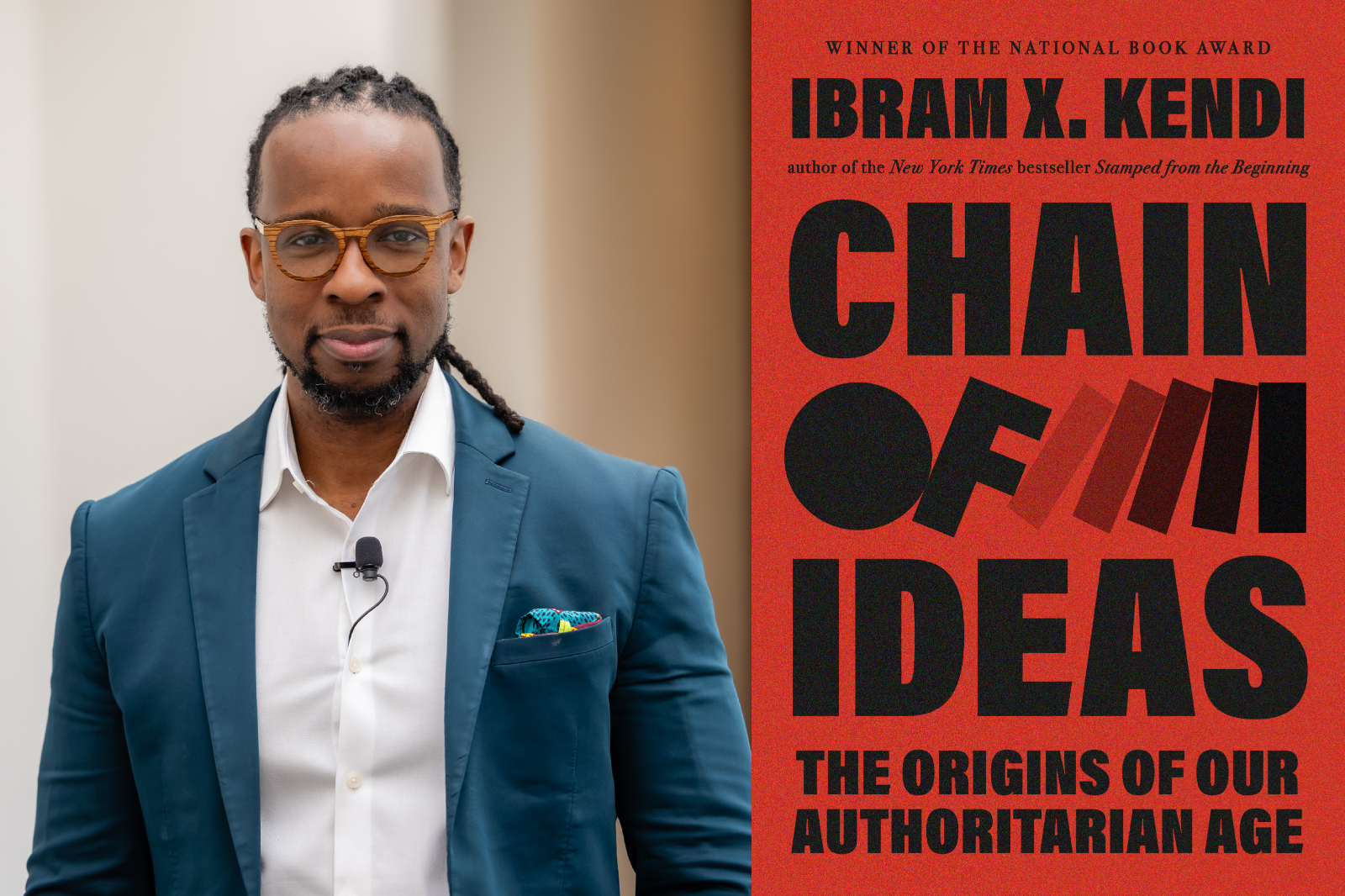
If you’ve wondered how we entered this modern age of authoritarianism, historian and bestselling author of How to Be an Antiracist, Ibram X. Kendi says the “great replacement theory” has played no small part. He argues that the racist idea—that shadowy elites are enabling people of color to replace or steal the livelihoods, cultures, and electoral power of white people—is a key ideological driver of our authoritarian age.
In a new book, Chain of Ideas, Kendi examines the resurgence of this conspiracy theory over the last two and a half decades in hopes of helping the country change course.
Dr. Kendi is a professor of history at Howard University and joins me now. Welcome to Forum.
Ibram X. Kendi: Thank you for having me.
Mina Kim: Ibram, you say that you didn’t find the subject of the book—the subject found you. What did you mean by that?
Ibram X. Kendi: What I meant is that my work has focused on the history of racism, including writing How to Be an Antiracist. What I didn’t realize when that book came out in 2019 was that there was already a political movement organized around “great replacement theory” that viewed antiracism as its primary antagonist.
This goes back to 2011, when a French novelist, Renaud Camus, published The Great Replacement. He later wrote You Will Not Replace Us, echoing the chant heard in Charlottesville in 2017. In both books, he positions antiracism as the force that these authoritarians are fighting against.
I had no idea this framing existed when I was writing my earlier work.
Mina Kim: So they were essentially arguing that being antiracist equates to being anti-white. And by “they,” who do you mean?
Ibram X. Kendi: I’m referring to people who promote “great replacement theory”—the idea that people of color are coming to displace the lives and livelihoods of white people.
A central claim is that antiracism isn’t about equal opportunity, that diversity isn’t about mutual respect, and that multiculturalism isn’t about shared coexistence. Instead, they argue these ideas are meant to harm or replace white people.
That’s one of the core falsehoods at the center of the theory.
Mina Kim: And how do you think this has ushered in our authoritarian age? Does it create a sense that people need a “strongman” figure—often how Donald Trump is described—to protect them?
Ibram X. Kendi: Yes. If people are led to believe that immigrants—particularly Black and brown immigrants—are invading the country, that they’re criminals, that they pose a threat, then they’re going to feel endangered.
And when people feel their lives are threatened, they look for protection. They’re more likely to support leaders who promise security—even if that means giving up certain rights and freedoms. That’s how authoritarianism can take hold.
Mina Kim: These ideas about immigrants stealing jobs or causing demographic change have been around for a long time. As you note, versions of replacement theory underpinned Nazism.
But you mentioned Renaud Camus, whose work is more recent. His framing of “great replacement theory” really emerged in the late 1990s through the early 2010s, right?
Ibram X. Kendi: Yes. And one important thing to understand is that ideas can exist long before they’re named.
“Great replacement theory” as a concept dates back to the late 19th century and was central to extremist ideologies, including Nazi Germany. But it’s in the last two decades that it has reemerged with renewed force.
Camus gave it a name in 2011, and since then, it has spread globally.
Mina Kim: And it’s based on a false premise, right? He observed more people of color in a French town and interpreted that as displacement, even though those communities had been there for decades?
Ibram X. Kendi: Exactly. I open Chain of Ideas with that story. Camus describes visiting a town in southern France where he sees people he perceives as immigrants from North Africa and the Middle East.
In reality, they made up a very small share of the population—around 4 percent. But he imagined that they were “invading” and “replacing” the so-called indigenous white population.
So he framed this as evidence of a “great replacement” that needed to be resisted, despite the demographic reality.
Mina Kim: I want to invite listeners into the conversation.
Have you noticed a resurgence of “great replacement theory”? If so, why do you think it’s taken hold again? Have you encountered it in your social media feeds—or even among family or friends? And if so, how do you respond?
You can also share whether Kendi’s work has changed how you think about race and racism in the U.S. His books How to Be an Antiracist and Stamped from the Beginning have had a wide impact.
Email us at [email protected], find us on Discord, BlueSky, Facebook, Instagram, or Threads at KQED Forum, or call us at 866-733-6786.
I want to play a clip of then-candidate Donald Trump at a campaign rally in Delaware in September 2024, where he touches on ideas related to this theory.
Donald Trump (clip): And they’re taking over our country. You see what they’re doing. Kamala Harris’s border invasion is also crushing the jobs and wages of African American workers and Hispanic American workers—and also union members. Unions are next, you watch. They’re hurting African American workers and Hispanic workers in particular. They’re taking your jobs. Every job produced in this country over the last two years has gone to illegal aliens.
Mina Kim: “Every job produced in this country over the last two years has gone to illegal aliens,” according to that clip.
Sorry, Ibram—you wanted to jump in?
Ibram X. Kendi: Yes. That statement reflects elements of “great replacement theory.”
I would also add that when elected officials are backed by wealthy interests whose policies may contribute to economic hardship, they have an incentive to redirect blame. Rather than people blaming those in power, they’re encouraged to blame immigrants, Muslims, or Black Americans.
This creates a cycle: people experience economic struggle, they’re told to blame other marginalized groups, and that division allows those in power to maintain control. That’s part of the dynamic I describe in Chain of Ideas.
Mina Kim: Another interesting aspect of that clip—and we’ll talk more about this after the break—is that Trump frames the issue as affecting African American workers, Hispanic workers, and union members.
You’ve also argued that “great replacement theory” isn’t limited to the far right.
We’ll have more with Ibram X. Kendi after the break. Stay with us. This is Forum.