This partial transcript was computer-generated. While our team has reviewed it, there may be errors.
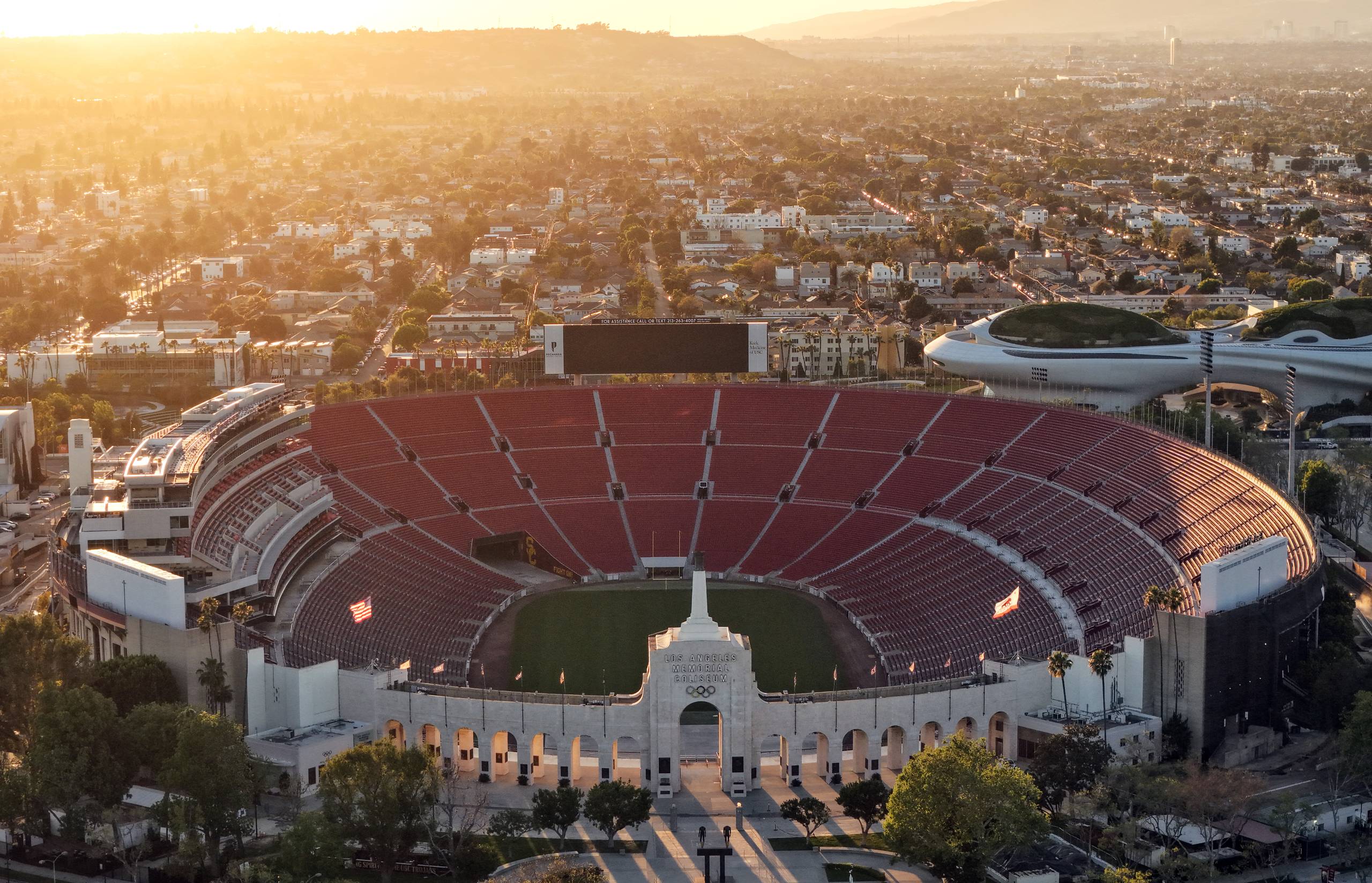
Mina Kim: From KQED, welcome to Forum. I’m Mina Kim. A January Economist survey finds soccer has surpassed baseball as America’s third most popular sport. Great news for California, which is hoping for an economic boon from hosting matches for the 2026 World Cup in Los Angeles and Santa Clara — that’s as long as political headwinds don’t get in the way.
Iran, which was supposed to play its first match in L.A., announced yesterday it would not take part in a World Cup in the country that killed its leader. Add to that, the U.S. hasn’t exactly been playing nice with its co-hosts Canada and Mexico. And travel bans and visa restrictions have already caused headaches for fans and some players.
But my guest Roger Bennett believes the unifying power of soccer will prevail over politics and make for unforgettable matches. He’s founder and CEO of Men in Blazers Media Network, and his new book is We Are the World Cup. Roger, welcome to Forum.
Roger Bennett: Oh, Mina, it’s a joy to be with you on KQED. Best thing from San Francisco since Bob’s Donuts.
Mina Kim: Thanks. Well, first, Roger, can I get your reaction to the Iran news? Because I understand no qualified team has dropped from the tournament since, like, 1950.
Roger Bennett: Oh, you’ve got some good knowledge there. Yeah, that was India in 1950, and they did not participate for a variety of reasons. But the fact that we go back to 1950 shows you how unprecedented this current reality is.
Look, I wrote this book because I believe the World Cup is one of the most remarkable mirrors to the world that surrounds it. That’s what gives it its power — its memory-making power. It’s a mirror in great times, when we see the world reflected back to us. It’s also a mirror in incredibly dark times, Mina, and that’s what we’re seeing now.
There is one precedent to this in the 1930s, when Germany annexed Austria and Austria had qualified for the World Cup. Austria immediately dropped out, and their footballers played with the German team. But this modern reality is utterly unprecedented. FIFA hasn’t quite worked out exactly how they’re going to process it, and it’s hard to take in football as the real front pages of the newspaper in this current day and age.
Mina Kim: I heard they could be penalized — even banned from future World Cup tournaments?
Roger Bennett: Yeah, this is all speculative at the moment. We’re waiting for a statement from FIFA. If you look at what’s occurred over the past week, when the conflict erupted, it was incredible. Within three days, with everything going on, the Iranian Football Association found the energy and ability to put out a statement saying they didn’t know if they could play in this World Cup they’d qualified for.
Then there’s been ricocheting back and forth — President Trump originally saying he didn’t care if they came or didn’t come. FIFA asserting that they were going to work this through. Then Iran saying, “We don’t think we are going to play.”
And today’s news — minutes ago, actually — is the president saying that for their players’ safety, it’s better that they don’t come. So this is an evolving story. Look, you need to be Jake Tapper or Wolf Blitzer to really unpack this. You need to get into the Situation Room with Wolf Blitzer, Mina.
But again, it shows you that football is the perfect mirror. When the San Francisco Giants play the Boston Red Sox, it’s an incredible game of baseball between two elite franchises. But when football occurs — and this is the premise of my book — the nation’s history, the nation’s culture, the nation’s politics take the field alongside those teams. That’s what gives this tournament its power, normally in great ways. In this moment, we’re seeing it in the most painful and challenging ways possible.
Mina Kim: Yeah. So you say that the tensions are part of what makes the World Cup so incredibly engaging for people — to actually see countries with such difficult histories facing off in a soccer match.
Roger Bennett: Exactly that. You can probably tell from my accent, listeners — I’m as American as Kenny Powers now, and I root for the U.S. men’s and the U.S. women’s teams. But I grew up in Liverpool, England.
One of my most formative experiences was watching — and I write about it in depth in the book — Argentina face England in the shadow of the Falklands War. It was an incredible moment where my English heroes as a kid, whom I thought were utterly invincible, faced Diego Maradona, who was essentially the Michael Jordan of his day.
He eviscerated the team. First with a goal he punched in with his hand, brilliantly branding it afterward as scored with “a little bit of the head of Diego and a little bit the hand of God.” And then the second goal — he picked the ball up deep in his own half and ran through nearly all ten outfield players before sliding the ball home.
It utterly eviscerated my heroes. That’s one of the most formative memories I have — not just the football, which was both transcendent and impudent, but also the greater context: the Falklands War, the sense of self, the sense of a nation being defeated.
And that’s what the World Cup offers. It’s coming to the United States, as well as Canada and Mexico, in 91 days’ time. And so much is going to happen between now and then, Mina. Obviously everything could be transformed. But hopefully — and this is what I’ll say — I hope it will be an electric connection and a positive, joyful moment for the world to feel that sense of togetherness.
Mina Kim: Yeah. Well, let me invite listeners into the conversation. Listeners, are you excited for the World Cup? Who are you rooting for? What match are you most excited to see?
Also, are you a longtime soccer fan, or is your interest more recent, if it’s there? Have you noticed Americans embracing it more? Email [email protected]. Find us on Discord, Bluesky, Facebook, Instagram, or Threads at KQED Forum. Or give us a call at 866-733-6786. Again, that number is 866-733-6786.
And Douglas on Discord writes: “I would have been shocked if Iran did play in the World Cup.” I mean, Roger, they were scheduled to play in L.A., right? Home to one of the world’s largest Iranian diasporas.
So what does this mean for the tournament? Each bracket has four teams in it, right? Could they possibly just play with three? Or is it more likely that a new team will come in to replace Iran?
Roger Bennett: You’re asking me a question that you should really be asking FIFA. They are the organizers, and they are currently working on exactly what they should do. There’s no precedent. There’s no protocol. There’s no process.
Mina Kim: Really? You don’t have a guess?
Roger Bennett: There are two teams that are being bandied about as possible qualifiers if you follow the most rational processes. One, dear listeners, is Iraq, and the other is the United Arab Emirates. So I think FIFA has some thinking to do.
Mina Kim: Yeah. Actually, I’ve got to be honest — when I think of FIFA, the overarching reputation for them is one of greed and corruption. I’m sure that’s because of all those investigations under Obama that exposed bribery and scandal.
And then, you know, FIFA probably got some eye rolls when they gave Trump the FIFA Peace Prize in December. I’m curious — does that taint it at all for you? Do you feel like FIFA has cleaned up its act?
Roger Bennett: I mean, look, every single sports bureaucracy knows that we watch sports for the effervescent moments — the emotional moments that create incredible memories.
When you watch the NFL Draft, how does it begin? It begins with Roger Goodell walking onto the stage. He almost whips up the crowd now with their ritual booing. They’re booing because the figure who runs the sport — they feel as fans, having traveled there — doesn’t represent them. He represents the owners. And he plays into that.
He knows in his head that’s fine, because the second the game kicks off, the booing stops, the cheering begins. And it’s the same with football and with the International Olympic Committee.
Every single World Cup in the modern period — 2010 in South Africa, for example — the drumbeat going into it was that it was going to be an absolute disaster. The crime rate was said to be so high that any fan going there would be exposed to grievous bodily harm.
But the second the ball kicked off, it revealed itself to be, I think, the most profound World Cup of my lifetime — a tournament played in the shadow of Mandela.
Then 2014 in Brazil — the storyline going in was social and economic unrest. There were riots outside games the year before across the nation, as people demanded social services and education, not football. It was projected to be a disaster, with calls to remove the tournament from Brazil.
But the game kicked off, and it was ecstatic. It was the greatest sporting party the world had seen.
So there is always that drumbeat of darkness. But once Lionel Messi takes the field, the world stops. The emotion kicks in. I think you call it cognitive dissonance. And that’s how we watch all sports nowadays. There’s the rational, and there’s the emotional. The emotional always edges it — at least one-nil.
Mina Kim: Why is soccer so powerful at that? What do you think it is about soccer and its ability to outshine scandal and concern like this, if you could go a little deeper?
Roger Bennett: Yeah, sure. And by the way, it’s not just true in the rest of the world — it’s true here too. I write in the book about 1994, when the men’s World Cup was last here. Right before that tournament, there was a study showing soccer was America’s 67th most popular sport — and tractor pulling was number 66.
So we’ve come a long way. You mentioned the Economist study at the beginning of this interview that found soccer has now surpassed baseball and is the third most popular sport in the United States.
Its grip on audiences, I think, comes from the stories it tells. When two teams take the field, as Walt Whitman would say, it contains multitudes. There’s this power of storytelling and global connection.
The Super Bowl has about 200 million viewers, which is enormous by American standards. But when the World Cup kicks off, five billion — with a B — people around the world are watching those games.
And it’s not like the Olympics, where track and field might be happening at the same time as volleyball or water polo and your attention is divided. There’s one game, all eyes on it. Heroes are made. Nations are changed.
I write in the book about 1982. I was in France as a kid. France reached the semifinal and was beaten in a deeply controversial way by Germany. I was shocked by how jubilant the French were afterward.
I’ll get back to that after the break. Is that our break music, Mina?
Mina Kim: It is. It usually starts playing at about 40 or 45 seconds.
Roger Bennett: I’d be terrible giving an Oscar speech. I’d just walk off stage immediately. God bless.
Mina Kim: I appreciate your sensitivity.
We’re talking with Roger Bennett, author of We Are the World Cup: A Personal History of the World’s Greatest Sporting Event. Listeners, you can join the conversation at 866-733-6786, by emailing [email protected], or on our social channels at KQED Forum.
We’ll have more with him — and with you — after the break. I’m Mina Kim.