This partial transcript was computer-generated. While our team has reviewed it, there may be errors.
Mina Kim: Welcome to Forum. I’m Mina Kim.
California Congressman Ro Khanna has been busy introducing a war powers resolution along with Kentucky Republican Thomas Massie, arguing that the president could not initiate major combat operations against Iran without Congress. The resolution narrowly failed to come to a vote last week.
Khanna and Massie are also the duo that forced the Department of Justice to release millions of pages of the Epstein files. And Khanna has been weighing in on the clash between the Pentagon and Anthropic as the ranking member of the House Armed Services Subcommittee on Cyber.
The conflict over the Department of Defense’s use of Anthropic’s tools is a topic we’ll dig into later this hour. But first, I’m joined by Silicon Valley Congressman Ro Khanna.
And if you have questions for the congressman, listeners, now is the time to email us or post them on our social channels. Congressman Khanna, welcome to Forum.
Ro Khanna: Mina, it’s good to be back. Thank you for having me.
Mina Kim: I really appreciate you giving us your time. The president has been giving conflicting statements on the war, saying early yesterday that it’s very complete and will be over pretty quickly—totally and decisively defeated—and then suggesting it would not end this week. I want to know how you read these mixed signals, Congressman.
Ro Khanna: It’s very concerning and sad to me. I hope he ends this war.
We have already lost, as you know, seven service members. Many of our troops and service members are at risk. We’re spending over a billion dollars a day. To put that in perspective, if we are in Iran for fifty days, that’s enough to have free public college for everyone in America.
So this is a war that does not have a clear objective. So far we’ve replaced Khamenei, who led a brutal regime, with Khamenei Jr. We’ve replaced an 86-year-old hardliner with his 56-year-old son, who is an equal hardliner. And it’s unclear what objectives are being met.
I have said very clearly that Democrats should not provide a single new dollar for this Iran operation.
Mina Kim: But how do you make that possible? You introduced a nonbinding war powers resolution that failed to come to a vote in the House. The Senate introduced a similar measure that also narrowly failed.
Now Senate Democrats have filed a new wave of war powers resolutions. But Congressman, what’s the value of these given—as you yourself said—that the president would not agree to them even if the chambers were able to pass something?
Ro Khanna: Well, as Bernie Sanders and I showed years ago when we passed the Yemen War Powers Resolution during Trump’s first term—even though Trump vetoed it—there was so much pressure that he voluntarily suspended the refueling of Saudi planes.
So Congress speaking out does matter.
Unfortunately, as you pointed out, we held every Democrat before but lost the vote by a few. We need to continue to put pressure on the administration.
My view is that we may win over some Republicans as they see the price of oil going up, as they see constituents facing higher gas prices, as they see the markets in turmoil because of the shock this has caused to the global economy, and as they see more of our service members at risk.
The interesting thing is this war is already unpopular. Usually it takes a few weeks or months before a war becomes unpopular. I don’t expect the war becoming more popular as we go along.
I hope the president ends it. But if not, Congress needs to continue putting pressure so that we can bring it to an end.
Mina Kim: Why do you think he started it?
Ro Khanna: He was talked into it, or he believes—with his advisers—that somehow they can bring about a new regime in Iran.
Obviously Iran’s killing of those protesters was horrific. They committed crimes against humanity against their own citizens. No one is going to defend the IRGC. The IRGC has also committed terrorism.
The president was convinced that he could significantly stop that killing or stop the regime. But the reality is that when we’ve interfered in the past—in Iraq and Libya—it has not worked out.
And so far we’ve replaced, like I said, one hardliner with his son, who is an equal hardliner. The IRGC is still in place. Americans have died. Billions of dollars have been spent. And it’s unclear what the objective is.
Even if we are further degrading the military weapons there, that’s something they can rebuild in a year or two, just like they’ve rebuilt things since we bombed them six months ago.
Mina Kim: Well, it’s certainly drawn attention away from the next development I want to ask you about, and that is the Epstein files—in particular the missing pages detailing allegations from a woman that Trump sexually abused her as a minor.
The Department of Justice late last week released sixteen of the fifty-three pages that NPR reported were missing. Those included more details that allowed news outlets to verify parts of her testimony.
What are your next steps on this, Congressman?
Ro Khanna: Well, Thomas Massie and my Epstein Transparency Act is the most significant legislation that a Democrat has introduced and gotten passed by Trump.
We’ve gotten 50 percent of the files out. It’s shocked the conscience—the number of survivors, over 1,200, who were raped as young girls; the number of powerful people involved in finance, real estate, technology, Hollywood, and around the world.
It’s led to prosecutions of figures including Prince Andrew, Lord Mendelsohn, and a former Norwegian prime minister.
We need accountability here.
One thing you pointed out is that some of this was covered up. There was an allegation—I don’t know if it’s true—by a woman that she was raped by President Trump when she was 13. They released one interview but withheld three others. It was Massie and my advocacy, along with journalism, that forced the release of those additional interviews.
Now, as I said, I have no idea about the merits of the claim. But the point is they cannot cover this up. We’re going to pursue every avenue—legal and through Congress—to get the rest of the files released and hold the rich and powerful people who abused these girls accountable.
Mina Kim: Can you help me understand why it’s been so hard to get these files, especially after the president promised to release them on the campaign trail?
Ro Khanna: I’ve gotten to know the survivors personally. They’ve been in tears in my office. They’ve relived trauma.
These women have been abused and abandoned for thirty years by our country. One filed a complaint in Santa Monica in 1997 about being raped, and nothing happened. Someone filed with the FBI in 1996 about similar allegations, and nothing happened.
The rich and powerful worked with Epstein to traffic and abuse these girls. They targeted girls from working-class families. They targeted girls without fathers.
It’s a terrible indictment of the powerful in our country and what they were getting away with.
We forced this issue because Trump promised to release the files but didn’t follow through. So Thomas Massie and I took it up, and against all odds we passed a discharge petition. There have only been five discharge petitions passed in the history of Congress since 1935.
We got Donald Trump to sign my bill. It passed 427 to 1 in the House and unanimously in the Senate.
Miraculously we’ve gotten half the files released. Julia Brown at the Miami Herald has been working on this issue for ten years and didn’t even expect us to get this far because it exposes so many powerful people.
But we’re going to continue fighting. Every time we push, more files are released. They’re supposed to release another 40,000 pages. They’re currently in violation of the law, but I’m confident we will get the rest.
Mina Kim: Congressman, what is the value of this effort given that consequences have been elusive? Some critics worry that releasing files could make prosecutions harder.
Ro Khanna: Prosecutions are taking place elsewhere in the world—in Norway, France, and Britain.
I agree that the administration has not pursued the prosecutions that should happen here. But there have been resignations in the United States. And frankly, there shouldn’t be buildings or universities named after some of the people in these files who abused young girls or went to Epstein’s island.
So there have been at least social consequences. But there absolutely need to be investigations and prosecutions.
The problem is that Attorney General Pam Bondi has shown no interest in doing that. Survivors contact me and say they see the men who abused them walking free.
This may take another administration before we see real prosecutions. But for me, this is a deeply personal issue. I’ve met dozens of these survivors. They’ve endured tremendous trauma.
This is about justice for them, and I’m not going to rest until we get the full release of the files and real accountability.
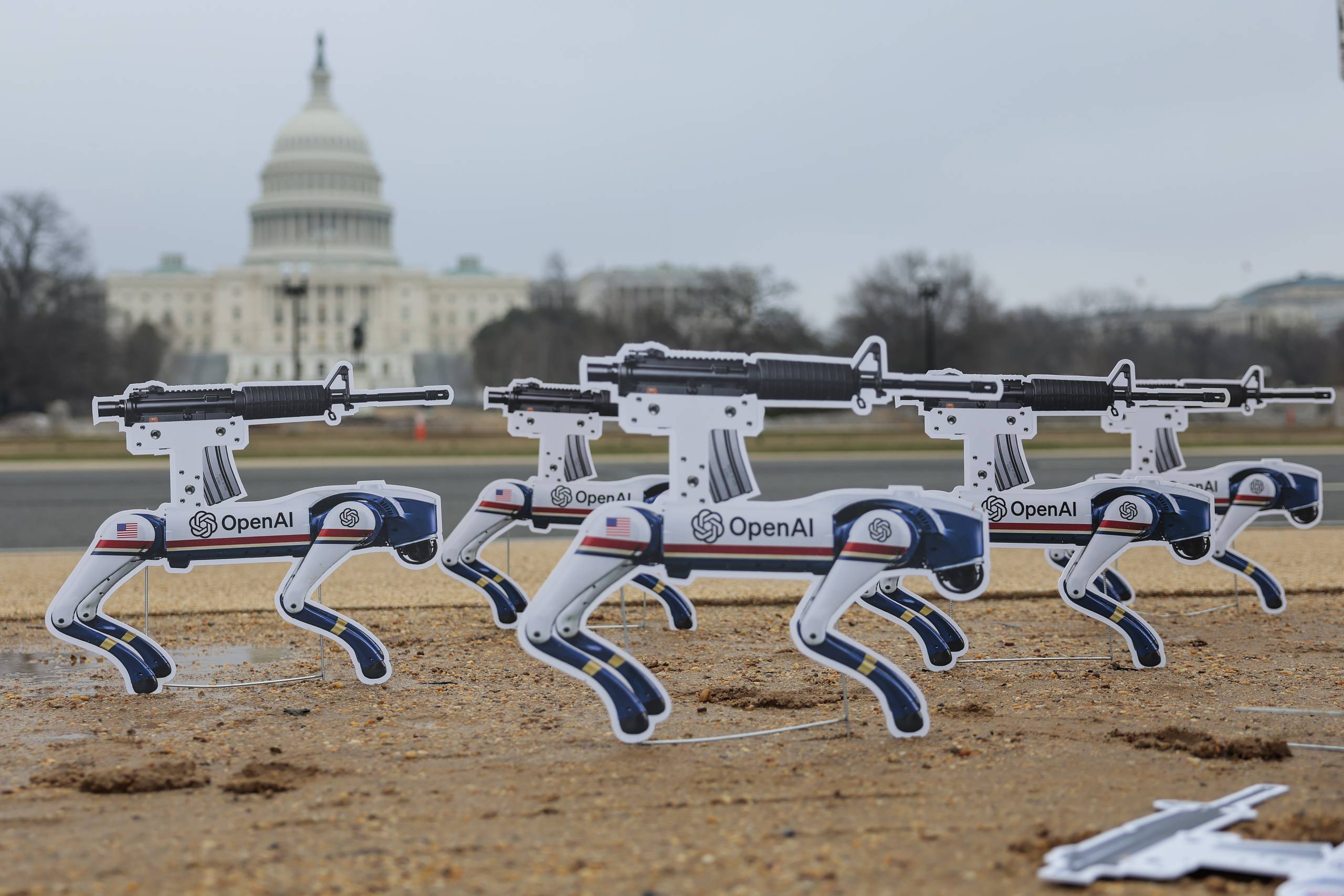
Mina Kim: Congressman, on Anthropic: in the next segment we’re looking at the Pentagon’s clash with the AI company over its position that it doesn’t want its technology used for mass surveillance or autonomous weaponry.
You praised Anthropic for taking this position. Should a private company be able to dictate how the Pentagon uses its technology in military operations?
Ro Khanna: Yes. Companies should be able to say their technology must meet basic safety standards.
Ultimately, Congress should set those standards. But I don’t believe AI should be used to kill people without a human being in the loop.
Dario Amodei at Anthropic was in my office a week before he made that statement. All he was saying is that AI should not be making decisions about killing people. You shouldn’t have AI striking a school somewhere without human oversight.
Even with humans in the loop we’ve seen tragedies—like the Iranian school where girls were killed. So we need stronger safeguards, not weaker ones.
Anthropic is also saying its technology shouldn’t be used for mass surveillance of Americans—building profiles of people.
Congress should regulate this. We should say AI can’t be used for autonomous killing and can’t be used for domestic mass surveillance. But in the absence of regulation, it’s important for tech leaders to draw ethical lines.
Mina Kim: What do you see at stake here? We just have about thirty seconds.
Ro Khanna: What’s at stake is innocent people being killed because AI malfunctions.
And what’s at stake is Americans having profiles built about them, where the federal government surveils them in violation of their basic rights.
Mina Kim: Democratic Congressman Ro Khanna, who represents California’s 17th District, is the ranking member of the House Armed Services Subcommittee on Cyber, Innovative Technologies, and Information Systems.
Thank you so much for giving us your time.
Ro Khanna: Thank you. Good to be on.
Mina Kim: And listeners, we’ll be talking about the latest developments in the controversy between the Pentagon and Anthropic after the break. Stay with us.
You are listening to Forum. I’m Mina Kim.