This partial transcript was computer-generated. While our team has reviewed it, there may be errors.
Mina Kim: Welcome to Forum. I’m Mina Kim. A man charged with the 2019 murder of a Silicon Valley CEO will stand trial this year. He’ll be the fourth and final person to learn his fate in the killing of cannabis startup founder Tushar Atre. All three other men have been convicted of murder and are now serving life sentences without the possibility of parole.
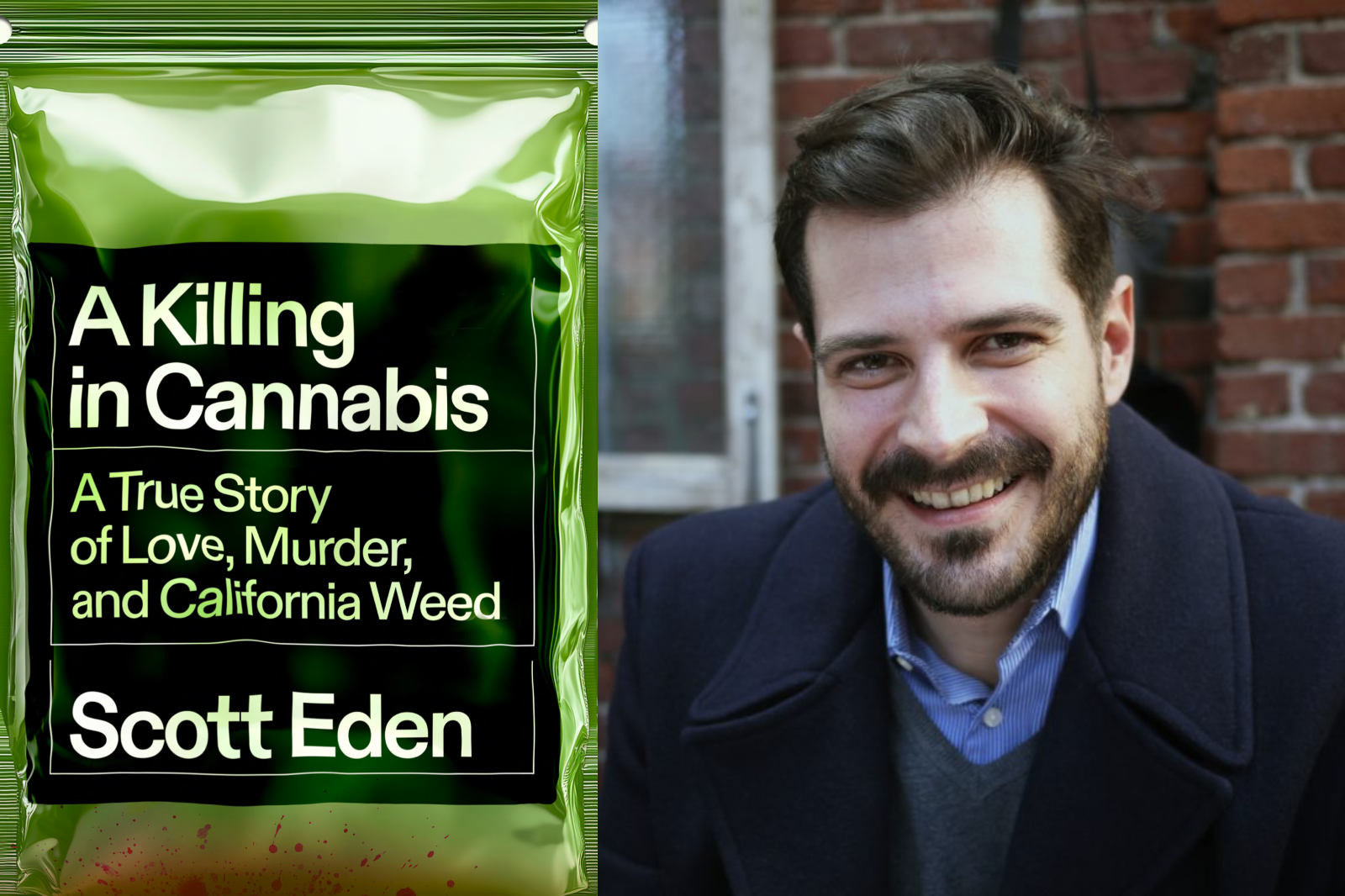
The murder of Tushar Atre caught the attention of my guest, investigative journalist Scott Eden, who saw in the brutal killing the entanglement of tech industry ambition and the dark side of black-market weed, which remains a potent force despite legalization in California in 2016. Eden’s book is called A Killing in Cannabis, and he joins me now. Welcome to Forum, Scott.
Scott Eden: So, so happy to be here. Thanks for having me.
Mina Kim: So the murder of Tushar Atre took place in Santa Cruz in October of 2019. Tell us—who was he?
Scott Eden: Tushar was a Silicon Valley tech entrepreneur. He was born in Westchester County. His mother was an IBM executive for a very long time—a computer scientist.
Following in her footsteps, after he graduated from college he moved west to Silicon Valley during the first dot-com boom. With the help of his mom, he founded a web design firm—eventually called AtreNet—in Silicon Valley. Many of his clients were other Silicon Valley startups.
He was really successful at this and spent twenty years or more running this very profitable business. Then, when California legalized cannabis in 2016, he—like many other tech people from Silicon Valley and from all over California who had not been in cannabis before—saw in legal cannabis a gigantic financial opportunity, a way to get in on a new industry.
So Tushar decided to found a licensed cannabis startup.
Mina Kim: And you paint him as part of the broader wave of tech entrepreneurs entering cannabis when it became legal. How did he specifically decide to get into it? What type of business did he have?
Scott Eden: There are several sectors of cannabis. You can be a grower, you can be a retailer. But Tushar decided to get into what’s known as manufacturing or processing. It’s really the descendant of hashish production—the creation of hash oil, where you extract the essential oils from the plant matter.
It’s really a high-tech sector of cannabis. It takes a lot—you have to create sophisticated labs—and that’s what he did. He decided to get into that sector of the business.
He spent about three years developing it from the ground up, but he very quickly learned that there was really no way to enter the business without first participating in the black market. He wanted to create a very sophisticated, cutting-edge lab, but it took a lot of hurdles to get licensed. There’s a lot of regulation around the creation of these labs because they can be dangerous unless they’re built in a certain way.
So it took him three years to get it up and running. But at the beginning, like others who were new to the cannabis world, he teamed up with legacy black-market players to learn the business—how to process, how to create a lab. He took a pretty big risk and created an unlicensed lab—a black-market lab—right after deciding to get into the business in 2017.
Mina Kim: And he jumped headlong into this despite the risks you described, because he’d fallen in love with a woman, right? Someone he met from Humboldt County who’d grown and sold weed.
Scott Eden: Yeah, there’s a love story component to it. By chance, Tushar’s family owned a home—or a series of homes—in Santa Cruz, and one of them he used as an Airbnb. A woman came to live there with her mother, who was dying from cancer. She didn’t have a job, but she seemed to have a lot of money and was able to rent this expensive Airbnb for multiple months with her mother.
He was intrigued by how she had so much money and was able to do that at such a young age—she was just thirty. Eventually he learned that she had been a cannabis grower in the Emerald Triangle, in Trinity County, one of the most rural places in California. She had worked in the black market—she was a black-market cannabis entrepreneur.
In his eyes, that was something he was amazed by and wanted to know more about. Eventually they fell in love and tried to create a business together.
Mina Kim: And it’s interesting because she knew from her own experience that you needed to tread carefully, especially if you were engaging with the black market. You write about her being the only woman growing weed on a backwoods hill otherwise full of stoner dudes bursting with unvented testosterone.
But it doesn’t sound like Atre really heeded that—even as he engaged with the marijuana black market. He didn’t always treat people particularly well. He seems really driven by what he’s trying to achieve, more than the people he needs to achieve it.
Scott Eden: Right. At the beginning of California legalization, it drew in people from outside cannabis. Tushar was very much what’s known in cannabis slang as a “chad”—someone coming from outside the culture, a square.
He was very much a fish out of water once he got into the weed business. On the other hand, there were similarities between where Tushar was coming from—Silicon Valley—and the cannabis world.
Tushar viewed business as combat, always wanting to win every business dealing—whether it was a trading partner, a client, employees, or even business partners. He brought that Silicon Valley mentality to weed. But the weed business itself has its own ruthlessness.
Rachel had lived in that world for years and knew the ins and outs. I think Tushar, at least at first, saw her as a guide—almost a spirit guide to help him maneuver through this new world he had entered.
Mina Kim: There was this part of him you describe as ruthless—kind of bro-y, sometimes a jerk to his workers—but there was also a part of him that seemed to want to do something new and interesting, maybe even something good for the world with this cannabis venture.
Scott Eden: Right. First of all, he was bored. After twenty years running this company that kind of ran itself—a big profit-margin business—he wanted something new.
He told Rachel he wanted to create something tangible—like seeing candy bars coming out the other end of a factory, almost like a Willy Wonka image. He also saw in Rachel these almost New Age or traditional views of cannabis as a spiritual, almost sacred plant. Many people in California and around the world view cannabis that way.
He latched onto that and saw weed as something meaningful to do—not just a business, but something medicinal that could help the world. Rachel very much had that ethos, and he wanted to change his life.
Mina Kim: I want to invite listeners into the conversation. Listeners, do you remember that time after legalization in 2016? What expectations did you have when California voted to legalize cannabis? Did you try to get involved yourself? Have you tried to start a cannabis-related business? What challenges have you faced?
You can email [email protected], find us on Discord, Bluesky, Facebook, Instagram, or Threads at KQED Forum, or call us at 866-733-6786. If you voted for legalization, do you remember why?
So Scott, tell us what happened in October. What happened to Tushar?
Scott Eden: Toward the end of the narrative I tell in the book—this three-year story of Tushar’s career in cannabis—he bought a beautiful home on Monterey Bay in Santa Cruz, in the neighborhood of Pleasure Point.
He was a big surfer, so he wanted a place where he could walk down to the breaks in the morning and paddle out at one of the most famous surf spots in California.
He also viewed his businesses almost like a kind of collegiate or frat-house environment. Some of the people living with him were workers—contractors and employees working at his hash-oil production facility.
In the early hours of October 1, 2019, there was a home invasion. People in the house heard it happening—they woke up and heard jostling sounds and Tushar yelling. Three people had entered the house.
From surveillance cameras afterward, sheriff’s deputies were able to piece together what happened. Tushar was taken from the home and was missing for a number of hours. Later that morning, deputies went to one of the properties he owned—a piece of raw land in the redwood forest in the Santa Cruz Mountains, a place called the Summit.
That’s where they found his body, riddled with bullet holes and stab wounds.
Mina Kim: And as I mentioned, four people were charged in the killing. Three have already been convicted, and the fourth—who may have been the one who actually killed him—is now awaiting trial.
Do you have any thoughts about why it’s taken quite a bit of time to reach this point in the case?
Scott Eden: There was about an eight-month homicide investigation. Arrests were finally made in May of 2020—and of course, that was during COVID. That’s one of the reasons it took so long for the trials to get started.
It was also a very complicated case. There were four defendants, each robustly defended by Santa Cruz public defenders who are very good at their jobs. At first, they were going to be tried together, but a judge later ruled that the cases would be severed into four separate trials.
There were also many pleadings and pretrial motions, which really slowed things down.
Mina Kim: The case is still active. Scott Eden writes about it in his book A Killing in Cannabis: A True Story of Love, Murder, and California Weed—the story of the murder of a Santa Cruz tech entrepreneur who was excited about the newly legal cannabis market and tried to jump in.