This partial transcript was computer-generated. While our team has reviewed it, there may be errors.
Mina Kim: From KQED, welcome to Forum. I’m Mina Kim.
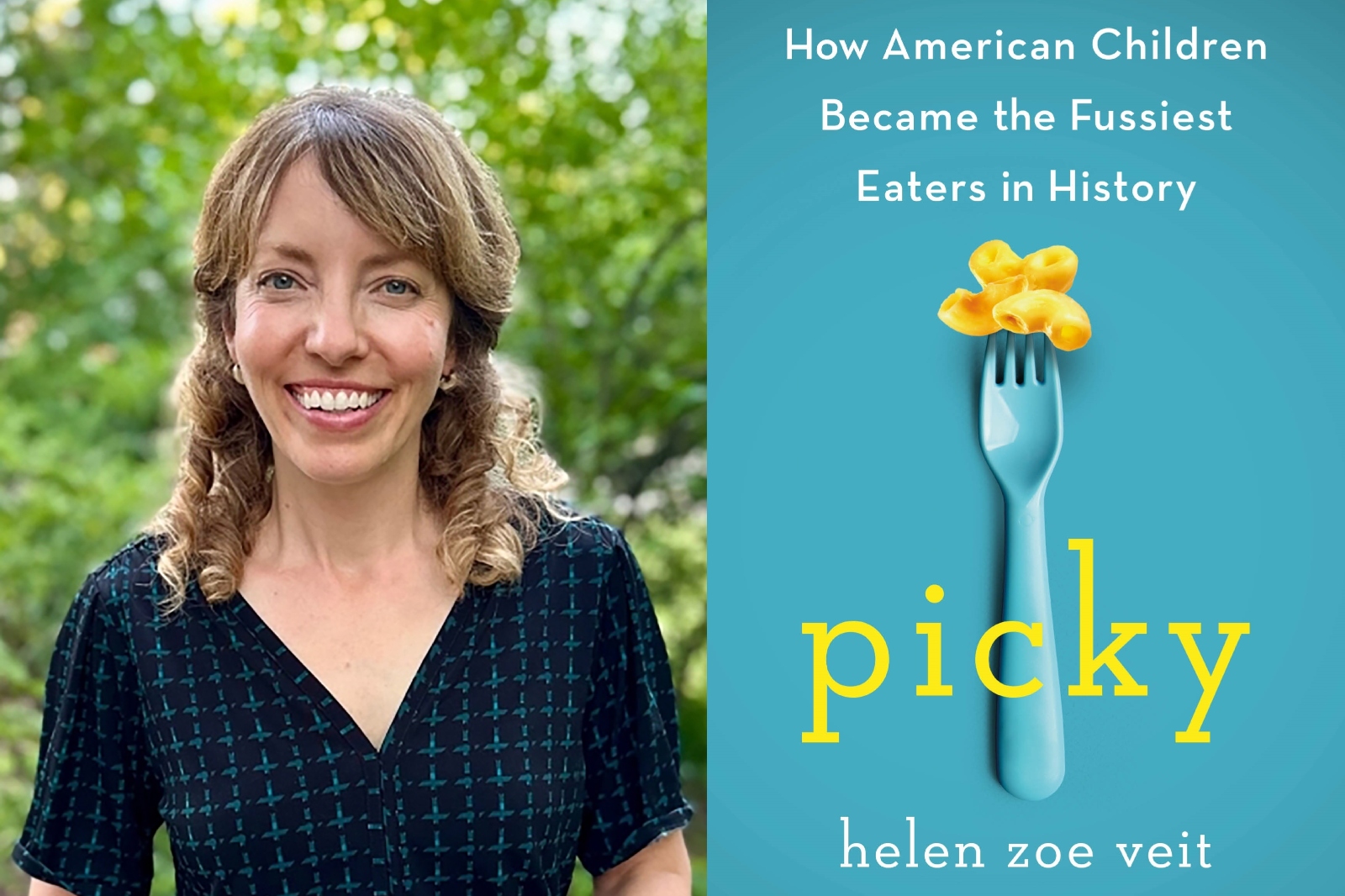
There’s a reason American kids are such picky eaters, and it doesn’t have to do with biology or an innate preference for bland foods like buttered noodles and cheese pizza, says social historian Helen Zoe Veit. It has to do in large part with cultural shifts over the last century, including changes in activity levels, widely adopted myths about child psychology, and the rise of highly processed foods.
And Veit says that’s good news, because if it’s not innate, it can be changed. So if you or someone you know is exhausted from trying to get kids to be more adventurous eaters—or from making separate meals just so they’ll eat—Veit says there are concrete ways to combat the causes of pickiness.
Her book is Picky: How American Children Became the Fussiest Eaters in History. Helen Zoe Veit, welcome to Forum. Thanks so much for having me.
So one of the things you point to in making your argument is how kids ate before the 1930s or so. Which was how?
Helen Zoe Veit: Oh man, it almost sounds like science fiction when you talk about it today because it’s just so wildly different from everything we’ve been told is natural and normal.
Americans in general in, let’s say, the nineteenth century ate so much more diversely than we do today in terms of species. They ate an incredible variety of plant species, a lot more heirloom varieties, wild plants, and lots more animal species than we do—different kinds of birds and fish and shellfish, organ meats.
And the crucial thing is that children, with very few exceptions, generally ate what their parents were eating. That was the norm for most people. So edible food would be ready at a meal, and kids would show up along with their parents and, for the most part, they would eat the same food.
The even more crucial part is that they weren’t just eating the food—everybody agreed they liked it. There was a broad idea that kids love to eat, that they’re naturally omnivorous, and enjoyment and pleasure were the big themes of kids’ food in the past.
Mina Kim: Yeah. You write about how to describe that someone “ate like a kid” was actually to describe them being overeager to try lots of things.
Helen Zoe Veit: Yeah. It’s just so different from today.
Mina Kim: And it’s not because food was more scarce then?
Helen Zoe Veit: When we think today about why kids ate more broadly in the past, we usually make two assumptions. One is scarcity—we imagine there wasn’t enough food to go around, so kids were forcing down hated foods as the only alternative to starvation. Or we might imagine it was harsh discipline—parents in the past who were ignorant of psychology forced their miserable kids to eat these foods.
The fascinating thing from the history is that really neither is true. Now that being said, hunger is important. There were plenty of people in the past who were poor. There were desperately poor people in America, and poor kids by all accounts ate eagerly.
However, middle-class kids, children of the wealthiest families, farm children living in situations of abundance—they were eating eagerly too. Here’s how hunger played a role with them. Kids were generally really hungry when they came to meals, even if they got plenty to eat overall.
They were doing more chores, walking more, spending more time outside, and they weren’t snacking much. Snacks were logistically hard. Before plastics, highly processed food, and refrigerators, there wasn’t a whole lot of edible food available between meals.
So kids showed up to meals with really big appetites. And I always say, if you’ve ever gone grocery shopping on an empty stomach and come home with strange items that just looked so good to you, you know what a powerful tool hunger can be in sharpening our interest in food.
Mina Kim: So compare what you just told us about how kids ate a century ago with how kids eat today. How would you characterize how kids eat today?
Helen Zoe Veit: I think there’s an irony at the heart of modern children’s food. Many parents, who are just trying to do the best they possibly can to feed their kids, want their kids to be happy. They want to please their children. And they’ve gotten a lot of marketing messages and other messages—there are a lot of myths swirling around children’s food—that to please our kids we have to feed them a pretty narrow range of foods.
There are a lot of products in the supermarket geared specifically toward kids. Children’s food has become its own genre. Many of us think of kids’ food as a distinct category.
The irony for me is that so much of modern kids’ food is actually about displeasure. It’s about helping kids avoid all of these foods that they’re supposedly incapable of liking.
The real mission behind the book is to get a more expansive sense back into our culture of what kids are capable of liking. Far from the myth that maybe you could force your kid to hatefully accept these foods, I want to move toward the idea of teaching kids to love diverse foods—to get authentic pleasure and a much bigger sense of pleasure back into kids’ food.
Mina Kim: It’s interesting how much this idea that kids like a narrower and maybe blander range of foods has made its way into our culture. I’m just thinking about how common it is to see kids’ menu options at restaurants—and how often those options are exactly the same.
Helen Zoe Veit: Yeah. There’s an incredible homogeneity in kids’ menus across the country. Interestingly, in casual restaurants and in fancy restaurants, it’s often the same recombinations of white flour and a few kinds of meat and cheese, maybe some tomato sauce or ketchup.
French fries—it’s really narrow.
One of the many fascinating things about this project was looking at kids’ menus when they first emerged. If you look at children’s menus from the 1930s, for example, you don’t see many French fries or hamburgers. You see a lot of lamb. You see a lot of spinach. You see prunes.
And the idea was: this is normal kids’ food.
Mina Kim: Talk also about the lengths some parents have gone to accommodate pickiness—or the idea that kids want a narrow range of foods.
Helen Zoe Veit: Parenting around food is so hard today. I think that for many families it’s the hardest thing about parenting, and that’s not something I say lightly. There are many challenges with parenting today—sleep for some families, general busyness, social media—but for many families, food is the hardest.
That’s because parents have been put in an impossible position. On the one hand, they’ve been told: be so careful about talking to your kids about food. Never push them to eat anything in particular. Kids are natural rebels—if you push them, they’ll develop lifelong aversions.
If you push them to eat a particular quantity, they’ll never develop a sense of authentic fullness, which could lead to overeating or obesity. And if you make food too emotional or stressful, that could lead to disordered eating or eating disorders.
Parents are scared of doing the wrong thing.
But at the same time, they’re told kids’ health is extremely important. Childhood obesity rates are rising. Children are developing chronic diseases—type 2 diabetes, heart problems, high blood pressure—that were once rare in childhood.
So parents feel paralyzed. They don’t know what to do. They feel stuck.
A lot of parents today feel that children need special, separate meals. When they’re in the grocery store or preparing food at home, they’re buying and cooking different meals for different family members.
Many parents would love their kids to eat more broadly, and they’re trying to introduce vegetables and other foods using the parenting rules they’ve been handed. But they feel like they’re banging their heads against a wall of biological pickiness—when in part the problem is that our modern rules are so different.
Mina Kim: I want to invite listeners into the conversation. Listeners, is your kid a picky eater—or were you one? How do you deal with it? How much has it affected your mealtime dynamics? And are you trying to get your kids to be more adventurous eaters?
What has worked for you, if anything?
You can tell us by emailing [email protected], finding us on Discord, BlueSky, Facebook, Instagram, or Threads at KQED Forum, or by calling us at 866-733-6786.
It sounds like another big change has been more snacking. Snacking is more common. I imagine kids are coming to the table less hungry for that reason—and also because kids have become less active, you say?
Helen Zoe Veit: Yeah. Kids’ levels of movement are really part of the picture. Kids used to walk a lot. They used to work a lot outside. I’m not advocating for a return to some of the child labor practices of the past, but certainly many kids would probably be happier if they were moving around more during the day. We know exercise is important for all of us.
Another factor we might not think about in terms of hunger is milk drinking. One of the big changes starting in the early twentieth century was that parents were told they should give kids large amounts of whole milk. For decades, the recommendation was a quart of whole milk a day for kids as young as two.
That was taking up significant stomach real estate, and all of this contributes to kids being less hungry.
Of course, the food itself is also important. What kinds of foods are we feeding kids? What kinds of foods are in the kitchen to begin with?
The flood of highly processed foods into many American homes in the mid-twentieth century is another big factor in establishing new expectations for how easy it should be for children to like food.
In the past, the idea of acquiring taste was normal. Today, if you hear something is an acquired taste, we think that means it’s an adult food. But in previous generations, kids were acquiring tastes as soon as they were learning to eat. It was happening in early toddlerhood.
Once highly processed foods entered American homes, it became clear there were lots of foods kids didn’t have to acquire a taste for—they liked them instantly. So it became less common for families to teach kids to like foods over time.
At the same time, psychologists began telling parents that it was psychologically risky to talk too much with their kids about what they should eat.
Mina Kim: And it sounds like at the same time, these readily available shelf-stable processed foods made it easier to just hand a kid what they wanted—or to create separate meals for them as well.
Helen Zoe Veit: Yes. The ease of providing alternative meals when a child didn’t readily want to eat a family meal increased dramatically. It wasn’t like a switch flipped overnight, but it became less and less normal to expect a child to eat the family meal—especially when it’s so easy in many households to say, “Just make yourself a bowl of cereal,” or a PB&J.
Of course, there are class dimensions to this. There are many families who don’t have those options. But for many middle-class and wealthier families, it became easy to offer alternatives.
Mina Kim: We’re talking about why American kids are such picky eaters with Helen Zoe Veit. We’ll have more with her—and with you—after the break. I’m Mina Kim.