This partial transcript was computer-generated. While our team has reviewed it, there may be errors.
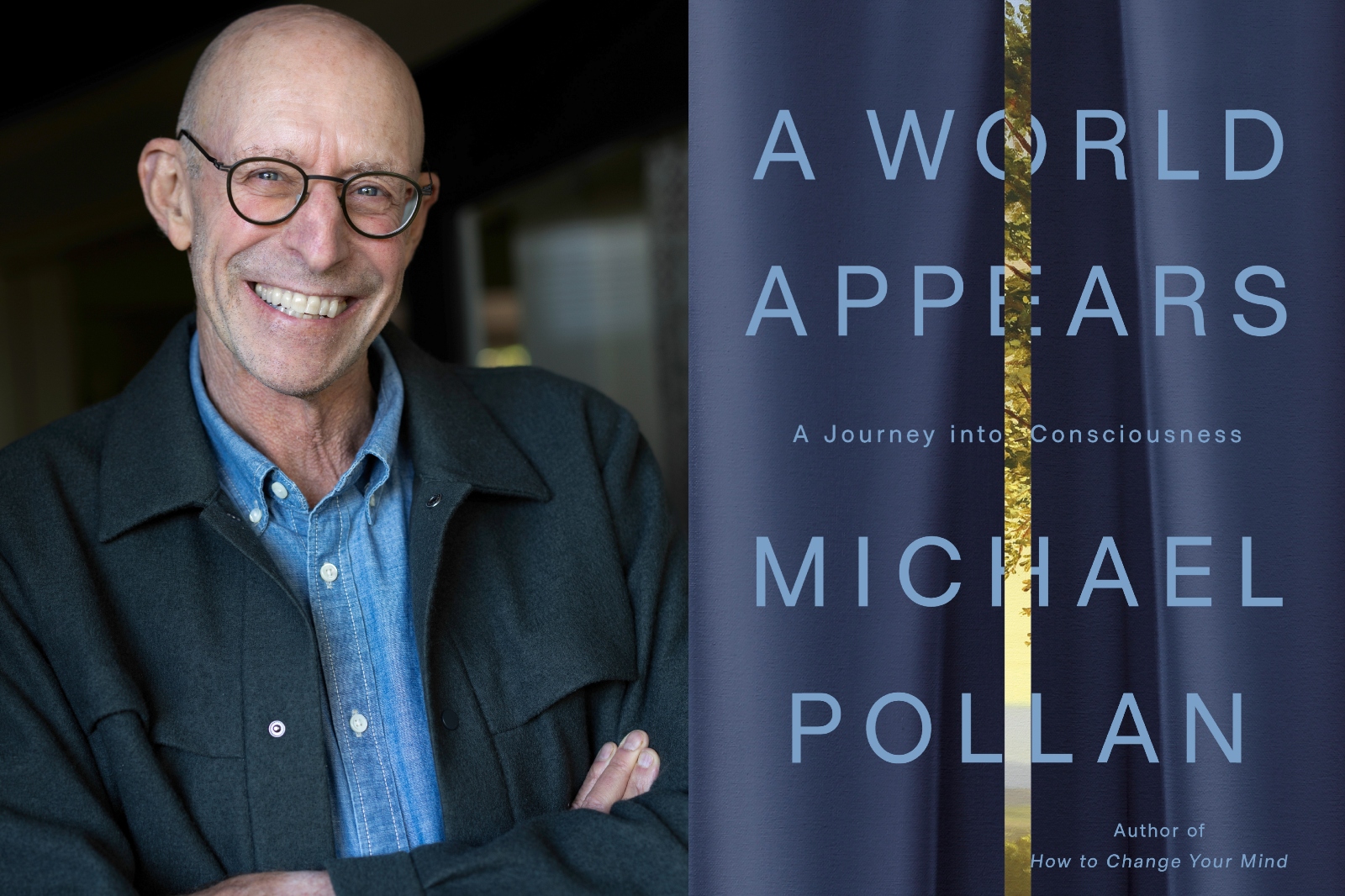
Mina Kim: Welcome to Forum. I’m Mina Kim. Michael Pollan, best known for his landmark books on food and eating like The Omnivore’s Dilemma and on psychedelics with 2018’s How to Change Your Mind, has delved into examining consciousness for his latest work — our subjective experience of the world. And if that sounds like a big and complicated undertaking, Pollan is the first to tell you that he underestimated what he’d gotten himself into — but also that it’s been valuable and fascinating and has convinced him, with the rise of AI, that human consciousness needs to be defended.
Michael Pollan is also a contributing writer for The New York Times Magazine, a professor emeritus at the UC Berkeley Graduate School of Journalism, and cofounder of the UC Berkeley Center for the Science of Psychedelics. Hi, Michael. It’s great to have you on Forum.
Michael Pollan: Oh, thank you, Mina. It’s great to be here.
Mina Kim: So it was your examination and experience of psychedelics that ignited your curiosity about consciousness?
Michael Pollan: Yeah. I mean, I’m not the first person who had a psychedelic experience that made them wonder about the nature of consciousness. Psychedelics have a way of kind of smudging the windshield through which we experience reality, and suddenly you realize, wow, there’s a windshield. What’s that about? And why is it the way it is? And could it be another way? And what’s on the other side of it?
So that was one inspiration. And then there was another one, also tied to psychedelics, of having an experience in my garden — this was on psilocybin — becoming convinced that the plants in my garden were conscious, that they were returning my gaze and had feelings toward me. Now, I didn’t automatically take that to be true, but it did make me wonder: How conscious are they? Are they conscious at all?
So yeah, that’s what posed the questions that I’ve spent the last five years trying to answer.
Mina Kim: One of the first questions was what consciousness is. The meaning is debated, but what did you land on in its simplest form?
Michael Pollan: Well, you mentioned it in your intro. I think subjective experience is a pretty good definition. You could even just say experience, since all experience is subjective. Another good one-word definition is awareness.
And then there’s a slightly more complicated one. The philosopher Thomas Nagel, back in the early ’70s, wrote an incredible and very accessible essay called “What Is It Like to Be a Bat?” in which he argued that if it is like something — if it feels like something — to be you, you are conscious.
You can see how a bat, even though they’re very different from us — they navigate the world through echolocation rather than in the visual way we do — we can at least say it must be like something to be a bat, and therefore a bat is conscious. I think that’s a handy way to look at it.
Mina Kim: So what were the questions you wanted to answer about it, besides whether or not your plants were, in fact, conscious?
Michael Pollan: I worked pretty hard on that one.
I went into this learning about something called the hard problem. This is a phrase introduced by David Chalmers back in the ’90s. He was saying that the study of consciousness — which, by the way, is fairly new; it was considered a career killer to work on consciousness because it was so elusive until really the late ’80s, when Francis Crick, the great biologist who discovered, along with Watson and another collaborator, how heredity works — DNA, the double helix — said, “For my next trick, I’m going to get to the bottom of consciousness.”
The hard problem is this: How do you get from matter to mind? How do you get from these three pounds of neural tissue between your ears to subjective experience? That is a very difficult gulf to cross.
Another way to put it is that your brain is doing lots of different things all the time without your awareness. It regulates your blood pressure, blood gases, glucose levels, temperature, hunger — all these kinds of things — and they never cross the threshold of awareness. So why does anything? Why can’t it all be automated? Why do we have this space of interiority where we can make decisions and have feelings?
Nobody has answered those questions to anyone’s satisfaction, even though there are a bunch of theories out there — by one count 22, by another count 222 — which should tell you that the field is, to put it politely, flailing.
Mina Kim: Related to that, there’s literally no way of getting around our consciousness. The world in front of us is a product of our consciousness. So how can we actually step out of it to really examine it?
Michael Pollan: Exactly. The only tool we have with which to understand consciousness is consciousness itself. We have to realize that everything we perceive is the product of consciousness. But even the scientific enterprise is a manifestation of human consciousness — the problems we choose to work on, the tools we use to measure things.
Science does not operate from a godlike perspective, as much as some scientists like to pretend it does. It is infused with us — with consciousness. So it’s kind of a labyrinth that we can’t ever fully get out of.
Now, that doesn’t mean we can’t figure things out about it. If you think of astronomy as another field that studies everything that exists, you’re studying that from inside everything. And astronomers still come up with very interesting measurements — rates of expansion of the universe, black holes, and so on. So there’s a lot you can learn.
But we have to keep in mind that there are real difficulties from a scientific point of view. We’ve organized science around the objective, third-person, quantifiable view of things, and we have not included subjectivity in the physical sciences. Going back to Galileo, he basically decided how science should be organized. He was doing this with one eye on the church, which was threatened by science. He said, we’ll leave subjective, qualitative things — matters of the soul, as they were understood then — to the church. And science will concentrate on objective things.
That kept some scientists from being burned at the stake, but it also left science poorly positioned to explore subjectivity — which is what it’s now trying to do.
Mina Kim: That’s a really good way to put it. Let me invite listeners into the conversation.
Listeners, how do you define consciousness? And what do you want to ask Michael about it? And if it helps, do you think plants or insects have consciousness? Why or why not? That helped me clarify what I think consciousness is.
You can email [email protected], find us on Discord, BlueSky, Facebook, Instagram, or Threads at KQED Forum, or call 866-733-6786. That’s 866-733-6786.
So with all the difficulties, Michael, what made it worth doing this investigation anyway? A lot of us probably carry on with life without ever contemplating that windshield between ourselves and reality. What good does it do to think about it?
Michael Pollan: That’s a great question. The more I worked on it, the more urgent it became — not necessarily to understand how it came to be, which is very complicated and has interesting evolutionary explanations — but because I developed a growing sense that our consciousness is under siege.
We live in a world where corporations want to monetize your consciousness. When you submit yourself to the algorithms of social media, they’re hacking your attention. We know now that our attention is being bought and sold. But attention is just an element of consciousness — it’s how we direct it toward one object or another.
Now we’re going a step further with artificial intelligence — more sophisticated algorithms that are not just hacking our attention, but hacking our ability to form emotional attachments with other people or other entities. That’s a huge step — allowing machines into the space of our mental lives.
I see consciousness as this private space of interiority where we have maximal freedom to think what we want. But increasingly, we’re thinking thoughts that are being planted there by others. And of course, we have a president who is a master at dominating our consciousness for ungodly amounts of time every day — at least in my case. Anyone who follows the news is probably devoting way too much headspace to Donald Trump.
There’s a sense in which our consciousness is being polluted right now, and we need to defend it because it is so precious. It is the space of our mental freedom.
As time went on, especially with the rise of AI, I came to think this is not an idle sport. Trying to understand consciousness — and appreciate it — is necessary if we’re going to defend it.
Mina Kim: You’re making me want to add another question for listeners: Do you think our consciousness needs defending? Do you think we can create a conscious AI — that a machine can achieve consciousness?
Steven writes, “Michael’s comment that psychedelics smudge the windshield of consciousness does not resonate with me. For me, LSD cleans the windshield.”
Michael Pollan: Yeah. And Aldous Huxley thought the same thing, right? The doors of perception were cleansed, and he saw much more. I think that’s also true. There is a way in which we talk about psychedelics expanding consciousness. Huxley wrote about the reducing valve of consciousness opening wide on psychedelics. So I totally take his point.
Mina Kim: We are walking through the labyrinth of consciousness with Michael Pollan this hour, who’s written a new book called A World Appears: A Journey Into Consciousness.
Listeners, you can share your thoughts and questions at 866-733-6786 — that’s 866-733-6786 — by emailing [email protected] or finding us on our social channels at KQED Forum.
More after the break. I’m Mina Kim.