This partial transcript was computer-generated. While our team has reviewed it, there may be errors.
Mina Kim: Welcome to Forum. I’m Mina Kim. With federal agents arresting and detaining citizens as part of the Trump administration’s immigration crackdown — purportedly to target violent criminals living in the country illegally — many have been left asking: What does it mean to be a citizen anymore? What’s happened to the protection and belonging associated with that status?
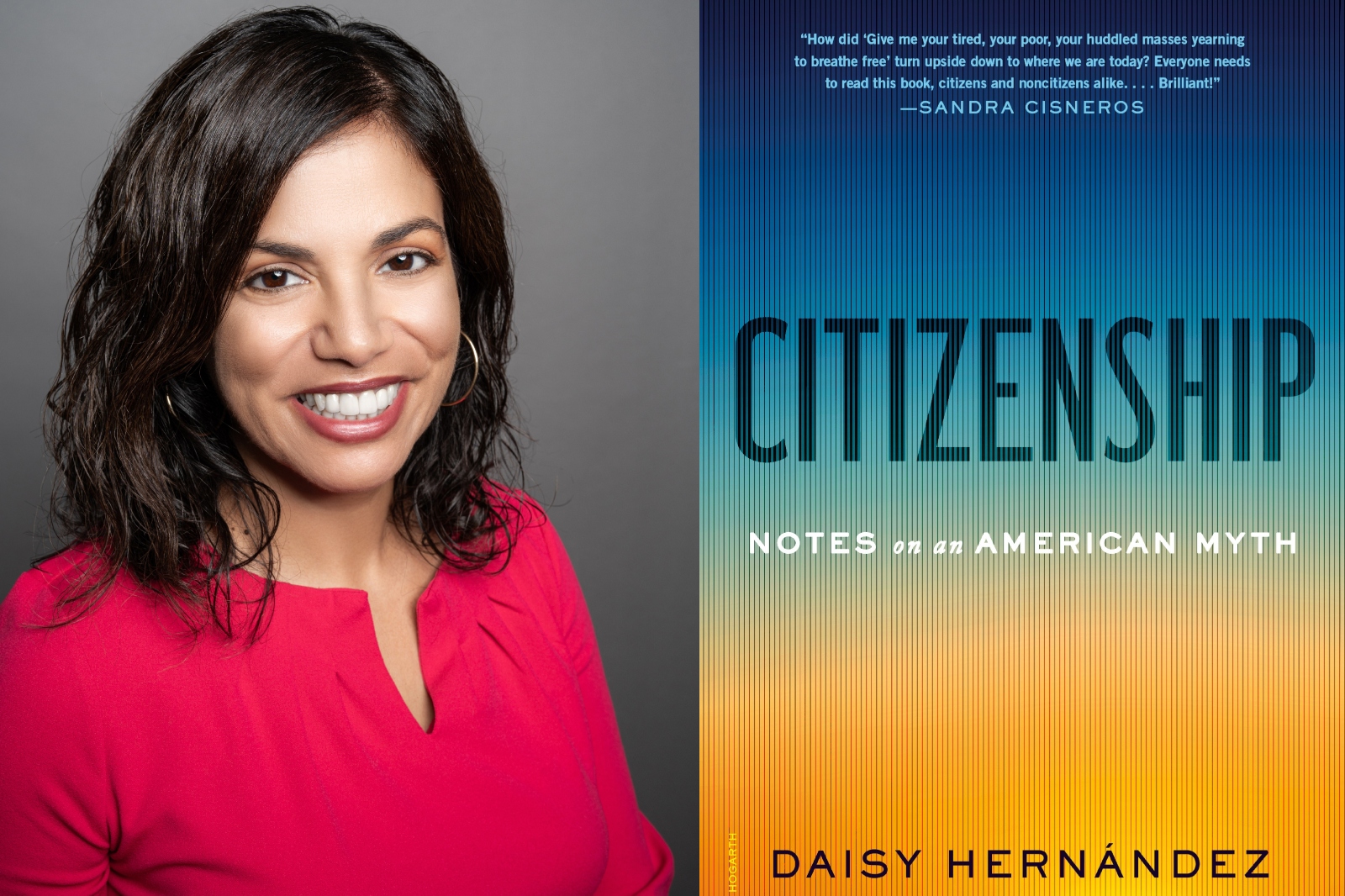
In a new book, Daisy Hernández, Northwestern associate professor of creative writing, offers needed context on why our understanding of citizenship can be so easily destabilized. She shows, through historical examples, social critique, and her own personal story, that citizenship is as much a tool of exclusion as inclusion.
Her book is called Citizenship: Notes on an American Myth. And listeners, how are you thinking about what it means to be a U.S. citizen in this moment — whether you are one or not? Daisy Hernández, welcome to Forum.
Daisy Hernández: Thank you so much for having me.
Mina Kim: Glad to have you. Before we get into the myth of citizenship, I just want to establish the generally held idea of what being a U.S. citizen means — the rights and privileges associated with it — even if many of us have not always felt that in practice.
Daisy Hernández: Yeah, absolutely. I think that a lot of times when people think about citizenship, they often go to the right to vote — very especially in federal elections — and there’s a lot of that in the news. But citizenship really affects every arena of our lives.
A part of our lives that sometimes we don’t think about when we have citizenship — when we have that privilege — is something as simple as: Where are you able to work? Are you able to work? What kind of work can you have? Your access to health care as well.
A lot of people don’t know that even if you have a green card, if you need access to Medicaid, you can’t do that in the first five years with federal dollars. You have to live in a state that is willing to pay for you to have Medicaid access. So citizenship really determines a lot about very intimate parts of our lives, including whether we can go to college and use Pell Grants. It has a very profound, expansive influence.
Mina Kim: Yeah. I was also struck by how you noted — by virtue of having first opened your eyes on land called the United States, as you write in your book — that you can travel without worry or a visa to more countries than you can name. So U.S. citizenship has defined how Americans can move about and exist globally too, right?
Daisy Hernández: Absolutely. Although there are other countries and other passports that can get you more access to certain parts of the world. But there’s no doubt — and I was surprised.
Mina Kim: There’s that passport index where the U.S. has dropped.
Daisy Hernández: Yes, exactly. I was actually really surprised. You know, I grew up in a family where my father is a political refugee from Cuba, my mother is from Colombia, I had an uncle from Puerto Rico, another from Peru. I tell people I grew up in the United Nations of Latinos located in New Jersey.
I thought I knew a lot about citizenship — it was so central to my life — and I had no idea that you could purchase U.S. citizenship. But that’s a program that’s been in place since the 1990s. So I also point out to people: there is actually a program where, if you have a million dollars, you can invest and effectively purchase it. It’s not only the traditional ways that we think of accessing citizenship.
Mina Kim: So how are you thinking about citizenship in this moment? Practically every day now, it seems like there’s a new story of a federal agent arresting or detaining an American citizen as part of the immigration crackdown. And, of course, there’s been the killing of two U.S. citizens in Minneapolis, Renée Goode and Alex Petty.
For many people, the idea of citizenship — and the benefits it’s supposed to confer — do feel destabilized. You give some examples at the outset of how our understanding of citizenship might not be as strong or as fixed as we’ve believed it to be. But I’m curious how you’re thinking about the role of citizenship in this particular moment — or how you’ve been hearing others around you talk about what citizenship means as well.
Daisy Hernández: Yeah. I talk in the book about the fact that right now you really are more a citizen of the state in which you live than of the country as a whole. You can see this very clearly with reproductive rights. If you’re a pregnant woman in California, your access to reproductive care is very different than if you’re in Texas.
If you’re transgender and live in Tennessee, you’re not able to get a license that reflects your gender designation, but you can if you live in Illinois. The same is true if you need to access Medicaid dollars to see a doctor — that varies enormously by state. I have an entire chapter in the book about health care access in terms of citizenship.
So I don’t think a lot of people think about state-based citizenship, but that’s part of what we’re experiencing. And then the larger picture of what’s happening right now with federal agents — this is something Black Americans in this country have faced since the beginning. That has not been the kind of citizenship white Americans or some other Americans have experienced. So in some ways what’s happening is new — the targeting of citizens — and in other ways it’s not new; the target has simply expanded.
Mina Kim: You note the story of Lennon Tyler last year — a white woman handcuffed at a border checkpoint in San Diego when she was coming back from a trip to Mexico with her German boyfriend, who had a tourist visa and was ultimately deported. She asked aloud while detained, “Why am I being detained? Is this legal? Can you do this to a U.S. citizen?”
What do you think she was essentially asserting about her citizenship in that moment?
Daisy Hernández: I think a lot of us have made assumptions about the rights we have as citizens — a sense that we would be protected by the government from itself, essentially. But that has just not been the case.
When I started doing the research and looked back at the history, as early as 1790 Congress said you cannot naturalize unless you’re a white immigrant. The history of racial exclusion in this country is quite profound. So citizenship has never been as stable a category as we’ve thought.
And when we look at U.S. citizens who have died in Gaza or the West Bank, the U.S. government has not defended its own citizens from attacks by the Israeli government or settlers. So we have a lot of evidence that we are not protected — but the pool of people who are not protected has expanded enormously.
Mina Kim: I want to invite listeners into the conversation. What are your questions or reflections on what Daisy is saying about citizenship? Are you a noncitizen residing in the U.S.? How are you feeling in this moment? Are you an American citizen who has felt lesser than, or just feeling differently about your citizenship status right now?
Tell us that story. What does citizenship mean to you? What do you associate with it? You can email [email protected], find us on Discord, Bluesky, Facebook, Instagram, or Threads at KQED Forum, or call us at 866-733-6786.
As you note, scholars have been searching for language to convey the idea that you can have citizenship and still be treated badly. Can you talk a little bit about that — the terms they’ve come up with to describe what may be closer to the reality of citizenship as you describe it?
Daisy Hernández: Yeah. I think many of us are familiar with the concept of a second-class citizen. But there’s a scholar who talks about semi-citizenship — you don’t have full citizenship, you have part of it.
Another scholar suggested using the word denizen — if you look up “citizen” in a thesaurus, you might see “denizen,” meaning an inhabitant of a place. He suggested something like “denizenship type one,” where you have full access to many rights, and “type two,” where you have more limited access.
But I like to go back to the sociologist T. H. Marshall. He was studying England and how citizenship developed there. What he pointed to was that in the twentieth century we saw the rise of what he calls social citizenship — yes, you might have the right to vote and free speech, but are you able to pay your rent? Are you able to see a doctor when you need one? Do you have access to education? Do you feel safe walking past a police officer?
I think a lot of times in the U.S., when we’re talking about racism, transphobia, or xenophobia, what we’re really talking about is social citizenship — the quality of our day-to-day lives as citizens.
Mina Kim: Interestingly, Marshall was really applying that mainly to white men in post–World War II England, right?
Daisy Hernández: Absolutely. He was looking at the history of white men in England. He said first we had civil citizenship — property ownership, free speech — then political citizenship — the right to vote, serve on juries, run for office — and then in the twentieth century the rise of social citizenship.
It’s a lot neater and tidier than real life, as other scholars have pointed out, but it does give us language for what we’re experiencing.
Mina Kim: And why is Marshall’s framework meaningful to you? Can you talk about when you started to realize that yes, you are a citizen — but your citizenship is different from other people who also hold citizenship?
Daisy Hernández: Yeah. I write in the book about working at the public library in my community. I loved the library — I was the child who was there every week checking out books — and then I got to work there when I was older. It was really exciting.
One day, a police officer from the local station, which was next door, showed up and said, “Hey, you speak Spanish, right? Can you come over and help me talk to this guy?” They had arrested someone who didn’t speak English, and no one in the police force spoke Spanish.
Even though I was asked, I didn’t feel like I could say no. It was a very emotional experience. I don’t even remember what I was translating — I kind of dissociated. It really shook me up. I’d had my own encounters with police when I was younger.
It was one of those moments where I realized: I don’t want to be doing this, and yet I don’t feel like I can refuse. I know I wouldn’t have been asked if I hadn’t been racialized in a particular way — understood as bilingual in a white community at that time.
I also write about being a teenager and being pulled over by three police cars for a broken taillight. I thought that was normal because I didn’t have a reference point. This was the 1990s, when my white community was becoming a Latino-majority community, and they saw me as a driver in a particular way — something I reflected on decades later. In the moment, I just thought, “Wow, they’re really serious about taillights.”
Mina Kim: We’re talking with Daisy Hernández, author of Citizenship: Notes on an American Myth. Her previous books include The Kissing Bug: A True Story of a Family, an Insect, and a Nation’s Neglect of a Deadly Disease. She’s an associate professor of creative writing at Northwestern and a journalist who’s reported for National Geographic, The Atlantic, The New York Times, and Slate.