This partial transcript was computer-generated. While our team has reviewed it, there may be errors.
Mina Kim: Welcome to Forum. I’m Mina Kim. Millions who grew up in the ’80s and ’90s remember getting that first Nintendo console or Game Boy — the first time they were pulled into the colorful world of Super Mario Bros. or the falling blocks of Tetris.
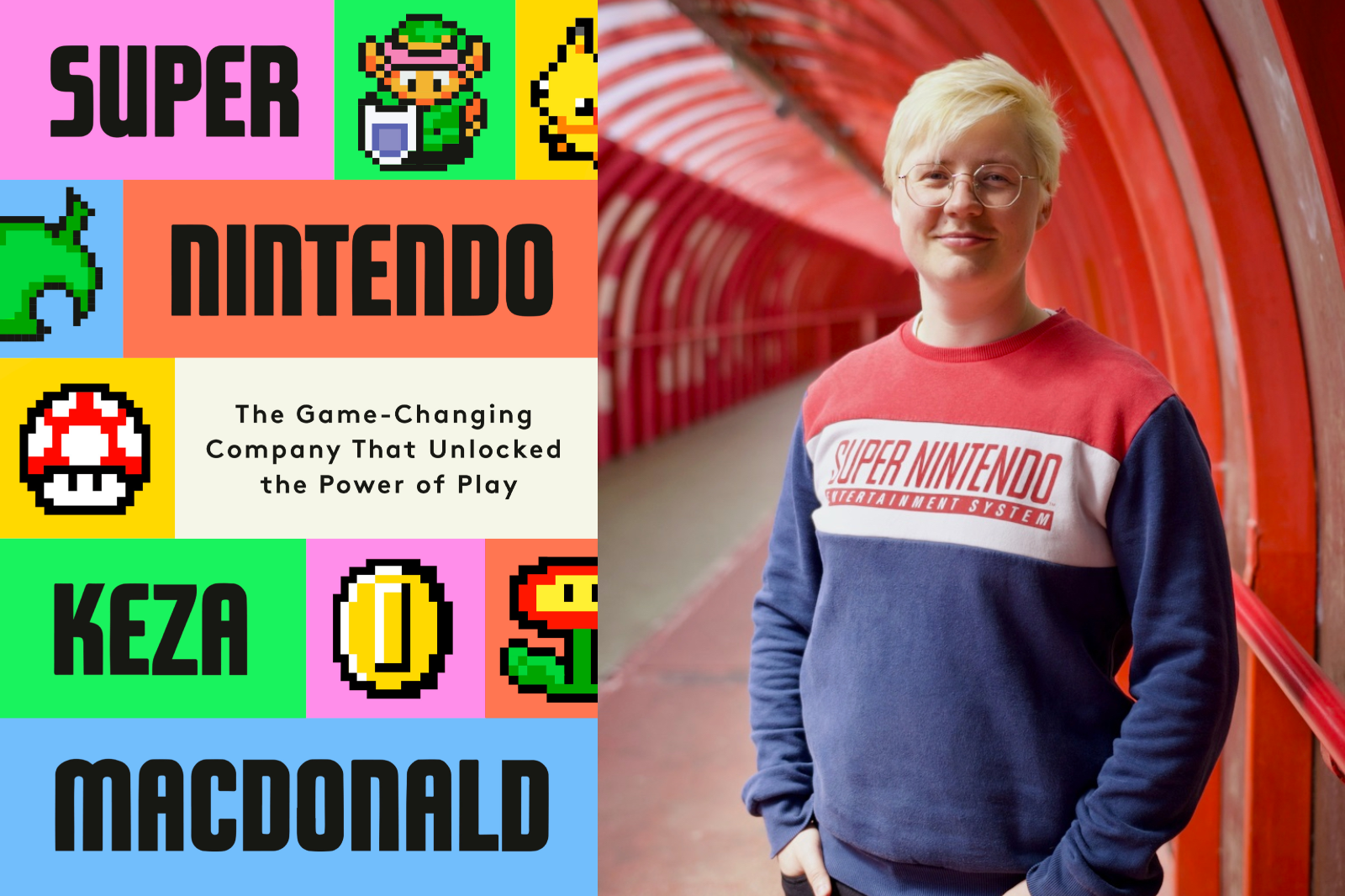
Look closely at the history of Nintendo and its creative output, says Keza MacDonald, and you’ll see one key factor that defines the company: an unwavering commitment to fun. From The Legend of Zelda to the introduction of the Wii, to Animal Crossing and Kirby, MacDonald has done a deep dive into what’s driven the Japanese company’s success and made it a cultural force. Her new book is called Super Nintendo: The Game-Changing Company That Unlocked the Power of Play.
Listeners, what’s the first Nintendo game you loved to play? You can tell us by calling 866-733-6786, emailing [email protected], or finding us on Discord, Bluesky, Facebook, Instagram, or Threads at KQED Forum.
Keza MacDonald is video games editor at The Guardian. Keza, welcome to Forum.
Keza MacDonald: Thank you for having me.
Mina Kim: Tell me what you remember about getting your first Nintendo console.
Keza MacDonald: I had slightly older, technophobic parents, so it took me a long time to persuade them that I should definitely have a games console. The first game I ever played was a Mario game — Super Mario World on the Super NES. And the first game that really captured me was a Zelda game on that same console called A Link to the Past. It properly sparked a lifelong love of video games, and millions of people share that story. Nintendo is a lot of people’s entry point into gaming.
Mina Kim: What do you think created that spark — that lifelong interest and commitment?
Keza MacDonald: For me, the older we get, the harder it is to make space in our lives for fun. It comes very naturally to us as children — the idea of play and all the ways you can play. But as you grow up, it becomes harder to connect with that playfulness. Video games are a very easy route back into that space of play and joy.
Nintendo games, in particular, have a knack for getting you into a childlike play space in your head. For that reason, they remain very important to me now — and to my own children — which is lovely.
Mina Kim: What is that knack? Plenty of video games are fun and immersive. What’s unique about Nintendo’s approach?
Keza MacDonald: Nintendo has a couple of things that no other game company really has. One is its franchises — games like Mario and Zelda that have been around for forty years, or Pokémon for about thirty. Some of the people who created those series are still working at Nintendo and still involved in making new ones. That creates incredible continuity — not just of quality, but of spirit.
The second thing Nintendo is very good at is experimentation. There’s a lot of space for creativity, and part of that means making space for failure. Not every Nintendo game or console has been a massive hit, but the ones that weren’t paved the way for the ones that really worked. That culture of creativity and innovation is something Nintendo has cultivated in a way many companies haven’t managed.
Mina Kim: Talk about how Nintendo games reward curiosity and why that’s such a powerful feature.
Keza MacDonald: I feel like every major Nintendo franchise speaks to a different aspect of fun. Mario is really about movement — it’s like a toddler on a playground. That’s the kind of joy it captures. Zelda is more about discovery — determining your own boundaries and exploring. Pokémon is about connection — trading and battling with other people.
Animal Crossing, meanwhile, was a game that millions of people played during the pandemic, when loneliness was a real problem. Having a game that let people creatively express themselves and connect with others was incredibly important. Each Nintendo game encapsulates a different version of fun.
Mina Kim: Another thing you describe as unique is that Nintendo generally avoids in-game monetization — that it’s not the company’s focus. Can you say more?
Keza MacDonald: Video games are huge now. They make enormous amounts of money and come in many forms. If you’re outside the gaming world, it might all look the same, but there are many different ways to play. People play on phones, consoles, PCs.
Nintendo still largely does business the way it did in the ’90s and 2000s: it sells you a game, and you play it as long as you like. Many companies now offer games for free but constantly prompt you to spend small amounts of money, watch ads, or pay subscriptions. That can be profitable, but it’s not what Nintendo has chosen.
Nintendo has preserved the idea that once you’ve paid for something, you should be able to enjoy it forever. It’s very family-friendly in that way. Every parent has probably been pestered for some iPad microtransaction at some point — Nintendo games aren’t like that. It makes the company quite different from many of the big game companies today.
Mina Kim: Let’s go to a caller. Rob in San Francisco — hi, Rob. You’re on.
Rob (caller): Thank you. I was a little older when Nintendo came along — in my late forties. We discovered it for my son when he was about three, staying overnight at a friend’s house that had a Nintendo 64. He took to it like a fish to water, and I had the best time playing with him. That lasted for a few years until he outgrew it somewhat.
But the thing that always brings me back to Nintendo is the sounds — the sound effects and music. It’s almost like a time machine, taking me back to when my son was three or four. It’s just a fun, innocent kind of game that every parent can enjoy with their kids. The kids feel safe with it. It’s just a feel-good experience.
Mina Kim: Rob, thanks so much for sharing that. That really captures the essence you talk about in your book — Nintendo’s commitment to joy. I’m curious how the company practices that commitment in reality.
Keza MacDonald: I think the teams at Nintendo now include many people who grew up playing Nintendo games. You still have employees who’ve been there for decades, but you also have millennials who grew up with those earlier games. People come to Nintendo with that childhood nostalgia and then re-create it for a new generation.
As Rob mentioned, Nintendo has become intergenerational. It’s something you can play with your children. In my house, there are several generations who all love Pokémon, which is wonderful. Nintendo recognizes that as a valuable part of its brand — making sure games feel welcoming for families and have that sense of safety and fun.
Mina Kim: You describe Shigeru Miyamoto — the creator of Donkey Kong and the original designer of Mario — as someone who basically says if it’s not fun, it’s not going to happen. Tell us more about him and his role.
Keza MacDonald: Shigeru Miyamoto is kind of Nintendo’s creative North Star. He hates this comparison, but he’s like the Spielberg of video games. He’s created several wildly popular franchises, many of which started decades ago.
His philosophy is that anyone should be able to pick up a game, understand it, and be smiling within the first few minutes. In the ’90s, he was known for walking up to people’s desks, pulling them over to try whatever he was working on, and then watching silently to see where they got stuck or confused. He would adjust the game based on that immediate feedback.
That’s one reason Nintendo games feel so welcoming: they’re designed so everyone can get into them quickly. But that takes a lot of iteration.
Mina Kim: Yes — a lot of iteration. It was fascinating to read about how hard it is to go from concept to a finished game. Remind us how transformative Donkey Kong was when it came out in 1981.
Keza MacDonald: It’s hard to remember now, but at the time, even the idea of a game with multiple levels was revolutionary. Most arcade games, like Pac-Man or Space Invaders, took place on a single static screen. Donkey Kong had a story — a carpenter, his girlfriend, and a giant ape who’d kidnapped her — which was more narrative than most games had.
It also had multiple stages with different challenges. And Mario was the first character ever to jump in a video game. Donkey Kong was the first game where jumping was a mechanic.
Mina Kim: And Mario becomes one of the most iconic video game characters ever. The story of his design is funny because it’s so pragmatic.
Keza MacDonald: It is. A lot of design decisions in the ’80s were just working within technical limits. For Mario, they had a tiny grid of pixels to create a recognizable character. That’s why he has blue overalls — for contrast — and a mustache, because Miyamoto couldn’t draw facial features in that resolution. The hat was also practical because hair was hard to render.
Mina Kim: Pretty incredible. Nintendo started with humble beginnings in electronic games and has become such a global cultural force. Can you talk about how dominant it is now?
Keza MacDonald: The closest equivalent elsewhere in culture is probably Disney. Nintendo is approaching that level of cultural omnipresence — not just in kids’ culture, but pop culture generally. The games have sold hundreds of millions of copies, but now the characters are also in theme parks and movies.
When I think about Nintendo’s impact, it’s not just how the games affect players. It’s also what those players go on to create. People who grew up with Nintendo make books, movies, games — bringing the feelings and inspiration from those formative experiences into their own creative work. So the footprint is much larger than it might appear.
Mina Kim: Listener Brendan writes, “I used to obsessively play Legend of Zelda with my family. We’d fight over turns — you could save three profiles, and we all accused each other of deleting progress. Eventually we realized the cartridge battery was failing. By the way, we’d get the cartridge to work by blowing on it, of course.”
We’re talking about Nintendo. I’m Mina Kim.