This partial transcript was computer-generated. While our team has reviewed it, there may be errors.
Rachael Myrow: This is Forum. I’m Rachael Myrow, in for Mina Kim. Billionaire media owners have seismically shifted the media landscape in the U.S. over the last couple of years. From CBS to The Washington Post, Americans have watched major layoffs, shifts in editorial direction, and even direct interference raise urgent questions about whether the press can still hold power accountable.
Is the fourth estate buckling beyond repair? Can independent media hold up half the sky for the rest of us? For how long?
I am so thrilled to be talking about all these questions with Matt Gertz, senior fellow at Media Matters, and Jeremy Barr, media and power reporter at The Guardian. Welcome to you both.
I thought we might start by running down the list of billionaires, because — boy — what a list it is. Number one: Larry Ellison and his son David. They purchased Paramount and installed a conservative apologist, Bari Weiss, at CBS News to serve like a choke chain on what used to be a pit bull of a newsroom. Oh my gosh — with storied names like Murrow, Cronkite, 60 Minutes.
Now the Ellisons are eyeing Warner Bros. Discovery, which owns CNN. Why don’t we start with you, Matt? Can we describe this fairly as institutional capture?
Matt Gertz: I think that’s certainly what they’re trying to do, yes. I mean, if you look at what we’re seeing from the Ellisons, they’ve moved in and started installing Bari Weiss, who is much more conservative, I think, than one would typically expect in a position like that — and someone who doesn’t have a tremendous amount of television experience, either. So she is in charge.
They’ve also installed a Trump-supporting right-wing think tanker as the ombudsman, Kenneth Weinstein. This was a requirement that the FCC kind of forced on CBS News as part of the merger that led to the Ellisons’ takeover.
I think what we see in situations like this is the oligarchs get their people in position, and then you start seeing the ideological clampdown on the institution. You see layoffs and buyouts hitting everyone who doesn’t fall in line, and you really see the breaking of an American institution.
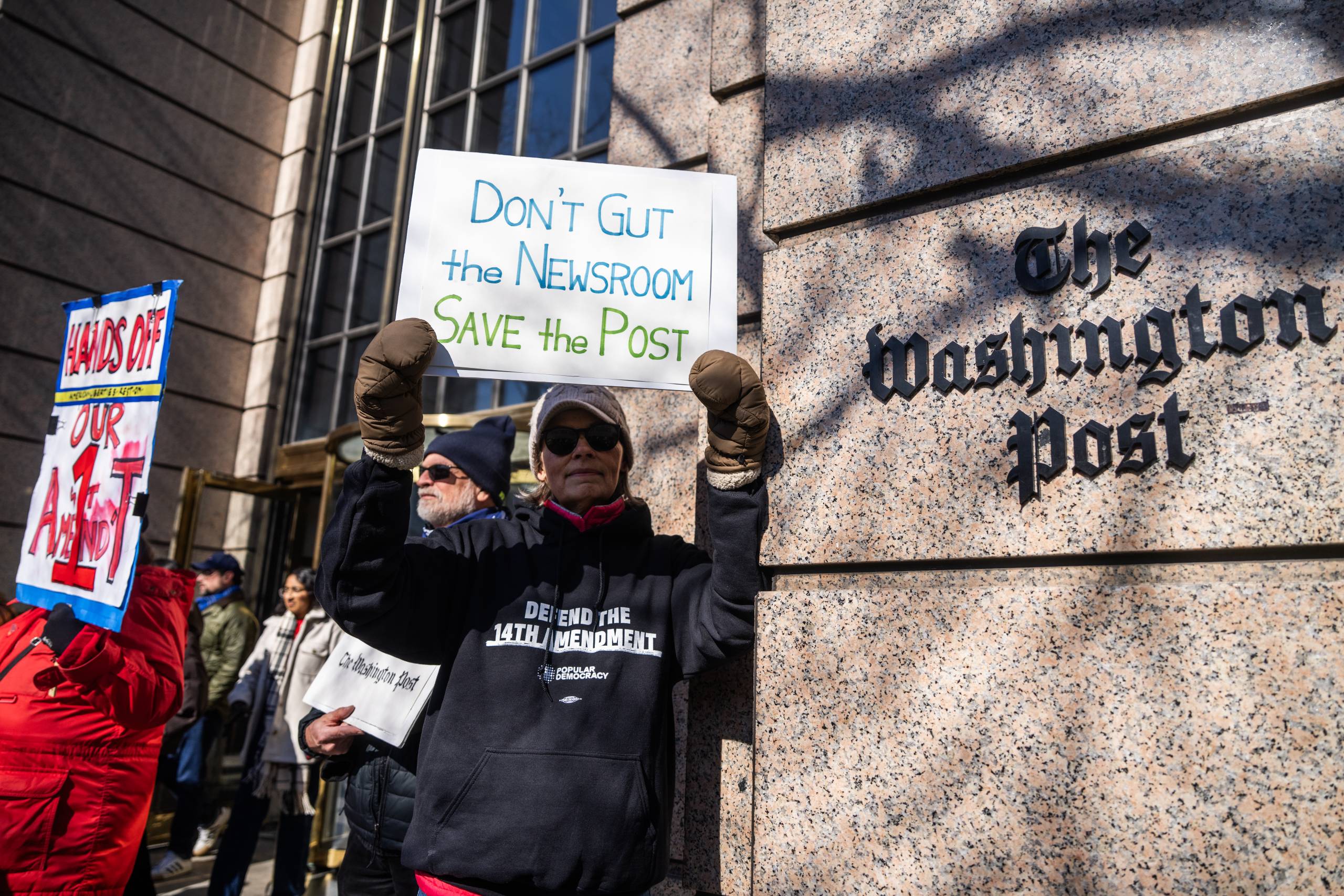
Rachael Myrow: Next on the list, Jeremy, is Jeff Bezos. Hundreds of thousands of Washington Post readers have canceled their subscriptions after Bezos gutted first the opinion section and then the newsroom. But The Post is one of the biggest media outlets in the country. In 2023, I believe, it was reported to have more than two and a half million subscribers.
Does that suggest to you that readers don’t really have much leverage over one of the wealthiest people in the world?
Jeremy Barr: I think the psychology and the strategy of Jeff Bezos is something nobody has really been able to fully understand. You can talk to people like Marty Baron, the former executive editor of The Post. You can talk to people who had meetings with Bezos, as I’ve done for my reporting at The Guardian. And I did work for The Post from 2020 to 2025 as one of their media reporters.
But we didn’t hear much from Bezos during that time. Certainly, I think he maybe made one appearance in the newsroom and said the right things. But trying to understand what his goal is — what his strategy is — I have no idea. You could ask 25 people who are experts on media, and they wouldn’t really know.
It doesn’t seem like he’s super committed to putting in all the resources necessary to make the place as successful as it can be. Certainly, when I left The Post last fall, the atmosphere was quite funereal — and that was even before the layoff discussions were happening. There was a sense that our patron at the time was not there for us anymore.
I also think there’s a misnomer — certainly among some people on Twitter, I would say more on the right — that journalists feel like they should be funded no matter how much money their work loses, and that journalism shouldn’t be a charity. And Jeff Bezos is obviously the consummate businessman.
But the Post employees I talked to wanted to make the paper money. Obviously, there’s the traditional wall between business and editorial, but it’s not true to suggest that employees wanted Bezos just to fund losses forever. I think the challenge was getting clarity on the vision and the strategy — and figuring out how the average employee could help the Post make money.
But where the Post goes from here, and what Bezos wants — he’s been so quiet and said so little that we’re always kind of left reading the tea leaves.
Rachael Myrow: Our grim death march through media continues with Bob Iger. He settled a defamation lawsuit with a $15 million payout over a case most believe the Disney subsidiary ABC would have won hands down. Then Iger canceled late-night comedian Jimmy Kimmel, although later backed down after an outcry from Hollywood talent and a spike in Disney+ cancellations.
I could go on, but I think, Matt, you see the pattern developing here.
Matt Gertz: Yes. And this is something we’ll probably come back to throughout the discussion. What we see with situations like this is President Trump being willing to use state power against the interests of these business leaders in ways we haven’t seen before in the recent past.
Because the news portion of the business holdings these oligarchs have is such a tiny fraction, he basically forces them to choose whether they’re willing to stand by their news outlets or whether they’ll give him what he wants in exchange for him getting off their back.
That’s what I think you saw with this $15 million settlement that ABC News paid to Donald Trump over a lawsuit that the lawyers there thought they would almost certainly win. The decision was made to basically set a precedent for other media companies and major corporations to knuckle under and do what Trump wanted in exchange for him leaving them alone for a little bit.
Rachael Myrow: Jeremy, let’s talk about Patrick Soon-Shiong, who I think doesn’t get as much attention as he deserves for what he’s been doing at the Los Angeles Times — steps that have led to plummeting circulation and an exodus of talent, the shrinking of the paper’s influence in California — all this as his medical patents are still getting approved by the federal government. So I guess that’s working out for him?
Jeremy Barr: Yeah, I don’t really know. You asked me what these people’s strategy is — what their goal is, what their mission is — and I have no idea.
Patrick Soon-Shiong — there have been layoffs. His ownership, I think, has not been successful. Their staff has shrunk. Their ambitions seemingly have shrunk. When he bought the paper, there was some hope. There’s always a little bit of hope when a billionaire buys your paper — you’re hoping you get one of the good billionaires. Some people say there are no good billionaires.
But I think there was some hope that at least he would insert some money into it and help build out their ambitions. They hired a pretty big-name editor in Kevin Merida, but it’s just sort of been downhill from there.
He also seems to have his own desires to be kind of a conservative media influencer. He goes on podcasts. He appears with Mark Halperin. He seems like he has his hand in a few different pots and is playing in the conservative media space himself, rather than taking the traditional stance of an owner.
I’ve covered layoffs and buyouts at the L.A. Times. It doesn’t feel like a place that’s ascendant. And I don’t know what’s going to happen long term because it’s not doing well financially. The business is not really growing. Subscriptions are not really growing.
Normally, that leads to more cuts. And more cuts lead to less journalism that’s worth subscribing to. That’s kind of the death spiral we’ve seen at many newspapers.
Rachael Myrow: And as you mentioned, it’s interesting to note — initially, Bezos and Soon-Shiong seemed to be examples of the “good billionaire.” But now, Matt, Rupert Murdoch and his son Lachlan appear to be marching straight into the field vacated by the L.A. Times. They’ve launched the California Post to export the New York Post’s culture-war tabloid model to the West Coast.
What do you think is going to happen to the local journalism ecosystem in California?
Matt Gertz: I think it’s probably in for a bit of a shakeup. The Murdochs — or at least the New York Post historically — have been very pugnacious and have really sought to create fissures within existing political institutions and political parties.
It’s interesting to think about what that will look like in five years and ten years because Rupert Murdoch is 94 years old at this point. He has built, on the one hand, Fox News, which is a virulently xenophobic and hateful outlet that is incredibly close to Donald Trump and has staffed much of his administration from its ranks.
And on the other hand, The Wall Street Journal, which has produced some of the best reporting of the last year on the Epstein story and many others.
Right now, you have a situation where Rupert Murdoch has been able to continue that two-track path, even as he has been sued by Donald Trump over Journal stories. I think there’s an open question about whether Lachlan would follow the same paths.
Rachael Myrow: We are talking, dear listeners, about the expanding takeover of traditional news media by billionaire owners — including mass layoffs at The Washington Post under Jeff Bezos, the new editorial direction at CBS following Larry Ellison’s purchase of Paramount, the Murdochs’ launch of the California Post, and much more.
And we’re talking about it all with Matt Gertz of Media Matters and Jeremy Barr of The Guardian.