This partial transcript was computer-generated. While our team has reviewed it, there may be errors.
Marisa Lagos: This is Forum. I’m Marisa Lagos, in for Mina Kim. ICE raids and protests are rattling cities, including Chicago and Minneapolis, as federal agents deploy a myriad of new surveillance tools. ICE agents are attempting to identify protesters and observers by scanning their faces and license plates with smartphones, using cell phone data and social media posts, scouring online activity, and using personal data to identify people’s real-time locations — potentially even hacking into their phones.
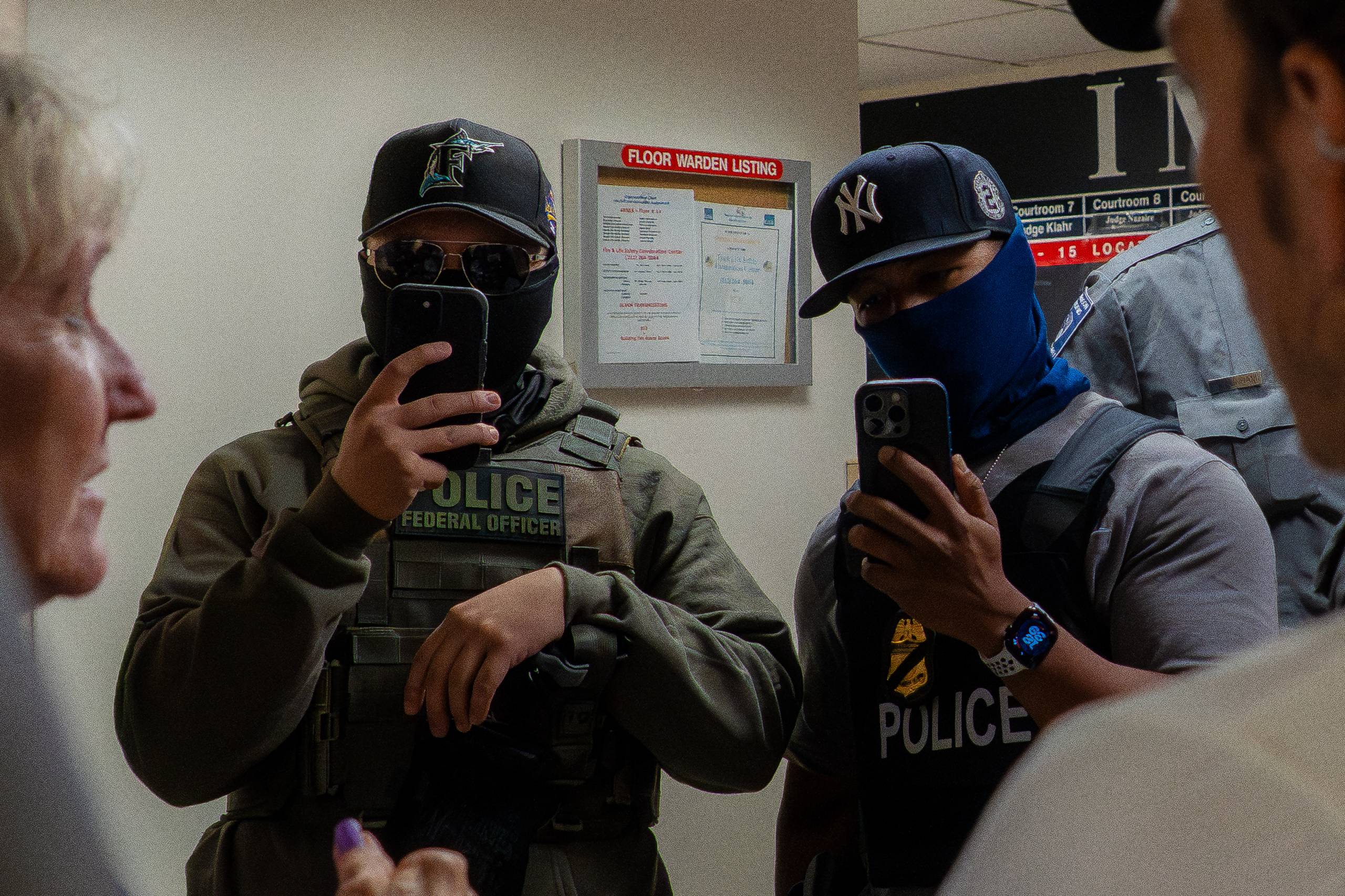
In several cases, protesters have reported ICE agents filming their faces with phone cameras and informing them that they are being added to a database of domestic terrorists. This all comes as ICE shells out tens of millions of dollars to acquire this technology, thanks to a massive infusion of cash provided by Republicans in Congress and President Donald Trump.
In this hour, we’re going to dig into what this technology does, how it’s being used, the concerns it’s raising, and whether — or how — it could potentially be reined in.
I want to welcome Sheera Frenkel. She’s a technology reporter at The New York Times, based in the Bay Area. Hey, Sheera.
Sheera Frenkel: Hey.
Marisa Lagos: Also with us this hour is Rachel Levinson-Waldman, director of the Brennan Center’s Liberty and National Security Program. Rachel, thanks for being here.
Rachel Levinson-Waldman: Thanks for having me.
Marisa Lagos: So, Sheera, I want to start with you. You recently co-wrote a story about a particular protester in New York named Nicole Cleland. Tell us what Nicole’s story is.
Sheera Frenkel: Nicole’s story is that she’s a middle-aged American woman who lives in Minneapolis who, a few months ago, was pretty outraged by what she saw as ICE activity in her community. She joined an observer group and decided she was going to start trailing ICE agents in her car and letting people in her community know when they were nearby by blowing her whistle.
One day, a couple of weeks ago in January, she’s following an ICE agent in his car when, all of a sudden, he pulls over. He gets out of his car, walks over to her, and addresses her by her first name. That’s already creepy — right? She has no arrest record. She’s never run afoul of the law. She told me she maybe has a parking ticket here and there, but that’s it.
So he gets out, calls her by name, and then tells her, “If you keep following me, you’ll be arrested.” She goes home and debates with her husband and friends what to do. Then, a couple of days later, she gets an email letting her know that her TSA PreCheck has been revoked — her ability to move easily through airport security has been taken away. There’s no further explanation. She just knows that the Department of Homeland Security has put her on a list of people who are not considered safe to travel.
Marisa Lagos: Wow. And I want to be clear about what she was doing. This is part of a tactic we’ve seen among people who have concerns about how ICE operates. There are protests, obviously, but there are also observers. And we know that, arguably, both of the American citizens who were shot and killed in Minneapolis were part of these groups — people who were going out and essentially just trying to document what’s happening in public spaces. Is that correct?
Sheera Frenkel: Yes. They’re in public spaces. As she told me, these are streets she drives on all the time. She’s in a personal vehicle. She’s not blocking traffic. She’s not getting especially close to the car in front of her. She’s just following it and letting people know where it’s going.
I’ll add one more important detail: she doesn’t know how the ICE agent knew her name. There’s a possibility he used a license plate reader, and there’s also the possibility that he used facial recognition technology.
Marisa Lagos: Wow. Is this common? Is this an experience you’re hearing about more and more?
Sheera Frenkel: I spoke with just over a dozen people who were either addressed by ICE agents or told by ICE agents that their identities were known through facial recognition technology. Some of them were so terrified that they didn’t want to be on the phone with me.
Marisa Lagos: Before we unpack all of this further, Rachel, I want to bring you in. Rachel Levinson-Waldman, director of the Liberty and National Security Program at the Brennan Center for Justice. Is anything Sheera just described — anything Nicole was doing — illegal, or a legal basis for being put on what’s being described as a domestic terrorism list?
Rachel Levinson-Waldman: No. That’s a great question. Being an observer, being a protester — those activities are squarely protected by the First Amendment. The law and the Constitution are quite clear. If you are in public and a federal officer or a police officer is doing their job in public, you are entitled to watch them. You’re entitled to take photographs. You’re largely entitled to record them.
Now, you can’t interfere with legitimate law enforcement activity. But as long as someone is maintaining an appropriate distance, that is well within your rights as a person in this country to do.
And your question about whether that would justify being put into a database of so-called domestic terrorists is also very well put. We do know that this is something the administration has been threatening and has laid out in policy. Multiple memos issued in the fall by President Trump, followed by a memo from Attorney General Pam Bondi, set out a framework that casts ordinary Americans — individuals and civil society organizations exercising their lawful rights — as potential domestic terrorists.
And we’re starting to see how that’s playing out in the streets, with people being very specifically threatened with being labeled domestic terrorists and placed into a government database on the basis of lawful activity.
Marisa Lagos: So it seems like there are kind of two things at play here. One is how this administration is collecting and using data. The other is the technology itself.
I remember, as a very young reporter, being sent to a house in the East Bay that the FBI had raided. Someone was accused of a pretty serious crime. A police officer walked up to me after, I think, running my license plate, and said, “Hi, Marisa.” It freaked me out at the time. But that officer was sitting in a marked police cruiser and using an established system.
That’s not necessarily what’s happening here. We’ve seen an explosion of surveillance technology — even in liberal cities like San Francisco. If you go to the SFPD website, there’s a list of what they use, and there are clear policies and conditions. I don’t believe we’re seeing that from the Trump administration.
I want to talk about some of these specific technologies. Facial recognition, in particular — Mobile Fortify and Clearview AI. What do we know about these companies, and what is the tech actually doing?
Sheera Frenkel: What’s so important about what you just said is guardrails. In the Bay Area, there are a lot of guardrails on this technology. We don’t really know right now what kind of guardrails exist — if any — on the federal tools, including the facial recognition programs you mentioned.
Clearview AI is a private facial recognition company that has worked with the Department of Homeland Security for years. Historically, it was used for very targeted investigations — things like child exploitation or stolen artifacts circulating on black markets. That part of DHS has been well-funded for a long time.
But when the Trump administration made immigration enforcement a central priority, a significant amount of funding was redirected to ICE. ICE needed a tool that agents could easily use in the field. That’s when Mobile Fortify comes in. It originated with Customs and Border Protection and was transferred to ICE. It’s essentially a plug-and-play app that requires no technical background.
We don’t know what image databases went into Mobile Fortify. Some people I spoke with believe it could include passport photos or images taken at border crossings — which could mean millions of people. Anyone who’s crossed a border, documented or undocumented.
So we don’t know the source data. We don’t know the error rates. We don’t know how accurate it is. And yet it appears to be used on both undocumented immigrants and U.S. citizens.
Marisa Lagos: And so agents are essentially scanning your face with a cell phone camera, and that’s being linked to other data?
Sheera Frenkel: Yes. They scan your face, and it returns a possible match. But something important to note is that facial recognition tools historically perform worse on people who are not white and on people from countries that are underrepresented online. Some of these images could be decades old, taken from border cameras or surveillance footage. We simply don’t know.
Marisa Lagos: And these are private companies, relying largely on scraped public data. Clearview alone has reportedly scraped billions of images from social media platforms.
Sheera Frenkel: Exactly. Americans have known for a long time that facial recognition exists. But I think many people assumed it would be used for marketing or retail or convenience — not for large-scale government surveillance.
Marisa Lagos: We’ve gotten comfortable carrying smartphones and uploading photos of ourselves and our families. But maybe people didn’t expect that data to be folded into a government database.
Sheera Frenkel: That’s what really matters here. There’s been an expectation that the government would be responsible about how it uses this technology. What’s surprising — and alarming — is how aggressively and casually it’s being deployed now.
Marisa Lagos: We’re talking about surveillance tools being used by federal agents with Sheera Frenkel, technology reporter at The New York Times, and Rachel Levinson-Waldman, director of the Liberty and National Security Program at the Brennan Center for Justice.
We want to hear from you. What questions do you have about the technology being used by ICE and Customs and Border Protection? Do you think you’ve been surveilled or tracked as you exercised your First Amendment rights?
You can email [email protected]. You can call us at 866-733-6786. Or you can find us on social media — Discord, BlueSky, Facebook, Instagram, Threads. We’re @KQEDForum.
We’ll be right back.